
Randy’L Teton
Interviewee: Randy’L Teton
Interviewer: Johanna Bringhurst
Description: Randy’L Teton talks to Johanna about her new book It’s Her Story: Sacajawea and her special connection to this incredible heroine in Idaho history. Randy’L Teton – Randy’L is a member of the Shoshone-Bannock Tribes of Fort Hall, Idaho. In 1998, Randy’L was chosen as the Shoshone model for the US Golden Dollar coin aka the Sacajawea dollar coin, Since then, Randy’L has gained wide recognition for her work in tribal history, tribal government, communications, and museum curation. She is proud to serve her family, tribe, state, and Indian Country by helping Tribes tell their story from an Indigenous perspective. She currently lives in southeastern Idaho with her three children and enjoys collecting coins. Randy'L also serves on the board of trustees of the IHC and is a valued colleague and friend of our work.
Date: 2024-03-13
Topics:
The visual topic map is hidden for screen reader users. Please use the "Filter by Topic" dropdown menu or search box to find specific content in the transcript.
Johanna Bringhurst: Hello everyone, and welcome to context. This program is brought to you by the Idaho Humanities Council with funding from the National Endowment for the Humanities. The views expressed here today do not necessarily represent those of the IHC or the NEH. My name is Joanna. Bring Hurst. And joining us today is Randy’L Teton. Randy’L is a member of this Shoshone Bannock Tribes of Fort Hall, Idaho.
In 1998, Randy'L was chosen as the Shoshone model for the US golden dollar coin, also known as the Sacajawea Dollar coin. Since then, Randy has gained wide recognition for her work in tribal history, tribal government communications, and museum curation. She is proud to serve her family, tribe, state, and Indian country by helping tribes tell their story from an indigenous perspective.
She currently lives in southeastern Idaho with her three children and enjoys collecting coins. Randall also serves on the board of trustees of the IHC, and is a valued colleague and friend of our work. Randy'L, thank you so much for joining me today to talk about Sacajawea.
Randy’L Teton: Yes. I'm back. Good morning. It's really good to be here. And good morning, my friends and family out there.
Johanna Bringhurst: So first we have to talk about how you say Sacajawea is name for a while, I was hearing people say it's Sacagawea. Can you tell us how to correctly pronounce your name and how we know that?
Randy’L Teton: Yeah. So, to our Shoshone people and how we would refer to my, my people, is, are, Sosoni Newe, we, consider Sacajawea, as one of our own. She's from the Agaidika band, which is based out of Salmon, Idaho. And to our people, we refer to her as, Sacajawea with the J spelling.
yes. There are other known names that you'll hear, Sacogawea with a G or Sakakawea with the two KS. but honestly, those were, misspelled based off of phonetically hearing her name. based on the region that you may have met her. but she was referenced in the Lewis and Clark journals based off of how they phonetically spelled it, when they when they were introduced to her.
at the Mandan Hidatsa village. So that's where you got sakakawea, because in their language, they have a lot of KS. But, in our language, we always referenced her as Sacajawea. so.
Johanna Bringhurst: You have a unique and special connection to Sacajawea. Can you tell us more about how you feel about this really remarkable woman and what your history is with her?
Randy’L Teton: Well, I just want to first off say that, you know, being of the same tribe as her, we both, are Shoshone from Idaho and, I am not related to her directly. but I do have family that are related to her family, and that is, the norm in Indian country. We're all related either by intermarriage or, you know, by a grandma, that was married into the family or grandpa.
that we really are one big community. I do want to say that I'm. I was very honored and humbled to have been asked to, pose as a model for, the former artist Glenna Goodacre when I was attending college in Albuquerque, at the University of New Mexico and never in my life did I ever think that I would be part of a huge, campaign, representation of of the beautiful Sacajawea.
and so given that opportunity, when I was, gosh, I was about 19 years old, you know, it was so long ago, and, you know, understanding the process that the US mint had, for the artists to openly seek out their own, models. I was very fortunate. And as I mentioned, very humbled to been asked by Glenna to model for her.
And one thing, that I'd like to add is that, being from a museum and history background, when we talked to Glenna, it was very it was really important to make sure that we were historically representing her, in the photos in and in anything that we, were doing with Glenna. So we got a, an original, deerskin dress from our area that was, dated to the 1800s and it was from it was on loan from a nearby Santa Fe, gallery.
And so I had my hair in braids. I was wearing some shell earrings, typical of what our women would wear. And, you know, those designs, really impacted and made a huge difference. And when I got to learn more about how the US mint proceeded in selecting, they included the, public to vote online for their favorite design and the favorite design.
That one is the one that you see on the Sacajawea, a dollar coin featuring myself and, baby Jean Baptiste, otherwise known as, Pomp. And so, you know, it's just so much history. and again, you know, being from, the, the Shoshone tribe, you know, we hear a lot about this, this young girl. And I feel like our stories align because we're kind of paving, she paved her path.
and a lot of the history is really unknown. She's got a lot of mystery behind her. beginning to like, when she passed away. how many children she had, where she went after the Lewis and Clark expedition. So there's a lot of unknown. But what I can say is that a lot of our stories that are passed down from families to families, you know, we still have intact.
And, that's the important thing, is that we know the history. and she lived to be in her 80s and maybe 90s and, you know, again, I'm just really proud to be part of this project. And she is an amazing, courageous young lady.
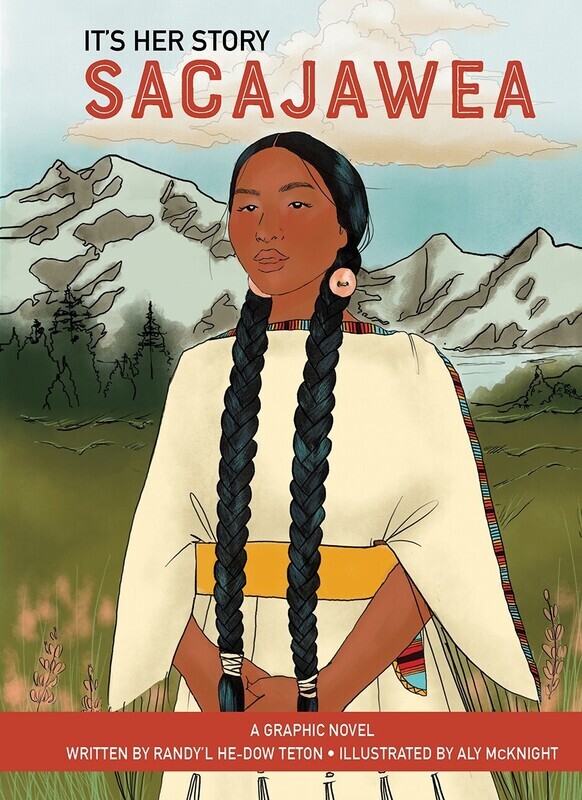
Johanna Bringhurst: You recently wrote a graphic novel about her called It's Her Story, Sacajawea, which is illustrated by Allie McKnight. The book just came out and is available in bookstores, online and from your personal website. Why did you take on this project now?
Randy’L Teton: So when I was 14 years old, I took up my first job at the tribal museum in Fort Hall, and one of the biggest questions I always received when I was working in the books in the bookshop is more about Sacajawea. and and again, I was only 14 years old. And so I started to do my own research, and I started to ask questions to our elders that are no longer alive today, to get a better understanding of who, Sacajawea.
It was. And and what she really did. And so, starting at 14, I, I chose to go into the field of museum studies, which is, you know, not a, not a popular, degree choice by many, but I felt that it was important, at that age, to represent my own people and be able to write books.
because when I was doing my research, the books that we had, available were all written by, white male authors. most of them were anthropologists and archeologists and historians. And I just felt that the indigenous perspective was missing. And, you know, we were well capable of telling our own story. But I think there is, a lot of mystery out there on how to get your books written or how do you get your story written and published.
And so I pursued museum studies and I started delving a little bit. I started delving a little bit more into the whole aspect and the history and, and then of course, got that opportunity to, do the modeling. And so that really opened my doors up more because I started to meet more, native peoples that had a story to share.
And, and then, of course, being chosen as the model for the coin that elevated my, my, visibility to speak on her behalf and to be her voice. And I had to make sure that the information that I was providing lined up with how with our stories. and so I've been wanting to write this story for a very long time.
and actually, the publishing company found me online. And if you do a Google search on my name, you're going to find a lot of news articles. a lot of, you know, interviews that I've done. And, but they found me and they asked if I would be willing to share a story and that they were doing this children's series and that they wanted to highlight Sacajawea.
and so, of course, I said yes. And that was a year and a half ago. And so, it took me about five months to write, get my manuscript in. And, it was a fast track because once I got my manuscript, submitted, it took them probably about three months of going back and forth, and we were doing a lot of editing.
And then they informed me that they already had a illustrator available. And that kind of worried me, because, you know, here I'm providing a tribal story, and I was worried that it was going to be a non-tribal person. And I wanted to be able to say, okay, we need to bring on a tribal illustrator. But luckily they said that we already have a tribal illustrator, and she is actually, Shoshone Bannock.
Her name is Aly McKnight. and she is enrolled here in Fort Hall. So we're both Shoshone Bannock. but she was not raised here in Fort Hall. She was actually raised in Nevada. And, so I didn't I didn't know her. And, just beginning to hear all these new developments on how this book was, it was going to be introduced to the public.
I was getting very excited. And, then it was released in November of 2023. actually, it was released earlier. I was told that the target date was November, but it was released in October online via Amazon.com. That was huge news to me. I just got a call, from the, publishing company, and they said that we're already releasing it online.
and then I started getting calls, that people were already, purchasing. I didn't even have my copy. I did, I just had the final manuscript, but I and the draft illustrations. And so I ordered my first book online on Amazon, and I got it back in like a week. And I was so excited, because I couldn't believe my eyes that I actually was holding my book.
And so, it was a wonderful feeling. just to be able to share the story about Sacajawea, from an indigenous perspective, from a Shoshone perspective, from a female perspective of being a mother and, you know, really the the trials and tribulations that Sacajawea have had from the very get-go of her being captured at ten and being enslaved and having, and a new husband getting pregnant and then being placed in a position within the Lewis and Clark expedition and pretty much taking care of, like, 25 men to help, you know, she was the only female with the child for two years.
And I say to my student presentations is that imagine yourself going camping for two years and just living off the land that was natural to her. And that's why she was, you know, essential to the expedition. But she really did, provide her survival skills. She was able to provide, you know, her knowledge of the land.
and so, you know, if it wasn't for her, you know, the expedition wouldn't have been successful.
Johanna Bringhurst: I really enjoyed reading the book. And because it is geared toward younger readers and as a graphic novel, I was kind of reading it with my, you know, my mother hat on. But I was so touched by the careful attention that you gave and descriptions of her role as a mother and as a giver of this expedition. What were the aspects of her story that were really important to you to get across in the book?
Randy’L Teton: I felt it was important to understand that she was only ten when she was taken from Idaho, by our enemy tribe, and the feeling that she must have felt the loneliness of her, missing her family, and she tried to escape so many times. And then how the family that she was placed with didn't want her. And that's why she was given up as a prize and won by the French Canadian fur trapper.
And just placing myself in her her moccasins of what was going through her mind. And how did that affect her. And and honestly, I feel like it was her survival skills of she had a baby now. She was taking care of her son and she she loved him so much. And, you know, and that's even, you know, in the Lewis and Clark journals when I read them years ago, you can tell that she was, very, very, caring to not only giving her attention to her baby, but, to the rest of the, the expedition, and, and, you know, if she had some food, she shared it as much as she
could. She shared her knowledge of. Of what kind of roots and berries to pick and which ones not to, the herbs to use when they got sick. but I felt like it was important to bring that Shoshone perspective that has been lacking in a lot of literature about Sacajawea. the books that I have written have read about Sacajawea are very, fact based, based off of the journals, the Lewis and Clark journals, very limited and they're male perspectives.
And so this was my opportunity to share what was shared with me and give it that, that Shoshone, that Shoshone, energy. And that's why it was important to include the Shoshone words. so again, you know, for our, Native American youth. So they're aware of, the words as well. So I wanted to really dig deeper, but I couldn't, the, my original manuscript, was, a lot longer than the book.
and so that was a learning process. was really condensing and keeping with just the high points. I think another element that, I would like, the readers to, look at is the fact that she did not die, at a young age. I think what's left out, too, is that she had a little girl, so she had, two children.
her little girl, Eliza passed away, close to one years old. and then she lost, Jean Baptiste when he was about 18. And so as a mother, I think about how that changed her life. You know, being a mother myself of three children, if any of my children, left this world, you know it.
How heartbroken she must have been and how that changed where she was going. You know, where she was going to reside. she ended up residing in the, Wyoming with her nephew, Basil, which is home of the Eastern Shoshone people. and so we have oral stories from the Eastern Shoshone that talk about, Sacajawea, and so there's a lot that I could have added in there.
But again, you know, because the book had required pages and our audience was ages 7 to 10. now I do have a request to write another book, kind of digging a little bit deeper in depth. so I'm thinking about that. I'm drafting, another manuscript, to dig deeper. so that's, a stay tuned.
Opportunity.
Johanna Bringhurst: I'm so happy to hear it. It really was moving to me to read this book, where, about Sacajawea, where she is the heroine. She is not one of the cast of characters. She is the heroine. And her actions really were instrumental in, in the story that we've heard in the past. Some of the things in your book were new to me, and I realize that a lot of her history has been told incorrectly in the past.
You brought up that she died young. What are other aspects that were have been told incorrectly?
Randy’L Teton: I was, representing her, for the two years while I traveled with United States Mint promoting the coin. I had an interesting individual approach me from the Mandan tribe, that claim that they adopted her as their own. And in traditional ways, that's common. But I do think that during that era when she was there, it wasn't a respectful adoption where they took her in and took care of her.
It it's a lot different. And so the way, I am sharing her story is, again, from a Shoshone perspective, there might there's a lot of other information floating out there, by the Mandan Hidatsas of how they look at her, even to other Tribes that may look at her and her role with the Lewis and Clark Expedition.
it was not always looked at in a positive light her role, and she was not looked at as a hero. and that's one of the things that the that does not, that is not talked about. And, and it is important to understand that she was so young and she was basically forced to do what her husband asked her.
Lewis and Clark specifically chose her because of her age. She was young, and they felt that she was strong enough to survive the expedition. She had fresh knowledge of the land. She had the knowledge of the language. and so they felt that she would, assist, you know, Toussaint, her husband, as an interpreter because he was officially, hired by the United States government, and he was paid.
He was given land at the completion of the expedition, and she received nothing. no money, no recognition. and it wasn't too long after they, they got they returned from the Lewis and Clark expedition that she actually left her husband, which is not a normal thing. because once you're married to a man, you're married for life.
And for her to actually leave him, we don't know why, but we do have oral traditions of her visiting other, family members, like the Comanches in Oklahoma. and so, you know, when we think about when I think about it, I have to think about all of what she was going through. And how just that expedition changed her life forever, and possibly for the better, because she was no longer enslaved.
she was the property of her husband, and she had the strength to leave him. And she also had the strength to allow her son to, be sent off to, Saint Louis. and the reason why is she wanted him to have a better future. She wanted him to be educated, and he was. He spoke. what was it?
Five different languages. He spoke Shoshone, English, French, Spanish. he did some studies in Europe. And then when he was done, he returned back home. And he became just like his mom and his dad. He enjoyed, living off the land. and it was really sad to hear that he did pass away at such a young age.
He did not get married. He did not bear children. So, Sacajawea does not have any direct family line from Sacajawea, because her two children passed away at such a young age. So those are things that are not talked about. And in fourth grade history, at least from when I was going to school. When you talk about Sacajawea, it's really just in general that she was there with the Lewis and Clark Expedition.
she was Shoshone from Idaho, but I am, very motivated to work with the, state of Idaho to start making those changes, adding in more narrative, adding in more of the history, having more curriculum added. So that way the kids are really learning more about Idaho history and how this beautiful young girl made a huge impact to United States history.
And it was only 200 and some years later that she was finally, recognized for her contribution. And and I think that's huge. And I think that's, a big win. and yeah, I'm just I'm just really proud to have this book to share.
Johanna Bringhurst: So what do you hope children will take away from her story?
Randy’L Teton: So far from the presentations that I have, completed, a lot of the kids are very engaged. They're sitting there with their eyes wide open. They can't believe that Sacajawea is from Idaho. They can't believe that she's that she's a Shoshone Native American, because I'm standing right in front of them, and I'm Shoshone and their friends that they're sitting next to they're Shoshone from Fort Hall.
So it's like, wow, she's Shoshone and she's from Idaho, and she's on a coin. And she was with the Lewis and Clark Expedition, and she got to go camping for two years. so these kids are very, you know, they're very excited to learn directly from someone that is Native American. And it and, my hopes is that their impression of the information they're receiving now goes a long way into, as they turn into adult and that they have this appreciation, of the tribal history and, you know, visiting the tribe, going to the museum, learning more, going to salmon and learning more.
There's an awesome Salmon interpretive center in Salmon that, talks a lot about, Sacajawea as people. unfortunately, and there is no, reservation in Salmon. I know that the Agaidika, band tried very hard to receive recognition to have a reservation in Salmon. but a lot of them were pushed to Fort Hall. And so, we have a very strong, family, from Sacajawea's people that still go over to Salmon and conduct, fun runs.
they provide, cultural teachings at the interpretive center. So there's, there's they still exist. They're not gone. And that's the thing that is important is to the kids is that we are still thriving. Sacajawea is people still are here. and we are doing the best that we can. And there are beginning to be more tribal authors out there.
So my hopes is that one, one tribal kids sitting there, can also go and write their stories because there's so much story there are so many stories out there that we have on our creation stories. you know, there's there's just so much to share.
Johanna Bringhurst: So she really was such a remarkable figure in history. Why do you think it's so important to tell those stories and to learn about the real history of where we're from?
Randy’L Teton: We're definitely changing the narrative when it comes to history. We are changing the narrative because we have more female authors. We now are seeing more Native American authors. So what was even back when I was going to school where you had a lot more male, non-tribal authors dominating the space. It's changing. It's flipping it. And and I'm just part of I am so proud to be part of that that flip and and the you know, the new changes that we're starting to see.
Johanna Bringhurst: And yeah, this gift, this book really is a gift, for all Idahoans to have this really beautiful insight into one of our heroes that's from Idaho, and to get to know about history from the perspective of her people and her family is a treasure. So thank you so much for joining us. Thank you for writing the book.
Randy’L Teton: In my language we say ous. Thank you so much and thank you for IHC, for giving me the space and the time to share my story. And like I mentioned, if you have the time. Anyone listening go out to, the tribal museum in Fort Hall or the interpretive Center in Salmon, Idaho to learn more. And you can also go to my website, randylteton.com.
Thanks.
Johanna Bringhurst: Thank you so much, and I hope you do have that next book coming with even more detail.
Randy’L Teton: Yes. Thank you.