
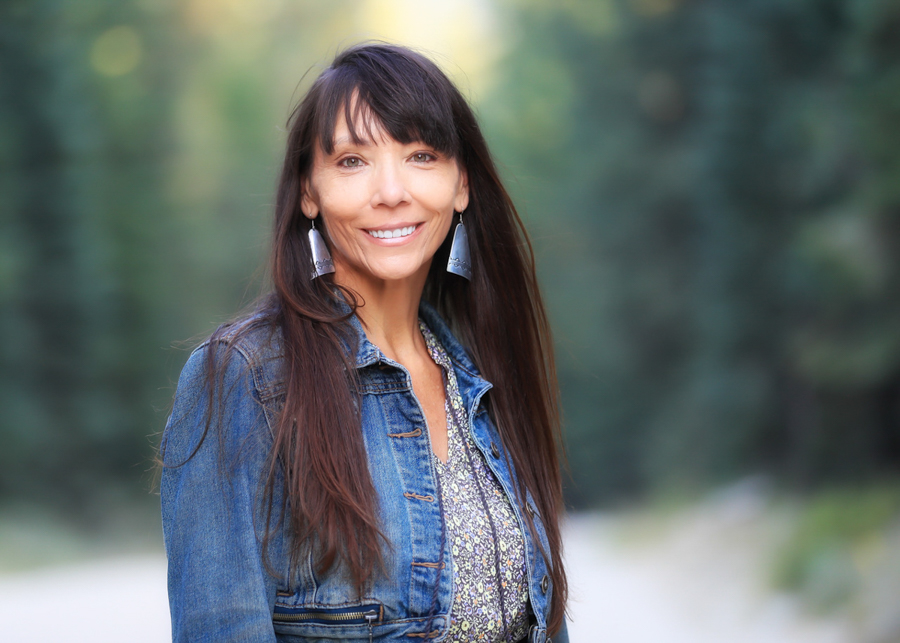
CMarie Fuhrman
Interviewee: CMarie Fuhrman
Interviewer: Johanna Bringhurst
Description: I am blooming from the wound where I once bled. –Rumi Idaho is fraught rich with stories of loss hope. Stories of failure resilience. Stories of doubt belief in a better future. Some of those stories are often repeated and some have not yet been told. It’s time to revisit our narratives from the past, to revise our stories for the future, to re-story a state and its beings whose destiny relies on what kind of storytellers we raise and what kind of ancestors we are going to become. In this interactive session that blends story, poetry, traditional ecological knowledge, science, and history, CMarie Fuhrman, Idaho writer in residence resistance will guide you on a journey of re-storyation. She will provide prompts, pedagogies, and poems to mix with imagination and literature to teach hope, resilience, and love and show how the craft of literature can make the stories and beliefs that change the future.
Date: 2023-10-16
Topics:
The visual topic map is hidden for screen reader users. Please use the "Filter by Topic" dropdown menu or search box to find specific content in the transcript.
Johanna Bringhurst: Hello everyone, and welcome to context. This program is brought to you by the Idaho Humanities Council with funding from the National Endowment for the Humanities. The views expressed here today do not necessarily represent those of the HHC or the NIH. My name is Johanna Bringhurst, and joining us today is CMarie Fuhrman. CMarie is the current Idaho Writer in residence.
She is associate director and poetry director at Western Colorado University, where she teaches nature writing. CMarie is the author of Camped Beneath the Dam: Poems and coeditor of one of my new favorite books, Cascadia Field Guide: Art, Ecology and Poetry, and also Native Voices Indigenous Poetry, Craft and Conversations. She has published poetry and nonfiction in multiple journals, including Terrain Talk, Emergence Magazine, Platform Review, Northwest Review, Yellow Medicine Review, and Poetry Northwest, as well as several anthologies.
CMarie is a columnist for the Inlander and the director of the Elk River Writers Workshop. She's also the host of a podcast from Colorado Public Radio, Terra Firma CMarie, recently presented at our Idaho Humanities Council Summer Teacher Institute focused on the environmental humanities. And we're so honored to have her joining us on Context to share more about the stories and storytellers of Idaho scenery.
Thank you so much for being here today.
CMarie Fuhrman: Thank you. I'm so happy to be here. And I'm always happy to, reach out to Idahoans, particularly teachers in Idaho, and help provide resources and stories and insights and perspectives, to bring into their classrooms and to, to help them build curriculum around. So thank you so much for having me.
Johanna Bringhurst: Great. Okay. I'll turn the table over to you for your presentation.
CMarie Fuhrman: All right. Thank you.
Yeah. I'm going to share a story with you today, about hope and about some wonderful, hopeful things that are happening within Idaho and and something for not only Idahoans, but our young Idahoans to look forward to and to know that that even in these times when it seems hopeless, hard to find that, the earth and the people that care for the earth are still planting and still building hope for sometimes generations that none of us will see.
This is called A Story about a South Fork Salmon River Logging Road, and What it Means to be a Good Ancestor.
This is the story of a river, a road, and a fish. The river is the South Fork at the salmon. More specifically, it is a stretch of the South Fork of the salmon River that begins in a meadow named Stoli until it joins the river beneath my favorite bridge, a bridge that curves in a way to suggest it is hugging the river that curves like a comma, asking drivers to pause as they cross, to pause and look into the water below, look in as if there are answers there, look in because the answers are there.
But this bridge is not on the road that the story is interested in, but the road and the bridge and the fish who swim in the river are all on the way to the trail where the story begins. The trail, like the river, like the fish, predates white settlement, yet it was worn by human feet. It is kept up by hooves and paws, and on a day in late May of 2022, it knows the tread of my own soles.
Following the tread of my partner, the paws of our two dogs, and the notion of wonder. On this day, the hill we climb is golden with arrowleaf balsamroot. I have known many flowers, but balsamroot to my knowing is the most companionable. Yeah, Iris of gold. Pupil of earth. I am never alone when I walk among them, each greeting me from beside the trail.
Each eye watching my step, giving me glimpses into the soil that is the soul of all things. Looking into those brown eyes I see ancestors, human and greater than every being whose bone and ash fed balsamroot's bloom. Fed others that grow here too. Fed the deer whose body fed my own once before I stopped picking flowers, I took the stem behind my ear and for a moment gained another sense in that moment, seeing through soil colored and gilded, I.
I saw what I think I can call immutability. For a moment I knew what was meant by the words look to the lilies. How they grow. They toil not, nor do they spin. And for a moment I toiled not nor spun as well. But this morning, the one of our story, the one after I stopped picking flowers instead, letting them grow and flourish to be breakfast for deer or vole, or just remain in poetry as a place where sunrises are born.
This morning I kindly greeted them as I walked up the steep trail, the very old trail with my dogs, my man and the song of robins above and river rush below. And somewhere in the distance, the din of a diesel engine to know the landscape of the South Fork at the salmon River, hold your hands at heart level. Palms down.
Spread the fingers of one hand and then the other, and wave them together, stopping at your first knuckle. Here is when the river runs through, still cutting the canyon that holds it. And there between your fingers are the drainages. We can name a few now, but know that names are mutable and these streams have many and may have more to come.
But today we'll call them Buckhorn and Camp and Phoebe and Nasty. And if you can imagine the landscape of your hands as big as mountains, like the Salmon River Mountains that hold the South Fork of the Salmon River, you will see how steep your fingers have become. What an effort it may be to get to the back of your hand, but what a gift the summit will be when you get there.
The view notwithstanding, the back of your hand becomes a place to hope for. This is where we are headed. The back of your hand, that is the summit and the ridge. So for the sake of our stories and stories yet to come, let's not name the drainage we walk, nor the creek that flows through it. Forgive my life of omission.
Betrayals like the one we are taking are best left unnamed, just as some wishes are left best left unspoken. If you want them to come true. The morning air is cool. It will rain. This, my partner, a fish biologist, calls salmon weather. And yes, there are salmon in the South Fork of the Salmon River. Or soon there will be.
And they are part of the story of river and road. But for the sake of our story, let's say they are more than salmon. Let's say they are a symbol for all life in the river, from steelhead to sculpin, mussel to lamprey. And weather matters greatly to the story, particularly that it is salmon weather because salmon weather means rain and rain means that from the top and sides of the hills that we see in your hands, water will flow down, down, down into the streams and the seas and down into the South Fork of the salmon River.
It flows down into the main Salmon River itself, and is passing now not far from here, in a river called the Snake, which joins the Clearwater, which joins the Columbia and drains into the Pacific. And somewhere in that saline water, spring Chinook are turning bodies east, turning back to fresh water and carrying with those bodies food for bass and root and black bear and Ponderosa carrying life in its myriad forms, carrying life back to the South Fork of the salmon River.
Salmon are carrying this life and their story as they make their way upstream, a travail not at all like the short and relatively simple walk up the drainage of our hands, but one that must overcome dams, resists current jump falls. Finally, to come to the headwaters where our story and the river began. Spring. Rain, spring snow, runoff, water.
The banks of creeks fill even only if slightly. They rise the secesh and the south fork of the salmon and the main salmon, so on down the line. And in times before the dams, before man was gatekeeper to passage, the rising water made it easier for salmon to move, maneuver around boulders over falls, and swim their way up thin streams and risk like tributaries to that place where even now lay eggs that will soon hatch and bodies that will grow and grow.
And eventually the same salmon weather will be the spring water. These young salmon ride down, passing us, passing their ancestors, passing their story on to a new generation. There is something else about the rain. When it falls as soon it will, and the bridge and drainage holding the trail which we walked on that early morning, it will loosen soil, and that soil and rain will let go some bits of earth which will roll down the hillside past early leaf and Ponderosa to an old dirt road.
And this is where our story may have stopped, because in this landscape and the story, the road begins to complicate things like dams. It begins to disrupt natural movement. It disrupts relationship between slope and river and rain and fish. It is as if mid step me and the dogs and the fish biologist named Caleb Cruz as photograph stills a moment the road stills the rain.
And yet it is also like pausing life because those hillsides like salmon turning east than the Pacific. Like me giving you this story, are meant to give something to the river. This is what it means to be a good ancestor, to keep the gift moving. And the hill gives pebbles and stuff and also boulders and entire trees. And though this seems catastrophic, sometimes a little catastrophe is necessary.
Sometimes it takes an avalanche to feed a river, the logs and boulders it needs to create homes and habitat hiding for bull trout. But from the beaches and push debris downstream. This is their agreement. The agreement was broken or at least altered, but the road rain has stopped and with it came a new partner and the relationship for the road was cut by a big yellow machine, not souls.
This time, not merely a path, but six feet of level earth. And instead of tread of soul, I'm tread of tire. The road is part of a web of roads cut into the fingers of hillside, zigzagging back and forth, swaying as if dancing and taking each tree it comes to as a partner, shaking the dress of limbs and boughs until the final.
The dip from ... or saw from which the coniferous dancer never recovered. It was the dance of industry, the 1960s, the pride of lumberjacks who, I know for I've met some, love the fork in the salmon River. Love the hills, and arrowleaf and pine as much as I do, as much as Nimíipuu as Tukudika, whose cambium peels are scars too. Love, we can agree, is as hard to define as Idaho.
And perhaps both are best that way. Perhaps. But then things changed. Perhaps our love, or more specifically, the way we showed it. Perhaps we found we can love or at least need a thing too much. And so hundreds and hundreds of miles of roads were cut into hillsides, millions of trees were cut, and four feet, and the slopes of the south were as bare as the back of our hands, except for the roads.
And when the big machines finally rolled away, when most of the old trees were gone and the lumberjacks moved on, only stumps that thrust from the earth like fists or tombstones or merely stumps, exposing their years in a circle of circles containing old songs containing ancient storms, circles by quarrels, and the print of your finger remain. Though I was born after the roads, I have seen the south fork of the salmon.
Without them, and black and white, and photographs buried in archives, and uncovered almost if by accident. But perhaps providence, for here is a haunting coincidence. The photographer who made the black and white photo, whose subject I know made the picture while on the same trail where I walked that May morning. Not just the same trail, but the same exact place and the provenance.
I talked about the accident of finding was a result of a search for a photo of a homesteader cabin. I'd read about that, no matter its fortitude when it was built. Is gone. No foundation or chimney or root cellar remain. I don't recall what I was hoping to find in my search, except that sense of all that comes with something so seemingly solid as home being suddenly so absolutely erased as if it never existed.
Which does not surprise me, given our history and the way entire lives and cultures can be erased, erased from it. So maybe just not wonder that this missing archives insures. But something like hope, which is something that R.E. Benedict in 1904 might have felt when he stood where many others, many unlike him, stood before and where I would stand 107 years later, there was no road into the South Forks and no gentle curve of bridge, no signs at stream crossing, no lookouts on peaks.
There were no dams on the salmon. Idaho had been a state for only 15 years, and the U.S. Forest Service was but a twinkle in Roosevelt's eye. but Teddy and Gifford had the wheels turning, and the photograph was taken by a man sent to scout for potential forest reserves. The label on the photo reads bull pine. Yellow pine is not place, but trees.
Food for a growing region. The photographer and his horses or mules or horses and mules. His gear, weighty and cumbersome, took this same trail up and up and set up his equipment first east, then west. I wonder what the trees heard in that moment when the shutter first clicked? Did the horses and mules flinch? The deer did elk or flicker tents with prescience?
That salmon? Was there a notion in that shutter of what was to come and not that a landscape as dynamic as the South Forks does not change? But in that moment, did mutability make us new sound? Did it usher in a change unlike any ever seen in these mountains before? And so, with a click of a shutter, a new story began at the south fork of the salmon, and in time a new sound would fill the hills.
First boxcars, then backhoes and excavators, fellers and semis. What once was this roar of river would be covered by sound of Progress. Before I knew of the man and his camera, before the archives in the rain, I knew too was coming, the rain that brought us to this pause, and the road I had made pictures of my own. First East, then West.
It was an outcropping of rock, a prominence, a place, a view. And I stood a top and paused. Because sometimes because anymore I am still by beauty. I am brought into a state of, sometimes to the point of tears. Tears. It confused me as much as they comfort me, for they seem not to know the difference between the beauty of joy and the beauty of pain.
Or maybe that we fear losing beauty for however we might define it. Beauty feeds hope, and perhaps hopelessness may be defined as the absence of beauty. And maybe my tears are both afraid of what we found and what we might lose. And so sometimes I hoard my emotion into a photograph. I collect the tears into a picture that I then pour out to friends, to myself, over and over again.
When solace seems so hard to find, and what I need to remind myself that there are places where despite gods and men, despite conflicts and catastrophe, despite the longing of a river for her fish, the streams for their first names, despite what would come after the first shutter, likely the very first shutter to close on these slopes, and the steep fingers of feed, water and sediment and boulders and seed into the South Fork River.
There is a place that I can turn to, even only if in memory, where I stand on the edge of hope. And perhaps it is the immutability of the photograph that spaces that beauty gathered as evidence, is necessary to prove there is something to be hopeful about. Is this what is meant by faith? Look to the early who do not spend or toil.
There is something else about the photographs, about looking at places where we can imagine something Wallace Stegner wrote about in his wilderness letter, when he wrote, something will gone out of us as a people. If we ever let the remaining wilderness be destroyed, we simply need that wild country available to us, even if we never do more than drive to its edge and look in.
He called it part of the geography of hope, and perhaps been addicted to, and perhaps the loggers and miners and the homesteaders that came and removed who could do they may prove salmon, wolves, grizzly, Ponderosa, and how many others who had a different name or no name, a different story, or no story at all for this place? Maybe they saw something that looked like hope, a human centric kind.
The short view, the narrow view like the photograph that can only hold so much, that can show only a bit of what matters to an entire landscape, to a future. For I believe that wilderness to native people, native fishes, and even some poets is not so easily labeled. It's not so easily boundary. It's not wilderness at all. It's simply an extension of life.
Like home. Maybe like the hands you use to make the landscape of the South Fork something to be attached to, not separate from. No nature, not nature, only nature, only wilderness. And knowing this home existed and allowing it to exist meant human existence, meant life meant that we too are part of the landscape or wilderness, and what we have inflicted, what we were about to inflict.
We'll lose more than trees and fish would cause us to lose. What we didn't then was hope. I believe most that those that would come in the half century after Benedict loggers, CC workers, miners and homesteaders did so with good intent. I believe they took pride in their work, were glad to have work, and believe their works were part of a greater good, and those with children believe they would be remembered as good ancestors, making a better future for their children and those children to follow.
I like to think that whomever drove the dozer that made the road that I am telling you about tells a story of progress and industry and frontiers, and to children who would look with pride at their fathers and mothers, trusting that yes, it was destiny. Yes, it would regrow. Yes, this land of plenty would always be. And yes, we were fair and did the best thing for those who had first called this canyon home.
I have to believe that story in order to believe this one. The one I'm trying to tell you, the one that says we are capable of a great many things, the best of which may be new stories. Come back with me now to the pause of the rain and earth on the road here the earth and seeds that were tumbling with water.
Stop. But rain, rain, water, rain drops is a gift that is always in motion. So when the drop it is the flat. It cannot sheds its watersheds are bent to do the gathers and pulls on compacted earth, gathers and pools until it finds a slope enough to make a rivulet car rentals and fall finally down. But in this new path, missing the roots at once, but maybe feeding a different stream, maybe the fourth force of its gathering destabilizing and carrying more earth, more rocks and trees, more and more.
And down and down into the river where Reds ancestors have been made for centuries. And those reds are flushed. Maybe the eggs are lost and salmon return to empty beds if they return at all in a year. And in the years after the logging, after the easiest trees were felled, the trees that shaded the river kept cool. The water for fishes gave shade and eventually homes.
The land began to slide whole hillsides into water and I say hillside because though you and I talk about a small stretch of road, a single curve, really like the salmon that represent all fish in the river. This piece of road is representative of the over 800 miles of roads. Cut into the fingers and ridges, cut into the landscape that is an extension of home, cut in miles longer than those traveled by salmon that return from the Pacific to Sterling Meadows, which is very long indeed.
And if you can imagine that distance and the roads which back, and how the land then sloughed and slid, you know that more land went into the river, then the river, and all its wonder could manage. I understand this in poetry, which can bend to hyperbole, but this is not exaggeration, for I have seen it. And if I could tell you the way my partner has graciously told me, my partner, the fish biologist Caleb, who has spent most of his career studying habitat homes of salmon, I would give you the science of sediment.
I would offer the facts and data graphs with lines red and blue that would show the distribution and declining numbers. I would show you, too, that though the lines staggered greatly toward declines and steeply as the South Fork Salmon River slopes the loss, there is something else happening. Some of our being here in cooperation and the idea of healing in those lines, a shift, however subtle a river recovery arising, a line of hope.
And for some that might be enough, and for some that may be the only story they need. But on a day in May and a treasure trail where the souls of ancestors and treads of a man mostly forgotten to history. The paw prints of Prince and tread of Caleb. Then may I found something? Data can't measure that no scientific experiment can track something that my photo would gather.
And someday, perhaps be placed next to another, as if by accident, maybe with a bit of providence. Something that is almost forgettable should be forgettable. A restoration, a restoration, a new way of being good ancestors. Before the photograph and the ancestral trail. I have not known the South Fork of the salmon River without logging roads. I can recall first glimpses my finger pointing to these signs and Caleb's answer it doesn't go anywhere.
It was cut for logging. It goes to where trees were and stopped, and I could not understand, not fully, that a road would be built to nowhere. And in those early years, when I still hunted the canyon for deer, the roads were the easy way in. Dense and steep as the country is. The roads are what was left to them.
It was easy walking, quiet walking. Of the hundreds of miles I've walked in the South Fork, many of them have been on old roads whose convenience and use have made them trails.
When I was first in love with the South Fork, I loved her roads and all. I let roads be my convenience without second thought, because I was taught love is an acceptance of what is. And I believed that if this could remain immutable, this landscape as I first met it, if no more change would come. No more holes in her sides, no dams on her rivers.
If the designations we place by the institution, we place faith in, could protect the South Fork of the salmon River, the streams and creeks, Nasty, Buckhorn, Camp and Phoebe the trail from being found out as a trail so ancient it aches with history. If we could protect it, keep it from changing. Keep the tractors and plows and mining companies away, then maybe that would be love.
Maybe that would show a little hope to predecessors. Maybe they would look to us with some pride and say they did try. What I am trying to say is that I fell in love with the South Fork, despite its scarred hillsides. Because I am embarrassed to tell you though, I imagine things could get worse. I never imagined they might get better.
This was my story of the South Fork and the roads, and I thought that despite what Caleb's research was finding, her research has been done and ignored before. But this was as good as it gets. And so this I accepted, and I put my faith in places down river in time that dared to be removed. Perhaps the roads that were closed would stay closed and never tempt another timber sale, and that the kenosis and Ponderosa like for.
Wisdom, Stegner writes, is knowing what you have to accept. What I didn't know, what I couldn't see was this was not the story of the South Fork. We had to accept. What I didn't know was the reason Caleb had brought me to the Soul Trail. What I hadn't yet seen was a new story of being on the land.
The story of the South Fork of the salmon rivers you've seen could be the modern story of many places in the West. The story after the stories whose language was ignored, settlers moved in. Natives were forced out. Those who instilled fear from grizzlies to sheepherder Indians were killed. Manifest destiny was invoked in trees and rivers and deer and land were now named resource or commodified, and a certain amount of greed settled in.
One seemed bound for innumerable by the aforementioned sons and daughters of the loggers and miners, was taken by saw by shovel or by gun, was taken by dredge or drill, by single homesteaders, and huge corporation by government entities created to preserve and then was either colonized or banned in the areas that defended photos made preserve plans, were written and promised to caring for the land and serving people to which people it served, and how to define caring was mere mutable and only sometimes realized in the areas that were abandoned because they offered no resource.
A Paul settled in lakes that offered no fish or labeled barren rivers reduced to reservoirs were stocked to attract visitors and became thick with algae and stale of story. And this says nothing of the people, those who call this homeland, those whose ancestors wore the trail in people as resilient as the landscape and who, like salmon, are trying, despite all the obstacles to return home to natal waters through culture and language, both of which are dependent and not apart from the landscape they are attached to, attached as we to the back of our hands.
And when looked at this way, when considering the entire West, a new story seems almost impossible. It seems sometimes that the only change can be for the worse. It seems that we are depending on someone downstream or down the years to fix what is wrong here today we looked at this way hope is an impossibility that exists in the future, and the fear of not knowing what the first ancestors knew, what Benedict felt when he set up that tripod in 1904, what Stegner meant with his words in 1964, and what I saw on that main morning, looking first East, then west, then back east again, is the fear.
I have a transistor is the fear that drove me to write the story is a fear that if we do not bring action to create hope, the only story we will have is the one already written in roads on the landscape. I forgot to mention you on that may walk. You know Clark here, such a deep purple and more than I had ever seen.
I forgot to the Ponderosa. I wanted to mention it stood alone on the hillside, 200ft tall. A Sentinel minder known for I have not known, many larger. For most the old trees. Well, we've learned what happened, and even this one was the arrow. Straight and primed for the mill. Sometime, somehow it was spare and house beetles, and held Robin's in our backs as we leaned against it, eating our lunches, looking west.
And its rings are the stories of thunder, storms and winters. The song of Naomi, hue and cry of offspring, the sound of wolves howling, the shutter, Benedict's camera and the sound of the song. And now my sound to in the heartwood is the DNA of the Pacific, delivered and spent salmon sat by turkey vultures and eagles, and its bark is a nest of woodpeckers, and its view is a landscape that's, over the last century and a half has been forced to change.
And because imagination is part of my trade, I imagine the 1960s and a sire who saw this Ponderosa, its location, its presence, like a lighthouse, a beacon and said, no, not this one. And the tree heard that too. And maybe that felt something like hope. The rain when it came fell with a fervor. The clouds threw the rain down.
And despite our attempt to take shelter beneath denser pine, the rain found us to. And in time all I had protected was coat and hat was cold and wet. When rain dripped from the whiskers of the dogs, from the brims of our hats, and the sides of our packs. Rain like tears on our cheeks. Rain chilled down, our spines, rain filling each crack and crevice it could reach.
Rain finding roots and delivering life. Rain as salmon weather. The old dog stood in the rain like a challenge, being lost his way beneath our bent legs as if in his canine lineage. Rain and dog were never to meet. And me, I thought of the water gathered, gathering on the slow water, shedding off leaves and limbs and rock and water, watering the old pondo, water at the top of the ridge, carrying seed, and some sediment going down and down to that place where the first rain in our story stopped.
This rain fell and did not stop. And when the storm passed, or as storms are wont to do quickly in this part of the salmon River mountains and before the rivers, and return before the din of river rose up the hillside, I heard a sound that inspired the opposite of hope. I heard the roar of the excavators diesel engine as it caught and fire to life again.
It was the only sound other than the river and birdsong and thunder and stuffing of trees. We had heard all morning. It had been our constant companion on the trail up till. And then I saw it and gasped and pointed at its orange body. It's just a shell and it's time to just smiled and said, come, let me show you said a word.
I've come to anticipate obliteration. When we reached the place where the old trail, the Indian Trail, once met the road, I am overwhelmed by the smell of raw earth. I look west and see what is called obliteration. Trees uprooted and earth upside down, soil tilled and mounted, rocks strewn without pattern, scrapes and poles. And what could be called catastrophe if I didn't know what Caleb then tells me.
Soon, a woman toting a canvas bag filled with native seed mix, seeds of yarrow and bunch grass will come walking past. She will scatter the seed, while others transplant nine bark and sand gnosis and to newly un compacted soil that was only hours or days earlier. Road. She will walk toward the river where I can see the giant orange excavator working its way down and down the ridgeline down the old road.
It tears up as it moves, pulling together road cuts to road, Phil pulling hillside to hillside together like seams. A balloon. On occasion, the excavator will grab a root ball and all the juvenile pine and place it into a hole. It's left in the rec center. Rock. Then another swipe above to pull below, leaving slow where shelf once had been.
And for a moment it is like I am watching time unwind. History in reverse at six feet an hour. And the irony of Indians finding the road, the native seed planted in the compacted soil, the tribe and the government. Benedict's photo and now mine. Stegner story of hope meeting mine. The irony of healing a wound, or maybe what looks like metaphor for the beginning of a healing between ancestors, new and old, that is not lost on me.
And when the excavator reaches the river, it will be driven to the top of another. Another. No work going road and it will begin again and again until another 300 miles of roads are obliterated, and then the land will be left to heal. The sound of the heavy equipment that has brought destruction and grace will reside in the rings of the Ponderosa.
The rain that has fallen, the rain. It gave us pause and chill. The rain that fell as if it had a job to do or soak into the soil. That is the soul of all the things in the South Fork of the salmon River will make its way to sea to root, and it will feel something like I felt the first time I saw the South Fork.
Something like I felt when I saw the upturned earth, something I hadn't imagined possible. Something like love, but more like, hope. And what gives me the most hope in the story has less to do with this unroading, with what this unoading will do for fish and the river. That that is important to this hope. I felt welling like painbeautytears was the hope for humans because in the plan that created this change, the forest plan, the plan of land managers was a plan for future thinking.
A story written by those who will be seen as good ancestors, even as they will not live to see the entire result of their work. For though it will take a half century or more for the wound to heal, it will. And there's a chance. And another woman, a century after my passing. As in love with, as in love as I am with the south fork of the salmon River.
Will of a may morning walk up with what she believes. Wake up what she believes is a game trail. She will follow the tracks of wolves and bear the heart shaped hoofprints of deer and musk of elk. She will look into eyes of the arrow, leave not knowing all the ancestors looking back at her. She will, I hope, feel the ghosts of others that ask her to stop and look first West, then East.
She will stop near the base of a ponderosa that may by then be only a snack. Ghost itself still stalwart and knowing, and she will lean against it and see a landscape she would never imagine a road upon. She will step to the edge of the ridge and look in and see what some have called resource. Some have called preserve, some have called wilderness, and some have no name for at all except,
And maybe she will step to that edge. Arms open, eyes wide. And the sound, the trees and birds and river will hear will be the sound of her voice saying, thank you. Epilog. Today, 300 miles of road have been obliterated in the South Fork of the salmon River. 200 more are scheduled for obliterate Nation. Though it is too soon to tell the effect these actions will have on streams, tributary tributaries and fishes below, we can look to old data from the hundreds of miles of decommissioned roads and the Payette National Forest, the Nez Perce-Clearwater National Forest and others and know that the work is not in vain.
It's important to note, too, that healing the land, at least in the South Park, was not unlike healing a body. Groups once at odds, both federal and local, tribal and non came together to heal the landscape, to remove a road, support a river and save her fishes. We are, as humans capable of a great many things. The wounds men make in the earth do not quickly heal, writes Stegner.
Still, they are only wounds. They're absolutely mortal and better a wounded us than none at all. Place your fingers together one more time. For another look at the South Fork of the salmon River. Perhaps you can see it a little more clearly now. The drainages between your fingers, the steepness of the ridges. Imagine it as it can be in five years and 50 years, and see the river as it flows beneath and between your fingers.
When the round of your knuckles meet the river that has been carving the canyon on the south fork of the salmon River for millions of years, its stories begin in the rock and soil buried beneath mussel beds and rainstorms cobble in time you can see it or start to. If you roll your palms upward, look how they form something like a basin.
Look at how they seem to be giving something away. Look at the life that runs in the lines. It's there. There is the answer. The one I told you was in the bottom of the river beneath the bridge that pauses like a comma. There is what it takes to make a new story. There is where the future of the South Fork, the salmon that is all fish.
The West and the future for our predecessors live. There is the geography of hope right there in your hands. Thank you.
Johanna Bringhurst: Oh, wow.
Thank you CMarie, thank you for sharing your incredible words with us. Your writing is so beautiful, hopeful, and your perspective on Idaho's past is powerful. I will definitely take with me thoughts of what kind of ancestor I will be for those who come next.
CMarie Fuhrman: Thank you so much and thank you. Thank you also for having me on to read to you today. I really appreciate it.
Johanna Bringhurst: Thank you.