
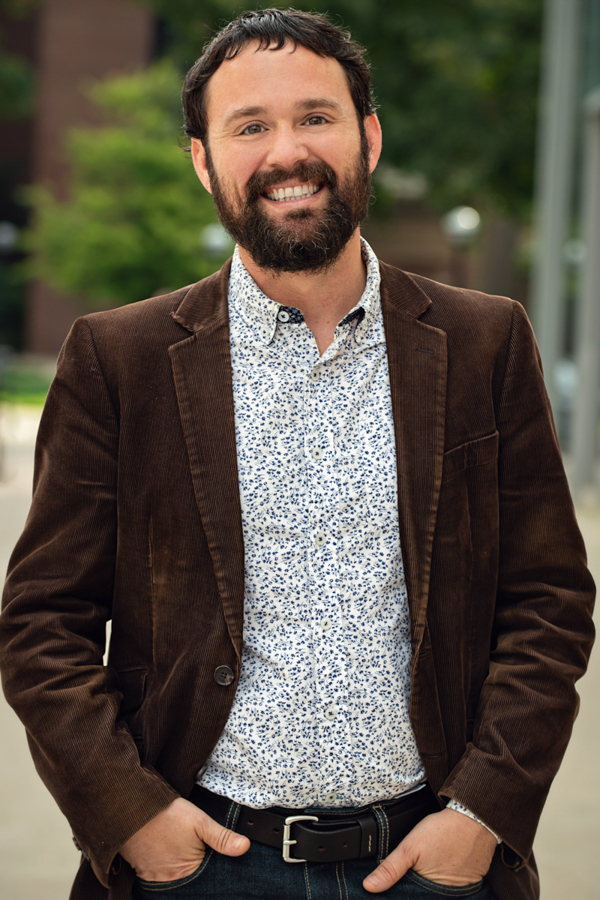
Dr. Nick Underwood
Interviewee: Dr. Nick Underwood
Interviewer: Johanna Bringhurst
Description: Dr. Nick Underwood, a professor of historian modern Jewish and European history from the College of Idaho joins us to talk about the essentials of Jewish history, antisemitism, Idaho’s Jewish history, and the value to all Idahoans of our religious diversity.
Date: 2023-09-01
Topics:
The visual topic map is hidden for screen reader users. Please use the "Filter by Topic" dropdown menu or search box to find specific content in the transcript.
Johanna Bringhurst: Hello everyone, and welcome to context. This program is brought to you by the Idaho Humanities Council with funding from the National Endowment for the Humanities. The views expressed here today do not necessarily represent those of the IHC or the NEH. My name is Johanna Bringhurst and joining us today is Doctor Nick Underwood, a historian of modern Jewish and modern European history from the College of Idaho.
Doctor Underwood has taught courses on modern Jewish, European and world history at Sonoma State University, University of Wisconsin-Milwaukee, and Napa Valley College. He has held postdoctoral fellowships at the GHI Pacific Regional Office at the University of California, Berkeley, and the Fraenkel Institute for Advanced Judaic Studies at the University of Michigan. He also serves as managing editor for the journal American Jewish History, and as project manager for the Digital Yiddish Theater Project.
Nick, thank you for joining me here today to discuss Jewish history. Many Idahoans have learned about the tragic history of the Holocaust, but do not know much about the full history of the Jewish people. There are thousands of years of rich history to study, and we have limited time together. So can you help us understand the essentials and where we can begin learning?
Dr. Nick Underwood: So, Johanna, first of all, I'd like to thank you for the invitation to be here. It's a it's a it's a thrill to participate in this project. And with the IHC, big supporter of the work that you're doing. And again, just appreciate the invitation. yes. So, thousands of years of Jewish history in 30 minutes, I think.
I think we can do it right. you know, and I think you're right, too. You know, one of the things that hopefully will kind of come out of this conversation is that I think a lot of people when when they have any experience or understanding about Jewish history, it's either tied to kind of two, two moments, right?
The Holocaust or kind of biblical history. Right. And I think what happens in between and after, especially after the Holocaust, is one of the things hopefully will come out of this conversation and kind of really kind of deepened understanding of, of a really varied global kind of experience for, for, for, for Jews. Right. and, I think that hopefully that'll kind of come through in this conversation.
Johanna Bringhurst: Thank you. I'm excited to learn more for myself and for our listeners as well.
Dr. Nick Underwood: Absolutely. So I think, you know, one of the things we can do is I think it's important to understand kind of the way that kind of Jewish history has, has transformed. And one of the things I will do today is I'm a historian. So, a lot of obviously, when we're talking about Israelites, when we're talking about Jews, we're talking about a religious community.
I will focus less on the kind of like the, the theology and more really kind of on the, on the history. So we'll be thinking about kind of patterns and migration and we'll talk about language, and kind of where Jews have found themselves throughout time and for some of the reasons for that, if that, if that, if you think that's an okay approach.
Johanna Bringhurst: That sounds perfect.
Dr. Nick Underwood: Great. you know, one of the things that I think it's important to understand is, you know, kind of Jewish history has changed a lot. And one of the major kind of turning points was, so if anyone is familiar with the Bible and we're kind of understand the story of kind of like the five books of Moses and, and, and the Hebrew Bible or the Tanakh, as it's known by its Hebrew acronym.
we know that there is a period in Jewish history when it is Temple based. Right? This is the Temple in Jerusalem. and kind of Jewish society, life and culture is centered on, on this, temple. this is an extraordinarily important part of Jewish history. And if anyone is familiar with the book of Leviticus, knows that all the rules kind of put into how one walks into a Temple.
This is kind of set up for this particular moment in Jewish history. Unfortunately, there are two temples that exist. and the Second Temple, is destroyed in 70 C.E., and by C.E., in Jewish history use BCE. And so the before the Common era and Common era, sometimes also called BC or A.D., so when I say city, I'm referring to A.D. in the 1870 C.E., the Romans destroyed the Second Temple.
And this kind of fundamentally changes, Jewish history. it goes from, a community, a religion, a nationality, if you will, that is based on the temple. And we kind of move away from, the priests kind of having the authority within, Judaism and Jewish culture and move to what people refer to as the rise of the rabbis.
once the temple is destroyed, we start to see kind of dispersion of Jews around the world in certain places. And we'll talk about some of that in a little bit. and what we start to see when we talk about the rise of the rabbis. So I've mentioned the Hebrew Bible, the Tanakh, the Torah, the five books of Moses, which is part of that.
we start to see the development of what's called the Talmud. and the Talmud is a compendium of the Mishnah, which is the, writing down of the Oral Torah. during the period of the Bible, there were oral kind of there was an oral component to the Torah, that was circulated, that is written down. and then there's some kind of, compendium to that called the Gemara, which is kind of a way to try to understand to some extent, the missioner.
And over hundreds of years, rabbis debate and kind of think about and put together, the, the Talmud, there's two Talmuds. There is one, that is finished first in, Jerusalem it's sometimes referred to as either the Jerusalem Talmud or the Palestinian Talmud. both, both terms are used. and then also there's the Babylonian Talmud.
And that is, the more authoritative one that is finished in around 550 C.E. takes hundreds of years. to put together the Talmud is an attempt to, with the basically with the fall of the temple, with Jews now in diaspora spread all over the world. How do we understand Jewish law? How do we kind of, follow Jewish law?
The Talmud is there to try and kind of create what in Hebrew Halakha or Jewish law. Right. And that's what the Talmud tries to do. So after. So this is why we think of 70 CE as a as a turning point, right? The the the the temple is destroyed. and then we start to see kind of new, new figures in Judaism kind of rise as being kind of authoritative.
And it's the rabbis, and the rabbinic order really that kind of create and establish this Talmud. and in these, years of diaspora become one of the two, major books that kind of Jews, kind of utilize in their daily lives. The the Bible, of course, and the Talmud.
Johanna Bringhurst: Great. Can I ask you, when most people think of Jews, they think of their religious identity. But you talked about an ethnicity and a race beyond.
Dr. Nick Underwood: Yes.
Johanna Bringhurst: Just a just a belief system. Could you explain more?
Dr. Nick Underwood: Yeah. you know, in the classes that I. That I teach them, one of the questions I always posed to students is, what does it mean to be Jewish? Right. And I think that that's one of the things that changes over time. clearly, when we're talking about ancient Judaism, we were talking about the Temple period. This is everything, right?
You know, I think that it's interesting sometimes to think about religion as almost a modern construct, right? I mean, if you were thinking about ancient times, you were thinking about even the years 500 C.E. religion, culture, society, all these things are intertwined with one another, right? we see kind of over time, the separation of some of these, and we kind of see like, well, we'll start to see, as we move in, in more in the modern period.
People who are Jewish, who identify as Jewish but not religious at all. Right. and that changes over time. depends on who you are and where you are, like how you answer those questions. but yes, there is a time when Jewishness, is really kind of, confined to Judaism and how Judaism is kind of an overarching kind of component of life.
but as Jews leave, their ancient homelands, and go to other places, their interaction with religion, their interactions with other societies change, and they're almost always in kind of constant discussion, with those creator societies. I'm not sure if that's a satisfying.
Johanna Bringhurst: Yes.
Dr. Nick Underwood: Or yes. Yes. It's complicated.
Johanna Bringhurst: Of course. And do all the rabbis agree with each other on how to understand the Talmud and the Bible, or is there a range of thinking?
Dr. Nick Underwood: There is a range of thinking. And, you know, one of the things that I think is beautiful about kind of the Talmud, especially so the way that it's printed, there's originally the Babylonian Talmud that's printed. And then over into the Middle Ages. What ends up happening is that there are later versions of the Talmud that are actually, printed with later rabbinic commentary.
There is a famous, rabbi, his name is Rashi. he lives in medieval France, and he becomes one of the, most prolific commentators on both the, Torah and the on the Bible, and also, the Talmud. So there are later printings of the Talmud that have RashiS's and some other people's commentaries on it. And one of the beautiful things about it is you'll see them completely disagreeing with each other.
They're debating, I think, sometimes, you know, the most, Jewish approach to taxes, that they're in constant debate with those texts. And what does that mean? Why this word? How is this word used here in this section? Whereas maybe in the Book of Numbers that Hebrew is is used in that word is used differently here and then maybe later, it's used differently.
How do we understand the use of these words? So the rabbis over time, still today, debate, on how to understand, the mission of the Gemara and of course, also the Bible. So.
Johanna Bringhurst: Thank you. Thank you. So then after this time period, Jews began to spread out across Europe, across the Middle East. What did that look like?
Dr. Nick Underwood: Yeah. So first, after kind of leaving or kind of dispersion, up until it's one of the things that I think is, is, is, is, eye opening to, to, to many people is that between the seventh and the 13th centuries, 90% of, global, global Jewry lived in Islamic societies, mostly around the Mediterranean, and also up into the Iberian Peninsula, which until 1492 was, primarily controlled by Islamic empires.
so I think, you know, so primarily the initial migrations are in and around the Mediterranean. and like I said, from the seventh to about the 13th century, the majority of global Jewry live in those lands. It's after, it's really kind of after, 1492, which is with first the Inquisition and the expulsion of Jews from the Iberian Peninsula by, Ferdinand and Isabella.
and then we start to see kind of like movement into other parts of the world. But it's, it's a it's an important thing to understand at first when the migration is kind of, regional to some extent. and then we start to see kind of Jews, like, expand out to other places around the world.
Johanna Bringhurst: When did Jews first come to America and North and South America?
Dr. Nick Underwood: So, yes. So the the first. so I'll first say this. So Jews start to move into Europe, mainly around the year 1000, but in very small numbers in the Rhineland, in the western part of Germany, into the Americas. It happens after the expulsion and it happens as a result of the expulsion. So the first Jewish communities in the Americas that we see are in a, a area port town in the northern part of Brazil.
called Recife, around just shortly after the year 1500. And then it's from there, that we start to see the first, kind of arrivals of Jews in, what can now be referred to as North America, in the Dutch colony of, New Amsterdam. And it's about, 1654 that there are there's actually recent, recent, history that's actually kind of uncovered that, this is probably the first established community that comes to North America.
There apparently are a few other, there are a few other, Jews that have come to, this area, but they don't they don't stay. They leave. but we still refer to as, this community from Recife that comes to Amsterdam as the first kind of, Jewish community in North America.
Johanna Bringhurst: Wow. I did not realize it was so early. I think we always think of the Puritans. Yes. Settling here, that's really interesting.
Dr. Nick Underwood: Yeah. It's interesting. And I also should note too that. So and I, and I apologize for not mentioning this earlier is, you know, when we start to see this, these diasporas from kind of ancient homelands, we start to see kind of also different communities of Jews emerge. Right? So when we're talking about the Jews being, displaced from the Iberian Peninsula, we're talking about a group of Jewish, Jews who are known as, Sephardim, or, which comes from the old biblical term for what is known as the, the Arab peninsula called Sepharad.
so when we're talking about the Jews that come to the Americas, first, those are Sephardic Jews who are establishing themselves in Recife and then in, New Amsterdam, the other communities of Jews, Ashkenazi Jews who are Jews that originate from Central Europe, Ashkenaz and also, category of Arab Jews, who we probably won't talk about very much today because we only have a limited amount of time.
but Mizrahi Jews, too, so are kind of mostly Jews of Arab descent to some extent. so when we're talking about these, when we're talking about, global Jewry, we're talking about different communities. Ashkenazi Jews and Sephardic Jews sometimes have different practices in how they interpret, certain, holidays and whatnot. use the same books, right?
I mean, Bible, Talmud, but sometimes even there there's different, there's different traditions within, those, those communities.
Johanna Bringhurst: How were Jews received by those communities and what was life like for them?
Dr. Nick Underwood: It's, it depends. the community in Recife is is stable there for a number of years. The reason they moved, is because the government, they're starting to kind of, put more, restrictions on kind of, mobility, practice. so, you know, there's some stability there, but they moved, that's why they moved to New Amsterdam.
And there's even kind of issues there with the governor of, of New Amsterdam at the time, in the Islamic lands for a good number of years, the, the relationship between Jews and their larger home societies really doing relatively stable. There's, in fact, a good hundred to 200 years around the maybe around the seventh to ninth century that it, some people refer to as the, the Golden age, for Jewry in the Islamic lands, lots of cultural, production, lots of philosophical, religious kind of production to a real kind of, really almost kind of conversation, too, with the Islamic society.
There's there's debates during this period as to whether or not Hebrew should adopt an Arabic kind of, meter to it in terms of prose and literature. So there's lots of kind of moments of, stability, upward mobility to some extent within these, largely prescriptive societies. we also see the same thing at times in the European lands, too.
So, as you know, again, most people are familiar with the Holocaust. We know of the tragic events of those moments. But before that, where Jews are finding themselves, they're experiencing, moments of, of autonomy in some cases, some kids, sometimes cultural kind of religious flourishing. you know, the, the, the Talmud is developed in an area that will ultimately become part of, the Islamic empires, especially after the ascension of Muhammad and the development of Islam.
so we see kind of some major things happening when Jews are kind of within these societies. We also do know that at moments there are moments of persecution in all of these places that that we're seeing whether, whether it's, a new Caliphate that's kind of has different restrictions than their predecessor, whether it's the colonial authorities in, in South America that are putting on new restrictions.
whether it's, you know, people in, in the European lands encountering Jews and thinking them as, enemies of the faith during, during the Crusades. So we have a bunch of moments of kind of both hostilities and also kind of prosperity or I don't know maybe prosperity is not the right word, but stability.
Johanna Bringhurst: So then in the 18th, in the 19th century, things started to change. But the rise of Yiddish culture, can you help us understand what that what does Yiddish mean? And and why was this a successful change?
Dr. Nick Underwood: Yeah. So the rise of Yiddish for so it's, it's one thing that I, I think about a lot, my own personal research deals with Yiddish, specifically in France. So I think about the rise of Yiddish culture. And hopefully also this will kind of, dovetail into a conversation about Ladino culture, which is, another kind of, language, that emerges.
one thing I should say, actually, before I talk about Yiddish is, you know, one of the things that's really fascinating and interesting about kind of the Jewish diaspora, is that whenever Jews are kind of encountering these societies like we were just talking about, they're developing sometimes their own versions of those languages. And there are on record dozens of Judeo languages, which are typically like languages that are based on the major language but written in the Hebrew script and sometimes involving, Hebrew components into that language.
So, for instance, there's Judeo Arabic, which is written by Jews in the Islamic empires. that would be Arabic written in Hebrew characters, and it would be a version of Hebrew, excuse me, Arabic, that might include Hebrew isms, for kind of, daily life. Right. Yiddish begins as Judeo German, right? It's a version of high middle German that that is established around or emerges around the year 1000, and it's a version of German that is written in, the Hebrew script.
and then as Jews kind of move around as Jews from central Europe are kind of expelled and kind of end up in Eastern Europe, Yiddish develops a large kind of Slavic component to it also also has this, Hebrew component mostly for kind of religious purposes. Others, others as well. But a good, portion of the Hebrew used in Yiddish refers to kind of, religious, religious components.
so that's all to say that there's a really very wide, vast, varied, kind of, Jewish linguistic history, that goes along with these diasporas, the Sephardic Jews, developed, it's debated as to how we can refer to it, but I think, simply, there's a Judeo Spanish or Judeo Espana, which is also sometimes referred to as Ladino, and Sephardic Jews, especially in places like Izmir.
And so I'm like, I really kind of develop a flourishing kind of Ladino culture as well. So whenever Jews kind of are moving around, they're adopting languages. and there are scholars working on, these Jewish languages, and they're finding that there are dozens and dozens of them that have emerged around, around the world in different periods of time.
but back to Yiddish. so I mentioned that Yiddish is a is a is a language that kind of emerges, in the, around the year 1000. and it's used widely by a number of Jews in Eastern Europe after Jews are kind of like moved from Central Europe into Eastern Europe. That's used by a number of them.
It is kind of part of, the, the Jewish Enlightenment that happens, around the same time as the European Enlightenment. It's also a language used, primarily by, Hasidic Jews, as they're kind of establishing themselves around the 18th and 19th centuries. and it's also a moment it's also the language that in the 19th century will end up being used, by Yiddish speaking Eastern European Jews who are trying to figure out, how to establish kind of new national identities.
Right. This is the 19th century is a period when Europe is experimenting and figuring out how to identify itself. in the wake of Empire, in the wake of, you know, the fall of the kings and the Queens, kind of, these new national identities, and Jews are doing the same thing. Right? And Yiddish is kind of part of this, where in the 19th century, it it's it's an effort to kind of create this, this, this literature, kind of really kind of create this world, just beyond the, the daily vernacular, kind of within Yiddish.
And we start to see a rise of secular Yiddish culture that really kind of has this kind of like, national identity embedded into it. and it's a really remarkable, project that happens. It's mostly in the late 19th century. we see a bunch of a number of writers kind of switched from maybe writing in Hebrew, maybe writing in, Russian to writing, writing in, in Yiddish.
and from that we get some of the most, well known, Jewish stories, most notably, from a writer named Sholem Aleichem, who writes, a number of stories based on, a milk, carrier named Tevye. he will write a number of short stories based on him, and it's actually those short stories that end up being turned into the Broadway musical Fiddler on the roof.
so we have a wide kind of flourishing, kind of, Yiddish culture that that is really kind of happening in the late 19th century and carrying on into, into the early 20th century and in Eastern Europe, where we're talking about, millions of Yiddish speakers of this period, too, which is also which, if you think about it on a very basic level, makes sense as to why why Jews would want to start to create in this language, because this is the language that people are actually using, right?
This is how people are communicating. So perhaps we can elevate this to some sort of different kind of stature.
Johanna Bringhurst: So Jews in Europe at this time are talking to each other in Yiddish every day and then starting to write and create fiction and explore their culture using the Yiddish language. This is so fascinating to me, and I'm curious, did the rise of Yiddish culture come because Jews wanted to be a part of the communities where they had settled, but also retain their Jewishness?
Or how would you view that?
Dr. Nick Underwood: So I think it's, you know, it's important to understand the context that this happening in right. When we think of Eastern Europe, we're talking about Europe, but we're not really talking about central or Western Europe. Right? When we think of Central Europe, we think of German speaking lands. Right? These are mostly, mostly monolingual spaces. It's not entirely true, but generally speaking, you know, a form of German, like Yiddish once was right. Western Europe also, you know, it's people are speaking ..., maybe, Spanish.
some places I know also Basque, of course, and some of the, the, the, the Pyrenees and the Basque lands. There were primarily Spanish, maybe French. Right. So we have Eastern Europe is a different space and it's multilingual. Right. And it's also a place that develops in terms of kind of like nation states very differently. Right. The way that Eastern Europe is constructed and it's through really, World War One.
It's a very different place than the rest in central and Western Europe. So and I say that only to say that these are multilingual, multinational kind of empires. And so, yes, to, to to answer your question, that is what's happening. Right. We can develop these cultures. We can develop this identity that is, an attempt to kind of maintain some sort of, some sort of Jewishness that might work in this framework.
Maybe it's a linguistic kind of national understanding. but yet, still part of these larger societies.
Johanna Bringhurst: That is really interesting because you're right. When we think of Europe today, it's nation states, clearly defined borders, languages. But Eastern Europe was so different at that time. All of Europe was in the early 20th century. Conflict and other factors caused a lot of migrations around the globe. What was happening to Jewish communities in Europe at that time?
Dr. Nick Underwood: So it's a, turn. It's a great question. And I'll kind of I want to go back to one thing that I said before, too, is that kind of so Yiddish is not only its function in exactly the space that you're, that you're talking about. Yiddish is also the language. So, when the Russian Empire, absorbs or takes a majority of Poland, they mark off what's called the Pale of Settlement.
and it's a, it's an area restricted. It's not only Jews, but Jews are restricted to this area. So it's also there's a few things that are happening here. So the Yiddish is happening in that context. but it's also happening in this space where Jews are restricted to and a settlement, is in place until the early 20th century.
so it's also there's this other element to that where kind of like Yiddish is forming in a, in a time and a place, where, Jews are restricted. they're facing kind of limits on where they can go and move. so it's also a way for Jews to kind of connect with themselves. So it's, it's simultaneously informed by kind of like the larger forces at play in Eastern Europe.
Excuse me. but also kind of for the particular Jewish experience, which is, that Jews in Eastern Europe are living in these, in these, in the Pale of Settlement and the pale of Settlement covers, a vast majority of the Eastern Europe that we, that we, that we're familiar with, places that we're talking about today.
Kiev. Warsaw. all these split Poland, what we know, we think of as Poland and Ukraine. Belarus. These are that was the kind of original like that was the area of the settlement. so, so yes. So just and I. Yeah. So. Okay, so excuse me. so turn of the century, what ends up happening is we start to see kind of, conflict also arise and a lot of different ideologies.
The 19th century, right, is kind of like when, when capitalism starts to flourish and socialism and communism and all these isms that, you know, and, in, in, in, in, at least in, when I teach our civilization course, you know, this is the 19th century is the century of isms, right? Everything is popping up. Romanticism, and Jews are kind of also kind of attaching themselves to some of these movements.
sometimes they see themselves as, as way to kind of ways to get out of the some of their, conditions, some of them, and they see them as liberatory in a, in a variety of ways. but the conflicts that happen in the turn of the century do end up affecting, Jews. we start to see Jews, involved in revolutionary movements as early as 1905.
we also start to see, with the, with the, with that violence, we start to see pogroms, kind of emerge. Right. So as early as earlier than this, but still kind of definitely after, 1881, we start to see pogroms in Eastern Europe. Pogrom is, as a as a as a word use. It comes from, a Slavic word, that can mean a lot of things, but typically within the Jewish experience, it means kind of a targeted violence against a Jewish community.
And a pogrom can be, five to hundreds or thousands of Jews kind of being attacked. So that's what I mean by the word, pogrom. So, with the turn of the century, we start to see these riots of pogroms, and it really kind of affects how Jews start to think about themselves, how they start to kind of think about ways of organizing themselves.
it should be, you know, when we when we start to think about the rise of Yiddish and the rise of, like, this particular kind of Eastern European, Jewish national, however we to understand it identity, it's at the same moment that we start to see Zionism in modern Hebrew kind of be established as a, as another potential, potential kind of Jewish national identity too.
So the conflict, the violence, the, the, the, disruption that is happening, in Eastern Europe, in the late and early 20th century, even before we get to World War One, is really kind of affecting Jews and how they're understanding their places in society.
Johanna Bringhurst: So can you explain Zionism to us and how, how maybe how it was perceived and what it originally was meant?
Dr. Nick Underwood: Sure. So, yeah. So we see Zionism emerge in the late 19th century, there are as I mentioned, there is a rise in kind of, anti-Semitic attacks by way of these programs. but we also start to see, primarily in, well, not primarily in France. We have an affair called the Dreyfus Affair, which is, Alfred Dreyfus is a high ranking military official in the French army.
and he is brought up for treason because he is suspected of stealing, giving secrets to the German secret, military secrets. It winds up being a large affair. and essentially he is accused, because he, suspect for being Jewish. and for a number of people, this is a defining moment. typically, the story goes that Theodor Herzl, who is a Viennese journalist and writer, is in Paris at the same at this time, responds to or is writing about the Dreyfus affair and comes up with this idea of creating a Jewish national home.
And we know now that actually he developed some of these ideas prior. But the Dreyfus affair is definitely still linchpin in kind of the understanding of the development of Zionism. and Zionism is a movement that that sought, to establish a autonomous political homeland. And I'm actually going to split that up a little bit for Jews. I say political because I mentioned Theodor Herzl, who was sometimes called the father of political Zionism.
But in the earlier 20th century, there's a variety of Zionisms right. There's a cultural Zionism that is a, put forth by a person named Ahad Ha'am, who really thinks that it should be a Hebrew culture that drives people to a particular place. And there's more of a grassroots way of kind of establishing a national home.
Herzl thinks that it ought to be done by way of kind of, international diplomacy. so there's a variety of Zionisms that happen and emerge in the late early 20th century. Originally, it was not always thought that Palestine would be the place that this national homeland would who would emerge. There's many people who were thinking of places around, around, around the world, the Pampas and Argentina in the so-called or the Uganda Plan and kind of, in West Africa, there's a number of Zionists too, that think that there should be, that, that the homeland should be placed in Eastern Africa.
there's actually there's research right now going on that there was actually in Baja California or in Baja, an attempt, kind of coordination with some students who are grad students who are working on this right now, that there were a number of inquiries around the world about, about where this potential homeland could be, after 1905, with a program and kitchen of, the Zionist, the International Zionist Organization, the Congress.
that is where they kind of start focusing more on, what they would call Eretz Israel, the Land of Israel or Palestine, as it would have been called then under the Ottoman Empire. and even kind of dating to the Roman Empire. so, yeah. So Zionism is this attempt, this varied attempt, through a different route about how to find a Jewish national homeland somewhere, which is in opposition to, to some extent, of what the people who were advocating for Yiddish were doing because the Yiddish speakers thought that they could create that national autonomy in the places where they saw themselves.
of course, that's not true of all Yiddish speakers. But, you know, if we're thinking big picture about kind of how these national identities are evolving and how they're emerging, they're they're they have different kind of, they have rootedness, understood differently.
Johanna Bringhurst: Okay. So going.
Dr. Nick Underwood: That's helpful for.
Johanna Bringhurst: So as the 20th century is progressing, there isn't one unified idea among Jewish people of what Zionism means or where should be a homeland, or even what that looks like. But most are living and speaking different languages and different nationalities. But Yiddish culture kind of unites them across those borders. Is that fair?.
Dr. Nick Underwood: For Yiddish speakers.
Johanna Bringhurst: For Yiddish speakers, yes.
Dr. Nick Underwood: Right. I mean.
Johanna Bringhurst: in Spain.
Dr. Nick Underwood: In Spain Ladino speakers and speakers who are speaking various languages. Their their approaches to this is are going to be very different, right? Ladino speakers in the Ottoman Empire in the early stages. I'm not I'm not supportive of some of that or this is, of course, I'm speaking very generally here. generally speaking, not, not supportive of the Zionist movement because they have some stability with the Ottoman Empire.
Right. We're talking about Jews in Europe that are that are experiencing violence and instability, and kind of creating some of these ideals, and ideas around that. Right. So, you know, do it. It's actually if we go back to our earlier conversation about the Talmud and how rabbis are, constantly debating what, how to understand the mission of Gemora, and also, the Bible, that could be extended to the conversation that we're having now, which is that Jews around the world are cannot can, kind of agreement.
Right. There's lots of different approaches and debates and arguments about how, how these kind of, issues, to be solved. So, even among the Yiddish speakers, there's debate, right? Is it, do we, do we kind of adhere to Republican societies? Right. Like places like France? Is that where we can create this, this Yiddish cultural world for us?
Is it adherence to socialism or communism? Right. Is it like, you know, an abandoning of these types of frameworks that that, that are kind of seen in some of these states? so even within the Yiddish communities and, and Zionist communities too, there's debates about how, how this should work, how this looks like, so it only complicates I, I'm only complicating the picture further, unfortunately, and not making it simpler.
because there is there is agreement amongst some groups, but there are many groups that are in disagreement with each other.
Johanna Bringhurst: History is complicated.
Dr. Nick Underwood: It's, you know, my students hate it when I, when I, when they ask me a question, I say, you know, it's complicated.
Johanna Bringhurst: I can really. So in the 20th century now we have World War one. There's a lot of change in Europe. instability, famine, depression leads to a lot of migration, which also sets the stage for the Holocaust. What do we need to to understand to be able to put into context the Holocaust in the greater story of the Jewish people?
Dr. Nick Underwood: You know, I think kind of the way that you set it up is, is a really nice way to do that. Right? This is a moment of instability, not just for Jews, but for Europeans, right. In the wake of World War One. So one thing that happens, and we should kind of talk about this a little bit, is that, you know, when we have we mentioned the transfers affair.
the Dreyfus affair is a turning point in kind of thinking about Jews in society. Right? Many scholars and historians think of like prior to the Dreyfus affair, when we think of anti-Semitism, we're thinking about anti Judaism, right? It's targeted violence sometimes against Jews because of the practices that they're doing as primarily not Christian. Right. Most pogroms, most kind of anti Jewish violence happens in in Christian dominated lands like Europe.
Right. And there's historical reasons for that. it doesn't, it does happen in the Islamic lands but not as common. so with the Dreyfus affair that what we start to see is we start to see this shift away from anti Judaism to something that is really kind of embedded into the racial theories that are emerging in Europe in the late 19th century.
And we start to see a racialization of Jews. Right. And so it's important to understand that because it helps contextualize how and why, in the early 20th century, this so-called Jewish question emerges so broadly, and is confounding for people because of how, non-Jews are starting to imagine Jews in racial categories and assigning them kind of, inherent or centralized qualities that they think, are, disrupting their particular societies.
Right. So it's important to understand that, especially if we think about, Hitler's anti-Semitism, it is a very racialized antisemitism. So it's important to understand that this kind of, along with this instability, kind of socially and culturally, politically, that's happening in Europe at this time. We're also seeing this rise of this kind of racialized antisemitism that is feeding, into these changes.
And it's not just in Europe that these anti-Semitism, this racialized anti-Semitism are spreading. but to kind of to kind of keep us on track a little bit. We'll kind of focus on, on the European case here, but so, yeah, so that's what's happening. and we start to see kind of, Jews being kind of scapegoated, really kind of for all the ills of society.
Right? Whether it's the rise, you know, the anti-Semitic tropes that exist that, you know, Jews control money and are moneylenders and, you know, kind of therefore, kind of controlled global finance, in the early 20th century, there was a famous banking family. The Rothschilds were both, based in France. you know, that was a code among anti-Semites, for kind of targeting Jews as kind of, being in charge of global finance.
There's a contemporary parallels, today. but historically speaking, the Rothschilds, were part of that. Alongside that, though too Jews were kind of blamed for, Bolshevism, communism. Right. So they're kind of like, attached to these, these elements of society that, people are threatened by. Right. And so kind of we start to see this is where this racialized component comes in, right?
Where like there's this kind of, people, anti-Semites tend to think that there's something centralized about these Jews that kind of make them, have a propensity towards, towards these movements. Right. And it has to do with othering, scapegoating. How do we blame the ill, how do we simply, blame or place blame or understand the root causes for, our societies?
and in the European case, primarily what happens in the early 20th century is that Jews start to be targeted. they were, of course, like I mentioned before, targeted, before. But we start to see this uptick in kind of these, these moments of antisemitism, fed through, this lens of kind of a racialized understanding of them at this particular moment.
Johanna Bringhurst: Okay. So Hitler, in seeking power in Germany, lies about Jews to have a scapegoat, a convenient scapegoat as to why the German economy is in shambles, why German people feel that they are not receiving their proper place in the global order of things. I think it's really important when we talk about like othering and scapegoating, to be really clear that this was not true.
These were lies.
Dr. Nick Underwood: Yes.
Johanna Bringhurst: And. Hitler sought to manipulate German people to gain power by lying about blaming Jewish people for the troubles in their country.
Dr. Nick Underwood: Yes. And I think, Johanna, it's a good point to make about all of these kind of, stereotypes that they're not rooted in truth. Right. we'll step back for a second to kind of be able to flesh that out even more. there is an antisemitic myth that, develops, called the blood libel, which is that Jews kidnap a Christian child, murder that child, and use that blood as an ingredient in martyr for Passover.
I have seen a number of recipes for matzo over the years. I have never seen one, ever, that includes even a teeny tiny drop of blood. Right? No, never seen it. Never seen it. So. Yes. To Europe.
Johanna Bringhurst: So we can rule that out?
Dr. Nick Underwood: Yeah. Rule it out. so. Yeah. So the point, I mean, just to further your point that these ideas are, based on kind of fear, scapegoating and an attempt to very simply, blame someone for larger societal lives. And in the case of Europe, when we're talking about a small population, right, usually these Jewish communities in these in these places are one, three, 1%, 3% very small.
it's easy to blame a minority for society's ills, right. so, yes, they're all completely fabricated. They're not they're there's no truth to or, you know, kind of a world, you know, a group of Jewish cabal that's, you know, controlling all of global finances. Many people in the early 20th century thought, The Protocols of the Elders of Zion, which is, a fabricated, book by the Russian Empire.
That is a secret, supposedly a secret meeting of Jews that are trying to that meet to control, global finance, completely fabricated. You know, if we look back at Jewish history, especially in these places, you know, Jews in Germany had some upward mobility and there was a large German Jewish middle class, same thing in, in France, especially by the, late 19th and early 20th century.
But if we think about, like Jews broadly conceived in Europe, we're talking about a fairly impoverished population. We're not talking about a wealthy population. Yes, we mentioned a couple wealthy families. But again, just to kind of prove or to further your point, that a lot of this is just fabricated. There, there. I think you're right. They're lies like I think the the word you used is it's perfect.
and and then they're not really kind of they're, they're, they're, they're, they're rooted in an attempt to kind of, create an explanation for the ills of society than they are rooted in the actual actual truth.
Johanna Bringhurst: Absolutely. So Hitler escalates his anti-Semitic beliefs and views after the Nazi Party takes total control of the German government and begins a systematic campaign of exterminating Jews from Germany. And as Germany expands its borders through invading other nations to exterminate Jews in those nations as well. the Holocaust is very widely known. We've all learned about it in school, read books, seen movies.
But what happened after the Holocaust? Because I guess, well, I will be honest, when I was growing up learning about the Holocaust, the story that I or the narrative that I intuited was. That the war ended and the allies beat Hitler, and it was it's all okay from there. But the first time that I traveled to Europe, I really learned for myself how successful Hitler and his regime was in really murdering millions of people.
And they were largely successful in that goal.
But not totally successful. What happens to the Jewish people after the Holocaust? How do survivors rebuild? Where do they go? Walk us through it
Dr. Nick Underwood: So, I mean, just like, everything. It's complicated. you know, and one thing I'll say too, is you know, when we were talking about Yiddish culture before, that is the culture that is murdered by the Nazis, right? Most of, the mass killing happens in Eastern Europe, right? Germany has a very small Jewish population. so, you know, it's when Germany kind of enters the eastern eastern Europe, after the outbreak of war in September 1939, that Hitler encounters and has these kind of Jews within their land.
So it's it's an important thing to remember that that mass murder happened in Eastern Europe. Right. so.
Johanna Bringhurst: You mean Poland? Ukraine? Yes. Belarus? Yes. The former Yugoslavia?
Dr. Nick Underwood: Yes. Those those places. Right. I mean, if we if you map, where the five main killing centers are the operation Red heart and others, those are in Eastern Europe, right? There are concentration camps all over. Right? There's tens of thousands of concentration camps. Okay. You know, colleagues of the United States Holocaust Memorial Museum are uncovering and there's estimates.
I think it's now like 55,000 concentration camps all over Europe. But in terms of like mass killing, that's really happening in Eastern Europe, both by way of these camps, by these, extermination centers, but also, by way of, of, some, some people refer to it as, the Holocaust by bullets, the, the murdering of millions of Jews just by armed people on the front lines.
so that's all to say that this is kind of, you know, the kind of tie that to the to the Yiddish cultural component of it. Right, is that, we, we do see Yiddish culture come back, but it's, it's, it's slow because of that is who was the target was after the war. It's a complicated story for for many people.
it's, Jews who are liberated. there are there are choices, but there are fewer choices as to whether ways to get out of Europe or stay in Europe are difficult. there ends up being a series of displacement persons camps, that are established in the early wake of the war. some of them remain open until the 1950s, and they're an attempt to try and rehome, rehome these, Jews.
Right. some cases, it's where they originally came from. Some places we see Jews going to places such as South Africa, Argentina. there's a number, that try to make their way through Brazil and Uruguay. also Jews go to places like Mexico. And then, of course, we a number of Holocaust survivors come to the United States, and dramatically, kind of transform the, the, the American Jewish population.
you know, if we think about the Holocaust, one thing that it does and, you know, we kind of talked about kind of Jews migrating and we talked about Jews going to South Africa in the wake of the expulsion from, the Iberian Peninsula. We talked about Jews in the Islamic lands and how that changes. the Holocaust really is another moment of transformation, of global global Jewish population, where, the centers of Jewish, life are no longer in Europe.
There will now end up being an in other places and, and after, May of 1948 and, the establishment of the state of Israel, will will over time see Israel, the United States, and then by the mid 50s, early 60s, France will end up being the third largest Jewish population in the world. So the Holocaust does kind of cause a major transformation of where, where Jews are, because of murder and also because of the migration that happens as a result of that.
So their attempts to establish themselves happen, in a variety of ways. Like I mentioned, there's camps, people are trying to make their ways to different places around the world. There are also Jews that are returning, trying to return home to the to their homes in Europe. there are some estimates that in the early aftermath of the war, there's about 1500 Jews that try to go back to Berlin.
there are a number of Jews who, return to France or go to France. A new, there's about 35,000 Jews that migrate to France by the late 1940s who had not been in France before. but the situation for them in a lot of these European places is, is not good. because it was not good for anyone in Europe because this was a global total war.
there were housing shortages, there was political instability, economic crises. so they were trying to establish themselves back in other places that were, you know, had been destroyed in a number of ways. So the attempt to kind of reintegrate into European society was it was a difficult one. but, I'm working on a new, new book, that is specifically trying to answer this question of what happens to Jews who go back to France, and especially Yiddish speakers who go back to France.
And what do they do? And a number of them, despite the difficulties in trying to reestablish their communities and their homes, sometimes having to fight in court to get their homes back, or maybe there's there's dressers or bureaus or possessions that have been stolen, during the war, they are trying to reestablish their cultural ways of life.
and, and they're doing that relatively quickly. so there are attempts to kind of reinstitute some of these, cultural practices, French speaking Jews do the same. German speaking Jews in Germany do the same as well. There are Jewish populations that that remain in in Europe. Hitler was not successful in eradicating Jewish life from Europe.
And a lot of these, a lot of these attempts actually are how can I say this politely? are a response to that in kind of saying that, you know, at least the, the figures that I am researching and writing about are very, very deliberate in the attempt to reestablish Jewish life in Europe as a response to Hitlerism, as the word that they use as a response to Hitlerism.
And so there's this kind of like this attempt to kind of recreate life there, as in, in response to the genocide that had just happened. and it wasn't an easy task, like I mentioned. It's, it's it's, it is a, in a, a ruined landscape that they're trying to do this. And so there are a number of different paths that people take in, in trying to reestablish themselves.
some of these, if we're talking about native speakers, some of these Yiddish speakers try to maintain Yiddish. Some of them shut it, in North America, there is there's a number of Yiddish speakers who seek refuge here, and a number of them, and don't transmit, Yiddish. They try to integrate or assimilate into maybe Canadian or, or, U.S societies and shed, shared Yiddish to some extent.
so there is a there's a variety of ways, of course. I mean, this is the story of our conversation. there's a variety of ways that choose kind of respond to their postwar moments. And some of it is to maintain those cultures, and some of those are to, integrate, and maintain a Jewishness, but in a different way that maybe works in, these new settings for them.
Johanna Bringhurst: So how would you describe the, state of Jewish communities in 2023?
Dr. Nick Underwood: In the world?
Johanna Bringhurst: Yeah, yeah.
Start in the United States.
Dr. Nick Underwood: I mean, I think in the United States, it's, you know, there's a long Jewish history here. And I think that it to me, it's hard to talk about, you know, kind of the American Jewish community, right? I mean, you know, my own work on France. I talk about French Jewish communities, plural, because there's a number of them and they're not always in agreement with each other.
And and it's probably safe to be. That's probably true about in the United States as well. Right. there are a number of Jewish communities, ethnic, religious, political. and I think a number of them are, you know, advocating for themselves and kind of prominent in, in a number of places. the Hasidic community, in, in around the United States, mostly, based in, in, in New York is is almost, you know, bringing Yiddish back because of their, because of the growth of their families and how they maintain Yiddish in those communities is a very different Yiddish and different Yiddish cultural world that are existed among secular Yiddish
speakers in Eastern Europe, of course, but still nonetheless, you know, a a challenge to kind of, bring some of those, elements back. we've had, you know, the, the global or the, the American Jewish, community remains, you know, it's integrated and successful in a, in a number of a number of ways.
I mean, it's a it's a difficult it's a difficult and challenging, question to answer and probably is the topic of a, of a different conversation. but, but I think it's kind of, emblematic of, of the Jewish history in, in, in the Americas here is that it's diverse and, varied. Excuse me. and, I think integrated into the fabric of American society, probably in ways that most people don't recognize or realize.
in a number of ways.
Johanna Bringhurst: Absolutely. I think most Idahoans would be surprised to know how long there has been Jewish communities in Idaho. here in Boise, where we're recording, we have had, a Jewish community since the 1800s. Is that right?
Dr. Nick Underwood: That's correct. Yeah. We start to see, a Jewish presence, you know, establish Jewish presence in Idaho from from the work that I've read, in mid-19th century, the mid 1800s when Jews to to come out here, primarily in mining, and then, there's a remarkable Jewish history at Idaho that I don't think most people realize.
Boise has the longest. Let me get this right. The longest continuously used synagogue west of the Mississippi, which means that. So there was a there was a synagogue that was established in the mid 1890s, 1895. It was a community of establishment in 19 1890s. And shortly after that, synagogue was constructed. I believe it was I think it's built in 1895.
that building, although it's no longer it's in its original space. That building is still used by the Jewish community in Boise. And it is, again, it is the longest running, continuously, continuously used synagogue west the to our older synagogues west of the Mississippi, west of the Mississippi. But they're not used as synagogues anymore. and it's, the building is on the National Register of Historic Places.
it's, it's, it's a beautiful Moorish design, kind of late 19th century. It's a really it's a really beautiful building. but. Yes. And and even more so, not just the, the the synagogue, the historic synagogue here, but Idaho for a good portion of the 20th century, supported two and lease in Boise, two two Jewish communities.
there was the the original kind of German Jewish, community that followed, the reform movement, which is a German Jewish kind of, development, from the early 19th century, and then kind of exported to, to the Americas. and then shortly after that, about 40 years later, there is an Eastern European Orthodox community that is established, in, in Idaho.
And for a number of years, those two communities maintained their own synagogues. Over time, they blended and they kind of merged into, the congregation that is now, but yes, there is a there's a long and deep history. Idaho also is the first. So, Moses Alexander, who was one of the founders of, Congregation Beth Israel, which is the first the German Jewish, community that I mentioned.
he is, he is first, the mayor of Boise. And then in 1915, he is elected governor of the state of Idaho. And Idaho is the first state to have a practicing Jewish governor elected as governor. California had a, governor who was voted earlier, but he was not a practicing Jew. so, you know, if we want to split the historical hairs, there is one that we will split and Idaho has the first elects, the first practicing, Jew as governor.
And then during the World War one.
Johanna Bringhurst: That's a history to be proud of.
Dr. Nick Underwood: Yes, absolutely. I mean, I think that it shows, it it shows the kind of like the depth and the complexity of kind of the history of Idaho and, and who has been a part of society here and who is kind of being represented in the kind of, in the, the upper echelons of Idaho society in Idaho.
Johanna Bringhurst: We are fortunate to have so much religious diversity and so many different congregations and religious groups that have settled here or originated here. Can you talk a little bit about why that is such a valuable legacy for Idahoans to be a place of religious diversity?
Dr. Nick Underwood: I mean, I think that any place that has a variety of people in it is valuable. I mean, maybe that's maybe I'm biased because I'm a historian that studies, you know, places that I don't live in. And then I'm fascinated by it and fascinated by, different languages being spoken and the ways that people kind of structure their lives.
So maybe it's just, a byproduct of my profession that I think that these types of places are just enriches all because we can have different conversations. And, you know, if we embrace the kind of Jewish mode, maybe we can have arguments, but those arguments can be fruitful and kind of move somewhere. They don't have to be antagonistic or always antagonistic.
Right? I think that there's a way that, you know, societies can be built, that have these various approaches to maybe religion or whatever it might be. And I think there's something to be valued there, because I think that we only we can only learn from that. you know, I think that whatever we experience, different cultures and different ways of thinking and just organizing ourselves in the lives and, and, and our lives in the way that we think about each other or to think about ourselves is, is is important and valuable.
you know, one of the when I teach at the College of Idaho, I teach an introduction to Judaism class. And, Rabbi Dan Fink always invited the class to to come for, Shabbat service on a Friday and have students experience that because many of the students that, take our classes are some of them do, but few of them, most of them do not have a Jewish background.
And so this is kind of an exposure, to Judaism, a Jewishness for them, he invites them and a number of them take a number of them, take him up on the offer, and they they write about it and the transformative experience a number of them think that think of it, right, that this is, experience and exposure to something they've never seen before and how much they value it.
and really, I think is, is I think just exposing ourselves to, to these, to these just kind of ways of life, I think are important and I think only, only help kind of create a, a more interesting and, constructive kind of society. Right? I mean, again, maybe I'm maybe I'm biased. Maybe I'm kind of leading a little into what I personally am interested in.
but, yeah, I don't know. I grew up in a kind of multicultural household, so I think to some extent I'm kind of influenced by that as well.
Johanna Bringhurst: I agree, and I really appreciate your description of how valuable it is to have that diversity. I am a person of faith, and being curious about other faiths has only enriched and strengthened my experiences and trying to understand, the human experience, our religious views and faith. There's such a or, or not having them is such a part of our human experience, and it really helps us to appreciate and understand each other.
And I really appreciate it. I hate to end on a sour note, but I do want to talk more about anti-Semitism. You would think that after the tragedy of the Holocaust, we wouldn't be seeing anti-Semitism any more. but we are, and it has been on the rise in recent years. Why do these lies persist? Do you think?
Dr. Nick Underwood: it's hard to this is going to be speculative. it's hard to get into the mind of of an anti-Semite. but I think that these I, I think, you know, I have a colleague who sometimes refers to anti-Semitism as Judeo phobia. And I think that as long as there's fear of another and in this case, fear of fear for what we're talking about Jews.
and those fears that we know are based on kind of lies and misunderstandings, misperceptions, misconceptions, that I think that these ideas will persist. And I think that the reason that they do exist is because they're simple answers for people's ills. and I think that as long as there are societies and I, I hope that I'm wrong about this.
But I do think that if it's not Jews, it will be another minority culture that is targeted, to explain why bad things are happening in the world or whatever it might be. Right? Maybe that's too glib and that's flippant. but I think that these ideas persist because there are still these unwarranted, unsubstantiated, unjustified fears of, of Jews in society, and, and this constant kind of thinking of them as other and not belonging, I think is based on that fear.
And I think as long as that those fears exist, then we will start to have we will still have people kind of put forward, the particular agendas, that are kind of based on, on these anti-Semitic ideas. and I think that what we're seeing here, I think one of the changes that's happening is, we're seeing there's always been kind of grassroots level anti-Semitism historically.
but we're, we've but we're starting to see kind of a shift away from, this kind of top down kind of, governmentally sanctioned, anti-Semitism to something that's kind of more into the fabric of, of various communities around the world. and I think that that is something to be fearful of. and it is also something that we need to be constantly aware of when we're thinking about kind of the the rise of anti-Semitism, that there is potentially something new about what's happening, in the way that people are thinking about about Jews.
and kind of as to your point, completely, disregarding the historical record, and, and a factual understanding of kind of, of Jewish history, Judaism, whatever it might be. and I think it's good to be, to, to pay attention to that. Not sure if that satisfyingly answers your question.
Johanna Bringhurst: well, it is a terrible question, but I appreciate what you said in particular about fear. When we fear each other. Yes, that can lead to hatred, to,
To not understanding each other. Yes. So if we can be curious about each other and seek to understand each other, we can eliminate fear and misunderstanding. And I think you did your part today, helping us to understand more about Jewish history and culture. And I really appreciate you taking the time to talk to me today.
Dr. Nick Underwood: And it was a pleasure. It's been, wonderful to talk with you. And and again, you know, I think that what you know, what the Idaho, Humanities Council is doing is exactly this, right? I mean, there's something embedded in, in the humanities to have these conversations that has. I mean, your point is great to to ask questions and and explore and be curious.
I think that's kind of, those are those are approaches to, to, to thinking about some of these topics. And I appreciate the invitation to talk with you about them. And, hopefully we'll have a chance to talk again.
Johanna Bringhurst: Thank you. And I'll share more information about Doctor underwood, it and his scholarship in the notes for this episode. Thank you.
Dr. Nick Underwood: Thank you.