
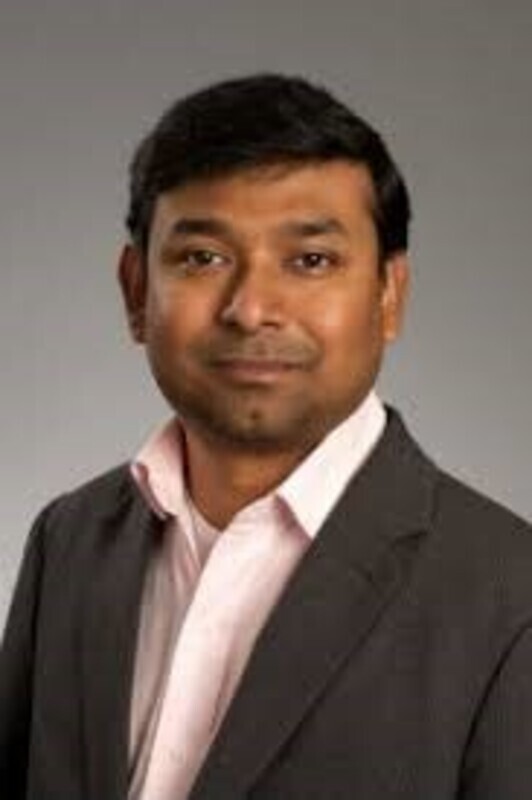
Dr. Gautam Basu Thakur
Interviewee: Dr. Gautam Basu Thakur
Interviewer: Johanna Bringhurst
Description: Dr. Gautam Basu Thakur is the director of the critical theory minor at Boise State University and chair of a new department and major- Humanities and Cultural Studies. He joins us to talk about this new program and the value of applying critical theory to literature.
Date: 2023-08-23
Topics:
The visual topic map is hidden for screen reader users. Please use the "Filter by Topic" dropdown menu or search box to find specific content in the transcript.
Johanna Bringhurst: Hello everyone, and welcome to context. This program is brought to you by the Idaho Humanities Council with funding from the National Endowment for the Humanities. The views expressed here today do not necessarily represent those of the IHC or the NIH. My name is Johanna Bringhurst. And joining us today is Doctor Gautam Basu Thakur. He is a critical theorist working in the fields of comparative cultural studies, postcolonial and globalization studies, British literature of the Empire, race and sexuality studies, and world cinema.
He has a PhD in Comparative Literature from the University of Illinois at Urbana-Champaign. Doctor Basu Thakur is the director of the Critical Theory minor at Boise State University, and chair of a new department and major humanities and cultural studies. Gautam, thank you for joining me today. I'm so excited to talk to you about what's happening in the humanities at Boise State.
But first, I'd love to know more about you and the work that you do. What got you started in the humanities? How did you fall in love with this field?
Dr. Gautam Basu Thakur: thank you Johanna. I am very excited to be here. And, to get this opportunity to talk about humanities and my involvement with humanities and literature. So, how did my journey start? So. More often than not, when I hear this question, I hear responses like it was my calling. I was into literature from a very young age.
But I think, what we often forget is there are other external factors which also shape who we are and what our interests are. And for me, it was, I would say, both, a variety of external factors social, cultural, economic, historic, as well as my own interest in the humanities. So I was born and raised in Calcutta, city in the eastern part of India, which was founded in 1690 by the English East India Company.
And it served as the capital of British India till 1911. So it was not a considered in that the first English literature department anywhere in the world was established in Calcutta in 1815 at the Fort William College. So it was not Oxford or Cambridge, Yale or Harvard where the English Literature Department started, but it started in my city.
So there was already a kind of, culture, where students can go and study English literature, by which we meant primarily British literature. and I grew up in that culture talking of other, you know, social factors, my growing up in a somewhat affluent family meant I went to a private school that meant English was my designated first language.
My mother tongue was officially my second language. And, throughout school, I read literature, primarily British literature. And so there was obviously that kind of relationship, which helped me kind of get connected to, English literature. That said, it was not my first, priority, as a major, when I was in high school, I my first priority was, archeology.
I wanted to, study paleontology, paleo or archeology or paleoanthropology. but unfortunately, my city did not offer an undergraduate course, in, in ontology or paleo anthropology. It was just a history undergraduate major. And then you can go and specialize. And my family was not keen to send me out of state. So I went to my close second option, which was English literature we call the English Literature major English honors.
Now, the other thing that happened was, this happened the year before I went to, college is it was summer like this. The school was about to open and I was flipping through all my new textbooks, and I opened my English book and the page opened, and the lines I first saw where, what do the fields be lost.
All is not lost. Hope and glory, the unconquerable will. And that's from John Milton's Paradise Lost book one. And I was fascinated with the power of the words. I was fascinated with the entire scenario of a defeated Satan trying to make a comeback. But more importantly, I was fascinated with the author or the poet who was able to come up with those words.
I did not know much about the context from within which Milton was writing, but those words fascinated me because I could relate them to my day and time. It was the early 90s, and those words suddenly resonated with the music that was listening to grunge and alternative. I found an odd resonance between those words and Nirvana. Kurt Cobain saying teenage angst has paid off.
Well. I am now old and bored or Smashing Pumpkins saying, in spite of all my rage, I'm still a rat in a cage. So this connection of being able to relate, 16 17th century work written in England in a very different sociopolitical context in terms of my own growing up in a very cosmopolitan city in the eastern part of India via American alternative music, coming from Seattle pushed me towards learning more about English literature, and that's where it started.
So I did my undergraduate, bachelors, in English literature, followed it up with a masters in English Literature. And basically back then in India, studying English literature meant starting with all the English, learning all the English and Middle English, learning to translate from Old English into modern English, reading the King James Bible from cover to cover, and then the entire range of British literature, starting from Chaucer and ending with Dylan Thomas.
So undergraduate degree in English literature. Master's in English Literature with a specialization in psychoanalysis. then finally I did a master of philosophy, where I wrote a thesis, an MPhil thesis on the British Romantic poet Percy Shelley. after which I came to the US to do my PhD in a comparative literature department, because I realized I have been reading a lot of British literature, but not literatures from other parts of the world written in English, including American literature.
So I opted to work in a comparative literature program. But it was also where I was going to get access to training in critical theory, especially psychoanalytic theory. So that's how it started, as I said. And that's, where I am now. And, I've been teaching, British literature and French theory as well as, film for some time.
My first job was at the University of Mississippi and, then for the last about ten, 11 years, I'm here in Boise State.
Johanna Bringhurst: So what are you working on in your own research and writing outside of the classroom.
Dr. Gautam Basu Thakur: So I, I had two projects, going this summer. One I just completed. It's, in the copy editing stage, and it's an essay on Victorian literature or British 19th century literature. And I in that essay, I'm looking at two short stories, one by Arthur Conan Doyle, and the name of the story is The Terror of Blue.
John Gap. And the second story is by Rudyard Kipling, one of my favorite authors. And the title of the story is The Strange Ride of Morrowbie Jukes. What's interesting about these two stories is that the protagonists in each of these stories get trapped in the bowels of the earth and have supernatural experiences. what my essay is trying to do is move away from reading them in terms of the genre, supernatural fiction or horror fiction, and think about why through out the 18th, in the 19th century, and even beyond, British literature carry this anxiety about their protagonists getting trapped in natural chasms like holes, caves, pits, wells, and experiencing in those those unnatural,
natural, yet unnatural spaces, uncanny encounters with cryptid animals, zombie like human figures and things like that. And I make the point that there's a history that's embedded in British colonization of South Asia, a traumatic history which kind of gets represented in British literature in this particular format. the other project which I'm working on now is also an essay, and it looks at the some of the writings of the French 20th century French psychoanalyst Jacques Lacan, especially his ideas about love.
What does love mean? specifically, I'm looking at a very kind of a cryptic statement that Lacan makes, and he's known well for making cryptic statements where he says, love is giving to your other or beloved what he or she doesn't want, and asking from the other that thing which he or she doesn't have. Now, that's very kind of unique in the sense that doesn't go with our commonplace notion of what love is.
Right? So I'm taking up this particular, statement by Lacan, and I'm thinking about how it can be explored or unpacked so that it makes sense to even non psychoanalytic readers. And I'm doing it through close reading of two texts. One is a short story. Most people read it in high school, I guess, or Henry's The Gift of the Magi.
And the second one is a film Clint Eastwood's, Million Dollar Baby. And I'm looking at how in both the love relationship, in oh, Henry's story between the husband and the wife and in the Eastwood film between the coach and his student, that those relationships can be understood using Lacan's idea of what love is. So these are the two projects that I'm involved in right now.
And, these are two very different projects. But, they also kind of both employ, you know, the, the psychoanalytic theories from Freud and Lacan to understand why in British literature we have this, you know, presence of anxieties about getting trapped in fearful spaces. And what is the meaning of love in the Lacanian sense explored via these two texts?
Johanna Bringhurst: You make me think of Jules Verne also being trapped in the earth in having having wild adventures, anxious adventures.
Dr. Gautam Basu Thakur: Absolutely. And, we have that, you know, that thing running throughout the 19th century. But as I said, you see this anxiety of encountering, deadly, underground spaces, even in contemporary cultural texts, for example, the Christopher Nolan's last part of the Batman trilogy, where Bane throws a Batman or Bruce Wayne into the spit, we are never told where the spit is.
We are told it's in a far, far away land. But if we look closely when the camera pans from the pit, you can see in a distance the blue walls of the surrounding city. And those blue walls are particularly recognizable to anyone from South Asia. And I'm thinking to many from outside of South Asia, because those are the walls of the Unesco heritage city in Rajasthan.
Also, the way the pit is designed, there are similar kind of wells like water wells, that were designed during the medieval and the post-medieval period in India, and those exist today. So like those staircases coming down and those, angular cases. So it's very, very characteristically a site that is a far, far away land. But that land is India.
And obviously, you know, in colonial representations, India as a colony or Africa as a colony have always been associated with these kind, as dangerous spaces where the colonizer suddenly encounters deadly, you know, adversaries, where they are trapped. So we see this throughout, you know, as you said, Zhou Vir and other others who are writing. We see that in Ian Foster's very, very well-known novel, The Passage to India, the incident in the caves where you get trapped in the cave and you experience something, but you really don't know what it is.
But it's very, very kind of, detrimental to your health, mental and physical health. So. Yeah, absolutely.
Johanna Bringhurst: I really appreciate how you include film in your scholarship. Films are such an important part of the humanities. How we tell stories, how we train, understand, and our experience. Has that helped you explore the layers of these themes?
Dr. Gautam Basu Thakur: Yes. Yeah. and, India has a very, thriving film industry. Many people know about it. which is the Bollywood industry. So I definitely grew up watching those films. But India also has regional film industries or regional, film productions that happen in regional languages. And, again, going back to the place of my growing up, Calcutta, Calcutta have had film makers, world renowned filmmakers like Satyajit Ray, who Martin Scorsese, he considers to be one of the best filmmakers.
so Ray is in the ranks of Kurosawa and folks like that, there's been, other filmmakers like Ritwik Ghatak and Mrinal Sen and recently, Rituparno Ghosh. So we also have the vernacular film production, which is very different from Bollywood. So you just can't relate. So the difference in, in the analog, just a way to put it would be if Bollywood is Hollywood, then Bengali film would be French.
Films like arthouse films. So that kind of difference. So I grew up watching lots of films. I grew up watching, theater. We have a very thriving theater culture in Calcutta. and I also grew up, thanks to my father, who spent, a long time in the late 70s and 80s in the US. a lot of Hollywood Westerns.
so sometimes my mother would not, like me going to, you know, Clint Eastwood films or Buck Spencer in Toronto. Films by my father would take me anyways. And, then when I was doing my own work, in my graduate level, I found films to be very useful for understand in complex, dense philosophical concepts, even concepts from Freud and Lacan, which I would not be able to understand just by reading their theory.
When I watched a film and I thought about the film using those ideas, I found that to be very helpful. And that's something that I try to do in my writing as well. As I said, I'm trying to explore that very dense and cryptic comment by Lacan about love through million Dollar Baby. Similarly, my first book was an exploration of postcolonial theory.
What does it mean to say I do postcolonial theory? What are the main ideas in postcolonial theory? And then explaining those ideas through James Cameron's Avatar? So I started my public, my first book, my so-called entrance, into the book world with writing about films. And, I do that when I'm teaching as well. I think, our students, they watch a lot of films, and I do not kind of, you know, discriminate between high cinema and low cinema.
I am very happy talking about Francois Truffaut alongside, the Marvel Cinematic Universe. so I find that it also helps students to understand some of those kind of dense ideas, that they might not be otherwise finding, easy to crack. So I think so. So great. And as I said, all, all films that come, whether it's Barbie or, you know, is is going to go around, you know, but what is also important is not to watch or read anything passively.
It's important to be able to critically understand a film or a novel or a short story. And critical. I understand that critical understanding can only happen when we can analyze the text from multiple perspectives. We can. We measure and balance different perspectives, often perspectives that might be opposed to one another. And that only brings out the the quality of art.
And that's something that humanities teaches. both students and scholars how to read and understand from different perspectives, including perspectives which might not have a common meeting place.
Johanna Bringhurst: I totally agree, my family just watched Oprah there where Art thou? And I had so much pleasure and joy in learning and watching the film with my children and my husband, and discussing the history and the art and the soundtrack and the cinematography and. Looking at it from different points of view. You are the director of the critical theory minor at Boise State, and I think critical theory has gotten a lot of attention recently, but a lot of us still don't really understand what the different theories mean and what their utility is to scholars.
Can you explain the value of applying theory and literature study?
Dr. Gautam Basu Thakur: Yeah, absolutely. I mean, I think the first thing that I have to say is, the confusion that many people have over critical theory as a discipline in the humanities, is, partly because of the naming of the discipline or field as critical theory. I mean, what does it even mean to say critical theory? I mean, we have critical pedagogy.
We have, in physics, I think something called critical mass in, in the field of health sciences, we might have something like critical care unit that's critical in critical theory. I mean, the same as critical and critical mass or critical care. so what does it mean? Does it mean that critical means important theory, or does it mean to be able to critically use theory in order to understand a text?
But it doesn't even stop there because, there are two fields within the humanities which carry the name critical theory. The only difference is one uses lowercase cnty and the other, which is the program at Boise State use it. Capital C and capital T you in talking about critical theory. So when we are using capital C and capital T to designate that field, we are primarily talking about a specific moment, which is mid 20th century, and theories or a specific set of theories that evolved or emerged from disciplines not directly related to literature or the humanities.
I would say literature for that matter. and this time and, and, and kind of context must also be placed squarely in France. So what we do in capital C and capital T critical theory is derive, borrow, meld together ideas that emerged in mid 20th century France in departments such as anthropology, history, psychology. So very different from literature.
And by taking these ideas from these different disciplines, we try to figure out ways for understanding literature, cinema or other forms of cultural texts and expressions. So, for example, you know, Claude Lévi-Strauss was an anthropologist and his use a structural anthropology or I mentioned Jacques Lacan, who was a psychoanalyst. So he was a practicing psychoanalyst. He was teaching students to training them to become psychoanalysts.
And his writings then are used when I am reading a text like The Avatar or, Million Dollar Baby, from history, we have Michel Foucault, and then, you know, the person who comes closest to literature with Jacques Derrida, even though he's basically talking about language and the structure of language. so we get very different perspectives for looking at literature and film and, you know, going back to a discussion about film, unlike a short story or a novel, I think film is especially useful for exploring multiple perspectives because it's made up of multiple elements.
We are just not following, narrative presented through visuals. What we are also looking at are the edits. When does a short end, how does it end? We are also looking at the camera angles. We are also looking at the film score. We are also looking at acting and all these things come together. And when we look at these at a film from all these different perspectives, so we are looking at the details, but also we are looking at the whole.
Then we have those multiple perspectives that helps us to critically understand the film. Now, coming back to the usefulness of using critical theory, I think critical here is to be understood. And I really don't like the words, but it's something that has been traditionally used in, in, you know, in the university system. it basically means 20th century French taught not even theory, French taught, I can't say philosophy, even though I consider many of these French, you know, thinkers to be philosophers because Jacques Lacan was a psychoanalyst.
Foucault was a historian. Levi Strauss was a field anthropologist. I don't know how they would have reacted if they were told you're a philosopher. Maybe they would have been amused. Maybe they'd have been flattered. So I would just like to think of the critical theory that we have at Boise State as, as as a program that helps students learn about mid 20th century French thought, which have had a great impact in many humanities disciplines.
Literature included. And it gives the student the perspective of exploring concepts and ideas and texts from these different disciplinary viewpoints. So if I'm reading literature, if I'm reading a text by William Wordsworth or Percy Shelley, if I'm just looking at the rhyme scheme, or if I'm just looking at the context of when it was written, I might be missing out on that critical way of understanding that writing, which can be derived from Livy, Strauss's theories about cultural anthropology, or Derrida's ideas about how words interact with each other.
Right. And I think having multiple perspectives to life in general is very, very important because unless we see, let's say the question like, what is a good life from multiple different perspectives, I don't think we can take a responsible or come with or come up with a responsible answer to the question, what is a good life? and that is crucial for I believe, citizens.
Who, who or for becoming responsible citizens. so what this program does is it tries to offer, multi-disciplinary education to students who.
Want to explore literature and humanities from different perspectives.
Johanna Bringhurst: Thank you for that explanation. That really helps understand that we want to use these tools to just drive greater meaning, more perspectives, more understanding, to consider.
Dr. Gautam Basu Thakur: Yeah, I think I should throw in a caveat. I mean, that's at least my vision. as as someone who is leading this program, it's also kind of my, approach or methodology in my own work. there might be others, my peers who might have a different approach to how critical theory or mid-century French thought can be used.
and again, that's great. I mean, more ideas, more perspectives will allow us to have greater, you know, the, a greater perspective. But, within the limited scope of the program, I direct this minor. The attempt is to give our students the opportunity to learn about various perspectives, which can be then used to understand literary and cultural texts.
Johanna Bringhurst: We're really excited to learn that Boise State has a new department in the humanities that you will be chairing. Can you tell us what it's going to be about?
Dr. Gautam Basu Thakur: Yes, absolutely. I'm delighted to. So this is a new department, and major, this is the Department of Humanities and Cultural Studies. And the major which is launching this fall is, a Bachelor of Arts and Humanities and Cultural Studies. What? So two things that went into this. And this isn't just me working on this. I worked with my colleagues.
I worked with my, the deans in my college. but two things that I would like to mention here, in context of our discussion so far, is me and my colleagues wanted to create a major where students from the Treasure Valley and Idaho and the region would get the opportunity to study traditional humanities disciplines literature, film, culture, but learn how to connect those to the present day and age.
So that's something, as I said, back when I was, starting off as a freshman, I was able to suddenly, almost intuitively connect to John Milton. To me, growing up in the early 90s, listening to American music, if I didn't have that traction, possibly Milton wouldn't have led me towards literature. So I do feel that there are great works of literature.
We have great works of literature, Shakespeare, Rabindranath Tagore. but do they still help our 21st century students? Idaho students connect to their lives in the present? So we wanted to create a major where the traditional reading of humanities disciplines, literatures, film sticks, other texts would also connect to the global present. And the other thing we wanted to do is create a major which would have a strong public facing educational, trust.
So this new major allows a student to gain a degree in humanities and cultural studies, with a specialization in one of the three tracks that we have, we also call them tracks or emphasis areas. So a student can specialize in the area of literature, culture and theory or public humanities. Or the third one is rhetoric and community engagement.
Now a student in literature, culture and theory would, as I said, read, watch and be able to connect that reading and analyze analysis of text to contemporary issues. student in the public humanities would gain the opportunity of learning humanities skills and how to apply them in the public, as in when he or she or they go out to work in the public, engage with the public address.
What are the main issues in the public sphere? The third track, Rhetoric and Community Engagement, will allow students to gain knowledge about the, field or discipline of rhetoric, but also then learn about how rhetoric can be used to.
How rhetoric can be used to engage with the community, or how words and language can be crafted to meet the different needs of our different communities in Idaho. Because the kind of language that I might be using in creating a website for selling cupcakes in Boise would be very different if I'm doing it in, non-urban setting.
so the use of language, how words are to be used and how words can be used to engage with different communities and for addressing different community issues, is the third track. So overall, the idea is we through this new major, we would be able to train a new generation of students in Idaho and the region who would be better equipped to use their humanities skills for public good.
And the last thing I would like to say is, as far as I know, this kind of a program does not exist anywhere in Idaho or the region. So this would be a first for the region. And I'm hoping this would allow us to serve the students of Idaho and the region much better.
Johanna Bringhurst: It's really exciting to see a new humanities program with such a strong public humanities component. We're all trained, I think, to understand the human experience better and to learn how to appreciate the people around us and understand their perspectives, and that our differences are a strength in our community. So I'm really excited to see that students will be going out into their communities and using those skills and engaging more around the state.
Dr. Gautam Basu Thakur: Yes, absolutely. And I think when today we are so anxious about AI and all those things, human students with humanities skills, would play a very, very important role in the near future and beyond. So this would be our, attempt to contribute to, not just the humanities as we know it, but also, reimagining the humanities for the 21st century, for it is not enough just to know how to read or analyze a work of literature, but to be able to take the ideas out of that masterpiece, let's say, from Ernest Hemingway's works or Melville's works, and be able to find their relevance and use in today's context.
So that's the attempt. And, that's why this new program has been created.
Johanna Bringhurst: Wonderful way. So appreciate you coming to the to talk to us about it. We wish you the best success this first semester with your new program. And thank you for being with us today.
Dr. Gautam Basu Thakur: Thank you, Johanna. Thank you very much.