
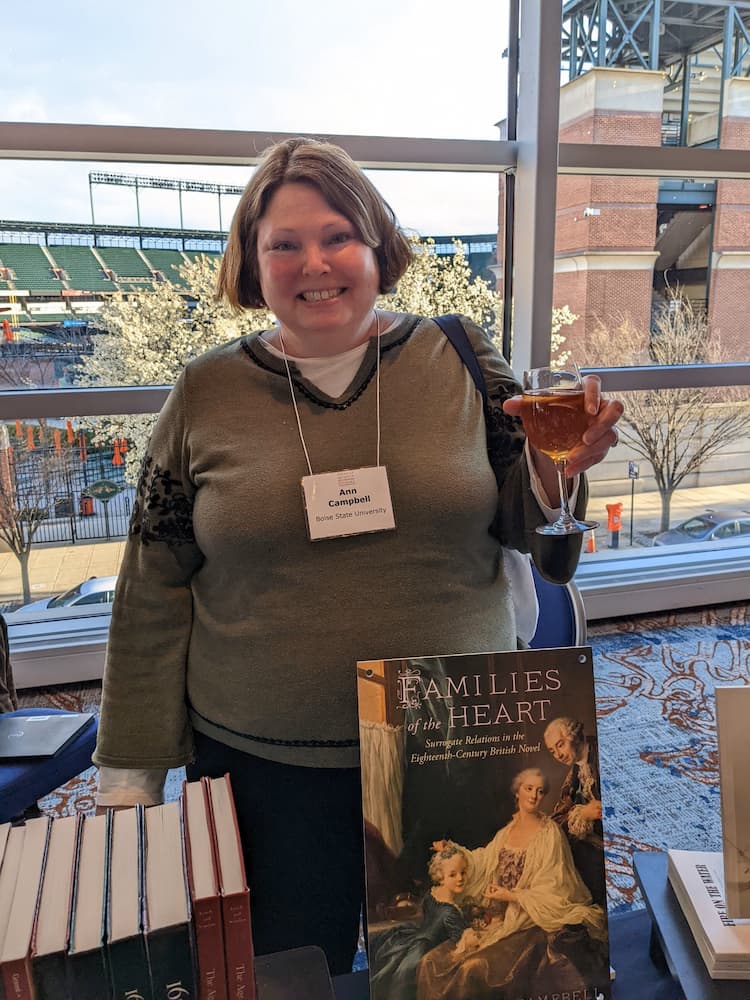
Dr. Ann Campbell
Interviewee: Dr. Ann Campbell
Interviewer: Johanna Bringhurst
Description: Dr. Ann Campbell, a professor of English Literature from Boise State University, joins us to talk about why Jane Austen is the author of our go-to comfort reading and viewing, despite publishing only 6 novels over 200 years ago.
Date: 2023-08-23
Topics:
The visual topic map is hidden for screen reader users. Please use the "Filter by Topic" dropdown menu or search box to find specific content in the transcript.
Johanna Bringhurst: Hello everyone, and welcome to. Context. This program is brought to you by the Idaho Humanities Council with funding from the National Endowment for the Humanities. The views expressed today do not necessarily represent those of the IHC or the NIH. My name is Johanna Bringhurst. And joining us today is Ann Campbell, a professor of English literature at Boise State University and director of the BA Program in literature.
She has a PhD in English from Emory University and is a scholar of marriage and family in 18th century novels, and is also the director of the Hendricks Martin OSHA lit for lunch program and a co regional director of the Jane Austen Southern Idaho Region Book Club. And thank you for joining me today to talk about Jane Austen.
Dr. Ann Campbell: Thank you for having me.
Johanna Bringhurst: We have been talking about Jane Austen in preparation for our conversation today. And even though she wrote over 200 years ago and only published six novels, Jane Austen is still as popular today as ever. Why do we keep reading Austen again and again and watching the movies and the TV shows?
Dr. Ann Campbell: I think there is a powerful pull. The more that society becomes decentralized, fractured and polarized, which certainly describes our current moment, the more we want to return to some kind of cool, peaceful place where things are as we expect them to find them. And they're the same every time you go back. And they're orderly in a way. that gives peace to your mind in times of conflict.
I mean, just this morning, I was thinking about Austen as I drove my son through a coffee line, and, the person who came on took her order. I mean, I don't like those point of service things anyway, where they give you the thing to do a tip. But on top of that, the person actually asked me how much I wanted the tip and my Austen came out.
And if it's a gratuity, right? You don't ask someone what the gift is. And I think when I go through those moments in modern culture where things are seismically shifting generationally or in terms of expectation of what your role is as a consumer or in a relationship with a business. I always think of Austen because she would have a nice little one liner for that, but I couldn't produce.
Johanna Bringhurst: Yeah, I think you're right. And it seems that there is appeal there for both men and women. Like you said, that predictability of the order and the routine of life for men and women was different in that time period than today.
Dr. Ann Campbell: Absolutely. And I think if I were at the stage where I was dating or trying to find a companion right now, I have no idea, how people play that out anymore. I mean, in Austen, there is an old fashioned sense of courtship and predictability. Okay, well, someone has exchanged a lock of hair and everyone looks at that, and the code is clear.
That means that the couple must be engaged. Now, there are times when it turns out the couple has done something outside of the norm, and so therefore they didn't follow the rules. And therefore that, assumption is wrong. But the assumption is we're ingrained in the society. So it's easy to track where you stand with someone. I think that's much more challenging now for certain.
Johanna Bringhurst: Do you think we have nostalgia for those courtship rituals of the past?
Dr. Ann Campbell: Absolutely. Exchanging letters, exchanging tokens. knowing exactly where the relationship is going. Ethical considerations of character and what it means to be responsible to your community. Those are all things that we find in Austen. but a fractured certainly in the modern world. I mean, some for the good. some for the frustrating. But to enter back into that world in your mind is to find a place of peace and placidity that you aren't going to find outside of it.
Johanna Bringhurst: I'm glad you brought up community, because that is a big part of life for Austen's characters is they interact with their community in understandable, predictable ways, and they seem to find so much connection in community that we were missing today.
Dr. Ann Campbell: I think absolutely, especially I think, after Covid. Community is one of the things that suffered the most devastating destruction. And, you know, turning to some of the things like the For Lunch series and the Austen Book Club. those became urgently important to me as part of my life. some during Covid and some after it. But because it's so important to feel integrated into a community and feel meaning and connection in your daily life to other people of goodwill.
and those provide that for me. And I think the more that you engage in the community, yes, you're putting energy outside of yourself, but that energy comes back tenfold. And there's a reason that people, who value that connection are often drawn to Austen because they find that in there and they apply it to their own lives.
Johanna Bringhurst: You're reminding me of the dances in her books and in the film portrayals where everyone goes, oh, you know, the dress code. They know the appropriate etiquette and behavior, how to host, how to be a guest, and the way that they interact through dancing is such a formal structure. I don't think we have anything that resembles that today, do you?
Dr. Ann Campbell: No, not at all. and I think that there is within that structure in the novels, people are evaluated for how much they understand it, whether they can perform it. I love the part with columns and, Pride and Prejudice where Darcy is, he goes and introduces himself to Darcy without a formal intermediary. And you can just imagine you see it in the movies, which is so wonderful.
Darcy looking at him like just a gas. You don't do that, right? Don't you understand these implicit rules? And everyone does understand them. But when he violates them, it becomes a subject of gossip in the neighborhood and humor and, criticism. But for that to happen, there has to be a common understanding of the rules to create that kind of, ethical debate around violating them for what reasons and when.
if you don't have a common understanding of the rules, all the other stuff can't even happen.
Johanna Bringhurst: You're I think you're totally right. And something else similarly that I enjoy about Austen's books are you see the characters, particularly women, navigating life at all of its stages and ages in interesting ways. It's not just about a young woman. You also see the mothers and the older women and women who have never married and young girls, and how they are navigating life and these courtship rituals.
No matter their role.
Dr. Ann Campbell: And I think that the better characters in Austen, the ones that are marked as ethically admirable, are the ones who integrate characters from all stages of life into the community, into their lives. I mean, Emma isn't what we're talking about today, but her responsibility that she reaches to, you know, a poor widow in the community, comes up for a lot of criticisms because the expectation is that she is supposed to, as somebody in the community, if I standing make sure that everybody is included and valued, in the community, whether young or old, whatever their social position.
And I think that for women, you see a lot of characters in here who are widows, who are the unmarried sisters or who are at different stages of life finding a place in the world. to be connected and to be able to enact, Austen's values.
Johanna Bringhurst: I think we usually think of Austen fans as being women, but there are many men who also underground.
Dr. Ann Campbell: Yes.
Johanna Bringhurst: Yes. Who also value the role, the roles that men play in Austen novels.
Dr. Ann Campbell: Yeah. And I think we talked about this a little bit, even just before we started the show. I think it would be very hard to kind of figure out what your role in society is as a young man. Now, being a 16 year old, we were talking about sons and what that means. that on the one hand, there's an expectation of them treating everybody equally and respectfully and thoughtfully, which is what it should be.
On the other hand, there are still all the expectations of certain types of codified manners as well. and it's not necessarily clear which role is going to be rewarded at any given moment and what it means to be respectful of women, while at the same time feeling confident about your value in society as well.
Johanna Bringhurst: But in Austen's world, it was very different for men.
Dr. Ann Campbell: Yeah, absolutely. I mean, interestingly enough, in a lot of her novels, what we think is the dividing line between men and women in conventional family relationships from the 50s is very different because men don't work. You know, nobody works really. Not. I mean, their, their, their lives are much more close in structure. And women don't do childcare necessarily, constantly in the upper classes because they have nannies and governesses.
And, so they both have leisure time and responsibilities to the community and hospitality that are, would look different in kind of the 50s nuclear style family. But men did have their rituals, and all these Pride and prejudice going out hunting together or, you know, having drinks after dinner when the women went off and had tea in the other room, there were expected rituals of connection in the neighborhood, with other men and a role that they played in the family.
That is certainly different from the kind of, not knowing exactly what role you're expected to play. Now.
Johanna Bringhurst: Thank you for that. In, in our discussion, we decided we wanted to focus on two of us since novels that are best known. Pride and Prejudice and Sense in Sensibility to explore some of these issues. should we start with sentence and civil?
Dr. Ann Campbell: Sure, absolutely.
Johanna Bringhurst: Okay, so let's talk about, the men in this novel and what, society expects of them. We have Edward Ferrars, who has a younger son in a big family that is wealthy, moderately wealthy, and Colonel Brandon, who is a man of leisure who, had a career in the military. And what do what is life like for them?
Dr. Ann Campbell: I think life for them. I mean, you see that with, Edward, his sense of direction, listeners, he wants to go, into the clergy, but his family thinks that's not fashionable enough. but he's kind of a retiring, quiet guy. He wants the quiet life, and their expectations of him are different. And you see, Colonel Brandon, who has been disappointed in love and, you know, is now from Marianne's point of view.
I admire the old man because he wears flannel waistcoats. Right? but he still has an important role to play in the community. he's seen as a bachelor, but he is somebody who is anxious to find a bigger connection to the community. Ultimately, through marriage.
Johanna Bringhurst: Right. And B, these are the men who are in a courtship ritual with the two main characters, two sisters, Marianne and Eleanor, who have very different temperaments.
Dr. Ann Campbell: Yes, very. Yeah. What is it? my favorite character. Almost in the novel. The two characters are. The Palmers were minor characters, but I think they're just hilarious. Mr. Palmer being this kind of acerbic character who's always kind of nasty and getting off zingers, I think he was played by Hugh Laurie in, which is perfect, right?
And Mrs. Palmer, who is just the most good natured, kind of lazy thinker in the world, and they have these wonderful interactions where he says something nasty to her and she says, oh, you know, Mr. Palmer, you're so rude. And she laughs. And then that wonderful lunch, she goes where Mr. Palmer is just the kind of man I.
So you have these marriages that, some of them appear ill suited, but work because of the personality types involved and some of them ill suited. and in conflict. But overall, because people are integrated into larger communities, the individual relationship, even if it's not incredibly successful, can weather the storm. The Palmers have virtually nothing in common, but they're constantly traveling around and connecting to other people.
Same with, Sir John Middleton. And that's the biggest part of their lives. Is this connection to a larger community?
Johanna Bringhurst: That's right. You see the Palmers and the Middletons who don't see maybe the best suited.
Dr. Ann Campbell: Men in.
Johanna Bringhurst: There.
Dr. Ann Campbell: But it works because they both have the things that they enjoy in life that overlap. I love Sir John. She's got one. Austen has one line. It's. I think it's got a semicolon or something. It's a parallelism where Sir John was a sportsman. His wife was a mother. And it's clearly meant to be comic and critical in some ways.
But it also works because Sir John runs around the country and collects people to go to dinner. And then Lady Middleton gets to perform dinner. Right? With all of these, she's got an ample amount of money and she likes to entertain. And, so even though these people have very little in common, somehow the marriage functions because there's a complimentary, expectation of what each of their roles is that they both are on board for.
Johanna Bringhurst: Interesting. So when we see Marianne and Eleanor, you know, evaluating their prospects for marriage, looking forward to the future, they've just lost their father. Their circumstances have changed. How do they navigate these different relationships in these different opportunities?
Dr. Ann Campbell: Well quite different. We obviously what's the title? The, Marianne trusts herself, entirely and her emotions, and she spurns convention and the kind of rules that Austen, expects people to behave according to. She gets burned, by Willoughby, who exploits that. and Eleanor, on the other hand, is so reticent and follows the rules so much that she ends up being poked in the eye by Lucy Steele, who exploits that.
So, there's all kinds of examples of how following your heart has advantages and disadvantages and either extreme of completely acting according to the rules without any sort of concern for individual circumstances, or violating them without any concern for the consequences of that are both two extremes that, neither of them work particularly well.
Johanna Bringhurst: Perhaps part of what's comforting also about us in Trading and Sense and Sensibility in particular, is, you know, they're happy. Yes. Come in. Marianne has her heart broken, but then, you know, but she ends up with the person who is right for her ultimately. And it's someone different. And Eleanor, has this love that she thinks is requited.
But circumstances don't allow them to be together. And ultimately the circumstances change that they can't be together.
Dr. Ann Campbell: Yeah. there's a lot to be said for a happy ending for marriage represents. And literature in an art which is typically an integration, successful integration. into society and a maturation and ability to kind of work within a community, in a relationship, instead of just being a free agent.
Johanna Bringhurst: Oh, I like how you said that. Why do you think that Sense and Sensibility still resonates with people today?
Dr. Ann Campbell: Well, family conflict is a no, I think confined to the past.
Johanna Bringhurst: Unfortunately, no.
Dr. Ann Campbell: And brothers and sisters, still today certainly is. Then, can have completely different personalities that come into conflict, and evaluate and judge each other's lives, consistently. So I think the family drama part of it resonates. I think also this the fact that, Marianne, in some ways is a very realistic portrait of even a teenage girl today.
I mean, she's hardheaded, she's moody, she's very emotional. She wants to read romantic poetry because she feels she's, you know, she's got the emotional depth for it, which society doesn't accept. So she very much as that kind of anybody who's been around girls that she was familiar with that dynamic. And, there's a pretty much an Eleanor in every family.
if there's more than one kid. Right. You are. Who's the one who's kind of the organized get things done. practical, more Type-A type in the family, trying to get things, consistently on track. And I think we're attracted to that. We're attracted to family drama, which is eternal, and we're attracted to the idea that there is somebody for everybody, where you can feel most yourself and most comforted and most secure in a relationship.
Johanna Bringhurst: I was struck also, reading Sense and Sensibility again, how I felt like I knew these people.
Dr. Ann Campbell: Oh, yeah.
Johanna Bringhurst: The the psychology of the individual, the Jane Austen character that.
Dr. Ann Campbell: I sort of time.
Johanna Bringhurst: Yeah. Yes. Absolutely timeless.
Dr. Ann Campbell: I mean, that's why the poem I know the minor characters in since are my favorite, the middle Lady Middleton, but kind of she just likes to entertain and and Mrs. Jennings, I love Mrs. Jennings. She's described as kind of vulgar and over loud and jolly. You know, she's a wealthy widow, and she just does what she wants and tries to marry people off.
And she's always in a good mood. And, I love that. I love these kind of characters who are just they're unconventional for Austens time, but they make a success of it, and there's warmth and charm and generosity in them as well. I mean, Mrs. Jennings may seem like she's just kind of bumbling about, you know, being her loud, jokey self, but she's the one who invites the sisters to stay in London.
There's a warmth and a kindness in her that, that's really valuable and meaningful to the resolution of the novel.
Johanna Bringhurst: And she this is one who cares for Mary, Marianne and Eleanor. When will it be? Breaks her heart.
Dr. Ann Campbell: And yeah, she tries to comfort them in her own way, and she's, she's just to me, those those minor characters are delightful characters in this novel. And the Palmer is just. I mean, I wish I could see them in every scene. They just are hilarious.
Johanna Bringhurst: I know. Do you think that we can relate more to the main characters or to the minor characters?
Dr. Ann Campbell: To me, I like the minor characters in it better. I mean, this is an early, Austen novel, and it was originally written as a novel in letters and then changed to a different perspective. And I think it still bears the marks of some of the clumsy kind of, transition from one very different mode to another. So Eleanor and Marianne, I mean, they're meant to be examples of sort, two certain types of character, and so they can feel wooden at times or almost caricatures.
But for some reason, the minor characters, to me are the most lively and joyous part of the novel.
Johanna Bringhurst: Yeah, I, I agree, I, I loved Hugh Lowry's portrayal.
Dr. Ann Campbell: so I mean, that's play from thinking. I mean, every time I read this part with Mr. Palmer, I think of him. He's just the perfect.
Johanna Bringhurst: And we all know that person, right? Oh, yeah. Sarcastic curmudgeon that.
Dr. Ann Campbell: Yeah. Who may have, you know, who may be a good person at bottom, but they can't. What they really want is to, you know, be the original in the room and just have the zingers and just to kind of be above it all, you're right.
Johanna Bringhurst: And then we see ultimately, when Marianne is taken ill and their home, Mr. Palmer behaves so gallantly.
Dr. Ann Campbell: He's a decent guy at bottom, but he's his his ruling, passion, which is a term used a lot during that period. it's kind of your dominant character trait. below that is still a goodness of heart. But he finds that vulnerability, I think, passé or embarrassing to expose. it makes him, in his opinion, look silly and not particularly bright.
So he keeps the best part of his character hidden.
Johanna Bringhurst: One character that I, I was telling you how much I admire is Colonel Brand Brandon, that he suffered a heartbreak but behaved so selflessly and gallantly in that situation. And now he is in love with someone that he has no expectation will love him back, and yet still his a true, generous, kind friend to that person. I personally would like to find a colonel you mentioned for for a friend.
Dr. Ann Campbell: I feel that it should be an ask the lady what a dating app or something right? Do you want a Colonel Brandon? You know. Do you want a Edward Ferrers? People can take personnel. Are you just looking for a will? Yeah, he does want a will be for a good time weekend.
Johanna Bringhurst: thank you for your million dollars.
Dr. Ann Campbell: Yeah. I mean, well, as a academic, quite entrenched in the inability to monetize anything I do, but, yeah, I'm sure somebody who's financially smarter could do that. But it is true that those character types are very common. In fact, when I pop Pride and Prejudice in an honors seminar a couple of years ago, there was an H.
an HBO special. I can't even say the name on this, but it was Fboy Island, and we actually talked about that relationship to Pride and Prejudice, because Willoughby pretty much falls into that character type, you know? Well.
Johanna Bringhurst: So let's transition to Pride and Prejudice. in this novel, we follow the Bennet family, who has a number of daughters, but we learn quite a bit about the older three.
Dr. Ann Campbell: Yeah.
Johanna Bringhurst: What do you say on a.
Dr. Ann Campbell: Well, at least two. You know, the third kind of iffy, but, I honestly, again, I kind of like everyone loves Elizabeth. She's pretty much everyone's favorite character and she is just delightful. But I find a lot of humor in Lydia, honestly, just the kind of brazen side of her. I mean, Austen, I think one of the things she does that is so brilliant is that she'll put people of different character types in conversation with one another in order to expose all their flaws without having to even comment on it.
So, for instance, when Collins is trying to read, he wants to read Fordyce's sermons, which is this, you know, tiresome, preachy tract, on all the kind of submissive traits that women should exhibit. Lydia's gets bored and starts talking about the regiment. She's racist. She says, or he says, I never read novels, and her mouth drops. I mean, that makes Lydia look terrible because she has bad manners, but it also speaks in some ways to what, kind of tiresome boor and sanctimonious guy Collins is by insisting on reading these, reading these sermons to young women.
So the novel is incredibly clever at putting characters into conversation to expose the strengths and weaknesses, through the conversation and not through expository, kind of, didactic passages.
Johanna Bringhurst: That's true. We learn a lot about each of the daughters in the Bennet family. When their cousin, yes, Collins comes to town and they each have to interact with him in different ways. So how does the Bennet family operate in their community?
Dr. Ann Campbell: Well, it seems like this community is pretty limited, and you always feel in these novels there's a fairy tale component, no question, because, there's really not much opportunity for these young women to meet men. Everybody in the community, they already know it's fairly small. Their role in it is pretty clear. They're connected to the Lucas's. They're connected to a few other families.
But how are they going to meet men? Any of them really? Mr. Bennet refuses to go to London during the season where typically women of that class would meet men, because he just kind of likes his library. And a little self-indulgent. And the mom is a bit crass. Right. So if that first line in the novel, probably the most famous line in literature, potentially about the universal, universal truth of, a man, young man of with money and position, being in want of a wife.
It's held up to some kind of it's obviously an ironic statement is held up to ridicule through the figure of Mrs. Bennet, but it turns out to be absolutely accurate, because Mr. Bingley does very Jane and Elizabeth, those Mary Darcy. So these men who get imported do get parceled out to the women. Wickham marries Lydia. Not a great match per se, but in fact, it does turn out to be true that all of these young women find some kind of match when these men are thrown into the neighborhood.
Johanna Bringhurst: Mr. and Mrs. Bennet have an interesting marriage. Yes. Well.
Dr. Ann Campbell: Interesting is one term for. It's kind of like the farmer's, in the sense that you get the kind of acerbic, satiric father and the kind of clownish mother, but so extreme that it is kind of a dystopian looking marriage that clearly Mr. Bennet thought Mrs. Bennet was really hot back in the day, and married her, and now has a sort of contempt for himself based on the decision you made.
And he's not he's not willing to accommodate the reality of the decision he made and be a good father and find peace and, peace and value in that. Instead, he just isolates himself off in his library. So a lot of the problems in the family are a total lack of parenting. I mean, when, Lady Catherine comes across as kind of the evil, see witch type character, but I love her.
Honestly, I find her hilarious. when she says things like, why didn't you have a governess? Why didn't you learn? I mean, it's a good example of putting, those two character types in contrast or conversation. But by putting these thoughts in Lady Katherine's mouth, it makes it seem like they're bad. But the reality is they should have had a governess.
They should be going to London and meeting people. They should have been trained and disciplined and, had a more, structured childhood. Because, you see, especially with the youngest ones, they're just kind of running around crazy.
Johanna Bringhurst: Yeah. And I think that's part of the comfort in reading the book is these sisters who haven't had the most opportunities and the best foot forward in life still make excellent.
Dr. Ann Campbell: If it works out for.
Johanna Bringhurst: Matches, it works out for them.
Dr. Ann Campbell: He is happy because she, you know, she has such low expectations and not much discernment. So wandering around the country with Wickham, you know, trying to find cheap lodgings, is acceptable to her.
Johanna Bringhurst: That's true. Tell me more about the men in Pride and Prejudice.
Dr. Ann Campbell: Well, Darcy's the dreamboat, right? And, of course, we tie him up now so much, with Colin Firth. Right. Who plays him in the show? I do remember hearing something that I thought was funny, that in VHS copies that people used to have at blockbusters and libraries, if you remember those, there were two scenes, according to this kind of urban legend of blockbusters that were always, fuzzy because people had played them and replayed them.
One of them was the Phoebe Cates, scene in the pool in Fast Times at Ridgemont High, and the other was the Darcy in the Lake scene and the BBC Brighton Bridge. So very there's a it's an interesting parallel because once a kind of sexy shot of a woman and the other a sexy shot of them in, but in very different contexts.
Yeah. But that, that kind of romantic vision of Darcy is, got some Byronic characteristics, but, passionate and loving and loyal at heart. In the end, he's the ultimate dreamboat prom king of literature, no question.
Johanna Bringhurst: But he's also very socially awkward. Oh, yeah. Not able to express himself well. He doesn't behave as he ought to, and.
Dr. Ann Campbell: He's saved by a good woman, right? That's one of the awesome plots of literature, right? She trains him up and he shapes right up, you know. But, of course, in the novel, his brush kind of behavior just over lies a good, loyal heart. In reality, a guy who acted like that probably is just a jerk. It's a nice thing about Austen's world.
It's at the bottom. There's a deep well of, kindness and warmth just waiting to come out.
Johanna Bringhurst: Maybe that's true of all of her characters. She seems to write lovingly about even her most absurd yeah characters, and expresses their psychology in more of a full way, where you see how the characters first react to someone, but then after time and intimacy, see how that understanding changes, which is pretty reflective of real life.
Dr. Ann Campbell: Yeah, and they find a place where their type of personal city will function successfully in the world. Most of them I, I, Charlotte Lucas is a favorite character of mine who gets, I think, pretty abrupt treatment by most readers of Austen because you, you know, who wouldn't like Elizabeth better? Who goes around telling off man all the time and does exactly as she pleases?
But Charlotte is a more representative figure of the time who really understands the practicalities. for women who don't get married of limited means. And she finds a way to make her marriage to Collins, who is a repellent character, successful, right? She chooses the back room to where he's not going to come and stay because he can't see Lady Catherine from the road.
She encourages them to go out and guard right for the helpful exercise. She enjoys her hands. I mean, she finds, she finds way to be content in in the kind of middle road and choosing a life she knows isn't going to be fantastically romantic like Elizabeth's. But that gives her security and connection and, gives her a role in the world that is her own.
Johanna Bringhurst: That's part of, I think, why we return to Austen again and again is that you see a character like Charlotte Lucas use her agency to build the life that will make her happiest in the circumstances that she has.
Dr. Ann Campbell: Yeah, absolutely. I mean, what is that famous line? I wish I had it right in front of me with, without ever thinking much of men or marriage, marriage had been her object, right? But she knows herself, and she's self-aware about what she wants, and she's willing and happy to, to settle into it. And then you get Elizabeth, who shoots for the stars and gets it because it is, a comedy, right?
Ending with marriage. So you got both ends of the spectrum, and there's contentment and happiness and both in their own ways.
Johanna Bringhurst: Mr. Darcy has a friend, Mr. Bingley, who falls in love with Jane Bennet. What is really interesting about their relationship is that they are so well matched and well suited for easy temperament.
Dr. Ann Campbell: Right? I mean, in a way, I almost think these two in life would be incompatible because they're too similar. You know what I mean? In almost every relationship that I know, there is a spender in the saver. And, you know, the more social one and the more introverted one like these two are almost a carbon copy of each other.
So it's kind of one of those relationships that I feel like looks good on paper, but like, would it actually work? I don't know, but they're both drawn to each other because they're very amiable, easygoing, people pleasing type of people.
Johanna Bringhurst: And then we have the opposite of that, right? Yeah. Mr. Darcy and Elizabeth.
Dr. Ann Campbell: Yeah. That's where all the sparks and the fireworks are.
Johanna Bringhurst: So is their courtship traditional for Austen's time, where they, exchange notes and run into each other. She shows up at his house.
Dr. Ann Campbell: She takes a.
Johanna Bringhurst: Tour.
Dr. Ann Campbell: I mean, it's I think it is, it's fairy tale context in that sense, because it would be very unlikely that he would be thrown into her orbit that frequently and, you know, in the period. But I think that, they're kind of they're the model for every romantic comedy afterwards. Right? It's always that kind of opposites attract.
And it starts out with dislike, and it, moves towards affection as they see each other in kind of pressured circumstances or learn more about each other. But it is much more. I mean, it sets the standard for the romantic comedy. you know, You've Got Mail has the same sort of dynamic, right? All the 90s romantic comedies, they're always about essentially two strong willed characters who start out in conflict and move towards, mutual respect and resolution.
Johanna Bringhurst: You know, when I was in ninth grade English, I remember my teacher saying, every story you've ever read or seen comes from the Bible, Shakespeare or Jane Austen. And there's some.
Dr. Ann Campbell: Truth to.
Johanna Bringhurst: That. Yeah. He had this challenge of what's, not can you find an original story or plot that doesn't connect to those? And I was really surprised to see how much is inspired by, Pride and Prejudice. persuasion, sense and Sensibility.
Dr. Ann Campbell: Oh, absolutely.
Johanna Bringhurst: In our current literature and in television and film.
Dr. Ann Campbell: Well, it is the ultimate romance story. And there's a reason that it's the favored, you know, I mean, there are definitely people who prefer the later novels persuasion, but they're outliers in a sense. I mean, the average Austen fan and for very good reason. Pride and prejudice is the favorite. It is that warm place you go back to.
It has the sparkling wit and charm of the characters and the interaction. It's got the gradual unfolding of understanding, and all of her novels are smart enough to end with marriage, right? Yeah. Any of us who've been married know that, no. Marriage is smooth sailing. you may be very satisfying and joyful at times, but it's also going to involve a lot of conflict and, being at odds at times.
And so she has the perfect kind of end at the time when everybody's happy. And as you read it, you know, you're coming to that and there's a great deal of satisfaction in them. Yeah.
Johanna Bringhurst: Earlier you talked about how during Covid and after you became much more involved and valued partnerships and relationships you have with other Austen fans. Can you tell us a little bit about the Hendrick Martin oh, sure. Lit for lunch program.
Dr. Ann Campbell: I love this. unfortunately, I got thrown into the position of running it when, Cheryl Hendricks, who's the Hendricks part of the Hendricks Martin, who was a colleague and a professor at Boise State. She had a long illness, and she died, and she was the one running it. So it's an honor to honor her, a good friend, an amazing colleague, a great scholar.
And just because for myself, I had been really finding the value of these social connections through literature. I decided to take over that program. We moved it over to OSHA because it's, got in its theme and purpose is to, provide college level, intellectual material and engagement for adults 50 and over. So, I mean, it's right in my wheelhouse.
And every year I do an Austen novel in there. And then obviously with the Jane Austen Book Club that I run. You're quite a bit of Jane Austen, too, but I've found so much meaning out of that. I love teaching, I love being in the classroom, I love my field, but there is something I mean, you're still having in a classroom.
There's reading going on. Students, honestly, in their 20s, and I was at that stage at some point in my life, too. Your life is all over the place. There's so many different things going on, so many priorities. Because you students have jobs and commitments and families, some of them have children, you know, parents, they're taking care of, a literature class is, is is a small slice of a part of their life.
But in a lot of these other programs, these are often retired people. And this is a huge, part of their life is these book clubs. And they have so much wisdom to share based on their life experience. I mean, I brought my parenting problems to it for lunch and gotten some good advice from, people who've gone through it all before and the way they connect the literature to their lives.
To me, that becomes more and more of an important thing is what are these? What do these stories have to say to us as people navigating the world? And, you know, having read kind of some of these self-help type books, but more kind of what makes a good life again and again and again. One thing you see over and over, of course, exercise is good, but that's a bit harder.
You know, eating vegetables is never bad. Need a carrot stick, even though it never seems appealing, but the one that brings joy and that has incredible impact on people's health and longevity is friendships, either casual or, glancing. Even the interaction you have with somebody at the grocery store. But these kind of long term intergenerational friendships that show up in Austen, everywhere in these book clubs, you form them and they are a great source of connection and joy.
And, you know, I do all this stuff as volunteer work. You know, my job is at BSU. And yeah, I get asked why, you know, why are you putting all this energy into these things that aren't bringing you any money? And honestly, it brings me the greatest joy, these connections. And, it has made my life so much richer.
And I think Covid, in a sense, for a lot of us, was that stop sign in your life where you were forced to pause and think about what you value and what you're going to do going forward. And for me, emphasizing things that were connected to other people and connected to my joy literature was where I wanted to very deliberately to go.
Johanna Bringhurst: I really appreciate you saying that, that just because we don't live in the time of Austen, when those social connections were such a part of the structure of your life, doesn't mean we can't find them. We just have to build them and create them and work at it today.
Dr. Ann Campbell: Yeah, they're there and you have to, take some risks and go out and make the effort to find them. But it's the reward is just tenfold for every bit of energy you put out there, and the kind of love and value that comes back and the lifelong connections to people who are interesting and fun to talk to is just incalculable.
I mean, I can't imagine not having things, these things in my life now.
Johanna Bringhurst: And you're a part of the National Jane Austen Book Club as well. How did you, become a member? And if our listeners are interested, how can they get involved?
Dr. Ann Campbell: Well, that's a great question. And I love, the southern Idaho region of, the national Jane Austen Society. And I love the national Jane Austen Society, too. I got involved in it essentially, maybe five years ago. Six I made two, New Year's resolutions. One of them, Henry, was starting to get my son, maybe 7 or 8.
I mean, he was still, there's a lot of demands, but I could see that his focus in the world was changing to his friends. And so I'm a planner, right? That type A Eleanor. personality. I'm like, where am I going to go from here? What is my life going to focus on? And so I decided to take tennis lessons and to join the Jane Austen Society.
Now, one of these things worked out. One of them didn't. I'm a very poor tennis player, apparently, and I hate running. So I was constantly dragged on a tennis class that didn't go very far. But, I joined the Jane Austen Society just as a member and started going to the book clubs and the person who was running them, she was just starting up a new stage in her own life, where she started a business out in Eagle, so she really didn't have time to run it.
Given my connection to BSU and the field, it was a natural. And so I just kind of picked it up and I started running, zooms, you know, during Covid, which is not my favorite thing to do. But there was people were so excited to see each other in any kind of format. And when it picked back up, you know, just the joy of people hugging one another and being connected and, you know, the their love of the books and their love of the community and their hospitality.
I mean, being at some of these meetings is like living in an Austen novel, because these are people who care deeply about hospitality and community, and they have taught me so much about how to live a fruitful, meaningful, connected life.
Johanna Bringhurst: If you are interested in becoming a member, we'll put the website right.
Dr. Ann Campbell: Yeah, it's a fantastic investment. And just like as a little aside, I got my mom involved too, who lives here and we do all this stuff together. Last year we went to the National Aspen Conference while I was on sabbatical up in Victoria. and it was just amazing. And we're going to go to the one in Denver this fall.
So it's become, a new way to connect with my mother as well as a connection to the community. And it's just such a great experience. She's now 80, right. So how many years she has left? it's not clear. But to have these experiences together over Austen is just something I will never forget or undervalue.
Johanna Bringhurst: Sharing your love together, absolutely. Well to finish up. Since you are an Austen scholar, I have to ask you which is your favorite book? Oh, and who is your favorite character?
Dr. Ann Campbell: Well, funnily enough, my husband can't help but remind me because you know, he's got a bit of Mr. Palmer in and I got to get his digs in occasionally. when we first met. Yeah, I must have asked him to read in us the novel, and he obliged by picking up mansfield Park, which I then was like, oh, no, don't read that one.
Read Pride and Prejudice. That's the that's the first, that's the my first Austen. well, everyone should do. And now he claims that he never read it again because I crushed his love of Austen in the. You didn't read out right. It's all my fault that he never became an Austen fan. But ironically, honestly, Mansfield Park is one of my favorite, Austen novels.
Now, I tend to really love the, minor characters and their relationships and connections. And I'm not a big fan of Fanny, but the world depicted in Mansfield Park, I think. Is it quite brilliant and artistically complex? Yeah.
Johanna Bringhurst: Okay, so if we have not read Mansfield Park now.
Dr. Ann Campbell: With Pride and Prejudice, but I never I'll never I guess the lesson here. Well, the lesson on my point of view is just that he was getting lazy and didn't want to read it, and so he was able to get a shot in there. But, the lesson from his point of view is never discourage anyone from reading whatever asked and they want.
Johanna Bringhurst: That's perfect. Last words. And it's been such a joy to talk to you. Thanks for being on context and thank you so much for speaking so beautifully about how important human connection is and how much it matters to a life of love and joy and a long life to connect with people that we love over things that we love.
Dr. Ann Campbell: Absolutely. Thank you so much for having me. I can never say enough good things about Austen and the wonderful people you meet. through studying her and reading her.
Johanna Bringhurst: Thank you.