
Susan Anderson
Interviewee: Susan Anderson
Interviewer: Johanna Bringhurst
Description: Join Susan Anderson, History Curator at the California African American Museum as she walks us through gold rush California. She will look at this time period in California history through the lens of African Americans and their stories.
Date: 2023-02-17
Topics:
The visual topic map is hidden for screen reader users. Please use the "Filter by Topic" dropdown menu or search box to find specific content in the transcript.
Doug Exton: This program is brought to you by the Idaho Humanities Council, with funding provided by the National Endowment for the Humanities. With us today is Susan Anderson, the history curator for the California African American Museum.
Susan Anderson: Well, hello everyone. I am going to tell you a few stories, today that are going to provide some background on a subject that isn't very well known. And it has to do with the presence of African-Americans in Gold Rush California. And we're going to use this as an opportunity to maybe break a few myths and share some history that isn't that well known.
And one of the things I'd like to mention, first off, is that even before California was a state, there was a fairly important African-American presence. I mean, it goes all the way back, to Spanish colonialism when the conquistadors and their missions were being established. Many of the people that traveled to New Spain, to the New World were African descended people.
They were navigators on ships. They were sometimes priests. There were sometimes enslaved people. They played all kinds of roles. So in those parts of the United States that were colonized by Spain, the African presence started early. And at the same time coming more into the 19th century, there were definitely U.S. born African-Americans in California. And what we're looking at here is a picture of a man named John Grider.
And he has a really extraordinary story because he was part of what we call the bear Flag Rebellion, which was when a group of us born people living in what was then Mexico, Alta California, threw up a flag that they improvised at the, Presidio of Monterrey and declared, California's independence from Mexico. Now, this was in 1846, four years before California became a state in the United States.
But one of the things that's been excluded from this narrative of California's origins is the fact that there were at least seven African-Americans who were with Fremont, Colonel Fremont in the United States Army and others who were part of the Bear Flag Rebellion. And John Grider was one of them. An example of U.S. born black people active in California even before California became a state.
And another example of that is the building of the first black church in the western part of the United States at Saint Andrew's AME church was established in Sacramento in 1850, and over the 1850s, that period of the Gold rush, Saint Andrew's A.M.E. church was the site of most of the meetings of what were called the, Colored Conventions.
Many states free states during the 19th century had what they called colored conventions, and these were big statewide meetings of leading African-American citizens who were organizing against slavery and organizing on behalf of their equal rights. And California had its own branch of the colored Convention that started meeting in 18 55, which was kind of the peak of the gold rush years.
Here's a map that shows the part of Northern California that was dominated by the gold fields. And you can see the orange snake figure that moves down through the eastern Sierra Nevadas. That was, considered the mother lode. the gold mining region was probably about 120, miles, from the top of El Dorado County, down to the southern end of Mariposa County, very close, as you can see, to the border with Utah, deep in the interior of California, in the eastern Sierra Nevada.
And the gold rush was of great interest to African-Americans around the United States, partly because, as, African-Americans joined the throngs of people from the United States and around the world who were coming to California in one of the largest human migrations in history. there were stories being published in the newspapers back east, especially the abolitionist press, with amazing tales of wealth that was being earned by African-American miners in California.
And this acted as a lure, for black people as well as white people and others of all nationalities who came to California during the Gold rush. Gold was discovered in 1848. You've heard the phrase 40 niners by the new year of nine 1849, people were thronging to the stage. African-Americans included. Black people were also interested in California, not just because of gold, but because of the possibility that California could decide how many slave states there were in the United States and how many free states there were in the United States.
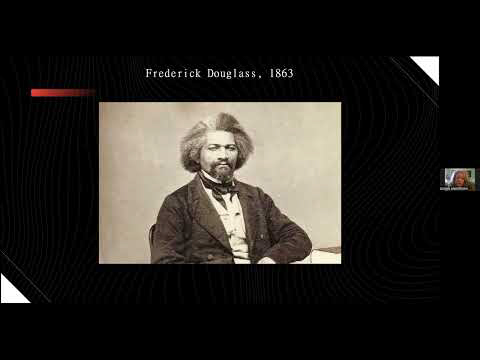
So the gold rush happened under the scrutiny, worldwide scrutiny. But it was definitely, if you read, black newspapers like Frederick Douglass paper, we're looking at an image of Frederick Douglass, the great 19th century orator, abolitionist and leader. If you read his newspapers, if you read The Christian Recorder, which was a national newspaper of the African Methodist Episcopal Church, if you read William Lloyd Garrison's newspaper, The Liberator, you would be able to see the level intense level of interest that African-Americans around the country had in California and in the gold rush.
And indeed, although many histories, if you, are a kid in the school system in California, it's not likely that you're going to learn much about the history of African-Americans in the gold fields. But as these next two daguerreotypes that I'm going to show you prove, there were indeed, miners, of every of every background in the gold fields.
This is a daguerreotype that was taken in 1852. It is attributed to a photographer who had a studio in San Francisco named Joseph B Starkweather. It was taken by him, in, Auburn Ravine, up in the Gold Country. And you can see on the right, down in the bottom of the photograph, the tools of a miner, the pickax that stuck in the dirt, the gold pan.
That's kind of precarious. Viously perched on those rocks. The bucket and his shovel in, this long tom or this rocker, where water was poured over rocks as one of the ways to separate gold from ordinary rocks and dirt. And this is another daguerreotype taken in the same year of 1852 by the same photographer. Starkweather, that shows an interracial group in Spanish flat in El Dorado County.
El Dorado County is where gold was discovered at a place called Coloma. And you can see the two miners with their rocker up front. You can see their diggings where they went underneath the surface of the earth to find or rocks that may contain gold. And behind them, the freight wagon, with two miners, one a teamster driving the wagon and the other, probably, hired to load the wagons, with the with the take of the day.
And another map of California that shows the entire state. And you can see colored in toward that border. the, the gold mining region. And one of the things we really need to consider about the environment that black people faced in California is that it was admitted into the United States in 1850, and it was admitted as its constitutional convention had wanted, as a free state that had a constitution saying that California would not tolerate, slavery.
At the same time that California was brought in as a free state, this compromise passed by the US Congress contained a series of bills. And they were in this situation during these years leading up to the Civil War, of trying to balance the, interests of the slave holders who wanted to see slavery expand into the West and the concerns of those representing states in Congress that did not want to see the expansion of slavery.
There were many members of Congress who were pro-slavery, but didn't want slavery to expand out of the South. They weren't all abolitionists. And when California was allowed to come in as a free state, part of this balance of these interests was the passage of the 1850 Fugitive Slave Law, which was a draconian measure that put put all black people in the United States at risk of being kidnaped and captured and sold into slavery, whether they were free or not, whether they were in free states or not.
And another aspect of the fugitive slave, law of 1850 was that it provided monetary rewards for people that that, led to the capture of so-called fugitives, and it made it a criminal offense to assist fugitives. And with this situation, a culture was set up in the United States, which I would argue has not completely abated. That made it, that empowered white people to police black people and betray them and call the police on them.
In this situation where there might be a suspicion that an African-American person in a city like New York or Boston or Chicago, was suspected of being a fugitive. So California, it even though it came into the Union as a free state. And even though today I think a lot of people feel that California has a reputation as probably the most liberal state in the United States, it California didn't start out that way.
The origin of the government in California was in racial inequity and social injustice. So the situation with slavery was that it was tolerated. And when a person took, someone who claimed to own them to court, or they were supported by the black community who would hire white lawyers to represent them in court, because courts did not allow African-American chickens to testify in court in California, the it would depend on the sentiments of the judge.
And if you had a pro-slavery judge, then the judge would rule in favor of the person who claimed to own the slave. Every now and then, there would be an anti-slavery judge and the person who was claiming their freedom would win the case. And the problem in California was that the government, the superintendent of schools, the legislators, the court system were, by and large dominated by pro-slavery Democrats.
This is an image included because it contained. This is a clipping from the Sacramento Daily Union from 1850. The page of advertisements and in this block of ads is an ad taken out by a man who was looking for, a person who had run away from him, an 18 year old Negro girl that he wanted to sell.
There was an ad for that in the Sacramento newspaper. This is a picture. It's a little blurry, so I apologize. Of steamships, along J Street in what is now downtown Sacramento. This was an area where slave auctions were actually held, in California.
At the same time that we had this atmosphere of slavery being tolerated and supported, that we have a legislature that passed laws, starting with statehood, that disenfranchized African-Americans that were denied the vote, that made it impossible for them to testify in court, and a range of other, laws that were very racially restrictive. At the same time, as I mentioned before, African-Americans were very organized and very active in California in the 19th century, starting during the gold rush.
Their main vehicle for mobilizing against these injustices was the Colored Convention. And they were, meeting regularly, sending delegates, to these meetings, raising money to pay for cases, to support people who ran away, from people who claimed to own them. And this clipping, newspaper clipping from 1856, it talks about the second colored convention that was held and was intended by 60 delegates.
They represented 16 counties, mostly in Northern California. And it quotes the mirror of the times, which was the first black owned newspaper in the state of California, found it in 1855, and the mirror of the times draws a connection between African American civil rights, the Colored Convention, and the Gold Rush by describing the delegates to the second convention, who, it says were chiefly young men, the majority of whom were miners of stalwart frames, men of labor, and men of thought.
And the article goes on to say that they owned real estate, that some of them have wealth from 5 to $30,000 each. That was a lot of money. And 1850 and that, they were some several of them were graduates of college. and all were literate and they all had ideas of parliamentary forms. So this organized black population in California during the gold rush, as I was saying, fought on many fronts.
And one of the main ways of organizing was to fight these court cases when, a slaveholder would challenge, someone who had run away from them. And there was a famous case brought in San Francisco of Archie Lee. And it's full of really quite dramatic instances. the case was in and out of court. Several lawsuits involved over a few years.
I'm happy to say that ultimately, Archie Lee was freed, by the courts. But that was only after many cases where he, faced, the opposite, decision in lower courts. Now, the gold discovery area, we've talked about the Eastern Sierras, and specifically we want to talk about the gold discovery. Now, this is a story many people in the United States have been told.
And if you're a kid in the fourth grade in California public schools, you are going to learn that John Marshall found gold at Sutter's Mill in 1848. And this map gives you a sense of where that is just to the east of Sacramento. And, on the South Fork of the American River in El Dorado County. Here is, the view today of a stone monument that is in, our state park, Marshall Gold Discovery State Historic Park, which is built in this that the same area, the same area where gold was found.
This stone monument is supposed to show us where John Marshall knelt down and put his hand in the water and pulled up gold flakes. They have kept the original spelling, from a, declaration that someone who was present at the gold discovery made it when he wrote gold, spelling it g o a l d. And this is also in Marshall Gold Discovery Park, in the spot where gold was discovered in Coloma.
This is a monument to James Marshall, who is the man that we've all been taught. Discovered gold. This is the front of the monument. This is a cenotaph because Marshall was actually buried at this exact spot. So the memorial was built on the top of, where he was buried. And this is the back of the memorial today.
John Marshall. And what I want to do is mention that one of the things we have to do with U.S. history, California history, gold rush history, is to start to ask questions about these official narratives that we are given, because many of them are only partially correct, and some of them are outright false narratives. And there's so many instances when we want to explore a subject like African Americans in the California Gold Rush, that we're at a disadvantage because the black people who were there have been wiped out by professional historians, by academics, by people who preserve the history in state parks.
All of those people who are the ones who manufacture history have by and large, done us, a disservice. And they've made many people disappear. And now there are those of us who are going back, breaking through the past to try to restore stories and people and events that have been left out. So what I would like to do is introduce you to this couple, Peter and Nancy Gooch, whose family had a lot to do with this area that we think of as the gold discovered area, and have a lot to do with the heritage and lineage of the gold discovery.
So this was a picture taken of Peter and Nancy Gooch on their wedding day in 1858. They had come to California about 6 or 8 years earlier. We're not exactly sure of the year. They had been brought to Coloma, where gold was later discovered. Gold had been discovered by, the a man who claimed to own them. They were enslaved people.
We don't know how, but they were able to gain their freedom. They probably worked and earned money and bought it, which is typically what happened. And the two of them, got married. They ran a household together and they started buying land. We have deeds on record showing that Peter and Nancy owned about 2 or 300 acres of land.
And this these are their descendants, Andrew and Sarah Monroe. Andrew is sitting in the middle with his youngest son, James on his lap. James was the baby, and to the right of the screen is Andrew's wife, Sarah, and they're surrounded by their children. Their eldest, Pearlie, is in the center between his parents in the back with a vest and a waistcoat, and to the left, seated is their one and only daughter, Cordelia, and Andrew and Sarah Monroe carried on the tradition that Andrew's parents, Peter and Nancy Gooch, had begun of buying land.
By the 20 early 20th century, the Monroe family, owned about at least 600 acres of orchards, fruit orchards, pine forests and importantly, their family owned the property that included Sutter's Mill, where gold had been found on the American River. The gold rush, another aspect of history that's really excluded the gold rush was the disaster. It was a disaster for Sutter.
John Sutter, who owned the mill, his his lands were overrun by squatters. His workers deserted him to go find riches in the gold fields. James Marshall, who who's, the memorial we just saw in the park was a well known, drunk in the town of Coloma. He, he ended up living in poverty for the rest of his life.
He never was able to find riches. And, but the Monroe family was steadily increasing its prosperity, its stability, and slowly buying up property that had belonged to Sutter in the area. This is another picture of the Monroe family in front of their home. This picture, and the one we just saw were taken on the same day. This is the day that that memorial that we saw of John Marshall was dedicated in the park.
It had already been built 1890, more than 50 years after the gold discovery by the native Sons of the Golden West. And this is the same day you can see Andrew Monroe wearing his top at before their home. And in the next slide, this is a picture of their home as it has been preserved in Marshal Gold Discovery Park.
And you can see the home behind the family and the home today. Well, one of the things about this story is that the gauchos and the Andrew and Sarah Monroe and their family knew James Marshall very well, and Andrew Monroe was a major landowner in the area. And when James Marshall died, impoverished, Andrew Monroe and his son Pearlie standing behind his parents.
They buried Andrew, and they buried James Marshall in the spot that became the foundation for that memorial.
And they owned the land on which James Marshall had discovered gold. This is a headstone of the entire family. None of the, Monroe children had children themselves. And so it's got all the lists, the names of all the children. One of the remarkable things to know is that when the state government of California was ready to build Marshall Gold discoveries, State Historic Park to commemorate in 1948 the centennial of the gold discovery, they had to put together the land parcels.
The land, as I mentioned, on which Sutter's Mill had stood, where gold was discovered, didn't belong to the state. It belonged to the Monroe family. And as the state was putting together land parcels to build the park, Pearlie Monroe, who was one of the few remaining, Monroe's, had his own ideas for how he would like to see this site commemorated.
Also, he was growing fruit and selling it to his neighbors. He had a Christmas tree business in the pine forests that he and his family owned, and was trying to negotiate with the state, which was adamant about acquiring his land and what the state of California did was, resorted to the courts. They had the Monroe property condemned by the court, and they took the family's property by eminent domain.
I just want to say, before we move on, that some of you may have been hearing recently stories about land being stolen. There's another example in California, Bruce's Beach down in Manhattan Beach, where black owned resort was, was stolen from the family, and the family had the land returned last year. And we're learning more and more of these stories as the national discussion about reparations emerges.
This is one of those conversations to have what the state did in order to obtain the land that belonged to the Gooch Monroe family, and then to spend years not even mentioning these families in a way that interpreted the history when visitors, go to the park. So we're going to move along from that story related to the gold discovery.
And some of the really surprising developments that we need to know that complicate that history. That's been such a simple story until until now. And we saw images before of miners, African-American men, because it was mostly men who joined the gold rush, who were digging for gold, who were prospectors. Well, another aspect of the gold rush is that there were African-Americans who owned mines during the California Gold Rush.
And this, we're I'm going to talk just for a few minutes about one of them. Now, this is a picture that I took, at the Hagen Museum in Stockton, California, and it's of a man named Moses Rogers. It's a diorama in the museum, and it's a little comic. All this is a very archaic style of interpretation of history.
but it's. I felt that when I saw it. It's useful for museum golden goers, because most of them are going to be surprised to see a black man down in a mine and to learn more about his story, especially since Moses Rogers was a mine owner. He was. Now that was the this was the diorama. representation of Moses Rogers as a much older man.
But this is an actual from an actual photograph of Moses Rogers taken in the 1850s when he was a young man, I think I would say a young, handsome man, and well known among his fellows, Moses Rogers was one of many African-American leaders, businessmen who were involved in the Colored Convention and other, civic organizations. People lived scattered around the state in the 1850s, in this early period.
But they had connections with each other through clubs, through civic activities, through cultural activities. And Moses Rogers was well known in his industry. there are, quite a few, mentions of him in historical newspapers, mainstream white newspapers, as well as documentation of the connection that he had with other, African-Americans in these public endeavors. Now, this is a picture it's not easy to see here at all.
I'm very sorry for that, but this is a picture of the mine that Moses Rogers owned. It was called the Washington Mine. And this is a, typical stamp mill operation. You have these wooden buildings spread across the landscape and also little hillocks that are tailings. That is the waste from mines. And these wooden buildings are shelters that cover the stamping operations where the stone weights would be, you know, the miners would go down and in, two deep into hundreds of feet down into the earth.
They would move their cart through the mazes of tunnels, digging the ore, and they would come up with their carts into the stamping rooms where these stone weights would be dropped onto the ore to break it up and to make it possible to bring the ore out. And then the ore was washed with lethal chemicals like mercury and chlorine and cyanide to bring out the gold.
And then what was left over the waste, the rocks, the chemicals were thrown into heaps, and that were called tailings. So these several buildings were the Washington mine, of course, all the activities going on underground. And, I hope I'm working on a book and I hope to be able to get better, images in that format.
This is the home that Moses Rogers, his wife and six daughters lived in. He was down in Mariposa County, where his mine was a lot of the time. But the area where the mines were, we just saw was very rough country. And he and his wife had the highest expectations of life for their family and their daughters. So he built this home for his family.
They lived in Stockton, which is still in the southern, area mining area. And it shows you, the status that Moses Rogers had, in the 1850s to build a home like this. And this home is all on the National Trust for Historic Places. Thank goodness it has been, preserved. I'm going to move just to another part of California to talk to talk about another gold rush story.
This is an image of Alvin Coffee, who has an extraordinary story that you can actually read online because he recorded with the Society of California Pioneers, one of the rare, reminiscences of coming over land with a party from Missouri to California during the gold rush. There are many memoirs, diaries, reminiscences by whites, but very few by African-Americans that have survived.
And we're lucky to have this one. And frankly, if you Google Alvin Coffee, you will be able to find that on the Society of California Pioneers website. Alvin Coffee, came to California and a fairly large party from Missouri. he was he knew the Hale family, who were one of the founders in San Francisco, of the Society of California Pioneers.
You know, that word pioneers is very problematic word for a lot of reasons. One of the reasons it's problematic is that it seems to imply that before the pioneers arrived somewhere, nobody lived there. And of course, that's false. Every story, every location that we are talking about was the homeland of indigenous people. All of these lands were already inhabited and had been inhabited for tens of thousands of years.
So that's a problem with the word pioneer. Another problem with the word pioneer is unspoken, and that is that in it there is a racial meaning to the word pioneer. It has always been used in the United States to mean white people who showed up in the plains, or who went west in wagon trains, and it hadn't. People do not think when they hear the word pioneer of African-Americans who also went west on ships and in wagon trains and joined those numbers that during the gold rush were called the Argonauts.
So there are a lot of problems with using that word. And literally it means these people who came to California before 1849, but they didn't mean people, they meant white people, because Alvin Coffee came over at a party of people that helped found the California society. And because if you read his reminiscences of the overland trip, you will see how, absolutely essential he was to the journey, that that party made, he was made, a member of the California Society of, pioneers.
the here is a copy of his membership papers. He was very proud of his membership. In fact, in this portrait, that button that he's wearing beneath his foreign hand bow tie is his membership. but his membership insignia and, he had a long life with many offspring. This is a picture of his wife, Mihaela. Alvin coffee had to go back and forth from Missouri to California.
Three times. One journey, one way, was extraordinarily arduous. But the first time as an enslaved person, his the, the man who said he owned Alvin, Doctor Barrett, had made a bargain with him. And this was actually something that was regularly done between slave holders and enslaved people. They made the bargain that when they went to California, if they were able to earn the money by digging gold and doing other labor to buy their liberty or buy their family's liberty, that would be the deal.
And Alvin Coffee had made that deal with Doctor Bassett and Doctor I'm sorry. Doctor Barrett and Doctor Barrett reneged on his promise, and he took Alvin back to Missouri. They went by boat, and Alvin knew that if he caused a ruckus on the way back, he could be sold in New Orleans, which they passed through on the ship.
It was the biggest slave market in the United States. So he went back home. He was sold to someone else. He talked them into letting him go back to California to earn money, to buy himself, Mahalla and their children. And he did that, he dug for gold. He chopped trees. He knew how to repair shoes. So he repaired shoes for miners.
He did their laundry. When you read his story, it's hard to understand when he ever slept. But that was the story of many, many, many enslaved people who came west. Alvin Coffee story was actually a typical, story where black people worked around the clock to earn the money to buy themselves and buy their families so they could live in a free state like California.
Alvin Coffee and Mahala settled up in Shasta County, which the part that they lived in became to Homer County. This was at a time, when the state law in California forbade African-American children from attending public schools at all. And so they actually ran a school for African-American and Native American children in their living room. He became active.
Like many others. He had a he in his family had a turkey farm into him, a county. He became the benefactor of a. Home for the elderly and the infirm that was built by colored women's clubs. He too was well known as a leader around the state, until he, died in the early 20th century. Now we're going to move to another part of the state.
And this is just to tell our last story, because I want to give, you know, the impression that even though it was the gold rush and even though there the population at this point in California's history was concentrated in Northern California because of the gold rush, San Francisco was the largest city, then Sacramento and then Marysville up in Yuba County.
It wasn't until the 20th century, about 1910. Between 1890 and 1910, Southern California was Angeles had a population boom. People were coming to L.A. from all over the country. And then by 1910, the bulk of the population in the state had shifted to LA. During the gold rush, there was a small LA was a small, rough town.
The African-American population was not as large as it was in the Northern California cities, but every part of the state was touched by the gold rush. The the money that it generated, the things that it paid for. And there were industries that were state wide, like the cattle industry. All of that was going on. And as I mentioned before, African Americans, especially those in kind of leadership positions, they were connected with each other.
They were in touch with each other. So we're going to move, for our final story to Los Angeles. What we're looking at here is a photograph that's late 19th century. we do not have an exact year, but this is the homestead of a woman named Biddy Mason. And these are her descendants and her family. And this home actually belonged to her friend and her rescuer and her benefactor, an African-American man, named Robert Owens.
Robert Owens had helped rescue Biddy Mason and her children. And another black woman, Hannah, and her children, from a family that had come out to California with, a mormon party to establish a mormon settlement in San Bernardino. And it's this group, actually, as they rode by wagon train through the Mojave Desert to get to the border of California, this group of Mormons is supposed supposedly, those who named the Joshua Trees, Joshua trees.
Now, in California, Joshua trees are a big deal to, California and Nevada. And in our huge Mojave Desert area, and Biddy Mason, and her family and Hannah's family walked in and came west, with this Mormon party. Robert Smith was the slave holder, and he after many events, and his being a being disgruntled with the church and other things, was on his way out of California.
He didn't like being in a free state. He was a Mississippian, a dyed in the wool slave holder. And he wanted to take his family and the black members enslaved members of his household to Texas, which was a slave state. So he was trying to sneak out of the state of California undetected because it was a free state and get people to get to Texas before they realized what was going on.
Well, the problem was that Biddy and others, her daughter and others in her party were in touch with free black people who lived in L.A who let them know, you know, this isn't a free state and he can't do this. And Robert Owen, who was a wealthy man, who owned stables and a livery service in downtown Los Angeles, found out their location, and they were taken by Robert Smith and his family to, canyons to hide them in the Santa Monica mountains.
And Robert Owens took ten of the vaqueros from his, business, from his livery stable. And they got the sheriff of Los Angeles to go ride up into the mountains. And they rescued the family. And afterwards a trial was held in 1856, in court in Los Angeles, Judge Benjamin Hayes presiding. And it was a landmark law students.
Very interesting because Judge Hayes, a Virginian, was a pro-slavery, judge. But he, took the case. He heard the, the the, Robert Smith's and his company's testimony. And because the law did not allow it prohibited African-Americans from testifying in court. He took Biddy into judge's chambers. No one knows what was said between the two of them.
Although Biddy was. Her words were represented later, after the case, and in a landmark case, Benjamin Hayes decided that, Biddy and Hannah and their children were forever free. The wonderful thing about this story is not only the liberty of the people involved, but Biddy Mason went on to become one of the most beloved figures in 19th century Los Angeles.
She became wealthy. Robert Owens helped her invest in land and property. There are really significant areas of downtown Los Angeles that she and her family once owned, and she also was a nurse and a midwife, and she was known for her acts of charity and philanthropy. she tended people of all races during epidemics in jails and just became so well known and so beloved that, when she died at the end of the 19th century, the Los Angeles Times, wrote her, published her obituary, which was very unusual for a white newspaper to mention the passing of an African-American person, even someone who was seen as prominent.
So I'm going to end there with that last story and have I look at this is just a small taste of this history. there's many more stories, many more geographical locations, many more events that can be covered and that, I hope to be I hope you'll be reading about soon, but that gives you a sense of really some of the complexity of California Gold Rush history, some of what's delightful about it, what's been left out over so many years, and what we really need to have restored.
And thank you so much.