
Dr. Markie McBrayer
Interviewee: Dr. Markie McBrayer
Interviewer: Doug Exton
Description: Join Dr. Markie McBrayer from University of Idaho as she discusses the history of third parties in the United States' two-party system.
Date: 2022-11-11
Topics:
The visual topic map is hidden for screen reader users. Please use the "Filter by Topic" dropdown menu or search box to find specific content in the transcript.
Doug Exton: This program is funded through a more Perfect Union initiative of the National Endowment for the Humanities.
Dr. Markie McBrayer: Hi. Welcome to our lecture on third parties. So this is presented for the Idaho Humanities Council. And I am Dr. Markie McBrayer. So just to convince you that I am qualified to talk to you on the subject, my name is, doctor Markie McBrayer, and I'm an assistant professor of political science over at the University of Idaho.
I teach American politics and policy. So all kinds of things ranging from the presidency to introductory American government. So for today, we are going to be talking specifically about third parties, what we know about them, in American politics, how they are sort of constrained by Duverger's law, which we'll get into. We'll also talk about other barriers to third parties as well as the importance of third party.
So even though we don't see many of them, successful at the national or presidential level, what role do they play in American politics? Okay. So I'd like to start off with like what comes to mind when thinking about third parties. So, this is Ralph Nader. And as we know, he ran on the Green Party, for the Green Party in 2000.
Right. and that was the narrow victory of George W Bush over al Gore in the 2000 election, right? George W specifically was able to win because he had a 537 vote margin in Florida. Okay. but Nader here, the third party candidate, he won about 97,000 votes, right? And disproportionately those were people who were slightly more liberal.
Right. Who would have voted for Gore. And so the argument goes that one of the reasons that al Gore lost the presidential election in 2000 is because of Ralph Nader. Right. And the votes that, Gore would have gotten instead went to Nader. Okay. That's at least the critique. Okay. The next one, for those of you who, remember this from, 92 and 96 was, Ross Perot, right?
So Ross Perot in 92 was a really popular third party candidate. In fact, the second most popular third party candidate, in terms of presidential elections, he won 19% of the popular vote in 1992. And when he ran again in 1996, he won 8% of the popular vote. Okay. Even though, he didn't, he wasn't a real competitor on between the two parties.
he was like one of the prominent third party candidates that we think of in American politics. But really, the most successful third party candidate that we've ever had was actually Teddy Roosevelt. Right. So, and I know you're like, well, wasn't wasn't Teddy Roosevelt a Republican? He was, particularly when he first served. So he came into office in 1901 when McKinley was assassinated.
And in 1904, he wins a full term. Okay. He wins a full term. And he. But in 1908, for the 1908 election, he decides, like, I don't think I'm going to run again. And so he sort of thinks that Taft will be a good successor to him. but ultimately, Roosevelt is not super pleased with the administration of, of Taft.
And broadly, you would probably, characterize this as Roosevelt as dissatisfied that Taft is not progressive enough. So, Roosevelt launches his own campaign in 1912, right? In response, in response to, like, how he thinks that, Taft has been insufficient. So he launches his own campaign with the Progressive Party as a third party candidate. Okay. Now, obviously, he was a Republican four years ago.
so this very much splits the vote. So Roosevelt getting, running as a third party candidate in 1912, splits the Republican Party, quite a bit to where Roosevelt receives, a quarter of total votes, whereas Taft also receives a quarter of the votes, leaving most people to then, like in terms of plurality, to be supporting Woodrow Wilson.
So the fact that, Roosevelt runs and then splits the vote for the Republican Party in 1912 means that Wilson is sort of the obvious winner. Okay. So just that sort of gives you a little bit of historical context about, how third parties have played a role in, like recent presidential elections, and they're still super important.
Okay. Now, why don't third parties then seriously compete? Why don't third parties seriously compete? Right. We we very rarely see them. Like, I've just given you three examples when they were prominent, but they've never made it into, the office of the president. Right. You do see some, third party candidates in, Congress, but for the most part, you're not seeing them dominate on a national scale.
And so I want to highlight a few reasons for why we see that. The main one, though, and if you take away anything from this, this talk is, Duverger's law. So Duverger's law comes from comparative politics. it's really, really important here. The basic idea is that winner take all representation, right? Or first past the post representation will automatically lead to two parties.
So when voting for president, voters are going to be motivated to choose what they perceive to be a top two candidate. So in many cases, voters might have a preference for a third party candidate. Maybe they did prefer Nader in 2000, right? He best match their preferences. but oftentimes people will not go with the candidate that best matches their preferences, but will instead choose a candidate that they think is more likely to win, right?
Is more likely to win. I'll give you an example, that we use in class quite frequently. So in class, like let's say that we are getting candy for Halloween, that I'm going to be bringing candy for Halloween to class. And your favorite candy is something really unusual. Let's say that it's circus peanuts. Okay. if you really love Circus Peanuts, but you know that the rest of the class doesn't really like Circus peanuts.
You might not disclose that. Depending on the rules for what kind of candy I'll bring. So I asked the class. I'm going to bring whatever candies you prefer to class on Monday. Okay. And 25% of you say Snickers, 25% say Twix, 40% say, Skittles, and then 10% say Circus Peanuts, which I agree is unusual, right? So 10% of you all love Circus peanuts.
And so as a consequence, I proportionately bring 10%, like circus peanuts, along with the Skittles and the Twix and the Snickers. Right. I proportionately bring that much to class. Right. So the rules structured how you would answer. Now, I want you to imagine a different scenario. Imagine instead that I say we're going to vote on a candy, right?
We're going to vote on a candy. And the top candy is what I'm going to bring on Monday. Okay. Are you going to choose Circus Peanuts again? Probably not. Right. You will not choose Circus Peanuts because you know that that candy is not going to compete in that kind of way, right? Only 10% of the class really likes it.
You know, it's an unusual preference. Instead, your second favorite candy is Skittles. And so you say I'm. It's actually Skittles this time, right? Because you know that I'm only going to bring the most popular candy. I'm not proportionately bringing different kinds of candy depending on votes. Instead, I'm only bringing the most popular candy. So you instead change your vote to being that second favorite candy.
You love Skittles. Okay, that's the basic idea here, is that people know that third party candidates can't really compete at the national level, and so they will sort of, optimize their preferences by choosing a candidate that might not best fit their preferences, but they know competes on the national level. So that's why, like the perception of a top two candidate leads to two parties in this case.
And this is true in, like across the world that if you have a first past the post system as opposed to, proportional voting, right, you're going to see two parties emerge, right? Whereas typically proportional voting, proportional like electoral systems lead to multi-party systems. We don't have a proportional election system. We have one that is winner take all first past the post and the other like small component of this is it doesn't just change voting behavior, it also changes the incentives of parties.
Right? If, smaller parties are going to be disincentivize from forming because they know that they're not going to be able to compete at that kind of scale, right? They're not going to be able to compete at that kind of scale. So you not only have voters preferences changing, but you also have parties being disincentivize from wanting to participate and now Duverger's law do for Jason, I just want you to take this away too, for case law is like the primary reason that we don't see third party candidates, seriously compete right at the at the national level.
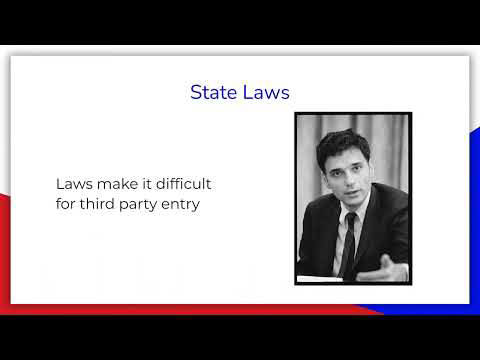
But there are a few other smaller reasons that I think are worthy of mention. so one of them is, is state laws or even federal laws. So laws generally make it difficult for third party entry. So if you are a third party candidate, you likely have to petition in order to have your name on the ballot. So that could require thousands of signatures, typically thousands of signatures for your name to even appear on the ballot.
there are also things like, like in order to make televised debates, right, in order to be on the, the, presidential debates, you have to meet a 15% poll requirement in order to be on those nationally televised debates. That's not a state law. That's a federal law. But still, there are laws that are structured, at that level of government, both state and federal, that discourage third parties from entering.
Again, this is a secondary reason to do Raj's law, but for the most part, this also plays a role. The other thing is that, like what you can see here is like a tug of war. Many conflicts in American politics can be described as dual ist in nature. In other words, there's not necessarily a compromise or, gray area.
And because of the nature of these kinds of conflicts, it typically means that like issues get divided into one side or another side. Okay. and as a consequence, that also sort of structure is where, how many, how many party options you might have. Okay. Again, though, this would be considered secondary or even tertiary to do Virginia's law.
The third one is political socialization. So oftentimes how we learn about the political world is from, growing up. Right. Like going to class, like obviously we learn quite a bit from our parents. We inherit quite a bit from our parents, but, we also learn quite a bit from school. We also learn quite a bit from school.
So this means, some of the first places that we learn about elections are for class president rate or class representative, or school president. Right. You participate in these in these electoral systems and they tend to be again, sort of like first past the post systems. And what students learn about in schools tends to be about the two party system.
Right? They tend to learn about Democrats and Republicans. Or if we go further back in time, we're talking about things like the Democratic Republicans or the, Whigs, right. Or Federalists. But for the most part, children are socialized very early on with the two party system. Right? They're socialized very early on with the two party system, and therefore it makes it more difficult to introduce third parties to, to people as they age, because they were mostly socialized with the two party system.
The other thing is that third party supporters have very, very diverse ideological preferences. And and what I mean by that is, you know, third parties would be more competitive, likely if, they were all clustered at one end of the ideological spectrum. So imagine a world in which, all of the third parties that compete are clustered on the liberal end of the spectrum.
They might be able to sort of pull some people over, from the Democratic Party, and be more competitive that way. But instead, what happens is we see third parties all across the ideological spectrum. So you see, the Green Party, right, which tends to be more on the liberal side of the political spectrum. But then you also have the Libertarian Party, right, which is more on the conservative end of the political spectrum.
That means, though, that they're pulling from diverse parts of the populous, right? They're pulling from diverse parts of the populous. so they're not able to sort of create some kind of coalition. Like you're not going to see the Libertarian Party and the Green Party form its own coalition because they're too ideologically diverse. This also means because they're not able to form a larger coalition, they're going to be less competitive.
Okay. So third party candidates are reflective of preferences across the ideological spectrum. And as a consequence, that means that they're going to be less competitive. They're going to be less competitive on the national scale. But I don't want this lecture to feel as if third parties, it's it's never possible. Right. Like for them to to win federal elections.
That's not quite the point here. Like it is quite unlikely. Yes, but third parties serve other purposes beyond just like winning an election, right? Third parties can engage people who are disenchanted with the current political system. Right. We see, trust in parties has declined in recent decades. And so as a consequence, in order to keep those people engaged, third parties might be a way forward, right?
The Green Party, the Libertarian Party might be ways in which those, people stay engaged in political processes. The other thing, and this was sort of alluded to much earlier in this talk, is that they definitely can influence electoral outcomes, right. Like Roosevelt really highlighted that. Right? Roosevelt highlighted that, because he split that ticket. Right. Because he was, split that Republican ticket.
He and Taft were not able to win. They both earned about 24 or 25% of the vote. And instead it went to Wilson. Right. And it's also argued that the reason that Gore lost was partially because of Ralph Nader. Right. And I think that this is the bigger one is that oftentimes third parties help put issues on the agenda that simply wouldn't have appeared in other times.
Okay. Or in other. It's through the, the, the two party system. And so instead, you see, particularly at the end of the 20th century beginning or, excuse me, the end of the 19th century, the beginning of the 20th century, third parties play a role in, changing some of the issues that the two parties are considering. So this can also help sort of, change the policy positions and reframe the policy positions of the two political parties.
Okay. Now, just to sort of sum up what we talked about, really the primary reason that we don't see third parties compete in in significant ways is the concept of due for case law. And, and like that's the main takeaway that I would like you, to have from this talk, we also talked about the other barriers to third parties, like state laws.
like the sort of dualist nature of conflicts. But, really third parties, even though they aren't typically nationally competitive, they still play an important role in American politics.