
Dr. Erik Hadley
Interviewee: Dr. Erik Hadley
Interviewer: Doug Exton
Description: Ritualized festivals in Francophone Belgium (Wallonia) are central to civic pride and historical commemoration. Many saint-military marches, featuring hundreds in Napoleonic-era uniforms escorting a saint statue, received UNESCO recognition in 2012 as 'Intangible Cultural Heritage of Humanity.' These processions often involve families with generations of participation. Binche is famous for its Carnival, featuring les Gilles—masked men with ostrich plume headdresses. In Mons and Ath, saint processions evolved into large-scale celebrations: Mons' festival includes mock combat with a dragon, while Ath’s features giant statues. The Carnival of Binche (2003), Le Doudou of Mons (2005), and La Ducasse of Ath (2005) all hold UNESCO recognition. These traditions, dating back to the late medieval period, ceased during the French Revolution but were revived in the 19th century. This talk explores their reinvention, 20th-century evolution, and their role in modern community identity. Bio: Dr. Erik Hadley earned his BA in History from the University of Montana and his MA and PhD from the University at Buffalo, specializing in Early Modern Europe and the Atlantic World. He is a lecturer in the History Department at Boise State University, teaching medieval and early modern Europe and oceanic histories. His research focuses on cultural history, folkloric rituals, identity, and commemoration in Western Europe and indigenous cultures of the Americas and Hawai’i. Dr. Hadley received a 2019-2020 Fulbright Research U.S. Scholar grant to Belgium to study the historical evolution and public memory of UNESCO-recognized folkloric festivals. He has authored numerous articles on cultural identity in French-speaking Belgium.
Date: 2021-07-27
Topics:
The visual topic map is hidden for screen reader users. Please use the "Filter by Topic" dropdown menu or search box to find specific content in the transcript.
Doug Exton: Thank you so much for joining us for tonight's Connected Conversation. A program conducted by the Idaho Humanities Council. If you're not familiar with our organization, I encourage you to check out our website, Idaho humanities.org. I'd like to remind you all that you may submit any questions using the Q&A feature located at the bottom of the screen, or the chat feature also at the bottom of the screen.
With me today is Erik Hadley from Boise State. It's an honor to have you with us today. And I turn it over to you.
Dr. Erik Hadley: Thank you Doug and thank you to the Idaho, Humanities Council, for inviting me back to do a presentation. I did, I was have I was lucky enough to be able to do one in February on the topic of, of, Hawaiian and, Native American, connections in terms of land sovereignty movements and, that worked out really well.
And I'm pleased to have been invited back to talk about something maybe a little closer in my wheelhouse in terms of work I've been doing over the last few years, and that is on, festivals in Europe in particular. So, I'm joining you from Elmo, Idaho, at the visitor center for the City of Rocks National Reserve, where they have graciously granted me access to their WiFi and the nice place to sit.
While I'm down here on vacation with my family. So, thank you all for attending. And, I've got a PowerPoint I will share with you.
All right. Hopefully you can all see that, the topic of my, presentation today is, a series of festivals that I'm studying, currently in Belgium and writing about and doing active research on, for a dramatic title. I went with this the the Gilles, Giants and Dragons Oh My, the reinvention of folkloric festivals in Belgium.
And I'll get into each what each of these, terms are, over the next hour. First, a brief introduction to Belgium. I usually do this because Belgium people send a note for chocolate or fries or waffles, but, not a whole lot more. Belgium is a small country of about 11 million people.
It's in Western Europe, centered, between France, Holland and Germany, and is often considered to be the battlefield of Europe for much of of European history at least, from the mid 15th to the mid 20th centuries. It is a, it's a monarchy, so it's government is very similar to that of Great Britain in the sense that it has a, puppet elected parliament with, with a head of state, which is a, hereditary monarchy.
However, it's in some ways more like the United States or even Germany, and that it's a federal system. It's divided up into three federal regions. And these are really divided up. Two of the three are divided up based on language. The northern half of Belgium is, is called Flanders. It's Flemish, based language. There are five provinces there.
And then the southern half of the country, is called Wallonia. And it is French speaking. You can see the dividing line here. It's also made up of five provinces. In the middle is the capital, the city of Brussels, which is a separate federal region. It is officially bilingual. Both, Flemish, which is basically Dutch, and French speaking, although it's about 85% French speaking.
Presently, my work centers in the province of Hino or Aino, which is in the, in the western, part of Wallonia, you can see that, there at borders against it's right up against the border of France. A brief history. I'll try to keep this as, brief as possible, but it's really important, I think, to understand, the significance of the rituals I'm looking at.
The Low Countries, it shows a map of Low Countries from the mid 16th or mid 15th, mid-16th against to mid 17th centuries. And you can see it's a, kind of complicated series of provinces squeezed, between, the modern state of France and, to the east would be Germany or at the, at the time, the Holy Roman Empire.
And it was made up of a series of provinces, which, which were not controlled by either the, the German states or the French king. They were independent. Eventually they would, consolidate leadership under a single family. Many people would know this family is one of the most powerful families in European history. And that would be the Habsburgs.
This man here, Charles the fifth, was born in Belgium, in Ghent. Through family alliances and marriages. He would, rise to become one of the most powerful rulers in Europe in the, in the, late 16th, well, mid to late 16th century. He would be the Holy Roman Emperor of the German lands. He would also be king of Spain.
His son Philip the Second is the one who, since the great Armada, against England. And he also is, of course, the overlord of these low countries, these kind of small, very wealthy, highly populous states. In between, France and the German states, two important things have happened to create the modern state of Belgium. This shows this is the domination of the House of Habsburg.
And you can see up in the north, the Netherlands or Low Countries here. And then, to the, to the east, the Holy Roman Empire and to the south, the Spanish lands. On the death of, Charles the Fifth, his son Philip would take control of Spain in the Spanish dominions. And while his brother Ferdinand would take control of the Holy Roman Empire.
But both. So you'd have two different lines of the same Habsburg family. The Low Countries stayed with with the Spanish. And the first major historical development, happened also during the reign of Charles the Fifth and that is the advent of Protestantism, particularly Calvinism, which took over the northern provinces. And eventually, they wrote rebellion against the very pious and Spanish kings, who were deeply Catholic and over an 80 year period.
From the 1570s to the 1640s, they fought for independence. And by the 1640s you have an independent Dutch Republic to the north. The Spanish are able to hold on to what are what would be considered the state of Belgium. And this map here kind of shows you, this is in late 18th century, but what's called the Austrian Netherlands, there are the parts of, of, the Low Countries which remain Catholic, and their Catholic identity is really central, to my work, to the north is the Protestant Dutch.
And then you can see the Holy Roman Empire and the French squeezed in there. The second significant impact is the French Revolution. The Austrian countries were seen as eventually, after the die off of the last of the Spanish bourbon. So the Spanish, Habsburg kings, the Belgium lands were turned over to the Austrian Habsburg branch in the 18th century, and so they became the Austrian Netherlands.
But they retained a lot of their independence, a lot of their autonomy. They were ruled by Regency, but they were really self-governing, and left alone. And again, these were very strategic areas of Europe, very wealthy areas of Europe, and highly prized. And so, a number of major battles and many people are familiar with, stretching from Waterloo in 1815 to, the battle of the bulge in 1944, early 45.
The Battle of Epe during the First World War, Belgium becomes this kind of staging ground between, the British and the French and, and, and, the, different German, German states over this period. So back to where we are. Belgium becomes an independent state in 1830. After the end of the Revolution, the Napoleonic Wars and, I'm studying a series of festivals in this province of.
Hainaut Why? Well, I was doing work in Belgium in the early 2000 on, on a, doctoral research project for my dissertation. And I was actually studying the French Belgian borderland and the communities on the borderland. And in the course of that, I made a number of friends in Belgium, and they kept inviting me to different.
Over the course of the year, I was living there to many different festivals. And, it was something of a distraction from my, doctoral work, but a really pleasant, welcoming distraction. And I, I started asking questions. Why? Why are they dressed this way? Why do they have giants? Why is there why, why, why is there a Saint Roch statue?
Why do all these things exist? Why is there so much popular participation in them? And when I finished my dissertation, I was looking for a second project, and, kind of lit on the idea of of looking at something that had received relatively little, interest, at least in, English speaking, history. So, I formulated a research project presentation for the Fulbright organization, which is part of the U.S. State Department in 2018 and made my application.
And in 2019, I was granted a six month, research grant starting in, January 1st of 2020. Lasting six months. And I arrived in, Belgium shortly there, shortly before that and began my research. And I was able to research there for about two and a half months until the middle of March 2020. I think we all know what happened at that point.
On March 12th and 13th, Belgium basically shut down completely. The Fulbright program also shut down and all grantees were sent home, and then international travel was suspended. So I didn't wasn't able to complete my project. And I'm hoping to return next next summer or even potentially in a future Fulbright to, to complete my research. But what I wanted to present today was a brief version of what, of what I managed to accomplish in the time I was there.
So we're going to look at, a few different types of festivals in Belgium. I've divided up into and what I will call three different regions of this one little province of Hainaut in the far western areas is the region of the giants West Hainaut, the. And there are two we can look at briefly today. They're called a Ducasse.
Ducasse is a, a French word which which comes from the word delicacy. And a delicacy is a is a saint processional or a ritual? A ritualized, communal religious processional carrying typically either a relic of a saint or a statue of a saint, or sometimes both around the city, typically on the saints special day of the year.
It's a very Catholic thing. It's in some ways it's it relates to what's called the the cult of saints. I'm starting with Saint Mary, but all sorts of other saints. And in this western area, what we see in these ... or the Ducasse is they evolve into these giant festivals. In one case in the, in the city of, at Giants, as in the Goliath, and Samson and then person playing David fighting Goliath and then in the city of Mons, dragons.
And what eventually evolves in that from that Saint processional is a ritualized combat between a giant green dragon in the city and and someone playing Saint George on horseback in the middle of the of the province. It's the region of Carnival, and it's centers on a small, beautiful medieval town called Binche and they're very famous, marchers of their, of their carnival celebration who are called Gilles.
And we'll talk a bit about the origin and peculiar ness, and uniqueness of the Gilles. It starts in Binche, but the, the Binche tradition of Carnival, a very specific. When we think of Carnival, we typically think of Mardi Gras as in New Orleans, Mardi Gras with floats, and different crews doing these folks in marching bands or for in South America, the, the Rio based one or elsewhere in Europe would be the Venetian, version of Carnival with the comedia del arte masking.
This is a very unique, the most well-known carnival in Belgium, and it's spread from Binche throughout the region. And, kind of other towns began imitating that carnival. And then to the farthest east of the region, we call it the region of saint military marches. Again, these are like .... They they start out as marches dedicated to a specific saint.
In this area was a very militarized area and, a lot of warfare happened. It was very strategic. It fell fell on the line of the Meuse River and the Somme River, which eventually feed into the Rhine. That's a mountainous area around the Ardennes and there are big fortresses there. And so when they did these saint marches there, they wanted protection, military protection of the marchers and most importantly, of the relics and statues themselves.
So what you see in this area are dozens, if not a hundred different marches, military marches that spanned from late spring all the way to early fall. Every year. Why did I pick these? I pick them because they, fit a standardized model of research. All of them have been given UNESCO cultural heritage status as intangible heritage of humanity.
The carnival Binche, first in 2003, followed by the Ducasse, is that of Mons and at in 2005 and eight, and then eventually six of the military marches of Saint Roch in 2012. All of these festivals are still celebrated today. They all have museums dedicated to them, they have folklore commemorative organizations, and they've been given formal recognition both locally within their region.
Like in their federal region, at a national level. And then even with UNESCO at an international level. So let's get into it. Here's the first of the four. This is, in the city of Mons. What you're looking at is a, a gothic, collegial church. It's not a cathedral. It's a gorgeous church.
I lived in the city of Mons during my Fulbright. In fact, I walked by this church almost every single day. In the, on Trinity Sunday, which is typically the first Sunday in, June. They have what's called the processional of mons, the returning of this special carriage with, with, the relics of a saint to the church.
And this church is named after the saint, to which is dedicated Saint Waudru, who was a woman, from the seventh century. And they still have a relic remains today, which is quite amazing. This is the the Ducasse part of it, the beginning of it. It what that is to say that what happened in this town is each year, starting with the Black Death in, 1349, they began carrying the relics of the saint around the city, physically creating a protective layer or prophylactic, protection around the city by marching through all of the major, avenues, within the city walls, and then eventually even outside the city walls to
protect it, in after from disease, but also from warfare. At the end of this processional, the, the the chariot, which you'll see shortly is pushed back up a ramp into the church and the, the local folklore tradition is you can't stop if it pauses. Something bad will happen to the town in the next year.
And, local tradition holds. The last time it stopped was in 1940, just before, the war. Shortly thereafter, it's followed by what's called Le Lumecon. More, typically in English be The Combat of Saint George and the Dragon. And here we see, the dragon is being held by a bunch of, men dressed in white.
There's also what are called wild men or leaf men. They're dressed in green. They help carry the tail at the back of it. They are opposed, by a group of men called .... And I'll show you, pictures of them as well as Saint George, on horseback is played by a human actor. In this combat, it takes place in the Grand plaza or the central plaza of the city on the same day as the procession.
And you can see that that there that there's virtually no, cordon between the, the participants of the ritual and the spectator, up to, upwards of over 10,000 people in this plaza alone. And the closest circle are typically young men. Typically, they take their shirts off and they try to fight to to steal the hair of the dragon, but on its tail, which is made of horsehair.
And it's considered a great honor to be able to pull a chunk of horse hair out. So they spin this dragon around the circle while people, grab and push and and, jostle with one another to get this hair. I was supposed to. I was invited to participate in this, of course, in 2020, that this festival didn't happen.
Eventually, after a series of mock, ritualized combat moves between Saint George and the dragon, the dragon is dispatched, with a pair of pistols, which tells you that this is not just a medieval, processional. And then it's put back in the church in a cave underneath the church to wait for the following year. The origins of this, date to this woman, Saint Waudru, who is a very interesting saint.
She lived in the seventh century in, the city of Mons. She was, mother she was married, she had two daughters. You can see them here in this 18th century, painting. Eventually she, retires, and and forms a monastic style community known as a canons, which is, has a quite a little less rigor to it than than being a formal nun.
It's a religious community where you still take vows, but it's it's more open to to it's not a cloistered system where, where you live within a walls and never emerge. And, upon her death, she was named a saint and her body was preserved in relic form. And then commemorated eventually with the great, neural net Cathedral, non cathedral, church of Saint Waudru.
This is her body was separated between the head and the regular body. The head, also known as the chest, is and the body are on display in the church, all year long. And then on the on the day before the processional, they are descended, brought down into this chariot here, which was made in the 18th century.
And they're put inside this chariot, and then they go around this community, in the Middle Ages, the following this chariot would be, all the guilds of the city, dressed in their medieval or early Renaissance and in some ways, gear or costuming, and they would follow along behind, the religious processional and that would declare to the community their importance, their worth, their status.
Typically they would also be aligned with certain saints, most notably Saint Roch, who's the patron saint of disease. And as I said, this really originated as a processional during, the Black Death. So there are some connections between the, the, the epidemic of 2020 and malls. And what happened, in 1348, 1349, so if you were watching this and say, okay, what's going on here?
On the one hand, we have this we have this, veritable relic, of this, holy woman who was named a saint. How did that get to a dragon? And that goes in a different direction. This is a, 15th century painting of Saint George slaying the dragon. Saint George was, would have lived in modern day Turkey at the time, under the Roman Empire.
And, he supposedly, well, while stationed there, fought and killed, Dragon and then, also was canonized as a saint and became, notably associated with the kings of England in the Middle Ages. Saint George is still patron saint of England. The Red cross flag of England. And in the, at the time, the Middle Ages in this community, the County of Hanover was a very powerful county.
And eventually Edward the Third, the King of England, Mary, the daughter of the Count of Hainault. And so there's this English influence into the counties. And that's how we begin to associate this, this, noble order of Saint George in the City of Morals. And then an a more strange thing happens, supposedly this, man named Jules, the chin.
Notice the commonality of the name Jesus will reference that back to, the carnival about later. This is a 12th century knight who also went on crusade to Egypt, with the Count of hanno. And on his return, he supposedly killed a dragon outside of Mons. This is, in the in the museum for, the the Dukes of Mons.
They have, brought in his, funerary statue so you can view it. And then also the mummified head of a crocodile known as the Dragon's head, which we believe he brought back from, Egypt. On crusade. We know that's documented as early as 1409. And so two things are happening here. On the one hand, we have this, the canons chapter of Saint Law, drew, and this and then the the Black Death in the 14th century, on the other hand, we also have this highly noble order dedicated to dragon killing that eventually want to bring that into this, this processional.
Here's the city of Mons. You can see, the ground plus here and the, great cathedral up here. And, so it would emerge from this cathedral, move through these different, squares, and then the combat would take place on the ground. Plus, after the processional, one of the earliest images we have of it is this picture or this painting, from the late 18th century, in 1795 says that in the mons at the bottom, this is during the French Revolution.
It's a minimized painting, but you can see on the ground plus of this town, you can see Saint George with his lance. You can also see the dragon. There are, some of the wild men and devils or also devils that carry these little inflated bags to their dressed in black. And they are they're a common element in popular, festivals in Europe.
And then over here, the protector of Saint George, ..., named after the chin himself. And so you see that here? And it, well, one common element we'll see in all of these rituals is they run into some difficulties in the 18th century with religious authorities and with secular authorities. Almost all these rituals will start out as, as obviously as religious processions, marching people with relics through cities and then popular.
You see this popular attachment on to it with the with the dragon example. What we see is kind of a noble, attachment to it. The Order of Saint George, which had its, its, chapter house on the ground plus itself, which has this connection back to Jules Chin, the Dragon Killer, and back to Edward the third, who had a presence in malls.
And so, the dragon aspect has no religious, aspect to the, the to the, the processional itself, but becomes in some ways far more popular than the than the, than the the Saint Audrey processional. So in the late 18th century, it becomes these become kind of, chaotic and, uncontrolled. Groups of people get very excited about it.
They start to actually look at the picture I showed you. They start to break down rules. We see reports of dancing and drunkenness in the streets, lots of music, multiple day festivals. And the religious authorities get really upset about this. This is supposed to be a pious ritual, not a profane ritual. It's supposed to be a positive ritual, meaning you're doing something and you're doing something to protect this community, and it's being co-opted by this popular secular element, both high society in terms of the Saint George people and low society in terms of the spectators.
And so these begin to see increasing regulation of this, and this regulation occurs, and all of these festivals are actually up in the 20 years before the French Revolution by, by, local authorities, particularly in this case, the Austrian authorities, who are controlling the low Countries. And then, of course, the French Revolution will come in. And in 1794, these revolutionary armies will sweep through, Belgium and conquer it.
And Belgium will remain part of the French Empire, First Republic and then Empire until 1815 at the Battle of Waterloo. And initially they're very anti church and they come through revolutionaries. They burn churches, they destroy relics, they melt down all the metal, they close all of the monasteries, burn them down as well in some cases, and then forbid all rituals that have any religious, particularly Catholic, element to it.
And that affects all of these and much again, we're looking at the rich, the the post, the post revolutionary legacy. It takes 50 to 60 years for many of these, many of these rituals to recover back to and when they recover, they change. That's this reinvention process. They're not the same. There's something fundamentally different about these rituals in the late 19th century than them, how they had been practiced prior to the French Revolution.
Here. This is, in the Belgian centenary, a 100 year centenary of the anniversary of its 100 year independence, you can see the combat of Saint George and the Dragon again. You can see this early version of this green dragon with this long tail. Saint George on horseback, a lot of people and watching as spectators kind of chaos, people falling down.
You see the chin chin with the kind of mock horse around their bodies. They're supposed to protect, Saint George against the wild men and against the devil's. Here's a 1858 version of the of the, dragon himself. You could see the white men carrying him, ... now dressed in plaid. You can see there.
Eventually, they'll be up to 11 of these tensions. You can see the devils, which are, on the ground with their with their inflatable bags. And then, of course, the wild them with their clubs. And this again shows this is on the ground plus and more. And so it shows again the, the, what's called the muscle of the combat.
And this is a post-World War Two era version, 1949. But they use this, print multiple times. This is in 1962, and you can see it by this point it has been modernized. Now you see the Belgian flag all over the red, black and yellow flag of Belgium. You see the combat? See, many of these elements have been preserved.
So you get this notion that we have this continuity between 1795 and, nearly 100 years later, and then 100 years after that, and by 18, 1962, second of my rituals is in a nearby city of at at also a military city, a fortress city, also under the under the purview of the Council of Hainaut. They go in a different direction, but it's it follows a similar line in the 14th and early 15th centuries.
They're also doing a du pass or Delicas. In this case, they're celebrating a couple saints. First, the saint of the city, Saint Julian, and then also, Saint from the Bible, Saint Christopher. Saint Christopher is typically associated with a great height or statues, etc.. And so, you see, the, the attempts by the local community, again, we see secular innovation into a religious, processional.
They can begin making statues to commemorate both Saint Julian, but more so Saint Christopher. By around 1408, down by 1481. See the first mention of Goliath as a statue of the Old Testament, and of a mock again, a mock battle, much like we see in Mons, but this time in, with with a giant and someone playing David who throws rocks and, defeats Goliath.
We see the addition of, more, giants later in the 16th and 17th centuries. We see the in the records, both Samson appears, an eagle appears, and all of these, giants are being built by what we call a confraternity, which are basically lay brothers. Like, these are not religious people, but they have a religious association, almost like a masonic lodge today, but a Catholic association, and they were associated also with their guilds and in this case an ad because it was a military city with the defenders of the city, the guild of archers, the guild eventually of cannon years, the guilds of crossbowmen, who who defend the city
itself and they build these, these these giants by the 18th century, we see the addition of a female character, Madam Goliath. And on the day of the of the festival, which is happens in late August, Goliath comes out and, he marries, madam Goliath. And so we have this mock marriage. And combined marriage is a sacrament in the Catholic Church, but between two artificial figures in this case and then subsequently, David is defeated.
David defeats Goliath in a mock combat afterwards. There's another, picture of, of Goliath and his bride. And in this case, in 2012. Typically, David is played by a child, and typically a child of one of the groups that are associated with building and moving and maintaining the the, the, giants around the city. And so in this case, there's, David of 2012 proposes rocks.
He has three chances to get it in this little hole in David's armor to to bring good fortune to the city.
The giants meet the same fate, in the French Revolution in 1794, the revolutionaries invade. There's a popular society or revolutionary society in in in the city of at who petitions to to see religion removed from their, rituals. They want to go to more civic communal rituals. Like what associate with the French Revolution, celebrating the nation rather than celebrating, religious associations at a local level.
And so they burn all the giants, they're destroyed in an auto to say, you know, on the date that they should have been marching in August of 1794. But after, after Napoleon, ends the Republic and creates the empire. And in 1804, he also reaches a concordat with, with the Pope. And we see a slow restoration of Catholic practices and worship in France and in areas conquered by France, such as Belgium.
And so the giants are rebuilt in 1806, and by 1809 you start to see, a reemergence of this ritual, but very tightly controlled. It doesn't look anything like what the old ritual, looked at like before the revolution. By 1843, we see a new Goliath in this picture, century later. This is Goliath with the same head, but changing body, types.
In 1945 and now in today, if you go to the museum and, you can go it's called the Mason Dejounte or House of Giants. And you can see, the in the interim time they're not marching the Giants. You can go see how they're constructed. Here's a picture of my wife, with, Madame Goliath at the Mason.
Dejounte. So that's the giant processional. What is notable about the giant processional is that, by the one notable difference after the French Revolution is that is no longer religious association with it. It's run by the city government. It's paid for by the city government. It's stored by the city government, the people who, work on the giants and carry the giants, do so, without any sort of religious connection.
So it, it completely removes itself from the, the sacred religious elements that had been associated with it before the revolution. My third example. Come on, let's get through these pretty quickly. One of my favorites. When I did a lot of work on when I was in Belgium last, February and, January is the Carnival of Binche, and the carnival Binche.
If you don't know, carnivals are kind of an anti ritual or, inverted ritual. They come, it comes right before lent. Lent, begins on Ash Wednesday and lasts for 40 days until Easter and the and the and lent in the Catholic liturgy is a what we would call a negative ritual. You you abstain from doing something.
It's a it's a it's it's sacred, but negative meaning you don't do something like, for instance, give up fish or give up something else. As part of, of, as worshiping of Christ between Ash Wednesday and Easter, and Carnival emerges in the Middle Ages as the last great hurrah before this negative ritual happens. So in this case, carnival is a positive ritual.
You are doing something, but it's profane. It's not run by the church at all. It's a popular ritual, typically celebrating what we call the lower body eating gluttony, drinking, music, dancing, sex. All of these things are celebrated in carnival. We see carnival celebrations all across Europe during this time. And in Belgium there were many different carnivals. And so the part of the whole story of this is why this carnival, how did it become the most important carnival and the single archetypal form of carnival that Belgium would then, celebrate in the 19th and 20th centuries?
We we the earliest archival references to Carnival we have in Belgium are from the 14th century. You can see that it was run by the commune, the city government in some ways, and as this great celebration, leading right up to to lent, the in this picture is a picture I took, of the pyro.
And this is a children's marching group, and this looks very much like a Venetian carnival scene. You can see the pointed hats, the black masks, the pastel colors. And this is one of the modern day groups that march, and they have a special day on, Sunday. So when we think of Mardi Gras, Fat Tuesday, that's the day before Ash Wednesday and, and typical carnival, it's not just that day.
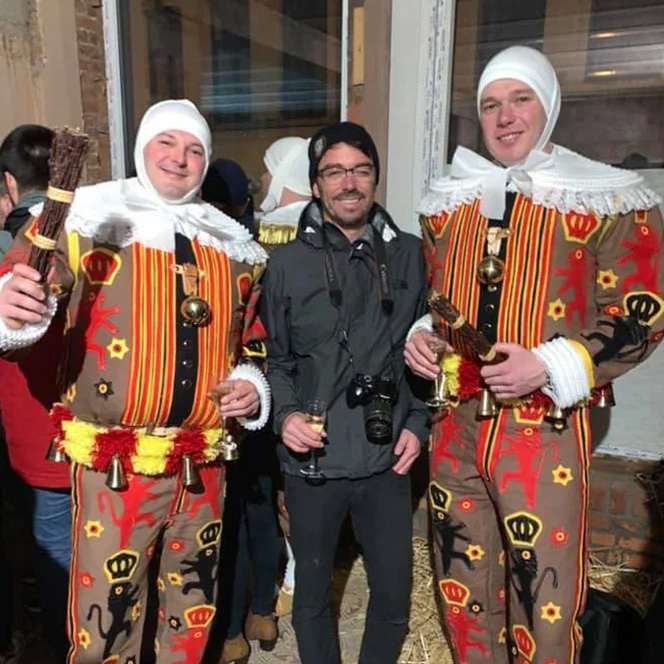
There's also the Monday to Sunday in the Saturday preceding it are also celebration days. Again, much like we see with the two previous festivals, it's on the Grand Plus in the center square. The highlight of of Carnival are really the jewels. And these are the jewels here. And they wear and part of the day they wear this mask, other parts of the way they don't have a mask on.
And so they have this very famous headdress. And the deals to be a jewel, you have to be what? Used to be a native born son of the town of ash. Nowadays, if you just live in Binche for five years and are a man, you can participate as a Jew. It's a very expensive, endeavor. Jewels are typically from the or drawn from the bourgeoisie.
The middle class. This was a, initially a Guild City. It had a lot of textiles. Eventually it would become a mining city in the 19th century and still had a fair amount of wealth. So the jewels wear this last wax mask that's from the 19th century, has eyeglasses and a very 19th century mustache. But another part, later in the day, they will take the masks off and wear this, famous headdress, made of ostrich plumes.
And they will march through the city. And this very famous, distinctive medieval costume, and they will throw oranges to the spectators. And, you're considered lucky if you catch one. They have to actually put chicken wire up over all of the windows in the ground. Plus, for fear of breaking it, we're talking thousands and thousands of oranges being thrown through the city.
You can't throw them back at the jewels, by the way, it's forbidden. So today they're about, a dozen different societies of jewels. They all wear the same outfit on on Mardi Gras itself that Tuesday. They all follow the same ritual, and they all have to be native born sons of the town. That Fat Tuesday starts early.
Early in the morning. It's a picture of me with two of these tools. This is taken at about five inches the morning. They wake up in the pre-dawn blackness. And the oldest jewel of each society is is, honored first. And a drummer will appear at his house in a fight for will appear at his house.
And then he moves to the next house and he'll pick up the next oldest and then the next oldest until the entire group is assembled of it could be upwards of 80 different men. And then they will move into, the ground. Plus, by around 9 a.m.. And each house, they stop and they have a little tiny bit of champagne.
It's forbidden to be drunk as a Jew. So it's kind of, in some ways an inverse of carnival. There's they're very, very, regulated, very standardized, very controlled and very, revered. And the girls, they dance in marching these very famous costumes. And then eventually they throw oranges in their fetid and celebrated through the town.
On the day of Mardi Gras, the day ends after midnight. So they're up for it, and they're on their feet. They're not allowed to sit down or sleep. They're on their feet from about four in the morning all the way to midnight on the next day. So it's it's a pretty serious endeavor. This is, one of the last festivals that happened in Belgium before the shut down the carnival of, of 2020, in late February of last year.
The carnival. We also can thank the French Revolution for understanding something about this carnival. It was it was also banned by the French revolutionaries. And a protest happened and a man named Francois Gaillard showed up in an archive, say, in the habit or manner of a girl, as in the costume of a jail. And that's the first reference we have to the jail is in around 1795, about the same year.
That picture of the, the combat of and of dragons and molds, and much like these other festivals, we see tight regulation. First, outright ban by the revolutionaries, then after Napoleon and the overthrow of Napoleon, a slow relaxation, but still continued, tight control of these festivals until around 1850. And then we see reinvention after that. This is a picture of the hats that are in storage.
I had a chance to go meet this man, and it's called a Blue Eyes. Yeah. His name is called Kirsten. His family's been making and making these jewel costumes since the mid-19th century. And then you have this kind of historical commemoration of them. The girl in 1875. This is Auguste Guy, the nephew to that one who protested in the French Revolution.
This is a picture of him. It's a very formalized picture. You could see the hats holding the oranges and wearing the very famous, what they call the double hunchback outfit, where it's stuffed with straw and the front and the back. The curious origin story of the of the Jews really comes out in the late 19th century, and it relates back to what we call the Spanish legend.
Remember I said Belgium was controlled by the Spanish, not the French, before the Revolution. And a woman named Mary of Hungary, she had married the King of Hungary. And after his death, she moved to Belgium as the regent of the little countries. She was sister to Charles the Fifth from the beginning of my slides. And she built a palace.
And back in 1549, that palace no longer exists today. And supposedly she had a festival there in the summer of 1549, a very famous festival. She invited her brother and nephew. The future King of Spain, and they, celebrated for two weeks. And during that, supposedly they either brought Incan warriors from the conquest of, of Peru into the palace, or they had local people dressed as Incan warriors to celebrate the conquest of Peru.
And that's the explanation for the great hats these these plumed hats. And even they even go as far to say, looking at the costuming of the costume itself, with all of its very intricate detail work on the, on the, the tunic and the leggings, that these might represent the tattoos of a Native Americans. Now, of course, we have no historical evidence to suggest this is true or not, but what it tells you is this attempt in the late 19th century to find historical origins to these celebrations, which go back to the Middle Ages in some ways, because they're folkloric and because they're not as well documented, their loss to the annals of time,
their oral traditions, passed down that are not documented. And so there's this work by folklorists and archivists and others in late 19th century to say, well, why do they wear these hats? Why do they throw these oranges? Where do they get these costumes? And this 1549 celebration of Mary of Hungary and Binche really stood out of the historical gloom as a likely possible source for this.
You see this again? Which is my last try to finish this up in five minutes. I can take questions. The last of my examples. And these are the military marches of the East. Hanno, there are, as I said, almost 100 of them. Six of them were dedicated to, as UNESCO or acknowledges by Unesco. And I picked two of those, six to study.
They're both dedicated to Saint Roch. Saint Rock is the patron saint of disease. We see that, we've seen him appear before and Mons and to protect against the Black Death. And what happens in this area, this, of eastern, Belgium is, the plague breaks out in the 16th century, in 1636, to be very specific.
And a bunch of chapels to Saint Rock are constructed, and they start doing processional with statues of Saint Rock to try to save the town from death. And of course, these towns are all dead. You know, it wasn't just in 1349 that the plague continues all the way to the 18th century, generate general ivory. Every 20, 30 years, another outbreak in every in the same town will occur.
And so today, well, as I mentioned, beginning of the talk, they wanted to take the, the statue of Saint Rock out, and tour the town to give this prophylactic protection of the city by carrying it around the city limits and then throughout the city. But, they also wanted to protect the statue. So they started using city militias, carrying initially like, swords and, axes, but eventually, you know, muskets, to protect the statue.
And so that's where they come. Military saint marches. It's not just the saint that does it. It's there's a military aspect to it. This is a picture of my son and wife, doing what's called the torch lit march. The of the night of the Saint Roch processional, where the whole town. Doesn't matter if you're a military member of one of these organizations or a member of the clergy.
Everybody has the right to take a torch. Even visiting Americans, it turns out, and walk and walk the the route that will be taken the following day by by the the marching organizations. And that's what's going on here. When the marchers appear, they're dressed in Napoleonic costumes. And this is one of my questions. If this march goes back to the early 17th century, shouldn't they be wearing 17th century costumes?
Why are they all dressed up as if they were just came back from Waterloo? And, the story I was told was well, after the Napoleonic Wars, of which many Belgian men were conscripted into, they came back and they had their uniforms and they and they just use those uniforms to continue the Saint Roch march, which makes sense, except except for one big problem, and that is these marches were also banned by the French revolutionaries.
And unlike the other examples I've talked about today, they did not come back after the war. After Waterloo, these marches were still banned until the 1850s, and the first reemergence of them is in the 1860s. So the next question is, well, then why Napoleonic uniforms? And these are gorgeous Napoleonic uniforms. You're talking 2000 men and women today.
Historically, this was that these were just men that marched. Women were given a special place, but it was a nonmilitary place. In the, in the, in the processional today, we've seen integration of men and women into, into the marches. And they organize much like the jails have different societies of jails, or in the combat of Mons, they have the different groups that hang out together the chin, chins and Saint George, the the white men and the leaf men, while men, they hang out socially and create organizations.
Here we have different, marching groups, upwards of 15 to 20 depending on the march. And each of these marching groups also includes a band. And these are highly trained, musical, marchers. And then in this case, we can see a sapper regiment. A sapper regiment is basically a military engineering regiment that would create, for instance, trenches, redoubts and other aspects for, say, military, I'm sorry, artillery, combat.
And, that's where a lot of Belgian men found their place in the Napoleonic Wars. And then the last group, the people who are allowed to carry the statue of Saint Roch, are called the off. And as well as pontifical means the, the, the people's wealth. In this case, they're dressed as if they're North African, military units from the 19th century.
In fact, what happened was the Belgian, different Belgian groups sent assistance to the Pope in Rome during the Italian unification efforts in the late in the 1870s. And that reflects their, their military costume. And they carry the actual statue of Saint Roch, which you can see here. And each day it's returned back to its chapel and then, the march goes on for 4 or 5 days.
One interesting aspect to this and kind of close on this so I can take some questions, is how I much like what we see with the carnival about we see kind of a reinvention of tradition of, of the historical origins. And one of these examples in Taiwan, the city of Taiwan, they're in the in the late 19th century, early 20th century.
They reinvent the origins of their march. You'll notice here this says this is in May 1907. Basically, pamphlet for the march and it says 40th anniversary, which would say that the first anniversary would have started in 1867, which it did of the modern March. So later on, by the within a ten years of this one, they will reconnect the march back to this the 17th century, and remove that that kind of interim period of the French Revolution to 1867.
And all of a sudden it's the 250th. When I last attended one of these marches, it was the 367th. And they ignore this big kind of gap, in the middle of, of the 70 year gap in the March. And they also relocated, the march itself from the outbreak of plague to a warfare example to to explain the military units, in 1654, the city of Taiwan was put under siege by the Spanish, and miraculously, disease struck the Spanish army.
And that was led to this commemoration of Saint Roch. Saint Roch, in this case protected the city by inflicting disease on the soldiers, and they reconstructed their history around that. That event of 1654, much like the 1549 event and Binche, became this moment of historical clarity for explaining the military uniforms as necessary for the Saint Roch processional. Here we see this sort of pontifical in 1920s.
You can see that it's not fully standardized yet. In this case, we have people, dressed in this would be like, pre-World War Two, the Belgian Congo. Military uniforms. In 1933, we see a marching band, we see this cannon, which the in historical tradition, the they say the the city of Taiwan is claimed from the Spanish, and they call this the the cannon Spanish Spaniel.
But it turns out this cannon wasn't claimed by the Spanish. It wasn't even owned by the Spanish. Was in the city, inventory prior to the siege. So we have this kind of creation of tradition or creation of historical intervention in some of these, examples. So I'm going to wrap up there, I think the last thing I want to say is there's some common themes here.
We see religious origins, particularly of disease and plague is a common element to the origins of these rituals. These communities are in crisis and strife. And, they they're looking for some control or agency over these events. And they turn to the two religious elements, particularly, saint worship. We see popular secular appropriation of these rituals, which leads to tension both with religious authorities and secular authorities over disturbances and civic problems, as well as public drunkenness and, fighting and dancing and things like that.
There are a lot of crossover elements of these rituals. We see wild men in the combat of malls, but also we see them actually a bit in acts with the Giants. We see Saint George in both of these. We see Saint Roch across all of them, many ways. The torchlight marches, which were part of the military marches, are then appropriated back by the, but the combat, in modes, we see this big crisis of the revolution and the post-revolutionary era, and then a recovery in the later 19th century and this turn to the creation of origin legends, often going back to the Spanish occupation.
We see standardization, and in this case, the 1930 centenary is really important to standardize these rituals. There's crisis in the 1960s and 70s, particularly driven by economic crisis in Belgium as the decline of the coal and iron industry, but then recovery and, UNESCO status. And then we see new challenges, for instance, what status to women have in these typically exclusively male, rituals.
And in the case of the military marches, we see an open acceptance of women into the ranks. So I want to stop there and leave about ten minutes for questions. So that's Doug. I'll turn it back to you. Thank you.
Doug Exton: Awesome. Well, thank you for all the information. It was quite a wonderful presentation. Definitely learned a lot. The first question I wanted to ask was in the military marches, there was kind of an obvious, influence from other, you know, people in other cultures. You know, case in point, the North African uniforms and the uniforms from Napoleon.
Was there other influences on these other festivals, even ones he didn't talk about since Belgium kind of acted as that, you know, battlefield for all of Europe just kind of, you know, navigate through.
Dr. Erik Hadley: Yeah. I mean, for instance, in the Carnival of Binche, there's a lot of associations of the costume which are assumed in some people, some associations have been that they have these dramatically Spanish origins where they're getting the oranges from. Well, the assumption is they're getting them from Valencia, which is a Spanish province. They're being brought up into early spring, up into Belgium because of the Spanish trade networks.
And the Spanish rode up to Belgium. And then they're they're seen as these like enormously treasured artifacts in a, in a pre-industrial world to have access in late winter to, to fresh oranges, which are then thrown by the community, by these deals, out to the community and, and the kind of exotic ness of the headdress itself as Native American, in fact.
And that being said, there's been in the last 30 years, there's been a lot of research on this, and the jury's still out, but a lot of historians are pushing back against the Incan origin, concept and say, well, maybe, maybe it's more local. Maybe people in Binche, like did this on their own, but it's clear that it's because of this access to the Spanish trade, to a mediterranean trade, to have ostrich feathers, to have oranges.
That, that, that you can see the, the foreign, influences, in the, the Saint Roch marches with the Napoleonic uniforms. They, they're often dressing up as French regiments of, of the Napoleonic the most, the highest, like the Imperials and the Napoleon's Imperial Guard, are represented there. So on the one hand, they carry these Belgian flags, and the other hand they see themselves as part of the of the French Empire or are commemorating their their participation in the French imperial struggles of the early 19th century.
So in those cases, yes, there are a lot of foreign elements.
Doug Exton: And speaking of local, I'm wondering if you can talk about kind of using folklore as, you know, part of your identity, whether it's, you know, I was like a personal identity or from what I've kind of gathered is that all these cities have these festivals as part of what makes their city unique.
Dr. Erik Hadley: It is it is central to their identity. I mean, even more in Boise, for instance, if you're from Boise, you probably know the Jaialdi Celebration, which is, I think every five years and every five years, 3 or 5 years, which is a Basque celebration in the Basque Quarter in Boise. And it's enormously influential and significant to the Basque community, but also to the city of Boise.
This is like that times a magnitude, you know, you have thousands and thousands of people that participate in each of these rituals. And, they're also major tourist draws. And what you see is a lot of cross-fertilization. Like when I was in Belgium last year, I became friends with a fifer in one of the military marches who was being hired by one of the, the Jills in Carnival to be his fifer for the carnival celebration.
So the so he was going over to work in Binche as, for carnival. But then later on in the year, back in May, he would go back and be and wear his, his Napoleonic uniform and be in a marching band there as well. So I would argue, I had so much positive, interaction and response when I told people what I was doing in Belgium, there was this enormous kind of his gratitude towards me, but happiness that there was an international recognition of the folkloric significance of these traditions and that they that these could be shared beyond the kind of immediate French speaking world that they lived in.
And so I had a lot of doors open. I was invited to, all of these festivals, to, and to, to watch them firsthand, to meet the people of the organizations, to come into the museums and work in them. So I was I have a lot of gratitude towards the different Belgian organizations, but they have really taken folklore to a next level they make.
This may have made folklore the centerpiece, the front and center, part of their civic identity and individual identity. I didn't get into some of the slides, but some of those later slides, they show, a grandfather and a grandson who are all who have been in the same regiment dating back to the 19th century and who's whose, son will be in the next level of the regiment and is already dressed in a children's uniform.
So you see these these genealogies of people, that are attached to folklore.
Doug Exton: And I was going to say you talked about, you know, that tradition with age and, you know, direct ties to the town. So definitely seems like, you know, who's been here the longest, really plays a role into that hierarchy, you know? And like you said, the child, you know, already being a part of it because the entire family has been there.
So that sense of pride there, I think that's really interesting and really cool.
Dr. Erik Hadley: And they, you know, in some ways democratize these rituals. Some of them were seemed really elitist in the 1950s and 60s, and kind of old to a younger generation of really an Americanized generation, postwar baby boomer today generation who really the 1950s and 60s started to reject these rituals as kind of archaic and sexist and traditional, and in response to the folklore evolved in response to them.
For instance, in molds, up until the 1960s, all of those people that acted on the combat were paid actors and typically lower class paid actors. And by the late 1960s, a certain the whole festival kind of started to get this CD aspect to it. A public drunkenness and kind of lower class interest. And like people didn't know what was going on.
They were just being paid. And so they renewed the whole festival in the 1970s and said, now we're no longer going to hire people to do this, and we're going to we're going to invite people to do this, and we'll take applications. And all of a sudden it wasn't just wasn't become class based, but it became much more people from lower classes and upper classes and the middle class all found, dignity and restraint in what they were doing.
And you see that with the Jills who move Carnival in a very different direction in Belgium. And you see other places where there where the spectators can drink and dance and do these things. But the, the participants themselves are very, very, you know, very dignified. And you see the same generationally. You see that with the Jill's the son of a Jill.
So Jill is a Jill, from a racial perspective, the first black Jill, a black man from the Congo who had moved to Belgium in the 1960s happened. And so you do see opening of doors. And it's not just about native born sons from a racialized perspective, that can be Jill's anyone. And they deal with the issue of gender by saying, in with the carnival, for instance, that every Jill has to have a woman, a woman who helps him through the week, who dresses in, who and, and that seems to our eyes, I think to some extent, not knowing how this works seems still seems kind of paternalistic and and perhaps
it is, but the women that participate in this see this great dignity do to it. And testified before the UNESCO hearings to say no, we feel are we are equal actors in this in this ritual. We are it's inclusive to us. It couldn't happen without us. And so we're happy going forward not to be a Jill now.
We'll see. We'll see what happens in the next generation.
Doug Exton: Yeah. And I think that's a really interesting point that you brought up, with the women that are involved is, you know, to us, from our perspective, it can seem very, you know, subservient, almost. But to them, you know, in their perspective, you know, like you said, they feel that they're equally involved, you know, in the customs. And I think that's just something that's really important to keep in mind, especially since we are becoming more of a globalized society.
And, look, you know, having access to all these customs like the one that you talked about, that normally we wouldn't you know, there's just as long as there, you know, okay with that and feeling recognized that, you know, that's what matters because it's from their perspective.
Dr. Erik Hadley: Yeah. It's I mean, it's easy to judge. And so, you know, when I was in banished, I talked to a lot of women who and almost everyone I met was, in fact a woman of of of the Jill. And sometimes that she was woman. But it's weird because we use that term kind of a literal translation, but, Jill's woman could be a sister, a mother, a grandmother, a wife, of course, sometimes a daughter.
And, typically it was family related, sometimes a friend. I knew, a woman who was a woman who. Who. And her husband, her husband was best friends with this Jill. And she became. But the Jill himself was single and didn't have, someone to help them. So she offered to be to be his, person. And so it does take some time to try to deconstruct and figure out, okay, at what level is this equitable and or what level is this not, and what role do I, as an outsider, have to say about that?
Yeah.
Doug Exton: Looks like we are out of time and fortunately. But thank you again for all the information, wonderful presentation and everything you've been doing with the IAC.
Dr. Erik Hadley: Thank you. Doug. Thanks to everybody who participated, who listened. Thank you for your questions. And I, I encourage you all to go visit Belgium when you can safely do so and, experiences for yourself. It's a really fun place.
Doug Exton: Okay. We'll have a good one, everyone.
Dr. Erik Hadley: Thank you.