
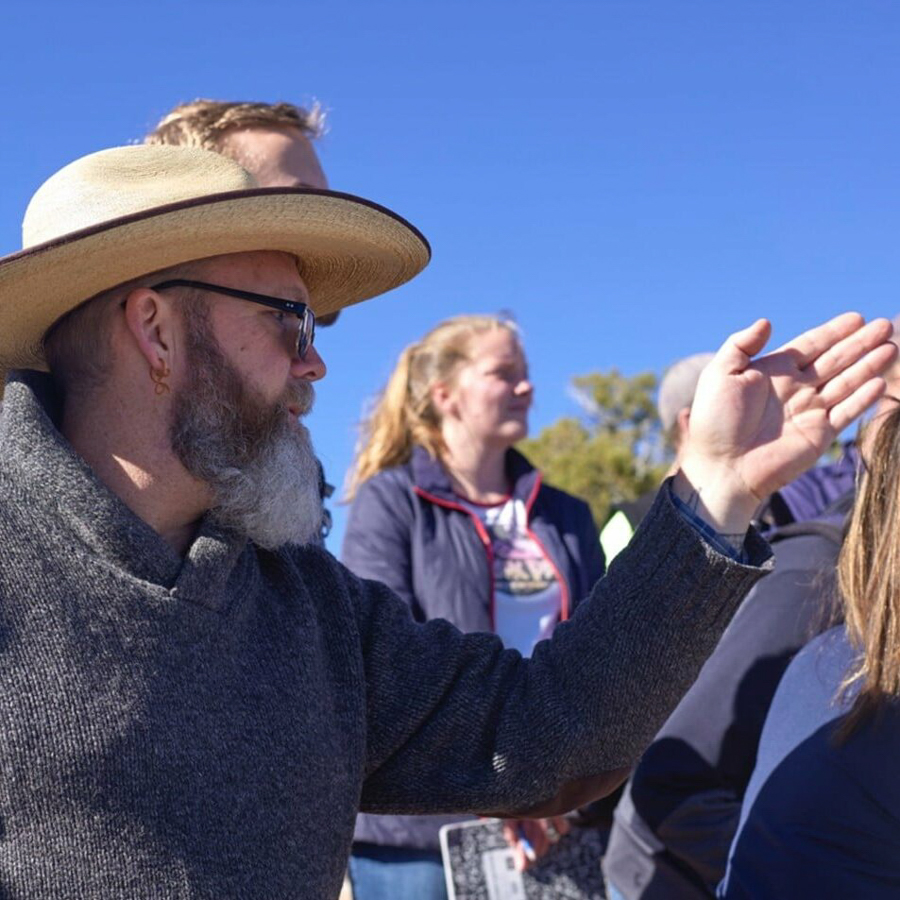
Judson Finley
Interviewee: Judson Finley
Interviewer: Doug Exton
Description: The Fremont cultures of the northeastern Great Basin and northern Colorado Plateau are understood as the northernmost maize agriculturalists in the North American Southwest. Because of the relatively recent timing of the Fremont foraging-farming transition (AD 300-1300), we can learn a great deal about the subtle interplay between climatic conditions and social decisions leading to the intensification of farming, the formation of early agricultural villages, and the development of complex societies. The Cub Creek reach of Dinosaur National Monument in northeastern Utah is a case study in the socio-ecological dynamics of Fremont culture. Bio: Judson Finley is Associate Professor of Anthropology and is Department Head of Sociology and Anthropology at Utah State University. Judson has spent his life and career living and working in western Wyoming, southern Idaho, and northern Utah. He specializes in the intersection of archaeology and earth sciences and it relates to the region’s cultural and natural history.
Date: 2021-07-13
Topics:
The visual topic map is hidden for screen reader users. Please use the "Filter by Topic" dropdown menu or search box to find specific content in the transcript.
Doug Exton: Thank you so much for joining us for today's connected Conversation. A program conducted by the Idaho Humanities Council. If you're not familiar with our organization, I encourage you to check out our website, Idaho Humanities. Org. I'd like to remind all that you may submit any questions using the Q&A feature or the chat feature located at the bottom of your screen.
And with me today is Judson Finley from Utah State University. It's an honor to have you with us today. And I turn it over to you.
Judson Finley: Great. Well, thank you very much for having me. And, this is, really nice to be with you all. It's a little unusual for me in the sense that I can't see any of you right now. So, so hello to all of you out there, and I look forward to hearing from you. So my name is Judson Finley.
I am associate professor of anthropology here at Utah State University. I'm also the department head of sociology and anthropology here at Utah State University. And I thought I'd begin just by introducing myself a little bit. I grew up in, you know, really in this tri state region that is, kind of the intersection of southeastern Idaho, northeastern Utah, and southwestern Wyoming, mostly in Wyoming.
But I lived on a ranch for a while when I was a kid in southeastern Idaho and a little place called Thatcher. If any of you guys know, know where Thatcher is. My grandparents were from Salt Lake, and, and then my dad worked in construction in southwestern Wyoming. So I really just spent a lot of time kind of bouncing around in this area as a kid.
And, I grew up really with a strong sense of, what it was like to live in the rural West and to be pretty connected to places and to be pretty connected to the history and also to the indigenous history. And that's really what led me to archeology. I did my graduate work. I did my undergraduate work at the University of Wyoming.
I've spent most of my career working in Wyoming and the surrounding states. I did my graduate school in Washington State University, which kind of took me up to Pullman, and in the Moscow region. And that experience really made me realize just how big Idaho is and how diverse Idaho is. I've been back here at Utah State University in Logan since 2012, and it wasn't too long after that that I started working in Dinosaur National Monument.
So when, when I was asked to give this talk, I don't have work specifically in Idaho that I could talk about. I've done a lot of research, around the Yellowstone region, looking specifically at kind of the contact area history of Shoshone people. But most of my work recently has dealt with the Fremont archeological record in northeastern Utah, and specifically in the Uinta Basin and in Dinosaur National Monument.
And so I thought I would share that work with you. So this will be I understand that these talks are not all archeology and, which is great, and that this is a very diverse audience. So I'm going to try to speak very generally about the nature of the archeology. I am my archeological training is really cross-disciplinary in the sense that a lot of my background is in geology and earth science and climate reconstruction.
So I really spend a lot of time thinking about that nexus of geology, climate and culture. And that's really what I want to talk about today. And I want to talk about within the context of, of farming and some of the most difficult places to farm in western North America. And what we've come to understand about those relationships of geology, climate and culture in relationship to what we refer to as the agricultural transition.
So this is a really big kind of global problem. That also we're thinking a lot about right now because it's informing informing us a lot about how these kinds of early agricultural systems dealt with environmental change and what kinds of systems they developed that maintained sustainable populations and sustainable subsistence economies. So I'm mean, it talks about climate.
And, you know, generally, I'm going to try to be I'm going to be pretty, I'm going to try to not get into into too much deep science about archeology. But there's going to come a moment towards the end of the talk where I'm going to get very specific about climate. I'm going to talk about dendrochronology and tree ring reconstruction and what we're learning about the environment, over the last 2000 years based on that.
And there are some really important lessons for us, especially in these moments where it's very hot. Right. And, I just came from six weeks in the field in Dinosaur National Monument, 100 degree days in Dinosaur National Monument are no joke. We're seeing all kinds of effects of, you know, these just really massive droughts and heat domes that are building all across the western US over the Pacific Northwest and, and into the central area, what that's doing to water and water shortages.
So I think that there are some lessons to be had with that as well. So I'm going to go ahead and share my screen. So again, what I'm going to talk about is, the Fremont archeological record, specifically in northeastern Utah's Uinta Basin. All right. And I hope that some of you all have had a chance to visit Dinosaur National Monument.
Maybe been there just to to to sight see, maybe been there to raft on the Green or the Yampa. But it's a really, really cool place. And I feel really lucky to be, to be working there. Now, the national park Service kind of tapped me to do some work initially, looking at rock art. Right?
Because there's so much rock art in Dinosaur National Monument and really across the state of Utah and I agreed because of course, I would be foolish not to, you know, not to spend some time looking at, at rock art. But I find that as I've done more and more work with rock art, people are always asking me, they want to know, what does it mean, right?
What does that rock art mean? This is a site called the Rochester Panel, which is down in the San Rafael Swell south of price, Utah. It's a really, really cool panel. And I like to show this one just because it's so deeply complicated and it's a good I think, illustrate version of me saying, I don't know, I don't know what the rock art means.
All right. So, this was the panel that I was showing here, which is the Rochester panel. And again, it's it's a really, really cool, panel. There's a lot and a lot of things going on here. This kind of rainbow thing. But also what looks like a bunch of monsters and, you know, this crazy line that runs all the way through it.
There's a lot of what we would consider to be classic Fremont rock art in this panel. So again, suffice it to say that that this is my way of saying I don't really know what rock art means, but what I can do as an archeologist is learn something about the context of the lives of the people who made that rock art.
And that's what I want to talk to you guys about today. Okay, so now Fremont is also relevant in southeastern Idaho because it really does spread all the way up into the Snake River plain and into southwestern Wyoming. But let me begin, because we're talking about agriculture, just to kind of give you, a map that shows somewhat of a timeline of the evolution of the development of maize agriculture in western North America.
All right. We see the earliest evidence of of maize agriculture down just north of Tucson about 50, 700 years ago. All right. And that's about maybe 20 to 2500 years after maize was first domesticated in central Mexico. All right. So the thing to remember about maize is that it's a tropical grass, right? It's one of the most evolutionarily successful species on planet Earth, along with pigs.
Right. But it's a tropical grass that has been domesticated to grow in all different kinds of environments. All right. So what you see here is this kind of progression of maize as it moves further north. And people were selecting for traits that would allow it to be grown in environments that were cooler, drier with shorter growing seasons. Right.
I've got a star right here on this area of southeastern Utah, which is the Cedar Mesa area, and that's central to Bears Ears National Monument. There's a lot of controversy over Bears Ears, but from my perspective, one of the most important things about Bears Ears is it's the heart of maize agriculture in the northern Colorado Plateau, in the sense that it was here about 3000 years ago, 3000 to 2000 years ago, that maize was finally selected for of of land race that could be successfully cultivated in a dry farming environment.
Right. And so they were able to move maize agriculture off of their floodplains and other well environments up onto the dry mesa tops of Cedar Mesa. And it's from there that we start to see the spread of maize all the way north up into northern Utah. By about 1700 years ago, right around AD 300, we see the first evidence of maize agriculture.
And this is in my project area in Dinosaur National Monument, right up in northern Utah. All right. Now, bear in mind that people were growing corn all the way up here onto the northern slopes of the winter range and all the way out here around the Great Salt Lake. Right. You get to much further north of that, and you can't grow maize at all.
You get into southwestern Wyoming and all southwestern Wyoming is good for is, alfalfa. Right. And you get out here into, into the Snake River plain. And of course, you can grow, maize, but it's very specific. Selected maize, genetically engineered maize. That requires a lot of water. Okay. All right. So just kind of keep that timeframe in mind.
So let me introduce you then to, to Fremont, to the Fremont archeological record. All right. It's very typical of Utah, north of the Colorado River and extending into western Nevada, southern Idaho and southwestern Wyoming. All right. But the core of what we refer to as the Fremont Archeological Cultural Area is Utah, north of the Colorado River, you get south of the Colorado River, and you're really in the Ancestral Pueblo and, cultural area.
These are transitional forager farmers. And that archeological record pretty much well, all across this area spans this timeframe from about 8300 to 1300. I really like this this cartoon right here. This is from, a Utah archeology Awareness week several years ago that really encapsulates what the Hallmark Fremont cultural traits are, right? They're maize agriculturalists. They lived in pit house villages.
They practiced a mix of, hunting and gathering and farming. So they're really kind of on that cusp of full time foragers and full time farmers. They use these very distinctive styles of, of monos and metate. Is these grinding stones this referred to as a trough matata or a Utah matata gray where pottery. And it's this great where pottery that we see extending all the way up into southern Idaho, very distinctive styles of, anthropomorphic rock art, granaries, and then what are referred to as these Fremont figurines.
Right. These kind of unfired clay figurines that look a lot like the rock. Our imagery. And we also see some of the iconography that's present in these, figurines and the rock art replicated in the archeological record. So we kind of get the sense that people, this style of clothing and decoration that they wore very much mimics these figurines.
And, and the, the rock art. Okay. Now remember that maize comes out of the American Southwest. Ultimately it comes out of Mesoamerica. So it's really important to to contextualize the Fremont archeological record as being a southwestern phenomena. Right. And so we talk about the Utah, the Uinta Basin as being the absolute northern periphery, and that the Fremont world has kind of been characterized more broadly as being the northern periphery of the American Southwest, kind of like the, you know, characterized as that kind of the backwater area of of farmers.
And that's that's really a misconception, right? This is this is all part of a continuum, a spectrum of people who are making a living in various ways. Right. Some people are more fully committed to agriculture than they are to hunting and gathering, and that shifts throughout the course of, of their lives. So we talk about adaptive diversity and residential cycling in the Fremont archeological record.
And simply what that means is that over the course of your lifetime, if you were living in the Fremont world during this time, you could spend part of your life fully committed to farming, and then you can move into hunting and gathering and back again to to farming. People moved a lot in and out of these agricultural communities.
And this is really apparent from the bio archeological record, looking at the, the skeletal, stable isotope composition of people that were living around the Great Salt Lake is really where we see a lot of that kind of that evidence. Now, what I'm really interested in is the environmental conditions of this foraging and farming transition, and the conditions under which these kinds of agricultural communities formed.
Right. Both the social and environmental conditions. And for me, as an archeologist, I've come to understand that this is a perspective that we can really reconstruct within the context of human generations. And that's not something we can do oftentimes in the archeological record, because you have to realize that the archeological record is a very coarse grained reconstruction of past lives that operates on the order of several hundred years.
Right. So what we're attempting to do is squeeze time down. We're very obsessed with time in my team, and we do that using what we refer to as Bayesian chronological modeling and then also dendrochronology. So we'll talk a little bit more about that later on. But I'm not going to get too bogged down in those kinds of details with you guys.
Okay. So let's talk about some archeology. And I'm just going to show you kind of give you an introduction to my study area and Dinosaur National Monument. It's really cool. And again, if you've not been to dinosaur, I really encourage all of you guys to to take a trip out there. It's worth the time and effort. You can spend many, many days in Dinosaur National Monument and not see it all.
All right, so here's the boundary of the monument right here in red. It was formed initially in 1915 to protect the, the Carnegie quarry, the dinosaur quarry that Earl Douglas found and expanded in 1938 to cover all of the kind of the wild and scenic river corridors of the green River right here. And the Yampa, all right.
And there was an effort in the 1950s to try to to build several dams here as part of the Colorado River storage project. And I think we all know where that would have ended up at, especially today had that gone through. But you really have to see this country to believe it. It's really spectacular. This is again, one of the northernmost networks of Fremont Mesa agriculturalists that we know.
I've been working in a couple of areas, the Jones whole area right in here, and then the Cub Creek area right in here. And that's what I want to kind of talk to you guys and introduce you to, this is just a composite set of photos looking at the the Jones whole area. All right. And it gets a lot of visitation because river rafters and other people come in here.
This is prime fly fishing area. So there's a lot of people that come in and see this area. And really a lot of them are interested in the archeology. It's covered with rock art, really, really beautiful rock art. Just a small sampling of these red pigmented, images that are Fremont in nature. You know, these three anthropomorphize right here wearing, you know, probably what are some kind of a feathered a quilt, feathered headdress, what we refer to as the strong man.
These kind of these guys that have their arms up like this, they have really, really big shoulders. And these trapezoidal bodies. The landscape itself is really, really beautiful. And even though this is technically part of the middle Rocky Mountains, it very much has a Colorado Plateau flavor to it geometrically. And by that I mean there's a lot of exposed, slick rock.
And this exposed, slick rock is really important because it directs all of the the runoff, both in rain and snow down into these valley bottoms. And this is what people were taking advantage of. Really beautiful waterfall called Ely Creek Water. Falls or Ely Falls. This is all spring fed, right? So all of this water that's coming down this, this channel right here is what's ultimately running off of that sandstone and getting trapped in the valley bottoms and and push down to the bottom.
A really ideal situation if you're a transitional forager farmer. All right, so, just a Google Earth kind of overview image looking down onto Jones hole. And again, this is, Ely Creek coming down in here and Jones whole running right down in here. You can drive in and park at the fish hatchery right here and hike down two miles.
Really, really beautiful hike. Or if you're on the river, you camp down it at the confluence of Jones Hole in the green and hike up. But again, you can see all of this exposed slickrock. And from an agricultural perspective, and I don't know how many of you guys grow a garden, but I'm kind of, you know, since moving to to Utah, I've, I've become a, you know, a wannabe farmer.
I grew up I grew up farming and gardening with my grandpa and my, my dad. We moved away from all that. So coming back, I've been learning, teaching myself how to garden again. And it's been a real interesting experience. And I take a lot of lessons from the archeological record into my gardening and vice versa. But this, this sandstone sheds a lot of sandy sediment down here into the bottom of this canyon.
Right. And it also reflects a lot of heat and light and the water that pools up, down in this, the bottom of this floodplain creates essentially a really, really nice agricultural niche. Right? It's well watered. It's warmer because of the exposed sandstone. So you get a little bit of a shield from early frosts or late frosts. So this is really important in in maize cultivation.
And so I like to think of this area as being a Fremont farm. So if you ever visit Jones Hole, just remember to yourself that you're, you're, you're seeing a Fremont farm that's about a thousand years old. Red circles here represent rock art sites, and, yellow circles represent granaries. Now, remember both rock art and granaries are part of the kind of quintessential material culture of Fremont.
So I'm going to show you, some photos of this, this granary right here. I just want to say I love the National Park Service because they pay me and my students to go out, wander around and find archeological sites and document archeological sites. And it's a really, really tough job. Because you get to see things like this.
All right. Now, I worked for about three years before I finally found this site. I knew it was out there somewhere, but half the, you know, half the process is the journey of figuring out how to find it. And once you find it, it's really easy to to come to. This is a Fremont granary, all right. And what you see here is basically the the wooden superstructure of, a wattle and Dodd, what we refer to as a mud Adobe or you call structure, where people were basically just taking these sticks, lashing them together.
Right. You can still see the lashes on here. And when you get in close, you can you can still see the, the knots that people tied a thousand years ago. And that to me is like, those are like snapshots in time that I love. Likewise over here you can see where somebody took a handful of mud and smeared it on the wall.
And so you see their fingerprints preserved in this. All right. This was basically a, a two bean storage chamber that you would have reached down through the top to, to to put corn and other kinds of things like that in. Right. We think of these as being largely corn storage features. But I wanted to show you this is a reminder that these represent much more than just food storage.
Right. These are gear storage places as well. This is a composite fishhook that came out of that granary that I showed you. Right. So here's a piece of wood. It's been carved, burned, bound together with this worked bone barb and then sealed with, with a pine pitch. Right. This is basically like, if you're a lure, Fisher, this is kind of like, you know, a prehistoric panther Martin or a spinning Rapala.
Right? Because it's it's got the little spots on it to make it look like a minnow as it's, as it's cruising through the water. But just bear in mind that this location is easily three miles from the green River. We actually like for miles, about two miles from Jones Hole. So people are storing all different kinds of stuff in granaries.
And that's the that's kind of the key point that I wanted to to make there. Again, this area was used mostly between about 8811 hundred. All right. So now I want to show you the Cub Creek area. And this is where I've been doing a lot of my work, over the last several years. In fact, I just finished, about two weeks ago.
Well, it's been five years of work all all over down here in the in the bottom of of Cub Creek. This is Split Mountain. If you've ever been out in this area and this is, the absolute southernmost extent of the middle Rocky Mountains. Right? You go further south from this, and your you go into the Uinta Basin, and then you get to the top of Woods Plateau, and then you're in the formal physiographic province of the Colorado Plateaus.
But the green River comes through here. Jones Hole is right up here. The area that I was just showing you, and the river comes through and comes out. It's split mountain right in here. Right. And this whole area is just a really remarkable archeological landscape. All right. And it's been well known in archeological literature from the 1950s and 1960s when, a man named Dave Breton from the University of Colorado did some work here.
And then it really fell off the radar screen. And part of my task was to really figure out what what was going on at Cub Creek and kind of what it what it meant. Archeologically but again, just to remind you, right, that this is all, this kind of Google Earth aerial image doesn't really do the landscape justice.
It's really, really dramatic landscape. But you get a sense of the, again, the exposed sandstone, all of these box canyons that come down off of, Split Mountain are channeling all of that water and sediment right down into these little, areas out in here, all of which are well watered, well protected, and make excellent gardening locations. And so what we know is that this is the area that people were when they first came into the area, about 1700 years ago, I'm going to say probably from the Mesa Verde region.
This kind of ancestral, what we refer to as basket maker culture, exploiting an environment that they recognized from that area, from that kind of Four Corners region. All right. So what I've done is over the last several years is really just works to record archeological sites and build a chronology. All right. And I'll show you kind of what that, what that starts to look like.
But I just wanted to give you a sense of, of the landscape. It's very arid, very dry. I think vernal receives somewhere on the order of about 12in of precipitation a year. So dry farming would be really, really difficult here. People really had to have a good sense of how they can water their crops to be successful farmers in this kind of environment, but again, you get the sense of this, you know, these slick rock landforms that are, channeling a lot of water and sediment off big arroyos.
It's, well, water. This is all, you know, cottonwood groves that are that are growing right down in here and then split Mountain in the background. All right. Now just, another, you know, kind of I think this is a really cool image. I've been walking by this, for the last couple years, and I finally snapped a picture of it.
It was just one of those things that dawned on me one day. This is near Jose Morris cabin. And Jose was this. You know, she was the daughter of one of the first settlers into this area called Browns Park in the 1880s. And, she lived until 1964 on this cabin out in Dinosaur National Monument. And so this is right next to her property.
But this shows you what people were doing during the historic period. Right. This is an earthen dam, and they constructed it specifically to trap the water that was running down the chute and just maintain a pond right here. Right. And you can see how thick the grass and sedges are right in here. And that just gives you a sense of how watered, how well watered these landforms are.
So again, if you are a historic agricultural s trying to farm or garden, this is an excellent spot to do that. All right. So again, just to kind of give you a sense of, of what that landscape looked or some of the things look like. Right. Lots of rock art. I mean, thousands of panels of rock art in this valley, what we consider to be these classic, you into Fremont and some more figures like this, one of the few really, really beautiful, true cliff side granaries in, Cub Creek.
Again, just a landscape view looking into the area of Josie's cabin. You see Split Mountain coming down right here. And all of this kind of green, base. This is not irrigated right now. This is all just spring fed. All right. So again, really, really good agricultural opportunities. And the archeological record that drew me there is these pit houses right.
And so this is a photo of one of the pit houses that the University of Colorado team excavated in the 1950s. Excuse me, 1960s. And, there's about maybe 40 of these pit houses that were excavated. And at this point in time, up until my work, we didn't have any sense of how old these pit houses were. And some people speculated they were about 1718 hundred years old.
Some people thought they were maybe a thousand years old. We just didn't really have any idea. So that's kind of been part of my my task. All right. So now looking back over my last several years of work, this is kind of how the landscape breaks down right? Yellow represents the yellow dots all represent storage localities, granaries, other kinds of things like that, that all seem to be positioned along the base of of Split Mountain, right in here.
More storage sites up here that we just started to discover this summer. That's a really interesting new discovery for us. These, red sites are what we refer to as roasting sites. So if you if you're collecting a lot of maize and other kind of food stuffs like pinyon pine, yampa root, other kinds of, of good roots like sago lily and other things like that, seeds roasting, all of those things up.
People were creating a lot of these just big fires that they were burning, to roast those, those materials. And we see a lot of evidence of that grinding stones and other kinds of things. Blue are the pit houses. So all along and those pit houses are really concentrated right here along this major stream of Club Creek. And then green is the rock art sites.
All right. So really four major categories of of sites in here. And besides the locations, our primary objective has been to radiocarbon dating sites. So what I'm going to show you right now is that, is a what we refer to as a multi plot. All right. And what I'm going to do is just compare what we refer to as these upland roasting sites with the pit house sites.
All right. And all you really need to know is that these upland sites span that classic time period from about 8300 to 1300, right. We're focused on what we refer to as short lived annuals. So things like maize, twigs from granaries and other things like that that really help us refine the accuracy of our reconstructions of time right up here to about 1300.
All right. And then down here is, the chronology that we have from the pit House village. And this was a real big surprise for us. And what hopefully you can take away from this is that the ages of these pit houses are really, really tightly constrained. Right? This was a very, very brief event. It wasn't people living in pit houses for a thousand years.
Right. What it was, was people adopting maize agriculture, working out a system that was successful using that system for several hundred years, then settling into a village for some period of time before ending that village occupation and going back to the old way of doing things right. So this is really not what we expected in the archeological record.
And this has been really, really informative for us because it's really making us question the nature of how and when and under what environmental conditions. These Fremont villages all across the state of Utah formed. All right. So I've had the luxury of working with one of my good colleagues who's a dendrochronology AST, and remember that the tree ring record gives us a a year by year view of precipitation conditions in the past.
All right. What we're actually looking at is tree ring width and tree rings respond to trees respond to precipitation in the sense that when they get a good water year, the tree ring width will be wide. And when it's a dry year, it'll be narrow. All right, most tree ring reconstructions if you if you really dig in to this span the last maybe 500 years to about 800 years.
All right. And so this is pretty well known throughout the western US this last 500 to 800 years. But that really puts us in at the very end of the Fremont record. And so I challenged my friend Justin here to build a 2000 year precipitation reconstruction. And he thought that was a really great idea. And we worked it out.
And I can, you know, I can talk more about how we how we did that. But, bottom line is you put a bunch of graduate students to work, you get out there, you carry a chainsaw, and you walk around in the worst possible environment you can imagine. That will preserve trees on the landscape for 2000 years.
And so this is, again, this is really hard work to build these chronologies. But this is what you're looking at is this 2000 year record of precipitation for northern Utah. And it has a lot of implications for climate across the Colorado Plateau into the southern Rocky Mountains, but also into southeastern Idaho as well southern Idaho. So let me talk a little bit about that.
Again, each of these represents an annual, represents annual variation, right? So when we look at the year to year record, it's really, really noisy. And so what we oftentimes do is we'll smooth these records out. So we'll take a running average. Blue here represents a 50 year running average. Red represents a 100 year running average. So we're basically we're just taking the noise of the year to year record.
And we're smoothing it out. All right. The black line that runs through the center is the historical mean. All right. So we use historical mean conditions as a way to calibrate our tree ring record, and project it back into time. And so we can really think about deviations in relationship to the historical mean. And in this case it goes the historical mean and goes back to about 1890.
That's when the weather and climate data goes back to and the vernal area. All right. So I just want to point a couple of things out to you. All right. One, there's a tremendous amount of variability in the precipitation reconstruction for the past. All right. This area right in here represents the droughts of the 1950s and 1930s. All right.
Those were not very bad droughts. In a historical perspective, when you get back, especially into this area right here from about 8500 to 542 and right here in the late 1200s, those were really, really severe droughts. All right. Droughts that that were sustained for several decades. All right. Now by by perspective, we're in the second decade of a pretty major drought that started following a major wet event, a major, El Nino event in 1997.
Right. So we had some pretty severe peak drought years in 2002, 2003. And now we're seeing that again. Right. And so, you know, we as humans tend to have a really, really short memory of these kinds of things. And so things looked very extreme and severe out there right now. But that's part of the pattern. And they are don't get me wrong, they are.
But it's part of a pattern that has been ongoing for the last two decades. All right. It's starting to shape up to look like one of these really early major droughts. But we don't really know that for sure yet because we'll need some time to to be able to look back on it. Right. But just remember that this drought lasts for about 40 years, from AD 500 to 5, 42 people were farming successfully throughout this entire period and Dinosaur National Monument.
So the indigenous agricultural strategy was successfully adapted to cope with this kind of of drought conditions. All right. I'm going to this chart gives people a lot of headaches. And, I'm not going to delve into it too deeply, but a different way for us to think about the precipitation reconstruction is in terms of variability, right. How much change is there from year to year and from decade to decade?
All right. And and again, you just kind of have to think about like we have some really, really wet years, like 2019, 2018. We're really, really wet years. 2020 and now 2021 are shaping up to be really, really dry years. Right. So we've got a lot of variability from year to year in those, in those records.
Now we can also think about variability from decade to decade. Right. And again, this is the kind of variability that people remember in their culture and particularly in their oral culture. And if you're a transitional agriculturalist who is making a living part time foraging and part time farming, you want to have an ideal balance of foraging and farming to offset the variability of droughts.
Right? So really think about agriculture as being a strategy for adjusting to droughts. So what I want to show you is that we have peak variability right here at about 8300. So environmental conditions were least predictable right around 8300. And that's really important to our reconstruction. This bottom chart is the one that really gives people headaches. This is what's referred to as a wavelet analysis.
And all this is doing is capturing the periodicity of variability over the last 2000 years on the x axis. All right. And these things that are outlined in black represent significant events that are occurring on the order of about 30 to 120 years. All right. So you could expect in this area a major period of drought or moist conditions, what we would call a fluvial every 30 to 120 years.
This is what defines the last 2000 years, except for this period right in here from about 8750 to 1050. All right. And that dominant variability regime completely breaks down and disappears from the precipitation record. All right. Now, what's driving that in this particular case is a strengthening of the El Nino Southern Oscillation system. All right. So there's really cool relationships here between again what's going on in the equatorial Pacific.
And precipitation conditions in the interior west. So when we project this onto the archeological record, what we see is that the first maize appears in the archeological record right around AD 300, when variability is the highest. And in fact, this makes good sense because it's during this time that foraging returns would have likely declined and people would have needed to supplement their diet, and farming or gardening would be a good way to do that.
All right. That continues through until the end of the Fremont period here at about 83,300. But what, again, is really surprising to us is that very narrow window when that village phase was occupied from A.D. roughly 840 to 1080, corresponds or occurred during this period when variability broke down. All right. Now, what that means from a practical perspective is that precipitation delivery became more predictable from year to year.
It's not necessarily that the mean changed. It was just more predictable. That would have perhaps where we speculate made returns on gardening and farming increase, and then we start to see all of the subsequent very quick responses of that, which would be an increase in population because you have more food, you have a healthier population producing more children.
They settle down into a more permanent landscape, style. They're building houses, they're storing, they're doing all of the things that we expect out of a society that's intensified their production of of agricultural products for a very brief period of time. All right. Because as soon as this variability regime returns at 1050, it's within a couple of decades that the the village and Cub Creek was completely abandoned.
All right. So this is a really important lesson for us in the sense that this indigenous agricultural style is a successful adaptation to a predictable drought regime that intensified when that drought regime dropped and returned to a stable strategy with the return of those variability conditions. So that's a really big lesson for us. And I kind of summarize those those points here.
And, in this in this last slide, and I think that's where I'll end. All right. Now there's a there's a story to be had here about, you know, what goes on with society. And again, you have to kind of just imagine if you have a relatively egalitarian hunting and gathering society that finds itself in a situation where they're living in a more settled communal environment, forming early villages, and now there's a series of problems that have to be solved about who gets what land to garden, what do you do with the surplus crops, how do you redistribute that?
How do you solve disputes in your community? And more importantly, how do you solve disputes between communities? Because inevitably there's inequality that emerges amongst these communities and that leads to conflict. All right. And I would say this is really the important thing that the Fremont archeological record has to contribute to what we know about one of the most important events in human history, which is the transition to agriculture, that we can understand in a very, very great level of detail, chronologically and environmentally, what those conditions look like, that these early societies formed.
So, okay, I did pretty, pretty good in staying on my mark. I think we've got about 15 minutes for for questions. But with that I like to thank my my research team. Eric Robinson, who is at just starting a tenure track position in the Department of Anthropology at Boise State. So hopefully you guys will hear from him in the near future.
Great experience working in archeological contexts all over the world. So I really do hope you guys hear from him. Justin DeRose is the dendrochronology that we work with. Eric and Justin and I were just awarded a National Science Foundation research grant to continue this work, throughout, parts of Utah so that hopefully I haven't bogged you guys down too much in the science.
But, this has been recognized as, I think, hopefully contributing something new to how we understand culture and climate, in this context of an agricultural transition. Andrew McAllister, a close friend and, photographer who's done all my photography. And then folks, of course, at the at Dinosaur National Monument have been exceptionally supportive. So with that, I'll,
Doug Exton: And awesome. Thank you so much for that wonderful presentation. I really like to you touched not only on the culture, but you also hit the climate. I spoke to you because I definitely think that plays a key role. You know, like you said. And then our first question is, was there any involvement either by, Native American individuals or tribes in your research so far and have they been able to, you know, kind of add, you know, their historic story or something into that.
Judson Finley: So, a couple of my students who were, one who is, Northwestern Band Shoshone and another who is was Navajo, who had been part of my, my field crews, We haven't had a lot of, collaboration with, with the Ute community. So I've had some conversations with, with Betsy Chambers, who's the, the tribal liaison.
But we just haven't reached that stage where we're doing direct collaboration with the tribes yet. But hopefully that's going to kind of come as part of this National Science Foundation award.
Doug Exton: Awesome. And then obviously, each culture is unique and their experiences are all different. But is the story of the Fremont people in terms of, you know, a very narrow window of village settlements? Is that similar to other, tribes or culture cultures in the area?
Judson Finley: You know, it's interesting there's not one of the, one of the real serious challenges for the Fremont archeological record. And I'm going to speak a little bit as a as a Fremont outsider right now. Right. Is that, you know, the whole kind of narrative of the Shawnee has been and that includes the Ute has been that they are they arrived relatively recently into these areas that would be, you know, southern Idaho.
So the Northern Shoshone and the Eastern Shoshone in western Wyoming and the Utes in northeastern Utah. And that again, and this is kind of the this is that this is the common wisdom, right, that those Ute people replaced the Shoshone, and Ute people replaced the Fremont. And that's not something that my research in western Wyoming in particular supports.
And it's kind of one of the things that I'm hoping to build up to, and it really just requires a lot of kind of putting things into place. Right. But the real challenge is, is that there's not a there's not a really strong oral tradition amongst the Shoshone people of an agricultural past. And certainly not of a village past of living in a village like this.
Right. And so we're kind of operating out of that window of the oral histories. There's some suggestion that, that there were Hopi people and so ancestral Hopi and ancestral Kiowa people living in this area, and I think very likely, mixing with what would have been ancestral Ute populations living in this area. But again, that's still kind of a, you know, there's a lot of work to be done to, to kind of be able to suss that out.
But but I think the short answer is, is that there's just this kind of story doesn't really exist in the oral traditions that I know.
Doug Exton: So and then how did the Fremont people influence the land? Because we talked a lot about how the land kind of directed how they would live. So besides the that, down, you know, the land and then also the rock paintings, were there any other evidence of how they modified the land to suit them?
Judson Finley: That's a that's an awesome question. All right. And, one of the things that we discovered so, you know, again, my training is in geology. And so I'm constantly thinking about geological problems. And one of the things that you see in Cobb Creek when you go in there is there's really big deep arroyos, right? These deep, steep sided drainages that are typical of a lot of desert environments.
And there's a lot of questions about the environmental conditions under which arroyos form and how people influence the formation of, of arroyos and, and likewise, how they affect people. Right. And because if you're a floodplain agriculturalists and the floodplain cuts it down and entrenches, then you're in trouble. You can't get water to your crops anymore. So we started to explore that because there's some pretty real expectations of these environmental conditions.
Particularly the shift in variable and precipitation variability should trigger, under the right geo morphic conditions, a down cutting of the stream and so we've been looking to demonstrate that. But then I started that work in October. What we started to to realize pretty quickly is that the these geological environments have a lot of evidence of fire. And so we looked at another site this summer and we're just right on the on the edges of the data right now.
But, you know, and we're talking about massive amounts of sedimentation. I found some Fremont, materials that are almost 4.5m below the surface, and they're less than they're about a thousand years old. So that's a lot of sediment deposition in that amount of time. So what we see is a lot of stratified evidence of burning of the landscape.
And so what you have to think about from an agricultural perspective, and this is very anthropological. And people do this all over the world is that they use fire to modify the landscape. And they have been doing this for time immemorial. But as an agriculturalists, you burn off an area and burn off all of the vegetation, and then you turn in that charcoal and ash, and that will serve as a kind of a fertilizer.
It will enrich the soil. And then you grow your crops until the yields start to decline. And then you move on to a different area, let the vegetation grow back and repeat this cycle. And so that's kind of what we refer to as it's kind of classic slash and burn horticulture. And so that's something that we're really starting to see now.
And it's not something we've thought a lot about, but it's certainly something we're going to be looking at more closely. Because again, people were very, very they knew how to manage these landscapes. These were very, very carefully managed landscapes for, fire and water.
Doug Exton: Not that's awesome. They were able to take, you know, that stratification and really, you know, come up with these stories of how these people lived, how they were able to, you know, adapt to that landscape. Yeah. Because to me, if just looking at that landscape, I would not think, you know, a whole civilization and culture be able to thrive in that environment.
Just a quick glance, because to me it looks very arid.
Judson Finley: It's very it looks very like it's very hard to to make a living there, but really, really great place for, for farming. And so one of the things that's been really fun is to take the, you know, the, the National Park Service division chiefs out and show them some of the things that we've been seeing. And, you know, if you drive into Cub Creek today and, and a lot of these places, you can't hardly walk around in the floodplains because they're so overgrown.
And then you show them, you know, a 4.5m sequence about 15ft of fire history that spans the last 2000 years and say, this place needs to burn. You need it. You need to light this place on fire.
Doug Exton: Yeah. Or can you tell anyone that? And it's probably not going to be an easy conversation to have.
Judson Finley: They're they're embracing it. And I you know again I mean we're seeing now and and have been seeing and this is this is not news to anybody. Right. We're seeing the consequences of the combination of over a century of, of removing fire from the landscape, coupled with climate change. And what you get is really, really massive fires. So instead of fires that are adapted to frequent or landscapes that are adapted to frequent fires.
Doug Exton: Awesome. Well, thank you again.
For the lesson of the archeological record.
Yeah, know. And I think it's really interesting, you know, seeing that slow shift back into, you know, that more cyclical approach, you know, kind of embracing how fire can actually be good in terms of the landscape.
Judson Finley: Yeah. It's going to be interesting to see what kind of decisions we make moving into the future. And, you know, archeology oftentimes is regarded as a novelty, meaning that we find cool things. Right? And so, you know, like, for example, Cooper's very archeological site up there on the, on the salmon River is one of the oldest dated archeological sites in North America now.
Right. That's super, super cool. That gets a lot of attention, right? Yes. We learn that people were here a long time ago, but we don't learn a lot about how archeology can inform our landscape, cultural and natural resource management policies today. And I hope that this kind of work is really a kind of guide for that.
Doug Exton: And hopefully it will be and unfortunately are out of time today. So I just wanted to say thank you again for all the information and the wonderful presentation. Thank you to everyone that attended.
Judson Finley: So I hope that I didn't, go too far over your heads with, multi plots and, and wavelet analyzes, but this is how we, this is how we learn about climate in the past. And I think it's important to try to get that information out there. So thank you guys all again I have no idea who you are.
I would like to see your faces. But, thanks for having me.
Doug Exton: Yeah, have a good one.
Judson Finley: You too.