
Dr. Jodi Brandt; Dr. Rebecca Som Castellano
Interviewee: Dr. Jodi Brandt; Dr. Rebecca Som Castellano
Interviewer: Doug Exton
Description: Rural lands are vanishing across the Treasure Valley and Idaho, impacting individuals, households, and communities. Join Dr. Jodi Brandt and Dr. Rebecca Som Castellano from Boise State University for a discussion on how these changes are measured, their implications, and the social effects of disappearing farmland. Bios: Jodi Brandt is a researcher at the Human-Environment Systems Research Center at Boise State University. Her work examines how human societies and ecosystems can thrive on a rapidly changing planet. She focuses on quantifying human-environment interactions and works with economists, ecologists, anthropologists, farmers, hunters, and tribal communities. Rebecca L. Som Castellano is an Associate Professor of Sociology at Boise State University. She earned her Ph.D. in Rural Sociology at The Ohio State University, an M.A. in Sociology from the University of Kentucky, and a B.A. from Western Washington University. Her research examines food policy, inequalities in sustainable agriculture, food insecurity, and climate change adaptation. She is currently studying the experiences of Latina farmworkers in Southern Idaho and land use changes affecting farmland and sagebrush steppe. She is also exploring how COVID has shaped local food consumption. Som Castellano has received national awards, including a USDA National Needs Fellowship. Her research is funded by the American Sociological Association, the USDA, and the Mountain West CTR-IN Program for Clinical and Translational Research.
Date: 2021-03-23
Topics:
The visual topic map is hidden for screen reader users. Please use the "Filter by Topic" dropdown menu or search box to find specific content in the transcript.
Doug Exton: Thank you so much for joining us for tonight's Connected Conversation. A program conducted by the Idaho Humanities Council. If you're not familiar with our organization, I encourage you to check out our website Idaho humanities .org. I'd like to also remind you all that you may submit any questions using the Q&A feature located at the bottom of the screen.
With me tonight is Doctor Jodi Brandt and Dr. Rebecca Som Castellano. It's an honor to have you with us tonight. And I turn it over to both of you.
Dr. Jodi Brandt: Yeah. Thank you, Doug, and we're really happy to be here. Rebecca and I have been working on this issue for several years, coming at it from different perspectives. So it's just a real pleasure when the community is interested in what we're doing and when we can share some of the things we've learned. And maybe more importantly, getting the insights back from you, from the community, because that really helps drive what we work on next and what the focus of our future research is.
So we just have prepared a short PowerPoint here to kind of like, just kind of stimulate the discussion more than anything. And I'm going to talk first and then, about the land use trends that we're seeing and what some of the impacts might be for, conservation and biodiversity. And then Rebecca will speak to the impacts that we're seeing for local and rural communities.
So I'm going to share my screen here.
All right. So I first I'd like to talk about this issue in the context of what we're seeing in terms of farmland loss and land use changes, not just in Idaho. Thing. It's really a dynamic that's occurring across the entire West. And so this first slide, what you're seeing is a map of the whole U.S., and public and private lands and anything in a color that's public land and anything in white or no color, that's private land.
So what is very obvious from this map and what probably all of us here already know, is the West just really, dominates in the nation in terms of the proportion of our lands that are in public lands. And what this is, is a map of population growth in the last ten years, human population growth. And so the red areas are counties that are losing people, so depopulating.
And the blue areas are areas that are increasing in human population. And here also the West stands out. And in terms of you can see that a lot of the of the nation is actually losing human population. But the prominent trend in the western U.S. is one of an increasing human population. So what we're seeing is this, really dramatic increase in human population growth on a very small landmass because development can't occur on public lands.
So all of this human population growth is is occurring on a relatively small proportion or a small aerial extent. Okay. So that's kind of like the context of the West. And then within the west Idaho is this hotspot of growth. So we're currently the fastest growing state in the US. So even faster than all of the other western states.
And again, all of that growth is occurring on a small proportion of the land. Idaho has about 60% of its land and public land, which means 40% of Idaho is in private land. And, that private land, 22% is farmland. And if you look at the USDA statistics, the, the composition of that farmland, what what we have is about 25,000 individual farms, and 90, 96% of those farms are classified as family farms.
And this includes any, any operation that's producing food or fiber that could include cropland, rangeland, pasture land and woodland. So it's kind of like a keystone of family business, family operations. In Idaho, farming is and maybe some, some of you know, but when I first came to Idaho, I certainly didn't appreciate how unique Idaho's agricultural land is.
I'm from Ohio, where we just have acres and acres of corn and soybeans, and it's awesome land. But that's kind of what we grow corn and soybeans and wheat. Whereas in Idaho, there's just this amazing capacity because of the climate and the irrigation systems to, to, to grow so many crops. It's actually one of the most diverse agricultural production systems in the world.
So of course we have the potatoes, but we also have all kinds of grains, all different kinds of livestock, fruits and vegetables, hops, great. Fruits and, wine grapes. And then we have a growing dairy industry. And so here is just some statistics, and I'm not going to read them all off. But, you know, in terms of the entire U.S. for several crops, we rank in the top five in terms of how much we produce.
And, you know, we're comparing ourselves to, again, California and Wisconsin and Iowa. One thing that's really special about Idaho agriculture is that we can grow seed crops here. And that's due to the unique climate that we have, which is really good for pests, like avoiding a lot of pests. And so, for example, 70% of the hybrid temperate sweet corn seed in the whole world comes from Idaho.
And then just in terms of economics, the agricultural industry generates 21% of Idaho's total economic output. And so what we're saying is we have these rich agricultural lands that are kind of the keystone for communities and families in terms of our economics and our culture. And around the state. We are seeing these dramatic changes as agricultural lands are converted to development.
And a lot of the research that many of us are doing here at Boise State are to kind of get these to questions, what are the impacts of these land use changes and and why? We want to know that is because should we try to do something? Is this is this something that we should be making policies about and actively trying to protect these farmlands, or is it just, we should we just let it, you know, kind of be what it's going to be?
So here's just an example of some research that, several of us at Boise State did where we kind of zoomed in on the Treasure Valley because it really is an epicenter of growth. I don't it is definitely not the only place where growth is occurring. And I think growth is now spilling over into the whole Snake River plain.
But it's kind of like the canary in the coal mine, so to speak. And what we're seeing here, is the Treasure Valley and Canyon counties overlay. And here's the aerial photo which is showing the landscape. And the blue. The growing blue is the urban footprint, in Boise. And we took past data from satellites to measure the growth of this urban footprint.
And then we used statistical models to predict what the urban growth, the what the urban footprint would be in the future based on the rates of growth that we have seen in the past. And so what we can see, the timeline scrolling over there on the on the right hand side, is by 2100, really the vast majority of what is now farmland in the Treasure Valley will be converted to.
And a developed land use.
And when you when we summarize, well, we did these growth projections for different scenarios. There's the business as usual scenario. But then we also played with things like, different types of land use zoning, so smaller lot sizes, for example. And we played with different rates of population growth because it's not really for certain how quickly the population will grow.
But when we calculated the amount of agricultural land loss that would be lost by 2100, it will range between 31 and 65% of agricultural land that would be lost. And in terms of acres, this is 110,000 to 240,000 acres. And this discrepancy between these estimates so almost double, you know, there's a twice as much 65% as it's about twice as much as 31%.
That really what that will be, whether it will be 31% or 65%, it really will depend on the policies and the decisions that we make. Now.
So this is our our data from Boise State. But I it in the context of the policies that we currently have in place to protect farmland. I wanted to show this data that was produced by the American Farmland Trust, which is a nonprofit, a national nonprofit that, is heavily involved in farmland protection policy. And what they did is for all 50 states in the whole US.
They, did policy reviews and and summarized in the form of these quantitative scores, the rankings for different types of farmland protection policies across the US. So these six different groupings are the six major mechanisms that exist in the US for protecting farmland. And the grain would be Idaho score. The light blue would be the median score of all states, and the dark blue would be the top score.
So the highest scoring state and low values would be, weak farmland protection policies and high values would be strong farmland protection policies. And so what we can see when we look at the grain, which is the Idaho scores, three of the six major mechanisms, Idaho is not even active in or has not even adopted. And then of the three that they have adopted, they have relatively low scores, not necessarily the lowest scores.
But they have generally, low scores. So although there has been activity in the realm of land use policy and farmland protection in Idaho, there really is an urgent need for stronger land use policies, that consider multiple dimensions. And this could be not just farmland protection, but affordable housing, biodiverse and ecosystem services.
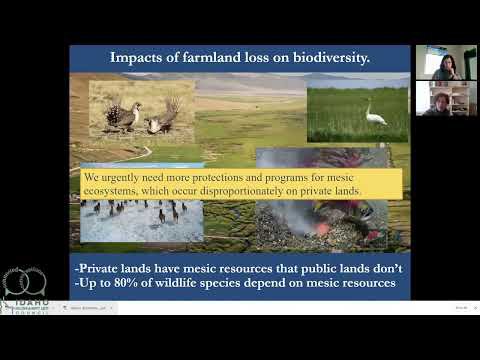
I just have a couple slides here, about the impacts of farmland loss on biodiversity. And so what we see here is a picture in Lemhi County, which is, kind of near Salmon, Idaho. And what this picture really characterizes is the private public land divide, I guess, so to speak. So all of this lowland, this green, lush area, that's what we call working lands.
So this is private lands that are in, ranch or farming and then like up on the upper left corner, these uplands, those are all public lands. This is BLM land. And so what we can see here as the private lands tend to be really green, really lush and really open. In terms of if you're if you're a critter and you're trying to pass through this landscape, whereas the uplands, they also are pretty are obviously really open, but there's hardly any green or what we call mesic resources.
So one way in which farmland loss, is impacts biodiversity is that private lands have these mesic resources that public lands in many areas just simply don't. And in Idaho, 80% of wildlife species depend on mesic resources. And so this is, you know, migrating animals, salmon, waterfowl, sage grouse, it's, portion of their life cycle.
They really depend on these mesic resources, which are disproportion on private lands. So here, we urgently need more protections and programs for mesic ecosystems, which which occur disproportionately on private lands. And then the second way in which farmland loss, impacts conservation and biodiversity is this issue of wildlife connectivity. So again here we have kind of like this idealized, private land working landscape.
And, you know, it's just wide open spaces for these, these migrating ungulates to pass through. So that's kind of our best case scenario. Our worst case scenario is we turn into something like this, worst case for for the undulates the migratory. And this was kind of an impenetrable landscape for, for a lot of migrating animals.
And with what's going on in Idaho now, what we're finding is, is we kind of have this in-between landscape. And so we we still do have, possibility or connectivity. But you have a subdivision here and maybe an agricultural easement over there and still working lands over here. And so there still is connectivity. But really we what if we could, we could get more bang for our buck or better outcomes if we had a more systematic, targeted, implemented implementation of land use policy or private land protection.
Because even this amount of disruption of connectivity in the landscape does have a major impact on, biodiversity. So now, Rebecca, now it's it's, you and I'm going to turn off my, microphone here.
Dr. Rebecca Som Castellano: Great. Thanks, Jody. So I'm a rural sociologist here at Boise State, and I wanted to speak a little bit to thinking about how farmland loss can potentially impact farmers and, communities. And one of the important things I think that needs to be considered in this conversation is that land use change is occurring in concert with a lot of broader changes in the agriculture and food system.
Sometimes I'll refer to this as the agrifood system. In many decades we have had processes of industrialization, globalization and concentration that have led to us to have fewer farms, but ones that tend to be far larger. Can you change this slide for me, Jody? Thank you. One more time. We're quick. There we go. So over time, the share of larger farms has increased.
And in 2017, farms with over $1 million in sales accounted for about 68% of all the value of agricultural production. And this was up from 28% in 1987. So there is one way we can see a pretty dramatic shift happening. And importantly, the share of midsized farms has decreased. So in 2017, farms with $250,000 in revenue made up about 10% of all production value.
And this was down from 45% in 1987. Can you click one more time for me, Jodi? Thanks. The acreage in cropland is also becoming increasingly concentrated in the hands of a small number of very large farms. As of 2012, 36% of all crop land was on farms with at minimum 2000 acres. And this was up from 15% in 1987.
And the average of cropland acreage doubled between 1987 and 2012, going from about 650 acres to a little over 1200 acres. In contrast to this overall trend in the agriculture of consolidation. And this is kind of interesting for Idaho, there has been less consolidation in cattle cow calf operations. So I think that's one important thing to note.
But again, we still see an overarching trend towards kind of industrialization, and globalization. So again, if we if we think about other aspects of that, we might look to specialization. And this is where we see farms growing fewer crops on average. And so this really represents a movement towards mono cropping in a way from work.
Polyculture systems, field crop operators often now just grow 2 to 3 crops. And with livestock production there's often no production or much less production of crops. And rather, an increasing reliance on purchased feed. Despite this increased consolidation, most production continues to be carried out by family farms. So Jodi mentioned this, I think, percentage of 96% of family farms.
And this is true, that we still have a predominance of family farms. And one, I think important metric with this is that family farms accounted for 90% of farms with at least $1 million in sales in 2015, and produced 83% of production from million dollar farms. So this is also thinking about how the term family farm can be somewhat misleading.
It may not necessarily be what we conjure in our mind of what a family farm is, that a lot of family farms are very large in scale, and may not necessarily be recognized by many as what we would think a family farm might look like. The consolidation of farmland is also important. And obviously very relevant to our conversation today.
In 2012, 36% of cropland was held by large, and mid-size farms. And this is a shift from previous times. In 1987, for instance, while large farms operated about 15% of cropland, midsize farms operated more than 50% of cropland. So we're seeing those kind of mid-scale farms, definitely having kind of a decrease in the amount of crop land.
This consolidation, of farmland has led to a lack of available farmland for many farmers, particularly those who are looking to lease land. And this has also led to overall higher prices for farmland, creating a more competition for that land. And it's also made it more difficult for new farmers, right? People who want to kind of get into farming made it more difficult for them to enter.
And Jodi, if you can do one more clip for me, I think another important note here is thinking about the concentration not only of kind of production, but the other aspects of the agricultural food system. And we see that large corporate firms are playing a really important role in coordinating agriculture globally. The use of contracts has become increasingly evident.
This is particularly true in hog and poultry production. There's been many firms. There are many firms that operate many, multiple farms and then so again, we see this consolidation also happening in other sectors. So in this graphic we can see consolidation in the seed industry, which we, which is a sector of the agrifood system where we have seen, again, pretty dramatic consolidation occurring.
Can you click for me, Jody? Thanks one more time. So input costs are decreasing increasing. And most farms, are seeing a decline in their incomes. And together this has created a situation where for many it's difficult to survive. And this is particularly true for what we call kind of the AG of the middle. So those kind of middle range or middle scale farms.
So this first table that we're seeing here is showing that the scale of farm is related to this share of income coming from the farm from farming. And so one thing we've seen is that because the AG of the middle has proven to be really vulnerable to consolidation because of many of these factors that we've talked about, we have seen an increase in off farm employment.
So this is in a farming household where someone is now increasingly working off the farm. And we see that this varies somewhat by the, size of the operation. The smaller farms are more likely to have, a greater share of their income coming from a farm. Can you like one more time for me, Jody? I have a couple other tables here that I wanted to show.
We can see here that this also varies by region. Right. And click one more time, Jody Thanks--that we also see that this varies by commodity specialization and that field crops in particular tend to fare more poorly. So thinking about this kind of AG of the middle and how farms are surviving, there is increasing importance in in having a source of income off the farm in order to for farms to be able to, be financially, viable for, for a household.
Another note here is that the average age of farmers has been increasing. And this combination of factors has led to many farms being really vulnerable to land use conversion. And this is selling to larger firms and also selling to development. This disappearing AG of the middle is concerning for rural communities because this group of producers, this agriculture of the middle has also been found to be more likely to employ more people, to utilize local services, to contribute to local institutions and to kind of help maintain overall well-being in rural communities.
One more click for me, Jody. Thanks. At the same time, we have an increase in this urban population, as Jody was mentioning, and an expansion of the urban landscape into formerly rural landscapes. And here we might refer to the urban rural interface. This is the space where the urban and the rural meet. Many farms exist at this urban rural interface, including here in the Treasure Valley.
But these farms are obviously really vulnerable to land use change and conversion given their proximity to this growing urban landscape. So this is coupled with the other dynamics that we've already been talking about, as well as things like changes in climate. Some studies have suggested that rural areas are going to be more likely to suffer from changing climate.
And in in some research colleagues than I have done, we found that local farmers, are facing some of these challenges and are also really working to figure out innovative ways of addressing these various pressures that they face. So if we bring this all together, we see that farmers at this urban rural interface face a lot of challenges and pressures, and also some unique opportunities.
Can you click for me, Jody, please?
Dr. Jodi Brandt: Thanks.
Dr. Rebecca Som Castellano: So in addition to what we've already spoken about, challenges for farmers at this urban rural interface include dealing with potential conflict between like an ag folks and non ag folks. For instance, the presence of tractors, for instance on roads can can be a source of conflict. We see issues of rising land prices and this pressure to convert land, land to development.
But there's also some great opportunities for farmers that reside in this urban rural interface. And this includes being in close proximity to local food consumers. Farming in the shadow of metropolitan regions can mean greater access for farmers to consumers, and also for consumers to farmers. And we find that some of these smaller scale farmers who are more likely to engage in direct to consumer opportunities, like farmer's market or CSA, are also more likely to reside in this kind of urban rural interface.
And we also see that, some of this kind of AG of the middle is also more likely to be in that zone. At the household level, these farms have greater access to institutions and resources when they reside in this space. And they also have access to things like, you know, health care, other jobs if they need that off farm employment, etc..
So there are some real benefits for agriculture residing at this urban rural interface. Can you cook for me, Jody? So we're all communities are therefore, you know, really vulnerable to land use conversion in many ways. And many of the reasons to protect farmland involve supporting local communities, both rural and urban alike. And some of these include ensuring the ongoing production of food and fiber, often the most productive farmland is also the farmland that's being converted to development.
And these smaller scale farms that I was just speaking to are more likely to exist at this urban rural interface. And they also may be more likely to be able to support kind of local food systems and influence local food security. They also might be more likely to engage in something that's been referred to as civic agriculture, that is, farmers who are highly engaged in the local community.
And so that can be really important for the health and well-being of rural communities. In, in really encourage those connections between urban and rural people. The other point here is that, there are important ways in which, preserving land at this urban rural interface in particular can help urban. I'm sorry, it help rural economies and communities survive and thrive.
Agriculture serves as the base for many rural communities and is keeping the land and farming. By keeping the land and farming, it can really help maintain that economic foundation. In addition to some of these kind of obvious economic benefits that farmers, derive directly from sales, we can also think about how farmers buy equipment. They buy seeds, they help maintain this land in some really important ways, including some of the, the things that Jody was speaking to earlier.
We also can see that some studies have demonstrated that residential developments cost municipalities more than the top tax revenues that they generate. So there's also some other kind of economic benefits to the local rural communities that exist in that regard, as well. In addition to these kind of economic benefits, I think that many of us can probably think about non-economic benefits as well.
Right. So a sense of place, the beauty of the landscape, sentimental attachment to the landscape, a feeling of local heritage, etc. these are other reasons that preserving farmland can really be beneficial to rural communities, and also people from urban places that are proximate to those rural communities. And finally, people have noted that farmland preservation can help stem urban sprawl and help to ensure future sustainability of ecosystems and rural communities, and regional communities more broadly.
We also know from some of the previous research that we've done, that folks in the Treasure Valley are really concerned with the loss of farmland. And that this concern is, has been found to be greater among rural residents and those living at this urban rural interface. So I think that's also just a really important thing for us to know and recognize the importance of agriculture for Idahoans, particularly those living in rural places.
And those living at this urban rural interface forces us to confront the realities of this land use change. And who can benefit from the preservation of that land? One more click, Jody. And if you want to finish on this last slide.
Dr. Jodi Brandt: Yeah. So I guess we just had, you know, some take home messages or recommendations for decision makers, which is, right now there there are some efforts and where, you know, those efforts are laudable in terms of a farmland protection, but we need stronger land use policies that, you know, are kind of integrative in and consider multiple dimensions, the rural rural communities, biodiversity, ecosystem services.
And there's multiple different dimensions of farmland and land use. In terms of conservation, mesic systems occurred this proportionately on private land. And so we really need to target protection mechanisms, whether that land is developed or not. But diverse mechanisms to protect those mesic systems. Because if critters can't get to those mesic areas in certain times of the year, then that that's a real problem for conservation.
And then in terms of the lay out land protection that we're seeing now, it typically happens opportunistically. So, like, for example, a local land trust has a big bunch of money. At the same time, if they know of a farmer or rancher who's willing to put an easement on their land. So they're not really there's not really programs in place that enable, land trust to systematically, prioritize different parcels of land that have a money flow and a system to, place, place easements or land protections on, on, on the places in a, in a planned way.
And so more targeted placement of private land conservation would provide greater benefits. And that's that's all we have in terms of the PowerPoint.
Doug Exton: Awesome. Well, thank you both for the insight on both of your perspectives. You know, just the different ways that this issue not only important, but also how it affects people and the different ways to approach it as a whole. The first question we have, which states rank high in terms of policies to protect farmland?
Dr. Jodi Brandt: Yeah, there's a bunch of good questions here in the chat. So I think, and several of them have to do with this one slide that I showed, which was those, protection policies. So maybe I'll just show that one again, if that's okay.
Doug Exton: Oh, totally.
Dr. Jodi Brandt: Trying to find my controls here. There it is. Okay. So I just want to point out that this is not my my data or our data, that this was a report published by, by a national NGO. But I'll tell you what I know about this data. So the first question was which states rank high in terms of policy to protect farmlands.
And, so it tends to be the coastal states. And there's two reasons for that. One is because they've been dealing with this issue for a long time. So if you think about California and Oregon and Washington on the West Coast and then on the East Coast, you have, you know, Connecticut, Rhode Island and Maryland, they've been that for for many decades.
They've had this urban growth and urban sprawl. And so that's one reason they've kind of developed these systems, these statewide systems to do land use policy and farmland protection. And then the other reason is those states tend to be politically liberal. So, you know, politically liberal folks tend to be more open to land use planning and general and farmland protection policies, whereas politically conservative states tend to be opposed to any kind of centralized type of land use planning.
So, yeah, what you see is in this trend, if you if I had a map to show you of like the whole nation ranked and different colors based on their overall score, you would see this general trend of the coastal states having higher, higher, stronger land use policies. And then the center states, or more moderate states in the middle that haven't been experiencing, land use, development for that long and, who are also more politically conservative, they would tend to have lower or weaker land use planning scores.
And then another question here. That's a good one. So independent land trusts, they are not actually one of the six policies that are considered, the place that is the federal state is meant program. But what what they did here, they were looking at kind of federal and state policies and local land trust. That's not something that's a state or a federal policy.
Those are more ground roots, efforts that they need, like donations from private organizations in order to make those farmland protection investments. So I don't have any data on how states rank in terms of, for and in terms of like these ground roots efforts, this, this report or this data analysis was really focused on federal and state policies.
Doug Exton: You know, thank you for clarifying that. And showing that table again, I think is definitely very helpful in this next question, I think will be geared more towards Rebecca, sort of skills to do like a farmer's market. You know, those like super social, you know, salesman skills essentially look quite different from those needed on, you know, the family farm, you know, the labor aspect.
From what the person asking the question I've seen. So what's your experience or research in that kind of skill set the skill set divide. If you have any.
Dr. Rebecca Som Castellano: Yeah. Well I can speak to this both from a research perspective and also from a personal perspective. Before going back to graduate school to become a professor, I was a farmers market manager. And so I have some experience from this as, as a kind of from the farmers market manager side. And so, yeah, I mean, it of course varies.
You know, it varies a lot based, you know, by farm. And I think that, you know, one of the, opportunities for farmers markets and also the challenges is that you wear many hats. And one of those hats is helping farmers market themselves. And so you play a role sometimes when you're in the, in that farmer's market manager job of helping someone figure out how to lay out their table, how to make the, you know, things attractive.
You know, you help sometimes with pricing. And so I think that that sometimes that's true. Right? There are sometimes is a mismatch between the skills that make for a great farmer. In terms of like the production side of it and the skills that make for a good marketer. You know, on the other hand, I've seen many farm farmers do a fantastic job.
And and one of the things we know from the research is also some of that kind of marketing side gets delegated. There is sometimes a gendered component to that, that in some instances, you see in a kind of traditional farm family, that a wife might be more likely to be the one to go do the direct marketing and think about that marketing side.
Although, of course, it's not always the case that sometimes when smaller scale farmers use an apprenticeship or internship program, that sometimes those interns or apprentices are the ones that play that role. So yeah, I think that that can be true. And also, I think that there are a lot of, ways that people manage to to still kind of be successful in that way.
Doug Exton: And then another question from the audience is, it seems that the intermediate, you know, largely urban rural interface farms have traditionally had more diverse and, heterogeneous crops and overall less intensive land use with fence rows, irrigation canals and other fallow areas that may provide ecological services. Then what we see with the expansion of larger farms. Do you have any data on that?
Dr. Rebecca Som Castellano: Yeah, and I'm just reading the question here, Doug. So I'm sorry, I'm more of a visual.
Doug Exton: Learner in the same way. Don't worry.
Dr. Rebecca Som Castellano: Yeah. I mean, there's some truth to that, right? The and I spoke a little bit to that, that the farms that tend to exist in this urban rural interface are more likely to be these kind of very small farms. And that's a category of farms that's been increasing, or sometimes this middle range farm size, those, those traditionally have been farms that are more likely to be these kind of polyculture systems.
So thinking about farms that are growing multiple crops and also often raising animals at the same time, and that does lead to less intensive land use. And, and sometimes, you know, greater ecological services. I'm would be happy to, you know, I don't have that data on me right now, but I'd be happy to share out some research, with Doug, who potentially.
I don't know if you have a mechanism, Doug, to be able to share out further, but, yeah, there certainly is research, on that topic.
Doug Exton: Yeah. If you send it my way, I can definitely link it when we post the recording of this.
Dr. Rebecca Som Castellano: Cool. Yeah. And Jody might, might have something to say about that as well.
Dr. Jodi Brandt: Well, I completely agree with what Rebecca is saying. And at the same time, with these large operations, there's also a tremendous opportunity there. So I'll give an anecdotal example of one of the largest easements, private land easements in the Idaho Montana area, as Ted Turner came in and bought this huge ranch. And then he put it all under easement.
So that means it can't ever be developed. And then also it's like managed for natural resources because he doesn't need to make money. Right? You know, so sometimes these large landowners, they because they have less pressure, like their margins are less or are less razor thin, I think. And also because they have people working for them that could implement, you know, more environmentally friendly land use practices.
They actually have the capacity to make a really big impact if they would choose to use more environmentally friendly practices. So I think I think that Rebecca is totally right that you could say, by and large, these large and intensive agro industries are worse for the environment. At the same time, if there were if there were some regulations or incentives in place in terms of making them or incentivizing them to do more environmentally friendly practices, that that could be where you make your most impact because it's easier to regulate them.
And there they stand because they have so many acres they could implement, you know, an incentive program over a huge amount of acres, ask their employees to do it, and then they make a lot of money from that. So there is a lot of opportunity with those big operations.
Dr. Rebecca Som Castellano: Yeah. And I would just build on what Jody's saying as well by adding that, you know, a lot of farms and all kinds of scales, you know, view themselves as stewards of the land and care deeply about the, you know, ecological impacts of their operations and are doing lots of new and innovative, you know, techniques or some old techniques, you know, to, to, to engage in those ecological practices.
So it's certainly, you know, we have to always be careful about, you know, making really such broad generalizations about, about scale.
Doug Exton: You know, and another thing that I've noticed, from a personal perspective, is there are definitely a couple farmers, that are subdividing their land and then selling off, you know, an acre here or there or a couple acres at a time, you know, either for, you know, those younger people to, you know, have their own farm or selling it to a developer for, you know, a smaller subdivision.
So how does that play into, you know, this loss of farmland turning into more developed, less rural uses?
Dr. Rebecca Som Castellano: I feel like Jody might be better suited to answer this question, but but one thing I would just add a at the start is I'm not as familiar with some of some of that, Doug, but it makes me think about something I think is really cool that's happening to our organizations that help link up, you know, farmers that want to retire, but they don't want to sell their land to development with young farmers who are trying to get in to agriculture.
And there are some really cool kind of funding mechanisms to help support both of those people. And so I think that is kind of getting that what you're talking about in terms of, you know, giving some land to a new farmer and helping with that process, I think there are some innovative things happening in that regard.
Dr. Jodi Brandt: Yeah. And I don't know the exact answer to your question, Doug, but I would just say that, you know, a lot of farmers and ranchers, my dad's a farmer and he doesn't have borrowing pays and stocks like his retirement plan is his land. Right. And, if he needs it for anything for medical expenses or that's what that's what he would sell.
So I think when we think about, farmland protection strategy, these, you know, these landowners have been working their whole lives to build up the value of that. And then sometimes, like if you're in a Treasure Valley and you can sell that land for $50,000 an acre and you have 100 acres, man, that's a lot of it's difficult to turn that down, right?
To give it to a young farmer that you don't know. And Rebecca has done some really interesting research. I'll let her speak to that. But like, a major predictor of whether a farmland gets sold for development is. What if the farmer has an heir? But I I'll let Rebecca speak to that.
Dr. Rebecca Som Castellano: You know, there was some research that, my colleague Gillian Maroney and I were doing looking, in part at how farmers in the Treasure Valley were managing kind of, pressures from development, as well as thinking about climate change. And kind of an unexpected finding was that the presence of an heir really played a big role in the land use, decision process.
And it was leading to some people who had maybe been doing maybe more traditional commercial, commercial agriculture to move towards, for instance, like making, greater use of dredge to farm a direct to consumer sales, for instance. And that the heirs in some cases were getting involved in that. But sometimes it was just knowing that you had a kid that that was interested in being involved, and they weren't old enough yet to be, you know, playing a role.
But they just their presence and their interest was enough for for the farmers to be thinking through some of those maybe more innovative, things that they might like to do. And so, that definitely, you know, there are sometimes factors that we might not immediately think about that can that can end up playing a significant role in decision making.
Doug Exton: And then with the, public land, you know, that's owned by multiple different federal entities and state entities, is that amount of land, you know, growing or shrinking, or is it pretty much just saying the same in Idaho?
Dr. Jodi Brandt: Well, to my knowledge, I'm not a public lands expert, but everything from what I know, federal lands, that kind of immovable. There's not a lot of activity, at least in Idaho, going on in terms of taking federal lands and making them into private lands. That, you know, there is definitely extractive use and other kinds of use of public lands, but there's no transactions to make that into private lands.
State lands are a little bit different. There is the state does have the. So the state lands are managed by the Idaho Department of Lands. And their overarching mission is to make money to fund education in Idaho. And so they do. I'm not sure about how they, implement or exercise these rights, but they do have rights under some situations to sell Idaho state lands for that purpose of making money for the state.
I think it's a minor dynamic that's occurring. That's my understanding. But it it does occur.
Doug Exton: In more on the social aspect, you know, with at least for my own personal experience, when I moved here and I've heard from a lot of people, I've lived in Boise longer. Meridian is essentially, you know, just done I want 80, you know, from, you know, the true pure farmland. So now you have a village and you know, you can drive from Boise to Meridian and not even see any, you know, size of farm.
So how do like the subdivisions and other developments, is there a way to, you know, only acknowledge that this used to be farmland but still have that heritage associated with it?
Dr. Rebecca Som Castellano: I don't know, I don't know if that's a good question, Doug. I'm not sure how to answer that. You know, I mean, I think that, to to do that in a meaningful way, I think sometimes it's done in a way that may not feel very satisfying to rural communities. Right. Like, I think one thing that comes to mind, for instance, I think there have been efforts to do this right, thinking about how subdivisions are planned, even how they're named, and trying to honor that land in those ways.
But I'm not sure how much that I'm not sure how far that goes to alleviating these broader economic, social, cultural senses of loss and a real experience of loss in rural communities. And I would just point to a chat, something that Marianne put in the chat about these new kind of large land purchases, purchases, driving out, locals out of business.
And you know, this is true, right? They drive farmers out of business. But that also made me think about, a form of kind of like rural gentrification, in a sense. Right. When we hear the term gentrification, we're often thinking about urban spaces and people getting kind of priced out. But we also see this happening in in rural places.
Right? So with this land use change and development, you can then see that people that have been a part of a community for a really long time might then get priced out of that as well. So I think that that's another kind of social aspect of what we're talking about. That's really important to think about. What does it mean to be a person, a young person that's chosen to stay in a rural place, which is actually relatively uncommon these days we have a lot of so-called brain drain and then no longer be able to afford a home in your community.
For instance.
Doug Exton: So the next question, Can you think of the best way to word this? But, you know, kind of that concept of, you know, when you plan a city, does rural farmland belong, you know, kind of that dynamic, especially when, you know, in some instances a city can be really that leading charge, you know, in the broader scale of a region.
So it's kind of like, how does that dynamic, you know, play in when a city, you know, at least, you know, on the internal aspect decides they don't really want to worry or focus on farmland?
Dr. Jodi Brandt: Yeah, that is a great question. I can speak to that a little bit. So land use planning, there's multiple levels of jurisdiction to that. So there could be the city of Boise has its policy, and then Ada County has its policy. And then you would have the state policy, and then you would have the federal policy. And those are typically the like the four major jurisdictions.
But for example, the city of Boise could say, we're going to protect 40% of our farmland within our jurisdiction. But if that's not synchronized with what Ada County is doing or what with what the state is doing, then sure that you might have this island of farmland within Boise City, but everything else around it is developed. And so going back to that national report that American farmland trusted, they, they developed these, overall rankings.
So each state had one ranking of whether it's the highest or the lowest in the whole nation. And then they tried to look at it and, and these, these rankings were based on actual farmland loss, as a product of development pressure. And what they found is when you had maximum alignment between, like federal, state, county and local policies, that's when you have the best outcomes, right?
Because, and that goes back to like this idea of more politically liberal versus politically conservative. You know, politically conservative states believe in like, states rights and local jurisdictional rights. So they're very hesitant to implement these state level policies that would, cause that alignment of a policy that finer scales. Whereas politically, politically liberal states in that analysis, Oregon came out, I think, as the top ranking line.
So they have the state who's making state policy. They're accepting federal money for the for the federal from the federal policies, and they're implementing or they're working with local and county jurisdictions to make sure that there's some unified or synchronized land use and farmland protection policy.
Doug Exton: And I think a really good example, you know, what you talked about with, you know, the random floating farm, you know, in an urban or suburban environment, if you have the time to look up the village of Meridian on Google Maps right across Eagle Road, you know, I mean, it's going to sound kind of weird, but there's this random giant farm, just because of the way the developments happened in, you know, I'm sure part of it is the owner of the land not wanting to sell their land, you know, getting multiple offers for it.
But I think that's a really good example of, you know, how that looks just from a visual perspective. And another person is I wondering, you know, what can you do to get involved, you know, on the county level with, you know, planning and zoning in the sense of, you know, not having just that, you know, sprawling environment, but having more of that balance, whether it be denser building or just less development.
Dr. Jodi Brandt: Yeah. And I will tell you what my observation is, how it works here. And then I don't really get down to the county level, you know, what happens within a county. But my understanding of how it works is that the county commissioner, really has a huge amount of influence in zoning decisions. And I say in Canyon County, well, all of that farmland is zoned as farmland.
So there actually has to be a conscious decision made at the county level led by the county commissioner and the people that that county commissioner has, you know, on the committee or whatnot. There has to be a conscious decision to rezone that land for development. And this is the I've gotten so many emails and phone messages about this.
Again, I create the land use protections. I'm not a government sort of person, but this seems to be a really common complaint that, all of the or many of the constituents of that county, they, they try to voice their concerns and they don't really want the sprawl to happen. But the decision making power, is in the hands of the county commissioner and that office and, tends to there is money involved so that they tend to side on the development, the developer, rather than keeping that lands on their farmland.
And by the developer, I mean obviously that farmer must want to sell that land too. But they tend yeah, there's this dynamic that they tend to say, yes, we're going to you have a willing seller and a willing buyer, then we're going to change the zoning. So I don't know what the solution is there except to put pressure on elected officials.
That's the only thing I can think of.
Doug Exton: You know, public testimony is always welcome. From what I've seen, both, you know, city of Boise, I'm sure other cities as well, they are public meetings. So even with social distancing, there's still ways to be involved in that, you know, public hearing process, whether it is through writing a letter, sending an email, or even just watching, you know, whatever live platform it's being broadcast on.
Ada County uses YouTube live. So I think reaching out to the planning and zoning department, you know, just kind of asking, like, how can I get involved from a, you know, citizen standpoint can also be helpful.
And then I think this will unfortunately be the last question we will have time for tonight. But another audience member asked, it seems like there seems to be a much more efficient gravity foot irrigation infrastructure. That's also now in the urban rural interface. Does this seem true?
Dr. Rebecca Som Castellano: I think Jodi and I can probably both speak to this. And, I mean, this is not my area of expertise, but in doing some kind of inner disciplinary research and working with some interdisciplinary groups, I would say my observation has been that there has definitely been a move towards, different forms of irrigation and part of that has also been in tandem with some crop transitions.
So, for instance, we have seen a large increase in.
Dr. Jodi Brandt: Hop.
Dr. Rebecca Som Castellano: In hop production. And so changes in irrigation strategies have, made sense with some of those changes in crops as well. And I think, you know, part of that part of the driving force there is definitely, you know, water concerns. So I have had a similar observation.
Dr. Jodi Brandt: Yeah, I would say I, I go to the more rural areas that just hit the urban rural interface, and I see a lot of farmers or ranchers making investments in irrigation in the very rural areas too. And in my mind, how I understand that is, because that's a super, expensive investment to go from, like a drainage ditch and drainage irrigation system to, say, a center pivot or sprinkler irrigation system.
So it's those farmers and ranchers who plan to stay in production. They're the ones that make that investment, and that investment enables them, just as Rebecca was saying, to grow higher value crops. Because you can control the water, you have more stable, steady water supply. So I don't think it's just in the urban rural interface that farmers are making that investment.
But I think a key decision, a key thing that farmers and ranchers decision making process there is that they plan to sell in 5 or 10 years. They're not going to make that investment. But if they're in it for a longer period of time that they're willing to make that investment.
Doug Exton: So I am going to ask one last question because I think it, you know, is really important socially for our state. You know, if you look on the whole Idaho scale, Boise's definitely that dominant urban environment where there's there's other small rural cities and towns scattered throughout. So how does that dynamic between, you know, those really smaller towns that have, you know, a couple hundred people that are almost all farmland to Boise?
You know, that dominant figure? That's all urban. You know, how is that dynamic playing out on a statewide scale?
Dr. Rebecca Som Castellano: I'm not sure about how it's playing out, the statewide scale, but I will just say in general, you know, having connectivity to an urban center can be really beneficial for a rural for rural places. We find the, the for the more rural, community is, often the greater the issues related to kind of health and well-being are.
And that can be as simple as like having access to a hospital, having access to other employment if a person is willing or interested in commuting. So, it's not, you know, that that proximity to an urban place can be of great benefit to, to a rural community. And it can also bring challenges, as we're seeing in this very conversation, right, that that this whole conversation is about that proximity between these kind of traditionally more rural, places at an in an urban center.
Doug Exton: Awesome. Well, of course, we got our outline for tonight, but I wanted to say thank you again to both of you for all the insight on your expertise on this topic. You know, really showing those nuances. And thank you to everyone who hung it out until the end. Since we did go a little bit over. Have a good night everyone.
Dr. Jodi Brandt: Thank you everyone.
Dr. Rebecca Som Castellano: Yeah, thanks.