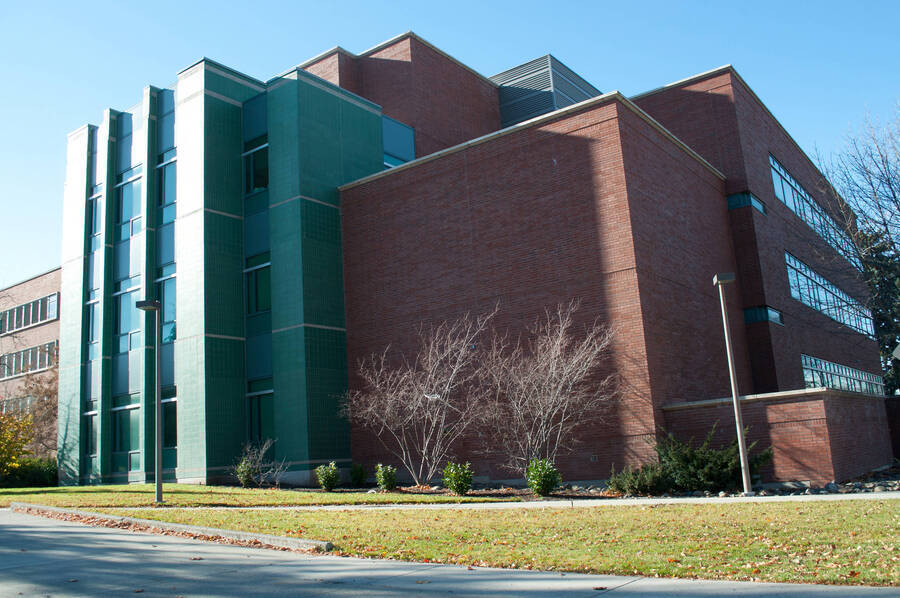
Agriculture Biotechnology Building and Laboratory
Geographic Coordinates: 46.729457, -117.013962
Location: Rayburn and 6th street
Agriculture Biotechnology Building and Laboratory Overview
Date: 2000-
Standing: Yes. Built between 1998-2001, dedicated in 2000.
Architect: Ellis-Feeney Architects of Lewiston and SRG Architects (Portland)
Architectural Style: Postmodern
Description: Three Floor,45.000-Squar-foot Brick Building
Use History: 80 Percent of the Building House Molecular-based Research Programs involving Plants, Livestock and Microorganisms,20 Percent of the Building Consist Faculty Offices,Conference Rooms and Interaction Space.
Cost: $24,500,000. $24.5 Million
Sources: Register
History
The Agricultural Biotechnology Building at the University of Idaho is representative of the institution’s enduring commitment to agricultural research and education. “This [construction of the facility] is one of the most important things we will do in the 21st century in terms of this university,” said President Robert Hoover. Designed to support disciplines such as plant and soil science, entomology, animal and veterinary sciences, microbiology, molecular biology, and biochemistry, the building integrates modular laboratories, classrooms, and offices to advance the university’s academic mission.1 As one graduate student put it: “What this [building] represents . . . is how the College of Agriculture keeps updated and makes the needs of our community, locally and globally, part of our outreach mission.”2
Construction began in 1998 and concluded in 2001, marking the final major project of the 20th-century campus building boom. The $24.5 million project received more than $6 million in federal funding, $5.3 million from the state, $3 million in private donations, and $1.3 million from other sources. One source of funding included the Idaho Wheat Commission, which also advocated for the inclusion of strawboard—a wheat byproduct—in at least one conference room. Occupying the last vacant site on the Academic Mall, the building represented a strategic investment in the future of agricultural innovation.3
Design
The design of the Agricultural Science Building is contemporary, emphasizing rectilinear forms with Neo Deco-inspired elements. Unique materials such as green tile support the Neo-Deco characteristics, giving the building an almost timeless appearance. The building also incorporates a campus staple–red brick–imparting a collegiate continuity to the design, while the green tile and varied projections anchor the building firmly in the 21st-century.
Physical Description
The 48,000-square-foot, 3.5-story building is composed of steel-reinforced concrete, red-pressed brick, glass, and metal paneling, and features contrasting green tile. The east elevation showcases a central projection highlighted by horizontal fenestration bands, vertically divided by twin buttresses and clad in green tile. Dual-paned, metal-framed windows and standard ADA-compliant glass-inset metal doors appear throughout.4 The north and west facades are marked by unornamented bands of sash windows with flush-light transoms, while the south elevation connects to the Agricultural Sciences Building.5
Notes
-
Nathan J. Moody, “National Register of Historic Places—Registration Form: The University of Idaho Historic District,” initial submission to Idaho SHPO, unpublished, University of Idaho, Moscow, Idaho, May 7, 2025, 64. ↩
-
Kathy Hedburg, “Biotech Building Called Key to Ag’s Future,” Lewiston Tribune, October 24, 1998. ↩
-
Moody, “National Register of Historic Places—Registration Form,” 64. ↩
-
Ibid, 63. ↩
-
Ibid. ↩
Browse Images