
Blake House
Geographic Coordinates: 46.724674, -117.00807
Location: Blake Street
Blake House Overview
Date: 1952-
Standing: Yes
Notes on Naming: Originally, named for Mrs. Ethel Steel, Board of Regents, 1933-1946, a leader in the movement to provide cooperative dormitories at the U of I.
Architect: Hugh Richardson (Lewiston); General contractor, Commercial Builders (Moscow)
Architectural Style: International Style
Description: Wood frame with brick ornament, flat roof; basement and three floors, 11,116 sq. feet
Use History: Cooperative dormitory for 58 girls; replaced Ridenbaugh Hall as a residence. The dormitory has moved several time since then.
Cost: 150,000. $150,000 (Bonds)
Sources: Cards, Morton, UG 12 (2320)
History
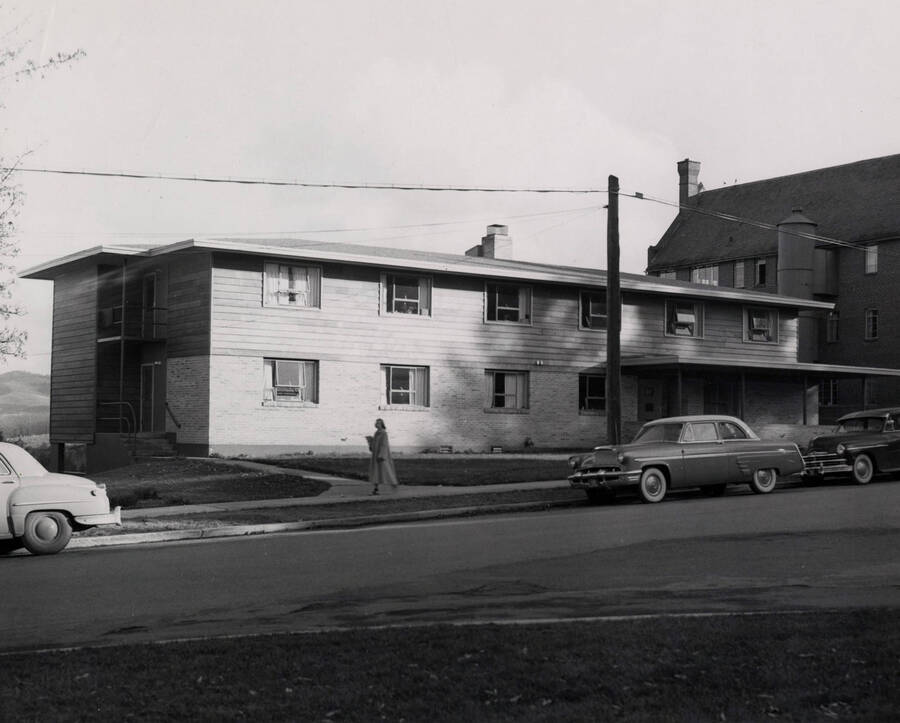
Blake House, originally named Ethel Steel House, was designed by architect Hugh Richardson of Lewiston, Idaho, and built by Commercial Builders of Moscow. The building was completed in 1953, and played a significant role in the University of Idaho’s tradition of cooperative campus housing. It was constructed as a women’s dormitory, and offered a range of modern amenities previously unseen on campus, including a sprinkler system, incinerator with a garbage chute, fire escapes, and color-coordinated rooms that contributed to a sense of modern luxury and feminine appeal. Notably, it lacked a smoking room.1
The house was formally dedicated to Mrs. Ethel Steel, a former member of the Board of Regents (1933–1946) and a prominent figure in the university’s cooperative dormitory movement. At the dedication, Steel recalled initial skepticism about the co-op model, noting, “When the plan was first presented to the Board of Regents, we had our doubts… However… we chose to proceed. This decision proved to be a prudent one.” Steel House remained a women’s cooperative through the 1980s and was later renamed Blake House (or the Blake Avenue House) when it was repurposed for administrative use.2
Design
Blake House reflects the International Style of post-war Modern architecture, characterized by a conspicuous lack of ornamentation and clean, functional lines. Some Prairie-style influences appear in the building’s hipped roof and sharply defined angles. Hugh Richardson’s design emphasized practicality while incorporating subtle stylistic references that softened the building’s modernist profile.3
Physical Description
The four-story structure, partially built into a hillside, has a wood frame on a reinforced concrete foundation. Its exterior features a combination of rusticated brick in common bond and horizontal wood clapboard siding. Aluminum and glass are used for both doors and windows, which vary in style and include single, double, plain steel, and sliding configurations. Though updated, the building retains the core elements of its original material palette and construction style.4
Ethel K. Steel
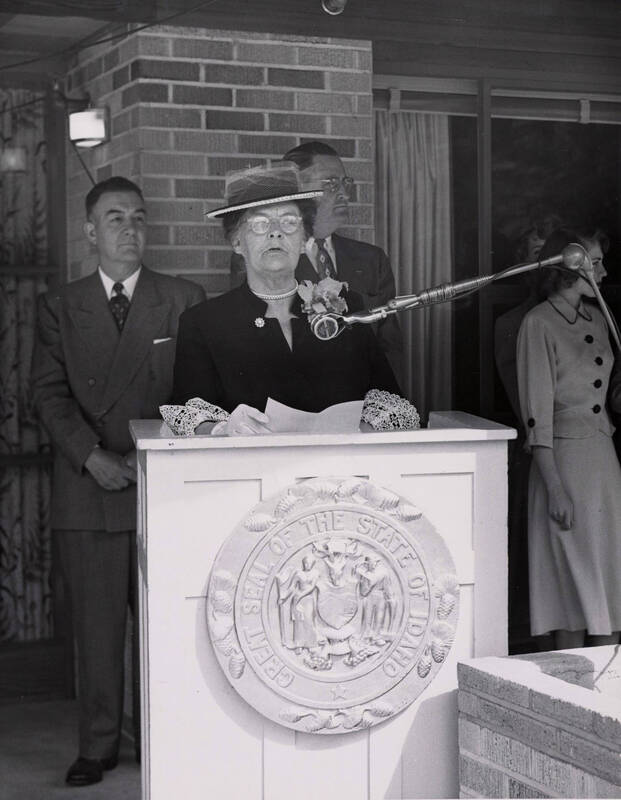
Ethel K. Steel served on the University of Idaho’s Board of Regents from 1933 to 1946 and was both the namesake and driving force behind the university’s first cooperative women’s residence. Steel House opened in 1953, and offered affordable housing paired with shared responsibilities for upkeep and meals. Steel was honored at the building’s dedication with a silver tea set, and was recognized for her commitment to “better education through cooperative living”, a vision that helped make higher education more accessible to women and shaped student life on campus for decades.56
Notes
-
Nathan J. Moody, “National Register of Historic Places—Registration Form: The University of Idaho Historic District,” initial submission to Idaho SHPO, unpublished, University of Idaho, Moscow, Idaho, May 7, 2025, 27–28. ↩
-
Ibid. ↩
-
Ibid. ↩
-
Ibid. ↩
-
Steel House: Women’s Cooperative Housing at UI, Harvester Blog, January 29, 2024, https://harvester.lib.uidaho.edu/posts/2024/01/29/steel.html. ↩
-
Steel, Ethel K. (1894–1970), Archives West, https://archiveswest.orbiscascade.org/ark:80444/xv148020. ↩