
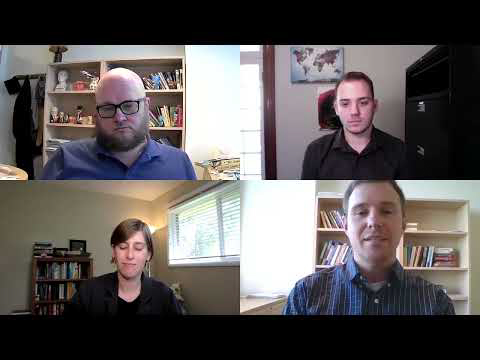
Dr. Jaclyn Kettler; Dr. Jeff Lyons; Dr. Steve Utych
Interviewee: Dr. Jaclyn Kettler; Dr. Jeff Lyons; Dr. Steve Utych
Interviewer: Doug Exton
Description: 3 political science professors from Boise State University to discuss issues facing Idaho voters, both on the local and national level. Topics for discussion include voter apathy and voting patterns and each panelist will bring their own specialty to this timely discussion. This program is funded by the 'Why It Matters: Civic and Electoral Participation' initiative, administered by the Federation of State Humanities Councils and funded by the Andrew W. Mellon Foundation.
Date: 2022-05-05
Topics:
The visual topic map is hidden for screen reader users. Please use the "Filter by Topic" dropdown menu or search box to find specific content in the transcript.
Doug Exton: Thank you so much for joining us for today's webinar. A program conducted by the Idaho Humanities Council and funded by the Why it Matters civic and electoral participation Initiative, administered by the Federation of State Humanities Councils and funded by the Andrew W Mellon Foundation. If you not familiar with our organization, I encourage you to check out our website, idahohumanities.org.
I would like to remind you all that you may submit any questions using the Q&A feature located at the bottom of the screen. With me today is Dr. Jeff Lyons, Dr. Jaclyn Kettler, and Steve Utych from Boise State University. It's nice to have you with us today. And I turn it over to you.
Dr. Jaclyn Kettler: Great. Thanks for having us. So we're going to start with just a couple minute kind of opening statement. And then we're excited to take all your questions. So, I'm going to talk just a little bit about some of the kind of voting rights and administration issues that we're thinking about this election and that we know, you know, these are always issues, every presidential election, because we get higher turnout, more people are interested in participating in a presidential election, and there's more attention on it as well.
But of course, Covid 19 has thrown some additional challenges, you know, for election administration this year. And we also want to remember that elections are run by state and local governments. So every state has a different election system and some way voting processes and administrations vary. So knowing that, you know, there will be a few states are kind of facing some different issues.
As we get into the election. So far, we're seeing really high enthusiasm across the country for voting in Idaho. We've surpassed 1 million registered voters, which is really impressive. As at like right after the 2016 election, we had about 850,000. So we've definitely added some since. Since then, we're seeing higher than, than usual early voting numbers across the country and in Idaho.
This is resulting in some longer lines in states. You may where I seen in the news, really long lines, people waiting hours to vote. You know, we still don't. There's a few things kind of motivating those long lines. Some states have had tech issues with, like, voting machines and things. There's also just a lot of people who really want to participate.
There's also some concerns and lack of confidence about the election. So people may want to go out and vote early just to make sure that their vote counts. There's also like lines of social distancing, right? So they're there. They look pretty long. Even when they're moving pretty fast. So that's definitely one thing that people are paying attention to, right.
And concerns on whether or not it's going to take way too long for people to vote and whether people are able to actually, vote. There's also some concerns about voter suppression efforts and whether that'll make an impact on the road. So far, that's minimal. It's, you know, examples of that. But I think there's some concern on Election Day that there might be some intimidation happening across the country.
Michael McDonald, a scholar working with the US Elections Project, has estimated that 60.5 million people have already voted, which is well higher than 2016. So this suggests that we can have really high turnout this year. However, we still don't know whether people have just shifted more voting by mail because they don't want to go vote in person for for Idaho.
I haven't seen statewide numbers yet, but for Ada County, we have about 29,000 that have voted early in-person already. That's not as high as 2016, but we've seen an increase in absentee ballots requested. And so it's likely that some of those, people have shifted over there. So far in Ada County, over 140,000 absentee ballots have been issued and about 93,000 have been returned, which is a pretty good, rate of return for at this point already.
And 27,000 absentee ballots were issued in 2016. So just an example of how people are kind of shifting how they're voting this election. Thinking about early voting and returned absentee ballots, about 122,000 people have already voted in Ada County. We were at about 75,000 in 2016. So again, we've got a pretty high turnout in early and absentee, voting already.
But again, we'll have to wait until after the election to see if this actually results in much higher turnout or whether people have just shifted how they're voting in some county. Other counties in Idaho are also already seeing higher the number of absentee ballots, you know, returns surpassing their 2016 numbers. These the counting of these absentee ballots are a bit challenging, adding in some additional, factors for, our local, county clerks.
They've been at work trying to get more, equipment and also other sorts of mechanisms to prepare for the processing of these absentee ballots, because you have to like check the you have to open the envelopes, check the signatures, make sure everything's been, you know, put together correctly. And this takes some time. And there is a risk that people's ballots will be, not, you know, rejected.
MPR estimated over 550,000 ballots rejected in the presidential primaries this spring. And so that's that's a big concern, right? That people are able to make sure that their ballots are their absentee ballots or are, counted appropriately. The deadlines also vary for, you know, having to get your absentee ballot in some states. That has to be by Election day.
Other states it can be postmarked by Election day, making it important to know your state's laws in Idaho, it needs to be in, by, or on Election Day, so time to get those in the mail if you have it yet. And then in Idaho, one thing that happened was during the Idaho Legislative special session this fall, they passed a bill to where, county clerks can start processing these absentee ballots.
A week before the election, before Election day, so they can already start that work starting tomorrow, which will hopefully help things move smoothly along once we get to Election Day. Just knowing where we have so many more absentee ballots usually that are cast. And so I mean, there's still some unknowns, right? And so some challenges. But at this point, it's definitely exciting to see lots of people out there.
And then do the astic to get their their vote counted. Thank you.
Dr. Jeff Lyons: Great. Well, with, that, great discussion, sort of the rules and the counting of ballots and things like that. With regard to how things are going to function now. And on Election Day, I want to take a little bit of time to, to chat about sort of what the lay of the land looks like in Idaho, and especially here in the Treasure Valley with regard to, partisanship and, sort of where the voters stand, on some different things.
And then I'll turn it over to Doctor Utych will talk about kind of how voters might think about the think about, casting ballots and things like that. We all know it's no secret that, the state of Idaho is, is among the more, Republican leaning states, in the country. But I do think sometimes that people, are prone to overstating, that marginal little bit.
So in 2016, President Trump got 59% of the vote in the state of Idaho, which is a lot. And it was certainly by no means a competitive race. But there are places in Idaho where things are quite a bit more competitive. So when we, start talking about, local level elections and so, you know, discussions of the presidential race eat up so much of our, media coverage and so much of the things that people talk about.
But these other races are sometimes overlooked quite a bit, but they can actually be, where some of the most interesting policy takes place and where some of the things that might impact, people happen the most. So here, locally, as we sort of shift our, our level of analysis down a little bit in Ada County, in 2016, President Trump won by nine percentage points.
So we would kind of think of that as being a place that certainly has a Republican lean to it. But it's not overwhelmingly Republican, and it's a place where Democrats can be competitive, at least under the right circumstances. And I think that's what makes it really interesting. And I think that's one of the things that I'm at least looking looking forward to seeing what happens.
Next week, in terms of kind of trying to understand how the balance of partisan power might be, might be shifting or might not be shifting here locally, when we look to our, our other, popular county to the west to Canyon County, it is a decidedly more Republican place. So in 2016, President Trump won by about a 40 percentage point margin.
And Canyon County. So you can drive 20 minutes down the freeway and have a very different set of local politics. And I think that's really important to kind of keep in mind. But we've had all these discussions about the potential, changing nature of the Treasure Valley and changing nature of Idaho. And, there's been a ton of growth here.
Right? So, the city of Boise, but especially actually the cities of Meridian, the city of Nampa, as well as parts of northern Idaho, Up and Kootenai County have been growing very, very quickly. We also know that a lot of these people come from states that we typically think of as more, liberal kinds of places. So there's been a lot of discussion about the extent to which maybe people who are moving here from California or Washington or places like this could be changing, the electoral makeup here in Idaho and here locally.
And so I want to talk about that a little bit, because I think it's really, really interesting to think about, you know, could we be a place that's kind of in flux and, through the School of Public Service at Boise State, we've been doing, statewide surveys now for five years and surveys here locally in the Treasure Valley.
And we've been trying to monitor these changes. And we've been asking people, you know, where'd you come from? How long have you lived here? Have you lived here all your life? Questions like this. And then we compare that to what their partisanship is. And we've been seeing something very, very consistent every single year that we've asked these questions.
And that's that. The people who are moving here, even the people from California or the people from Washington that we might, think might be liberals are really not on average. So it's actually the case that the people who are moving here tend to be slightly Republican as a group. Right? So they're about 55 to 60% of them are Republicans, which actually is basically the exact same share that we see for the people who are born in Idaho and have lived here all of their lives.
Okay. So, I personally, while I find the mobility and the growth incredibly interesting, I don't think it's going to change our politics at the state level. But that doesn't mean that it might not change it at some local levels. It could be the case that the people who are moving specifically to the city of Boise could be Democratic on average.
Right. So those are the kinds of things I'm paying attention to when we look back at the 2018 midterm race. We did see Democrats do, better locally here in the Treasure Valley than we had in previous years. So we saw Democrats pick up some seats in the Idaho state legislature, especially seats of out in West Boise.
So district 15, places like that. We also saw Democrats do well county wide in Ada County. Right. So we had the election of some Democratic county commissioners, for example. Right. But 2018 also was a midterm election year. It was a year that was very strong for Democrats across the country. So it may not have been a sort of representative story about what we can expect to see from our partisan politics, here in Idaho or.
Right, locally here in, in Ada County. So, with that said, I will I'll turn it over to, Doctor Utych to talk about how these voters might, might be thinking about things.
Dr. Steve Utych: Thanks. That's been great so far. So I'm going to hope not to disappoint everyone with my discussion here. But, I'm going to talk a little more about ideas of partisanship and polarization, even from a very broad perspective as it relates to the 2020 election. So a lot of you have probably heard we're in a time of really high and hyper polarization.
And that's true, right? We're in a situation where people tend not to switch party identification, and they tend to be driven more by their party identification and how they vote. Now. Right. We see a situation where historically, we've seen the best predictor of how someone's going to vote is their partisanship, right. Whether someone's a Democrat or a Republican is really going to predict, shockingly, who they vote for at the polls.
Right? Democrats will vote for Democrats, or Republicans will vote for Republican candidates. What we've seen recently, though, is that this is really kind of hyped up, right? It's really built up a lot over, over previous years where actually the strength of an individual's partisanship is a predictor for how they're going to vote has increased in recent years over previous times.
Or you think of times what was less polarized, like the 1990s. We're seeing a big change in that. And you see a lot of that. Donald Trump's approval rating. If you look at a graph of his rating over time, you can kind of see it looks like a flat line with some jumps up around it. Right? His approval rating tends to be in the low 40s.
And it's tended to be that way for the last four years. Which suggests a lot that, you know, it's really hard to move opinions about Donald Trump. He's done a lot of things as president. Right. Some things that people love, others that people hate, different people love and hate different things. But interesting scenario where he was impeached and didn't do anything for his approval ratings really.
Response to Covid has not done a lot for his approval ratings. Pretty much everything that happens tax cuts, Supreme Court justice nominations, which we we're going to have a confirmation vote to that. Those tend not to influence his approval ratings. Right. It's kind of like no matter what happens, his approval is pretty stable. Right. And that's kind of a suggestion that polarization and partisanship is what's driving a lot of this, right?
Republicans like Donald Trump generally with some very vocal exceptions, Democrats don't like him. Right. And independents, they're the ones kind of driving that they're harder to predict. But we also look at some polling on some of the races, right now and we see, you know, there are conditions where maybe that's not totally the story of some of these races.
Right? And when you look at some of the Senate races that are happening where you actually see certain candidates outperforming, their presidential nominees in the polls, right? One obvious one is the Senate race in South Carolina, which is shaping up to be pretty competitive and pretty close with Lindsey Graham, the incumbent Republican, and against his, Democratic challenger, Jamie Harrison.
Harrison and in Graham are pulling at basically ties depending on the polls. Sometimes with Graham up a little head, I think 538 has, roughly 70% chance for Graham to win, 30% chance for Harrison. But the idea is we're talking about the possibility that a Democrat could be elected senator from South Carolina. In a race where, you know, we don't have the same conditions that caused a Democrat to be elected.
And Doug Jones in Alabama, right, where the Republican candidate was embroiled in a pretty horrible scandals, pretty unpopular, things like that. Lindsey Graham is honestly relatively unpopular. But, you know, when it comes down to it, we're seeing that, you know, I don't think anyone's predicting that Joe Biden is going to win South Carolina, but people are saying there's a chance that Jamie Harrison can end in these very close races.
That's where we see, you know, we do see polarization. We could see some value to ticket splitting from people where people will vote for one candidate for one office and a different candidate for another one, or they'll vote for nobody or third party, things like that. And we could see that in states like South Carolina, that's become competitive at the presidential level.
We've seen their neighbors, Georgia, where there are two Senate elections, where Democrats are polling very well, specific rules in Georgia. I mean, one is incredibly likely to go to a runoff vote. The other one could be decided on election night. Joe Biden is competitive in Georgia. Has a decent chance to win Georgia. That's kind of a state that people have typically looked at as solid Republicans.
So that has changed quite a bit. Biden has a non-zero chance to win Texas, which would be kind of devastating to Trump's chances to become to be reelected. He's not likely to win it, but he's polling decently well to the point where there's there's a shot that he can win that. And we see a lot of demographic changes in these states.
And the idea is what we think of as swing states. In the past, states maybe like Missouri or Ohio are becoming less and less swing states, right? It's actually becoming, you know, according to a lot of the polling and a lot of the predictions, more likely that Joe Biden wins Georgia or Texas? Definitely. North Carolina, Arizona places like that.
Then he wins Ohio. So I think it's the idea that when we think of this era of polarization, we also think that people are changing demographics are changing, voters are changing. In the states that are pivotal, are states we normally don't think of in the past. But, that's what I have to say. So I'm happy to turn it over to questions which are more interesting
than hearing me talk.
Doug Exton: Thank you all for your wonderful introductions. So the first question that I kind of want to start out with is, social media has really been pushing for not just everyone, but really focusing on the younger groups to go out and vote this election, especially since for a lot of people this is their first presidential election they can vote in.
And do you all think that actually is helping with voter apathy, specifically within the younger, younger groups? Obviously, it's kind of hard to predict until we have official numbers, but.
Dr. Steve Utych: I'll say I've I've seen some suggestive evidence here saying that with the early voting numbers, you're seeing pretty strong turnout from younger voters. Compared to traditional, you know, I don't know how much of that is a social media campaign versus a lot of incredible unpopularity of Donald Trump with young voters. A lot of younger folks don't care for him at all.
You look at the polls and you see approvals, it's the Gen Z people are the ones who most disapprove of him. Right? So, you know, I think there could be a lot of explanations for that. I think there's a suggestion here that turnout rates for young people are going to be higher, but I guess we'll see, in 2020 than they have been in previous years.
But, you know, I don't know that we can get it because I don't know that we can say for certain that that's going to happen. And they'll certainly, you know, based on everything I've seen, will still be lower than than other demographic, age demographics.
Dr. Jeff Lyons: Yeah, I agree with that. And I think that, it's certainly within the realm of possibility that you will see the turnout rate tick upwards a little bit in that group. But it will undoubtedly still be the lowest turnout rate of any age group. And, you know, it's I, it feels like I think almost every election we asked this question and it's a good question, you know, how to stimulate turnout amongst a group that has a generally low turnout rate is a really good and important question.
We tend to see remarkable stability in turnout rates amongst this group. And they just they kind of tend to hover in this same ballpark. So, you know, regardless of, of, of what's going on. So, you know, we saw low turnout rates, amongst the youngest, the youngest voting cohort in the 2004 presidential election, the 2008 presidential election, when there was all kinds of conversation saying, you know, don't we don't you think we should have higher turnout rates amongst this group?
Because, for example, we're fighting two huge wars, in the Middle East, and they're the ones fighting it. Right. But we still kept seeing fairly lackluster turnout. So it's certainly possible. But it probably will still be the group with the lowest turnout rate of all age groups.
Dr. Jaclyn Kettler: One thing that I do think is really interesting, and I agree with all of that completely, but we're seeing more younger people volunteer to be poll workers. What a big concern this year, right? Is. Most poll workers tend to be like 60 or up. And they're especially especially at risk for Covid. And we've seen across the country a lot of high schoolers, step up to kind of volunteer even though they can't vote yet, which is really encouraging to see.
Right. Like that's a nice form of, a way to be engaged and involved, even if you can't vote yet.
Doug Exton: And then the next question is, what do you think the effect of, the president and state congressmen discrediting the integrity of elections, regarding the integrity of mail in/absentee balloting is having on the state of Idaho.
Dr. Jaclyn Kettler: Well, I think that's definitely been one big concern. Right. And one thing that, I mean, the Idaho secretary of state and Idaho County officials have worked really hard to try to discredit misinformation, trying to provide information on all the security measures they take here. So, like, there's a lot of a lot of effort going into the state of Idaho to make sure that they're safe and secure and trying to make it accessible.
I mean, compared to a lot of states, voting is much easier in Idaho. We have a lot of mechanisms where, like same day voting, no excuse absentee ballot voting. So like, I think that officials have been trying to work really hard here to provide confidence, because it's definitely something that voters are expressing concern about the security of elections.
But at least here in the state, I think a lot of efforts have gone into trying to help make sure everything's safe, secure and and votes will be counted appropriately.
Dr. Jeff Lyons: And I think one of the interesting thing that's happened as a result of this is there's there's some polling out there that suggests that, you know, perhaps not surprisingly, it is Republicans who are a lot more skeptical about mail in ballots and all of these kinds of things. So you might well get some big, partisan differences on who chooses to vote in what different way.
And so, for example, right now is, early votes, are coming in and in many states across the country, and they look pretty good to Democrats in, in most places. But we do have to keep in the back of our mind it's we you know, the Republicans just aren't going to they aren't going to do they're not going to vote through the mail.
There could be big groups of Republicans coming on Election Day. So I do think that, like, we we might be getting different voting modes by party, which is sort of, kind of interesting. Like, you think this is not something that would become partisan necessarily. But in our world, where everything has become partisan, partisans are showing differences in how they want to vote.
So it's kind of an interesting thing.
Dr. Steve Utych: Yeah. And I, with all of that. And just to to add on, as you're seeing, you know, in Idaho, we have a benefit where we have pretty broad and pretty accessible early voting. So there's a lot of alternatives to people, to mail in voting where, you know, I went and early voted just last week. Meridian City Hall.
And it was actually a great process. I didn't have to wait at all. I walked right up and someone was ready. But, you know, even with small lines is often better than lines you would have on Election day and things like that. So a state like Idaho is less of a concern, I think, because of the broad alternatives people have, for voting, not voting in person, not voting in person on Election Day, in a crowded place, obviously in the middle of a of a pandemic.
A lot of people don't want to do that. But we have pretty less crowded places to go vote early and things like that. So I think, you know, I think we're seeing the situation where a lot of the comments from, from certain elected officials, including the president, have led to maybe even a backlash of some people who were planning to vote by mail, that are now just saying, hey, I'm going to show up and vote in person instead because you think my mail in ballot, I'm worried that it's not going to count, right?
I haven't seen as much of that in Idaho. I think to to Doctor Kettler's point about how good Idaho has done with election administration compared to some other places, though.
Dr. Jaclyn Kettler: And to follow up on that important point, like if you got an absentee ballot, but you have now decided that you want to vote in person, that's fine. Just bring your absentee ballot with you when you go vote so you can turn that in. And then you can vote in person. So there is that flexibility as well.
Doug Exton: Yeah. I think that's a really good point to bring up with the fact that even if you have that absent, absentee ballot, you can still change your option to vote in person if you decide to. And with Idaho being, a predominantly homogenous state, have there been any trends in, increased minority voting within Idaho throughout the years?
Dr. Jeff Lyons: You know, I can't speak to Idaho-specific, data necessarily. I do know that there are a number of groups, especially here in the Treasure Valley, that have made a concerted effort, to register for, for example, Latino voters in Canyon County and places like that. And so I have heard, a lot of things about that.
I have not actually seen a breakdown of turnout rates by race in the state of Idaho, over time to, to answer that specific question. But I would say nationally, in recent elections, we have seen increased turnout rates, specifically amongst Latino voters. So so we definitely have seen that, especially in parts of the southwest.
And we think that might be part of what's going on to some of these points that Doctor Utych alluded to earlier of places like Arizona, potentially Texas becoming a little bit more politically competitive. So, yeah, I, I guess I can't answer the Idaho specific question, although I do know that there has been a concerted effort by some groups to get at least more registration done in those communities.
Dr. Steve Utych: Yeah, I think it's also to that point, it's important to note that even if turnout rates stay stable over time for Latino voters, given the rise of the percentage of Idaho's population that identifies as Hispanic or Latino, that's a group of people who are going to have more power within Idaho elections. Even if their turnout rate remains exactly the same, just because they're becoming a larger and larger portion of the state's population.
To the point where it's actually pretty significantly high. Now, I think last I saw was 17% or so, which is a big increase over time. And so, you know, turnout is is a part of it. And I think it's important that that groups turnout increases. They're going to become even more powerful even more quickly. But even without that, demographic change is an important key aspect of that.
Doug Exton: And then I know we already talked about how about 60 million people have voted nationally. Do you mind touching on how many people have already voted in Idaho so far?
Dr. Jaclyn Kettler: We don't know for the full state of Idaho, and that 60 million number doesn't include Idaho because the US election project doesn't have access to data from Idaho. So that's like the floor. Like that's like not even including some states. As I mentioned before, like Ada County, we, we're we've we're seeing higher numbers. And I might, and we, other counties have reported much higher numbers.
So it looks like I mean definitely for the state it's higher than usual. We but we don't know whether it means turnout will be way higher. I suspect it will be higher, but how much higher will depend a little bit on how many people decided to shift to early voting or absentee voting, rather than voting on election day.
Doug Exton: And then, do you mind touching on any issues facing rural voters in Idaho? Since I know so far we've talked a lot about Ada County in the Treasure Valley, so I was wondering if there's any unique issues within the rural communities throughout the state.
Dr. Jeff Lyons: Yeah. So, I'll, I'll take a stab at that, which is in our, our survey work that we've been doing in Idaho over the past five years. One of the one of the series of questions that we always ask is, sort of open ended. Just say, tell us what you think the biggest issues are facing the state of Idaho.
And one of the most fascinating things is that, and I'm somebody who's very much interested in sort of urban-rural, differences and things like this. We find very similar responses across the state. It actually doesn't matter as much of a place as urban or rural. What we've been seeing is that consistently, when we ask people what the biggest issue facing the state is, they say education.
It doesn't matter where in the state they actually are. There are some partisan differences, but they actually aren't as big as you might think. Most of the years we asked the survey education is the top 1 or 2 for both Democrats and for Republicans. Now, they might be thinking about different things when they say that, but they say the issue of education is number one.
And then recently we've seen growth appear or concerns around growth appear as the biggest issue. And again, that's in both urban and in rural, in rural parts of Idaho. So when we when we do that kind of survey work, I go into it oftentimes expecting to see differences there. We just haven't seen nearly as much as I would.
I would expect to see.
Doug Exton: Yeah, I think that's a good point because, a lot of people tend to look at Idaho as two very different groupings between urban and rural. So it's interesting to see that there at least believe that there's the same issues between the two groups. When you ask them.
Dr. Jeff Lyons: I think in general in Idaho, we just don't, you know, we don't have the same kind of urban-rural divide that a lot of other states have where they have these, you know, larger metropolitan areas than we have, and they tend to be much more democratic than we have right to say that, you know, Ada County, the county with, the biggest city in the state capital, still is Republican by about a nine point margin in the 2016 election.
Right. And then as you move to most other parts of rural parts of Idaho, that, that margin increases, obviously, but they're still, generally speaking, Republican places. And Republican voters, you know, are fairly similar across, you know, urban-rural geographies in the state is kind of what we've seen.
Doug Exton: And then it does seem, as, Doctor Utych mentioned, that partisanship is kind of on the rise, but also at the same time, this election might really be that a shifting point for it. Do you have any thoughts on how long this, strict adherence to partisanship might continue past this election?
Dr. Steve Utych: So for me, it's hard to see an end, just because of, you know, electoral systems in the United States require kind of, they don't require, but they lead to the most likely outcome being that there are two dominant parties, just because, you know, with the first past the post system where, you know, you kind of it's just set up where most, most countries that have electoral systems like this end up having two dominant parties and that partisanship then it becomes really hard to shift in a lot of people.
If you look at partisanship as a lot of political scientists do, as a, as a social identity, that people have something they feel a connection to. You know, when you ask a lot of people how they think of themselves, right? They'll come up with, I'm a Republican or a Democrat. And that that kind of identity is really hard to change because it's part of who they are.
Now, of course, we see people willing to kind of change that at times. So we've seen realignment in history in the United States. During the Great Depression, we saw a lot of voters shift from Republican to Democrat. During the 1980s, we saw the reverse. We saw a lot of voters shift from Democrats to Republican. Under Ronald Reagan, with his two landslide victories for president.
So I you know, I won't say it's impossible, because things could happen that change that. But just the stability of partisan identification is so strong, and there's so much animosity between the parties these days where people just really hate members of the other party. And there's a lot of political science research to back that up. And given that animosity, it's hard to kind of see that change happening.
Right? I think everyone wants to look at a party when they lose an election and say, well, now they're going to come and get people in the center and, you know, bring them in. And they never do, right? They really don't change what they're doing very much. And, you know, so it's hard to predict going forward. Anything could happen.
But right now I don't see an end.
Dr. Jeff Lyons: Yeah. Just to add on to that, I think that, it's one thing to have your politicians be very partisan. It's one thing to have a Congress or a state legislature. that's very partisan. It's another when it comes into our social lives and it comes to how we see our fellow Americans. And to the extent that that's what's happened over the past few decades, that makes it that much harder to change, right?
When so Doctor Utych alluded to this, you know, this animosity between the parties, it's really, really high. And we're seeing it dribble into so many aspects of people's lives that have nothing to do with politics. And once that happens, it's a really hard thing to reverse. You know, there's this there's this survey question going back to the 1960s that asks people, how upset would you be if your child married somebody of the other political party?
Right. And when you go back to the 60s and the 70s, there were people who said they would be upset about it, but it was, you know, 20 or 30% of people, something like that. Today, it's the majority of Americans would be upset if their child married somebody of the other political party. Right. And so we're seeing this sort of social sorting going on where people are sticking to their, their own partisan kind.
By most estimates, something like 80% of marriages in this country are same party marriages. They're Democrats, married to Democrats or Republicans married to Republicans. Right. And so as our sort of social lives drift apart more and more, it's really hard to see any kind of reversal in that. But, you know, stranger things have happened. So so who's to say.
Dr. Jaclyn Kettler: And coupled with all of that happening, we've also seen a nationalization to some degree of our state and local politics where people participate and think about state and local politics in terms of their national partisan identity. So it's just that kind of it's not just what do we think about our congressional or presidential elections that we're really thinking in terms these partisan perspective.
So it just kind of gets reinforced over and over again. And we've seen state parties really the platforms now reflect the national party platforms pretty closely, all those types of things. So yeah, without pretty major reform it might be really hard to stem, you know, kind of turn the tide at this point.
Doug Exton: And I know one thing that's been a hot topic for a while actually, has been the concept of a third party within the US electoral system. Do you think, in the future that ever without major reform will ever really have a true sticking point? Since there has been a lot of talk, especially with Kanye West on the ballot?
You know, a vote for Kanye West isn't the same as a vote for a third party. You know that kind of dialog. And also there's the dialog of a vote for a third party is considered a wasted vote. So I was wondering if you might be able to speak to that and how to get beyond that stigma of the third party being not eligible.
Dr. Jaclyn Kettler: Yeah, I mean, it's really hard, right? Because as Doctor Utych was mentioning, like our our system reinforces these two parties. It's not impossible. Canada have done it. And so I think the way you go about it, it's perhaps having a strong regional party, maybe in the West that comes up and then kind of you start from like the local state level and then work up to being trying to be competitive in like presidential elections.
But it's just really hard. Like you have to have, you know, all these ballot signatures and all these types of things to get on the ballot. So it's just it's a pretty hard it's a pretty hard path to kind of overcome, especially when it's not just the system, but mentally we think about, you know, wasting a vote if you're not voting for one of the two major parties.
So there's definitely a lot of challenges. It's not impossible, but it's it's hard to really get that sustained momentum going, I think, for a third party.
Dr. Steve Utych: Yeah, I think, you know, totally agree with Doctor Kettler's point is that third parties, it's just hard for him out there. Given not only the electoral rules, but the amount of people who are going to vote based on their own parties and identities, it becomes really difficult. I think if you're ever going to see the potential for a third party success would be something like an independent candidate who has a lot of money and a lot of name recognition running for president when the major party candidates aren't especially popular.
Now, of course, we had that perfect storm set up in 2016, and it didn't happen right? Though the Libertarian Party in 2016 did do quite a bit better in their presidential results than they ever had, suggesting that, you know, if it's the right person, but it's kind of not a party at that point. It's like kind of just a cult of personality, almost, for someone running against them.
You know, I think we saw in the 1990s, Ross Perot did fairly well as a third party candidate, attracted a lot of the vote. Didn't build a party, though, right. He had a party that he made, the Reform Party that's now kind of gone. Because it's it's not really about party building. And what Doctor Kettler talked about is the idea of building a party often comes from the ground up, but often the easiest way for someone who's not a Democrat or a Republican to get attention, or maybe even to win an election is to be a major personality, a well known person who can run as an independent.
But that's not very good for party building. It's kind of a one off type thing.
Dr. Jaclyn Kettler: So maybe when The Rock decides to run for office down the road as an independent, he'll have a chance. But it is just really challenging.
Dr. Jeff Lyons: Yeah, I think I think what's become more common is to see sort of people from the outside trying to change the two major parties, right. So I think you can make an argument that that was what we saw in, you know, to a fair degree with Donald Trump. You can make an argument, that that's part of what, Bernie Sanders has tried to do.
Right? So these are forces, I mean, both Donald Trump and Bernie Sanders are not people who have forever considered themselves either Republicans or Democrats. So but they've had a lot of success within the party. So, I think that's kind of the more common or more, more impactful route that we may see.
Doug Exton: Speaking of change, our next question from the audience is some national commenters have talked about there being the possibility that the Republican Party could be dominantly swept out of the national offices. Both the presidency and Congress. And an impact of that would be the Republican Party kind of having to take that internal looking to reinvent itself. How do you think that scenario would play out in regards to Idaho if that did happen?
Dr. Jaclyn Kettler: Well, we had a lot of these discussions in 2008, and then in 2010, we had a Republican wave, right? So like I think we have these discussions sometimes when it looks like there may be a wave election, but our two major parties are really able to adapt and they're just they're pretty. It takes a lot. Right? So even if they have a bad election or two, they usually come back pretty quickly.
There you saw like the Tea Party really kind of re-energized, the Republican Party, some, pushing back against the size of the government. So it's possible that you could have kind of like a faction or something like that, really kind of push them energy again. But, I mean, there was hopes after 2008. I mean, there's even discussions in like 2012 about the Republican Party trying to reevaluate how to better appeal to minorities and other, you know, younger generations.
And yet they never, some of those plans never really were implemented, stuff like that. So, I think it's it's interesting we often have these discussions, I mean, the Republicans after 2008 have become so strong at the state level, like Democrats are still trying to, you know, just claw back to be holding like half the state legislatures or something.
So, I think I, I think that it's probably I think they'll be fine. But whether or not the Republican Party should be thinking about, again, seriously, how to appeal to a broader population, I think is a really great question. And whether or not that happens probably depends on some of your leadership, those types of things.
Dr. Jeff Lyons: Yeah, I think I think to think about that possibility, you know, so Doctor Kettler mentioned a bunch of great examples, but we also can look to the Democratic Party after 2016. Right? They suffered a surprise loss at the presidential level while albeit winning the popular vote, but they don't hold any of the branches of government in 2016.
There's a lot of sort of internal reflecting in the party, a lot of questions about sort of which direction the party should take. How seriously should they take the losses in the upper Midwest? Does that mean they need to shift their strategy? And I would argue today's Democratic Party, probably not dramatically different. Right. We have a, you know, a presidential nominee who's about as establishment Democrat as you could get.
So it's probably not dramatically different in that sense. The Republican Party might be in a little bit of a different situation. Given that, like Doctor Kettler mentioned, they have some demographic challenges, there's no doubt about that. You know, it's interesting. They've only won the popular vote one time since 1992, and that was in 2004.
So they do have some challenges along those lines that they need to grapple with. But frankly, I would expect to see if we see a Joe Biden win and Democrats taking control of the Senate, probably a strong Republican showing in 2022. That's what we tend to see in midterm election years. And then it will be a question of which direction the party takes, because I do think they're at a crossroads of whether they want to sort of pursue, President Trump's vision for the party or sort of the more establishment kind of Republican views for the party.
So there could be some interesting routes there.
Dr. Steve Utych: Yeah, I think to those points, we can learn a lot from the 2010 and 2018 elections about what the future of a party who had kind of a crushing defeat in some ways, very different ways, but similar in both in that they lost complete control of of both branches of Congress and the presidency. And the Republican Party responded with kind of a attack on the establishment and where the establishment was seen through the lens of the nominee, John McCain, and some other people in their power through the Tea Party that enjoyed a lot of electoral success by challenging, you know, establishment Republicans in the primary, we saw, to a smaller extent, a backlash
from Democrats against the establishment a bit in 2018, where, again, some some well known establishment congresspeople were primaried and defeated by much more liberal candidates in safe districts. That seems to be a strategy. The question is, what are we going to see a pushback against in 2022 if the Republicans are defeated pretty badly? You know, it's hard to say if the establishment really doing this right.
The idea might be a push back against Trumpism. And and, you know, Trump, Trump focused candidates in some way. Right. And kind of a reckoning for people who were unequivocally supportive of Trump. Or we might see a push back to more moderates, but that's just speculation. But I agree that we, you know, we're not going to see the Republican Party end, right?
That's that's probably not going to happen. They might be out of power for a little bit, but it might be a lot less than we think.
Doug Exton: And, kind of building off of that, with the popular vote, since Idaho's population is rather small compared to other states and the entire U.S. population. Do you think that leads to a little bit of apathy within Idaho voters on that national scale, since other states that have more than double the population of Idaho, can influence a national election a little bit more, at least on that popular vote scale.
Dr. Jeff Lyons: You know, I would say that if that's going on, Idaho tends to have fairly strong turnout rates. So if there is that apathy, it's at least, you know, I wouldn't say we're seeing it manifest itself in our turnout rates. And while it is true that we have, you know, fewer electoral college votes than in much bigger states, it's also true, I guess, if you want to think about it in a mathematical sense, that each individual voter has a higher chance of impacting the outcome in a state like Idaho than they probably do in a state like California.
So, I think what's maybe more driving some of that is, is is less about the size of the state and more about the, sort of the partisan balance of the state. Right. So it could potentially drive down Democratic turnout or independent turnout a little bit if they feel like they know who's going to win the race anyways.
If there's not a bunch of competitive races and things like that. But like I mentioned earlier, there certainly are competitive races in some places in the state of Idaho.
Doug Exton: And then another component, since you mentioned the Electoral College system, do you think there is a chance that that will be revised or modified? Since we have seen, especially in the 2016 election, where the Electoral College is the reason why the result was different than the popular vote.
Dr. Steve Utych: I would say the extent to which we could expect the, Electoral college to be modified really relates to the extent to which Democrats take overwhelming control of state legislatures in enough states to get it over, to the majority. So basically, to the point where changing the Electoral College wouldn't change current outcomes, there's, a pact of a lot of states to basically agree to, support the national popular vote with their electors, but that wouldn't take effect until there are 270 electoral votes, enough to get a majority, and then all the states would agree to it.
And by that way, it would be a guarantee that the winner of the popular vote wins the election. Of course, the states that have signed on are all states that are heavily Democratic states right now. Not a big surprise, because the Electoral College, as we've seen recently, that tends to benefit Republicans. And but but if we get to a point where, you know, Democratic control is kind of overwhelming in states, we could see the Electoral College go away.
I think there's a lot of desire from some Democrats, from a lot of Democratic politicians and from the public to get rid of the Electoral College. And I think with that, I think there'd be a lot of pressure on Democrats who are taking control of state governments to follow through with that.
Doug Exton: Yeah. And one thing that I would be curious to see if that did go away or was modified intensively, how that would impact the smaller states in the voting turnout when it comes to the national election, because, well, like we talked about earlier, Idaho is small. There still is that very consistent turnout. But I wonder if there would be that, kind of disillusionment with the fact that their vote would only be a million votes in this, like the pool of 300 million, rather than our electoral college being somewhat competitive compared to other states.
Dr. Jaclyn Kettler: Yeah, I think there's always a lot of debate about that. Right. But then some of the response is often like, well, yeah, but your individual vote, you know, it matters right, in that. So like I mean this is a long term debate like the, you know, scholars and everyone's been looking at this for a while. I do think it's interesting you can't go back in time and find where Republicans were more favorable of reforming the Electoral College when it was expected to be helping Democrats.
So our demographic have shifted away, or that hasn't really happened that way. But it's it's always kind of a fascinating debate to watch.
Doug Exton: And then since Idaho tends to side more Republican as a whole state, do you think there that Idaho has the chance to become a swing state? Either with this presidential race or in the next couple presidential races? With the shifting demographics and the shifting ages within the population of Idaho?
Dr. Jeff Lyons: I would say not any time soon. There's really you know, we certainly have seen, you know, some sizable shifts in states. They tend to fit a certain profile, the kinds of places where we've seen these big changes, either they have really, rapidly changing demographics, which Idaho's are certainly changing, as we talked about earlier, they're not changing as fast as a lot of other states, though, or other states.
Here I'm thinking about Virginia, North Carolina, Georgia, places like that that have also just seen a lot of growth. They've had these, Texas probably also qualifies as they've had these booming economies. They've seen a lot of people, moving there. Well, Idaho has seen that growth. Like I mentioned earlier, there's really no evidence so far that the people moving here are any different politically than the folks who have already been here, essentially.
It's not to say it won't happen. It very well could. It's probably just going to be a very slow, gradual process if it takes place. And, you know, there's other there's just like once we start talking about 20 and 30 year time horizons, there's just so much unpredictability and party stances and just what the world looks like from all kinds of things.
As you know, 2020 has shown us. So, I think we don't have a whole lot of certainty about anything, but I'm like, if I had to bet my money, I'd be pretty, pretty confident, you know, saying Idaho is going to stay Republican for the foreseeable future.
Dr. Steve Utych: Yeah, I would say of anything there's a better chance, that within the next but maybe not this cycle, but the next cycle of Idaho growing enough to add a new member of Congress. And that would probably create at least one competitive congressional district within the state because of how it would have to be divvied up. You probably have two safe Republican districts and one that's that's fairly competitive.
So if we look at Idaho being a swing in some way, I think that's maybe how it could how could be as adding a third congressional district and having that district probably heavily concentrated within Ada County, and, you know, that would be a probably a fairly competitive district.
Doug Exton: And then this might be one of our last questions since we are running short on time. Does the Idaho Constitution guarantee eligibility and access to, just the ability to vote both on local, state and national levels? To your knowledge?
Dr. Jaclyn Kettler: I don't know for sure. What's, maybe maybe Doctor Utych or Lyons knows the Idaho Constitution better than I do. I just know that we've had definitely a sustained effort by the state and local governments to make sure voting is accessible. And, I mean, I really like, in terms of this, we don't have, you know, vote by mail where you just get your ballot in the mail.
But we have so many other of the, you know, mechanisms a lot. One period of early voting, same day voter registration, no excuse, absentee voting, all these types of things that really are efforts to help increase, voter turnout. So I there's it's it's definitely refreshing to look at Idaho compared to some other states and see just everyone kind of on board for making sure elections are accessible as well as safe and secure.
So not overlooking that in the process, but.
Dr. Steve Utych: Yeah, I also don't know for sure. My guess would be no, because I know we do have felon disenfranchisement where people convicted of felonies can vote in Idaho. So I guess there's not because that's a law. Because that's something that's that's there. There's probably not a constitutional guarantee to the right to vote in Idaho. But I agree with Doctor Kettler that that I think Idaho does a pretty good job of making access to the vote
pretty, pretty fair for people. I said I went to vote early and there was no long line or anything. Some places in the country, you can't avoid that, right? You've probably seen on social media the images of people waiting in line forever to vote. And that is really struggling with people's access to vote. Not everyone can wait eight hours in line to go vote.
Here, you know, you can vote by mail. You can vote absentee. You could vote early. And the lines are not especially long. I think we do have a sufficient amount of polling places here. That's not true in every other state. So I think, you know, I think the state is is is working pretty hard to not disenfranchise a lot of people.
Doug Exton: Yeah. I was going to say, I think Idaho is definitely one of the more accessible states when it comes to voting. Similar to all the reasons you both touched on. And I think the images, since we are in the middle of a pandemic, the images of those lines, the fact that everyone is six feet apart, it just visually makes it seem even longer.
So I think part of that is playing into that aspect. Whereas if it wasn't a pandemic, that long line would probably be a quarter of the size or half the size, and it would still move at the same pace, but it just visually doesn't have that same impact. And then the last question that I will ask is, what do you think the main, issue outside of education is facing Idaho voters just in general with like accessibility to voting, even though we are pretty accessible state like education of the different issues going on within Idaho on the ballot, stuff like that.
Dr. Steve Utych: I'll take the easy answer for the main issue. And the main issue right now is Covid 19 and the pandemic. That's in Idaho, there are a lot of differences of opinion about what to do about that. It's pretty objective to say that in terms of case increases recently, we're not doing very well compared to a lot of other states.
And part of that is there's a lot of pressures on current state officials to, you know, there are a lot of people who don't even like simple things like mask mandates. They certainly wouldn't like a lockdown or things like that. And I don't think a lockdown is especially a tenable solution in a lot of places just because of the US government's, the federal government's response.
But, you know, it's it's a tough it's a tough problem. Right? A lot of people are scared. A lot of people are worried. And that's just it's such a dominant issue in this election that I think a lot of people out there on both sides of the issue, the people who say we're not doing enough and the people who say we're doing too much, that's really impacting a lot of their decision making and what they're doing.
Dr. Jaclyn Kettler: Yeah, I definitely agree. I think along with that, you know, there's that's feeling some anxieties to write about. How to best vote, make sure your votes are counted, whether or not, in general votes are going to be counted accurately across the country. I think all of these things are kind of driving into that anxiety as well about, you know, the role of government and then also thinking about, you know, I and, you know, like here in Ada County, they're going to have a, a, polling location for people who have Covid.
So like, I think people are what if I get sick? What what do I do? Right. And so I definitely agree that, Covid 19 just continues to be such a large pressing issue for so many elements of our government and our elections.
Dr. Jeff Lyons: And I think that, you know, it's it's, exacerbating what one of the underlying things which has some upside to it also. But it's that our system is kind of confusing. It's a little bit hard to understand. You know, we've got federal elections, state elections, local elections. The counties are running elections under state law in some cases. So there's just all these different layers to our system.
And and like I said, there's some really nice, side effects of that. But what it means when you have this sort of, extra confusion thrown into the situation by the pandemic and things like this, that people are hearing what, you know, their friend somewhere else is able to do, but they may or may not be able to do.
And so there is just a lot of, you know, confusion. And frankly, the, you know, the state officials and the county officials who are trying to administer, administer the election have a hard job in trying to, you know, communicate this to the right people in the right places. So I do think that that kind of, magnifies and amplifies the challenge a little bit.
Dr. Jaclyn Kettler: Along with that, there's still there's a lot of misinformation that gets shared, right, whether it's, especially social media. So I know local officials, election officials have been really struggling on how and when to address misinformation or disinformation. So make sure that people have correct information, not just for how to vote, but what's actually happening with our elections, too.
So I think that kind of plays into some of these issues as well.
Doug Exton: Yeah. And another thing that I think could be better is just the general like knowledge of what is really on the ballot. And I just don't know if that would be more on the people running for certain positions within, like Idaho or Ada County or like on a state level. I just don't know where that would come from.
But it was one of those things. I got my ballot in the mail and I opened it and like half of the ballot. I was like, I've never heard of any of these things that I'm voting on, you know, for the state of Idaho, because, I mean, all I've heard has been stuff for the presidential election in that federal level.
So I don't know if that's something just because of the timing of it all. With the presidential election being so dominant on media that, you know, state of Idaho elections and Ada County elections have just kind of fallen into the back burner since it's not going to grab like the views and the ratings, that state elections would.
Dr. Steve Utych: I think that will always be the case here, especially, you know, I'm sure you saw and people have seen their ballots so far and voted the judicial retention elections.
You know, good luck trying to figure that one out. These are, right, especially these are a lot of judicial. Okay. Right. They're pretty nonpartisan. Right. It's how are you going to enforce, you know, the magistrate. Right. Like who's going to handle, you know, misdemeanor cases and like, I don't I don't know if they're doing a good job or not.
Right.
Doug Exton: Exactly. That's kind of how it's going. When I read it, I was like, what is this.
Well, we are unfortunately out of time. So I wanted to say thank you to everyone who took time out of your lunch to attend. And thank you to our wonderful panelists.