
Lopez, Maria (Mary) Rodriguez
Topics:
The visual topic map is hidden for screen reader users. Please use the "Filter by Topic" dropdown menu or search box to find specific content in the transcript.
Transcript
Patricia McDaniel: One two threeOne two three
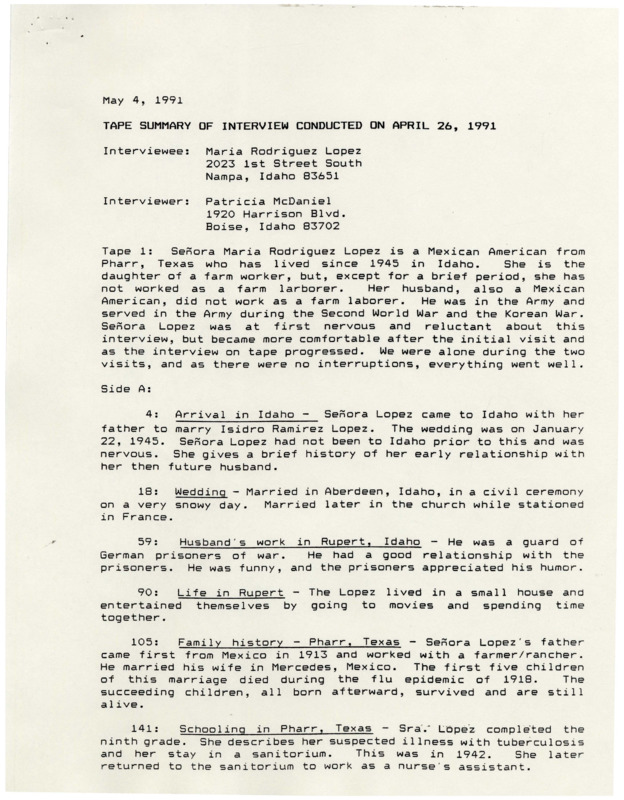
This is Patricia McDaniel at an interview with Maria Rodriguez Lopez at her home in Nampa, Idaho. Today's date is April 16th, 1991. This is Patricia McDaniel at an interview with Maria Rodriguez Lopez at her home in Nampa, Idaho. Today's date is April 16th, 1991.
Okay, Mrs. Lopez. Let's start at the beginning, talking about when you came and left Idaho. Where did you come from? Jairo?Muy bien, señora López. Vamos a empezar al principio a hablar de la de cuando vino usted y dejó a Idaho ¿Usted vino de dónde? ¿Jairo?
Maria (Mary) Rodríguez Lopez: Oh, I came from Park, Texas.Oh, yo vine de Park, Texas.
Patricia McDaniel: Park, Texas.Park, Texas.
Maria (Mary) Rodríguez Lopez: Y vine a Everlyn. Y vine a Everlyn.
Patricia McDaniel: In what year?En que año?
Maria (Mary) Rodríguez Lopez: It's 1945.Es la 1945.
Patricia McDaniel: And did you come alone or with family?¿Y vino usted sola o con familia?
Maria (Mary) Rodríguez Lopez: My dad. He came with me to get married. Because my mom couldn't come because it was too expensive. So my dad just came and we got married, and everything went backwards.Mi papá. Él vino conmigo a a casarnos. Porque mi mamá no pudo venir porque era mucho gasto. Así que mi papá nomás vino y nos casamos y todo se regresó para atrás.
Patricia McDaniel: So her boyfriend was waiting here in Idaho. Did he have a job?Así su novio estaba esperando aqui en Idaho. Él tenía trabajo?
Maria (Mary) Rodríguez Lopez: They weren't in the Army.No estaban en el Army.
Patricia McDaniel: You came from Park, Texas to be here in Idaho with your husband?¿Usted vino de de Park Tejas para para estar aquí en Idaho con con su esposo?
Maria (Mary) Rodríguez Lopez: Yes, in, uh, we got married in January of '22 in 1945.Sí, en, uh, nos casamos en enero del 22 en 1945.
Patricia McDaniel: And what do you think about when you arrived here in Idaho? Or is this your first time?¿Y qué piensa usted cuando llegó aquí en Idaho? O es la primera vez.
Maria (Mary) Rodríguez Lopez: Or she left. Or she was really nervous and scared. Well, I didn't know anyone. I didn't know anyone, not even that. But no, I knew the people from before because we were neighbors, so my husband and I knew each other before and we were boyfriend and girlfriend, but when he went overseas during the last war, as they call it, we broke up.O se fue en. O bien nerviosa y con miedo. Pues yo no conocí a nadie. No conocía a nadie, ni así. Pero no, ya las gentes del yo las conocía de antes porque éramos vecinos, así es que yo y mi esposo nos conocimos antes y fuimos novios, pero cuando él se fue para oversea la guerra pasada, este como le dicen este, quebramos
Patricia McDaniel: It will end.Se terminara.
Maria (Mary) Rodríguez Lopez: Friendship, because he said it was better that way too, and I also agreed until he came back. So if anything, we were, it was time for us to go back like that, just like when he first arrived here in Everlyn and we were going to the United States back from the last war, he sent me a letter saying he wanted us to be boyfriend and girlfriend again, and then I...La la amistad, porque él dijo que era mejor así también y yo también opiné hasta que él regresara pa atrás. Entonces si acaso estaban, tocaba que volviéramos pasar así como si cuando nomás llegó a él aquí a Everlyn y diríamos a Estados Unidos pa atrás del de la guerra pasada, me mandó a escribir que quería que fuéramos novios otra vez y luego me.
In another letter he sent me an offer of marriage, which would mean that we would get married.En otra carta me mandó a ofrecer casamiento, que sería que nos casáramos.
Patricia McDaniel: And that's how she got here to Idaho. And she was very nervous.Y así es como llegó aqui a Idaho. Y bien nerviosa.
Maria (Mary) Rodríguez Lopez: Very nervous, with a husband. And no, we got married.Bien nerviosa, con esposo. Y no, nos casamos.
Patricia McDaniel: Everything is very pretty.Todo muy bonita.
Maria (Mary) Rodríguez Lopez: My wedding already.Mi boda ya.
Patricia McDaniel: And the wedding is where it was. Here where? In Everlyn.Y la boda es donde estaba. ¿Aquí en donde? En everlyn.
Maria (Mary) Rodríguez Lopez: In the garden Where?¿En el jardín Donde?
Patricia McDaniel: With friends.Con amigas y amigos.
Maria (Mary) Rodríguez Lopez: And then my in-laws, the parents of everyone they knew in Everlyn, along with many relatives and friends they knew from back in Texas. So everyone was at the wedding for every occasion. It was very nice, there was lots of food. We got married in the afternoon.Y pues mis suegros, los padres del toda la gente que conocían en Everlyn, con muchos parientes y amigos conocidos desde allá del de Texas. Así que todos estuvieron en la boda en todo. Muy bonita, mucha comida. Nos casamos en la tarde.
Patricia McDaniel: Yeah.Sí.
Maria (Mary) Rodríguez Lopez: And the dinner arrived quite large.Y la cena llegó bastante grande.
Patricia McDaniel: So it was a good party.Así que fue una fiesta bien.
Maria (Mary) Rodríguez Lopez: Very big and quite a lot of snow.Bien grande y bastante nieve.
Patricia McDaniel: There was a lot of snow.Hubo mucha nieve.
Maria (Mary) Rodríguez Lopez: I remember that on the day when we were going to get married because we were married by the judge and me, my husband and the godparents who went with him, had to carry a shovel to the judge's house afterwards because there was a lot of snow, etc. and the same thing going back to get me into the car hahaha.Que me acuerdo yo que en la día cuando nos íbamos a casar porque nos casamos por el juez y yo y mi esposo y los padrinos que fueron con él, tuvo que cargar una pala espada para la casa del juez después porque había mucha nieve, etcétera y lo mismo pa atrás pa subirme al carro jajaja.
Patricia McDaniel: Yes, but like this.Ya, pero así.
Maria (Mary) Rodríguez Lopez: No, My dad was also my dad was present.No, Mi papá también fue mi papá estuvo presente.
Patricia McDaniel: So you got married in front of a judge instead of in a church?¿Así ustedes casaron con con un juez en vez de en una iglesia?
Maria (Mary) Rodríguez Lopez: And then, can I continue? Well, when, when I left, he came back because he was in the service and then they sent him to California. And then, when it was over, the war ended, and he got his discharge. That was in August of '45, and then he re-enlisted in '48, and then Korea.Y luego este, puedo seguir? Bueno, cuando, cuando yo me fui, que él ya vino porque él estaba en el servicio y luego lo mandaron pa California. Y luego, cuando se acabó, terminó la guerra y sacó el el discharge. Eso fue en en agosto, el 45 y luego se volvió a alistar el 48 y lo cual Korea.
And when he came back, they sent him to France, and I went there with him. At the time, my oldest daughter, Taba, was five years old, and that's when we got married in church.Y yo cuando regresó pa atrás, lo mandaron pa Francia y yo me fui para allá con él. Yo en mi entonces mi hija mayor Taba, tenía cinco años y allá cuando nos casamos en la iglesia.
Patricia McDaniel: In France.En Francia.
Maria (Mary) Rodríguez Lopez: So, in, in, in, in, as they say in the Army post there, in the Army chat, we got married in church. Mhm. And also, well, acquaintances I had among soldiers with their family attended the wedding.Así, en, en, en, en cómo le dicen en el post ahí del Army , en el chat de del Army nos casamos por la iglesia. Mhm. Y también bueno, conocidos que tenía entre soldados con la familia atendieron a la boda
Patricia McDaniel: How come they didn't get married in a church in Everlyn?¿Cómo es que no se casaron en una iglesia en Everlyn?
Maria (Mary) Rodríguez Lopez: Because that time was very short, let's say, they didn't have enough time. But now the more we got married, the following week they sent him to Robert to guard German prisoners. And then we had about a month here in Rupert. And then they sent him to California.Porque fue muy corto el tiempo ese, digamos, no tuvieron bastante tiempo. Pero ahora mientras más nos casamos y la siguiente semana lo mandaron para Robert para cuidar prisioneros alemanes. Y luego de ahí tuvimos como un mes aquí en Rupert. Y luego lo mandaron pa California.
Patricia McDaniel: Ah, let's talk a little bit about your work, Rupert's husband's husband's work in guarding prisoners from. From Germany.Ah, vamos a hablar un poco de de de su trabajo, del del marido del esposo en Rupert en guardando prisioneros de. De Alemania.
Maria (Mary) Rodríguez Lopez: Yes, from Germany. Yeah. Yes. He was a guard. The prisoners.Sí, de Alemania. Ajá. Sí. Él era guardia de de guarda. Los prisioneros.
Patricia McDaniel: And how was work? How was it?¿Y qué tal el trabajo? ¿Cómo fue?
Maria (Mary) Rodríguez Lopez: Oh, the the The.Oh, el el El.
Patricia McDaniel: What did he think of the prisoners?¿Qué pensaba él de los prisioneros?
Maria (Mary) Rodríguez Lopez: They were very strict. No. No. Did they treat them badly? No. He wanted to keep them safe. Naturally, they gave them orders that if they wanted to escape, they wouldn't. But he never says that those he looked after never gave him any trouble. Mhm. Very good prisoners. And they looked after them very well. And everything they brought was taken out in the morning to work in Betabel.Eran muy estrictos. No. No. ¿Que los trataban mal? No. Él quería guardarlos bien. Naturalmente que los daban órdenes de que si se querían escapar. Pero él nunca dice que él, los que cuidaba nunca le dieron problemas. Mhm. Muy buenos prisioneros. Y los atendían muy bien. Y todo lo llevaban los salían en la mañana a trabajar en Betabel.
Then my husband told me that they used machetes to harvest the beets, like they use those machines now. They used machetes. They used that, and they walked on their knees, the poor things. And sometimes what they did because it was cold. When it was cold, he says they made a fire, they roasted beets to eat, and then sometimes when the potatoes came, they also put us to...Entonces me decía mi esposo que usaban como unos machetes para trapear el betabel, como ahora que usan esas máquinas. usaban unos machetes. Este con eso andaba y andaban de rodillas los pobrecitos y y a veces que hacían porque estaba frío cuando estaba frío dice que hacían una lumbre, se ponían a asar betabel pa comer y luego a veces cuando venía la papa, también nos ponían a.
Patricia McDaniel: Toward.Hacía.
Maria (Mary) Rodríguez Lopez: So, to fish for potatoes, they used straw. Now they don't. Now they just use a machine, and they also made a fire and threw in roasted potatoes like mash potatoes. It says there was a prisoner who was very funny and laughed with the patient because he was very mischievous and spoke little English. He said.Así a pescar papa entonces usaban paja, ahora no, ahora usan pura máquina y también hacían una lumbre y echaban papa asada como mashpotato. Sí y no dice que andaba un come y come y un prisionero muy cómico y se reía con el paciente porque era muy travieso y hablaba poco el inglés. Decía.
Patricia McDaniel: The prisoners spoke, they spoke EnglishLos prisioneros hablaron, hablaron ingles
Maria (Mary) Rodríguez Lopez: I know, and more so, and they dared to talk to him like that, but this one of them was very, very funny, very funny. How are you?Se y pero más pues y se animaban a platicar con él así no, pero este uno de ellos era muy, muy cómico, muy cómico. Cómo le está.
Patricia McDaniel: Please bite.Picando favor.
Maria (Mary) Rodríguez Lopez: Or really good at telling jokes like that. And then he'd say, "I'd work and work," and I'd say, "Well, he told us we had to cross America, but he didn't tell us how far we had to go, even on our knees, but he was very, very naughty, very naughty." And my husband laughed a lot with him.O muy bueno ya diciendo chistes así. Y luego decía cuando andaba trabaje y trabaje y y le decía pues este nos decía que teníamos que cruzar América, pero no nos dijo cómo de hasta andabamos de rodillas, pero muy muy travieso, muy travieso. Y mi esposo se reía bastante con él.
Patricia McDaniel: Yeah.Sí.
Maria (Mary) Rodríguez Lopez: And then, well, I'll tell you, they sent him for it.Y luego pues ya te digo, lo mandaron pa.
Patricia McDaniel: Yeah.Sí.
Maria (Mary) Rodríguez Lopez: The war is over and they took him back.Se acabó la la guerra y se lo llevaron para atras
Patricia McDaniel: Did you take Germany right away? No, just like that. How long had you been with Rupper?¿Se cogieron a Alemania enseguida? No, ya así. ¿Cuánto tiempo llevaban ustedes en Rupper?
Maria (Mary) Rodríguez Lopez: Oh, well, we were there for almost two months. When they sent him to California, eh?Oh, pues casi estuvimos como un casi dos meses nomás. Cuando lo mandaron para California, eh
Patricia McDaniel: And where did they live? In.¿Y donde vivieron? En.
Maria (Mary) Rodríguez Lopez: In or on a little house we rented. Mhm. In a little house we rented.En o en una casita que rentamos. Mhm. En una casita que rentamos.
Patricia McDaniel: And it's in the little house.Y que está en la casita.
Maria (Mary) Rodríguez Lopez: Or in a small house, or just one, a bedroom in the kitchen and everything comes out. But back then, no, there was no television. We'll see if with us, he didn't think of fear. Yeah, but how were they doing or were we like that? (inaudible)O en una casita chiquita, o nomás una, una recámara en cocina y sale todo. Pero entonces en ese tiempo no, pues no había televisión, Veremos si con nosotros no pensaba miedo. Ya, pero y como andaban o nosotros así de. (inaudible)
Patricia McDaniel: How did you have fun? What did you do when he wasn't around? Okay.¿Cómo se divirtieron, qué hicieron cuando no está? Bueno.
Maria (Mary) Rodríguez Lopez: Well, I mostly listened to the radio when he came over sometimes when they were having dinner, or when he came over, because he left in the afternoon around 5:00 p.m. Sometimes when he came over, dinner was already ready, and we'd have dinner. We'd say, let's go to the movies or go somewhere to see a movie.Pues yo casi lo más el radio cuando él venía a veces que cenaban o ya para cuando él venía ya porque salía en la tarde como a las 17:00 de la tarde,. A veces cuando ya venía este ya tenía la cena lista y y cenabanos. Es que decíamos vamos al al cine o a una vista a ver una movie.
You see they weren't going to be at dinner.Ya ves que no se iban estar en la cena.
Patricia McDaniel: And there were or were other Hispanics at that time who.Y habían o habían otros hispanos en en esa época que.
Maria (Mary) Rodríguez Lopez: Probably yes, but I didn't meet anyone because we spent quite a bit of time in that little town. It's a small town. Who knows? Now I know.Problablemente sí, pero yo no conocí a nadie porque como nos tuvimos bastante en ese en ese pueblito, es un pueblito chiquito. Quién sabe. Ahora ya sí.
Patricia McDaniel: I know, I know.Ya sé, ya.
Maria (Mary) Rodríguez Lopez: See.Sé.
Patricia McDaniel: Well, let's go. Let's go. Instead of going in. Let's go ahead, let's go back a little bit to the past to talk a little bit about your life in Texas and your upbringing. Your parents? Where were they from?Pues vamos a. Vamos a pasar. En vez de pasar en. Vamos en adelante, vamos a a regresar un poco al al pasado a hablar un poco de su vida en en Texas y de su educación. ¿Sus padres? ¿De dónde eran?
Maria (Mary) Rodríguez Lopez: My dad and mom were born in Mexico. They were born and raised Mexican. He hates it.Mi papá y mi mamá, ellos fueron en México. Fueron nacidos y criados como eran mexicanos. Odia.
Patricia McDaniel: And when and when is that I saw how they came to the United States and when.Y cuando y cuando es que vi cómo es que vinieron a los Estados Unidos y cuando.
Maria (Mary) Rodríguez Lopez: Well, my dad came to work alone first. I think he said the first year he came to the country to the Texas Valley was 1913, and he worked with a rancher. Oh, but I don't remember how many years he was there. It was about two or three years. And then he brought my mom over, and the rancher himself and his wife were the godparents.Pues mi papá vino primero a trabajar solo. Me parece que dijo que la el primer año que que vino al país para el Valle de Texas fue en 1913 y estuvo trabajando con un ranchero. Eh más yo no me acuerdo cuántos años estuvo ahí. Serían unos dos o tres años. Y luego hizo trajo a mi mamá y. Y el mismo ranchero y la esposa de él fueron los padrinos.
Because he went and brought it to her.Porque fue y se la trajo.
Patricia McDaniel: Yeah.Sí.
Maria (Mary) Rodríguez Lopez: And there they were, at the work ranch.Y ahí estuvieron, en el rancho del trabajo.
Patricia McDaniel: They got married in Texas.Ellos se casaron en Texas.
Maria (Mary) Rodríguez Lopez: Ok. On that one.Ok. En ese.
Patricia McDaniel: In that one.En ese.
Maria (Mary) Rodríguez Lopez: In Mercedes, Texas. Yes. And then there. Well, then. The rancher didn't want to run the ranch anymore, as they call it, and... And then my dad came to Far and there he started looking for odd jobs doing labor because he had to.En Mercedes, Texas. Sí. Y luego ahí. Pues ya, ya. El ranchero ya no quiso tener correr el como le dicen el rancho y. Y entonces ya mi papá se vino para Far y ahí empezó a buscar trabajitos haciendo labor porque era.
Patricia McDaniel: His his his father too.Su su su padre también.
Maria (Mary) Rodríguez Lopez: That is, that's where my two brothers were born, and the first five that my mother had in her family, they all died.O sea, ahí fue donde nacieron los dos hermanos míos, que los primeros cinco que tuvo de familia mi mamá, todos ellos murieron.
Patricia McDaniel: The first ones.Los primeros.
Maria (Mary) Rodríguez Lopez: Five first five.Cinco primeros cinco.
Patricia McDaniel: After.Después de.
Maria (Mary) Rodríguez Lopez: Then he was born, then my brother was born, who is the one who lives in ... right now. Mhm. He's the oldest of us, eh?Luego nació, luego nació mi hermano, que es el que vive ahorita en .... Mhm. Es el mayor de nosotros, eh
Patricia McDaniel: But in reality he was the 6th one who came.Pero en realidad fue el el 6.º que venía.
Maria (Mary) Rodríguez Lopez: I was coming then. Mhm. Because my mom says it's the 18th.Venía entonces. Mhm. Porque dice mi mamá que que el 18.
It was the first year of '18 or '17. That's when a very strong influence came and my mom was raising some one-and-a-half-year-old boys and they died from that strong influence that there was and then it was when she had my brother who lives in peace.Es el primer año del 18 o el 17. Por ahí fue cuando se vino una influencia muy grande y mi mamá estaba criando unos cuates de año y medio y se le murieron de eso de de influencia ya grande que hubo y ya después fue cuando este tuvo a mi hermano que vive en paz.
Patricia McDaniel: And you were also born in Zaragoza.Y usted también nació en Zaragoza.
Maria (Mary) Rodríguez Lopez: And we were all born there.Y todos los nacimos ahi.
Patricia McDaniel: And he has two sisters, he told me the other day.Y tiene dos hermanas, me dijo el otro día.
Maria (Mary) Rodríguez Lopez: In California, in California.En California, en California.
Patricia McDaniel: Two sisters in California, but they were also born in Far. There was, and so you spent your entire life in Far before coming to Idaho.Dos Hermanas en California, pero también ellas nacieron en Far. Hubo y así usted pasó toda su vida en Far antes de venir Idaho
Maria (Mary) Rodríguez Lopez: To them, as if I were.A ellos, como si mí pues.
Patricia McDaniel: And let's talk a little about the education you had back in Far. There was school in Far. Tell me a little about your education.Y vamos a hablar un poco de la educación que que tenía usted en. ... había escuela. Hable un poco de de su educación.
Maria (Mary) Rodríguez Lopez: I mean, I went until, Because the school they call School plus talk and then it's that in high school back then there was no way to see Junior High and all that and it was even from six they moved me to High School, which was when it started at that time and that until then I only had until 11th grade.O sea, yo fui hasta, Porque la escuela que le dicen a School más talk y luego es que en el high school este entonces no había como ver a Junior High y todo eso y era parejo de del seis me pasaron al High School, que fue cuando comenzaba en ese tiempo e y ese hasta entonces nomas me había hasta el 11 grado.
Patricia McDaniel: And you finished.Y usted terminó de.
Maria (Mary) Rodríguez Lopez: No, I only made it to grade nine. I didn't want to go anymore, right?No, yo nomás llegué hasta nueve nueve grado. ¿Ya, ya no quise ir, No?
Patricia McDaniel: And what did I do? And what did he do after finishing his formal education? What did he do after that?¿Y qué hice? ¿Y qué hizo después de terminar su educación formal? ¿Qué hizo después?
Maria (Mary) Rodríguez Lopez: Oh, well, I worked. They did odd jobs, they worked in fruit packing plants, packing fruit. There was a plantation house that we called "café." A plantation house where they would plant plants in pots, and then from there, some would sell them to stores and all that. And... And no more work, because...Oh, pues trabajaba. Hacían trabajos, hacían empacadoras de fruta, empacar fruta. Había una casa de matas que le decíamos café. Casa de matas donde plantaban uno, matas en macetas y luego de ahí unos la vendia para las tiendas y todo eso. Y. Y no más trabajo, porque.
Patricia McDaniel: Until until until he came.Hasta hasta que hasta que vino.
Maria (Mary) Rodríguez Lopez: IdahoIdaho
Patricia McDaniel: See each other or get married.Vernos o para casarse.
Maria (Mary) Rodríguez Lopez: And then for a, in one, as they call it, cementary of tuberculosis. This There they had me for nine months and my brother too because...Y luego para antes en una, en una, como le dicen de de cementary de tuberlculosis. Este Ahí me tuvieron a mí nueve meses y mi hermano también porque a.
Patricia McDaniel: As sick.Como enferma.
Maria (Mary) Rodríguez Lopez: As if I were sick and then they said we would be there for like nine months to be sure that no and no, well after three months the doctor told me that they could kiss me and I told my brother that, that they just had different bedrooms for us, separate for the men and the women and and only on Sundays they gave us permission, no more than half an hour to talk about ..., that is to say to visit each other and and and I told my husband that the doctor had told me that I could go home, that I was fine.Como enferma y y entonces este metían que estuviéramos como nueve meses para estar seguro que no y no, pues habían para los tres meses me dijo el doctor que podían besarme y le dije a mi hermano eso, que nomás que nos tenían diferentes dormitorios a los hombres separado y a las mujeres y y nomás los domingos nos daban un permiso, no más media hora de hablar un ..., o sea de para visitarnos y y y le dije a mi esposo que yo el doctor me había dicho que yo me puedo ir para la casa, que yo estaba bien.
And she said no! She said no, stay the nine months so we don't leave together. And so I stayed and then when I got out that was in '42, in December, in '42 we got out and in '43 in the In the spring time they sent me a letter asking if I wanted to come work at the center as a nursing assistant. And when I came I stayed there for three months only and I didn't want to work because there was one outside for the payment only $20 a month with room and board, things, but still $20, who knows, I still would have lasted like that because I had everything, but they put me in the infirmary and Farmers when the patients were really serious, my.Y dijo no! Dijo no, quédate los nueve meses así no nos vamos juntos. Y pues me quedé y luego cuando salí eso fue el 42, en diciembre, el 42 salimos y la el 43 en la En el primavera en spring time me mandaron una carta que si quería venir a a trabajar al centro de ayudante enfermera. Y como vine estuve tres meses nomás y ya no quise trabajar porque hubo una afuera por el pago nomás 20 $ por mes con el cuarto y comida, cositas, pero como quiera 20 $, quién sabe, Yo como quiera hubiera durado así porque pues tenía todo, pero me pusieron en en la enfermería y Farmers cuando estaban los enfermos bien graves, mi.
And then no, they didn't give you any more chewing gum or gloves or anything.Y entonces no, no le daban a uno mascar más ni guantes ni nada.
Patricia McDaniel: Stop, stop.Para, para.
Maria (Mary) Rodríguez Lopez: For the cleaning and everything, I had to do my own cleaning in my room, and I was a little scared, so I said no. So yes, yes, I got over this illness all right. I didn't want to get the infection. I texted my dad and mom instead. They said, "No, because if you're not comfortable, you don't want to be here anymore."Para la limpieza y todo que tenía que hacer yo misma la limpieza en mi cuarto y me dio un poco de miedo y dije no. Entonces sí, sí, salí bien de esta enfermedad. Que se la agarre la la infección y no quería. Mejor le mandé a escribir a mi papá y a mi mamá. Dijo No, pues si no estás a gusto, no quieres estar ya vente.
And how did he do it in Mexico? Mhm.¿Y como lo hizo en México? Mhm.
Patricia McDaniel: So he did it again.Así volvió a a hacer.
Maria (Mary) Rodríguez Lopez: Yes, it was when I started working like that with some tomato packing plants, where they also dump tomatoes. I also worked there.Sí, ya fue cuando comencé a trabajar así con unas empacadoras de tomate también donde estén botan tomate. También trabajé ahí.
Patricia McDaniel: I was working quite a bit like that before coming to Idaho, so let's jump in, let's do one, one, let's jump in. Let's talk again about your life here in Idaho. You told me the other day that after this season, your husband went back to work in the Army, right? And then you went to live in France, in France.Así trabajaba bastante antes de venir Idaho, ya pues vamos a dar, vamos a hacer una, una, vamos, brinque. Vamos a hablar otra vez de de su vida aquí en Idaho. ¿Me dijo el otro día que después de esta en esta temporada, su esposo volvió a a trabajar en el Army, verdad? Y luego se fueron a vivir en en Francia, en Francia.
Maria (Mary) Rodríguez Lopez: No, that was when he came back from Korea. They sent him back because of Washington. And then I was leaving and I was here in Tampa with my in-laws, and I was going to go there. And then he told me that, right? He said, "No, don't come back, because they gave me the order that they're going to send me to Arkansas," he said.No, eso fue cuando se vino de Corea, ya así lo mandaron por lo de Washington. Y luego de allí yo me iba entonces y estaba aquí en Tampa, con mis suegros y yo me iba a ir para allá. ¿Y luego me habló eso no? Dijo No, no te vayas a venir, porque me dieron la orden que me van a mandar pa Arkansas, dijo.
So I ordered a stroller, which we had, and it was even, I don't remember the year. Anyway, a very good stroller, and I sent it to the garage to get it tuned up, and then he came to us on the bus, I think it was on the train, I don't remember, and he picked me up, my daughter, and we went in the stroller.Así es que mandar a crear un carrito que teníamos una hasta incluso era yo no me acuerdo el año. Anyway, un muy buen carrito y lo mandé a lo metí al garaje que le dieran un tunup y en eso nos se vino él en el bus yo creo fue fue en el tren, no me acuerdo y me levantó a mi y a mi hija y a mi hija y nos fuimos en el carro en.
Patricia McDaniel: But before you left, you lived here in the house for a while.Pero antes de irse, usted vivía aquí en la casa un tiempo.
Maria (Mary) Rodríguez Lopez: Yeah.Sí.
Patricia McDaniel: Yeah. And what did you do here in Tampa? Did you work?Ajá. Y qué hizo aquí en Tampa ¿Ha trabajado?
Maria (Mary) Rodríguez Lopez: Or sometimes. Sometimes I worked in beetroot. What do they call it here? I realized I'd never worked in that field. And then...O a veces. A veces trabaje en el betabel. Como le dicen aquí? Saqué que yo nunca había trabajado en eso. Y entonces.
Patricia McDaniel: What.Que.
Maria (Mary) Rodríguez Lopez: This Black, they call him.Este Black, que le dicen.
Patricia McDaniel: So.Así.
Maria (Mary) Rodríguez Lopez: So they used this little hoe, and since my back hurt, and since I didn't work much at it, because everything was done by contract, and I wasn't contracted, well, when I wasn't there, the pay would increase because I wasn't quick to get better. I liked working by the hour. Yeah.Entonces usaban este azadón chiquito y como me dolía mi cintura y por cierto que no trabajaba yo mucho en eso, porque todo hacían por contrato y yo para el contrato no, pues cuando no me esté aumentaba el dinero porque no era pronta para de sacar mejor. Me gustaba trabajar por horas. Ajá.
Patricia McDaniel: So with a little bit of the contract and how it went.Así es que con un poco del contrato y como como fue.
Maria (Mary) Rodríguez Lopez: The contract for beet work. Mhm. That's even a good idea. They pay, right? Well, for example, $20 or $25 an acre, and naturally, those who are too light for that daily work can even do an acre, which is more important. It depends on how they are; the beets are so filthy and clean that they're clean. And those who are good at it, well, they get paid much more now.El contrato de cuando en el trabajo de betabel. Mhm. Eso hasta hace buen entendido. Pagan cierto. bueno, por ejemplo 20 o 25 $ el acre te pagan y naturalmente los que son muy livianos para ese trabajo del día hacen hasta un acre que sabe más. Depende como están el el betabel de mugroso limpio así está limpio pues. Y uno que es bueno para eso pues hacer así ahora más pues ahora les pagan mucho más y.
Patricia McDaniel: Now yes, of course.Ahora sí, claro.
Maria (Mary) Rodríguez Lopez: They get paid a lot more and some are very quick to do well.Les pagan mucho más y hay unos muy prontos para bueno.
Patricia McDaniel: That's how it worked for a while.Así se trabajaba así o una temporada.
Maria (Mary) Rodríguez Lopez: I don't know, later when we came from France, this was when.No sé, ya después cuando venimos de Francia, este fue cuando.
We came here, here in. I left then, I went with my mom over there, here to the Valley, because, uh, my mom got really sick and that's when she died of cancer. That was in '56 and I was there with my dad. I didn't want to leave him alone for a while until my husband passed away, he was here, he was here, he was here.Nos vinimos para acá, aquí en, Yo me fui para entonces me fui con mi mamá para allá, para acá al Valle, porque, eh, mi mamá se enfermó mucho y fue cuando ella falleció decáncer. Eso fue el 56 y tuve allá con mi papá. No lo quise dejar solo por un tiempo hasta que pasa mi esposo, él aquí andaba en aquí, andaba.
Patricia McDaniel: So.Así.
Maria (Mary) Rodríguez Lopez: I was working, doing odd jobs, and then at the end of '56, we came, and then by then my son was also here, who was born in France, and we came by train. And since we didn't have any property yet, we rented, I don't know, a little house until we found a little place, and then he started to get sick and struggle.Que andaba trabajando, haciendo un trabajito también y ya la el fin del 56 del año 56 nos vinimos y entonces para entonces estaba mi niño también, que fue el que nació en Francia y ya nos vinimos en el tren y. Y como no teníamos propiedad todavía, pues rentaba, no sé, casita hasta que hallamos un lugarcito y luego él comenzó a estar enfermo y y batallando.
That's how it was when the veterans sent him to duty, they sent him to cover for ten months there and...Así fue cuando lo mandaron para el duty los veteranos, lo mandaron para cubrimiento diez meses allá y.
Patricia McDaniel: And what was he sick from?¿Y de que estaba enfermo?
Maria (Mary) Rodríguez Lopez: Because when he went to the hospital, he was sick. He got pneumonia, like he wanted to get it, and when he got to the hospital, and they were there for about two months, by then it wasn't pneumonia, so he got some back pain that the doctor said was like arthritis. Then, and right after that, that's when he got pneumonia really bad.Porque cuando fue al hospital él estaba enfermo. Le dio como pues como le quiso dar como pulmonía y como le dio cuando entró al hospital y tuvieron como dos meses ahí de para entonces no era por la pulmonía, tonces el le dio como una dolor de cintura que dijo el doctor que era como artritis. Entonces después y luego de ahí, ahí fue donde le dio la pulmonía bien fuerte.
Mhm. And. And then they sent him from there. The veterans sent him to Cury, that's where the hospital was.Mhm. Y. Y luego lo mandaron de ahí mismo. Los veteranos lo mandaron pa Cury, ahi estaba el hospital.
Patricia McDaniel: And you went with him?¿Y usted fue con él?
Maria (Mary) Rodríguez Lopez: Not at first, no. The three months he was there, no, because they couldn't. They wouldn't let anyone visit unless he spoke to me, either by phone or text. But no, later on, when I was there, they would bring in more visitors, we'd go and...No de primero, no. Los tres meses que estuvo allá, no, porque no podían. Como no metían a que visitara uno si no me hablaba o por teléfono o me escribía. Pero no, ya después cuando ya este, ya metían más visitantes, íbamos y.
Patricia McDaniel: And what about the hospital in Wudin? What was it like? What was it like? Were they hospitalized?¿Y qué tal el hospital en Wudin, eh? ¿Cómo? ¿Cómo fue? ¿Fueron Hospital, eh?
Maria (Mary) Rodríguez Lopez: Yes, but there he had only patients like this, since that tuberculosis illness, he was there for 10 months.Sí, pero ahí tenía nomás puros pacientes de este, desde esa enfermedad por Tuberculosis, ahi estuvo 10 meses.
Patricia McDaniel: There were very good doctors and nurses.Habían médicos y enfermeros muy buenos.
Maria (Mary) Rodríguez Lopez: Very clean, and my husband says he was doing very well. He says those who were quite ill had surgery, and I don't know what's wrong, but they removed ribs, and many times they came out like this on one side, they were on one side, mhm, but he was there for ten months.Muy limpio y y dice mi esposo estaba muy bien. Los que estaban bastante malos dice que los operaban de y yo no sé que no está bien, pero que le sacaban costillas y muchas veces que salían así por un lado andaban por un lado mhm, pero ahi estuvo diez meses.
Patricia McDaniel: And very comfortable and And you went to visit.Y muy cómodo y Y usted fue a visitar.
Maria (Mary) Rodríguez Lopez: Either I know or I don't know that he was there and when they let him out, the Wilkinses went outside, me and my two children went.O se de o no sé que estaba ahí y ya cuando ya lo dejaban salir él pa pa afuera los Wilkins iba, iba yo y mis dos niños.
Patricia McDaniel: And you went in in in the.Y usted fue en en en el.
Maria (Mary) Rodríguez Lopez: No car, on the bus.Carro de no, en el bus.
Patricia McDaniel: In a little while, if not in the car.En el ratito, sino en el carro.
Maria (Mary) Rodríguez Lopez: Or sometimes I didn't have one. I don't know how to drive.O a veces que no llevaba. Yo no sé manejar.
Patricia McDaniel: Not yet.Todavía no.
Maria (Mary) Rodríguez Lopez: Or not? I could never learn. No, they tried to teach me. My wife and then my children, when they grew up. I don't get very nervous, and I said no, no, no, no, because I'm going, and God I'm going to have an accident. And there's no need to say no, better yet, I never learned. No, because if they tried to teach me, I'd rather go on the bus, otherwise I'd see how his brothers or his sister would get along.¿O no? Nunca pude aprender. No, me trataron de enseñarme. Mi esposa y luego mis hijos, cuando crecieron. No me pongo muy nerviosa y dije no, no, no, no, porque voy, y Dios voy a un accidente. Y no hay necesidades de no mejor, nunca aprendí. No, porque si trataron de enseñarme mejor me iba en el Bus, si no este al ver como sus hermanos o así su hermana vez que nos llevamos.
Patricia McDaniel: To someone who was going.A alguien que iba.
Maria (Mary) Rodríguez Lopez: To visit it too and because they wanted to see what was going to happen to them too.A visitarlo también y pues que querían ver lo que les iba a ir con ellos también.
Patricia McDaniel: How long did it take to go on the bus, On the bus?¿Cuánto tiempo tardaba en ir en el autobús, En el bus?
Maria (Mary) Rodríguez Lopez: Well, it arrived about three hours later.Pues llegó como como tres horas por ahí.
Patricia McDaniel: So nothing.Así que nada de.
Maria (Mary) Rodríguez Lopez: Close, right? If not, it's not productive.¿Cerca, no? Si no, no está productiva.
Patricia McDaniel: And when she went to visit him on the bus where he was staying.Y cuando fue a visitarle en el en el bus donde se quedaba en.
Maria (Mary) Rodríguez Lopez: A hotel, where I rented a quarter of a motel, there was a motel nearby, right there at the hospital. It was there. Okay.Un hotel, en la rentaba 1/4 motel, había un motel cerquita, ahí en el hospital. Ahí estaba. Bueno.
Patricia McDaniel: So, let's talk a little about life here in Nampa. And what it was like and how the years have passed here in Nampa. The year they came to live here in Nampa, never to stay. What year was it?Pues así vamos a hablar un poco de la vida aquí en Nampa. Y cómo fue y cómo ha pasaron los años aquí en Nampa a El año que vinieron a vivir aquí en Nampa para no quedarse. ¿Qué año fue?
Maria (Mary) Rodríguez Lopez: Well, it was like this, to establish a place on our property. Our little house. It was in '57 when we bought the house, and he was looking for jobs like that until he found a job in a store. And he worked there.Pues fue ya para, como este establecer un en la propiedad de nosotros. La casita de nosotros. Fue en el 57 fue cuando compramos la casa y el andaba buscando trabajos así hasta que hayo un trabajo en una tienda. Y ahí estuvo trabajando en.
Patricia McDaniel: Like a shop doing.Como una tienda haciendo.
Maria (Mary) Rodríguez Lopez: That was this as a Clerk, as the also says this almost 15 years worked here until the store closed.Que era este como Clerk, como lo dice la también este casi los 15 años trabajó aquí hasta que se cerró la tienda.
Patricia McDaniel: And what was the name of the store?Y como se llamaba la tienda
Maria (Mary) Rodríguez Lopez: La Napa Food CenterLa Napa foodcenter
Patricia McDaniel: It was a store...Era una tiendad de..
Maria (Mary) Rodríguez Lopez: Oh, oh.De de.
Patricia McDaniel: The groceriesDe groceries
Maria (Mary) Rodríguez Lopez: And then in '69 we went back to that little house, we sold the little house and bought here.Y luego yo en el 69 nos volvimos a la casita esa, vendimos la casita y compramos aquí.
Patricia McDaniel: With.Con.
Maria (Mary) Rodríguez Lopez: It's here, and then when I started working at the plant that used to be Potato Grow, I think. And then they moved it to Western, and now it's located in Carnation. I worked there for 14 and a half years, 14 years.Esta en esta y luego cuando comencé yo a trabajar en la en la planta que antes era la potato grow, Yo creo. Y luego la cambiaron a la western y ahora corre por la Carnation. Ahí trabajé yo 14 años y medio, 14 años.
Patricia McDaniel: I could pay for the machine and walk away. Okay, let's talk a little about work.Yo podía pagar la máquina y dar la vuelta. Okay, vamos a hablar un poco del trabajo.
Maria (Mary) Rodríguez Lopez: Now.Ahora.
Patricia McDaniel: Well, we have a little bit more on this side. Uh, let's talk a little bit about your work working in the packing houses.Pues tenemos un poco, un poco más de este lado. Eh, vamos a hablar un poco del trabajo de de usted trabajando en esa en las packing houses
Maria (Mary) Rodríguez Lopez: WhereEn donde
Patricia McDaniel: Not here No.No aquí No.
Maria (Mary) Rodríguez Lopez: It's processing, they call it. At first, no, no. So I wasn't working as they call it, standy. Mhm. This one, yes, because they gave you a lot of layoff. Two, or sometimes two or three weeks? It depends.Es processing que le dicen. Ahí de primero, no, no. Entonces no estaba trabajando como le dicen stady Mhm. Este si, porque les daban a uno mucho layoff. Dos o había veces que dos o tres semanas? Depende.
Patricia McDaniel: It depends. It depends on what?Depende. ¿Depende de que?
Maria (Mary) Rodríguez Lopez: From whatever work they had there. From Dad. Why are you rushing, Dad, huh? And there were times when Dad's work was very scarce, and naturally, the new ones would get laid off. And that's how I was, for about a year. So, they gave me a lot of leave, until later, when they caught me, already during my period, and that's when I worked for 14 years until I retired.De la del trabajo que tuvieran ahí. De papá. ¿Porque corre, apura papa eh? Y había veces que se ponía muy escasa la la papá y naturalmente que las nuevas les daban layoff. Y así estuve yo, como fue como un año. Así que me daban layoff muy seguido, hasta que ya después me agarraron, ya de regla y fue cuando trabajé 14 años hasta que me retiré.
Mhm.Mhm.
Patricia McDaniel: But always doing the same thing, right?¿Pero siempre haciendo lo mismo, no?
Maria (Mary) Rodríguez Lopez: Sometimes they put me in the Clean Room, that's where she's peeling a potato, peeling the potatoes, and then the dad comes, right away, she cleans up anything bad, removing the little things, yes, and what's half-stained with rotten food. But at most, they put me in the inspection of the, as they call it, the French Fried, to remove what was there.A veces que me ponían en el CleanRoom, ahi es donde está pelando una papa está pelando los ya viene la papá, ya, ya limpia nada por uno mal está quitando lo lo cositas sí, y lo que está medio manchado de podrido. Pero casi lo más me pusieron en la inspección de la como le dicen de la French Fried para quitar lo que estaba.
Patricia McDaniel: So it was a thing of almost one part machinery and another part people.Así era una cosa de de casi una parte de de maquinaria y otra parte de de persona.
Maria (Mary) Rodríguez Lopez: The work of almost everything was running on the sidelines, everything where the potatoes go through those inspections that tell them that the potatoes are cut, not cooked, no.Ya el trabajo de pues casi todo iba corriendo por banda este todo donde van pasando los papas como esas inspecciones que le decían que son de vaya la papa, cortada, no cocidas, no.
Patricia McDaniel: Raw but already raw.Crudas pero ya crudos.
Maria (Mary) Rodríguez Lopez: But you see, I grabbed the tip with the ladle, with my hand like this because I didn't even want us to use the knife. Here in the center, we had to be like this.Pero ya ves que agarra uno la la puntita me estaba podrida con el cucharón, con con la mano así porque no quería ni que utilizaramos el cuchillo nomás. Acá en el centro sí teníamos que estar así.
Patricia McDaniel: And what else did you like about the job?¿Y qué más le gustó del trabajo?
Maria (Mary) Rodríguez Lopez: Oh, well, I liked that line of inspection better. And there were times when...Oh, pues a mí me me gustó más esa la línea de la inspección. Y había veces cuando.
Patricia McDaniel: Because?¿Por qué?
Maria (Mary) Rodríguez Lopez: Because no, it wasn't hard work and cleaner. No, it was very tough, just like here in the clean room where the potato is being processed.Porque no, no era trabajo duro y más limpio. No, era muy bravo uno tanto como acá en el clean room donde está pasando la papa y.
Patricia McDaniel: And who worked with you, who was it, the other people who worked with you.Y quien trabajaba con usted, quién fue, las otras que trabajaban.
Maria (Mary) Rodríguez Lopez: Or they changed depending on.O cambiaban dependía de de.
Patricia McDaniel: Many Hispanic women.Muchas hispanas.
Maria (Mary) Rodríguez Lopez: Or everything, all mixed up, all mixed up. This Mexican does.O también todo, todo revuelto, todo revuelto. Este mexicano sí.
Patricia McDaniel: Hispanic. I'm Mexican and also American.Hispanic hispana. Soy mexicana y también y también americano.
Maria (Mary) Rodríguez Lopez: I mean, I'm the only one who's inspected as Mexican. The rest depends on the American one. If the potato wasn't clean enough, the most they had was four, and when it was really clean, only two, hmmm. So the one that was the most attractive, they left them at the table as an exception, and the rest they sent me to the table.Ósea, pero en la inspección nomás yo de de mexicana. Lo demás de la americana depende. Si estaba poco limpia la papa nomás teníamos lo más que tenían eran cuatro, que cuando se ponía bien limpia nomás dos mhm. Así es que la que tenía más señorita las dejaban en la mesa excepción y la demás me mandaban al tengo.
Patricia McDaniel: And you stayed put during the inspection to see if it had been there for enough years.Y usted se quedó en el quedo en el inspection a ver si llevaba bastantes años.
Maria (Mary) Rodríguez Lopez: I don't know when there will be more, gentlemen, it's increasing. Well, they left me there, and there were times when I was in the clean room here, in the first one, a machine would break down. They would ask volunteers who wanted to work on the packaging, and there were times when I...Yo no sé cuando puedan ser más señores va aumentando. Pues ahí me dejaban y había veces cuando pasaba en el clean room acá en el primero este se quebraba alguna máquina, este preguntaban voluntarias que quién quería trabajar en el empaque y yo había veces que me.
Patricia McDaniel: You're talking about this packing job and you were going to tell me why you didn't like that job.Está hablando del del de este de empacar y usted me iba a decir porque no le gustaba el ese trabajo.
Maria (Mary) Rodríguez Lopez: Because many times I had to lift boxes and they weren't heavy enough. And I wasn't. I was afraid to handle heavy things on my own.Porque muchas veces tenía uno que levantar cajas y resultaba poco pesado. Y yo no, Yo tenía miedo manejar cosas pesadas por mí.
Patricia McDaniel: For him, for the damage, or for this. Why?Por el, por el daño o por este. Porque?
Maria (Mary) Rodríguez Lopez: Well, yeah, it was coming, when the French fries came, the bread rolls or there were times when they ran, when they went to the packaging they came in little packages, in plastic bags and one just grabbed the plastic bags because the boxes go by gang and they had to throw them away quickly or the plastic bags came or whatever French fries it was one had to grab the bag quickly, pack the products at home, because if it didn't happen and I could, it wasn't too soon for that.Bueno, ya, ya venía, ya pa cuando venía la la French fries las batas de pan o había veces que corrían ya pa cuando iban al empaque iban en paquetito, en bolsitas de plástico y uno nomás agarraba las bolsitas de plástico porque van por banda las cajas y tenían que echar pronto o iban las bolsas de plástico o de lo que fuera french fries tenía uno que agarrar pronto la bolsita, empacar los productos en la casa, pues si no se pasaba y yo podía, no era muy pronto para eso.
Yeah, eh. Sometimes it was better that the supervisor put a band on me when I was going through customs. The main thing was that she'd better put me there to remove the suspects who told her what was kind of rotten and you don't know what she said. What do they call it? They changed every half hour and they keep changing every other hour.Ajá, eh, Mejor a veces que me le decía la supervisora que me pusiera una banda donde estaba pasando el aduana. La principal que mejor me pusiera allá para estar quitando los los suspect que le decían lo que estaba media podrida y no sabes qué decía, Cómo le dicen? Cambiaban cada media hora y van cambiando en otro.
Patricia McDaniel: Place or something like that.Lugar o algo así.
Maria (Mary) Rodríguez Lopez: Because not only did some have just one job.Porque no nomás unas tuvieron un solo trabajo.
Patricia McDaniel: AND.Y.
Maria (Mary) Rodríguez Lopez: It was helpful because you were learning everything. Aha, aha.Se servía porque ibas aprendiendo de todo. Ajá, ajá.
Patricia McDaniel: And did you like that?¿Y le gustó eso?
Maria (Mary) Rodríguez Lopez: Oh, yes, yes, I liked it. Not very well, like, ah.Oh, sí, sí, me gustaba. No muy bien como ah.
Patricia McDaniel: He rose, he rose after so many years, he rose to a position like that of a supervisor.Subió, subió después de tantos años, subió a una. Vamos, una posición de eso de ser supervisor.
Maria (Mary) Rodríguez Lopez: Oh, no, no, no.Oh, no, no, no.
Patricia McDaniel: Never.Nunca.
Maria (Mary) Rodríguez Lopez: No, that's it. That's what you need. I think you need a lot of study and knowledge to know everything, as the paper says. Everyone has to pass.No, eso. Para eso necesitas. Yo creo que bastante estudio y saber a saber todo lo lo que mucho como lo dicen la paper Work. Si tienen que pasar todos.
Patricia McDaniel: Those of day.Los de día.
Maria (Mary) Rodríguez Lopez: And almost the most important thing is the... The only woman who worked like that was the big lady, the one who was the supervisor of the clean room for packaging, but from then on, the supervisors were all men because they had to...Y casi lo más es la. La única mujer que trabajaba así era como la big Lady la que la de supervisor del clean room del empaque, pero de ahí para los supervisores eran puros hombres porque tenía que.
Patricia McDaniel: So, all men. There were no women like that, but those who worked on the gangs or in inspection or in the first were all women.Así puros hombres. No habían mujeres como esas, pero las que trabajaban en las bandas o en inspección o en el primero eran puras mujeres.
Maria (Mary) Rodríguez Lopez: Well, women, mhm.Pues las mujeres mhm.
Patricia McDaniel: So the boss was always a man.Así que el jefe siempre fue un hombre.
Maria (Mary) Rodríguez Lopez: Yes, the mere supervisor they called the woman, they called her big lady, who was the one we made her here as a butler, if she wasn't in touch with us, eh? And they would tell you, well, they need so many women in a gang, they changed or they needed one or two there where the potato was happening or something like that.¿Sí, el mero supervisor que le decían a la mujer, le decían big lady que la era la como nosotros le hicimos acá como mayordomo, si era la que no se entendía de nosotros, eh? Y te decían bueno, necesitan tantas mujeres en una banda, ellas cambiaban o o necesitan una o dos allá en el en la donde estaba pasando la papa o así.
Dog.Ajá.
Patricia McDaniel: And what were the conditions like at that factory or at that one? At the, at that, at that place. They treated me very well.Y qué tal las condiciones en esa fábrica o en esa En el, en esa, en ese sitio. Me trataban muy bien.
Maria (Mary) Rodríguez Lopez: Oh, yes, they treated us very well. And then, when I started working, there wasn't this one.Oh, sí, trataban muy bien. Y luego pues cuando yo comencé a trabajar no había este.
Patricia McDaniel: What year did you start working?¿En qué año empezó a trabajar?
Maria (Mary) Rodríguez Lopez: In the last few years. Let's see. It wasn't like February 69, like that, but now, but it's like I'm telling you, they gave me a lot of money. I started already, already, already, on my period. It was in '71, when I stopped slimming down like that.En los últimos. A ver. No fue el de febrero 69, Así, Pero Ya, pero es como te digo, me daban mucho dinero. Yo vine a comenzar ya stady stady ya de regla. Fue el 71, fue cuando ya no me me rebajaba así.
Patricia McDaniel: This is how I've been on layoff for two years.Así llevo dos años de layoff
Maria (Mary) Rodríguez Lopez: From the police and then the police came in. Because when I started working there, no, there wasn't Junior, and then the police came in, and no, and when he came in, a lot changed because, as much as those in the Watchers payments as they call them, and the police by honor and so on, there were many things that there were that he had that could help us in the union.De policía y luego entró la. Porque cuando yo comencé a trabajar ahí no, no había entonces a Junior y luego entró la y no, y cuando entró pues cambió mucho porque tanto como los en los pagos Watchers que les dicen y la por señoría y así na muchas cosas que había de que tenía que podía ayudarnos en la union.
Patricia McDaniel: You were a member of the union.Usted vamos fue miembro de la union.
Maria (Mary) Rodríguez Lopez: Eh, no, I don't have to pay. Eh. So you're a common land. Yesterday, when the union came in, the two who call it what they call it didn't work.Eh, no que pagar. Eh. Es entonces eres ejido El ayer cuando entró la unión de no trabajaban los dos que le dicen Cómo le dicen.
Patricia McDaniel: If they are from Aha.Si son de Ajá.
Maria (Mary) Rodríguez Lopez: Well.Eh.
Patricia McDaniel: The costs of being a member.Los gastos de de ser miembro.
Maria (Mary) Rodríguez Lopez: Yeah. And even when I retired, there was very good insurance, benefits from everything, but it all came from the Union.Ajá. Y todavía cuando yo me retiré, pues había hay muy buena aseguranza, beneficio de todo, pero todo de vino por la por del Unión.
Patricia McDaniel: So, before entering the Union there was no security or anything.Así, antes de antes de entrar en el Union no había esto de de seguridad ni nada.
Maria (Mary) Rodríguez Lopez: There were no years. Yeah, and they pretended they had whatever they wanted with the workers. I mean, if you didn't like the position they gave you, if you didn't want to work, then quit. And when the Union came in, it didn't change much, right? In a way, because we had minimal meetings very often with the Union. So they're representatives, uh.No habían años. Ajá y hacían como que se lo que les daba gana con los trabajadores. O sea, si no te gustaba esa posición que te ponía, si no querías trabajar, pues salte. Y cuando entró la Unión no cambió mucho, eh? En un lugar porque nos teníamos mínimos meetings muy seguido del con el Union. Entonces que son representantes que eh
And by then they already had someone in charge of receiving complaints to see how they treated you. And all of that was written down and when we had the union, the meeting, eh, the one in charge said, well, this is happening and says, oh no, it's not right. That's what I said, I was going to give to the supervisors and the mero or as they call him, since they ran the entire plant there, the boss, well, the one who, as they say, also the manager, to walk around there in his place, with the one who ran the entire plant, he ordered the supervisors and everything and he went and talked and this is not right and well, to do this and thisY ya para entonces ya ponían uno que se encargara de recibir quejas a ver cómo te trataban. Y todo eso iba ahí apuntando y cuando teníamos el unión, el meeting, eh, aquella que estaba encargada decía pues esto está pasando y y dice o no, no está bien. Eso dije, iba a dar con los supervisores y con el mero o como le dicen, ya que corrían toda la planta ahí el jefe pues el el que como lo dicen también el manager, a andar por ahí en su lugar, con el que corría toda la el, el mandaba los supervisores y todo y él iba y hablaba y esto no está bien y bueno hacer esto y esto
and.y.
Patricia McDaniel: And the manager noticed the complaints many times.Y el manager se fijó en las quejas muchas veces.
Maria (Mary) Rodríguez Lopez: He didn't realize what was happening until it was said. And any accidents that occurred had to be reported. Or if a job, for example, in a place where it was very, very hot, like on some gang or something, they put a worker there, a hard worker, they forgot about it and left it there.Él no se daba cuenta de lo que estaba pasando hasta que ya se dijo así. Y de los tocante a los accidentes que hubieran tenían que reportadas. O si un trabajo, por ejemplo, en un lugar que hubiera mucho, mucho calor, este en alguna banda o algo, ponían uno trabajador allí, un trabajador trabajador, se olvidaban y ahí la dejaban.
And the union said oh no, when it's really hot, just half an hour and change it, because no, it can't be that it's there for long where it is.Y el unión dijo oh no, cuando esté muy caliente, media hora nomás y cambien porque no, no puede ser que esté mucho ahí donde está.
Patricia McDaniel: So the workers. They were more comfortable with the union.Así los trabajadores. Ellos estaban más a gusto con la union
Maria (Mary) Rodríguez Lopez: Because they did a lot for the workers. I don't know how it will work now, because when I left that was still in place, but then the so-called right to work came in. And it changed a lot, because now they say that if you don't want to pay or join the Union, no, it's not required.Porque el hacían mucho por los trabajador más No sé ahora cómo correrá, porque ya cuando yo salí ya todavía estaba eso, pero luego entró el haberse como le dicen right to work pues. Y cambió mucho, porque ahora dicen que si no quieres pagar o entrar en la Unión, no, no es exigido.
Patricia McDaniel: But before yes.Pero antes sí.
Maria (Mary) Rodríguez Lopez: And before, you did have to pay, and naturally, it was better because, in the end, you had the right to speak, to defend yourself, and the Union helps you. And now, when that came in, well, those who didn't want it, and many others, or me now, later. Those who didn't pay, Twelve, wanted to be given the same benefits as those who are paying, and that's it.Y antes sí tenías que entrar y y pues naturalmente que era mejor porque al final tenías derecho de hablar, de defenderte y el Union te ayuda. Y ahora pues cuando entró eso, pues el que no quería y también muchos o yo ahora, después. Que los que no pagaban Doce querían que les dieran los mismos beneficios a los que están pagando y ya.
And I'm not very familiar with that because I don't know how it's right, but I had already retired or four.Y con eso no estoy muy enterada porque pues no sé cómo está bien, pero yo ya me había retirado o cuatro.
Patricia McDaniel: Of course, that's always a problem. There's a union, and there are some workers who are members and then there are others who aren't, but those who aren't members have the same benefits.Eso sí, eso siempre es un problema. Hay una unión y hay unos trabajadores que son miembros y luego hay otros que no, pero los que no son miembros tienen los mismos.
Maria (Mary) Rodríguez Lopez: I mean, many, many people think no, that's not good, because for my part, if that had happened, ah, before I retired, if the person following me was paying all their electricity bills and everything, and I wasn't, it wasn't fair that I also wanted the same thing. I need.O sea, este muchas, muchas personas piensan que no, eso no es bueno, porque pues yo digo de mi parte, si hubiera habido eso, ah, antes de yo que me retirara, si la que estaba seguido de mí estaba pagando todos sus derechos de de luz y todo, y yo no, no era justo que yo también quería lo mismo. Necesito.
Yeah.Sí.
Patricia McDaniel: And while I was there, you were working with, on, on, on what your husband was doing.Y mientras estaba. Estaba usted trabajando con. En en, en. En eso que hacia su esposo.
Maria (Mary) Rodríguez Lopez: He was already there when he started working at the store where he's been doing it in '68. Yeah, well, when I was here. I started working here at Carnation, he was already there at the store, well, when he started working at the store in '68, and I started working at the store in '69, at the 60th.Él ya fue cuando él comenzó a trabajar en la tienda donde está haciendo el 68. Ya, pues cuando yo este. Comencé a trabajar en el aquí que es la Carnation, es ya estaba en la tienda, pues cuando comenzó él comenzó el 68 a trabajar en la tienda y yo el 69 en el en la 60 y.
Patricia McDaniel: And her husband was happy with his job, and after many years he became a supervisor. Yes.Y su esposo estaba a gusto con su trabajo ya bastantes años llegó a hacer un supervisor. Sí.
Maria (Mary) Rodríguez Lopez: When? Because when he came in, it was like a very close position. They were messengers for the store. He ran the store and... And he treated him very well and everything. So they got along very well. But some time later, her husband got sick and died of cancer. Yes, in the PAP that said it was the message that he was running the store, and when he died, then they put my husband in charge of the store because by then he had been working for a while and no, well, they closed the store, he could.¿Cuando? Porque cuando él entró estaba un como una posición muy amigos eran mensajeros de la tienda. Corría la tienda y. Y lo lo lo trato muy bien y todo. Así que se se llevaron muy bien. Pero ya en algún tiempo se enfermó de murió de cáncer en su esposo. Sí, el en el PAP que decía que era el mensaje que estaba corriendo la tienda y ya cuando ya él murió, entonces pusieron a mi esposo de que él entendió entendiera de la tienda porque entonces ya pa entonces tenía ya tiempo de estar trabajando y no, pues cerraron la tienda, podría.
Patricia McDaniel: And after that age what happened to you?Y después de esa edad que qué pasó con.
Maria (Mary) Rodríguez Lopez: With your husband? So he started to get very sick. First, he got sick, he came down with it, and then when it wasn't one illness, it was something else, and so he didn't leave the VA hospital. When it wasn't one thing, it was something else, something else. And he struggled a lot to get them to treat him.¿Con su esposo? Entonces él ya comenzó a estar muy mal de primero le pegó la enfermedad, la suriyase y luego cuando no era una enfermedad era otra y así es que no salía del del hospital de los Veteranos. Cuando no era por una cosa, era por otra, por otra cosa. Y él anduvo batallando mucho pa pa que le dieran a él.
He wanted his Social Security, or what do you call it, Disability, and he struggled a lot. And in the end, a labor specialist told him what he had and said it wouldn't work out, and that's why the disease never goes away. And then my husband said, "Well, what am I going to do?" That's how I am, because his whole body was covered in this skin disease.Quería su Social Security e este o como le dice eso Disability y batalló mucho. Y al final este un especialista de los trabajos le dijo lo que tenía y le dijo no te va a salir bien y por eso esa enfermedad nunca se quita. ¿Y entonces mi esposo le dijo bueno, dijo y qué voy a hacer? Así era como soy, porque él se llenaba de todo su cuerpo, todo esta enfermedad del de la piel.
Mhm. I mean, do you think that in a store, where I have the most experience living, working, like you are, they're going to take care of me the way I am? And he said, or he said, no, don't take care of me. By then, he sent me to the hospital for eight weeks, like waiting, he said, "You're going to go there and I'm going to go take care of what's there."Mhm. ¿Digo, tú crees que en una tienda que es donde tengo más experiencia de vivo, de de trabajo que eres tú, que me van a ocupar así como estoy? Y dijo o dijo no, no te de cuidado de. Para entonces lo mandó ocho semanas todo el hospital como esperando, dijo vas a ir para allá y yo voy a ir a atender que hay.
He said, "And the government is going to pay me because I'm going to get all the medication that the health specialist prescribed for my husband. They didn't have it at the hospital, so he ordered all that medication to be brought and they gave it to him there, at the other VA hospital. They kept him there for eight weeks."Dijo Y el gobierno me va a pagar a mí porque yo voy todo el medicamento que que el especialista en salud recetó a mi esposo no lo tenían en el hospital, así es que él este ordenó por que llevaran todo ese medicamento y se lo hicieron a él ahí en el otro, en el hospital de los veteranos. Lo tuvieron ahí por ocho semanas.
And that's when he told them, "Well, what am I going to do? I have my family, and he's a specialist." He said, "No, he can." He said, "I'll come because I've already," he said. "No one told them my husband, no one among the doctors, not even our family doctor, has ever wanted to help me get my disability, because he doesn't know what I have." Then he said, "Yes, I know, so when?"¿Y fue cuando él les dijo Pues qué voy a hacer? Tengo mi familia y él es especialista. Dijo No que puede, dijo Yo llego porque ya dijo Nadie les dijo mi esposo, nadie entre los doctores, ni el doctor de nosotros, de la familia, nunca ha querido ayudarme pa sacarme mi disability, porque no sabe qué es lo que tengo. Entonces le dijo Yo sí sé, pues cuando.
And him.Y él.
Patricia McDaniel: He helped in taking out.Ayudaba en en en sacar.
Maria (Mary) Rodríguez Lopez: Yes, it was when the same specialist sent a letter to social security, another one to the veterans and another doctor to us in the family, telling us what he had, what illness he had and everything, and well, explaining everything to them, and then, after a month, they started helping him and since then, now, I can't do it anymore, there's no other one, no, there's no work, the simple truth is.Si fue cuando el mismo especialista le mandó una carta a social security que que otro los veteranos y otra doctor de nosotros los de la familia y diciéndonos lo que tenía, qué enfermedad tenía y todo y pues explicándoles todo y no pues luego luego ya el después de un mes lo comenzaron a ayudar y desde entonces ya, ya, ya no puedo, este ya no hay otro, no, no hay trabajo, la mera verdad.
One because he was already very sick and that, the older he was, the more so.Uno porque él ya estaba ya muy enfermo y eso pues su edad entre más, más.
Patricia McDaniel: So you didn't go back to work, right?¿Así no volvió a trabajar, no?
Maria (Mary) Rodríguez Lopez: Even then they were already helping him with the social number and... And the veterans don'tYa entonces ya lo ayudaban el número social y. ¿Y los veteranos no
Patricia McDaniel: Let's go back a little bit to your life here in Nampa while you were working and also when the children were very young, and talk a little about life, not only at work, but also about life living here in Nampa. And I want to know, for example, something about your children's school days and how they spent their time at school and their experiences with their friends and teachers.Vamos a vamos otra vez a a regresar un poco a a su vida aquí en en Nampa mientras estaba trabajando y también cuando los niños eran muy pequeños y hablar un poco de la vida, no solamente del trabajo, sino también de de la vida viviendo aquí en Nampa. Y quiero saber, por ejemplo, algo de de sus hijos en la escuela y como pasaron en la escuela y sus sus con sus amigos y maestros.
Maria (Mary) Rodríguez Lopez: Oh, well, them. Well, me.Oh, pues ellos. Pues yo.
Patricia McDaniel: The three of us, three years old, two daughters.Nosotros tres, tres años, dos hijas.
Maria (Mary) Rodríguez Lopez: And I'm not a son and I don't own anything. When I was working in the fields without anything, when I left, when I was layoff at the plant, I told them the plant, the one they didn't have. Or in the summer. So when they were 14, 15 years old, I took them. The work they started to know what it's like to work in the fields and I didn't like it. I didn't tell them, well, I told them one of two things: either you're going to continue wanting to work like that or you finish your studies, your school, so that you can get a good job yourselves, and no, well, they made a fuss and...Y yo no soy un hijo y no poseo. Cuando ya entonces trabajaba yo sin nada en la labor, cuando se fuera, cuando estaba layoff en la planta, yo le digo la planta, la que ellos no. O en en el verano. Entonces ellos cuando tenían 14, 15 años, me los llevaba. La labor que comenzaron a a a saber cómo es trabajar en la labor y yo no le gustó, No le dije bueno, le dije una de dos o van a seguir a querer trabajar así o acaban su estudio, su escuela, para que ustedes mismos agarren un buen trabajo y y no, pues ellos alborotaron y.
Patricia McDaniel: They graduated from high school.Se graduaron de del del high.
Maria (Mary) Rodríguez Lopez: High School, and my son went to Portland. He went to school for a year and a half, more like that back then. That's when I became really interested in theater. By the way, we went to see the other ones there twice because he did two plays, as they say. Yeah, yeah, we went to see them.High School y mi hijo este él fue a Portland. Fue un año y medio año al colegio este más por entonces ahí, ahí me interesó mucho como el teatro. Por cierto que dos veces fuimos a ver los otros allá porque él este hizo dos plays como les dice por ahí. Sí, ajá, lo fuimos a.
Where he had everything there, we went to see him. One of them was this West Side Story, and then when he came out of La Mancha, Men from Maggie, it was also a... You know, and they weren't proud enough because he did a good job. Yeah.A donde él tenía todo ahí en que lo fuimos a ver que uno de ellos fue este West Side Story y luego cuando salió de la Mancha Men from la Maggie también fue un. Saben y no estaban lo bastante orgulloso porque hizo un buen trabajo. Sí.
Patricia McDaniel: And it was like he is, or he carried most of it, or it was him. I mean, this.Y fue como él es o llevaba la mayor parte o fue el. O sea, esto.
Maria (Mary) Rodríguez Lopez: It wasn't in the sketch, as they call it now. There's nothing.No estaba en el sketch, como le dicen ahora. No hay nada.
Patricia McDaniel: New in Mexico.Nuevo en México.
Maria (Mary) Rodríguez Lopez: No. Because you see how that one. That one, they made the Wesley Store very, very famous. There were two of them, like gangs, and well, and he was like one of six, another one from America.No. Porque ya ves como ese. Ese vista que le hicieron vista muy hasta muy famosas la Wesley Store, él eran dos como gangs y bueno, y él era como era uno de seis, otro de América.
Patricia McDaniel: Well, in this story.Bueno, en esto del cuento.
Maria (Mary) Rodríguez Lopez: He went to the had quite a bit of fun. Yeah, very good with the take and.Él fue a la tuvo bastante divertido. Sí, muy bien con el toma y.
Patricia McDaniel: So he went to college, and his daughters were also studying at university? No. After graduation? No.¿Así él se fue al colegio y también las hijas estaban estudiaban en la universidad? No. ¿Después de graduarse? No.
Maria (Mary) Rodríguez Lopez: My daughter. My daughter. The oldest, Anita. She didn't go. It wasn't just going to school. Because as I told you before, she graduated in May and July. They spoke to her. A lawyer who was working since then began working as a secretary for lawyers and. And like she worked twice in a bank also as a secretary and now she doesn't, well now she has her good job whereMi hija. Mi hija. La mayor Anita. Ella no fue. No fue tan solo ir al colegio. Porque como te dije antes, ella graduo mayo y julio le. Le hablaron la. Un abogado que trabajaba desde entonces comenzó a trabajar así de secretaria con abogados y. Y como dos veces trabajó en un banco también de secretaria y ahora no, pues ahora tiene su buen trabajo donde
all that for nothing. todo eso para nada.
Patricia McDaniel: And the other one?¿Y la otra?
Maria (Mary) Rodríguez Lopez: And my other friend, Sandy, this one. She went there for that too. But when she was in that school, she took up photography. She really liked photography and took classes and everything. And then Juan went to school, to college, there in Portland, because they told her she could study more. Regarding photography.Y la otra amiga Sandy, Este. Ella se fue para allá pa por la también. Pero ella cuando estaba en esa escuela agarró de fotografía. A ella le gustó mucho fotografía y agarró clases y todo. Y luego Juan al cole, al colegio, allá en en Portland, porque le dijeron que ella podía estudiar más. De tocante a la fotografía.
Patricia McDaniel: In what? In which school?¿En qué? ¿En qué colegio?
Maria (Mary) Rodríguez Lopez: At Portland State. I think it was like that, and it wasn't just for about a year and a half. Why do I say, "She said no?" The classes they're giving me here, and I was already learning them at Nampa High School. Here. And she told them, "Well, I'm already here, I've been through this," she said. "I wanted to learn more."En este Portland State. Yo creo que por ahí fue así y no nomás fue como año y medio. ¿Por qué digo, nos dijo no? De lo que me están dando aquí de estudio las clases y ya las aprendían en nampa High School. Aquí. Y les dijo a ella dijo pues yo ya estoy a los ya pasé por esto, dijo. Yo quería aprender más.
And they told her, "One of the teachers there says he understands photography class." He said, "Well, if you want to learn more, much more about this, you have to go to a school in California. I don't know which school or where." And he didn't want to. He said, "No, because because of the money my daughter used to get to go like that, it's better to start working like that."Y le dijeron Uno de los maestros ahí dice que se entiende de la clase de fotografía. Dijo Pues si quieres aprender más, mucho más de lo de esto, tienes que ir a un colegio de California. No sé qué colegio ni ni qué parte. Y ya no quiso. Dijo No, pues una por el gasto del dinero de donde agarraba mi hija gastos para ir así mejor empezó a trabajar así.
First he started working on.Primero comenzó a trabajar en.
When I was going to school, I worked part-time. Then I worked at Chachipen and then at. By then, she and her application had already said she wasn't going anymore, she didn't want to attend school anymore. So, she continued working there and applied for other jobs. But when I worked at the one where they make these computer chips, they didn't make them. Intel copied them. It's a very large plant that makes them, and it didn't start.Cuando estaba yendo al colegio Part time. Entonces trabajó en Chachipen y luego en. Para entonces, ella y su aplicación en cuando ya dijo que ya no iba, ya no quería atender al colegio. Eso como que ya siguió trabajando en ahi y hizo aplicaciones en otros trabajos. Pero cuando yo trabajo en esa donde hacen estos computers chips no los hacen, los copió la Intel sea una planta bien grande que hace y no comenzó.
He was lucky he got a job there, he already has all those working.Tuvo suerte que agarró un trabajo ahí, todos esos trabajando ya tiene.
Patricia McDaniel: In.En.
Maria (Mary) Rodríguez Lopez: At Intel, he has been working there for about ten or 11 years.en Intel ya tiene como diez, 11 años de estar trabajando ahí.
Patricia McDaniel: So the children go, they finish school and go to study outside of school.Así es que los niños se van, van los terminaron la escuela y se fueron a estudiar día fuera de en en los colegios.
Maria (Mary) Rodríguez Lopez: And right now he's working here in the area, here where they also make things, right?¿Y ahora mismo él está trabajando aquí en la zona, aquí donde hacen también, no?
Patricia McDaniel: And when they were very young, they had a good time, either at school or... And they didn't encounter any of the discrimination here.Y cuando eran muy chiquillos lo pasaron bien y bien a gusto o en las escuelas o. Y no se encontraron nada de la discriminación aquí en alta.
Maria (Mary) Rodríguez Lopez: No, not that I know of, of course. I still believe that's still the case. But it's not going to A like it used to. But no, I don't, I never heard of them having that problem.No, no porque yo sepa no, naturalmente. Todavía creo yo que todavía hay eso. Pero no va a A como antes. Pero no, yo no, nunca oí yo que tuvieran ese problema de.
Patricia McDaniel: They never talked about.No hablaban nunca de.
Maria (Mary) Rodríguez Lopez: Not that, never. And I wondered, "Not like that." And no, well, these kids, uh, had very good friendships, let's say, with the older one, especially with Mexicans who are quite Mexican, and these two, not like Ricky. Sandy did have a Mexican friend, but they hung out more with American friends, which they all are good.Eso No, nunca. Y me preguntaba No así. Y no, pues estos ninos eh, tuvieron muy buenas amistades, digamos, con pues más la mayor con mexicanos que son bastante mexican y estos dos no como Ricky. Sandy pues sí tenían amiga mexicana, pero se juntaban más con American amistades que bueno son todas.
Patricia McDaniel: Let's go all out.Vamos de todos.
Maria (Mary) Rodríguez Lopez: Yes.Ya.
Patricia McDaniel: Almost and also of those of.Casi y también de los de.
Maria (Mary) Rodríguez Lopez: The Americans are also very good.Los americanos también muy buenos.
Patricia McDaniel: And you and your husband encountered discrimination while living here in Idaho, or in Rupert, anywhere around here.Y su esposo y usted encontraron una discriminación mientras vivieron aquí en Idaho, o en Rupert, en cualquier parte de aquí.
Maria (Mary) Rodríguez Lopez: Mmm well, when we because my in-laws is in April, well as I told you they bought that house, then yes I noticed that in restaurants here in other places they had, you know, they didn't bring in Mexicans, but then.Mmm bueno, cuando nosotros porque mi mis suegros es en abril, pues como te digo que compraron la casa esa, entonces sí me fijaba yo que en como en restaurantes aquí en otros lugares tenían saben que no, no metían mexicanos, pero entonces.
Patricia McDaniel: And what did they do? Didn't they go to the restaurant that time?¿Y qué hicieron? ¿No fueron a esa al restaurante?
Maria (Mary) Rodríguez Lopez: No, no, no, everyone had the one with that signature. But then, like in a community, my brother-in-law Paulino was the one who understood. He started gathering people, like this, as they call it, a contractor, to gather people to work on the farm. And that's how I met ranchers in a place like that, and they liked him, and many of them, instead of lounges.No, no, no, todos tenían el que tenía ese sing. Pero entonces, como en una comunidad, Mi cuñado Paulino era el que se entendía. Él comenzó a a juntar gente para como este, como le dicen contratista para juntar gente para trabajar en la labor. Y así conocí a rancheros en un lugar así y él le gustaba y muchas en lugar de lounge.
And my husband says they went there once, they had a Christian sign there, not a Mexican one. By then, my brother-in-law already knew who was running the place there, and he tore it off the door and came in and lifted the bar. He said, "You don't need that." He said, "Here we are." What are you going to do? You're going to kick us out." He said, "No."Y ahí dice mi esposo que una vez fueron ahí, tenían un sign ahí cristiano, no mexicano. En para entonces mi cuñado ya conocían que corría el lugar ahí y lo arrancó de la puerta y y entró y se levantó la barra, dijo no necesitas eso, ya dijo aquí estamos nosotros, Qué va a hacer? Nos va a echar, pues dijo No.
He said, "Look," he said, "The only reason we have that shit." Then there were a lot of braceros who told him that they call him now. And then Lilia, "Yeah," she said, "The reason why places like that were like that was what the guy told her." I don't know if the reason is true. I say that because, what's more, in the bars, like in the bars, many people said, they just started drinking and wanted to start a fight and they took out knives and guns and everything.Dijo Mira, dijo La única motivo que tenemos ese sing. Entonces había muchos braceros que le decía que ahora le dicen Y luego Lilia Ajá, dijo la razón que ya el motivo por qué lugares así fue lo que le dijo el man. No sé si será verdad la el motivo que hay. Eso digo porque es más, en las como en las cantinas dijo muchos dijo nomás comenzaron a tomar y quieren hacer pleito y sacan navajas y pistola y todo.
And we're afraid. That's why they started saying they weren't involved, but those who were there were Mexican-American. Sometimes, as they say now, they tell us Hispanic, well, born here, that they also had it here, and well, no, until finally they did something about it.Y nosotros tenemos miedo. Digo por eso que comenzaron a poner que no metían, pero los que estaba eran así mexican-american, a veces como dicen ahora, nos dicen que Hispanic, pues nacidos aquí, que aquí también la llevaban y pues no, hasta que al fin hicieron algo por para eso.
Patricia McDaniel: So there was discrimination against braceros, but not against Mexicans. Mexican Americans who were born here in the States.Así es que había una discrimina ción contra la los braceros, pero no contra los mejicanos. Los mexicanos americanos que nacieron aquí en los Estados.
Maria (Mary) Rodríguez Lopez: Because they knew them well. And I'll tell you, like in that place when they got to know my brother-in-law and my husband well, well, they didn't say anything to him, but there were always places where when many people came in, let's say they were from the other side, they always kicked them out because they were afraid they'd get drunk and start fights.Por el que conocían bien. Y ya te digo, como en ese lugar cuando conocieron ya bien a mi cuñado y a mi esposo, pues a él no le decían nada, pero siempre había lugares que cuando entraban muchos digamos que eran del otro lado, pues siempre le sacaban porque tenían miedo que se fueran a emborrachar y hacían pleito.
and there were some who were not very good people, in others they were, but as they say, one takes it all.y había unos que no es que muy de muy buena gente, en otros estaban, pero como dicen que por uno lo llevan todos.
Patricia McDaniel: Yes, exactly, yes, exactly. That's what happens, and ugly isn't ugly. So. And there were no other places where they encountered discrimination, like in restaurants or bars. But, let's say, at the movies. Nothing. No.Sí, exactamente, sí, exactamente. Eso es lo que pasa y lo lo feo no es lo feo. Así que. Y no había otros sitios donde se encontraron en discriminación en unos restaurantes o en los bares. Pero vamos, por ejemplo, el cine. Nada. No.
Maria (Mary) Rodríguez Lopez: We went to the movies. No, they never said anything to us. Nothing. No.Nosotros íbamos al cine. No, nunca nos dijeron nada. Nada. No.
Patricia McDaniel: And here in Nampa there was a swimming pool and there was no discrimination in that.Y aquí en Nampa había una una piscina y no había nada de discriminación en eso.
Maria (Mary) Rodríguez Lopez: And well, then, by the time I had my children, this one, more than a man, liked to keep pace, and not all of them mixed up, we'll see. No, he didn't say anything to them.Y bueno, pues ya, ya pa cuando ya los míos que yo tenía mis niños este más que lo que era hombre, le gustaba ir mucho al tiempo y no todos revueltos, ya veremos. No, no les decía na.
Patricia McDaniel: And when you were in Vamos at the beginning, when you started buying a little house, did you encounter any problems in buying it?¿Y cuando ustedes estaban en Vamos al principio, cuando empezaron a a comprar una casita, encontraron problemas en comprarla?
Maria (Mary) Rodríguez Lopez: No, no, no, the little house, that was supposed to belong to a lawyer, and he introduced himself to my husband, and... And I don't know where they met. He told him he was looking at it. They were looking at buying a little house. And he said, "I have a rental on Southside, that was it," and I came. My husband just told me, "Go see it and see how it is because I was just starting out, I don't even remember where I was working."No, no, no, la la casita eso tocó que era de un abogado y y él se dio a conocer con mi esposo y. Y yo no sé dónde se encontraron. Que le dijo que la andaba. Andaban comprando una una casita. Y dijo Yo tengo una de renta de Southside que fue la y vine. Yo apenas me dijo mi esposo anda a ver la de ya ver cómo está porque estaba comenzando, ya ni me acuerdo donde estaba trabajando.
So.Entonces.
Well, it was when he started working at the store. We were there before, a little bit before. No, no, I'm not lying. It wasn't at the store. It was at the barbershop where a product comes in. He worked there for a while, about two, like a month or two. Or when he got really sick, eh. And he said, "Go see her."Pues fue cuando comenzó a trabajar en la en la tienda. Entonces éramos antes, un poquito antes. No, no, no estoy mintiendo. No fue en la tienda. Fue en la barbería que viene un producto. Trabajó un tiempo ahí, unos dos, como un mes o dos. O cuando se enfermó bastante, eh. Y me dijo Anda a ver la.
And it wasn't very small. They had about two small bedrooms, a living room, a kitchen, and a bathroom. But what I wanted was to have my own house. Yeah, yes and no, we didn't struggle. And then we were there in '69. So there was a Mexican family here, right? And those apartments weren't there. So one afternoon I looked through the window, because the kitchenette also passes by, and through the window, he told me that we were taking all the furniture out of here, out of the house.Y no estaba muy chiquita. Tenían unos dos cuartitos de de recámaras bedroom y la salita y la cocina y el baño. Pero pues yo lo que quería era tener mi casa. Ya, sí y no, no batallamos. Y luego este ahí estábamos que fue en 69. ¿Entonces aquí había una familia mexicana eh? Y no estaban esos apartamentos. Así que una tarde me fijé yo por la ventana, porque también la cocinita pasa y por la ventana me dice que estamos sacando todos los muebles de aquí, de la casa.
Patricia McDaniel: Is this house?¿Es esta casa?
Maria (Mary) Rodríguez Lopez: Yes, this one's over at the courthouse, they tell you, just across the sidewalk there, and there were some Americans, there were two or three Americans, and I went to look for them later because they were taking out all their furniture. That's where the family came from. The man was a truck driver, he had a truck, and the whole family went to work on the farm.Sí, este hay pa la en el court que le dicen nomás pasando la la banqueta ahí y andaban unos americanos, eran dos o tres americanos y vaya a buscar para eh después porque estaban sacando todos sus muebles. De ahí la familia. El señor era troquero, tenía una troca y se iba toda la familia a trabajar en la labor.
But it's not them and my husband put them in the store. I said, look, this is son, well, report it, he told you when the ladies come because we liked this place here, because on the corner he said when the ladies come, this man and the lady come, go, report it, he said let's see what happens. No? How so? Because they never greeted me at the window when they arrived and no, I already saw that it came to spite not coming down the window, his family and they stayed looking at all the furniture out there.Pero no son ellos y les ponían mi esposo en la tienda dije mira, esto es hijo, pues informa, te dijo cuando vengan las porque nos gustaba aquí este lugar, porque en la esquina dijo cuando vengan la el señor este y la señora anda, informa, dijo a ver qué pasa. ¿No? ¿Cómo? Porque nunca me recibieron las la ventana cuando llegaron y no, ya vi de que llegó a pesar no bajar los la familia de él y se quedaron viendo todos los muebles ahí afuera.
Patricia McDaniel: And they left them?¿Y los dejaron?
Maria (Mary) Rodríguez Lopez: Yes, they just took them out. And then this one. Yeah. So what he did was throw them in the truck and I came, I came and spoke to the lady. Tovar is being held. The family. I said, "Look what happened." Look, they came, they had them. We took out the furniture and this. What happened? He said, "It's not that this gentleman said her husband fell behind on his payments."Sí, solo sacaron pa afuera. Y entonces este. Ya. Entonces pues él lo que hizo fue echarlos a la troca y me vine, me vine yo y hablé con la señora. Está retenida Tovar. La familia. Dije Mire qué pasó. Fíjense que vinieron los tuvieron, Sacamos los muebles y estos. ¿Qué pasó? Dijo No es que este señor dijo el esposo se atraso con los pagos.
Yeah, and no, and they gave him a chance to pay, but after five payments they warned him that if he didn't pay they were going to throw him out. So what were they going to do? He said, "Well, let's see," he said, "Let's see where we have to look for another place over there," I said. "Look," I said, "Don't you want to give me the name of the owners because we're interested in places," and no, he did give me the name, they were some Americans, some old people, okay?"Ajá y no, y le dieron chance a que pagara, pero con cinco pagos ya le avisaron que pues si no pagaba pues le van a echar fuera. Pues como fue el que van a hacer? ¿Dijo Pues a ver dijo a ver dónde nos tenemos que buscar otro lugar por ahí dije Mire, le dije no quiere darme el nombre de quién son los dueños, porque nosotros nos interesa en lugares y no, si me dio el nombre, eran unos americanos ya, ya ancianos, ya eh?
He gave me their name and phone number. And no, I was the first. William, the wife. Well, talk to her, and no, no. Then I talked to her, and the lady answered. "Uh, you told her everything." We were in this and everything, and she started telling me the reason why they had done it, and the house was fine. They were renting this.Me dio el nombre de ellos y el teléfono. Y no, ya fui yo el primero. Le William, la esposa. Pues háblale y no, no, Luego le hablé y contestó la señora Eh, ya le dijiste entero. Estábamos en esto y todo y ya me comenzó a decir el motivo por qué habían hecho y la casa estaba bien. Esto rentaban.
Mhm. Huh? And he said, "Well, what time does your husband get off work?" It's about that time. I told him the time, and he said, "Well, we'll go in the afternoon," and no, well, since we were there, we started talking, and my husband said, "Well, if you give me a chance, I'll sell my little house here, I'll buy it from you."Mhm. ¿Eh? ¿Y dijo Bueno, dijo anda, a qué hora sale tu esposo el trabajo? Ya más o menos. Le dije la hora y dijo Bueno, dijo vamos a ir a la tarde y no, pues como fueron ya empezamos a hablar y mi esposo le dijo pues si me das chanza dijo a vender aquí mi casita, esto yo te compro.
And he said, well, he said, well, the Lord asked me how much, why do you want to sell so much? But well, if they give me one because the little house, as I told you, wasn't worth it. If you give me about 3,500, he said, I'll give it to you as a down payment on the campsite. And he said, well, he said, this is how we do it. He said he got this little house for 3,500 and then you just give me 3,000 in cash, in cost payments.¿Y él dijo bueno, dijo pues me preguntó el Señor qué tanto, que por qué tanto quieres vender? Pero pues si me dan uno porque la casita ya te digo, no valía la pena si me das unos 3500 dijo dijo eso te los doy yo de enganche de campamento y dijo bueno, dijo así lo hacemos. Dijo que agarró la casita este por 3500 y luego nomás me das 3000 en dinero, en pagos de costó.
Well, if they do it, it's because it cost us like 7000.Bueno, si lo hacen es que nos vino costando como 7000.
Patricia McDaniel: That's where they come in.Ahí entran en esta.
Maria (Mary) Rodríguez Lopez: House, but no, because we had to paint it and the carpet was another carpet, give it like two shampoos and it costs a lot of repairs.Casa, pero no, pues tuvimos que pintarla y la alfombra entonces era otra carpet, dale como dos champús y sale mucha reparación.
Patricia McDaniel: If not in in in the family when it was necessary they arrived.Si no eh en en en la familia cuando cuando fue necesario llegaron.
Getting One Three with María López. That was it.Getting One Three with María López. Eso fue.
When it was. When it ended. The other tape is. We were just starting to talk about the process of making big decisions in this family. For example, when you bought a house, how you and your husband came to the decision together, or if it was who was in charge more.Cuando estaba. Cuando terminó. La otra cinta es. Estábamos a empezando a hablar de la vamos de proceso de llegar a las decisiones grandes en esta familia. Por ejemplo, cuando tú has comprado una casa en en cómo es que llegaron a la decisión usted y su esposo juntos o o si fue que que que mandaba más en.
Maria (Mary) Rodríguez Lopez: Or well, he always said, when we were going to buy, for example, the property here, we came to see it, and he said, well, he said, what do you think? Do you like this place, because we're going to have to fix it up, paint it. And he said, "No, you can't or no? No, it's not work, I think. And it's not going to cost us much." But he had to make six, nine, ten excuses, or nine, because everything was, well, exorbitant.O pues él siempre cuando íbamos a comprar por ejemplo la propiedad aquí este vinimos a verla y me dijo bueno, dijo que te parece? ¿Te gustan este puesto que vamos a tener que darle compostura, pintarla Y dijo No, no puedes o no? No, no es trabajo, creo yo. Y no nos va a costar mucho. Pero él tuvo que poner seis, nueve, diez excusas o nueve, porque todo estaba bien, desorbitado.
Patricia McDaniel: But they arrived at the.Pero llegaron a la.
Maria (Mary) Rodríguez Lopez: Decision to buy the one who bought both, the same when he was going to buy a car, he always put my name on the list, on the registration, even though I don't drive and But he says that because we were both there, yeah.Decisión de comprar la que compró los dos, lo mismo cuando él iba a comprar un un carro, este siempre me ponía mi nombre en la lista, en el registro, aunque yo no manejo y Pero él dice que por estar los dos ajá.
Patricia McDaniel: And as for the work, let's discipline the children. Who was the one who was bad? I mean, that's what my father, the big boss, always says. As for disciplining the children, who was it you or your husband?Y en cuanto a ha trabajado vamos a disciplinar a los niños. ¿Quién fue el que llevaba mal? O sea, eso dice mi padre siempre el gran jefe. ¿En cuanto a disciplinar a los niños, quién fue usted o su esposo?
Maria (Mary) Rodríguez Lopez: Well, in him, more so. But always this. As you say, I, or I, or I didn't have an opinion, right? Between the two of us. Or for example, when my oldest daughter started going out to dances and all that. She would ask me if they were going or not, the worst thing was when an American boy came. Even so, I went out to the house and he was almost killed by a car. I told her I wanted her at the house by a certain time and...Pues en él, en más. Pero siempre este. ¿Como dice me, me o o no opinaba no? Entre los dos. O por ejemplo, cuando mi hija ya la mayor comenzó a a salir a los bailes y todo este. Me decía si van o si no el peor cuando venía un muchacho americano. Aún así, sal fuera a la casi lo mata un un automóvil y le decía la quiero pa cierta hora en la casa y.
And my girl would go out, she had to do that hour of cleaning, otherwise the pig would struggle to get out. The same with the dances. And from then on, there were dances in the Caldwell countryside. A man was in charge of organizing those dances. He went to Boy Hernández's, and I told him, "No, I would take her." And a friend who lives in Pal Northside would take her boy, and he would tell me, "If you're going to the dance, Anita's going, if not, she's not going."Y mi muchacha salía, tenía que hacer esa hora que limpia si no batallaba el puerco salir. Lo mismo los bailes. Y desde entonces había bailes en el campo de Caldwell. Un señor que se encargaba de hacer esos bailes. Era donde Boy Hernández y le contaba No, yo la llevaba a ella. Y una amiga que vive para Pal Northside llevaban su muchacho y él me decía Si vas tú al baile, va, va Anita, si no, no va.
Well, I had to go too. And sometimes he stayed with the others in the house, let's say, with me. Then he only had Rick in the middle and he stayed with her. But he never, ever gave her a second thought, neither me nor him. We liked to give ourselves a lot of freedom, you know. Yeah.Pues tenía que ir yo también. Y él a veces se quedaba con los demás en la casa, digamos, conmigo. Entonces tenía nomás a Rick a medio y se quedaba con esa. Pero nunca, nunca le dio un pues ni yo ni él Nos gustaba darnos mucha libertad, no Tú sabes. Ajá.
Patricia McDaniel: But it's always very different with a man. And it was different for the son. Yes, because...Pero siempre con el hombre es muy diferente. Y fue diferente para el hijo. Sí, porque.
Maria (Mary) Rodríguez Lopez: He always has more freedom, let's say, to go out here with us. Naturally, when he left Hubremos, he went to school and then he went to California. So he was alone all the time and until, and then he came with an agreement and he was with us for a while and then. But because he started in a music group and he was everywhere.Siempre el, el el hombre tiene más libertad, digamos, de salir aquí con eh, Naturalmente que él cuando se salió del Hubiéramos, que fue para al colegio y luego ya eso fue pa California. Así que todo el tiempo solo y hasta y después venía pactada y y estaba un tiempo con nosotros y luego. Sino porque él comenzó en un grupo de música y él andaba por todas partes.
Patricia McDaniel: Like a band.Como como una una banda.
Maria (Mary) Rodríguez Lopez: They were already walking.Andaban ya.
Patricia McDaniel: And the daughters, what did they think about having less freedom than their brothers?Y las. ¿Las hijas qué pensaban ellas de de esto de tener menos libertad que sus hermanos?
Maria (Mary) Rodríguez Lopez: Well, no, no, no. He didn't say anything. No.Pues no, no, no. No decía nada. No.
Patricia McDaniel: Mhm.Mhm.
Maria (Mary) Rodríguez Lopez: She never had that one. That one. That one. Well, Anita. She really liked dancing, Mexican music. And there's Sandy, nothing. No, she didn't like any of that. She didn't go out for those dances or anything like that.Nunca tuvo ese. Esa. Esa. Pues, Anita. Le gustó mucho el baile, la música mexicana. Y está Sandy nada. No, no le gustaba nada de eso. Ella no hacía por salidas los bailes de esos ni nada así.
Patricia McDaniel: He didn't even go to the Mexican, Mexican dances.Ni se fue a los bailes mexicanos, mexicanos.
Maria (Mary) Rodríguez Lopez: She liked it a lot, and... But my husband told me, if you go with her, you'll take her, she'll go, and if not, she won't, because he didn't like her going alone. Yeah. And I couldn't say.Le gustaba mucho y. Pero me decía mi esposo si tú vas con ella la llevas, va y si no, no, porque no le gustaba que fuera sola. Ajá. Y no podía decir.
Patricia McDaniel: If she went to ballet too.Si ella fue al ballet también.
Maria (Mary) Rodríguez Lopez: They took her like this and this friend of mine took the ones they told us about, they took them every Saturday and...Se la llevaban así y esta amiga mía llevaba las de que nos contaban, las llevaban todos los sábados y.
Patricia McDaniel: And was your spouse there too? Or not? To dance?¿Y fue su esposa también O no? ¿Para bailar o no?
Maria (Mary) Rodríguez Lopez: He didn't like dancing much. Neither did I. I wasn't. I wasn't a big fan of dancing, no, no.No le gustaba mucho bailar. Ni yo tampoco. Yo no, No fui viciosa para el baile no, no.
Patricia McDaniel: Yeah. The daughters had. Come on, a quinceañera. Like, when. When they turned 15, there was a party for you guys that... No.Ajá. Las hijas tenían. Vamos, quinceañera. Así, cuando. Cuando llegaron al año 15, había una fiesta de ustedes que. No.
Maria (Mary) Rodríguez Lopez: I don't understand it. No, I don't know why, but no, no, but they didn't want to. It's this union of the two. No.No la entiendo. No, no sé por qué, pero no, no pero ellas no quisieron. Es esta unión de las dos. No.
Patricia McDaniel: So they don't say much spending. Does this spending better reflect what they're going to do?Entonces no dicen mucho gasto. ¿Dice mejor este gasto que van a hacer?
Maria (Mary) Rodríguez Lopez: Isn't it good for anything else? No, because I did like it. And I asked them both, and they didn't answer.¿No sirve para otra cosa? No, porque a mí sí me gustaba. Y les preguntaba a las dos y no me.
Patricia McDaniel: They didn't want to.No quisieron.
Maria (Mary) Rodríguez Lopez: Sandy less, I'm telling you. I wasn't really arguing with her about the dance anymore. But no, I didn't like it anymore. Uh-huh.Sandy menos, Ya te digo. Ya no le debatía el baile de verdad. Pero no, ya no me gustó. Ajá.
Patricia McDaniel: There were other Mexican customs that they had here at home, as they observed here at home, for example, on Christmas Eve.Habían otras costumbres mexicanas que que tenían aquí en casa, como observaron aquí en casa, por ejemplo, en la Nochebuena.
Maria (Mary) Rodríguez Lopez: I put the author that my husband died, um, no, I didn't put a tree, no, because every year, well when I had my girl at home, I liked to buy a big tree and decorate it, they decorated it themselves. For a year, we would get together here at my house on Christmas Eve. I don't know. And or if they don't have a shirt. When they started buying their little house, they would change and now that my husband died these past two years.Puse de yo la autora que murió mi esposo, este No, no puse árbol, no, porque cada año, pues cuando yo cuando tenía mi mi muchacha en la casa me gustaba comprar árbol grande y decorarlo, ellos mismos lo decoraban. De un año nos juntábamos aquí en mi casa en la Nochebuena. No sé. Y o si no hayan camisa. Cuando empezaron menos a comprar su casita se cambiaban y ya Ahora que murió mi esposo estos dos años pasados.
No, no, I better buy a small one and put it up there because no, it doesn't give me the courage or anything, because well, I'm alone here.No, no, mejor compré un chiquito y y lo pongo arriba porque no, no me da ánimo ni nada de sí, porque pues yo sola aquí sí.
Patricia McDaniel: But when the children were.Pero cuando los niños eran.
Maria (Mary) Rodríguez Lopez: Oh yeah, they loved decorating it and. And then.Oh sí, les encantaba decorarlo y. Y entonces.
Patricia McDaniel: And they also observed Christmas and Easter, and all in a Mexican way, or more like an American one.Y observaron también vamos a observaron Navidades y y estas Pascuas. Y todo en una manera mexicana o o más como americano con.
Maria (Mary) Rodríguez Lopez: Well, as an American, no Santa Claus happens. I still make tamales every year, and since I was here, I bring them from here on ashes. And do we get together sometimes, right? Last year I can't, this December, what happened? I can't come. My daughter, the one who's in town, doesn't, because every year she came and we all spent time together eating tamales, and my daughter invited her.Pues como Amaericano no santa no pasa. Yo cada año todavía hago tamales, tamales y como era me me los llevo de acá ceniza y. ¿Y en vista nos juntamos nosotros a veces o no? ¿El año pasado no puedo, este diciembre qué pasó no puedo venir. Mi hija, la que está en pone no, porque cada año venía y nos pasábamos todos juntos comiendo tamales y mi hija invitaba la.
Patricia McDaniel: And that he ate more.Y que más comiera.
Maria (Mary) Rodríguez Lopez: That Christmas Eve night, we just made tamales. And that was it. My daughter likes to make a lot of Perkins, like sweets and all that, and sweets, and she invited us to cook. Her husband has two brothers here. And they and their friends would come.En esa noche de de la Nochebuena que lo hicimos por tamales nomás. Y así nada. Mi hija le gusta hacer muchos Perkins como cuquis y todo eso, y dulces y y invitaba la cocina. El esposo de ella tiene dos hermanos aquí. Y los iban ellos y amigos.
Patricia McDaniel: So I found out where you learned to make it? Tamales at home. In peace?¿Así conocí dónde aprendió usted a hacerla? Los tamales en. En casa. ¿En paz?
Maria (Mary) Rodríguez Lopez: Yeah, over there with my mom or with my mom, huh? Back then, compared to how they do it now, my mom, and I remember she had a special bathroom for that.¿Sí, allá con mi mamá o con mi mamá, Eh? Que en esos tiempos de comparación a como ahora lo hacen mi mamá y me me acuerdo que ella tenía un baño especial para eso.
Patricia McDaniel: Yeah.Sí.
Maria (Mary) Rodríguez Lopez: No? Full of tamales cooking every year on Christmas Eve that made him famous, eh, No.¿No? Lleno de tamales cociendo cada año de la Nochebuena que le hizo famoso, eh, No
Patricia McDaniel: So how did they make it? With what? With more than, for example, these, the tamales I know. It's made with more than this.¿Pues entonces cómo lo hicieron? ¿Con qué? Con más de, por ejemplo los los estos, los tamales que conozco yo. Está hecha con con esto más de de.
Maria (Mary) Rodríguez Lopez: Of corn, of corn.De maíz, de maíz.
Patricia McDaniel: Those days of also of corn.Eso días de de también de de maíz.
Maria (Mary) Rodríguez Lopez: Leaves.Hojas.
Patricia McDaniel: The leaves.Las hojas.
Maria (Mary) Rodríguez Lopez: Corn husks too, but back then, up in the Valley of Texas, I noticed that my mom, well, in all the marquesas, they sold pig heads. And well, you know, my mom sewed them up and then she had a mill that made the ones she had, uh, really tasty. Yeah, I really did, and I made some food like that, or else I'd give it to the neighbors, and I'd give them all tamales.Hojas de maíz ya también y pero ya entonces allá en en el valle de Tejas, allá me fijaba yo que mi mamá pues ahí en todas las marquesas vendían las cabezas de marranos. Y pues bien, que tú sabes y mi mamá las las cosía y luego tenía tenía un molino que las que tenía eh bien sabroso. Sí, yo la verdad, oye sí, y hacía así comidita o si no la a los vecinos que a todos les repartía tamales.
Mhm. And in the new year that we're celebrating, these fritters have already been good to us. Quite a few fritters. Like that. So every year, let's say every day, like that. We had the habit of what was customary.Mhm. Y en el año nuevo que le estamos dando el año nuevo este buñuelos ya nos ha sido bueno. Bastantes buñuelos. Así. Así es que cada año, digamos cada día, así está. Teníamos el costumbre de lo que se acostumbraba.
Patricia McDaniel: And they also celebrated important days for Americans in this plaza. For example, on July 4th, you also celebrated Independence Day.Y celebraron también en esta plaza los días de importantes para americanos. Por ejemplo, el día 4 de julio celebraron también ustedes esa ese día de independencia de de los.
Maria (Mary) Rodríguez Lopez: Yes, yes, but no, not as much as here. This one, but.Sí, sí, pero no, no tanto como aquí. Este, Pero.
Patricia McDaniel: And on May 5th.Y el 5 de mayo.
Maria (Mary) Rodríguez Lopez: Also, no, no, we weren't going to go anymore, because there were a lot of parties and they scared us, either very medium-sized or very big, that we didn't like it, they didn't let us go anymore. Before, parents were very strict with us, mhm, eh. And so, no, we didn't go much, that's what it's about. And they said they let us go to the dance.También,No, no, que anduviéramos ya, pues había muchas fiestas y pues nos asustaban o muy medianas, muy grandes, que no nos otras que no nos dejaban ir más. Antes los padres era mucho muy estrictos con uno mhm eh. Y así es que no, no íbamos mucho a eso va. Y decía de que nos dejaban ir al baile.
No, not at all the dances, but at our wedding, as a daughter at a wedding, they invited us and we went to the dance because they had a party, we participated.No, no en todos los bailes, pero nuestra como boda como hija en casamiento, que nos invitaban y nos vamos al baile porque hacían una fiesta, participaban.
Weddings. I remember that in the courtyard, which we called the property of the house, there were no things like grass, which here to extract, it wasn't just dirt, so they decorated the courtyard with some kind of palm trees that made like arches. Everyone would decorate and put ribbons on them, and moreover, where the bride and groom would sit, very decorated, very pretty with flowers, and then it was pure orchestra music.Bodas. Me acuerdo yo que las en el patio que le decíamos la propiedad de la casa este no había cosas de como de zacate que aquí por sacar para no era pura tierra, así que decoraban la el patio con había una clase de palmas que hacían como arcos todos decoraban y les ponían listones y más donde se iba a sentar el novio y la novia muy decorado, muy bonito de flores, flores y entonces era pura orquesta de música.
Patricia McDaniel: And what kind of music did they play?¿Y qué clase de música tocaban?
Maria (Mary) Rodríguez Lopez: No, no, no. There were no mariachis back then. Well, yes, there were mariachis, but not at a wedding like Vicente's. Another custom. Lots of mariachis. But back then, it was a music orchestra. Oldies who call it Sí.No, no, no. Entonces no había mariachi. Pues sí, había mariachis, pero no en una boda como era Vicente. Otra costumbre. Mucho mariachi. Pero entonces era orquesta de la música. Oldies que le dicen Sí.
Patricia McDaniel: Also. And so they danced with that emotion. The orchestra's music was very good.También. Y así bailaban con esa emoción. La música de la orquesta muy bien.
Maria (Mary) Rodríguez Lopez: I don't know, except when they mixed Mexican and American music.No sé, excepto que cuando revolvían música mexicana y americano.
Patricia McDaniel: And they celebrated their daughters' weddings just as much. Oh, the, the, the, the youngest is getting married now, the one and the one.Y las bodas de sus hijas celebraron tanto también. Oh, la, la, la, la menor ya se va a casar la y la que.
Maria (Mary) Rodríguez Lopez: Transforms the one that is in.Transforma la que está en.
Patricia McDaniel: House when he got married.Casa cuando se casó.
Maria (Mary) Rodríguez Lopez: Yes, a very good wedding theme.Sí, la tema de muy buena boda.
Patricia McDaniel: Here in NampaAquí en Nampa
Maria (Mary) Rodríguez Lopez: They got married saying the. They got married in the Catholic Church and the reception was here at the American MHM. We made quite a bit of food and.Se casaron diciendo la. Se casaron por la Iglesia Católica y y la recepción fue aquí en el American MHM Este Hicimos bastante comida y.
Patricia McDaniel: And they made good food. You guys.Y hicieron buena comida. Ustedes ya.
Maria (Mary) Rodríguez Lopez: And the dance?¿Y el baile?
Patricia McDaniel: And what makes them serve as food?¿Y qué hace que sirvieron de comida?
Maria (Mary) Rodríguez Lopez: Not tamales? No, but Mexican food like this. So my mother-in-law was a very, very good cook and... And the friends we had helped us in the kitchen. Uh? Well, they volunteered. A lot of volunteers. There was a lot of Mexican food. They served mole, stewed meat, rice, salads, and everything, a lot of food. And my daughter, well, I'll tell you, she worked with a lawyer, she had a lot of experience with the Mexican national team, and they came.¿No tamales? No, pero comida mexicana como esta. Entonces Mi suegra era muy, muy buena cocinera y. Y las amigas que teníamos nos ayudaron en la cocina. ¿Eh? Pues de voluntarios. Muchos voluntarios. Es que hubo bastante comida de mexicana. Como ponían mole, carne guisado y arroz y ensaladas y todo bastante comida. Y mi hija pues tenía, te digo, trabajaba con un abogado, tenía muchas con la selección mexicana y vinieron.
Voices with quite a bit of a lead. It's fine, everything looks very nice, and it's just the two of them who have to sort things out because by the time they got married, they'd been together for about three years. We decided to be boyfriend and girlfriend, so...Voces con bastante ventaja. Es bien, se ve todo muy bonito eso y nomás ellos dos arreglar porque ya pa cuando se casaron ya tenían como tres años de de andar juntos. Decidimos ser novios que así que.
Patricia McDaniel: With a...Con un con.
Maria (Mary) Rodríguez Lopez: A Mexican and.Un mexicano y.
Patricia McDaniel: A Mexican.Un mexicano.
Maria (Mary) Rodríguez Lopez: Yeah, yeah, we came here from birth and raised in ballet, right? And that's it. Well, when they got married, they bought their property, their little house, a little earlier.¿Ajá sí, vinimos aquí de nacido y criado en en los padres de él también de a del ballet, eh? Y ya. Pues cuando se casaron es un poquito antes comprado su propiedad, su casita.
Patricia McDaniel: And they live here in Nampa.Y viven aquí en Nampa.
Maria (Mary) Rodríguez Lopez: Or if not now, they live in a different house now. They bought five acres and built a house there. Right?O si ahora no, ahora viven en otra diferente casa. Compraron cinco acres y hicieron una casa ahí. ¿No?
Patricia McDaniel: a fairly large piece of land.un terreno bastante grande.
Maria (Mary) Rodríguez Lopez: Five is where he wants it. He says yes, I'll sell here. I want him to buy a fair. He'll put it there because he has quite a lot of good space. Well, let's see how much he'll sell here. It'll be a mistake. I don't have time, I don't want his.Cinco es donde quiere. A que dice que sí vendo aquí. Quiero que ponga compre una ferias. Así la ponga ahí porque tiene bastante lugar de bueno misma. Pues a ver qué tanto me va a vender aquí. Le va a traer error. No me tiempo, no quiero sus.
Patricia McDaniel: Yes, yes, it's always a difficult step to take, changes, and then continue quite a bit because you don't.Sí, sí, siempre es un paso difícil los cambios y después seguir bastante porque no.
Maria (Mary) Rodríguez Lopez: He wants to, and neither do I. I want to be alone a lot longer because there's so much work for me, like the grass looks at my yard, and the boy still hasn't come with so much money.Quiere, ni yo tampoco. Quiero estar ya mucho sola porque pues hay mucho trabajo para mí, como la hierba mira mi yarda y todavía el muchacho no ha venido con tanta cantidad de dinero.
Patricia McDaniel: Well, all right, let's wrap this up for today.Pues muy bien, vamos a terminarlo por este por hoy. Como.