
Murillo, Thomas
Topics:
The visual topic map is hidden for screen reader users. Please use the "Filter by Topic" dropdown menu or search box to find specific content in the transcript.
Transcript
Angela Luckey: The following is an interview with Mr. Thomas Murillo by Angela Luckey. The interview took place in Mr. Mario's home, seven Willow Wood Avenue, Pocatello, Idaho on May 13th, 1991. This interview is part of the Idaho Hispanic Oral History Project, so we can talk a little bit.A continuación, una entrevista con el Sr. Thomas Murillo realizada por Angela Luckey. La entrevista tuvo lugar en la casa del Sr. Mario, ubicada en la avenida Willow Wood 7, Pocatello, Idaho, el 13 de mayo de 1991. Esta entrevista forma parte del Proyecto de Historia Oral Hispana de Idaho, así que podemos conversar un poco.
Okay. All right. do you know why your family came to this country.Está bien. Está bien. ¿Sabes por qué vino tu familia a este país?
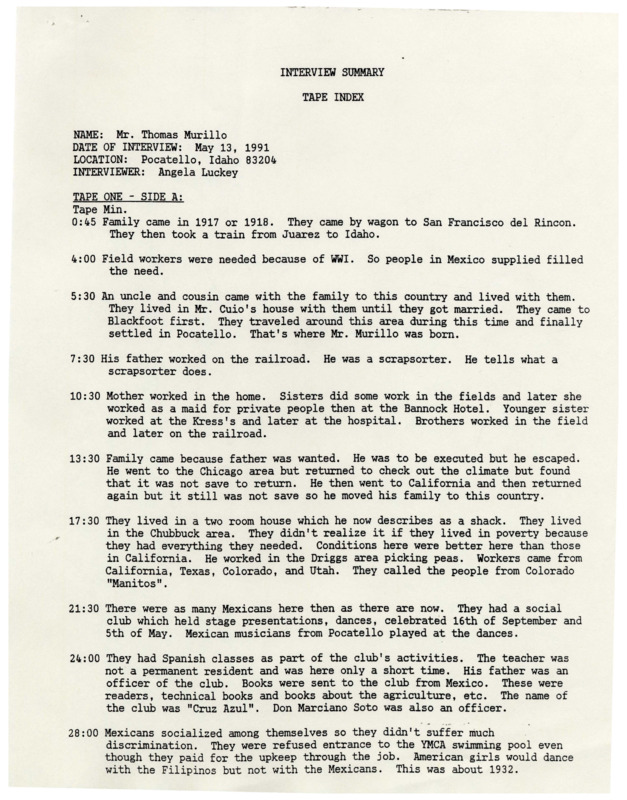
Thomas Murillo: In 1917 or 1918? But I can't remember. I should have gotten in touch with my sister, but she as far as I know, she's still in California. And,¿En 1917 o 1918? ¿Que yo recuerde? Debería haberme puesto en contacto con mi hermana, pero, que yo sepa, sigue en California. Y...
That's as close as I can come.Eso es lo más cerca que puedo llegar.
Angela Luckey: And how did they come?¿Y cómo llegaron?
Thomas Murillo: They came by, they started by a wagon pulled by mules and horses. I don't know which, open wagon. As I understand it, they went from Manolo to San Francisco del Rincon. They, took the train there. San Francisco, to Juarez and cross over to El Paso on foot. And, from there they, were loaded on to a train.Llegaron, empezaron en una carreta tirada por mulas y caballos. No sé cuál, una carreta abierta. Según tengo entendido, fueron de Manolo a San Francisco del Rincón. Tomaron el tren allí. De San Francisco a Juárez y cruzaron a El Paso a pie. Y de allí los subieron a un tren.
that was there. By, Richmond a few times, looking for workers to work in their fields up. And I'd also like, were hired there, loaded on the train. Claimed to but by train. That's the of travel to use.Eso estaba allí. Por Richmond, varias veces, buscando trabajadores para sus campos. Y también me gustaría que me contrataran allí, que me subieran al tren. Afirmaban que sí, pero en tren. Esa es la forma de viajar.
Angela Luckey: Do you know which train it was?¿Sabes qué tren era?
Thomas Murillo: No, I have no idea. I'm sure there was a change of train somewhere. Because the rail personnel, I don't know, it's, maybe the Santa Fe and the Southern Pacific and they come up into this country. Must have come through, Denver and then, change trains. Come in. Was come here by the Pacific from Denver.No, no tengo ni idea. Estoy seguro de que hubo un cambio de tren en alguna parte. Porque el personal ferroviario, no sé, quizás el Santa Fe y el Southern Pacific, vienen a este país. Debieron pasar por Denver y luego cambiar de tren. Llegaron. Vinieron aquí en el Pacific desde Denver.
I traveled there myself during the war. That's the way I remember the trains.Yo mismo viajé allí durante la guerra. Así es como recuerdo los trenes.
Angela Luckey: Was it difficult for them to immigrate at that time?¿Fue difícil para ellos emigrar en esa época?
Thomas Murillo: No, no. As I understand it, it was easy. Because, of the need for, workers in the fields who at that time, you know, actually, US was fighting in Europe, World War one and they needed, field workers as well as I'm sure in other, in other fields, they needed workers. And so, as today, it's, very convenient and cheap source of labor.No, no. Según tengo entendido, fue fácil. Debido a la necesidad de trabajadores en el campo, ya que en ese momento, Estados Unidos luchaba en Europa durante la Primera Guerra Mundial, y necesitaban trabajadores en el campo, al igual que, estoy seguro, en otros campos. Y, por lo tanto, como hoy, es una fuente de mano de obra muy conveniente y económica.
People of Mexico City.Gente de la Ciudad de México.
So they experienced no difficulty that time. They didn't even have passports. They had, but they did have some kind of an entry paper that I've seen, with the pictures of the family and a stamp on it so that, it was probably pretty simple. By the time. and as I say. The same situation existed very well before World War One, as existed in World War Two.Así que no tuvieron ninguna dificultad en esa época. Ni siquiera tenían pasaporte. Sí, pero sí tenían una especie de documento de entrada que he visto, con fotos de la familia y un sello, así que probablemente fue bastante sencillo. Para entonces, y como digo, la situación era muy similar antes de la Primera Guerra Mundial, y también durante la Segunda.
They needed people, this country. Many people did to, work harvesting crops that put American people's food on the table. So it was it was convenient. And maybe it was made easier for they didn't apparently they didn't have quotas. And.Este país necesitaba gente. Mucha gente trabajaba en la cosecha para alimentar a los estadounidenses. Así que era conveniente. Y quizás se facilitó porque aparentemente no tenían cuotas.
Angela Luckey: do you remember your grandparents?¿Te acuerdas de tus abuelos?
Thomas Murillo: No, I never knew them at all. I have pictured my father's mother, and, that's. I've never seen a picture of my other grandparents. I remember when I remember that my mother's father died, when I was small, because I remember seeing the letter and notifications bordered in black. I guess that was the custom those days, but other.No, nunca los conocí. Me he imaginado a la abuela de mi padre, y eso es todo. Nunca he visto una foto de mis otros abuelos. Recuerdo cuando recuerdo que el abuelo de mi madre murió, cuando era pequeño, porque recuerdo ver las cartas y las notificaciones con bordes negros. Supongo que esa era la costumbre en aquellos tiempos, pero otras.
But I did not know anything.Pero yo no sabía nada.
Angela Luckey: Did anybody else come with the family when they came?¿Vino alguien más con la familia cuando llegaron?
Thomas Murillo: Yeah, I had an uncle. Joe and, cousin Nicholas, Nick. Do they come here? They came with family. There were young teenage guys at the time, and they're both dead now. But, those were the two came. That I know of. And I'm sure that's all the ones. Well, I mean, my sister, sister and two older brothers, of course, who?Sí, tenía un tío, Joe, y mi primo Nicholas, Nick. ¿Vienen aquí? Vinieron con familiares. Había jóvenes adolescentes en aquel entonces, y ambos ya fallecieron. Pero esos fueron los dos que vinieron. Que yo sepa. Y estoy seguro de que son todos. Bueno, me refiero a mi hermana, mi hermana y mis dos hermanos mayores, claro, ¿quiénes?
Angela Luckey: So your uncle lived with you during those times?¿Entonces tu tío vivió contigo durante esos tiempos?
Thomas Murillo: Both. Both my uncle and, my cousin lived with the ladies who lived,Ambos. Tanto mi tío como mi primo vivían con las señoras que vivían,
In Mr. Curios household and and, you know, and moved a couple of houses over from, third, Nick was still living with those my uncles, still Great Lakes they lived with until he got married.En la casa del Sr. Curios y, ya sabes, y se mudaron un par de casas más allá, en tercer lugar, Nick todavía vivía con esos tíos míos, todavía vivían en Great Lakes con ellos hasta que se casó.
Angela Luckey: And and so they all came to Idaho.Y así fue como todos llegaron a Idaho.
Thomas Murillo: At that time? Yeah.¿En ese momento? Sí.
Angela Luckey: first.primero.
Thomas Murillo: I'm, among all of them. Did I know I'm sure a lot of them. But my cousin Nick now, he, he got on in Wyoming sometime, and, lived with the family. And then he quickly joined in. But, yes, they all wound up in the same year. Well, thank you.Estoy entre todos ellos. ¿Sabía que muchos? Pero mi primo Nick, él, él se fue a Wyoming un tiempo y vivió con la familia. Y luego se unió rápidamente. Pero sí, todos terminaron el mismo año. Bueno, gracias.
Angela Luckey: We're saying that the very first time we came down Idaho.Estamos diciendo esto la primera vez que venimos a Idaho.
Thomas Murillo: To, Blackfoot, they came to Blackfoot, and from Blackfoot, they went to Aberdeen, and I guess from Aberdeen to Salt Lake, because they came here from Salt Lake. And no place around north.Para los Pies Negros, llegaron a Pies Negros, y de Pies Negros, fueron a Aberdeen, y supongo que de Aberdeen a Salt Lake, porque vinieron aquí desde Salt Lake. Y de ningún lugar cerca del norte.
Angela Luckey: And you were born here?¿Y tú naciste aquí?
Thomas Murillo: Yeah.Sí.
Angela Luckey: You know that after they went, right?Sabes eso después de que se fueron, ¿verdad?
Thomas Murillo: Yeah, yeah. I know they're born after they came from Salt Lake and Salt.Sí, sí. Sé que nacieron después de venir de Salt Lake y Salt.
Angela Luckey: what kind of work did your dad do?¿Qué tipo de trabajo hacía tu papá?
Thomas Murillo: He worked on the railroad. he had made two previous trips with the family still to Mexico. And, I only known him working on the railroad. his first trip took him into the Chicago area, and the second trip took him to the California. So cooking valley? Yeah, he he worked there. Now, he may have worked in the fields there, but, I don't know.Trabajaba en el ferrocarril. Había hecho dos viajes previos con la familia a México. Y solo lo conocía trabajando en el ferrocarril. Su primer viaje lo llevó a la zona de Chicago, y el segundo a California. ¿Entonces, en el valle de Cooking? Sí, trabajó allí. Puede que haya trabajado en el campo, pero no lo sé.
There's. Anyway, you go to the two places that he had worked, so, it's almost certain to be rewarded. Most of the time.Ahí está. En fin, vas a los dos lugares donde trabajó, así que es casi seguro que te recompensarán. La mayoría de las veces.
Angela Luckey: You work that have work on the.Trabajas que tienes trabajo en el.
Thomas Murillo: He was a laborer, and, he, he spent most of his railroad career here in cook, working for the Union Pacific in the stores department, as a, scraps or in the material yard.Era obrero y pasó la mayor parte de su carrera ferroviaria aquí, en Cook, trabajando para Union Pacific en el departamento de almacenes, como chatarra o en el patio de materiales.
Angela Luckey: that when was that? During World War.¿Cuándo fue eso? Durante la Primera Guerra Mundial.
Thomas Murillo: Well, no. No, he started back there. I'm not sure what year he started that, that to guess about the year before I was born. and,Bueno, no. No, empezó allá atrás. No estoy seguro de en qué año empezó eso, así que supongo que fue el año antes de que yo naciera. Y,
Until he retired in 1964.Hasta su jubilación en 1964.
So he thinks that, been a part of 40 years doing what I.Así que él piensa que, habiendo sido parte de 40 años haciendo lo que yo.
Angela Luckey: What is this craft? So you do. What is this? Graduating?¿Qué es esta artesanía? Pues sí. ¿Qué es esto? ¿Graduarse?
Thomas Murillo: Well, they send in, used material. Well, he worked in a material yard. And among other things, they stored new materials such as new rails and stuff like that. And also there came their use material, which had to be sorted out as to what was usable and what was scrap. So that was what their, work consisted of.Bueno, enviaban material usado. Trabajaba en un depósito de materiales. Y, entre otras cosas, almacenaban material nuevo, como rieles nuevos y cosas así. Y también llegaba el material usado, que había que clasificar para saber qué era útil y qué era chatarra. En eso consistía su trabajo.
Angela Luckey: And then your mother, she stayed home.Y luego tu madre se quedó en casa.
Thomas Murillo: Yeah. Yeah, yeah, my mother had more than a handful, raising seven kids. And my father. So, you know, I know that's what it was. Anyway, it's too much about when why was going on and working and leaving the kids. Well, no, that's, that was unheard of in those days.Sí. Sí, sí, mi madre tuvo más de un puñado, criando a siete hijos. Y mi padre. Así que, ya sabes, sé que era así. En fin, se trata demasiado de cuándo y por qué iba a trabajar y dejaba a los niños. Bueno, no, eso era inaudito en aquella época.
Angela Luckey: Did your sisters go, stay with her? did they do some work or was.¿Tus hermanas fueron, se quedaron con ella? ¿hicieron algún trabajo o fue?
Thomas Murillo: Well, my older sister worked a lot. She, she worked out in a field with us. later on, after she got older, she worked as a maid for some people here in town. And also at, back hotel. So she worked very hard to. But my older sister, she, you know, she worked, when she graduated from high school.Bueno, mi hermana mayor trabajaba mucho. Trabajaba en el campo con nosotros. Más tarde, cuando era mayor, trabajó como empleada doméstica para algunas personas aquí en el pueblo. Y también en un hotel. Así que trabajaba muy duro. Pero mi hermana mayor, ya sabes, trabajó cuando se graduó de la preparatoria.
Different places here. I mean, I remember she would be creches, but most of the time she worked at the hospital and later worked for some doctors.Aquí hay diferentes lugares. Recuerdo que ella trabajaba en guarderías, pero la mayor parte del tiempo trabajaba en el hospital y luego con algunos médicos.
In an office job, sometimes.En un trabajo de oficina, a veces.
Angela Luckey: So your brothers, worked.Así que tus hermanos, trabajaron.
Thomas Murillo: Well, they, when all the brothers worked out in the fields and went to school. And later they in 1937, I went to work on the railroad at the freight house. And so they didn't have to work on the fields anymore. Would they got enough of that when they were younger? And it was very hard. And, eventually my oldest brother, sometime after my mother died, he left the railroad.Bueno, ellos, cuando todos los hermanos trabajaban en el campo e iban a la escuela. Y más tarde, en 1937, yo fui a trabajar en el ferrocarril, en la estación de carga. Así que ya no tenían que trabajar en el campo. ¿Tendrían suficiente de jóvenes? Y era muy duro. Y, finalmente, mi hermano mayor, poco después de la muerte de mi madre, dejó el ferrocarril.
He studied mechanics after the war. Then, after I moved, gone to California. Right. He then pulled up states and went to California to work for the right track circulation. But my other older brother stayed here on the railroad. My youngest brother stayed on the railroad. But the in between brother between my youngest and me, Lewis. He also gone to school, aeronautical school in Oklahoma and became a meteorologist here.Estudió mecánica después de la guerra. Luego, después de mudarme, se fue a California. Claro. Luego se mudó a California para trabajar en la circulación de la vía correcta. Pero mi otro hermano mayor se quedó aquí en el ferrocarril. Mi hermano menor se quedó en el ferrocarril. Pero el hermano intermedio entre mi hijo menor y yo, Lewis, también estudió aeronáutica en Oklahoma y se hizo meteorólogo aquí.
And we left to the same day in 1956, he went to North Carolina, and I went to California, and he moved from, North Carolina. Well, he was working here not too far from my mother died, and then he went to North Carolina, and then he went to Arizona. And from Arizona, he went to El Paso.Y nos fuimos el mismo día, en 1956. Él se fue a Carolina del Norte, yo a California, y él se mudó de Carolina del Norte. Bueno, él trabajaba aquí, no muy lejos de donde murió mi madre, y luego se fue a Carolina del Norte, y luego a Arizona. Y de Arizona, a El Paso.
Angela Luckey: Why did your family come here?¿Por qué vino aquí tu familia?
Thomas Murillo: Why did they come in? Well, we could, because my father had, become involved in the, in a matter of, that, the, the owner of la haceinda of that town, was built on, had in for my father because my father turned in there, too. Well, he claimed my older sister, he was.¿Por qué entraron? Bueno, pudimos, porque mi padre se había involucrado en un asunto relacionado con eso. El dueño de la haceinda de ese pueblo, donde se construyó, estaba en contra de mi padre, porque mi padre también se había delatado allí. Bueno, él reclamó a mi hermana mayor.
And, he didn't like to work. and he liked to drink and gamble and, I guess, that it didn't go over too well with the that, guy that owned the town. And I seen that my name don't get moved beyond. And, very conveniently when once this is all green Revolution. It was the Bunny Brown Band.Y no le gustaba trabajar. Le gustaba beber y apostar, y supongo que eso no le convencía, bueno, al dueño del pueblo. Y he visto que mi nombre no se ha movido. Y, muy convenientemente, cuando todo esto es la Revolución Verde. Era la Bunny Brown Band.
The revolutionary came to the town and raised and raised the hell among the guy who was a friend of my father's. And somebody saw that guy. And after they left that we it reported on my friends. My father's friends had been in in that bunch of friends in the town so naturally followed. My father had been in cahoots with them.El revolucionario llegó al pueblo y armó un escándalo con el amigo de mi padre. Alguien lo vio. Y después de que se fueran, denunció a mis amigos. Los amigos de mi padre habían estado en ese grupo de amigos del pueblo, así que, naturalmente, los siguieron. Mi padre había estado conspirando con ellos.
So that was all that old guy needed to, have my father arrested, and he was thrown in jail. fortunately, that night before he was to be shot by another revolutionary band. Right. they open the doors in the jail, and my father got out, and he came to the United States, and that's where he went to the Chicago area.Así que eso era todo lo que necesitaba ese viejo: arrestar a mi padre, y lo metieron en la cárcel. Afortunadamente, esa noche, antes de que otra banda revolucionaria lo fusilara, abrieron las puertas de la cárcel, y mi padre salió y vino a Estados Unidos, y de ahí fue a la zona de Chicago.
And, he stayed a period of time. I don't know what kind of money, but he stayed a period of time. And then he went back to Mexico to see if it was safe to go back. And apparently it was not safe. So he came back to the United States, this time to to California. Then after a period of time, he went back again to see if it was safe for him.Y se quedó un tiempo. No sé cuánto dinero, pero se quedó un tiempo. Y luego regresó a México para ver si era seguro regresar. Y aparentemente no era seguro. Así que regresó a Estados Unidos, esta vez a California. Después de un tiempo, regresó de nuevo para ver si era seguro para él.
And no, it was not safe for him. So that's what happened to the family. And it became the United States.Y no, no era seguro para él. Así que eso fue lo que le pasó a la familia. Y se convirtió en Estados Unidos.
Angela Luckey: At that time. Was was it your sisters then? How many family members came? Just your mom and your dad?En ese entonces. ¿Fueron tus hermanas? ¿Cuántos familiares vinieron? ¿Solo tu mamá y tu papá?
Thomas Murillo: Well, one of the, the three kids, my oldest sister and my two older brothers and my uncle and my mother.Bueno, uno de los tres niños, mi hermana mayor y mis dos hermanos mayores y mi tío y mi madre.
Angela Luckey: But a bunch people.Pero un montón de gente.
Thomas Murillo: Yeah, that was seven. Yeah, my brother were small. The one, those three. That was very close. I guess maybe a couple years old, you know, you know, probably, you.Sí, eran siete. Sí, mis hermanos eran pequeños. El uno, esos tres. Eran muy parecidos. Supongo que tendrían un par de años, ya sabes, ya sabes, probablemente tú.
Angela Luckey: Know. So, when you worked out on the field, what did you live in that the farmer provide.Saber. Entonces, cuando trabajabas en el campo, ¿con qué vivías que te proporcionaba el agricultor?
Thomas Murillo: In, in that one year that I remember and I'm not sure what year it was, but in about 1929, we did live out on the farm on, Chubbuck Road.En ese año que recuerdo y no estoy seguro de qué año fue, pero alrededor de 1929, vivimos en la granja en Chubbuck Road.
And I don't know if it was the same year or the following year. We lived on farm where the Ordnance plant is located now. We lived there, and I, I'm pretty sure that it was two different years, but, I don't know what year they were, in relation to where the one on the farm moved shack to my house.Y no sé si fue el mismo año o el siguiente. Vivíamos en la granja donde ahora está la planta de artillería. Vivíamos allí, y estoy bastante seguro de que fueron dos años diferentes, pero no sé en qué año fueron, en relación con el lugar donde el de la granja se mudó a mi casa.
20s to the house. but nowadays it's unbelievable. Yeah. I went last year with my niece. Sure. What it was. And because her mother, my old sister, was out there with us, and, the house over here, the ordnance plant is not I, I can't remember. The old house was like. But it was like living in a park because actually part of that farm was rented out as a picnic area.Veinte años para la casa. Pero ahora es increíble. Sí. Fui el año pasado con mi sobrina. Claro. Lo que era. Y como su madre, mi hermana mayor, estaba con nosotros, y la casa de aquí, la fábrica de municiones no es mía, no me acuerdo. La casa vieja era como... Pero era como vivir en un parque porque, de hecho, una parte de esa granja estaba alquilada como zona de picnic.
So it was pretty nice out there. And, with couches, too. It was pretty good. I don't remember that. We built, That we were living in poverty because, I mean, we were supplied with milk and eggs for the farm and apples and things like that. My father took time off. He was still employed on the railroad.Así que se estaba bastante bien ahí fuera. Y, además, con sofás. Era bastante bueno. No lo recuerdo. Construimos... Vivíamos en la pobreza porque, bueno, nos abastecían de leche y huevos para la granja, manzanas y cosas así. Mi padre se tomó un tiempo libre. Seguía trabajando en el ferrocarril.
He was really lucky because when the depression came, he he was laid off for a while, but not very long. And so when he wanted to take us up there, I guess there was a need for extra money. Of course. So he took, time off from around, I don't remember. They called it, it wasn't vacation, but, something happened.Tuvo mucha suerte porque cuando llegó la depresión, lo despidieron por un tiempo, pero no mucho. Así que, cuando quiso llevarnos allá, supongo que necesitaba dinero extra. Claro. Así que se tomó un tiempo libre, no lo recuerdo. Lo llamaban... no eran vacaciones, pero algo pasó.
They would go ahead and take us out there to work and when and, we came back and contracted job on the railroad. So, I, the conditions that I found in, in California when I went there, ammonia, ammonia field workers was not, nearly as good as the conditions that we were under here. in 1932, 1934, 1936, I worked in great outside of drinks in the fields.Nos llevaban a trabajar allí, y cuando regresábamos, conseguíamos un trabajo en el ferrocarril. Así que, las condiciones que encontré en California cuando fui allí, trabajando en los campos de amoníaco, no eran tan buenas como las que teníamos aquí. En 1932, 1934 y 1936, trabajé mucho en los campos, tomando algo fuera de la mesa.
And at that time, those people came from California. This was in the depths of the depression. They came from California to the Idaho to work so that, either there wasn't too much work at that time in California or the working conditions were better here than it was in that, Harriman versity Co. Those three years that I spent in good working old people paying, to work, work from, California, there was one Texas family, and, the rest of them were from Colorado.Y en ese entonces, esa gente venía de California. Esto era en plena depresión. Vinieron de California a Idaho a trabajar, así que, o bien no había mucho trabajo en California en ese momento, o bien las condiciones laborales eran mejores aquí que en el condado de Harriman. Esos tres años que pasé en California, gente mayor y trabajadora que pagaba para trabajar, trabajando desde allí, había una familia de Texas y el resto eran de Colorado.
and... and Idaho.Y Nebraska y yo.
Angela Luckey: From the braska.De la braska.
Thomas Murillo: No, I don't remember if there might have been, but I don't remember from Nebraska. but those states that I remember, yeah, I was family in Texas. So, people from Colorado with money, they called me from Utah and, and, Idaho and the, you know, the few families from here in Portland in 1932, about half dozen families going from here to there.No, no recuerdo si los hubo, pero no recuerdo de Nebraska. Pero de esos estados que recuerdo, sí, tenía familia en Texas. Así que, gente de Colorado con dinero me llamó desde Utah, Idaho y, ya sabes, las pocas familias de aquí de Portland en 1932, como media docena de familias que iban de un lado a otro.
There were, several people, several families from the Idaho Falls area that were there, too, at that time, only where they were necessary. But they were 1932. Later on, some came to live here, and I found that they were born outside of Idaho. So it was probably the cause.Había varias personas, varias familias de la zona de Idaho Falls, que también estaban allí en ese momento, solo donde era necesario. Pero era 1932. Más tarde, algunos vinieron a vivir aquí, y descubrí que nacieron fuera de Idaho. Así que probablemente esa fue la causa.
Angela Luckey: whether very many Mexicans, Mexicans down here.si hay muchos mexicanos, mexicanos acá abajo.
Thomas Murillo: Well, I, I think, I think that at that time there were probably as many as there are now, but, I mean, the fact that they were able to organize, a social club, the.Bueno, yo, yo creo, yo creo que en ese momento probablemente había tantos como hay ahora, pero, quiero decir, el hecho de que fueran capaces de organizar, un club social, el.
Groups are. And I think it was called. Yeah. And they held, stage, presentations, and, and make dances.Los grupos son... Y creo que se llamaba... Sí. Y hacían presentaciones en el escenario y bailaban.
for the six in September and the 5th of May. And people, you know, made speeches and there were musical, presentations. The people that played for the dancers who were all Mexican musicians from Porto. so, I'm, I make judgments. There were quite a few people who to support that kind of activity.Para los seis de septiembre y el 5 de mayo. Y la gente, ya sabes, dio discursos y hubo presentaciones musicales. Los que tocaron para los bailarines eran todos músicos mexicanos de Oporto. Así que, yo... yo hago juicios. Había bastante gente que apoyaba ese tipo de actividad.
Angela Luckey: That was in the 30s? That was in the 30s?Eso fue en los años 30, hmhm. Eso fue en los años 30.
Thomas Murillo: Yeah, the late 20s and the 30s. The 30s. It all ended when the depression came and so many were laid off on the road. And that broke it all up. But, in order to sustain that kind of social activity, there has to be, you know, quite a number of people to get a bang. For example, to play for our dances.Sí, a finales de los 20 y los 30. Los 30. Todo terminó cuando llegó la depresión y muchos se quedaron sin trabajo. Y eso lo destrozó todo. Pero, para mantener ese tipo de actividad social, tiene que haber, ya sabes, mucha gente para que tenga éxito. Por ejemplo, para tocar en nuestros bailes.
And, the speakers were all good speakers, as I can remember. You know, I was small. I was always zeroed in on that kind of stuff. And, yeah, they,Y, los oradores eran todos buenos oradores, según recuerdo. Sabes, yo era pequeño. Siempre me centraba en ese tipo de cosas. Y, sí, ellos...
There were there were a considerable considerable number of people from Mexico around here. And they were at that time from southeast Mexico. we even had one year. We even had classes in Spanish. And, I heard in.Había una cantidad considerable de gente de México por aquí. En ese entonces, eran del sureste de México. Incluso tuvimos un año. Incluso tuvimos clases de español. Y, según escuché,...
Angela Luckey: School.Escuela.
Thomas Murillo: Well, I'm talking about.Bueno, de eso estoy hablando.
Angela Luckey: With this club.Con este club.
Thomas Murillo: Here. Yeah. and I went to it, I was the dummy. And I had always been able to spell real well in English. I remember that I had my troubles in, in Spanish, but, you know, I was only maybe 6 or 7 years old. Eight at the most. But, yeah, we had classes in Spanish.Aquí. Sí. Y fui, yo era el tonto. Y siempre había tenido muy buena ortografía en inglés. Recuerdo que tuve mis problemas con el español, pero, ya sabes, solo tenía unos 6 o 7 años. Ocho como mucho. Pero sí, teníamos clases de español.
Angela Luckey: Taught them to,Les enseñé a,
Thomas Murillo: I don't know who the man was. I, I kind of think my impression is the guy was just stay here for a short period of time. I know he wasn't one of the, permanent residents here.No sé quién era el hombre. Creo que solo estuvo aquí un rato. Sé que no era residente permanente.
But. So, again, you know, there there must have been a considerable number of those here to sustain that. Going back to this, you know, this story.Pero. De nuevo, debe haber habido un número considerable de personas aquí para sostener eso. Volviendo a esta historia.
Angela Luckey: Oh, yeah. great. They called me. Yeah.Oh, sí. Genial. Me llamaron. Sí.
Thomas Murillo: Well, my father was, some type of officer of that club, because when they broke up, we wouldn't end up with a bunch of, books that were sent by the Mexican government. I still had one of them around the state. Right? I, I came too late to this, idea of saving and having books, having my own library.Bueno, mi padre era una especie de oficial de ese club, porque cuando se disolvieron, no nos quedaríamos con un montón de libros enviados por el gobierno mexicano. Todavía tenía uno por el estado. ¿Verdad? Llegué demasiado tarde a esta idea de ahorrar y tener libros, tener mi propia biblioteca.
So I won't be able to salvage one, no, two, two and,Así que no podré salvar uno, no, dos, dos y,
Angela Luckey: What kind of books?Tipo de libros.
Thomas Murillo: Well, one of them is, kind of a primary reader, and the other one is a technical book on shooting, really just. I mean, I made it up, when I went to work on the moment that I'd be employed, one of the things that I, had to learn because nobody else wanted to do it was to mention my work.Bueno, uno es una especie de libro de lectura principal, y el otro es un libro técnico de fotografía, en realidad. O sea, lo inventé cuando empecé a trabajar, cuando me contrataron. Una de las cosas que tuve que aprender, porque nadie más quería hacerlo, fue a mencionar mi trabajo.
And, here I couldn't, like, managed to keep this book in its own sheet metal sheet metal fabrication in Spanish. But interesting to me that I should have that damn book after my experience my job. but they were some of the others that I remember, kind of, it's not fair to call them propaganda from, any government puts out literature telling them the type of improvements and the advancements and things like that.Y aquí no pude, como que, mantener este libro sobre fabricación de chapa metálica en español. Pero me resulta curioso que lo tuviera después de mi experiencia laboral. Pero había otros que recuerdo, en cierto modo... no es justo llamarlos propaganda, ya que cualquier gobierno publica literatura que les cuenta las mejoras, los avances y cosas así.
The one thing that I remember had to do was maybe agriculture or water preservation, something along that line. Those are the ones that I remember, the terror others.Lo único que recuerdo que tenía que hacer era quizás agricultura o conservación del agua, algo por el estilo. Esos son los que recuerdo, el terror en los demás.
Angela Luckey: Those books that man that taught. Was he the one that brought those?Esos libros que enseñó el hombre. ¿Fue él quien los trajo?
Thomas Murillo: No, no, they were sent to the to that club. The crews are still on tours and they were blue cross translates as the Blue Cross.No, no, los enviaron a ese club. Las tripulaciones siguen de gira y eran de la Cruz Azul.
Angela Luckey: And your dad was one of the officers?¿Y tu papá era uno de los oficiales?
Thomas Murillo: Yeah, yeah.Sí, sí.
Angela Luckey: Do you remember who was president? And then remember anyone who was present?¿Recuerdas quién era el presidente? ¿Y recuerdas a alguien que estuviera presente?
Thomas Murillo: No, I don't, another man, very intelligent man. Management was the unknown. So he was one of the officers in the club, he's the only one that I can remember.No, no lo sé, otro hombre, muy inteligente. La gerencia era desconocida. Era uno de los directivos del club, el único que recuerdo.
Angela Luckey: Well, I Mexicans treated and, you in those days.Bueno, yo los mexicanos traté y, ustedes en esos días.
Thomas Murillo: Well,Bien,
By and large, I think, there was, What, discrimination or prejudice that there was here wasn't too apparent because, We Mexicans socialized among ourselves, as I say, with social club. Like I mentioned, they made dances. And, there were always weddings and baptisms and even the, wakes for the funerals. What? They all were social activities.En general, creo que había... ¿Qué? La discriminación o los prejuicios que había aquí no eran muy evidentes porque los mexicanos socializábamos entre nosotros, como digo, en clubes sociales. Como mencioné, hacían bailes. Y siempre había bodas, bautizos e incluso velorios para los funerales. ¿Qué? Todas eran actividades sociales.
And, for example, the dances. What the heck? I'm I'm a lover of music. And certainly we had the music to dance to, which meant that we didn't have to go, to, try and get into the, the watch, the dances where we were go out. Anyway, we knew that, but it didn't make any difference because what did we need from them in the way of social activities when we had our own, which were that is nice is there's, and food was served.Y, por ejemplo, los bailes. ¿Qué demonios? Soy amante de la música. Y, desde luego, teníamos música para bailar, lo que significaba que no teníamos que ir a ver los bailes a los que salíamos. En fin, lo sabíamos, pero no importaba, porque ¿qué necesitábamos de ellos en cuanto a actividades sociales cuando teníamos las nuestras, que eran agradables, y se servía comida?
The Mexican food and the music was Mexican women were amazing. So what the hell did we need from them? But certainly the the discrimination prejudice existed in, in housing and jobs. yeah. I myself turned down for two jobs, told very explicitly because I was a Mexican. I couldn't have those jobs. refused entrance into the YMCA swimming pool, even though my father and all the rest of railroad employees contributed some, like a dollar or $2 a month to to, subsidy of that YMCA.La comida y la música mexicanas eran increíbles. ¿Qué demonios necesitábamos de ellas? Pero sin duda existían prejuicios discriminatorios en materia de vivienda y empleo. Sí. Yo mismo rechacé dos trabajos, y me lo dijeron muy explícitamente por ser mexicano. No podía aceptarlos. Me negaron la entrada a la piscina de la YMCA, a pesar de que mi padre y el resto de los empleados del ferrocarril contribuían con algo, como uno o dos dólares al mes, al subsidio de la YMCA.
and, those kind of things. one of the one of the things I'm so funny to is even now, in 1932, when I went to drinks to pick peas, I remember the one one of the Mexicans basically dances on Saturday nights and drinks the Mexicans did. But I remember that the American girls would go to, you know, a little rather more of a community.Y ese tipo de cosas. Una de las cosas que me divierten tanto es que incluso ahora, en 1932, cuando iba a tomar algo a recoger guisantes, recuerdo que una de las mexicanas básicamente bailaba los sábados por la noche y bebía. Pero recuerdo que las chicas estadounidenses iban a una comunidad un poco más grande.
The girls would go, but they wouldn't dance with the Mexican, you see. They would dance with the Filipinos. There were always in those camps. The Filipinos came in California to see, and they always dressed real flashy, you know, and they always had news cars because maybe 4 or 5 guys would chip in by car. You could and they they were always dressed real fine, those guys.Las chicas iban, pero no bailaban con los mexicanos, ¿sabes? Bailaban con los filipinos. Siempre había en esos campamentos. Los filipinos venían a California a ver, y siempre vestían muy ostentosos, ¿sabes?, y siempre tenían coches nuevos porque a lo mejor cuatro o cinco chicos se sumaban en coche. Se podía, y siempre iban muy bien vestidos, esos chicos.
And so the American girls would dance with them, they go in with vixens. And I thought it was funny or, you know, they weren't until, the latter years that I went to 1936, that they, you know, the, the assimilation began to take place because inevitably, the end of their pieces and why there would be at least one American girls and take off to California, the Mexican.Y entonces las chicas estadounidenses bailaban con ellas, se juntaban con las zorras. Y me pareció gracioso, o, ya sabes, no fue hasta los últimos años, cuando llegué a 1936, que la asimilación comenzó porque, inevitablemente, el final de sus obras... ¿por qué habría al menos una chica estadounidense que se fuera a California, la mexicana?
In 1930. Who's the movies come out to men and what the hell? Alone. You know, they, Looking back, I thought it was funny.En 1930. ¿A quién le gustan las películas para hombres y qué demonios? Solos. Ya sabes, ellos. Mirando hacia atrás, me pareció gracioso.
Angela Luckey: Well, when you when your family was shopping, did. Where did they shop? I mean.Bueno, cuando tu familia iba de compras, ¿dónde compraban? O sea.
Thomas Murillo: Well, we shop...,Bueno, disparamos,
The shopping, I remember, what the hell? J.C. Penney bought it. began here in this very white green room. I can move J.C. Penney from Myer. Is childhood. There was Mr. curious Store somehow or another. He's Italian. He. He glommed on the knowledge that, these people needed a special type of food.Las compras, lo recuerdo, ¿qué demonios? J.C. Penney lo compró. Empezó aquí, en esta habitación verde blanquísima. Puedo trasladar a J.C. Penney de Myer. Es de la infancia. Estaba el Sr. Tienda Curiosa, por alguna razón. Es italiano. Él... Se aferró a la idea de que esta gente necesitaba un tipo de comida especial.
items.elementos.
Angela Luckey: Or imported Mexican.O mexicano importado.
Thomas Murillo: Food. Yeah, yeah, because the only store in time after him. But he was knowledgeable about it. And, he, he made quite a bit of money from the white foods. I remember him delivering groceries from the dark place I'd been playing inside, searching for us. Conversation between the railroad and wooden fence all the way through. oh.Comida. Sí, sí, porque era la única tienda en el tiempo después de él. Pero él sabía mucho del tema. Y, él, él ganó bastante dinero con la comida blanca. Lo recuerdo entregando comestibles desde el lugar oscuro donde yo había estado jugando, buscándonos. Conversación entre el ferrocarril y la cerca de madera todo el tiempo. Oh.
What? first street and, Clark began, then came all the way down here to, I was taught street, along the railroad yards and inside the fence. The Mexicans lived on those houses, from, wires to, land inside the real property. And, there was a row of houses, a row of apartments, I should say.¿Qué? Primero la calle y... —empezó Clark—, luego vino hasta aquí, según me enseñaron, junto a las vías del ferrocarril y dentro de la cerca. Los mexicanos vivían en esas casas, desde los cables hasta el terreno dentro de la propiedad. Y había una hilera de casas, una hilera de apartamentos, mejor dicho.
And, I think for families that was there. And at each end, there was on the south end, there was a big house and a couple of families, and then north and Black Road Farms that, a family lived there, and then a Greek guide. And then there was another small house north of that. Right. Close environment. So in there I was not sure when they are shopping at Mr. Shoe Store.Y creo que para las familias que había allí. En cada extremo, en el sur, había una casa grande y un par de familias, y luego al norte, en Black Road Farms, donde vivía una familia, y luego un guía griego. Y luego había otra casa pequeña al norte de esa. Sí. Un entorno cerrado. Así que no estaba seguro de cuándo estaban comprando en la zapatería.
And so he had regular deliveries there. And I remember you had the first pick up truck that I can remember. All metal is one of the sons and helping to lady and the rest of them like the Eastland store and block store were very the only ones I remember that, I'm sure at least one story, how long this country was there on the east side, between first and second on Center Street.Y hacía entregas regulares allí. Recuerdo que tuviste la primera camioneta que recuerdo. Todo metal era de uno de los hijos y ayudaba a la señora. El resto, como la tienda Eastland y la tienda de bloques, eran los únicos que recuerdo, estoy seguro de que hay al menos una historia sobre cuánto tiempo estuvo este país en el lado este, entre la primera y la segunda calle en Center Street.
So, they were going there and that was going back that far. And then during the my high school years, blocks where I had families to trade here. And Joey thing where one question time to go rest and retreat to. And then it was it happens you know, talking about the Mexican people here back in the 20s, for example, there was a.Así que iban allí, y eso se remontaba a tiempos remotos. Y luego, durante mis años de preparatoria, había bloques donde tenía familias que intercambiaban aquí. Y Joey tenía una hora de preguntas para descansar y retirarse. Y luego sucedió, ya sabes, hablando de los mexicanos aquí en los años 20, por ejemplo, había...
There was a Juarez pool hall that was located on first and Lewis, across from the freight house. And there was, right across the street across Lewis. From the south side of Lewis was that row of that complex of wooden, rooms that was, the red light area and that was on the little side. And then on the Bonneville side of that block was this row of apartments.Había un salón de billar Juárez ubicado en la Primera y Lewis, frente a la estación de carga. Y justo enfrente de Lewis. Desde el lado sur de Lewis estaba esa hilera de ese complejo de habitaciones de madera, que era la zona de prostitución, en el lado pequeño. Y luego, del lado de Bonneville, había una hilera de apartamentos.
That was all, was surrounded by battling Mexican guys. And, what I started to see right there, on the corner of the Juarez pool and going from that's the south and 100 block of South first, going back to Center Street, the men across and the street going north on the first, or there was a barbershop, which was next Mexican.Eso era todo. Estaba rodeado de mexicanos peleando. Y lo que empecé a ver ahí mismo, en la esquina de la piscina Juárez, y yendo desde ahí hacia el sur y la cuadra 100 de la Primera Sur, volviendo a la calle Center, los hombres al otro lado y la calle que iba hacia el norte por la Primera Sur, o había una barbería, que estaba al lado.
And,Y,
I think. I'm not sure, but there might be a little Mexican restaurant. The bar is full of that restaurant. It was a pool hall restaurant to, since I was drinking prohibition. But,Creo. No estoy seguro, pero podría haber un pequeño restaurante mexicano. El bar está lleno de ese tipo de restaurantes. Era un restaurante de billar, ya que estaba bebiendo durante la prohibición. Pero,
There was no Mexicans in this town. At least sustain those two businesses.No había mexicanos en este pueblo. Al menos mantén esos dos negocios.
Angela Luckey: So most of the people traded for the other Mexicans. Traded in them?Así que la mayoría de la gente intercambió por los demás mexicanos. ¿Intercambiaron con ellos?
Thomas Murillo: Oh, yeah. Sure. So. Well, today, of course, that's that's not true in those days. It was a sense of they traded water, they were treated based and where they had where the stock, where the merchandise. It was slows maybe in their price range and, styles that they liked in particular.Ah, sí. Claro. Bueno, hoy, claro, eso no es cierto en aquella época. Se pensaba que comerciaban con agua, que se les trataba según dónde tenían el inventario, dónde la mercancía. Eran más lentos, quizás en su rango de precios y en los estilos que les gustaban en particular.
But yes, I remember that Eastland store, it was clothing stores going there. Quite few.Pero sí, recuerdo aquella tienda Eastland. Había tiendas de ropa allí. Bastantes pocas.
Angela Luckey: Somebody told me that. Yeah. You knew, or the Chinese... The Chinese that somebody seems to me somebody told me that you knew about the Chinese and.Alguien me lo dijo. Sí. Tú lo sabías, o los chinos aquí. Y, los chinos que alguien me dijo que sabías sobre los chinos y...
Thomas Murillo: Well, I know I know something about the Chinese and the Japanese. I was close to the to the Japanese, but. Yes, right there in that area, North first, where the fire company is now North first. And around the corner on center, there were several Chinese restaurants. and when I say seven, there might have been three.Bueno, sé algo sobre los chinos y los japoneses. Estuve cerca de los japoneses, pero... Sí, justo ahí en esa zona, Norte Primero, donde ahora está la compañía de bomberos. Y a la vuelta de la esquina, en el centro, había varios restaurantes chinos. Y cuando digo siete, puede que fueran tres.
But then farther across the alley on the center, going east on center, there was the Keystone Cafe, which was Chinese. And of course, showing you how to cook is still there. That's Chinese. And, I think there was one on South First. Chinese, probably between Phoenix and Juarez, but then on second, North second, there were Chinese.Pero luego, más allá del callejón en el centro, yendo hacia el este por el centro, estaba el Keystone Cafe, que era chino. Y, por supuesto, todavía hay demostraciones de cocina. Eso es chino. Y creo que había uno en la Primera Avenida Sur. Chino, probablemente entre Phoenix y Juárez, pero luego en la Segunda Avenida Norte, había chinos.
In fact, there was there were quite a few Chinese moving. I remember them very well, quite a few Chinese. And then,De hecho, había bastantes chinos mudándose. Los recuerdo muy bien, bastantes chinos. Y luego,
kitty corner from where all those guys were, was another bunch of Chinese. And in fact, when they tore down the because I think it called Flatiron Building, something like that, that Rosa's used to run along, Hotel Avenue, the 600 block, going north.En la esquina opuesta a donde estaban todos esos tipos, había otro grupo de chinos. Y de hecho, cuando derribaron el edificio Flatiron, creo que se llamaba así, por el que Rosa solía correr, en la Avenida Hotel, en la cuadra 600, hacia el norte.
While the Chinese lived there, you know, brick building only they were torn down there. Used to get a big charge on looking, you know, other than that, tunnels that were in under those brick buildings. And of course, we were, from the spelling Fu Manchu time we could, you know, we could imagine all kinds of things going on.Mientras los chinos vivían allí, ya sabes, solo que los edificios de ladrillo fueron demolidos. Solían cobrar una gran cantidad por mirar, ya sabes, aparte de eso, los túneles que había debajo de esos edificios de ladrillo. Y, por supuesto, nosotros, desde la época de Fu Manchú, podíamos imaginarnos todo tipo de cosas sucediendo.
Certain buildings, they, they stayed on into, right up to the world, up to World War two because they were running the lotteries, right there in that one building that was on call. Clark. And the second was to park in the second. So right up until, beginning of World War two, those guys were still in business there, and I had, I know I had one friend that worked, I think Keystone, Petco.Ciertos edificios se mantuvieron hasta la Segunda Guerra Mundial porque operaban las loterías, justo en ese edificio de guardia. Clark. Y el segundo era aparcar en el segundo. Así que hasta el comienzo de la Segunda Guerra Mundial, esos tipos seguían operando allí, y yo tenía un amigo que trabajaba, creo que en Keystone, Petco.
When he came, he came to tell you he had to go to school, go to school to buy a little school. And, I mean, he was a big us, but he didn't know how to learn how to speak, English. So, you know, he had started in first grade there. It was tiring for me and my my big mouth.Cuando llegó, vino a decirte que tenía que ir a la escuela, a comprar una escuelita. Y, bueno, era un tipo grande, pero no sabía hablar inglés. Así que, ya sabes, había empezado el primer grado allí. Fue agotador para mí y mi bocaza.
I used to think the black kids calling people, those guys chinks and ching ching chong or something like that. And I remember I opened my big mouth once and knew him, hit me up and nothing happened. But after that I learned several of the things that you didn't see, the like with the blacks too, you know, you learned very, very early that, you know, see certain things even if you are stupid and, yeah, leave it at.Solía pensar que los chicos negros que llamaban a la gente, esos tipos chinos, ching ching chong o algo así. Y recuerdo que una vez abrí la boca y lo conocí, me llamó y no pasó nada. Pero después de eso aprendí varias cosas que no se veían, como con los negros también, sabes, aprendes muy, muy pronto a ver ciertas cosas incluso si eres estúpido y, sí, déjalo ahí.
Lee and I became good friends. yeah. And I guess because of the Keystone and the Shanghai's into the Chinese. guys, there in that area on the east side, I know my brother had a Chinese friend to, but, they, they were mostly here because of those restaurants, and there were no women. You know, that Exclusion act left them out.Lee y yo nos hicimos buenos amigos. Sí. Y supongo que por el Keystone y la afición de Shanghái por lo chino. Chicos, allá en esa zona del este, sé que mi hermano también tenía un amigo chino, pero venían principalmente por esos restaurantes, y no había mujeres. Ya sabes, la Ley de Exclusión los excluyó.
And, although the Japanese, you know, they're Japanese girls and went to the Bombay school with us. I don't know how that came about, because the Exclusion Act was aimed at them, too. But, yeah, I had a lot of Japanese friends who.Y, aunque las japonesas, ya sabes, son chicas japonesas y fueron a la escuela de Bombay con nosotras. No sé cómo sucedió eso, porque la Ley de Exclusión también estaba dirigida a ellas. Pero sí, tenía muchas amigas japonesas que...
Angela Luckey: You say you were talking about. You went to bar, was cooking. Tell me about your school life and speak English when you went to school?Dices que hablabas de... Fuiste a un bar y cocinaste. Cuéntame sobre tu vida escolar y cómo hablabas inglés cuando ibas a la escuela.
Thomas Murillo: no, I doubt it, because, I guess I had to learn there, you know, I can't remember that far back, but I know what the heck. At home, we spoke Spanish much, my father. You see him saying that? No, no, you don't speak English in this house. You. You know, well, spoken like not in the house.No, lo dudo, porque supongo que tuve que aprender allí, ¿sabes? No recuerdo tan atrás, pero qué demonios. En casa, mi padre hablaba mucho español. ¿Lo viste decir eso? No, no, aquí no se habla inglés. Tú... bueno, no se habla en casa.
But when I went in my first grade, I had no idea how much. I couldn't know very much English if I had, you know, I was explosive because there are black kids around us and the Greeks and Italians. And so, in the Indian. So the French, so the so English was spoken in the neighborhood, but not not before I got into the Bible school.Pero cuando entré a primer grado, no tenía ni idea de cuánto. No podría saber mucho inglés si lo hubiera sabido, ¿sabes?, era explosiva porque había niños negros a nuestro alrededor, griegos e italianos. Y también en la India. Se hablaba francés e inglés en el barrio, pero no antes de entrar en la escuela bíblica.
it was more chances.Hubo más oportunidades.
Angela Luckey: Is that when you go to elementary school is.¿Eso es cuando vas a la escuela primaria?
Thomas Murillo: Well, and, you know, the last year, which would have been, I think the fourth or fifth grade, we were, we were bussed. We were sent to Washington School because apparently the one school was filled. And so there we go. Bunch of Mexican kids and black kids and Chinese and Greek kids and the talented, oh, this great mix that have at the bottom.Bueno, y, ya sabes, el último año, creo que en cuarto o quinto grado, nos enviaron en autobús. Nos enviaron a la Escuela Washington porque, al parecer, la única escuela estaba llena. Y ahí estábamos. Un montón de niños mexicanos, negros, chinos, griegos y los talentosos... ¡Ah, esa gran mezcla que tenemos en la base!
You know, we had to go to Washington, Washington Lord and the lawyers and the college professors, doctors, kids went to school, I guess, were forced upon that school. And I remember Mrs. Cross called from the first saying she didn't was the first, and we were not welcome. And, it was talk about culture shock and, it was,Sabes, tuvimos que ir a Washington, Washington Lord, y los abogados, profesores universitarios, médicos, los niños fueron a la escuela, supongo, fueron obligados a ir a esa escuela. Y recuerdo que la Sra. Cross llamó desde el principio diciendo que no era la primera, y que no éramos bienvenidos. Y se habló de choque cultural y, fue...
It was pretty rough first, but, I love that. And I cannot be get pretty good grades in the Kaiser Chiefs, talk. And so she, I think she would lose favor on me. She wouldn't. She wouldn't, as hostile to me as she was the rest of guys, I, you know, I found out that, you know, that one of the schools, really, these are the mixture, nationalities and and, you Asian colors and all that stuff.Al principio fue bastante duro, pero me encanta. Y no puedo sacar buenas notas en los Kaiser Chiefs, por así decirlo. Así que creo que ella me perdería el favor. No lo haría. No lo haría, a pesar de su hostilidad hacia mí, como hacia los demás chicos. Descubrí que en una de las escuelas, la verdad, se trata de la mezcla de nacionalidades y colores asiáticos y todo eso.
I know this is unusual for this country, after all. This is more of a country. And at that time, more we were all white. And, here we were that that school over there was just about anything was being, and, it was so unusual when Mr. Spring's principal put together a radio program. Musical. Everybody, everybody that this the same song in your country that they or their parents couldn't afford the key.Sé que esto es inusual en este país, después de todo. Es más, es un país. Y en ese entonces, éramos casi todos blancos. Y ahí estábamos, en esa escuela de allá, donde se hacía de todo, y fue tan inusual cuando el director del Sr. Spring organizó un programa de radio. Un musical. Todos, todos, escuchaban la misma canción en su país, y ellos o sus padres no podían pagar la clave.
Not quite popular. You go around from. Civic clubs to churches putting on that program. So it was highly unusual.No es muy popular. Se organizaba en clubes cívicos e iglesias. Así que era muy inusual.
Angela Luckey: Did you sing a song?¿Cantaste una canción?
Thomas Murillo: Yeah. from my mama. Mama and I. It is dead now, we say. Right, the song. I don't remember what it was. And, Socorro. Ernestine. Mildred, Socorro was, more yellow here. and they sang this song. No, she just sang a song by herself. So, I don't I don't it was supposed to represent Spanish.Sí. De mi mamá. Mamá y yo. Ya no sirve, decimos. Sí, la canción. No recuerdo cuál era. Y, Socorro. Ernestine. Mildred, Socorro era, más amarilla aquí. Y cantaban esta canción. No, solo cantaba una canción ella sola. Así que, no sé, no sé, se suponía que representaba el español.
Angela Luckey: Was called the by, not.Fue llamado el por, no.
Thomas Murillo: and, you know, kids sang in Japanese and Chinese and German. And also going with, but that was, that was indicative of what an unusual school at that part. There were, I don't remember any incidents of, racial problems, with the exception of one time guy told me that I couldn't drink out of the farm water, and the other kids were drinking because I'm Mexican, but, I, I to remember he was an older guy.Y, ya sabes, los niños cantaban en japonés, chino y alemán. Y eso era indicativo de lo inusual que era la escuela en esa zona. No recuerdo ningún incidente de problemas raciales, salvo una vez que un chico me dijo que no podía beber agua de la granja, y los otros chicos bebían porque soy mexicano, pero, recuerdo que era un chico mayor.
What he was doing on the school grounds would be on me, and I think he was trying to be smarter about that. But certainly in that school, you know, I saw no distinction at all made by the teachers. I think there was quite unusual also that those teachers should be so, very minor. After all, it was not common to have that many, different kids.Lo que él hacía en el colegio me incumbía, y creo que intentaba ser más astuto. Pero, desde luego, en esa escuela, ¿sabes?, no vi ninguna distinción entre los profesores. Creo que también era bastante inusual que esos profesores fueran tan insignificantes. Después de todo, no era común tener tantos alumnos diferentes.
Of people of any kind in one school in this area here. Because and, yeah, I, I certainly remember that, the Mrs. Woods. Mrs... Woods out a great big gold wedding band, and boy, we used to don't like to class. She'd come down and she would, monkey on the head with that thing. I used to a few ways.De gente de cualquier tipo en una escuela de esta zona. Porque sí, sí, recuerdo perfectamente a la Sra. Woods. La Sra.... saca un enorme anillo de bodas de oro, y vaya, antes no nos gustaba ir a clase. Ella venía y se daba un golpe en la cabeza con esa cosa. Yo solía hacerlo de varias maneras.
A very going through my head. But you. I mean, there was no, there was no favoritism in a group class if you misbehaved, didn't matter. What the hell you were. As far as the skin when she laid that attitude and she taught this, I think she taught everybody in my in my family, including, you know, the sister, because she was very close to very well-liked lady.Me pasó por la cabeza. Pero tú... O sea, no había favoritismo en una clase grupal, si te portabas mal, no importaba. Qué demonios eras. En cuanto a la piel, cuando ella puso esa actitud y enseñó esto, creo que se lo enseñó a todos en mi familia, incluyendo, ya sabes, a mi hermana, porque era muy cercana a una señora muy querida.
Angela Luckey: She knew. Where did you go in the high school.Ella lo sabía. ¿A dónde fuiste en la escuela secundaria?
Thomas Murillo: Hotel High school. That's the other way to do that was quite community experience, I think. I suppose everybody but, there were only two, two of these Mexicans in that class that I was interested in a steamer in. I graduated same class. Again, there was, Well, I'd seen her in the seniors pictures in my yearbook of her being a member of a couple of, organizations.Hotel High School. Esa es la otra forma de hacerlo, creo que fue una experiencia bastante comunitaria. Supongo que todos, pero solo había dos mexicanos en esa clase que me interesaban por un barco de vapor. Me gradué de la misma clase. De nuevo, había... Bueno, la había visto en las fotos de los estudiantes de último año en mi anuario, donde aparecía como miembro de un par de organizaciones.
I belonged to them that way to the state. and, so I, a few as, as I had, take part in the social, in many social activities, and I, tried, football, but I was too small. I get the hell out of me, or I don't feel I still have that because I'm Marshall Bogan hiding from the group, and I'm sure he spent a whole year playing because of it.De esa manera, pertenecía a ellos, al estado. Y así, algunos de los que tenía, participaban en muchas actividades sociales, e intenté jugar al fútbol, pero era demasiado pequeño. Me largué, o no siento que aún lo tenga porque soy Marshall Bogan, escondiéndose del grupo, y estoy seguro de que pasó un año entero jugando por eso.
And now, in 1981, it finally flared up on you and covered in a lot of pain. But, I, and as I said, I weighed 127 pounds in my senior year, and I, I couldn't do, I couldn't do as well as I would like to in, football anyway. But I took part in criminal sports. They had the social activities, of course.Y ahora, en 1981, finalmente se agravó y te llenó de mucho dolor. Pero, como dije, pesaba 57 kilos en mi último año, y, de todas formas, no podía jugar al fútbol americano tan bien como me hubiera gustado. Pero participaba en deportes delictivos. Tenían actividades sociales, claro.
Like, almost. I was a part of, I was, I suppose I was living a dual life then, just like I did later, and I did with it. Heck, you know, during the day, I was a student with all the virtues. And after school. All right, became. Excuse me. That's what it was. because through my, high school, I didn't, I didn't cross the street.Casi. Era parte de, supongo que vivía una doble vida entonces, igual que después, y lo hice con ella. De día, era un estudiante con todas las virtudes. Y después de la escuela... Bueno, me convertí. Disculpa. Eso fue. Porque durante la secundaria, no cruzaba la calle.
I didn't automatically draw a line. You know, the Mexicans.No tracé una línea automáticamente. Ya sabes, los mexicanos.
Angela Luckey: You.Tú.
Thomas Murillo: Whites. I had quite a few white friends. only one of them was social. I was still in school House, but the rest of them, I didn't know, and then I. I was not an outcast. So I had a lot of friends with the most guys. This guy. Hello, Steve Bachelor who who is a justice Supreme Court good friend.Blancos. Tenía bastantes amigos blancos. Solo uno era sociable. Yo todavía estaba en la escuela, pero a los demás no los conocía, y luego yo... No era un paria. Así que tenía muchos amigos con la mayoría de los chicos. Este chico... Hola, Steve Bachelor, que es un buen amigo de la Corte Suprema.
You know, even after, after.Ya sabes, incluso después, después.
That he was always very friendly. well, he had reason to, like, saved you from getting his blood, but, like a guy who's going slugging had to come by. And I was a friend of the guy that was going to slowly. He's a big guy. And one of those rough roughnecks. You know, Steve was about to be a, fighter.Siempre fue muy amable. Bueno, tenía motivos para, por ejemplo, salvarte de su sangre, pero un tipo que iba a dar golpes tenía que pasar. Y yo era amigo del tipo que iba a... lentamente. Es un tipo grande. Y uno de esos rudos. Sabes, Steve estaba a punto de ser un luchador.
Anyway, I to talk the guy out of. Fighting with Steve. And so after that, you know Steve, of many people who were good friends over the last 40, but, the. No, I was not a part of the social activities of who did I speak at all? Because, you know.Bueno, yo para convencer al tipo de que no se peleara con Steve. Y después de eso, ya sabes, Steve, de muchas personas que fueron buenos amigos durante los últimos 40, pero... No, no participé en las actividades sociales de ¿con quién hablé? Porque, ya sabes.
Angela Luckey: I go to a number with this. Mexican kids had opportunities to hold officers and I cheerleaders.Voy a un número con esto. Los niños mexicanos tuvieron oportunidades de sostener a los oficiales y yo a las porristas.
Thomas Murillo: And it's, at that time, I can't.Y es que en ese momento no puedo.
I can't say that because I'm problem. There's only two of us there now. I think that, let's see. Junior third. I was a freshman. I, they were all sophomores. I don't remember any, I don't remember any in the junior class. So there were so few of us that, it, it, I, I, I don't.No puedo decir eso porque tengo un problema. Solo quedamos dos ahora. Creo que, a ver. Tercero de penúltimo año. Yo era de primer año. Todos eran de segundo año. No recuerdo a ninguno, no recuerdo a ninguno de penúltimo año. Así que éramos tan pocos que... bueno, bueno, no...
We would have had have been outstanding, too. Well, can't have been, thank you very much. I think there was no real barrier to to becoming, you know, sort of, a school. Class officer. But, as I say, I don't think there's any barrier insofar as you can distinguish in process. I don't think it was there.También habríamos sido excepcionales. Bueno, no puede ser, muchas gracias. Creo que no hubo ningún obstáculo real para convertirme, ya sabes, en una especie de delegado de clase. Pero, como digo, no creo que haya ningún obstáculo que se pueda distinguir en el proceso. No creo que existiera.
there were Japanese were certainly very highly I mean, very intelligent kids. And I went to school with the Japanese and I think only later were they.Había japoneses que eran ciertamente niños muy inteligentes. Y fui a la escuela con los japoneses, y creo que solo más tarde...
The girls were very shy Japanese, girls were shy. So I can remember that. Anyway, those guys held any office in high school.Las chicas eran muy tímidas. Japonesas, chicas tímidas. Así que lo recuerdo. En fin, esos chicos ocupaban algún cargo en la preparatoria.
Angela Luckey: And did you go to college?¿Y fuiste a la universidad?
Thomas Murillo: I went to college after the war. After I finished my apprenticeship, when I decided to try for a, engineering degree and, I did it by, going to by working at night before to 12 shift and going to school in the day. And, I was only ten for two semesters, and the, not, not sure.Fui a la universidad después de la guerra. Después de terminar mi aprendizaje, decidí intentar obtener un título en ingeniería y lo logré trabajando de noche antes del turno de 12 y estudiando durante el día. Solo tenía diez años durante dos semestres, y no estoy seguro.
at the time of working in that year, I had to go back to work in days. And so I, had to drop out and it was two semesters.Ese año, cuando trabajaba, tuve que volver al trabajo en cuestión de días. Así que tuve que abandonar la carrera y fueron dos semestres.
And after that, I'm just going. I find it a job someplace where I could continue my education. And, I, Announced plans going closed, so I knew I had to leave town or do it. And, I came up with the idea of going to work for the government. I was already working for the government in Spain, for the Air force, and and they were building bases and,Y después de eso, simplemente me fui. Encontré un trabajo en algún lugar donde pudiera continuar mi educación. Y anuncié que mis planes de irme habían terminado, así que sabía que tenía que irme de la ciudad o hacerlo. Y se me ocurrió la idea de ir a trabajar para el gobierno. Ya trabajaba para el gobierno en España, para la Fuerza Aérea, y estaban construyendo bases y...
I also trained to get a job because, and, the fourth choice I had was to go to California. Well, Los Alamos, they kept putting me off and put me off, and they said they would try and get me a job.También me preparé para conseguir un trabajo porque, y la cuarta opción que tenía era ir a California. Bueno, en Los Álamos, me pospusieron una y otra vez, y dijeron que intentarían conseguirme un trabajo.
Angela Luckey: And you care for cook? Cook? Yeah, I got a point. I considered counsel. I'm going to go get this, because that way, you know, these kids go in those trucks going boom, boom. Well, look at you, Miss Smarty. Did she say you get scared by her?¿Y te importa cocinar? ¿Cocinar? Sí, entiendo. Consideré pedir consejo. Voy a buscar esto, porque así, ya sabes, estos chicos van en esos camiones haciendo bum, bum. Bueno, mírate, señorita Sabelotodo. ¿Dijo que te asusta?
Thomas Murillo: You know her. She doesn't.Tú la conoces. Ella no.
Angela Luckey: She think everybody loves her.Ella cree que todo el mundo la ama.
Thomas Murillo: So I, I tried trying to get on with the Air Force on the hill field. You know, I didn't. And I said, no, everybody wants to go to Spain to work for them. And, besides that, they needed political connections. I hadn't the Navy. So if you got to know somebody, you go a politician. Well, door shake and another guy, they were.Así que intenté conectar con la Fuerza Aérea en el campo de batalla. ¿Sabes? No lo conseguí. Y dije: «No, todos quieren ir a España a trabajar para ellos». Y, además, necesitaban contactos políticos. No tenía la Marina. Así que si conocías a alguien, eras político. Bueno, un saludo y otro tipo, eran.
I mean, I wasn't political enough time for them to loan me. And, I was a Democrat anyway, they were Republican. So anyway, I did get to go to Spain. 40 of the one of them was almost never did at Columbia. So I went California because once the Los Angeles area first. Yeah. And the place that I put was just after the war as a machinist.O sea, no tuve suficiente tiempo político para que me prestaran. Y, de todas formas, era demócrata, ellos eran republicanos. En fin, sí pude ir a España. 40 de ellos casi nunca llegaron a Columbia. Así que fui a California porque una vez estuve en el área de Los Ángeles primero. Sí. Y el lugar donde estuve fue justo después de la guerra como maquinista.
I'd already graduated from the French school here, but, I'd already contacted it. I'd be in, recruiter by phone. He wasn't going to. He was in Salt Lake at the time. And, so he sent me a application, and I told him to look out for you. So, you know, if you could send where you stop and talk to me.Ya me había graduado de la escuela francesa de aquí, pero ya los había contactado. Me habrían llamado para hablar con el reclutador. No iba a hacerlo. Estaba en Salt Lake City en ese momento. Así que me envió una solicitud y le dije que me buscara. Así que, ya sabes, si pudieras enviarme un mensaje para que me avisaras.
So. I did, after I left Los Angeles. San Jose. And by luck, I, we checked in the hotel. It was just a block from IBM.Así lo hice después de irme de Los Ángeles. San José. Y por suerte, nos registramos en el hotel. Estaba a solo una cuadra de IBM.
Development, branch of IBM. And, we've been up all night. I decided not to go to bed and go ahead and with the first thing. So they opened up the meeting, but it was over seven. So I went over there and, yeah, they were already opened it. They sent me the personnel that time, IBM scattered all over, so they sent me on personnel or by we're lucky that their personal life would be nice.Desarrollo, rama de IBM. Y estuvimos despiertos toda la noche. Decidí no irme a dormir y seguir con lo primero. Abrieron la reunión, pero eran más de las siete. Fui allí y, sí, ya la habían inaugurado. Me enviaron al personal esa vez, IBM estaba disperso por todas partes, así que me enviaron a personal o, por suerte, su vida privada estaría bien.
And they were hiring machines and they said no. So I started to walk out of there and a lady called me back and asked me if I worked on machines like blades and Miller machines. I told her, yeah, said, would you like to try for a model maker? And I said, well, I'm not sure I know what model makers do, but they worked on that.Estaban contratando máquinas y se negaron. Así que empecé a caminar y una señora me llamó y me preguntó si trabajaba con máquinas como cuchillas y máquinas Miller. Le dije que sí y le pregunté si quería ser maquetista. Y le dije que no sabía a qué se dedicaban los maquetistas, pero que trabajaban en eso.
Yeah. What do you think? She raises an interview with me with a guy there in personnel, and they arranged for three other interviews in different parts of town. Then they told me they were getting in touch with me, but I had a peek at one of the papers, one of the guys inside saying that they recommended that I'd be hired.Sí. ¿Qué te parece? Me propuso una entrevista con un chico de personal, y organizaron otras tres en diferentes partes de la ciudad. Luego me dijeron que se pondrían en contacto conmigo, pero leí un poco uno de los papeles; uno de los chicos de adentro decía que habían recomendado que me contrataran.
So yeah, I came back in, but, we've got a letter from me telling me that.Así que sí, regresé, pero tenemos una carta mía diciéndome eso.
Unknown: They want me to go to work with.Quieren que vaya a trabajar conmigo.
Thomas Murillo: So that's why I haven't been to, Go to work with IBM. And actually, it was, she's the one that, maybe soon because I want to work in OAC. I've been in Italy during the these, I thought I was on the heavy up there. I just liked it. It was different than it is now.Por eso no he ido a trabajar con IBM. Y, de hecho, fue ella quien... quizás pronto, porque quiero trabajar en OAC. Estuve en Italia durante estos años y pensé que estaba muy ocupado allí. Simplemente me gustó. Era diferente a lo que es ahora.
Oh, my God. Restaurants. All kind of Mexican restaurants on the East Side with all that great food. Oh, and music and dances and the beautiful girls. I don't know the place, but when it came time, I. She didn't like it, so she she made a decision that we should go to San Jose. So that's how we wound up.¡Dios mío! Restaurantes. Ah, restaurantes mexicanos en el East Side con toda esa comida deliciosa. Ah, y música, bailes y chicas guapas. No conozco el lugar, pero cuando llegó el momento... No le gustó, así que decidió que fuéramos a San José. Así fue como terminamos.
Is it was a great decision. We made it through a big difference in my life.Fue una gran decisión. Hicimos una gran diferencia en mi vida.
Angela Luckey: What does the model making.¿Qué significa hacer modelos?
Thomas Murillo: A money maker is just a, a machinist who, who differs only in that he has to be able to make parts with, a form, a blueprint for drawing. a, he has a moment for us to be able to make parts just by oral instructions or just with a sketch. And, there's a reason for that.Un fabricante de dinero es simplemente un maquinista que se diferencia solo en que debe ser capaz de fabricar piezas con un molde, un plano para dibujar. Él tiene un momento para que podamos fabricar piezas simplemente con instrucciones orales o con un boceto. Y hay una razón para ello.
Don't. Because, they only have them and, research and development, they don't have to be manufactured in manufacturing and come to makers of machines. You see. but in the model show, there the word model in that case means that you're making the first part. The model part. They don't know if it's going to work or not.No. Porque solo los tienen y, en investigación y desarrollo, no tienen que fabricarse en fábrica ni llegar a los fabricantes de máquinas. Verá, pero en la exhibición de modelos, la palabra "modelo" significa que se está fabricando la primera pieza. La pieza modelo. No saben si funcionará o no.
whatever mechanism it's going to be used in. So that's why they use the word model. And now other than that, the same machines, everything is the same. The. But, as you go along, you soon learn that the other difference is, the existing, that you have to be able to respond, real fast to, the engineers needs you.Sea cual sea el mecanismo en el que se vaya a utilizar. Por eso usan la palabra modelo. Y aparte de eso, las mismas máquinas, todo es igual. Pero, a medida que avanzas, pronto descubres que la otra diferencia es que, al existir, debes ser capaz de responder con rapidez a las necesidades de los ingenieros.
as a moment. You you work on a team of teams composed of, a couple of engineers and an electronics technician and the, design at that point. And, whatever they decide that they need to meet, they need to be made. that's what you therefore go through, select the material, but then you, make it so that so it, it requires, accuracy, beyond which I was used to working, over here and, didn't have the blueprint to study to see how you make it.Por un momento. Trabajas en un equipo compuesto por un par de ingenieros y un técnico electrónico, y en ese momento, el diseño. Y, lo que decidan que deben cumplir, debe hacerse. Por lo tanto, eso es lo que se hace: se selecciona el material, pero luego se hace de manera que requiera una precisión mayor a la que yo estaba acostumbrado a trabajar aquí, y no tenía el plano para estudiarlo y ver cómo hacerlo.
So it, and I had the least amount of, that was experienced when I went. And so it was, it was really tough on me. I never had an opportunity for machining, but even here, as an apprentice, I, apprentice machinist, it was only another guy, and I didn't really know what we're doing the day we walked in there.Así que, y yo era el que menos experiencia tenía cuando fui. Y así fue, fue muy duro para mí. Nunca tuve la oportunidad de trabajar con máquinas, pero incluso aquí, como aprendiz, yo, aprendiz de maquinista, era solo uno más, y realmente no sabía qué hacíamos el día que entré.
I know the first day I was going to report for work as an apprentice. My father asked me what I was going to do, and I couldn't tell you. I didn't know when. This idea, on the other hand, the other 58 guys, they all had done some kind of machine, whether in services or on the railroads here. You see, they might have been machinists helpers.Supe el primer día que iba a presentarme a trabajar como aprendiz. Mi padre me preguntó qué iba a hacer, y no pude decírtelo. No sabía cuándo. En cambio, los otros 58 chicos ya habían trabajado con algún tipo de máquina, ya sea en servicios o en los ferrocarriles. Verás, podrían haber sido ayudantes de maquinista.
This Mexican guy. Well, he had...Esto no menciona a Guy. Bueno, él tenía...
but, he noticed that he wasn't really one. So he, he walked back to the beginning as an apprentice. And, I, I struggled all through the friendship, just because I just didn't have a knack for it. But the thing that came through it was a real good apprenticeship. We were three weeks of every month in the shop, and one week of the month we spent in the classroom or upstairs and in the classroom.Pero se dio cuenta de que no lo era realmente. Así que regresó al principio como aprendiz. Y yo, yo, tuve dificultades durante toda la amistad, simplemente porque no tenía talento para ello. Pero lo que surgió fue un aprendizaje realmente bueno. Estábamos tres semanas al mes en el taller y una semana al mes en el aula, o arriba, en el aula.
We studied drafting, shop man.Estudiamos dibujo técnico, taller.
history, English. Because I forget the other. So anyway, I did very well in the first room, so, I, I made it through because of that. We'll see. But otherwise, I like we having real problems compared to those other guys who, you know, are working against guys that already before the war had worked, you know, so I just picked it up, in the Army of the Navy, most of our, Muslim Navy, the Air Force, because they were so technically oriented.Historia, inglés. Porque olvidé lo otro. En fin, me fue muy bien en la primera sala, así que logré pasar gracias a eso. Ya veremos. Pero por lo demás, me gusta que tengamos problemas reales comparados con esos otros que, ya sabes, trabajan contra gente que ya había trabajado antes de la guerra, así que simplemente lo aprendí, en el Ejército, la Armada, la mayor parte de nuestra Armada musulmana, la Fuerza Aérea, porque tenían una orientación muy técnica.
So I had I had a tough time there. And then I go to work like the Army, that most often they're all hotshots. They're. So I was up against the beginning of you on again. you know, they they seemed to. Okay, well, when the guys with my management group told me once that they feel better when I went through, we were.Así que lo pasé mal allí. Y luego fui a trabajar como en el Ejército, donde la mayoría de las veces todos son peces gordos. Así que me enfrenté al principio de nuevo. Ya sabes, ellos... ellos parecían... Bueno, cuando los chicos de mi equipo directivo me dijeron una vez que se sentían mejor después de mi paso, lo estábamos.
You never hired me later on until I, he told me once that I was never going to be the best model. And he said, you know, then that they got my book. Great. Hell yeah. And they did. Yeah. You know, you are very impressed by the fact that I was very calculation. None of the risk, high reward.Nunca me contrataste hasta que... una vez me dijo que nunca sería la mejor modelo. Y luego dijo, ¿sabes?, que consiguieron mi libro. Genial. Claro que sí. Y lo consiguieron. Sí. Sabes, te impresiona mucho que fuera tan calculador. Nada de riesgos, gran recompensa.
So that that's the worst way.Así que esa es la peor manera.
Angela Luckey: How do you feel about education?¿Qué piensa usted sobre la educación?
Thomas Murillo: Well, I would feel very strongly about education. I, I mean, it's, I think it's, to me, it's, real ideal to me, kids. But when I say educated, I don't mean if you just get a degree from the university like that doesn't mean you have to go, I mean, I like, I like, liberal arts education, very technical typesetting.Bueno, me interesa mucho la educación. Para mí, es un verdadero ideal, chicos. Pero cuando digo educación, no me refiero a que si te gradúas de la universidad, eso no significa que tengas que ir. Me gusta la educación en humanidades, con una tipografía muy técnica.
Thank you very much. Because, after spending, you know, 21 years in engineering, I'm not, 20 years in engineering. I know how badly those guys need to get in touch with people. And and, I mean, when you when you consider that they don't have to even have a good knowledge, working knowledge, you things, language, you know, to be useful, to be able to write it on a line, let alone a paragraph that knows what to do in there.Muchas gracias. Porque, después de pasar, ya sabes, 21 años en ingeniería, no llevo 20 años en ingeniería. Sé lo mucho que necesitan esos tipos conectar con la gente. Y, quiero decir, considerando que ni siquiera necesitan tener buenos conocimientos prácticos del idioma para ser útiles, para poder escribir una línea, y mucho menos un párrafo con la información necesaria.
I have to write a paper. Well, I know what they do. That one guy, I wrote his paper for 100 a month on thing, and here he was a senior, in, San Jose State going through degree in electrical engineering later on. I mean, I did a lot of technical writing for them. It was too hard to try and work from your from,Tengo que escribir un trabajo. Bueno, sé lo que hacen. A ese tipo le escribí un trabajo por 100 al mes, y él estaba en su último año en la Universidad Estatal de San José, cursando ingeniería eléctrica. Es decir, escribí muchos trabajos técnicos para ellos. Era muy difícil intentar trabajar desde cero.
Stuff that those other engineers had written. They just, you know, I mean, I know from my experience here, I, I for, I know how, how hard it is for people, for a guy that's been high school 13 years. And to get the second highest grade on the entrance examination over here. But, you know, you know, there's, there's a lot of guys with lower grades than you.Cosas que habían escrito esos otros ingenieros. Simplemente, ya sabes, o sea, lo sé por mi experiencia aquí, sé lo difícil que es para la gente, para alguien que lleva 13 años en la preparatoria, obtener la segunda nota más alta en el examen de admisión aquí. Pero, ya sabes, hay muchos chicos con notas más bajas que tú.
That shouldn't be that way. And. Yeah, when you. We took the entrance examination, English entrance examination over here in our apprenticeship program that we trained. At what level? When we took English, I got the highest grade, the two classes. Very. And so, you see, it's there was a lot of people with a lot of training with the agreement with, are not, to my mind, they're not really educated, I think.Eso no debería ser así. Y. Sí, cuando... Hicimos el examen de ingreso, el examen de ingreso de inglés aquí en nuestro programa de aprendizaje donde nos capacitamos. ¿En qué nivel? Cuando cursamos inglés, obtuve la calificación más alta, en las dos clases. Muy. Y entonces, como ven, había mucha gente con mucha capacitación, con el acuerdo, que, en mi opinión, no son realmente educados.
Well, they're, they're going to be engineers and that's all just they're going to make money. They're going to be wheels. And, I don't I don't think too much. Right. I think engineers, if they're that smart, should be, should know something about the outside world.Bueno, serán ingenieros y eso es todo. Solo ganarán dinero. Serán un negocio. Y no creo que sea demasiado. Claro. Creo que los ingenieros, si son tan inteligentes, deberían saber algo sobre el mundo exterior.
Rather than just bringing home a big paycheck. And that's the vegetation. Yeah. But I also feel training for those who don't, who are not really, attuned to to the college, like, it has to be more put on that because you don't have to be a college graduate to make good money. for in order to, to live in this country, they pick, I mean, after all these entitlement programs came to pass because of the civil rights movement.En lugar de simplemente traer a casa un buen sueldo. Y eso es lo que se ve. Sí. Pero también creo que la capacitación para quienes no están realmente familiarizados con la universidad debe ser más importante, porque no es necesario ser graduado universitario para ganar un buen sueldo. Para vivir en este país, eligen... bueno, después de que se implementaran todos estos programas de ayuda social debido al movimiento por los derechos civiles.
And I know a lot of the brothers there. And so they're running around with three pieces with a degree in their hand, and they make payments as far as, wages. But they, you know, looks good. I mean, we could be walking down First Street and so they with the three piece suit in the middle of the day and, everybody knows you, you have an office job, but, is the pay money isn't everything either, but that we have to earn our 13.Y conozco a muchos de los hermanos de allí. Y andan por ahí con trajes de tres piezas, con un título en la mano, y pagan los salarios. Pero, ya sabes, se ven bien. O sea, podríamos estar caminando por la calle Primera y ellos con el traje de tres piezas en pleno día, y, como todos saben, tienes un trabajo de oficina, pero el sueldo tampoco lo es todo, sino que tenemos que ganarnos el 13.
And the reason, I don't you think I did okay, but not getting a degree. They, you know, I didn't get a degree and better, I, I think that, well, I grew up, I did as well as a lot of the guys with degrees there. I could I could have done, I don't say better because that's what the, what I'm talking about in most places, becoming managers supposed to be, you know, that's,Y la razón, no creo que me fue bien, es no obtener un título. Ellos, ya sabes, no obtuve un título y mejor, creo que, bueno, crecí, me fue tan bien como a muchos de los que tenían título allí. Podría haberlo hecho, no digo mejor, porque eso es lo que... de lo que hablo en la mayoría de los lugares, convertirse en gerente se supone que es, ya sabes, eso es...
And I didn't care for that. I absolutely didn't, after I learned what what they had to go through, you know. No, I was. I was only you. I always a lot of people knew that. A lot of people thought I was stupid quick. A lot of people knew what I had done myself for, you know, proven favor by staying out of.Y eso no me importó. No me importó en absoluto, después de saber por lo que tuvieron que pasar, ¿sabes? No, yo era. Solo era tú. Siempre lo supe. Mucha gente lo supo. Mucha gente pensó que era un estúpido rápidamente. Mucha gente sabía lo que había hecho por mí mismo, ¿sabes?, demostrando mi favor manteniéndome al margen.
I was off the job. It wasn't. It wasn't for me. I wouldn't have lasted 24 hours. Manager, if I didn't have the I didn't have the skill to work for it. You know, you're happy. You're still come over. I didn't stay right.Estaba fuera del trabajo. No lo era. No era para mí. No habría durado ni 24 horas. Gerente, si no tuviera... no tendría la habilidad para trabajar. Ya sabes, estás contento. Aun así, vienes. No me quedé.
Angela Luckey: Back to your family. I just want to know a little bit about the relationship of the family. Was, who was the boss and who did the discipline.Volviendo a tu familia. Solo quiero saber un poco sobre la relación familiar. ¿Quién mandaba y quién impartía la disciplina?
Thomas Murillo: Oh, my mother, my mother. She knew about us, and she sure discipline me. And so I had to go. I don't know about her disciplining her. My older brother and, certainly me and, I'm sure my younger brothers, although I've never been married, being disciplined and I'm sure they were, I knew that I wanted my baby.Ay, mi madre, mi madre. Ella sabía de nosotros y me disciplinaba mucho. Así que tuve que irme. No sé si ella la disciplinaba. Mi hermano mayor y, desde luego, yo y, estoy segura, mis hermanos menores, aunque nunca me he casado, al ser disciplinados, y estoy segura de que lo eran, sabía que quería a mi bebé.
I mean, I recognized that the reason I was because of probably you pretty, you know, there's no question that I was an angel. I wasn't, I mean, I wouldn't, a thief or I was a drunkard or, God forbid, a little part of the community. People just didn't do that for me. But it was good that there wasn't that kind of stuff or.O sea, reconocí que la razón por la que era así era probablemente por ti, bonita, sabes, no hay duda de que era un ángel. No era, o sea, no sería, un ladrón ni un borracho ni, Dios no lo quiera, un pequeño miembro de la comunidad. La gente simplemente no hacía eso por mí. Pero era bueno que no hubiera ese tipo de cosas.
I remember in high school, guy used to go to school with. He'd come by, we go to school, got it. And we thought we had a place. We were the Chinese got it lived and we smoke a cigaret. You. When I was, we were running for position through the sale because of that, so, but, no, my, my mother and father were, I suppose, moderately strict.Recuerdo que en la preparatoria, un chico iba conmigo. Venía, íbamos a la escuela y lo conseguíamos. Y creíamos tener un lugar. Éramos los chinos, lo conseguíamos, vivíamos y fumábamos un cigarrillo. Tú. Cuando yo era... nos postulamos para un puesto a través de la venta por eso, así que, pero, no, mis padres eran, supongo, bastante estrictos.
And so, there were certain things that I was not allowed to religious. They after 10:00 and, I always let them know where I would be going. And when I didn't do that, then I knew I was in for.Y entonces, había ciertas cosas que no me permitían hacer religiosamente. Ellos estaban después de las 10:00 y siempre les avisaba adónde iba. Y cuando no lo hacía, entonces sabía que me esperaban.
Angela Luckey: The, the different, curfews for the girls.Los diferentes toques de queda para las niñas.
Thomas Murillo: Well, my, I don't remember that. See, my older sister was up. I mean, she's quite a bit older. She was born in about 19. 70. And that would be about 15 years for me. See, so I didn't know about that, and I wasn't around on my own. Sister was in here to school out and in the Army.Bueno, no me acuerdo de eso. Mira, mi hermana mayor estaba despierta. O sea, es bastante mayor. Nació como en 1970. Y eso serían unos 15 años para mí. Mira, así que no sabía nada de eso, y no estaba sola. Mi hermana estaba aquí estudiando y en el ejército.
I don't remember that kind of stuff, but, things were a whole lot different than that. suited or faced with those. Other things that, you know, women are faced with the. When we talk about drugs, abortion, like I said, that that kind of stuff was going on there.No recuerdo ese tipo de cosas, pero las cosas eran muy diferentes. Me enfrenté a esas cosas. Otras cosas a las que, ya sabes, las mujeres se enfrentan. Cuando hablamos de drogas, aborto, como dije, ese tipo de cosas estaban sucediendo allí.
Angela Luckey: So your mom, did you go with your, you know, if she went with your sisters on their dates or whatever?Entonces tu mamá, ¿fuiste con tu, ya sabes, si ella fue con tus hermanas en sus citas o lo que sea?
Thomas Murillo: Oh, no. oh, no. I mean, dating with another matter, too, you know? And then you didn't, I mean, all the cases that I can remember, I remember one guy left some flowers at our doorstep. Front doorstep. I don't know who he was. I usually like my little sister, but, You know, so many cases, there were girls in order to get married and had to elope with the guys.Ay, no. Ay, no. O sea, salir con otra persona también, ¿sabes? Y luego no lo hiciste, o sea, en todos los casos que recuerdo, recuerdo que un tipo dejó flores en nuestra puerta. En la puerta principal. No sé quién era. Normalmente me cae bien mi hermana pequeña, pero, ya sabes, en tantos casos, había chicas para casarse y tuvieron que fugarse con los chicos.
You know? Sure. Okay. and, that's true, sir, that they did a couple of on studies girls did. It was just that way.¿Sabe? Claro. De acuerdo. Y es cierto, señor, que hicieron un par de estudios sobre chicas. Fue así.
Angela Luckey: They didn't come and ask for their history. Anything.No vinieron a preguntar por su historia. Nada.
Thomas Murillo: No, because the father was so interested in, you know, really like his own studies, girls that my, my grandfather lives in, You know, they, you know, he had a local school like this, but he told me once one time they were I think there were three of them, and they were crazy. Back in the ward in front of the girls, I was home.No, porque el padre estaba muy interesado, ya sabes, le gustaba mucho estudiar, las chicas con las que vivía mi abuelo. Ya sabes, tenían una escuela local así, pero me dijo una vez que eran, creo que eran tres, y estaban locas. De vuelta en la sala, frente a las chicas, yo estaba en casa.
They would, you know, make sure they're on character, real someone else. And, this night, you know, we sent them through the dark, emerged first room service with a gun. Ask them what their business. The business they had to, get lost or you. You know, that kind of boom was.Se aseguraban de estar en el papel, de ser otra persona real. Y esa noche, los mandamos a la oscuridad, y el primer servicio de habitaciones salió con una pistola. Les preguntamos qué hacían. El asunto que tenían que resolver era perderse o... ¿sabes? Ese tipo de auge era...
Angela Luckey: Is Henry Gonzalez. Is there.¿Es Henry González? ¿Está ahí?
Thomas Murillo: Anything. So this is grandfather, you know, quite. Yeah.Cualquier cosa. Así que este es el abuelo, ya sabes, bastante. Sí.
Angela Luckey: It's emotional. I love them.Es emotivo. Me encantan.
Thomas Murillo: Yeah. Hell, yeah. Most of them. Okay. Go ahead. Yes. Okay. Oh, I remember when my older sister told my mother she was going to get married. Oh, my God, my. Oh, And I remember when my uncle and I are going to go those. Girl. Oh, my God, my mother just threw up with. That's the way it was in those days, you understand?Sí. Claro que sí. La mayoría. Bueno. Adelante. Sí. Bueno. Recuerdo cuando mi hermana mayor le dijo a mi madre que se iba a casar. ¡Dios mío! ¡Dios mío! Y recuerdo cuando mi tío y yo íbamos a esos... Chica. ¡Dios mío! Mi madre acaba de vomitar. Así eran las cosas en aquellos tiempos, ¿entiendes?
Angela Luckey: Why did she do. Why did she get so upset?¿Por qué lo hizo? ¿Por qué se enojó tanto?
Thomas Murillo: She like the family he was marrying through, And, I have no idea why Mister said it. convicted to, Okay. rest or getting married? I don't, you know, you don't know about those things. It's, it's with my, I know with my uncle that, my mother didn't like the the his family because they they've always been these people that traffic you.A ella le gustaba la familia con la que se casaba. Y no tengo ni idea de por qué lo dijo el señor. Condenado a... Bueno. ¿Descansar o casarse? No sé, ya sabes, no sabes de esas cosas. Es... es con mi... sé que con mi tío... a mi madre no le gustaba su familia porque siempre han sido de esas personas que trafican contigo.
Now. We do area story order. I'm kind of stuck pins those records, but, my mother just didn't go for that. her brain was going to marry with them, Yeah, but you said it could have been I. I have no idea where the certain subject to my, godfather marry Esther. But the fact remains, that's where he was.Ahora. Trabajamos en el orden de la historia. Estoy un poco atascado con esos registros, pero mi madre simplemente no lo aceptó. Su cerebro iba a casarse con ellos. Sí, pero dijiste que podría haber sido yo. No tengo ni idea de dónde está el tema de mi padrino, que se casó con Esther. Pero el hecho es que ahí es donde estaba.
And so they had to elope. Andrew Hurley, I think, you know, I understand why they wanted to marry so. So, felt he was wanting to. And he was one of the, Well, just say good time, boys. Yeah. Yeah, he like it the good times. But, you know that that's the way people were at that time.Y entonces tuvieron que fugarse. Andrew Hurley, creo que, ya sabes, entiendo por qué querían casarse. Así que sentía que quería hacerlo. Y él era uno de los que decían: «Bueno, solo diles que lo pasen bien, chicos». Sí. Sí, le gustaban los buenos momentos. Pero, ya sabes, así era la gente en esa época.
They brought her up in Mexico with the help of different New Mexico. or it wouldn't be in that way here.La criaron en México con la ayuda de diferentes nuevos mexicoamericanos, o no sería así aquí.
Angela Luckey: So at what age did you leave your home?Entonces, ¿a qué edad abandonaste tu casa?
Thomas Murillo: Well.Bien.
Angela Luckey: And what did you leave home?¿Y qué dejaste en casa?
Thomas Murillo: Oh 31.Oh 31.
Angela Luckey: And why did you leave?¿Y por qué te fuiste?
Thomas Murillo: Because I was going to get married. Because I got married.Porque me iba a casar. Porque me casé.
Oh, my mother was, I don't I don't consider that you to me, but she didn't want to leave home, and that's all there was to.Oh, mi madre era, no creo que tú seas para mí, pero ella no quería irse de casa, y eso era todo.
Angela Luckey: You know, so you could leave home until you were getting married. Boys or girls?Ya sabes, para poder irte de casa hasta que te casaras. ¿Chicos o chicas?
Thomas Murillo: Yeah, well, it was done in those days. who and the hell I ever heard of a guy? We could. We graduated from high school going off to little guy. And so I don't remember that happening. It was always when we got married in that home.Sí, bueno, se hacía en aquellos tiempos. ¿Quién demonios ha oído hablar de un tipo? Sí, podíamos. Nos graduamos de la preparatoria y nos fuimos a vivir a un hombrecito. Así que no recuerdo que eso pasara. Siempre era cuando nos casábamos en esa casa.
Angela Luckey: Did your family bring any traditions, any Mexican traditions when they came? Were there any traditions that you kept? well, some turkey.¿Tu familia trajo alguna tradición, alguna tradición mexicana, al llegar? ¿Conservaste alguna tradición? Bueno, algo de pavo.
Thomas Murillo: I'm talking about some of them right now. They know the the way you conducted yourself. Yeah, towards your parents and what they expected of you and what you did as per their, requirements.Estoy hablando de algunos de ellos ahora mismo. Saben cómo te comportaste con tus padres, qué esperaban de ti y qué hiciste según sus requisitos.
Well, for example, my, my father was helping them education. And just even though, you know, my older brother spent most of a lot of him when they should have been in school. So spending or not working in the wheat fields and potato fields and one so Carver saw over in the school, they went to see and I think that that was handed down to him because it's like he was a bookworm and I became a bookworm.Bueno, por ejemplo, mi padre les ayudaba con su educación. Y aunque, ya sabes, mi hermano mayor pasaba la mayor parte del tiempo en lugar de estar en la escuela. Así que, trabajando o no en los campos de trigo y de patatas, y Carver vio algo en la escuela, ellos iban a verlo, y creo que eso se le transmitió, porque él era un ratón de biblioteca y yo me convertí en un ratón de biblioteca.
My daughter and, the three others of my brothers that are bookworms. Now, I don't say that's the condition, but it's something that. Sure. Yeah. Heck, what's it done? I mean, they're one heck of a lot of people in this town. One in Lexington. I don't read a book. I've never read.Mi hija y mis otros tres hermanos, que son ratones de biblioteca. No digo que sea la condición, pero es algo que... Claro. Sí. ¿Y qué es lo que hace? O sea, hay muchísima gente en este pueblo. Uno en Lexington. Yo no leo. Nunca he leído.
Angela Luckey: Where there any kind of special celebrations and things that they that your family do.¿Dónde hay algún tipo de celebraciones especiales y cosas que hace tu familia?
Thomas Murillo: No, no, no, I, I think,No, no, no, yo, yo creo,
I think this idea was not, didn't become, popular until maybe the Texans came here. Those ideas came into our near us, and God knows what else they they celebrated and, oh. Personally, it was my own idea, in case you ever heard us. we're not right. Sure, because I don't like people. All these people that were here before the Texans, they all came from my school.Creo que esta idea no se popularizó hasta que llegaron los tejanos. Esas ideas llegaron a nuestra zona, y quién sabe qué más celebraron, y... bueno, fue idea mía, por si alguna vez nos oíste. No tenemos razón. Claro, porque no me gusta la gente. Toda esa gente que estaba aquí antes de los tejanos venía de mi escuela.
I never heard of thing where I first heard some of them about the Texans. And so those kind of traditions are, They should have come with our parents. We may we should.Nunca había oído hablar de algo sobre los tejanos. Así que ese tipo de tradiciones deberían haber llegado con nuestros padres. Quizás deberíamos.
Angela Luckey: Do it on. oh.Hazlo, oh.
Thomas Murillo: It should have showed up long before the Texans got here. Would never, never show here. So those kind of things, have, let's say, been acquired by the Mexican people here since these other people came up. And, when you read this, well, what the heck? baptism in the Catholic Church.Debería haber aparecido mucho antes de que llegaran los tejanos. Jamás lo habría hecho. Así que, digamos, ese tipo de cosas las han adquirido los mexicanos desde que llegaron estos otros pueblos. Y, cuando lees esto, bueno, ¿qué demonios? El bautismo en la Iglesia Católica.
Angela Luckey: and that.y eso.
Thomas Murillo: Yeah. Oh, I would say so. And, first communion parties for that and, and confirmation work wonderfully. so they are willing.Sí. Ah, diría que sí. Y las fiestas de primera comunión para eso y la confirmación funcionan de maravilla. Así que están dispuestos.
Angela Luckey: To work.Para trabajar.
Thomas Murillo: In our church. I don't know why those kind, it is like the Quaresma, the, We call.En nuestra iglesia. No sé por qué ese tipo... es como la Cuaresma, la que llamamos.
Angela Luckey: That.Eso.
Thomas Murillo: Land. Yes. That was very much a part of.Tierra. Sí. Eso fue una gran parte de.
Angela Luckey: Did your mother did your mother cook special foods around labor?¿Tu madre cocinaba comidas especiales durante el parto?
Thomas Murillo: Believe you? Oh, yes. my mother was just a great cook. her my mother.¿Crees? Sí, claro. Mi madre era una cocinera estupenda. Mi madre.
Angela Luckey: Left us.Nos dejó.
Thomas Murillo: This bakery. Mexican bread. Yeah. I never knew nobody in California. Did I ever find my bread like you? And there are people here that still remember my father. when he owned bakery? Yes. Yeah. Yeah. And and, of course, because of that, on the way back to the university, he would, wait, he would be hired to.Esta panadería. Pan mexicano. Sí. Nunca conocí a nadie en California. ¿Encontré mi pan como tú? Y hay gente aquí que todavía recuerda a mi padre. ¿Cuando era dueño de la panadería? Sí. Sí. Sí. Y, por supuesto, por eso, de regreso a la universidad, lo contratarían.
Angela Luckey: Cherry.Cereza.
Thomas Murillo: Make the, breadfruit.Hacer el, fruto del pan.
Angela Luckey: What kind of foods that your mother looked like during that.¿Qué tipo de comidas comía tu madre en esos momentos?
Thomas Murillo: we were in Texas. I remember shrimp.Estábamos en Texas. Recuerdo los camarones.
Angela Luckey: One of that. That in Puerto.Uno de esos. Eso en Puerto.
Thomas Murillo: You know, where we would. It might have been, you know. Yeah, I know fruit, because I remember to do taste good. but. That's what it might have been feasible. Yeah, but the only thing I remember, my dad was like, you know that shrimp?Ya sabes, dónde lo haríamos. Podría haber sido, ¿sabes? Sí, conozco la fruta, porque recuerdo que sabía bien. Pero. Eso es lo que podría haber sido factible. Sí, pero lo único que recuerdo es que mi papá decía: "¿Conoces esos camarones?"
Angela Luckey: How about the copy that that.¿Qué tal la copia de eso?
Thomas Murillo: Your hand is copy of? That's right there.¿Tu mano es una copia de...? Ahí está.
Angela Luckey: I was in California and Christmas. Did she cook any special things for Christmas?Estuve en California en Navidad. ¿Cocinó algo especial para Navidad?
Thomas Murillo: Yeah. well, the the special thing came out this year.Sí, bueno, lo especial salió este año.
Angela Luckey: Did everybody get involved?¿Todos se involucraron?
Thomas Murillo: And then later voted to prohibit the grinders? or you grounded the corn.¿Y luego votaron para prohibir los molinillos? ¿O molían el maíz?
Angela Luckey: You grounded for around here?¿Estás castigado por aquí?
Thomas Murillo: Yes, yes, yes. And then that went right on right up to Pearl Harbor.Sí, sí, sí. Y luego eso continuó hasta Pearl Harbor.
Angela Luckey: Where did you grind it up?¿Dónde lo moliste?
Thomas Murillo: Well, the mill was attached to the edge of the table. Part of the corner. Yeah, yeah, yeah, that was tradition.Bueno, el molino estaba pegado al borde de la mesa. Parte de la esquina. Sí, sí, sí, era tradición.
Angela Luckey: So she didn't do it on the.Así que no lo hizo.
Thomas Murillo: I don't remember her doing that.No recuerdo que ella hiciera eso.
Angela Luckey: You know, she used to like a meat grinder or something like that, but it was, grain grinder.Sabes, a ella le gustaba una picadora de carne o algo así, pero era una picadora de granos.
Thomas Murillo: Yeah, I guess so. I mean, every Mexican family had its, Yeah. You know, I hunters, those who started the carryover items.Sí, supongo que sí. O sea, cada familia mexicana tenía sus... Sí. Ya sabes, yo, los cazadores, los que empezaron con los artículos transferibles.
Angela Luckey: But, you know, so the guys were in charge of meeting.Pero, ya sabes, los chicos estaban a cargo de la reunión.
Thomas Murillo: Yeah, well, the young guys, kids hit you. Oh, yeah. Yeah I remember, yeah, I remember that day in Pearl Harbor that, there was a for some reason they were playing golf on this or that. That sounds like fruit. This family lived in, with some guys. We went.Sí, bueno, los jóvenes, los niños te golpeaban. Ah, sí. Sí, recuerdo, sí, recuerdo ese día en Pearl Harbor que, por alguna razón, estaban jugando al golf en esto o aquello. Eso suena a fruta. Vivía una familia con unos chicos. Fuimos.
Angela Luckey: I.I.
Thomas Murillo: That instead of doing it that way.Que en lugar de hacerlo de esa manera.
Unknown: But. Yeah. You know, man, I.Pero. Sí. Ya sabes, hombre, yo.
Thomas Murillo: Was your father.¿Era tu padre?
Angela Luckey: Was growing up. Was it like a party when you do that?Estaba creciendo. ¿Fue como una fiesta cuando hiciste eso?
Thomas Murillo: Yeah. Yeah. That, that always involved in the party. but, because the young people involved that didn't involve, you know, drinking that kind of, mostly based on food or other food, for example. Families here use pork a lot, and the more they. And so it involved cooking all that stuff before.Sí. Sí. Eso siempre estuvo presente en la fiesta. Pero, como los jóvenes que participaban no se dedicaban a beber ese tipo de cosas, se basaba principalmente en la comida u otros alimentos, por ejemplo. Las familias aquí usan mucho cerdo, y cuanto más... Así que antes implicaba cocinar todo eso.
And and it was, yeah, it was, You couldn't call it, you know, for the party who was involved in food, but because the older people, the older guys were not in the. Well, they didn't it didn't you didn't include drinking.Y sí, lo era. No se podía decir que, ya sabes, la fiesta estuviera involucrada en la comida, pero como la gente mayor, los hombres mayores no estaban... Bueno, no lo hicieron, no incluía la bebida.
Angela Luckey: how did you meet your wife?¿Cómo conociste a tu esposa?
Thomas Murillo: while I was over there drinking beer in that bar where she is a cocktail waitress. She could bring me beer. I mean, we we kept her in beer. And so, because I am a man. Because men are that way, would eventually start noticing who's serving beer. She. She's quite good looking, but she was very. And so we started going out together.Mientras estaba allí bebiendo cerveza en ese bar donde ella es camarera, podía traerme cerveza. O sea, la manteníamos con cerveza. Y así, como soy hombre, como los hombres son así, con el tiempo empezó a fijarse en quién servía cerveza. Ella... Es bastante guapa, pero era muy... Y así empezamos a salir juntos.
And that's how we became. We.Y así fue como nos convertimos. Nosotros.
Angela Luckey: Fit in. can you describe your wedding? Did you elope?¿Cómo encajaste? ¿Puedes describir tu boda? ¿Te fugaste?
Thomas Murillo: I don't know if you call it love. I suppose it was. Yeah. we took a cousin of mine, my cousin Nick's daughter, named Gloria, to, a guy that she running around this time. We went to a place to get married. Maybe I want to in there because the my being restaurant and,No sé si se le llama amor. Supongo que sí. Sí. Llevamos a una prima mía, la hija de mi primo Nick, llamada Gloria, a un chico con el que estaba saliendo. Fuimos a un lugar para casarnos. Quizás quiero ir allí porque estoy en un restaurante y...
Then somebody spoke up and said, well, listen part Spanish. And so because of that, they to that that married. But, as you well know, Spanish is not my. Is not a part of my person in that. And and, claim to be Spanish. I know, most of the family, Mexican, as you know, that's one thing you have to pick up on that, probably because of that kind of business that, became, dyed in the wool Mexican.Entonces alguien habló y dijo: «Bueno, escucha, parte del español». Y por eso se casaron. Pero, como bien sabes, el español no es mi idioma. No forma parte de mi personalidad. Y dicen ser españoles. Sé que la mayoría de la familia es mexicana, como sabes, y eso es algo que hay que tener en cuenta, probablemente por ese tipo de negocio que se volvió tan arraigado en México.
I will not change just because they wanted me to be something else and never had one. I was just going to go to school, I guess because I was a Mexican. I'm not going to change that. So that hopefully they won't discriminate this bunch of crap. And I've done I think I'm doing okay by being embarrassed good and bad.No voy a cambiar solo porque querían que fuera algo diferente y nunca lo tuve. Solo iba a ir a la escuela, supongo que por ser mexicana. No voy a cambiar eso. Para que no discriminen a esta porquería. Y creo que me va bien pasando vergüenza, tanto para bien como para mal.
I've had my good times too, because I am now and I like myself because of that.Yo también he tenido mis buenos momentos, porque soy ahora y me gusto por eso.
Angela Luckey: And your parents, you know, same way. Did your parents feel the same way?Y tus padres, ya sabes, igual. ¿Tus padres sentían lo mismo?
Thomas Murillo: What? But they might.¿Qué? Pero podrían.
Angela Luckey: Be.Ser.
Thomas Murillo: Mexican. Oh, yeah. yeah. My father never did take up citizenship, neither to my mother, you know?Mexicano. Ah, sí. Sí. Mi padre nunca se hizo ciudadano, ni mi madre tampoco, ¿sabes?
Angela Luckey: How about you show your child?¿Qué tal si se lo muestras a tu hijo?
Thomas Murillo: Oh. My daughter. I when she was in high school, she didn't. She was like, big Mexican. But afterwards, she she picked up on today. Yeah, she's. I guess. You bet I. But, you know, take on trips to Mexico. So she's become acquainted with the Mexican culture, and she feels she is a part.Ay. Mi hija. Cuando estaba en la preparatoria, no lo hacía. Era como una mexicana muy grande. Pero después, se dio cuenta de lo que era hoy. Sí, lo es. Supongo. Claro que sí. Pero, ya sabes, viaja a México. Así que se ha familiarizado con la cultura mexicana y se siente parte de ella.
Angela Luckey: What do you value most about being a Mexican?¿Qué es lo que más valoras de ser mexicano?
Thomas Murillo: Oh, gee, there's so many things. So many things I, I mean, I yeah, I.Oh, vaya, hay tantas cosas. Tantas cosas que, quiero decir, sí, yo.
So many things. First time I went to Mexico in 1951 and I saw those poor man. So. And,Tantas cosas. La primera vez que fui a México fue en 1951 y vi a esos pobres hombres. Así que... Y...
The music. I really love food. the country and of course, the when I was traveling, the Mexican movie, the most beautiful word my followers could, if I'm prejudiced that way. No, I'm not prejudice. Prejudice means the judge before me. I don't know, I've been this way too. 70 years, and, I know what I'm talking.La música. Me encanta la comida, el país y, por supuesto, cuando viajaba, el cine mexicano, la palabra más hermosa que mis seguidores podían usar, si tengo esos prejuicios. No, no tengo prejuicios. Prejuicio significa el juez que tengo delante. No sé, yo también he pasado por esto. 70 años, y sé de lo que hablo.
Angela Luckey: So it. So you said that, you have quite a music collection. You're a pretty. You consider yourself pretty good. Starting on Mexican music.Así es. Dijiste que tienes una gran colección de música. Eres muy guapa. Te consideras muy buena. Empiezas con la música mexicana.
Thomas Murillo: Well, I don't know what the story would mean, but I mean, I. But let me put it this way, that since I was a little child down there, third, we had, one world record players drop and all these, I think they called and you put all I was to draft and all was another. And, I was in diapers yet, and I was standing up there on the chair and putting the records on and cranking it, and, I needed, the diaper change, but I wouldn't get that.Bueno, no sé qué significaría la historia, pero bueno, yo... Permítanme decirlo así: desde pequeño allá, en tercer lugar, tuvimos un récord mundial y todos estos... creo que llamaron y pusiste todo lo que tenía que hacer, y todo era diferente. Y, todavía usaba pañales, y estaba de pie en la silla poniendo los discos y dándole a la manivela, y necesitaba que me cambiaran el pañal, pero no lo conseguía.
My mother had to go get. You have to listen to my diaper. And from there, even in to my high school years where I, like, the big band music and swing music and all of that never lost the thread of the Mexican music. And, then, I went to California and started hearing some of that music that I, I knew that I knew from my childhood.Mi madre tuvo que ir a buscarla. Tienes que escuchar mi pañal. Y desde entonces, incluso en la preparatoria, donde la música de big band, el swing y todo eso, nunca perdí el hilo de la música mexicana. Y luego, me fui a California y empecé a escuchar algo de esa música que conocía de mi infancia.
And I started picking up on eventually I started making studying the composers and, based on my memories of that folk music, music from the old days in my school, I really like it. I like to do lots. I don't like a religion with me so long I line. I got a few books on the history of it and, yeah, I'm just kind of just crazy about those guys playing.Y con el tiempo empecé a aprender de los compositores y, basándome en mis recuerdos de esa música folclórica, la música de los viejos tiempos de mi escuela, me encanta. Me gusta mucho. No me gusta que una religión me acompañe tanto tiempo. Tengo algunos libros sobre su historia y, sí, me encanta cómo tocan esos tipos.
I'm a frustrated guitar player. I wish I would have been more real scared of the, the ramifications of being a good guitar player because it involves a whole lot of drinking. I know quite a few that have gone down because of that. Yeah. So where are you? And, maybe it was. Oh, you know what they're saying.Soy un guitarrista frustrado. Ojalá hubiera tenido más miedo de las consecuencias de ser un buen guitarrista, porque implica beber mucho. Conozco a muchos que han caído por eso. Sí. ¿Y tú dónde estás? Y quizá lo era. Ah, ya sabes lo que dicen.
You you can't. And so I, I dropped out of group and I can remember very little with, with no, but I was becoming very adept at it. And because I liked it so much and I still do like it, with a lot of.No puedes. Así que dejé el grupo y recuerdo muy poco, pero me estaba volviendo muy hábil. Y como me gustaba tanto, y todavía me gusta, con mucho.
Angela Luckey: People who are some of your favorite, what are some of your favorite songs and musicians?Personas que son algunas de tus favoritas, ¿cuáles son algunas de tus canciones y músicos favoritos?
Thomas Murillo: Well, with me, it's, more composers and songs. going back to the earliest ones like, who are, you know, versus that band that you, I had later when I was in, I think and, oh, there's so many they come rushing by, I can't think well or anytime, but, okay.Bueno, conmigo, son más compositores y canciones. Volviendo a los primeros, como, ¿quiénes son, ya sabes, en comparación con esa banda que tú, yo tuve más tarde cuando estaba dentro, creo y, oh, hay tantos que pasan corriendo, no puedo pensar bien o en cualquier momento, pero, está bien.
And and I bought rap sheet, Christmas Eve. But you know how I, they beat,Y compré antecedentes penales en Nochebuena. Pero ya sabes cómo me golpearon,
Or two. But that was already popular, so. Well, I like to, to,O dos. Pero eso ya era popular, así que... Bueno, me gusta...
It's, Oh, yeah. as I say, I have, I have a few books on, Mexican music. And so I've always been interested in, in the composers because their lives are so, distinct, unique, you might say, some of them, like, I can't think of the names right now. I give up, medical career to write Mexican popular music.Ah, sí. Como dije, tengo varios libros sobre música mexicana. Siempre me han interesado los compositores porque sus vidas son tan distintas, tan únicas, podría decirse que algunos de ellos… no recuerdo los nombres ahora mismo. Dejé la carrera de medicina para escribir música popular mexicana.
I like, as I say, I like those trios as a guitar trios. And then later the mariachis. I like them quite well. I, singer with, folkloric ballets and I, I've been privileged to see, about their analysis about 12 times. The times they change, she has changed. It's gone long to so many different facets and so, the Mexican music and history, and there are other ballets, three other ones that I've seen.Me gustan, como dije, esos tríos, como los de guitarra. Y luego los mariachis. Me gustan bastante. Soy cantante de ballets folclóricos y he tenido el privilegio de ver su análisis unas doce veces. Con los tiempos que han cambiado, ella ha cambiado. Ha abarcado muchas facetas diferentes, incluyendo la música y la historia mexicanas, y hay otros tres ballets que he visto.
And I'm always fascinated by them. the music being the most fascinating one, of course, the costumes and the history. It's involved with a lot of. Yeah, I like it a lot.Y siempre me fascinan. La música es lo más fascinante, por supuesto, el vestuario y la historia. Tiene mucho que ver con... Sí, me gusta mucho.
Angela Luckey: Tell me about your art experience and talk about that. And let's give me one minute. I'm going. you were telling me about your farming experience during.Cuéntame sobre tu experiencia artística y cuéntame sobre eso. Dame un minuto. Me voy. Me contabas sobre tu experiencia agrícola durante...
Thomas Murillo: Yeah. When, of course, wasn't like, so many guys, I wasn't I didn't mind that when you come back, you did.Sí. Cuando, por supuesto, no había tantos chicos, no me importaba que cuando volvieras, lo hicieras.
Angela Luckey: You did drift.Te desviaste.
Thomas Murillo: Yeah.Sí.
Angela Luckey: During World War two.Durante la Segunda Guerra Mundial.
Thomas Murillo: Yeah, well, I tried to. I tried to join, I volunteered in the early part of 1942, but, since had a flat footed at that time, they had this thing that, you couldn't get into the Marines, to the Navy or to, Coast Guard was left feet. So when they told me that guy, I said, boy, I got no time to sit this one out.Sí, bueno, lo intenté. Intenté unirme, me ofrecí como voluntario a principios de 1942, pero, como en aquel entonces era un desastre, tenían esa costumbre de no poder entrar en la Infantería de Marina, la Armada ni la Guardia Costera. Así que cuando me hablaron de ese tipo, pensé: «No tengo tiempo para quedarme sentado».
And it was only about months later that I got my greetings from the draft board, so I knew it was too late to sit it out. And I was working in really me that when I. When I, checked out, they told me, oh, if you look into this matter, getting into a real battalion there for went down in Fort Douglas.Y solo unos meses después recibí la aprobación de la junta de reclutamiento, así que supe que era demasiado tarde para quedarme al margen. Y estaba trabajando en eso cuando... Cuando me dieron de baja, me dijeron: "Si investigas este asunto, entrar en un batallón de verdad allí, porque... cayó en Fort Douglas".
And I looked that guy and I just got crazy here and not really in the army, but be damned if they didn't. If they didn't want to put me in real time that time, they were into in engineers. The Corps of Engineers sent me to New Mexico, and I was only there a couple of weeks when, my God, they there was a big hustle and bustle.Y vi a ese tipo y me volví loco aquí, y no era realmente del ejército, pero que me aspen si no lo hicieron. Si no querían ponerme en tiempo real en esa época, estaban en los ingenieros. El Cuerpo de Ingenieros me envió a Nuevo México, y solo estuve allí un par de semanas cuando, ¡Dios mío!, había un gran ajetreo.
some guys were going to half the battalion was going to, Alaska. And so that half those guys started selling all their summer clothing and all this John were buying it up like crazy. We're going to go to Africa to see. Well, I think within about 48 hours the orders changes and all reversed. And now all of us who had bought all these summer clothes were going to Alaska and those those guys, we took them to Africa.Algunos iban a Alaska, la mitad del batallón. Y esa mitad empezó a vender toda su ropa de verano, y John la compraba como loco. Íbamos a África a ver... Bueno, creo que en unas 48 horas las órdenes cambiaron y todo se revirtió. Y ahora todos los que habíamos comprado toda esa ropa de verano íbamos a Alaska, y esos chicos la llevamos a África.
So we did we we went on up in Alaska and, I, I was in North Korea, which was the engineering company of this road tech company. It was the game that you guys did pick and shovel work, just like just what we did, just what I'd been doing, you know.Así que fuimos a Alaska y yo estaba en Corea del Norte, donde trabajaba la empresa de ingeniería de esta empresa de tecnología vial. Era el juego en el que ustedes hacían trabajos de pico y pala, igual que lo que hacíamos nosotros, igual que yo.
Angela Luckey: Then.Entonces.
Thomas Murillo: Getting answers. That's what they called. Yeah. The railroad laborers intersection. Jerry's and got to do so many names they had. But anyway, that's what I wound up in. And, we were sent to Alaska to spread, from Skagway in Alaska and into British Columbia and up into the Yukon Territory. It was a small room, 200 level miles.Obteniendo respuestas. Así lo llamaban. Sí. La intersección de los trabajadores del ferrocarril. Jerry's y tuve que lidiar con tantos nombres. Pero bueno, en eso terminé. Y nos enviaron a Alaska para expandirnos, desde Skagway en Alaska hasta Columbia Británica y el territorio del Yukón. Era una habitación pequeña, de 320 kilómetros de terreno llano.
And what we were doing up there was they were building in Alaska Highway at the time, and Whitehorse was a midpoint. they started Edmonton and and was in Fairbanks. In between was Whitehorse. So this little railroad from Skagway up to White Horse was bringing those supplies. It junior troops up there. So the army took that route over.Y lo que hacíamos allá era que estaban construyendo en la Carretera de Alaska en ese momento, y Whitehorse era un punto intermedio. Empezaron en Edmonton y estaba en Fairbanks. En medio estaba Whitehorse. Así que este pequeño ferrocarril de Skagway a White Horse transportaba esos suministros. Llevaba tropas jóvenes allí. Así que el ejército tomó esa ruta.
And I went first up to Whitehorse from Whitehorse, and they sent me down to, a place called Log Cabin in British Columbia. And, so I was there, I don't know how many months I was there. I don't remember very well. Could have been there six months. But as it happened in that, in that company, because we were all getting dances, Mexicans were.Primero fui a Whitehorse desde Whitehorse, y me enviaron a un lugar llamado Log Cabin en Columbia Británica. Y estuve allí, no sé cuántos meses. No lo recuerdo muy bien. Podría haber estado seis meses. Pero como sucedió en esa compañía, como todos estábamos bailando, los mexicanos también.
The railroads in this country uses a lot of Mexicans as gang dancers, track laborers. You and I got in that company there. I think I caught 33 of us, and some of them were from Mexicans and speak English, so they quickly decided they'd better have somebody in there and spoke the two languages. But they knew somebody could work in the office.Los ferrocarriles de este país emplean a muchos mexicanos como bailarines de cuadrilla y peones de vías. Tú y yo nos unimos a esa compañía. Creo que atrapé a 33 de nosotros, y algunos eran mexicanos y hablaban inglés, así que rápidamente decidieron que sería mejor tener a alguien allí que hablara los dos idiomas. Pero sabían que alguien podría trabajar en la oficina.
You see, it wasn't enough. You know, most of spoke English, Spanish, but it want somebody could really help them. Aside from the right to do the work in the office. So they, the guy was doing it, the guy from Montana. And he would become friendly friend from the time down in Mexico. And, so, he suggested me.Verás, no era suficiente. Sabes, la mayoría hablaba inglés y español, pero necesitaban a alguien que realmente pudiera ayudarlos. Además del derecho a trabajar en la oficina. Así que, el chico de Montana lo hacía. Y se hizo amigo desde México. Así que me recomendó.
And so they looked at my record, and then they looked at the other records of the other question guys, and I was going to graduate from high school. So they sent me a letter asking me if I was interested in came down working with the. Yeah, I just gone through my first winter up to, you know, 45 degrees below zero is not exactly.Revisaron mi expediente y luego los de los otros chicos que hicieron la pregunta. Estaba a punto de graduarme de la preparatoria. Me enviaron una carta preguntándome si me interesaba trabajar con ellos. Sí, acabo de pasar mi primer invierno con temperaturas de hasta 45 grados bajo cero, no es exactamente así.
Yeah, well, I spent too much time and. Yeah, Carmen told me that I'd like to come down, so come on down. Let's see what happened. So I went down there and they they talked to me and they decided. Yeah, well, it, it was, was pretty well cut and dried because I could type and, I could spell and I could write.Sí, bueno, pasé demasiado tiempo y... Sí, Carmen me dijo que me gustaría ir, así que venga. A ver qué pasa. Así que fui, hablaron conmigo y decidieron... Sí, bueno, estaba bastante claro porque sabía escribir a máquina, deletreaba y escribía.
And so that's how I was able to, avoid being shot at by Japanese, German soldiers. And, at the time, I kind of feel guilty because I got a lot of my buddies from here or getting shot up there. I was working in the office, but then I started remembering those days when they couldn't hire me here.Y así fue como evité que me dispararan soldados japoneses y alemanes. Y, en ese momento, me sentí un poco culpable porque muchos de mis amigos eran de aquí o recibían disparos de allá. Trabajaba en la oficina, pero luego empecé a recordar aquellos días en que no podían contratarme.
And I couldn't swim in this YMCA because I was rescued. I said, well, actually, I don't have that big a stake in this war. And and I start feeling guilty because, if, that's the way it is, you know, I'm not an American. If I'm not ready, what the hell businesses do? I have been, killed for this country.Y no podía nadar en la YMCA porque me rescataron. Pensé: «Bueno, en realidad, no tengo mucho interés en esta guerra». Y empecé a sentirme culpable porque, si así son las cosas, no soy estadounidense. Si no estoy listo, ¿qué demonios hacen las empresas? Me han matado por este país.
You know, I came to peace with that, you know, and, I, I didn't choose the branch of service to go, and I could have easily.Ya sabes, acepté eso, ya sabes, y yo no elegí la rama de servicio a la que ir, y podría haberlo hecho fácilmente.
Unknown: Got in the country.Entré en el país.
Thomas Murillo: I did start to sidestep that suggestion that I go see. Yes, because I know I would wound up being treated. So I, it was just a matter of luck, and that's all it was. And I didn't I didn't pull the cards from the deck. Somebody else did.Empecé a eludir la sugerencia de ir a ver. Sí, porque sabía que me tratarían. Así que fue solo cuestión de suerte, y nada más. Y no saqué las cartas de la baraja. Lo hizo otra persona.
Angela Luckey: So in the office work. What kind of work?Entonces, en el trabajo de oficina. ¿Qué tipo de trabajo?
Thomas Murillo: Well, I was raised as a typist, and I, you know, I did, I wrote letters, typed letters and, Even, translated the articles of war through. So it's this one guy's from Mexico and the guy in trouble, and he was given a punishment to come on mission consist of walking up and down the country area for field, packing them on the rifle.Bueno, me crié como mecanógrafo, y, ya sabes, lo hacía. Escribía cartas, las mecanografiaba e incluso traducía los artículos de guerra. Así que hay un tipo de México que está en problemas y le dieron un castigo por ir a una misión que consistía en recorrer el campo, cargando las armas en el rifle.
This was his punishment. I don't remember what he did. He got drunk and he got in the fight or something. Later on he tried to pick one on me. But anyway, he said he didn't understand what his sentence was. So they asked me to write articles of war in Spanish, which I did. So, you know, that was kind of stuff like, I, I did, and you know what?Este fue su castigo. No recuerdo qué hizo. Se emborrachó y se metió en la pelea o algo así. Después intentó burlarse de mí. Pero bueno, dijo que no entendía cuál era su sentencia. Así que me pidieron que escribiera artículos de guerra en español, y lo hice. Así que, ya sabes, fue algo así como... lo hice, ¿y sabes qué?
Guys like that, they come in, get in trouble. You know, they'd be up in the mountains for a long time, and then they come down for one reason or another, and they'd go downtown Skagway and get drunk, and you'd get in fights, breaks out. So they'd make a guard house and then piece of them in and then, you know, Ken, the captain invested.Tipos como esos llegan y se meten en problemas. Sabes, pasan mucho tiempo en las montañas, y luego bajan por una razón u otra, van al centro de Skagway y se emborrachan, y te metes en peleas, se escapan. Así que construyen un puesto de guardia y luego los meten en una pelea, y luego, ya sabes, Ken, el capitán, se involucró.
sit in judgment. So a lot he couldn't understand what it was all about. So that's where they used me.Sentarse en el juicio. Tanto que no podía entender de qué se trataba. Así que ahí fue donde me usaron.
And it was that had to work. And keeping records was like, they were laying a new rail line someplace up in the mountains there, and I had to keep a progress report. How many times a plane and how many rail they made each day. Things like that.Y era lo que tenía que funcionar. Llevar registros era como si estuvieran construyendo una nueva línea ferroviaria en las montañas, y yo tenía que llevar un informe del progreso. Cuántas veces por avión y cuántos trenes hacían cada día. Cosas así.
Angela Luckey: Did you tell me that there were some soldiers that were drafted, some Mexican guys that were not citizens?¿Me dijiste que había algunos soldados que fueron reclutados, algunos mexicanos que no eran ciudadanos?
Thomas Murillo: Yeah, that one guy. That one little guy. I can't think his name right now. Yeah, he was from Japan. And, he could hardly speak. English. And, that's, you know, another guy named George. Really nice guy from. Chicago. But he was from Mexico.Sí, ese tipo. Ese pequeñito. No recuerdo su nombre ahora mismo. Sí, era de Japón. Y apenas hablaba inglés. Y ese era, ya sabes, otro tipo llamado George. Un tipo muy majo de Chicago. Pero era de México.
Angela Luckey: And, well, they take 1 or 2, or they were.Y bueno, se llevan 1 o 2, o lo eran.
Thomas Murillo: Just.Justo.
Angela Luckey: What happened to draft and they didn't have.¿Qué pasó con el draft y no lo tuvieron?
Thomas Murillo: They do. I mean, my two brothers were not citizens, and they were both of my, my oldest brother was one of the first guys drafted here in town. But, again, that was another job that I got was, they made it easy for these guys to get their citizenship and what they had to do there, what we did, there's, we get on the train.Sí. Mis dos hermanos no eran ciudadanos, y mi hermano mayor fue uno de los primeros reclutados aquí en la ciudad. Pero, repito, ese fue otro trabajo que conseguí: les facilitaron la ciudadanía, y lo que tuvieron que hacer allí, lo que hicimos, fue subirnos al tren.
The trains ran from Skagway across the border into Canada, not from the Yukon Territory. And they would have to get on the train and cross the Canadian border to go into Canada and then go back across into Alaska. And at that point, then they had crossed into the United States, and that time they were given, their citizenship.Los trenes salían de Skagway y cruzaban la frontera hacia Canadá, no del territorio del Yukón. Tenían que subirse al tren y cruzar la frontera canadiense para llegar a Canadá y luego regresar a Alaska. En ese punto, ya habían cruzado a Estados Unidos, y entonces se les concedió la ciudadanía.
It was simple as that. So, perhaps it was something that had been. Caused by the war. And it was made easy for these guys. I, I never did ask the two brothers how they went about it. I know how they got their citizenship to.Fue así de simple. Quizás fue algo causado por la guerra. Y se lo puso fácil a estos tipos. Nunca les pregunté a los dos hermanos cómo lo lograron. Sé cómo obtuvieron su ciudadanía.
Angela Luckey: And you said, that you were used for translating the law. It is. Your relatives speak Spanish important to you?Y dijiste que te utilizaban para traducir la ley. Lo es. ¿Tus familiares hablan español? ¿Es importante para ti?
Thomas Murillo: Yeah. Yeah, I I'm sorry, but it's Texans that because we feel that way? Yeah. I just can't see this carrying on conversation, jumping from word from one language to the other. You go along with it. Fine. And then kind of calling yourself bilingual. I just don't think that's bilingual around easy you can speak to line is completely cut and, if you can't do, any business, call yourself bilingual.Sí. Sí, lo siento, pero ¿somos tejanos porque nos sentimos así? Sí. No me imagino esta conversación interminable, saltando de un idioma a otro. Sigues adelante. Bien. Y luego te consideras bilingüe. No creo que sea bilingüe cuando se habla con facilidad. Se corta la línea por completo. Y si no puedes hacer negocios, te consideras bilingüe.
But. No, I met this guy in León.Pero no, conocí a este tipo en Leona.
Once. I guess it was that year ago, and I went to Mexico. We were in this bus station and I started talking to this guy who's American who spoke Spanish. He lived there. And then all of a sudden, in conversation, he says, you're not, Mexican. He said something about, why are you saying here? You said.Una vez. Supongo que fue hace un año, y fui a México. Estábamos en una estación de autobuses y empecé a hablar con un tipo estadounidense que hablaba español. Vivía allí. Y de repente, en la conversación, me dijo: «No eres mexicano». Dijo algo sobre: «¿Por qué dices que estás aquí?». Dijiste.
He said, yeah. And you don't speak Spanish like a Mexican? Mexican because I speak Spanish. Right. And something like that. And it, it got me pretty upset. And when we got back to California. Now, I'm not gonna let you get away from me, so I'm going to. This is 1964, right? I decided I was going to make an effort to, try and retain what I already had and maybe improve on it.Dijo que sí. ¿Y no hablas español como un mexicano? Mexicano porque yo hablo español. Claro. Y algo así. Y me molestó bastante. Y cuando volvimos a California... Bueno, no voy a dejar que te alejes de mí, así que lo haré. Estamos en 1964, ¿no? Decidí que iba a esforzarme por conservar lo que ya sabía y tal vez mejorarlo.
The American,El americano,
The matter of my being born being Mexican also was, Inspired, if you want to call it that, by a guy during the war. He was from Mississippi and there were seven horse races. There are. He told me one day that, as soon as this country was finished with the Germans projects, they were going to take care of the Mexicans to.El hecho de que yo naciera mexicano también fue inspirado, si se quiere llamar así, por un hombre durante la guerra. Era de Mississippi y había siete carreras de caballos. Las hay. Un día me dijo que, en cuanto este país terminara con los proyectos alemanes, también se encargarían de los mexicanos.
And, it increasingly enraged me more because I didn't know what to say. I didn't know how to answer. And then the more I thought about, the more I said, well, one reason is because you know what being Mexican is. And so I grew. When this war is over, my Mexican wait for that. And some people he comes across.Y me enfurecía cada vez más porque no sabía qué decir. No sabía cómo responder. Y cuanto más lo pensaba, más decía: «Bueno, una de las razones es porque sabes lo que es ser mexicano». Y así crecí. Cuando esta guerra termine, mi mexicano espera eso. Y con algunas personas se cruza.
But more than that, going for it. That's what this is all about. So, they didn't go to Mexico, but I did go in 1951 and the first time I saw those pyramids that they had to work on, and that's when I knew what being a Mexican was all about at that time, I was I to study all I can about being Mexican, about Mexican history, but I don't know what the hell to talk when somebody says that to you.Pero más que eso, ir a por ello. De eso se trata. Ellos no fueron a México, pero yo sí fui en 1951 y la primera vez que vi esas pirámides en las que tenían que trabajar, y fue entonces cuando supe lo que significaba ser mexicano en aquella época. Estudié todo lo que pude sobre ser mexicano, sobre la historia mexicana, pero no sé qué demonios decir cuando alguien te dice eso.
Now have an answer. Let's see. And that's what that's what what impelled me to study Mexican history. To study everything I could about it. And I studied.Ahora tengo una respuesta. Veamos. Y eso fue lo que me impulsó a estudiar historia de México. A estudiar todo lo que pude sobre ella. Y estudié.
Angela Luckey: Said important to your daughter, to Spanish speaking Spanish in the culture?¿Dijo importante para tu hija, el hablar español en la cultura española?
Thomas Murillo: No, she does speak French. She's very much, a student of the culture teaching. But, she's the Spanish is because she doesn't, all of the years have gone by, she's let it go by, they call it procrastination, and she certainly has interest in it. She can understand something glorious, you understand? But, she she doesn't know anything about it, but picking it up.No, ella sí habla francés. Es una estudiosa de la cultura de la enseñanza. Pero es española porque no lo hace, han pasado los años, lo ha dejado pasar, lo llaman procrastinación, y ciertamente le interesa. Puede entender algo glorioso, ¿entiendes? Pero no sabe nada al respecto, pero lo está aprendiendo.
But all the rest of it. Yeah, she the music, the food, she likes, you know, going to she really enjoyed going down this archeological places. So she's gotten that much out of the.Pero todo lo demás. Sí, la música, la comida, le gusta, ya sabes, ir a... disfrutaba mucho visitar estos sitios arqueológicos. Así que ha sacado mucho provecho de...
Angela Luckey: Where have you traveled in Mexico? Where have you traveled this?Pésimo viaje en México, ¿A dónde has viajado así?
Thomas Murillo: Well, where are you from? The north to the south and east to the west. going through. Right. Juarez. All the way down to Yucatan. The border is out to my right. And from the cruise to, wireless, which are on the Pacific. I haven't gone to a good book. and that's, you know, there's nothing there that interests me.Bueno, ¿de dónde eres? Del norte al sur y del este al oeste. Atravesando. Claro. Juárez. Hasta Yucatán. La frontera está a mi derecha. Y desde el crucero hasta la conexión inalámbrica, que están en el Pacífico. No he consultado ningún buen libro. Y, ya sabes, no hay nada que me interese.
there's nothing historic that I can think of. And everybody wants to go without a book all the way out in the sun and get a tan. And I tell people, hell, I got my of standard equipment or, you know, I don't have to go to Homestead Beach to get a tan. and, I've been as close to this Tuscan passage for I, I want to go back up close to me, it means wealth and a wealthy person.No se me ocurre nada histórico. Y todos quieren salir al sol sin un libro y broncearse. Y les digo: «¡Rayos! Tengo mi equipo estándar, o, ya saben, no tengo que ir a Homestead Beach para broncearme». Y he estado tan cerca de este pasaje toscano desde que... quiero volver a estar cerca de mí; significa riqueza y una persona adinerada.
And I don't mean that I've done that. I cruise. Oh, that, that's really that's on the blanks, I think. Yeah, that hits me just right. A lot of good seafood buffet and great music. Yeah. Every day new music starts done. Plus, just goes on till midnight. I like it, I like the very hot in the backwoods.Y no quiero decir que ya lo haya hecho. Me gusta navegar. Ah, eso es lo que realmente está en los espacios en blanco, creo. Sí, me ha dado justo en el clavo. Un buen bufé de mariscos y buena música. Sí. Cada día empieza música nueva. Además, sigue hasta la medianoche. Me gusta, me gusta el calorcito del bosque.
Then you could turn on. I could, because those people really are different. Different from us, from you, from you and from me. I sit there and I'm listening, talking and their mind language. And I say, how kind of we're brothers. How come I don't understand? Interesting is because they're speaking mind, you see, very tiny people, and their history is very fascinating.Entonces podrías conectarte. Yo podría, porque esas personas son realmente diferentes. Diferentes de nosotros, de ti, de ti y de mí. Me siento allí y escucho, hablando con su lenguaje mental. Y digo: "¡Qué hermanos somos!". ¿Por qué no entiendo? Lo interesante es que hablan con la mente, ¿sabes? Son personas muy pequeñas, y su historia es fascinante.
and, yeah, I, like you could tell so many archeological, zones to go to. This fascinates me. God, last year we to my school with intention was only the intention of going stay to work workload to research our family. Well, I also wanted to go to Yucatan, so I put the horse we recorded we had in the car.Y sí, como se puede imaginar, hay muchas zonas arqueológicas para visitar. Esto me fascina. Dios mío, el año pasado fuimos a la escuela con la única intención de ir a trabajar para investigar a nuestra familia. Bueno, también quería ir a Yucatán, así que metí el caballo que grabamos en el auto.
I went to town first, and then I stayed. So on that by the time I started back, I didn't have time to go to one.Primero fui al pueblo y luego me quedé. Así que, para cuando regresé, no tuve tiempo de ir a ninguno.
Angela Luckey: I'm planning to go to summer, but.Estoy planeando ir al verano, pero.
Thomas Murillo: in fact, she just brought it up today, and, I told her I'm not in any hurry. Rather, we got this work done and, in the fall would be all right. And, my youngest brother, I think, wants to go with me, but I told going on, I can only tell you that it will be between now and the end of the year, because I don't want to say I want to go.De hecho, lo mencionó hoy mismo, y le dije que no tenía prisa. Al contrario, ya terminamos este trabajo y que en otoño estaría todo bien. Y creo que mi hermano menor quiere ir conmigo, pero le dije que solo puedo decirte que será entre ahora y fin de año, porque no quiero decir que quiero ir.
I want to hold him up waiting on me because I'm, you know, I'm no longer meeting any schedules. But, of course, that's what worked against me when I went to Mexico. And I wasn't working against any schedules. And but I got my time out and I was down $2 when I got.Quiero entretenerlo mientras me espera porque, ya sabes, ya no cumplo con ningún horario. Pero, claro, eso fue lo que me jugó en contra cuando fui a México. Y no estaba trabajando contra ningún horario. Pero conseguí mi tiempo libre y perdí $2 cuando llegué.
To 30. But, you know, that's from having from not having my services invite me in, but I just didn't arrangement schedule, my itinerary set. Well I didn't a lot of travel time see. And they really caught up with you.Hasta los 30. Pero, ya sabes, eso se debe a que mis servicios no me invitaron, pero simplemente no preparé un horario ni un itinerario. Bueno, no tuve mucho tiempo para viajar. Y realmente te alcanzaron.
Angela Luckey: Is it looks like we just have a little bit left. And I didn't ask you about the discrimination. Maybe you or your family experience in Pocatello.Parece que nos queda poco. Y no te pregunté sobre la discriminación. Quizás tú o tu familia sufrieron en Pocatello.
Thomas Murillo: It wasn't it wasn't talked about very much again. And I think it's not I think that it wasn't because they it was an experience or because one thing we slept in under the rug, it's because we,No fue... no se volvió a hablar mucho de ello. Y creo que no fue porque fuera una experiencia o porque algo que hubiéramos ocultado bajo la alfombra... es porque...
We mixed among ourselves and, again, you know, told you back when they turned me down for the job. Yeah. the railroad, that, freight house. And as an apprentice machinist, when I was proposed to the Union by this guy. And then they didn't allow me to use that, swimming pool at the one and see, you know, my father paid a subsidy and for this paycheck.Nos mezclamos y, de nuevo, ya sabes, te lo conté cuando me rechazaron para el trabajo. Sí. El ferrocarril, eso, el almacén de carga. Y como aprendiz de maquinista, cuando un tipo me propuso entrar al sindicato. Y luego no me permitieron usar esa piscina en la que estaba, y mira, mi padre pagaba un subsidio y por este sueldo.
And I know that it happened to other guys, too. at the same time, other Mexicans who are lighter skinned or like you, you see.Y yo sé que a otros chavos también les pasó, al mismo tiempo, a otros mexicanos que son más claros o como tú, ya ves.
Angela Luckey: What a lot of that like to see, and.A muchos les gusta ver esto, y...
Thomas Murillo: Oh, yeah. And, soda fountain in the early in the early, Way back when I was, you know, I might have been ten, 11, 12 years old. And, something happened at the Strand Theater. I don't know what they told me, what they tried to do. Me and I got mad, and I told this friend of mine, he was a Basque, and I told him about it, and he said, you go tell them that your money is as good as anybody else's money.Ah, sí. Y, en la fuente de sodas a principios de los años... allá por cuando tenía, ya sabes, unos diez, once o doce años. Y algo pasó en el Teatro Strand. No sé qué me dijeron, qué intentaron hacer. Me enfadé mucho, y se lo conté a un amigo vasco, y me dijo: «Ve y diles que tu dinero vale tanto como el de cualquier otro».
Well, I didn't do that because I just didn't show my face anymore. and then over here at the at the Rialto, the East Side theater. Oh, man. Grossman used to put the Indians, the Mexicans and the blacks in the left hand, rear, rear, left hand section. That movie house. So I stopped going back to and, in the soda fountains.Bueno, no lo hice porque ya no aparecía. Y luego aquí en el Rialto, el cine del East Side. ¡Vaya! Grossman solía poner a los indios, los mexicanos y los negros en la sección de la izquierda, atrás, atrás, izquierda. Ese cine. Así que dejé de ir a las fuentes de soda.
I think that,Yo pienso que,
Wow. That Greek guy. And we're kids together, and he he refused to serve over his restaurant trying to do the that, but other than that, I, I don't remember ever being refused service at the soda farms. But I do remember my older sister telling me about one of their black friends. They went into. The Walgreens, to which drugstore.¡Guau! Ese griego. Éramos niños, y él se negó a atender a su restaurante intentando hacer eso, pero aparte de eso, no recuerdo que me negaran el servicio en las fábricas de refrescos. Pero sí recuerdo que mi hermana mayor me contó sobre uno de sus amigos negros. Fueron a... el Walgreens, a qué farmacia.
And they refused to serve the black lady, but, not not hurt. They didn't do that to her. And,Y se negaron a atender a la señora negra, pero no le hicieron daño. No le hicieron eso. Y,
There was discrimination in housing because even I experienced that from this one guy that he worked with in the on the house for. I worked there was house for right now. I knocked the door and my God, there, there he was. And I get one of the report to me, and I know Tony Rogers when he moved in that house down here to him pays.Había discriminación en la vivienda, porque incluso yo la experimenté con un tipo que trabajaba con él en la casa. Yo trabajaba allí, en ese momento. Toqué a la puerta y, ¡Dios mío!, allí estaba. Recibí un informe, y conozco a Tony Rogers cuando se mudó a esa casa aquí, a él le paga.
well, I was told firsthand that he had to go through some legal maneuvers to buy the house because there was objections to. And, do you know Tony.Bueno, me dijeron de primera mano que tuvo que pasar por trámites legales para comprar la casa porque había objeciones. ¿Y conoces a Tony?
You know, well, you know, in the past, he's he's had his own attitudes or his attitudes of superiority. And, that must have taken them. Taken him down one hell of a notch. we,Ya sabes, bueno, ya sabes, en el pasado, él tenía sus propias actitudes o actitudes de superioridad. Y eso debió haberlo deprimido muchísimo. Nosotros,
Since I've been back, he's been friendly to me. And, I was never. I was never seduced by his boss. And I let him know about it. And so we were always very good friends. Really. He's been came. I realize that's just the way he is. And and but the hell he's he was probably the only well, his sister Margaret.Desde que regresé, ha sido amable conmigo. Y yo nunca lo fui. Nunca me sedujo su jefe. Y se lo hice saber. Así que siempre fuimos muy buenos amigos. De verdad. Ha venido. Me doy cuenta de que así es él. Y, pero demonios, probablemente era el único... bueno, su hermana Margaret.
All right. You and he married this great girl again. They're another example, you know that her father, man, he disowned when she married Tony and then must have been hell road is equal. To who? After all, he just didn't care to be a mason. Sometimes. He was a person who was, several Irish. And his name was Anthony Irish.Muy bien. Tú y él se casaron de nuevo con esta gran chica. Son otro ejemplo, ya sabes que su padre, hombre, lo repudió cuando ella se casó con Tony y entonces debió ser un infierno. ¿A quién? Después de todo, simplemente no le interesaba ser masón. A veces. Era una persona que era, varios irlandeses. Y se llamaba Anthony Irish.
Rogers. Really? but, on the other hand, he. There's a lot of things that I admire about Tony. he's never drank. He's never smoked, you know, and that's why he looks good at his age. he, he always did. He he's kind of complex in that he was trying to be. He was a wannabe.Rogers. ¿En serio? Pero, por otro lado, él... Hay muchas cosas que admiro de Tony. Nunca ha bebido. Nunca ha fumado, ¿sabes?, y por eso se ve bien a su edad. Siempre lo ha hecho. Es un poco complejo, porque intentaba serlo. Era un aspirante.
He would be. Why would it seem time? He never lost his his, Mexican, traits. You know, he always spoke Spanish. well, he jumped back and forth like the Texan would do with, he, he has some likable qualities, but, you know, it's hard to find with for that. You know, I give him credit.Lo sería. ¿Por qué parecería que ya era hora? Nunca perdió sus rasgos mexicanos. Sabes, siempre hablaba español. Bueno, saltaba de un lado a otro como lo haría un tejano. Tiene algunas cualidades agradables, pero, ya sabes, es difícil encontrar a alguien con esas cualidades. Sabes, le doy crédito.
Angela Luckey: Wasn't even president of the Mexican organization at one time.Ni siquiera fue presidente de la organización mexicana en algún momento.
Thomas Murillo: Well, this was after, after I left, there was an organization here that was formed. In fact, you know, we were together before I left, but it was. That's how he exposed himself. You know, this one year, not only to get together food, to, put together the celebration. 50 main, 16 of September. And this one year. Well, I felt to me to, organizing and,Bueno, esto fue después de que me fui. Se formó una organización aquí. De hecho, ya sabes, estábamos juntos antes de que me fuera, pero así fue. Así fue como se expuso. Este año, no solo para reunir comida, sino para organizar la celebración. 50 Main, 16 de septiembre. Y este año... Bueno, sentí que debía organizar...
We used the memorial hall for the dance and, and, trying to, for I had to talk to this guy North. I think his name is associated with the dance mortuary. Well, when I went to in the hall, he told me that Tony Broadcasting told him not to write.Usamos el salón conmemorativo para el baile y, al intentarlo, tuve que hablar con North. Creo que su nombre está relacionado con la morgue del baile. Bueno, cuando fui al salón, me dijo que Tony Broadcasting le había dicho que no escribiera.
And so you can imagine. My sponsor, as this is happening, you know, as working together at that time tonight, as good friends with the great big guys named Jake Jacobson. And Jake was very, involved in, Veterans Affairs. In fact, you state commander, the signal veterans, and, boy, a guy who's huge something. And so I wanted to I said, Jake, does that memorial building belong to the American Legion?Y como pueden imaginar, mi patrocinador, mientras esto sucede, ya saben, trabajando juntos esta noche, era buen amigo de un hombre enorme llamado Jake Jacobson. Jake estaba muy involucrado en Asuntos de Veteranos. De hecho, era el comandante estatal, los veteranos de la señal, y vaya, un hombre muy importante. Así que le pregunté: «Jake, ¿ese edificio conmemorativo pertenece a la Legión Americana?».
Only? Oh, hell no. And I said, well, there's cat over there telling me that he can rent me. Like, what? A building. I said, I'm a veteran, but I got as much as it is. But I said, am I not entitled to retire? He said, yeah. I said, well, we won't rent to. And he said, oh, who are you talking about?¿Solo? ¡Ni hablar! Y le dije: «Bueno, hay un gato ahí que me dice que puede alquilarme». ¿Qué? ¿Un edificio? Le dije: «Soy veterano, pero ya tengo lo que tengo». Pero le pregunté: «¿No tengo derecho a jubilarme?». Dijo que sí. Le dije: «Bueno, no le alquilaremos». Y me dijo: «¿De quién estás hablando?».
I talked to him, so he called me. He recommended invoice the state command and told him what was happening down here. And I guess he could not raise his hands and.Hablé con él, así que me llamó. Recomendó a Bill al mando estatal y le contó lo que estaba pasando aquí. Y supongo que no pudo levantar las manos.
A few days Jake said, you call and talk to the weekend. I don't know where they rented you. That's obviously. Well, then later I met, Tony and his wife down there on Center Street one night, and they came to me. I him to speak to him came. I said, you know that story about Tony trying to do that is not true?Hace unos días, Jake me dijo: «Llama y habla con él el fin de semana. No sé dónde te alquilaron». Eso es obvio. Bueno, luego conocí a Tony y a su esposa allá en la calle Center una noche, y vinieron a verme. Fui a hablar con él. Le dije: «¿Sabes que esa historia de que Tony intentó hacer eso no es cierta?».
He didn't do that. I said, don't come telling me that. Go tell no, he's one. Told him I didn't make up the story. And so from that time on, you know, until I retired and had no use for Tony, you know, I mean, he, you know, my mother kind of things. But as I look back now, I try to figure out why would he do the thing?Él no hizo eso. Le dije: «No me vengas con eso. Ve y dile que no, que es uno». Le dije que no me lo había inventado. Y así, desde entonces, ya sabes, hasta que me jubilé y dejé de necesitar a Tony, ya sabes, o sea, él, ya sabes, cosas de mi madre. Pero ahora, al mirar atrás, intento entender por qué haría eso.
And the only answer I can come up with is that he's chosen, as so many of us are, of course, and that it's pretty childish thing to do. I mean, who was his reason? Because he was not the head of the of that group at that time. But, I had insinuated myself into that position. Some, you know, other guys had suggested to me, just like he came to be the, the leader in previous times.Y la única respuesta que se me ocurre es que él fue elegido, como muchos de nosotros, por supuesto, y que es algo bastante infantil. O sea, ¿quién lo motivó? Porque no era el líder de ese grupo en ese momento. Pero yo me había insinuado a ocupar ese puesto. Algunos, ya sabes, otros me lo habían sugerido, al igual que él llegó a ser el líder en épocas anteriores.
And he did later on to...Y más tarde también tenía un arma. Y también había...