
Rosales, Epigmenio J.
Topics:
The visual topic map is hidden for screen reader users. Please use the "Filter by Topic" dropdown menu or search box to find specific content in the transcript.
Transcript
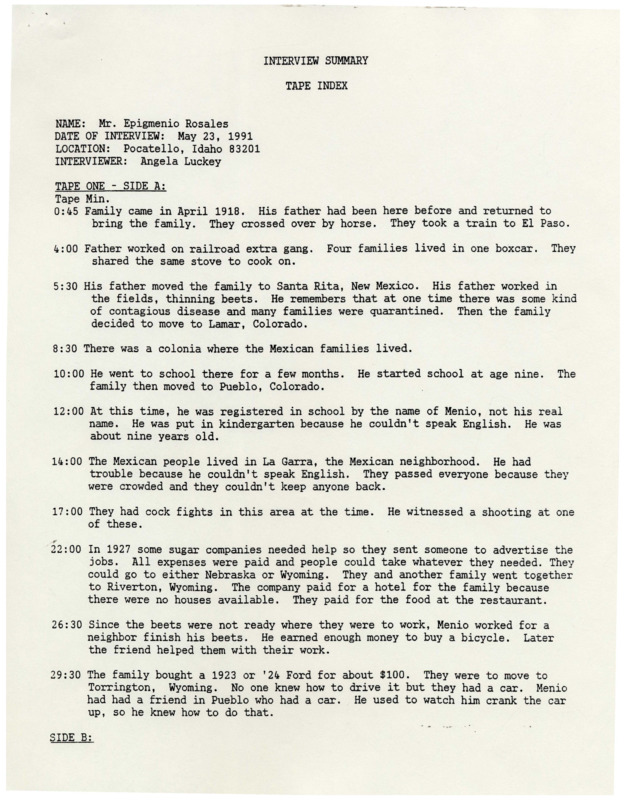
Angela Luckey: The following is an interview with Epigmenio J. Rosales by Angela Luckey. The interview took place in Mr. Rosales home, 251 Washington Avenue, Pocatello, Idaho. On May 23rd, 1991. This interview is part of the Idaho Hispanic Oral History Project. We will be talking about when your family first came to this country.
Epigmenio J. Rosales: And we first came to this country. That was in, around 1918. Yeah. Somewhere in April. Sometime in April. My dad, he had been here before, a year before. And then he went back and decided to come and live over here, bring the family down this way. I don't think there was a revolution down there at that time.
I think he was a little bit by that time. I think. But, there were still robbers around, you know, and, we we traveled, down come coming this way back to. And we traveled down this way and,
By horse and horseback. My mother had a horse. And carrying my little brother, he was in a five, eight, nine year, nine months old, maybe nine months. And I was with my dad, and he's with him on the horse. And there was another family with us, you know, friends of the family.
Because my dad and him had been here before, you know, so they decided to go back and bring the family, the family down here.
So I don't know how far we traveled by horseback, you know, because because, you know, from Zacatecas, Santa Ramon, where I was born. There's a long ways to come over here. So there must have been a train when we somewhere. I don't know how far it was from where we lived, but I remember getting on a train.
Angela Luckey: How old were you?
Epigmenio J. Rosales: Me? How old I was, I was about four, four years and maybe seven when I was born on October 28th, 1912. So I was about going on five. Anyway.
I remember seeing a little light from the train, you know, but then we come down to El Paso. And there was, there was, a lady there. She was here in the houses there, and we were in my dad rented one of the house or one of her houses, and we stayed there. I don't know how long. Maybe temporary.
And then my dad and, these other friend, the other family, they got, hired on a railroad track who were working for the, extra again. And they allowed, they allowed, families on these extra again, I guess, because they were short of help at that time. So I don't know how long he worked on the railroad.
And then extra again. There was two family families on each side of the boxcar leaving together.
Angela Luckey: But they lived in the boxcar?
Epigmenio J. Rosales: Ya boxcars on the railroad. And these extra getting. And there was a lot of, you know, two families on one side and two on the other side. And you would shared that one still on each side. This family on the other side got one stove and we had a stove over here, two of us, we shared the change to the cook.
And then from there. I think my dad decided to come to, New Mexico because we had an uncle on my mother's side living in Santa Rita. And we will make. And, that's where we was headed toward down that way. And then before. Before we got over there, we, stopped and, Largent I don't know where.
Anyway, anyway, we stopped in, Wylie to think be to my dad when, you know, work on the way down.
Angela Luckey: In New Mexico.
Epigmenio J. Rosales: In New Mexico. So we started, getting closer to where my uncle lived, my, my dad, he got a job cleaning beach. And this. You know, Wylie, I think it was a town where we lived. And then from there, after the thinning, the agriculture, you know, in the summertime, we went to Santa Rita.
And then from there, my uncle had a big house. I mean, he had upstairs in a dumpster. So we stayed on the downstairs, and my dad worked there for. I don't know how long. Maybe a year, maybe two. I don't remember.
And then, my dad, he decided to go closer to Colorado. So. During that time, in the wintertime, there's a lot of sickness there, you know, a lot of people getting sick, and they quarantined the houses. And he couldn't visit nobody. Nobody at that time, I don't know, it wasn't as influential or something this contagious. They didn't, a lot of new people to visit when somebody was sick, you know.
But, anyway, my dad, we were there with my other uncle. I don't know what kind of work they had done there, but they had a job and. And we stayed there one winter, maybe two, I don't know. And then my dad decided to come closer, you know, down to Colorado, Colorado. So we shot up and, we in Colorado, I don't know if it was Lamar at Lamar or I think that's in Lamar was in Colorado.
I'm not sure where we up there. For the winter. Oh his in which, you know, he was working or some kind of a job. He got a job there somewhere. And,
And we stayed there one winter in Colorado. And to Lamar, I think it was Lamar. Colorado. Must have in Colorado.
Angela Luckey: But what year was that?
Epigmenio J. Rosales: That's what I was wondering. It was an, maybe 19 or 20, 19, 20, something like that. I don't know.
And, there in Lamar there was even a colonial grand there, you know, a lot of Mexican people just to stay there in the wintertime were big colonial era people. And there wouldn't. But one morning we got up. It was snowing all the time. You know, when we got over there.
After the work was done, we moved over there to the Colonia. We had a bunch, mucho hente, Mexican people there. And they had, all the way from the Colonia, they had pigs and chickens, raising chickens and pigs. The big dump was a little ways further.
Angela Luckey: Did those animals belong to the people of the Colonia?
Epigmenio J. Rosales: Yeah. They brought their own.
Angela Luckey: They brought their own?
Epigmenio J. Rosales: No, they raised them. You know, they worked on the wheat fields and that the they they had chickens and they the reason has pigs to.
We didn't have nothing like that. So anyway, one morning we woke up and, the house the house was,
Good was, the final, you know, there was no was way over the roof was a door washed blood with just you. We couldn't open the door. And, My God, I don't know how you could, maybe pull the door, open this inside, pull it open, and never let us know we could get out. It was, well, you know, so we we we had to shovel the way out there so we could go out.
It would let us know that the Air Force, the wind. Mr.. The wind blew it over, you know. You know, went to school. There were, maybe two months. I don't know how long.
Angela Luckey: What was that? And mean?
Epigmenio J. Rosales: Oh, no, I haven't got to that yet.
Angela Luckey: Oh, okay.
Epigmenio J. Rosales: No. We went, I went to school there maybe 2 or 3 months.
In school with that one.
Oh, yeah. And the colonia, they, I don't know, the government or somebody sent one, teacher to help the school people speak English.
But that was about 8 or 9, I guess, maybe going I nine.
Angela Luckey: He hadn't been to school yet.
Epigmenio J. Rosales: No, no, no. Moving around. Yeah. Moving around. And then from there, there was another family. They wanted to go to Pueblo, Colorado. So my does very well. That's what I want to go I see I want to go down that way. So you see what it is like. So this man, he said, well, I have relations over there.
And, and we'll find a place for you or you can stay there. So this family and my dad, you know, and we went over there to, I don't know, we went by train, I guess the pueblo. And there.
Never got there and,
I didn't know how to speak English and my and I, there was, there was a school at that time that my, there was, girl living, a neighbor, a girl that was going to school there. She was about 12 or 20, and she, she spoke English. You know, my mother always call me by manual all the time, manual and manual programing that they,
So I stayed by that name. Manuel. But my real name is Epigmenio.
I don't know why they gave me that name. For those who want to call me Manuel. So when these girls took me to school, you know, she, they asked her what was his name here. Manual. So I've been manual ever since. I went through and I put me in a different world, playing with glue and drawing pictures.
Angela Luckey: When you were 8 or 9, you nine.
Epigmenio J. Rosales: I was about nine years old and so it must have been 1920 or 2021, maybe 21. And then, this, school was a mini school. And there was also a mini college. They call it the mini clinic. There was one, but not too far away. They call it the same medical lake. Lake and the mini school. So that's where I went the first year.
Then my dad decided to move closer to town. We lived in a larger, Mexican people there.
Angela Luckey: It was the following.
Epigmenio J. Rosales: Notice the pueblo and pueblo. Yeah, that's a city. That's, Yeah. He, that's what we call it. La guerra. And there was another. Another place, they called it all salau the Mexican people and Salado. And we lived on a little Mexican people there.
So my dad decided to move closer to town, but everybody mixed around there. And made.
Well, he got a job there, and they're still works working there.
Angela Luckey: What did he do?
Epigmenio J. Rosales: I don't know, he still works. I don't know, he was working in, wire mill. They called it the wire making wire or something. I don't know. So we stayed there, and I went to, the other school. When we moved closer, there was another school down that we. We went to this place, Bessemer Bessemer School. And the town was also called Bessemer.
Bessemer. And, the school was Bessemer School.
So I went to school there about five, six years. And I had troubles with the teacher because I couldn't speak English. You tried to learn, so I didn't learn very much. And besides, they were crowded. The school rooms were crowded. They had to put two classes in one room. And then even if you didn't have a good grades, are you still going just to show them up to another grade?
You know, after all, even if you didn't. Even if you didn't,
Even if you were not qualified to go to another room, they still would put you in another grade higher. So I didn't have much. And then I went to school there, but 5 or 6 years, I guess.
Angela Luckey: At Bessemer..
Epigmenio J. Rosales: Bessemer.
School, that was in one.
In Pueblo, Colorado.
And there I mean, yeah, it was a wonderful time in the Italian gringos and, mixture of mixed, you know, those people, Italians and Jews and, I don't know what they call them. Yeah. They had their own barrio up there. We lived on one side of the. Were you in the summer? School was right here. And we all we lived over here and the water was, where it was on this other side in the school.
Business school was here, but but their school was over here somewhere. Over here.
Angela Luckey: Yeah. A separate school for the Mexican kids.
Epigmenio J. Rosales: No, it was all people really. The only, the only that were really Italian. They were all they were, they had their own school but there were still Mexican people and the.
Angela Luckey: Mexican food.
Epigmenio J. Rosales: And Mexican stew, but the of it was, more Italian was like gives you like a real fellow. They had their own barrios.
You know, so now only in the garage. I had a friend, that I used to be. Well, we were in the same room in the medical school. It was. That was before we move to Barcelona. And, and, they used to have roosters like, you know, put their locks on there. Yeah. On Sundays, they used to have a lot of guys who put on bed.
And those roosters like some. One day, my friend and I, we were playing marbles, I guess not too far away from them. And then, some shooting around there. Somebody was shooting somebody, and he was. And it happened to be his father, his dad.
My friends Dad, the the other guy shot him, and that was the end of him. Oh, that was bad. And anyway, we moved from there to Bessemer. And then when I went about a year back.
After a year in school in Bessemer, you know, we decided to move this other way. There was a railroad here. And then this summer school was here. And then we cross the railroad overpass on the same street, and we moved over here is a little hill, the Italian,What you call it? What did I call it? Italian neighborhood. The Barrio de los Italians.
I had to go this way, and I had to go over the railroad overpass and then go straight to school. And these guys, we are... The Italian town is just standing around. You young kids, you know, going to school. One time there was about four, maybe six guys just visiting each other.
And when I passed by there, by them, you know, one of those guys grabbed me, put my arms behind me, and had one of those little guys smarter than me, just working me over. He was really pounding the heck out of me, you know. So next time I say, boy, I'm going to go around the other way. I'm not going through here no more, so I didn't.
So the next time I said, well I don't want to go around the other way, I'm gonna go through here. No more trouble. I didn't know there was another street over here. I had to go this way or this one. Then go to the way, the wrong way to school.
So that was the end. I didn't go to learn to walk.
There in school there was a... Bigger kids, you know, they used to play ball, what they call it?, those big balls. Not not baseball, softball, softball. I guess that's what it was. Softball that bigger around a little bit bigger area. Italian. Right. And then they used to go to school there.
And there's the one guy that they call you name was, they call him Tony Sirico. He was one of the main players there in school. One of the best. But, anyway, I was about maybe 12 years old at that time. Maybe 12, 11 or 12. And then, From then, one time. He was in the higher grade.
He was ready to go to high school. I guess he was bigger. There's to be because he was bigger, you know, taller. He was ready to go to high school. But, and, vacation time, he had him and some other guys happened to go down where we used to live with. And, and on the others, well, where I used to live.
We used to, I was going to the store one day and I had about a quarter of milk, you know, a jar.
Angela Luckey: You took your own jars to the.
Epigmenio J. Rosales: To the. Yeah. And then and then we get.
You know, they sell them.
Put one in, you know, and we used to take.
Angela Luckey: They recycle them empty jar.
Epigmenio J. Rosales: And then we'd pick one full, full jar of milk at home. So I had, one of those jars on my arm. And this on the record, I think. I thought he was a nice guy. You know, I liked him, you know, they, they were going. That's your mother and this, Don't. You asked me. Hey. You you have a match?
You got a match on you. And I said, no, I don't I don't smoke. I said, well, why don't you. Yeah, well I don't smoke. And then before I know he hit me on the face, you know, on my head or shoulders, my knocked me down on the sidewalk. And I used to think a lot of him, you know, it kind of hurt my feelings, you know that.
Anyway, I never seen him after that. I never seen him for about 3 or 4 years later. And that was about. I must have been about 11 or 12 at that time. And about three years. In 1927. I think it was 1927.
Some of the tour companies needed people to go work on the fields, on the farms, clean the boots and up, and so they needed help in certain places, you know, so they send somebody from the sugar factory to town to advertise that they would, pay everything for transportation and everything. And, and they could take anything they wanted and they'd pay for everything.
Angela Luckey: Was this a...
Epigmenio J. Rosales: Yeah. ... Yeah. Yeah, it was a country. So there was another family to live. And with us, we and my dad signed a large. And because he was not working too steady those days 1927. I think that's what it was.
So this and this. And we could go either to Nebraska, I don't know where, but to Nebraska or to Wyoming. So my dad was sent me to send us to Wyoming. So this put the other family in us, we get the upper. We were friends or my closest other family was from the same town that my dad was born in and out over the summers.
...
You know, we were born in the same city around there. You know, "paisanos", we were very good friends, and I had two girls and two boys. We were bigger than I was. Two girls were younger.
And, but we went on the same train to Riverton, Riverton Wyoming. And there we worked on the beach.
Oh. When we got there to Riverton, the farm that, we were going to work for, he didn't have a house to for us to stay, so the company rented us. He was paying. They were paying for the hotel where they said, well, you're going to stay here till the farmer gets a place for you. You, you you don't have to pay for anything.
So we stayed on the road till, I don't know, maybe 2 or 3 weeks.
We used to go to, the restaurant and order whatever we liked. And the company would pay for. I know. Sure, you enjoy the, bacon and eggs. I thought that was very good. And I used to that stuff, you know? So. And we were really eating good. He was there. Then the farmer go to her house right there in town.
So we moved to this house and the beach were not ready to be thin, you know, work on them. His were not ready. But there was another friend of ours that I don't know about. I don't know how far, but three miles, maybe, maybe a little more. He had too many beets and he couldn't do them alone by himself.
So. And they were getting too big, you know. He would be. Why don't you, would you like to come and help me? Bring my beets and then whatever, whatever time you put over there, then I can come and repay you. I'll come and help you in your your beets. So and so. My dad said, well, I can't it's too far away for me, black man.
I may have to go with you. And, And I had a bicycle, you know, I had a bicycle in Pueblo because I used to go out, pick cherries and apples. And I bought my own bicycle in Pueblo, so I took that with me. So I was the one that went to help him finish his. His boots.
I stayed about a week over there helping him. And then when our boots were ready, then he'd come over and help peel another school. He's mean your knowledge. You know. So he helped for the same days that I was over there and we didn't take long to finish.
And, That, we within the beach and then, I don't know, there was a celebration in the summertime. I don't know what it was. In town in Riverton. They were selling hot dogs, and, Oh. You just. And then you know what I had, and, one of those people things, a lot of people there, you know, and, we there was, a friend of ours, him and I went and I think my brother was with me, too.
We went to town to the see the the first thing you know, young man in the city. And, we bought a hamburger. I guess he was a hamburger out there. And, one stand there stands, you know, around. We had, we had a hamburger. And then we were walking away from the stand when I heard some shots.
One. And you shot the one. The soldiers, sandwich was shot. Him. And this boy right there under. I don't know what for. I don't know that problems before or. Okay, but there's the Indian fella. He. Maybe they had worse. Anyway, he shot this. Guy that was throwing those hamburgers and stuff. I think, he was in jail after the.
So, we finished the beets and,
Thinning the beets. And, then... came up and we told them. We, he was starting to know when we finished up in those beats and then We decided to do what I did. He says, well I don't know, we're going to move, I don't want to stay here. And then there was another family. He says, well, we we, you know, Colonia in Torrington, Wyoming.
Now, remember Torrington, Wyoming. And there's a little under Colonia. You go down there and like, you can stay there all winter, you know, you're going to pay the rent or anything, so. Well, maybe I have to buy a car. So we went. He bought a car, a 19. I don't know what year it was. 23 or 24. Ford.
Angela Luckey: How much did it cost?
Epigmenio J. Rosales: I think we I think he paid $100. Maybe something like that.
Angela Luckey: How much did you make?
Epigmenio J. Rosales: I mean, worth it? Made it pretty good money, I guess, because we had we had the money just.
Angela Luckey: But how much did you make? An acre or an hour?
Epigmenio J. Rosales: I don't remember.
We've, we're do 20 in the 28, 19, 27. I don't know who was president then at that time.
Anyway, we, we must have made a down pretty good thumping beats because he says $100. Well, we buy a car so we can travel. So he bought this for. He's, light up, your know, closed car. I didn't know how to drive a car, either, I was.
I no, I drive.
No, I didn't know how to drive a car.
Angela Luckey: So you didn't know?
Epigmenio J. Rosales: No, I.
Didn't know what.
Angela Luckey: You had.
Epigmenio J. Rosales: No, no. You never. You never own one anyway. But I know more or less, because I had a friend in Pueblo. We were good friends, you know, and his mother was. I always had boarders, you know, but them. And they had a car a for, newer, newer model, you know, and each one and I used to go with him and I used to watch him.
I drove his car and what he had, what he had to do to get it started. He had to crank it with, hand by hand.
And if you put too much spark on the on your or your gas, if you that crank would jerk back and you might break your hand, you know. So we have to be careful when you start like that. And they didn't have no batteries.
All right. I, I watched my friend when I was in Pueblo. He used to drive his Ford. And he always had to crank it. And he was careful not to put too much work on it. So. So you want to kick back and break your wrist? So I learned from him, but I never drove it.
You know, I never do it. I just watch him do it so I know more or less how to go by. But it. So. I,
I did learn how to drive it. You know, I drove it around, you know, good. And prepared for the road. We were going to Tarentum. Stay over there and Torrington and another family go on this thing for a problem with us. We were going to go to Torrington to stay there for the winter. So we went clear from, Riverton.
We had to go clear over here. Clear to Torrington to stay. And they were starting to snow. But we got there all right.
Angela Luckey: You drove?
Epigmenio J. Rosales: I was the only driver. All that. We took their dishes, you know, and Wilson, whatever we took cooked with him. That's in the car because we didn't do anything. No furniture. Oh, my bicycle had to be with me all the time. I wasn't going to leave that. No.
Angela Luckey: How did you pack that?
Epigmenio J. Rosales: Oh, I just packed it on the back or somewhere, I'm over the roof or somewhere. But I wasn't going to leave my bicycle, nowhere. Anyway, we went to Torrenton and we looked for a place to stay. It was full. No place. It was all filled up.
And so we decided then this other family, they said, well, I lived in, Salt Lake City before I went to Pueblo. If you. I think we better go down there. There might be more work down there. So we started coming to Salt Lake.
And then, I don't know how many days it took us to get there, but I remember going down hill or someplace. I don't know where it was. Oh, we passed Cheyenne, and we have to go turned. And then we had to go here around to show. And this way. And then to Utah. I don't know where which which way we went, because the when we was getting closer to Salt Lake, you know, we were already in Utah.
I think. There was a big lake or a reservoir or some way down, and we're just going downhill. But I had chains on that tire and we had chains on the tire, so I just looked down there. Oh boy, that's good. We fall down there. It'd be nice, but it wasn't bad. No, no, no. Traffic.
Angela Luckey: Was your other your friends with you?
Epigmenio J. Rosales: Yeah, they were behind us. I was the one leading the way.
Angela Luckey: He had a car.
Epigmenio J. Rosales: Yeah, they had their own car. Yeah, they bought one to go. They bought it before we bought ours. We bought ours at the last. You know what? We figured it was really needed something. But they already had their car because they had bought one before. You know, the two big boys and the two two girls, they made pretty good on the beach.
So they. Anyway, we got some lake. There. We rented one house there. The two families in the same house.
And then my dad, he got acquainted with somebody from the railroad.
And, during the, close, it was very close. Very close to the holidays. Then my dad and they decided, oh, this, this, and this is where I should hold it closer to where I live. There's a good, good house. They're pretty good size. Where you girlfriend's going to stay there. You know where we'd be neighbors. There. Well, now, his wife was from Seattle, so they were at home, and she used to play the mandolin.
This lady. And, my dad, my folks we used to visit after we moved to this other house where they lived, right near close neighbors there. And, so she plays a much like a dentist. And then she was another on on the mandolin. She was good on the holidays. And then there and the railroad there were having,
Some kind of a, reunion, you know, where, the workers would go have get together and get presents, candies, take the kids over there. Okay. Then they invited me and my brother, my brother, to go to this, the railroad underground house. And they told me. So we went there. Oh, they put out peanuts and apples and oranges in the bag.
Gave it to us. So we had that for Christmas. Then in January and then these, Forget what his name was.
This man that was, working during a railroad deal. He told my dad, if you join a union, they'll get you a job on the railroad. Well, you have to join the union first. And so then we know he was working for a Denver and real ground there. There was, where we lived, and, there was the other Union Pacific depot was harder.
It was on the other way, but they were very close. But anyway, he says, you go to, depot, I think, is that the, the Union Pacific depot and the Union Union there in the, I think they'll only charge you about $2 for to be a member. So we went over there. It was in January.
We're somewhere on there where we were. Maybe. And by that time, I was. Oh, I was about 15, maybe 15, probably. I was 1975. 19. 19, 27, 28, you know. So I was. Probably was about 15 going on 16, maybe back in my life. And, so my dad, he, he was collecting, union dues was,
he was road master. You know, he went traveling around here. So he was the one that got us the job. We gave him $2 for me, $2 when my dad and we got a job, and the other people got a job to. So they sent us way up, oh, I say about quite a ways from Salt Lake.
Nothing. Nothing over there. Nothing. A brush brush, no trees, no nothing. When you start stirring,
This place, they call it Ajax. Ajax. That's the name of the section where we were. There was another little. Another section. Changing close by. That's another section or early?
Anyway, they is,
Who in this road? Roadmaster told us where where we could go to work. The foreman in this, in this, section was a Japanese. And then he didn't talk much. He was all right. You know, when he seen me, he said, oh, you're not old enough to work. You know, I think you old enough to work. Well, I said, well, Roadmaster send me here.
So. Yeah, I guess all right, isn't it? Yeah. Well, I guess so. Take a chance on you.
And I start working there because I know I was about 15, 16 going on 16. There. And,
And then, he had a guy working for him, I don't know how many years down living here, you know, great big tall guy, well-built. You. Got other people working there too. Not only us know but this guy and he said well you go work with this, this number one man, he's he's been working very long time, you know, with him.
So he you work with him and he's your partner. I look at him, okay? And make sure me, it makes it come to the right. He was, number one there in the section number one for energy. So he probably thought that, if I work with him, he could make me quit working. You know, because I was just a kid.
Anyway, we were stamping bars, digging ties out, tamping bars, low flam bars, you know, tamping ties with. And I stayed about, I don't know how many days my joints on my finger, my hands, they were, they were hurt because I was not used to that tamping bars, you know. But that didn't bother me, I just kept at it. And he, and this guy, boy, come on, we got to beat them other guys, we got to put in more ties, more than they do.
So, we always did. We always put it maybe 1 or 2 more than they did with the other guys. But he was always in competition with the others. And then the foreman, Larry, he didn't say nothing. You know. I got my joints on my hands. They were, well, right here, you know, tempting, but let them dig them up, put some new ones in there, and then put it with it with a hammer for some.
You learn. And then one day, he sent me to the section. We were about maybe a mile or over, maybe two miles, he says. You go to the good, section and get them below. Bring me some plugs. I don't know what plugs was.
Bring me some plugs. And, So I thought it was spark plugs. You know, I was thinking about cars, spark plugs for the cars, and I was wondering, what does he want spark plugs for? So I went through the section over and looked for the spark plugs and for cars. You know, those for the car. I went back and I said, there is no spark plugs over there.
No, no spark plugs, plugs for the nice thing as long sticks you put in the dice.
To tighten, you know, it was a one of those sticks and you and then you put a spike on it. And so you'll tighten up those two. Will I have to go back again. So then a boom a big bundle plugs. So they grow. Put them on maturity took them away. I didn't have a no motor to go.
I had to walk down there or run down.
We worked there for, I don't know how many months. Go on then.
Angela Luckey: This is during the winter.
Epigmenio J. Rosales: Yeah, still wintertime. I'm still cold. And then, then I got used to working with this guy. You know, he was still human. I got to be good. The French guy that I work with, the slave driver, I call him because he tried to make me clear, you know. And then, the Japanese, he said, I need another man here.
Anybody here knows anybody in your family to come work here? And then my dad said, yeah, I go on and. But he lives in Michigan. Okay. Write to him, send him over. Tell him I don't know how he got there. I don't know if they sent him a parish or what, but anyway, he did get a job there.
Go get my job. And. Oh, he worked there. He got him and my aunt and my mother or sister.
Angela Luckey: So that way. Oh, so it was your uncle?
Epigmenio J. Rosales: He was my uncle and my mother's, well, and my mother's sister. Her sister married this fella, so he was my uncle.
Because he had a nice, nice place to live there in another room. Store. Everybody here. But, then in, started to get a warm up, you know, some Virgin Mary, I guess. I don't know, Lynn.
He started to warm up and. One time, you know this, Japanese. He he bought a new car. Brand new car. And he had friends again. Trailer. So he used to go get his groceries. Well, it's quite a ways from the center because he had to go to Saint John. Another the other section, and then, I don't know, turn out to 12.
That's quite a way. But, he bought a new car, and then he. And we used to go with him here, only he invited me and my brother and my uncle. If you want to go uptown, come with me. So we used to go with him.
And then, one time, We used to go to the movies, you know, he said, you guys go to the movies. I'm going to see my friends over here. I have friends here, and I, well, you I go visit with him, you go to the movies. So my uncle there, and I'm not. I don't know who my brother was, was with us or not.
You guys go to the movies, and then I'll pick you up later. So. And, one of these times that we didn't go to the movies, we just all just walk around. So we were walking around. I don't think my brother was walking with us that time. He was just growing up. Here's the little ten. So we was walking and my uncle and I were walking down, down.
And I seen one guy coming towards us, you know, he was alone. And he got closer and I thought, gee, I think I know that guy. But he was, you know, after three years, 3 or 4 years later, he what? I was can I think I think I know, I think I know like. So I asked you they don't, I know you they were nice I think I know you, I just like what's your name?
Your name is Tony, isn't it? Yeah, that's my name. Tony... Oh, yeah. How do you know my name? Oh, yeah. I can remember you. You live in Pueblo, didn't you? Yeah, I was, yeah, I'm literally just a little from school, so he's. I was going to be friends with him. And then I told him, well, you remember one time you asked me for a match and I didn't have a match to give you, so you could have, like, a cigarette?
He said, oh, I don't know. I don't remember. Well, I do.
I popped him on his head, I don't know where.
Makes me feel kind of funny, you know, because I hit him. You know, I hit him. I don't know ... I really hit him. Hard too, you know, think he landed on the sidewalk, and then I was going to hit him again and again, and then my uncle died. I'm better. He grabbed me from behind, pulling away from him, and I was going to work.
I was working on him or. And then, my uncle, he grabbed me from behind, and. Hey, don't don't don't. What are you doing? What's the matter with you? So I was going to settle with this guy. And when that guy got up, like he took off, he didn't stay there. And you know.
And then we went back after I settled my score with that guy. We walked around, you know, now, I was going around really working more, more. But my uncle held me back, you know, and he and I was bigger because when he hit me, you know, I was about 11 or 12 years old and. Anyway, we went back home and in May, they were looking for beet thinners.
And then my dad said, I think I'll go to Idaho because they needed help in Idaho to work on the beach. So this and this, we were in Manchester and then the Japanese, he he knew this guy, so he said, oh, I know, yeah, I know the man that's, looking for help. So he told him about us wanting to go work on a beach.
My uncle stayed there, and my dad, we we got they sent us over here to Shelley.
Shelley Idaho.
And that.
Shelley Idaho. And,
At that time then
That first year the few men who took us around looking for the place for us to work that first year. It was 1929, I guess she was 28. We spent it in Ajax in the winter time or 29, I don't know. So.
We, I went to the sugar, the sugar factory. That's where. That's true. Their factory. There was houses there, you know, and this field, him and he took us around and car looking for a place for us. So we went down towards first. I got the first and we crossed snake River. Because the one farmer that needed help or he had about 20 acres.
Sure thing. And, he he said, well, I got some dinners here. You got a place for them to stay home. And, Yeah. He said you know. Well, I have a, chicken coop here. They can clean it up and sleep there. And my dad said, no, thank you. You can have you're a beach. So we told that people may not, you know, go to sleep in a chicken coop.
So we told that fieldman, no, we're not going to sleep, no, chicken coop. Yeah, that's what it was, chicken coop. So he said, nope, we don't want, we're not going to work here. So he took us around and then he sent us to Shelley, we went back to Shelley. And then there was a farmer there. Between Shelley and Arrojo Falls, there was a beat dump right there. And the farmer was right there, right next to the railroad tracks. The farmer, he had about 20 acres. So we moved there, he had a nice place for us. So he's in beach there. And then, And he had the biggest beach. You know, if you had 14 turn to an acre, you had a good crop, a beach, 14, 12, 16, ten to an acre.
And then he had the biggest beats. You know, if you had 14 tons to an acre, you had a good crop of beats. 14, 12, 16 tons to an acre, you had a good crop. And he had 24 tons to an acre, right, big ones.
And, you know, we had, certain wages we were supposed to get for something which so many, so much at times. And we had our friend and, shellfish thing and chili. He was.
Working there at the minute. I said, I'll take us. And, when we finished up in those beach, you know, you he went to the factory to get the money for us. You know, the only and we were just supposed to get so much uptown, you know. But he didn't know how much, so he said, well, I'll pay you so much.
And he was going to pay us more than what the company was paying for. The bitter. So then, he happened to meet, this friend of ours up there and, factory to factory, and they started talking and how much they were paying, you know, and then this, good friend of ours, the question was, in my head, he said, oh, no, no, no, no, no, you're paying too much.
You're paying too much. We only did it so much. Oh, boy. So there. We lost about $100 right there. And I never had a good friend. Large, but he was paying us more than, the company was paying so much an acre, but he never bothered to ask, you know, he just pay. So much. So we. The beach.
Anyway, we went the next year. We. The next summer we went to work for another another another farmer. You had a big farm. You had three. He had three hired. Now we're year round. Three men working all year because he had a lot of work there essentially. Still, you know, this was over here towards first down this other way.
I don't know what...what was the name of that town over there, Shelley? Upper Press or Goshen? What was it? Wapello? Wapello? Where do we live? Ziegler? Ziegler? Okay. Oh, yeah. I tell you, when we. Oh. Let's see. What was. And I forgot something. We're Larson... Wapello. It's about five miles from Firth. And...oh, before...oh, yeah, I tell you.
When we, before we went to work for these, to go for a little falls, you know, we we there was, Boy, before we we went to this, first, first, you know, after the guy from, that to the chicken coop, you know, he's. We were looking for. For a place to work. And, then he says, well, you can, you need to get the first, you know, a little town right close by there.
There was a some farms around there, you know, he had beat around there. He says, you you can stay here. These, they had, there was a, rancher there that had a, a little house was, little trees around there. He he told us, you can stay here and then go wherever. And no matter where you go, you can go ... wherever you want to go.
The thing which. So. So we did we. That's what we did the first year before we went to Idaho Falls. Do.
And right there we seen we met my compadre Arvo... They were growing there, still growing them. They used to go fishing. We lived right by the canal there and they used to go fishing right there. There was this small cheese factory. Somebody making cheese or I don't know, they took that away later on, but that's what they used to make cheese there.
Angela Luckey: That Frances's husband,
Epigmenio J. Rosales: ...
Angela Luckey: Jose husband? Oh.
Epigmenio J. Rosales: You know. Well, that's the Frankie's brother. Francis would anyway, their little they were still young, and they used to go fishing over there and then I don't know how come, we met, doing a lot of, pasta and, what was the, their father shown it to Janet. They couldn't show it. And they they were working there and, such.
And he was working on their writing towns right in first and a section there. And we used to visit them, you know, we got acquainted somehow. We got acquainted with them, and. We used to visit with them and, and, and then, in the summertime, We, you know, they used to make enchiladas and tamales, so, you know, fried chicken and, and then, you know, that works.
And so we were invited to them. And then there was, some people from Pocatello used to go play, you know, you know, to join because they like to go and shoot this, have an enchiladas and the others, whatever.
And anyway, Domingo. Domingo, ladies. And, what was, Ernest Morita used to play guitar, I think Ernest Morita. I think that was his name. Ernest, I forget. Anyway, he used to play the guitar, too, and. Yes, Ernestine, father and Rose's father, who was.
At, Anyway, Ernestine was married to Tony Torez, Torez. She was about 13 then around there, and they used to go over there and from here from Pocatello. And there was another girl, I forget what her name was. So we got acquainted there, and and they used to come here, Pocatello, to visit over here.
Angela Luckey: Is that when you started playing the guitar? You know.
Epigmenio J. Rosales: I didn't know. I didn't have no, no, no instrument. I wish I had the desire to play violin, but, you know, I didn't know nothing about a guitar. Because in Mexico, when, my dad, when back from here, from this country, before coming this way, there was a friend of his person. But I was there, and I stopped by there, you know, just to visit.
And he had a violin with him over his shoulder. That. And then my dad here, a harmonica that he had taken from here to Mexico. So they both got together playing him. The one, that man playing the violin and my dad the harmonica. So I like the violin. I said, gee, someday I'll learn how to play that.
But I never, ever since then that was maybe 4 or 5 years and not like one a little over four years. And I started making sticks with a another stick with a string on it. Tried to play like a violin that just kept that up for a long time, trying to figure it out. But I never owned a violin or nothing, so I grew up without a violin anyway, with a desire after, you know, through.
Angela Luckey: So those guys would get together and play. Why, when you got together to eat.
Epigmenio J. Rosales: And I got, I started playing, I bought a violin here, and I drove all this when I, when I the Mingo playing the violin here. And I used to play mandolin to the banjo to. Then I bought me a violin here in Idaho Falls and. There was a sheepherder there. I got acquainted with in the winter time.
He used to play the guitar. And then I started learning how to play the violin to. So then the farmers, I mean, you know, the farmers in the wintertime, they they like to make partition on and they know him, you know, because he was a sheep or and they were pretty well known. Anyway, he worked for the, was the, Cox? Anyway, they used to have honey, they used to have honey and sell it.
And they also had sheep. Sheep. And he was working for them. And they always make parties, you know. So I met other people that play the violin, too. And I start picking it up little by little very soon. And so I don't play violin.
Angela Luckey: And so you learn all by yourself.
Epigmenio J. Rosales: Yeah. Yeah. I didn't. Then we moved to, this other place. Learning where it was. I worked for him for maybe 11 years, I guess.
Well, anyway.
Angela Luckey: You were working for Larsen.
Epigmenio J. Rosales: Yeah. We, after the film, and they took me to this. You know, for for a place that he thought would be just right for us. So that was 2 or 2 Berkeley locations. You got to go to a large farm or you're over 200 or more 200 acres or something like two, 300. He used to raise beets and spectators and hay and straw, you know, I mean, we that's the we had a job there.
So that was in the 30s.
1930, I think it was when we moved to there somewhere around there. So. And then, I think you need to go a little from the railroad. From the railroad. You got laid off, and then they go to don't go to town. They go to a, place, a house where they ... wherever they want to go.
And and we used to visit them. After all, we knew. So.
That, the Larsons
Well let's see before and 1929, you know, I used to hear about a family named Dominguez who used to. There was a about 28, 29, I think it was 19, 20, 29. Something, 28. When we lived in close to Ottawa Falls that first year, we worked on the second year, I think it was.
That farm was a big beach, you know, there was a, friend of ours, he used to go to Driggs. A lot of people used to go to Driggs, pick peas over there. And, this friend of ours, he says he used to visit with my dad, you know, just over there, say, hey, I know there's a nice little girl, or she's about 13 years old, a real nice looking girl.
You. A lot of these years, I'll take you down there so you can meet her. That was in 1930, I think. 1930. Around there. 1930. But then they'd never come. But there's only one thing, though. There's two brothers that sure like to fight, and, Well, that's all right. I'll meet them. So. But, never got to meet my my wife.
You. She was about 13. I think that time. But, you got to watch that because she's got her two brothers. And, boy, they sure liked to fight. And, Oh, well. But, he was going to take me, you know, get acquainted with, with her. They're nice looking girl. Just right for you.
But they never come, so I never. I never met her. Carol. 1934 or 35. Because they used to live in, they had they had moved to Ray-Ray and they worked over in a rotary marriage.
Angela Luckey: Okay.
Epigmenio J. Rosales: That's where they used to work there right around 1930. And then they moved on to Shirley in 19, maybe 33, I guess when they moved that to over here to Shirley, where I was, of course, they lived over further away from us. So, you know, I didn't know him, you know, I didn't know them. But, movies were popular there.
They they used to box a lot. I owned a retreat. That's all they done down there. They were well known over there. Box. Ya box. You know the promoters down there, small-town promoters. They want to make something for the people to go watch. Their favorite guys that like to fight, you know. And the two boys, her brothers, they used to box over there. They liked them over there. And then they moved to Shelley. Well, not to Shelley, but to the farm.
And on a spot night, you know, before, they used to have a celebration there in Shelley. And they, they had, they also had, besides other programs, the they had a will for those, wheels, Ferris wheel. You know, they had a, you know, something like a colonel matter that they had there. And then they had, they also had a platform where they built.
So they had boxing there in the evening. That was around 7:00. They had boxing there. And the boys, her brothers used to fight. So that's how come I used to see them. But I never got acquainted with them or, you know, you know, I never know those. They never used them. But I know who they were. And I seen my wife do.
She was with her cousins over there. The one night. Oh, and 1934. You know, I sit down to sleep.
We can't walk without my shoes or my socks. I want to see them, please. Oh, that one.
Angela Luckey: Okay. How?
Epigmenio J. Rosales: I seen her.
I seen her that year. 19, 1934. Her brothers had. They were there boxing. And she was with the summer cousins. You know, girls, summer girls. They were cousins, you know, they were walking down the street and no senior walking around. I didn't pay attention to her. I didn't know what you were. I didn't know she was either. So, there was another girl that I had before and before her.
We're not talking about my time.
No. I'm not. Nothing about your life. I'm talking about mine.
And, I never met her, you know, and then, like, they used to go to California every winter after the work was done, they used to go to California.
They went in 1935. They decided to come to Pocatello earlier than usual, and they moved right next door to where I live, where we lived on the second, the sugar factory, because we didn't stay in the foreman either. In the wintertime, we moved to the sugar factory. They had houses there, and there was about 3 or 4 houses there, right?
Right.
Angela Luckey: And one right there in Idaho farm?
Epigmenio J. Rosales: No, here in, Chile. Yeah. All right. Then they come to Chile from California or wherever. I don't know where they were before that, 1935, and they moved right next door. But the next house where we lived. But right now is, I am, I am I lived in two rooms and these are the house. And I named my brother.
And I used to have these other two rooms and they moved on this other than the following house. You could see the through the window here. So I used to pretend like I was writing a note there. You know, I had the light in the night time. I pretended like I was Jewish writing something. And I know she was looking at me, but, I do let her know.
Anyway, I didn't, I didn't get acquainted with her right away, but, boys, they they, you know, the one. They like the boxes. Come on. I want you to help me spar with a boxing girl. So, of course I'm going to have a fight coming there. So I have a fight coming up in a riot. And, I'd like to have you help me spar with the boxing gloves.
And I said, oh, sure, I will. And then I got acquainted with him and. And that's how come I got acquainted with her and her older brother, too.
And my sister.
And. Oh, yeah, he's a well, her sister. She was after me.
Angela Luckey: And,
Epigmenio J. Rosales: She listened and. But, I never, I never, you know, I, I respect that the family here know. And, So I happen to be the one who was going to fight in a rotary. So I helped him spar around with him and human. I got to be real good. But.
So, the family, you know, got no, no, no fight her dad and, and, your brother John won't do it, did he? Yeah. And Pete, then they picked up on, for another family over there. You know, Ellery for. But, her father and these other. They picked him up. So. Because he liked to watch the boys fight, so he they picked him up and we went to rotary.
When he was getting away, they were away, and away in the room, you know, downstairs, the basement. They had the doctor there, checking your blood pressure, pressure. See if he was all right to fight. like, And then away and see what they weighed and all that. So they got him there.
And then they. And they asked him, do you think their boy, your friend here. Good one, a box. You know. Oh, we're not that we're not going to be on that on that card, you know. He says, oh I think he will. You already knew and think about it. Know I didn't know what was going on over there.
And then he said, hey, would you like to box, take somebody else place? He says, why? Yeah, you bet. Oh, I sure, yeah. They told me the guy was going to fight you. His car broke down the road. Son was in Blackwood or somewhere, and you won't be able to make make it for the fight. So he called up over there.
So that's how come they got me to fight that night? So they checked my blood and everything, what I weighed, 135 pounds. Was you there? Yeah, I was not down there.
You know you didn't go to watch the fights.
Oh okay. Anyway.
They they got me I was one of the first ones to fight in the ring.
And when I was around my corner sitting down. I was sitting down, you know, ready to fight the other guy. The other guy was in the other corner. No, it's on the other corner. Some drunk guy got up on the platform, and he yelled out loud, you know, knock that Mexican greaser out of here and send him back to where he come from.
You come and I just listen to him. And then the referee, he went over closer to him, oh, yes, knocked him out of the platform way down the floor. Everything was quiet after that. You didn't say no more. Anyway, you. So I didn't have no boxing shoes on. No, I was in no. And no shorts that more, you know, to fit me right now shoes were a little bit larger, so I was not going to fight that much.
But anyway, I done pretty good anyway. I had to, the shorts that I was wearing, I had a little too big, I had to pin them down with something to pull them up. After the fight, I think I got $10 for the fight. You know, they paid us off, you know.
Angela Luckey: And you weren't?
Epigmenio J. Rosales: No, I don't know, he beat me, but, you know, just a decision. But I wasn't expecting to fight because I wasn't that I was not, I'm not used to working people. A lot of women around the ring and on. People are always going for their favorite fighter, you know? So I was kind of a little charmed to be there, with a, George shorty.
Anyway, he beat me, but not, you know, just a decision. And my brother, I think he he became my brother. But when he came to fight, you know, when his turn came to fight up to the ...
Angela Luckey: It was popular.
Epigmenio J. Rosales: Yeah. He was partners like that, you know, they were popular there. So anyway, he'd done pretty good.
Angela Luckey: For most of the boxers. Mexican guys.
Epigmenio J. Rosales: No single division rancheros does have a strong general because we like to fight some of those for sure. Some guys from the city to they like to fight, you know.
Angela Luckey: Did you wear gloves and.
Epigmenio J. Rosales: Oh yeah. And we had to have a gloves. You, they put tape put on your, around your knuckles and then the boxing gloves on. And we got paid. I got my share. What I think they gave me. And then I went to the store and, and bought her a box of chocolates.
Anyway, I gave her a box of chocolates because I was just getting acquainted with her, and I wanted to get to know her better. So. So I bought her a box of chocolates and gave it to her there in front of her dad. Yeah, it was for her anyway, and then later, Oh, I don't know. How you butter her to go to the movies?
And her brother, her older brother went along. You tagalong to watch? Oh, I don't use a you had to tag along. So. Anyway, we were watching a her and I were separate from him. He was separated himself somewhere else and we were together watching the movie. Should know what? Really. And I really liked the movie. There you go.
Anyway, we start falling in love with each other here. Put my arm around her, and then, Well, we went home, know that? And I say, I told her, hey, I think you. I think you and I belong to each other, don't we? And she's. Yeah. And of course, her brother, she had told me before, those. We sure like to have you to be a member of the family, cause they they had already.
Yeah. And, I said, well, gosh, that sounds good. So then I asked her, do, why don't we just get married at, we we were in the movies, you know? So next day we got married.
Angela Luckey: Just like that.
Epigmenio J. Rosales: Just one day. And we got married next day.
...
Yeah. Like today, we we got married after that movie.
We got married, and,
Angela Luckey: Well, you didn't. Did you get married in the church?
Epigmenio J. Rosales: No, no, no, this.
Movie came right? Just right for us to propose that.
Angela Luckey: Movie, was it?
Epigmenio J. Rosales: Oh, no. I know I've heard of them before, but I never got acquainted with her.
Angela Luckey: Yeah, but what movie was it?
Epigmenio J. Rosales: You know what?
Angela Luckey: What movie went well?
Epigmenio J. Rosales: It was nice, a nice movie, you know, anything I remember? I don't think I would, and I was too good because I was hurting my arm around, I was paying more attention to her than the movie. I guess.
Angela Luckey: So you just went, like, to the judge or some justice.
Epigmenio J. Rosales: The next day we went,
To Idaho Falls and got married. But the judge. And that was it. And I'm still married. We're still married.
Angela Luckey: For a year now.
Epigmenio J. Rosales: 56, 56 years.
Must've been a good movie.
It must have been a good movie. You're right. Because there's. We're still together. Then after that, I wish they were going to California, where they're, And, I used to box. After that, I got acquainted with some more promoters around small town promoters. You. They put boxing matches on, and they. I was looking for somebody to wash the boat.
They don't always want the same guy in boxing with the shovel. They'll want something different. And then I stuck it around like that. For the papers, you know, like that. So. Went to California.
Angela Luckey: Did Mary go with you? Did Mary go?
Epigmenio J. Rosales: Yeah. We got a point. Yeah. Oh, yeah. We had Johnny, Patsy, Nellis.. And I knows.
What was his fault.
Yeah, that was before we started going over there.
Angela Luckey: You went with your dad and mom?
Epigmenio J. Rosales: Yeah, with my dad. So they started going, that they had a, new car, Chevrolet. And they started going to California to enter. To get away from that cold weather here and then come back in the summertime.
Angela Luckey: Where did they go?
Epigmenio J. Rosales: Oh, we used to different place in Oceanside or ocean. Oh, yeah. Me so but here's what I see. Some of is always with Santa Maria. It was a loop. There's some, you know, run down the coast. And they used to have a place here. You know, you might have boxing around that,
And, would you was expecting Rita. It was 1942, wasn't?
1942
...
Her folks moved to Nassau, Oregon. They bought a place over there. You they bought a home over there.
They had a home. There.
And, and then I told her, well, she was expecting Rita. So I say, why don't you go or stay with your folks, and I'll go to California and see if I can find a job. That's what. That's what I was looking for. You know, a job, a steady job. No, that was my intention. So the thing that I station to.
I sent her over there, and then I took off to California.
But, to, LeMans to over there. I work one week picking lemons, and I never got paid for it because they were on a strike. But I still, you know, I still worked anyway, after that, after the strike, I still pick lemons. And then they had boxing there, too. So I started boxing around. There, somewhere.
Well, I'm not really a riverside. Well, I was not in Riverside as I was in, another little town that we would read. Let's not forget. Anyway, I used to go with other guys. I used to go, but I got I got, acquainted around there. And they used to get. What did I do pretty good there for a while.
And then my brother in law, he had. He was in, Oceanside.
Just this year or San Diego. He was working over there with a Japanese. And he this Japanese had, 20 over 28, 25 men working year round, all all year. And he was working for him. Then he. And then he then he said, hey, you if you want a steady job, I want it for you. If you want it.
So I said, oh, you bet I do. So then I went over there, Oceanside. And I got, I run there a little, little, trailer. No, trailer house, one of those, A little.
Movies on a smaller, you know? No, I was there by myself all the time. The owner had a house. I mean, door right next to it, and I rent it from her. Right, right by there. But I. I had a job there anyway. One time, you know, work there and then I got a job right away.
Steady job. Then one time, my brother in law and I was going. I was going to work that on his car because we used to go to work together.
And his career over to the Japanese farm, about five miles from, from town. And then we was going to work in the morning, driving down that way, there was a patrol car coming this other way. And then he recognized that we were Mexican. So they stopped us. You know. They stopped us. And then they start asking us questions.
You know, they the first they asked me first, you know, and I told them, yeah, because they asked me where if I was born here. Where was I born? I said, I was born in Mexico. I said, I was born in Mexico, but I was raised in and, and then I told them where I lived, you know, Pueblo, Colorado and Shenandoah, right.
New Mexico and and Wyoming and Riverton and and Salt Lake. And I mentioned all those places where I worked there. Jackson. Saint John, because I worked at Saint John, too, after my uncle moved over there, after he moved to Saint John. And then he, he, he got a job for us to go to work in Saint John before talking before in Chile.
So we were in Saint John to. And I don't know where it where I worked. And then I okay then. Okay. So they they turned me loose okay okay. Then they started questioning him and he told them, well, I was born here, you know, they didn't believe him. They took him. They took him to the house. He was married.
They take him to the house to prove it, that he was born here. When he that when they brought him back to the car. Boy, you know, these social. And then how come they didn't send you back? Oh, come. They didn't send you to that was. Oh, well, I tell the truth. I don't know, but he was telling the truth, you know, he was born here.
Walsenburg home, Colorado. But I told him I was so or born in Mexico. And I went to school in Colorado, Pueblo, Colorado.
Unknown Speaker: You had your little card?
Epigmenio J. Rosales: I don't remember.
So anyway.
Angela Luckey: What year was this?
Epigmenio J. Rosales: 1942
And then, that then at that time, there was a war going on here, overseas with the Japanese. Japanese. So I think it was, you know, when they hit hit or and then they started, at that time, you know, they start taking all the Japanese away from the coast. They took everything away from them.
And this farmer was where we worked. Yeah. He had 25 men, 22 over 20 men, working and year round planning seed, vegetables, cabbage and whatever. You know, he had a big farm in. Anyway, they took the farm away from him and they sent him to concentration camps. And then, that was the end of that job. The steady job that I thought I had.
So. So I went back to. Oh. And then, at that time, I think she was expecting Rita months and the, Japanese were still there, but they were going to take them away. Then, I was going to buy a car from one of the Japanese. Yeah, nice. Nice. Ford. I was going to buy it from him for $100.
And it was worth more. But something happened that he couldn't sell it. I don't know why they took it away, so I didn't buy it. So, So I went back to Naselle, where she was. Then,
No, no, no, her folks, her that were still working there. And then before that time. They called me, told me that, she was really sick and, when she was having Rita and she they didn't know what was wrong with her. She was still working there at the company, and, so they showed me a telegram, you know, so I quit working because I know you're staying there.
They were going to take all the Japanese away from there. So I went to Naselle and right there in, how they do this, they had a little town they call a little Tokyo little town there they are selling everything. They're cheap. Just giving it away. But. So anyway, I went to Naselle and from there. Rita was born.
And then, I think with that over there, you know, they should be sooner over there and over here. So I didn't reach over there. And then I went back to Portland over at, Larson's. House in 1942. And I was working there for the Larson's the summer. Yeah. Teen beach there and the beach there. And then the.
Oh. All summer. And then over the beach there and, you know, I was, I was, I heard I was I had a steady job was there since June of but my brother had moved to. In the summertime in 1942 on brother. He was working on the railroad here in the summertime because he didn't like the farm. He didn't never want to work on the farm.
So he come to Pocatello and got a job on the railroad here. That's where he met his wife, Nellie. He was boarding with them. They got acquainted, they got married. And then what.
Was her maiden name.
Angela Luckey: My Nellie's maiden name before she got.
Epigmenio J. Rosales: Married Nellie Garcia. You know Jess Garcia and ... That's her sister. Well, yeah. And Nellie,
And, and then, then my brother, he. He got my dad a job here in the river and, here in New York. And I thought I was going to stay in a rancho, the farm over there. I like it, you know, I like it. And but, then my brother said, oh, don't you? Yeah. I got a good, steady job.
And there you have more wages. You get more benefits.
Angela Luckey: A job at the railroad?
Epigmenio J. Rosales: Oh, yeah. And my brother, he he told me to come here. He he said, I have a job for you here, so you better come. That was in December 1928. 1942. So. But I was going to stay at the firm. But he said, no, you don't get no benefits over there. You better wages here and everything. So because of him, I come over here Pocatello.
Angela Luckey: And you work for the railroad?
Epigmenio J. Rosales: And ever since I was a railroader, working around I was there, held different jobs. You know, I moved around.
Angela Luckey: What kind of job would you do?
Epigmenio J. Rosales: Oh, I used to hang heaters for the steam engine engines. They had, steam engines, you know, 1942, before the visual circuit in. So I had to hang heaters, you know, big pipes, and then hook them up to the engine with heat, steam, and then fire them up, or put fire on them. Doesn't matter. You know. But we had to fire them up in the house and around house.
And I, I liked the job that I was doing.
Then. Then I moved around you know, and from one job to another those that was started coming in that there was no more hanging, hanging heaters cause they, they got away with the steam engines, they start bringing in those diesel units after the. Worked in the coal chutes and I work in a fan house and I worked in the fire house all over.
So.
Angela Luckey: What are your parents? Did they come here? Who? Your parents did. They moved to Pocatello.
Epigmenio J. Rosales: My parents? Oh, they were here before I came because my brother got my dad a job here in the section.
Angela Luckey: You were in Nampa. Still?
Epigmenio J. Rosales: He was. He was, he got here in the summertime, and my dad. Oh, and my dad come here before cabin beach.
In the fall.
In the fall? Yeah, it was in, I don't know, over. I don't know, I should have been October anyway. And then, at that time, these Japanese that they had were in concentration camps.
Enough.
Yeah. But let me tell you, before I come over here, I know after they had, you know, I liked beets in the farm first before coming here, you know, but at that time, they had, Japanese from the concentration camps. They heard about the Japanese over there, or maybe 16 to top the to beets or Japanese up in beets.
There was still 1942. And,
Angela Luckey: Were there some kind of a gang? How many did they how well did they watch you?
Epigmenio J. Rosales: Well, well, I don't know what they done, but, Farmer, they couldn't do nothing, you know, that. They had to do what they were told to do. So they've done. They worked on the farm over there helping beets. For versions that year.
Angela Luckey: There was their camp. They came from. Where was the camp where they came from?
Epigmenio J. Rosales: I don't know. Well, I don't know where they were. They were camp. Maybe somewhere, maybe Boise. I don't know, but that's what they had of doing over here at the farm. There was but maybe 12, 16.
Angela Luckey: Did they live on the farm?
Epigmenio J. Rosales: And yeah, they stayed there in a place where the farm.
Yeah. The farmer had two cabbage. They're pretty good size.
Angela Luckey: Just the man.
Epigmenio J. Rosales: Just man alone? No. No families. Just the men alone. And they. They were the ones that up the beach that was there to.
There was, quota. When I come to Pocatello.
Because of my brother.
Who says you get more benefits here? And all you got to do is just join in the union, and that's all. That's all you got to do. And I like the railroad anyway. Oh, it did, I, I enjoyed it. No section.
Angela Luckey: He talked a little bit about...
Life and Pocatello. I mean, like whatever. And many Mexicans here by the time we got here.
Epigmenio J. Rosales: Yeah, there's of Mexican people here.
Angela Luckey: Did they live in a certain neighborhood?
Epigmenio J. Rosales: They lived here in town, you know, and a lot of them work there in the yard there in their own house here. That was during the war. And
Unknown Speaker: ...
Epigmenio J. Rosales: Well, yeah. Well, yeah. Don't, don't don't guess it was Rogers. He was working in a section here, right? Was a flower man there.
Angela Luckey: That's Tony's.
Epigmenio J. Rosales: Yeah, I don't know. Yeah. We used to, Tony Rojas. And his dad was working here, and I like a deep blue.
I grew up in Hancock over here.
Unknown Speaker: ...
Epigmenio J. Rosales: I remember.
We, we go to, well we visited before you know, before we come here.
To the town.
We used to visit, you know, they used to go over there to the farm and, and you can learn the circle. Yeah. And right from the same town we, we were from. So my dad and him, they, they were patients. This was we were red from the same.
Unknown Speaker: And all the Mexicans lived around on.
Epigmenio J. Rosales: No over here. Yeah.
But closer to that railroad over there by the mill.
Garcia. Yeah, yeah.
And that means.
They, And yes, his father used to work there. They used to live in the yard, but they had they moved him out.
Unknown Speaker: Let us live there, too.
Epigmenio J. Rosales: Or she let us the, the, they come later.
Yeah. I believe they're two around there.
Yeah.
Angela Luckey: How are you treated here?
Epigmenio J. Rosales: They're pretty good. You know, if you you mind your behave yourself. I mean, of course, there's guys that are. I don't like the Mexican people very. The, Mexican greasers, you know, they're they they get they talk to you like that, so you wind up with them, you know? Get in trouble with them too.
Angela Luckey: When they have the dancing around here.
Did you play?
Epigmenio J. Rosales: Did I did that? After I got started playing, I started learning how to play the violin more. I played the violin with Domingo, Domingo, Hugo's and, fiddle. And, who was, the Grange.
Wasn't there? Grange Hall for you to go, guys, like. Yeah.
There was, there was another place down by the river where you. They had this and I, like, built.
Yeah.
Center. They said it was me.
The because I remember, I can't remember too much about. But I remember that place there.
You know, there was, upstairs. We used to play there, and, there was, Oh. Who was, Rodriguez? You know, his husband? His first name. You said he George Rodriguez. He used to play piano. And there you go. I was playing the violin with, the other, mandolin. Banjo, guitar?
Angela Luckey: You play piano, too, didn't you?
Epigmenio J. Rosales: Well, they came later. Yeah, that came later. Anyway, I bought a piano from,
Carlos Martinez for many months at a bar.
He used to have a bar at a center there. Well, he wanted me to have him, and I want to build. Build, a boxing team there, you know? Yeah. One time, you know, he had that bar over there, and then he had a big picture of Jack Dempsey. A real nice picture, you know, in that position, that real nice picture he handed out there and just play.
He said, hey, what do you and I get some of these boys to come, and we form up a group on the east side, the east side. You know, they say gang or whatever it was. Okay, that's strange because nobody, nobody. Well, there was during the war time.
Angela Luckey: You didn't get drafted.
Epigmenio J. Rosales: No, I didn't, I don't go see it, but, see, I had too many kids. They didn't want to be for, supporting my family. I had too many to support him.
Angela Luckey: Did not come in here.
Epigmenio J. Rosales: Well, according to them, I. Gosh, we had a.
Wrong on them. We had.
Four. And then that was over 30 years old. So, you know.
They didn't take him, but he was come. I was too.
I was coming close to it when when the war was over, 1945. I don't know when it was.
When was it over 45, 45.
Yeah, something like that.
Angela Luckey: You remember?
Epigmenio J. Rosales: Yeah. We used to have good dances there.
And then later on, We,
Don't usual have some, We decided,
People like to celebrate on the 16th September, 5th of May, you know, and, Tony Rogers was, main one. He was. Well, he's, well, pretty well educated, you know, he knew how to talk, and he knows how to talk. So he was the main one to get the people organized here. So then, him and I, we got together, and they.
And then he like a we didn't have an a membership here. No membership to collect money, no membership, you know. So so we said, well, we could do it one way. Somebody go out with the people, collect money, whatever they want. I give you $0.50, $0.25 or whatever they want to give. And then we would form, programs and, for their celebration, you know, we had dancers and stuff like that, and, groups like that, you know, so.
So, Tony. And then don't guess it was ... and I got together and, Tony Haskell were. We were very, very close. We could, I had my guitar, so we used to go together, you know, the three of us. We used to go to play the Blackfoot around with the Mexican people. There was a lot of Mexicans over there.
No, sir. And understand all that people down there, and, they donated a good to ten, $15 of them. $5. They were good. You know, I think to have a good celebration, they we don't have to have a no membership. And we just have to go over there and just, well, whatever you like to donate for the celebration.
So that's we made that money and, compressors and so I'm, I'm doing a score and, I was going to get a car.
So we got the money, and then we got our meetings and we got our meetings for. And we figured how much we wanted to have collected, and then we figured out how much we were going to spend for customs and all that. So, so we will, you know, so there will be no money left because we didn't we didn't in tend to have money for ourself.
We just want to have a program. And it was so good because I enjoy being with that. Mr. Robertson, this is Escobar because he killed himself, committed suicide. I think he had cancer.
Oh.
Yeah. He killed himself there in front of the church around there somewhere. I don't know why. He later, you know, later, he was with people.
Who? And then.
Oh, yeah. Well, I'm like a mother. Vicky. Yeah, well, I got acquainted with him, too, because, you know, the, you know, the local mother, you talk about, Walsenburg or somewhere.
Unknown Speaker: Yeah. Well, and they she know my mother.
Epigmenio J. Rosales: And then she knew your mother. Yeah.
Mom that we knew and Michael Mosley, Vicki and, Man, who? They were not married yet. That was before they got married. Somebody else here, like a father.
And they work on the railroad too, in their own house.
And then I, I knew Tony Gonzalez and his sister Gonzalez and Morelos, all, all the families there and daughter's Tony Torez she was married to another lady before marrying Monica. Yeah. My that they used to go to California to that and they, they like to have a new store business. And the store they had of the store here took it for a long time.
Yeah. They were selling groceries, you know, small business to. Yeah.
Angela Luckey: Do you does your family have any traditions that they do that are Mexican?
Epigmenio J. Rosales: Like, how is that,
Angela Luckey: Not this.
Unknown Speaker: Big. That's not like for Christmas or birthdays. No. Your mother of the only thing they ever done was my my service for Christmas. She didn't make a lot of tamales. Oh. When they come around, she don't. They never left her home without,
Epigmenio J. Rosales: Oh. She used to make turkeys to be drunk. Those who.
Full knowledge. But everybody.
Kind of. She done that.
Angela Luckey: And your mother did.
Epigmenio J. Rosales: Oh, yeah.
Yeah. She's. Anybody come to the house during that time. Went on with the.
Very.
Unknown Speaker: Like a sack of tamales.
Epigmenio J. Rosales: Or. And the first ones fed were the little kids. Little kids first.
Unknown Speaker: Your grandma was good. Everybody was like that. But that was. That's what she was, you know, the old way. You know. Anybody come to her? Yeah.
Angela Luckey: Did she grind her own corn?
Epigmenio J. Rosales: No. No, she been here, so.
I don't know what she did.
So I don't know. I like to.
Unknown Speaker: Know that that her. She smart. She had the grinder. She had a grinder. Grinder.
Epigmenio J. Rosales: Grinder.
Yeah, yeah. Good luck. I mean, has it kept it.
Well, she did she still got it. Yeah. Yeah. So to implement.
A system.
And then she used to make enchilads tambien. Yeah. And right there work to live is now a big yard there.
That's where their house.
Where they live.
That's where they live.
Now anybody that we know and went over there to visit. Oh come on this is home to eat right. Quit.
But the tradition. So I don't know of them having a you know what a tradition I don't I.
Angela Luckey: Quinceañeras?
Epigmenio J. Rosales: Oh.
You know.
No, no. My source of course.
Yes. My brother. No.
That's all she had was the two boys.
My brother, he's.
Angela Luckey: You know, him? Butcher.
Epigmenio J. Rosales: My brother. Yeah. He's, he's the reason I'm here. And look at him. Because he was. He. Come on. You come to Pocatello. Every you you get a good feed benefits here. So.
Angela Luckey: Okay, so you stay here just because as a job in your family.
Epigmenio J. Rosales: Okay? Yeah, I was up.
Angela Luckey: You stayed. Why did you stay here?
Epigmenio J. Rosales: Well, I have a job.
A job in this, folks.
What are you and my folks were here, and my brother. And then I start making friends with everybody around here. Oh, one time I competed real for them. One time we went to a dance over here to 30, 30 club one time.
I can't do it. I tell them that.
Yeah, yeah, they were discriminating a lot of people. You know, we went to this, they had a band from somewhere that come in to play for the 3030 club.
Was a big club.
So yeah, 30, 30 club, I don't know, the building might still be there or not, I don't know, but still there. Anyway, we went, my complaint. I said, how are you there? You haven't got some good music over there coming in from somewhere. Why don't we go there and see what it sounds like? I am a preacher, and she used to make the money doing it, you know?
Yeah. Then we got all dressed up for this occasion. Go over there.
Yeah, yeah, I had my brother had a necktie and he was well dressed. He was well dressed, you know, and, that was ahead of my father and my and my family and my her and I were ahead, and I thought it was just going to work right in there, you know? And then there were somebody on the, on the door with, open on the door and then with an opening says, no Mexicans allowed.
That took me by surprise. There. No Mexicans allowed. And I was very like, well, sorry, you're not allowed. No Mexicans. Okay, so I was ready to take off. And then, like, Father God, I had, you know, just he seen who it was, I knew who. What tomorrow. You know, Mexicans are, what I think I am.
Oh, real. Come on. Yeah. No, no. That's okay. You can come. Yeah, yeah. I didn't know you was with them. So we went and, Yeah. You got to be covering church culture.
For that special music. Yeah. They had special music there. And, no, there wasn't going to let us in because we were Mexicans.
See, I didn't know a lot about this because I wasn't like, there wasn't, you know, I was with Michael. Modern day. Yeah, I had I got my eyes.
I, you know, was going to pay for that.
Yeah. Yeah. That was a good night.
For,
Until afterwards. Okay.
So we went in there and we were the only Mexicans there. Nobody else went. Yeah. And then there was. I know the theater down on this center there. I don't know what the name of the theater. Rialto.
Oh, yeah. New center.
Unknown Speaker: You said that that was the Rialto here.
Epigmenio J. Rosales: All right.
Angela Luckey: Oh. What, they sent you here?
Epigmenio J. Rosales: Yeah. They said through the Mexicans from the, white people. The Indians and the black people. The Mexicans away from the others. The white Lewis clippers. I didn't go to that movie no more.
We didn't go to the movies.
I didn't care for it anyway.
Unknown Speaker: But they did. I remember how they did finish the set, but I didn't know why I was dumb. I didn't know what they were doing.
Epigmenio J. Rosales: Yeah.
Unknown Speaker: We were separate. But I did notice that, you know, that people. But I didn't know why I. You never, never dawned on me.
Epigmenio J. Rosales: And then Tony realized he got, he got he got he got, the other theater. He was in charge of it. Yeah. I mean, I mean.
Or he took over that audition. Everybody went over there, you know, to the movies.
Tony Roberts had Mexican movie. Yeah.
Mexican movies. The. Yeah. And, when we was, and, 16th of September when they had programs, you know, there was, I used to be in the programs one time, my calling, my daughter, I was, I could play piano them two hours.
Because they didn't play the piano. Bam. No, I couldn't play the piano.
But I was already well acquainted with the piano because, that's not what I wanted to do when I was at home in the morning. I wouldn't even eat breakfast before going to work. I was on the keyboard right there.
Angela Luckey: Take them out. Really?
Epigmenio J. Rosales: Yeah.
Get his lunch, paper his hand and throw him out the door.
Yeah, sure.
Used to go on time. Yeah.
You're going to be late for work. And, when I was young, I hate to leave the piano. Well, okay. Okay. So I took a. Yeah. Anyway, Michael and I was in the program one time. She played a piano, and I played that. Marcia. Marcia. So tennis.
And get it. Yeah, I was playing the guitar, and she was playing the piano, and we was on that program. And then, one time Joe Garcia. Yeah, Joe Garcia and George, your brother. He used to play the accordion, and we used to get together him. Joe, Joe and.
George. We used to practice, and, he used to play the accordion. We was in the program one time. Oh. One time we was, I don't know where where the dance was across town was Memorial, I guess. I don't know.
Unknown Speaker: I didn't go to a lot of the stuff anyway. So we spent.
Epigmenio J. Rosales: Anyway, we was on the, the somebody hired this other group, I don't know who was in charge of hiring the music, so. And they were, American Western music. You know, I think that's what it was. Was. So they hired his worth of music to play for the 16. So took. And then, they were playing, and then when they took intermission, then we come on the program.
George with his accordion, me with a guitar and, George and there was two other guys from Aberdeen that come around to, I don't know what, I'm play the guitar to it. So there was no, no 4 or 5 of us there after that. Then they went to turn us loose. They said, hey, we want you there to play better, but oh no can do it.
Yeah. You know, they were we were not, who were not we were not hired to play. So they were already hard. So we couldn't just take over. But they they didn't want to turn there. You weren't. You got to play there. You. But other than. Anyway, we'd done good. And. Oh Joe. He's he's he's a he's good.
We always get along good music and and friend who's a good friend. Well, we should get a we, we always enjoy our friendship.
Unknown Speaker: Johnny was in that program.
Epigmenio J. Rosales: Oh, yeah.
Heating element, Mexican hot dancing. That's really nice. Yeah. Johnny. You know Johnny, my son used to.
Angela Luckey: Dance with Eleanor.
Epigmenio J. Rosales: I they were little kids there.
I have, I know, small. Yeah.
Well, I mean, just fine, you know, so this Johnson, this white.
Angela Luckey: Haired girl that is his mother.
Epigmenio J. Rosales: His mother. She used to. She's the one that.
To dance, you know, right up until they were in the program.
They were good, too. I mean, they had some really dressed up, you know?
Yeah. When I had to. From Beverly to.
I, you know, there was a no picture.
I don't know.
Helen or John Dancer, I don't know, but you. There was just little kids and. It was nice. I enjoy.
That. Used to have a lot of nice things. And at that time the people got together and done something, you know, now they don't do nothing. Nothing stuff. But then they should have programs. Yeah, we do Mexican dances and all that. Now they don't. Yeah. I don't know.
Know we're here at, this, all over here. What you call it, this hall over here, the skating rink.
Earlier we played there, a lot of a lot of time.
On the Mexican program.
Yeah.
That, program there and there at the Memorial Hall.
Yeah.
Memorial building, things that relate to each and everything. It's nice.
Yeah. We used to have gatherings, families, gatherings, composers. ...
Actually, that's our.
Shoot that Michael come by a little bit, too. I used to go over there. We used to go over there and visit, and then they bought a piano. I don't know if you're going to take piano music.
You're a morning person anyway.
No ceremonials. No. Not thing that.
The piano and,
Angela Luckey: The Beatles. Her grandfather and her mother's father.
Epigmenio J. Rosales: Yeah, I'm a bit of a grandpa. Yeah.
Yeah. Yeah, yeah. Capital was Ramona's grandpa.
Oh, yeah. That's my mother, Vicky. Yeah, yeah, that's very grandpa. My grandma. Well, they had a piano downstairs, so I don't know who was going or.
The point I was going to play. And and, you know, I don't think she ever.
And then, they but, Yeah. And then they, but of a violin for a month, I guess was Ramona for somebody. I guess, the Mingo had, two. I listen, they sold it. He sold it to them to watch it, to learn how to play a violin, to. But I don't know. She keep that up or not?
...
You know, it's been good.
They run on the farm, I think.
Well, I like the farm because I just. It's supposed to be healthy for you or the farm, but it's not. I thought it was. You know why?
Angela Luckey: Why?
Epigmenio J. Rosales: It's all right to be out there. But, you know, the threshing machines were. You thresh wheat and all that stuff, oats and all that stuff. And some farmers got a lot of that stuff, you know? And when you know, where you're threshing all that stuff, a lot of that just gets in your lungs. It's no good for you.
And then when you're in the cellars, circuit potatoes, you know, some old sacks, you know, they just throw them in. You'll like a lot of that. Of that comes to your lungs. It's no good for you either. It's a come on.
Unknown Speaker: That you worked over here within that machine.
Epigmenio J. Rosales: What about the farm?
In those conditions. But I didn't know that because I went down to the split cellars. You know, the trucks come in there, and then they'd come through a tractor down, on the ground there.
There's additional flying all over. It's not clear. No, really.
We'll come right back to when you did you time when you worked and you fell off of the train up. The thing about working on the diesels, on the machines. I mean, over.
Here on the railroad.
Never. Never that when that this was this was start coming.
Unknown Speaker: And he tried to tell me that he doesn't have that problem because I know it is because that building got it worse. And he has industrial and industrial. Bronchitis. That's what they think he has.
Epigmenio J. Rosales: Yeah. That's just what the world that it was.
But the farm to that has nothing to do. Yeah, but because all of the dry stuff gets.
Don't work very much like this, you know, more, that this place over in this in your looks. And they've done a lot of that and that threshing machine that they worked a lot on those. Potatoes. Stack them up, stack them up, put them on the trucks. Take them out.
Know we're here on the railroad. When they when they start bringing those diesel units, you know, the outside was all right, but, when they, they built this other new this chapel right here, monitor. They called it monitor. That was before I retired the 70. They had it all covered up, you know, real nice inside.
Real big long. It's all covered up that first year.
But when, you know, of course, I was a helper there. You know, I had to take care of the diesel units, send them, send them, and then water that and then. No, not not no, I was just a sender. I just send them that. I helped a hustler, you know, move them around. We bring a set of units.
Negative. Or maybe six units. That's that's a bring them in run house there over here. And then, then I have to check on the sand boxes. And that had the hoses hanging from over there. And the sand boxes are right, right, right where the smokestack is. Right there. All the smoke come out and the sand boxes right there.
And I had to climb over there, put the hose on that sandbox, and the dust from the from the sand come up. And not only that, some of those, diesel units blowing that smoke, blowing my ears.