
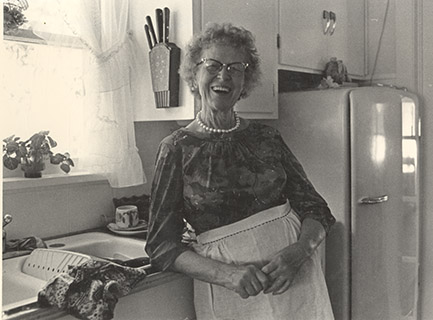
Description: Tuberculosis and other sicknesses. Growing up on the farm. Women's work. Father's strictness. 6-5-74 1.2 hr 18p LS
Date: 1974-06-05 Location: Moscow; Burnt Ridge; Troy
Subjects: childhood; children; families; farming; holidays; homemakers; homesteads; illness; medicine; parties; railroads; schools; sewing; timber
Topics:
The colored topic bar is hidden for screen reader users. Use the topic buttons below it, the "Filter by Topic" menu or the search box to find specific content in the transcript.
Helen Kellberg Anderson: We were quite, oh we didn't read real well, most of us. And I suppose we were short of the material and stuff to do, you know, in those days. We didn't have drawing books or anything like that. We did our own coloring on our own tablets and stuff like that. So we'd have to read our reader three or four times a year, the same thing over and over again. And you know, you'd like to go back over your reader, you know, if we went through the book, we'd have to read it again. We wanted something else naturally. But our first books that we had in our first grade was, oh it was a primer, a little brown primer, I forgot the name of this one. But it was like, see Fanny Fanny had an apple,… and see the kitty, and kitty riding, and the kitty can play with the ball, or see the birds in the tree, or something like that. But we never learned by phonics either, we just learned by reading and spelling the words out. And I never did have any trouble. I was a pretty good reader. I always made a statement I wasn't going to be the dumbest in the class. And so I guess it was just that way, I had big determination, and I had wonderful handwriting. And just from a little kid while I could write, I don't write that good today, but I was a real good writer. And I enjoyed work, I made good maps, and extra perfection, you know, really. And the teacher drew a pig on the backboard, you know, for something. All the kids could look at, or draw, or so forth. Anyway, I got up there and I just went ahead and made that pig just like she did. And she got all laughed and didn't say anything. But they wanted me to go on and I could have had a penmanship, become a penmanship teacher at that time. Through the 8th grade I could have that to do penmanship, because they needed teachers so bad. And many teachers only went through the 8th grade because they needed teachers so badly. And that's when we also got started. And many teachers, and then of course they took a bunch of courses later on, whatever they wanted to do. But there is a good person you should ask. She can tell you all history from way back. We've talked to her so much.
Laura Schrager: Did you ever participate in the programs that they had?
Helen Kellberg Anderson: Oh, we certainly did. We really had wonderful programs. We had good singing and we did all kinds of things. Drills, we'd have Chinese, Japanese songs, and we'd dress up in different things. And we had real plays, where as good as anything you'd practice, see anyplace else. No, this was in grade school. Well, we just weren't done yet. But I had easy to learn at that time. I'm not super out of prison anymore. But anyway, it was nothing for me to learn, things like that. And I enjoyed it and I loved to ask them out.
Laura Schrager: What are some of the things that you did?
Helen Kellberg Anderson: We had drills or we had little dances. Not real dances, but folk dances. We had tambourines that we had in our drills. And sometimes we'd have a drill, maybe for Thanksgiving. We'd have a tissue paper pumpkin head that looked like little pumpkins with green vines on the center vine. And we'd go, you know, pumpkins. And we should be, you know, pumpkin heads bright and gay. We ought to have a holiday. Children ought to be thankful, B, for all the blessings given to thee. So it was real nice. And we had that that we sang with these, or went around the circle and sang these songs. Then we had patriotic songs. And I think we learned some of the most beautiful patriotic songs I've ever heard. And that was, of course I was older then, and that was during World War I. And Will Carlson, she was in the community and she was a real go -gatherer. You know, to get people interested and be patriotic and so forth. And I know we learned to sing with Idaho, which means Idaho, Gem of the Mountains. And Idaho comes from Indian word, sun coming over the mountain. And they told about the plains and the hills and so forth. It was beautiful, around the rocks, trees and hills.
Laura Schrager: What made you decide not to go ahead and be a teacher?
Helen Kellberg Anderson: Well, folks had a big family. And I think I would have done very well too in home economics too. I didn't do anything pertaining to all this. But all the kids went to school. They all went through high school, except my brother and I. And they went out to college. And my old, no, no. Albury went back east to school. I was there in college back east. And then my oldest sister went through high school and then she went through as normal. And then my three sisters, they went through high school in Moscow. And then Ted went through the university. And Eva became a teacher. I think she went to normal school at that time. And they became a teacher and she taught school for several years. And then she finally got married. And my twin sisters, they went through high school. But both of them, Alva worked in the store as a blum. Oh, clerk. But Albury, she got married after she died in high school. And now she's a missionary in South America. She's been a missionary in South America for 28 years.
Laura Schrager: So how come you didn't become a teacher?
Helen Kellberg Anderson: Well, I get that everybody left home and mom was getting older. And they needed some help. And my brother Oscar didn't get any help. He stayed home until he got married. He married Ruth Kilburt. Then of course they were on their own. But then my brother, another brother was through high school. He formed the plays. His name was Layton. And then finally mother, dad had died. And then mother was very poorly. And I kept her up on the house of plays for two years or more. And took care of her. And then she kind of wanted to be in her own home. So then we moved down here on the home plays because I didn't have water, just a well, and electricity, or anything like that. It was handier down here to take care of her. And then she would like to be in her home plays. So I took care of her for eight years. And then she died here on the home plays. So maybe it was longer than that. It was what I had taken care of before. So, and then, well I was married though in 1923. And we had five children. And Lois, Lois and John were born up at the house of plays. And I was sitting here with mother at the same time. But we had a girl come in and help for a few days. So I was able to take over again. One girl stayed, or she was a cousin I suppose, stayed for an old month or so. But, so I guess that's the reason. Maybe I wasn't just supposed to go on. But one thing that encouraged me to go on to high school, you know, well I want to go, but mother never mentioned me going, everybody else going. And so I was all right to rest. But there was two anxious that I may go. And I don't know the reason why.
Laura Schrager: Were they less anxious to have their girls go through high school than their boys?
Helen Kellberg Anderson: Well, no, the other girls got through that. Sometimes they were going to go to the ... Church and Eva too. But mother never encouraged me or one, same mentioned, even mentioned about me going to high school. And I guess, I'm always a little bit timid. I guess that's where my bad part comes in. And I was sick of it for myself. So when she would mention me going on to high school, in those days when they went to high school, they always went, you know, if they would go on into the field of education or something like that, they had their minds right up. Well, I know I had done real well in high school, but like I said, mother and neither father, dad, ever, the boys, that always had nothing, money to the boys. I thought the girls had a little harder to get money to spend and so forth. And boys had it easier coming in. They'd say, oh, do you need some money?
But, you know, I always felt that the girls had harder that way. But, oh, dad, you know, he was pretty well -to -do, but, you know, not flush or anything like that. They always had to struggle and make money every year. But that never was, never mentioned about me going to high school. I don't know why. And I guess I was one of those people that just didn't speak up again enough, because I find myself today sometimes getting particular, because I don't stand up for myself sometimes. So that's what it is. So I guess it's my timidness, and then I'll probably feel bad about it and then keep it to myself. I wanted to ask you some things about when you were a kid that you were telling me to go to school. Oh, yeah. I was always doing some things. I was the one that always has to do things. Well, I wanted to. That was the one thing. I had to be doing something. Just don't mind the business. Trust me, I had to be doing something. But I was the one that noticed everything. I saw everything, and of course that's one reason I probably would get in Dutch, because I saw more. People wouldn't have to say anything. Nobody had to mention it, but it was anything. Well, I'd see it and I'd know it, and I couldn't help it. It's just my nature. Anyway, but we always went after the cows. And we went, oh, the canyon is almost... But, see, for a smile, deep. But we'd have to go over about three different hills, you know, down and go further south. And every night we'd bring the cows home. And we'd always have six, seven, maybe eight cows and some extra calves or something. And drive them up to the top of the hill. And of course we'd exercise for those cows, and them coming out of the canyon, cows would always beat us, you know, and we'd walk so much faster or else they'd poke and have to go back. And this was... Anyway, this is every night we did that. And it was either Ted and I or Leighton and I. I see my guy always was with them a lot. But one night, I wasn't with them. I guess I was doing something else. And later years when Leighton and Teddy, I think, were supposed to get the cows. And they hunted for three days. And they'd come home and wouldn't find the cows. And Dad said, my God, they milked those cows. They're going to, you know, they won't milk. You know, if you go too long, you'll ruin the cow. And so it went for about three nights trying to find them, and they never come. And Dad thought he was just maybe scared of cows or scared to go down for bears or something. But it wasn't that. So then Dad got on his horse and he went down there. And there was no herd laws in those days and not very many fences. So they went from this east pasture clear around trout pasture and up the canyon followed the railroad track and came out and tried. So he found a cow that sister came in to try them. So you could see why the boys couldn't find the cows. And we used to go down. There's many houses in the canyon at that time. There was a cusick house, by the people that call it cusick. I don't know too much about them, but the older children knew more about them than I did. But they moved away. And then there was a fiddler house, and there was a log cabin. And this one was in a kind of quite large, long room. And it was all papered with German newspapers. And so we couldn't read them. But it was that, what you call this, hand writing, you know, so curled up that you can hardly understand. Oh, it was really the old fashioned German script. Yeah, script. And I think it was beautiful, but I couldn't read anything. Of course, I would probably have been that good in German anyway. But it was that kind of word that you couldn't begin to try.
Laura Schrager: Did they have little gardens?
Helen Kellberg Anderson: Yes, they had. I don't know too much about the gardens, because they too had pulled out. I guess they couldn't just live and make living there. Although I think some of that soil was nice and rich down there. But there wasn't enough of it. But they had planted bluegrass lawns and they were well -capped, and fed some around it. And there was apple trees and a few trees, and those, and berry bushes like gooseberries and currants and blackberry. And then they always had this pretty flower. They had sweet dreams and other flowers that we'd go down there and pick, many years afterwards. And they would grow up in the brush around, way out in the lawn, and grow up in the, oh, they'd grow almost, oh, two and a half, three feet tall. And then they'd have these great big heads, almost as big as saucers. They were so pretty. We finally quit going down there because my cousins moved away, and we were alone. But we used to go once or twice a year down there. Oh, they had some apple too, and it tasted almost good, almost a stray apple, no, it tasted good too. But then as we got older and so forth, we didn't go down there. But one thing I think scared us was our cousins, my two cousins, that is, they all are. And we took an ocean to follow the fence line, put a new fence in there, so we followed the fence line clear to the bottom of the creek there, and thought we was going to play around there. But we saw a bunch of tiny snakes. They were almost white, I guess it was newly born, and they had such big heads on them, so we figured they were rattlers. So we decided we'd better get out of there. We didn't bother getting those good. And so we walked back, and so I think that's about the last time we'd been down in that canyon. But there was other, the Porter Place was interesting. We used to go down there. After they left, they used to be, went to Broadway School, and the girls' names were Mamie and Isabelle, and the boys' name was Sam. And they could have had another sister, but I don't remember. But anyway, we just walked to school, and the older kids were higher up in school, grade school, and they always had a good time walking to school. And there was the Pearson girls, and they were, I think they were four girls in the Pearson family. And then it was Shiloh Rubrik and Edith Carlson, and Minnie Auer, and then Emma and Gladys and Alice. So there was quite a few young girls going to school. Of course, they almost seemed like they were like, it wasn't growing up that you'd think that they were almost 20 years old. They weren't that old, but they wore longer dresses and everything. And it was quite versatile, and that was just a little tight. But anyway.
Laura Schrager: Do you remember the canyon getting logged at all?
Helen Kellberg Anderson: Oh, yeah, quite, yes I do. I don't know if you want to say something more about it. I'll tell you this a little bit. I was in school. Anyway, I went to school, but in those days, everybody had to have a gate to go into the yard. We had big board gates with several boards across and supports and hooks and a fastener gate to the fence under there to open and shut. Everybody had a gate. I think it was because they used to pasture. Well, it was a style, something new, so everybody had a gate. So all these women, especially Selmer, Reuben, and all the girls, and the Pearson girls, and I don't know, you just probably told them quite fast. Anyway, they'd all congregate there, you know, and talk about the books like Annie Green Gable, Annie Green Gable is the way to call it, and all the Pepper's family and Tom Sawyer and lots of other ones. I liked that early, early one.
Laura Schrager: You'd get together and talk about the books?
Helen Kellberg Anderson: Yeah, and Little Women and so forth. I don't know. I don't think they used to talk about one, The Hell in the River of Babies, but I didn't know which book that was. Anyway, they'd always mention that, and then they'd look at me, because I was Helen, you know. So I heard exactly what they said and kind of laughed when I went by, and I'd talk about Hell in the River of Babies, and I didn't know if that was in the Little Women or Pepper Booker. Uncle Tom's Cabin, too, was an interesting book that the teacher used to read these books five minutes after noon recess to settle the kids down. So they were interesting books. Anyway, they had a remark of Helen and her babies, and I walked past, not paying attention to it. So then this year, or it was the last year, I wrote to Minnie, and I said, I remember how you used to talk about Helen and her babies, but I wouldn't let on that I heard what you said when I just walked by. So she wrote back and said, I didn't think you remembered that, but if you hear any of those funny remarks, you won't, too. It makes you feel a little bit timid. Anyway, little Michael Dean, they lived at the brick house, and he couldn't start school. He'd always stand out of the gate, watch us go by. Oh, he just loved people. So he'd say, Helen, Helen! He couldn't say the L in it, and I was embarrassed to tears, because it was like calling me Hen, because he demanded to say Helen, but he couldn't say Helen. So I guess I didn't show quite so much interest in him, because I liked him and all that, but he didn't know any better. I couldn't say the L, but it made me feel kind of let down, because he called me Hen and said Helen. He was cute, though, and he'd have his eyes through the bars of the gate. You was asking what?
Laura Schrager: I asked whether you remembered the logging.
Helen Kellberg Anderson: Oh, yeah. Their logs, all these canyons, all the trees were gone. The hill signs were just stripped, like you could see where they'd pull the trees down. They had an engine in the bottom of the canyon, they called it, the donkey, where they'd pull these trees down. They'd saw them, and then they'd pull the trees down to the bottom, and then they'd, I don't know whether they chopped the limbs off, up there down the bottom, but anyway, then they ran them through the mill. This creek that goes through the Arcadian, they had banked that and made a dam, so they had a mill pond down there. Oh, they shipped out an awful lot of timber. And, oh, and in this mill pond, the salmon would come upstream to spawn. And so sometimes they'd catch a great big salmon down there. So anyway, one of my, Lois, my daughter, when she was about seven or eight, she took another kid with her down there, and they were going to fish in the creek, because they liked to fish. And so she caught a salmon, and she told this other kid, tell them to help me, she said, I need some help, because fish are too big for them, for her hook. But he thought she maybe got just a little, tiny fish, and he wasn't about the one to come down there and see that. So anyway, she finally got his attention, and they hooked it, or got it two or three times, but they finally lost it, you know, and it got away from them. But there was quite deep rules in this creek, and now even today that you can go down there and maybe fish, smell fish. But the bears are eating them up now, so bears just live on there. And Elmer Johnson, oh, just two or three years ago, went down there, and he was going to fish. He liked to go down there a bunch of years home and see if there was any fish. But he went down there, and there was a mother bear, and a cub or two, and an old father bear there. So the old bear got on his hind legs, and he started to walk toward him, so he thought he better go home. So he went up to that loggin room, and quite a ways into around here, you hear he's still coming walking. So I think that was practically about the last time he went down there, but there was a little cub up in the tree, and of course they didn't like that for a while. So we've had quite a few bears in later years. We never had so many before, because it logged there and disturbed the lodge, you know, but now they moved off the mountains and coming down to the valleys, I guess, more.
Laura Schrager: Can you tell me that story again, where your mother and you saw the cougars?
Helen Kellberg Anderson: Oh yeah. This is before I ever started school. And I had had pneumonia about three times after we'd come to Idaho, and so it wasn't very well, and I was sitting there on a chair, and kind of shaking, and oh, we kind of weak. Anyway, one day mother told me to come to the window quick, she says, and there was two cougars. They had long tails, I know what kind they were, but anyway, they walked past our place just like a team of horses. They were tall, almost, oh, about 30 inches tall, or maybe taller than that, maybe two or three feet, two feet, two and a half. Anyway, they were big, and they were walking side by side. We watched them as they went down the hill, and went down to our pasture, and I haven't seen them since. But there are cougars here, different people has killed cougars off and on. They even tackle a cow over at the machine shed, was all scratched up, and straight on its back, when they figured it was a cougar that had gone. I think some people went, and I don't know where they found them, but I thought maybe they had killed this big cougar, and that was on the upper end of the ridge that they found him, I think, in the like, the Olsen tree woods there.
Laura Schrager: Can you tell me about when you, you know, the camp, the logging camp, that you used to go down to?
Helen Kellberg Anderson: Oh, yeah, that was in the mill.
Laura Schrager: Oh, that was the mill?
Helen Kellberg Anderson: Bullbide, yeah. When they were logging down there, Mrs… mrs. Peterson… oh, and Mrs. John Peterson, and somebody else was cooking down there, I don't remember who it was, Mrs. John Peterson and her sister -in -law, I think, I used to know her name too,… at the logging camp, and they had, oh, quite a few big buildings down there, because they had bunks for the men, and they had big dining rooms, and so forth, and they did them. And then when the mail came, the train always brought the mail to the people, the train didn't stop until they were there. But anyway, they wanted butter, Mrs. Peterson wanted some butter, so, mother churned butter, and I took it down there, and I was all alone, I went down by myself, and I went down our canyon, and walked clear to the bottom until we got to Bullbide, which is quite a ways too, because you go past Carlson Canyon too. And so I was just going to go around the corner of this punk house, there was a great big rock about as high as this table, and then it was just wide enough for me to, between this rock and the corner of the punk house, it gets past, there was a trail there. Well there was a great big snake, and it just darted under this big rock. Well I went on past the corner, and went into the house and brought this butter, and then I played with their daughter for Gladys, for Peterson, quite a bit, and oh for an hour or so. I walked past that rock and made it all clear, and then I walked up to Carlson Canyon, and old Joe Carlson always had some bad bulls, so I thought well if that bull comes after me, I picked up a club, and I said I'll just swing this around my head, and I'll be alright. But I didn't see the bull, and I came up to the house, and then I followed the road home, and it's a mile back up to our place, but anyway it was quite a walk, and being alone because you could see most anything as you go down there, and many times when we used to go down and get the cows too, we used to go in that canyon too, and we'd see snakes maybe in the spring, cows would drink water and so forth, pigments. But I'll always live as an impure snake that I have all my life. I probably wouldn't have been a missionary if I wasn't so scared of snakes. I don't think I could have gone to a foreign country, but I guess maybe the Lord knew that I couldn't go with snakes, although I know that he would protect me and so forth. But my sister went, and I said I guess I was supposed to stay home and get some help, take care of my mother and dad and so forth. I've been a busy person all my life, and I don't know what to do, but maybe just keeping the home together.
Laura Schrager: There was a story you told me about chewing gum last time?
Helen Kellberg Anderson: Oh, yeah. Oh, this is good. This is when dad had worked on the railroad. Dad had worked on the railroad, on the first Continental Railroad, where they drove the Golden Spike at Provo, Utah, where the railroad met over the whole United States. And dad, there was nothing for the men to do, so before they'd go to sleep at night, they had kind of a bunkhouse or maybe it was some kind of sidecar or something that they had. I don't remember what they had. They had something there. They'd go and gamble, you know. And so dad, he'd gamble one night there, and he lost all his money. And so, oh, he was just beside himself because he'd lost $300, and he was going to leave. And he didn't know what to do with himself, so he said he'd just have to gamble one more night. So he'd gamble, like all get out, and got his money back. That taught him a lesson that he'd never done, and he'd gamble anymore. So he got so strict even with his family that he couldn't even chew chewing gum or play cards or anything that was gambling weed. That was out. And when you didn't smoke, you didn't chew, and you didn't swear, he really, I guess, learned a lesson, and that was good for us too, because my sisters and brothers didn't smoke, none of them, and they didn't drink. And when the shooting game, when the Watkins man would come, his name was Johns from Juliet. He'd always like to recognize the children, so he'd give them his gum. And of course, we were so many in the family, and so when Dad came home from work, my hair would be chewing his gum now, it tasted so good, and we'd pull it, you know, or we'd pop it, you know. Oh, I guess my aunt would say, Mommy's a dick, it's poppin', it's poppin'. So we'd stick our gum maybe under the pantry shelf or something, stick it to it or under the table or someplace, each one had a place for their own, you know. And then, of course, we'd chew that gum off and on for a whole week or more, you know, whenever. We'd think about it, go and get our gum, you know, we'd chew it. But then, finally, we'd forget about it, and of course, then whenever we wanted to clean up one, they'd find the gum stuck here and there, we'd leave it behind. But anyway, it was kind of nice that Dad was strict, and he learned as well, and helped us too, because he wanted us kids to be good kids, and they all turned out to be good kids. Mother had a nice family, Mother and Dad had a nice family. And they weren't crossing or little bad people, you know, we'd all do some things to get into Bishop. Just like we went to, many years ago, and this had been about 1910, we went to the Ringling Brothers in Moscow, Ringling Brothers Circus, and so we saw all these trapeze acts and all the things that they had done there, walking ropes and so forth. By the way, it was so exciting to see this circus, and I think it was more fascinating to the boys, because when they got home, then they fixed up in the barn, boards attached to the rafters and the roof of the barn, and on each side, they would try and stand on them, or sling on them or something, you know, like they did in the circus. And they played around and tell, oh, maybe somebody will finally get hurt, maybe not hurt that bad, but it finally, something stopped, the ropes slipped out of one end, or something, and then it had to be a collision, or something, something, but one of the craziest things, we all did it. During hanging season, or after hanging season, they always had big beams, big square beams, to hold the barns together from one side to the other, and then beams up and down. Well, we would dare ourselves out there on these beams, and then we'd say, one for the money, and two for the show, and three to get ready, and the fourth to go, and we let down a shot on the hay. Well, that worked just fine, because there was a lot of hay in the barn, there was lots of fun, but we'd go out there, but it was risky, because that beam that they put around was so slick from putting the hay in the barn all the time, and it was practically shiny, it was so slick, and here we'd get out there on there and jump down, and sometimes we'd jump and the barn was almost empty, and there would be rails, fence posts and stuff in the bottom of my point, they did that, they probably did it so there'd be a little bit of air underneath, so it wouldn't heat, and the hay would heat if it was low down. Anyway, here we're jumping without any hay in the barn, but I guess we were young and didn't hurt us very bad. But I think it was, I don't know whether it could have been the fourth of July, but Nathan, he was younger than I was, he was two years younger, and he was going to jump off, and he hit his head in this square beam and cut his forehead, and deep gas, and Dad, he sewed it up, in those days he didn't run to the doctor, but he sewed up the scar on his forehead.
Laura Schrager: Your father could just sew it up for the snow?
Helen Kellberg Anderson: Yeah, he sewed it.
Laura Schrager: Did he just get a regular needle and thread?
Helen Kellberg Anderson: They had, no. Oh, he must have had stuff for the wood. They had, they always called it the cat guts, and it's one of the worst, right?
Cat guts, that rot, I mean, dissolves, and it does, it's a use of today. And so I guess it's popular, but I didn't want to call that kind, but that's what it was. And anyway, it happened the same, similar thing happened to Teddy, oh, he had a rough time. Well, he had several bad things that happened to him. But, uh, you should tell this, Teddy, he got air shippers while he, he was playing with a kid at school, and he got scratched on his neck, and so Mother was washing him clothes when he come home in the afternoon, because she had this big boy who was such a big family, and washed my hands. And so she looked at him, but she thought, well, it's just a little scratch, you know, it shouldn't hurt, it'll go pretty soon. But she didn't think about putting anything on it, you know, she didn't put something on it, even turpentine would help. But, uh, because that was our old standby, was turpentine forever cut or hurt, you got, or wire cut, and we never got a lock drawer or anything like that from it. But anyway, he got air syphilis, and he was so sick, high temperatures, and he was there two or three, two or three weeks, you know, and he was just wasting away, and he had such headache, he could hardly stand it, and so forth, so, old Joe Carlson come up, and our neighbor, from a report in Carlson, and he said, I'll tell you what you do, he said, you grate a tub full of, uh, And, uh, and then you take a big sheet, and you put them in that, and wrap these potatoes all around him, and then I just put them back around there, and, um, and you just grate them raw potatoes, and put them on him, and they put them on him, and the crisis, they figured it would be about two o 'clock that night, and it had been almost a month, and, um, and that night, he went to sleep, and, uh, but he came out of it, you know, he finally come out, well, the people left him, and the headache left him, and the potatoes had drawn all this infection out of him, and he was just a little lip, and weak as a dish rag, and, um, he lost all his hair, and, uh, he was just, had to learn to walk all over again, it was just pitiful, and, uh, he couldn't start school, he didn't go to school, you know, this was in the spring, and he couldn't go to school until the next year, and, oh, I don't know when he did go, in the fall, he went to school, and he had to wear a hat, wore a blue serge cap on his head, and he had a little blue serge suit, and, uh, he went to school, and they had to wear the hat in the school, too, because he freeze on his head, you know, and, but he didn't have any hair. But, um, when his birth began, that, that following year, Dad bought him a nice wagon, a coaster wagon, and, uh, I better not put this one down, it's somebody's memory. Anyway, but he finally got better. The thing, when he got to be, you know, about twelve, oh, maybe nine, ten, I don't know, um, he was riding his coaster wagon down the, at the, uh, lane, down toward the bottom of the hill, and it was fourth of July, and he, they had some friends over, but he caught his leg in the fence, and took out a big piece, I, I, I, under, on his knee, under his knee, and, um, so, Dad, so that thing back, and you can, and no anesthetics, no anesthetics, and that kind of thing. But that wasn't the worst of it. That, he finally got over that, and he had Dad's car. But the next thing, when he was, um, oh, fourteen, fourteen, fifteen, fourteen, maybe, and he got a ringworm, and he had ringworm, and he just liked cats, you know, and public cats, and then when he got ringworm, he was here, and all over his body, big as ours, and, um, uh, so he thought he should go to the doctor. And, uh, but we always, he cured it with, uh, turpentine lard, and that would kill it, turpentine, about anything, you know, but lard kept it from burning. So he, but he went to the doctor in Troy, and he put this black iodine, painted all those sores with black iodine, and he come home, and he, burning them up, you know, one burning is bad enough, but they had twelve, fifteen burns all over your whole body, that he thought, Dad called him up, what's he doing, boy, you're gonna kill him, he said. He said, put some vaseline on. So they put the vaseline on all those sores, even the lard would have done it too. And, uh, and for he had, and they put bandages on it, and the next morning, the flesh just dropped out in the hunks, and everyone made holes, just holes in the skin, everywhere, and then of course, then that flesh came out, and, and it finally healed up, but they used vaseline, and I don't know if they had anything else that they could use at the stage,… to heal him up again. But that poor boy sure suffered, just terrible. It was just too bad, we shouldn't let him go on, and we would do a man who was gonna do a thing like that. I didn't know, they were just black old paste, you know, just, oh, terrible. It was really strong stuff. Oh, it was, yeah, and the flesh dropped out by a hole for an inch or better deep, and wherever it went, oh, it was just, boy, I was in the X -car all his life from then. So he had gone through so much, like, bad things, I think. You know, he went on to high school, and it was a university, and he took electronics, or electrical, electronics, and he got a hundred on his chest, and he went back, then he's gonna go back to Chicago to a school, and then the first test he gave him, then he got another hundred tests right there, the first test, you know, it's the first test he did. But anyway, they said they'd give him a job, well, they'd give him a job selling wash machines, and crazy stuff like that, you know, problems with some kind of job. And my brother was going to school in Rock Island, that's not too far from Chicago. Well, anyway, there was a, kind of a, oh, there was a gang, gang, I guess, and, and pickle with dad. Oh, oh, he sold a few wash machines. But anyway, I don't know how he got out, I think, I'm not sure, whether he had a car or something else, but anyway, he had gangsters that would steal cars, and take them to certain garage, and you'd have to pay so much to get them back, and so forth, you know, you know. It was just a gang, something gangster there, that was wrong, they were just stealing, and selling, and exchanging, something like that. But anyway, Ted finally came back home, and then he worked. You've got the tuberculosis, and you can leave out any names, you know, people, you know, I want you to tell about it, about it on the bridge here. Oh, I was going to say, but,… we were many, many, many people on Bird Ridge, going to school, you know, the highest roads around. Well, I think there was 46, maybe, some said it could have been 50, earlier, more than that. But we were an awful bunch of kids going to this one -room schoolhouse.
Laura Schrager: Let me ask you, how did they treat the kids who had tuberculosis?
Helen Kellberg Anderson: Well, they always said that, well, they didn't know as much about tuberculosis as they'll say. People were harder up, and didn't have the food, I think… they probably were, many might think probably, well, you can't really say they were, people were good cooks, people were good cooks, and they had gardens. But they always thought then that they should have fresh air,… and they always thought about milk as being a good product. But I think, too, I would dare to mention that, I don't think people, they didn't have very many clothes. And like I said, that you wore, and most people maybe wore one suit of underwear all week. And the next week you'd put on another suit of underwear, that's in the wintertime, you know. And lots of times they'd make dresses out of,… maybe men's wool pants, you know, the panda legs, they'd make panda coats, and of course they were going to be warm, because they had to walk to school, they'd walk those three miles to school. And of course,… our clothes probably wasn't really warm enough for lots of people, and then they had to fart a girl, and probably didn't eat big enough breakfast for one thing, too. But I think, you know, it wasn't enough sanitation, I think, more than anything else. But I do think that most all this was, cost from getting these sort of clothes was through the water bucket, you know, because nobody else had it afterwards. And nobody else got it after we got the drinking found. So I think maybe just related to that, that many of the school children… got TB from drinking,… drinking,… water,… drinking water, water, with a panda dip in it, with a panda, with a water bucket, with a water bucket.
Laura Schrager: Once someone got tuberculosis, were you not supposed to go near them?
Helen Kellberg Anderson: It's the craziest thing, you never knew if they had tuberculosis. Nobody knew they had tuberculosis. I think until they got sick enough that week, and the beauty, that they stayed home.
Laura Schrager: I think that's all the way it went, see?
Helen Kellberg Anderson: It went so far, nobody knew. The Puritans up here, where they got all that tin on the barns in the house, they had two boys that died, and the hemorrhage there was so often vomit of blood. I think maybe Clara, she was a nurse, but she died too. But she died from blood poison, but I think her blood was so thin, that the blood poison couldn't attack her. But she didn't look real well, she was so pale. I wouldn't dare to mention her, but she died with blood poison, probably getting scratched or something in two or three days. But these two boys, they were sick, and they put them in tents. The Puritans were in tents outside, and my sister, my oldest sister, she was sent to Colorado, Denver, Colorado, to the tent area there. But my youngest sister, she was 15, and Dad put a tent out here, and she slept out there in the tent.
Laura Schrager: Was that so that they'd get lots of fresh air?
Helen Kellberg Anderson: Fresh air, and then we're out too, and maybe we'd be right around the rest of the children too. But I still think, today, you know, using the Cupid TB, in six months, you see, maybe sooner than that, with penicilloma or sulfa or something. But those days, I think they needed more nourishing food than they possibly could get. You probably had too much of the same thing, you know how it is in those days. But we were much more fortunate, but I think my oldest sister worked too hard, because she used to carry water from down the bottom of the hill, and up the lane to the house, and you know, with a big family, that water bucket was always empty, and that was no good for her. And I think she worked too hard, and she looked like she was.
Laura Schrager: She got water from down by the creek?
Helen Kellberg Anderson: It was a spring well down there. And then when they carried it up, and when they washed it, they took this little drag or sled, they call it sled, they just bore two runners in it. And I don't think they even had it. They had metal on the bottom of those runners, I don't know. But otherwise, they were just two boards, but it turned up on the end, so it was like a sled. So it would slide in a hollow barrel full of water whenever they washed clothes. Well, we didn't do that very long here, but anyway, she was the oldest girl, and she probably had a lot of the blood, you know, hard work. And every new house, the house not finished, you know, Dad built the house so much, and then, and added to it. But just when they first come here, maybe she worked too hard. And Auntie Laura up here, she died with total clothes, and she was in a tent. And Ernie's about to die with TB now, and she was in trunk. So I, see, it was just in the community. And another thing, we had communion, like they always say, with wine. You know, wine is supposed to kill germs and stuff like that, so you shouldn't get it for the next person. But people dig out of the one cup, and your bunch, who I'm sure wasn't healthy, you know, some people had big long mustaches and everything else, and beards and everything else. But then Pastor Bird come, and he told them it was unlawful to have a single cup for sanitation's sake. You know, it was very good to, one thing to believe, if you had faith enough, you know, you wouldn't get total clothes from that, or the wine as a purifier. But I know we didn't like it for that reason either. So I was glad when they said to, that they would have individual glasses and a sewing dinner. But anyway, a drinking water, a water bucket with a dipper in it. And then, all of the school children got total clothes from drinking water from a water bucket with a dipper that all of us drank out of, let's say, dipper, and carried the germs. After Dad bought a drinking container where everyone had to have their own cup, no one else got TB.
Yeah, nobody else got TB. Yeah. Let me see.
Laura Schrager: Can you tell me something about the proof dryer that your father had?
Helen Kellberg Anderson: Oh yeah, oh yeah. That was easy. Anyway, Dad had a prune ground. We had about 20 acres of prunes and prune trees. We had parrots and apples and peaches too. They grew wonderful to the frost ground. We had them for quite a few years. But the prunes, that was interesting because that harvest lasted a long time. My two oldest boys stayed out of public school. They stayed out of school in the fall because we had so many prunes to pick. They had dried prunes and a big prune dryer. It had a kiln where you put a fire under the building. It would be like an oven that would dry all these prunes. We had around, I couldn't say, close to maybe 48 doors, big doors like a house door. Inside these doors, we had about 24 doors on each side. Each side would be a lot of grates that you'd put in there. Just like you put in oven grates, but these were wooden grates made out of wooden sticks. They were about maybe 36 by 40 long. Maybe longer than that, but they were that long anyway. 36 is better. Each grate was that big. In one door, you'd put maybe 12, 15 grates at least in each door. They were all filled with prunes on each grate. Then these 24 doors were clear around on both sides. This big fire, what they called a kiln, would dry these prunes. Then they'd have to change the ones from the bottom and put them to the top. The top ones would come down to the bottom so they'd dry more evenly. Dad would haul.
I should say that he washed these prunes in three or four buckets of, well, first a bath with lye water. About 60 boxes, big boxes, to the depot in Troy. Every day he'd go with 60 boxes of prunes. As long as the Cecil Mast lasted and the Chipmunk from Troy to Spokane. From there it went out all over the country. The United States shipped out to different parts of the United States. There were several dryers. There was another dryer on Bird Ridge. Dad said, well, it's no use for me to have a prune dryer anymore. I believe I will. I won't dry any more prunes anymore. We'll just take them over to Westbrook. Well, he took them to Westbrook. No. It wasn't long, or just another year or so, that the Westbrook dryer burned down. So then, of course, we just, people came and bought them and used them for fruit and jam. And then all the people come by. That's when we, then our prunes have been. I wouldn't dare tell the Smiths to do. Mom had, we were a big family, and Mother used to put up 60 gallons worth of prune bread. Ha ha ha. And it lasted until the next day, although Mom would give a lot of that away too, lots of times. So, Mom didn't have any, you know. But she put up that much. And Mother would bake 60 noes of bread every time she baked. And she'd bake two or three times a week. And she was the best bread baker, making buns all the way. So good. But she was a big family, and they ate lots of, like, old Mama canned meat. She canned, like, 100 quarts of meat and several hundred quarts of fruit and vegetables and so forth. And I remember when they learned how to can beef, and meat. They learned that from the university, how to take care of the meat and canned meat. So, it's keeping all this. And same with the corn and the vegetables, that all came that way. I think so.
Laura Schrager: You mean before the talk, you didn't eat canned vegetables at all?
Helen Kellberg Anderson: Yeah, well, Mama always will be canned, but you know, to get certain things to keep, you know, people didn't can it. They dry it. You know, one method was to say that, our folks never did it, but many people did it. They would take cream or milk and scald it or something like that, but the corn in that. And then, I suppose by having this hot milk or something, then they'd hang them in sacks, cloth sacks on the line until they dry out thoroughly. And then they would put them away, store them dry, put them in containers and stuff. And then take out what corn they wanted, you know, and cook. And it was a real good corn. You'd be surprised. It was just so exceptionally good that you just could hardly believe it would be so good. It didn't have an old taste or anything. It tasted so fresh. I don't know. I don't understand today, but it wasn't enough cream or that to hurt it, I guess, but they scalded it. You have to always have a, you always buy at your things. Well, they used this hot milk or hot cream or whatever they did, and it was good. It was very tasty. And there was dry corn they put in containers and came in and just scooped off what you'd want for a meal or something. It was good. I was surprised. But Mother can from way back in Oklahoma, so tomatoes and peaches and stuff like that. She must have known it for a long time. In Sweden, they generally, like the dairies and stuff, they wouldn't can them much. She said that you could just put your arm and they'd just keep, definitely, dairies weren't that touchy, so if you washed them and so forth. So that's what they did. That's what the Indians did. They either dried it and hung them by, you know, hung them up. So they'd dry them and get into them and so forth. Here, I'll make an off -the -dare.
Laura Schrager: Would you help out a lot at home, like when she was canning and stuff?
Helen Kellberg Anderson: Oh yeah, we all did. We all worked and helped. We never, always had a job to do. My older sister, she did a lot of sewing. She sewed for us kids, you know. And then when she went on to school and was gone, well then I would sew up my own dress. We didn't know. We worked just, we all sewed and never had much work. We never had so many dresses, but we looked real nice, you know. And materials weren't that expensive. The better expensive materials would come to, but... Maybe better expensive material, around 35, 45 cents, you know. And Monica, when she came to this country, she could buy all wool, beautiful dress wool for about 10 cents a yard. 10, 12 cents a yard. And some materials were on it, say 4 cents, 5 cents a yard. Well, you know, it didn't cost very much, you know, at that time.
Laura Schrager: But everything's just gone sky high now, you know what I mean? Would you get to pick out what, you know, what material you would get?
Helen Kellberg Anderson: Well, I never picked out very much of my material. I think Mother was good about it. Well, I think for Christmas one time, I said I wanted a pink dress. And my sister wanted a blue dress. And it was like wool, nice stuff. And we had a dressmaker to make those in town. Because, oh, Mother was a bunch of kids, you know, too busy, you know. And couldn't always do that. We had so much cattle and lots of milk cows and cream cans. We had chickens, not too often, but not to keep us and sell more eggs. But we didn't sell eggs on this way too many. But Dad had big herds of cows and they made milk cows and stuff. So there was six boys, I think, if I count them all. I have to always count them up. I have to count them. Alber, Oscar, Teddy, Leighton, Russell, and that was Boyd when he died… and we were, I think, five girls. Hilma, Minnie,… and I, and Eva, and Elva, and Elvira. Elvira. Two. We were twelve. And twins. Elvira, Elva, and Elva, and Elva, and Elva, and Elva, and Elva, and Elva. And that's six. And Mother had, she had a baby that was on a day or two. And he couldn't breathe. There was something wrong with it. She'd all died. So we were twelve. You know, Dad didn't, but Boyd died at four. He got a walking -type boy or something. Oh, he's a, oh, we, I think everybody went through a hula golf scene. I wasn't that bad. My kids, my kids had got a hula golf awful thing. But, that's an awful scene, yet it is coughing. And, like, she was with me for a whole year or more. Because I had to charge these guys. I can't get them to get in the water. But I wasn't that bad off. I was unfortunate that way. The kids got chicken pox. Well, I was feeling sorry for that again, Boyd. I had all the water treated around the middle. And I got to sit there and have bread with, and have thick cream on it, and sprinkle sugar on that. And they were eating the milk and sugar and cream around their bread. And they tasted so good, you know. And I won't say enough, and Toddy didn't have any.
She was nice. She baked wonderful bread. But, we were invited to the first party over there. All the kids in the room. And, she had, I don't remember, we had something. But, she had these brown cookies, you know, big brown cookies. And she'd pass these cookies and pass these cookies to us kids. And we sitting outside, you know. And you couldn't buy them. You just couldn't buy them or break them. It was a thing, you know. You just hired to rock. And so, their dog was on the table. And we couldn't even ...
So, we put them down there and the dog ate the chews. Those cookies that were brown, glasses, cookies or something, they should have been soft. But, they were just, she just couldn't get your teeth in. And she'd pass them, you know. And it was a shame not to take any either, you know. So, I don't know why everybody else did. But, I know that's where I got mine. I was just bringing my friend on the table to the dog because I couldn't buy them. They just hurt my teeth, my mouth, my teeth. I just couldn't buy them. I was afraid to break my teeth off. And so...
Laura Schrager: Would girls and boys go to those parties?
Helen Kellberg Anderson: Yeah. We were, I think, all girls at Mimi Decker's party for her, daughter, Matt, Pianta's. But, I had a Smith. And she'd have boys and girls and she'd always try and couple up the boy and the girl together. Sit together, you know, and eat off the same plates, you know. Because we were short on dishes and plates. But, I didn't like that for a while, you know. I never did. But, she was always trying to throw in people together, you know. We were just looking to see the movie, you know. Couldn't be more than 79 or something. But, she always tried to couple girls up with the boys. I never cared for that. Sometimes you go over messy boy, you know. Kind of sloppy.
Interview Index
Short on materials in the Burnt Ridge schoolhouse and they'd reread the lesson book. School programs, plays and drills. Wanted to teach and go on to high school, but ended up staying at home.
Dad gave money somewhat more freely to the boys than the girls. Went after the cows every night. Once the cows disappeared for three days and father tracked them to Troy.
Two deserted homestead cabins in the canyon had blue grass lawns and berry bushes and sweet Williams that bloomed for years afterwards.
Older girls congregated by the gate and talked about books they'd read and talked about Helen and her babies (from a book) when she walked by. Young Rodin boy mispronounced her name.
Hillsides stripped of timber and sawed in Bovill, Wade the stream a mill pond and the salmon would spawn there. Few bears after they logged. Seeing two cougars walk past the house like a team of horses. Taking butter to the Bovill mill. Scared by a snake near the bunkhouse. Also afraid of Joe Carlson's bad bulls.
Dad worked on First Continental Railroad and lost $300 gambling, but won it back the next night. After that he became quite strict and wouldn't even allow them to chew gum. Sneaking gum from Watkins man and hiding it in the house.
Seeing the Ringling Brothers Circus in Moscow around 1910 inspired boys to do stunts in the barn. They all jumped off beams in the barns to the hay, Layton cut his head on a beam and father sewed it up with cat gut.
Teddy got erysipelas from a scratch on his neck that no turpentine was put on. Old Joe Carlson's remedy with potatoes and blankets brings him through the crisis. Father sewed up a bad cut on Teddy's leg.
Teddy got ringworm and the doctor put black iodine on the sores and it burned him badly. The home remedy would have been better.
Tuberculosis epidemic on Burnt Ridge, People didn't have enough clothes, but it was mainly a sanitation problem - the water bucket at school. First symptom of TB was extreme weakness. Treated by being put in tents outside in order to get fresh air. Needed more nourishing food. Older sister worked too hard - carried water from spring to house in buckets. Everyone drank from the same communion cup in church.
Father's prune dryer and twenty acre orchard.
Father stopped drying prunes at his place and soon after the Westburg's dryer burnt down.
Mother's canning and baking for a family of 12, Dried corn after boiling it in scalded cream.
Older sister sewed for the family. Later she sewed her own dresses. The Troy dressmaker made her a pink dress for Christmas, Whooping cough. Childhood parties.