
Description: Farming: routines, threshing, economy, changes. Neighborliness 7-23-73 1 hr RM
Date: 1973-07-23 Location: Kendrick; American Ridge
Subjects: winter; livestock; farming; farmers; wheat; food; orchards; sports; schools; parties; literary; cards; threshing; homesteads; world wars; working conditions; unions; wagons; horses; automobiles
Topics:
The colored topic bar is hidden for screen reader users. Use the topic buttons below it, the "Filter by Topic" menu or the search box to find specific content in the transcript.
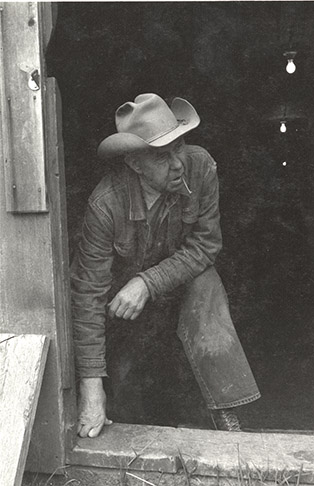
Rob Moore: Walt Benscoter was born and raised on American Ridge and still lives within a mile of his father's homestead. He has farmed all his life, growing up with the increasing mechanization of farming procedures. Since bigger equipment enables a single man to farm more land, many of Walt's neighbors have left and their yards been plowed over. He tells stories about thrashing crews, socials, the farmers union, the depression, horse drawn equipment, and many other phases of a vanishing way of life.
Walter Benscoter: When I was a kid I used to work for four bits a day.
Rob Moore: Four bits a day?
Walter Benscoter: Yeah.
Rob Moore: Doing what kind of stuff?
Walter Benscoter: Oh, that was in horse and buggy days, you know, and things weren't very well mechanized and they even planted beans with it. You know, in these old stab planters? Well, I got one out here in the shop, I'll show you. And they planted, with these stab planters, one row or two rows at a time, whichever you were capable of doing, you know.
Rob Moore: Is it something you carry one with you?
Walter Benscoter: Yeah, you just carry it, you stab it in the ground and go through it, you know, plant a hen at a time. And I used to do that in the spring, hoeing beans. Then it got up to a dollar a day when I got bigger. Then we used to have pile of beans, you know, that was kind of a kid's job, you know what I mean? A man could do a lot more, but a kid could do it too.
Rob Moore: Pile of beans?
Walter Benscoter: Pile of beans, you know, they were all planted in rows and the cutter would bring two rows together and then the side delivery rake would rake six rows together and then put them in piles so they could be picked up, you know, and hauled to a machine.
Rob Moore: Oh, a machine to get the beans out?
Walter Benscoter: Yeah, a thresher machine. And I used to pile of beans and all that kind of farm work, but we used to raise a lot of beans here, believe it or not. But, well, the price got to where we couldn't afford to raise them. To get what I mean, we wasn't getting enough out of them to pay because there was so much labor concern. You can see why that was, it was all hand labor, you know. cultivating, you cultivate a team of horses, some people have two row cultivators, most of them are single row. And then they should be hoed, a lot of people didn't, but if you didn't, you got your ground cicada and you couldn't raise them. Then wages didn't amount to much. Harvest wages were usually pretty good. I think, of course, those were mighty long hours and it was hard work. Pitching bundles, I think we used to get two and a half. I never did pitch bundles, but when I got big enough, I drove a bundle wagon. And we used to get four dollars for that, that included the team and the wagon and the man. I hauled a lot of bundles.
Rob Moore: Was this a good bean growing country?
Walter Benscoter: Well, not really, you know, and it depended a lot on the season. You know, a good season with good rent and everything. I believe they did raise beans here that made eight, nine sacks to the acreage.
Rob Moore: How many pounds is that?
Walter Benscoter: About 150 pounds in a sack of beans. They're quite heavy, you know… but, uh,… then other years, we wouldn't get over four sacks. You know, a year like this, you wouldn't get over four sacks. I remember one year that we planted beans and it was drizzling rain when we planted them. And we never got another rain until those beans were harvested. But we did have winter moisture, something we don't happen to have this year. And we got, if I remember, we got about four sacks that year.
Rob Moore: What was the price of beans?
Walter Benscoter: Well, around a nickel.
Rob Moore: Nickels for how much?
Walter Benscoter: A nickel a pound, yeah. And of course that varied too. Just, you know, if there happened to be a shortage, I remember one year that the Navy bought up a whole slug of beans that was going to make a trip around the world, which I'm sure they did. And the price went up. But I can't remember now to just what point. It seemed like it was about ten cents or so. But that was just temporary. After the harvest it was gone, you know. That was my brother. Then Southern Idaho, we got to producing beans and they were irrigated, you see, and they could raise so many more pounds for the acre and we couldn't, well, they just kind of run us out of business.
Rob Moore: About when was that? About when did you stop?
Walter Benscoter: Well, let's see. That was,… i remember pollen beans from about twelve years old in the morning. So that would be about 1910, twelve, following in there. That's when I was a kid. I don't know. We raised beans even after I got married. I remember one year we had 125 acres of beans and the whole cock-eyed orch got wet. It got rained in the fall. Got them wet and we hauled them and stacked them after they froze dry. And we threshed them and hauled them to Troy. And if my recollection serves me right, we got two and a half cents for them. But they were damaged. They all had to go through a picker, you know, or they picked by hand. They used to pick a lot of beans by hand.
Rob Moore: Select them? Huh? Select the good ones, you mean?
Walter Benscoter: Yeah, you know, they had to, well, in these warehouses, I don't know just how they did do it, I never did visit one when they were picking beans, but they had some sort of a conveyor belt and a whole lot of people sat along that belt and picked the dirt and the colored beans out. And of course that cost 22, but not very much because wages were only about a buck a day. But even after I got the farming for myself, wages weren't anything I remember. Well, that was during the Depression. That was in the 30s, the dirty 30s. Best man I ever had on the place. I paid a dollar and a half a day and that was top wages. A lot of guys were only getting a buck. But he was a good one. He was a farmer that had, well, I shouldn't say he was the only good man I had, but I had several. But this one I remember in particular, he was from the Dakotas. He froze out in the dust bowl back then. He told me how many years he'd gone without a crop. I think it was five years he'd gone without a crop. Something like that. How I get the bank carried him, I don't know what else. And he came out here busted. He didn't have a centroid name. He was hitchhiking on the railroad.
Rob Moore: That was in the 30s?
Walter Benscoter: Yeah… 30s, I think that was 30s. Yeah, 32 or 33, I can't remember quick. Anyway, he went to work for me just before haying. I can't remember now what we were doing. But I remember when we got ready to hay that it rained. Putting air every day there for a week or ten days. And we just built some feed racks and went around. Probably built some fence too. Yeah, I know we built some fence. And then he worked for me all through haying. And harvest, I believe. But I don't know. You could hire men then that knew something about farming. And now all the labor you can get on the farm now is mostly high school kids. Most of them don't know means about farming. Have to educate them about it. And of course you know what wages are.
Rob Moore: Hey, did they ever get that minimum wage raised to, what was it, 220 or something like that?
Walter Benscoter: The Congress passed it but they haven't sent it to the President yet. They're still waiting on it. Boy, I'm getting more and more than we used to in a whole day.
Rob Moore: What did you do during the Depression? Did you keep farming during the Depression?
Walter Benscoter: Oh, I was farming, yeah. I had to borrow all my life insurance to feed my family, pay my grocery bill. And at that time we raised a terrific garden. And I would say at least half or maybe more of our living expense came out of the garden. Of course we had our own meat. Had our own hogs and meat. And that helped a lot. And milk and butter and eggs. But hell, we sold grain for 25 cents a bushel and that didn't even pay expenses. Sold hay for $8 a ton baled. I remember it cost $4 a ton to bale it. And $4 and I spent, at that time I spent $4 a acre for rent. And a lot of times I had to make over something so you could see where I was. Pretty tough titty, I tell you. It sounds like it was. Well, it really was.
Rob Moore: Were you farming with machinery then or still using horses?
Walter Benscoter: No, at that time we still had horses. I think we got our first combine in 1938. I remember right. Well, we had a little old wheel tractor. We didn't use it much for farming. We run a chop mill with it and we did some farming with it. That's chopping grain. We had a little chop mill that we chopped our grain with. Feed our horses and our pigs and our cows. Well, we had milk cows. I didn't keep many milk cows. Five I think is the most I ever had at one time. But I always had about at least three. So we sold cream but there was no money in that either. But there was no money in anything no matter what you done. Eggs. I sold eggs for 8 cents a dozen. Boy, that's cheap eggs. They're 80 now or better.
Rob Moore: When you were farming with horses, how much land did you farm then?
Walter Benscoter: Well, I was farming with my brothers. The place I lived on had 330 acres. And Frankie's place had about 200. And Pete's was on the old home place. He had 160 and then we rented. Well, we was renting 40 acres at the old Jacob's place and then we bought it. Well, that would be over 700 acres the three of us was farming.
Rob Moore: How many men did you have to have working for you?
Walter Benscoter: Well, really, doing our farm work, we didn't have any. Just harvesting and haying. And we raised quite a bit of hay. The idea was to build the ground up, you know. And then, matter of fact, the place I was renting, the guy insisted that I raise so much alfalfa every year. It was mandatory. And then, of course, with horses you had to have a lot of hay. And we sold hay. And boy, that was lots of hours for a few dollars. What was sort of a typical day like when you were...
Rob Moore: Pardon? What was a typical day like when you were horse farming? Oh, you mean for hours?
Walter Benscoter: Hours or what you did. Well, if you want to figure the hours that were spent and the time you got up until you went to bed, it would be about 18. Of course, you didn't put that many in the field, but you get up and you had a whole bunch of horses to wrangle. I used to work 9, 10 horses all the time. And, well, 8 during the farm work. Mostly 8. When I was plowing, I'd use 9. But that took quite a bit of time. Then you had the cows to milk, you know. So you spent several hours before you got in the field. In the fall, late in the fall, I went to the field Monday morning with a lantern to find my plow. And of course, you had to quit when it got dark. Then you had the horses to take care of and the cows to milk again.
Rob Moore: Around haying and thrashing and stuff, did you usually hire people or did you trade work with other farmers around here?
Walter Benscoter: Well, we traded some work. Like, a thrashing machine would have a crew. You know, it had the sack saws and the bundle pitchers and of course the machine men, whatever was necessary. And the farmer's job was to get the bundles to the machine. And that's where we traded work, with the bundle haulers, you know. And then that period passed and the machine got to hiring the whole crew and of course charging more per sack. And if you got a bundle that you could get a bundle team on, well that would cut your traction bill down, you know.
Rob Moore: Did you ever have your own thrasher?
Walter Benscoter: No, we never did have a thrasher. First thing we had was a combine. Harsh drawn combine.
Rob Moore: Was that a ground power or what?
Walter Benscoter: No, it wasn't a ground power. It had a motor on it.
Rob Moore: How'd that work?
Walter Benscoter: It worked good. It was a real good machine in one sense, but it was never built to handle the straw that we had. If you get what I mean, it was a, well, the header was just too narrow. It was a holt, which was a popular machine at that time. And it just didn't, you had to be awful careful. As the grain was standing, but it seemed like at that time we had an ungodly amount of down grain. And that's one thing that caused us to buy it. You couldn't bind down grain. There was no way you could get it with a binder, you know. But you could with a combine. And that's why we bought the combine. We had a bunch of down grain and we bought this combine and we had, you might say, a hell of a time the first year. Because there was a lot of down grain and awful slow. And you can imagine what that would be with a bunch of horses stopping and starting so many times, you know. If we'd had a tractor to pull it with, it would have been a lot simpler and you could have gone a lot slower. It's kind of hard to get horses to creep, you know what I mean.
Rob Moore: Well, did you know how to run it then?
Walter Benscoter: Oh, well, we learned how. I never did actually run the machine. I always rode combine. Even after we got the tractor, that's all I done was drive. My brother was a good mechanic, so I used to help him overhaul the thing. I knew all about it. But it was much simpler when we got the tractor.
Rob Moore: How many horses had to haul that combine?
Walter Benscoter: Well, the first combine we had, we used 12 on them. And the next one we got, we used 18. And we got on some steep ground down there on the landing place. We used 24. Yeah, 4 '6", and 24. Boy, that was steep. That was quite a thrill, the first round I made around that hill. My leaders would come out of sight before I got up the hill on the other side. That's a fact. They was out of sight. I couldn't see where they were. Till they got the combine up on top and it was right down over the hill.
Rob Moore: Was it a problem keeping them slowed back enough? Pardon? Was it a problem keeping them slowed back enough going down a hill like that?
Walter Benscoter: Oh, no, no. After the horses have been on the combine for several days, after they've learned, they were real good. You know, you just drove the lead team, you know, the rest of them were all bucked into the bull chain of the combine, the center chain. I never did have a runaway. I've heard of people having runaways in the combine, which I would never want to experience. You're missing your paper. Yeah.
Rob Moore: What other kind of equipment did you have to use when you were doing horse farming? What kind of equipment?
Walter Benscoter: Well, years ago when I was a kid we used to use walking plows. And of course the old harrow and the acme harrow and the disc. And as a matter of fact we took an old cedar and made a weeder out of it, which was very similar to the duck foot weeder they have now. It was very light in comparison, you know what I mean.
Rob Moore: It was made out of cedar? Huh? Made out of cedar?
Walter Benscoter: No, a cedar, you know, in a drill. Oh, a drill. Well, this was before the drills. They called them a cedar, but they had shanks that come down, you see, that were suitable to put sweeps on. We used that for several years. Then of course, did you ever hear of a right lap? Well, there are discs that turn just one way. They throw to the right. I call them a right lap. And that was one of our main tools, too, was a right lap. We worked about seven horses on it. And a plow, then we graduated from a walking plow to a gang plow. And we worked six and seven horses on those.
Rob Moore: You still had to walk behind a gang plow, didn't you?
Walter Benscoter: Oh no, you could ride a gang. As a matter of fact, they had sokey plows. They were just a single-furrow plow that you could ride. And we had one one time. And you could use either three or four horses on it. But we never did run it very much.
Rob Moore: And why?
Walter Benscoter: I don't know. Well, I'll tell you one thing. The draft, it would work three horses. It worked three horses a lot harder on it than it would on a walking plow. So we just walked and used the walking plow. It was getting more acre that way. The furrow was the same. They were both 16-inch plows. Then after I moved down to the wire class, I got a three-bottom plow. I used nine horses on it. That was quite a craft, boy, getting nine horses ready and getting out there in the morning. Once in a while in the spring, we'd have a hard band where we had a lot of work to do. We'd try to get everything plowed in the fall, but some falls didn't allow it. You know, you couldn't go out and plow ground as dry as it is now like they do now. You know, you go out with a big old heavy tractor plow. You can plow putting it any time of the year you want to. But we couldn't do that. We couldn't keep plowing the ground. There was some moisture there.
And so some years we didn't get our plowing done. I plowed snow under a lot of times. They used to claim it was the wrong thing to do, which I think it was. But I used to do it.
Rob Moore: Why would it be the wrong thing to do?
Walter Benscoter: Well, I don't know. They said I caused the ground to run together or something. I don't know, you see. Yeah, I plowed as much as six inches of snow under it. Matter of fact, I plowed when it was too hot, I had cold that you couldn't have plowed if there hadn't been snow. You know what I mean. The ground would have been froze. But with the snow there, you had a cinch on it except for the first fur on the morning. And boy, that was a tough one to break.
Rob Moore: Is that when it froze over? Is that when it froze?
Walter Benscoter: Yeah, it just freezes in, you see, from the side. But after you got the first round, everything was roasted then. Do you think farmings become a harder thing or an easier thing since all this... Oh, easier. Held bells of combine man sets and an air-conditioned cab. We used to sit out there and eat the dust. Eyes full of dirt. Boy, I'll say it's easier. And not only that, they had plowing and whatnot. They have air-conditioned cabs under tractors. And you come in at night perfectly clean. Used to come in at night covered with dirt. Boy, yeah, there's no doubt about it. It's a much easier thing now. And one man can do so much more. Think how much more a man would do with a tractor today would say, even if you just got a five-bottom plow and have a lot of them a lot bigger, than you would do with a walking plow and one furrow.
Rob Moore: But how much could a man do a day, a good plow man? How much could he plow a day with a walking plow?
Walter Benscoter: Well, I think about three acres was the limit. I remember that was a long day. Now the plow forty… easy… maybe even more. Depends, you know, the bigger the tractor, the bigger the plow, the more you plow. You know, the walking plow days was a long hour a day, I'll tell you.
Rob Moore: But how old were you when you started working the walking plow?
Walter Benscoter: Oh, you see, I had two brothers, older than I. So I actually didn't have to go to jail until I was about, I suppose I was 16 or 17 years old before I ever done walking plows. I used to do other jobs before that, such as raking hay. Harrow, I used to harrow when I was quite a bit younger. Walking plows was quite a grass. Walk all day. It ain't easy walking, is it? Gonna have had mud cleared up the money, you know, when it was sloppy in the fall, freezing and thawing. And you just work right up your shoes and up your pant legs.
Rob Moore: When the thrashing crews would come around, how many of them were there?
Walter Benscoter: Better than 20, most of them.
Rob Moore: And would the farmer take care of them while they were at his place?
Walter Benscoter: Absolutely, the farmer. Well, there's nothing else that changed. When I was a kid, the farmer always fed them. He fed all the horses, he fed all the men. But that changed, and they got to having cook houses.
Rob Moore: Why did it change? Do you know?
Walter Benscoter: Well, I really don't know why it changed, but it did. And of course, it was an imposition on the farmer to have to feed them because, you know, he'd have to get extra help for the house. And sometimes it was hard to get, usually though it was neighbor girls. But in any case, it changed, and they went to the cook house, and everyone ate at the cook house. And the waterbuck for the engine, they all had a waterbuck that hauled water for the engine, which was a steam, you know, a steam engine. And he'd haul water for all the horses to drink. Sometimes it wasn't the best water. It was old pond water, and sometimes the horses wouldn't even drink. They'd put it near a choke to death before they'd drink it, you know. And we wouldn't even go near the buildings and stay out in the fields, night and day. Make our beds a straw pile and tie our horses to our bundle rack and feed them on the ground.
Rob Moore: You used to work with the thrashing crew? Pardon? You used to work with the thrashing crew?
Walter Benscoter: Oh yeah, I followed the thrashing crew a lot, several falls before we got the combine.
Rob Moore: Where does he work mostly when you go to the thrashing crew?
Walter Benscoter: Oh, just down the ridge. Just down the ridge. I never... You know where Junie Mae lives up here on top of the hill, out on the red roof? One year we thrashed that whole cock of the whole cock hydrant. Clearing from there, this whole lower portion with one machine. As I remembered, the next year then we had a wet fall. And a lot of rain got wet and damaged. And then that brought in another machine.
Rob Moore: Was it harder to thrash?
Walter Benscoter: Well, you couldn't thrash it until it dried out. But a lot of it sprouted. Sprouted right in the shock and was a terrible loss. So the next year they formed a co-op here on the ridge and bought a machine. And from then on we had two machines until the combines took over.
Rob Moore: Who owned that first machine?
Walter Benscoter: Oh, well, Warren E. Mae used to own the machine. That's Junie's dad. He owned the machine for years, but the machine that thrashed the whole ridge the year I went with him was Chris Meyer. He is the guy that owned the place that I lived on down there. He later sold out. That's when I rented the place. But he had a real big machine. It was, I think, a 42-inch cylinder. And there were 10 bundle haulers. Now you asked me how many went with the machine. There were 10 bundle haulers. I can't remember now, there's five or six pictures. I think there's six pictures. That'll be 16. A clean-up man is 17. An engineer is 17. An engineer is 18. A fireman is 19. Three sack-sewers is 22. A separator man is 23… draw-bust is 24… sometimes I had an oiler, it would be 25. That's quite approved. That's a good question.
Then of course after they got to that same year, if I remember right, we had a cook house. And there had to be a roustabout. There was another man. And two cooks.
Rob Moore: What did the roustabout do?
Walter Benscoter: All groceries mostly. And water for the cooks. Of course that water had to be good water. And of course it was all done with a team of horses. You didn't jump in the car and run to town again. You drove down there with a team of horses. I think you probably made a trip to town every day. You would have to to get fresh meat.
Rob Moore: Usually from this end of the ridge people went down to Kendrick? Pardon? Did people usually go down to Kendrick from this end of the ridge?
Walter Benscoter: Oh yeah. Yeah.
Rob Moore: How about when they, after the grain was all threshed, the farmers had it sacked up?
Walter Benscoter: Yeah, the machines just put it in piles, you know, make it fly high. That was a standard height for a sack pile. Then after it was all threshed, the farmer had to haul it to town.
Rob Moore: How old did he get at the time?
Walter Benscoter: Team wagon… listen, I told you about this company machine. Well, they changed things there too. They quit the sacks and went to bulk. That was the first bulk that was ever hauled there. And they went to bulk, which was a big thing. They was active. And the farmer, I don't remember now how many wagons they run. I think it was six or so.
Rob Moore: They just keep running them all the time?
Walter Benscoter: Yeah… that's right. I think they had six bulk wagons. And they hauled, I believe, around 150 bushels to the load. Which would be a mighty small load for a truck now, you know. And you took your turn. And some poor devil didn't know he'd come in way late at night.
Rob Moore: Did they ever use those tramways off this ridge?
Walter Benscoter: Not off this ridge, but the tramway off of the Potlatch Ridge. There was a tramway that went down to Juliaetta too. Yeah, there was a tramway into Juliaetta. I remember right, I can't remember where it was. I can't remember. But I'm quite sure there was one. But I remember the one that came into Kenton really well. Matter of fact, I remember seeing it work.
Rob Moore: How did that go?
Walter Benscoter: Well, they had buckets. I can't remember now. Yeah, I think they were buckets. Some kind of buckets or clamps or something. They clamped a sack and there was just one sack at a time. They had trams that hauled five sacks at a bucket. And it was just a continuous thing, you know. It was just one sack right after the other.
Rob Moore: And the weight of the sack going down?
Walter Benscoter: Yeah… they even had to have a, I don't know how they started it. I suppose they just put a few sacks on it and started off. But they, of course, they had to have a break. I can't remember now what tram it was. There was some tram in this country that got away. The break fell. And boy, it took the end right out of the cockeyed warehouse. Yeah. You know, they'd be, I can't remember now how far apart those buckets were. They had to be far apart enough so that a man was able to load them, you know, as each bucket come by. They tried someplace. That was down on the Snake Rivers, I think. They tried a pipe. Tried to run it down bulk, you know. But it wore off the grain and wore off the pipe. Wasn't practical.
Rob Moore: What about this cooperative that you said was up here that people formed a co-op to buy a thrashing machine?
Walter Benscoter: No, that, well, yeah, they formed a co-op. I don't remember now how many farmers there was. Norley could tell you because he worked on that machine all the time. You get his opinion on that.
Rob Moore: How about other co-ops?
Walter Benscoter: They had another co-op. The farmer union had a co-op here years and years and years ago. That's when I was a kid. And they used to buy a lot of stuff through the co-op. Well, it was mostly produce, such as honey. They used to buy honey and fish and brews, raisins.
Rob Moore: Would the co-op also buy stuff from the farmers?
Walter Benscoter: Yeah, in return, I don't ever remember what this particular ridge ever contributed to the co-op. I just don't know.
Rob Moore: About when was that?
Walter Benscoter: You asked Norley about that. He's got a hell of a lot better memory than I have.
Rob Moore: But your dad was a member of that co-op?
Walter Benscoter: Oh, yeah… practically everyone was.
Rob Moore: Was the farmers union formed for any purpose besides getting cheaper stuff to the farmers?
Walter Benscoter: Well, the farmers union, you know, I don't know. I think they had a lobbyist from Washington, D .C. to lobby for farm programs, you know, and stuff like that. And I think that was the main purpose maybe of the co-op was just to buy stuff cheaper, you know, and cut out the middleman, which it did, and why it died out. I don't ever know why. I just don't know why.
Rob Moore: About when did it die out?
Walter Benscoter: Well, I can't remember that either.
Rob Moore: But when you were, was it still going when you were married?
Walter Benscoter: Oh, no. No, all cousins. It died out before then. I never got married when I was 27.
Rob Moore: 27?
Walter Benscoter: Maybe I was older than that. I guess I was. I guess I was 28. I'll ask Dad for a while. Ha ha ha ha!
Rob Moore: What kind of changes have you seen on the ridge here as far as, as far as the way people work with each other and everything? Or the way neighbors are with each other and stuff like that?
Walter Benscoter: The neighbors are as close as they used to be… not in there… i don't think… the farms have gotten bigger. People sold out. Nobody sold out around here lately, but, uh, oh, I could show you, I don't know how many buildings I used to be building. Or there aren't any more.
Rob Moore: Well, did the early farmers cooperate with each other a lot more than they do today, you think?
Walter Benscoter: Oh, yes, I do.
Rob Moore: In what sorts of ways?
Walter Benscoter: Well, well, I never went. They were more helpful for one another. And one thing that's ruined that, I think, is the automobile. We used to have parties and annual regular gatherings, you know. Meet once a month or so, play cards and but they even at one time they had a literary program down here at the schoolhouse. That went by the board. I, I, I landed, mostly all of the automobiles, people got to automobiles and they got to go on places and they didn't have time to associate with their neighbors. It was about what it amounted to. They wanted entertainment. They went to Lewis and Moscow or some place.
Rob Moore: Was there, was there any way that the, uh, so the farmers could help watch out for each other? Like, like during, during, uh, during the hard times, during the winter or something?
Walter Benscoter: Oh, well, yeah, I don't think there's a doubt in the world what they'd do that right today if anybody got in hard circumstances, what they would, they would help them out. I know it happened not too long ago, right down here below us, a neighbor, Smith's daughter, had an accident, a terrible accident. They went over the grid and broke her back and she needed medical attention real bad. And Bob wasn't financially too well off and hell, the neighbors raised him quite a slug of money. They didn't donate a C dollar, they donated 50 in the hundreds and really dug down for him, you know. So I think as far as that's concerned, they, uh, that probably is the closest now they ever were.
Rob Moore: Before there were telephones and things up here, how did people keep in touch with each other to make sure everything was alright?
Walter Benscoter: Horseback. Horseback.
Rob Moore: Even in the winter they'd ride from one place to the other?
Walter Benscoter: Yeah, everything went wrong, that's the only way all the communication would have. One neighbor to the other, you know, what would you call it… mouth ear?
Rob Moore: They never tried to set up signal systems or anything to, uh, Pardon? They never tried to set up signal systems or anything?
Walter Benscoter: No, no signal systems.
Rob Moore: But how long would people be snowed in up here when that came?
Walter Benscoter: Oh, we were never snowed in very long. Not when we had horses, because, you know, a horse would wallow through it. I remember when we, just before they had good boat orders and, you know, good road equipment, a bunch of the guys here on the ridge went together and built a great damn big V and put about a foot in the road. And we'd go out, I don't remember how many horses we had, about twelve anyway, and we'd clean up the roads with it, you know. And even one instance, I remember over here it got so bad we couldn't get through it with the horses. That was after automobiles came. Had to have the road rules. And, uh, we even shoveled that drift out. Then went through with the heat. But before, before that, before automobiles, we used to drive over the top of the drift. We'd get, or go through somebody's field, you know, go around it. But there wasn't near as much traffic then as people going to horses, they didn't go near so much. At least they didn't go near so far.
Well, tell me about the socials you used to have out here.
Rob Moore: Are there things people would do, like, when they weren't working?
Walter Benscoter: Well, uh, mostly card parties, I'd say. And one time there used to be quite a number of card parties. And like I said at one time, that was really before my time, was when they had this literary program down here. Which was a fine thing, really. Babe can tell you about walking to school through the snow. She lived up there. She's a daughter of a sister. And, uh, I didn't have to walk so far.
Rob Moore: Where was the school from here?
Walter Benscoter: Well, that's where Frankie lives.
Rob Moore: The school was on your place then?
Walter Benscoter: No, no. We bought it. We bought it after, bought the school house and the school grounds. After the school dissolved and went to Kendrick. The state forced that on us, you know. A consolidation of districts. Which I never did approve of and I don't approve of yet.
Rob Moore: Was that just a one room school house there?
Walter Benscoter: One room school house.
Rob Moore: How many years did you go there?
Walter Benscoter: Oh my God, there was 48 kids in it. Too much for one teacher, but they did learn a little. Most of them went to high school I think after one.
Rob Moore: How many years did you go to that one room school house?
Walter Benscoter: Eight… eight. Eight grade… and of course after that then you went to the high school of your choice, which was usually Kendrick. I went one year to, one year to Kendrick and one year to Lewiston. I had a sister living in Lewiston and I boarded with her and went to Lewiston. And my brothers both had to go to the war. Pete and Listed, Frankie was drafted. And nobody to take care of the place so that was the last of my schooling. After the war I never went back to school.
Rob Moore: Were you working the place all by yourself then?
Walter Benscoter: Yeah, mostly I had a hard, that was another thing. You couldn't hire a good man. You couldn't hire a man to take care of the place. I had high school kids. Just one of the times I'll ever hire. We got by. Ready to get ...
Rob Moore: Were prices better during the war years?
Walter Benscoter: Oh yeah, yeah during the war prices came up. I was trying to think, I think we got to $2 .25. That was after the war. That was I believe the fall of 19 if my memory makes me write it. Somebody would have a record of it. We got to $2 .19. That busted a lot of guys. They thought like they think now it's going to $5 .00. And they hung on to it and it went back down. I don't remember how low it went but it went low enough to bust a lot of them. And what got the guys, you know I said it was sold when it was two and a quarter. They could have paid off all the debts you know and been on top of the world that they held. And then after it started back down they wouldn't sell. And they held on and it went to the bottom and they had to sell. Some of them lost their prices over it.
Rob Moore: Why did it go back down again? Who knows? Who knows what brought this terrible rage right now?
Walter Benscoter: I wouldn't be surprised if wheat never came back. Wouldn't be a big surprise. Because it seemed to happen before.
Rob Moore: When your brothers came back then you all three started farming together and farming a bigger place?
Walter Benscoter: Yeah we rented another place and we were very fortunate. We got 200 acres of land. Then we bought 40 acres, paid $100 a acre for it and liked to never pay for it. You know, things just kept going down and down.
Rob Moore: That was when the Depression was coming on?
Walter Benscoter: Well, it went right from then.
Rob Moore: What was it?
Walter Benscoter: That was about 1920. And the depth of the Depression was in 1932 you see so it was just... gradually going off. The first crop we raised, the first...yeah I think after the war we got a good price for it. We sold them. I think we got $2 .15 or something like that for a week. And that saved our goats because we had gone in debt for horses and machinery. And we were able to pay off that first fall. But then it just went from bad to worse.
Rob Moore: How long did the Depression last out here?
Walter Benscoter: Well, all through the 30s… really… it started picking up. Well, let's see. When Roosevelt was not elected, can you remember? It started picking up from the time he was elected. I believe it was 1932. I think that was about the toughest. As it tells before, there had to be 32, didn't there? 32 and 36 and 40. Yeah, I think 1932 was when it started picking up. But those were the main years, clearing from the 20s. Well, practically up to the 40s. But it was getting better and everything was getting a little bit better each year. You know, you can make gold.
Rob Moore: Were there programs out here that helped you directly?
Walter Benscoter: Well, there were at one time. I think they probably killed them all now. But the government used to, what do you call it, subsidize? I don't know what the word is. There was a big, big farmers, great big farmers. They made a killing on it. Well, matter of fact, you can farm, you know, there's more economy in a big farm than there is in another farm. In another farm, you got to support your family the first thing you do, and that was kind of hard to do at times.
Rob Moore: Did you ever have to take another job besides farming?
Walter Benscoter: Well, no. As a matter of fact, there wasn't another job to be had. With as much livestock as we had on hand, you just, you know, it would be pretty impossible. I was cutting all the cutting on wood though, used to burn wood exclusively. And that helped a little.
Rob Moore: You cut it with a bucksaw or a sweet saw? Pardon? Cut it with a bucksaw or a sweet saw?
Walter Benscoter: Too bad. I cut it with a bucksaw. Yeah, I thought an old cross cut a good many days. As my neighbor up here would say, that makes the noise, last one. You might have talked to Norley, he'll get some, his memory is much keener than mine, much keener. He can remember dates and I can't and I've forgotten years ago. Hmm. I'm just wondering about what it was, you know, how the changes happened, how things changed over the years here. Well, I can't tell you, they changed. And just what brought the change about, I don't know. It was so gradual, you know, that you just, well, you just accept it, that's all. You don't really realize it's happening until it's happened. There's been no, I can't think of any drastic change that ever took place.
Rob Moore: Things just kind of kept getting harder and harder for the small farmer?
Walter Benscoter: Yeah, that's right… well, there used to be, years ago, there was lots of farms around here, 80 acres, even down to 40 acres. And the majority of them was 160, but it just, well, it just wasn't enough, you know what I mean, to support a family anymore. They used to do it, and how they done it, I don't know, because, well, we know that everything was cheaper. Personally, I lay the most of it to labor.
Rob Moore: The cost of labor?
Walter Benscoter: Yeah, the cost to labor. And that's what brought bigger equipment. My nephew over here is farming all the land where three boys used to farm. But he's doing it with a lot bigger equipment. Different equipment. Used to take, when we first started combining, we had two sack stores, a header puncher and a driver on the combine. They're a crew of four. Well, now, he combines all alone.
Rob Moore: The first combines, were the first combines you still sacked the grain?
Walter Benscoter: Yeah, sacked it. Yeah, and then all those sacks had to be picked up. About broke my back picking up sacks.
Rob Moore: How much do the sacks weigh?
Walter Benscoter: Oh, usually about 145 pounds, 140 maybe. Depends, a lot of times we use secondhand sacks. And they've been stretched, you know, you could get 145 pounds from them pretty easy. New sacks about 140. And it depended a lot on your sack store. If you had a good sack store, you throw your sacks. If you had a poor sack store, you'd have sold them up kind of sloppy. My brother used to sow sacks all the time and he was a good one… real good.
Rob Moore: Peter?
Interview Index
Paid 4 bits per day, nothing mechanized; planting, pulling, and piling beans as a child; became expensive to grow beans, all hand labor; hauling bundles with a wagon.
Bean growing depended on season, not necessarily a good place to grow beans; prices, sack sizes; how beans were chosen by hand, low wages in the Great Depression, “Dirty Thirties”.
Farming during the Depression; raised a garden, but half or more of living expenses came from that (milk, butter, eggs, meat, etc.); hay prices; farming with horses still, got first combine in 1938; rented acreage farmed with horses.
Typical day when farming with horses; 18 hour days, not all in the field; traded some work for use of a thrashing machine; sometimes hired a partial crew; never owned a thrasher, but had a horse-drawn combine with a motor which worked pretty well, but didn’t handle straw as well. Stories about using combine.
Other horse farming equipment used; tried to plow everything in fall due to moisture levels.
Farming has become easier with combines, air conditioned cabs, plowing with tractors way easier, come in at night perfectly clean instead of covered in dirt, one man can do so much more.
Walking plows was hard work, started at age 16; cook houses used to feed crew.
Worked with thrashing crew during many fall seasons, worked on American Ridge; two cooks fed workers in cook house; trips to Kendrick for fresh meat.
Machines and sack piles, courier to town by wagon; changed to bulk wagons hauling bushels to loader; no tramways used in American Ridge, but over in nearby towns.
Cooperatives formed to buy thrashing machine; other co-op formed by farmer’s union when he was child, bought lots of goods through the coop, produce, honey, fish, brooms, etc. Co-op would also buy goods from the farmers. His father was a member of the co-op. Co-ops died out before 1927.
Changes on American Ridge, the way neighbors work with each other; neighbors aren’t as close as they used to be; farms have gotten bigger; farmers used to cooperate with each other more, helped each other more; used to have parties and regular gatherings, played cards, literary program at schoolhouse. Automobiles changed things with neighbors, traveled to larger towns for entertain.
Neighborliness with accidents, medical costs, back then. Before telephones, kept in touch by horseback. Not snowed in very often; horses helped clear roads of snow.
Socials were mostly card parties, literary programs. American Ridge one-room schoolhouse later dissolved, consolidated districts and moved to Kendrick. He attended for eight years, then went to high school of choice, Kendrick and also Lewiston since his sister lived there. Never returned to school after World War I, no one to look after the home (brothers went to war). Prices better for crops after the war.
When brothers returned from war, they rented another place and got 200 acres of land. Wheat prices.
Great Depression in the area lasted through the 1930s, but started to pick up when Roosevelt was elected. 1932 was the toughest year. Government subsidy program helped smaller farmers.