
Description: Herding cattle in meadow rangelands. Experiences with Nez Perces. Family homesteading. Neighbors. Construction of WISM. Father's accident and death. 8-15-73 1.5 hr 19p
Date: 1973-08-15 Location: Deary
Subjects: African Americans; Native Americans; accidents; childhood; death; families; farming; food; funerals; homesteads; hunting; immigrants; languages; murders; railroads; schools
Topics:
The colored topic bar is hidden for screen reader users. Use the topic buttons below it, the "Filter by Topic" menu or the search box to find specific content in the transcript.
Arthur Bjerke: I wish to Christ five, six years ago that I would have took it somewhere up and went back to Denmark and Sweden and Norway. Because I could have spoke to all of them. Oh heck, I could read Sweden just as good as I could in Norway and in America as far as that go… our neighbor over there was a Swede. Well dad was in Sweden for ten years you know. So he could learn it and he could talk just as good as any Swede and he could read Sweden. Well this fella over there, he had Swedish paper. Well I was the kid that always went after the mail so I bring his paper here. He had the Swedish American Post. Well they had to have to read that and of course I'd read it so I could read it good. And Denmark and Norway, that used to be one country at one time so they used the same language but it sounds different. But they used the same book, same Bible and everything. Well I could have went to Norway, to Denmark and then I could have went right across the… little piece of the ocean that had stick in there and over to Malmö, Sweden. That used to belong to Denmark in early days but during the war Sweden took Skåne away from Denmark so it belongs to Sweden now.
Sam Schrager: Did your family, did they speak Norwegian when you were a boy at home? Did you have to learn English in school?
Arthur Bjerke: Well yes they spoke at home but the girls had learned it on the outside and when they were home so I learned it from them pretty well.
Sam Schrager: Did your parents learn to speak English good? No not very good, what are you broken? Did it ever give them a hard time that they couldn't speak English?
Arthur Bjerke: Oh not too bad, well dad it didn't bother him so much. But mother it bothered her a little. Well after dad sold the timber here he bought 40 acres down there on the ridge and of course we raised quite a little hay here and we bailed the hay here and that 40 acres was all cleared up and there was a lot of hay down there so we'd bring the cattle down there and keep them down there in the winter and then we'd bring them up here and keep them here in the summer. Well next to where we lived there was a bunch of Germans around there so I learned there was an old German, his name was Hecht. He'd pretty nearly always come up to the place every other night down the way and he'd spoke off a broken German so I learned I could get along pretty well with the Germans. So you could say there was four languages I could understand pretty good.
Sam Schrager: Can you tell me what your father was like? Tell me what kind of a guy he was?
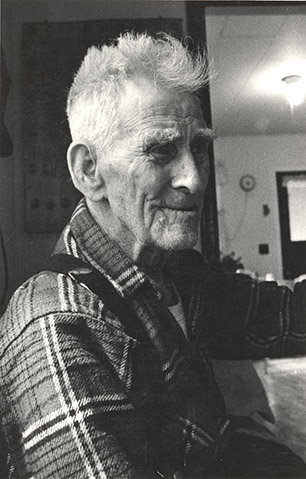
Arthur Bjerke: Well that's his picture right there… when he was a kid you know there used to be a lot of them Russian wolves come over there and I guess they were pretty vicious and within early days you know they used kind of a muscle loaders and flintlocks and they saved all the ashes out of stove and everything they could and burnt potential out of it to make life. Well he was about twenty -two, twenty -one or two and he was sitting up burning potash and he heard the wolves. They had a hard man and he got the hard man and they went out to wolf hunt. They'd put a goat on the sled see and then cut down wolves and come riding on the sled… and dad put the sawn screw in and put the charge out of the gun because it's been laying out in the shop there where they were burning potash so they figured it was maybe damp and they poured in new powder and put in new flint and they went out and he put in too much powder and he blows the guns to pieces and the screw in the back end blows out and went in under his eye and broke the chain bone and I guess they operated on him six times and those days they didn't use chloroform he used to have to take it away. They took out over twenty pieces of bone out of his face on that one side. That's why he got the face turned, the picture is just off from one side of the face.
Sam Schrager: Did you say that your mother had a harder time because she couldn't speak English very well?
Arthur Bjerke: Well it bothered her more but of course there was always somebody around and dad got a blood poison and gangrene in his legs so he died and got the banker from Jerry to come out, he wanted his will made… and they wanted to leave the place to me, dad says if you take care of mother as long as she lives we leave the place to you Well I said that's alright but we'll see what the girls has got to say about that. Well the girls they both said they didn't want nothing so that is the place to me and that mother got what little money they had… and she had that… and when dad died I and my sister went into town you know there was no architecture around here but the father had the store in there, he carried caskets in one thing or another and he had to serve with caskets in there and he happened to be in Spokane last day and he come in and we was upstairs looking at the caskets and here they come and we were looking at one casket, it was a nice looking casket and about the same Mr. Reston was using $40 for a casket those days Well he had one and I had with Mark Dadey's hour, that was a nice casket… he come up and he says you don't want nothing, you want doesn't over there, that was a bigger casket Yeah I said it's a pretty big nice casket, quite a lot of prizes and you know $40 was a lot of money those days Well he said you take satin and he said you have that in for $40 My God you know the neighbors around here that had people die and used them $40 caskets God they went pretty crazy over there that I could buy that nice casket I never told him that I paid only $40 for that
Sam Schrager: Why do you think he gave it to you for $40?
Arthur Bjerke: Well I always traded with him and he was kind of a funny fella, I don't know Some people couldn't get along with him at all and others again you got along with pretty good… there was another story in there that was kind of a buck in him too But they couldn't do nothing with him because this fella had caskets, by God he had the money… and he bought a lot of stuff but the car loads up So he could sell cheap goods and the rest of them and make money I know one time one fella bought a bunch of haywire, that is bailing wire… and he started selling cheap goods and the horse out And by God, old Jurgen shipped in a carload… and by God, he started selling it for two and a half a spool… instead of three and a half a tail of play… he was funny, and finally he sold out and he went down to Seattle He had two boys and two girls… and the oldest one of the girls died afterwards… but two of the boys are kind of think is alive in one of the girls They are down around Seattle Well the oldest boy come up here, it must be five, six years ago And they come to Jerry and visited… and by God, nobody knew him And one of the Anderson's, when they told them who he was, they come out to visit me… and I was working out here… and mixtures just to me, he says, you know who this fella is… i said, well just try them and let me think… i looked at him and I said, by God, I said, he's got all the map of old UC Jurgensen all over his face That was Johnny Jurgensen, so we had quite a visit… well I've seen him for forty years
Sam Schrager: I wanted to ask you what you did after you took care of the cattle What was the next job that you worked on after that?
Arthur Bjerke: Well, I think about the next job I worked on And was around the place and then when they started building the railroad I worked on the railroad gangs, driving teams
Sam Schrager: What do you remember about the building of that railroad?
Arthur Bjerke: Well, I remember when they put the cut to the roof in Derry They had a big kind of gas or steam outfit, kind of a throw… and the clouds, the hard pans, and then the head ridge that run right alongside of it Plowed the dirt up on a kind of a draper And that went up and the dirt fell in dump wagons Then they'd haul it out and dump it… they claimed that Phil threw Derry, that there should go bears in that fill… and they claimed there is another one, birds that fill up that cornel… there was mostly daygos and that stuff on the shopper gang And one get in there that the rest of them didn't like They hit him in the head and they'd bury him in the dirt Then cover him up Did you know about that back then, when they were building the railroad, that there were a couple of guys missing? Well, the bosses knew it all right, but what in hell did they care?
Maybe this fella had a couple of three hundred dollars Common, and railroad was, well, on parish missions, they didn't have to pay him… that was money in the contractor's pocket… and when our drove team up that cornel, the blast of the whole dam cut there It was wide, they were going to put in sidetracks in there And they had dump cars that run out with the dirt And then they kind of had the bridge that we'd drive up on And the dump cars running under a square hole and we'd dump them, slip scrapers So the dirt would go into the dump car, and when you get the dump car up there You start it and that fella would ride out on it and break it to a stop Under that pass, empty the car and straighten up the car and then a horse would bring it back… one morning it was cold and the fellas outside at the dump were kind of enliven They were cold, they went down and set a fire to a big brush fire Got a burning pretty good and they got up onto the dump car that's come out And by God some of the fellas that had been shooting left a box of powder in that brush fire And by God that went out and boy there were sticks and logs and everything flying all over the country Well there was a white man out there and a day go on the dump Boy they sure went there and then, but nobody got hurt Well I worked at the other side and she got through with the teamwork And I come home and stayed home a while There were a band in the trestle, they called it the High Girls trestle… so I went over there and they got up pretty high with it And it didn't make any difference to me how high I went, I didn't get dizzy… the boss says you think you can stand it to walk on them timbers up… my trestle was 97 feet high you know… well I got up there and I run back and forth on the timbers up there And it didn't bother me and I saw I got a job alright, that's why I stayed there about a month during the winter There was a fella from the whole country that stayed here with the folks And he then the tourists here, helped the folks do the tourists I didn't have to stay at home Well then, when we got through up there the boss says He says I wish to God he says we had some more trestles to bed He says I'd like to have you run to home Because you were about the fastest man on the trestle I had The rest of them were older men and they were slower and more careful Well you know them square timbers that have to be bolted together… and you take get 97 feet high walking on and 2 by 12… you take the stringers with 2 by 12 bolted together so they'd make 12 by 12… and you had a long way up in there when you get up to 90 feet to run across on the
Sam Schrager: Do you remember what the daygos were like? Did you have much to do with them… the daygos?
Arthur Bjerke: Well they were Italians and Bohemians Or someone was that nice for them There was one out there staying up here… that always got eggs and butter and meat from her… the boss's name was Pedro He went back to Italy… and there was quite a few of them Italians had stayed here You can't tell their Italians now anymore… they were just someone in one part of Italy Some of them Italians were just as light as any of them But the south part of Italy they were pretty dark… and there was one Bohemian that used to live up there on the hog meadow He turned out to be quite a logger By God you know he was always making a little money And by God you know he got right hard times Quite a few fellas that go off playing work for him… and he always seemed to be able to have a little money… well he had an after you lie that was kind of half foolish And by God you know when he died he made you some money
Interview Index
Arthur understood four languages as a boy, even German. His parents didn't speak English well.
Arthur understood four languages as a boy, even German. His parents didn't speak English well.
One side of father's face blown off while hunting wolves in Norway. Place deeded to Arthur when father died. A bargain on a good casket at Jorgeson's store. Jorgeson underpriced the other Deary store by buying by the carload. Arthur recognizes Jorgeson's boy forty years later.
Building the grade for the W. I. M. rail road through Cornell. Italians murdered and buried along the grade. An explosion. Arthur works on a high trestle. Italians were good people, some stayed; Sam Piwash became a successful logger.