
Description: Role of small city newspaper. Coverage of local issues. Boosting Moscow. Relation of college to town. Moscow banks in the depression. Frank B. Robinson and Moscow's newspaper rivalry. 9-3-76 2 hr p
Date: 1976-09-03 Location: Boise; Moscow
Subjects: Great Depression; prohibition; Psychiana; University of Idaho; bootlegging; businesses; dances; farming; newspapers; politics; sports; wine; women; world wars
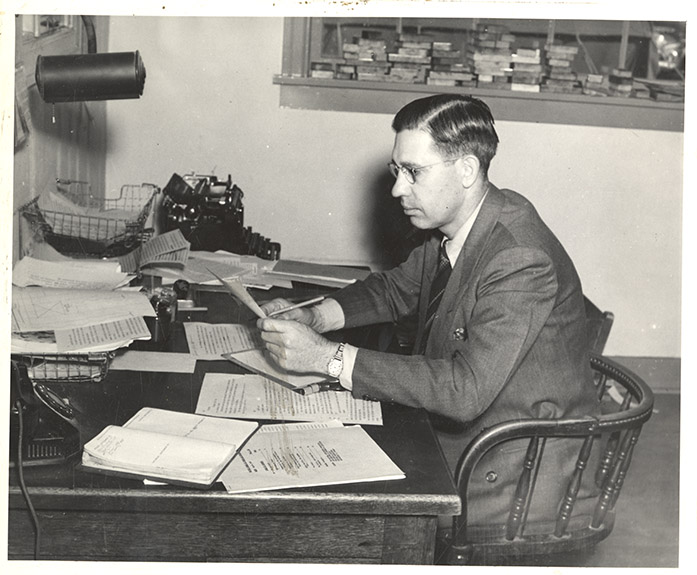
Louis Boas
Born 1900
Occupation: Editor of Moscow Daily Star-Mirror and Daily Idahonian (1926-1966)
Residence: Moscow
Topics:
The colored topic bar is hidden for screen reader users. Use the topic buttons below it, the "Filter by Topic" menu or the search box to find specific content in the transcript.
Sam Schrager: This conversation with Louis Boas took place at his home in Moscow on September 3rd, 1976. The interviewer was Sam Schreger. Moscow, you had mentioned to me that you had a chance to go overseas to go to Tokyo.
Now, you decided to go to Moscow instead?
Louis Boas: Yes. Well, the man who I was working with, who was editor of the Idaho Statesman, was a man by the name of Applegate, A .A. Applegate. And he used to be professor of journalism at the University of Montana. And he had connections with people in Japan. And we talked late at night. And he said he thought he could get me a job with a Tokyo advertiser. And I said, well, that would be interesting. I think I'd like that. I never came down to the point where I had an offer, but he was starting negotiations. Then I had the chance to come to Moscow and buy an interest in the paper here. So security was the reason why I came, rather than adventure of being overseas. And at that time, one journalist from Boise was on the Tokyo advertiser, Hallet Abend. And during World War II, oh, he was in the news quite a bit, as an expert on Japan, and he lectured in this country and so forth. And he had come from Boise also. So that was an idea that you'd get, oh, have fun, have adventure, and so forth. The security of coming here and making some money was the reason why I chose it.
Sam Schrager: When you first came here, did you look at it as a long-term commitment?
Louis Boas: Yes, because I bought an interest in the paper. And I'd gone to school here, so I was familiar with the town. And I'd worked on the paper part-time, so that I knew what it was and so forth. So I committed to make this my life's work.
Sam Schrager: I wanted to ask you, who you remember in the 20s as being prominent people in Moscow? In Moscow?
Louis Boas: Well, there was A .H. Oversmith, a lawyer, and George Lamphere, who was my partner,… and Hawken Melgaard. He owned what is now the First Security Bank. At that time, it was a private bank, First Crust and Savings Bank. And he and his brother in Minnesota owned the block, Stockton Barrow. And he was quite prominent. And then Roland Hodgins, who ran a drugstore here, and the drugstore still carries his name, Hodgins Drugstore. He was very prominent. And of course, F .A. David, who was the father of the David Brothers, who owned David's store. Frank A. David owned the store outright. It was just a family affair, and sons worked with him, of course. And in the 1920s, oh, trying to think, Dr. Gritman was quite well known and quite popular. It's for him that Gritman Hospital is now named, and he owned a hospital that stood upon the grounds where Gritman Hospital is now. It was a framed structure. He was quite prominent. I've missed some, I know, but those are the ones that I can think of.
Sam Schrager: How important was the newspaper to the town at that time?
Louis Boas: Oh, I think it was important to the town. It was the only source of getting information through the town. We had no radio station then. The radio station didn't come until, oh, gracious. In the 1940s, I believe, I would say we didn't have any radio station until about 1940. And it was the only way of getting information out, was through the newspaper. Much more so than now, I think, actually. And then we carried, the items were small items, but they were important to the people of town. And it gave the merchants an opportunity to advertise. It was the only advertising medium.
Sam Schrager: Do you think the local coverage of the paper was more important than the national coverage at that time?
Louis Boas: Definitely. Definitely. It still is. I think more than half of your people in town take an outside paper, either from Spokane or Lewiston. Both the spokesmen review and the Lewiston paper have large circulations here. And I think they take the local paper now for the local news, because they can get the world news through larger proportions through Spokane or Lewiston publications.
Sam Schrager: At that time?
Louis Boas: At that time, and I think today. They were taking Spokane. Oh, yes. Oh, yes. Not so much in the early 20s. The Lewiston paper didn't have any circulation here, but the spokesmen reviewed it. And more than half the people took it. And I'm sure that more than half the people now take one or the other, the spokesmen of the Lewiston Tribune. But there's no other publication that serves the city and gives the city information. The Lewiston Tribune has some moscow news, and the spokesmen of the U .S. some. But not much. Not as much, no. That's what your local paper is for, is it stress the local news and people can take the outside paper, or they take Time Magazine or Newsweek. But your local newspaper should be and must be the conveyor of local information and serve as a watchdog over local government. That's the number one.
Sam Schrager: Did your paper do that in those days or the 20s?
Louis Boas: Oh, yes. You've, that's the major responsibility of the newspaper, is to be the watchdog over public institutions as a representative of the people. That's why you have constantly needle public officials. That's your job. Keep them on their toes. No question about it. I've maintained for years that any newspaper that didn't fight with the police department wasn't doing anything… always… because they like to hide things. That's natural. And your job is to fight them out. I never let a reporter fight it. If he had trouble getting something out of the police, blotter, or through a city official, if he had trouble, he was to be quiet and calm and just accept it. Tell me. And I'd go and do the fighting. And sometimes she had to use threats. Say, oh, okay, if we don't get this, I'll call up a lawyer and we'll get a subpoena. So you break them down. Does that sound funny to you?
No, it doesn't at all, because that seems to be the way it is now. Well, that's what the newspapers are for. They're charged with that by the Constitution. When the Constitution says, the First Amendment, the people shall have a right to a free press and free speech. The people have a right to a free press. Not the newspaper. The newspaper has no more liberties than I have as an individual. But the people have a right to a free press. So that puts responsibility of that free press, work for the people. If you find corruption in city government, expose it. Don't let them cover up. Many people think that the newspapers are given a privilege. Under the Constitution, they are not. It's the people that's given the privilege to have a free press. That's a great distinction. In a small town like Moscow, as it was then, in practical terms, it seemed to me that it would be difficult to have a town become very fast. To have too much of an adversary relationship within the power structure of the town itself. Now, did you find that... I mean, I would think that there would be pressures, a lot of pressures even on the paper, not to look too closely into the people. There is. In a small town like this, I wouldn't think this paper could go too far. Well, you've got to use your strength. There's always a threat of libel. You've got to be factual. If you aren't, you're going to get sued. I've been sued twice. My paper's been sued twice for libel. In both times we were freed. In other words, two different times I was sued for $150 ,000 and the paper was sued for $150 ,000. We won both cases. Because the main thing is the truth will prevail. Now, tell me briefly about what basis a suit could be brought against you. Well, you had him liable, an individual. I'll tell you the second one. The first one was over a controversy of a Naval ROTC student and a man in town having...
...created a disturbance and a paper got involved in it and we upheld the student's rights. There was a public meeting and so forth. I'll skip that. But the second one is typical of how a newspaper can get sued for libel and yet be innocent. A man came here a number of years ago with the idea of establishing a program, business... ...to provide programs for the radio stations of Idaho. Sort of a syndicate idea. And he rented the building up on North Main Street and he was going to use the talents of the University of Washington State College... ...and hopefully to get national advertising for that program. Well, he was living at Coeur d 'Alene or Hayden Lake and the police got a telephone warrant for his arrest from Coeur d 'Alene. The charge was passing bad checks. Well, we carried just a little item about an inch and a half long. He was arrested here in Moscow at a motel upon a warrant from Coeur d 'Alene for passing bad checks.
Well, the police came down from Coeur d 'Alene and took him back. I didn't even pay any attention to it. About five months later, we were served as subpoena as being charged with libel. We referred to this article. Gosh, I looked the article up and I couldn't see anything wrong with it. So I sent a reporter to the police station and they looked back in the log and found where it had been typed out. And our story was absolutely factual. But it turned out that he had only written one check. And the police got it as checks, plural. We reported it as checks, plural. So we consulted our lawyer. We got a lawyer from Lewiston who was very good, Clements. And he said it sounds bad. So he made a trip to Seattle to confer with the recognized libel expert of the United States who happened to live in Seattle. I can't think of his name now. He wrote a book on libel, which I have someplace. And he said it's libelous per se.
Checks are different than check. I was sued for $150 ,000 and the paper was sued for $150 ,000. And in federal court, well, federal court means it's between states, between one state and another. So they cannot sue in a state court because one of the people resides outside the state of Idaho. Well, it appeared this man moved from Hayden Lake to Spokane. And so our lawyers tried to prepare as much as they could for the trial in federal court in Moscow. And as a last resort, we, about two weeks before the trial, we sent a local attorney, Morry O 'Donnell, Morris O 'Donnell, down to Boise to check at the Secretary of State's office to look over the incorporation papers. Just thought we might find something. And we already had dug into this man's history and he'd come and he'd been a high binder, oh, in Arizona and Utah and Oklahoma, where he had promoted various stock selling schemes. He was not a very good individual. We knew all that. We had planned to have witnesses appear to testify to that effect. But O 'Donnell, when he went down to the Secretary of State's office, found in the file a letter from this man, written to the clerk of the Secretary of State, and he said, don't be surprised at the heading of this letter as coming from Spokane. He said, this was only done at the request of my lawyer that it would be better to sue in federal court. So I have temporarily moved to Spokane rather than Hayden Lake. So Mr. O 'Donnell got a copy of that letter and when the case came to trial, by our attorneys made a motion that jurisdiction was not correct. There was no jurisdiction in the federal courts and produced a copy of this letter to show the reason why, that he had said he was only moving to Spokane temporarily for the purposes of bringing suit. The judge threw it out immediately and the statute of limitations had expired for bringing the suit in state courts. So we were free.
That's the life of a newspaper man. But it sounds a bit crazy to me because there was no malicious intent on that law. No malicious intent. You made a mistake that the police had made. Now police make mistakes all the time. Of course, truth is the biggest defense against libel. We were going to produce that naturally. We were going to produce the chief of police. We were going to produce the log of the police records that there was no malice intended and so forth and so on. But you weren't that confident. No, we weren't. We weren't. Who knows what a jury is going to do.
Sam Schrager: When did this happen? What decade was it?
Louis Boas: Well, it was in the early 60s or late 59. This other case that you spoke of, the ROTC, that was in the 50s. That was in the 50s. Yes. I would guess about 1956 or long in there. But you always run that risk.
Sam Schrager: But you had no, in the 20s and 30s in those years, were there any situations that were running the risk?
Louis Boas: Oh, I was threatened with death one time, yes. Someone was going to kill me.
Sam Schrager: For doing what?
Louis Boas: Running a news story. Well, without you. You didn't.
Sam Schrager: Without you didn't run the story?
Louis Boas: Certainly. There was a lawyer that threatened me. A lawyer from Lewiston who is now dead… that's common.
Sam Schrager: Was the story going to be hurting him?
Louis Boas: Well, hurting his client. I can't remember the details of it now. But he called me on the phone and said, If I ran that story, he's going to kill me. And I said, Well, that's fine. I'm going to run the story. Which we did. And that's the end of it. Nothing ever happened. He may have been, may have lost his temper and said something he didn't mean, I don't know. But it was still a threat.
Sam Schrager: But in terms of dealing with the watchdog of government, what would that usually get down to in a specific concrete way in the 20s and 30s?
Louis Boas: For instance, the prohibition is in my mind. Because I know that from what I've heard, not only here, but a lot of places, there were varying degrees of enforcement of prohibition. It seemed to me to be almost a selective enforcement, perhaps because you only had a limited amount of resources.
Sam Schrager: But what was the attitude that the paper would take towards that prohibition and question?
Louis Boas: I don't think I ever entered into it. It was unpopular with everybody. But I recall an instance where we were quite critical of a certain sheriff at that time who used high handed methods in arresting people. Instead of being polite about it, he'd bang them around. And we criticized that very severely. That's the case of watchdog. He reformed, but shortly after that he was not in office. That's the only one that comes to my mind right now… those things… i had an argument with, a long time ago, I had an argument with the clerk of the district court. A reporter reported to me that he was sure we were not getting all the news of minor things divorce actions filed, a marriage license issued. So I went and talked to the clerk and she said, well, they requested not to have this rung. So I said to her, well, you know, you're doing my job. You're deciding what's going to go in the newspaper. That's my job. Now, if you want to edit the paper, come on down and apply.
And this clerk saw the wisdom of that and from then on out, nothing was ever withheld. That individual is a very good friend of mine today. Very good friend. But she was doing my job, you see, when she decided that they asked not to have this divorce in the paper while she just took the papers in a drawer where the reporter wouldn't find it. Or a marriage license. And then after that, they'd always come to me. Dozens of couples have come down to me and said that we're going to get married, but we don't want it in the paper. And I'd say, well, maybe one of your parents does. I will not keep it out. I'd say if you want to keep it out, go someplace some little distance. Go over to Washington or go to St. Mary's where they don't have any daily paper and where it would not be reported and sent on into Spokane. Go to Orofino or someplace else, but if you think it's necessary. If you get married here, it's going to be in the paper.
This relates to what you were saying to me a little once when we talked about the newspaper as being the paper of record. That's right. I think it should be. I think every newspaper should be a paper of record for its community. I think that you carry every court action, whether criminal or civil, because it should be a record. So that you, as a historian, want to look up something, you can find it in the paper. You can see what it was about. I think every newspaper should be a newspaper of record for its community. Of course, we have The New York Times as the nation's newspaper of record. That is why every speech that the president makes, and this has been going on for years and years and years, is published in The New York Times in full. It may take two pages. It may take three pages. It's published. Every speech that the Secretary of State gives, no matter where, is published in full The New York Times. It's to recognize a newspaper of record for the United States. You can always find it there. Every act of Congress, may just be in table form with every act of Congress that's reported in The New York Times.
Sam Schrager: How did you regard social activities as whether or not they were news worthy of record?
Louis Boas: What I think of is, we take these rural papers, for instance, the one that Troy Kenner, they would typically record, you know, what happened on Little Bay Ridge, and they'd have all the stories. And it recorded really the life of those people. But in a place like Moscow, it was a city. Well, we did that in the early days, the 1920s. We had correspondence in Big Bear Ridge and Fix Ridge and Troy and Gary and Beaudel and all those places, yes. Because we had readers in those places. We wanted to give them something. They don't have big news. They don't have important town council meetings, but they do have John Jones going to Portland to visit his sister. So you put it in. People, names make news. And in qualifying, your life is news and record. Right. That's news. Names make news.
Sam Schrager: What about Moscow? Were the standard different from what would be included from Moscow?
Louis Boas: You wouldn't include as many trivial facts in Moscow as you would for the outlying communities, because we had bigger news to publicize. More important news. But we ran some of those small things. We ran what we call a personal column every day. Somebody leave and go to New York, why it was two or three lines. What about- The bigger you'll get, the bigger the town gets, the less you can do that. That's correct.
Sam Schrager: In terms of political conflict in the 20s and 30s, politics itself, did you ever find yourself in the paper involved in an issue, a big political issue?
Louis Boas: Oh, sometimes a big political issue, yes. Like maybe the war in Vietnam is an example, but we didn't have the war in Vietnam in the early days. But big issues of that nature, we tried to take a stand, tried to publicize it. But we did not do the way it's being done now, recommending a candidate for election. I didn't think I was smart enough to do that, so we just kept that out. Let the people decide. We didn't try to say that the Democratic Party of Idaho was a better party than the Republican. We weren't smart enough for that.
Sam Schrager: So you didn't consider the paper wasn't affiliated with the Republican Party?
Louis Boas: No. We tried to maintain an independent attitude. Individually, I was a Republican, but I tried to be fair on either side. And as far as choosing between candidates for state office or county office or city office, no. Try to publish each side and make no choice of our own. I think it's wrong in a small town to try and make a choice. I think it's wrong now for the newspaper here, and I suppose they all learned this from what's on the air. To decide that Joe Dolks is a better mayor than somebody else. I don't think the paper has a right for that in a small town. In a big city, where the individuals are not known, it's a little different story.
Sam Schrager: What about dealing with the questions of policy? What's the right stand to take on an issue? Did the paper feel it? And editorially it was appropriate to take stands on the issue?
Louis Boas: No… it's too small a town. People are too close to it. I don't think anyone on the paper is qualified to do it. Certainly today, the editorial policy of a paper seems largely directed towards those ends. Policy opinion. Yes, I know. I don't think there should be too local, because I say I don't think the editor now, any more than I was as editor, is that brilliant. We can distinguish what's right and what's wrong. Now, in the big papers, the stand is taken by a policy board, the Portland Oregonian or the Seattle Times. The editorial opinions are not the expression of one individual person. They'd have a daily meeting of four or five.
Sam Schrager: The editor would say, okay, what will we discuss editorially for today's paper?
Louis Boas: And they decide and hash it back and forth. And then the editor would say, okay, we'll take a stand, so and so, on this issue. Bill, you write that editorial. And then discuss some other issues. They've got an editorial board. But here, in a small town, it's one person. And that one person's no smarter than you or I. But you would feel a difference between taking a stand on a local issue and taking a stand on a national issue. Some would, yes. Because you're too close to the local issue. And you can view objectively a national issue. You can't be objective in a small town with a small town issue. I don't think you can. You're too close to it. They're friends of yours or they're not friends of yours. And that in itself could influence your position. Definitely. Definitely. Rather than the merits. If you don't like Joe Dokes, why, it's easy to say, oh, I guess programs haywire. If you like Joe Dokes, why, oh, he's a fine fellow. I think he's on the right track. Those things are too close for a small town. And yet some of the small town papers, for instance, I've looked at some of the old Dearie and Troy papers, and it's venomous what the editors were doing. I know it. I know it. And just vendettas against other editors. In fact, one of the favorite targets of the small town editor was his neighboring editor. I know it. Before 1920, in the 1915, 1916, when the editors in this county used to battle back and forth, every issue was libelous. No one ever took him to court, but every issue was libelous.
Sam Schrager: Why do you think they were involved in that kind of action?
Louis Boas: Oh, they thought it was popular. I don't know.
Sam Schrager: Sold papers, maybe?
Louis Boas: Maybe, I don't know. Pete Orkin. He was running that Troy paper. Boy. That was awful. He could have been sued for libel every day. He was that kind of a firebrand. I knew him.
Sam Schrager: What do you remember him as being like?
Louis Boas: Firebrand… he had been here way early, I don't know, in the 1910, 1911. Then he went down to Sullen, Idaho. It was a firebrand, I told you. He was, yeah. Darn.
Sam Schrager: But that, do you feel there was a period of time when this personal journalism, editorial journalism, was in vogue and that that ended later? Or was it just in certain areas of people?
Louis Boas: Oh, my impression is that it was more or less universal for small town papers. Not only in Idaho, but I think in other states, too. I think it was a universal concept of back-to-down journalism.
Sam Schrager: But it was never one that was, or was it, in law school in the earlier years?
Louis Boas: Certainly, no, sure. But in the 20s, when you were in the 20s, I didn't see it in your 20s papers. No, no. It was earlier than that. In the teen years, 1910 and on, I think it was more or less universal. It was my impression. In fact, I noticed in... Ben Franklin used to have arguments with other editors all the time. In the Star Mirror mirrors of the 20s and 30s, this newspaper staff was not printed in the paper, usually. And the editorials were unsigned or uninitiated. I mean, there was no identification, really.
Sam Schrager: Was there a reason for that, for the policy of not advertising who the staff was at that time?
Louis Boas: Well, yes, because it's a... why advertise what the staff does?
It's the newspaper's responsibility. The newspaper takes the responsibility as an institution for what appears in print. I've never seen any other newspaper which had signed editorials other than the Lewiston Tribune. I've never seen one. Now, there may be, but I've never seen them. They aren't in the big papers. And I've often wondered why the Tribune does it, because it should be the opinion of the paper, the opinion of the institution, as a representative of the people. That's what the opinion should be, rather than the opinion of Jay Shalaby or Bill Hall. Who cares what Bill Hall thinks?
You care what the Lewiston Tribune, as a representative of this part of the country, thinks and believes, not Bill Hall. And I've never seen any newspaper have signed editorials other than Lewiston. Maybe you have, I haven't. No, no, I was thinking also of the masthead. I was curious to see who was on the staff at this time. I noticed you didn't... Well, I don't know that any newspaper carries a full staff. No, I don't think so. No. You'll have the name of the publisher if there is an individual designated as a publisher, and possibly the name of the editor, and that's it. And with us, up until the time I sold out at the news, at the Idahoan, I sold my interest and retired in 1966. Why the publisher was designated by our articles of incorporation and bylaws as the corporation. There was no individual publisher. The publisher was the corporation. And after I left, why they named William Marano as publisher. And what it meant, I don't know.
You feel personally that the idea of the newspaper as a collective entity is the way it ought to be conceived rather than as a group of individuals. Right. Right. It should be its own identity. Everybody in the organization contributing to present that identity to the public.
Sam Schrager: What's the advantage of that in your view over the group of individuals approach?
Louis Boas: Well, the advantage is that it becomes singular. It becomes speaking with a singular, unified voice rather than as a group of individuals agreeing upon a choice. It should be, I believe, an entity by itself. Right or wrong, that's my belief. No, I think it makes sense. I wanted to ask you some about the booster way of approaching progress, which I feel was very strong at that time. Not that it doesn't exist now in the chambers of commerce, but I think in the 20s and 30s, well, 30s, it wasn't a depression. But the great hopes were certainly apparent in the newspapers of the time. I'm wondering how the paper felt about boosting the city of Moscow. Well, I think it felt that you try to present the best picture you can of your community. I think that still exists. Little papers and big papers. I think the Seattle newspapers are trying to present the best and happiest side of Seattle at all times. I'm sure they do. And the Boise statesman is trying to present the best side of Boise. Best foot forward. Sure, that's natural. For bigger little papers. It's expected of you. And it's what, I like Moscow, that's why I live here. Why shouldn't I tell my friends?
Same with you… and when I see somebody, just the other day, George Blanda was released by the 49ers, I guess, football team, and he went to his home in Illinois. Why would anyone want to live in Illinois?
I don't know. But he does. That's his home. So he's a booster for Illinois. I can't imagine anybody wanting to, like, I guess Illinois is a fine state, but I've seen of it. It doesn't appeal to me. And I don't know why anybody would want to live in Florida with a terrific keep. They have them in summertime, but a lot of people do. And they like it, and they tell their friends about it, and they're boosted. Well, just as a, I see one problem in this, just to be a devil of advocate, and that is that if you boost your town a lot, it can lead you not to want to see the things about it that are in need of improving. You can, that's right. You've got to look at it objectively. You've got to have an objective attitude that you can still support your town, support its institutions and its climate and so forth as a healthy institution, as a healthy program, without overlooking its faults. And we all know that every town has its faults. Our streets are too narrow, and it's too bad. That's a fault. When they laid the town out, they didn't make the streets wide enough. That's why you're parking on only one side, in so many areas of the residential district. It's a drawback. And you've got to recognize it, but you still see it.
Salt Lake City is beautiful. Great, big wide streets. You've been there, haven't you?
Big wide streets, I don't know how wide they are, 120 feet or something. Brigham Young had the right idea when he laid it out. He was looking to the future. And so many towns don't. Even Boise years ago had narrow streets. It had to widen them.
Sam Schrager: What about prospects for growth? Did people in Moscow in the 20s, were the businessmen very concerned about attracting whatever growth they could to the city?
Louis Boas: Oh, they wanted it, certainly. I don't know why, but every one wants his town to grow. The only one that didn't want a place to grow, I think, was Tom McCall, as governor of Oregon. He said, come visit us, but don't stay. Which is very unusual. Most states want to attract population, and attract business, and attract money, and attract growth. Just natural.
Sam Schrager: Were there ways, practical ways of doing that in the 20s?
Louis Boas: I mean, you can say we like a town to grow, but that doesn't bring people to it. No, I don't know. Your Chamber of Commerce was constantly urging people to settle here, and urging businesses to locate here. They're still doing it. They recently formed an economic development association, I believe, and they got to track the land down the southern end of the town as an industrial park. Yes, well that means that they hope to get some clean type of industry there. And that's just continuing the same thing that's been going on since the town first started. You always want to attract other people to your community. I don't know where, wherever you live, you do that. I think that's a universal appeal. You know, in some of the recent controversies in Moscow, last five years, for instance over the New Couplet, there was an effort made to establish a difference in interest between the business community and the residential community of the city.
Sam Schrager: Now, in terms of the early days, the 20s, the 30s, back then, was there any difference in interest in ...?
Louis Boas: Certainly. There's always a difference. If the city was going to open up a new area or create a paving district, while there were some opposed and some for it, certainly. All of your street improvement in the town has come through creation of improvement districts, in which the taxpayers of that area pay for the paving and the sidewalks and curbing and all that. And they never were unanimous. I don't believe they were. There's always one who didn't want it, who didn't want to pay for it. That's natural. Well, the difference between business and residential interests is the one that I wonder about, because it seems from that point of view that the business interests certainly are the people that do make the important decisions about what will happen in Moscow. Oh, I don't believe there was a division between the residential community and the business community. I don't believe there was any great difference in those days, any more than it is now. There's some opposed to it now. Some people living in the residential area are opposed to the business community, thinking making too much money or this and that. But it's not universal. It's small. And I don't think there's any difference in the 1920s than it is now. I don't believe so. Well, looking at the universe...
Sam Schrager: The university faculty and staff, in those days, were they a separate community from Moscow? Or were they, on the other hand, integrated with the social structure of the town?
Louis Boas: I mean, I have a sense that there is certainly a degree of separation. It is a world unto itself. I think there is a greater integration between the town and university in the earlier days than there is now, because the university depended upon the town to a greater extent for support. The town would bat the university for support for money and so forth. I think there was a greater integration. Many, a larger proportion of university teachers belong to the Chamber of Commerce than is true today. I think the president of the university would come to the Chamber of Commerce luncheons as frequently as anybody. And my understanding is now that Mr. Hartown never goes to a Chamber of Commerce meeting. And I think that there's a very small proportion, smaller proportion of the faculty that are interested in the community through the Chamber of Commerce and through the service clubs, and there was in those days. That's my impression. I'm not active in any service club, or I'm not active in the Chamber of Commerce now, but I know that even to the time ten years ago when I retired, I think that there was, oh, the university felt a little more independent of the town. They didn't take as much interest in the town's civic opportunities. Then they had. I noted it. Yet they're more interested in politics than they were in the old days. Now in the 1920s and 30s and 40s, I only recall one instance where any person from the university's staff was interested in the politics of the city. And that was Harrison C. Dale, became a member of the city council.
But now we've got always, it seems to me, that there's two or three on the city council from the university's staff. And they're more interested in the politics than they are in the community affairs. I noted in the early papers that I looked at that the coverage of university events of speeches by the president and that sort of thing seemed much greater than it is today. It seems that today what goes on at the university is often not considered news unless it's sports. Yes. I agree with you. I think there's a, I said I think there was a greater integration in those days than there is now. I think the separation was greater now. Probably because the town's people think the university is well enough established that it doesn't need too much support. And the university family believing that the town can't do it as much good and so they go their own separate ways. But in those days, earlier days, why we tried to give university news prominence, keep it. It's our institution. And we were proud of it. We wanted to publicize it.
Sam Schrager: Do you think that the town was able to successfully promote the university at the state level in those days?
Louis Boas: Oh yes. Oh yes.
Sam Schrager: As compared to now?
Louis Boas: More so.
Sam Schrager: In what way would that be?
Louis Boas: I mean, in the newspaper. We raised money to send people down to the legislature. Lobbying supposedly. We would have somebody down at the legislature frequently. Businessmen. Businessmen. That's right. We'd have to stay for ten days and support the institution. Oh yes. I think to send somebody down now, I don't know. I really haven't followed it that closely.
Sam Schrager: But in those days, haven't you asked?
Louis Boas: No. We're talking about the leading, some of the leading citizens of Moscow, as we were earlier.
Sam Schrager: How closely knit was the social structure of the leadership of Moscow? How closely integrated was it in those days?
Louis Boas: Quite closely integrated. Much more so than now. Any businessman didn't belong to the Chamber of Commerce or a service club and wasn't active in those, why an effort was made to get him active. And I think much more so than now. They'll pay their dues now. A larger number pay dues but a fewer percentage, smaller percentage, take an active role in the Chamber of Commerce. They depend too much upon the Secretary. Let him do it. And that's like a small family and a big family. You've got to cooperate and the businessman and the professional man will be willing to do more of the work. The Secretary in those days was a part-time Secretary. He got maybe fifty dollars a month to keep the minutes and do the corresponding and so forth. Didn't have a full-time Secretary Manager of the Chamber of Commerce and so the community, the leaders in the community, professional and business, would do more of the work. Head up a committee and the committee would have an objective and try to perform to reach that objective. Now the Board of Directors tells the manager to do so and so.
Sam Schrager: When decisions were made affecting the community, the business community, was there much consultation among the leadership that you think of the leading citizens that were talking about it?
Louis Boas: Sure. I'm sure there was. Definitely. Well, during the bank crisis, as an example, in 1933, in the late 1932, when we had the banking crisis, as the recession approached, banks were failing all over the country. And two failed in Moscow. The first trust and savings bank was owned by Hawken Melgaard. The first national bank closed. It was a branch of the old national bank of Spokane. And the Idaho State Bank had closed previously. And everyone was fearful just about the time beginning of 1933. Roosevelt went into office in March in those days rather than January. And the leaders of the town got together. My partner was one of them, George Lamphere. And they seriously and meant it. Pledged their assets to the first security bank and they had a great big sign out in front signed by George Lamphere, Franklin David, Roland Hodgins. We pledged our assets to this bank security. And they meant it. There was no run on the bank. And the bank stayed open until Roosevelt closed all the banks of the nation for a period of what, two or three weeks. But those men did that. They got together as a group, not through the Chamber of Commerce, but just individually. And about a dozen men who were worth good share of money at Beech, they pledged their assets to the bank. That's community cooperation. And that is. That's an excellent example of what I'm thinking about. That happened. That happened. Definitely. I didn't sign. I didn't have any money. My partner did. But the leaders of the community, I would guess about a dozen, pledged all their assets to the security of that bank. And the state opened. A run never developed.
That's a great asset to the community. To have Republicans and Democrats. My partner was a solid Republican. Roland Hodgins was a leading Democrat. Didn't matter. They wanted to see the bank stay open. They wanted to see the town free of that fear of collapse. I understand that Hawke and Milgard was very upset about having to shut down at all. He definitely, definitely felt that it was quite wrong. Right. He felt it was wrong. And of course he had to shut down when Roosevelt closed all the banks. And I believe they had an army of auditors check the banks before they were allowed to leave. But Hawke and Milgard kept his open. Right to the end.
Sam Schrager: These banks that had failed in Moscow, did they take many people down with them?
Louis Boas: The first, the state bank, Moscow State Bank, yes, took quite a few people down with them. The Idaho First National Bank did not. Because it closed in fear of a run. The old national bank was Spokane. It closed and all its branches closed. And I don't think anybody got hurt. I'm sure everybody got paid off in full. When the bank reopened, it was shortly after that sold to the Idaho First National Bank. And having, instead of being a branch of the old national bank with Spokane, it became a branch of the Idaho First National. But I don't think anybody ever lost a dime by that bank's closing. They closed to prevent a run on the bank and prevent anyone being damaged. But the Moscow State Bank, it hurt. It hurt. Yes, it hurt. I was banking there. And all I ever got back was about fifty cents on the dollar. I didn't have much to lose in those days, so it didn't matter much. Still. Still, you lose half of what you got in there. They paid out roughly half fifty cents on the dollar over a period of a couple of years until they could get their money back in on loans and so forth.
Sam Schrager: What was the condition of the working people, of the more blue collar people, people who were definitely not well off before the Depression hit? Were they in really bad shape in what was going on?
Louis Boas: I don't think they were. I don't think they were in bad shape any part of the country. I think they were in pretty good shape. Wages were quite low as compared to what they are today, but they bought just as much at that time as they did now. No, I think the working man was prosperous in Moscow. The ones who were hard hit were the farmers. Wheat was eighteen cents a bushel in 1931, 1932 rather. We burned wheat in the stoker of the old-star mirror as an advertising stunt, just to publicize it. It didn't burn very well, but we took some eighteen-cent wheat, which was a price on the local market, and fed it into the stoker. Mixed a little coal with it, and it burned. Just as a promotion stunt, we showed that we were trying to help the farmers to get rid of the surplus, burdensome surplus of wheat. The farmers were the ones that were hurt.
A lot of institutions foreclosed on the farms. They couldn't pay off their mortgages, and water farms were foreclosed. I'd figured that people in the cities, people in big cities really having a rough time, I figured the farmers who told me they were still here, those that held out were in fairly good shape because of what they could grow on their farms. But I was wondering, to me, Moscow seemed like a kind of in-between place, not a big city. We didn't have any industry. People who worked were people who worked in the stores, or the university, or the... There was no industry anymore than there is now. We have no industry. But those people were not laid off at that time. No, not to any extent. The only industry we have now is the industry of building the plumbing trade, the electricians trade, the cartonry trade. That's it. We have no industry. We don't have any blue collars, except service industries, more or less. But like the clerks in the stores. Of course they were not laid off. The town was in good shape, in better shape than other towns in Idaho, because more students came to the university. They couldn't get a job in Nampa or Twin Falls, so might as well go to the university.
Sam Schrager: You mean enrollment in Creasdale?
Louis Boas: Definitely. Definitely. Enrollment in Creasdale because of the Depression. A student couldn't get a job while he'd come to the university. He had a few hundred dollars, and they batched, and Papa could spare a few hundred, and so they came here, rather than to try and get a job. No, the enrollment increased during the Depression.
Sam Schrager: Do you think they spent a lot less than they would have in the 20s, these students?
Louis Boas: Oh, I think so, yes. I've heard some people say that you had been entertained, and amusements became even more important in the university than they had been when they... Well, about all the amusement we had in those early days was a movie, and campus dances, dances on the campus. But you didn't have a bowling alley, we didn't have TV, and radio was embryonic, and about the only entertainment you had was a movie. Or to go out Sunday afternoon and walk the railroad tracks. Which you told me. Yes. That's right. You know, there's something about prohibition, and then I'd like to ask you. I understood that the impetus for local option here came largely from the churches in the teens, or the early teens, and that the anti-licker sentiment did run very high in some quarters in Moscow. I wasn't here then. Well, I had heard that the revivals, some of those revivals, as late as the early 20s were also making a lot of hay out of that question.
Sam Schrager: Do you remember the Bulgin revival?
Louis Boas: Definitely.
Sam Schrager: What do you remember about that one?
Louis Boas: I remember that I got arrested. I was working on the Argonaut, and Bulgin had a tent, I believe, at what we now would call the Christian Church lot, the lot right to the east of the post office, where the Christian Church had been built later. And he had a big tent there. And I was working on the Argonaut. It was my freshman year, in 19, in 1920. We heard rumors that he was attacking the university as a place of sin and so forth. So the editor of the Argonaut, a man from Boise by the name of William Langroys, and I went up to listen to one of his lectures on the night the Argonaut was going to press. And we sat in the back and just listened. We didn't hear anything said about the university at all. So after 30 or 40 minutes, we got up and left and walked down the sidewalk on 3rd Street. And I, undoubtedly, we were laughing about it and talking.
And police or somebody, or Mr. Bulgin, made some remark to the policeman in the hall, we were disturbing the peace, and we got arrested. And all we were doing, we might have joked about something or laughed as we walked down the sidewalk. And we were taking the police station and released immediately. Nothing ever happened. But he was a, Bulgin was a fire eater. He was a Billy Sunday type. Billy Sunday is probably too early for you, but you've heard about Billy Sunday. Yeah. Yes. Bulgin was that type of individual. That was his living, was to work the communities up and tell them how sinful they were and so forth. But I never heard any verification of the fact that he attacked the university. I've heard people say that he attacked the university. Yeah. I've heard it too, but I never, because it could verify it.
You must have been pretty mad about being here. Yes. I was mad. You really weren't doing anything. Not a thing. We just sat just quietly in the back of that hall as we could be. And when we get out, I don't doubt what we may have laughed a bit about it or made some joke and so forth. And the window was open and I suppose our voices carried into the hall. He was anxious to get somebody arrested for the street.
Sam Schrager: Do you remember at the time that there was prohibition here that there was a definite division of opinion about it?
Louis Boas: Well, certainly. Sure. And a lot of people seem to believe that it really was going to answer the problems of our society. That's why Congress passed it. I don't recall now whether it was it, oh, it had to be a constitutional amendment, yes. The 18th Amendment. I think people believe that it would be something that would help the country. But they counted upon greater acceptance and turned out to be the case. Well, I've been told that, you know, the better families and parties in Moscow would drink socially during that time. I think it was adored by a lot of people, naturally. Yeah, my dad made wine during the period, so did I. It was adored. Yet only a few years before it was approved by the Congress and the people, or the legislature, I could get with. There were two ways to approve a constitutional amendment. One, by the vote of the Congress and then the referendum vote of the people, or approval by the Congress and then approval by the legislature. To amend the Constitution in two ways. I don't recall how the 18th Amendment was ratified, whether it was by legislative action or whether it was by a vote of the electorate.
Sam Schrager: That happened when, 1915, or only in there someplace?
Louis Boas: I don't remember how it was ratified. Well, I know from what I've been told by Hap Moody that most of the enforcement that they were engaged in was out in the lumber company. Right. Picking up the bootleggers out in the hills. Hap Moody was number one. He was the best in the North Idaho. He looked like the lumberjack, and he got dozens of bootleggers arrested. He was a deputy sheriff, I believe. Before it became terrible. He looked the part. He was under summer feel. That's correct. They still have quite a reputation out there. You bet they do. Summer feel and Moody and Jordan. Yes, sir. That's right. Hap Moody was the best. He showed me a couple pictures of himself looking at that. You wouldn't think he was a cop. Not at all.
Sam Schrager: Oh, by the way, do you remember the past time? Was that a place that everybody would use or just some people?
Louis Boas: Oh, just some people. Principally, farmers, a lot of farmers went in there in the wintertime in the afternoon and played cards or played pool. It was a working man's headquarters, more or less the way the corner club is now. Same type of individual that goes to the corner club now. Except go down there now and drink beer. And of course, when I was here, the past time didn't have beer, but they, I believe they either stayed open all night. I'm sure it was a 24-hour operation. That's right. Yeah, it was a 24-hour operation. I'd gone in there as a student, study for an exam, and knock it off at 11 .30 and go down to the past time and get a sandwich and a cup of coffee. A lot of students used to do that occasionally, but it was mostly a working man's hangout. They had a bar and they had a, I mean a... Counter. Counter, yes, a restaurant counter. And there was a cook on duty, I believe, 24 hours a day. So I'd gone in there many a time to get a sandwich and a cup of coffee at midnight after studying for three, four hours. Get out and get some fresh air and go down to the past time and get a sandwich.
Sam Schrager: What was the problem with President Kelly?
Louis Boas: It seemed to me from the reading that I've done about the University history that he just had more trouble with the,… than the probably any other presidents that I've known across. He was only here a couple of years. Well, he tried too many reforms. He wanted to do this. He brought in an assistant and I was not too familiar with what happened up there, but the faculty was all against him. He couldn't get the cooperation of the faculty. His junior college proposal was one that... Yes, I did greatly remember that. I think that's correct. I think he did start the idea of having a junior college as part of the overall picture. Two years of general preparation. Yes, yes. He just didn't go over. He couldn't get the cooperation of the faculty. He didn't get the cooperation of the town. He just rubbed everybody the wrong way.
Sam Schrager: Did you see my article on football?
Louis Boas: I haven't seen that yet and I was going to ask you if you would briefly tell me the story of the Kelly estate. Well, Mr. Kelly's one of his ideas was that athletics should be amateur completely. No athlete was entitled to any more than any other individual. In those days, the athletes would work for say $50 a month. They would work around the gymnasium. They would set chairs in the gym for a meeting and they would sweep the gym and do other chores. Or they would work for a dormitory as a hasher and get paid that way and they worked. There was nothing given to them free. They had to work for it. But Kelly's idea was that if he was an athlete, he should not even get paid for working and they should get no help at all. Well, the coaches were quite disturbed. So informally, a little group formed downtown to raise some money for athletes. I was treasurer of what money we raised. We went up and down Main Street and we raised probably all told maybe $2 ,500 to $3 ,000.
I was treasurer at the Old Star Mirror and we kept our money in the Moscow State Bank, which was right down the street on the corner. The coach would give a football player or a basketball player a requisition to me to pay him $30 for a work performed and moving chairs or sweeping out the gym or washing towels or what have you. Or raking the lawn and they did the work and I would keep that requisition and give the boy a check and he would cash it. Well, Earl David was one of the leaders of the movement. He's been dead now about 10-12 years. Abe Goff was another. And I think it was Earl David pretty sure that said, well, of course we did have at that time as we still have now, we were in the Pacific Coast Conference and they had a commissioner and all aid given to athletes, whether they worked for it or strictly aid, had to go through the University Bursar's office. To make it legal. Any under the counter payments to an athlete was wrong. So the commissioner would come and once a year and go through the books and ask questions around town and see if he could find out whether we were abiding by the rule. So we thought what we were doing might be come under suspicion. So we decided we'd hide the money and because Mr. Kelly was so adamant that no athlete would ever get any pay of any kind. He said, well, let's put this in the name of the Kelly estate. It was Earl David's idea. So we opened an account at the Idaho Moscow State Bank under the title of the Kelly estate. And I was treasurer and I wrote the checks on the Kelly estate as a joke about President Fred Kelly. And of course then the Idaho State Bank closed. Oh, in January I believe of 33.
And our money was tied up and we had about $1 ,000 left in that. We spent most of it for football, you see, in the fall. We had about $1 ,000 in the bank. So everybody who had money in the bank and I had my money there, you filed a form to get your money back when the bank was liquidated. So I filed the form for my own personal account and I filed the form for the Kelly estate. And the bank examiner who came here from Boise to liquidate the bank said, well, that's fine. I've got to have your authority to act for the Kelly estate. Get me your certified copy of your appointment as administrator or executor of the estate. And I want a copy of any wills that were involved and so forth. And I tried to explain that it was not an estate. And the examiner couldn't understand why it wasn't an estate. It was just a state, Kelly estate. I argued and I wrote letters to the state banking commissioner at Boise and tried to explain the situation to him and he couldn't understand it. After an exchange of letters over a couple of months, why they finally, and I think I got some other letters from maybe Abe Goff, Earl David or something to verify what I was saying, they finally accepted the explanation.
So eventually this little group got 50 cents back on the dollar, but we were strapped for any help for the athletes for the next semester. That's the story of the Kelly estate.
Sam Schrager: Were you able to float the athletes so that they could continue at the same level of competition they had?
Louis Boas: Well, I don't remember. I don't remember what they did. Of course, in January football was over and basketball was partly over. And about the main help that was given was to football players. Basketball players is small squad, let's say a squad of 14. I don't remember what happened then. I just don't. Of course, the people who ran the dormitories and the sororities helped out a great deal. They gave preference to athletes for hashing jobs. We contacted the sororities and they would help out to see the football players where they had the hashing jobs and the sororities, which provided them for meals. Outside of that, all they had to pay for was their room. And so they got the cooperation of the dean of women and the people who ran the dormitories who ignored President Kelly's stand and they cooperated a great deal. Had it not been for that, then the athletes might have suffered severely. But I don't recall what happened after the bank closed.
Sam Schrager: Do you feel that in the past there ever was a real conflict between funding athletics and funding academics?
Louis Boas: No. I think it was accepted as it is now. I don't think there's much opposition to it. A few students are against it, sure. A few faculty people are against it, but not many. I think it's recognized that intercollegiate athletics are a part of campus living. It's a part of campus life. I don't think it's any different now than it was then. Let me ask you a little about George Lanphier. He remembers character being very odd. The kind of person that really stood out in the law. He was Irish. He was Irish and brown. He was a fighter. He was a fine fellow. I thought he was. Some didn't like him. But I thought he was a fine fellow and he stood for what was right. But I say he was Irish and he'd lose his temper in a hurry.
Sam Schrager: Did he share the same ideas about the operation of the purpose of the newspaper?
Louis Boas: Oh, I'm sure he did, yes. Definitely. He knew it. And he believed in it. I'm sure he did. Well, there are charges that Frank Robinson made in his autobiography, which I read not long ago about Mr. Lanphier. I want to ask you about, because I feel that those are strong charges. I have never read his autobiography, Frank Robinson. I'll tell you what he says about, he lays onto Lanphier really all his problems with the trial that he went through for the passport, the falsification, all that. He charges Lanphier with it, with the being the man responsible for bringing those troubles on him.
Sam Schrager: Do you think that he was?
Louis Boas: Oh, yes. George Lanphier called the situation to the attention of the naturalization service. That's correct. But I don't know that he did any too much. Frank Robinson was an opinionated man too. And a fighter just like George Robinson, like George Lanphier was. But I've never read Robinson's autobiography. I've read several of these books, but never his autobiography. Well, he said, the way he tells the story, the way their disagreement started, this is Robinson's video, is that it started when, after he had been having his printing done by the paper, he realized that, I think through having it done by the Oak River Press, that he could cut his bill in half, rather than paying $2000 a month. He could do it for $1000 a month. He realized, he says, then that Mr. Lanphier was taking him to the cleaners on his printing. And that was one of the, he made that charge. The ill will, in his mind, seemingly dated from that. Well, I can assure you, having been a member of, a partner of George Lanphier, that he was not taken. That he was charged the same printing rate for his publications of anybody else. There was no attempt to charge him more. The trouble flared up between the two, because he was, Robinson was always hard pressed for money in those days. He overextended himself. He had a couple of drugstores. In fact, he had three at one time. And he was always overextended. And he owed the old-star mirror a size of bussom of money. Something like $5000. From six or seven months in the rears. And so George Lanphier went to Robinson one day and said, you pay your bill. I'm going to sue you. That was the fracture. I can tell you that because I know it.
And Robinson eventually paid up. Then he went to Elk River and got some printing over there and got acquainted with Bill Marano. And so, mad as he was at George Lanphier, and me too, he opened up his own printing plant and ran his own newspaper. Which eventually consolidated with the Star-Amir to form the Idaho Union. But it was, the fight occurred because he owed the Star-Amir money, which was long past due. And I say Lanphier was Irish. And I wasn't with him when he talked to Robinson, but I suspect he flared up and got pretty mad. And made Robinson pretty mad too. So that was, that was the reason why they split. Anybody else would tell you in town the same thing. Robinson was always pressed for money. And he'd run bills, run them as long as he could. And he had printing done in Spokane. He had printing done in Portland. And he was slow paid because he was overextended. This probably because of the rare expansion he was inventing with this movement. Yeah. It grew rapidly and a lot of money came in. But he spent it just a little faster than what came in. And he's advertising throughout the United States in newspapers and magazines. He had to pay those. Public cash on the line. What makes it make sense to me?
Because his argument didn't make sense when I read it. That you know it started in that way. Well George Lanphier was too ethical to charge him any more money than anybody else. He charged him at fair price. That's all he wanted.
Sam Schrager: Do you think that he had been, Lanphier had been suspicious of him prior to that?
Louis Boas: I mean like you don't think so. No I don't think so. I don't believe he believed in his religion but. In my opinion it from what other people told me is that Robinson was never too solid on Main Street. No he wasn't. He wasn't. Oh they thought he was like Bulgin and Billy Sunday. He was capitalizing on his idea that he didn't believe in it. This is what the general opinion was. He didn't believe in his opinion. That it was a racket. That he was running it as a racket to make money. That was a general opinion in Moscow. But he had thousands of students all over the country who believed in him implicitly. And he appeared very different to the people of New York. That's right. That's right. Oh he was, had thousands of students who just believed anything he said. And paid him for their beliefs.
Sam Schrager: Do you know was there a lot of money involved in what a student would pay if you went in for all the lessons?
Louis Boas: I have been able to find out. I don't know. I think I don't know. The series of lessons. Oh series of lessons and then advanced lessons and then advanced lessons. But I don't know what the prices were any charge. I may have known at the time but I forgot. But I don't think they were too expensive. Let's say ten dollars for the first series and maybe twenty five for the second series. I don't know. Totally it was the numbers. It was the mass marketing. Yes the mass marketing. And he sold his books.
He wrote half a dozen books and he sold those to his students. You know the way that he presented the starting of the newspaper is a bit odd to me too. I'll tell you in the autobiography how he tells it. It is that when he bought the press and moved it in with the idea in mind of just doing his literature he says he didn't plan on doing the newspaper. But he says that the Spokane paper carried the story when he bought the press that he was planning to start a newspaper. That George Lamphere read it and spoke in the paper and confronted him on the street about it and got him so mad. He was saying you better not start another newspaper in this town. This town has got one newspaper and that's all it ought to have. And threatening him that if he did he would make a lot of trouble for him. And he says that got his ire up so much he told him you just better go down and start working on it because I'm going to run the paper. Now that's the way he tells it happening that in fact he had really planned on doing a rival paper until Mr. Lamphere got his goat and that's what made him decide.
Sam Schrager: Does that seem plausible to you?
Louis Boas: This is the first time I've ever heard that. That's the way he tells it. It doesn't seem plausible to me. It's just the way he wants it to be. May have happened I don't know but I never heard it until this instant. The problem with his book is that it's very selective. He only presents the things to make himself look good. And he makes it look as if George Lamphere maybe had it come to him when he died in that accident. It's as if it's a divide. Retribution for all the trouble he made. Well of course that would be a libelous but then George Lamphere was dead by that time so he can't libel a dead person. But he presented himself to him really as a saint who was let's say going through the same kind of persecution that religious figures meaning figures have traditionally been subjected to you see. So these things that happened to him the problems he went through became signs of his medication. But why I ask you about this at some length is because I see that as the historical record and I would like George Lamphere to be able to defend himself and he's not here. But Robinson's writing was very self-serving. Definitely that would be correct. I would agree with the fact that his writing would be self-serving. But I've never heard that story of George seeing him on the street and threatening him about the paper. This was the first time I've ever heard that.
Never heard it before. But I think as I say that my belief is that he owed money and George Lamphere was not one to sit back and let him continue to owe it indefinitely that he I know he went to him because he said, Louie I'm going to go up and get that money. And he went to see Robinson wherever he had his office and said, you pay up. And I'm sure they had some strong words. That wasn't there but I'm sure about it. Well you can tell from Reed just from the personality he projects in that book and that he was very bullheaded himself. Oh yes he definitely was. He was bullheaded.
Sam Schrager: But after that happened would you say that George Lamphere really didn't want to see him out all of his school?
Louis Boas: Yeah I think that's probably correct. I don't know. I don't know what George thought. He claims in the book that Bill Borah really befriended him. I've heard of that yes. And really helped. Yes. I don't know but I've heard that true yes. I think obviously Bill Borah would be a good ally to him. Right. Right. So he kind of tries to pin as much as he can. Borah was a fine man and I'm sure that Borah might very well have helped him as an underdog. And Borah was a brilliant man. And I think he was for the underdog at all times. So he might very well have helped Robinson in his troubles. I don't doubt that. But I have no knowledge that he did or didn't.
Sam Schrager: Do you ever hear the story that Robinson came here from Southern California because he had been promoting oil stocks?
Louis Boas: No. Never heard that. He came here from Portland. I know that he came from Portland and took the job as a druggist at the corner drug store operated by Charles Bolles. B-O-L-L-E-S. I know he came from either Portland or the Portland area as a pharmacist. This was the first time I've ever heard that he was in Southern California as an oil salesman. Is that so?
I never heard that. But what I heard was not as not authenticated that he had been selling some phony, or maybe not phony but selling oil stocks. I never heard that until this time, this instant. It's the first time I've ever heard that. I don't know whether that's true or not. But he himself didn't mention it in his book. He mentions being in Southern California but not what he was doing there. When he talks about his previous life before coming here, he does make it very clear really what a down-and-out life he had. He's a strange little biographer. He dwells on that at some point. Boy, I guess he was an alcoholic for at least six years or more. I've heard that. I've heard that he was an alcoholic. I think he mentioned that when he was here. But at California episodes, Rand knew to me. He never heard it. What's also interesting to me is that the divergence in the view that people seem to have of him and then on the other hand of his wife and children. Because they seem to have been highly respected. That's correct. How much his wife and children believed in his religious philosophy, I have no way of knowing. His wife was highly respected. She went to the Presbyterian Church. He was active in women's affairs of the church. And the family was highly respected. One of the granddaughters is living here now. I can't think what her name is. It lives out east of town someplace. That's Alf Robinson's daughter, the granddaughter of him. They were highly respected, definitely.
Sam Schrager: What happened in the way the merger of the papers came about? How did that happen?
Louis Boas: Well, George Lanphier died. It was a partnership between George Lanphier and myself and my brother-in-law, John Montgomery. And of course, when one partner dies, the partnership ends. That's law. That's a legal fact of the case. As soon as one partner of any business dies, the partnership ends. So that meant that George Lanphier's widow merely was a part-owner of the business, but she was not a partner. So it became necessary then to either dispose of the business and divide up the selling price, or for one of the others to buy it out. And we advertised a business for sale and had some prospects. One person came in from the middle of the west someplace and looked into it. So it became that way. And finally, through the auspices of Abe Goff, who was our attorney, he approached Robinson and said, Why don't you get together if George Lanphier is out of the picture he was the one you had the war with? Why don't you and Louie and John Montgomery get together and settle this thing?
So that's the way it happened. And we got together and in a very short time decided to merge, and that was it. And the merger then was through the News Review Publishing Company. Did you decide that it was part of the agreement that you would go on as editor of the... Yes, that was part of the agreement. Part of the agreement was that I would be editor, John Montgomery would be advertising manager, and Bill Marano would be business manager, general business manager. That was part of the agreement, it stipulated in the agreement of merger.
Sam Schrager: Did you have much or many doubts or any trepidation at that time that you might not be able to get along with him?
Louis Boas: Yes, sure. But we did, we had a long time. He didn't take any active part in the newspaper at all. Bill Marano didn't run him around any more than I did. He owned stock in it and that was that, just as much as I will own stock in General Electric Company in New York. But he didn't have anything to say about the newspaper's operations or anything. So he didn't try to dictate how anything he'd done was interesting. No, he didn't. Well, that was kind of understood. He would be a silent owner of stock. And then when he died, Mrs. Robinson was the same way. She had no part of the operation and she was a fine woman. She still is. She's still living now with her daughter someplace in Texas. Florence. But I've seen her several times. She moved to California and when we'd drive down there, we'd stop and visit with her. Sure, yes. She's a fine woman and I count her as a good friend. And I'm sure she does me. We've got a long time.
Yeah, the Samsons had told me about visiting her down. Near Monterey. Yeah, in Carmel. Carmel, yeah, that's correct. Yeah, we were down there just a year and a half ago and I didn't get to see her then, but I called her on the phone and I suppose we talked for 45 minutes on the phone. And she urged us to come out and see her, but we were trying to get on south so we just kept on going. But the year before, we'd been out to see her. I guess we'd out and spent several hours at her apartment.
Sam Schrager: Well, as the news review operation as a whole went, was the portion that was the Psychiana mailings the majority of the business?
Louis Boas: No. No.
Sam Schrager: The newspaper?
Louis Boas: The newspaper was and other accounts. It was a good piece of printing, yes, but it wasn't the majority by any means. No. And of course not too long after the merger, why Frank Robinson died of a heart attack. Oh, roughly five or six years, I don't remember too much. Then of course Psychiana stopped. The son, Alfred, liquidated Psychiana. Which is interesting to me because I understand that he could have got a lot of money for it if he had wanted to let somebody else take it over. I wouldn't be surprised. Sounds logical. But he didn't care for it. No. It was liquidated. Well, it seems to me that that sort of polarization between the two men, the two places, is not unusual to happen in small cities. It happens now and then and it can happen even in small towns, but on the scale that it was, it seems really to be not that uncommon in other places that I know of.
And yet, from what I've heard, Robinson did have, he had some friends. Oh, yes. And yet he still strikes me as an isolated thing from what I've been told. There really weren't many people that he thought were wrong. Not too many. That's correct. He had some friends. Sure, anybody has friends. He had friends in town, but I'm sure that he had a lot of people who didn't think very highly of him, who thought he was running a racket and so forth.
Sam Schrager: During the period of competition between the two papers, was that a difficult period, do you think, for both papers?
Louis Boas: I think it was. Neither of us made any money. Because town was amazing after the support of two papers. So you cut prices and you cut prices on ads and you cut prices on printing and to survive. We both survived, but I'm sure neither of us made any money. The logical thing was to merge or have one of them quit and so forth.
Sam Schrager: When you thought of why Robinson started the paper in the first place, I mean, in your understanding of why at the time, why do you think he had done it? Just out of spite?
Louis Boas: I think out of spite, yes. Partly out of spite and partly out of, oh, conceit that he wanted to be a big shot. He wanted to own a newspaper and inflated ego as a publisher of a newspaper. He could go back all over the country and say, I own a newspaper, I own three drugstores and I do this and I do that as part of the ego image that he wanted to create. And he did run. He had three drugstores here. We got mad at one of them and decided to run him out of business and the best way was to buy a drugstore and open two new ones and he did that. He was a man of peculiar philosophy and he got mad at one of the druggists. I forget which one. So I'll show you, I'll run you out of business. So he had three of them. Which meant that no drugstore in Moscow was profitable. He cut the liver out of all of them and gradually closed one, then he closed another and then he closed the third.
Sam Schrager: So he wasn't really successful in this?
Louis Boas: No, no. He poured a lot of money into them. That's his nature. And I'm satisfied he got mad at George Lanphier and he went open the newspaper. Also because it created an image that he wanted to reflect over the nation. As a newspaper owner, as an owner of several drugstores and as a driving a Duesenberg car and all these things, it was part of his ego image.
Sam Schrager: What about this Robinson Lake that you gave to the county?
Louis Boas: Well, it was a spot for picnickers and the soil conservation service put in a dam to create a small lake and prevent flooding down below. And so Robinson decided that he would buy the land surrounding that and give it to the county as a gesture of goodwill to win the approval of the people of the area. So he did. And the county commissioners named it Robinson Lake in honor of the donor of the property. He gave him the property. I don't know how much it cost him. Not a great deal. Maybe seven or eight thousand dollars, which was of course worth a lot more than that. But he liked to claim, and I've seen him claim it in more than one place, that he prevented by buying, getting that land, he prevented it from being developed for resort purposes. Oh, I doubt that. There was no attempt ever made to develop that as a resort. It wasn't big enough. And of course in the very few years it's silted up and it's dry now. That was by then not too long ago and it's dry. It's just silted up and full of weeds because it wasn't deep enough. It was built for a purpose to catch the waters of the creek and of course as a timber was removed from the mountains, the flow in the creek became less and less and so it was no longer a threat. But 40 years ago it was a threat. It used to flood down below. Let me ask you about social life in Moscow in the 20s.
Sam Schrager: When you came back here and started in the newspaper and in those earlier years what were the main social activities, let's say, that you would be involved in?
Louis Boas: Old dances, friends visiting back and forth, that's about it. There were many more dances then there are now. The Elks used to have dances frequently and of course now they have an open dancing every weekend I guess for people to go there. My wife has belonged to one sorority, I belong to a fraternity. We'd be invited to their dances and you'd go to a dance and you'd play cards and go to the movie, that's about it. It wasn't a very structured social life with a lot of organizational affiliations. Not too many, no. We had your lodges and they would have dances more so than they have now. I'm sure the Moose and the Eagles, which I did not belong, they used to have dances. They may still, as far as I know, I just don't know whether they do or not.
Sam Schrager: What about the political party activities?
Louis Boas: My understanding has been that Moscow was very strong Republican town. Used to be. At that time. Yes, at that time it was. I would say you're correct. Latah County was one of the Republican strongholds in those days. Probably the most Republican county in the state of Idaho.
Sam Schrager: Do you know why?
Louis Boas: No, I don't… it's curious to me. I don't know. I don't know why, it just was. I know the GAR. We were very strong here in the early, early days. It seemed like there were a lot of Northerners that had pretty strong civil war feelings. That's about as far as I've gotten an understanding. I think the GAR in the early days, the early 1900s, was strong all over the state of Idaho. Very active in Boise where I was reared. The GAR was quite active. They had their own building and it was quite an active organization. Of course it died when the members died and that was the end of it.
Sam Schrager: Did you take part in politics at all over here?
Louis Boas: No, none at all. I promised my wife I would never run for public office. I think she made me promise that before she'd marry me. She's in the other room, you could ask her. But I took no active part in politics. Never have. Never went to the meetings, never was on the central committee or never ran for office or anything.
Sam Schrager: Is that just because it doesn't interest you or the principal?
Louis Boas: Well, I wouldn't want to be in public office. I wouldn't want to be in politics. I just didn't take any active part at all.
Sam Schrager: Was there a special reason why she wouldn't want you to?
Louis Boas: Well, it used to be in the early days that the first thing a newspaper editor of a small paper would do, would be get in politics. Run for political office. That was common all over the country. So I didn't want to. I think it was better for the paper that I didn't. Also, we were doing printing for public bodies. And if I had been in the city council, we couldn't have done any printing for the city of Moscow. So, just you'd be hauled into court if you did. A man at Lewiston who had a hardware store was on the state road commission in the state of Idaho. And he sold some equipment to the state highway department. The attorney general immediately raised the question that he could not accept payment for that because he was a member of the state highway commission. So he immediately resigned his state highway commission ship.
And so, if you're in politics and doing public printing, you couldn't. Now, as far as the newspaper's concerned, that's different. But commercial printing would be the place where you'd get caught. You couldn't do any for the county if you had a county position. The city if you were on the city council. If you were in the legislature, you couldn't do any state printing. We did a lot of state printing. Always have. University of Idaho state printing. So it'd be caught up in that conflict of interest. I understand that the newspaper had a cooperative program at the university for getting some training to journalism students. Yes. We did for many, many years through the journalism department at the university. There was no formal agreement. The teachers at the university journalism department wanted to know whether I could use some of their senior students as reporters. And I said yes. So they reported to me for like a laboratory. And the lab work would be twice a week to spend three hours at the Idaho only. And I'd send them out to get a story. I'd say go to the high school and cover the high school today or get this story or that story. And it was informal. I mean, nothing ever formally signed. Just informal. And that went on for many years. I don't know if they still do it or not or not. I've seen some articles that the ad hocooning has run in the last few years written by a university student. I just don't know whether. I've seen them employ people after the graduate. Yes. Oh yes. They're doing that. Yes. But I don't know whether they have any informal agreement to use students as reporters or not. We did. Give me an idea of what you viewed as broad coverage of the town. What you thought was appropriate to cover that made the news in Moscow. Anything that somebody else was interested in. If you're interested in this way, then I should run it for you. If you're interested in a report of the Chamber of Commerce, I should run it. So a judgment of whether it's of interest to the community or not.
I can't find news. News is what somebody else wants to read… or hear.
Sam Schrager: How big was the staff in the 20s and 30s?
Louis Boas: Oh, in the 20s, staff was about three. In the 30s, about four. Then after we merged, my staff was probably for the newspaper, like five. I don't know what it is now. Seven or eight.
Sam Schrager: Staff in meaning what positions?
Louis Boas: Oh, editorial positions. You know, reporters or that nature. Yes.
Sam Schrager: Is that including yourself?
Louis Boas: No, not including myself. And of course, when you come to the printing department, it was much larger, naturally. But I meant staff, meaning the, uh, the repertorial staff and editorial staff. It was small and gradually grew. I don't know what it is now.
Sam Schrager: Did you tell me that you had someone stationed in Pullman?
Louis Boas: We did have, in about the 1950s, we had an office over there. Right on Main Street. Staffed by one or two people. And covering the news and trying to look out for circulation. The office was on Main Street, a poem. We operated that for several years. It was still being operated when I retired. And I know they closed it not too long after that. And I see that they just announced the other day they had a correspondent from Pullman. But I don't think they have an office there. We had an office there.
Sam Schrager: In those days, was there a key business rivalry between Moscow and Pullman?
Louis Boas: Oh, certainly. Certainly. There still is. Always has been. As far as I know.
Sam Schrager: How does it compare with the rivalry in Lewiston?
Louis Boas: Oh, more intense. Lewiston's that much farther away, that much harder to get to. There is now a great rivalry between Colfax and Pullman and Spokane. A lot of people shot in Spokane. And of course, Pullman and Moscow being close together, there's always been an interchange of people between the two. People from Moscow go over there to see what the furniture stores got and sometimes buy. And people from Pullman come to Moscow to see what the stores have got here and buy. But we've got a much bigger business area than Pullman has. So there are more come this way than that way.
Sam Schrager: Can you shed or speculate for me? Shed a little light on why that is so that Moscow seems to be so much more dynamic as a business community than Pullman?
Louis Boas: Well, it's the fact that we had a more vigorous bunch of merchants. Merchants who were more aggressive and built up their own businesses to attract trade. We had, when I first came here, Mr. Williamson, who had a big department store, which is now the Thutuna Apartments. He was a vigorous merchandiser. We had David's store, which was a vigorous merchandiser under Franklin David and later his sons, who were all in the business. And they were, you know, competitors, promoters. And Pullman just never had any good, solid merchants. They were lackadaisical. They didn't go out and push and compete so that they didn't grow and we did. That's why we got the shopping center west of town and Pullman didn't. It was a cinch two years ago that the first one that started was going to get it. Well, this one started first. The merchants here don't like it, but I think it's going to help the town. My viewpoint is it will help the town. My viewpoint is if I was going to have a restaurant, I'd want to be right next door to the other restaurant.
Track the trade. So I think the stores out there will attract shoppers from a wider area. And the merchants in downtown Main Street are going to get the fringe benefits. They can't find what they want out there. They're going to come downtown here and find it. The more traffic you've got, the more merchandise you're going to sell. That's going to be an asset to the community. And I think it will be an asset to every retail merchant in town.
Sam Schrager: Do you think that it may initially have a depressing effect on some of the town's people and merchants?
Louis Boas: I don't think so. I could be wrong, but I don't think so because, say, any businessman will say he wants to be where his competitor is. As close to him as he can. But the only question that I have about it, one thing I wonder, is the size of the potential market. If there are going to be enough more people coming in because of what's being offered, you wouldn't come into Moscow to offset the competitive effect of us. Well, I think it will because people from Moscow now go down to Lewiston to shop at Kmart. They have a Kmart at Lewiston. They go down there to shop down there because they have bigger stores and more stores. They'll drive that 39 miles. Well, now, for the thing out here, it's going to bring people from a wider area. More are going to come to Moscow to shop from Palouse than came before because they have Kmart out there. They have a less-dressed drugstore and we've got a drug fair here and it's greater selection, more choice. So they'll come from farther away. I think more people will come from Colfax to Moscow and Palouse and Genesee and around. It'll take certain trade from south of here that now goes to Lewiston, nor come to Moscow if it's shorter.
It strikes me that Moscow has a lot more stability as a city does. When you look at the two towns, there's much more continuity there. It seems there's a lot more just altogether turnover. Well, I think part of that is the fact that Washington State University has a greater impact upon Pullman than the University of Idaho has upon Moscow. Washington State College is just double the size of the University of Idaho and I think it overshadows the town to a greater extent than it does the university. So, overshadowing it, they've been more active. The faculty of WSU has been more active in politics, in running the city council and overshadowing the town in the service clubs, the Kiwanis and Rotary and so forth. They dominate to a greater extent. And that hurts the town. And Moscow has a much better balance. The service community in Moscow is very strong. I think that's correct. Have I helped you?
Sam Schrager: Yes. A good deal.
Louis Boas: I think the one more thing that I'd like to ask you about is, as you went on in the newspaper working, did you find you got your education on the job to learn to do that?
No, I, oh, as a senior in high school I was a part time reporter for Boise newspaper. As a senior in high school. I worked for that newspaper, the old Capitol News, during the summer before I came to university. And I liked it and as soon as I got up here why I started working on the Argonaut. And after about a year, we were getting into the recession of the 1920, I realized that I was a burden upon my dad and so I freelanced. And I got to be a correspondent for half a dozen newspapers.
Sam Schrager: Is that how you put yourself in the field?
Louis Boas: Yes, correct. I didn't realize that. I wrote for the Salt Lake Tribune, the Portland Oregonian, the Seattle Times, the Spokane Chronicle, the Oregon Journal, the Seattle PI, I had both newspapers in Seattle so I'd write two stories. And I wrote for the Christian Science Monitor and as a senior in my last year at university I was averaging $300 a month income and wages were 35 cents an hour. I made more money then than I made after I left here by far. I took the job for $100 a month but I made $300 a month my last year in college. Freelancing. That's interesting. It sounded like that was a... So I had training. And you had a long standing interest. A long standing interest. I think I told you before I went back to Westinghouse Company in the publicity department as a ghost writer. And then got disgusted with Pittsburgh and came out to Boise and got a job on the Idaho State School. And then the chance came to come up here.
Sam Schrager: Do you know what it was that attracted you to journalism?
Louis Boas: Nope. I have no idea. Just liked it. Better than I liked engineering. That's what you said.
Interview Index
He chose security of Moscow over adventure of going overseas. He came to Moscow as a long-term commitment.
Prominent Moscow businessmen in the 1920s. Importance of Moscow Daily Star-Mirror to the town. People took the Spokesman Review for national news. The paper's major responsibility is to be the watchdog over public institutions: importance of challenging police secrecy. Right of the people to a free press.
A libel suit against the newspaper for using a police blotter report which was not accurate; the paper won on a point of residency. A death threat if he ran a story.
The paper criticized the sheriff for rough handling of prisoners. An argument with the court clerk over withholding news of record; he turned down requests from couples who wanted marriage notices withheld. Each newspaper should be the paper of record for its community. The New York Times is the nation's paper of record.
Recording social events from outlying areas: names make news. In Moscow more important news took precedence. The paper took stands on major national issues but not local issues or candidates: small town editors can't be objective about local issues. Vendettas of small town editors in the teens - Pete Orcutt's libel, (continued)
Personal journalism was universal in the teens. A newspaper organization should present a single entity rather than a collection of individuals.
Boosterism of local newspapers is universal and natural. All towns have faults which should be recognized - narrowness of Moscow streets. Everyone wants his town to grow. Chamber of Commerce activity to attract new business. Differences between businessmen and rest of community.
There was greater integration between university and town in earlier days. Prominence of university news in local paper Moscow promoted university with legislature. Chamber of Commerce. Moscow leadership was close-knit.
Leading businessmen collectively pledged their assets to keep Melgarde's bank open. He lost 500 on the dollar at the Moscow State Bank.
Working people were not very hard hit during the depression, except the farmers. The paper burned wheat in the stoker as a publicity stunt. Moscow was in better shape than other towns because university enrollment increased.
He was arrested after attending the Bulgin revival for the Argonaut, for no reason except publicity for Bulgin.
Failure of prohibition - he and his father both made wine. Hap Moody's skill in apprehending bootleggers. Going to the Pastime as a student.
President Kelly didn't get along at the university - he tried too many reforms and didn't get cooperation from the faculty or town. Kelly's opposition to support for athletes led a group of businessmen to provide funds, which were hidden in the bank as the "Kelly Estate". When the bank closed, this was thought to be an actual estate. Acceptance of athletics.
George Lamphere, his partner, was a fighter who stood for what was right. He called the situation of Frank Robinson's place of birth to the attention of the immigration authorities. Despite Robinson's claim, Lamphere would charge him no more for printing than anybody else. Their break came when Lamphere demanded that Robinson repay his large debt. Robinson was always pressed for money because he was overextended. Businessmen felt that Robinson was running a racket he didn't believe in. His wife and children were well respected in Moscow. Merge of the Star Mirror and News Review, (continued)
Robinson took no role in Idahoan management. Neither newspaper made money during their competition. Robinson started the newspaper out of his desire to create an ego image to reflect across the nation. Robinson Lake.
Importance of dances in Moscow social life. No strong organizational life. Moscow was perhaps the Republican stronghold of Idaho. He promised his wife that he wouldn't run for political office; this was better for the paper and avoided conflicts of interest over job printing. Cooperation of newspaper with journalism at the university.
News is what someone wants to read. Business rivalry between Moscow and Pullman. Moscow's merchants were more vigorous. The new shopping center will help existing town businesses. WSU overshadows Pullman much more than University of Idaho does Moscow.
His newspaper background - he put his way through college during the post World War I (WWI) and the Great Depression by freelancing.