
Description: First dinner at the White House with Teddy Roosevelt; her gown. Senator Borah. Her kidnapping as a baby. (Interview recorded in Beaverton, Oregon for radio broadcast; donated by Sister Mary Christina) 10-15-71 .5 hr p Maureen Bassett
Date: 1971-10-15 Location: Moscow; Washington, D.C.
Subjects: politics; women; families; marriage; automobiles; clothing; legislators; senators; presidents; death
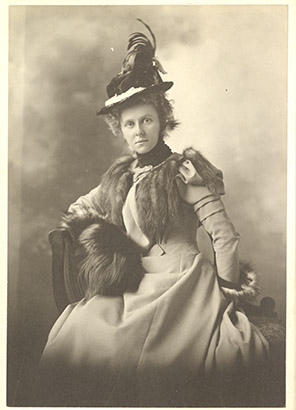
Mary McConnell Borah
Born 1870
Occupation: Wife of Idaho Senator William Borah
Residence: Moscow; Washington; D.C.
Topics:
The colored topic bar is hidden for screen reader users. Use the topic buttons below it, the "Filter by Topic" menu or the search box to find specific content in the transcript.
Maureen Bassett: ...and Mrs. William Borah, who is our guest today. She is going to have her 101st birthday on October 17, 1971, which will be on Sunday. And our show today will be just a couple of days preceding Mrs. Borah's birthday. She's the widow of Senator William Borah, who was a senator from Idaho, and she is now a resident of Maryville Nursing Home in Beaverton, which is run by the Sisters of St. Mary of Oregon. And as we talk with Mrs. Borah today, Sister Christine is going to help us in following her life from when she was a very tiny young lady up until what she's doing at the present time. Good afternoon, Mrs. Borah. Good afternoon. Now you were born in Eureka, California... Yes. ...101 years ago. Yes.
Mary Mcconnell Borah: ... I don't remember exactly the day, but I can almost remember the second day of my life.
Maureen Bassett: Very good.
Mary Mcconnell Borah: And I was taken by my grandmother, who thought that I was the most beautiful baby that had ever been born. But I was slightly disfigured by some red spots, which seemed to be in the blood under the skin. And grandmother should have been a doctor if she'd been a man. But at once she knew what she was going to do. She was going to take this baby to a famous doctor that she had read about and see that those red spots were obliterated at once. So mother wasn't well, because my brother was only a few months older than I, and that mother was a very delicate woman anyway. So she consented to let grandmother take me to this famous man who wasn't far away. And so grandmother bundled me up and took me on this little train that ran to Portland. And then she first had written a note to the doctor describing my symptoms, and he had written back to her, bring the child to me, and he had made the date when she was to take the baby to. So when she arrived in Portland, she was too early to go to the doctor, but she had been wise enough to make an engagement at the little hotel in the village. And so we might have to be there for a few days while he treated me. So after she got me bundled off up to the hotel and cuddled in bed, I was a good baby. But on the train going down to Portland, there had been a strange woman who never took her eyes off me. Grandmother told the story after it. She said the woman fascinated her. She wasn't afraid of her, but this woman never took her eyes off of the child. And so when we arrived in Portland, grandmother made the reservation, and she turned and saw that woman was in the very spot again. So she heard the clerk say to the woman, Madam, what kind of a room do you want?
And the woman said, I'll not take a room now because I expect a friend to meet me here, and she'll probably have her plans. So that was grandmother remembered that. So she was assigned her room, and she cuddled me down in the bed while she went to the bathroom, which was quite a few steps then. In those days, I think they only had, they didn't have bathrooms to eat. Well, when she came back, opened the door, there was no little Mary. The bed had been robbed. I was gone. Grandmother ran screaming down the hall. My grandchild has been kidnapped. Well, there was some sort of a conference going on, and the lobby was filled with men, and they were all so excited. And Porter came up from the desk, and he said, why, I saw a woman half an hour ago with a big bundle in her arms going through that lower part of the hotel and out the back door. Well, the men all started out. They forgot there that they were being delegated to some sort of convention. They went out to hunt me. Well, I think perhaps in three quarters of an hour, they located this woman with little Mary. Probably I was screaming at the top of my voice. Well, anyway, they had an awful time getting me away from this very strong woman, but they finally got me, and here I am today.
Maureen Bassett: I'm so glad that they found you.
Mary Mcconnell Borah: Well, a whole life full of adventure after that. That was my first venture in life, but it seems to me that it just kept on through the years. I was either in the newspapers with some kind of disease that nobody else had ever had in the world or something to keep me in the limelight. I was not beautiful, not fascinating, but I just kept up the pace. And so when I met my husband to me, he had just made a speech for my father.
Maureen Bassett: And your father was William J. McConnell, who was one of the first United States senators from Idaho, and also a governor of that state, was he not?
Mary Mcconnell Borah: Yes. Well, anyway, I think Mr. Borah was then just out of college, and he was with a group of young students trying to find out something about the world that he was soon to tumble into. Well, let's see there.
Maureen Bassett: When you met your husband, he was working with your father, or for your father then, right? And he also worked in your father's campaign?
Mary Mcconnell Borah: Well, not exactly, but I wouldn't say that he worked in the campaign, but he was very interested in my father, and my father asked these young college men questions. And Mr. Borah was young, and he was the only one who seemed able to answer any kind of question that father propounded to him. Well, anyway, then life went on, and by and by, I was a big girl, and I met Mr. Bora, and recalled some of the things that had happened. Well, we became friends, and one day he came in great haste to tell me something that I must answer immediately. Will you marry me?
Maureen Bassett: Such a question.
Mary Mcconnell Borah: I've been appointed by the governor to take care of the big case in Washington, and, well, I had two days to get ready to go to Washington. Well, there might be some interesting bits in between time, but I did. And I, Mr. Bora, he was Mr. Borah then, and with the governor of Idaho, we proceeded to Washington. And, of course, Washington wasn't entirely new to me, but I had forgotten much about it because I was only a child when my father went into the Senate. And then, well, but I had a very interesting few days in Washington, and my greatest interest wasn't in politics as it should have been. It was watching the people on the street that was all new to me, and for the first day in any city in the world, a new automobile was being tried out, and I had my eyes glued from the hotel window. People had gone crazy, and men driving horses, the horses were up in the air, and I thought eventually they were coming through the second window, we were on the second floor, and, of course, I couldn't imagine what was happening. Well, it turned out later that the first automobile that was ever seen in the world was taking place, and the governor and my husband popped into the room just as excited as I was. I had started a letter to my mother to tell her all the things I had seen. Well, that was my first trip to Washington.
Maureen Bassett: Mrs. Borah, in 1907, Senator Borah was appointed, he became a senator, and you went back to Washington, and at that time you were invited to attend a dinner at the White House when President Teddy Roosevelt was the president, and your husband told you it was not an invitation, it was a command performance. Oh, yes. Can you recall anything about that first time you were at the White House?
Mary Mcconnell Borah: Yes, I can remember that very perfectly. I can remember we had been in Washington only a very short time, and my mother, before we went to Washington, advised me about my clothes. Now, don't think that you need a lot of new clothes, because a new senator has to make his place in Washington, and it may be months before you're invited out to any form of dinner at all, or any form of meeting. So I was very, I had plenty of clothes such as they were for a girl. I was young, you know, but one day at our door came a colored messenger bearing an invitation to a dinner at the White House, and I had a colored servant. She was with us for 40 years, and she came in with that invitation in her hand, not interested if it's an invitation at all to go to the White House, but telling me about this wonderfully beautiful man who had brought it. He was a colored man, but all his garments he wore. So, of course, in the meantime I was opening this invitation, and I... The next morning, bright and early, I started forth to the finest shop in the city, wherein I had never poked my no lusus, and to buy myself a dress for that first dinner at the White House, and the madam of the shop looked at this young person coming in without much interest. She said, what color would you prefer?
I said, well, I hadn't thought of a special color. I said, perhaps blue or pink, and she was very indifferent. She brought out a few things that were really very lovely, but she was so blasé. A young thing didn't interest her very much, and finally she said to me, it's the dinner you're going to, a formal dinner. I said, I presume so. It's at the White House. Well, the woman then nearly fell over, and she became vitally interested in the clothing, and she said, may I ask you, what is your name? And I said, Mrs. Borah, who girls she called. This is the young wife of that famous Idaho senator. Well, I was a different person. Oh, how they loved me. And in the end, one of the girls said, I must show Mrs. Borah the gown that we came in today from Paris. She said, the loveliest, loveliest thing, came the vision of the most beautiful gown I had ever put my eyes upon. But I said back, I couldn't think of buying anything so expensive as that. You'd be surprised how cute this gown would be. Well, of course, in the end, I bought the gown thinking that my husband would be thrown into jail when he refused to pay the bill. But I thought the price was worthy, and they tried the gown on, and the help in this place was so enthusiastic. The gown was just a fluff of white, the most beautiful thing that was ever made in Paris. And so she said, and Mrs. Borah, I'm going to get slippers for you, just the magic and stockings. And so, well...
Maureen Bassett: That's what you wore to the White House dinner the first time you went there?
Mary Mcconnell Borah: It was the first time I, but when I got home, I tried the dress on. It needed a few little pennies, and I was to come back. So that night, when my husband came home, I said, Billy, I bought a dress today for the White House dinner, but I think you're going to leave me before we go. I said, it was very expensive. He said, honey, I'm so glad you bought it. He said, I intended to tell you to get the very nicest thing you could find. So that was the kind of a husband I had. I wore the gown. But I first I must tell you about the woman who owned the little shop. She said, the last time I saw her, she said, Mrs. Borah, would you care if I had a painting of you in that gown for my own self to keep in my room to look at? Of course, I was very young and had golden hair. I never was pretty, but that helped to make me a little bit pretty, because the night we went into the White House for dinner down this long hall where we were to take off our wrap, which I didn't need any wrap that that beautiful gown kept. I was very happy to have a little bit of a dress and more, but the color made in the dressing room said to me, may I ask you your name, madam?
And I said, my name is Mrs. Borah. She said, you're the loveliest thing I've ever seen. And I stooped over and kissed the old colored woman on the floor. I was happy, you know. I knew I looked all right and that my husband wouldn't be ashamed of me. So as we went down the hall, we were stopped by the young aide at a desk to find out if we were really invited, but he recognized Senator immediately from his picture that had been in the paper so many times. So he said, and Mrs. Bora, you're to be seated at the right of the President. And I said, well, he laughed out loud, and so did my husband to think of me being seated. And like gray, gray crowd like that, all the diplomatic people, here I was to sit next to the President. Do you wonder that I did that… well, that young officer, I saw him several times after, and the way he always greeted me was by putting his hand over his mouth like, oh, so well, anyway, it was a wonderful, wonderful dinner. I said, Mr. White, before we came to Washington,… i said, Mr. President, we had an old friend of yours visiting us for a few days. He had just written a book, and while he was there, he read us some extracts from the book, and he said, Senator, this book has never been published, but it's one of the finest books that's ever written. He said, nobody knows that I've written it. It hasn't gone to the publishers yet. It has no name. And he said, I hadn't been very well, and I had never told anybody that I was writing this book...
And Senator was perfectly, perfectly entranced.
Maureen Bassett: And you told President Roosevelt about this?
Mary Mcconnell Borah: Yes, I was telling him about the dinner, and the President of the cult was so excited over that book. And he said, I received a copy of the book yesterday, and I immediately took it to the French and then the French. And I said, read this book. It's the finest political story that was ever written.
Maureen Bassett: Do you remember the name of the book?
Mary Mcconnell Borah: I said, Mr. President, I think I can beg a little bit now. I named the book. He said, after Senator was gone, he was making a speech that day. He couldn't see it through. And so the President, Mr. White, was reading it. And he read me down a list of names that he might call the book. I shook my head. And he came to Stratagems and Spoils. I said, there's the name for your book. He said, all right, Mary, my book is Stratagems and Spoils. Well, the President, of course, was terribly excited to think that I had named that marvelous book. I said, Mr. President, I think he might have given that name anyway. But I said, I'd just like to beg a little bit. And the President laughed and laughed, and Senator went sitting. Of course, it would be like, here's the bed. And they were, President and Mrs. Roosevelt were sitting way across. Mrs. Roosevelt said, Mr. President, what do you think your wife has so interested in my husband? And she said, I never saw him pay any attention to a guest. He was always thinking about something else.
Maureen Bassett: You captured the heart of the President the first night you met him then. Yes.
Mary Mcconnell Borah: And he was always so kind to me after that. You know, I had so many wonderful photographs of great things. And I said to my niece just yesterday, Mary, why didn't you pack my photographs? I said that I had the most wonderful pictures in the world.
Maureen Bassett: What did you do after your husband passed away, Mrs. Borah? You were in Washington, D .C., and worked in the hospitals?
Mary Mcconnell Borah: Well, life, of course. This stopped for me. We went. We came from Washington out to Idaho for the funeral. Then back to Washington. And I thought, well, I can never be here without Billy. I thought that my mind would go on. So I made up my mind to rent my apartment and go back to Idaho. But Idaho was changed. Every place in the world was changed. But, of course, my friends had all gone. And the babies, when I was there, were grandmothers now. And there wasn't anything for me to do.
Maureen Bassett: So you went back to Washington and worked in the hospitals?
Mary Mcconnell Borah: Then I went back. During the war. Went back. And there was always a lot to do. I never was idle. And so when my niece came, she said, Amen. I'm going to be married, and mother will be alone. And there's nobody but you. So I sold my earthly possessions, things I'd cherished, and I couldn't. Idaho and my, with my sister.
Maureen Bassett: She's here right now at Maryville Nursing Home with you, right?
Mary Mcconnell Borah: Yes.
Interview Index
Mother's frailty. Her brief kidnapping as a baby in Portland.
Her exciting life. Meeting William Borah. He was the only young man who could answer the questions of her father, the governor. Borah's marriage proposal. Her fascination with the people on the streets of Washington. Witnessing the first automobile ever driven in Washington.
Mother told her not to worry about clothes in Washington because they probably wouldn't get dinner invitations as a new senator. The black maid brought in the invitation from President Roosevelt, thinking only of the man who had delivered it. (continued)
Buying a beautiful gown for her first White House dinner. The transformation of the saleswoman when she realized her customer's identity. Her fear that husband would disown her for buying such an expensive gown. Her beauty in the gown.
Her reaction to being seated at the president's right hand. She told him about how she had named William Allen White's Strategems and Spoils, a book which the President loved. Subsequently she was close to the President.
Her grief after husband's death. She returned to Washington because Idaho had changed.