
Description: With Margie Brocke. Robberies of the Troy bank. Local attitudes toward wealth and prospering. Country-town differences. Santa Claus. Student loans. Causes of 1970's depression. 11-9-76 2.5 hr 67p
Date: 1976-11-09 Location: Troy; Kendrick
Subjects: German Americans; Norwegian Americans; Swedish Americans; banks; holidays; logging; thieves; women
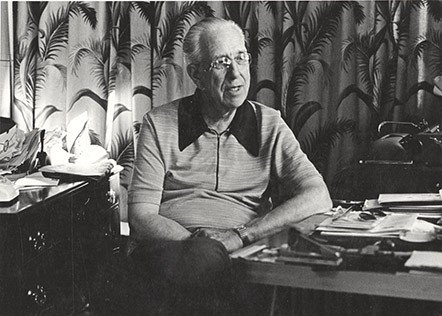
Frank Brocke
Born 1906
Occupation: President of First Bank of Troy; where he worked for forty-seven years; chairman of school board
Residence: Troy; American Ridge; Kendrick
Topics:
The colored topic bar is hidden for screen reader users. Use the topic buttons below it, the "Filter by Topic" menu or the search box to find specific content in the transcript.
Sam Schrager: This conversation with Frank Brocke took place at his home in Troy on November 9th, 1976. His wife, Margie Green-Brocke, also took part in the conversation. The interviewer was Sam Schrager. He started by telling me about the Green's robberies.
Frank Brocke or Margie Brocke: Well, we start from the beginning. It was on Thursday night, about ten o 'clock. We had undressed. Bobby was in his room. He slept out in a room on the side. Margie and I, she was in bed, and I was all undressed and had my pajamas on. There was a wrap at the door a little after ten o 'clock. I'd come out here and I pulled the blind back. There was a young fellow there. I said, What do you want? He said, We ran out of gas and we were looking for the service station man. I said, He's across the street. He lives right over there. He professed that he didn't hear me. He said, Would you open the door so I can hear you? I opened the door. About that time, he also opened the screen and he came up with his gun. He stood there and pointed at me and said, All you have to do is behave yourself. He said, Nothing will happen. Of course, he proceeded to walk through the door. I stepped back and he came in here and he said, Don't look at me. He walked in here and some morgue heard the commotion. She came walking out of the bedroom door. He hollered to her and said, Don't look at me, but you mind what I tell you. We didn't say a word. I said to mine, It's all right. It's okay. He proceeded. We walked in here and in the meantime, he went back there and opened the doors. There were two more came in. They immediately went through the house completely. One stayed with us and the other two went upstairs. They went into every room in the house.
He asked… the first remark was, he said, That time clock in the bank opens at nine o 'clock, doesn't it… i said, Yes.
Why? I don't know. It was a shocking question because normally that's late and we don't have an exact time. Anyway, I did say yes, it does. He said, We'll be here in the morning. He said, You behave yourself. He told me, He said, You can stay here. He told Mark, You go to bed. By that time, Bobby was out. They took him upstairs. He laid on the bed upstairs. They were constantly exchanging them back and forth. They turned out all the lights. We had two ducks and dogs out here. They were barking frantically because they knew something was wrong. They knew it wasn't right. They barked extremely loud. They barked until one o 'clock in the morning. That was between 10 and 11 by the time this was going on. During the process, very few words were spoken to us. Other than the fact that he asked, he asked what time did time clock open and very few words he said. They said, Anyway, I asked him if I could put my pants on. I pulled my pants on over my pajamas and put my bedroom slippers on. I laid down on the Davenport. This chair, this lounging chair, was here. After they had turned out all the lights, where they had every light out, there was enough sunlight from the street came in here that you could see outlines and you could see each other.
Anyway, time drugged and a-drug and a-drug. I never got off of the Davenport other than to turn over or to move. They had the bedroom door open so they could watch her. Then they would take their turns to go upstairs and stay. There was always one up there and there was always one here. The other one was just in and out. As time went on, about midnight, they decided that one of them could go to sleep or at his rest. They made a beeline for this chair to see who could get it. The two of them got there at the same time. They squirmed and argued over who was going to stay and get in the lounging chair there. In the meantime, they had their guns. Every so often, they'd take it out and roll that thing. Obviously, the next morning we found 22 shells on the floor. Quite a few of them, I'd say, have a dozen. It apparently fell off in the process of rolling them. At any rate, they confided, they whispered, and they talked. Oh, by the way, when they first came in here, of course, they said to me, don't do anything foolish because we will, we will, your son, you won't recognize him tomorrow if you do pull anything that you, like trying to escape or something that you shouldn't do. That was a big warning that we had, is that they were going to take it out on Bobby. They told Bobby that you do anything, and you won't recognize your dad tomorrow. This was unknown until the next day. That's what their threat was. They were free, Bobby. There was no handcuffs put on. I had a handcuff on one hand.
Marge, did you have handcuffs on? Right from the beginning? Bobby did too. Okay, but you were free to walk, and they were free to, the harness was that much free, but they weren't behind. But anyway, mine was not hooked or hooked together. Mine was just hanging there, like that. So... Well, that was only in the morning, wasn't it… no… right from the beginning? All the time? Yeah, right from where it starts. I see. Okay, Bobby was here, which he looked to... He looked to the door. He looked at all the time. I thought it was just when they left that morning. Well, anyway, the only answer that happened, I think you had to go to the toilet. I sure did. And so, and of course, she, Mars was convinced that they were all three boys, and one was dressed as a girl. Well, I just assumed she was, or she had every indication. That was the youngest one, she was the kid. But that was irrelevant anyway. She convinced them that she had to go to the toilet, so they went and watched over her.
Sam Schrager: Could you sleep at all?
Frank Brocke or Margie Brocke: Oh, no, it was impossible to sleep. I went to the bathroom with my handcuffs like this, and you can imagine trying to go to the bathroom with a fellow having his gun in your stomach. That's the worst thing I ever would feel in my life. And you know, when you get nervous, your bladder fills up, and it would rupture, and I know it would've... At any rate, so then that was the only incident at all. That is, I never moved, and Mars never moved. We never conversed back and forth. And they'd made the movements. They'd got awful irritated over the dogs barking. And they threatened to go out and kill them. Well, the older one said, oh, no, people would hear the shot, and he says, we can't stand that. Well, let's go out and beat them and knock them out. They didn't dare take that chance either, because they couldn't get away. There's only one at a time dared go out the door.
Wasn't the next one a boy? Wasn't none before a boy? Well, they were all three boys. Yeah, just a young boy. That's a young Gordon boy. Well, anyway, the largest... the tallest one who guarded me was the California boy, because I... the rest of them, the other two of the Gordon boys, which were known by us, that they had these stockings down there. When this boy came to the door, he had nothing but a sombrero and a... what would you call it? A Mexican cowboy suit on. And he had a deal right here on his neck that stuck out at least that bar. And it was red and black. And, of course, the purpose of that was, that the minute I looked at him, I was going to look at that. It was obvious that that was a detractor. It looked just like an overgrown boil or something. It was stuck out there and looked funny. And I glanced at it, and you glanced, and you're looking. Of course, he kept saying, don't look at me. And the more he said it, the more he looked at me. But there was nothing unusual about him. He was a good-looking kid. So then after they got in here, by the end of the year, they all covered their faces. But... so that went on. Other than the fact that the dogs quit, they just ran out of steam about 1 or 1 .30. Yeah, they just barked out, until they couldn't bark any longer. And so they finally calmed down. Well, at 4 o 'clock, it started to get light. And so they got me up, and they said, we're going to the bank. And I said, okay. And so he had taken the... they had already gotten the keys out of my pants. So they had those in their possession. And I asked him if I could put my coat on, and he said, well, not until I examine it. So he went through the pockets. He went through to see that there was no guns or knives in that, I guess. Anyway, he finally handed it to him. He says, okay. So I put that on over my pajama tops. And I don't think I even put on a cat hat. Anyway, 4 o 'clock, the two of them took me to... the one went ahead. He was gone. And so they went in there, and Marge was fastened to the spread spring. And Bobby, they fastened him to the doorknob upstairs. Well, he just said, we're going to the bank. So we went to the bank. And they reminded us now, don't pull anything smarter. Your family won't be here when you know where this is all over. And of course, they told them that don't pull anything smarter. Mr. Rocky won't be here. Anyway, we went up there. I went out in front, got in this car, goes to the sedan, and I climbed in the back seat where there was... geez, there was chains and there was bars. There was lots of tools. I had to raise my feet practically up to my chin to get over the floor and into the seat and get up there. So we went right directly up to the bank. And he drove around the back. And in order to turn the car in the direction he wanted, he had to drive... We had a backyard in the bank because it wasn't as big as it was now. But there was a couple of cars back there. And he drove up and he backed back toward the alley and doing this process of backing, he rubbed against another car and caught the chrome strip that was on his car, caught on the other car, and he couldn't get it loose, so he had just tore it right off. He went ahead and he just give it the gun. The other kid gave him the devil for that. He said, gee, you're making a lot of noise. How people didn't hear it?
I don't know. I guess one person did get up, but he didn't do anything about it. But they didn't make any... That was an incident that would arouse suspicion. You could hear it. Anyway, it was daylight. You could see all around you. Not daylight, but morning. And so we went in the side door of the bank and they marched me over to a chair and a desk and I sat down and I was handcuffed then. They handcuffed me then together in front of my hands, in front of me. And we went up there. And so then he sat me down in the chair and the one on guard stood right behind me with the gun I could flash around and he'd go from one side to the other and I could see that he was carrying the gun and kept it right on my back. Well, the other one went into the office space and he called back down here and said everything was all right. I could hear the conversation that we got up here all right and we're inside of the bank. And so he left here. He checked the two, Marge and Bobby, and he left the house here. I'd say within probably between 15 and a half hour after they were on. Well, during this process I sat, and I must have sat there for 15 minutes or so. In the meantime though, I had told him when he was here and they said they were going to stay till 9 o 'clock. I think I brought up the subject. He asked me here about how much money was in the bank and I said well, around $50 ,000. I don't know why I told him it was irrelevant. But anyway, I said there's a reached $4 ,000 or $5 ,000 in currency outside of this safe. I said if I were you, I'd take that and go. Because my feeling was that we could not possibly live through this. There was no way that they had to kill somebody to get out of this thing if they were going to stay till 9 o 'clock. And because that was a dangerous thing, people came to our door any time after 7. And they had talked here. You could remember their voices. And they were amateur. Because we didn't know they were amateur. But my thoughts was that somebody has to die out of this mess. They've got to be killed. They've got guns. And it could easily happen. So at any rate, I tried to tell them to take this $4 ,000 or $5 ,000 that was outside the safe and get out while getting as good. Because I didn't see any way that they were going to survive till after 9 o 'clock. Anyway, that was irrelevant. So we got up to the bank. So I sat there in this chair till they got all together and got their plan to organize again.
And they said, would you open the safe or the vault? And I said, yes. And I got up. And I was still handcuffed, but I was in front. And I ran the combination. And it opened right off the back without a flaw. And then I stepped back and they stepped in. Well, they took me into the laboratory the minute we had two up there, but this was the men's side. And by that time, he put my handcuffs off and put my hands behind me. And the handcuff and bit the back. Well, I sat there. I sat on the toilet seat. And that was a small toilet or anything. And they talked. They talked very loud. You could hear the conversation. Anyway, they were busy in there. And I could hear them rattle a tin can in the box, tin boxes where people would have certain things that they kept in their papers and so forth. And some of them had a few valuables. And I could hear them forcing these boxes open. I don't think that afterwards we found they'd only opened about four or five, but they found nothing so they quit. So in about an hour, this kid come back.
He said, where is that money that you said was out in the open? I said, well, it's up on top of that cabinet file. He said, oh, and they'd hung it all over, and they couldn't even find that because it was higher than they were and they couldn't see it. And I guess they didn't know how to look for it. Anyway, he found that. And so it went on, and that was about five o 'clock. And it got so quiet, you could hear a pin drop. What they were doing, I don't know whether they were counting that money or whether they were... I just don't know. But it got so quiet that I thought, by golly, I can sneak out of here. And so I got up and was able to open the bathroom door. It was not locked. And I started out. And I got in the furnace room, but it was between me and the side door. And I got halfway through that door, and I heard the ruffling of people walking. And boy, I, of course, scammed and leaped back into that toilet deal. But it all flew to shoot and get, see. Anyway, that's the only time that I really tried to escape and get away from him. I'm afraid for you during this time. Afraid?
After the first ten seconds, you don't. That was my feeling. I don't know about Marge. I guess you were naturally afraid all the time. Yeah. I don't think... Well, I knew Bobby would be terrified. No, I don't think he was. Well, he kept his cool. Oh, very much. He got out of his handcuffs. Yeah, so this was the next morning we discovered all of this. He had fooled around until he got one of his handcuffs off, out of that door, by pulling on his hand and off of that door. And so he came downstairs, and that was about seven o 'clock by that time. And I left at four, so he had that time. It was about seven. I guess so, but he was... Between six and seven. Yeah, he was excited. He didn't know what to do. He didn't know where they were. The doors were all open. And he didn't know where they were, or, you know, so he'd run back up and pretend like he was still handcuffed. Yeah. Pretty soon he'd come down again. Finally he made a... I told him to go over next door to the neighbors. By that time he tried to work the head off, and then he couldn't try to carry him on that... ...bed spring. ...spring, me and everything over to the neighbors. He was just desperate to try to get away from them. Well, there wasn't any of them in the house then. They were all gone. No, they were all gone. They never came back. We didn't know that. So you were really both very afraid, and you were scared that you... But the biggest thrill I got was the first... When you walked to the door and you saw what it was, that... I would say ten seconds, that was all over that shop. Well, eleven o 'clock every night after that. Yeah, it was eleven instead of ten. Sat out here on the Davenport, eleven o 'clock every night we'd get the creeps. Yeah, yeah. That took quite a while to get that out of your system. Never, ever, ever...
If anybody's strange or the doorbell would ring, people were cautious, so they didn't come. I don't know, I think the sheriffs or the people, friends, just said don't go near the house. But anyway, it took about a year until people started to come. If they did come after hours, anytime after nine o 'clock, you just sort of tied up and not. But anyway, let's get back to this. I was in the toilet and I tried to get out, and I went back in. So time just went on. Well, by seven o 'clock, Willis Bowman came, who was the cashier of the bank. And he walked in, well, he walked right into their arms because they were waiting. And he, they just told him, and they took him by their arm, and they locked him in the vault immediately. They did, see, I heard, they did question him. They said, what time does the time vault open? And he said it opens at nine, doesn't it?
He said, well, he said, I don't know. Because he said, I remember, it could go a little by that, or it could be a little before. And he wouldn't verify nine o 'clock. Well, that shocked him. And they kind of got a little bit of a scare. And so they let it go by, and then they locked him up, and that's the only words they had with him. Well, in about 15 minutes, here came Clyde Bowman in. He was a very close friend to the two Gordons. And so, and he was, he'd come over no more than to leave a deposit because he was going to Spokane. So they made him lay down on his stomach in the basement room right outside of where I was, and lay down flat. And so he said, he said to him, he said, well, you can't stand this. He says, I've, he says, I've got a commitment. And he says, my family's waiting for me, and I'm going to Spokane. He says, if I'm not out of here, he said, there's going to be trouble. Well, I was so amazed that he had that kind of news that he even remembered, just talked, but he did. And they said, well, that's different. But they gave him the orders. They told him, all right, you go back over there. You get in that car and you leave immediately. But he said, you know, Bobby Rocky. Yes. Well, if you do anything out of the way, you'll never know that boy tomorrow. That's the threat they used on him. That's what they told him. So Clyde, they excused him, and he walked back out the door, and he went over. He had customers by that time. So he waited on his customers, and as soon as the service station was empty, he got in his car and he drove off. And he went to Spokane. And all the things said, all right, there was Alfred Severson, who had walked in there, and was waiting on him, wanted to get some gas. And he said to Clyde, he said, I'm going over to the bank for a minute. He said, cash a check. He said, I'll be right back. Oh, Clyde, you didn't say he's entered their work. Brother, you don't know what you're in for. That's what he went and he's in mine. Well, Alfred come over. He was one of the first that was just snapped right up. So he was put in the vault along with Willis, and they were in the father's vault. And he didn't come back. And Clyde knew why. So he got in his car and left. Well, that was it. Clyde didn't call the cops. No, or didn't stop in Moscow either. But, you know, it's a funny, funny, funny thing. There was a time here I could have got up, they were in the kitchen, and I could have ran out this door. But my thought was, the money isn't important. We don't care, it's insured, we can't lose. And if I do that, and we don't know who they are, we don't know whether they're professionals or if they're amateurs, and here was two people left. And I had no reason to believe what they might just kill somebody and get the heck out. And here I was trying to be a hero, see?
And I decided, no, that's not necessary. We'll go along. I'd always been taught that. I'd been told that by my bosses. That there's no money in the world worth taking the chance. There's no use arguing with a bank holdup man. Because we are insured, that's why we are insured. So that thought just completely left me. Now, when I walked out of that place up there, or cried to get out, that was my own life. I figured there was no way that they could get even with anybody else. If I got out that door, I was gone. Boy, they'd had to shoot right out in the open, and I didn't think they would. At any rate, people started coming in. The cars were coming to the back door, and by eight o 'clock, I think we must have had at least anywhere from five to six people already in the vault. They'd come in the door, and they had taken me out of the toilet by that time and taken me over and put me in with Willis and Alfred. I think there were several employees. Anna Marie was in there. She was a teacher, and they had Cheryl. They had five or six of our girls, and we were all in there. So then they took Willis and I out. They said, you get in the big vault, you get in the money vault, because that was after eight o 'clock. So we went into the other vault then. So I told Willis of all that had happened in case. I told him, I said, the fact that that is not going to open at nine o 'clock, because Willis knew that it was going to go by, I said, they'll probably shoot me on general principle just as a warning because of the fact that I had lied to them that it did not open at nine. I said, that just could happen. So I told him all I knew of what had happened just in case that I had been snuck out. So anyway, people would walk in, and there was a sort of cabinet file right inside of the side door, and he was laying on the floor, the one guy, the California boy, and the other one, the older Gordon boy, laid right in front of the vault, sort of at an angle that he could see the vault, and the other one was outside. He wasn't there, the little girl to be. She was not in the vault at all. She was not even there. They had already made their plans for that. So as they walked by, they still laid on the floor. They just laid down, and they'd just say, going through there to that vault over there, and then they'd get the other one, he'd say, right inside that door. So they would go into the door, into that vault. And there was a little girl, this was about 8 .30. They had already had her. Her mother had come in to cash a check, and so they had her in the vault, and she didn't go back out. So this little girl, who was only about, oh, maybe that high, had come in the door, and, where's Mommy? And so she got clear inside, where's Mama? Where's my Mama?
And this guy said, no, and he says, you got in that vault, and the little kid started to run back out, drop back out the door, and he grabbed her. And so I stepped, I was standing in the vault door by that time, I was watching, taking it all in, and I could see these people, and as they walked by, and I'd say, just do as he says, I was helping them, you know, hurting these people into this vault. And so in this little girl, I grabbed her, and I said, now listen, honey, nothing wrong. I said, I'll take your run on over there, and I put her in there with her mother, say, because otherwise, you don't know what would have happened, you know, you could have blow the whole thing right there if she'd have got back out. Anyway, that was the only incident that happened, otherwise they were all grown people, and we had 22 people in that vault by 9 o 'clock. Well, 9 o 'clock came, and nothing had happened. The vault didn't open. In the meantime, when he took me out of that vault, out of the toilet, to put me in the vault, I stopped, and I said, I understand, Mr. Bowman told you that that time slot might not open at 9. I said, it could go on by. He said, it had better not, just as though that was a threat. And I said, well, he wound it, and I said, sometimes we don't watch it that close. He said, well, we'll just wait and see. And he was very pointed and pretty tough, which was irrelevant, but I figured I'd get my two bits in, and I said that it would open, and then Willis said that he had wandered, and he probably wandered on by. Anyway, 9 o 'clock come, and this kid that was on the floor, on the right of the vault, right in front of it, got up. He stood right in the vault door, and he had his gun right in front of him, and he pointed at the front door. And this other kid who laid over on the side said, you're damn fool, what are you doing?
He says, boy, he says, they come through that door. He says, I'm letting them have it. And I said, now, wait a minute. I said, you just lay back down. He said it would take longer? Yeah, because 9 o 'clock and it hadn't opened, see. So it's meant that it did go on by. Willis had wound it too much.
Sam Schrager: But you guaranteed?
Frank Brocke or Margie Brocke: I said to him, I said, I'm guaranteed, just as a statement, I guess. I said, you get your money, you just lay back down there, because I didn't want him shooting at people that come in the front door, and they were already jamming the front door, trying to get in. And it was locked, and they couldn't come through, so they just kept coming on to the side. And as they came around to the side, they heard of him in the vault, which was the only answer. But I tried to calm him down. I said, you get back down there. I said, you get your money, because otherwise I don't know what would have happened. I really don't. I don't think they would have left voluntarily with the idea, well, somebody's foolish. Then they might have said, you dirty S .O .B., and I could have shot me just as a lesson to the rest of them. But he didn't, and he listened to me. He did. He laid right back down there, and the other guy stayed in his position. That was the longest 14 minutes I've ever spent, if you know what I mean. And that clock didn't open, and they kept getting up, saying, is it coming?
And I said, just take your time. I said, just gotta open. And by golly. Finally, on 14 minutes after 9, it did open. And, boy, we didn't waste any time. We took the money out. We shoved it in the bags, and we pushed it out the door. When we got through, they said, we said, that's it. And they picked it all up, and they went. They went right out the door. They didn't take a hostage, but they disappeared just like that. Well, we immediately, but they did lock the vault door. They locked Willis and I in. We were locked in the vault. And so, naturally, the first move was to get us out. So we didn't have a screwdriver. Well, I don't know, but there was no way to take the plate off of the lock, this vault lock. You know, dime would work, but we were fingering it anyway. We said, who's out there that has opened a vault?
It was opened a combination. And nobody spoke up. And finally, Ollie Johnson, Ollie Hansen, who was a husband of one of the employees and who was already locked in the vault, whose wife was locked in the vault, said, I think I can do it. So Willis gave him the figures, told him what to do, and that opened the first flag. So that took another five or ten minutes. All these other people, they were loose. They were turned. They never locked that door. In fact, when they left, they left a crack in the steel door so that there was no air in that vault. There wasn't ours. We had ventilation in the big vault and the money vault. But when they built the other one, there was no allowance made for air because it was a storage vault and there was no combination on the door. In other words, you couldn't have locked it if you don't want to. You could throw the bolts, but that's all. But anyway, they didn't know that. They didn't lock that door. They left it open, which was the human thing to do. That is, just a crack so that there was air. And of course, the minute they left, then it wasn't a matter of a minute that they... He told them to remain in there five minutes or else. They might get hurt. It was just a matter of a minute that somebody came out.
Sam Schrager: So had the police been called in yet?
Frank Brocke or Margie Brocke: No. So by that time, we called because the minute we got out, that's the first thing I did was call the sheriff immediately. So they came down. And I was taken in one of the police cars. They found the abandoned car by that time. It was up this side of Moscow out there where Roy Bell was out on that stretch road toward Robinson Lake from off of the highway back before that saw me. It was up in there. So they took me immediately up in there to identify the car, which I did. That took about an hour and a half. And I hadn't shaved and I hadn't dressed. I still had my pajamas on and my clothes over them. So we came back to bank. And then I immediately came down here and shaved and got dressed and went back up. But that was the thriller. And so they started immediately search and alarms and so forth. They drove through a blockade on the Pullman Road, these three people with the money. And unbeknown, they switched cars and there was no way to identify them. They had no knowledge of who they were. But they left immediately. And so that was on a Thursday, well, Friday. We were just constantly drilled. And all the employees, all those that had to be interviewed that saw them. But they had the socks stuck and pulled down over their face. There was no way in the world. Anna Marie had made the smartest remark. She was in this vault. She says, that sounds like Jill Gordon. And it was. But it just rolled out of your mouth and that was all. And she had them in school. Yes. Yes. But we picked up at least three, 22 bullets off the floor up at the bank.
Did you tell them that they had that fluorescent paint? Yes, they had fluorescent paint so they wouldn't shoot each other in the dark because they were in the dark here.
Sam Schrager: But when Bobby got, when he went next door, what happened from that?
Frank Brocke or Margie Brocke: The neighbors didn't do anything. They called Glenn McKee, coach. And then Morris Harlan did live next door. He stood in the doorway with his gun. He was ready to shoot anybody that stirred. And Glenn came down and. He saw the handcuffs off him.
Sam Schrager: Who else?
Frank Brocke or Margie Brocke: Bell. Bell, I'm sorry. Yeah, Hart Bell. No. Was it? Was it Beaker? I don't know who it was, the superintendent. Brown. Yeah, Brown. Yeah, Hart Brown. Hart Brown, yeah. Saw the handcuffs off of you. Yeah, they saw the. That was not till 8 .30. In two. Yeah, that was the easiest. And then Ed Pearson came down with all his keys and finally got a key that was. Meanwhile, Bobby got a TV table in by the bed and he got some oil and he rubbed my arms like that. He was trying to get those things off and he always felt bad, always after that, because my arms were just completely black and blue and he thinks that he did that. Trying to get the handcuffs off of me. Well, your wrists are so dumb and small. Well, it looked like I could have gotten hot hands. Yeah. They must have had them pretty tight. But anyway, the whole secret was that what gave it away, and of course we had as high as 12 FBI guys here. They came from Montana, they came from Spokane, they came from Salt Lake or Boise and then the Loist invention. So they went over the road after road up Moscow Mountain and for evidence of what they might throw away. And we never did recover those. They threw that in Robinson Lake. And that's how they got out of here. They went that direction. But what they had done upstairs was that they kept, he kept lighting a match off of a match folder to see what time it was. He'd set by the window and it'd be in dark and no light on. Well, he'd marched this route and then he threw this match pad down on the floor. They didn't find that at first. It was sort of under the bed. So on the second go around, I think by Saturday, they had found that match book upstairs and it referred to a Walla Walla motel. And that was the link that broke. That's what, that's what solved it. Up to that point, I would say up till, I think they discovered that on a Saturday and they started checking. And that, that, that just fell into place. See, they left here.
Wasn't it on a Thursday? They left here on a Thursday, Thursday morning. They went to Reno. And from Reno, they went on into Los Angeles where they lived. It was a suburb of Los Angeles. They put this money under the floor of the front porch of their father's home. And so they took out a thousand dollars apiece, gave it to their wives. One of them had a girlfriend, but they gave them instructions that they could go out and buy all the clothes they wanted, which they did. They had changed cars. They had traded cars in Reno and bought a new one and gambled some. But overall, there wasn't over 7 ,000 missing out of the 55 that took, I think they recovered less than between 47 and 48 ,000. And at any rate, they traced, they had the description of this car and then they brought it back up here. And then they found out from friends who, it was a white car, white sports roadster. And that was very, and friends, people here that went to Moscow, I'm sure, they checked the service stations. And they discovered who belonged to the Gordon Brothers.
Sam Schrager: Their new car?
Frank Brocke or Margie Brocke: No, no, the old car that they were in, see. And see, when they were here, when they robbed, that was a stolen car. It stole that from one of the seed companies in Moscow. The sedan that I rode in that they came here to rob. So there was, and they had abandoned that up on the back road. Were they both their wives in Moscow? No, no, they weren't with them at all. But then they got in their car. In their car. And they went right on it. They went through a roadblock between Moscow and Pullman. But no, there was no identification. There was no checking done on it. I remember one truck driver said that he saw this, I believe this was evidence, they saw this car while they were lined up in this roadblock. And he was high up in a cement truck, and he could look down. He saw this kid swamped over in this rumble seat behind. He just took it for granted, well, he's probably cold. And he's just bundled up down there. The third one was, he was watching the money, yes, no doubt. But they had $55 ,000 in their car. But nobody knew. But anyway, they went straight through. So by the following Monday, they had the number of the car, they had the identification of it. They knew who they were. So they immediately ordered the California FBI to go to the parents' home. Well, the two boys were there, and the father was there. And the first thing, they've naturally denied it. And so then they finally confessed and turned over the money. They went out of the house and found it and gave it. And the father called me the next day. And he called again because they had trouble getting a bond to get them out of jail. So he wanted me to guarantee a $1 ,000 check.
Sam Schrager: Did you?
Frank Brocke or Margie Brocke: No, no. No, not to refer them to their family. They had relatives up here.
Sam Schrager: Now, how did they track the car?
Frank Brocke or Margie Brocke: They didn't quite understand. Well, when you go to a motel, you register your car. Yes, and you not only give your name, but that's the only way they could identify. The car was what they came back up here with that description. Anyway, it was a white, off-white Club Coupe. And so they had no... And that car had been seen. It had a California license on it. It had been seen around Moscow. I wonder if they'd registered under their own names and that. Yes, because they figured it would be that far away, wall-to-wall. They didn't think it was taking any chances.
Sam Schrager: Did you know them or did other people talk to you about them afterwards? I mean, those kids?
Frank Brocke or Margie Brocke: Well, they went to school here. The youngest one, the younger one, played with Bobby. Yes, they knew us so well. They knew what kind of people we were. We knew that they knew also that they claimed that they had studied this plan for over six months before they undertook it. The three kids, these three boys. And of course, the third one, the third one, being a California boy, he was the one that was the prominent one. The other two tried to stay away from me in so far as that I might identify him or could. But they would never talk out loud. They would whisper. And so the kid that came to my door was the one that lived in California, who was a total stranger.
Sam Schrager: Was there anything in their character, you know, from what you would have thought them as part of the engagement?
Frank Brocke or Margie Brocke: Joe was a troublemaker. He went to a seven-day Adventist. And for a seven-day Adventist, he just wasn't what he should have been. He went to the academy over at Spangleway. He'd go down and walk along the sidewalk with anybody's coming. He'd shove them off the sidewalk. He was sort of a bully, but he wasn't a big kid, but he was just an arrogant young snapper. The boy, the youngest of all, wasn't he… no. No.
Sam Schrager: How much time did they do?
Frank Brocke or Margie Brocke: Well, they got seven years, as I recall. And at the end of three, they were in a school. They were in a reform, a federal reform, set up where they were studied. It was just like going to school. And at the end of the three years, in their time of probation, they had accomplished their education, and they were let out. Now, the two Gordons, I don't know what ever happened to the California boy, but we heard about the Gordons because they had an aunt here, and she was hearing from them. Joe would come and visit Troy people, and he would talk about it. One was a dentist technician. Very successful, and the other one was a body man. Well, their father was a body and a fender man. So he had a little knowledge. And so, as I understand it, they both have done well, and are now, even to this day, are holding their own. They're married and happily married and doing okay. That's the word. One of them, his wife, had killed his father. Yes, I believe so. In a car accident. I think that's true. But I don't know about that. I'm just kind of guessing. I wonder what their motivation really was. Well, you would like to talk to them, of course, but heck, I don't know you don't. I talked to this Dick McConnelt, who had held us up some 15 years ago. I did business with him and talked to him and met him and discussed many, many things. But that's one thing I never did do, didn't bring it up. Never asked him what the reactions were, because it's by Gons and who I do it.
Sam Schrager: Would you describe that one to me?
Frank Brocke or Margie Brocke: Well, that was so short lived.
Sam Schrager: That was the time that you went and visited one person?
Frank Brocke or Margie Brocke: Yeah, he was a very large man and, of course, lived up in the Clarkia area. He had married a widow that had, I believe it was five or six kids, and they were destitute. He just couldn't get a job. He was sort of a slap-happy man anyway. They owed over $300 rent. They owed over between $300 and $400 grocery bill. Electricity had been turned off the day before. Although it was summertime, they were destitute. The story is, the way he told it, she said to him that particular morning, which was on July 7th after the Fourth of July, she said, Dick, if you don't go out and raise some money, she said, I won't be here tonight. He said, where will I get money? She said, well, go rob a bank, just like that. He just did. He walked into our bank about two o 'clock in the afternoon, walked through the door, and he had great big large, they called them aviation glasses. They fit right down and covered half your face, really. He walked up. It was very quiet. There were two people in the bank. Willis was talking to a family out here, the host sides, Paul Smith and her husband. I was just fooling around at my counter opening some mail, and the girls were waiting for three o 'clock to come so we could start bouncing. At any rate, he walked up to the second window from where I was standing, and Gene Crear stepped over. He just turned the, he had a lunch pail, these things that opened at the top. He just said to her, this is a stick up, fill up the pail, fill up the box. She sort of drooped over and she passed out, fainted on the floor and fell right down beside me. I said, my golly, I said, Gene's fainted. So I stooped down like this to talk to her. She said, a stick up. So I raised back up and walked over to him. By that time, he had backed away. But he had a good-sized gun on him. That barrel looked about the size of a dime at the end, anyway, opening. So he just walked back and then he walked over to me.
I said, what do you want? He just filled the box. I said, well, I reached in the drawer and threw out the money on the counter and said, put it in there yourself. So he had the gun on one hand and he opened the box and he put it in. I never said a word. I looked at a man over from top to waist all I could see to find a marking on him. Clean shaven, smooth face, round face, big man. He walked out just as calm and as collected as he could be. Never said a word. He walked out the door. Well, Willis started to follow him. I said, now you be careful. I said, Brian, you don't know what he's got out there. There might be two or three guys in the car that'll mow you down. There again, I was always taught no money's worth the risk. So he stopped. We tried to see where he went. He disappeared just like that. We tried to see where he went. We looked around the corner and there was nobody who walked up the street at all, past Clyde Bowens. He went right behind Clyde's server station, right up through the alley, clear up to the city park up on the hill. That's where his car was waiting. We ran around that bank within, I would say, within a minute after he left there. That was too long, I guess, because you just didn't know. We couldn't find high herd or no trace of him, period. Well, we immediately called the sheriff. They came down and that took them until Tuesday to get him. But he was a dead giveaway. That was from rags to riches. Tuesday evening, there was a man came in from parking, his neighbor, the man who he owed the grocery bill to, the man who owed the rent to, the man that knew he had this pistol.
He said, what's it worth? An FBI had checked and checked and checked. He never had a clue, not even a sign of one. He had gone through roadblocks. Everybody knew him. Everybody knew Dick McConnell. He was a likable guy. He was a grandson of the former president. He'd wave to him and they'd say, hi, Dick. He'd go right on through. I'm the former governor. Yes, yeah, McConnell. Anyway, this man said to me, he says, what's it worth to you to find out who robbed your bank? And I said, well, this man was a merchant. He was a merchant to Avery. Clarkia's name was Avery.
Sam Schrager: Was it Avery or Clarkia?
Frank Brocke or Margie Brocke: No, Clarkia was the man's name was Avery. And I said, well, he introduced himself. And I said, well, Mr. Avery, I can't promise you anything because I said, we're insured, so we take no loss. But it seems to me, I said, I believe that the Idaho Bankers Association have in the past offered a reward, a standing reward of $500 to anybody that would give information to an holdup. But I said, then I'll see what I can do. Well, he said, that's not important. So he came in. We went into my office and he told me the whole story. He said, I'm sure he's your man. He described him. He described the gun. And I said, yeah, that's him. He said, I'm sure it is. And so I called the FBI and they came down. And they came down in a logger's outfit. They had logging boots on. They had logging caps and all their, they were aggressive loggers and they were going to go up and associate him. So they stopped at the bank and got the story. And Avery told him what he knew and how to do it. So they went up there. And on the way in the Clarkia, they met him coming out. They recognized his car. He had traded cars too, by the way. He had spent that much. He'd spent practically all the money. He got about $5 ,500 at any rate. They met him, so they followed him into Bovill. And he and his wife and his mother-in-law were in the car. And they were stopped at the tavern. Those were the days when, I don't know whether, I believe they had stock machines. And of course, he had planned the stock machines to beat everything. So anyway, he got out of this car and they surrounded him. And so they searched the car and found, I believe it was $1 ,500. And he claimed that's all he had left out of the whole thing. And that was in the trunk in the back end. And they arrested him. And he finally, they took him up and put him in the lineup along with five or six others about two o 'clock in the morning. And we all identified him. And so he confessed. And he got three years, I believe it was, and he served about a year and a half.
Sam Schrager: Was it his son that came down here not so long ago?
Frank Brocke or Margie Brocke: Yes, his stepson. He said, I never knew nearly as much about my stepdad since he talked to Frank and found out more about his stepdad. But his stepdad was like the one he ever heard from him. He was just a dumb, overgrown fool. He listened to the girl. He was in love with her. And he would have done anything within his means, obviously, to satisfy her. He robbed the bank just because he figured I guess he had nothing to lose. And that's what she wanted, why he'd take a chance. And he did. And he got away with it up to that point.
Sam Schrager: So he felt that later came in and asked you for it?
Frank Brocke or Margie Brocke: Yeah, but that was three or four years later. She came within a few months and wanted help, wanted to borrow money. While he was still in jail and man, alive, no way. But three or four years, even after he was out, I would say it was at least three years he come and introduced himself and wanted to know if he could get a car loan. And he had divorced her. He was pretty stable. He had a job up in Prophylax, lived in Bovill. And he had his down payment. And so I did help him, that's true. And then he tried after that to get a loan to buy, to go into the vacuum cleaner business, and I turned that down. And then he married a very good lady. They lived in Elk River. And Dick and I got along fine. He was always paid his payments, as agreed. There was a lot of good in him, there's no doubt about it. And he, right to this day, he's up in Coeur d 'Alene now. He's got a son-in-law who has a patent on a... ...jish. And more, they could really become very, very wealthy people. It's something, from what I heard, I heard about here about a week ago. And it's a son, I believe it's a medical or some sort of a deal, that's really could develop into something. You know, the legend that I hear, I've heard about him coming in and giving him... Well, that was... People have always said about that, how it caused consternation, among others, saying, how could he loan this kind of money?
Yes, that's right… now, of course, the guy from Los Angeles, he tied a story to that, see? That a robber, the bank robber that held up the bank went back after it was all over and got a loan. Well, it wasn't... Sure. There was a lot of circumstances involved as far as getting a loan was concerned. He proved himself. I could say, sure, while you were SOB, you held me up. I stood in front of your gun. I wouldn't loan you money, I don't care if you had gold in your pocket. I don't see that. I didn't even dawn on me that a robber shouldn't be loaned money. That's the farthest from my mind. To me, he was just another customer, and if he was entitled to a loan, he got it, whether he was a bank robber in his lifetime, or he was the son of a prominent governor in the state of Idaho.
Sam Schrager: Did you send the letters that he got?
Frank Brocke or Margie Brocke: Yeah, everybody thought they could borrow money since I was that easy, you know, that's true. You were criminals. Yeah, they were criminals. They had been in jail and they needed $5 ,000 to get out. Oh, yeah, hundreds of letters like that.
Sam Schrager: Really?
Frank Brocke or Margie Brocke: But it sounds to me like from what you're talking about, both these robberies, that you didn't feel and don't feel that somebody who robbed a bank is at all necessarily of a bad character. It doesn't mean that as an individual, he's just no good. Well, every case is different. Here was a weak-minded fool. He never shot us. I could have taken that. I swear, knowing Dick McConnell, if I knew him today, when he walked into that bank, I'd never had seen him before, but if he'd have been recognized, he was a man you could have walked right up to and said, Dick, what in the world are you doing? You know better than this. He would have said, yes, I know, Mr. Brocke, I'm sorry. That's just the type of guy he is. Anybody will tell you that. He had a lot of friends in Moscow. He had people that knew him. There was nobody that had a very bad word for him. He was just a victim of her agitation, her desires, and she took advantage of him. It's too bad, but I never looked at it from the standpoint. He paid his debt. He was arrested. He went to prison, and he wanted a car loan. It was a secured loan. He was not a deadbeat, and he was really not a robber by F-Art. So it's really more the circumstances that he was made into. Yeah, that's right. Because sure, it was blowing up the story, and it was not right after he got out of prison, as I say. It was at least three to four years before. He banked with us. He had an account with us. He'd come in.
When that business with the Gordons and the guy from Los Angeles,
Sam Schrager: When you told them that the bank vault would open at nine, did you feel that it was safe?
Frank Brocke or Margie Brocke: That was a safe.
Sam Schrager: Do you feel that was a mistake?
Frank Brocke or Margie Brocke: It didn't turn out to be a mistake. I don't think it would have changed them, but it would have taken this pressure off because they believed me. The way they said it, they said, that safe opens at nine o 'clock, don't it… i said, yes… i figured it would open at 8 .30. That's when I always wound it ahead of time. I thought, well, if it does open at 8 .30, that's just making them hang around just as long as they can because the more apt they're going to get caught. But when Willis come and said that I wound that, it passed nine, and he told them, he said, I don't think you're going to open until 9 .15. Well, that made the liar out of me. Then I tried to tell them, well, I didn't know that at the time you asked me. It could go on by. They thought that was a stall and that I was just pulling their leg. It sounds like in that kind of crisis, that people, you don't know how to... Okay, the dates. Okay, the dates on the first holdup was July 6th of 1950. That was when McConnell came in the bank. The three boys from California was September 5th, 1963. One other point I'd like to make in regard to making a loan to McConnell and respecting him up to a point, I would have to say that to me, I had more respect for McConnell than I did the Bowman's and Noonan after what they did to me. So there you've got a comparison. I would much rather trust McConnell than I would any of those other three. That's how bitter I can be. So there's two sides to everything. Now, getting back to Christmas in my time, which was you believed in Santa Claus as a little kid. We did. I think what you referred to is that my dad died in January of 1921 or 1919. So consequently, our last Christmas together as the family was December of 1918. And he, as long as I can remember, was the Santa Claus, dressed as Santa Claus came into the house and distributed the toys. We had a Christmas tree, and we were scared to death of him, and yet never even gave it a thought, but that was the real Santa Claus. Well, about November of 1918, George, of course, he was the older of the family. He was born in 1904, 1918. He would have been 14 years old. So consequently, he was wise, as the fellow said, and I can remember when he told me just before Christmas of 1918 that there was no Santa Claus, that daddy was Santa.
And I can't tell you what went through my mind, but obviously I was shocked and to the point that, is that possible? And come to think about it, maybe it's true. Anyway, I lived through it, and so none of the rest of the kids, he and I then, were the only two that knew that there was no Santa Claus. So when Christmas came that December, and the night before Christmas, my dad was dressed up as Santa Claus. He had an overcoat, and he apparently wasn't able to get a suit because that was when the flu was bad. And he had taken his overcoat, and mother had basted a red lining in it. And that long coat, which went from, that was his overcoat, that served the purpose. He had the beard, and he had the cap. And he came in the house, and we went through the act.
Sam Schrager: What was this act?
Frank Brocke or Margie Brocke: He was Santa Claus, but we knew different, but we went along.
Sam Schrager: What did he do when he came in the house to see you?
Frank Brocke or Margie Brocke: Well, just because he was a stranger, and we believed that he was Santa Claus, he wasn't going out as you know.
Sam Schrager: Did he bring presents?
Frank Brocke or Margie Brocke: Oh yes, he brought the presents, and we each got a present. One present was the size of it. Oh yes, and I remember more distinctly. That's what makes me remember, was the fact that he didn't have his suit on. And I knew that, and I knew why. And I knew it was dead, but that's the one before. In 1917, when he came, he was dressed as Santa then. He had the suit, and he went through then. And of course then, we all believed in Santa Claus, that he was Santa Claus. But you wouldn't have told your younger siblings that he wasn't, that it was your dad. You wouldn't have broken the notion. Not at that time, because the fact that George made me keep my mouth shut, because he didn't want to spoil it, because he was one of five. And so he told me that left the three young ones, and so who was to tell him?
I wasn't. And of course then, Santa Claus was all a thing of the past after he passed away. And then Santa was no more, that is only the imaginary one. But up to that time, Sam saw helped me. We believed in Santa Claus, and I was 12 years old, 11 years old. You couldn't have told me any different. That's unusual, isn't it, even you compare it to this day and age.
Sam Schrager: What about for that day? Do you think most kids attended the week?
Frank Brocke or Margie Brocke: Yes, yes, yes, they did. I think especially if you were in the rural, if you were a country boy or a country girl, you didn't have access to the secrets or to the gossip and to the statements. Yes, obviously I would have no idea when you asked that question of just how general it was. All I know is that you took it for granted. Nobody even suggested anything else but what there was at Santa Claus.
Sam Schrager: What about the Christmas celebration in the community? Was there a community get-together?
Frank Brocke or Margie Brocke: Yes, we had a Christmas, we always did. Yes, they had the Friday before, school let out on the Christmas. You had two weeks' vacation, it never changed. Of course, the Friday before school let out was the Christmas program, yes. We had a Santa Claus.
Sam Schrager: Now, you say, well, why didn't you get wise then?
Frank Brocke or Margie Brocke: I don't know. There again, you took it that there was a Santa Claus. That's just like there was a God, just like all the rest. You were just taught. Santa Claus was just a religion, I guess, because we certainly weren't told any different.
Sam Schrager: Do you remember what the program was like?
Frank Brocke or Margie Brocke: Oh my, yes, you took part in it. Sure, you bet. I had to say a piece or be in a dialogue, yes, oh yes. I can just see it. Our little old schoolhouse on the ruler down on American Ridge was packed. Man, there must have probably been 50 people in there and you couldn't even find a place to sit down. But everybody came, you bet. Of course, everybody being taken part in the program made you. You had to come. We had a school. They had a school all the way from 18 to 25 students. So everybody partook in it, yes. There was a tree and they had the candles too. They had the candles on the tree that was lit. What a dangerous thing. But everybody was so cautious and careful. There would usually be two. There would be a school program on the Friday before Christmas. Then there would be a church or a Sunday school Christmas during the week, or usually the Sunday or the night before Christmas, or not the night before, but a day before we would go to the church. There again, they had a Christmas tree in the church. I can remember very distinctly. That, there again, was candles that was lit. The little candles that hooked on the tree and somebody lit them. They were burning. They burned. They were all doing the program. And of course, their church program would be different than the school. The school would be skits. There would be comedy. Or there would be Christmas poems that you would learn and recite. Whereby the church program would be very religious type.
Sam Schrager: What was the church there on American Ridge?
Frank Brocke or Margie Brocke: Right above the school.
Sam Schrager: Was that Methodist?
Frank Brocke or Margie Brocke: Yes. That's where I got my Sunday schooling. We faithfully went every Sunday. I can remember, you'd have to have a verse in Sunday school class. We'd have a teacher, a regular teacher, who taught us year after year, or you might say Sunday after Sunday, usually the same one. You got to be very close to her and she got to know all of us kids. But you'd have so many verses, then you'd get a book that you could take home. That was yours. That was your reward. And of course, if you didn't know a verse and you didn't have time to learn one, you always come up with the verse, God is love. You got by. That was the tolerance Sunday school teacher. I don't know how many times, not too many, but I used it more than once. She'd say, you mean you didn't memorize a verse? No, I didn't have time. Don't you remember one?
Yes, God is love. Okay, that's it. What could be greater? That's a lot of that is. God is love. That's true. That's my belief. So really not terrible strictness at all. Oh no, not in Sunday school. They were very tolerant, of course. Yes. But the more aggressive ones there, they would learn a verse. A verse, you know, usually a verse is two lines. You could pick it anywhere in the Bible. But the Lord is my shepherd. Of course, that's where I learned. Oh, I could say the Lord is my shepherd. Of course, that's... I don't know. I've often wondered how many children today know the Lord's Prayer. Do you ever stop and think about it? Are you around anybody? I'm not. I don't know. Not kids, no. But we learned it down here. Never forgot it. I came to command the same way. Those things you don't forget. And that's where I learned it was in Sunday school.
Sam Schrager: Did you go to revival?
Frank Brocke or Margie Brocke: No. Oh, we had a... In this Methodist church, they never had services after night because the winters were long, they were hard, and it was cold, and there was nothing but a stove in there. So there would be services by voluntary ministers that would come to the area. They did have a minister for a while, but it was hard to support one. So they would have volunteer ministers that come. Well, usually those type that are traveling are those that are revivalists, they call themselves. And they could holler and they could preach. And I can remember one from our own mail carrier by the name of J .I. Mitchum. And of course, he knew us, he knew the family, he had carried our mail for years, and we'd meet him usually every day and wave to him, so on and so forth. But he preached a sermon that I don't think I'll ever forget. But it was unusual because I knew him. I never had any idea that he was a religious man. Yet he came to this service and he preached a sermon. And oh, what he went through. And so impressive, see, and I remember it.
Sam Schrager: Was it emotional? Was that how they were?
Frank Brocke or Margie Brocke: Yes, they were emotional. They would—the Lord's wishes that he was there and he was screaming and he was putting this on because the Lord wished him to do so. And of course, those, the same through and fresh out of the kid. I would suggest that I wasn't over—it was after my death. I'd have to probably 14, 15.
Sam Schrager: When you say God is love, I'm curious, do you feel that many people try to live out their religious beliefs and their lives and their actions? Do you think that's something that people can do?
Frank Brocke or Margie Brocke: Well, I think a lot of religion is, you know, individual thinking. Of course, if you have the fundamentals of religion and can draw your own conclusions now, God is love. Now, what more could you ask? How better could you explain it? Because I think religion is love and your fellow man, how you treat him. To me, that's the greatest religion in the world is to be fair and honest and right with your fellow man. You know, I'll never forget. I knew an old insurance agent out of Moscow. Now, Ollie Bowman was a religious man, very religious and a good man. But I can remember this insurance agent coming down and he was a Presbyterian and Ollie was a Lutheran. And they would get to not exactly arguing, but they would talk among themselves and get a little bit loud and express themselves. And I can remember to this day when this fellow says, Ollie, he says, don't you know the church is for us sinners?
And I never forgot that. And Ollie, he, oh my, my, my. I don't think he thought of that. See, now I don't believe that's true. But in a way, yes.
Sam Schrager: Why do you, if you're a deep religious person, why do you have to go to church to show it?
Frank Brocke or Margie Brocke: That's what makes hypocrites, often. Just because, oh, I got to go to church because they'll talk if I don't. Now that to me is not religion. I don't know why they're recording all that. No, to me it's interesting. I mean, what, because I feel a lot of people are fairly independent in their thinking about religious matters. And as far as doing what seems right and figuring out for themselves what it is, what it means. Well, I'm one of these that think if you do live right, if you do do the right thing in your own honest mind, and you are honest and you treat your fellow man's where the good Lord is going to have a spot for you somewhere in this world. I just can't see it any differently. And there's no minister and there's nobody in the world that can stand over me in the last minute and say, Oh, no, you got to, you've got to do this all over. You only got a day to live. No, that's that's clean your slate. That is to me is not religion. No way. Might be wrong. I don't know. But goodness knows that man isn't my judge. You know, there's a religious idea about human nature, you know, what the nature of man is. And I'm wondering what do you you see it seems to me like you really operated on the belief that that most men are men are mankind is good. And the nature is good.
Sam Schrager: Would that be true to say?
Frank Brocke or Margie Brocke: Well, it's true because I live in an area and you live in an area. We have no idea of what's really taking place in a good large percent of this world. We don't see it. We see it on maybe on your TV set of the sin of the rottenness of the corruption that's taken place in the world. But in this area that we live in, which we are so fortunate, we have no idea of what really dishonest, distrustful gangland mafia. We have no idea of what that's like. Sure. We have kids and we have grown ups that make mistakes and break laws. But that's nothing compared to the thousands of crimes that are being committed every day in the big cities in the east and in foreign countries. See, that's where we have we can set up terrific example out here. And we don't. I'm sure we have the hazards. We have the temptations as oldsters and youngsters to break laws. But common sense. If you know that's what my mother always used to say. And my banker friend who taught me the banking business, be honest. And I asked him, should I study some law should in order to be a banker? Should I know law?
He says, Frank, the answer is right from wrong. If you've got a mind that will tell you and you're firm in that judgment of determining right and wrong, that's enough. That's commercial law in America as we know it today. And that is common sense. In other words, you know, acts that are done against mankind and you say, oh, no, that's wrong. That's never taught to me to do it that way. That is wrong. Then you must be right. You have a right to live by that decision in your own mind. That is commercial law. That is common law. And that is judgment. See, so you make your own bad disabilities. And if you're wrong and if your judgment is bad and you're constantly wrong, people will tell you, you know, your community tells you. Another thing that I, my philosophy is this idea of the almighty dollar. The ... to me, money is the root of a lots and lots of evil. Not all evil, but lots of it. And we're in the world is going to take us. I don't know. But it is sad. People that accumulate fortunes, count their money 24 hours a day, think about it at least half the time, worried for fear they don't have enough, share it with nobody, don't care what the other man does, even argue with their own children as to whether I should charge you 6 % or 10 % interest. Those kind of people I will never tolerate. Yeah, I respect them from the standpoint they're honest, they've done nothing wrong, but there's something missing in their own thinking. See, I don't like that. And as a banker, that's an awful, awful funny way to talk. That's again, that's part of my makeup. That's the way I've always been. But you certainly see it in a bank. You learn the makeup of people when you're their banker and have been their banker, know what's behind the thinking. I would much rather loan a man $100 and he might be a little alcoholic, he might have nothing in his pockets. But if he is honest and he knows how to do a day's work and has the will to pay his debts, he's the best risk in the world. And the man that is a schemer, you can use the word tightwad if you might, or is a man that will go to any length to gain his point, to get that extra dollar. To me, he's dangerous and you have a right to worry, wonder whether he's going to pay you back. To me, it's no fun when I've dealt with people like that too.
The kind of people that live around here, the kind of people that came into the bank in the 20s and the 30s and the 40s, if you were to describe what their character is like, the type of people that they were, I'm sure I know their farmers and I know their loggers, but I'm wondering what kind of people they seem to be. They obviously are pretty trustworthy people, they're mostly real law-buying people, that's obvious. Well, of course, that's what you get. That's why I say that we here in this area in the country, now you can say the whole northwest if you want to, but this inland empire, this area that we are surrounded with, is an exception. I don't say that there are other parts of the United States that can be just as an exception, but we happen to know this area and it is that type. And you've got good and you've got bad, but far and the majority are good, and that's the kind of people that I did business with.
Howdy. Hi, Diana. Hi.
Sam Schrager: How are you… and, well, you know, they used to say a lot about this rags to riches business, that this, you could go from rags to riches, this opportunity was there for everyone. What do you think about that? Was that just a myth?
Frank Brocke or Margie Brocke: No, it happened, but it was very seldom. We had a lumberman who really went. I don't know. Of course, when you say from rags, that means from nothing. And A .P. Lewis was that type of a man that got into the sawmill business, and he was an aggressive man and understood it. And fell into a contract, got good men to work for him. And yes, he went from, you might say, a $10 ,000 man wealth to a million in a period of about, I would say, 15 years, 20. And he lived it that way, though. He really enjoyed his money. He was not a miser, and he didn't, after he got the first half a million, he didn't strive and struggle and kick to get the other half a million, to make a million. Or I think when he died, at the height of it, he probably was worth a couple million dollars. But he did something with his wealth. He helped others. But he lived in a time when investments were tragic, and helping others was often a mistake, because easy come, easy go. That's another difficulty we have with people like that that make their money. And he had credit, and he could loan you, say, $10 ,000. But sometimes that was the mistake of their life. He not only hurt himself, but he also hurt the person that wanted to borrow it, because the plan wasn't good. He got into the automobile business, and he was a lumberman. He had no business in the automobile business. And he took with him inexperienced people that were friends, and tried to make them into the automobile business, and doing the 30s and the 40s and even the 50s. The automobile business was a tragic business, because you depended strictly upon the turnover and credit. So he survived, yes. But he finally went out of the sawmill business, and his wife lost her health, and he lost his, and he died virtually broke. So that's ragged to riches. And back to rags again. Well, it so happened that he had enough to take care of himself. But no, his family could have had, you might say, half a million dollars, and they ended up with nothing. But beyond that, it was so seldom that you had examples like that. It took, if it was true, that a farmer, for instance, a very conservative farmer, went out here, and he was, well, we had a case of a bachelor that came here, and his uncle started him in business and gave him land. And now today that man is worth possibly five to six million dollars. It took him a lifetime to do it. But I would not change places with that man. To me, what money has brought him is nil. Nothing. He's helped nobody. He never will. He's that type of man. Now he went from nothing to that. And you see that. I can give you the incidence of farmers out here that 50 years ago had mortgages on their farm, and now they're millionaires. But that was through hard work, lifetime. Now to me, rags to riches is something that happens overnight. That is within a very, very short time. Well, through the hard work of a lifetime, that was something that led to a number of farmers buying a market. Well, mind you, many people do, yes. And I also saw people that had a small fortune and lost it all during the Depression and tried to recover, and it was a slow process. And you know, once you've had wealth, and it's taken away from you, and you try to come back, it isn't easy. As a rule, those kind of people are impatient. They expect it. They may have made their first few hundred thousands fairly easy, and the next one is just so slow and so hard that they give up, and they're getting older, and consequently it don't come the second time like it did the first. They lose the spirit.
It's interesting that, I mean, I've understood that there are a number of people around who have become extremely successful through farming, through a life on the farm.
Sam Schrager: And what do you think the difference makes, made the difference for them that would permit them to do so well when so many other farmers seem to be scraped?
Frank Brocke or Margie Brocke: Well, of course there again is the opportunity. And for instance, just say for instance, that you picked out a family out here of a young man, and you turned over, the father turned over 500 acres to him, and told him to go ahead and farm it and see what can happen. Now, if he turns that over to him and he gives him a long-term lease, he turns over, he has outfit to him, and the price on that value is low, the interest rate is low, the ground is good, and the prices are fair, yes, he has a fighting chance. But if you turned around, and this young man didn't have a father, but he was going to buy the neighbor, and he has 500 acres of land, and he'll lease it to you, but I've got a $100 ,000 outfit, I want you to buy that, and I'll lease you my land, you will get two-thirds of the crop. And he starts in, and that young man, in my mind, has two strikes against him before he starts. He has to have more than the elements of a good harvest, he has to have very cheap interest rates, which he cannot get, he has to have long-terms, which this man at ... says, no, I can't give you more than five years. So all of those things force him against the wall, and it's impossible right now to accomplish what, the opportunity that he would have had previously. Now, doing the lower times, when perhaps wheat was only worth a dollar and a quarter, to a dollar and a half, but for $5 ,000 you were in business. You could take $5 ,000 20 years ago, and walk out here, and rent 300 acres of land, go out here and buy you a diesel tractor, buy you a second-hand combine, buy you a used piece of a cow or a bisque and a harrow to go with it, and you had a chance, and they did it. But you've got to be conservative, you've got to work hard, you've got to tighten the belt. The trouble is, with a lot of difficulty with the young generation, if they have a good year, they think the next one is going to be better. And that cannot be, farmers have a tendency to always be a year behind, especially if you're in debt, where you can't build up a savings account or a surplus fund to take care of the good and the bad. But you have a good year, and you spend your money, and you get you the things you've been denied over their lifetime, and you get yourself in debt, or you say, well, and then the next year comes along, and it's a poor year. The crop is a 50 % crop, and the price is low. Then you're in trouble. See, now that's the other side.
Sam Schrager: Do you think that the chances to make a success or good for most people are only for a small percentage?
Frank Brocke or Margie Brocke: Well, Sam, right now it's tough to go into any kind of farming. It's tough to go into your business even, because of the demand for capital, the high, the amount of money that it takes to get you going. The risk is greater. Right now I'd say it's now...
Sam Schrager: What about your generation?
Frank Brocke or Margie Brocke: Your generation. Oh, no. No, no. Of course, in my generation, you could go farming. You stood a chance. Everybody trusted. In other words, you could get the long terms, and it was no problem to... Especially in my time where there was horses, that was still simpler, because the investment was virtually nil. You could go to a sale and buy the best plow in the gone country for a two-bottom plow, a 16-inch two-bottom plow, or a six-horse gang, you call them. You could buy that for $25. Now you go out and you buy a tractor for $50 ,000, you buy a $10 ,000 plow, and you've got $100 ,000 in an outfit to farm, not only $300 ,000, but say $500 ,000 in it, and it don't meet. It's out of proportion. And that's the difference between now and then it was 20 years ago. And that seems to be getting worse. There's something about wealth that I want to ask you, and it has to do with status. And it seems like these days there's a lot of status attached to having money, to being wealthy.
Sam Schrager: And I'm wondering, in the earlier years, did that mean, did that count for as much as it could count for a great deal? Did people who were wealthy see themselves better?
Frank Brocke or Margie Brocke: Yeah, they were recognized. In other words, now, in Latah County, for instance, I would judge that we have between two, this is an awful spread, but I'd say between two and five hundred millionaires. That is a little bit unbelievable, but it is on paper that's possible. Now, 50 years ago, at the time that I was beginning, a young man, a man that was worth $100 ,000, he was really considered a wealthy man. And yet today, they measured his success by the dollar. Yes, if he had $100 ,000, he was considered a very successful person. But that was history, and 9 chances out of 10, he was. If you had an estate, in those days, at $50 ,000, which would be the average farmer, why that was considered very, very good. Often, this particular, these individuals, that was worth $100 ,000 to $200 ,000, they were loaning money to neighbors. They were helping finance the land purchase of somebody else or buying themselves. And of course, it was very, very easy. There was no income tax problem. So it was very easy to start. Once you had $100 ,000, it was very easy to get to the $200 ,000, it was far more easy to get to the $200 ,000 than it was the first $100 ,000, just the same way today. If you're young and you've got a good thing going, and you've got a million dollars, it's not too hard to become the second million. And that was true in those days.
Sam Schrager: Well, do you think that these men with wealth, were they deferred to by other people, by local people? Did it really count?
Frank Brocke or Margie Brocke: Did people...
Sam Schrager: Condemn them?
Frank Brocke or Margie Brocke: No. Was they deferred to mean kind of... Oh, I don't think so because nobody bragged about it if you were wealthy. In other words, that was a public opinion. And I had an uncle that was wealthy, as we know him to be wealthy. He was very conservative. He was frugal. He stayed home a lot. He was considered tight, but you didn't condemn him, or people didn't rush to him. No. He had a family, and I think his family was far more attractive than he and his money. I think that's what made life kind of interesting for him. In those days, there were large families, and his family had four girls and three boys, and he was seven. And so they made his life for him, but he continued, as long as he lived, to accumulate wealth. Because he was a farmer, and his boys... That's another thing that helped make your wealth, is your boys helped you on the farms.
And it seemed to be all the old-timers, as a rule, even down in my area where I was born and raised, they were all good. They had a stable background. They weren't accumulating a lot of wealth because as their families became older, and the boys grew up, it was harder to save the money. In other words, the boys, the generation, they wanted a car, or they wanted better horses, they wanted better farm equipment. And where Dad had been getting along, the old-fashioned way, the old walking plows, and the two horse gang, well, that took his capital. And of course, that changed the picture, where it was harder to make that wealth grow faster. But it was still there. If you owned your land, I can remember, as I became part of the banking business, of knowing farmers who had a $2 ,500 mortgage on their farms, when I came to Troy, and this was also true in Kendrick, that $2 ,500 mortgage had already been there on their farm ten years. It had never been reduced. The interest was paid annually, and that continued to go year after year without a reduction. Now, that was because they had so many places for their money that they were getting the living they were making, that all they figured they had to do was pay their rent on the mortgage, and that set them up for another year. Well, as I continued to be in the banking business, I tried and I successfully managed to get farmers, and those kind of situations, to pay at least $100 a year on that principle. And just like the fellow says, he paid the rent for so long that he don't think he owes the principle, and it had become a picture that nobody could ever bother me for that principle. And yet he would never miss $100 to put on that principle ten years, yet it had paid for. And it worked, and it worked. And that's the principle of the Federal Land Bank, and all mortgage companies today. You don't get along without amortization, but that didn't be. That wasn't that way when I first went into the banking business. When you talk about wealth and the people who had had money, that didn't mean that they were singled out in any way as honored, particularly honored by the community. I don't think the word Sam is honored, as I think it was respected. If you had wealth, you were a little bit, as a fellow said, probably a little bit better than anybody else. That was an attitude to me. As young as I was, it didn't make any difference. But the poor guy, well, he didn't live, he could have lived better, you know, planning us. No, he's used to dirt, and yet they're real poor. You look down your nose to the degree that he wasn't trying to help himself. He might be the best friend in the world, he might be the best man. But the man that had wealth, and he had a decent car, and his house was well-built, and it was clean, and he had a good family, and he had the wealth. You couldn't help but put it all together and look up to him to the degree that, well, in my day, the president of the bank, of which I went to work for, was a farmer, retired farmer. The vice president was a farmer, he was my uncle, and so were the directors that made up the bank. They were all farmers, and they were successful, moneyed men to be in that position. They weren't considered any better than anybody else, but, oh, he's a banker and a farmer, well, he was just a little bit above. But you didn't single him out. There were so very few millionaires in Latah County during those years, and anybody that wasn't a millionaire, he was not a farmer. He had some other scheme or some other way of making it. Well, I've had the idea that on the other side, people were poor and remained pretty poor. A lot of them really had to struggle and didn't have the circumstances or whatever. Things didn't seem to break right for them, and they really were stuck. Of course, that's the individual. There are people that you could give $100 ,000 to, even farmers in those days. Let's just say $500 ,000, which was a fortune to them. Unbelievable. In five years, he would be broke. Now, that was history. You had to separate that from the good from the bad. He was a poor manager, he was a poor farmer. In the old adage, you heard him say, anything that man touched turns to gold. That's the successful financial operator who manages, who does things right, who is a good farmer, who takes care of his equipment. He's the man that everything he touches goes to gold. This other poor guy that struggles constantly, year after year, and he's never had anything, yes, he still is in the rut. We have those. We'll always have them. Right today, there are not very many in Lidar County, but there are some. Every community will have one or two or three or four. No matter what they do, they cannot do it right. That's the same thing in business, whether it be a farmer or not.
Sam Schrager: What about the average man, neither extreme? Were his prospects good?
Frank Brocke or Margie Brocke: He never got to be wealthy, and he never was poor. He had a good living. He provided food for his family. He raised them, and he kept them clean. They were educated as near as he could, because those kind of young children in those days got jobs. They boarded, and they went to college for some way. They paid their way, and they got through. Yes, those persons you respected also. Sure.
Sam Schrager: What about the question of cleanliness?
Frank Brocke or Margie Brocke: I've heard it said that before REA came in, before they had rural electrification in rural areas, that rural people felt inferior to the town and city people who were better dressed, cleaner.
Sam Schrager: Is there truth to that?
Frank Brocke or Margie Brocke: You get into that position where you may take a bath only once a month, or whatever it happens to be. That farmer probably changes overall every two months. Those are the personal things. Yes, it is true. The advantage that you had in town, you had hot water, running water, lights, electricity, your neighbors dropped in on you constantly, people come to see you, there was a tendency to keep the house clean. They have the advantage. Out in the rural, once you got into that category, you were accepted those conditions. You were clean. Don't get me wrong. I'd say 80 % of the people were clean. But 20%, yes, they didn't know any different, and they didn't want to know any different, and that's the way they lived. And their children wouldn't be any better. But I think you can credit a lot of children for making their homes. For instance, if you lived in the country, they only took you to the 8th grade, so that child had to go to high school. He had to go to high school to the city. Pretty soon he was bringing his chum home to stay with him all night, or her all night. Maybe that child would say to mother, we've got to clean this up, we've got to live different. I was in Mary's house. Gee, they have it so nice in Troy. We can have that, can't we?
And pretty soon you're teaching your mother, you're teaching your parent, not the old man. He probably stayed in the same rut, but the mother has pride. That happened many, many times. And that has been a very, very deciding factor to make people live better. And as a fellow said, there's no excuse for filth. None, period. Even the worst, hardest-of person in the world. There's water, it's cheap. You can be clean.
Sam Schrager: So it would be the exposure of young people to the town?
Frank Brocke or Margie Brocke: Yes, I think that was a very, very deciding factor in order to make parents keep up with the Joneses, in other words.
Sam Schrager: Do you think there was much difference between the town people and the rural people?
Frank Brocke or Margie Brocke: Very, very much so. When I came to Troy, the rural people would come into the bank, mothers. Very seldom did the wife transact banking business. Either the husband was too old or he wasn't well, and she would come in. This family would come in there and I couldn't talk to them because I could not talk to the Swedish or the Norwegian language. And they would, if I was alone, they would point or they would say cash or deposit. I could figure it out. But they couldn't talk it. And it was sad because that was how bad that home was. But that was not true right here in the town itself because the kids were coming home from school, high school. They were talking American language and the parents were understanding it and answering them in Sweden or Norwegian. So they were getting an advantage that the rural wasn't getting. Pretty soon, just over a period of year after year after year, pretty soon it got to be broken down. And yes, that was even common. Ollie Bowman's. I think that lots and lots of their conversations that went on in their home with Swedish. Because they're again, the kids, the kids, I think to this day they can, they're talking of the Swedish language is very limited. They can understand it. But they would answer in American and the father would talk to him in Sweden.
Sam Schrager: Did it take you very long to be accepted by the Swedish?
Frank Brocke or Margie Brocke: Oh my. Yes, it took me a long time to be accepted in Troy. I was here in 1926. I would say I was here a good 10 years and maybe longer and in the minds of a lot of them before I was accepted as a very, very close friend. They would treat you right. They would confide. But it wasn't the same because they couldn't talk the language. Swedish people are very clannish. That's always been a, so are German. So are the rest of them. They like to stick together. But I think in those days the Swedes were more so than ever where you had a Swedish and Norwegian combination. But oh no, you don't become a Swede overnight. I was put in my place many times that way. Put in your place for being too friendly, too full? No, no, you just were, I'm waiting, I wait till Mr. Paulson will wait on me. And even though I knew what they were doing, I could do it. But oh no, no, I'd rather have that old man wait on me because he's my speed.
Sam Schrager: Were the Swedes and Norwegians in those days, did they have a keen rivalry between them or was it more of an actual union?
Frank Brocke or Margie Brocke: No, I'd say there was a keen feeling. It was a little bit under the boards, in other words under the table. If they got into difficulty they would stick together. But if you got two of them separated and they got into an argument, then they could express themselves. Yes, there was an undertone. I think the Norwegian felt that he was inferior to the Swedes. Because I think you noticed that most during the Second World War when Hitler invaded Norway and took it over, you know, there was a lot of Norwegians resented it because it was them to a Swede.
Sam Schrager: Why should you be any different than us? Why should he conquer our country and not touch Sweden?
Frank Brocke or Margie Brocke: Oh, he's afraid of us. See, they rub it in and that happened, you know, and it hurt. Oh yes, that was true. And of course it was common knowledge. I heard it many, many times. You know what a Norwegian, ain't a goddamn Swede. You know what a, yeah, he's a Swede with his brains knocked out. See, that was common. And the kids, you know, they'd rub that in all the time. And I could never tell a Swede from Norwegian. They were all the same to me. But not them, they knew. But this town was really just about completely Swedish. Oh, well, or in the Anno region.
Sam Schrager: Oh, it was probably in Troy, right?
Frank Brocke or Margie Brocke: I would say that it probably was a little bit more Swedish, but it would be 40, 60, maybe in that category.
Sam Schrager: And were those people that weren't one or the other, were they really kind of a separate class-wise?
Frank Brocke or Margie Brocke: No, no, other than church-wise. They were separate on the church. But business-wise, friendly-wise, no, you would never know the difference. No, no. And in the bank, there was no discrepancy between Germans. Yeah, you were treated as an individual. But church-wise, they had the Trinity Church here and the Swedes was up there. And when it came time that they consolidated, there was a little resentment, but not too much. But I think the Swedes dominated it. And they were superior. They had the best church. But no, there was no Iraq right now. No, the school was not. I have heard the German community be in a tight-knit one. That reminds me. I have heard the German community at Cameron. Yes. Yes. Now, my parents were German. My mother was German. They could talk German. And of course, during the First World War, my mother and the Second World War was, Hitler was involved. No, it would be the First World War, when the Kaiser was involved. My mother, my mother, and my brother, who were sisters, could talk German. And they used to converse in the phone altogether in German. And all we were considered as anti-American and anti-German and so forth. And it was very bitter.
Sam Schrager: Strong anti-German ..., right?
Frank Brocke or Margie Brocke: Yes. But Cameron is a German settlement period, so it was pretty much Southwick. But more German than Leland. Cameron and Leland were very much, and they still are German settlers. But American Ridge, that was American.
Sam Schrager: Why?
Frank Brocke or Margie Brocke: I don't know. But that's where we all settled. And there was no – there was German, there was English, there was Scotch, there was – there only was the Coxes were the Scots, Benscoter were the English, Eichners were the German, the Brockies were the German. Callison was, I'm sure, English. Not a Swede or Norwegian among them. And that was – our school was that way. And yet you went right down to Kendrick and up the other side, and that was the Dutch, the Germans. And Bear Ridge was – Bear Ridge had a few more Swedes. They had a German – they had a – and they had a – a manual Lutheran, that's the Swede church there. So they were a little bit Swedes.
Sam Schrager: Do you remember the klan at all, Klu Klux Klan?
Frank Brocke or Margie Brocke: Oh, yes. Of course. Yeah, I can remember – yeah, they used to burn the sign. I can remember seeing it burned.
Sam Schrager: Where?
Frank Brocke or Margie Brocke: When I lived in Kendrick.
Sam Schrager: On the hillside?
Frank Brocke or Margie Brocke: Mm-hmm, yes. But they were not very active. That was right after the First World War. But just enough to stir up a little – I think it was mostly just antagonism. But the IWW was the most – they were the most active. I can remember that. That was after the First World War and during the First World War. Were – I won't work.
Sam Schrager: Were farmers – No, that was – Were farmers very worried about them?
Frank Brocke or Margie Brocke: No. No, but I think you read more about it than you dealt with them. I think probably Kendrick had a few IWWs. They were agitators. But there was no working people in Kendrick. I think Bovill, though, and Derry had a little run-in with IWWs on the railroads. That's about the only time that you'd see them. But they were more active than the clan. You know, good old days. I think one thing I wanted to ask you about was the difference between the healthy and the sick economy. Because you talked to me about this a little bit in the past. That there are things that aren't looking very good now in terms of the economy. And I was just wondering, you said one time to me that if you had the money in the pockets of the working people and the farmers – The laboring people. Yes, I've always contended that if you make the farmer prosperous, you make the laboring – if you have money in the hands of the laboring man, the rest of the world will survive. Because those are the two people that one makes it, the other one spins it. And vice versa. The farmer makes it, he buys, he puts the laboring man to work. And the laboring man works and buys the products of the farmer. And those two people keep the world moving. And you stop and analyze that, study it, compare it, and you'll find that that is true in any agricultural country. Now if you're mining, of course he still has to have the food. If you live in an area like the Arizonas where they have a very limited amount of farming, they still got to buy that food, which makes the farmer prosperous. But you classify the laboring man. He's the buyer. You put money in his pocket and he's going to spend it. They've got to have food. And if he spends it, that takes it out of the farm, off the land. Now that's why unemployment is no good, Sam. See, that destroys that buying power. And that buying power can be so marginal that it can be the profit. It upsets the economy. It upsets the supply and demand.
Yes, I felt that very much after the First Depression. That's what had to be done. Of course, that's what they tried to do, but it was a slow process. You can be three years going into a deep depression. It'll take you 15 to get out of that, to get it right and to get it going. You can't pry in those pumps that fast without destroying that economy, destroying people. It seems to me like the corporations are the ones that are really... Well, corporations, in the 1930s, the corporations were small and there was no... It was easy to handle now. They used to say, well, we went through a depression, but believe me, the government would have never allowed General Motors to go broke. I disagree with that. They could have gone broke. They can't today, though. You let General Motors go broke today. And it's so big. It's as big as government.
That's what's happened to our country. That's what happened to these big corporations. They control the economy of our country and it's a dangerous, dangerous setup. But I don't know the answer to that one. That is a serious problem that we face. We've allowed that to happen. We have actually allowed these corporations to go on, more or less that they not only own their own company, they own and control hundreds of small corporations besides themselves. That's what the danger part is. What have they done? They formed corporations. Now, they should have turned that money over to stockholders. As they accumulated wealth, they've had wealth. Instead of that, they've been allowed to pile it up, buy corporate stocks of other companies. They control the corporations. They control those. They get better deals. They just set up their own companies until they're, instead of making a billion, they're making 2 billion profit. And it's going that way. Now, where's that going to stop, Sam?
There's nothing to stop it. Now, I had to trust laws. We've had them, but they have not been strict. They've not been conformed to it. And that's one thing that they have never done, is try to stop any corporation from buying another corporation. Buying the stock of another corporation. That's never been. You can see that. That's common sense. How do you deal with something? I don't know. There just don't seem to be an answer. Now, a deep, downright terrible depression would do it. But, geez, Sam, think of what it would do. It would ruin the financial. See, we're not so much different between this depression and the last depression. We've got wealth in this depression. There is money. There's money flowing. In the 32 depression, there was no money. There was no way to get any money. Banks were slipping, and they were losing. They had no capital. They had no deposits you couldn't borrow. Now, we don't have that situation yet. We've got, they call it, a recession. I say it has been a depression.
Sam Schrager: Do you think it's a real depression?
Frank Brocke or Margie Brocke: It has to be a depression. Now, there's no way to draw the line. The only thing about a recession, a depression, or a recession only lasts about three months. And you're back on the track again. They were just more or less scared. They just as much as said to this business, now, straighten up, or else you're going to go have a depression. We've been into this thing now, darn near four or five years. That has to be a depression because it started right off the bat, and it never got over it. So, with all this wealth, and this money that's turned loose, in the first depression, there was wealthy people. They had what money there was. There was money, but it was in the hands of the few. They controlled it. That was the General Motors and the Ford Company and the railroads were doing good. The oil companies all had their hands in it. They were all right, but the poor were really poor. And now, today, here you've got the middle class of people, where the husband and the wife is making anywhere from $15 ,000 to $30 ,000 a year. They're spending their money. They're having a good time. They're enjoying themselves. But this guy that's getting $10 ,000 or less, which is unbelievable, plus the unemployed, is having a hell of a time. And there's no relief in sight for him. A lot of them are uneducated. A lot of them can't go up the ladder any farther. They're employed by large banks, by large corporations. Somebody got to die in front of you to get to that, and by that time he's too old. And that's the life that they're leading. And yet, the retirement end of it, the retired people that are on big incomes from retirement and Social Security, they're living pretty good. I could take my Social Security, I could take my retirement, and I could be gone here 30 days out of the month and enjoy myself and travel all the time, and could say I could afford it. I wouldn't enjoy it, but that's how I could live. And yet, there's a depression. And we've got starving people, we've got hungry people, and we've got a stagnation of the economy. And it could get worse.
Sam Schrager: Do you think the credit is part of the credit problem?
Frank Brocke or Margie Brocke: Oh my, that's the most abused thing we have. Abusive credit. And you can't blame them here. You can go out now and buy and get yourself a brand new home. The government says we'll suspend the payments, what is it, three years? And we give you a cheap interest rate, and that's all you've got to pay. Now, what in the world, that's no answer. See, they talk about the dole, they talk about putting you on relief. That to me is relief. Because that's piling on a debt to somebody under an inflated price, and asking him to pay $35 ,000 for a house, and he pays the interest in ten to three years. If he makes it okay, if he's not, I don't know what we'll do then. That's just exactly what they're saying. Now, I say that I like for people to own their homes, but I don't think they should be giving it to them that easy. I think there should be a principal payment. There should be strings tied to it. And in fact, I think if you buy a $30 ,000 home, you should at least have a couple thousand dollars to pay down on it. Because a lot of these people, Sam, have not learned to save. They've lived from hand to mouth so long, and they live high on the hog. I saw here about two years ago, before this thing was really serious, what impressed me the most, they went into a home. That was when the recession was just starting good. They went into a home to a man that was earning $25 ,000, he and his wife, and they weren't able to make their living and pay their debts. And they used that as an example. You know what I wanted to say?
I wanted to say that man and that wife needs a manager. Somebody would tell them how to spend their money, and you'd be amazed how many people we got that are doing that. You go out here tomorrow, and if you had ten acres of land up here, and it was a very desirable piece of land, and you decided you wanted to sell it, you say, for instance, that ten acres has cost you $5 ,000 five years ago, three years ago. But now I want $30 ,000 for that ten acres. Now somebody's going to pay you that. Now that is inflation, Sam. See, he gathers credit. He goes out and he borrows $30 ,000. He might have $5 ,000, he borrows $25 ,000, and he pays it to me. That is inflation.
Sam Schrager: These guys, these politicians that accuse the Congress for appropriating $5 billion to put unemployment back to work, that's inflation?
Frank Brocke or Margie Brocke: No. That's no more than feeding people. If that's inflation, then this whole world is crazy. But the guy that'll come up here and pay that kind of a price for a piece of land that is a fictitious value, that to me is inflation. Every time you walk into the grocery store, if you've got money in your pocket and you're the middle class, and they raise the price of a can of baking powder, 50 cents, and you say, geez, that's quite a raise. Well, I need it. I'll pay it. That's inflation. That starts, those are the wheels that make inflation go. Paying more for a price and putting profit, and that creates volume and volume and volume, and that's what creates inflation. Just like an automobile, they raise them whether they need it or not. General Motors had the biggest profit-taking year in the world. They raised 10 percent. That's inflation. And until we can convince business to quit that and to cut down their profit. But it's in the air. You can raise something, 10 percent, and there's no overproduction. There's money to buy it in the hands of somebody, not the poor, not the unemployed, but the hands of somebody has got that. That's inflation. And we're making that bid, but nobody wants to stop it. It's political dynamite, but price control should have been on this thing at least five years ago. But oh no, it was political suicide. All we got for mixing was wage controls. That's right. And then that never worked. Rent controls, that never worked. Hell, they all come there. No, there was no enforcement. But that's inflation. And it's going to go on and on.
I don't know how you stop it until you do get some kind of controls.
Sam Schrager: Do you think the government could possibly be the agent to do that?
Frank Brocke or Margie Brocke: Yes, yeah. They've granted the president power to stop that right now. But nobody wants to hear that. Now Parker can be threatening him. He said he will.
Sam Schrager: What's that? I heard a story about Ollie Bowman. Maybe I even read it in that book by that man. And he once got really mad at a man and said, no man calls me a liar. Do you remember that? Is that a true story?
Frank Brocke or Margie Brocke: Yeah, it's a true story. Yeah, he was very, very... You call Ollie Bowman a liar or a crook to his face. You better run, no matter who you are. That's true. But this man that he shook and grabbed that way, one was intoxicated. That was over a sail, over a sail of horses. And the other was Ramsdale. But I'd forgotten really what that was about. But he grabbed him by the... He had the counter between you and the guy. He grabbed him by the shirt and was going to pull him right through the window. But that was a liar. But the other one was... He repudiated the bid on a team of horses. That was Walt Johnson's dad. And they had words. And he sat him down in the chair. He was a big man, you know. But he was intoxicated. He made a mistake there. On Ramsdale he did not. Ramsdale, I'm surprised he didn't pull him right through that window and slap him to the ground. Because he could have and he would have. But the other one was a moral mistake because of the fact that the man... He had his side and Ollie had his side. And Ollie was hard of hearing. And it was very, very easy at a sail to make a mistake. He was known to make mistakes. So that one I'd never have pulled him, but on Ramsdale one I did, yes. And I saw him both. But he was... Ollie Bowman was all so very self-respecting when it come to that. He felt he was an honest man. He felt he was a very sober man. And that he was a very honorable man. And boy, you ever told him any different. You had a fight. That was just the way he was built. He took pride in the fact that he was honest.
Sam Schrager: Did he believe that he could read character pretty well? Character?
Frank Brocke or Margie Brocke: Yeah, that he could assess. I doubt that. No, I wouldn't say that. No. No, I would just definitely say no to that. Because I don't think he... His mind was never settled that much. That he would study a person. Being religious, and if you're a deep religious man, to me you're a poor judge of humanity. To others you may think you are perfect and you are a symbol to yourself. But to judge others as a rule, those kind of people in my mind often fail. Maybe that's wrong. I don't hold out against Mr. Bowman in any way, shape or form. I would say that he didn't try to do that. I don't think he ever pretended that he could judge other people. I think he was a dishonest man by his experience more than anything else. So he would base his decisions on the major... Mostly acquaintances. And what they were in the community. He and I, I've often thought if they'd have turned either Ollie Bowman or myself loose in a city to run a bank, you wouldn't know where to begin. That's the fact. That's right. I wouldn't even to this day. I would be so scared, I'd be so conservative. Because of that lack of that particular knowledge that you would make a flop before you started. And that's how we were. When we were at home plate on our own ground, nobody could tell us what to do. But if we had had to go to Moscow, even Moscow is not considered a big place. But if we went to Moscow, I think I'd have been lost. That's why I... Any opportunity to go to Moscow now, when the students are so active, I'd be lost. I'm afraid I'd try to help them all. Because a student is a student and you can't do that. There's good and there's bad. But you know, part of your reputation, I think, has been... People have said to me that you have shown a very exceptional ability to evaluate character.
Sam Schrager: Do you think that's true?
Frank Brocke or Margie Brocke: You've got to go back. Now, when we first started making student loans, there was a lot of things I did that people didn't know about. I used to call the mother and the dad of the student who'd come in there and say, I want $300. And I wouldn't know him. In some cases, I knew the name, like an attorney from Orofino or Grangeville. I'd heard of him, see, and they'd come in there and I'd say, well, your parents know about this, no. I would go in the back, I'd say, well, you hang around maybe 15 minutes and I'll see. I'll get some time and I'll see what it looks like. So I would go into my room and I would call 9 times out of 10 and it would probably be the mother because she'd be there in the morning. And I'd say to her, your boy is here, your son is here, he wants $300. What about it? Should he have it or should I say no? She said, what did he want it for?
And I said, well, he's got some unpaid bills and he owes some book rentals or whatever it happens to be. Sounded legit. She'd say, okay, Mr. Rocky, you go ahead. I'll see that you get it. All right. I went back to him, but she said, don't tell him. And of course, he would refrain from me calling his parents and I'd have them out of 10 would. So the whole thing had to be under the board. And that happened many times, yet they didn't know about it. I didn't reveal it. And I wrote it on the application. I'd call his parents. They have okayed this. It was unknown to the student. And so, and I don't, to my knowledge, I don't think there was a parent that repaid it. I did in once or twice have to call the parent and remind, would you tell John that you understand that he was a note at the tribe bank. You'd better pay it. And why next week I'd get the money. See now, those are the things that nobody knew about yet. I got credit for making the loan out of the blue sky off the top of my head. And there was other incidents. You, you did, you sized a kid up. I helped a young gal attorney and I can't think of her name to this day. And she was in real serious help. She needed help. She was on her last year, her last semester up here. And I called and often, I often called the athletic department or the head of the, of the law department and get their records. And I would ask him, I would say now, yeah, I want some help.
I said, I'd say to them, do you think she's deserving of it… absolutely. You'll never have a problem. And we did that time and again to old, well,… who was the basketball, you don't know him. Anyway, basketball coaches, we had more pledges from the athletic department because they were always the ones that needed the help. And I would call them, Willis used to call them or whoever made the loan, we'd call and get a verification of their grades and that they're standing and whether they're going to be there and should we loan them $200. And that was also something that was between us and the departments at the university. See there was, and besides the parent, I had that to go with me. And, but I would do it. The chain bank said, oh, the hell would you get out of here? We're not calling university. That's their business. But we would, we would call their superior or their professor and get a low down on her. See, which is good. But anyway, this gal, this young attorney, and she had tears in her eyes. And so she needed $600. And that was rough. She couldn't get her, she couldn't graduate because she raised that kind of money. And I let her have it. And by golly, that was one of the most grateful things I think that ever happened. She had a, she had a job. She had a place to go. And she was rated the top in her class. One of the very, very potential good Idaho graduates that went to Washington. And boy, she wasted no time. And that note was paid before the six months was up. And I, that was what I remember. I had nobody to tie to but the university. But her impression to me, her sincerity, the fact she was a girl, I guess maybe it must have helped. A young, a young student, a young girl. She was in her twenties. But I went with her. And boy.
Sam Schrager: Wasn't it traditionally that bank policies to go real hard on women wanting to be?
Frank Brocke or Margie Brocke: No, no, no, no, no. That phase phased out 20 years ago. When I first came to Troy, very seldom would you see a wife come into the bank and even cash a check. The only ones was I told you before is the ailing parent or the widow or somebody that had to carry the ball. But normally your wife, she was afraid to go into a bank. I had, I had the housewives tell me years later, gee, I used to be afraid of you. I would be the last place you were the last guy I ever wanted to see.
Sam Schrager: Why?
Frank Brocke or Margie Brocke: Well, you're the, you were the banker and I was afraid. I was afraid to go in there. But all of a sudden in the years of time, it started changing. And just, you know what you should take for that code. You believe in Alka-Seltzer?
Sam Schrager: No… should I?
Frank Brocke or Margie Brocke: Oh man, I think that's the greatest. I just got it today. Oh, I think that's great. It was Alka-Seltzer.
Sam Schrager: So, so it changed in women's times?
Frank Brocke or Margie Brocke: Yes. And, and about, oh, probably 1940. In the forties. I don't know why. But people, a wife would come in, her husband would be busy. And she's, and she said, we got a note in the mail. We're overdrawn. Is there anything I can do? Would you give me a note and I can take it out and have John sign it? That's what she'd say. I said, I'll go better than that. If you sign it, Mrs. John Jones, that's all we want. And that started it. You did that and you did it. And you, and you would see people out on the street and you'd say to you as your counselor, well, you're coming to sign a note. The only way it would be good, she'd have to sign it on the back. But it was not considered as a legitimate instrument when the wife signed it. But now it's of course different. But that's how you did it. Once you did it, the word got around why pretty soon they were doing it all. You would just damn lucky to see the husband in six months. They'd be doing all the business. Depositing, borrowing. In fact, I had an instrument, Sam, an incident where it was sad. I had a prominent, and I say prominent, he is a prominent, probably that's employee. And he had his wife and he had a bank account, a joint account. And I wrestled with that woman every damn month. She would be anywhere from four to eight hundred dollars over in Maryland before he'd get his paycheck. And I cried my damnedest to stop her. I'd get her in here. She would cry just like a child. Frank, she says, I can't. And I didn't want to loan her money because that wasn't the answer. She was just simply spending her husband's money before he got it. I said, don't you talk it over with him. I don't dare. He killed me if he knew I was eight hundred dollars over in Maryland.
I said, well, what are you doing to me? I said, what did he do to me if he doesn't like you for doing it? I said, I'm a part of this, too. And she says, oh, my, I never thought of that. And we wrestled with that thing. And finally, it never got any better. And I kept on for another three months. And I finally told her, I said, where are you going to have to tell him where I am? Now you make up your mind. In order to protect myself, somebody has got to talk to him and you've got to find out what's wrong. If he's not making enough or if you're spending it foolishly, he should be in on it. And oh, it was just hard for me to say that. But I knew that the cat has got to get out of the bag these days because he's going to find out. He's going to wonder. And he was making good money. He was making around thousands, twelve hundred dollars a month. And so she promised me, OK, I will. Oh, and it went on. And it took her two months before she finally. And I kept riding her. I sent her over there. I noticed I was not safe. Remember?
So finally here they came. He and her together. Oh, man. I thought, boy, the whole damn roof of this institution is going to go right up through the sky. And he apologized. He said he never felt so cheap in his life. He says, I am to blame. I says, to blame you, too. He says, he's far out. I'm the one to blame. I make this money. I've given her the checks. She's deposited them. I never have asked any questions. I've never had a problem. He said, I was setting pretty. I wasn't even worried about the bank. And that went on for years. And finally it came to a head. And brother had loaned him a muck money to get him started equal. And he says from now on, Frank, I'll write the checks. And it changed their whole life around. Here she was losing weight. She was sick. She was a nervous wreck just over it. And you could. And that's understandable. See, I knew that was always happening here. I knew she was going through hell. She just couldn't control herself. No, sir. She was just a poor manager. She had no judgment as to where she got off. And once she got behind, it got impossible to catch up. And the damn paycheck was spent before she got it. And she had to get the groceries. She had to keep the kids in school. She had to clothe them. And what would she do but write a check?
And I couldn't turn it down. And I had two of them just alike that way. They weren't at the same time, but there was two different incidents.
Sam Schrager: In a lot of families, didn't the woman wind up managing the finance?
Frank Brocke or Margie Brocke: Yeah, many, many cases the other way around, especially where he played poker or the husband would never bring the check home. Or he would cash it at a tavern on the way home and then bring her maybe two or three hundred dollars. And then say, well, this is all that's left. I spent the rest. And see, now you have those two. But as a rule, that depends on the individual. You can't draw the line and say that that's true in every case. This particular case, both of these cases, the husband was so goddamn tight. That's why I knew that he wasn't going to shed it or turn it away, turn it off just like that. Because, oh, that's why I was figured that God, he's going to be so damn mad and he's going to blame me for allowing it. And of course, when she took the blame, in both cases, she took the blame. She said I'd been wrestling with Frank for the last year. He keeps warning me. He keeps telling me he doesn't know what to do. He's begged me to talk to you and I won't. And so that helped me. They saved my neck and he didn't dare kill her. Even though he might have been mad and no. You know, I wanted to ask you if you'd like to briefly go through some of what happened when you left the bank. And the reason is that I figure historically, even though it's mighty recent, that in the long run it's something that people will probably always wonder about and think about. Especially now that, well, I think they would have anyway, but now the bank has changed hands. Well, we'll make the next session over that. How about it? You want to do it that way?
Yeah, I would rather, yeah. Okay, I wasn't really sure if it'd be worth, you know, wanting to go through a big hit. It wouldn't be long and I've learned to be reasonable. I've got the hate and I've got the disgust for him, but that don't change anything. And I don't have to be that way and still tell exactly what's happened. No, I wouldn't object to that. In fact, I would, so fellas, it'd probably be better to get it off your chest because there's nothing unusual about it. There's no secrets. And the way it turned out, why? Farmers and loggers between the two types of people you seem as much as you. Well, I think you should be one or the other, however. And it didn't used to be. In other words, in the olden days, if you logged yourself or your neighbor, you were a farmer and a logger because the average farmer, his background was logging. He came here and he cleared his land. He worked in the sawmill and farmed his ten or forty acres. And they worked side by side. And eventually, as he got more length, he finally got enough that he could make his living. He made it off of that. He turned to farming from logging. So sure, there's a connection. But the younger generation, though, that went into logging have stuck by it. They've been well paid. It's a dangerous profession, though, because I know there's been many a housewife that has bid her husband goodbye in the morning at five o 'clock and knows in the back of her mind he might not get home tonight. And it was that treacherous for years and years. It never failed. Every summer we lost a good young man due to a logging accident, sometimes two and three a year. But now, of course, it's a little bit the thing of the past. They've become more conscious. The chainsaw has made them bunch up. In other words, you don't go here and you don't go here and saw it on a tree now. They stick together and they go in like they're clans. And that's helped. The type of people, it seemed to me that the farmers were meaning somewhat different kind of life. Although maybe I sometimes feel they were quite similar in the families, but then sometimes I think they were rather different in the kind of life. Well, of course, we have farmers that are now 50 and 60 and 70 years old that never logged in their life. They weren't loggers and yet you go out here and pick out many, many of them. And that's what they did when they first came to Troy. They were loggers and they eventually went into the farm. It was easier. And if you got enough land fared, of course, then you just became a farmer and the heck with the logging. Now, I know of lots of young people today whose fathers are loggers that don't encourage their kids to go to the woods at all because of the hazard and because of the danger of it. But they're well paid. Man, I don't know. You know, you compare a logger to a schoolteacher, the logger gets the most money. And yet he has no education from the standpoint that he's required to go to college to be a logger.
Sam Schrager: Do you think that in the early days there was much difference in so far as, like, say, drinking in the farm?
Frank Brocke or Margie Brocke: Oh, yeah. Yeah, you took that for granted. Yes, I'd say probably 60 percent of them drank. Yes. Usually on weekends, very seldom would you see a logger that would be sober Monday morning enough to get on the job. And by Friday he was darn thirsty. So he wasn't drinking. But I also have known loggers that never quit that had the bottle with them consistently and they're sad. But they seem to be nippers rather than heavy drinkers. They would just nip at that bottle all day long and get a good meal and sleep in a cold bed. And they got by. But they suffered for it in the end, of course. And farm families and men would tend to drink much better. No, no. No, I think that's up to the community. I've been told, I don't know how true it is, that there's quite a bit of drinking on the prairie. But how true it is, I don't know. I wouldn't say that. But normally, no, a farmer, if he comes to town, he gets a glass of beer. When he would drink that beer and go home, and that's the day they don't, I don't think there's a rule with farmers. Very few of them are steady drinkers. But then there's a difference that struck me too. The payroll that the loggers on are making this money, you know, piece by piece. And the farmer would have won. Yeah, he's a one-shot deal. Yeah. And of course, there's good and there's bad to that. A lot of them, or rather, get on the monthly payroll. At least they got a guaranteed income. And they know how much they're going to get. The farmer gambles on the weather, and he gambles on the price, and he gambles on those elements that he has to fight to see that he saves his crop. But I suppose even the logger gets laid off at least anywhere from one to three months out of the year too. And he doesn't arrange his affairs, but he has a heck of a time to undo the layoffs. He doesn't have any money either. So it works both ways. That's his fault. I've known young people who worked in the woods when I first came to Troy. Or say during the 30s, they were young people. And until 1960 or 1965, never had nothing. And all of a sudden, I don't know what did it, what caused them to change, but they started saving money. And before they retired, they had a bank account of $5 ,000 to $10 ,000 in savings. Now that's unbelievable. But that's true.
Sam Schrager: Were these loggers?
Frank Brocke or Margie Brocke: These were logging men. They weren't, when you say logger, while they were sawyers, they were that type of person. How is the historical society money-wise? Are they hard up?
Interview Index
1963 robbery of the First Bank of Troy. The night long siege, holding the Brocke family hostage in their home. He was taken to the bank at 4am. The wait in the early morning hours in the bank. Son's reaction when freed of his handcuffs. Experience of fear. Going along with the robbers rather than resisting. Capture of customers, employees and a little girl. Failure of safe to open at 9am; near violence of robbers, countered by Mr. Brocke. (cont.)
Getting money and escape. Release of prisoners from vault. Search for the robbers; their subsequent actions. The critical clue. Their arrest. Two of the three boys were from Troy; they've held good jobs since their release from prison.
Dick McConnell, the governor's grandson, robbed the bank; he and his wife were in desperate straits in Clarkifc, and she goaded him into doing it. The teller fainted. His perfect escape. The information came to Mr. Brocke from the owner of the Clarkia store, who saw the man go from rags to riches. Several years after he got out of prison, Mr. Brocke gave him a car loan. He was a man of good character.
The first holdup was July 6, 1950; the second was September 5, 1963.
Belief in Santa Claus, until his brother told him the truth; his father acted the part every Christmas. Last Christmas with father. School and church Christmas programs. Learning verses for Sunday school - you could always fall back on "God is Love." Reliance of American Ridge church on visiting ministers; an emotional sermon preached by the mail carrier.
Religion is compassion for fellow man, doing the right thing. Going to church can be hypocrisy. Advantage of living here rather than in cnme-ndden cities. Doing right is common-sense; the community will correct you if you're wrong. Money is the root of much evil - how money can destroy people's character. Honest vs. scheming people.
A man who went from rags to riches and back again. A man who became wealthy and helps no one. Farmers became wealthy from a lifetime of work. Difficulty of those who've known wealth to become wealthy again. Favorable terms of establishment necessary for success in farming. Even twenty years ago it was possible to be a success because the investment was low. Wealth was noticed in the early days. Estimate of millionaires in the county today.
Success was measured by money. Measuring wealth; stability of most farmers. "Renta." The wealthy were more respected then others by the community. Negative attitude towards poor who weren 't helping themselves. Bank board in Kendrick was made up of farmers. Some poor people could never be successful. Average people. Lack of cleanliness among some in country-role of children in improving their parents' homes.
Backwardness of country people compared to town in learning English. It took him ten years to be accepted in Troy; he was often put in his place. Clannishness of cultural groups: Swedish-Norwegian joking rivalry, domination by Swedes in Troy. German communities. American Ridge was American. Klan cross burnings in Kendrick. Farmers weren't worried about Wobblies.
A healthy economy has money in the pockets of farmers and laboring men. Enormous power and uncontrolled growth of corporations presents severe crisis for society. We are now (1976) in the midst of a depression, with significant differences compared to the thirties. Abuse of credit is severe; people don't know how to save, (continued)'
Credit creates inflation; paying more than you should is inflation, and it's in the air. Price controls should've been instituted five years ago.
Ole Bohman wouldn't tolerate being called a liar - two cases. Ole Bohman wasn't a man who tried to judge character. He or Ole Bohman would be lost banking in the city. Before giving student loans he often checked with the parents or school (without the student knowing). Helping a woman law student.
Wives were afraid to go into the bank in the early days; by the Second World War they were transacting most of the business. Dealing with a woman who kept spending more than her husband was making; the husband's shame.
Farmers and loggers: fear of fatalities in the woods. Many farmers used to log. Logger drinking. Managing money.