
About the Collection
The Collection
This digital collection contains digital copies of Private Raycide Mosher’s Civil War letters along with accompanying transcripts, in order to make those letters more accessible.
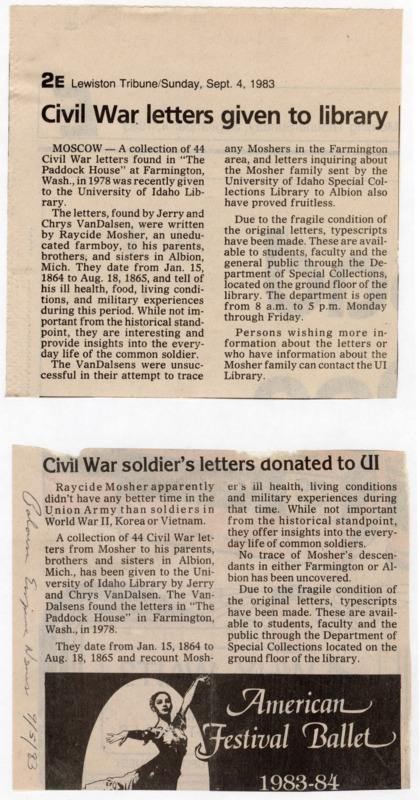
The Raycide Mosher Civil War Letters collection held by the University of Idaho Special Collections and Archives includes 44 letters written by Raycide Mosher between January 15, 1864 and August 18, 1865; an 1899 letter to Raycide’s wife, Adeline Mosher, from her niece, Ada May Kirby; photocopies of Raycide Mosher’s federal military service records; typed transcripts of Raycide Mosher’s letters; and assorted secondary research related to the 1st Michigan Engineers and Mechanics Regiment.1
The Civil War Letters
In 1978, Jerry and Chrys VanDalsen discovered Raycide Mosher’s Civil War letters in the “Paddock House” in Farmington, Washington. It is unclear how the letters made their way from Michigan to Eastern Washington, although many Civil War veterans and their families traveled west after the war, in part due to settlement incentives provided by the federal government.2 The VanDalsens donated the letters to the University of Idaho Library in 1983.
Biography
Raycide Mosher (1839-1891) served with Company A of the 1st Michigan Engineers and Mechanics Regiment during the American Civil War. On December 14, 1863, at the age of 24, he enlisted as a private with the Union Army at Clarence, Michigan; he joined Company A of the 1st Michigan Engineers on January 6, 1864.3
During his service, Mosher regularly wrote letters to his family, who lived near Albion, Michigan, in which he discussed his experiences in military camps, reflected on the course of the war, and advised his family on how to run their farm, particularly when it came to caring for Mosher’s sheep. Family members included Raycide’s father, Henry “Harry” Mosher; his mother, Sarah “Sally” Mosher; his sisters Maria and Clarissa; and his brothers Ezra and George.
As Mosher describes in his letters, Company A departed Michigan in late January 1864, traveling through Tennessee, Alabama, and Georgia, where Mosher participated in General Sherman’s March to the Sea in late 1864. Following the Union Army’s capture of Savannah, Georgia, Mosher’s unit traveled north through the Carolinas to Washington, D.C. To Mosher’s disappointment, his unit was kept in service in Tennessee for several months after the end of the war in April 1865; he was finally discharged on September 22, 1865.
Raycide Mosher married Adeline (nee Davis) in Michigan in 1867, and the couple, along with much of the rest of the Mosher family, eventually moved to California to farm.45 Raycide Mosher died in Napa County, California, in November 1891.6
Raycide Mosher’s letters are a window into the quotidian elements of service in the Union Army during the later phases of the Civil War. Mosher’s attention is trained largely on illness, food, pay, the layout of camps and hospitals, and family affairs back home. Well-known patterns and events associated with the Civil War, such as high rates of death by illness and Sherman’s March to the Sea, are illustrated through Mosher’s observations and experiences.
Sources:
-
University of Idaho Special Collections & Archives, Raycide Mosher Civil War Letters. ↩
-
National Archives and Records Administration, Homestead Act (1862). (Archived: https://perma.cc/T3H4-N2LR) ↩
-
Enderlin, Dean A., Civil War Veterans Buried in Tulocay Cemetery, Napa, California. (Archived: https://perma.cc/XU9U-657G) ↩
-
FamilySearch.org, Michigan, County Marriage Records, 1822-1940. ↩
-
FamilySearch.org, Raside Mosher ↩
-
Find A Grave, Pvt. Raycide Mosher. (Archived: https://perma.cc/F999-XVZE) ↩
Technical Credits - CollectionBuilder
This digital collection is built with CollectionBuilder, an open source framework for creating digital collection and exhibit websites that is developed by faculty librarians at the University of Idaho Library following the Lib-Static methodology.
Using the CollectionBuilder-CSV template and the static website generator Jekyll, this project creates an engaging interface to explore driven by metadata.