
About the Collection
About the Diary
This digital collection presents a diary kept by Bunro Sakaino, a Japanese American man from the Portland, Oregon, area, while he was incarcerated in concentration camps across the United States during World War II.
The diary is part of a larger collection held by the University of Idaho Library Special Collections and Archives, the George Shihei Shitamae papers. The Shitamae family owned a hotel in Seattle before they were forcibly incarcerated during World War II, following Japan’s attack on Pearl Harbor and President Franklin D. Roosevelt’s issuance of Executive Order 9066. The University of Idaho Library purchased the collection in November 1997 from Russell Books, a bookseller in Spokane, WA. Its provenance prior to that purchase is unclear.
Although much of the material in the Shitamae collection pertains to the family’s experience of separation and incarceration at centers around the Northwest, the collection also includes a handwritten diary believed to have been written by Bunro Sakaino, who was interned (see Notes on Terminology below) at several locations across the United States. As noted in provenance documentation within the collection, “internal evidence interpreted by Yosh Shimoi indicates that it was… written by Bunro Sakaino, DoJ # 146-13-2-61-14.”1
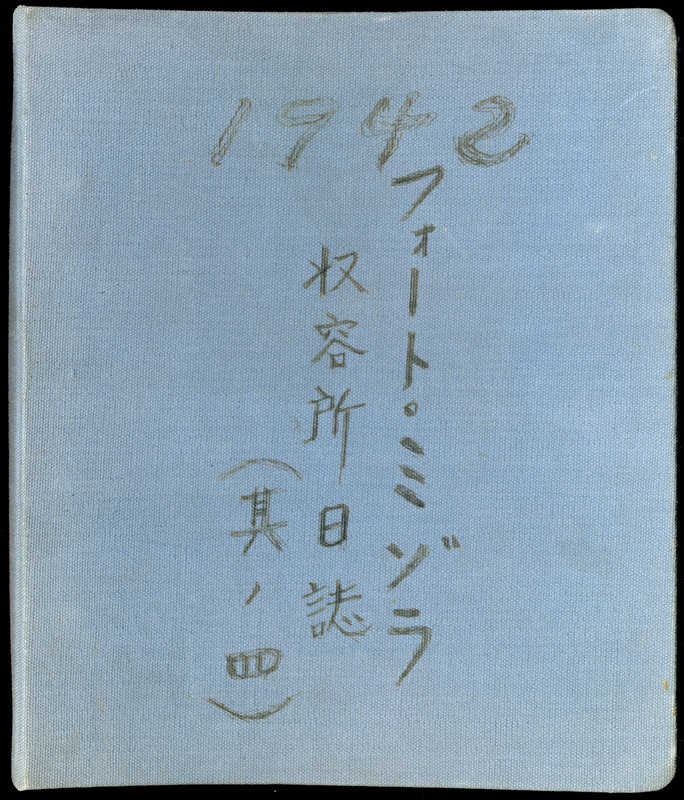
Subsequent research by scholar Priscilla Wegars led to the acquisition of Sakaino’s closed legal case file from the National Archives and Records Administration. This file indicates that Sakaino, a resident of Portland, Oregon, was born in Tokyo on June 29, 1886, and arrived in the United States via San Francisco in the spring of 1910. Federal authorities began monitoring Sakaino’s activities as early as October 1941, and the Federal Bureau of Investigation targeted Sakaino for incarceration on December 6, 1941. The Portland Field Division of the FBI apprehended him on December 13, 1941, and by early 1942, Sakaino had been transferred to the Immigration and Naturalization Service Detention Center at Fort Missoula, Montana.
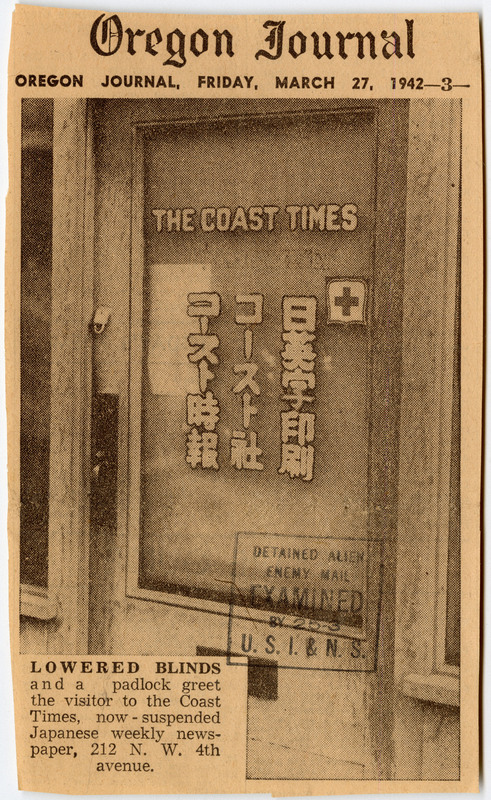
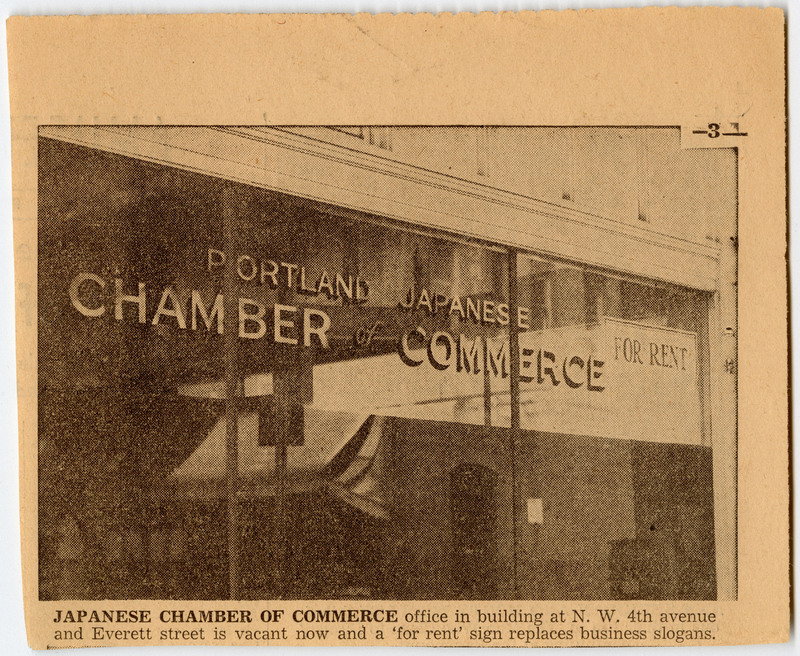
Among the activities considered in the federal case file for Sakaino’s incarceration were his positions as an editor of the Coast Times, a Japanese- and English-language publication, and as the Secretary of both the Japanese Association of Portland and the Sokoku Kai (Fatherland Society), a “patriotic nationalistic organization with branch chapters located throughout the world wherever Japanese communities are to be found.”2 The FBI also reported that Sakaino had been “presented with a wooden cup by [the] Japanese Foreign Office,” paid dues to the Portland Japanese Chamber of Commerce, was a member of the Oregon Buddhist Church, and was known to have published an annual book listing names and addresses of Japanese Americans living in the Portland area.3 Authorities concluded that Sakaino’s “Japanese interests strongly indicate Japanese loyalty and these interests, in addition to his extensive and important Japanese contacts, warrant subject’s being interned.”4
The diary includes details of Sakaino’s everyday experiences in concentration camps, beginning in March 1942 at Fort Missoula; through his incarceration at Fort Sill, Oklahoma, April to June 1942; and his time at Camp Livingston, Louisiana, until March 1943. This diary ends on March 27, 1943, as Sakaino was preparing for transfer to a concentration camp at Santa Fe, New Mexico, likely the Santa Fe Internment Camp. Subsequent records indicate that Sakaino was held at Santa Fe through February 1946, when he was released. In the federal case file, he was last noted as en route to Spokane, Washington.
Translation
The diary was translated between 2024 and 2025 by Naoko Tanabe, a Japanese researcher and translator with Densho. Densho is a nonprofit organization with a mission “to preserve and share history of the WWII incarceration of Japanese Americans to promote equity and justice today.”5 During the compilation of this digital collection, University of Idaho Library employees made minor formatting edits to this transcript to ensure proper viewing, but the translation is otherwise left as originally received.
Translation of the diary was made possible with generous support from the Terry Abraham Endowment. Abraham led University of Idaho Library’s Special Collections and Archives for many years, and with his wife Priscilla Wegars worked diligently for the preservation of Pacific Northwest history, particularly the roles and lives of Asians and Asian Americans in the region. Priscilla Wegars is the founder of the University of Idaho’s Asian American Comparative Collection (AACC) and retired affiliate faculty of CLASS.
Notes on Terminology
The terminology surrounding the detention of Japanese Americans and the locations they were held has shifted considerably over the decades since World War II. The U.S. government promoted the use of euphemistic terms during and after the war as a defense of the mass detentions, but today more frank and condemnatory language is broadly preferred. This collection follows practices outlined by Densho.6 Below is an abbreviated version of Densho’s terminology practices as they relate to the Sakaino diary:
-
forced removal and evacuation: “evacuation” and “relocation” were euphemisms used in the 1940s and later. Sakaino frequently uses the term “evacuee” in the diary. “Exclusion” and “mass removal” are considered more appropriate terms today.
-
incarceration and internment: “internment” was a euphemism applied to all Japanese-American detentions in the 1940s and later. “Incarceration” is now considered more appropriate for most of these detentions; “internment” is appropriate when referring to those detained by the Army or DOJ, as is the case with Sakaino. “Detention” is a more general term that may apply to either situation.
-
Japanese American and Japanese: the government frequently referred to U.S. residents of Japanese descent simply as “Japanese” in order to downplay their Americanness. Sakaino usually uses the term “Japanese” in his diary to refer to people of Japanese descent.
-
concentration camps, assembly centers, relocation centers, and internment camps:
-
“assembly centers” were camps where Japanese Americans were confined before being sent on to longer-term camps. Densho notes that this is a euphemistic term for a “makeshift concentration camp.”
-
“relocation centers” or “internment camps” are the older euphemistic terms for what Densho prefers to name “concentration camps.” These are the longer-term camps where Japanese Americans were detained. Facilities at Fort Missoula, Fort Sill, Camp Livingston, and Santa Fe Internment Camp, where Sakaino was detained, all fit the definition of concentration camp.
-
Please see Densho’s Terminology page and Encyclopedia for more information about appropriate terminology related to this history.
Sources
-
Box 1, Folder 1, MG 387, George Shihei Shitamae papers, University of Idaho Library Special Collections and Archives, https://archiveswest.orbiscascade.org/ark:80444/xv302637 ↩
-
Box 1, Folder 8, MG 387, George Shihei Shitamae papers ↩
-
Box 1, Folder 8, MG 387, George Shihei Shitamae papers ↩
-
Box 1, Folder 8, MG 387, George Shihei Shitamae papers ↩
-
Densho, “About Densho,” https://densho.org/about-densho/. ↩
-
Densho, “Terminology,” https://densho.org/terminology/. ↩
Technical Credits - CollectionBuilder
This digital collection is built with CollectionBuilder, an open source framework for creating digital collection and exhibit websites that is developed by faculty librarians at the University of Idaho Library following the Lib-Static methodology.
Using the CollectionBuilder-CSV template and the static website generator Jekyll, this project creates an engaging interface to explore driven by metadata.