
U of I Campus Architecture
Overview of U of I Campus Architecture
The buildings and landscapes that make up the University of Idaho campus are the result of a long and layered architectural history. Each era of building and growth builds on the visual and functional cues of its predecessors. At the outset, early 20th-century revival styles such as Renaissance, Romanesque, and Classical Revival planted the seeds that would become a formal red brick theme—a motif that would set the standard for campus building design for the next century and beyond.
From the 1920s through the 1950s, these revival styles evolved into the well-known presence of Collegiate Gothic, reinforcing the aesthetic identity of the campus. These Collegiate Gothic buildings created an academic core surrounding the Administration Lawn, a plan put in place by the Olmsted Brothers. While this plan has been altered and modified over the years, its creation has significantly impacted campus planning and the resulting built environment.
From the 1930s through World War II, student growth persisted despite financial constraints, ushering in a new era of efficiency and functionality. These Minimal Traditional, Modern, and International Style buildings used new materials and methods while at the same time maintaining campus continuity with the frequent inclusion of red brick.
Following the postwar crunch, mid-century creativity abounded with Brutalist, Postmodern, and Contemporary buildings. Despite their experimental scale and form, they often utilized the same pressed red brick building materials, keeping a contextually unified look. Newer landmarks, such as the entrance signs, echo the classic University of Idaho Gothic silhouette, nodding to the campus’s early 20th-century origins.
Taken together, these changing waves of design and style map out the evolution of the University of Idaho’s built environment—tracing the various ways that architectural shifts reflect changing educational priorities, student growth, and societal trends. While many of these different categories have some overlap in time, the general progression from early 20th-century Revival through late 20th- to 21st-century Postmodern and Contemporary styles is clear, providing a comprehensive architectural history of campus life.
Early 20th-Century Revival Styles (1902–1951)
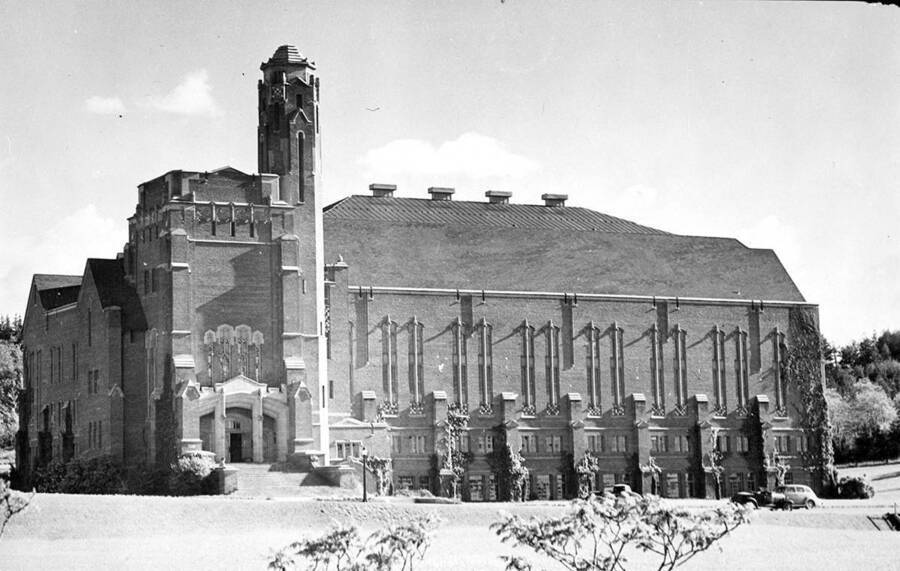
The Memorial Gymnasium (1929) is a striking example of Collegiate Gothic on campus.
- Styles: Renaissance Revival, Romanesque Revival, Classical Revival, Mining Vernacular, Collegiate Gothic, Dutch Colonial Revival, Colonial Revival, Gothic Revival.
- Characteristics:
- Red brick façades, formal symmetry, historical references, decorative detailing
- Symmetrical façades, arched windows and doors, classical detailing, masonry construction (Renaissance Revival)
- Rounded arches, heavy masonry walls, towers or turrets (Romanesque Revival)
- Columns and pilasters, pediments, formal proportions (Classical Revival)
- Pointed arches, vertical emphasis, decorative stonework, towers, ornate entrances (Collegiate Gothic)
- Gambrel roofs, flared eaves, dormers (Dutch Colonial Revival)
- Symmetrical façades, multi-pane windows, classical door surrounds (Colonial Revival)
- Steeply pitched roofs, buttresses, carved stone detailing (Gothic Revival)
- Key Buildings:
- Ridenbaugh Hall (1902) – Renaissance Revival
- Art & Architecture South (1904) – Romanesque Revival
- Morrill Hall (1906) – Classical Revival
- Art & Architecture Building (1907) – Mining Vernacular + Renaissance Revival
- Administration Building (1909) – Collegiate Gothic
- Beef Barns (ca. 1918) – Dutch Colonial Revival
- Life Sciences South (1925) – Collegiate Gothic
- Mary E. Forney Hall (1924) – Collegiate Gothic
- Hays Hall (1927) – Collegiate Gothic
- Memorial Gymnasium (1929) – Collegiate Gothic
- Carol Ryrie Brink Hall (1937) – Collegiate Gothic
- Student Health Center (1937) – Collegiate Gothic
- Archie Phinney Hall (1938) – Collegiate Gothic
- Virtual Technology & Design Building (1942) – Colonial Revival
- Lionel Hampton Music Building (1951) – Collegiate Gothic
- Niccolls Home Economics Building (1951) – Collegiate Gothic
Early to Mid-20th-Century Modern and Minimal Construction (1927–1965)
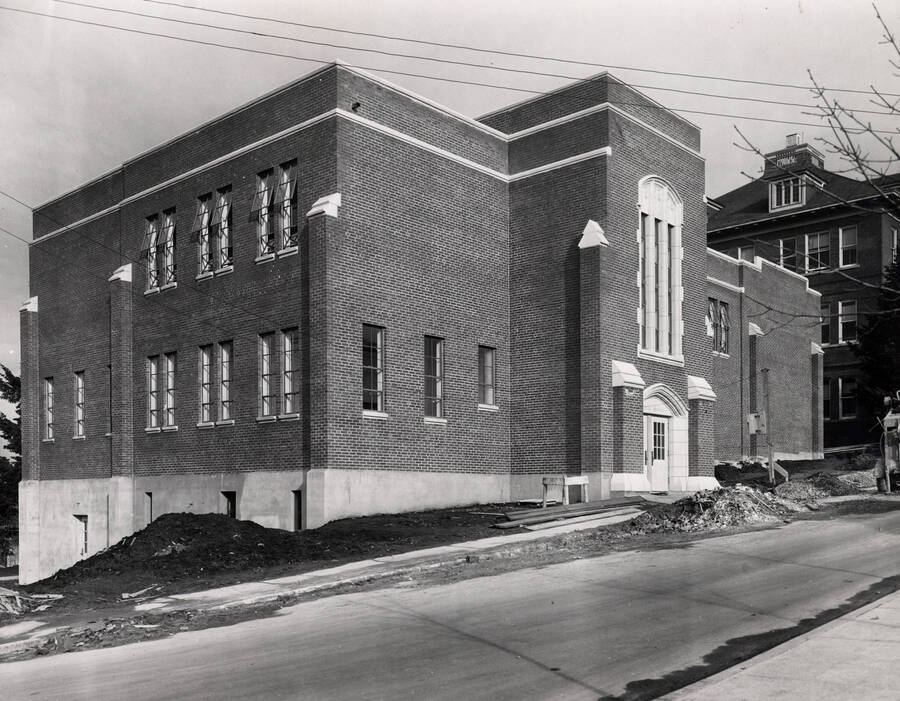
The Food Science Building (1942), pictured above, is an excellent example of the transition between Collegiate Gothic and International Style, as it embodies characteristics of both.
- Styles: Minimal Traditional, Industrial Vernacular, Early International Style
- Characteristics:
- Simplified forms, functional layouts, economical materials
- Low-pitched gable roofs, minimal ornamentation (Minimal Traditional)
- Functional, rectilinear forms, large windows, exposed structure (Industrial Vernacular)
- Flat roofs, unornamented façades, horizontal/vertical window bands, steel and concrete framing (Early International Style)
- Key Buildings:
- Energy Plant (1927) – Industrial Vernacular
- Native American/Migrant Education Center (1935) – Minimal Traditional
- Vehicle Research Laboratory (1941) – Industrial Vernacular
- Food Science Building (1942) – Collegiate Gothic + Modern transition
- Kirtley/Gauss-Johnson Engineering Buildings (1942/1950) – Early International Style
- Janssen Engineering Classroom Building (1950) – Early International Style
- E. J. Iddings Agricultural Science Building (1951) – Early International Style
- Engineering Annex (1965) – Minimal Traditional
- PREEC Greenhouses (1956) – Industrial Vernacular
Mid-Century International and Brutalist Modernism (1950s–1970s)
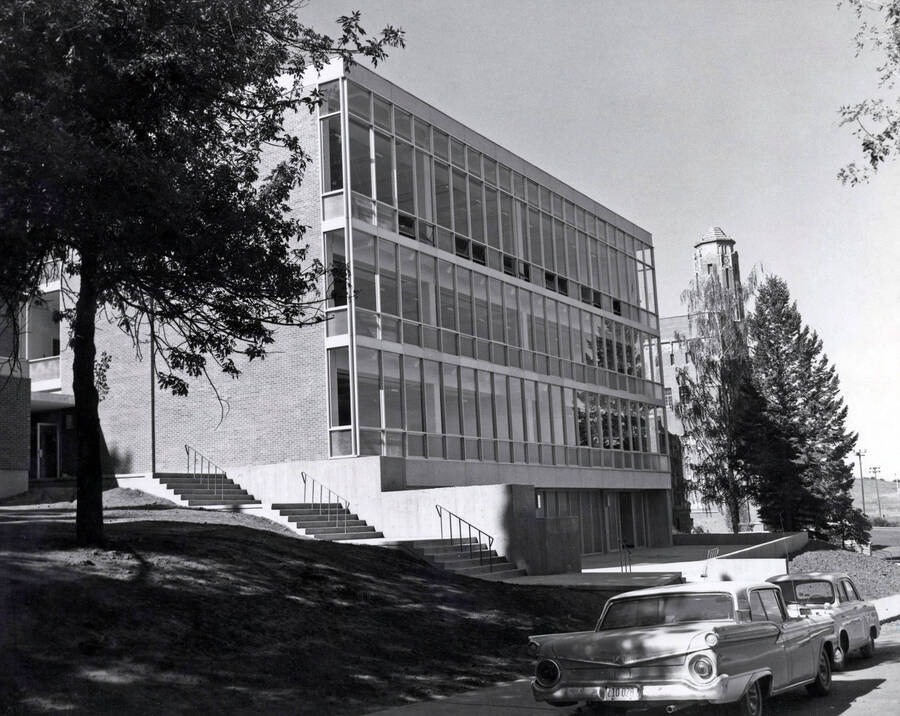
Art and Architecture North (1966), pictured above, is one of the best examples of an International Style curtain wall on campus.
- Styles: International Style, Brutalist / Modern
- Characteristics:
- Flat roofs, smooth façades, glass and steel curtain walls, open floor plans, geometric forms (International Style)
- Bold geometric forms, massive concrete surfaces, modular elements (Brutalist)
- Red brick sometimes incorporated to harmonize with historic campus buildings
- Key Buildings:
- Blake House (1953) – International Style
- Shoup Hall (1958) – International Style
- Mines Building (1961) – International Style
- Wallace Residential Center (1963) – International Style
- Malcolm M. Renfrew Hall (1964) – International Style
- Art & Architecture North (1966) – International Style
- J.E. Buchanan Engineering Building (1968) – International Style
- Donald R. Theophilus Residence Hall (1969) – International Style
- College of Natural Resources Building (1972) – International Style
- College of Education Building (1969) – International Style (significant remodeling has altered the original exterior of this building, however, it retains elements reflecting its underlying International Style)
- Physical Education Building / Swim Center (1970) – Brutalist
- Menard Law Building (1973) – Brutalist
- Kibbie Dome / ASUI Activity Center (1975) – Modern / Quonset Hut
Late 20th-Century Postmodern, Contemporary, and 21st-Century Modern (1988–2021)
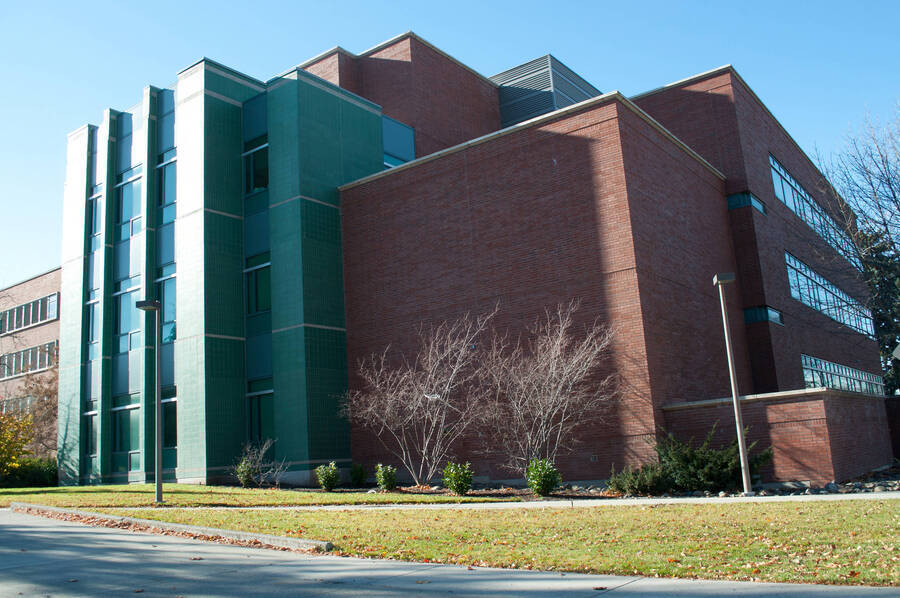
Pictured above is the Agricultural Biotechnology Building (2001). This building exemplifies postmodern construction that utilizes traditional materials to create a cohesive campus aesthetic.
- Styles: Postmodern, Contemporary, 21st-Century Modern
- Characteristics:
- Eclectic references to historic styles, ornamentation, contextual harmonization (Postmodern)
- Innovative forms, sustainable materials, mimetic design, open interiors, integration with landscape (Contemporary / 21st-Century Modern)
- Key Buildings:
- Gibb Hall (1988) – Postmodern
- Engineering & Physics Building (1991) – Postmodern
- James A. McClure Hall (1995) – Postmodern
- Idaho Student Union Building (1999) – Postmodern
- Agricultural Biotechnology Building (2001) – Postmodern
- J.A. Albertson Building (2002) – Postmodern
- Living Learning Community Buildings (2003–2004) – Postmodern
- Integrated Research & Innovation Center (2016) – 21st-Century Modern
- Executive Residence (2019) – 21st-Century Modern
- Idaho Central Credit Union Arena (2021) – Contemporary / Mimetic
Notes
- Nathan J. Moody, “National Register of Historic Places—Registration Form: The University of Idaho Historic District,” initial submission to Idaho SHPO, unpublished, University of Idaho, Moscow, Idaho, May 7, 2025, 7-9.