
Administration Lawn (Olmsted Green)
Geographic Coordinates: 46.726209403394954, -117.0097376389116
Administration Lawn (Olmsted Green) Overview
Date: 1908-. Much of the plan was never implemented
Standing: Yes
Architect: Olmsted Brothers
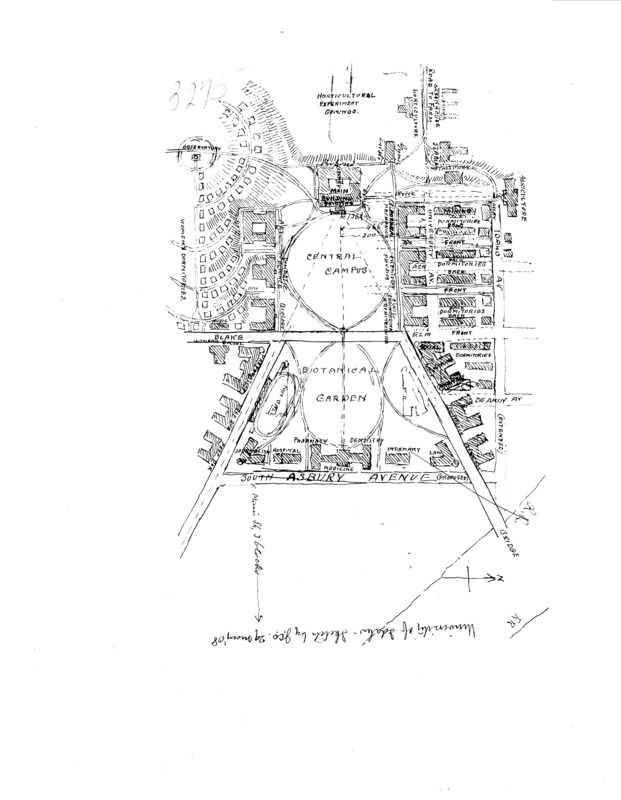
Description: The Administration Lawn was envisaged in 1908 by John C. Olmsted of the renowned landscape architecture firm Olmsted Brothers. In his report to University of Idaho President James MacLean, Olmsted referred to the area as “Center Campus,” underscoring its intended role as the university’s central green space. It remains the only surviving component of Olmsted’s original campus plan.
Use History: Presidential Grove 1911
Sources: 1908 Olmsted Sketch
History
The Administration Lawn was envisaged in 1908 by John C. Olmsted of the renowned landscape architecture firm Olmsted Brothers. In his report to University of Idaho President James MacLean, Olmsted referred to the area as “Center Campus,” underscoring its intended role as the university’s central green space. It remains the only surviving component of Olmsted’s original campus plan.
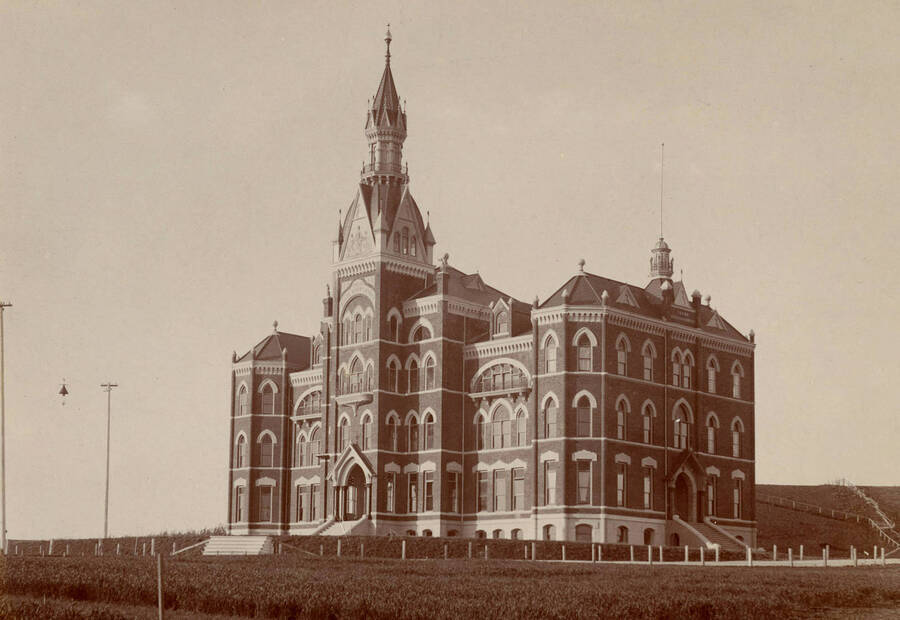
Despite this, the original Olmsted plan has deeply impacted the long range expansion of campus, setting the standard of green space and trees as a repeated element in subsequent years. The present day volume of campus trees comes into sharp contrast when looking at early photographs of the Administration Building, and the initial construction of the Olmsted Green, where trees were scarce.
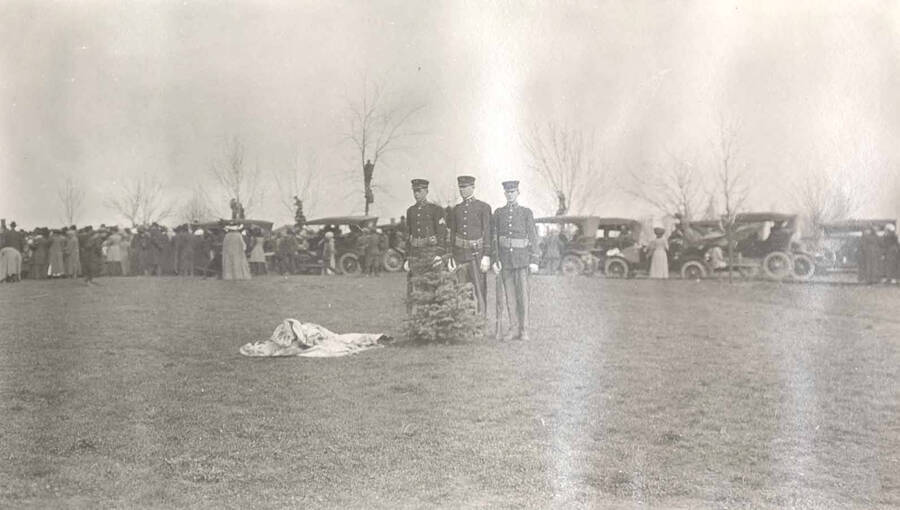
A prominent feature of the lawn is the Presidential Grove, a commemorative space that began in 1911 when former President Theodore Roosevelt visited the university and planted a tree. The tradition continued with additional plantings by notable figures, including President William Taft, Vice President Charles Curtis—the only Native American to serve in that role—and First Lady Eleanor Roosevelt. Each tree includes a dedication plaque memorializing the occasion.1
Design
Olmsted envisioned a central lawn that would serve as a communal and symbolic heart of the university. Over time, additional elements were introduced to enhance the space’s ceremonial and educational value, such as labeled trees planted by academic departments and commemorative benches donated by alumni and community members.2
Physical Description
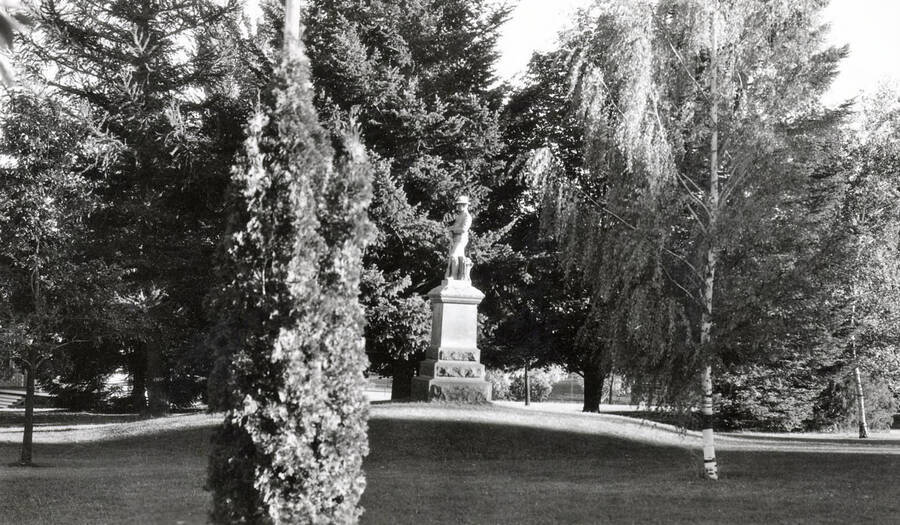
The eleven-acre lawn features a network of concrete pathways running east-west and north-south, with a stairway extending to the northeast toward Hello Walk, a tree-lined promenade leading to the Administration Building. The site is covered primarily in grass and dotted with mature trees arranged both along walkways and in more vernacular groupings. Notable features include a Spanish-American War Memorial Statue honoring University of Idaho students, remnants of a historic maple grove, tennis courts, and the tree-lined Presidential Grove at the lawn’s southern edge. More recent tree plantings, dating from the 1990s to the present, are identified with departmental signage.3
Olmsted Brothers
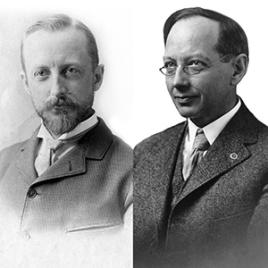
Following the retirement of Frederick Law Olmsted, Sr., his sons Frederick Law Olmsted, Jr. and John Charles Olmsted established the Olmsted Brothers firm, which grew into the leading landscape architecture practice in early 20th-century America. Their projects included expositions in Portland and Seattle, and major park systems in cities like Boston and Seattle. As founding members of the American Society of Landscape Architects, they were strong advocates for the profession. Their portfolio also spanned roadways, campuses, and civic spaces, and they prioritized preserving natural landscapes.4
After the 1907 reconstruction of the University of Idaho’s Administration Building, President James MacLean invited the Olmsted Brothers to develop a campus plan. John Charles Olmsted proposed a formal layout centered on the Administration Building, featuring diagonal avenues, a central green (now Admin Lawn), and carefully placed academic and residential buildings. Although most of the plan was never fully realized due to funding limitations, elements like the open lawn and parts of Hello Walk were implemented. The university continued to consult Olmsted in later years, and his influence remains part of the landscape architecture curriculum today.5
Notes
-
Nathan J. Moody, “National Register of Historic Places—Registration Form: The University of Idaho Historic District,” initial submission to Idaho SHPO, unpublished, University of Idaho, Moscow, Idaho, May 7, 2025, 15. ↩
-
Ibid. ↩
-
Ibid. ↩
-
Olmsted Brothers, The Cultural Landscape Foundation (Washington, DC), accessed July 22, 2025, https://www.tclf.org/pioneer/olmsted-brothers. ↩
-
“The University of Idaho,” The Cultural Landscape Foundation, accessed July 22, 2025, https://www.tclf.org/university-idaho. ↩
Browse Images
![Snow scene, trees in front of Administration. [2-57]](https://objects.lib.uidaho.edu/campus/small/campus00785_sm.jpg)
![University of Idaho campuses scenery, lawn near Administration Building. [6-1]](https://objects.lib.uidaho.edu/campus/small/campus02427_sm.jpg)
![University of Idaho campuses scenery, lawn near Administration Building. [6-2]](https://objects.lib.uidaho.edu/campus/small/campus02439_sm.jpg)
![University of Idaho campuses scenery, students on walkway to Administration Building. [6-27]](https://objects.lib.uidaho.edu/campus/small/campus02447_sm.jpg)
![University of Idaho campuses scenery, students on walkway to Administration Building. [6-28]](https://objects.lib.uidaho.edu/campus/small/campus02448_sm.jpg)
![University of Idaho campuses scenery, Administration Building lawn. [6-31]](https://objects.lib.uidaho.edu/campus/small/campus02452_sm.jpg)
![University of Idaho campuses scenery, Administration Building lawn. [6-32]](https://objects.lib.uidaho.edu/campus/small/campus02453_sm.jpg)
![University of Idaho campuses scene. Students on administration building walkway. [6-47]](https://objects.lib.uidaho.edu/campus/small/campus02468_sm.jpg)
![University of Idaho campuses scenery. [6-5]](https://objects.lib.uidaho.edu/campus/small/campus02471_sm.jpg)
![University of Idaho campuses scenery. [6-7]](https://objects.lib.uidaho.edu/campus/small/campus02476_sm.jpg)