
About the Collection
About the Collection
The Experimental Forest and Savenac Nursery Photo Archive contains photographs related to the establishment of two Forest Service Experimental Forests in north Idaho, Priest River and Deception Creek, as well as the Savenac Nursery in western Montana. These images were taken over almost 80 years, from 1910 to 1989, and depict the people, places, and machinery of forest workers in the region.
This digital collection was co-created in 2013 by the University of Idaho Library and Bob Denner, a forester with the Rocky Mountain Research Station. Denner was the Superintendent at the Priest River Experimental Forest before transferring to the Moscow Forestry Sciences Lab. While at Priest River, he discovered boxes of photos and documents stored in the office attic. Eventually he brought them to Moscow, where the historic materials were digitized and cataloged. The Moscow office also provided a number of photos and documents that added to the historical record of these sites.
The physical materials represented in this digital collection remained the property of the Forest Service. Most digital items presented here may be reproduced with acknowledgement to the USDA-Forest Service. An exception to this are the photos from Priest River of original cottage interiors, of J.A. Larsen, and of his wife Jenny and daughter Margaret. Those are reproduced from the private collection of Ms. Susan Marsh and will require authorization from the Marsh family for reproduction.
About the Locations
Priest River Experiment Station
The Priest River Experiment Station was established in 1911 at a site on the east side of the Priest River, about midway between the towns of Coolin and Priest River. It was the headquarters for Forest Service research in Region 1 until the administrative headquarters moved to Missoula in 1922. The Missoula unit was then named the Northern Rocky Mountain Forest and Range Experiment Station; Priest River then lost the “Station” in its name and became the “Experimental Forest”.
The scientists working at Priest River first planned to study the silviculture of western white pine and its associated tree species of the mixed conifer forests of northern Idaho. However, forest fire research very quickly became a top priority. Between 1935 and 1942, the buildings that make up the present administrative site were constructed by Civilian Conservation Corps (CCC) enrollees. The administrative site and outlying features were listed on the National Register of Historic Places in 1994. Priest River remains a very active research facility used by Forest Service and academic scientists, and students of all ages.
Deception Creek Experiment Station
Because most of the facilities and staff at Priest River were occupied with fire research, the Deception Creek Experimental Forest was established in 1933 for the purpose of examining and understanding the ecology of forests dominated by western white pine, since the issue of studying western white pine was still very important. Extensive stands of white pine were found in the Coeur d’Alene Mountains, so it was decided to reserve about 3500 acres that encompassed the Deception and Sands Creek drainages. The Honeysuckle Ranger Station stood near the site, being located at the confluence of Deception Creek and the Little North Fork of the Coeur d’Alene River; the station was able to provide assistance with management activities.
Research activities continue to examine uneven-aged management, cultural activities to promote white pine growth, and strategies to reduce the impact of blister rust. The buildings that were constructed by CCC and Emergency Relief Appropriations (ERA) no longer exist. They were removed in the early 1970’s after constant vandalism made them unusable.
About Deception Creek Experimental Forest
Western white pine, the State Tree of Idaho, was responsible for the influx of the timber industry into northern Idaho at the beginning of the 20th century as the stocks of eastern white pine were liquated. Capable of impressive size, the wood was straight grained, easily worked, and had very little taper in its logs; there were vast areas in northeastern Washington, northern Idaho, and northwestern Montana where white pine was the most dominant species. The economic value of white pine cannot be understated as communities, sawmills, and roads were established while the timber industry wasted no time in developing the means to harvest and process this resource.
The Forest Service timber sales in white pine forests would employ a variety of cutting methods and cultural treatments as an informal means to test their effectiveness in producing natural white pine regeneration for the future. However, scientists and foresters recognized the need for a systematic and long-term process to monitor and evaluate these methods. And so, the Deception Creek Experimental Forest (DCEF) was established in 1933 to study to ecology of western white pine and provide a site dedicated to research and demonstration purposes. Located within the Coeur d’Alene Mountains, an area of extensive white pine forests, DCEF is composed of 3500 acres and includes the Deception Creek and Sands Creek watersheds. It is located just upstream from the confluence of Deception Creek and the Little North Fork of the Coeur d’Alene River at the site of the Honeysuckle Ranger Station (now the Honeysuckle Campground).
Construction of the headquarters site began immediately as a spike camp was built in an area on Sands Creek that was cleared and homesteaded in 1905. The Civilian Conservation Corps (CCC), the National Industrial Recovery Act (NIRA), and the Emergency Relief Act (ERA) programs made possible the construction of 2 residential cottages, shop, garage, fuel house, bunkhouse, and office. The remote location of DCEF made it difficult to keep a year-round employee and winter damage from deep snow was a constant and expensive problem. In the early 1970s vandalism reached a level that made the repair costs prohibitive and the buildings unusable. All were subsequently demolished and cleared from the site.
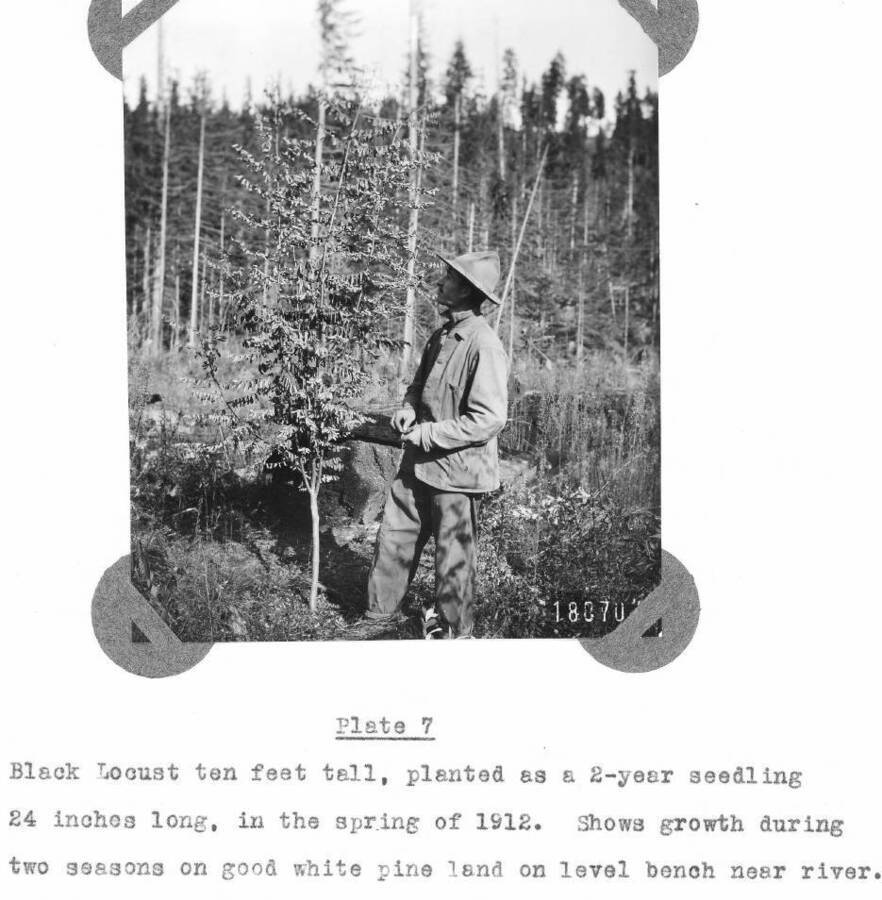
Timber management was and remains the primary activity on the Forest. Several early sales by the Forest Service prior to the establishment of DCEF are examples of certain cutting methods, both good and bad, and have provided opportunities for the testing of timber stand improvement activities such as the timing and intensity of pre-commercial thinning. Recent cuttings have been used to investigate selective harvests and uneven aged management for successful regeneration of white pine; other studies have examined and compared mechanical slash reduction with traditional slash burning. White pine blister research has been prominent and resulted in extensive planting and monitoring the progress of certified resistant seedlings.
Group tours of DCEF may be arranged by contacting the Moscow Forestry Sciences Lab.
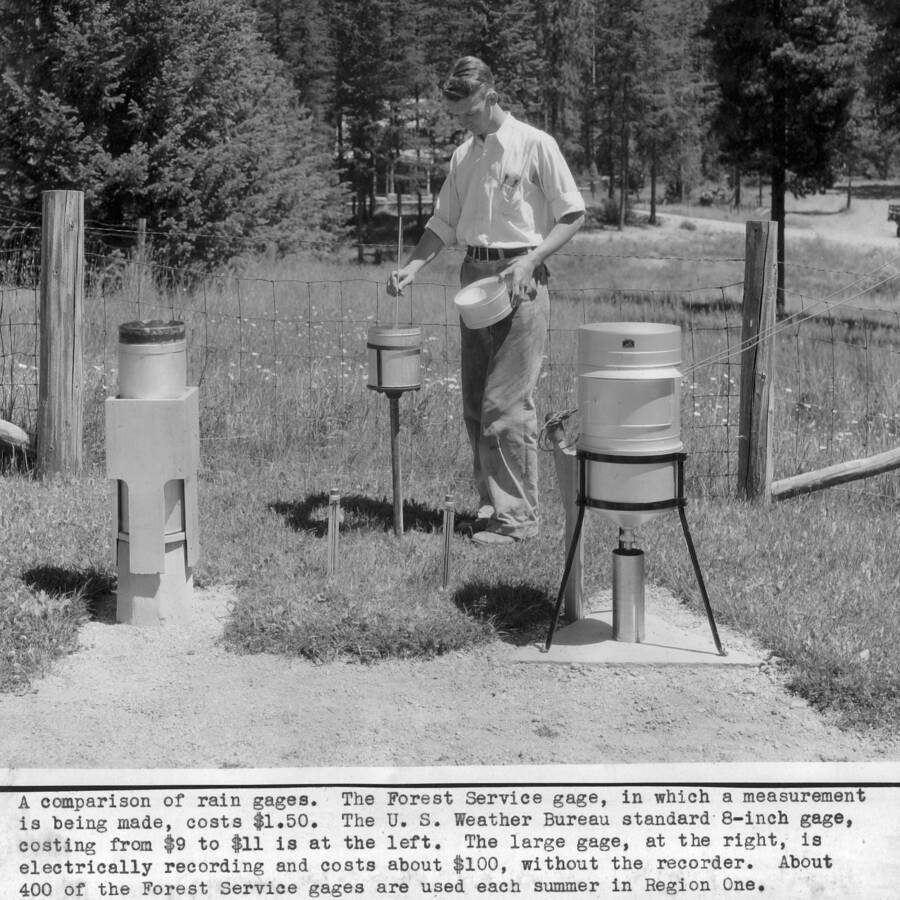
The images of DCEF and surrounding areas depict the facilities, weather stations, infrastructure, research sites, equipment, and people. The photos were taken by staff and visitors to DCEF, including a well-known Forest Service photographer, K.D. Swan. Where a Forest Service accession number was visible in the lower right corner of a photograph, the date taken, location, description, and photographer were crossed checked against the official Forest Service Photographic Record. The digital images were created on a Hewlett-Packard flatbed scanner, model 8290 and scanned as .tif images with a resolution of 300 dpi.
The photos by Forest Service personnel are in the public domain and may be reproduced with acknowledgement to the USDA-Forest Service.
Savenac Nursery
Savenac Nursery is located near Haugan, Montana and is 15 miles east of St. Regis, Montana. Savenac was once one of the largest and oldest USDA Forest Service tree nurseries in the western United States, operating from 1907 until 1969. The nursery site was selected by Elers Koch, of the Forest Service, who also helped fight the Great Fire of 1910 that burned much of the northern Rocky Mountains, including a portion of the nursery.
Savenac once produced over 12 million seedlings annually for use in reforestation of national forests throughout the western United States. In 1969, its operations were moved to the Coeur d’Alene Nursery. Savenac was listed in the National Register of Historic Places August 16, 1999. Today ten buildings built during the 1930s by Company 956 of the CCC remain at the site, together with landscaped grounds, a stone bridge, interpretive trails and a small arboretum.
About the Savenac Nursery
In 1907, Elers Koch, Forest Supervisor of the Lolo National Forest, was on his honeymoon (via horseback) in Mineral County, Montana. Koch and his bride came across an abandoned homestead along the Savenac Creek and he thought it an ideal site for a tree nursery. Within a year, seed beds were prepared; such was the beginning of Savenac Nursery and several other modest nurseries, including the Boulder Nursery (also in this collection), which was established to serve the Helena National Forest.
When the great fires of 1910 spread through the area, the Nursery site was burned over. As the extent of the damage was realized, the Forest Service recognized the need for a large scale operation to produce seedlings in the quantity needed to plant the recently burned area and for disturbances in the future. The smaller nurseries such as Boulder were discontinued. The following year, more land was cleared at Savenac and by 1915; some 10 million seedlings were in the ground, producing about 3 million seedlings annually for planting. Research conducted at the Priest River Experimental Forest investigated seed ecology and seed bed requirements; this was put to good use and advanced the nursery practices at Savenac.
By 1916, all seed and seed bed research was transferred to Savenac. Now the nursery conducted research in addition producing millions of seedlings annually and making constant repairs and improvements to the facility. Tools, equipment, and methods developed at Savenac found a wider application at other nurseries. Savenac had become recognized as the source of innovative ideas and practices for large scale tree nurseries. Through the decade of the 1930’s. Savenac produced 8-12 million seedlings annually for planting and became the largest, most productive tree nursery in the nation.
Much of the nursery and facilities expansion was the direct result of an infusion of labor provided by the Civilian Conservation Corps (CCC). In 1935 enrollees of Company 956 settled into Camp Taft, across the St. Regis River from the nursery. The crew stayed until the program was discontinued in 1942. Most of their labors took place in the seed beds but these with the necessary skills built the office, two cottages with garages, the packing plant and stock storage room, an implement shed, improved the water and sewer systems, completed the cone storage shed and seed extractor, and graded and graveled roadways within the nursery.
After a downshift in production during WW II, production increased to earlier levels and the nursery continued operations through the 1960’s. In 1969 the nursery program was transferred to a new nursery in Coeur d’Alene, which now serves the needs of the region. Since then the Forest Service has maintained the facilities for educational and environmental programs. In 1999, the site was listed on the National Register of Historical Places. Savenac is open to the public and offers a self-guided tour of the facilities and grounds. Contact the Superior Ranger District, Superior MT for details.
The images of Savenac Nursery depict the facilities, equipment, and people. The photos were taken by staff and visitors to Savenac, including a well-known Forest Service photographer, K.D. Swan. Where a Forest Service accession number was visible in the lower right corner of a photograph, the date taken, location, description, and photographer were crossed checked against the official Forest Service Photographic Record. The digital images were created on a Hewlett-Packard flatbed scanner, model 8290 and scanned as .tif images with a resolution of 300 dpi.
The photos by Forest Service personnel are in the public domain and may be reproduced with acknowledgement to the USDA-Forest Service.
Technical Credits - CollectionBuilder
This digital collection is built with CollectionBuilder, an open source framework for creating digital collection and exhibit websites that is developed by faculty librarians at the University of Idaho Library following the Lib-Static methodology.
Using the CollectionBuilder-CSV template and the static website generator Jekyll, this project creates an engaging interface to explore driven by metadata.