
Description: Learning banking at Kendrick; offer to work at Troy. Advantages of one-room schoolhouse. Father's death. World War I and anti-German sentiment. 3-18-75 1.5 hr 39p
Date: 1975-03-18 Location: Troy; American Ridge; Kendrick; Moscow
Subjects: Great Depression; banks; education; families; illness; world wars
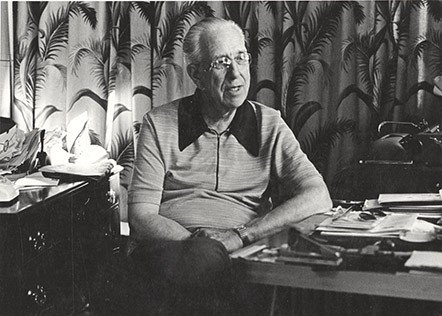
Frank Brocke
Born 1906
Occupation: President of First Bank of Troy; where he worked for forty-seven years; chairman of school board
Residence: Troy; American Ridge; Kendrick
Topics:
The colored topic bar is hidden for screen reader users. Use the topic buttons below it, the "Filter by Topic" menu or the search box to find specific content in the transcript.
Sam Schrager: I was curious about when your parents first came to the Kendrick country.
Frank Brocke: Well, of course, I was pretty young at the time that they passed away. My dad passed away. And of course, I never really heard mother talk. She was born in Kansas. And when they came west, I would not know. They were obviously young. And my father was born in Genesee. So they were... My grandfather came from Luxembourg, which was close to Germany. And my mother was German. So there was German on both sides of the family. In fact, my mother could talk very fluent German. But dad couldn't talk at all. He died when he was only 40 years old. So to go back and state their background, I don't know too much about it.
Sam Schrager: When were you when he died?
Frank Brocke: I was 19-6, 19-19. I was 13. I was the second of five children. The oldest one was George. And he was 14. He was 15 when my dad died. He was doing the flu epidemics of 1918, 19-19. Oh, is that what... Yeah, that's why he passed away. He was a victim of the big flu epidemic… and..… first mother, we lived on a farm. And the whole thing was left to her and us two boys to decide what we wanted to do. We went to a rural school. And of course, the year of the flu epidemic out of nine months of the... Or eight months school. I think there was only three actual months that you attended school because schools were closed. And so the following year, we went to Kendrick. And I actually missed the seventh grade and went right into the eighth grade. And George went to high school. So I took the eighth grade at the Kendrick Elementary School. We continued to farm. And we took the... My dad had... He had something like out of 140 acres of farmland. I think he had about 60 acres of fall wheat in. And we went ahead and kept that wheat because it was on granted ground, my grandfather's place. And then we put in our own 80. George and I put in the crop the following... Next two years, we were there and we continued to farm and go to school from the ranch. And well, two years later, that was in 1919. And in about 1922, mother moved and the family removed to Kendrick. And of course, there was a time I graduated from high school. And George did not graduate, but he continued to go to school part-time. And then he got a job. So like a pretty big responsibility for the kids. Oh, yeah. Yeah, that was something. And it ought to have seen us. We hauled our grain down a grade of three miles to Kendrick. And we had a very good wheat crop that year. And of course, we had to haul all the crop off. I can remember the Queen Mother and I, and George, we would load that wagon with 25 sacks of wheat. You'd stay up quite a time. But it can be done. You can do anything if you have to. But they were not wealthy people. Dad had some insurance and some mother paid off the balance on the farm. So we had the 80 acres of land clear, which was good. We had a good home, a good house, a large house, but it was good. And we sold off the animals, the horses, and time when we quit. But we farmed them for three years and then rented it out to one of our relatives. And he farmed it for a couple of three or four years. And then the mother passed away then in 1937, I believe it was. So she didn't live too long.
Sam Schrager: Do you remember much about that flu epidemic?
Frank Brocke: Oh, yes, yes, very much.
Sam Schrager: Can you tell me what it was like?
Frank Brocke: Well, it seemed as though heavier people, husky people, and I don't mean necessarily fleshy. It was very hard on fleshy people. It was the enlargement of the heart. That's the virus affected the heart and enlarged it. And of course, the fat of you were, you had a tendency to crowd your heart anyway due to flesh and fatness. And my dad was a heavy man that weighed some over 210 pounds. He was mine built about six feet tall. And so consequently, he got the flu on a Sunday morning and he lived until the following Sunday and died in the afternoon. But their heart continued to enlarge and it crowded the lungs. And there was not room to breathe and the heart beat all in his chest cavity. That was really the thing and there was no cure for it. I can remember my aunt telling about, from Bovill, Mrs. John Brockley's wife. She was a nurse. She nursed through people. And she said, the skinny ones survived. And of course, in Bovill, they had whiskey that they manufactured. It was more or less of a town where you could get whiskey. Anything to stimulate the heart and thin the blood and create the circulation seemed to be a help. And of course, the flu epidemic hit during the prohibition days and we never even had whiskey in the home. Neither was it available. But I often thought that had we had whiskey, a lot of flu victims would have survived it. But it was very, very contagious. And you never knew when you got it. My dad got it from a neighbor's family that he had been there and they were playing. They used to go in the wintertime on Saturdays and play cards. And of course, he came home with it and that same day he got it. But then we all got it with him. It just seems as though one day is all it took. And he got it on Sunday. And I would say by Wednesday, we were all on our backs. I never went to bed. I had a very mildest of any of the family. I believe my brother Kenny had a very mild. He was the baby. And the smaller, the younger you are, the less it bothered you. But my mother was on her back and my sister and George, they had it very hard and walled to it. So you were the ones that took care of the family. No, no, we had a wonderful person. She was a cousin to us children. She came and lived with us all doing this thing. She was a hard-working soul. Her name was Carrie Daybald. She married a man by the name of Bechbo who was an undertaker and a furniture man in Kendrick. And she took care of our entire family from the time we took it until I would say, having lost our dad, why it was terrible for my mother. And she stayed a good month after we got over the food, which lasted about two weeks. And I was a godsend. I'll never forget that person. I can just see her this day. She did everything. And of course, I was not allowed to go outside, but I helped her with the cooking and things of that sort. And of course, everything was soup and broth.
But there was days to remember. And I've never seen anything like it since, an epidemic that would equal it.
Sam Schrager: Did it hit most of the town?
Frank Brocke: Oh, yes. It was so widespread. It was national-wide, nationwide. And people died by the hundreds and probably the thousands. On American Ridge in itself, we lost two within two days of each other, two prominent people. Both of them. One was a mother and then my own dad. And others died. And of course, doctors were so scarce. Our regular doctor got the flu. So he was put out of commission early during the epidemic. And there was a doctor who took his place. That was never what you'd call a very good doctor. But nobody knew what to do. All they did was prescribe aspirin and go to bed and stay there and eat light. You just had to wear it out. That was the thing. And if you could survive it, you did. If you didn't, you died. And the fever, of course, was fantastic. It got up as high as 105 and 106. And of course, when it got over that, your chances of survival were virtually nil.
Sam Schrager: How far was your place from school?
Frank Brocke: By a road, it was about two miles. But across the country, across the field, that we could go, I would say, a little over a mile and a half. It was probably two and a half miles by the road. But during the fall and then during the... When the snow would be crusted, we would walk across. And then when it dried up in the spring, we would walk across. But normally we walked. And it was very seldom, unless it was very bad, did we get transportation. We walked. You walked through sleet and snow. And you were dressed warm. That was part of the life. Dad used to take us the worst time. Whenever the snow was too deep that you had to wade, he would go. But we lived back of a hill from the main highway. And they didn't open roads in those days. You had to either wait or else you got... Where there was snowdrifts, if you got a sled and a team, and it was possible, you went around. You went out in the field to get out to the highway or to the road. It wasn't even called a highway in those days. It was just... They called it a main road. And that's how you got there. But snowdrifts was very common. And as I say, our top of our hill, where there'd be a cut in the road, the snow would be three feet deep. Well, a horse... Your only means of travel was by horse and sled. So consequently, a horse couldn't go through that while you went around. So you, as a route, he got out. But many, many places was isolated, that they couldn't drive around. And so consequently, if there ever was a bad winter, it was not impossible to close the school in a rural school. The teacher never got there while none of the kids did. But you would go to school every day. Yes, every day that you got in, you bad. When you missed school, you were either very sick or else there was some real legitimate reason. Yes, you took it far more serious than they do nowadays.
Well, this must have been past the time then when, like what I've heard is in the real early days, that the kids wouldn't go to school but for a couple of months or a few months and would stop school for harvest and all that kind of stuff. No, no, that was not in an elementary school where you only went to the eighth grade, see. Because you were normally too small to be in the harvest or too young. So the biggest difficulty was for the first graders and the real small children. But I, as a seventh or eighth grader, you just went to school. You liked to go to school and it was part of your life. I think you went. You enjoyed other kids. You enjoyed your playing. They always had a good time at the recesses. You'd play games and you thrived to go to school and you made yourself go. Because to stay home in the wintertime, you did enough of that. You wanted to get out. And as a rule, in those days, it seems to me that there was more, the crust was on the ground and you walked on top of the snow at least two months out of the year. And that was the deepest time. That would be December and January, which months would be the hardest part of the winter. So there was no excuse. You could get on a sled. We always took a sled to school and never went without a sled. That was part of your books. Because you coasted during the noon hour. You coasted at the 15-minute recesses. And that was it. And so consequently, if you managed at all and there was up and down hills out of a mile and a half, I dare say you always coasted a good half a mile. You could with a sled. And the sled was no problem to do at the pool.
We had one younger brother and then my sister, who was younger, I think that it was harder on them than anybody. But we had good sleds. We had big sleds, too. That is at least three and four kids could get on a sled. They weren't little tiny ones. They were big. And a good old flexible flyer. That was the one. Every good sled was a flexible flyer.
Sam Schrager: When you talked about playing at school, what were the kinds of things that you do besides sledding?
Frank Brocke: Oh, shinny. And that was in the spring and the fall. You ever hear of shinny? Never heard of it. Well, shinny was... You dug out a hole in a spot in a fairly level ground. I'd say it would be two feet across and it would be just like a cup. It would be rounded in a round bottom and probably in the very lowest spot in the middle. I would say that would be probably a foot or maybe eight inches deep. So it would hold a can. And your shinny was a can no matter what. A tomato can or a peach can or not too big, but just so it would roll good. And they beat it up, you know. So it would... It was maybe four or five inches long and then maybe you couldn't get your fingers around it. And they'd beat that down to where it would be more or less rounded and it would roll. Well, you'd have, say, 20... The circumference of the circle around the little one in the middle would probably be... Oh, the circumference of it would be 20 feet. 10 feet from the hole each way, see. And then they'd make little holes. That would be about three or four inches deep and the circumference of about six inches. And then you'd have a stick, a shinny stick. That was what you'd drive the thing with. Well, as you come out of school, the last one to the shinny deal was it. He had to chase the can or get the can and try to get it into the center. And they could knock that can maybe two or three hundred feet. And then you had to go get it with your stick and you couldn't pick it up. You had to beat it back. And of course, the point was that if you had your stick in the hole, well, then you were safe. Nobody could bother you. But as the can came back to the hole in the middle of the shinny diamond, you'd take your stick out and run over and try to knock that can away from him and make him go back and get it again. And in the meantime, they could steal your hole. So instead of being real close to it, you were way off. And this guy that was driving the shinny, he could look out the corner of his eye and if he saw a hole, he could run and get his stick in there then that everybody tried to find a hole. And then the one who didn't always had to go chase the shinny again, the can. And that was the game. And they played that hole indefinitely. That was the big game. And of course, there was baseball in the spring, some baseball in the fall. But of course, in a small rural school, it was hard to get two teams. It was virtually impossible. We usually played with about four or five on each side, and it was the size of it. And then the girls could play shinny, and they couldn't play the other. And then they used to make a sled effect. They would have three or four boards nailed together. And then you had a wire and you had a stick in it every so often. And you could pull that and put kids on it. And that seemed to be fun. Quite a bit of that. And you pull it on the grass. It pulled fairly easy. That was a game that was played.
Sam Schrager: Would shinny be a game that all kids would play, kids without ages?
Frank Brocke: No, you had to be careful because it got rough. Yes, I would say that you could hold that stick and protect yourself so that they hit it. That's what you always had to watch out for. There was a lot of skinned legs. That was the worst. Nobody ever raised a stick up to hit anybody, but you were always beating on the ground or trying to hit that can. And so you had to guard yourself by the stick. The stick was usually about that long. And there was nothing on it, just a blunt stick. There was no hook on it. There was no... They weren't too big. The lighter the stick, the better a chance you had because it was too heavy. You had to carry that and you wanted to be able to move and maneuver.
Sam Schrager: Could you have a lot of kids playing that at once?
Frank Brocke: Yeah, you could have 20 kids, whatever. Any number, whatever the diamond called for.
Sam Schrager: And if there was only, say there was only 10 kids, then they had to lay a shinny stick over the hole that was dormant, see?
Frank Brocke: So nobody could use that hole. In other words, if there was 10 kids playing, they could only use 9 holes because one of them always had to be... You always had to have somebody that didn't find a hole. And he was the guy that chased the can. And if... And by the way, if you got it into the big hole in the middle of this shinny diamond, if you got it in there, you'd try to just like hockey to the degree. Same idea as hockey.
Sam Schrager: Is it like a goal?
Frank Brocke: Yes, and no, you tried to get that into that hole.
Sam Schrager: In the middle, see?
Frank Brocke: And by nobody stopping it. And if you did, then everybody had to run to... They had a fence, which would be, say, as far as from here, oh, here, out to your car. And you ran there and you had to hit that fence and then run back and get and find your hole. Find A hole, no matter what. But then whoever had the last one back, of course, he never found a hole and he was stuck. And of course, then you couldn't get them too young. Everybody, the older you were, the more speed you had. And of course, you never had to drive the shinny. So the little kid, he was always, as a rule, left out in the open and he'd have to be the shinny. But even then, you could... And then after he drove it, by then you could help him by trying to get... Because everybody would try to get out and hit the can and you left your hole while somebody else could get in and see. And so if this young man was alert, while he would watch and then get his turn, he'd pretty soon, he'd have a hole. And you could all gang up against somebody that you wanted to drive the shinny. That's not like an ingenious game. That's right. I've never heard of it either. But oh, it hardly a year went by. And I went to Kendrick. They never heard of it. And when I went to the city school, there was no such thing as shinny. But we played it all.
Sam Schrager: What was shinny itself? Was that just the game or was that what they called the can?
Frank Brocke: No, the game was called shinny. But of course, the shinny can. That's what it would be, shinny can… yes.
Sam Schrager: Well, what about the school itself? Was it just a one-room?
Frank Brocke: One-room school, yes. And I would say at one time, during my career there from the first to the seventh grade, I spent six years in that. There was at one time when they had two teachers, it was that highly attended. And I think that was around 40 students, which would be rare. And there was older boys. There'd be boys that would be 15 and 18 years old. They'd be attending that school, which was unusual. As a rule, by the time you're 12 or 13, you've graduated from the eighth grade. But there was cases where boys came from, moved in, and it'd be a large family. And they had never graduated from the eighth grade. And it was a law you had to. You had to go to school until you passed the eighth grade, or until you attained a certain age. So consequently, there was older students going to school.
Sam Schrager: Was it hard for them, do you think?
Frank Brocke: No, they never had opportunity. It wasn't because they were poor students. No, what I meant is having to sit there in the classroom. No, they were on, Ray. That's true. Your teachers all were strict. There was no teacher put up with much. If there was such a thing as a poor discipline teacher, your school was bad. You just knew that it was bad. You had to be tough. You had to be very strong discipline in those days to teach a rule of school. When you had so many, and all eighth grades, everybody, you listened. Here I was in the seventh grade, and maybe three rows over to me, the second or third or fourth would be reciting. You would listen. You would learn so much from the younger people. And of course, they in turn learned from us. You tried to concentrate, but it was hard. I was always one to listen anyway. But I can recall that, yes. You're saying that it was good to have, and it's great to hear. Well, sure, because you had to really concentrate on it. You studied a lot at night. You took books home. Because in the daytime, when other classes were reciting, they didn't necessarily talk about a whisper. They talked normally. You couldn't say, don't talk so loud, and so forth and so on. But you listened to other classes recite. And if you were in a sixth grader, when you heard the newer, you always made your classes the primary and the first, second, and maybe the third, fourth. The first four grades was on one side of the school building. The school building was all open. There was no—and it was small. The whole school wouldn't be any bigger than that room, which would be possibly 20 by 30 feet. And there was a stage, took out of it, and there had to be a room for a stove, a great big pot-bellied stove. So by doing that, the kids, the aisles weren't over 18 inches apart. And of course, you couldn't help but know what was going on all through the room. So you learned, and there was a blackboard, a lot of blackboard work. In other words, the teacher was constantly using the blackboard. Well, these things all took your attention, you know. It was a job, I'll tell you. You marveled at a teacher that could teach eight grades in a daytime and keep them in order. And as I say, you were a strong disciplinarian. And when a child got balled out or got disciplined in the school room, we all heard it. And of course, you sized the teacher up then. You knew, oh boy, that better not be me. I've seen teachers slap kids or hit them on across the hands with a ruler. It was common.
Sam Schrager: Usually a good reason for it?
Frank Brocke: You bet, oh definitely, yes, you had to. Whispering, I think, was the worst difficulty in talking out loud. And that was the worst offense in the mountain. But you can imagine what it would be like if you didn't have silence within reason, see. And the only noise you was to hear was in the other class reciting. Because if you were talking, you took the attention of others. So it had to be to anybody now that looks back on it while you know that you had to have silence by your other students. And they were there to... Another thing I marvel at, we used to spend a lot of time in writing penmanship. That was a very, very highly thought of subject. I guess maybe the teacher had too many she couldn't read, and of course, too many papers that they couldn't read that she dwelled on that. And spelling was another thing. Writing and spelling was very, very important. And if you analyze what we have in this day and age, those are the two very weaknesses that we have in our system, is writing and spelling.
That's true. My writing is terrible.
Sam Schrager: Well, did you ever take writing?
Frank Brocke: No, not in school, not... Except they taught you handwriting in third grade, but then that was the end. No, we literally had writing through every class clear up through the seventh grade, as I say, up to the eighth grade. You had a writing class, penmanship, they called it. And you took it from a book, you followed instructions, and you were assigned a lesson.
Sam Schrager: What were these recitations about? What would class recite?
Frank Brocke: Well, you would have... You would just like to do in this day and age. I think they recite, reciting, that's the... you answer a question orally. Oral recitations, they called it in those days, and I think they still have that. But they didn't have nearly as many examinations as they have in this day and age. Teachers constantly order examinations nowadays, and in those days, it'd be very, very rare that you'd have a written examination. Everything was done more or less orally, and even down to exam... oftentimes, examinations were oral because there was no reason to write them, and that just made more work for the teacher, and she couldn't possibly keep up. So you took your turns in answering, usually as a rule. If the teacher asked a question, and there was four in your class, and she asked Nessie, you answer this question, and if Nessie said, I don't know the answer, then you raised your hand, and if you knew it, you got to recite, and you got to tell the answer. That was common. In other words... and that was at the discretion of the teacher. They're always smart, and then there's the slower students, and I was never one to... I would probably never answer unless I was asked to answer, because, you know, that's up to the individual.
Sam Schrager: Did the teacher have an idea, you think, of where each kid's progress was?
Frank Brocke: Oh, my yes. You bet. Very much so. More so, and that's true. I think that's why I favor the small, rural country schools that we have in this day and age, like when you compare Troy to Moscow, there's a lot of individual attention, and that's what happened in our time in rural, small country schools. You were part of her, and she was part of you, that is, your teacher... was just... made you what you are, that is, as far as education was concerned. You could learn at home, but their parents were busy, or in lots of cases they didn't... they never had much education, and they learned from you, probably, in many cases more than what you learned from them. There were exceptions, but as a rule, you... Mother used to help us a lot. Dad never did. He never was asked, but Mother, she was a graduate of the Lewiston Normal, so she knew, she understood a lot, and was a fairly good writer, but she didn't believe in doing your work for you, but she'd make a study, a study you had to. I found this out when I went from American Ridge, where I got my first six years of education, and I moved to Kendrick. That's quite a change, going from a school where you've lived all your life up to that time, and you knew every child, and you walk into a city school, and I was called a city because it was large. There was probably 40 kids, and there was two classes together, the seventh and eighth, and with my background, I skipped the seventh and went right directly into the eighth grade from the sixth, because I was so far advanced in comparison to the town school, and that was the reason. I was not a high-graded child. I worked hard, from my knowledge. I was never more than a C student, C sometimes a B, very seldom did I get an A, because I was not, I don't know how I was slow, but when I learned something, I never forgot it. It's just interesting to me, the way you're talking about country schools, because I'm so young, and the more facilities it has, the better, and the country school with so many kids, any one kid would have a tough time learning, but when you say that you could learn from the smaller kids, that's really interesting to me, because I don't usually think of that. Well, of course, those schools are gone now, where there is no rural school anymore, in comparison, very seldom, probably in Elk City, or somewhere, isolated spots in the state of Idaho, you probably have that one classroom, one school, one classroom, but you compare Troy to Moscow, and I think there's a world of difference, and of the two places, I don't belittle Moscow, but I think that's true, the bigger the school, the less individual attention that a student gets. If you've got it on the ball, if you're an A student, you're a smart child, I don't care where you go to school, you're going to be an A student, but if you are a C student, and you go to Moscow, and if you need special attention every day, not just once in a while, but constantly, there's no teacher in a big system that has her hands full and doesn't know you from Adam, it's going to go out of her way, or his way, to see that you get that special attention, whereby in a small school, everybody knows that child, everybody knows that teacher, and that teacher soon learns that family, learns the background, and becomes a part of that child and is determined, if she's a good teacher, she'll say, I'm going to give that person more time than anybody else, because the A student, they don't worry about those, they don't need it. So they've got to dwell on these students that have the problem. And I've been on the school board for 27 straight years, and I got to know the insides of a lot of teachings and principles and curriculums. I never did believe, when they took sound reading, that was the worst thing that ever happened to any student in the United States of America. You remember when they dropped sound and went to the pictures or site, the site reading they called it?
We never recovered from it. You go out today and talk to a student that has sight reading, nine of them out of ten can't read. In your lifetime, you recall, did you have sight or sound?
Sam Schrager: I'm not sure exactly what the difference is. What is it? The difference between the two?
Frank Brocke: Well, the sound reading, when you learned your alphabet, and you sounded your words like madam, m-a-d-a-m, the word was sounded out, that's how you learned it. But let's take the picture. When you learned the spell cat, on your primary, you learned the k at c-a-t, and how you learned it was sight. You saw the animal. It was a picture and a book. No, I had the other way, the sound. The sound reading, that's right. We had several older teachers in the Troy School, and they continued to have both. Virtually picture music was forced upon the schools, and they couldn't get away from it. They continued, the older teachers continued to use the sound along with the sight. They had fairly good success, but the younger ones that came in, that had learned it through the universities and got their certificates used to the sight, it was easier to teach, less trouble, but very, very poor for the child. I think they're back to it now. I understand they're back to sound. Yes, they're heading that direction.
Sam Schrager: What do you think the reason it was that kids couldn't master reading that way?
Frank Brocke: Well, it was just a principle that somebody said that this other's better. You go through that. It's just a philosophy.
Sam Schrager: Were the teachers hard to keep in the bridge signals?
Frank Brocke: No, no. They were much more settled in there than it is now. Of course, the war made it impossible to find teachers. Of course, there was no such thing as a young man. I think when I go back in my first eighth grade or up to the eighth grade, I don't think I remember of a single man teacher in an elementary school. Everything was looked upon to the women, to the young girls. When you got into high school, whether it was common to run into the man teacher, which was a new experience for you too. Well, my impression has been that that was one of the only jobs open to win. That's true. That's right. Yes, that was very true. There was occasions when rural schools had a man, but it was very, very rare. In other words, it was take it or leave it. They were that scarce, and you had to take whatever you could get.
Sam Schrager: Would you have the same teacher for more than one year?
Frank Brocke: Oh, yes. Many of them stayed, you might say, there were teachers in the Troy area that had been here a lifetime. They sometimes, because there were so many rural schools, they sometimes shifted. But I think I would say that if a teacher didn't stay over two years, there was something wrong, and she would ask her to leave. But as a rule, they stayed anywhere from one to six and up to a dozen years. Usually the teacher fell in love with some local man. She got married, and then that was the end of it, because they didn't, as a rule, a housewife never worked in those days. But it was interesting, and the school trustees was very hard to find in those days also. My dad, I believe, served one term, and that was all, but otherwise, it was usually that was a man's job also. And the rural schools, it was hard to find anybody that would run on a school board, because it required a little time, and so many of them didn't understand it. And I don't, I think the only thing they met was once a month to pay the teacher, pay any bills they wanted, and once a year to hire a teacher for the next year, and that was about the size of it.
Sam Schrager: Each school district financed itself?
Frank Brocke: Yes, they had, they raised, there was a school tax, and that was a tax levied upon the lands within that district, yes. And that's how all schools were financed before the state equalization deal came into effect. There was not even state aid until, during my lifetime. And it soon became, as it went on, why finally as things got tougher, there was such a thing as equalization, which was brought on, which was done by the state and brought on. Otherwise, I don't think there was no county levies either, because your local districts financed your school.
Sam Schrager: What was your farm like when you were young and growing up on it?
Frank Brocke: Well, I myself liked horses, and I loved to be with my dad, and I used to ride on the binder with him, ride on the plow with him, ride on the drill, wherever he was, I was. I liked horses, I harnessed a horse when I wasn't even able to, I had to have something to stand on to get the harness on him, and our horses was gentle, those that weren't gentle. Of course, I was worn constantly by my dad to stay away from him, which I did, but you gradually, pretty soon you're petting him and you're on their back or you're fooling around with him like anything else, and I didn't like towers, though. I hated to milk a cow, although I had to, but the horses was my first love. And he used to, whenever we'd go to town or whenever we'd have the team hitched up, I always wanted to drive, even if I had to set in his lap, and he never met me, that was it. I was doomed to be a farmer, I guess that was my life. And as I say, when he died, and we had to go on and harvest the crop that fall, I ran the binder myself. George and I'd take turns, but as I recall, I think I ran it 90 % of the time, and I had an awful time reaching down there with the end of my toe to trip the bundle rack, bundle deal every time. But we worked together fine, and the plowing, I often think, if you've ever had three horses on a walking plow. Now, that's one furrow that's about, on an average, would cut about 10 to 12 inches wide, and you'd start around a 30 or 40-acre field. And I'd like to see a young generation do that. Now, it would take you at least two weeks to get that field plowed, and you would start at 8 o 'clock, 7 o 'clock in the morning, and you would work till 5 at night, because it would be dark. And in the fall, the days got shorter, and as a rule, you could go out in the field at 8 o 'clock in the morning, and then by 5 o 'clock, it would be starting to get dark, and you'd have to quit. You'd follow that plow around that field hour after hour after hour, and you hold the plow in place. You can't let it go. You walked behind it, and you guided it, and you plowed. And I've done that for three solid years. We had a disc plow that you could ride, but my dad never believed in that only in the springtime. In the fall, you had to use a walking plow, because the disc plow wouldn't stay in the ground, but a walking plow would. And so we had to do all of our fall plowing. We had to do it with a walking plow, with three horses. And of course, you had two lines, and then you went around your waist, and then your two hands was on the plow handles. And the horses followed the furrow. Only at the corner would you have to steer them, because they followed the furrow. One horse was in the furrow. That's how you hitched it, so that that horse being in the furrow pulled the plow, and you just had to keep it in you this way and that way. It was minor. And you planted your beans. I'd done that. I did everything that was to be done on the furrow.
Sam Schrager: Is that what you were growing then, beans?
Frank Brocke: Yeah, we grew beans in those days. Beans and oats and wheat was the principle three crops. Right.
Sam Schrager: Rotate?
Frank Brocke: Yes, very much. So yeah, your bean ground went into fall wheat. That was how you got fall wheat. And of course, beans were a problem, because they were so much work. You had to work your ground good in the spring and try to kill all the wild oats if it was possible. And if it was a dry summer, as a rule, you had very few weeds. And I've seen the year when you didn't even have to hoe. If you did hoe, it would be only on certain spots of the field where the wild oats was the worst. But if you planted your beans in June, and there was a wet spring, the wild oats came right up with the beans. And there was no way that you could cultivate and get the wild oats out of the row. You could kill them in between the rows. That was no problem. But to get the wild oats, which means that that wild oats had to be hoed. And that was a tough old job, I'll tell you. Because you hoed beans in July, and they made that one when it was hot. And we did. We did well, kept them as clean as we could.
Sam Schrager: The thrashing of beans was a problem, too, wasn't it?
Frank Brocke: Well, not if it was a normal fall. As a rule, you stack your beans. It was very seldom that anybody would thrash their beans out of the shock in the field because it was too undependable. If you didn't, why, you were constantly being rained upon. So as a rule, I'd say 80, 90 percent of the farmers stacked their beans, put them in a pile, and then they were free to thrash them at any time. And of course, machines, thrashing machines were scarce, and you had to usually wait, and you didn't dare take that chance. My dad had a thrashing machine. In fact, we used to call it the little coffee grinder. It was a hand fed. You had to stand up on a platform and feed it by hand. And he thrashed many and many and many an acre with that little thing besides our own. I never even heard of it being that small. Yeah, it was very, very—well, I had an uncle who was— my dad's brother was very handy with tools, and he used to overhaul that thrashing machine every summer. Everything—I don't think there was a thing in it like the boxings for the cylinders were made of hardwood, and he would chisel those out because you couldn't buy them otherwise. And the rattle rakes and the equipment inside—the machine itself was wood. And so it was very easy for him to do.
Sam Schrager: Did the family try to be self-sufficient? I mean, as far as like growing the food to eat and the lunch?
Frank Brocke: Oh, yes. Oh, yeah. We had a garden. During my lifetime, our garden would cover at least an acre to two acres, and a portion would be set aside for sweet corn. And our potatoes was always separate though from the garden. We may have had a couple rows of early potatoes, but the potato patch in itself could be up to five acres. We used to put away anywhere from, I'd say, from 60 to 100 sacks of potatoes every fall. We'd dig that many, and they went into a pit, or they went into a cellar in our house. And so help me. We ate potatoes three times a day, and you thought nothing of it. It was just as important as meat or anything else. If you didn't have potatoes, you didn't have anything. We had potatoes for breakfast, for dinner, and for supper every day of our life. Well, we had seven in our family. Sometimes you had a hired man, and you lived off of potatoes and beans and meat. Meat was something that you had at least twice a day. That would be known. Sometimes you wouldn't have it necessarily for breakfast. For us kids, anyway, we would have eggs and potatoes, and that would be the size of it. But your dinner meal and your supper meal were both heavy meals, excepting when you went to school and you took a lunch. That was usually a jelly sandwich or whatever it was in. Whatever the season was, peanut butter sandwich made by homemade bread. But during the war years, that was a rough one, bread. When we would go to town, if Mother would buy a loaf of bread off of our grocery counter, we went home. We ate that like cake. We didn't care if there was anything on it. A piece of bakery bread to us was just like eating cake. You could just give us a slice of bread, and that would do it. You would be the same as a piece of candy compared to a piece of candy.
Sam Schrager: It was that that we did?
Frank Brocke: Yes, and it was a luxury, see. You didn't buy bread. There was no excuse to buy bread because Mother baked the bread. But during the war, the flour got so bad. Even after the war, as time went on, it took time to really get a bread flour. It was all dependent on the flour. Anybody could make pretty good bread if the flour was good. You had to have patience, and you had to have reasonable know-how. If the flour was not good, if the flour was heavy, your bread was heavy. That was the way it was if it was not ground properly.
Sam Schrager: Well, was the wheat that was grown here okay for making bread?
Frank Brocke: Oh, yes. They made bread. There was a flour mill in Kendrick, a very prominent flour mill, the Kendrick flour mill company, which had their own power. Their machinery was run by water. There was a floon there. They made flour. But during the war, of course, the war effort took all the flour. All the flour was earmarked for the government. You took what was ever left. Of course, the only flour you got was ground fast, not properly ground. It was very coarse. It was rough. But it was it. You got by. It was nourishing. That's all you wanted. I know my wife, Laura, has tried to make bread with the wheat now that's grown here. It just doesn't come out too well. Well, of course, soft white, no. They blend it now. Most Northwest wheat is not the best flouring bread because they have to mix it to make some of their higher proteins. But for baking, I understand the Japanese think it's the greatest. There is a difference, apparently, between the soft white wheat is good for the pastries and so forth.
Sam Schrager: Were you kids all pretty close in age?
Frank Brocke: Yes, yes. Every one of us. Within two years. George was the oldest. He was born October. I was a year up to June before I was born. Then I went on around from June. On around to June into November, Margaret was born. Then from November around to November, clear around to July before Wally was born. I believe Kenny was younger by about three years. He was the baby of the family. He was only about, he was just walking good. He wasn't over two years old. He never remembered his daddy at all. But he wasn't over two years old when my dad died.
Sam Schrager: Did the kids look out for each other a lot?
Frank Brocke: Oh, sure, as I should say. Yeah, you did. It was more or less taken for granted, you did. It was part of the life, in fact. You played together with five children. You were always playing at the same deal, or you were making something, or you were sharing something with other members of your family. That is, we were. I think that was common. I never heard of many. They were all large families. I would say that that was common. You learned to play at school. I think that was part of your education. You'd learn how to play at school. You'd learn different things to play. Of course, to play shinny would be impossible at home. Mumblety-Peg, though, and marbled games. When I went to Kendrick, that was the big thing in Kendrick. When I moved to town, it was the marbles. I was a darn poor marble shooter, I'll tell you. They gave me 25 marbles, and in two days they were all gone. That was the game. The Good ones, they were running out their ears. Talk about, get good. Some of these high school kids could really nip off any marble at three and four feet away. But I never got that good. Whenever I played marbles, I picked the guy that I was to play with, so I'd have a chance. Or else I didn't play.
Sam Schrager: What about this mumblety-peg?
Frank Brocke: Well, that was played in the row, because that was with a two-bladed knife, a long blade, and then a short blade. When I got in there..… that was..… there,… that was mumblety-peg. You put this in there, and you flip it over, and it would stick rather than whatever fingers. That was how you counted, and that was whatever fingers you could get under this blade, where that was your score. You'd play that, and that was a common game. I went to Kendrick, and that was something they never played, but the marbles took their eye. Of course, a lot of basketball in Kendrick. They had more playground equipment. There was more swings, that sort of thing, in a Kendrick school. Of course, the older you got... I guess they played in the gym, they'd play basketball, bouncing the ball. But you never had the fun in a city school. Of course, you went home to eat. That required most of your time. That's right. You went home during the noon hour, see?
So, consequently, your 15-minute recesses just seemed to go in a high school or in a city school because you couldn't organize anything in 15 minutes to get a game going. So, consequently, you went home, and by the time you got back to school, it was ready to take up. Kendrick from the school down to our house would be three-quarters of a mile. I can remember another kid and I always ran that. We'd run. We had to go down to Steep Hill and then down Main Street. We used to run home and then run back. That was just to be running, trotting. We'd trot. It was a wonderful exercise. It sounds like, though, there was a lot more closeness, more neighborhood in the American region.
Sam Schrager: Oh, in the real school?
Frank Brocke: Oh, yes. Because although in Kendrick it was not so big, but what you knew everybody in time, you knew everybody in that school room because I don't think the Kendrick High School in my day ever got over 50 students. That didn't count, tell them. That was just 9th, 10th, 11th, and 12th. Although it was a nice big assembly, you still knew everybody, but there was grade school kids that you wouldn't know after you got into high school, even though they were in the same building. You may know them, but in my older age now, when I get to reminiscing and talking about families in old times, and I knew the high school kids, but in the same family, if there was a first grader or a second grader or a third, fourth, and even though they were in the same school, I don't even remember them. That's how you break away, but in this real school, you probably knew that first grader better than you did anybody in the world because you were taking sides with him. You'd help him or hurry. You'd wait on him. You just seemed natural. If the older brother was picking on him, that's the rule. You took their side and stopped him and so forth. You got to know everyone in the grade, in the real school period, their whole life, too, I'm going to tell you.
Sam Schrager: When you were a youngster, I figured you probably wouldn't be interested in the politics and stuff that was going on, but were you parents at all?
Frank Brocke: They were, but you never heard it. That is, they never discussed it at all. My dad came from a Democrat family. My mother was just as rabid. She came from a Republican side, just very outspoken Republican. He and his family were Democrats. They were married, of course, and mother. She, being a lady, kept her mush. That was very seldom did you hear the mothers or the girls talk politics at all. It was always the men. Naturally, we had no part. I voted for Hoover my first time when I got a job in Troy, which was in 1926. There was an election in 1928, and Herbert Hoover was a candidate, and I believe Al Smith was a Democrat. Ollie Bowman, my boss, was a staunch Republican. I had no knowledge. I didn't know anything more about politics than the man on the moon. He enthused me to vote for Hoover, and I did. Of course, that ended up in the tragic recent depression. Not that that was his fault or anybody's, but that's how you could be swayed. I was an open candidate for anything. Well, during the Depression, of course, and coming through with it, I switched over and voted for Rosicow because of the condition we were in. You never took any part.
I've heard people—I've heard it said that a lot of people became Republican after 1892, because Cleveland was in when they had the Depression in 1892. Yes, I think that's true. That's just what happened. The country certainly was a Republican area, for sure, clear up to Hoover's administration. Of course, that turned it around completely. Then it was dominated by the Democrats for many years. Now, during the Eisenhower, it started to come back until Nixon, of course, upset it again. So now, I don't know what's going to happen.
Sam Schrager: What do you think, or do you have any idea of what it was that would be of concern to your father or the other men?
Frank Brocke: Not maybe national politics, but locally.
Sam Schrager: What would be the kinds of things that they would be concerned about?
Frank Brocke: Mostly the policy of the Republican and the Democrats. There was no—Republicans wanted an embargo on everything. In other words, don't trade with any other country. Trade at home. They didn't believe in embargoes. Keep foreigners out and don't ship anything in here. Consequently, nobody would buy our products. That's why the commodities were so low. Everything was weak. The price of wheat was so low and all those things. I think that was the biggest issue between the two parties. There was tremendous difference between a Republican and a Democrat in those days. Now, they call them liberal and conservative. I don't think—I don't know, really. I can't go back and review on that at all, because I was too far away from it. As time went on during the 30s, why—and of course you were raised. I saw people that was absolutely broke in 1932 and had been wealthy in the 15s and 16s and the early 20s that had a small fortune and lost it all. Then I saw them come back and start their fortunes all over and have the opportunity to do well again. I saw Republicans that do that under a Democratic administration, and yet wouldn't even so much as give them an ounce of credit. I'm probably that I followed that line, because my mother side of the family still are staunch Republicans right down the line. Of course, after my dad's death, we drifted away completely from the Brocke relatives at all. They had nothing to do with us and we had nothing to do with them. Consequently, we were practically associating 90 percent of our time with my mother side of the family, who were staunch Republicans. But even then, the new generation didn't discuss politics very seldom. Obviously, they voted like they wanted to or like the parents. That's one thing that I've noticed all through my life, is that a Republican family, as a rule, the children are dominated and they vote the Republican ticket. They never made up their mind. I used to get kind of bitter over that particular item, is that if your parents were old die-hard Democrats, why the kids voted Democrats. No matter anything about it, same way with Republicanism. If the parents were die-hard Republicans, why the kids were. They never really analyzed the philosophies of both sides. The period, I would say up until all during the 20s, the 30s, even the 40s, the later county was actually dominated by the Republican Party. The rule finally, going after the Roosevelt administration, I think they were leaning, the younger generation was leaning away from Republicans. But Moscow was, they did the electing. We followed along. I believe George, my brother, when he ran for the Senate on a Democratic ticket in the later county, and one really had a terrific effect on it. They found out that it could be done, and it seemed to be the turning point. Otherwise, later county was just like Nez Perce County has dominated and still does to this day by the Democrats. Later county was dominated by Republicans, constantly, year after year after year. The Democrats never had a chance. Now it's breaking away. A Democrat in later county virtually has just the same opportunity as a Republican. It's very evenly divided.
Sam Schrager: What year was it that your brother got into legislature?
Frank Brocke: I would say that was in the early 60s. He ran as a senator. I believe he was in there two terms. Then he didn't run again. Then later he started running for the honey ran as a representative. That was in the late 60s, in the middle 60s, I guess. Then he ran until he was dead.
Sam Schrager: What was the effect there of World War I on this country and on the foreign business?
Frank Brocke: World War I.
Sam Schrager: You said that wheat was so high that people couldn't eat it, but weren't the prices improved for farming?
Frank Brocke: They had, going to World War I, of course, I was a pretty young man. You didn't see too much of it, only what you heard. We did go up and it went over $2. That was the result of the war, which was good. The cost of bread went up and things of that kind. They had controls. There was nothing like there is nowadays, or what happened in the last 10 years. Right now, the way prices have run away. I can remember World War II far better than I. There was the depression after World War I. Wheat was around $2. Consequently, the farmers did hold. When wheat was $2, it was going to be $3. You saw that. As I recall them, as I understand it, those that went through the experience will tell you that when wheat started to drop, the whole bottom went out. The stock market was minor in those days. The stock market was a big issue in 1932.
But crops were not a big issue in 1932. In other words, wheat was down. We were in Latah County and the Inland Empire felt a depression far greater in 1932 than they did the one in the early 20s. That was a case of crashing on markets. People were holding for a better price, and when it started to drop, it just dropped. After World War I. I was wondering what happened in your family. You were a farmer. The only thing that you suffered for was, I would say, you suffered more than the fact that you were German descent more than anything else. That was the hardest part. We had to play with it. My mother was German, my dad being German. Of course, there was a lot of propaganda against the German people. We had to be so careful. That was the hardest thing that we put up with in World War I. My mother and her sister used to talk over telephone, and they'd talk in German. That would air the English or the other people. They didn't like it, and they'd slam the receiver down. They overcame it after two or three years. It all straightened out, and everybody was associating again. It was strictly propaganda.
Sam Schrager: Was it supposed to be a question of loyalty?
Frank Brocke: Yes.
Sam Schrager: Were the German people really loyal to the United States instead of the Japanese?
Frank Brocke: Of course, it wasn't near as bad as when Japan, Pearl Harbor, took action against the Japanese, which probably was justified without a doubt. It's too bad it had to be.
Sam Schrager: Do you remember when the world after Pearl Harbor, how they took all the Japanese and consecrated them around a certain spot in California, and they had to stay there for a certain length of time until they could be cleared?
Frank Brocke: It never was that bad. There was a lot of hatred against the Germans. If you were German, you were a little bit tented, I guess. As I say, you minded your own business. You didn't go looking for trouble. That was the atmosphere in our place. We had no particular arguments with anybody, and of course, you got along. My impression has been that World War I was not that popular with a lot of people around here, whether German or Swedish. There seemed to me a number of Swedish people resented the feeling that they'd come from Sweden to get away from militarism, and then here they were being shoved in this war. Of course, I don't think the issue was ever very clear cut on World War I. World War II was so much different. I think we obviously were fighting for a good cause in World War II, because nobody wanted to see Hitler become so powerful. World War I was a tragic accident that got us into it. I don't think anybody knew really what we were fighting over in World War I in comparison. There was no communications. The only thing you ever knew was what you read in a newspaper, which if you were able to afford one, there was no radio, no way of communicating and telling the real truth. World War I was more or less—we were in it before we knew it, whereby in World War II was far more different. I can remember listening to Hitler, you could just about follow it in your own mind. There was very little propaganda. World War I was just lousy with propaganda constantly. That's how they had to in order to get people to follow. I don't think it was near as bloody. War is World War II. Of course, we were in it only a short time, which helped also.
Sam Schrager: After the war, you were hit too badly by the Depression then?
Frank Brocke: No, because the wheat prices dropped. The wheat was two or two and a half. It didn't go down, clear down to the bottom like it did in the Depression of 1932. Wheat went down to 25 cents in 1932 and 1933. But in the First World War, I can't tell you, Sam, just exactly how bad that was. In fact, we didn't really suffer from the Depression of the 20s. If you ate, you raised your meat, you had your food. There was no rationing like there was in World War II. In other words, as I recall, we hardly knew, other than when your neighbor's boy was called into the army in World War I. You didn't realize there was much of a war going on.
Sam Schrager: After you moved to Kendrick, you started a store?
Frank Brocke: No, no. In about 1923, we started a confectionary, a brother and I, which was the mistake of our life. We lasted not only about, oh, I would judge eight months, and it burned up. It caught fire in the middle of the winter. That was the last of it. But that was a tragic experience that didn't help anybody, didn't do any of us any good. I don't think we were in business over six months. We started in the spring, and late the following fall, it caught fire at midnight and burned up. I wasn't even there. I don't know. But anyway, it caught a fire. It was a tragic thing in our life. We had a little insurance, but my mother, who put up the money, we lost probably two or three thousand dollars, which was a fantastic amount at that time. But that's one of those things, about being ill-advised, poorly advised. She let two boys talk her into something. That's life for you, I guess. That's how you learn. That was a confectionary.
Sam Schrager: That means it was made candy?
Frank Brocke: No. We sold ice cream and short quarters for sandwiches.
Sam Schrager: Were you still in school?
Frank Brocke: Yes, both of us. Actually, we were both in school. Although George was not a much—he didn't have to go to school. He was over eighteen. But I was going to school at the time. It was the following year, because that winter then, it was the following year that I—23, 24— it was the following year that I went into the bank then in Kendrick. I was a senior. At the time, we had the confectionary. I was a junior.
Sam Schrager: What was it that never gave you the idea to look into banking?
Frank Brocke: Well, they had a young—they had an assistant cashier. Kendrick had two banks. They had a young assistant cashier who wasn't over— he was probably around twenty-five years old. Here I was a youngster of eighteen. We chummed together, that is. We had the ranch. We still had the farm. We had horses out there. Every weekend, by week, we'd go to the ranch. He used to ride up with us. Then during the week, we'd chum around. I got to know him very well. He asked me one day. I was interested in it. I was always good on figures. He asked me—I was to graduate the following spring. He asked me what I was going to do. I told him I had no idea. We didn't have enough for a farm to keep farming. That was kind of a wasted cause. He said, Why don't you see if you can't get in a bank up here where I work and see if you can't learn the profession?
Learn it. Just go in there. They won't pay anything, but see if you can learn it. It was just an idea. Lo and behold, in early December, I walked into the boss of the bank and had a conference with him and told him what I would like to do, that I would like to come into the bank and learn it, if it was possible. He said he was for me. He knew my background, knew my family. I knew the tragedies that had hit us. We'd had a fire. My dad had passed away. I had a fantastic number of relatives around Kendrick. That was our hometown. Both sides of the family, the Brockies, the Amblings, and the Eichgers, were all related. They were successful people. He said, I'll take it up for the president of the bank. I knew him, too, and he knew me and my background. He said, We'll see. That was in December of 1923. He called me back about a week later, and he said, Okay, you come in. You won't be paid. You come in after school. You start to work at 3 o 'clock. As soon as school is out, you can stay till we close up. You can work Saturdays, and you can work Christmas vacations. I did, and I was the most tickled man. All my school interests stopped right then and there. I was playing basketball, and I was not good. They wouldn't miss me. Anyway, I dropped that. My whole life was that bank, and going to school. Of course, that just gave me new hope. They liked me. By that time, my friend, who had enticed me to go there and do that, he was leaving. He knew he was leaving. He had a job in Seattle, so that's why he enticed me to move in there. The fellow they got was an older man. I would judge that he was well along in his 40s, the fellow that took this young man's place. He was a patient man, and he and I just became like that, too. He helped me with anything and everything. He just went out of his way. If you've ever watched a man post a machine, I'll bet that I watched a machine operate for nearly five or six months before I ever was allowed to touch it. All I could do was look at him and watch him, and watch him, and watch him. I stood there by the hour, and I watched him until it just went around in my head that I could do that. That opportunity finally came. I started posting, and I never stopped. I would say of his duties, I took over at least more than half, so he was free. I stayed there. That was in December of 23, and I worked there up until the spring of 24. The bank owned a farm down below Kendrick. It was a bench ranch, we called it, and it was loaded with rocks. It got so quiet in the summer times that you stood around. There was nobody came to town. Saturday was the only day that was active, and so I worked on Saturdays. But during the week, we had a team of horses yet, and we had sled, go-double, as we called it. My boss, who was the cashier of the bank, asked me if I would go down there and ride a haul of these rocks off of this farm. I did. I went down there, and I did that. He paid my mother for the use of the horses. I think she got maybe a dollar a day to feed him. But I did. I spent a good two months on this farm, and it was a hot place to. But I did my job, so then I came back. I worked that following fall, clear through then all through the year of 1925, and I finally got $25 a month for the first year. Then that fall, fall of 1925, my business started to pick up. So then they raised me to $50 a month. I was doing all the posting, and I was doing virtually all the book work. I was waiting on people. I was a teller. I was carrying my job. I got very well acquainted with bank examiners. So the fall of 1926, that's when Holy Bowman from Troy was looking for a young man.
Sam Schrager: Could I ask you first, would you explain what you have to do to post?
Frank Brocke: Well, you run a posting machine. That's the footing figure down to a sheet of paper. This is posting, see? That's a deal. And that's people's bank accounts. You post the checks and the deposits onto an account. Every individual has a sheet. And you take off his checks, and he's got a deposit you added on. He has a balance. But that was a big operation in those days. Now it's not near so big. But in those days, you had a posting machine that was slow. It took you hours to post, and it was a slow process. But anyway, I was working for Morning Till Night. Good, steady job. I liked it. I loved it. But anyway, this man up here, the president of this man, he was a Republican, and he had gone to a convention in Moscow. And the competitor to the bank I was working in in Kendrick was also to that meeting in Moscow. A fellow by the name of George Anderson, so Ollie Bowman told him, he says, I'm looking for a young man to put in my bank as an assistant. And this Anderson knew me, and he said, I think I got just the man for you. I really believe you. And I know you'll do a good job if we can just convince him to go. So he came down, and Mr. Anderson called me. He said, can you stop over today?
And I said, yeah. So I went over to my competitor. And he told me about it. He said, do you want a job in Troy? And I said, oh, sure. I was ready to go. I felt I'd learned all I could learn in the Kendrick State Bank, and $50 a month was not good. And so I told him, okay. And he said, okay, now he says, you'll be here the day after tomorrow, and I'll have Mr. Bowman come down here, and I'll call you, and you come over here. So I did, and I met Mr. Bowman, and he hired me.
Sam Schrager: And so— Is that the spot?
Frank Brocke: Right there, yes, yeah. And he was satisfied. And so then I went back, and I told my boss. I said, well, I got a chance to go to work in Troy on a new job. And first he said, fine. He felt that that was the thing to do. So he waited a couple days, and he finally, he said, and Frank, he said, I don't know. He says, I'd like to see you stay here. And I'd be darned he talked me out of it. He said that, yeah, I think you've got a good future here, and that you might better stay. So even against my judgment, even against my wishes, I wrote a letter to Mr. Baldy Bowman and told him what had happened, and that I decided not to come. And that morning, I was walking up the sidewalk. Our post office was three blocks away from the bank. And as I was walked up, I crossed the street, and here my boss was coming down the street, and he waved at me. He said, Frank, have you mailed that letter yet?
And I said, no, I'm on the way to the post office now. He says, well, hold it up. He said, I've been thinking about it. He said, I have a feeling that you want to go up there, and I'm talking you into something. He said, why don't you go up there and try it? Try it for a month, and if you like it, why, okay. But if you don't, why, just come on back. So I stopped in the middle of the street, or I stopped, and I tore the envelope up. And so the following first of the month, September 1st of 1926, I came to try. I kept my keys to the Kendrick Bank. I went, every weekend I went home, and I had to go see them. I had to go tell them, you know, about what I was doing and so forth. I had to report. Well, it went clear up into November then, and he said, well, he says, I think you must like it up there. And I said, yeah, I sure do. He said, okay, you give me the key, and he says, I guess this will be your new life. And I did, and that was the end of it. But it was just a miracle that I, that would have changed my whole life, of course. But I've been here, I've been up here ever since. I was September 1st of 1926, and that's, it'll be 50 years, and then I might, you're September 1st of 1976, but I came to try. So I was in the bank up here 47 years. So you can understand, it was a little bit hard to have to get out.
I sure can… i wonder why it changed his mind. Because I think he knew that I was disappointed when he asked me not to go. I think the look on my face probably threw him, and then he slept on it. That was the night before, see. And then he slept on it and decided, well, maybe I'm doing that boy a very high injustice, because he's only paying him $50 a month, which is not enough. And we're a small bank, and I'm sure that that was, that was his intent, because he just said to go try it, and he maybe figured that, well, at least I'll satisfy him if he doesn't like it. Well, he'll know in a month's time, and he can come back, see. Otherwise, if he'd have closed the door, I felt I'd have would have been out altogether, see. So it was a case of he weighing the facts, and maybe it was his own selfish interest. I don't know. But he meant, well, we left the greatest of friends.
Sam Schrager: Do you think that there was much, he might have had some feeling that since he'd broken you in, that you belonged to a bank?
Frank Brocke: Yes. Well, that's the way I felt. I felt that way. I felt that when he said, no, you stay, well, goodness, I have no choice. I got to do what he says, because he's my godfather, into that sense of the word. Certainly, I owed him my life. So I listened to him. Otherwise, sure. I had told him to go to hell, and I don't know. I wasn't that kind of a guy, but that would have been the thing to say, no, I promised a man in Troy, and I'm going to go, regardless of you. I didn't do that. I said, no, I haven't mailed a letter. Well, don't mail it, he said. You go up there and try it. And that just blown me out. See, that's what I wanted. Yet I couldn't do that without his consent.
Sam Schrager: Did you have a hard time making any decisions yourself?
Frank Brocke: It sounds like you had staked if we knew you wanted to come. No, I wanted to come. No, it was a chance of a lifetime. Because I had confidence in my ability. I knew what I could do. Sure, I was just a kid anxious to go. Troy wasn't very far away. I knew that, and I knew that Kendrick had nothing to offer me. Why, I'm sure. Well, you were at the bottom of the totem pole. And a new field was good, because they certainly needed it up here. They needed new blood, and everything worked out perfectly. The Kendrick Bank didn't last over three years after I left. They sold out to the farmer's bank. See, the Depression came on. The Depression started in 1929. And they had difficulties. There was no bank after that. So it was the smartest move I ever made.
Sam Schrager: Did this bank's competitor, did he know you fairly well when he recognized you?
Frank Brocke: Yes, he was anxious to get me out. I had it away, I guess. I don't know why. I was hurting him. I was very close to him. He was very close to me. It was the most unusual thing. I could go into that bank and go into the back room and sit and talk with him. By the hour, he liked me, and I would do the same to him. Although he had no place, no opening for me. He didn't dare hire out of one bank and go to the other. He wanted to get me out of town. That was the best thing to do. When you first started working in that bank in Kendrick, you didn't tell me what it was they had you do. You watched. You watched. He told me at the time. I went through, and every employee that I've employed, I've always told him, keep your eyes open. Watch. Don't hesitate to ask some person who you feel you'd like to talk to. Why? Why?
Read a letter. Everything in here is open and above board. That's what he told me in my Boston, Kendrick. He said, file these letters. Put them in this file. Read them before you file them. You've got lots of time. That's where you get your education. You learn how to write a letter. You learn what it's all about. I've had girls up here ask him to write a letter. They don't even know how to put it in a paper, in a form. Your letter may be the top of the page or halfway down the bottom. He always was told, and I learned that in high school. This man was pretty picky, too. Get your letter in the middle of the sheet, not on one side. Don't make your margins too wide. I learned all of that. I watched. Everything was watched. Just stand around. That's how you learn it. Ask questions. No matter how simple, how foolish they might be, just say, why did you do this?
You'll get an answer. Whether it be right or wrong, you're alone. You'll learn.
Sam Schrager: What were the first jobs that they let you do when you started letting them do things?
Frank Brocke: We had a register, and I'll never forget this. We had a register. Of course, in those days, you had collections. In other words, if John Jones brought a note in there, and he left it now, he said, I've taken this note from my neighbor. It's $300, and it'll be due in one year. I want to leave this here for collection. In those days, it was nothing to have sight graphs. Very common sight graph is when they draw on a business in Kendrick by somebody from Spokane. That collection is due in sight, or it might be due in 30 days. We had a collection department within the bank, and we had a register that we put those in. So, lo and behold, my job was to register these things in this book and then put them in a folder, and then they were there. Then you notified the person who had the collection. You'd write them a special notice. Dear Sir John Jones, Kendrick, Idaho, we have for collection a sight graph in the amount of $300, which is due on sight. It was signed Kendrick State Bank. You didn't have to do anything. You put that in an envelope, and you made it. The reason I'll never forget this is that some fellow brought in about four notes that he had had, and he wanted to leave them at the bank. The bank, when they were due, was supposed to collect them. Up to that time, everything we got was sight. The minute you got a collection, you notified the person who was to pay it at once. So help me. I sent out notices to these four guys that had left the notes in there, and they weren't due. They weren't due for a whole year. My boss had to apologize to the guys. Then they got the notice. They come around, and the same note, you get this. That note isn't due. Well, I have a young man working here, and he just misunderstood. So I never did that again. I remember that as though it was yesterday.
But that's life… so that was number one. But filing, filed checks, that's something else if you don't know. That's still done to this day. You go into any bank, they have to file the checks. That's a box about this long, and it's got guides in it. It'll be Mary Jones or John Johnson and so forth. Every file has a name on it, and you have to put that check in there. Then at the end of the month, you take them out, and you put them in your statement, and you mail them out. Now, you've had a statement where you wonder how to keep the checks straight. Well, that's what they call a check file. But I did those. That's where you learn the signatures. That's where you learn the accounts. That's where you learn so much. If you're eager, you learn it. Then there was letters to file. Then there was the janitor work. I did the janitor work. Washed the windows. Kept the place clean. I was about the size of the job, and you'd talk a lot. You bring a man, like Mr. Emery, who was an older man than me. He had a lot of banking experiences. They were always talking to me. I was a good listener. I never talked. I was a silent man. I was always listening. You've got to be a good listener. That's where you learn. If you're mine somewhere else, that's no good either. But they always enjoyed talking to me. I could write. I was a very good writer. My figures were very easy to read, which also was an advantage. There was a lot of writing in those days. I never took a typing lesson in my life, which was a mistake. I've always hunted peck all my life, until I got to be pretty good. I can write a letter and keep up with anybody. I used to have people just stand and look at me and laugh. I've seen you do that myself. It was just simply practice.
Interview Index
Father died in flu epidemic during World War I. Frank and George Brocke, still boys, continued to farm. xHeavy people were more likely to die from the flu; had whiskey been available, more people would have been saved. A cousin cared for the whole sick Brocke family.
Walking to school in bad winter weather. Enjoyment of school Taking sleds to school.
Playing shinny: rules of the game.
One room schoolhouse. Learning from the younger kids recite. Need for discipline and silence. Emphasis on penmanship and spelling. Oral recitations. Closeness of teacher to progress of students. Superiority of rural schools because of individual attention. Mr. Brocke skipped seventh grade when he moved to Kendrick because of what he'd learned on American Ridge.
More about advantages of rural schools for teaching of average students. Sound reading much better than sight reading. Most elementary teachers were women who stayed for years until they got married. School trustees and financing.
Love of horses on the farm as a boy. The slow work of running a walking plow. Hoeing wild oats in the beans; threshing beans. Father's hand-fed threshing machine, "the little coffee grinder."
Family garden: potatoes three times a day. Meals. Luxury of bakery bread during World War I. Making bread depended on the flour.
Age differences between brother and sisters. Closeness of siblings. Marble shooting experts at Kendrick. Mumble-peg. Going home for lunch at the town school reduced the opportunity for play. In rural school you got to know the little kids very well, but in town school you never ever saw them.
Parents never discussed politics with the family. Father a strong Democrat, mother a rabid Republican. Mr. Brocke knew nothing of politics, was persuaded by Ole Bohman to vote for Hoover in'28. Changing party strengths. Republicans were for trade embargo when he was young. People voted blindly for their family's party instead of examining the philosophies of both sides.
Brother George Brocke helped break Republican stronghold on Latah County by winning seat in legislature.
Post-World War I depression caused by falling wheat market. Living with anti-German propaganda in World War I. People didn't know what we were fighting for in World War I, but in World War II the issue was clear. Family didn't suffer much during World War I depression.
Failure of brother's confectionary business, which burned down.
His friend, an assistant cashier, got Mr. Brocke interested in banking. The Kendrick banker took him in without pay. Learning to use the posting machine by watching. He hauled rock from a bank-owned farm during the summer. Advancing in responsibility and in salary to $50 a month.
Ole Bohman was looking for a young man for the Bank of Troy, and Mr. Anderson (who ran the Kendrick bank) suggested Frank Brocke. His boss went along with the idea, but then persuaded Mr. Brocke to write a letter refusing the job; on his way to mail it the boss changed his mind, and Mr. Brocke went to Troy with the option of returning. The opportunity in the Troy bank. Mr. Anderson, a friend of Mr. Brocke's, wanted to get him out of Kendrick.
Learning the bank business in Kendrick by watching. His first job was handling collection slips; he sent several out by mistake. Learning accounts by check filing. Learning by listening