
Description: Troy bank and community support in the Great Depression. Victory during Bank holiday. Farm economics and bank policy. Banker Ole Bohman. School consolidation; work as school board clerk. 4-26-75 1.5 hr 38p
Date: 1975-04-26 Location: Troy; Kendrick
Subjects: families; education; banks; Great Depression; world wars
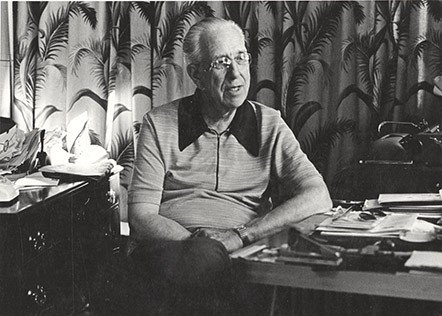
Frank Brocke
Born 1906
Occupation: President of First Bank of Troy; where he worked for forty-seven years; chairman of school board
Residence: Troy; American Ridge; Kendrick
Topics:
The colored topic bar is hidden for screen reader users. Use the topic buttons below it, the "Filter by Topic" menu or the search box to find specific content in the transcript.
Sam Schrager: Well, when we stopped, we just brought you up to where you started working for the bank here, and I was wondering what the policies were like when you first came here, what the bank of Troy was doing.
Frank Brocke: Well, that was in 1926, and the policy was a lenient policy. I noted in particular that as I stayed and learned the people and the policies, there was very much a tendency to pay the rent, which was interest, and they would pay the rental on the note with the idea that it was going to be automatically extended for another year. And to pay a loan off, especially a mortgage, was a rare thing because they never paid on the principal. They only paid the rent, they were the interest. And of course, that went on up into the 30s after the Depression, and the management more or less changed, and the policies changed. We went to a policy of making them pay so much a year on the principal, and eventually they had their mortgages paid off. But it was a dormant during the 20s, and obviously in the early 30s it was a case of never paying the note. And sometimes you wonder, they actually felt they probably didn't owe the principal along if they paid the rent.
Sam Schrager: Why was there that policy?
Frank Brocke: Well, there was a tradition, it was a policy of the bank, and of course it probably was hard to pay it, especially a mortgage, because they got that money for the purpose of buying the land or building a house, and the margin of profit from which it had to be paid from was so very little that the farmer was not necessarily prosperous, and consequently if he paid his interest, he probably would have done as much as he could do. Nobody thought anything about it. But I can remember our banking department used to tell us that, don't you realize that this bar or this farmer may think someday that he may never owe this, that he's paying his interest, but that's all he's got to pay. And it was a poor policy, there's no doubt about that.
Sam Schrager: Did it weaken the bank financially?
Frank Brocke: No, no, no, they were so good, and there were values of land, values of values, was creeping up upward, especially during the Depression of course, there was no way to value a land because of the fact that there was no money to buy and land values went down, but that was no sign that it wasn't going to come back. You as a banker, you always felt that, well, it's not going to be this way forever, and anything that goes down as a rule comes back up, and anything that goes up often comes down. But during the Depression, values of land was unreasonably low, just as right now, the last three years, that they've been unreasonably high. We could see in the Depression of the 30s that we had to make a recovery and that the farmer and landowners were going to be the first people to gain from it because of the value, they were too low. Of course, everybody improved their land, they improved their improvements, and that all added to values over the period of time. As we look ahead now, land that was valued at $50, $75, $100 an acre now is valued at $4 to $6 to $800 an acre. So that's all a result of—a part of that is a result of inflation, of course, but in those days it was just ... The demand became greater as people became more prosperous and had money. That's what made the land values raise and go back up where they belonged. You know, when you talk about the 20s, usually, if you read about the 20s, it sounds like a time when there was a lot of prosperity.
Sam Schrager: I mean, the 20s were supposed to have been a high living time, and then everything went wrong, but what happened here?
Frank Brocke: Well, if you measure it by the times and the condition under which you lived, it probably was good times under the 20s. However, it didn't take near the money to create prosperity. A man that was worth a couple hundred thousand dollars in those days was considered fabulous wealth. In other words, he was wealthy. And today, in Latah County alone, we have many, many millionaires. And so you've got to compare conditions of the 20s and the conditions of the 60s or the 70s. And sure, they live. That dollar, which is worth, what is it, 49 cents today and was worth a dollar at that time, it all plays in valuations. And now, certainly, our farmers are prosperous. They live very well, very, very well. They have fine homes, just as modern as it is. In those days, a farmer was not considered as such. You saw fine residences. They were usually in the towns or the cities. Moscow had fine residential, but the average farm, he put his wealth in his equipment, in his farm machinery, in his horses. And sometimes we used to say that barn was far better than the house because that was his pride and joy, was his farm. It was his barn or his outbuildings. And of course, your equipment. You didn't buy a plow maybe once in every 20 years. And certainly a walking plow is something you kept for a lifetime. Virtually that lasted and never wore out. The binder, more so. The life of a binder would probably never exceed more than eight to 10 years. It used to last that long. Now a combine, the turnover on a combine is about four years. So a drill was a lifetime as a rule. They took care of it. And of course, they never abused it in any way, shape or form.
Sam Schrager: What would you say that the situation of the average farmers around here was in the, in 20s? Did they have a lot of land cleared up? Were they doing well? Were they, were they, uh, prosperous or just getting by?
Frank Brocke: Getting by. Of course, that, that was enough. If you got by, if you got by, made a living, paid your debts, you were, you were living, you were considered as a, as a successful operation. And, uh, and of course those as a rule were landowners to me, as I recall, the man that rented and had to pay a third of his crop for renting it and, uh, and pay all expenses as a rule, if he had a poor crop, he did not make it. In other words, he lost money. Maybe one year he would gain it back in the next year. But if he had, uh, if he had one bad year or two bad years in a row as a rule, he took him five to recover if it was possible at all to recover because of the fact that, uh, he had, his machinery was wearing out, his horses were getting older and yet his expenses went right on. And consequently he, his chances getting back to, uh, the landowners and the mortgages, uh, as a rule, I would say at least 60 % of the farmers land was mortgaged in those days in the twenties, even though they had good years, they still had mortgages on their farms. Uh, the federal land bank was a very prominent, paid a prominent role in mortgages. Uh, the Prudential life insurance company was active. Uh, Hancock was active in those days. Uh, and individuals, uh, the Olsen brothers, Nick and John Olsen were, uh, were help finance and the bank of course, carried a few real estate mortgages. But many, many farms were mortgaged and you thought nothing of it. That was just taken for granted. And, uh, uh, and it was a slow process to get over that debt.
Sam Schrager: What were the, uh, the terms in the mortgage in those days?
Frank Brocke: Well, in those, in those days, why the terms would be 20 years, 10 year, 10 year, the bank could not go on a 10 years at a time, but there was no, it was made for 10 years. There was no, uh, nothing, nothing stated about that they were to pay so much a year. The interest was due each year, but the principal, many mortgages, uh, if they took them out in 1920 and the 10 for, and they were ran for 10 years, they were the same in 1930. There was no arrangements made for people to pay on the principal, which was a bad policy because, uh, the fact that the farmer, he was, if he was struggling, if he was breaking even, well, all he had to do was to pay the interest. Well, that's all he did do because there was maybe three places for every dollar. And that would be the last place you would put it because of the fact there was nothing, nothing forcing him to pay on his principal. And, uh, uh, however, mortgage companies, federal loan, and those companies, always, they gave you a 30 or 40 year mortgage, but they gave you a payment and that included some on principal. So they were, they were, you were liquidating that, but if you had a bad year, it was not unusual to send the interest and say, well, you extend the principal. And of course they were glad to do it in those days. That was, that was, nobody wanted to foreclose if you were an honest, hard working person and you got by.
Sam Schrager: What was the interest rate?
Frank Brocke: The interest rate was all the way from five, five to 6%. I don't think there was any in my time that went over a 6 % was considered high. Because on savings, on your savings deposit in a bank, 3 % was normal, three and four. So that was a good margin.
Sam Schrager: Most of the farmers foresaw that they'd eventually be able to just pay off the principal?
Frank Brocke: No.
Sam Schrager: Were they looking ahead that far?
Frank Brocke: No, nobody looked ahead that far. I think you, you never, never exceptions, of course, but as a rule, they wanted to, but they couldn't, it was a case of not being able to. And then when the depression came, I, those that needed help, there was government had an agency, the farm mortgage corporation, and they took the mortgages from the banks or whatever is necessary. Or if anybody was in difficulty, you could go to the federal farm mortgage corporation. And I believe that was 3 % interest at that time, 3 and 4%. And the bank or the person, they, you could take bonds, government bonds in place of the principle of the mortgage if you wanted to. And that was a very, very good setup. That was running in conjunction with the federal land bank. But that was, that was where that was saved a lot of farmers.
Sam Schrager: What about the amount of land that most farmers had cleared up by then? Were they still like 60 acres, 100 acres like that?
Frank Brocke: A lot of small farmers, yes. I'd say a man that had 300 acres was considered a very, very big farmer, 3 to 400, and which would be a good operation because he was just coming out of the horse, the horse operations into tractors. But those that had, were bigger farmers were renting the land. They didn't own it. There was very few large landowners in this part of the county. We had lots of little people, which was good, which was wonderful. We had lots of borrowers, small borrowers, which the bank lived on in those days.
Sam Schrager: Borrows?
Frank Brocke: Borrowed, small borrowers. By that I mean, a lot of people borrowed one and two and three hundred dollars, where nowadays, of course, 500 or a thousand dollar loan is considered small in those days, a hundred dollar loan is considered small.
Sam Schrager: Were there really many renters as a percentage of the whole farm population here?
Frank Brocke: I would say that the majority of them in those days were landowners. They were buying their land under contract or they were, they were clearing it up. In other words, they were buying cut over land that had been, or the trees had been removed and they were clearing it themselves, either by horses or dynamite, which is a common thing. But yes, there was in comparison to renters and to landowners, the landowners was bar and excess. I've heard statistics on the present operations in Latah County today, and this must be true all over the country. In other words, when I came to Troy, there was very people, a lot of those people, sons are farming their land as of today. And I think, and some, and I went, of course, that's 1926, that would be nearly 50 years ago. But that tradition of the father and the son is running out. In other words, the young generation don't want to farm and that leaves the father with the land holdings and nobody to leave it to and nobody to take over. And he's, since he is in that condition, he's becoming old and wants to quit, but he has no choice. He doesn't want to sell his land. If he had a son or didn't have a son, that's of course nothing to be done about it. But if he did have a son and he was working in Seattle, there's no way to entice that young man to come back here and take over.
But that's history. I guess that's general.
Sam Schrager: Is the amount of land that you need to farm now a very good fact?
Frank Brocke: Yes, all big factor. I contend that if you don't have at least 500 acres, you cannot, it's impossible to start farming and even that is becoming low. In the early days, if you had 80 to 160, that was a good farming unit. And as time went on, that just gradually kept increasing because your outfit had to be in proportion to the amount of land you had because it took you so much basic. You had to have it drilled. You had to have at least a five-item plow as time went on. You had to have the discs and the harrow. You had to have those things, whether you were farming 100 acres or 500 acres. So consequently, the only way you could make it pay was to get more land, either by renting it or by buying it. And of course, if you couldn't buy, well, you had to rent. And here's a rule in the 40s and 50s and 60s, it seems to me there was more more land available to rent. Now it's hard to find. The last 10 years, it's been very hard to be able to go out and lease ground because unless there was a death in the family, that's about the only way you could be gotten. There's not near the turnover. There used to be. I think I heard recently that one fall, there was over 40 sales and that was in the 30s. And that one auctioneer called 40 sales in one fall. Now that's unbelievable. I would say the last 20 years, good farm sales would in the Troy area alone would never, if you had one or two, you were very fortunate. And maybe a dozen in the county or in the area here because that's the difference. In other words, once you started farming, you're successful, you stay with it. And in the olden days, it didn't take you much to get started. For $500, you were in business and you could get you, especially if you had horses, you could get you a plow and a harrow and a drill and even a binder. And you got terms on, if you had to have a tractor, you could buy that on payments just like you would an automobile. By $500, you really were, you got a credit, you were a young man, you were good and had a good reputation. You got your seed and you got your gas. That was an annual payment. You used to be gasoline credit from October to October of each year. No questions asked if you were, you had a good reputation. That's something else that's changed. Now the farmer has to pay every 30 days in his row. Of course, he raises a very few of them have to buy their seed because they keep their own. But it's a different world. There's no doubt about it.
Sam Schrager: Did many of the renters in the 20s, were they working up to be farmers to own their own land?
Frank Brocke: Oh yeah, that was the number one thought. But there again, a good operating farm, there was no way to buy out. In other words, nobody wanted to sell. That's all you knew was farming. So consequently, you had no desire to sell that farm unless death in the family, then oftentimes they were sold. But many, many homesteaders still owned their land in the 50s as long as they lived. And then it passed to their children as a rule, why the children farmed it and it carried on. The 20s probably didn't have the same kind of, nearly the same kind of turnover that the 30s did then as far as farms changing hands. Not unless they were forced out. And later our county was very few land port closures. In fact, I know of only one that I know of and that was a voluntary in the Troy area. And that man redeemed it and he gave a deed to the bank in my name and I held it in trust and we held it, I believe around five or six years. Just for the idea that maybe he can pay it off and get it back and he did. His family grew up, he got help and he had two boys and two daughters and he was a good person. And he redeemed his farm and that's the only one that I even, that we even came close to ever.
Sam Schrager: You made that arrangement with the idea in mind that he might redeem it?
Frank Brocke: We didn't outright promise him, he outright deeded it to us with the idea, but he was to live there, he was to go on farming it. And we could do as we wanted to. If we felt that, no, we're through with you, we're going to sell it, that would have been the end. But we just absolutely gave it to him. We could see that he was gaining and that he had had good years and the crop and we took the taxes, we paid the taxes and paid the taxes, paid the interest on the investment that we had and the balance was applied on his debt, even though we held a deed. And we could see that he was gaining and so then we just decided to hold it in trust until he could pay it off and full. And as the loaning capacities became more desirable for the insurance companies, he was finally able to go to the federal land bank and finance it. And so we just gave it back to him and he paid the debt in full, that's what it amounted to.
Sam Schrager: This was the only foreclosure that you had?
Frank Brocke: The only land foreclosure. We had one land foreclosure and one machinery foreclosure. That was not a foreclosure on the land, that was a voluntary act. But on the other one, that was actually a sheriff's sale or it was a sheriff's sale of equipment. He had no chance to ever recover and the bank sold him out. But there was no animosity, it was expected anybody that knew what we had done felt that we were justified. There was no hard feelings, it was not one of these that you read about in the east where they all ganged up on the banker. But in our case, it was strictly, we were at the end of the rope and so was he. So you owned this man's farm for a while, it was in your name. Yes, I held it in trust because the purpose of that was that when you get it into a corporation, why in the event, as I recall, I think it looked better. In other words, the public knew about it, the records were printed. And of course, by putting it in an individual, we didn't want anybody to think that, well, he had lost it to the bank. And it was a psychological effect, that was the purpose of it. Now, as I understand it, the bank of Troy itself didn't invest in farms. You can't even by law, you cannot. The only way the bank can get a title to a piece of property in any state or in the state of Idaho, or any bank is that you must get it by an act of foreclosure or by an act of that's another thing. The reason that it was put in an individual's name is that you've got to foreclose a mortgage and get title to it. And that's the law excuses you then. But to go out and buy 160 acres, no bank can do that as an investment.
Sam Schrager: Well, in the 20s, when you first came to the bank, what did it have its investments in?
Frank Brocke: Well, it had loans and bonds, and municipal bonds and loans, yes. That was, there was no problem. The first bank of Troy always was a money-making bank. And the demand for money was reasonably good. And it prospered. They were, the people that owned it at that time were not people that led it by constantly declaring dividends, which was a policy that was good. They wanted to build the bank, and they did. They had an outstanding reserve account when the holiday, when the banking holiday hit in 1932, the bank was in very good shape to be able to muster to take on such a thing. And of course, when the bank holiday was declared, which was in January, March the 6th, I believe, is when the president took over and he closed all banks. Every bank in the United States was ordered closed, and it was to be only reopened by the consent of their banking department. And of course, there was only one examiner in the state of Idaho, and he was in the south. So we stayed open, and we made change, and we waited on people. But there was no withdrawals, or there was no loanings until that examiner could come and clear our records, which took three weeks from the time that the holiday before the bank was free to start in again. But we had an examination, and as I recall, it took about three days for him to go through. In the process of doing this, he had ordered that our capital was impaired and that we had to raise $50 ,000 to replace undesirable loans. So we went out one afternoon, Frank Green, Ollie, and Axel Bowman, and I had prepared a list of, I believe it was eight people for them to go see. And they started out, and they left about, I would say at noon, and by three o 'clock they were back, and they had $50 ,000 in their pockets. And I can recall calling the examiner. He was in Moscow. I said, well, we got the $50 ,000.
Sam Schrager: When can you come back? He said, what?
Frank Brocke: I said, yes, we have it. He said, all right, I'll be there tomorrow morning. And he was, and the following day we opened up again and was on the way. And that was, believe it or not, I think he was as surprised as he could be, and we had no, we had no, we knew we had no problems.
Sam Schrager: How did you know that you had no problem?
Frank Brocke: Well, I don't know. Frank Green was a very, very outstanding individual. And as I recall, the conversation, I didn't go along. I had a job and I stayed in the bank. And the people, the type of people they went to were money people that had money on savings and had banked in the tri-bank all their lives. And it seems as though when they walked up to these individuals, so the story goes, they told them what they wanted.
Sam Schrager: And it was just a question of how much do you need?
Frank Brocke: And they said, well, we'd like to have either five or $10 ,000. Okay, that's all I want to know. And they got it. No arguments, no, no explanation, just on the reputation of these three men. But that's how simple it was, because that's what you can do when you have respect. I can see them to this day when they went and came.
Sam Schrager: What you're saying is that it didn't take persuasion or anything?
Frank Brocke: No, no. It was just a matter of saying. That's right. Whatever they said, why that was the way it was going to be. That's very impressive. Yes, it was, yeah.
Sam Schrager: Well, why did the examiner hold that the bank was in a bad way?
Frank Brocke: Well, of course, that was a result of the depression. A bank examiner in those days took the attitude that this is it. This is the way it's going to be. In other words, if you're broke, you're broke. And there's no way, if he rules, this is a poor loan. The man may be honest. He may have assets, but it's not a bankable loan. Consequently, what you do is up to you. But we want it taken out of your assets, which was a very, very hard—this examiner was noted for his coldness, for his shrewd. And whatever you want to call him, he had the power and he demanded it. And so, consequently, you did it.
Sam Schrager: Now, what happened to these assets?
Frank Brocke: Out of $76 ,000 that was charged out within a period of less than two years, we had collected more than the $50 ,000 that was demanded of us to raise. So you can see that that's how we happened to get the deed to this particular farm. As a result of this, because we believed in these people who had the loans, we knew that they were honest people. And if there was a way to pay, where there was going to—it would be paid. And that's the type of business that we did. All they needed was a chance. And of course, we were willing to give us—we were willing to give that farmer or that person a chance, but the banking department wasn't willing to give us that chance. And of course, we didn't care because we knew that no matter what,… by their paying it, we believed in them, why the money couldn't be lost. And if it was lost, if these kind of people can't pay their debts, then we are in for more trouble.
Sam Schrager: And what's the difference, whether you got money or not?
Frank Brocke: It's that kind of a world that we were to live in, but it never materialized that way. After the bank holidays and the 30s, why it was slow to recover, but they did recover. It didn't happen overnight. All of the 30s were tough, tough times. And of course, the war came on in 1941. You saw an up sweep of employment. Farm commodities improved. That is, you've got a—in the beginning, they had a program of price supports per week in Barley. And although there was a couple of years, we had a price support on peas, but it was never a national thing. Farmers started to come back, and their biggest hazard was the elements. That was the worst because of the wet weather or the wet spring or the wet fall. And we were still in a stage of being undermanned. There was very few people to help in the harvest. Willis Bowman and I spent several years—I say several, I think we hauled grain for three years all during the war for a farmer out here who had no way of hauling his crop to town. His sacks laid in the field. And so at three o 'clock, we would close the bank, and he and I went out there the first year. And then he went to Bremerton.
Ollie and I, who was the president of the bank, he'd go with me maybe one day, and Norman Berg appeared to go another day. Or whoever I could get would go out there, and we'd load that thing with the day's crop. And we'd haul till eight and nine o 'clock at night, bringing in those sacks of grain. But that was common. You saw all kinds of people that was working no matter what you were doing. I forgot to ask you about the men giving the money to the bank and to keep it open.
Sam Schrager: What was the arrangement made with them?
Frank Brocke: They got stock. They got bank stock. Yeah, they became a stockholder in the bank. So they couldn't lose. That is, if they were a depositor of the bank, which they were, there was no difference in taking stock for that bank than a deposit slip, because they were still involved in the same. They believed in the bank, and they believed in the community. So it was not a convincing thing, but just to convince them that now you've got to help us. In other words, here we are three men with history behind us. We need help, and we go to our fellow friends and ask for this help. And they couldn't lose. In the majority of cases, why that stock was redeemed by individual stockholders as they could.
Sam Schrager: Were these men who had been closely involved in the bank in the past?
Frank Brocke: No, only as depositors. They were friends of Green and Lebomans. Yes, they were well-known. They were good old, stable, reliable, and they were all old. They were all older people. And by that, I mean Mr. Keeney was definitely in his late 60s. Mr. Johnson, or E .L .F. and Mons Johnson were definitely up in their 60s and 70s, and they were considered old in those days. John Nylund was, I would judge, 70. And all of these were back. With the exception of Mr. Keeney, they were all bachelors. Albert Louis, of course, was not. He was an individual. He didn't participate in this particular thing now, but let's see. Keeney and the two Johnsons and John Nylund. I believe that was the size of it. I think that was the number that they saw. It would be one, two, three, four. But there might have been a couple others there. I went back on the record.
Sam Schrager: Did anybody in the bank, any of you, have a pretty negative reaction to that having to do that?
Frank Brocke: No.
Sam Schrager: Did you feel you ought to be able to keep the bank open?
Frank Brocke: It would seem to me that that would be good. I would say Frank Green felt that way. He felt we were being abused by the banking department, and what they were asking was wrong. But there was no time to argue. There was no time to fight. In other words, you accepted it, because nobody was depriving you of anything. Even though he ordered these notes charged out, you knew that, and the largest loss was the closure of another bank that we had had our deposit in. That hurt the worst, because that was gone. That was beyond our control. There was a Spokane bank that had gone broke in 1932, 1931. We took a loss there of some over $50 ,000, and that hurt. There was no way to recover that. That was a loss. That was considered in this charge off. You knew just about anybody could go through these particular notes that he had demanded removed. You knew those people so well, and you knew, well, here's the bad, and here's the good. It was your judgment against the bank examiner, but you didn't argue, because, well, you knew, well, if that's what he wants, that's what he'll get. We want open. We want to get back into business. That was number one thought.
Sam Schrager: What did the bank examiner base his assessment of the individual role?
Frank Brocke: Just the idea that we were never going to have prosperity again. I guess the end of the world was coming. That man was here this spring. I talked to him. Sure, he continued to examine this for, I would say, at least 10 years after this had all happened. Mr. Bowman used to rub it into him a little bit. He'd say, well, how was I to know that we were going to have good times again? I had to take the attitude that it was no good. Consequently, if it was good, I wasn't hurting you.
Sam Schrager: What did you do?
Frank Brocke: You didn't argue with him.
Sam Schrager: Would he just look at the man's assets and say he didn't ever pay this back?
Frank Brocke: That's right. That was the idea. That was the idea, yes, pretty much.
Sam Schrager: How long? The bank opened up right after he came back and approved the books?
Frank Brocke: I would say March 26. March 6 was when the president took office. That was his first act, was to close all banks in the United States. Then you had to await your turn to get an exam, and then you get clearance to reopen. We were reopened before the 1st of April. In other words, as I recall, it was in the latter part of March that they got to us. After he got there, and he started and made his assessment and told us what was necessary, it just flew. We just did things so fast in order to get open. We wanted to be open for the payroll at the end of the month. As I recall, we made that easily.
Sam Schrager: What happened during the period of time you were closed as far as the you and the local people in their fields?
Frank Brocke: No, people still believed in you. Everything. There was one Moscow bank that was open. That was the first Crust and Savings Bank. They were the only one in the county that was open. The rest of them all had the same problems that we did. There was no place to go now. We, up here, I was appointed as a conservator, or they called it. In other words, I had charge of the bank. All I did was open our door every morning at 9 o 'clock, and we closed at 3. All I was allowed to do was to make change for a $20 bill or a $5 bill and talk. In other words, people came in. Of course, you were honest with them. You told them the story. There was nobody that, the minute you were open, said, I'm here to draw my money. It was the other way. It just started to grow immediately. There was not a single withdrawal of any consequence. In other words, people didn't say, well, I just can't wait for you to start opening up, no matter when it is, because I'm going to draw my money out. Instead of that, it was the other way around. I'm anxious for you to get open because we're going to deposit. We go right on where we're going to talk, and it did. Even before that, you knew it was coming. You knew something was going to happen. We never did experience a run on our bank in any way, shape, or form. We had a few that was nervous and did withdraw their money before the bank holiday, but that we expected also. We had people that normally were cashing their payroll check in months of January and February, or previous to the banking holiday, that would say, now if it'll help you, I'll deposit this rather than cash it. They did. We always experienced satisfaction, that is,… support. It was a sad thing. The Depression in general was sad. Many people, it wasn't over in March. We went all through the summer, we went through the fall. Many farmers were on edge. They didn't know where they stood. It was not a big year, 1941.
Sam Schrager: It was the what year?
Frank Brocke: I mean, in 1933. There was still the hazards. There weren't money-making. People were living very frugal. They didn't spend any more on a head too. Many people, when they came in in the fall, you heard so much that the bank was going to have to get tough and they would have to change the policies. People would come in, you might say, licked as they entered the door because they didn't know what was going to happen to them. They had no idea, but they went out smiling. None of us was tough. We wanted to play ball. I think we had the confidence of the banking department and they knew we were good and that we were trying. We had no more problems, any way, shape, or form.
Sam Schrager: What was the difference between the bank of Troy and the other banks that closed down? What made the difference here?
Frank Brocke: They were just naturally. Their capital was low. That was another thing that the first bank of Troy, Mr. Bowman, was a man who wanted a reserve. He believed in not paying everything out in dividends. In other words, if you made $5 ,000 profit, don't declare that in a dividend and give it to your stockholders. If you have to have a dividend, make it small, let's build a reserve, a reserve fund for losses and contingencies. That was a policy that went on for about 10 years previous to the Depression. As I recall, that account got up to $20 ,000, which was mammoth. In those days, it was a real bumper, as a fellow would say. Consequently, even though we had the problem, we were still above board. Banks that failed were those that were washed out, that had no capital left, that had real bad loans. In other words, losses that were no good, loans that were absolutely of no value. There was a lot of them that had those, regardless of who they might be.
Sam Schrager: Was this a difference? Did Detroit Bank have fewer bad loans and losses?
Frank Brocke: Yes, that's what it amounted to, yes. Well, I think because of management, because of policy, because of the people that—the Swedish people are shrewd people. They're not dishonest people, and that's what the majority of them were. I would just say that they just did not have that many bad loans. In other words, the bank was solvent. That's what you based it upon, the solvency of your community. It is a good, solid community. Now, lots of banks, where there was two banks—for instance, Kendrick had two banks. They had a Kendrick State Bank and they had a Farmers Bank, which was competition. Where you have competition, you can often have difficulty, because one tries to be a better fellow than the other one. The policy of making solvent loans becomes impaired because of the fact that, well, you overextend yourself. That's what happened many times. Now, we had a little bit of animosity between us and Deary and Bovill. Deary depositors often came down here and left their money, and would deposit with us. Consequently, we ended up making loans in Deary, even though there was a bank there. Of course, as shrewd as that man was, he still made mistakes because of the fact that he wanted to— and it was more of an industrial, a payroll community than Troy was. Troy had payroll individuals, but they had more farming here than Deary. Deary was still clearing land. They were in the midst of the forestry up in there. Consequently, their community was not so liquid as this one was, because of the diversity. We had lots of cream checks. The farmers were milking cows and selling cream. They were raising crops, and they were also still logging their land.
Wood was a big item. Consequently, this was a good area, where it's the center of the county. Moscow, of course, had three banks, and of course, their competition was over done. They were there again, and was in trouble. Genesee had two banks, which was just ... to too many. When you get that, one of them just had to fall by the wayside.
Sam Schrager: Do you think there was a real difference in support between what the community gave here and what they gave other places?
Frank Brocke: Oh, not necessarily. I think it's the type of people that you got. If you got a transit type of people, and you go to the Kendrick did there's a stable. Genesee's were stable. Deary and Volvo were not, because they were payroll people. Good loans in that kind of an area were hard to get, because of the fact that a man would come today, and he might borrow $50 or $100, which was a good-sized loan, and be gone tomorrow. There was no way to catch up with him. I would say that would be an unstable financial situation. It's changed now, but in those days it didn't. It was part of the picture. In other words, logging camps, where they employed a lot of people, and they were here today and going tomorrow. The house building, the construction was slow. As a rule, the houses were built of their own materials, of logs or else they would go to a sawmill out at Nora and get their lumber on time. There was no mortgage money to be had. You very seldom saw a man build a house in Troy, Deary or Volvo and take a mortgage on it, because nobody wanted it. Because of the fact that it was unstable.
Sam Schrager: Would you say that most all the patrons of the Bank of Troy were Troy area people?
Frank Brocke: Yes, I would say a good 90 percent of the business was local. Of course, our wealth was never tremendous. At the depth of the Depression, our deposits went down to less than $250 ,000, which was good. That's another reason why banks failed, because of the lack of money. No matter what, if you start a withdrawal deal on a bank, there's no bank in the world that can stand a run, because your money is loaned out, and you can't run to the bar and say, Well, here, John Jones is a depositor of ours, and he wants his money. Now, can you pay back the loan? Sure, I'd love to, but I can't. I can't rar out from anybody else. So you were stuck. You were in the middle, and that happened all over the United States. Bank runs are the worst. That's why today, during the Depression, that we are currently experiencing—that's why there are no runs, because of the fact that the government has guaranteed the deposit, there is no fear. That was one of the worst enemies there was. It was the fear that the bank was going to go broke, and I get mine before the bank does, which means that no bank can stand a run.
Sam Schrager: Did other banks struggle a lot to stay afloat in this area, or didn't they have a chance?
Frank Brocke: I think most of the banks that are closed in this area are closed before the Depression really was at its depth. In other words, after the crash of 1929, and by 1930, there was at least two in Spokane had failed. One Moscow bank had failed. The Kendrick Bank had consolidated. The G was closed, I believe, in 1928 or 1929. The Deary Bank was closed in the early—before the bank Depression, I think about 1930, in the same way as Volvo. What was left was becoming more stable, which was also helping. So consequently, Troy benefited by what happened in Deary and Volvo. So you were getting depositors from that area. Kendrick, the fact that they had consolidated and closed one of the banks, made it better for the other one. That's what it was. There shouldn't have ever been more than one anyway.
Sam Schrager: If we had talked about that period right around the crash in there, was there any inkling that anything was going to happen in 1929?
Frank Brocke: Yeah, but of course, I think the bank holiday itself, the fact that he, the president ordered all banks closed, was a surprise, and yet it was welcome, because it had to be. They were closing by—on the big cities in the east, they were closing by dozens at a time, which was terrible. That was the only—and if he hadn't declared the holiday, that's the run on them, the stop. Why—it would have just collapsed the whole— the whole United States would have collapsed. But by his closing, closing up and then ordering that they not be reopened only by the consent of the controller of the currency or your state bank— if you were a state banker, why, that you had to have the consent of your state commissioner, why, you knew, people knew that, well, if that bank opens, it's solvent. It was good. And from then on, it started the other way. There were no runs after that. They were through. But the damage had been done in so many cases. So I think if you didn't reopen, though, within, I would say, 60 days from the time of the holiday, why it was as a rule of hopeless. In other words, you were set for liquidation. By that, I mean it was undesirable. It was not a good bank. In other words, they had far more problems than they should have had. And that's the way it was. Well, in 1929, when the stock market crashed, what did people think— Well, we were—that hit the east worse than it did us, see, because we had very few speculators, stock speculators. We had nobody that suffered in the crash, because our people did not invest in those things. And the farmer was still experiencing reasonable prosperity. That is, he was at least breaking even. So consequently—and that's just naturally true.
I don't—we didn't feel it, really feel it, till the 1932 and 1933. And of course, the big climax came when the presidency changed. That's when it all came to a head, because they looked to him for—there was unemployment, as you know. There was a lot of strife and a lot of antagonism going on that all had to stop, because there was so much bitterness. And so that all played a factor. But as far as the real depression, where we felt it more after—we were late, in other words. The big industrial cities that were having it all through from 1929 and 1930, 1931, we hit bottom in 1933, when we say the bank closed. So by 1934, there was WPA, there was PWA. Actually, Sam, we had roads in the Troy area, in Latah County, that was absolutely mud deep, with a foot of mud every spring. We were wallowing through it, a car couldn't run. We wanted school bus consolidation, but it couldn't be done, because there was no way to run a bus in the wintertime, and in the spring and in the fall, because there was no bottom to your roads. So we had the greatest opportunity for federal monies, because that was the purpose. That's what came out of this thing, was the utilization of using federal funds to start projects.
They got a rock crusher. They put it out, put a rock—they must have had about two rock crushers in this area. Everything—they had one supervisor, and these things, we had mile after mile of roads graveled. They didn't rebuild the road, they just graveled it as it was. Zigzagged and you, some places they changed them, yes, but the majority of them, all they did was, and the spring opened up and they became dry, it was just load after load after load of eight, six and eight inches of gravel was put on those roads. It was miraculous. We'd never had them for probably now, but there had never been a gravel road in where there was—what was done in 1930 until probably in 1950 or 1960. But anyway, that started, and they left none undone. You got gravel wherever you had a chance. Streets of Troy were graveled and oiled by donated labor and by a project. Our sewer system was laid by WPA, and our grade school was built by PWA, which is a public works deal. That was in 1941. 1940. That gave employment. Yes, oh my yes, yes. And local people, as a rule, they were Lewiston contractors, so that is their original. But oh yes, yes. You saw guys that had, I can tell you one incident, a former manager of a department store, was shoveling, boy. You were tickled to death to get it. Yes, sir. It was just back in God's hand, at least you ate. But we had no—nobody went hungry in this area. That is, everybody had food, no matter what. We had sawmills operating. This is an experience. Ollie Bowman and Frank Green bought a bankrupt department store up here. They were the two old-timers. We didn't want the store to close. We needed it. It was a source of employer for about six or seven people. They bought this store. We had a man that ran a sawmill. He was an old-timer here too, named Rauch. He was unable to shell his lumber. That was a slow process. He was unable to give John Jones or whoever this employee that had worked for him, he'd give an order for $30 to be traded out for groceries or for merchandise. Then when he could pay these orders, he would. That was a godsend. In other words, by doing that, you kept the sawmill going. You kept people fed. They really were conscientious. They bought no foolishness. There was no liquor or beer to be bought in those days. They bought only the necessities when it comes to dry goods. That thing got up to thousands of dollars that those two men carried the burden themselves. He did that. That's something that very few people even knew about. Sure, the order on the Rauch Lumber Company was common talk. Anybody could have them, but the average merchant couldn't afford to take them. In other words, he would give anybody an order that wanted one. The fact that the sawmill was having a struggling, but they were money men, Oley and Mr. Green. They could afford it. They carried the load themselves, and they got the business. They didn't in any way pad their grocery list or anything. It was just normal business. Instead of getting cash, they got the order for grocery. That went on for, I would say, at least three years. Now, that was in the latter part of the 1930s. I think that store operated from 1936 to 1939. It lasted three years, and they finally closed it down. Because they could see that the town couldn't support too large. They had a merchandise store by a local citizen, so they closed it down rather than to keep it on.
Sam Schrager: How tough was it on individual families?
Frank Brocke: You were in a position to, I'm sure, see what suffering there was and people coming to you. If it's anything like, I know it's been here in recent years. Well, it was sad, more sad than, and there was lots and lots of worrying. You never really knew what went on in the minds of so many people, because there was still a little fear that if I had a bad year and we owe the bank money and they have security—crop and child mortgages were common in those days. That was crop and child mortgages. That means that you were in such a condition. If you were a renter, you had mortgages, your cows, you had mortgages, your farm equipment, you had mortgage, your household goods, you had mortgages, your crop to the bank, and you had done that for one year, see, that would be from October to October. If you couldn't meet that, there was a certain amount of worry that if the crop was poor, you knew you couldn't pay it, you didn't know whether the bank would renew it, and you lived under those conditions. That was the saddest part. I have seen many a mother or a wife have tears in her eyes when she came in, because you could tell they hadn't slept the night before, and they knew that they had to go to the banker and see whether or not it could be done. But we were not that type of people. If ever a man quit, he quit on his own. We never asked him to. Many times you felt like it. You wanted him to, but there was no way to tell him, John, you just said, well, quit. You're not making any money. You're getting behind. We want you to quit, because it was a poor—if you wanted to give him every opportunity, there was nobody who knows. We felt we were on a rising condition, and that things are going to be better next year. You always lived with that hope that next year was going to be terrific, that next year, man, I'm going to have money. You lived with that. The banker lived with it, and then the people lived with it, the farmer lived with it. So you had to take the attitude, well, if he thinks he can do it, why should we say no?
Because maybe he can. But finally, even he woke up, and he knew that, well, this is no good. I'm not getting anywhere. I have an opportunity for a better job. I'm just going to sell out, now, for instance, a year that can catch on. I can't remember this particular year, because when I was told to him the other day that there was 40-some auctions held in the fall. Now, that had to be fantastic, because those were voluntary. But anyway, this particular person told me, I knew what he was talking about. Well, we had one child, but anyway, that was just a baby. But I was approached to become a clerk of the local school district. That was an experience of my life. It seemed as though we needed a grade school, and we had exploded a bond election, and it went over. It was a PWA project, a Public Works Administration. They were to furnish 60 percent of the money to build the school, and the school was to cost $30 ,000 right at that. That meant that they would give us $18 ,000, and the local school district was to own for $12 ,000, and we were to get this school. Well, a gentleman that had an election, and anyway, this election passed by one vote. Then the next day, the opposition was that close, and the opposition was determined that they were going to declare the election illegal, because there was one man that voted that was not a citizen. The state of Idaho, of course, was the people to buy the bonds. The members of the school board were so anxious to get this going and get the money and get the bonds, because before the suit was started, that they immediately notified the state of Idaho that the bonds would be ready in ten days, and that we wouldn't be expecting our check. This gentleman that was a clerk of the he didn't want to be any part of that. He felt that probably the bonds were illegal. He knew the man that had voted illegally, so he resigned. They came to me and asked if I would be the clerk, and I said, sure, I'll do it. That was in 1939. That was the beginning of a cool trustee job that never ended. I stayed there for 27 years in school matters, and so a lot of water went under the bridge in 27 years. I would advise nobody to ever get on a school board and stay that long, because it's fascinating. It was great, and during those years, I would never trade it for anything, but you get pretty hard skinned. You get pretty thick skinned. It's pretty easy to say no. You—in those 27 years, in 1948, we consolidated the Troy schools after they had, in turn, become consolidated. When I first went on the board, I think there must have been at least ten school districts around Troy that still had their own schools, and they were endeavoring to consolidate, to bring them in here through some agreement without charging them tuition if they would get their bus. They were free to come in here, and no questions asked. By that, by the time, by about 1937, I would say that we had every district coming in to Troy. We had gravel roads, and that was an excuse to get gravel roads, because if you didn't get it under the WPA program, you could go to the state of Idaho and say, well, we need $3 ,000 for gravel. We got a highway district. Our highway district is broken, so consequently, we asked that the state give us $3 ,000 so we can go out here. So that worked. And roads was in politics at those times, and so when you went to a governor or a potential governor, you said, now, will you help us if you do what we put for you?
And it was all politics, and so consequently, we rated good things. Anyway, we got our roads graveled, we got our school consolidated and full. We had a total attendance here in our high school, and we got the grade school. That was the purpose of building the grade school, because our high school building, which housed all of them, was just bulging at the seams. So we went over there and built four grades. We put the first, second, third, and fourth. And yes, first, second, third, and fourth. And we were big enough at that time that each one of them had a teacher. So by 1939, that's when this was done, and by 1948, we had consolidated everything and we were going smoothly, but that's when the trend was that they wanted larger school districts in Volvo. But by that time, Volvo was going into Deary, and consequently, they were existing only. Deary had no gymnasium, they lacked school facilities, but the law was that you could only bond for 10 percent of your valuation. Well, if you had a 300 ,000, I would say that Deary at that time probably didn't have over $150 ,000 in evaluation, maybe 200 ,000, which meant the most they could raise would be $20 ,000. Well, you couldn't even begin to have a building program, and Troy was in the same condition. We didn't need anything at that time, other than a bus garage, and some improvements to our basement up here so we could have a hot lunch. But Deary had the problems because they were not existing. So they had meeting after meeting to determine—they formed a county organization here, five trustees, countywide, and they were to iron out and see what they could do in a way of consolidation. Well, potlatch ended up by taking in Princeton, and they brought all of the surrounding area into potlatch. Moscow drew the lines, and they started consolidating with their rule. One building school brought those into Moscow. Genesee did the same thing. Julia Edda and Ken Rick consolidated and made one school, and they took in the high school from Southwick, and they had a joint school between Nez Perce and Latah County. All right, Troy and Deary and Bovill had a problem, because Troy was self-supporting. They were getting along. They were doing okay. But here we got Deary and Bovill setting up there, unable to get anywhere. It was too far from Kendrick, and so it fell into the reins of where Troy—it was the only hope, it was the only chance, that Troy and Deary should go together in Bovill. Because Elk River was on their own, too, and it was too far to bus those to Deary. So we ended up with a Deary, Bovill, Troy, Deary, and a spudist, and we called it the White Pine Spudistic, and that was the beginning of it. And so I fell into the airship of becoming chairman of the White Pine Spudistic, which I held for over 10 years, I believe it was.
Sam Schrager: When we were talking before, you were talking about the virtues and the advantages of the one-room schoolhouses, and I'm wondering how that worked, because did you feel much of mixed feelings about trying to bring all the kids into Troy to go to school at that time?
Frank Brocke: Yes, because at one school, you were advancing—there was a place for the ones—you said that the ones—no, what was wrong was that they were teaching eight grades in one school, and that was not good, because of the fact that the salaries were beginning to increase. They lacked—they couldn't get roads, but the fact that they could come into Troy, and they could get the roads graveled and rebuilt where WPA never reached them. And their schoolhouses were deteriorating, they were becoming fire hazards, and the curriculum, the demand of a child, it became so great that no one teacher could service those eight children. And some of the districts were down to five and six kids, and yet you couldn't hire a teacher because salaries were not exorbitant, but even then a rural teacher got anywhere from 75 to 100 dollars a month, and that was a pretty good load. And if you were a fairly district out here that had to keep your school up and had to hire that teacher and a janitor, and the services, they were living more than what they could have come to Troy for. And by that time, they had passed the law in Boise, that state aid was based on daily average attendance. Well, no rural school could qualify for that, because it was getting so costly that they were complaining to give a rural school out here that had six kids, and they had the minimum, which was over a thousand dollars, while the state said, no, we're not going to pay that anymore. You consolidate, you go into your towns and build up their daily average attendance, and it was just common sense that it had to be. So that was the beginning of all of these things. Now sure, I can go back to myself, and you never went to a rural school. I did. I went to seven grades in a rural school. And I think the advantages there was, we all sat in a room, and I can recall that you heard the first grade recite, you heard the eighth grade recite, and if you were, as a rule, the first grader, you were way over his head. He didn't listen, but if you were sixth or seventh or eighth, you kept listening to what was going on in the second, third, and fourth. And what you missed, you went back, it went in your ear, and a certain amount of it stayed there, and it helped. Now when I moved to Kendrick, then I moved into a separate room. At that time, they had the seventh and eighth together. I skipped the seventh and went right into the eighth, because during the seventh, when I was in the seventh grade, we couldn't attend school very regularly, so they gave me an examination, and I was qualified to take the eighth grade, and I did. But it's true, that was satisfactory, yes. You just give us good. In other words, you could see where one teacher cannot teach eighth grade, eighth grades, and say it's satisfactory, and the demand, and so it was a part of history. But at the time being, it was great, yes. When I went to grade school, or in real school, elementary school up on American Ridge, there was not a vacant seat in that building, and that schoolhouse was as big as this front room and this together, and I would say there was 20-25 students in there, which was a good school, which was a good, well-attended school. But you could go out here in a round Troy. Every ridge had a school, Burnt Ridge, Little Bear Ridge, Dry Creek, Big Meadows, Bethel, and American Ridge, two schools out there, within, you wouldn't say shouting distance, but certainly within sight of each other, and they all had schools, and they all had a teacher. So financially, it became the burden. In other words, the students suffered from the lack of the fact that the community couldn't support it.
Sam Schrager: When you were starting on the board here in those early years, did the state have a large influence as far as the books that were used?
Frank Brocke: Oh, it was very, the county had more, because we had a county superintendent, and there was a state superintendent, but you never saw him, and when he did, he was more of a,… he, his attitude was that we would say, well, we need help. No, no, you don't need help. We need help. In other words, they had the problems, and we didn't see, because they were striving to get more consolidation. Their money that they were appropriating was being very, very foolishly spent, because under the, when it first came out with the daily average attendance deal, there was a minimum. As I recall, it was a thousand and thirty dollars, and I could be guessing on this. I don't know, it's been so many years ago, but no matter if you had at least a teaching unit or any part of one unit, which was in a rural school, could be anywhere from one to, say, twelve kids, you got that same amount, and then you'd jump to another unit, and then so forth. Now, a rural school always got one, and that more than paid the teacher salaries. So, you were, the taxpayer really, from what you were getting out of that money, the state was suffering. In other words, they weren't getting value received, and they felt that way. They would rather give it to a big unit, or you had a high school, or you had consolidation, and by supporting this individual school out here, where it was unsatisfactory in any way, shape, or form. So, consequently, your county superintendent, she was constantly visiting schools, and you did your own hiring, you did your own firing. That was your responsibility. They paid your, you ordered the county to pay the salary. You didn't even pay your own bills. They controlled the money. You had a budget, and you tried to stay within that budget, although we paid no attention. We knew our teacher had to be paid, and we knew that we had so much expenses, we had a cold bill, and everything had to be paid. And, of course, if you overdrew, or you ran short, you had to make it up out of the next year's budget, that's how it was run. But it was pretty lax, very lax, and even Troy Schooley, District No. 31, was a going good concern, but they had a poor clerk, because that was it. But we were getting by, and everything was, there was no cheating. You spent what you had to, and that was it. Our budget for school supplies was all very neglected. In other words, you were lucky. Of course, in those days, you didn't furnish paper. You didn't furnish anything to a student. That way, he was on his own. So all you had to do was see that your superintendent had some paper to write on, and maybe a few pencils. You got books. No, that was all. Book rentals didn't come in until after white pine became an issue, and after you got money.
Sam Schrager: Kids had to get their books?
Frank Brocke: Yes, all during my 12 years in school, I had to buy my own books. Yes, there was no free books at all. I wanted to ask you about when you first came here in Troy and started working at the bank. I was curious about what you learned from all of the building, and what you taught you. Well, at first by the time I came to Troy, I knew the fundamentals of banking. I knew all the bookkeeping angles. I knew how to post. I knew all the general principles of banking, because I'd already spent three years in a bank. But all you learned when you came was a policy of the present management. Ollie Bowman was a very kind gentleman. He was not a cold-blooded banker. As we know cold-blooded bankers, he wanted to help people. He had a desire to help them. He could never, very rarely could he demand of an individual, now you pay this or else. He never said that to any man. He just could not, and he would not. That rubbed off on to me to a degree that I have never been that type either. I knew when I was licked, or if I knew that the man wasn't trying, and that he was dishonest, and that he was boozing, that he was drinking up his money, that he was neglecting his family. I could become very, very irritated toward him, and I would tell him so. Many a time that I, and they knew it, I used to laugh because I could never walk into a tavern where there was beer served or alcohol served, because when I punch the other, it comes groggy, be careful. That was common knowledge, so I stayed out of them. I finally had to, because it was embarrassing, even though I didn't care, unless they were, as I say, the ones that abused. Of course, they had a guilty conscience too. I would say to a man, I said, you come in, I need a couple hundred dollars, I'll buy a gully, I'll give it to you, but I don't want to see you in that tavern. No, no, no, no, but an old lady went down, and there he was. Consequently, you kind of learn to know him, and you know that next time he's going to be just that much harder to get the next 200. But anyway, that's life. But, Alder Bowman, of course, he was a religious person to the degree that he never went near those places, and he was about as dry as they make him. But anyway, I learned those things through him, that tolerance, and I was not necessarily a liberal banker. I think I've always been very fair on what he wanted to be, and he was. The fact that he was not cold-blooded made it very difficult at times to make loans, because he knew that if there was a doubt, he used to say, oh, you go and see Frank, and that would be the end of it, and I used to assume the responsibility. And I liked that. That's how you became a banker, because in 1933, after the bank holiday, I became cashier of the bank. Mr. Bowman, as he grew older, took less responsibility, and consequently, before many years, the whole thing was late in my life anyway. So you just fell into it, and you begin to know your people, which after all is 99 percent of being a banker is knowing your people and who you're dealing with, because you get so close to them, and you get so wrapped in their affairs that sometimes you know the answer to their problem long before they do, and you try to help them. And if I had my say, I don't think anybody in the country would have owed a dime, because I wanted to see people out of debt. I didn't in any way try to encourage them to get into debt unless I knew that that was the answer. So that's the way it went.
Sam Schrager: What this was making me wonder is, when you first came here then, was your philosophy of banking, you still didn't really have one, and it was only Bowman that taught it to you?
Frank Brocke: I would say yes, because I was not responsibility. As far as I was concerned, I came in 26, and so I was here nearly, you might say, seven years before the bank holiday until the real responsibility fell up on me to be my own boss, do as I pleased. I've always, ever since then, I was never told, don't do this, don't do that. I did it on my own. After I became cashier and became the pool manager, working beside Ollie Bowman, I still had a free hand to do as I pleased. It was my guess I was lost up here because after 45 years of running a bank under those conditions, being your own boss, doing as you please, it was hard. They wanted differently. They wanted to say, they wanted to put regulations and put different demands upon me that I couldn't do this and I couldn't do that. I said, okay, but the minute they walked out the door, I continued this same pattern because I could not, I might say, lower myself to what they demanded, which was no more than to share responsibility. It was all right, but still, it was hard to do, just like they demanded that I take a vacation and be gone for two weeks. I said, well, that's up to me because if I left the bank for two solid weeks, I came home to an apple box of delayed correspondence. It was a terrible worry and an injustice because I couldn't ever catch up and that's what was happening. Even when I was gone three and four days, I'd come home and the correspondence got clear out of hand and it worried me. That was the reason I didn't take a vacation. There is no such thing as a compulsory law. There is a recommendation by the banking department that all employees must take a vacation. I've talked to many bankers that are vacations for that very reason, that they can't. It's a good policy, but still, they wanted departmentalization. This present board that runs the First Bank of Troy now, they demanded that I divide the loaning capacity up with other employees, which was all right. I still said that if John Jones comes in and he wants an automobile loan, he wants a private loan, and he's willing to wait for me. I'm going to wait on him if it takes all day. They didn't like that. They said, no, that's not fair. They wanted me to say, well, you go to that officer over there. He'll take care of you. I couldn't do it just because of the fact I'd waited on him for 25 years and he wanted me in and I was going to do it again. It was little things like that that brought on my difficulties.
Sam Schrager: What you learned from Ollie Bowman, did he have a philosophy that he told you, my principle is to do it this way?
Frank Brocke: No, he had a way. He was not a young man when he went into banking. He was an old man at that time. He was just a human being. He was not a banker in the sense that we know of a banker today. No, he was not a banker. He got the bank simply through the fact that he wanted to venture into new fields. He and there were brothers. He and Axel were in the lumber business. There was time for a change. In other words, the lumber industry was beginning to fade out because the sawmills, the timber was beginning to delete. He had an opportunity to go into banking. He had money. He was considered a wealthy man. He was known by everybody. He was a local man. He went into the bank just as green as I was originally in 1910 or around there. I don't think he was one of the original. 1905 was when the first bank of Troy opened. I think it was 1915 before he actually became part of it. He was an old man, but he was conservative. He knew the value of a dollar. As I say, he knew everybody. He was a natural man to take on this. But he never, in the sense of the word, was a cold-blooded, shrewd banker. He just followed his conscience. That's the way it was. Of course, the fact that he was tight, I would say that he was not a man that would throw away his money. I used to get a kick out of him. Some of these Jews had come in with these. In those days, you could have a carpet or you could have a watch. In the 1940s, it was nothing to have a salesman walk in the door. He'd have all his pockets full of watches. He was in for selling them. Let's see what you've got. Here's one for $25. Here's one for $10.
Here's $25. I'll give you $10. You listened to that conversation. I said, you, Ollie Bowman, bought the watch for $10 before the guy got up. The guy knew that. That was his job. He had his prizes way up there. You didn't know who that took. That was Ollie Bowman. That was his way. He was happy, and so was the guy that sold him the watch. That was his life.
Sam Schrager: Would you say he was very careful about what he would loan money for, what he would give money for to people that he could judge, whether it was a worthwhile purpose or not?
Frank Brocke: To me, I always used to think one time that he never would. I don't think he ever would say no, but oftentimes if you needed $300, you walked out with maybe $150. Now, that was pretty much my philosophy, too. I got that off of him, obviously, because a man came in with $500. He was a marginal case, and we were financing him. You had a feeling, well, he's pulled that figure out of the air. In other words, he asked him for $500 with the idea that, gee, I might not get it. I'm going to ask for $500 because I know that he's going to pull me down. That got to be pretty much of a practice. Obviously, it was dealt between us because we were both doing it. I can recall that. But there was one time that he would always fail. If John Jones lost his wife by death last night, and he came into the bank the next day, and he wanted to know, Mr. Bowman, Matilda died last night, and got to have the funeral, and I suppose I got to pay cash. Can I get it?
Oh, yeah, we'll loan it to you no matter what. That man might be $300. That would be a good funeral in those days. $200 to $300 was a normal deal. But that's when he really got sought. I noticed that's so often. Now, that was only Bowman, because he was kind, and he knew that man was in trouble, and he knew his wife had to be buried. He knew he was honorable and that he would pay it back, but it was too bad. There was no value received, in other words. But, yeah, we'll see that your wife is buried, and we'll lend you the money. That's when he could get all sought. But another person might come in and say, I need $300 for a team of horses. No, that's too much. You don't have to have that good a team. And they'd either walk out or else they would end up with maybe $150 and get a couple old nags. He didn't go into the facts of what he was getting for the $300. He just took it for granted, well, you can get by with $150, you don't have to have that good a team of horses. Well, sometimes that's false economy. That's just business. But that was his way. But he very seldom argued with anybody. As the time went on by the middle 40s, or the 40s even, he'd come to work at 10 o 'clock, and by 11 he'd go home, or he'd go up and down the street, or he would be. And if anybody'd come in and I wasn't busy, he would say, oh, you go to Frank's. He knows your problems. We never had words. We were always so close. I knew what he would do, and he seemed to know what I would do. So he never worried. We never had problems. We made mistakes. He made mistakes. I made mistakes. I could tell him when he would make a mistake, and I think he probably could tell me. I told him that when he loaned a man money, I never said, oh, I always called him Mr. Bowman. I said, Mr. Bowman, you know, darn well, he's not going to pay that. Well, he might, and he wouldn't. But on the other hand, there was many times that I've loaned money, Ollie Bowman has loaned money, to a man that staggered in your door. He was so drunk, but he could write his name, and we'd kid him and say, well, I hope you remember that he'd loan $100. I hope you remember this, because it's going to be due now next month. You only want it for 30 days, and you're pretty drunk. I'll remember it, and I'll see that you're paid. And he would never be back there probably the next week when he got his paycheck. He'd pay it. Ollie and I used to laugh at that. He would never stand it. He could never go into Moscow. He could never go into Spokane Bank and stand here in the door and get $100. That's right. That's the way we did it. But that's true. That was the way we did it. And you weren't ashamed of it either, because it wasn't everybody that could do it. But sometimes, you know, they had some of these boys would get carried away. They never denied us either. We never lost those kind of loans.
Interview Index
In the twenties people paid the interest ("rente") on their loans, not the principal. The bank expected land values to come back after the depression. Farms in the twenties - importance of equipment and barns; sixty percent were mortgaged. Difficulties for renters. Local people loaned money.
Tradition of farms passing from father to son is dying. Increasing size of unit needed to farm. Decreasing turnover of farms. Low investment for farming in early days.
The sole land repossession by the Bank of Troy during the depression was redeemed by the owner, while the bank held it in trust
The bank was in excellent shape when the depression hit. Closure of bank during Bank Holiday - amazement of examiner when the bank raised $50,000 to replace "bad debts". The money was given by local people on the bank's reputation. Bank's eventual recovery of those loans.
The bank helps a farmer haul grain sacks during labor shortage of World War II. (continued)
The men who lent money to keep the bank going were oldtimers. Mr. Green felt that the bank should not have to stay closed to wait for the examiners. The examiner's philosophy of doom. Confidence of people in the bank during its closure - there was no run on savings.
Reassurance of local people who felt beaten by the depression. Building a reserve account instead of paying interest to shareholders. The Troy bank didn't make as many bad loans as other banks. Competition between banks hurt them. Differences between farming and payroll economics. Most local banks which failed did so before the Holiday.
Depression not felt in 1929, because local people didn't invest in stock market. The depth of the depression was 1933. Tremendous contribution to roads and buildings from public works program. Ole Bohman and Frank Green bought and operated a department store and carried local people.
Fear of local people that they would go under. The bank never forced anyone to quit, although sometimes people did so on their own.
He becomes clerk of the school board when it's necessary to sneak through a disputed bond issue for building a grade school. Consolidation of rural schools in Troy; pressure on politicians to improve roads for buses. Countywide consolidation - creation of Whitepine School District. Limitations of one-room schools. State aid was based on daily average attendance. Role of state and county super intendents in schools. Budgeting for school operation.
He observed Ole Bohman's tolerance and fairness with people. He made his own decisions in the bank from the thirties on. His inability to give up making decisions for himself helped bring on the difficulties that led to his leaving in 1973.
How Ole Bohman went into banking (1915). He was conservative. He buys a watch from a salesman. He often gave less than was requested, unless it was for a funeral. Closeness of Mr. Bohman and Mr. Brocke. They loan money to a staggering drunk, who they know will pay it back.