
Description: Father's ministry. Eliza Spalding and Nez Perce religion. Family homesteading; mother's interests and isolation. Farm wildflowers and wildlife. Love of school. 12-13-74 1.5 hr 36p
Date: 1974-12-13 Location: Paradise Ridge; Moscow
Subjects: Native Americans; children; teaching; marriage; games; illness; childhood; illness; medicine; midwives; chores; families; schools; marriage; Chautauqua
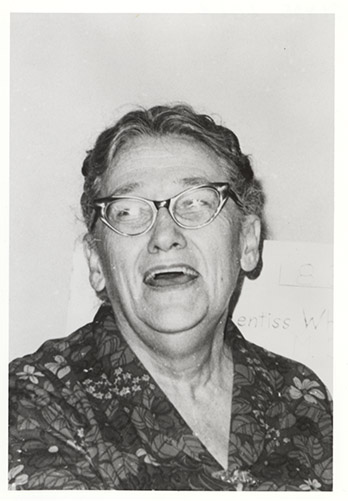
Lola Gamble Clyde
Born 1900
Occupation: teacher; farm wife; local historian; frequently addresses groups and aids researchers
Residence: Paradise Ridge; Moscow
Topics:
The colored topic bar is hidden for screen reader users. Use the topic buttons below it, the "Filter by Topic" menu or the search box to find specific content in the transcript.
Sam Schrager: Your father's coming out to this country under what circumstances he came. Okay.
Lola Gamble Clyde: My father was in about the second graduating class from San Francisco Theological Seminary, which was the only Western Presbyterian Seminary in the United States at the time. And the town of Moscow had a Baptist church already founded, and it had a Dunkard church, which met in the homes of the various members. So a group of Pennsylvania women who were homesick for the white churches of their own country saw the gray -green bunch grass rolling, and they figured the Presbyterian should have a church here, too. So they contacted a Dr. Boyd, who was the Presbyterian minister at Lewiston, and he wrote to San Francisco Theological Seminary. And as my father was in that spring graduating class, he was given the mission to come up into Idaho to establish Presbyterian churches. And our church was the third Presbyterian church founded in the state of Idaho, as well as the third church in the town of Moscow. Boise had a Presbyterian church, and Lewiston had Presbyterian churches ahead of us. My father always liked to tell how he came by steamboat to the mouth of the Columbia River and by riverboat to Walla Walla. And he was subsidized by the great lab banking house of Portland. They were banking and shipping people and immensely wealthy. He got as far as Walla Walla, and he found a nice young horse with a brand -new saddle and bridle waiting for him, and a sum of money to come up into this country. It had all been given by the great lab company of Boise, and they were always friends of the Presbyterian Church. They donated a hundred dollars toward the building of the first building that was established here. And when my father's church at Golden Ale, Washington burned down, they were the first people to offer to send money to help with the construction of a new church. And I've heard...
Sam Schrager: You took the horse and rode out here?
Lola Gamble Clyde: Yes, my father rode up into this country, and there were two interesting stories I remember him telling. They got as far as Almoda. Here he met a gentleman from Scotland, and they had three little girls with him. Two of the tiny girls were able to walk, and one was a baby in arms. These were the Cameron family from Scotland. And when they found out my father was a Presbyterian minister, they invited him to come to their tent south of Moscow and baptize the little girls. And this my father did the following Sunday when he reached Moscow. And this was the first Presbyterian baptismal service conducted in this new territory. When my father got as far as Lewiston, he was met by Governor McConnell. He wasn't then governor, but he was one of Moscow's leading citizens. And together they rode to the top of the Lewiston grade. And here they stopped at the Ruddy House, which was a halfway house where meals were served. And there were three lovely young daughters waiting on the table at the stagecoach stop. And Governor McConnell joked, and many years later I've heard the two old men sit and tell this story to each other, how my father, who was not married at the time, saw these lovely young girls and he told them, he said, now girls, whenever you get married, be sure you marry an Irishman. And Governor McConnell, who too was Irish, said, now I'm sure this young man is just speaking one word for the Irish and two for himself. And this was a great joke with the old gentleman in their old ages.
Sam Schrager: When he got to Moscow, what was it that he then had to do to get things going?
Lola Gamble Clyde: There was only one church building here at the time, and that was the Baptist Church, but they always graciously consented to any of the other churches coming and using their building. And my father preached there as well as in many of the little log schoolhouses, which had already been established in the rural communities around. And I've heard Papa tell about it being at the Baptist Church and he asked for some volunteer, they had a little reed organ, and he asked for a volunteer to come and play the organ for the singing. And the lovely young Elizabeth, Elizabeth Taylor Clayton, stepped forward and played. And they played The Cross of Christ I'll Cherish. And my father always loved to sing that song. And that was real interesting how in this pioneer community there was someone able to play and they carried on their church services.
Sam Schrager: Did he manage to support himself?
Lola Gamble Clyde: Well, he was largely subsidized. He came, he was sent here by the American Board of Missions. So, those were really missionaries sent out by the San Francisco Theological Seminary, besides just the free will offering, I don't think there was really much money in the community because there weren't over 12 or 15 regular members, I imagine, of the church. But I've also heard my father tell about the first Presbyterian wedding that he conducted. He was living in a little cabin over at the foot of the Paradise Hill. And he said he noticed a very lovely young couple that were very interested in religion. Every time he spoke at any little schoolhouse, coming riding horseback, came this nice -looking girl and her escort. And the lovely young girl was a girl named Julia Warmoth, who was the adopted daughter of the Bennett Summerfields. And her escort was handsome, courtly, young George Northrop. And they listened most attentively to the sermon. So, one lovely October day, the young couple rode horseback over to where my father's cabin stood. And the groom had brought half a sack of hand -shelled Navy beans. This was to be the wedding fee that he gave to the minister for performing the marriage ceremony. And so, I've often heard young George Northrop, when he became courtly, old George Northrop, tell how he'd spent the winter, or the previous winter, hand -shelling that bunch of beans to supply the marriage fee for the wedding.
Sam Schrager: Do you think he often took his fee in products?
Lola Gamble Clyde: Yes, I think so. I think there was very little money in the country at that time, and you paid for most of the services in goods. That's right, in vegetables. But as my father was batching in his pioneer cabin on his homestead that he had taken up, I imagine all those things came in pretty handy. What kind of range did he have as far as where he traveled and where he... Oh, well, I think he went to Colfax because the records show that he established a Presbyterian church in the town of Colfax. And he also went down into the Lapwai County because I heard him tell how in the spring, fresh in the big runoff of the spring down there, he and a friend who was one of the founders of the Presbyterian Church, a man named William Groat, how they tried to afford the Lapwai Creek right where it joined the Clearwater River. And the horses got down and floundered, and they walked out. He walked out on the tongue of the buggy to cut the tugs loose. But the horses weren't able to swim and make it to shore. The water carried them away and ground them. It was all the two men could do to make it across the river themselves and save themselves. So he supervised and rode from the Lapwai country up into this country and beyond a doubt as far as Colfax. There were no Presbyterian churches in Spokane at that time. Cowley came a little bit after that. But at that time, the radius would be from around Moscow.
Boy, the loss of those horses must have been a great loss to him. Well, I think it was.
I imagine they belonged to the ruling elder of the church who was Mr. Groat. But it was a loss anyway. But the water is high there in the spring, and we've often seen the water way up over where the little park is now.
Sam Schrager: What kind of responsibilities do you think he had as preacher? You said he baptized and...
Lola Gamble Clyde: Oh yes, and married and conducted the funeral services as well as comforting the parishioners and holding regular services.
But the church wasn't built until after my father had gone to Victoria, BC. So the church, the meetings had to be held either in the school houses or in the Baptist Church, which is located right where the present Baptist Church is in Moscow now.
Sam Schrager: I have heard that he ministered during a smallpox epidemic. Is that...
Lola Gamble Clyde: Well, it was mostly diphtheria. There was no toxin, antitoxin then. And when the children got diphtheria, the little throats just closed up and they died. We had one gentleman in town who had some secret remedy that was supposed to cure them. It consisted mostly of using coal oil. And they often called Uncle Jimmy Johnson, Coal Oil Johnson, because this remedy that he had for diphtheria combined the use of coal oil. But I don't know, I rather doubt that he really had any effect in saving the children. But they certainly died and the proof of it is to go through the Moscow Cemetery and see all the little headstones there of children that died in those early years with the black diphtheria.
Sam Schrager: Was your father much involved in fighting the disease?
Lola Gamble Clyde: Well, I don't think he had much medical ability. I think he was called upon mostly to come and comfort the bereaved and tell them the Lord giveth and the Lord taketh away and suffer the little children to come unto me and forbid them not for such is the kingdom of heaven. I think all you could do was stand by pretty helplessly and watch them die. So we've come a long way in preventive medicine since those early pioneer days.
Sam Schrager: When you speak of his preaching, do you have much of an idea or can you imagine what the preaching, his preaching, really been like in those days?
Lola Gamble Clyde: Well, I think it was pretty orthodox. It was pretty much the old Presbyterian line, you know, you were either saved or you weren't. And he wasn't much of a believer though in predestination. But I think that they stuck pretty religiously to the Bible and interpreted it pretty literally. There wasn't much, it'd be kind of unbending. My father always liked to tell how he'd studied the exegesis of the thing and how he had read it in the Hebrew and the Greek. And he did have a very wonderful memory. Now, this is something quite interesting because the old records at the San Francisco Theological Seminary say that when they gave him his examination, the examining board marveled at the wonderful memory he had. And I can remember when I was a young girl in college, our philosophy teacher had given me 200 Bible verses, just the chapter and verse. And I was to get a concordance and look them up and write down what those verses were. So I just thought I would go home and ask my father how many of them he knew. And then what he didn't know, I could look up and out of the 200 Bible verses, of course they were well known verses, he knew all of them and I didn't have to look up any. So that's how well they knew the Bible in those days. They knew every word of it. And he could recite whole passages and passages of it and never make a mistake. And it was really interesting and when I went back and told my philosophy teacher at the university what my father had done, I didn't have to look up any of them that he could give me, all of them.
He said, well they don't study, they don't learn the Bible like that anymore, do they?
And that's right.
Sam Schrager: Did he work with foreign, in foreign languages too? I mean, did he use, did you say he knew Hebrew?
Lola Gamble Clyde: Well, he had read the Bible, he'd studied the Bible in the Hebrew and in the Greek.
I don't think he, they were very thorough in the teaching in those days, you know. They were very, very thorough.
Sam Schrager: Would he then have spent much of his own time studying when he was out here?
Lola Gamble Clyde: Yes, I think so. He was a good Bible student and I think he did lots of reading and research on it all right.
And they certainly trained them well in those days. They were well grounded in the Bible and they weren't so concerned with the great social issues of the day as they are now. But there weren't so many social issues. It was all pioneer country, you know. And they were mostly concerned with just getting enough food and clothing and breaking up a little sod and getting crops planted, you know. And I think that the Sunday when they went to church was more of a social event. And it was a chance to get together and a chance to get cleaned up and get a bath and go out and meet with some other people. And often they took their lunches with them and made a sort of a picnic out of it in the good weather. They'd go to the church and sing and visit and then eat, have a nice dinner and then go home. It was the social event of the week with many of the pioneer people. And I think that had a real mission in the lives of the people too. It was a real fine thing.
Sam Schrager: Do you have much of an idea of where the Presbyterians in the county were drawn from? I mean, were they people who had just been Presbyterians back east?
Lola Gamble Clyde: Yes, I think so.
I think there were several people around here. A Mrs. Doak and a Mrs. and a Mary Hoke. This is the grandmother, the great grandmother Hoke. And they were all Presbyterians. They were Pennsylvania Dutch. And most of the Pennsylvania Dutch were from the Dutch Reform, from the Presbyterians, the followers of John Calvin from Holland. And the Pennsylvania Dutch were more closely identified with the Presbyterian Church than any other church. And Dr. Reader was one of the ruling elders of the church too. And they were of course of Scottish extraction.
And that was really interesting.
Sam Schrager: Would you, when you say that he didn't believe strongly in predestination, what do you mean by that? What was his view?
Lola Gamble Clyde: Well, in the old orthodox Presbyterians believed that it was all settled in heaven whether you were going to be damned or if you were going to be saved. And that no matter what you did here on earth, it didn't have much effect. That it was your destiny had already been cut out for you. Well, my father didn't hold with that. He thought that we could be saved by the redeeming grace of Christ as well as by our own actions and our own actions would redeem us. And I think that's a better belief.
And over the years the Presbyterians have certainly rejected all thought of predestination. I think most of them still believe in the saving grace that we have been saved in by the death of the Savior. And most of us have taken a much broader view of our religion than what they had a hundred years ago.
Sam Schrager: And you do feel that there was very little, or do you feel that there was very little social teaching as a part of the preaching?
Lola Gamble Clyde: Well, they always taught about, thou shalt love thy neighbor as thyself. That was a reaching out. And the people that were hard pressed for money, well we should try to help them, we should try to help the poor and the weak. We were to be good followers of Christ. And of course a lot of the social work of today is founded on the same idea that if we would follow the teachings of Jesus we wouldn't be, we wouldn't need so much emphasis on social workers and that sort of thing. But in those days there was no racial bigotry, you know. Of course we never had any of the black people here. And in those times, and the Indians, they felt that the Indians should be saved, that they had never heard the story of Jesus. And then it was the mission of the churches and of the Presbyterians to get out and convert them while really the Indians had a very fine religion of their own. They were the first ecologists. They believed in living in harmony with nature and not to try to conquer nature but to live in harmony with it. They said, the earth is my mother and the sun is my father. All nature was their bible and they knew every word of it. They saw God in the rising of the sun, in the setting of the sun and in the bow that arched the heaven. All of it was the work of God. And they said, the earth is my mother.
Sam Schrager: Shall I cut her hair or cut hay? Shall I dig under her skin and take out her bones like the white people dug the ore from the earth?
Lola Gamble Clyde: And they said, no we won't do this because when we die our mother won't take us back again to her breast. So they would just live with what mother nature provided for them and they wouldn't try to cultivate the land or dig for ore or cut the grass or cut the trees. They were the first ecologists, the Nez Perce Indians. The Nez Perce felt this. Oh yes, and I think that was a very good religion. I don't know how the Presbyterians could improve much on it really. I think that they had a very good religion of their own. But I think that from the time of Henry Harmon's falling all of the Presbyterians tried to enlighten the good Nez Perce Indians around here.
I thought you were broadcasting. Oh, we are. She's practicing.
Sam Schrager: How are you Mr...
Lola Gamble Clyde: You've got a long way to go. He doesn't like to hear me get started. He thinks I never get through. Oh well, there's no end to it. No, no there's no end to it.
But that's how it was the way I see it anyway.
Sam Schrager: Since we're talking about that, what do you think the influence of Spaulding's bringing religion was to the Nez Perce, to their way of looking at things?
Lola Gamble Clyde: Well, the Indians had so many things in their favor. They said of Henry Harmon Spaulding and of the Catholics that we Indians may fight about something we know something about. But here are people fighting and they don't know, neither one is sure that they're right. We never fight about our religion. And that seemed very sensible to me because nobody had the answers. And yet they carried on such a relentless war against each other. And the Indians didn't believe in that. And Henry Harmon Spaulding thought they should only take one wife. Well, some of them had gone along with that and others didn't. But it was, you don't legislate morals into people either. And I think probably the Indians saw plenty of examples among the fur traders and the early mountain men of the country that they didn't think they were sinning too much. And I don't think they were either.
Sam Schrager: Do you think that Spaulding, that his effect of bringing the Christian gospel to some of the Nez Perce, you think that had a lot to do with the divisiveness, the dividedness of the tribe eventually?
Lola Gamble Clyde: Oh yes, I do. I think so. They have always been the Christian and the non -Christian Indians since the days of Henry Harmon Spaulding. Because his first converts were old Timothy and old Chief Joseph and James. And the people that followed them then became mostly Christians. And the non -Christians were the followers of the people who resented the coming of the whites. And it went on down to the treaty and the non -treaty Indians. The treaty Indians were the Christian Indians and the non -treaty Indians were the non -Christians. And I think it added greatly to it. But even yet, they have two summer camps. At Taumock will be the Christian Indians. Around the Butte and Mud Springs will be the non -Christian Indians. And they still call themselves the heathens. And there's lots of going back and forth, of course, between the two camps. But at one it's mostly religious education and the singing of hymns. Around at the other it's playing stick games and doing a little gambling and having a little fun going on. A little drinking, a little fun going on. And there's still the two camps of them. And I think that there's still the treaty and the non -treaty Indians all right.
Sam Schrager: Does this break down to different parts of the reservation?
Lola Gamble Clyde: No, they all live together. It's not certain parts. It's different in the philosophy and different in the way of life. And one of the great gripping chapters of the Nez Perce history is at the great treaty of 1863. The treaty of 1855 had given the great Wallowa country to old Chief Joseph. That had always been his homeland. And while he was one of Spalding's first Christian converts, his love of the land surmounted everything else. And he wanted to be buried at the foot of Lake Wallowa, which he is. And there's a marker there to mark the place. But he laid the charge at young Chief Joseph's door. He said, you must never sell the bones of your father and mother. You must fight for the beautiful Wallowas. And all the tribes knew that young Chief Joseph, who was really a peace -loving man, would dig up the war hatchet and fight in defense of the beautiful Wallowas. So in the treaty of 1863, when they held the great council at Lapway, at Spalding and Lapway, into the tent where sat Howard and Miles and the rest of them, with their brass and their braid, came old Chief Joseph with his braids and his blanket. But under his blanket, he carried the white man's covenant, the white man's promise of Christianity and of brotherhood and fair play. It was the book of Matthew, the little gospel that Henry Harmon Spalding had given him off the first printing press. And as he sat there and listened, it gradually dawned on him that the new treaty intended to take away the beautiful Wallowas from him and that he and all his followers were going to be put on a reservation. So the old man arose from the table and from under his blanket he drew out the book of Matthew. He grabbed the pages out of the book and tore them into thousands of pieces and threw them in the faces of the generals assembled there at the table and walked out. And Henry Harmon Spalding wrote in his diary, he said, Old Chief Joseph has gone back to Egypt, but he much preferred the heathens to the white man's civilization with their false promises of brotherhood and fair play and equality. And that's one of the great gripping moments of history, all right, when he saw that all the promises were just nothing but a scrap of paper and the Wallowas were going to be lost to him after all. Eliza Hart Spalding, she worked very, very hard to put her husband through school. She took in boarders. She had about five boarders altogether. She boarded them for three dollars a week and she milked three cows to furnish butter and milk for the table. And with this money, that was enough to keep her husband there in school. But not only did she do all this in any free time, she taught school herself and raised a little money that way. But she was not contented with this. She wanted to improve herself. So she went to the great Lyman Beecher's classes and studied Hebrew and Greek and became quite proficient in them and could read the Bible in its original form. And that was quite an accomplishment for women of those times. She was highly skilled in all the household arts. She could weave clothing. She could make bread. She could make butter, make candles, do all the 101 things that were required of the women of those days. She could spin, card the wool, weave. On top of this, she had some special talents. She was quite a talented artist. And the Catholic people who had come in had gotten out the ladder to Heaven. And they had ten rounds to the ladder. And these, of course, were the Ten Commandments. Eliza Hart Spalding drew them a new ladder to Heaven. And she, too, put on the Ten Commandments. And she made the fiery furnace down below. And then Heaven was a gorgeous place. And the archangels were kicking the Pope out of Heaven. And he was tumbling down to Earth in the pictures that she drew. She was the first visual aid. She was ahead of her times in wanting to teach some visual aids. So she drew pictures to illustrate the great Bible stories. Bad of an Eve and the Serpent and the Garden of Eden. The picking of the apple. Daniel and the Lion's Den. And the fiery furnace. Aesop. And all the old Bible stories were illustrated. And some of those pictures that she made are extant. And they're in the museum over at Portland. So this was for the next person. Yes, that's the way she taught them. She taught the Bible stories by showing them the pictures. They could understand the pictures. She showed them stories of the creation. And on the first day, and the second day, and the third day, she had all that in sequence. She took three young Indian girls into her home to teach them how to bake bread and how to wash and iron and write and read. And Mrs. Spaulding herself developed tuberculosis. And there's always been the age -old question of did she give the tuberculosis to the Nez Perces or would they have gotten it anyway from their contact with the whites. But at that time they didn't realize that she had tuberculosis. But she was very, very patient and she was well liked by all the Indians. Many of them have left the record that she was a fine teacher and that they had liked Mrs. Spaulding.
She had a great sense of yearning for beauty of various kinds. They tell how in the second house that they built, she whitewashed the walls inside to make it lighter and a little more cheerful. And she only had three kinds of paint, brown and black and green. But with her green paint, she drew vines over the white walls to sort of decorate it. And probably she was remembering that the vines were symbolic of Christ. I am the vine and ye are the branches. She drew many, many vines on the walls, on the whitewashed walls of the cabin there at Spaulding. She sounds like a very exceptional person. Yes, she was. And she had to be or she couldn't have lived with the erratic, hard to get along with Henry Harmon Spaulding. But she kept it smooth and she was a very fine mother to the children. And we have the records in the lives of the Spaulding children. They all spoke with great affection of the kindness and the hard working mother. What a hard working mother she was. It was she who milked the cows and did all the work that had to be done to keep the family going.
Sam Schrager: Well what you're saying is Spaulding himself sounds like perhaps a little unlikely to be the man of perseverance that it took to...
Lola Gamble Clyde: He was a hard working man. I think Spaulding worked awfully hard but he was just hard to get along with. And he quarreled with the other missionaries and he believed in applying the cat of nine tails. He thought that if the Indians didn't obey the laws, that if he laid them down it was alright to have them whipped. He didn't do so much whipping of them himself but he commissioned other Indians to apply the lash, so many lashes for this and for that.
Sam Schrager: Do you think that the court would punish them like that? Was it foreign to their own ways of doing things?
Lola Gamble Clyde: I don't know if it was or if they were... they were used to fighting among themselves of course but I don't know that they really applied the lashes. But the rules would be that certain ones would apply the lash to people who broke the laws as laid down. And the laws were quite foreign to their way of doing things.
Sam Schrager: Well, getting back to your father and his work, do you think that the idea of civilizing the country would have been very important to him and the other early preachers to bring civilization to the country?
Lola Gamble Clyde: Yes, I think so. I think that they were all quite dedicated and they all had this dream that you had to bring Christianity to the corners of the earth. And that was the saving grace for the world. It was to hear the story of Jesus and to be converted and become Christians. And that was their job, that's what they were sent out to do. And I think all of them pretty much followed along on that line.
Sam Schrager: I wonder if, you know, when they talk about the real early pioneer days there being a lot of lawlessness around too.
Lola Gamble Clyde: Oh yes, I'm sure that some place in Moscow, I think there were five or six saloons. There were only 25 people living in the town but they had something like five saloons and three churches. So, and Sunday was wide open, that was the day you all came to town, did your work, you worked during the week but on Sunday you came to town and did your shopping and did whatever celebrating and was done. So that was kind of the way it was. They immediately set forth to keep the stores all closed on Sunday and not sell anything and try to make them all go to church on Sunday, I suppose.
Sam Schrager: Do you think he would have been strongly opposed to drinking?
Lola Gamble Clyde: Oh, I don't think so. I don't think so. I think he did quite a little of it himself in his later years anyway. But I suppose he went along with the customs of the day but it was never any crime in Holland, Ireland. He was never considered any crime. No.
Sam Schrager: Well, how do you think that his preaching as compared to the other denominations, would he have been more fire and brimstone than many or less? How much of a fundamentalist would you think?
Lola Gamble Clyde: Oh, I think probably less because he was really pretty tolerant and I think he was a little more progressive than some of the very early circuit rider kind of people, you know. I think he had a lot more understanding of human nature and I think he would be far, far less hellfire and brimstone than the fundamentalists of the very early days, I think.
Sam Schrager: Which of the churches would you say would be the more fundamentalist ones in the classical?
Lola Gamble Clyde: Well, I imagine these Dunkards were because you all wore bonnets, you weren't allowed to have your heads uncovered and you had to dress with great simplicity and eat with great simplicity and severity, almost puritanical. And I think they were much more so than the Presbyterians or the Baptists either. And of course the one great fundamental difference between the Baptists and the Presbyterians even at that day was the baptismal rite. The Baptists wanted them to really be baptized in water and get right down in the water and our church had always thought that sprinkling them or laying the hand, the whip hand on the forehead, that was enough. That it was the symbolism of it rather than the actual dunking of them, you know.
Sam Schrager: Now, then after he'd been here for a while, he was called to Victoria, was that the correct word?
Lola Gamble Clyde: Yes, Victoria BC.
And that was a big church. And of course in Victoria it's more England than England itself. And lots of Scotch people, Scotch Presbyterians. And the Presbyterian church there was a going concern. They had a big brick building at that time and it stood right down along, almost down along the harbor, close to the Empress Hotel, down close to the Strathcoma Hotel. And it became a very choice building site. But it was a, you know, it was a going, very much a going concern because there were lots and lots of Scottish people there. And they've always been the foundation almost of the Presbyterian church.
Sam Schrager: Is that, did that church burn down?
Lola Gamble Clyde: Yes, yes, uh -huh. It burned down not too long ago, maybe 10 or 15 years ago. But it had occupied such a very choice building location, right down close to the Empress Hotel.
And I imagine that they built out farther now where there's more room to park and so on. I haven't seen the new church.
Sam Schrager: What's the story of him meeting your mother?
Lola Gamble Clyde: Oh yes, well my mother was, was graduating from Angela College. That was the first, one of the first women's schools, private schools. It was an Episcopal school for girls. And my mother was very good in mathematics. And she had won a prize for excellence in mathematics. And they invited the young new minister of the town to come over and present, give the, oh the graduation speech to the girls and present the prizes and preside. So my father said he took a second look at her because in his country the girls didn't know mathematics. They kept them in ignorance. They didn't want them to know how to add. And he took another look at this girl and he said that did it. He looked a second time and he decided that that was the girl for him. So that was the story he liked to tell, anyway.
Sam Schrager: And then how did they come to come back down here?
Lola Gamble Clyde: Well my father had, while he was here organizing these churches, there was still free land here. And my father had a homestead, the original place of the foot of Paradise Hill that we still own. And always he kept thinking he'd like to come back and try his hand at farming. And after he married my mother, they were called Golden Dale Washington and they stayed there five years. Where he preached and established new churches at Centerville and Bickleton and the surrounding country. And then after his first two sons were born, he thought he ought to go where there was land and where they could do some farming. So he came back to where he had his homestead and where he had bought some other property and started farming.
Sam Schrager: He'd first come here in what year?
Lola Gamble Clyde: Well he came here in 1880 and he came back in 1887, seven years later after he was married and had two boys. He came back to his farmland.
Sam Schrager: Now what's that amazing little story about the, was it his brother that had the seminary?
Lola Gamble Clyde: Oh yes, it was his brother.
Sam Schrager: And the story about that and what it could have become?
Lola Gamble Clyde: Yeah, that's an interesting story. My father had an older brother who had come to California much earlier at the request of Dr. Scott who was the founder of San Francisco Theological Seminary. After he got it founded, he looked around and he had no one with a high school education to enter his theological seminary. So he made a trip back to Scotland and Ireland. And here he met a young John Gamble who had just graduated back there and he invited him to come. He said, I need someone that will start secondary school and teach boys so I'll have someone to go to seminary. And so Dr. John Gamble came to California and he opened a school for boys. And in fact he had, one became another, this one I'm thinking of was what they called it Laurel Hall. It was a private school for boys and among the boys, it was a military academy, and among the boys that enrolled there was young Leland Stanford. And of course he was the governor of, or he was the son of Governor Leland Stanford who was a multimillionaire, a railroad man, made a fortune there and owned much, much of the land in California. And the boy, of course the story is famous, how he got sick and died while he was a student there. And Governor Leland Stanford had sent the boy there because he thought he needed some good Presbyterian discipline. There may have been a little generation gap in those years too. However, when the boy died he was overcome with grief and remorse and he came to my uncle John and he offered to endow the school. He said, I will endow your school and we will have a great school where we will teach science and medicine. We will teach everything here and it will be a great school. But Governor Leland Stanford was quite a follower of John Starr King who was the great Unitarian minister of that day. And I think that my uncle John had a feeling that he would want him at this school too to teach some good Unitarianism. And my uncle John and Dr. Scott, both of them, rejected any claim to teaching that. They would teach Jesus Christ, him crucified and risen. And that only would they teach. So Governor Leland Stanford said he was beyond a doubt he would be able to find plenty of other people who would accept the offer. So Leland Stanford University was born. And the first president of course became David Starr Jordan who was a descendant of Reverend John Starr King. He was related to him in some way. I don't know just how. But the Starr, he carries down.
Sam Schrager: Do you think that your uncle would have objected to teaching all these other subjects as well as the religious ones?
Lola Gamble Clyde: Well I think he felt that, I think he felt that giving up some of the right, at least some of the right of teaching Christianity. If he had to teach Unitarianism he'd have to leave out the divinity of Christ. And they retreated behind their own promise and their own Presbyterian covenant that they would teach Jesus Christ, him crucified and risen from the dead. And that only would they teach. So I think that that probably was it. You know looking back on it you think that that was probably it because some place in the history book it said they were pretty stubborn old men.
Sam Schrager: How did your father, was he born in...
Lola Gamble Clyde: In Ireland, yes. He was born in County Donegal.
Sam Schrager: What induced him to come?
Lola Gamble Clyde: Well he came because his older brother was already here. His older brother John was already in California and had the seminary go, had the private school going and preparing kids for San Francisco Theological Seminary. And many of them, many of them went on to Princeton, went back to Princeton because it had a great Theological Seminary too, Presbyterian. And my father, my uncle John had an honorary PhD degree from Princeton. It was given him by Princeton because he sent back so many well trained kids from his school in California. And that is an interesting little side light on it all right.
Sam Schrager: You were saying that your mother found this country to be pretty uncivilized compared to what she...
Lola Gamble Clyde: Well yes it was for her because she had taught in a private girls school and it was a far cry from the rigors of pioneer life where you had no water and no wood and no central heat, no lights, no nothing. And she hadn't been trained in these frontier ways and it was pretty hard. I'm sure it was plenty hard for her.
Sam Schrager: Did you say that she really idealized Victoria?
Lola Gamble Clyde: Oh yes, everything wonderful happened over there of course. But maybe that is the way with all of us. It's all what went on when we were young and when we were little. Those were the wonderful times. Those were the good old days you know. But I know that as a girl she had had many things that she couldn't have in a pioneer settlement.
Sam Schrager: Victoria is such a civilized...
Lola Gamble Clyde: Yes that's right. They were great on form. The four o 'clock tea and the amenities, the social amenities were a lot more exacting over there than they were here. And my mother loved to read and she'd been... they'd had libraries there where you could go and have books and things to read and my mother loved to read. And it was pretty hard in a frontier wilderness.
Sam Schrager: How do you think she faced her feelings of lacking that she... Well she...
Why did she have to overcome that?
Lola Gamble Clyde: Well I think she just had to work so darn hard to get us all raised with seven children. You didn't have much time to philosophize. You didn't have much time to really know how you felt. You just simply had an awful job getting enough food on the table to feed them and get them ready and off to school. But our mother always set us down after supper by the light of a little coal oil lamp and tried to help us with our lessons. So that was... she knew how important it was to try to learn.
Sam Schrager: Did she read to you?
Lola Gamble Clyde: Oh yes, she read to us nearly every night. We'd have reading of some kind.
Sam Schrager: All kinds of things?
Lola Gamble Clyde: Yes, all kinds of things, yes. And she read as little women in the lamp lighter by a little coal oil lamp. And I inherited a love of reading by that and as a little girl and not able to read I thought, oh if I could just only get so I could read then I could see what came next in those stories. So I was real anxious and ambitious to get to learn to read. So it was probably the mother that had started to help them read. That's right, that's right.
Sam Schrager: Well when your father came back here with your mother, was he still preaching or did he just go to the farm?
Lola Gamble Clyde: No, that's right, he started in the farm and he wasn't very good at it either. He was ill prepared, he was ill prepared. The neighbors left because he took an oil can, there's some little countersunk bolts on a mower and he was trying to oil the countersunk bolts. He thought they were oil holes, that's all he knew about it. And he was just very, very poor, taking care of stock or any kind of machinery. He just was ill equipped to do it. Yeah, that's the way it was. It was just, it takes a special knack I think to run the machinery and to farm. And he certainly didn't have it. And on top of that his health declined, he wasn't well. So it was a tough go round I can assure you.
Sam Schrager: What do you remember from, what are some of your earliest memories from when you were just a little bit of a thing?
Lola Gamble Clyde: Well I remember how important it was to get a package from Victoria, a package from grandma. Grandma in Victoria would send us packages and that was a great event because there'd be, at Christmas time there were always bunches of holly, lots of holly grows there. And they'd send big boxes full of sprays of holly. And that was a wonderful event. And there'd be little things from the Chinese stores and Japanese stores that we wouldn't see in this country at all. There'd be little china tea cups and little boxes of tea and fancy little things that had come from the stores. And we were like our mother, we thought everything good and fine must have come from Victoria. Those were important things to us.
Sam Schrager: Did you grow up in the same little house, or did he build another place when he came back?
Lola Gamble Clyde: Yes he built a house, a bigger house.
They didn't, after he came back when he brought mama and the boys home, then he built a house for them. But it was on the same place. It wasn't the original little cabin where he lived.
Sam Schrager: Where did you come in the order of age?
Lola Gamble Clyde: Oh I was next to the youngest.
The four boys were pretty good size when I was born. My brother Gus is ten years older than I am. And I was next to the youngest.
Sam Schrager: When you think about what the place was like when you were growing up, what is it like?
Lola Gamble Clyde: Well, of course I remember the wildflowers the most because we had lots of them and that was great. Again after the long cold winters, you know, we loved the coming of the spring and going out to pick the first buttercups and the dogtooth violets and the bluebells. We called them bluebells, they were wild crocuses. And the little wild cyclamen. And back in the deeper woods there'd be lots and lots of trillium and they were beautiful. And little yellow violets coming in the spring. And that was the high time of the year was the coming of the spring flowers. And there were many, many birds around. Lots of robins and lots of bluebirds in those days. And jennywands making nests in the house. Every tree in the orchard and around full of songbirds of various kinds. And those are the things I think we all remember about our childhood was the great love of nature and of all the things around us. And wild lady slippers, little white lady slippers. And the little pink lady slippers grew in the deep woods too. My mother knew the names of so many of the wildflowers and she taught us the names of the wildflowers. And she was always thrilled when we brought in the first buttercups and the first of every kind that marked the progress of spring on the land. And that was the fine time of the year with all of us. One thing the early pioneers did was they were great on setting out fruit trees because they were hungry for fruit. And my father had a big apple orchard and a big prune orchard and a big pear orchard. Way more than anybody could possibly eat. And there was no market and there was no refrigeration in those days. You couldn't ship it. So in the fall the fruit just lay in bushels and bushels on the ground. And most of it decayed but all the neighbors came and carried away apples and prunes and pears and galore. And there was a great abundance of the lovely fresh fruit for everybody.
Sam Schrager: Did wildlife come?
Lola Gamble Clyde: Oh yes, lots of it. We saw all kinds of lovely things. There were many prairie chickens in those days and I never see them anymore. But there were prairie chickens, there were grouse, Chinese pheasants.
And I don't remember as a little girl seeing deer but there are lots of deer on the Paradise Hill now. I think the deer have improved since the early days. Maybe it's because the wildlife management has improved and they have got them started and growing again. But the deer come down now and feed in our garden. And I don't remember deer coming down at home when we were young children. But maybe that's because we had more cattle around and other animals that ate up the forage.
Were there wild animals that you saw though besides the... Well there'd be, yes there were lots of them.
There were skunks and there were badgers and ground squirrels. And that sort of thing. Rabbits, wild rabbits, the cottontails. And coyotes, many coyotes. But I don't remember the deer coming like we have now on Paradise Hill.
Sam Schrager: What about hunting?
Lola Gamble Clyde: Oh my father wouldn't allow anybody to hunt, no. My father was, I guess that's where we all inherited. We all carry on a war against the hunters on the Paradise Hill. And I'm still protecting this end of it. And I suppose that we got that from our dad because he was very set against hunters coming on the place to hunt anything. So I think that's where we inherited it.
Sam Schrager: Because to me he doesn't hunt?
Lola Gamble Clyde: Oh no, he doesn't hunt. No, no. None of us hunt.
We spend all our time hunting the hunters. We carry on a war with them. They'll protect the deer. And I think that's a good idea.
Sam Schrager: What did you think you found in the feelings about the war that you wasn't doing?
Lola Gamble Clyde: Well, he thought they were too lovely. Too lovely to kill. He thought a nice big chunk of beef steak was a lot better than a piece of deer meat. And I still think that's true. I think we all grew up not wanting to kill the lovely things. And we still are that way, all our family. We've spent all our life trying to protect them and keep them from being shot. That's human. Yes, yes I think so too. And that's why we're leaving the old home place too, the Nature Conservancy. So the deer and the birds and the things will have some place of refuge. We think our parents would like that real well. To know that there was one place where they wouldn't be hunted and where they could go and feed and be safe. Have a refuge from it all.
Sam Schrager: When you say that the family had a hard time, that it was tough going, what did that mean as far as privation goes? What did you have to do without that would have been nice to have had?
Lola Gamble Clyde: Well, just lots of things. I was the wet harvest of 93 when the grain all sprouted in the field and nobody had decent shoes. Warm coats, warm mittens, warm things to wear. I wasn't born until 1900, but I always could have used a few better things to wear, better clothes.
And warm shoes and over shoes and coats and hats and clothing. That seemed to be what we were always short of.
Sam Schrager: Did your mother do have to do a lot of sewing?
Lola Gamble Clyde: Well, she wasn't very good at the sewing. She did have a sewing machine and she did make over things, but she wasn't real good at it or quick with it. And we always were in need of some kind of clothing to wear, it seems to me.
And with seven of them to take care of and not very much income, it was plenty tough going, I think. That's why the packages from Grandma were so important.
Sam Schrager: How much did your mom need up?
Lola Gamble Clyde: Oh, about, most of the time there was about 90 acres of the 160. Now there's more, I think there's 120, something like that now, but for a long time it was just 90 acres. And my father did farm a couple of other farms, but the tough years made it hard and we never were very affluent.
Sam Schrager: Did he do any preaching during this time at all?
Lola Gamble Clyde: Oh, just in emergencies. He once in a while performed a wedding or a funeral for some old -time friends or something. But he really didn't do much, no. He was sick a lot and wasn't able to do much.
Sam Schrager: What about your older brothers? Did they start working the place?
Lola Gamble Clyde: Oh yes, they started in real.
Sam Schrager: Oh, Uncle Gus, when did you first drive a plow? About, were you eight years old or ten years old?
Lola Gamble Clyde: About ten years old. Yeah, yeah, when they were about ten years old they all went out in the field and drove plows and teams and they'd go to... I was driving around the walking plow before I started going to the dam. They got more horses and they got more haggling. They could take two horses and a walking plow, two horses on a haggle. We did nothing done but teaching. Yes, you were learning how.
Yeah, and that's the way it was. Gus, I want to talk to you about that.
Sam Schrager: When I come back, okay?
Lola Gamble Clyde: I'll talk to you about their early days and using the plows and all after. He'll tell you all about the horses. He'll tell you all about the horses. He knows all about it.
Sam Schrager: Oh, really?
Lola Gamble Clyde: Sure.
Sam Schrager: Well, how did they bring up those girls in those days?
Lola Gamble Clyde: Oh, we just, you know, we just all kind of brought up ourselves. We went to school. We went to school and school was never any chore for me. I loved to go. I just cried if I couldn't go. I loved to go. I remember the bad parts of it. I remember sitting in the mud and how cold I was and how muddy I was. But I didn't want to miss a day of it. I loved to learn. It was no bother for me. I would sit and I'd listen to the other classes recite and I would know what they were talking about. And I could learn their lessons and my own too. And when the teachers were too busy, when I got a little older, I'd gather up the little children, take them out in the hall and teach them to read. And I thought if I ever got old enough, I'd be a teacher and I'd teach the kids to read and to spell. And that's what I did. And that's what I did. But it was no hardship on me to go to school. I just loved it. The rest of the time at home I played house. My sister and I would have a playhouse out under the crabapple trees. We would make little dishes and we would have some dolls and we would do all the things that our mother did in the house. We would pretend we were churning butter and we'd sew dresses for the dolls and we'd dress them. And we'd make little pies out of the mud, mud pies for them and decorate up cakes and that sort of thing. And that was picking the wildflowers and playing in the playhouse were what we did mostly in the summertime. And then in the fall school started and it was a mile to walk to school and a mile to walk back home. So we didn't have much free time left after we got that done. But there would be spelling contests and we would study for the spelling contest so we could spell every word. And our mother would sit by the lamp and pronounce words for us way late at night so we could spell every word in the spelling book and not make a mistake. And that was the high point of our lives would be spelling down on Friday afternoon. They would all get up and spell all that and you'd miss a word and you'd have to take your seat. And there was much rivalry among the kids to be able to spell well. And they had cyphering bees where you'd see who could find the answers quickest to the, to the arithmetic problems. And there was lots of rivalry along the line of that. And it was considered very, very poor sportsmanship. It wasn't cricket to count on your fingers or to make little marks on the board as you added figures. You had to do it in your mind instantaneously and not be counting as you went along. And that was great fun too.
Sam Schrager: Were you expecting to work around the house much?
Lola Gamble Clyde: Well, we were invited to but that didn't mean we did much of it.
I didn't like to wash dishes, I didn't like to wipe dishes. I wasn't much interested in the work. I did go out and hoe in the garden pretty much because my dad made me. And I could go out and drive a team for him and bring in the hay, drive the hay wagon for him when he pitched on hay. But I didn't, I wasn't so good at the housework and I wasn't very much interested in it.
Sam Schrager: Did you get to go to Moscow any time there as a girl?
Lola Gamble Clyde: No, very seldom.
I went in two or three times when I had to have a tooth pulled. I went to the circus a couple of times as a little girl. But I didn't really go into town much until I graduated from the eighth grade and went in to go to high school. Otherwise we stayed out on the farm pretty closely.
Sam Schrager: What did you think of town as a girl?
Lola Gamble Clyde: Well, it was quite an adventure to get to go to town. It took about all day. You went in a wagon and home again and it took about all day. And I didn't have any real desire to go to town. I didn't care much about it. I was content to just to stay home, play with the dolls and that sort of thing. We did go to a few circuses. Our dad would generally take us to the circus or to the fair in the fall. We got to go to the fair. Those were about the only times. But I didn't feel much need for the going to town. I never felt a crying need to go.
Sam Schrager: I was wondering what do you think the difference is?
If you were playing with dolls, you wouldn't do much brotherhood doing. I was wondering how different the boys were brought up and the girls were brought up.
Lola Gamble Clyde: Well, the boys were busy with the field work always. And my father did rent some land when the boys were young boys. And they drove the teams in the field and we had threshing in the fall. They would thresh it. And the boys often went out and worked for other neighbors. We had four boys. Often the other neighbors hired them because they were the best workers in the country. They could turn out the work. Gus can tell you all about how hard he worked. Now he loaded all the great sacks of grain and brought them in.
Sam Schrager: How's the young boy?
Lola Gamble Clyde: He rode the lead team on the binder for the neighbors. They did the real hard work alright. And anytime I went out in the hay field is after my brothers were grown and gone from the farm.
Sam Schrager: So you think that then the girls were often sheltered?
Lola Gamble Clyde: Oh yes, we stayed at home and in the house. And my mother would never let us go out and work for other people. Many of the neighbor girls went to town as servant girls. Many of them went to the McConnell house and worked there as servants in the home. But my mother would never let any of us go. We weren't allowed to go to town and work. So we just stayed home and helped her as we could and played.
That was the main thing. As soon as I got old enough to read I did lots of reading. I would just read anything I could lay my hands on. I just read everything there was to read.
Sam Schrager: How do you think that the girls were treated as compared to boys?
Lola Gamble Clyde: I think part of what I'm thinking about is how they talk about how women's lives and all that.
About how women's roles should change. My mother was a very smart woman. A real brilliant woman. And she always believed in women's rights. And of course Idaho got women's suffrage real early. And my mother always went to town to vote. As far back as I can remember my mother would always go in to vote at the elections. And she was a great believer in women's rights. Because she was smart and was educated. And I think that made a lot of difference. She thought that women had just as much right as men. And she was a great prohibitionist. She was greatly against alcohol in any form. And she was very well read. And so I always grew up with the feeling that women were equally important. At one time as a little girl when I was 10, 11, 12 I thought I'd be a lawyer. I thought I'd be the first lawyer to graduate from the University of Idaho. There was nobody who had graduated then. And I thought I would be a lawyer. And I might have had enough money to go to law school. But going out to teach was a stepping stone to go on and further your education. You could get a job with one year at normal school. And you could go out to teach. So I settled for that and then I never quite got back into the legal field after that. But as a little girl I thought I'd like to be a lawyer. Because that would be able to help bring some women's rights into the world.
Sam Schrager: That was part of why you wanted to be a lawyer?
Lola Gamble Clyde: Yes, yes. I would help them see that women got educated and would get out and vote. And would show a little emancipation and that sort of thing. So your mother's belief in it was really very active. Oh yes, my mother thought it was very important and she wouldn't miss going out to vote. She was very well read and was very decided in her opinions about who should be elected and who shouldn't. And who she was going to vote for. And she knew the issues of the day, what they were all about. And just almost my first memory would be of Mama having to leave us to go to town to vote. And that was impressed on my mind because I didn't want her to go. I wanted her to stay home. But she would go to vote. And my father was always taking part in politics of some kind. And that was one thing he encouraged her was to get out and out and vote. He would like to tell her who to vote for. But he wanted her to be sure and get in and cast her vote. And my mother always did. My mother always went to town to vote. To see Santa Claus and to vote for the twice a year when she just had to go to town.
Sam Schrager: To see Santa Claus?
Lola Gamble Clyde: Uh huh, she went up and see Santa Claus for us. So there'd be some Christmas in the home for us kids.
Well, do you know whether she ever took part in any of the early activities to bring women's rights to...
No, no, my mother didn't. She didn't have time with seven kids. And not much to do with. She just didn't have time to take part in any of the political things going on. But she did get out to vote. She'd never fail to go and cast her vote for things. But she never took any active part in women's clubs or that sort of thing. Never.
Sam Schrager: Did she encourage you to have a career?
Lola Gamble Clyde: Oh yeah, she thought that was fine. That was good to get out and teach school or do something. Teaching was about the only vocation open to girls in those days. It was about the only thing women could do. Although I had had a dream that I would be a lawyer, I thought that was something women could do. And in high school I was always on debate teams and things, so I thought they would be good. My husband said he should have known better to marry me because he'd heard me debate and he might have known that a debate would go on the rest of our lives. So he doesn't think women should study things like that. I think maybe he has a point too. I think maybe he has a point. But be that as it may.
Sam Schrager: How did you feel about it when you were young and wanting to see women get rights? Did you feel that the men were really being unfair and closed -minded about it?
Lola Gamble Clyde: Yes, I did. I thought so.
I really thought so. My father had been born in the old country and he always told about how women there couldn't read or write. They were uneducated and that they should stay right in the home and do all the work. That sort of thing. I think that kind of made me all the more determined that I thought women should get out and take a place of their own and do things on their own, in their own name and their own right. And I still think that's right. That's what it was like. Yeah, I still think that's right. I think probably we inherited that from Mama because she always thought that the women should exercise their God -given abilities and do what they could. And I think that that was forward -looking for those days, all right. That was very forward -looking for those days. And that probably was because my mother had been educated too and so on and so forth. I think that that helped.
Sam Schrager: Do you think that someone she would have wanted to herself if she couldn't, to have gotten out of the world and been connected outside of it?
Lola Gamble Clyde: Yes, I think so. I think she had the opportunity, had she had the opportunity, she could have done it too, you know. Because I know at one time she said when times had been real hard, she had even suggested to my father that she get a job teaching the little country school, but oh, he wouldn't stand for that. Women shouldn't do things like that. They should stay home and take care of the children. But my mother was a skilled teacher and I think she'd have done a very good job.
Sam Schrager: Were they, did both of them identify with one political party?
Lola Gamble Clyde: Yes, they were both Republicans.
Yes, my father was, you always thought the Republicans were the people.
And my mother was kind of a prohibitionist. Whenever there was a prohibition party, she thought they were all right. But my father always associated the Democrats with hard times. When Grover Cleveland had been president, they had a panic. My father associated the hard times with the Democrats and the prosperous times with the Republicans. So he was all for a high tariff. My father was a great believer in high tariffs. And that all went along with the Republican Party in those days.
Sam Schrager: What did he think about Free Silver?
Lola Gamble Clyde: Well, I can't remember that far back, but he was against Bryan, I know. Because Bryan, I think, was running in 1908 against Teddy Roosevelt. And I can remember me going to school and the teacher wanted to know if my mom had gone in to vote. And I said, oh yes.
Sam Schrager: She said, well who's she going to vote for?
Lola Gamble Clyde: Well, I wasn't sure. I forgot. I wasn't just sure. But I said, I know they're not going to vote for Bryan because if Bryan gets in, we're all going to starve to death. I'd heard them saying that. If Bryan got in, we'd have hard times and we'd all starve to death. So I said, they're not going to vote for Bryan. And they were voting for whoever was running against Bryan.
Sam Schrager: I guess it was Taft, wasn't it?
Lola Gamble Clyde: In 1980. I was a lot stronger back then than Bryan. I believe it was Roosevelt. Roosevelt, yeah. But he didn't, Bryan never made it, he showed it. No. He ran enough. Yes, he ran enough. Now let me see. Now in 1908, I can remember that very well. Now, it must have been Taft because you see, four years later it would have been 1912. And then Wilson went in 1912 because you see in 1914 they declared, 1916 they declared war. He went back in, they kept us out of war. It was Taft. It was Taft he was running against. Roosevelt was the outgoing president. Roosevelt went in in 1904.
Sam Schrager: Well, what was your mother's feeling about prohibition as she was for it?
Lola Gamble Clyde: She thought people shouldn't be drinking.
That people, it was so bad that it took the money, it took their all sense of responsibility away from them. And she thought they should close the saloons and make it harder for them to get. To do the drinking. To do too much drinking.
Sam Schrager: Well, did this cause much conflict between she and her husband? Did you find a drink now then?
Lola Gamble Clyde: Well, yes, it was a problem.
It was more or less a problem, alright, yeah. But my father was a sick man and I imagine that a little whiskey gave him a little feeling of strength.
And in his old age, when he was old, I know my mother thought it was alright for him to go and have something hot to drink. Because there was so little that could bring him comfort. So I think she got more tolerant of it in her older years.
But I imagine she really would have approved then when prohibition came to this county. Oh yes, oh yes, she was greatly for that. Yes,
Taft was elected in 1908. Because Howard Taft served until 1912, and then before years. And in 1912, Wilson must have gone in because in 1916 they ran him on the platform. He kept us out of war, he kept us out of war. And then he started and re -elected when we declared war. And here's something interesting, I remember so well the day war was declared in April. I went to school that morning and on the blackboards I had big signs that the United States enters war. So many hundred thousand men are called. And I went into the history class and fine old Reverend Morse was the teacher. And he had the morning spokesman review there. And he held up his hands and they were kind of shaking.
Sam Schrager: And he said to me, Lola will you read the President's declaration of war?
Lola Gamble Clyde: And I read it through and I can remember it just like yesterday, those closing words. He said, the time has come, I read, when America is privileged to spend her blood for those principles that gave her birth. God helping her, she can do no other. That was his declaration of war. And the boys who sat there and listened that morning, two of them were to die. Holkushing died on the Italian front and Jewett Barnes in the Argonne Forest. And I had entered the high school with 110 kids. And I graduated with a class of 40. And there were only 12 boys in the class. All the rest of them were gone to the war. Out of 120, there were 12, half of them maybe had been boys. And there were 12 boys in the graduating class. The rest of them were all in the war. But it just, that just seems like yesterday to you.
Interview Index
After graduating from the San Francisco Theological Seminary, her father comes to Moscow area in 1880 to start the third Presbyterian church in Idaho, and the third church in Moscow. Support from Ladd banking interests in Portland. The first Presbyterian baptism. McConnell meets him in Lewiston; they joke with the Ruddy girls about marrying an Irishman.
Baptists gave other denominations use of their church. Organ music at early services. Father was subsidized by the American Board of Missions, and there were few regular members of the church. His first wedding ceremony. A team of horses drowned crossing Lapwai Creek in the spring. He ministered to families during a diphtheria epidemic; a coal oil remedy.
His preaching was traditional. He had a brilliant memory, thorough training, and knew much of the Bible by heart. He wasn't much concerned with social issues. Sunday church was the social event of the week.
Many early Presbyterians were Pennsylvania Dutch. Father did not believe in predestination. Social teaching of brotherly love.
The powerful religious outlook of the Nez Perce towards nature: they were the first ecologists. Nez Perce said that they never fought about religion as the whites did. Spalding's teachings divided the Nez Perce into Christian and non-Christian, treaty and non-treaty, a difference which still exists. Joseph tears up his book of Matthew at the treaty of 1863, when he realizes the Wallowas have been betrayed.
Eliza Hart Spalding. She helped educate her husband, Henry Harmon Spalding, who had inferiority feelings because he was illegitimate. They both studied under Reverend Lyman Beeacher at the Lane Theological Seminary—the father of Harriet Beecher Stowe, he had the first underground rail road for escaped slaves. She worked to put her husband through school. She was very accomplished in household arts. She taught the NezPerce by drawing pictures to illustrate Bible stories. She took Indian girls into her home to teach them. Did she give the Nez Perce tuberculosis? She was well liked by them. Her love of beauty and her hard work. Spalding was hard to get along with,and believed in using the lash for breaking of his laws.
Spreading Christianity. Moscow, with five saloons for a handful of people,needed civilizing. Her father wasn't much of a fundamentalist, compared to the Dunkards. The difference between Presbyterians and Baptists was over baptising.
Father meets mother as he hands out diplomas at a Victoria graduation. He returns to his Moscow homestead in 1887 with two sons. His brother John ran Laurel Hall, part of the San Francisco Theological Seminary. Leland Stanford attended the school, and after he died, his father offered to endow it as Stanford University; but John refused, opposed to Unitarian influences.
Her mother found frontier life hard, with a background of Victoria amenities. She loved to read and read to the children. Her father was ill-suited to farming. Christmas packages from Grandma in Victoria.
Spring wildflowers, birds and wild animals on the farm. Father's fruit orchard yielded far more than family or neighbors could use. Few deer. Father was completely opposed to hunting, and the family still is; they are leaving their homestead to Nature Conservancy. The family lacked clothing. The boys started farming at ten.
Lola loved school and looked forward to teaching. At home she played house. Spelling contests and ciphering bees. She did little housework. She went to town rarely, to circuses and the dentist. The girls in the family weren't allowed to work out, but the boys worked out very hard.
Mother strongly believed in women's rights, and always went to town to vote. As a young girl Lola wanted to be the first lawyer to graduate from Idaho, to help emancipate women. Mother was unable to participate In political activities or women's clubs but approved of her girls seeking careers. Teaching was the only career open to women then. Her father believed that women belonged in the home, and this made Lola even more determined.
Parents were Republican. Father associated Democrats with hard times. They said that if Bryan was elected in 1908, the people would starve. Mother believed in prohibition. Lola was asked to read Wilson's declaration of war to the high school class. Two of the boys in the class would die; only twelve boys graduated in her class of about sixty who had started.