
Description: Famous North Idaho women. Subservience of women to husbands. Women and prohibition. Her teaching experience; choice of marriage over career. Depths of the depression. Rural electrification. 6-5-75 1.7 hr 44p
Date: 1975-06-05 Location: Moscow
Subjects: authors; presentations; women; local histories; childbirth; teachers; families; normal schools; Great Depression; farming; family life education; marriage; women's rights
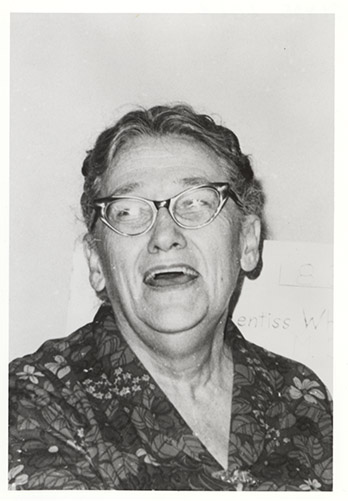
Lola Gamble Clyde
Born 1900
Occupation: teacher; farm wife; local historian; frequently addresses groups and aids researchers
Residence: Paradise Ridge; Moscow
Topics:
The colored topic bar is hidden for screen reader users. Use the topic buttons below it, the "Filter by Topic" menu or the search box to find specific content in the transcript.
Sam Schrager: And I thought perhaps, perhaps one at a time, I was thinking of starting with Polly Bemis, and who she was and what there is that's important to remember about her.
Lola Gamble Clyde: Well, Polly Bemis was Idaho's little China doll. She was born in the caves of Hong Kong, and at 15 she was sold into slavery to the great King Kong of San Francisco's Chinatown and the Barbary Coast. And after a short session there, it was Warren's Diggings and the Mining Saloons of North Idaho. They settled at Warren's, and here King Kong ran a saloon with Polly as the cook and as a chief attraction and as a chief supplier of all the comforts of home to the early day miners. And she was only four feet, about five inches tall, weighed about 85 pounds.
And one of her favorite gags was to grab up a great big cleaver and come out into the saloon and say, anyone here know likey, know likey my chop suey?
And of course, they all liked it very much. Now also mining in this country and running a saloon was a gentleman named Charlie Bemis, and he too was a gambler. So one night the great King Kong, the great Chinese riddle, Chinese puzzle, King Hong, and Charlie sat down for a little friendly game of poker. Well, they gambled away at pretty high stakes. And Charlie had a little sack of gold nuggets that he'd picked up out on his claim out on the Salmon River. And along toward morning, with all the chips down, it was the sack of gold nuggets against little Polly Bemis, the China doll herself. They played, and the great King Hong lost. But he had still had one trump up his sleeve. He whipped out his gun, shot Charlie Bemis in the eye, grabbed the bag of gold nuggets, and ran out the door into oblivion. But that was the way the great Chinese fortune cookie crumbled. And the story tells it that the bullet, while it went into the eye, it went under the eyeball, and Polly took her crochet hook, dug out the bullet, packed the eyeball with herbs, and nursed Charlie back to health. And then Charlie Bemis done right by that gal. He married her and gave her a little wedding certificate that she could hang up over their neutral bed, stating the fact to all the world that they were married. And this marriage certificate can still be seen up at the museum among the good sisters at St. Gertrude's Academy on the Camas Prairie. Polly lived out on the gold beginnings with Charlie for many years, and there's a creek there to this day that flows into the Salmon River, and it's called Polly Creek in her honor. She held open house there for all the river men. There was always food to eat and great kindness shown. After 28 years of married life, Charlie Bemis died and was buried at Grangeville. Polly made two trips to the outside world. She went to Grangeville to get her teeth fixed one time. She went to Boise at one time, and the rest of her life was spent there. They had 15 acres on Polly Creek, and this she gave to her neighbors, the Shep and the Clinkhammer people, who had a great cattle spread there in the country. And it was understood that they were to take care of her till she died, and they did. They put in the telephone line into her house so they could talk to her every day and see how she was getting along. She finally got sick, and they took her out to Grangeville where she died. The people from the Shep and Clinkhammer Ranch weren't there, so they gave her a pauper burial there in the Grangeville cemetery. The land passed into the Shep spread. Moscow always feels it has an interest in the great Shep Ranch out there because in later years, our own Bill Renfrew went to Alaska and organized a group of millionaire mining people, and they bought out all the Shep land for about six million dollars. And it belonged to that corporation for many, many years, and of course it's doubled and tripled in value since then. But it's one of the historic places of Idaho. Polly also left another museum piece. It was a blue silk dress. The silk had come from Hong Kong, and it was lined with flour sacks that had held flour made at the Grangeville flour mill. All down the front were little two and a half and five dollar gold pieces that formed the buttons on this dress. But the Polly Creek that's still flowing is in honor of our own little Polly Beamus, the little China doll.
That's really interesting.
Sam Schrager: What do you know about this King Hong fellow?
Lola Gamble Clyde: You say he was a great enigma.
Sam Schrager: Why is that?
Lola Gamble Clyde: Well, he was very, very wealthy, and he was a great, and he promoted many of the illegal goings on of the Barbary Coast, and he wanted to be quite anonymous, you know. So nothing much is known of him except that he did come to Warren's Diggings during the gold days and brought Polly with him and ran this gambling place there and disappeared after he thought he had killed Charlie Beamus. No one ever heard of him since. So we call him the big, the Greek -Chinese puzzle and that sort of thing. These Warren Diggings at the time were really quite a large gold dress. Yes, it was quite active, and a lot of gold I think was taken out of the Warren's Diggings out in that country.
Sam Schrager: What about Charlie Beamus? Is there any reason to think that he had an eye out for Polly before this gambling? Was he stuck on her?
Lola Gamble Clyde: No, I think not. I think it was just part of the game, you know. Part of the Chinese puzzle was, and women weren't valued much in those days, and it was just, she was just put up as any other chattel that belonged to the great King Hong, and he lost, and Charlie Beamus won it.
Sam Schrager: Was Charlie Chinese?
Lola Gamble Clyde: No, he was the white man.
Sam Schrager: And what about Polly as far as her character goes, or her spirit? What would you say about the kind of person she was?
Lola Gamble Clyde: Well, they said she was very hardworking and had a cute sense of humor and very kind, and she did all the things she did do just from force and necessity. She'd been brought up a little bigger on the streets of Hong Kong, and when she was sold into slavery, she just took it into inner stride. That was what the women were for, and I think that that's just about all there is to it, and all the men of that era testified to what fun she was and what a good little cook she was and how loyal she was to Charlie Beamus. And I think that's about all we know about her, you know, that she's one of the folk lore figures from the Salmon River.
Sam Schrager: What about the idea of her self -sufficiency, or looking out for herself? Was she considered to be very independent?
Lola Gamble Clyde: Yes, she was. Yes, she lived alone there in the shack on Polly Peak all those years, you know, and she always managed to make out and never wanted for anything, and there was always food for the wayfaring men that came along that passed along that way. She was quite famous as a Salmon River character.
Sam Schrager: She lived there for a long time after Charlie died then?
Lola Gamble Clyde: Yes.
I've forgotten just what year it was, she died now, but it was many years anyway.
Sam Schrager: Was she, you know, did she still keep some sort of a wayfaring house after all this death going on? How she managed to survive there?
Lola Gamble Clyde: Well I think that these neighbors, these ships and clinkhammers from the big cattle spread, down through the years they certainly befriended her and brought her food up the river for her and fretted things out for her all the time. It was they who took her to get her teeth fixed to Grangeville, and I've always hoped someday maybe they would take the Polly Bemis body back from where it's buried at Grangeville, take it back and bury it alongside of Charlie out on Polly Creek, but that would be a nice thing for the women's clubs to do. I think so.
And I imagine that she learned to speak very good English.
Yes, I think so. I think so. Of course all this is really before my time, I just know what the old historians tell about it and the old time stories, but she was definitely one of the early, I think she was one of the first women libbers of Idaho.
Sam Schrager: What makes her a woman's libber?
Lola Gamble Clyde: Well, because she came up such a hard way, but she managed to become self -supporting and lived alone and kept her little garden and fed the people who passed by, and I think she's someone in early history that we need to think about.
Sam Schrager: How about Mary Arkwright?
Lola Gamble Clyde: Well, she was a character. That's a gripping, exciting story too. She was born from, yes, oh yeah, she was born in the coal mines fields in Ohio, and she was the unregistered daughter of an itinerant preacher, to put it politely. The Arkwright name had come down through her mother's family, and they seemed to be people of some consequence from England. At very early age, the father was glad to get rid of her, so he sent her to take care of his father, who was blind and a very, very old man. So at 10 years old, we see Mary Arkwright Hutton leading the blind grandfather out into the public parks to listen to the soapbox orators or about lack of work and conditions in the coal mines and the hard life of the laborers. So when Mary Arkwright Hutton was still a young girl, she encouraged about 40 miners from the Ohio country to come in boxcars to the great Coeur d 'Alene country of Idaho, where gold had been found. History says she didn't ride in the boxcar with the 40 men. She had to ride in the coach, but if she'd been given her choice, she'd have ridden right along with the miners as they came west. When she arrived, she'd like to tell later that she rode in on the hurricane deck of a Cayuse, and she got as far as the Lake Coeur d 'Alene. From there, she went up into the mining country at Wardner and at Kellogg. Here she opened a boarding house, and she was a great cook. She was proof of her good cooking. She weighed nearly 300 pounds. It was a gigantic mountain of a woman in her own right. And a fine cook, the meals were served with great abundance. And they said what she lacked in good looks, she made up in her good cooking, and that the men thought there was no more beautiful sight in the world. And when a 285 -pound Mary Arkwright, May Arkwright Hutton entered the dining room carrying an enormous platter with a big pot roast surrounded by vegetables, it was the finest thing they could think of. She ran this boarding house and made quite a little money of her own by careful management and hard work. And then about 1900, she married Al Hutton, who was the railroad, an engineer on the railroad that carried the men between Cataldo and Kellogg. And he was a very fine man too, who'd been orphaned very young and had come up the very hard way. And he certainly appreciated and enjoyed May Arkwright Hutton's fine hospitality and her fine cooking. So he married her. And it was a wedding to remember. They got out invitations to it. Everybody was invited. May cooked her own wedding dinner, and it was all the things that the mining community liked. And they made it a double wedding. And their bridesmaid and best man decided they'd get married right at the same time and save the wedding expenses. They'd share the cost to the minister, and the best man thought they ought to share the wedding presents that May and Al had already collected. But Al Hutton drew the line of that. He thought that was going a little too far. So they kept their own wedding presents. But it was a gala affair. They shot off the fireworks all night, and there was much dancing in the streets to celebrate this very happy occasion. Now Al Hutton made a substantial salary as an engineer on the railroad, and they saved everything they made. And there was a group of them that met at the boarding house, and each of them was saving a little money, and they were buying up mining stocks. A lot of them didn't amount to anything and petered out, and they lost. But each year they kept saving and adding to it and investing in some other stock. And then finally, one lovely, lovely day, two men were walking through the hillside, and they noticed a different looking seam along the line. And they kicked it up and say they had discovered a galina mine too. And it was, they didn't know what to call it, but lying along the edge of the seam, there was an empty powder box, and on it it said Hercules. So they said, we'll call this the Hercules Mine. And the great Hercules Mine came in. And it was a mine that belonged to the butcher, the baker, and the candlestick maker. Everybody that could spare a few dimes had invested in it. And it was dancing in the streets that night. And it was even better than they had dreamed. The two men who discovered it went back out and surveyed and staked it out. And when it was assayed, it was decided that it really was a fine. And down through the years, it has proved that way. And it's still a very much a going concern. Here in Moscow, we have a special stake in the Hercules Mine because Jerry Day of Moscow, who married one of our own mix girls, was one of the organizers and promoters of the mine. And of course, Harry Day has been a great friend of the University of Idaho. Many, many of the wonderful books we have in the library are all presents from Henry Day. And Moscow, too, stood by to profit.
Sam Schrager: Did May Arkwright -Hutton invest in this one?
Lola Gamble Clyde: Oh yes, she'd invested and so had the husband. And at the end of the first year, their share was over $2 million. So May retired from the cooking business and they built a lovely home in Kellogg. And May started in dressing up and fixing up. And at first, the ladies sort of looked down their noses at her, you know, but she went on to bigger, better things. She became interested in women's libs. She'd always been a women's liberator in her own right, in her independence and in her ability to do things. So she set out to bring liberation to Idaho's women. And of course, in 1895, all the women in Idaho were allowed to vote. We were the second state in the union to see that women were given equal suffrage. So when she had that conquered, she thought she'd go over into Washington and do a little women's libbing over there because women had been given the right to vote in 1883. But about 1890 had been taken away from them again. So to Spokane came May Arkwright Hutton and they built downtown the great Hutton Building. And it was the first penthouse they ever had because the top floor was all made into a huge ornate apartment for Al and May Hutton. Now May was, they called her May Arkwright. She wore the pants Hutton because she believed in wearing men's attire. Not the graceful, dainty little slack suits that you see them wearing today, but the plain old blue surge suits and three cigars in the breast pocket and one cigar in her mouth. She was famous at the women's libs meetings and on the street corners of Spokane. But she felt rather, she felt a little lacking in the proper culture. So she took up studying Shakespeare. She wrote poetry and we have a few samples of that left. But she would hold receptions and she was a great one to patronize all the charities. And the greater the patronage, the more acceptance she gained. The church ladies were all delighted to see her come to those silver teas, you know, because when the rest of them put in their little silver dime or 25 cents, well she just dropped in a five dollar gold piece. So she was very welcome at all those, at all that sort of thing.
Sam Schrager: Did she have much of an effect in Spokane on Al's rights?
Lola Gamble Clyde: Yes, I think she really did. She really did because she got out and she wasn't afraid to spend money and she wrote and she entertained all the leading political figures of the time. She had Teddy Roosevelt there for dinner and very friendly with him until he made his famous remark about a woman's name should only appear in the newspapers twice, when she gets married and when she dies. So that finished Teddy Roosevelt with May Arkwright Hutton. But she was very friendly with Clarence Darrow when he came to try the Steubenburg murderers, the Hayward, Moyer and Pettibone cases. She was a great admirer of his and also a great admirer of Senator Boras who had done the prosecuting in that very famous case. She was a friend to all the United Mine Workers and contributed money to their fight for better working conditions. She was definitely a woman in her own right. She had very poor taste in dressing, such an enormous figure. She would get out big plushy dresses with wild flowers all splattered over it in great dimensions to match her own. And the Spokane women of that time looked down their noses greatly. One of them said, you know, I think I knew someone that used to board in your boarding house. And May said, yes, your father was the only one that ever went away and didn't pay his board bill.
Sam Schrager: And once when she appeared in a beautiful new silk dress, another of the society ladies, oh, is that your first silk dress?
Lola Gamble Clyde: Oh, no, she said, your husband bought me one 25 years ago. So she had a way of putting the ladies in their places, you know. And some of the poetry was out of this world. One she wrote for an elks convention. And it was something about this was out at Wallace. She said, here in this northern land, the elks come down to drink beside the real. The elks come down to drink their fill. The woods are gone and so is the real. But the elks still come to drink their fill. And this was greatly appreciated. She attended many of the political rallies and was ready to put up money for them. And one of the people wrote a poem for her. It was something about our May, hooray, our gal. Our gal may not be so good looking, but she's going to win this here fight. Words to that effect. And she was very, very prominent anyway in all of these, all of the things that had to do with women's rights and equal suffrage and so on. But time ran out on her in about 1916, the beginning of the World War. She went from women's rights to peace, to trying to keep peace. And she did a lot of work in various peace organizations. But time was running out on her and she sickened and died. But not before Al Hutton had built her a very, very beautiful home up on the south side of Spokane. And it too was designed by this cutter who designed the Davenport Hotel and many of Spokane's very lavish homes. And she continued to entertain there in most lavish style to the consternation of a few other people that lived out on the South Hill. I think she died about 1916 and Al Hutton then fulfilled the dream that they'd had together. And as a memorial to her, he established out on the lovely banks of the little Spokane River a gorgeous place for orphans. He called it the Hutton Settlement. There are four beautiful, beautiful houses out there. Each one has room for 20 children and house parents. And there's orchard, there's farmland, there's garden, there's cows for them to milk, horses for them to ride. There was even a swimming pool and a tennis court. And all these things were most elaborate when he built them back about the time of the First World War. And the interesting thing is that after all these years, there's still a very going concern. It's just a beauty spot out there. Beautiful buildings, beautiful everything. And as a little extra touch, the Northern Pacific Railroad brought in the old engine bell off the engine that Al Hutton had piloted. And it hangs there in the yard at Hutton Settlement to call children who lived there at the settlement in to the different meals. And it's something worth seeing. And out in the beautiful Fairmount Cemetery are two beautiful pink marble monuments that stand to Mr. and Mrs. Al Hutton, lovers of little children.
One thing that I wonder about with her, the story that you tell, is that if she was such a friend of the laboring man, I'm surprised that she could get along with the rich so well. Because you don't think of them as having the same interests at all. You think of the, I would think that the wealthy people wouldn't want to have much to do with her kind of politics.
Well, I think there were a lot of people interested in women's right to vote. And of course, she didn't live to see it become a part of an amendment to the United States Constitution in 1920, that all women would have the right to vote. And I think there were a lot of wealthy people at that time who wanted to see this past. And she had a big following. She was a character, but she had a heart to match her physical size. And I think that she made a great contribution to the welfare of the world in promoting the women's right to vote and women's right to share in the decision making of the world. And I certainly have always thought that Al Hutton must have been a very fine, wonderful man, because he stood right by her through all her work and all the glory and the dreams he shared with her.
Did she play a role in the Idaho women's suffrage movement, or was that a little before she... No, she did. She led it for Idaho.
And Susan B. Anthony was one of the people that she entertained a lot. All the things that had to do with women. Carrie Chapman Catt, all the early day people that dealt with women's rights and prohibition and that sort of thing, knew May Arkwright Hutton. And she seemed to share the common dream that they all had of doing this for women.
Yes, you know, yes. The year of the bullpens, when all our boys from the university were sent up there to guard the laborers, they rounded up a thousand of them and had them in what they call the bullpen. And she printed leaflets and got out for them. And she would go out to the stockades and bring in dozens and dozens of pies that she baked for them. And she was continually visiting to cheer them, bring them news from the outside world, and to protest loudly and longingly the treatment of the miners. And of course, when they commandeered the train, you know, and ran it down off the hills, they carried, they had it loaded with dynamite, and they ran it down through the mine and exploded and blew the whole thing up. May Arkwright Hutton and her husband were foremost in organizing it and getting it going. They were definitely, they were very definitely friends of the laboring people. And it had been ground into her from infancy because she had been born and abandoned back in the coal mines of Ohio.
Sam Schrager: Did she go back to Kellogg to live or did she go into Spokane?
Lola Gamble Clyde: No, after she went into Spokane, she became one of the leading figures in Spokane. She was one of the real characters of Spokane. And she did go home once. And she was very good to these half brothers and sisters of hers. She shared her wealth with them and that was, all those things were certainly to her credit, very much so.
Okay, now I want to ask you about Molly Bedem.
Oh yes, she's another lady from the mines. And Molly Bedem is one of the great characters of the Murray mining country. Tradition at least has it that she was a very young, innocent, loving and lovely wife. And her husband got terribly in debt and got into many, a lot of trouble in other ways. And she wanted to get him out of prison and help pay off his debts. So there was only one way open to women at that time and that was through prostitution. That's the only way women knew to make money at that time. So she too entered the field of prostitution and she came to Murray. And the story is, the story is that the owner of the saloon, her name was Molly Burham.
Sam Schrager: Burham, is that right?
Lola Gamble Clyde: And he took her into the saloon to introduce her to all the miners gathered there. And he wanted to say that this was Molly Burden of the Madame of Murray, just to identify her so the men would know who she was. So he did, he said he wanted to present to them Molly Burden, the Madame of Murray. But the miners thought he was saying Molly Bedem. So Molly Bedem, she became and she ran the little houses of prostitution that lined the row.
Sam Schrager: And someone asked her once, now where do you live?
Lola Gamble Clyde: And she said, well mine's the first one. She was the Madame. And but the tales of her great generosity, her great kindness to people in trouble, the miners that she fed, the miners that she staked, and the poor and the people who were down in luck. One of the famous stories is how a woman was giving birth to a child out along the Fourth of July Canyon in the snow and cold. And Molly Bedem came upon them and took off her luxurious fur coat and wrapped the mother and baby in her coat, put them on her horse, and she walked beside them and brought them into Murray. There are many other stories to that effect. She didn't live to be a very old woman. She was still young when she died, but up in the little weed infested cemetery at Murray, there's a little wooden headstone and on the slab it says Molly Bedem. And the interesting thing about it is I was there about a year ago and among all the weeds and the swirls and the trash in that cemetery, the only grave that's been cleaned off is Molly Bedem. And it was all cleared off of weeds and there was a little, a few little plastic flowers laid on it. And in an empty beer bottle, there were three or four little wildflowers that had been stuck in water on her grave. So I thought after a hundred years, there were still people remembering Molly Bedem.
Sam Schrager: What is it about Molly Bedem that made her such so well known up there? I mean, why, why has she stayed in people's imaginations?
Lola Gamble Clyde: Well, I think probably it was the many, many acts of kindness. The kindness is something that goes on living, you know, and that never dies. You've touched people's lives. And of course the stories may get better with the telling, you know, too, down through the years, but there are many, many fabulous stories about how she took in the sick and the old and the disinherited and the dispossessed and grubstaked them, started them over again with the money that she accumulated in devious ways. And I think those things people remember.
Sam Schrager: Is there any, any knowledge passed on or lore passed on about how she treated the women who worked for her?
Lola Gamble Clyde: Well, I think they were of the same sisterhood, you know, and there is a feeling of comradery, a feeling of sisterhood maybe among them. Anyway, Molly Bedem has become just a legendary lady of, a legendary lady of loveliness and kindness and all the sweet, fine things that she did. And it is proved by the little bunch of wildflowers in an empty beer bottle.
Now there's one other person that I was going to ask you about.
That was Jane Silcott. Oh yes, little Jane Silcott, because she antedates all of these three women because she was, she was the daughter of old Timothy and old Timothy was Henry Harmon Spaulding's first Christian convert. And Timothy of course lived down at Silcott, Washington, which is also known as Wawawee. It is also, it is also a Red Wolf's camping ground. And he, it got, it came to be called Alpawa because the Christians weren't allowed to work on Sunday. And Alpawa meant the place of Sabbath rest. And I'm interested to know that they saved the Timothy Bridge down there, the old Timothy Bridge that goes across the Alpawa Creek. And so once they put in this dam, you know, and flooded Silcott and they have a little park there now. And that's to, to, it's in memory of old Timothy who was a friend of the white men. Of course the, the Nesperces themselves, they considered old Timothy the greatest Uncle Tom Tom of them all because on so many, many occasions he did befriend the white man. It was he that, that Mrs. Harmon, Mrs. Henry Harmon Spaulding sent to Walla Walla at the time of the Whitman massacre to see how the little daughter, young Eliza, had fared. And he went down to try to, to buy her freedom from the captors.
Sam Schrager: Was he successful?
Lola Gamble Clyde: No, he didn't. No, he didn't get her. But later on she was rescued. But you did tell me that, that he had, she had agreed to take the Pierce party across. Oh yes, that's right. Yes, yes, little Jane. Well, little Jane was old Timothy's daughter and Timothy's wife was a sister to old Chief Joseph of the beloved Wallawas. And to them, to Timothy and, and Tamir was born little Jane. And little Jane was a very bright, fine looking little girl. And at about 17, E .D. Pierce came in to this country looking for gold. He got as far as the Red Wolf campground. He thought that old Timothy would have some of the Indians ferry him across at Walla Walla. We had to come on up Steptoe Canyon into this country. When they got there, Timothy said, well, you don't dare go on up through the Nez Perce country, up through Lapwai and Lilliston because there's great unrest and the Nez Perces don't want so many white people coming through their country. So he wanted to know how otherwise he could go. Well, he said, if you ferried across here from Silkout across the river, you could go on up the grade. And he said he didn't know the way. Well, little Jane, who was about 17, said, well, she knew the way and she would go with them and show them the way. So the E .D. Pierce party stayed overnight there and the next morning the Indians ferry them across the Snake River. He went up through Steptoe Canyon. He came through Steptoe Canyon on, on between Colton about in Uniontown, on down until he struck the Tenet Panup about four miles, about halfway between where Moscow and Pullman now are. When they got to the Tenet Panup or the South Palouse River, then they followed that on up out to where Troy now stands, on down to Kendrick. And from Kendrick they went on out over the, the plateau country on up to Orphenovar Gold was discovered. And Jane Silkout was very, very astute and very lovely little person. And a few years later, when the army put up the fort at Lapway, with the party came young John Silkout. Now John Silkout was an engineer. He was a Harvard graduate. He was a very smart, intelligent man. And he fell in love with the little Jane Silkout and they were married. And for a time they lived at Silkout and ran the Silkout ferry across the river. And later on they went up to Lewiston itself and right at the foot of the bluff and right at the foot of Fifth Street where the Fifth Street Railroad Bridge was built. They ran what was called the Silkout ferry. It wasn't down at Silkout, but it was run by Jane and John Silkout and was there where Fifth Street goes over to the, crosses the Clearwater River. And they ran it there many, many years and all the early timers, the Clydes and the Snows and the Martin Andersons, all the people from this vicinity that used to have business going to Lewiston, many of them crossed there at the Silkout ferry. And they said when John Silkout himself became a very bad drinker and when he'd be too drunk to go, Jane would get out the ferryboat herself and work it across the river for them. And often she had coffee ready. The old yellow house that they built there on the banks of the river, it's only been gone maybe 20 years. It was there for many years. I remember it well. And she was very friendly and hospitable, make coffee for the visiting people while they waited for the ferryboat to come back or to go over. And lots of folks remember her with great gratitude and that sort of thing. She didn't live to be a real old woman. And they had an open fireplace in the house and it caught fire and she was burned so badly that she died. And she was only I think about 53 or something like that when she died. But little Jane will be remembered long as the daughter of old Timothy and who led the E .D. Pierce party and as the wife of John Silkout who ran the ferry there across the underwater river at the very first coming of the first settlers into this community. When she died, John Silkout, the husband, erected a very lovely white marble shaft there on the hillside. They buried her right there on their own land just above where the ferry house stood. And all of us here in this community remember seeing the white monument there. I've been there at it many times. And a few years ago when we moved old Timothy and the bones of old Timothy and all his family from Silkout down the river when it was going to be flooded up to the Beachview Park at Lewiston, we talked then about moving Jane's bones from the bluff there along the Clearwater River, moving it over and burying it with the families and John Silkout too because he was buried there too, burying them with old Timothy's family. And when they went over to find the bones, Marcus Ware, who was one of the instrumental people in this, found nothing but broken redwood splinters off the coffin. And the grave had been robbed and the bones and everything were gone. Just the broken splinters of the redwood coffin were left. And that's one of the sad travesties of the world is how people will go and rob Indian graves for the little trinkets and things that were buried with them. Did Jane Silkout continue to be close to her people or did she spend more time with the No. No, it was a very friendly relation and they were all very much accepted down there because Jane and all her family had been friends of the whites and they were very compatible and I think John Silkout thought a lot of his little wife, everybody said that he did. He said he was just simply a drinking man, that was one of his failings and he would beat her when he got drunk but that was one of the ways of the world of that time, you know.
Grace Wicks told me a story about Jane and, well it was really about him, John, that when his sister came out to visit him, he took her around but never did bring her home to meet Jane.
Sam Schrager: Have you heard that story?
Lola Gamble Clyde: Yes, I've heard that and I think that that's probably true.
He probably knew that the sister wouldn't be able to accept in the right light and that was probably the way it was. I wouldn't be surprised that he, I wouldn't be a bit surprised if that's the way it was, all right.
Sam Schrager: Would you consider Jane Silkout one of the outstanding early women?
Lola Gamble Clyde: Yes, yes, I think she was one of the early women -livers. I think all four of these were. She wasn't a bit afraid to go with this bunch of mining men on this trek up into the orifinal country. I think she must have been a women's liver.
Sam Schrager: Do you know about heart and hand marriages?
Lola Gamble Clyde: No, I really don't know. I've heard of them. I've heard of them.
Sam Schrager: But you don't know of yourself of instances where that's the way that people got married?
Lola Gamble Clyde: No, no I really don't. I've heard of such things and I've heard of these heart and hand advertising agencies you know where you put an ad in the paper that you'd like a husband. I guess it's still going on today as far as that goes. But I think that this marriage business is so very important that I believe they ought to do a little bit better when they go out to find mates. They ought to look the situation over a little more carefully.
Sam Schrager: Speaking about women who were women's livers, what about all the women who homesteaded out in the Clearwater country, took up homesteads, the kind that Carol Brink writes about in Strangers of the Moon?
Lola Gamble Clyde: Yes, I think all of those were quite women's livers and some of them, yes I knew many of them, and I think they were. They all believed in women's rights and they were. In those days we heard a little more discussion of women's rights too, probably because they didn't have them. Nowadays we feel that we've had them so long we take them for granted you know. We just take our rights for granted. We can't realize there ever was a day that we were chattel and belonged to our husbands and we obeyed our husbands and so on you know. We've become so used to being co -partners and helping make the decisions and I think that that's the way it goes.
Sam Schrager: Do you remember when you were young, young women talking about women's rights?
Lola Gamble Clyde: Yes I do. My mother was a great woman's libert. She never missed a time going to town. She went twice a year. She went to see Santa Claus and bring something home and she went to vote and those were two very important things and the women's right to vote was very important with her and she never missed a chance to go to vote and she thought that that was the salvation of the country was when women could vote and help make the decisions.
Sam Schrager: What were the attitudes of you and your friends when you were young? Did you feel that women had an important role to fill that was being denied them?
Lola Gamble Clyde: Oh yes I remember definitely. I thought I would be a lawyer. If I didn't have enough money I'd have been a lawyer. I was always on the debate teams. My husband says the debate's still going on after all these years but I was going to be the first woman lawyer to graduate from the University of Idaho. It just simply took more money than I had. Didn't have enough money to do it but I would like to have been a lawyer and I would have been championing women's rights because I always maintained they certainly should vote and get out and know what was going on and be equal partners with their husbands. I think that's right.
Sam Schrager: Were the women, young women organized at all when you were young or was it just a very, an individual and a private attitude that people had? Do you know what I mean?
Lola Gamble Clyde: Yes.
Well I think largely it was kind of just an individual attitude that people had. My mother was an educated woman too and that helped influence us that we should grow up and learn and be educated and make a contribution to the world and not just do it through our husbands. There were so many of the early day women their husbands said and they just did and they never thought it through, you know, themselves. But many of them had no education and didn't have much background for it. But as far back as I can remember I believed in women's voting and women holding office and women being on equal terms with their husbands and able to enter into the problem solving.
Sam Schrager: Do you think that as a rule Lola that women did not have equal responsibility in marriage relationships that the men really did make the decisions and the women did not?
Lola Gamble Clyde: Yes I think so. As I look back on it that was the way I remember it. They believed in us, let the women be silent all you know. And I think that was the way it was. They were sort of considered inferior and they were to obey their husbands and be subservient and make him king of the castle. And I've always said that these big decisions that are made like who should be president of the United States and what we should do about Russia and China, I leave all that up to my husband. But the little things like how we're going to spend our money and how we're going to raise the kids, those are the things I decide.
Sam Schrager: Well in the early days do you think that pioneering women had more or less equality? Were they really subservient or did they have a more important role to play?
Lola Gamble Clyde: Well they certainly had an important role because most of them did the raising of the king, there was food on the table and all that sort of thing. While the husbands did of course the outside work like the sowing and the harvesting, most of them had plenty of hard time making a living. But keeping food on the table and the kids washed and scrubbed and cleaned and seeing that they got some form of education, some form of training, I think the women pretty much did that.
Sam Schrager: Well I'm just wondering, was that an equal relationship? Did they have equal responsibility in that way or were they still strictly second class?
Lola Gamble Clyde: Well, yes I know what you're driving at but I think it was just up to the husbands. Some educated husbands felt that their wives were on an equal basis with them but some of them, many of them in our community were from the old country and the more, the farther back the line, the closer they were to the old country, the more they felt that the woman's place was in the home and to run and wait on them and see that their food was ready on time and that sort of thing. I think they were part of the chattel, part of their lord and masters, what they owned and the women were to keep the thing running for them, you know, and the home was for them and they were to stay right in there and it always seemed to me that the real, the buns who were closer to the immigrant stock felt more that way than the people who had grown up in America and been educated here. They felt a little differently about it.
Sam Schrager: Do you think that the women in general went along with this and accepted their being chattel, not knowing, really not having thought of it any differently?
Lola Gamble Clyde: Well, some of them were smart enough not to let anybody ever know that they had any other thoughts, you know, about what every woman knows. Men who have climbed to the high places in the world like to think that they did it all by themselves and we who are their wives smile and let them think so. That's what every woman knows and a lot of them were smart enough, you know, to, I've heard many of the women from the old country say, oh, I wouldn't know anything about that. You'll have to ask my husband. He knows all about that, you know. It gave the men a great build up. I wouldn't know. I couldn't answer it. Just ask my husband. He'll tell you. He knows how it should be done. I think they were just smart enough to play the game, you know. They were just kind of going along with it.
Sam Schrager: After the women's rights struggle was won, the right to vote, I think, in Idaho, there really weren't many advances soon after that, were there? I mean, wasn't that sort of the end of the women's movement for the time being?
Lola Gamble Clyde: Well, a lot of them got very concerned with the prohibition. The people who had headed women's rights, a lot of them took up prohibition and became very much in favor of prohibition until finally they got it through, you know, under the Wilson presidency. But it led to such bootlegging and so on that it was, after all, it had to be thrown out. After that, it was thrown out again. But for a long time, we did have prohibition. And I think that came after women's rights. All right.
Sam Schrager: Why were women so attuned to that idea? Why did they think that prohibition was the answer to the world's ills?
Lola Gamble Clyde: Well, I think that many of them had seen all what they had saved for. Maybe the men would ride off to town and get drunk and spend what they'd been saving for and what they'd been trying to get ahead with. And the women had so little control over money of any kind. And if the men wanted to go and drink it all up, it was just done. That was it. And I think that they felt that the men just couldn't get it so easily, that that would make a better life and a better family life. And they would... So I think that that was what prompted the great drive for prohibition.
Sam Schrager: Was drinking much more of a problem then than it is now?
Lola Gamble Clyde: Yes, I do. I think so. There were open saloons everywhere and they were the gathering places of the men. They were there. That was their club. It was their pastime. It was everything. They could go and it was a sort of a fellowship. They could get together and talk. Talk men's talk and not have to have the women around, you know. And I think that it was really much more of a problem than it is now where social drinking is accepted, where the woman sits and has a cocktail and the men sit and have a cocktail together or go to an eating house and have a cocktail with their meal. This was... The drinking the men did in those days was done largely on their own. And the women stayed home and took care of the kids while the men went off and got on a big spree and come home and beat up on the children, beat up on their wives and that sort of thing. And I think it took a lot of work on the part of people like May Arkwright Hutton, for example, to call attention to the things that were going on.
Sam Schrager: Do you think that the isolation of a pioneer in rural life made drinking more of a problem?
Lola Gamble Clyde: I do. I think that the isolation, there was nothing else to do and the hard work and the men felt that they just had this coming and they could go off to town and leave the kids and the wife at home. And for a little while they could forget their cares and their worries and their sorrows and in the fellowship of other men. And I think that that was one place the men could go and there wouldn't be women and children following them too, you know. And there were problems in more than one way. Uh -huh.
Sam Schrager: Just an impossibility? Was the WCTU and all that just a failure?
Lola Gamble Clyde: Well, I don't think it's been just a failure. I think it's all a matter of education. If they can learn when to stop, you know. If they take a little drink to warm them up or a little drink to cheer them up, I always say I don't need a single drink. I can say enough stupid, crazy, irresponsible things without anything, you know. I am stimulated by talking to other people and enjoy it so much. But some people are so inhibited they can neither talk nor feel at ease. And those people have a definite need of something to take the edge off, as they say.
And uh -huh. It's been said to me that Prohibition led to more drinking because when liquor became forbidden fruit it reached many, many people, women and upper class people socially who never thought of drinking before.
Sam Schrager: Do you think that that's true?
Lola Gamble Clyde: Well, I suppose so. But I don't think there was as much drinking under Prohibition as there had been in the days earlier than that. People have, as Roosevelt got in such trouble for saying, the people learn to hold their liquor well, you know. And of course that was trouble with WCTU. But if they could take a drink and know when to quit, you know, it's the drinking beyond all sense of responsibility where you don't care what happens. I think that was where the trouble lay. And I think that during the Prohibition it wasn't quite so easy to get. Men didn't just go off to town and stay there two or three days at a time dead drunk because there was no place for them to stay. There were no saloons. If they wanted to get drunk and lie out on the road, that'd be about all. I think there was less drinking during Prohibition than there was before Prohibition came in. But it was far from the real answer. The whole thing was a matter of education, really. And if some people wanted to waste their lives that way, you can't make it fit everybody. But it's a matter largely of education. I want to ask you a little about the women homesteaders that you knew and what their homesteading was like.
Sam Schrager: Can you tell me about that?
Lola Gamble Clyde: Oh, yes. Well, the ladies that went up around Collins, those were all quite society ladies from Moscow. There was Mrs. Thorsen, who was the milliner. There was Iona Dare, who was Dr. Adare's daughter. There was the McConnell girls, who were the governor's daughters. And they went up around Collins, Idaho. And Joe Collins was one of the early day forest rangers that took people out and settled them. And he would find a good place for them to settle. And there were many folks that went up there. They endured much of the hardships of the early days, although as Carol Mireille Brink had so well put it in her Strangers in the Forest. And her Auntie Elsie Watkins was one of the women who went up there in homesteading. They had lots of hardships and bringing in their own food and packing back into the hills. And many of them spent much of their time down, though, at the Boville Hotel. That was quite a fancy, warm, comfortable place. And a lot of them went in there and did some of their homesteading by long range from there. And there was some sort of a deal on when they got these white pine homesteads proved up on. They could be sold. They could be sold to the big Potlatch Forest Lumber Company. It wasn't called that then, but who, whatever it was. These timber claims that they took up, nearly all of them didn't really do anything with them. They were just sold to the big lumber company that went in and harvested the white pine.
Sam Schrager: How much of the time were these women occupied with being on the homestead?
Lola Gamble Clyde: Oh, I really think they'd just been in in the summertime. I don't think they did much staying there all winter. They were allowed to come out. The government allowed them to do some coming out. I think it was quite negligible the amount of time or work they put in on the timber claims. I think Carol summed it up very nicely in her Strangers in the Forest. I think that's just about the way it was. I knew Carrie Bush was a very intimate, dear friend of mine. She often laughed about her husband was the first United States forester in the state of Idaho. He was a man of great integrity and decency. He came in, of course, a long time after these women had been up there homesteading. I really think that there wasn't too much hardships undergone. I think they went in and stayed during the nice weather in the summer months and picked some huckleberries and enjoyed the lovely mountain air and scenery. I think when it got very bad weather they probably came out to the Boville Hotel or down back down to Moscow.
Sam Schrager: Do you think that most of the people did know when they went into this that they were going to sell the land?
Lola Gamble Clyde: Oh, I think so. Yes, I think so. It was a very quick way of picking up the fast buck. Since time began we've always had people interested in turning over a little money in a hurry. I think so. I don't think they ever intended to go up there and log it off themselves or live there and make homes of it.
It just wasn't conducive to that. I'm just wondering if the people felt that these women were daring to go out there on their own or whether it was just an easily accepted fact of life to the local community.
Well, I really don't know just how the community felt about it. I really don't know. I was too young to really sense what was going on then. Carol's about ten years older than I am and she has a better understanding of it. I think she writes very well of it though. That's probably the way it was because I've known all these women later in life and they all tell about their hardships and so on. But they also admit that they didn't do much staying up there when the weather got bad and drifts got bad and they went down and stayed with the bovilles a lot and they came back to Moscow. They were allowed so many months off the claim anyhow. So they took advantage of that and put in the best months up there, which was the only way they could have done it I think. When you talked about Ida Tarbo, which we did talk about already, you mentioned to me another time you had curled hair then.
Sam Schrager: What was that? Was that a style?
Lola Gamble Clyde: Well, I bobbed my hair. That was the first women's lib, you see. We just cut off our hair and we'd have it all marcelled up, you know, in little tight curls and then we thought we were really defying the gods and that was showing our liberation. It's as good we do that when we're young because when we get old we don't have the time or the money to do it. So it's good we did it sometime in our lives. We curled our hair and bobbed it and all that sort of thing.
Sam Schrager: Was trust busting a very important idea to young people?
Lola Gamble Clyde: Oh yes it was. When I was a young girl in school I was much interested in Teddy Wieselfeld and the trust busting and I was a great admirer of Ida M. Tarbell and the trust busting and taking on this Standard Oil, you know, and so on. And I was a great admirer of Ida M. Tarbell for all the things she'd done. And she was trust buster number one among the women.
I want to ask you about becoming a teacher. Oh yes. And from what you said to me before, I had the feeling that your interest in teaching began when you were in school and enjoyed helping the younger ones to learn.
Sam Schrager: But then from there was it hard to become a teacher?
Lola Gamble Clyde: Well it wasn't too hard, you know. As a young child I hated to see the little children sitting in the rural school doing nothing, spitting on the desks and tracking mud on the floor and that sort of thing. And when I got to be one of the bigger girls the teacher would say, you go over and help them. And I'd gathered up the kids and take them out in the cloak room and teach them their spelling and I taught some little folks to read and it was most rewarding to see them catch on and learn. And I enjoyed doing it and I thought it was one way of quickly getting out and getting some money. And when I was a young girl in high school it was during the war and one of the girls in my class, and she hadn't been such, she hadn't been in the top ten percent at all, but she went out of normal school, went six weeks and got a job teaching for ninety dollars a month right out of high school. And I thought, well if that girl can do it, I can do it. Because I had been among the top ten percent. So that fall I went to Lewiston Normal, went one year there and I got my first job and I thought, well if I, I'll save my money and then I'll go back to school and I'll teach and I'll save money so I can get through college. And I went to teach in a rural school, I went down to Weiser, Idaho and taught at the Crystal School. Had great big classes, boys that had just come home from the World War, older than I was, older than I was. But we got along fine and many of those folks are still my lifelong friends. I came back, went to summer school at the University of Idaho and I just loved it. And I knew I had to finish college. Taught the next year, taught the Gray Eagle School at Genesee. Had all eight grades and three high school youngsters, nearly, nearly forty kids all together went through that school room. And it wasn't easy, you built your own fire, you tried to keep the place half way clean, you taught like mad all day. Taught many of them after school. Then I came and taught the Snow School. I put in four years there. Go to summer school every summer and teach. And that's where I met Earl Clyde. And during this teaching time I became greatly enamored of going out and being a rural supervisor. I thought how much a waste of time there was in the rural schools, how poorly trained the teachers were, how little they knew, how little added enrichment they brought to the program. And at the end of four years I went back to college. Well I really, and I took twenty -four hours. I did correspondence courses. I graded papers in three departments, English department for Dr. Miller, history department for Dr. C .J. Brosnan, which I continued to do until Dr. Brosnan quit and left us. And I graded for the school of education, Dr. Brosnan's classes. And I had a full time job that lasted about twenty -four hours a day. But I got through, I graduated. And I graduated summa cum laude in those days and that was the highest honors you could make. And I'd had just one year of college, one year of normal, and four or five summer schools.
Sam Schrager: So that wasn't doing bad, was it?
Lola Gamble Clyde: Then I had a choice. I was offered the job of history teacher at Whitman College because I'd been a great, nicest apprentice Whitman admirer and I'd graded all papers all that year. So Dr. T .C. Elliott, who was on the board and a wonderful old historian himself, asked me to come down. I considered it long and hard. Then I got an offer to come to Albion Normal in south Idaho and do critic teaching. And that was the foundation of my dream that I'd go out and be a rural supervisor. Idaho had two at that time. So I went to Albion Normal as a critic teacher. And I enjoyed my work, fine bunch of kids, fine bunch of teachers.
Sam Schrager: What did the critic teacher do?
Lola Gamble Clyde: We supervised the young teachers learning how to teach. But just imagine I had 40 teachers each semester to supervise. I had 40 teachers, way more teachers than I had children. I had maybe 30 children. But we rotated them around and gave them lessons. And I did some good things there because I had had the training at the University of Idaho. One thing I did, I did the state courses study in remedial reading. They never heard of remedial reading before, but I had studied and written for the education department on remedial reading, how to help children with reading problems. And that was the first remedial course study I ever had. And the state superintendent was a very fine woman and was interested in it. I did another good thing for her. She was getting her master's thesis from the University of Idaho in grammatical errors. And over the years she'd compiled that about 10 ,000 grammatical errors of the school children of Idaho made. And she wanted them classified into what rule of grammar these grammatical errors were breaking. So with the help of about 40 students, I combined them under eight grade grammatical rules like a plural noun takes a plural verb. A pronoun must agree with its noun in person, number, gender, and case. Those great rules of grammar and all 10 ,000 mistakes that were being made could be classified under eight. So I had the 40 students sit down, each one with a paper and each one with the eight rules, and I'd read them off and they would help me decide which rule of grammar these grammatical errors were violating. And we got them all down to eight rules of grammar. And that was a big contribution. And Mabel Lyman, Alan McConnell, got her master's on that. And that was good that she did. And it was good for those 40 teachers that they had that experience. And it was very good for me to have had the background and the training so I could help her get her master's thesis in it. And that was a fine experience. But down there, I became disillusioned with the teaching because here were old women still teaching, 70, 72 years old, and they were at the end of the trail. And they were looking forward to going out to old people's home and homes and spending the last days of their lives. And I thought there wasn't much for them to look forward to, you know, after all these years of teaching. So I decided while I was down there, I better come home and marry Earl Clyde before he changed his mind. And I was so lonesome. We were way back out of civilization. And while I liked my job and I had good kids, I decided I'd come home and marry Earl. And that's what I did. And I taught one year after that at the Smith School close to where we lived at that time. And then I just started to school for one. And after that for one and two and two and three and four, my own kids. But I served on school board here. I served 15 years altogether on. I wrote local school board. Then when we consolidated, I served on Moscow school board. Some of these things that I had dreamed of doing in other schools, I did for our own schools. So it wasn't any of it wasted, you know. And the other thing I did, which I've enjoyed and I'm still enjoying, Dr. Broston, who was a very dear friend of mine and a gentleman and a lover of history, asked me in my spare time, you know, after cooking for all these hired men taking care of poor kids.
Sam Schrager: Would I like to grade papers for him?
Lola Gamble Clyde: Well, because I love the history, I said I would. So all his exams came out here in many, many nights. They were all spread out on the table while I went through them and graded. And you're bound to learn a lot of history from grading papers. And I enjoyed every minute of it. And that's how I learned about our local history, too, was from grading the papers. I also did all the DAR contest papers. They carried on a big contest every spring, writing historical essays for the whole university. So I'd bring them out and spread them all out on the floor, the best and the next best and the next best, and then go through them and go through them until we had selected the top ones. And that was an interesting experience, too. So that's how whenever I talk anything about history, I feel that after all those years of grading, I should know a little. So that's it, Sam. I may not know it all, but I have picked up a little history. A little bit here and there. A little bit here and there. And most of it's pretty authentic because if it wasn't right, I had to go look it up and find out what the answer was. So I still have a little of that, but I loved it. Anyway, I loved it anyway, Sam, and it was fun.
Sam Schrager: And who are we to say where we make the biggest contribution?
Lola Gamble Clyde: None of us know.
Sam Schrager: What were your dreams about what could be done in rural schools?
Lola Gamble Clyde: Well, I hated the way they read. The children weren't learning to read. They were word readers. And I was far in advance of my time when I thought they should read to find out, read in answer to a question that it was no pleasure to sit and listen to them read. They weren't going to be dramatic readers and entertain huge audiences. And here we had them getting up and reading orally while everybody just was bored to tears with it. You could hardly stand to listen to them. And I thought, well, let's teach them to read to find out, read to answer questions, read to follow directions, read for anything, but don't read to entertain other people because you aren't entertaining them. Read silently, read quickly. And that was later on. Everybody agrees that that was right. You know, and down at the Smith School, I had a little girl that could read 600 words a minute. And that was just fantastic for those days. And she was counted. She passed the highest in the state. And she was entirely taught by reading by sentences, reading that way. And it was most revolutionary for back in 1926 and 27.
Sam Schrager: Did you come to this by yourself? Or did you have, were there other people?
Lola Gamble Clyde: Oh, there were lots of other people. Yeah. There was William Gray who wrote the curriculum on reading in 1926, right while I was a student in college. And we studied all his yearbook on it, the whole yearbook from NEA, National Association. Yeah, it's all devoted to reading, to what's wrong with reading. And he certainly influenced me. And then I saw in my own teaching that it was, that we just had added the wrong concept of having, now you'll read, Johnny, you'll read Mary. And they'd get up and limp through and you'd tell them every other word. I knew it was wrong. And I had always gone through the lesson and taught the new words before they started. And it was just most revolutionary though for those days. And when I was a critic teacher, I taught the same way. Teach them to read to find out, read to follow instructions, read for anything, read for your own enjoyment, but don't read for my enjoyment. Read for your own.
Sam Schrager: How could you implement that with the kids? How could you get them to actually do that?
Lola Gamble Clyde: Oh, well, there are many, many games, for example. There are many, many cards, card reading, sight reading. Hold up a card with a whole sentence on it.
Sam Schrager: Just for a minute, what did that tell you to do?
Lola Gamble Clyde: Maybe it's run to the door. See, they don't read out everywhere. They go do it. Put your finger on the table. Put your book on the desk. Go to the stove. Go shut the door. Go open the door. Read to follow instructions. All they have to do is just know what the card said if they, and do it. They don't have to pick out every single word and say the word. Just do what it told you. If there's a long list of colors, now one color tells you, find the one word that tells you. Don't read the whole thing. Just find one word. And that's lots of better. That's the way we all read every day. We've learned it through necessity. And, but back in 1925 and 26, it was revolutionary. But just the same, the courses study that I wrote for remedial history, for remedial reading in Idaho was the first one ever published. And it's still good. After all these years, I found one in the university library not too long ago, the Old State Courses Study. And by golly, it's still good psychology. It's good fundamental reading, teaching. And I've always had a deep interest in the reading.
Sam Schrager: Did you find it a difficult decision to make between a career in teaching and marriage and raising a family?
Lola Gamble Clyde: Well, it wasn't difficult after I went down to the normal school and saw the old women, the women who had grown old in the teaching profession. Many of them were embittered. They were sorry that they hadn't had children of their own and raised a family and savored life in many different aspects. And I felt that I was right in leaving while I still had the opportunity and was still young enough. And I've never regretted it. But I would think that having an independent career would be more of a women's ideal than getting married. That's right. And I really, and really when I got married, I hadn't realized that I'd have four babies in four years. I had thought really that I could come home and farm and help with my husband's work and teach. And I could have, except that the Depression came on in 1929 and my first baby was born. And married women were all kicked out of their jobs. They were, nobody could teach if you were married. Moscow lost about 10 very fine teachers because they were married. And that's the only thing they had against them. They said, there's two people holding jobs there. The married women have to get out. So I would have lost my job if I had had one. And by that time, the children were growing up and needed me. And I put my time into teaching them and helping them with their schoolwork. And by the time that was, by the time they were big enough to go to school and get out more on their own, by that time we were farming a lot of land and there was a world war on. And once again, I had more than I could do to raise the children and cook for men. And we farmed over about 1200 acres, scattered out, take lunch to one field, lunch to another, and so on. And I never did think again that I would go back to teaching. Because as far as the money went, the little I would have made teaching wouldn't have offset the waste and the loose ends at home. And I put my life into the four children and they've all been a credit to all of us.
Sam Schrager: What was this thinking on kicking out the women who were married? They felt that they didn't need the money?
Lola Gamble Clyde: That's right. They felt that there were two people on the payroll. So any married, no married woman could get a job. Oh, I saw some of the best teachers in Moscow all kicked out. Mm -hmm.
Sam Schrager: Do you think the people were, that the women were bitter about that?
Lola Gamble Clyde: Well, they accepted it as part of the necessity because Moscow stood in the bread line. It was just terrible. The banks closed, everything shut. There was no money. There was people that you never dreamed of were getting welfare food. Our minister at our church worked with the Red Cross and so did I. There was a family north of town who had been quite well to do and a baby was born. They didn't have a sheet or a blanket to wrap the baby in. We got some newspapers and wrapped the baby up in newspapers till some neighbors came in and brought some towels we could tear up. And it was really just pathetic. Milk, eggs. I sold eggs, ate since a dozen. I had five men here one winter. They had no place to go and I had a cellar full of food. We had beef that we could kill and pigs that we could kill. And the five of them stayed here with us and just boarded because they had no place to go and we couldn't turn them out.
Sam Schrager: Where did they come from? Were they your hired men?
Lola Gamble Clyde: They were really the hired men. And in those days, really the hired men, you just had them in the summer and after harvest they went to the woods or they went someplace else to work. That was the way you hired your men on a farm. You hired them just for seasonal work. But goodness, with winter coming on and these young boys no place to go, we couldn't do it. And I said, well, we have a cellar full of food. We have pigs we can butcher and these men helped us get it. They can stay and eat with us. So they did. And one of them stayed with us 20 years afterward and worked for us all those years. He's like our own boy. But that was how bad times were. So I didn't feel that it was discrimination for those married women to give up their jobs. I thought it was just only fair to share. If the man had a job and was working, then let the woman quit her job and let some other woman who didn't have a job have it, whose husband didn't have a job have it. And I think it was all right.
Sam Schrager: When did it hit? Was it 1929?
Lola Gamble Clyde: Yes, it hit, well, maybe not till 30. I think it was right at its worst in the 32 year when Roosevelt went in. Those were 31 and 32 were the worst on the farm because we just went down, down, down. 28 cents, we sold wheat for 22 cents a bushel. And those were bad years. We didn't have enough money one winter to pay the hired men even. And they stayed until we could. That's one winter that we boarded them all through, paid them a little along as we could, couldn't pay them. We would, they had food and warm place and they could sit and play cards and they would have a little snooze from town or little cigarettes or something. And that was the sum. But all of them were very good and they helped me with the dishes. And we made it. But it was, we, it was bad times. We had just bought, as we started out, we'd bought a 400 acre ranch over here, got it cheap, $80 an acre. It would bring $800 today. And we lost that in the Depression. We couldn't pay the interest on it. We couldn't pay the taxes on it. There just wasn't enough wheat to go around. They were the bad days, all right. Shut it off a minute. Which, yeah. Those came here that spring and visited and kind of looked the situation over, you know, about his dad. And when he saw that I was so good to him and treated him so well and he, all he really did was go out in the yard and watch the kids that they didn't get out under the horses feet and that sort of thing. And he said, well, Lola, I'll let him, I'll just leave Papa here with you. He said, he's happy here and satisfied. And I couldn't do any better by him than you're doing. And he gave him about $50 for a little spending money. And he said, well, we'll just let you stay here. So he did. He stayed here until he got so old he had to go to some kind of a home. And then Edwin came and got him.
Sam Schrager: Well, when they kept him in through the winter and fed them, then when the spring came, what would happen then?
Lola Gamble Clyde: Well, they went in the fields then. They took the teams. We had teams in the horses, horses everywhere. And they took the teams and went in the field and plowed and got their meal. And some of those boys, all they were getting was dollar a day. And we had a job getting the dollar a day for them.
Sam Schrager: Can you feature that?
Lola Gamble Clyde: But the one thing they did have, they had loads of good food. I'll always, I, you know, big platter of stew, carrots, cabbage, parsnips, onions, potatoes heaped up around it. The table would be full out to reach the clear every cross. A homemade bread, lots of hot biscuits, big apple cobblers. We had lots of apples. Cut up a big pan of apples like that and cream on it. We had cows. We milked. All of them had milk at the table three times a day if they wanted milk. So we made it through those years.
Sam Schrager: How many people did you have staying with you at once at a time?
Lola Gamble Clyde: Well, I had five. Two winters, five of these men. Plus my own kids, which was two and then three and then four. See, I had them that way. And then in the summer and in the harvest, oh, we had dozens. Like in this piece about when Alexander Lake came, I had about 17 men. We had horse combines, you see, and about four or five men on every combine. And boy, that just took them. And part of the time we were putting up hay as we harvested hay men. And hay men, that was the worst.
Sam Schrager: How long would you hire for during the summer there? Would that be very long period of time?
Lola Gamble Clyde: Oh, yeah. We harvested. We harvested for over two months. We'd start about the first of July and July and August. And one year we're way up into September with it. There were three months of it. All those men just, it was, I did have some good help. I had a real good woman work for me, a Mrs. Clark. And she was down and out. We picked them up walking on the highway, destitute. And no, no, we picked up anybody in those days. It was fine. Picked them up and she wanted a job. She had to have a job. And he was going to go, he didn't want to farm. He wanted to go someplace else. So he said he'd leave his wife with us. And she came here and stayed and she worked for $8 a month helping me. The year Earlene was a baby. And oh, she was the best helper. I haven't heard from her for years, but she was a wonderful woman. Couldn't have got the kids raised without her. And I just bless all those women that stayed by me and helped me.
Sam Schrager: How many acres were you farming in there?
Lola Gamble Clyde: About 1200. Oh, we had more than that. For a while we had over 2000 through those bad years when you couldn't make expenses. See, we had about 2000 acres and there'd be nothing left, just nothing. We didn't have fertilizer in those days. If we got 40 bushels, we just thought we were in heaven. We just thought we had the most wonderful crop. We didn't fertilize. But there was no market for your weed. Oh no, 22 cents a bushel. You know, no, there was no market. So no wonder we all thought that Franklin Roosevelt was the most wonderful person that ever lived. It was the first light in the tunnel, at the end of the tunnel, was Franklin Roosevelt. I remember him saying, we have nothing to fear but fear itself. I just sat here and heard it on the radio. Oh dear. No wonder it was God to us. He was God to us.
Sam Schrager: Was that hard for you?
Lola Gamble Clyde: You came out of a real Republican family.
Sam Schrager: Was that hard?
Lola Gamble Clyde: No, I became a Roosevelt. I became a Roosevelt Republican right then and there and I have been ever since. Oh, I tell you, he was wonderful. It was the first caring for the common man that we'd seen and with the coming of electricity. It just revolutionized life on the farm. No water, no electric iron, no heat, no nothing, no lights. And here came, we could read again, the children. They couldn't tell the difference between the country children and the town children in the town schools anymore. Before the dirty ones, the big gravel ones, the ones with dirty hair and dirty necks. Those were the country kids. And now here they were as clean and sparkling as anybody. Little dresses washed in iron until they shone, you know. And no more of that ironing on those old wood stoves and couldn't get the irons hot. And oh dear.
Sam Schrager: When did that come in?
Lola Gamble Clyde: About 37, about 37. And it just revolutionized life. The water, we had running water in the house, toilets in the house, no more going out to Mrs. Jones through four feet of snow and dragging the babies with you. Oh, you will never, no one who hasn't gone through it can know what it meant. Why, no wonder we thought Franklin Roosevelt was God. It's just no wonder. And we had begged Washington Water Power to give us some, the line, Washington Water Power went right through our land. We gave them an easement to go through the land. And we asked, we said we don't want any money for an easement. Give us some electricity off of it. Well, if we put in our own transformer, they would give us 500, they would charge us $500. Well, nobody had $500.
Sam Schrager: 500 for what, just to hook you up?
Lola Gamble Clyde: Yeah, to hook us up. We'd have to build a line and part ways and put in a transformer to bring the high -powered electricity down to our unit. Well, we didn't have it. So when REA came with that electricity, oh, it just made a new life for everybody. It was just wonderful. No one, go out to the barn at night without that lantern, go out and turn on a switch and there were your cows and your horses and you could take care of them. No one will know what a difference it made. Oh, dear. I think that instead of the before BC and after BC, it should be before electricity and after electricity. I really do. It was wonderful.
It made a new world for us.
Interview Index
Polly Bemis. She is King Hong's chattel, entertaining and cooking for men at Warren's Diggings. Charlie Bemis wins her in an almost fatal poker game with Hong. They wed and live on Polly Creek on the Salmon River, with hospitality and in isolation. Her self-sufficiency.
May Arkwright Hutton. She learns of labor rights in the Ohio Valley. She keeps a boarding house in the Coeur d'Alenes, known for her wonderful cooking. Her wedding. She gets rich on Hercules Mine stock. She goes to Spokane to enter high society and fight for women's right to vote. She puts the ladies in their places. Her poem about the Elks. Her husband establishes the Hutton Settlement, a home for orphans, in her memory. She led the Idaho suffrage movement, (cont.)
Her work for labor during the mining struggle in the Coeur d'Alenes.
Molly Bedamn. An innocent girl, she turns to prostitution to pay her husband's debts. How she got her nickname. Her generosity and kindness to those in need. Her grave in Murray is still cared for.
Jane Silcott. Friendship of her father, Chief Timothy, for the whites. She leads Pierce mining party around hostile Nez Perces. She runs ferry across the Clearwater with her husband John. Robbing of her grave.
Desire of Lola Clyde and other women for equality in the early days. Subservience of women to their husbands. Responsibilities of pioneer women. Old country people were more backward in attitudes towards women. Many women were smart enough to play the game.
Irresponsible drinking. There was less drinking during Prohibition. Education is the way to deal with the problem.
Women homesteaders in the Clearwater country. Most homesteaded only in the summer, and didn't work very hard. They planned to sell their homesteads to Potlatch Lumber Company, which wasn't legal.
Bobbing hair was early women's liberation. Interest in trust-busting.
Becoming a teacher. Her interest began by helping younger children while a schoolgirl. Going to school and teaching. Desire to become rural supervisor; work as a critic teacher. She writes first Idaho course in remedial reading. She reduces thousands of common errors to basic rules of grammar for another teacher's doctorate. Decides to marry after seeing spinster teachers. Serves on local school board, grades papers for Dr. Brosman and learns about history. She wanted children to read for comprehension, a revolutionary development.
How married life as a farm wife prevented her from teaching school - she put her efforts into raising the children.
Depression days. Married women teachers were fired in Moscow during the depression. Poverty of local people in the depression - wrapping a newborn baby in newspapers. Keeping the hired hands through the winter - one year they hadn't the money to pay them. Family couldn't pay interest or taxes on a recent piece of land they'd bought.
A famous doctor has his father stay with the Clydes. Plentiful food at the Clyde table. A wonderful hired woman. Franklin Roosevelt was good to the people, caring for the common man.
Revolution of rural electrification thanks to President Roosevelt - a new life for country people. Washington Water Power wanted $500 for a hookup.