
Description: Women's life in country compared to town. Women's civic achieve ments in Moscow. Women's teaching opportunities. Family size. Church activities; attitudes about dying. Social relations at university. Anti-German actions during war; Klan in the 1920s. IWW's in harvest. Frank B. Robinson. 10-12-76 2.5 hr p
Date: 1976-10-12 Location: Moscow
Subjects: women; authors
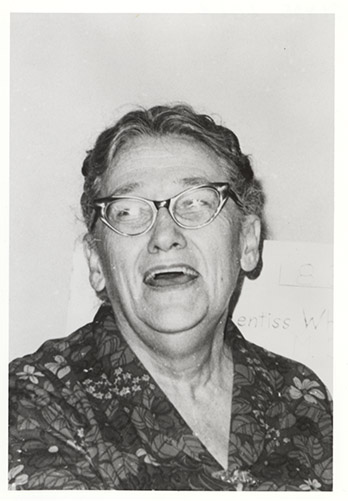
Lola Gamble Clyde
Born 1900
Occupation: teacher; farm wife; local historian; frequently addresses groups and aids researchers
Residence: Paradise Ridge; Moscow
Topics:
The colored topic bar is hidden for screen reader users. Use the topic buttons below it, the "Filter by Topic" menu or the search box to find specific content in the transcript.
Sam Schrager: This conversation with Lola Gamble Clyde took place at her home south of Moscow on October 12, 1976. The interviewer was Sam Schrager.
Lola Gamble Clyde: And they're driving it. And a man named Huff is driving it. And Huff came from Grangeville. They took it back to the World's Fair at Chicago and won a prize. They took it down to the Pacific in Yukon. Alaska Pacific Yukon exhibition in Seattle in 1999 and won a prize. And there they are. And he's got that picture hanging there on the wall. He has a lot of other old -time pictures. And in it are many replicas of old -time things. And he really knows an awful lot of history and stuff. You just love Uncle Bill. Well, let me ask you about his social life then. I wanted to know one thing about the women in those days. I've had the impression that a lot of them were not in the best of health. That there was a lot of sickness among the women who were here in the early days. And there wasn't all over the country in the early 1900s.
Sam Schrager: Do you find that to have been so when you think about it?
Lola Gamble Clyde: Yes, I think so too. It seemed to be one of the great subjects of conversation was the ill health that they all had. And part of it was that they didn't have enough outside interests, I think. And then every ache and pain was magnified. And as they used to say, she feels every pain, you know. And it was, maybe some of it was that. But in those days they had children, one right after the other, you know. Only ten children in ten years. And that's pretty hard on women's health. And then there was lots of hard work required of the early pioneer women. And I imagine their health wasn't very good. And doctors were very inadequate. They had so few of them. And in the very early days, most of the children were ushered into the world with the help of a midwife and that sort of thing. So they were, really the child bearing was hard, was really hard on them. It took its toll physically. Yes it did. It took its toll physically.
Sam Schrager: Is that because they didn't know enough about, at the time, about how to take care of that with the least trouble?
Lola Gamble Clyde: Well, I suppose so. And many babies were born without much medical attention, without any much prenatal care. And very little postnatal care. And doctors were few and far between.
Sam Schrager: Well what kind of effects would that have on the mothers then, to not have doctors' care? What would that do to them? Would that just mean they wouldn't get strong? They would become more weak?
Lola Gamble Clyde: That's right. And some of them died in childbirth if there were complications developed. They lost, mothers died in childbirth because they didn't have medical assistance at the time.
Sam Schrager: Was that fairly common out here?
Lola Gamble Clyde: Well, I think as a little child, I remember two of our neighbor women dying in childbirth. And that was quite a, you know. The large size families is one too that I worry about. I've noticed that.
Sam Schrager: That it seems like the early families here were very large, weren't they?
Lola Gamble Clyde: Yes, that's right. But the way my readings indicate that birth control was not unknown during that period of time, so that it could have been practiced perhaps if families had wanted to.
Sam Schrager: Or didn't they have any knowledge of birth control techniques?
Lola Gamble Clyde: Well, I don't know. A lot of them had the feeling that lots of children was lots of security. And a lot of them, their religion kept them from practicing what they did know. And I just wouldn't be able to answer, I don't know.
Sam Schrager: Well, when you talk about the security in the children, was that the idea that, and I'm just trying to figure this out from all that people have said, was that the idea that a big family, you'd have a lot of people to help on the farm? Was that the thinking behind it?
Lola Gamble Clyde: Well, it could have been, although I've heard some of them say, one father can take care of twelve sons, but twelve sons can't take care of one father. And I think that was quite true too. Each of them grew up and went on their own, you know, went on their own way, merry ways. And I don't know that there was so much taking care of the old folks, went on as could have, but I think religion entered in to a lot of their thinking, that they didn't have, not necessarily because they were Catholics, but many of the religions taught that the Lord giveth and the Lord taketh away, and this is just the will of the Lord that I'm giving these children.
Sam Schrager: So you mean the Protestant denominations?
Lola Gamble Clyde: Yes, the Protestants too. Many of the Protestant people felt that way, that these were gifts straight from heaven, and they accepted them as that, you know. Okay, but then what about, you know, we talked some before about women being chattel and that kind of thing, and really being in almost servitude because of all they had to do for the husband and children.
Sam Schrager: Now wouldn't it stand to reason that the only way that they could be free of that would be if they didn't have big families? I mean, to have a big family was to accept that idea, right?
Lola Gamble Clyde: Yes, that's right. Well, I just don't know what the feeling behind all that was with the early day women, but lots of them prided themselves about, I remember one old lady saying she did, 16 children and she lived to raise eight of them.
Sam Schrager: What did that mean? She lost the other eight?
Lola Gamble Clyde: Yes, she lost the other eight.
Sam Schrager: In childbirth or when they were babies?
Lola Gamble Clyde: Well, as small ones, there were different epidemics. Moscow went through the Black Bithyria scourge here a couple of times, and at one time, some of the early histories report that half the children in the town of Moscow died with Black Bithyria.
Sam Schrager: Oh, really?
Lola Gamble Clyde: I didn't know that. It was that bad. It was that bad.
Sam Schrager: Gosh, about when do you think that would have been?
Lola Gamble Clyde: Oh, it would be in the very early, in the early 70s, 1877 maybe, in 78. Along through there they had a bad, a bad epidemic of Black Bithyria. Well, to talk then about, thinking about this, what women accepted for their lives, it sounds to me like,
Sam Schrager: well, what I'm wondering, do you think that the women then questioned whether they should have an alternative to just being homemakers and raising families? Did that only come later that that was questioned?
Lola Gamble Clyde: Well... I mean, you know what I'm... Yes, I know what you mean.
Sam Schrager: Was that the only way they saw to live at the time?
Lola Gamble Clyde: Well, I can only answer from my own mother's viewpoint. My mother was an educated woman, and she had taught, she taught in the first girls' school in Canada, in the Angela College in Victoria, B .C., and when she moved to this pioneer settlement, she wanted my father to let her go out and teach school. And, oh, that was against the principles of the old country. The man made the living. It was his privilege and his right, and he wouldn't let her go. But I've often heard her say that she wished that my father had let her go and teach school at the same time because they could have used the money so well. And nearly all the farm women had cows, and they would milk them and sell the cream, and they got most of the egg money, and that was considered their money that they could do as they pleased. But the grain, the crop, had to go in for paying for land or machinery and go for debts. But the egg and the cream money, the women could have that.
Sam Schrager: But they spent it not on themselves, did they?
Lola Gamble Clyde: No, they spent it on the children and on food. Most of it went on the children and on food for the table. So, in other words, she was really exclusively in control of the children and the food for the table. That's right. That was her calling.
Sam Schrager: What about the household furnishings and, you know, the furniture and all that? Was that all hers, too?
Lola Gamble Clyde: Well, and once again, I can hardly answer it. The men did most of this buying, as I remember it, the Scandinavian men especially. But some of them took great pride in their houses and buying a piano for their daughters. That was the epitome of gracious living, was to be able to get a piano and give the girls music lessons. When I was a little child. And there were some of the families that could do that.
Sam Schrager: So, say something like sofa and chairs and that sort of thing, would that usually be the husband or wife who would make the buying?
Lola Gamble Clyde: Well, the major purchases. Most of the major purchases, like that much money, would be made by the men. The men would decide when they would get it and some of them took pride in having well -furnished houses and that sort of thing, you know. Well, I guess that, I know this kind of thing is, these sorts of things are pretty imponderable, they're difficult to figure. But I'm asking you some of these things because of the reading that I've done in now, when they're looking at women's history and social history in the 19th century. These are the kinds of questions that they're asking.
Sam Schrager: Why was it this way and how was it?
Lola Gamble Clyde: So they're trying to generalize on what, you know, some of these things that women's life.
Sam Schrager: But for other women, like besides your mother, was your mother unusual in her interest in getting out of the home to teach or do you think that it was common, most women would have if they could have?
Lola Gamble Clyde: Well, yes, I think if they had been fitted, but there's so few were educated in those days, you know, there were so few trained, I think most of them would have tried. Because I remember in later years when they opened the pea picking factory, when Moscow became the pea capital of the world and women could go to town and get jobs in the winter picking out the rogue peas from among the other peas. Oh, lots of the women went out and got jobs and would drive to town every day to pick peas. And that gave them a feeling of independence. They got money for doing it. And many of the married women whose children were then in school would even get a job in town to bring in a little extra money.
Sam Schrager: They come from the rural areas? They come from Troy and furthers?
Lola Gamble Clyde: Yes, oh yes, they came from Troy and come into Moscow to pick peas.
Sam Schrager: When do you think that started, in the 30s or before?
Lola Gamble Clyde: Maybe after 1925 people started picking peas because Moscow then had established a good market for green peas.
Sam Schrager: Well, what about the beginnings of women teachers in the schools? Now, in the early days I had heard that it was largely men, is that true? Largely men teachers in the rural schools?
Lola Gamble Clyde: Well, there were some, yes, but right around here that was a very well accepted position for the women was to grow, the girls. They would grow up to be teachers.
Sam Schrager: But I mean now, I'm trying to figure when, in the early pioneering, in the 80s, were there women teachers back that early in large numbers?
Lola Gamble Clyde: No, I think that most of the early teachers were men teachers. So your mother would probably have been unusual in having been a teacher at that time. Yes, that's right, because they weren't trained for it. No, that's right, most of them were men teachers. And it wasn't until maybe in the 90s that we saw women coming in, but that was a highly respected job for the young girls. They would grow up to be teachers or they could be nurses. That was a highly respected job.
Sam Schrager: Were they getting, do you think that it started then because that's when the girls were able to go to Lewiston Normal and the university?
Lola Gamble Clyde: Yes, I think so, yes, because in 1895 came the Lewiston Normal and that was a fine opportunity for the young girls to go on and get education.
Sam Schrager: And they were starting, they were going there right away to become teachers?
Lola Gamble Clyde: Yes, as soon as Lewiston Normal started. We had no school of education at the University of Idaho when it first opened.
Sam Schrager: Oh, there wasn't?
Lola Gamble Clyde: No, it was just the liberal arts. But the girls did go there, but not with the idea of becoming teachers so much. But after Lewiston Normal started, that was to train teachers and they did go down there. And that was an ambition with many of them was to go on to school, those that liked school.
Sam Schrager: Well then, do you think, would it be fair to say that probably the large numbers of, or the influx of women into rural school teaching started at when Lewiston Normal started? Or do you think it would have started before?
Lola Gamble Clyde: No, I think it started with Lewiston Normal very much.
Sam Schrager: Before that they wouldn't have really had a place to get it?
Lola Gamble Clyde: No. And for many years the student nurses had to go to Spokane to the hospitals there to get nurses training. They'd go up to Sacred Heart and get training there. But with the coming of Lewiston Normal, that certainly started turning out our own rural teachers.
Sam Schrager: Were they going to Cheney before Lewiston Normal for teaching?
Lola Gamble Clyde: Or do you know how that, because I've heard of women who were your contemporaries did go to Cheney too. Yes, many of them went to Cheney. And many of them from right around here went to Cheney. Yes, Cheney was established, Cheney Normal was established ahead of Lewiston Normal. Somewhat earlier. Yes, somewhat earlier. But you know, then it seems to me that the problem in a way was pushed back further because now once they were teaching in the rural school, then a young woman could teach until she married.
Sam Schrager: Right?
Lola Gamble Clyde: I mean that was built into the way that things worked. Yes.
Sam Schrager: Now how did people feel about that? I mean you've told me some of how, that you didn't mind stopping teaching, but do you think that at the time that after this freedom of being a teacher, making your own money and making your own way, that most of the women didn't mind to just give that all up?
Lola Gamble Clyde: Well I think a lot of them didn't give it up. A lot of them went on teaching after they were married until the Depression hit. And then married women couldn't get jobs because they felt that the single women needed the jobs or a married man who was head of a family should have the jobs. So married women weren't allowed to teach in this immediate vicinity during the Depression. No one would hire them. But before that, people, teachers had told me in the rural county that they, not only was it custom that they stopped teaching when they married, but in a lot of school districts they had it in the contract that you couldn't be married. That's right, yes. That's true. That's true. That doesn't seem like giving much choice.
Sam Schrager: No, that didn't give them much choice, did it?
Lola Gamble Clyde: They had to be really in love with the men they married, you know, to give up their independence.
Sam Schrager: You mean an encouraged romantic marriage?
Lola Gamble Clyde: That's right, an encouraged, you know. Yes, that's right. No, but in terms of, really, just from the point of view of fairness, it seems that that meant that for most of these people they had a choice between career and marriage. That's right. That's about the way it has been, you know, through the years. I'm just wondering, for instance, why they had that as a rule in the rural schools, and so many of them, that you couldn't be married and teach. I mean, to give a person the option would seem a lot fairer than to say you can't teach if you're married. Well, many of the rural schools did hire married women up until the time of the Depression. Many did. Yes, many of them did. I knew quite a few married women who taught around Moscow in the immediate vicinity, and they went on teaching and that sort of thing. But after the Depression hit, then most of the schools wouldn't hire a married woman because they felt that they should save the job for some single woman or for some head of a family.
Sam Schrager: Did most of these women that did quit teaching to raise their family and then come back to teaching, I mean, were they older women?
Lola Gamble Clyde: Yes, I think so. I think most of them were older women or women without children or women with just one child. They weren't women with a lot of children and a lot of household responsibilities. I think that was pretty well established.
Sam Schrager: How old would the youngest child have to be before a woman would feel comfortable with going back to teaching?
Lola Gamble Clyde: Well, I think they had to be a school age, and then they could take the child with them to school or put them in school someplace. I think that was the way most of them did, as I remember.
Well, I don't know. It does seem to me, for instance, with yourself, the choice that you made to marry.
Sam Schrager: Did you find it somewhat difficult to make the adjustment of being totally at home instead of out in the sun?
Lola Gamble Clyde: I had a very wonderful understanding, lenient husband, very indulgent husband. And he just said, Lola, you just go and do your thing and I'll do my thing. And he let me sit on school boards. At one time, I was never a board farm wife. I just sat on all the boards in town. At one time, I was on 14 different boards. Forleta County in the town of Moscow, school boards, library boards, Red Crowds, Whitman Hospital, mental health, county health unit. There was a dull moment.
Sam Schrager: But you didn't find it boring to sit on all those boards?
Lola Gamble Clyde: No, I just had fun.
Sam Schrager: How about in your younger years when you were first married?
Lola Gamble Clyde: Well, when I was first married, I tell you, I was just so busy. We had a great depression hit and we went down to 28 cents, you know. And I had about 17 hard men to cook for and four little children, one right after the other. Four children all under four years of age. I didn't have time for any regrets or anything else. I was just too busy trying to keep food on the table for everybody, you know. Well, you know, let's talk a little bit about unmarried women. I'd be curious to know what you think. It seems from what I've read and some of what I've seen, people like Catherine, for instance, who didn't marry. That's right. Now, do you feel that...
Sam Schrager: How would you explain why a lot of people didn't marry in those days?
Lola Gamble Clyde: It seems that there in some ways were a lot of that back in those days of people deciding not to.
Sam Schrager: Was it that the women were too educated for the men who were around or something like that?
Lola Gamble Clyde: Well, I suppose women, right men, just hadn't come along, let's put it that way. And someone weren't satisfied with the kind of men they met, you know. And you don't always meet just the right person. And hello! ...pressure on young women to marry. Yes, I think so too. I think the mothers were always afraid the girls would be old maids, you know. And they'd urge them to get out and meet young people and that sort of thing, you know. That that was the accepted thing to do. And all the mothers thought their daughters should be the bells of the ball, you know. And follow along in the way they had done. I think that there was that feeling among them.
Sam Schrager: Well, but talking about the choice between marriage and career, do you think that some of the women did make a choice for a job in independence and freedom? That it was not just that nobody came along, that there was something positive?
Lola Gamble Clyde: Yes, I think that's right. I think that there were many of the highly intelligent girls who didn't marry because they did like their work and their jobs and they'd have to give up too much. I think. I think that's true. Well, it seemed to me that with the...
Sam Schrager: Would you say that there was a generally higher level of education among the girls than the boys?
Lola Gamble Clyde: Yes, I think so. Their services weren't needed so badly on the farm. The girls, you know, the boys were needed so badly farming in the rural communities. And they'd always figure, well, when this boy got out of school, sometimes that was just right out of the eighth grade, well, we'll buy another piece of land and start him up farming. And that went on a lot and in the very, very early times, the boys stayed home and helped their fathers in the spring and in the fall. And maybe in the very early days, it would just be a couple of months in the summer they had school. And later on, it was just a few months in the winter that the older boys were allowed to go to school. And then they couldn't be working out in the fields and so on, so they'd go to school for a little while. So the girls, because they weren't needed, had the freedom to go to school. Yes, the girls had more freedom to go to school. Yes, I think that's very true. Okay, now we look at our educated young woman.
Sam Schrager: Could she easily find herself in a position where there wasn't anybody around who was her intellectual, who could be her companion that way?
Lola Gamble Clyde: Yes, I think so. I think that's right. I think they might have educated themselves out of the market. I think sometimes that happened. I think often that happened.
Sam Schrager: Do you think that men tended to be afraid of brainy women or not like brainy women?
Lola Gamble Clyde: That's right. I think that's true, yes. I think most of them can be aware of these school moms. They'll boss you around the rest of your life. Although in the early days, the school moms were generally quite the bells of the ball. They set the social pace, what the new teacher wore, and what she did was very much the pattern for the rest of the girls of the community.
Sam Schrager: Really? Of the young wives, too?
Lola Gamble Clyde: Yes, of the young wives, too. They'd watch what kind of hats and what kind of dresses the new school teacher was wearing. And that sort of was a pace setter in the outline.
Sam Schrager: Why did she find herself in that position, that she was the pace setter?
Lola Gamble Clyde: Was it because of being from... Yes, a lot of them came out from the towns to teach in the rural communities. And they had a little more money of their own. They could buy things like that. And they were expected to be well dressed and that sort of thing when they taught school. Coming from Lewiston, they might have been closer to the fashion. That's right. They came up from the big town of Lewiston and they might know what the latest styles were. What were the...
Sam Schrager: The styles, were the styles changing in those days? Were they different from year to year?
Lola Gamble Clyde: A little bit, quite a little bit. Yes, they'd wear high button shoes sometimes, and sometimes it would be Oxfords. Sometimes that sort of thing. Yes, the styles changed. I can remember my mother wearing the big leg -a -mutton sleeves on her coats. And then I remember the mother hubboards for the kitchenware, you know. And later on it was stylish to have high waists and low waists. And even the little girls in school would pattern after what their teachers had.
Sam Schrager: Do people actually have a little bit of extra money clicking around that they could follow fashions to?
Lola Gamble Clyde: Well, sometimes, you know, sometimes if they got a little extra cream check they would buy a little something extra. Or if you were buying maybe a new dress you'd try to get the style. Well, I'd heard that everybody had a black dress, that black was the big thing. Yes, that's right. They had a black silk dress and they had that to wear to church on Sunday. That's quite common, a nice black silk dress.
Sam Schrager: Well, the average farm wife at that time, like your mother and the women of her generation, how many dresses would they own?
Lola Gamble Clyde: Well, just about one good one would be all.
Sam Schrager: And that would be black?
Lola Gamble Clyde: Yes, a nice black silk one to wear to church or to something, a funeral or to a wedding. And they were few and far between, you know, they weren't a big invitational affairs like they are now or like they were for a while. And if you had any one good, decent dress they called it for church and funerals. And Mother Hubbard's the rest of the time, largely.
Sam Schrager: Mother Hubbard's were?
Lola Gamble Clyde: Kind of loose fitting dresses. Boy, you got lots of phone calls. I'm glad, I hope they are calling. ...wear is not being very healthy, like... Yeah, and of course it's a tight...
Sam Schrager: Now, was that kind of a constricting and dumb idea?
Lola Gamble Clyde: Well, these wasp waists, you know, that was going a little too far, I'd say. Cinching them in, you know, I think that could be very uncomfortable anyway. I don't know that it really hurt any of their organs, but I think it would be very, very uncomfortable.
Sam Schrager: And I think that helped liberate women when they threw away the corsets, don't you? Well, when did that happen? Was corset wearing, did tie corsets worn fairly late?
Lola Gamble Clyde: Yes, I think so. I think they were wearing them up until the First World War anyway. Yes, they were cinching them up tight and wearing, getting them the wasp waists and the fashions of the pre -war days, of the pre -World War I days. All show little small waists, you know, and that was a sign of great elegance and beauty. And regardless of how tight they had to cinch them, you know.
Sam Schrager: They get them?
Lola Gamble Clyde: Sure.
Sam Schrager: When you say wasp waists, why wasp?
Lola Gamble Clyde: Well, you know how wasps are, they have, you know, the hornets, they have little tiny... Oh! In the middle, their middle is very small, so that's a wasp. And that's what they call... So they had to have a wasp waist, they had to pinch them in in the middle, and then they could be big above on big hips, that was all right. But right around the middle they had to have a wasp waist.
Sam Schrager: Was this something that affected, that all classes did? I mean, would the relatively working class families do the same thing?
Lola Gamble Clyde: Well, a lot of the women who really went out, you know, and worked in the field, and lots of the early women did. They would go out and shock the bundles and pitch hay right along with their men folks. I don't think they did it, no. I think it was more the pseudo -society ladies that went in for the wasp waists. And of course pregnant women, that would be pretty hard to come by, they just wore the mother hubbards and covered all the defects.
Sam Schrager: Well the farm families, in those families, the average farm family, would they wear the tight waists?
Lola Gamble Clyde: Oh, I think not, no. I think most of the farm women were too busy getting their cows milked and the chickens taken care of, you know. So this is the town... It's more of a town. Yeah, more of a middle class town, ladies that had to follow along a little in the society trends. I think most of the farm women were just really pretty busy milking cows and raising gardens and getting the fruit can for winter and all that.
Sam Schrager: Was that a pretty clear, distinct line, do you think, between the rural farm women and the city people who were really middle class?
Lola Gamble Clyde: Yes, I think so. I think that's right. Well, to talk about the differences between them, would the town middle class ladies be much more involved in the social... Oh yes, much more, yes. They had their own rich parties and their party going and often in the early days around Moscow they would hire, they could get hired help very cheap and they would hire the nice little girls from off the farms that were growing up, 16, 17 year old girls, and they would work in these society homes of Moscow and that was part of their training. They learned how to make fancy desserts and how to cook and how to serve and...
Sam Schrager: What would be the sign where we could say these people are middle class and other people are working class? And would that be the sign of the middle class family if they had a girl working in the home?
Lola Gamble Clyde: Yes, lots of the middle class had hired girls that came in and worked and of course the... I forget what they called them, they called them the upper tans, the upper tans, you know. They would be like the McConnells, you know, and folks like that. They had serving quarters even, a little special room where the serving girls slept. And these girls helped take care of the children and helped prepare the meals and they learned many arts and many skills at cooking that their parents couldn't teach them because they didn't have the abundance of extra fancy food and different things on the farms that was available in town.
Sam Schrager: But say there would be a lot of other middle class families that would also have girls helping, right?
Lola Gamble Clyde: Besides say the upper tans. Oh yes, that's right, yes. There were middle class families too that would get girls and many of the farm women too would get a young neighboring girl to come and help in the harvest field of time when they had lots of extra men. That was just standard practice that one neighbor's young girls would go over and help out the other neighbors when they were harvesting and so on, help take care of the children.
Sam Schrager: But they wouldn't be living year round in the country?
Lola Gamble Clyde: No, they wouldn't be year round in the country, no. That was largely a city way, or at least the town of Moscow way that you went to town and stayed in the home there.
Sam Schrager: So it would only be say during harvest right at the busiest time?
Lola Gamble Clyde: Yes, the farm women had help, that's right. Yes, right at the harvest time.
Sam Schrager: Maybe for a month?
Lola Gamble Clyde: Yeah, a month, six weeks, something like that while they got the combine, the threshing and that sort of thing done. The binding and threshing of those days. So in other words, to really spot a middle class family at that time, you could say that they would be likely to have a girl living in and helping them and the women would wear these tight, these washed waists. That's right, these washed waists and dress up and go to little parties, little afternoon teas and parties and take part in the church work. And that was the middle class doings. In other words, they had leisure. Yes, that's right. And the country women didn't have that kind of leisure.
Sam Schrager: Would that be fair to say?
Lola Gamble Clyde: I'd say that's very fair. Yeah, I think that's right.
Sam Schrager: What about the church work that the women were doing in those days? How would you characterize it?
Lola Gamble Clyde: I know for instance, and this was on a grander scale, but I know that the missionary work was tremendously important and many young women who were educated actually gone overseas. Oh yes, well part of the missionary work that fell to the women's missionary societies, they called them ladies' aides in those days or missionary societies and that sort of thing. And they did lots of sewing for the missionaries overseas. They'd make layouts for babies and diapers and they were continually doing some kind of work to help the missionaries that they sent to the fields of China and Japan and Africa. They were always doing something to raise money to send medical supplies or something to the missionaries that they supported. And then the ladies' aides of the churches, part of their job was to keep the churches cleaned up and bring flowers on Sunday and bake cookies and carry on the evangelism between the families of the church and visit the bereaved and the sick and help each other in any way that they could. And besides raising money to carry on the work of the church, of the local church, they'd have bazaars even as they do today, you know, and church suppers where you all brought food and then sold suppers out. They'd have baked food sales and sell food and the farmers would bring in produce from the farm and often the minister was paid in kind. He would get a hog at butchering time, he'd get half a beef, he'd get so many sacks of potatoes. That was just an old farm custom that some of the nicest things you raised you gave to the minister.
Sam Schrager: Well, to carry on the work of evangelism between the families that you mentioned, what did that mean?
Lola Gamble Clyde: Well, it meant we will love one another, we will comfort them in sorrow and sickness and distress. We would visit them, we would bring, and the main thing was bringing things, you know. You brought the glass of special jelly, you baked one of your very special cakes, you baked one of your nicest pies if there was a death in a neighboring family, and you called and you brought something in your hands as the positive proof of your sympathy. You didn't come empty handed, you brought something to show that you shared in their loss and in their sorrow and in their time of need, that you were there to help them and be a spiritual comforter as well as a physical comforter. You could get in and turn out a washing for the family if the mother was sick, you could bake up a big batch of bread, you could do various things like that. So in other words, this evangelism worked mainly in times of need for other families. That's right, yes, that's right.
Sam Schrager: Did it work?
Lola Gamble Clyde: Oh, I think so. Yes, I think it was, I think it made the people who did it maybe gain more than the people who received, because it's more blessed to give than to receive. But you felt very grateful for your own good health and for your own good fortune, and you wanted to share with somebody else and try to make them, try to comfort them in what they were going through. And I think it worked both ways. It was nice to know in sorrow that you were remembered by other people, and it was nice to go and you gain too. There was a spiritual growth on both sides.
Sam Schrager: For the church work, how much of, how important was it for the women as a part of their overall social activity? Was this the main social activity for most women?
Lola Gamble Clyde: Yes, very definitely. The social life of the whole community sort of centered around the churches. The young people were taken care of. There would be parlor games for them to play, and a meeting ground for young couples so they could pick their partners for life that way. And there was an effort to keep them all within their own churches. That was a great thing. The young people of this church would get together for Halloween parties, for Christmas parties, for any holiday. There was a great getting together of the young people and the little children. There were games and plays and programs centering around the youth of the church as far back as I can remember. One of the big purposes of the church was to help bring up the coming generations and the belief and the traditions of the old folks.
Sam Schrager: Well, do you think that the churches in Moscow did much more of this, say, than the churches in the small towns that had to draw on most of the country folk to come in?
Lola Gamble Clyde: Yes, I think so. I think maybe Moscow was more able because there were more people in it to start out, but there were more homes, more people to exchange. And the country folks, it was hard to get into town. It took a team of horses to get there and a buggy. It took a couple of hours to make the trip in and out. So there weren't so many families in the horse and buggy days that could get into Moscow to take part in the church life, and often out in the little rural schools. The teachers would put on a Sunday school program Sunday morning for the children, at least, of the community. And sometimes they would be preaching at the schoolhouse Sunday afternoon. The ministers would come out and do a little evangelism right in the community because it was hard before the coming of the cars. For the families, it took about half a day to get uptown and go to church an hour and then drive back home. The whole morning was spent that way.
Sam Schrager: So many families would just stay and not go to church?
Lola Gamble Clyde: Yes, they just stayed home and didn't go. That's right, until the coming of the car.
Sam Schrager: Didn't some of the neighborhoods have just laymen too?
Lola Gamble Clyde: Oh yes, some of their own people did it. Oh sure, many of them. Many of the more devout people who had a little training would get up and read the Bible and they'd have little discussions. And the women that could sing would sing, and nearly every school had some sort of little reed organ of some kind. And they'd put on their own little church programs on the Sunday morning.
Sam Schrager: In Moscow, most of the women who were involved in the active church were, were they mostly the middle class women who had the leisure to take part?
Lola Gamble Clyde: Yes, that's right.
Sam Schrager: How many times a week for just roughly, or how often would they get together at the church for one thing or another?
Lola Gamble Clyde: I mean it would be more than just on Sunday. Oh yes, yes, well, yes they had women's clubs that met, and women's associations that met. And then they had sewing circles and quilting bees, you know, and missionary societies that would meet. Oh I imagine there wouldn't be a week go by, but there'd be a couple of meetings at the church for the women. And there was always choir practice for them to go to, and most of the women were the singers. Lots of them would be women. There'd be a few men that sang in the choir, but it was another place for the young folks to get together to, and try to get some of the young boys and the young girls to come sing too.
Sam Schrager: Well were the Ladies Aid and Missionary Society one and the same organization?
Lola Gamble Clyde: They were practically the same. Some people called them the Ladies Aid and others called them the Women's Missionary Society. I see. Nowadays we call them the Women's Associations. That means all the women of the church, and they do mostly Bible study. And then we have different sewing groups too that meet to sew for the missionaries. So that's the way nearly all the churches are constructed. Well it strikes me that in those days that from what we're saying that the church activity was definitely predominantly a women's activity, and the men were much less involved.
Sam Schrager: Is that true?
Lola Gamble Clyde: I think that's true. Yes, I think the women were the ones that really supported the church and did all the extra things about the church. Many of them had altar guilds that kept the altars decorated and washed the linens and the laces that they used on some of the church altars. It was the women that saw that all of that was ready. And nowadays I see lots more men taking part in it. But in those days that was the women's prerogative. And it was the women's social outlet more. The men had other outlets that they could go to.
Sam Schrager: Do you think it would be true to say that a lot of men had to be dragged to church if they'd go at all in those days?
Lola Gamble Clyde: I think there were a lot of them that had to be. There were some of them who had been trained to go to church and went. Especially I think among the Scandinavian people. It was so much a part of their lives in the old countries. And they were very devout and got their families to hook up the horses and go on Sunday morning. They did it. They'd been well versed in the work of the church. But among more of the Americans, of the longer people who had been Americans longer, been citizens of this country longer. They weren't so devout. But the people who had come from the Scandinavian countries, and that's a lot of them around the Moscow settlement, they were very devout in their attendance to their church.
Sam Schrager: Do you think that women by and large could really apply what they were preaching about and what they were praying about in church in their everyday lives to? Or do you think it was separate from what they did?
Lola Gamble Clyde: Well I think in the very early days it was very much a part. It was their reward. They might not have much right now at the present, but in the sweet by and by they would be rewarded. All the old time songs are along that line about there's a gold mine in the sky. And they were all going to have their reward later on. If they had suffering here on earth, that was more stars in their crown. And I think with the very early settlers, a lot of the women had that feeling that it was all right to sacrifice and suffer now because they would get their reward.
Sam Schrager: Do you think they really believed in it?
Lola Gamble Clyde: Yes I do. I believe that they believed that very... and when someone died it was always, well they've gone to their reward. We'll try and not grieve because they have mounted the battlements. But that changed... Well yes, in 75 years I think it's changed a lot. Well I don't think then, but you say the very early ones were very strong on that. Yes they were strong in between. Well I think gradually there was a tapering off and a questioning over the years. But I can remember as a child these women, all of them were going to get their reward in heaven and it was just all right. They'd do a little suffering here on earth, it was only temporary, all that would pass away. And they had mansions in the sky that they were building and their treasures they were laying up in heaven where the moths, where thieves could not break in nor moths corrupt. And every one of them had that feeling that that was the way it was going to be. So that was...
Sam Schrager: Do you think that was true of both working, of both the farm women and the middle class women?
Lola Gamble Clyde: It's a hard question. It's a hard question, I just don't know, I just don't know. But I think many of the farm women felt that way, that this is just a temporary, this is just a veil of tears we're passing through and we will overcome, we will have our reward in the next world and everything's going to be all right.
Sam Schrager: What was their attitude towards death then? Were they very matter of fact about it in those days? Did they just take it in stride?
Lola Gamble Clyde: Death is a kind of traumatic experience today. Yes it is. And I'm wondering what it was like then. Oh they suffered terribly too then. The women suffered terribly then in the loss of their children and in the loss of the loved ones. I think that somehow all the balm and gilead doesn't seem to ever assuage it much. We should, you know, if we want to show our faith and exemplify our faith in what we preach, we should be able to stand tall and strong at the time of death and say, well let's not hold this good man from his reward, he's earned it, heavens he's mounted the battlements, let us rejoice. But I never saw many of them doing it. I've seen the later ministers do much better at it. We've had ministers in our Presbyterian church that say, we have come today to celebrate the life of the person that's dead. And I think that's good. I think it's a much healthier way. Instead of we're here to mourn and grieve over the passing, you know, I think it's better to say we have come to celebrate the life that he lived. And that makes sense to me. But it's only in the last twenty years I've heard that approach. Now today we've come to celebrate, not his death, but we have come to celebrate the life that this good man lived. Well I'm wondering about whether the commonness of death in those days, as compared to now, would have had an effect. Because people must have lived with more uncertainty, knowing that their children might not grow up, knowing that death could take you at any time. I mean nowadays death only seems to become real when people become old. But most of the population doesn't seem to think they're immortal.
Sam Schrager: They think they're going to live forever, don't they?
Lola Gamble Clyde: Yeah. But I mean in those days I wonder how living with death, you all the time... Yes, and so many of the children dying and so on. Oh I think it's like Rachel of old grieving for her child and will not be comforted. I saw it go on and on, the grieving for their children. And really if they were firm believers, if they'd gone to this place of eternal glory, they should have been rejoicing. That they were out of all temptation, out of all sorrows way. But in all my years I've never seen anybody that wasn't just grieving for their child and cannot be comforted.
Sam Schrager: What about the death of older people? In those days, wasn't there a real tendency for the old in the families to stay with the family that they cared for?
Lola Gamble Clyde: Yes, they stayed with the family and there was always that talk about the vacant chair, and we shall meet but we shall miss him, you know, there will be the vacant chair. And I don't know somehow, it seemed that they were always missing the one that was gone. And there was much talk about it. Nowadays I don't think we spend so much time talking about it. We know it's like the ripening of the fruit and the falling of the autumn leaves. It's going to happen, it's inevitable and we accept it better. But in those days every life seemed to be so precious. And there was much talk about, oh, when grandma was alive and grandma did this and we'll never have any more of those wonderful things she did. And that's kind of a defeatist attitude. Well I read, I have read about death in the 19th century that people, that many of the farm, rural people, they really, it was very important to them, for example, the way that their relative died. If they died alert and knowing what was going on and if, particularly if they had a religious death. Yes, oh yes. I should write in through the pearly gates.
Sam Schrager: Was that something that was important?
Lola Gamble Clyde: Yes, I think so. A lot of them, especially the younger people that were alert, they all were trying to bridge that last few minutes and seeing if the person who died had looked into heaven and seen what was there. I remember a young girl who died and the mother always was so comforted because the last words the girl had spoken was, I hear the angels singing. And the mother said she had just looked, I know that my daughter looked straight into heaven. Because she said to me, turned and said to me as she died, I hear the angels singing. And that was of great comfort to the mother. So, but most of them, as I say, they were no better than Rachel of old. They grieved for their children and could not be comforted. It only took time to wear it out.
Sam Schrager: Was it the usual when someone was dying in the family for the family to attend on the person?
Lola Gamble Clyde: Oh yes, they all sat up with the dying person and they sometimes sent for the minister and the minister would come and sit up and somebody dying quite a ways off, they'd get on the horseback and ride to sit up with the family. So and so is dying tonight. We must go and sit with the family and they'd go and sit.
Sam Schrager: Would a close family friend sit too?
Lola Gamble Clyde: Yes, the close family friends would sit and sometimes the minister would come and sit all night to help the grief, the people through the grief. Yes. Well it certainly sounds different. Yes it does, it sounds different. It really does. And yet some of those old time traditions are so ingrained in you, you feel that it has to be done. When we lost our little Mary Louise Perrine last spring at the nursing home, I went over and sat up all night until she died with her. I felt, oh I just felt I had to. I couldn't leave her there to die alone and although I knew she wouldn't be, you have to do it alone anyway, you do it alone. But I thought I just had to be there and I went and sat up all night with her. So those are some of the traditions that stick with you. What about keeping, having the grandmother for instance or the uncle, staying with the family when they're really quite old.
Sam Schrager: Do you think that that made a great difference to them as individuals in their last years to be with the family?
Lola Gamble Clyde: I'm thinking of the contrast with today when so often people do go in the homes. Yes, they all in the homes.
Sam Schrager: In those days, would that person remain a functioning part of the family?
Lola Gamble Clyde: Well they stayed with them because it was, it's just that family loyalty, you know. I kept my brother Bert here who grew old and you knew him. I kept him here until he was 86 and he could no longer function, he had no longer any control of his bladder or bowels or anything. And I kept him until I just couldn't do it any longer. And then the doctor ordered him to the nursing home. He said, Lola you can't do it, you've got to. And I agree you doctor, I have to do it. I felt I was neglecting my duty. That I should have seen my brother down into the grave and not let him, not put him out in the nursing home. And yet I, no one knows better than I, I helped build all three of them, how wonderful they are and what good care, far better care than I can give them. But I suppose it's just selfishness on our part. We don't want to give them up. We don't, we fool ourselves into thinking we can do everything they need and that they're better with us than if they were there.
Sam Schrager: Well in the old days in those families, did most or many families have an old member in the family?
Lola Gamble Clyde: Oh yes, that's the only place they could keep them, you know. Yes, and until we built the two new nursing homes in Hemmings, that's been the first nursing home I think we built about 1955. Before that there was no place to go but to the poor farm out there. Which I understand was an awful place. Oh it was a terrible place, yes it was awful. And nobody with any kind of family pride would think of allowing their relatives to go there. It was just people who had, just the derelicts that went there. And I think maybe the new nursing homes with all their lovely facilities, maybe some of that old stigma sticks with us. I know some people who don't want to go to Ladau Condolescent, well that's the county. You know, just because they call it Ladau County Condolescent Home and that's so ridiculous because everybody pays there. Everybody, even the county cases, well they're getting Medicaid, they're getting Medicare. Everybody pays at both of them. None of them are county cases.
Sam Schrager: Well do you think that it had an effect on the family to have an elderly people in the home?
Lola Gamble Clyde: I mean nowadays it seems like it's just a husband, wife and a kid and that's it. In those days it was a bigger unit. Yes, well I think it gave them a feeling of continuity. I don't think the children suffered any by it. I think the children had a feeling of, well when we get old that's the way we are. And they could accept it. Here was grandpa and grandma and they were getting a little more frail, a little more feeble. And they'd have to make allowances. Grandma couldn't run and wait on them so much, you know. And I think it gave them a great feeling of continuity and a feeling of responsibility. And we've got to grow up and be able to take our parents places. And we've got to take care of our parents the way they take care of grandpa and grandma. I think, I don't think it was bad at all.
Sam Schrager: Do you think that for grandma and grandpa that they could function longer because they still had something to do for the family?
Lola Gamble Clyde: Yes, I think so. Some of them felt very helpful. They were always, I can remember grandma's, Earl's grandparents, knitting stockings for my children and making dresses. And oh, they took such pride in what the children were doing and what they did at school. They always wanted to go to the school programs and see what they were doing. And it's a great sense of continuity and it's a good picture of life, I think, for the children to grow up. And this is it. This is the process. Here are the parents and there are the grandparents and here are the uncles coming. And we'll have a family get together on Thanksgiving and then there'll be Christmas and then there'll be Easter. And all the folks will come. I think it made the family a very important unit. More so than now. More so than now, I think. I think so. You know, one thing I really want to ask you about when we're talking about the women, middle class women and country women.
Sam Schrager: Now what about the status distinctions between them?
Lola Gamble Clyde: I have a feeling that there were quite a few and that they were rather subtle. Oh yes, yes, surely, yes. This sense of superiority. Did it make the country people, or at least it seemed like it was intended for the country people to feel backwards. Oh yes, surely, surely. And, you know, as we know in any society there are always some people wanting to put somebody down, you know. And these were just the rural people and these children even in the school. Oh, these children come in from the country, you know, and they aren't as well kept. Like I say, with the coming of the electricity and water on the farms you couldn't tell the rural kids and the city kids. They were all cleaned and scrubbed, you know. But before that there was a distinction. The children wouldn't be quite as clean and there was lots of talk about B .O. and about these smelly kids, you know, and that sort of thing. Yeah, there was more of a distinction. And the mothers who had to pick the peas, their kids would come to school and their dresses wouldn't be ironed. And the days when dresses had to be ironed and starched and stiff. And there was a feeling, you know, among the other kids that, oh, these are the kids from the country. These are the kids from the other side of the tracks and that sort of thing. But that's been going on a good many years, you know.
Sam Schrager: Well, what did the country people say back to that? What did the country women, the farm women have to say to their city sisters who were a little uptown? I mean, did they feel that they were just putting on airs?
Lola Gamble Clyde: Yes, I think we, I, of course I as a country wife was quite different, you know, because I couldn't have cared less. I couldn't have cared less. But, but I remember, I'll tell you this one, because this really happened. There was a lady lecturing at a historical club and I was just a little fat country wife and I was invited to come into this great historical lecture. And this woman had toured Europe with a group of university children, university students. So she was going to give a talk on conditions in Germany and all these places she'd been. So it was, Germany had already gone into Poland. There was already the murder of the six billion Jews. They'd done all that. We were on the brink of war ourselves. And this woman got up at a historical club in front of all the selected town and started in telling about why she said Hitler did just right, murdering that bunch of Jews. And it went on and she talked about, oh, about 40 minutes about these terrible Jewish people. So at the end she asked for questions and I, who was just a guest of some folks there, got up and said, well, my Christian conscience won't let me sit here and listen to you talk that way. This was a crime against humanity and Hitler has, has committed an unspeakable crime and how you can stand there and defend him, I don't know. Said I to the lady.
Sam Schrager: So the lady took one look at me and she didn't answer, but she said to the hostess, said, who is that woman anyway?
Lola Gamble Clyde: I don't think I know her. See, I was just a little upstart from out in the country.
Sam Schrager: Who is this woman?
Lola Gamble Clyde: I don't think I know her. She must be a Jew herself. She has such a big nose. So I was still standing on my feet waiting for the answer. So I said to her, well, the word is Jewess, not Jew. I think she's a Jew herself. She has such a big nose. So I said, the word is Jewess. And I sat down. And, well, the other ladies came and apologized for her to me, but that was what this little fat farm wife did. At that very meeting. Of course, I was just a guest there. I should have kept my mouth shut, but I couldn't do it. So a year later, we were in the war and England was standing with our back to the wall. And the FBI came to Moscow to investigate this lady because she'd been a spy taking university students through Germany. And, of course, the first place they said to her was, right out, go out and talk to Lola Clyde. She'll tell you about the lady. So I told them about how she said, I think she's a Jew herself.
Sam Schrager: Did she teach at the university?
Lola Gamble Clyde: She was connected with the university. I thought maybe she taught German or something. No, but she was connected with the university. But that is a well -remembered factor on Moscow. And she stood up to her. Oh, yes, because the rest of them, of course, were too polite. They were all, she was the guest speaker. But I was just a guest too, and I just wasn't going to stand there and listen to her go on that way. So that was the response anyway. But I was never much inhibited, you know, by any of it. The University of Idaho, you know, before they had a university, he said, I had the IDL presidency. He said, I had no faculty, no buildings, and best of all, no alums. And I was sent by the head of the history department of a big bunch of books to return to Judge Forney. And he lived in that house. And it's not the first house built in Moscow, like that miserable book says. It was built much after a lot of the others. But anyway, I knocked at the door, and Mrs. Forney came to the window, and she thought I was a fuller birch man. She started motioning me for me to get away. I had a briefcase with me. She thought I was an Avon peddler, I guess. Avon wouldn't have done her any good. But anyway, she motioned me to get out of there. So I just hollered in at her. I said, Mrs. Forney, these are the judge's books. And if you don't want them, I'm going to throw them here on the porch for you. And I did. I just opened the briefcase and threw them on her porch. So Mrs. Forney got her books back, and then she opened the door to see what it was about. But I was gone by that time. That's how long ago I was working in the history department. That sounds like an elite attitude to you. Yes, and she thought I was a peddler, and she was motioning me. So I just dumped the books on her porch. And then we had Mrs. Hodgins, who had been an agnéu from Boise, and she was quite one of the elite. And Premille French, the Dina women, cut quite a swath, and she set quite a pace at her. Do tell me a little bit about her since she mentioned her. I've heard some of the old male alumnis of the college talk about Mrs. French. They certainly remember her. She had very strict ideas. If the young men called on the girls three times, she ushered them into her little private room and asked what their intentions were. And most of them, even in those days back in the gay -roaring twenties, said, I just got the worst intentions in the world. And I don't know what you're going to do about it, Premille. But she was quite a gal.
Sam Schrager: Would they dare call her Premille?
Lola Gamble Clyde: Oh, I think some of them were laughing a little about it. My intentions are very bad. I've got devious desires. So, anyway, one lady that entertained, they had lavish, very lavish parties and lots of cocktails. But she gave the word to these little serving girls, be sure and put three glasses of orange juice on the cocktail tray. Because one of them is for Dean Premille French. Be sure there is some orange juice for her. But the little serving girls always noticed that the three orange juice glasses came back untouched. So Premille must have had her a few of those little cocktails. But the little girls weren't quite that stupid. They put them on anyway since they were requested to do it. But anyway, she was very charming. She was a large, bosony woman. A real Dean of Women type. And she sailed majestically through the halls and laid down these rules and regulations for the youth of the land.
Sam Schrager: How understanding do you think she would have been of young people's problems?
Lola Gamble Clyde: I'm talking about now as the Dean of Students today, the college is expected to take care of all kinds of psychological problems if he's good or she's good. All I can say is Dean Premille, how I wish you were back here now. How I wish you were on the campus now.
Sam Schrager: Well, do you mean that just because of the moral tenor on campus?
Lola Gamble Clyde: She can educate, yes I think so. It might turn her hair white prematurely. Yes, that's right. I think it would be alright. But I mean for kids' problems.
Sam Schrager: If they had a problem, do you think they could come and confide in her?
Lola Gamble Clyde: No, I should say not. She'd sail majestically in, you know. I think most of them thought she was quite a hypocrite, and I think so too. Not that I ever ran afoul of her because I was an older girl. I'd been out teaching school and I was one of the older girls and studious and I knew what I was up there for. But I do think she was very kind or understanding or helpful with the problems if the girls got pregnant. There was just one thing, get out of university. Yeah, that's right. And she called after quite an affair up at the university and one of the professors was involved. She called in all the girls and gave them a lecture. She said, now you must remember Dr. So -and -so isn't quite himself. And one of the girls spoke up and said, that's right Dean, with all the talent there was going to waste around here, he never would have picked on that girl if he had been himself. And she was shocked. She was shocked that little gal nearly got kicked out of school over such a break as that. For saying that. Yeah, so she wasn't very understanding. But she was a good politician.
Sam Schrager: Was this a case of a girl who got pregnant?
Lola Gamble Clyde: Yes, yes. One of the university faculty members. So this other little gal said, well if he had been himself he never would have picked on that one with so much talent around. So they've had these problems going on for a long time. Oh, the flapper era. Yes, that's right, the 20s. The roaring 20s. I've had the idea that mores were really changing at that time. That's right, they were. Yes, it was the era of the hip flask, you know. And you go to a dance and all the boys had a hip flask. That was part, that was regular. It was the regular adornment. And the gals had the big strings of beads, you know. I had been out teaching school and I was older when I went back to college and I graded papers in the history department. Tons of them, hundreds of blue books. This was after your kids were... No, this was when I was in college myself. This was before I was married.
Sam Schrager: Before then?
Lola Gamble Clyde: Yes. You were at the university again. Yes, I was at the university.
Sam Schrager: What years were these?
Lola Gamble Clyde: This was 26 and 27 when I was there. And like I say, I graded history, oh, 400 blue books maybe a week for history. And it took 22 hours. One semester I took 24 hours and they took two credits away from me. And I had all A's. All A's the second semester and I had 24 hours.
Sam Schrager: From what you saw about what the kids were doing on campus, was there lots of social life?
Lola Gamble Clyde: Oh, yes.
Sam Schrager: How did the museum come?
Lola Gamble Clyde: Oh, fine, fine. All of it's falling apart. Here, come and take a look at this, Daddy. Come and see. These are real minds. Well, yeah, there was lots of social life. There was lots of this queen business going on. I had no time for it. You had 22 and 24 hours. Your nose is right at the grindstone, you know. And I graded for English. I graded the English department for George and Willie Miller. And I was on the debate team. I was on the, I did dramatics. I did two plays each semester.
Sam Schrager: Where did you live at that time? Were you in a sorority?
Lola Gamble Clyde: No, I lived at my mother's house and came in from the country every day.
Sam Schrager: How far out was that from you?
Lola Gamble Clyde: It's about four and a half miles out and I walked most of the time.
Sam Schrager: Really, you walked in and out?
Lola Gamble Clyde: Yeah, I walked a lot of the time.
Sam Schrager: Daily?
Lola Gamble Clyde: Well, not daily. Sometimes I did have an old car that we drove part of the time and I caught a ride with some neighbors that went to the convent sometimes. But lots and lots of times I walked because I'd be too late to catch a ride going home. I'd have to stay for play practice. I'd have to stay for, to go on debate teams, places, and for practice.
Sam Schrager: Was this one year that you did this?
Lola Gamble Clyde: I did it. I did it one year. I'd only gone one year. I mean, one year it was still normal. One year to the University of Idaho and the rest I did by correspondence in summer school.
Sam Schrager: Really?
Lola Gamble Clyde: Well, let me, there's a, guys, there's a couple of things about the, you know, I've heard a lot of, I've heard men talk about the fraternities at the time. And it seems like a lot of the countrymen did not, boys, didn't go into fraternities. They had too much money. Yeah, too much money. And they have mixed feelings about them, about the fraternities system. It was rather exclusive. Oh, yes.
Sam Schrager: Were the sororities the same way?
Lola Gamble Clyde: Oh, yes. In those days they were very exclusive and they were very snooty and, yes, that's right. There was lots of heartache and heartbreak over them. There wasn't on my account, because like I say, I was 26 years old. I'd been a school teacher and I was ambitious. I wanted to make good grades. And with all the hours I took and all the papers I had to grade, there was no room left for anything else.
Sam Schrager: You were there for business strictly for business?
Lola Gamble Clyde: Yeah, sometimes the girls, yeah, I was mature. And sometimes the girls at Foye Hall would invite me to come and stay all night with them if it got too late. And they knew I had so far to go home. They would invite me to come and stay and I did. And some of those girls are still my lifelong friends. Those girls would have me come there and stay and I did that. I had no time for it. I went into a couple of honoraries, an education honorary, debate honorary, and so on. And the thing I had to ask was, if I had to memorize a lot of stuff, I don't want in because I haven't the time to go memorize it. And they took me without memorizing all the rigmarole of stuff.
Sam Schrager: But do you know cases where girls' hearts were broken by not doing a sorority?
Lola Gamble Clyde: Oh, yes, girls. And the old mothers, the silly mothers back home and pounded into their heads. They had to make sororities and one girl tried to kill herself that very year because she hadn't made a sorority. And it was just ridiculous, you know. It was ridiculous. And some of them even, they would divide them up according to what church had you gone to. Well, if you'd gone to a certain church, then you would join this sorority. Gee, you or the church members would just simply be so mad at you. And there was just too much emphasis on it.
Sam Schrager: Well, did that mean that the sorority and fraternity life could easily just make it more difficult for the kids to study? I mean, just take them away from the studies?
Lola Gamble Clyde: Yes, I think so. You'd see the big long list of chapter names they had to memorize and the national officers and then all the pledge of allegiance and symbolism. Get all that stuff memorized, you know, in order to be initiated. I don't know how they ever got their lessons. But that time in there, getting their history, they'd have been better off. You know, I just thought it was a waste of time myself. But when my girls got that age, they all joined and I let them. I said, well, you just go and find out for yourself, you know. That's what you want. But they had it a little easier because they had more money and things to go on. And they were all real good students and most of them could use good students. And that was one good thing about the sororities. They made them keep their grades up and that was good. Because they put them down on the study table and the older sisters helped the younger ones and all that was good in that respect. And it did, I think it had a good effect on their morals because if they hadn't been pretty fine little gals, none of the sororities wouldn't accept them. That's another thing I want to ask you.
Sam Schrager: In those days, in the 20s, do you think that relations before marriage were really very uncommon?
Lola Gamble Clyde: Oh, sure they did. I think there were lots of babies born, lots of girls had to quit school in a hurry and go home. It happened all along. And there were mothers covering up, you know. They just weren't so open about it. Because then it was such a disgrace and such a stigma and so on and so forth. And poor little girls would be about to kill themselves over it. And I think that there was just as much going on, only it was all kept so in the dark. And it was so much more disgraceful and terrible, you know. Nowadays the gals have sense enough to say, oh they did it on purpose. They're going to raise their babies.
Sam Schrager: But like being French, do you think she probably knew that it was going on?
Lola Gamble Clyde: Oh yes, she was sticking her head in the sand. She wanted to make believe it didn't. And none of her little girls would think about it. And oh, she must have known. She had a lick of sense and all that. But it must have been a lot more difficult for kids in those days compared to now. When it's sanctioned you don't have to worry. No, no, they don't have to worry. I think it's better. I think it's better for their mental health. Better for their physical health. It's better all the way around. I think they've come a long way myself.
Sam Schrager: Was birth control information available in those days in the 20s? Could kids get it in college?
Lola Gamble Clyde: No, no, no, no, no, no, no, no, no, no, heavens, heavens. I had four babies in four years and I was one of the, I was one of the smart girls. And you know what I mean. And oh, there was great hush -hush and doctors wouldn't even tell you. No, after I had four babies. Why, they wouldn't even tell me then. No, no, the great hush -hush and secrets. I didn't realize it was so bad but it doesn't surprise me. Oh, just the way it was. No, you didn't talk about such things even. Uh -uh. You didn't talk about such things. I had a boy from India here and he was a foreign exchange student. And so he told me, he said, I'm going back to India and I'm going to make two blades of rice grow for only one grew before. I'm going to cut India's birth population in half. I'm going to cut it in half. He said, now, mom, I want you to tell me all about Planned Parenthood. And I said, I'll tell you, honey, the way it is. You start in planning after you know there's going to be another baby. He said, babies don't know a darn thing about this Planned Parenthood. The best thing you can do is go up there on the campus and ask those fraternity boys. I think they can clue you in, honey. So I saw him again just a year ago. He said, I've done pretty well. I have 11 sisters and they're all doctors. And in India the women of doctors serve the women. And after they've had two children, my sisters tell them that's enough and gives them the means, gives them the pill. And I said, well, I think that's just fine. Now you're just really working. And he says, I sell shell fertilizer. I fly my own plane. And he was from Madras and I am making three blades of rice grow for one group. I'm doing, we're doing all right. So you see.
Sam Schrager: So do you think that the mores in college and the university were different than they were in the country, say, in the rural areas around?
Lola Gamble Clyde: Yes, I think so. Yes, I think the girls out in the country, they were more intent on just getting a man and grabbing some men and marry them and they're all settled right there. They weren't going on to college. They weren't going out for careers. They wanted to become a farmer's wife, most of them, and most of them just did that.
Sam Schrager: Does that mean that they were much less likely to be fooling around, say, before marriage in the country?
Lola Gamble Clyde: No, I think it went on to every place because most of the gals seemed to think that was one way of catching a nice young farmer was just to get pregnant and by golly, we'd just have a shotgun wedding and there we'd be and they had her made. And they were common, I know. Oh yes, I think it was just as common, you know, and I think it was just as common then as it is now. I really do. I don't think they need to decry the young people. I mean, they just know better now. They are freer, they are more open, they are smarter.
Sam Schrager: Well, do you think there was a difference in attitude now?
Lola Gamble Clyde: I'm thinking now about the people who were of high status in Moscow.
Sam Schrager: Was there a difference between those who had high status like the McConnells who were naturally, who had definitely achieved high status, and those who were kind of the social climbers, who were upwardly mobile, you know, as they say now? Do you think there was a difference in their attitude?
Lola Gamble Clyde: I mean, I have been told by some people that the people who were genuinely of high status didn't try to show it, they weren't ostentatious, and that other people who were up and coming were always trying to put the other people down. Yes, I think that's true in any society. We had real ladies and gentlemen in town, just real ladies, fine people, fine good Christian women, and Clara Sampson's mother was one of them, Mrs. Moody, just one of the sweetest, kindest Christian women ever lived, and they were always helpful and kind and doing the right thing because it was right, and trying to be good Christians and good neighbors, and they weren't too concerned about the... all the little fashionable tricks and traits. There were a lot of real good, fine, bright, brilliant women, and with the coming of the university they really brought in a new dimension. Lots of those fine early -day professors' wives were smart and kind and gracious and highly intelligent, well -read, and they brought a new dimension into the community. Were they very involved in the community or were they more... Well, for a while there was a great division about this cap and cap, town and gown stuff, you know, the women, the town women would have a society of one kind, and then the faculty women, and then one year we were going to have a faculty wife for president, and next year the town women get to have it. You know, they went on exaggerating the difference between town and gown, but when I was a young farm wife and my children were growing up, I found that I had far more in common with the faculty wives than I did with the town wives. We were more interested in the same thing. We were interested in bettering the conditions for everybody's children. That's why I worked hard on the health unit. We had no health unit here, and when I had taught in the normal school in South Idaho, my, we just routinely vaccinated every child, gave them all their shops right at the school, and when my children started school here they had none of that. So I started questioning too, and many of the faculty wives had come from places for sure. It was just routine. They went to the schools on vaccinating. We even had dentists come out and fill the children's teeth right there at the school for 50 cents a child, and if anybody couldn't pay for it, the school paid for it. And we bought all the books in the normal school for I taught, and there were a lot of things that were, and I became, I started the PTA here in Moscow, and was the first president because I thought, my goodness, that's one thing where I can use my education and my training and the things I've seen done out in other places.
Sam Schrager: When was that about the PTA started?
Lola Gamble Clyde: Well, it had a little mother's club before that. I think it must have been about 35 probably. And about that time we put in the health unit. Ed Snow, my next door neighbor down here, was county commissioner. And so the first thing he did was put me on for the health unit to head a committee. But what you're saying then is, it seems to me that the faculty women tended to be more interested in those civic... Right. They were more interested. And they were the people I could count on as head of PTA. I'd get the faculty women, they would vote 100 % for these things. And the town women took less interest. A lot of them, of course, were picking peas and going all day and couldn't come to PTA. But even the middle class tended to be... Even the middle class, they tended to, well, my husband, I can't take a stand on that, it'd hurt my husband's business, you know. But the faculty wives were the ones that really saw the need for these things. So there was a certain amount of controversy over having a health unit. Oh yes, of course there was. Yes, there was a controversy. Is that because they were... Well, it was socialized medicine and we were sticking out our necks and yet we just were getting over the depression, just coming out from under when nobody had had doctors. So we were all just struggling along. But this was something we had done back in the school and it was a wonderful thing. And I worked hard on that, getting the PTA going, because there were so many things we could do. And we ran an exchange there at the school. We'd bring in all the outgrown overshoes, for instance, and put them in big boxes and the upcoming... Some other mother could take those overshoes our kids had outgrown. We didn't sell them, we just gave them. We had a room set up. We had a room there of patterns for little dresses for girls. We got through with patterns in there, it got too small, we took them in there. Next mother could check them out. And remnants of clothing. We'd bring them in. We had great button boxes. The library now has a button box where people go and get buttons. Well, we had it at PTA. They'd go in and pick out buttons. Warm winter coats and caps. Instead of getting them to a rummage sale, we hung them in the school. And PTA had women volunteers. And you go in and see if some of these coats and caps would fit your kids. And it made it more democratic because everybody went. We all went. And it wasn't that we'd gone to a rummage sale and bought them for next to nothing. We went in there and we took somebody else's clothes for our kids and gave ours to somebody else smaller. And those were all good progressive things.
Sam Schrager: Really?
Lola Gamble Clyde: Good progressive things. I put in the hot lunch program too. The government was just starting to sponsor it. And there was a big argument with the school board that heavens wasn't that something.
Sam Schrager: What more would the district have to do?
Lola Gamble Clyde: And so I served on that committee to put in the first hot lunches and help cook the first lunches.
Sam Schrager: What do you think that was?
Lola Gamble Clyde: That was about 35 and 36. Along in there. Maybe 34.
Sam Schrager: Were there some people who didn't see the use of PTA at the time?
Lola Gamble Clyde: Oh yes, we were a bunch of upstarts. They didn't want any PTAs around there either. Yes, that was no good.
Sam Schrager: Why would they not want the PTA?
Lola Gamble Clyde: Well, next thing we'd be wanting more new schools. And that was right. We carried the ball for more new schools. Of course we did. We wanted a new high school and we got it. And all those were good things. And all of that came about through PTA work. And it was good work. And we had fun at the same time. We did a lot of good things. And the thing that made it so important was it was the teeth of the depression. People were still. And we put in the lunch and milk. Everybody had to have milk. Give them the half pint of milk right there. And if anybody couldn't afford it, why let the government subsidize it. And of course, oh my, that was just terrible. But we did it in spite of them anyway. And now they wouldn't get along without the hot lunch. But there was lots of objection. Yes, I remember the superintendent of the school saying to me, well Lola, the first thing you'll be wanting is to subsidize mothers to have babies. And so I said to that superintendent, I said I could just use a little subsidy myself. I have four bright ones for you. And I feel the government should subsidize me. I've got four of them for you. And they're all going to be good, smart children get along in school.
Sam Schrager: And, but he said, well wasn't that nasty?
Lola Gamble Clyde: He says to me, you'll be wanting to subsidize these parents for having children. I said I could use a little subsidy right now.
Sam Schrager: So that's another example of really mostly women doing the work, isn't it?
Lola Gamble Clyde: Yes, yes. There weren't so many women working then. The married women weren't teaching. And we did all that PTA business and that was good. And we would volunteer our time and go up there and help them pick out the coats and the overshoes that were outgrown. We kept track of it. We checked out the patterns.
Now the distinction between the university women and the love women we were talking about, that was still existing in the 30s. Yes, it was still there because even in PTA they wanted to have a faculty woman, they wanted to write this into the constitution when we wrote it. One year we'll have a faculty wife and the next year a town wife and they did that a couple of times. Finally I said, well that's just ridiculous. What we are talking about is mothers. We're not talking about wives. We're talking about mothers of children.
And what difference does it make which mother?
Where they are. A mother of a child is going to be president. So we got that done away with. And then of course after the war and the Red Cross work and everything came along, we quit a lot of those activities because then they became accepted. It was accepted they'd have hot lunches. It was accepted and then a little later after that they consolidated. We had consolidation at the rural schools and it was another ball of wax. Then I went on the school board and I helped put through the books to the children. We would furnish books and rent them to the children. We wouldn't give them to them for nothing. We would rent the school books to the children. And that was good. But you would say that you counted more on the faculty wives as being progressive elements. Yes, that's right. And really the people you could count on to help you and anything that was good and forward looking to the community you get the faculty wives to help you.
Sam Schrager: Do you think there was much active antipathy between the faculty wives and the town wives?
Lola Gamble Clyde: Yes, in the early years. And even yet there is some feeling, you know, well we're not educated. These faculty women, I think they're still a little even. Sometimes when I tell them I belong to the League of Women Voters, oh my, some of the old time women think that's almost as bad as being a communist.
Sam Schrager: Really?
Lola Gamble Clyde: Yes, and I told them that I belong to Common Cause. The other day someone was asking me about who I was going to vote for. I said, well I don't know because I haven't studied it.
Sam Schrager: I belong to Common Cause and one of these dear little women at the church said, isn't that some kind of a communist front? Was the League going in the 30s?
Lola Gamble Clyde: No, no, we didn't get it going until the 40s. We didn't get it going until maybe the 50s, maybe the first of the 50s. Let's see, the League was going about 49 when I was on the school board because I joined it then. We were wanting to get through a bond issue and those women got out there and just worked like dogs getting that bond issue through. It was League of Women Voters that put it through.
Sam Schrager: For the school?
Lola Gamble Clyde: For the school, yeah.
Sam Schrager: Was the League a very controversial group here to start with?
Lola Gamble Clyde: Well...
Sam Schrager: Was there much opposition to it?
Lola Gamble Clyde: It certainly seems like uppity women, you know, getting together and making up their own minds about these things. Well, no, I always thought it was great stuff. Well, I certainly would agree with you on that. I thought it was great stuff. And a lot of the women though that had been brought up in this conservative republicanism, they took a look at League of Women Voters and they said, well, they're all democrats. But that isn't true, you know. Of course that's not true. And if they've allowed it to become that way, I haven't... I don't go anymore at my age. But if they allow it, it's their own fault they should have all been in there pitching equally. They expect them all to come. It's open to everybody. And if republican women sat back and didn't go, then...
Sam Schrager: and democrats dominated it, well, whose fault was it?
Lola Gamble Clyde: So, but I had heard that from republic... conservative republican women.
Sam Schrager: Were the college women very active in the churches too? As active as the local women?
Lola Gamble Clyde: Yes, lots of them, yes. Most dedicated, especially in the earlier times. And oh, heavens, they couldn't run the churches without the faculty women.
Sam Schrager: Oh really?
Lola Gamble Clyde: Oh heavens, they... our faculty women really carry on the brunt of the church work for us.
Sam Schrager: Did they in the earlier years too?
Lola Gamble Clyde: Yes, they were always dedicated, devoted people from the faculty down there pitching. When I think of the Dean Eldredge's for example, they were the backbone of the presbyterian church, the Axtell's. Just backbones. Oh, and when you're at Lewiston you should talk to Mildred Axtell. Her husband is on the faculty at Lewiston Normal. I think he retired now. Hensley, Kenneth Hensley.
Sam Schrager: Do you know them?
Lola Gamble Clyde: No, I don't. Her name is Hensley. Yes, Mildred Axtell Hensley. And their name would be in the phone book.
Sam Schrager: What were her parents?
Lola Gamble Clyde: Well, her father and mother were on the faculty at the University of Idaho. He was a foreign language teacher and they were great presbyterians, awfully hard working people, brilliant people. There were five daughters, all of them five beta kappas. Mildred's a five beta kappa. She is just a brilliant girl. And she'd have a little time now. Her husband was, well he was like vice president over all the whole thing down there. He was the old superintendent of all the buildings and grounds and he was vice president of everything. I want to ask you a little bit too about the revivals in those days. I've heard some interesting things about, for instance, the Bulgin and the Bulgin revival. I don't know if you remember Bulgin or not, but there were evidently quite a few. And what I was wondering about is, I've noticed this feeling of a real distinction between those people that seem to be in favor of the more emotional revival kind of evangelical type of religion and the others who feel that's emotional. Picturians went much for that. They were more like, well other splitter religions would have big revival meetings and even put up a tent, you know, and have a sawdust trail, sawdust floor, and a tent and big bleachers. They'd have kind of camp meetings even out of the foot of Paradise Hill, I can remember, when they had a big tent there for revival meetings. And my father didn't even encourage any of us children to go down to the revival meeting. He said, oh, they get carried away, some of them. But there were many people like Billy Sunday, you know, and he was more like a Billy Graham, I think.
Sam Schrager: Was he here in this area?
Lola Gamble Clyde: I don't remember if he ever came here or not. I think he did, though. I think Billy Sunday was in Moscow at one time. But my father had very little empathy toward the revival, meaning he thought that religion and Christianity was something that lived in your heart forever and that you didn't need to be revived. It was there all the time, and you go on in your way and let your light so shine before men that you didn't need to revive it. And that was all right, too. But all the Presbyterians have generally been a lot like that. But many others have believed in the, you know, we had, oh, maybe Southern Baptists, maybe Shaukhine Baptists, you know, and Holy Rollers. And there were elements like that that would, maybe they didn't have a church even in Moscow, but they'd come in and have a big revival meeting, and there'd be a big fanfare and lots of good music and singing. And lots of people wanted to hear the good singing and the good music. And some people liked a little sensationalism and preaching, you know. But... Entertainments. Yeah, that's right. But the Presbyterians have always been rather conservative, and it was something that your light so shine before men that all men can see it, you know, and that's the better way. So... There was, I think I've heard people say that they didn't believe that it was a real authentic change, that it was something that would just last for a little while. Yes. I think a lot of times it was that way. You know, lots of times it was that way. They were carried away by the emotionalism of the crowd and everybody walking down, you know, to confess their sins. Some of them didn't have any sins to confess. They were pretty good old people, you know, and they didn't need to get so carried away. But it was one form of entertainment. We must remember this looking back. They had no television. They had no telephones. They had no radios. They were just absolutely devoid of things to entertain them. The little school programs where the kids got up was about all they could really count on, or a little debate society, or a little literary society among their own people, and that was the sum total of their entertainment. So anything going on... Would attract people. ...would attract people. Well, you know, we're talking about religion, and I really have to ask you about Frank B. Robinson and about Psyche Anna.
Sam Schrager: What was your opinion of him and his work?
Lola Gamble Clyde: Well, I thought he was really a very kind -hearted, you know, nice person. The first person, any kind of cross, cross, any drive in town, everybody would ask Frank Robinson. He'd hid the list a hundred dollars. He was always ready to help. But I don't really think he believed in his own Psyche Anna business, because he used to laugh with some of the men and say, well, there's lots of fools in the world, or something to that effect. And he kept it rather quiet in town. He didn't like to sell the copies of his stuff on the local level. He sold it around the world, the lessons of it. But he didn't... He was very, very kind and very fine citizen, and I loved his beautiful wife, and I loved the kids. Yeah, they were fine kids, both of them. And I loved Mrs. Pearl Robinson. She was just a lovely, gracious, beautiful lady. And I never studied the religion much, you know.
Sam Schrager: Well, do you really feel that he did not believe in what he was teaching, in his Psyche Anna teachings?
Lola Gamble Clyde: Well, I never really talked enough to him, but... I don't think all these flamboyant, advertisement about, I talked with God, literally, and actually I did. We all talked with God, with our gods, you know. And I think Frank, I'm sure Frank Robinson talked with his God, you know, because he did so many lovely, fine, open -hearted, generous things.
But I... too many people kind of misinterpreted what he was saying, I think, too. I never made a study of the lessons. I never got them, I never... I did read his crucified gods galore, and I agreed with him. There have been... nearly every religion has its own form of Jesus Christ, who was sacrificed and died to save the world. Fight, fight. There were lots of them, and lots of them, almost the same name as Jesus Christ. And there was nothing wrong with that crucified gods galore, and Dr. Drury, who was our minister all that time, he thought Frank Robinson was an awfully smart, brilliant man, and he agreed with him about... there were many Christs who had been crucified, that history had a lot of... They discussed religion quite often. Oh yes, they talked, they did together lots, and were very good friends, and very friendly about it. It was very open, fine, intellectual discussions they had. I read his blood on the tail of a pig, and I thought that was inferior to his crucified gods galore. And the strange autobiography of Frank Robinson... Well, I just... I'm so... I enjoy the family so much, and I'm such an admirer of all the fine things he did, that I just am not a fit person to talk about his religion, because I never read it, I never studied it. I did read, like I say, his crucified gods galore, and I agreed with him, there were plenty of gods. The strange autobiography I've read, and it's an interesting... I found it a very interesting book. The whole matter of his prosecution, or his statements on his passport, which he said that George Lanphier brought against him, was a very bitter episode, it seems to me, and he suffered a great deal in that. And I'm just wondering what your impressions are, like reading that book. Does that...
Sam Schrager: why was there this strong antagonism between the two of them?
Lola Gamble Clyde: Well, they each ran a newspaper. You see, George Lanphier ran the...
Sam Schrager: Was it called Daily Star Mirror then?
Lola Gamble Clyde: Yes. And he ran the News Review. Mr. Robinson ran the News Review, and there was lots of rivalry. And George Lanphier was a Democrat, and his paper always upheld the Democratic side of everything, and the News Review was more Republican.
Sam Schrager: Was he a Democrat, Lanphier?
Lola Gamble Clyde: Yes. Oh yes, very strong. And of course it was Depression years, too, and there was lots of bitterness over Hoover, and all that sort of thing, and it was the New Deal, and everybody was out hooping it up, you know, for Franklin Roosevelt, and the new look on everything, the CCC camps, and the WPA work projects, and it was quite controversial between them, you know. But I know that during... Dr. Drury and I headed Red Cross, and I worked on the board with him all those years through the Depression, and as he said, there was no cloth to wrap a baby in. We'd take newspapers, newborn baby wrap them in a newspaper to protect them. No milk. They didn't want them to sell milk in gallon cans for 25 cents. It might be germs in it. Well, Dr. Drury said, Let them have the milk. The mothers can boil it if they are afraid of germs. I don't think this milk's going to hurt anybody. Be as clean as you can, put in a gallon can, let them have it. Let them have it for a quarter. And they did that sort of thing, and whenever Dr. Drury needed some extra money for the Red Cross, he went to Frank Robinson, and he was never turned down. We always got money when we needed it for things like that, and boy, those are Christian.
Sam Schrager: That's Christianity in action, isn't it?
Lola Gamble Clyde: And I told you the sweet story, the best story of all. We had a woman, they called her the Galloping Goose in Moscow. She was very retarded, you know, and very odd, and she walked on the road, everybody just hiked up and down. Whenever she'd see a lovely free meal someplace, she was hungry. She'd go in and eat. So one day she was at the Moscow Hotel, and the table was all set to entertain the state legislators, you know. They had lovely little red salads up all the places, you know. She saw that beautiful food, and she went in and sat right down. And of course the busboys and people came running in the heads up. They came running to ask your poor little old Ida right out of there, you know, so she wouldn't disgrace the meeting. And Frank Robinson rose in his majesty of six feet four, 225 pounds. He just waved the busboys away. He said, Ida is my guest today. She'll sit beside me and bring me her bill. And I love it. I just love it. That put everybody in the proper perspective. I will pay her bill.
Sam Schrager: You know, people like that aren't all bad, are they?
Lola Gamble Clyde: No. Well accepted by a lot of the businessmen on Main Street. He wasn't solid on Main Street. A lot of those people just didn't seem to like him. And I wonder if it was because of the polarization over this business with Lamphere, whether that is why he was not liked by a lot of people. I think so. I think part of it was that. Now one very nice thing that speaks so well of him is that when he had this trouble over entering the United States, one of the people who really defended him was Senator Bora. And Senator Bora wasn't given to just defending anybody. But he certainly went to bat for him and saw that Dr. Robinson was in. And he was really a very fine citizen and a very interested person. And like I say, I don't understand about his religion because I didn't read it. I never did read his lessons that he had. It was supposed to be lessons that you studied and I never read them. But the people that worked for him all said how good he was to them.
Sam Schrager: You worked for him?
Lola Gamble Clyde: Yes. They did feel he was good to them. Yes. And the McGoffs lost a little boy out toward the golf course out there, out toward Robinson Lake in a big spring when the spring freshets were going off. And everybody, all the neighbors came and looked and they couldn't find him. And Dr. Robinson, at his own expense, hired a plane to come down and fly low over the wooded area out there and they found the little boy. And Dr. Robinson saw that the family were really hard up and he hired Mr. McGoffs to come on into town and help him down at the Psycheana Publishing House. And Mr. McGoffs worked there until he died. And they were really, you know, just really, he was awfully good to them. And as I say, all my relationships with him were just on that order. When we needed something for Red Cross, we would just run the first person we thought about was go to Dr. Robinson and see what he'd do for us.
Sam Schrager: What about some of the religious denominations in town?
Lola Gamble Clyde: He claimed that there were some that were just really disliked him. Yes, some of them were very bitter and they'd get up and pound the pulpits, you know, and that sort of thing. And even in our own church, Mrs. Robinson and the children all belonged there, were members. And like I say, our Dr. Drury was very personally friendly with him and agreed about the crucified God's glory. He said, he is so right about it. Many of the great religions of the world, they all have a crucified God who died for humanity. And he said, it's symbolic. And I know what he means. But anyway, when we built the new church, they wanted a spire. No, that wasn't the point. They wanted a donation from everybody. So they went up and asked Dr. Robinson. He said, yes, he'd give them $10 ,000. But he would put on a spire, the spire that pointed to heaven. And he would be dedicated to his lovely wife, lovely, gracious Pearl Robinson. And our minister and I, we both agreed. They'd be all right. But mind them, there was some of the old time, the old fundamentalists there. Well, one of them said, he'll want the sign, Psycheanna. He'd want to put up a big sign on top saying Psycheanna and have it flashing on and off all night. And they wouldn't take the money. And that was a lot of money in those days. Oh, gee, the whole church only cost $42 ,000. So $10 ,000 would have done a lot of good. And as he said, I'm not a member of your church, but I would do it honoring my wife and my children. And I thought there was nothing wrong with that. But he wasn't asking for this sign. It was just the other people interpreted it that way. And every time they looked at that spire, they'd have to say, well, Psycheanna Robinson gave it to us. So did I tell you that this Paul Harsh, the brother to J .C. Harsh and the meaning of the news, they are Christian scientists, of course. And J .C. Harsh's past editor, the Christian Science Monitor. And of course, that newspaper is like the Manchester Guardian. If you see it in the Christian Science Monitor, you know it's right. It and Manchester Guardian, we swear by them, you know. Well, he wants to come and write a story about Psycheanna Robinson. He's a great believer and a great admirer of him. He studied it. He can just quote me long. Oh, I have the loveliest letters here from Paul Harsh. And I must write. And I couldn't have him two years ago because my brother was dying, my other brother. But I've got to write and tell him if he wants to write up about Psycheanna, come on now. I saw him when he was here a couple of years ago. Yeah, I ran into him at the museum. If he comes back, let me know because I'd like to interview him. All right. Because he's the only true believer I've run into. He's a real believer. And Paul Harsh wrote to me just the other day. I'd lost his address. Now, just the other day I had another letter wanting to know if he could come now and do it. And I've got to write and tell him, come on and write about Psycheanna Robinson. And I did give him Dr. Drury's address. And he'd written to Dr. Drury. And Dr. Drury says, I have the only complete file of the lessons that Dr. Robinson sent out. And you'd be welcome to come and borrow them from the library because he gave them, I think, to Huntington Library. And he could get them there and use them. So, I've got to write to Paul and tell him to come now, that he's welcome to come and stay with me and write the book. Well,
Sam Schrager: was his wife really devoted to him?
Lola Gamble Clyde: Yes, I think so. She seemed, in the book, that's how he presents her. Yes, I think she was very devoted to him. And he certainly lavished everything on her. And I remember the little girl was so sweet and so well liked. My daughters liked her so much. And there was a need in town for a youth center, some place where the kids could get together. And say those kids went down and talked to Dr. Robinson and he gave them one. He furnished it, he set it up, he got the machine phonographs to play, dance records so they could dance. Set the whole thing up. The first youth center in Moscow was Robinson's. You... I see...
Sam Schrager: Yes, did Tommy drive up? Do you remember the vocal opposition to him?
Lola Gamble Clyde: Yes, I remember that our church wouldn't take the $10 ,000 because... And they were the very conservative old time people.
Sam Schrager: And some of the others, though, didn't they denounce him from the pulpit?
Lola Gamble Clyde: Oh yes, they'd be up pounding the pulpit. Yes, yes, lots of them. You know, lots of them. But I never went along with it. I thought that he was a really very kind, very fine man. And I always remember that standing up in the Moscow hotel and assuming responsibility for our poor little... For the poor little lady that they were going to put out.
Sam Schrager: Did he have a stubborn streak?
Lola Gamble Clyde: Yes, I think he did. Yes, I think he had strong likes and dislikes, you know, too. Do you think that those he was opposed to, he was really strongly... Yes, I think so. Yes, I think so. This woman you mentioned, who was...
Sam Schrager: What did you call her?
Lola Gamble Clyde: The woman at the hotel at that time that was... Oh yes, we called her the Galloping Goose, because she walked all over the country. Her name was Ida, and she was rather retarded.
Sam Schrager: And was she around here for very long?
Lola Gamble Clyde: Yes, she was quite a fixture here for maybe thirty years.
Sam Schrager: How did she manage to get by? Was she living with parents or something like that?
Lola Gamble Clyde: No, she'd come all the way from Sweden or Norway, from back there. And she lived here, well she worked, she did day work mostly. She'd go out and clean people's houses and that sort of thing. But those depression days, I'm just sure she was hungry and she saw all these nice tables set so lavishly. And she was just going in, and she often went to church suppers and things where she didn't really belong, and would eat. But then they made her welcome at the churches. Maybe I should get going in time for you to get supper. Well, I got supper already. I got it in the... I got it in the... Yeah, my crock pot, I got it ready. I got supper ready. So I'm all set. But I am going to take one of these up now to this meeting tonight, you see. Because it's largely teachers that are coming, or wives of teachers. And I'm going to take one of those and I'm going to take one of Kenny Platt's books. And we'll give him a... Blacks couldn't stay at the Moscow Hotel. That was, you know, typical of attitudes in those days. Do you think that... What do you know about the... Well, I really don't know. I really don't know. There have always been some people, you know, and I imagine there are yet, you know, that would be prejudiced. I have never felt any prejudice in any way. I went to school with our one and only Negro family, with the children from that family. All of us kids were just crazy about them. They could run so fast and they were good to the little kids.
Sam Schrager: The settlers?
Lola Gamble Clyde: Uh -huh, the settlers. And we just thought they were wonderful. And we all, all of us girls just cried and cried when the settlers boys quit school because the big boys wouldn't be able to run us through and play black man with us anymore.
Sam Schrager: Black man?
Lola Gamble Clyde: Yeah, we played black man and uh -huh.
Sam Schrager: What was that?
Lola Gamble Clyde: Oh, they'd run out to catch you, you know, and you'd run from one base to another. And then the man out in the middle, he was supposed to be a black man. But the boys, they'd laugh just as hard as anybody about playing black man and they'd be the black man too, you know. And then sometimes they'd take a hold of our hands and we'd run them through and they'd help the little ones get through and not get caught.
Sam Schrager: You mean the older boys liked to play with the other kids?
Lola Gamble Clyde: Yes, uh -huh, and we all played together. And I remember us girls crying when the settlers boys quit school because they wouldn't be there to play black man with us anymore.
Sam Schrager: They quit to, they quit to move?
Lola Gamble Clyde: They moved, yeah, they moved to town. They moved off the farm, they'd been farming. That's right. Moved into Moscow and boy, we just felt awful bad that the settlers boys had left us.
Sam Schrager: Do you think that they were fully accepted out there?
Lola Gamble Clyde: Yes, I think so. I think out there in the farm, I remember many people, I remember one little, later on, Gene, who's my special friend too, you know. He was on the school board down in another school district and there were a couple of other gentlemen on the board. And this little girl that went out there to teach said, well I have three men on my school board and the only white man among them is Gene Settles. And he was very fair and very fine with everybody. And I never, of course my folks had no feeling of discrimination. Gene worked for us when I was a little girl and every evening he was planning for the state examinations to pass the eighth grade examination into, and prepare for high school. So my mother would send him down every evening and help him learn all the state and county officials and help him with his mathematics and help him with the things so he could pass. And he did, he passed. And oh, my mother was so happy because Gene had passed the examination, could go on to high school.
Sam Schrager: Would they go to the dances?
Lola Gamble Clyde: Well, as a little girl I never went to the dances so I really don't know. I really don't know. But they were certainly awfully well accepted out of that little rural school. I was in classes with the two younger boys, with Booker T., Washington Settles, and with John, who later became a teacher at Harvard, or Carver, at Carver College, and married a woman who was a professor there. They were both professors and came out here to Idaho to summer school a couple of summers. And she was a gracious lady too, in her own right. And I think Moscow has always just really been very, very friendly, especially the Settles family. They were just high class fine people. They weren't such hard things. I think there are some hard things about life. Good things are sorrowful bad things, and then we're not so sorry about leaving. If it were all the birds and the flowers on Paradise Hill, we'd want to stay forever. Yeah, that's right. When I was asking you about the size of families, the thing that I didn't finish asking you about was what happened in time.
Sam Schrager: Now when your generation was growing up and you were having children, didn't you tend to have smaller families than your parents had?
Lola Gamble Clyde: Oh yes, I think so. I definitely think so.
I got some information from a fine old druggist down in Genesee. And when I was pregnant with the fourth child, he stopped me on the street. And he said, oh, I think you've had enough babies. And I said, well, I've been thinking so myself. And he said, you come in here and I will show you what to use. And he got me one of those little rubber contraceptive deals. And the jelly that went with it. And diaphragm. Diaphragm was what it was, and I used it. And there were four and that was it. And four was enough.
Sam Schrager: Well, do you think this was something that was not only you, but was common to many of the women who were your contemporaries?
Lola Gamble Clyde: Sure, many of them, yes. They didn't know what to do. It was such a secret and the doctors wouldn't tell you. And there was no Planned Parenthood. There was no nothing. But still that changed. I mean, they must have wanted to find out. We were all sure we needed to find out. And I even went to these health units that I'd put up that I'd helped organize and start. And, well, they were very reticent. They couldn't tell you. They were afraid. Yeah, they were afraid, I think. And my doctor, the doctor who delivered these children one right after the other, he said only to me, Oh, mother, you're just the kind of a girl who should have lots of babies. You, they come, you have them easily. You've had no trouble. And look at the fine, bright, husky children you have. You should have had a lot of them. That's what my doctor said to me. And so I said to the doctor, yes, we're always, and we always are able to pay our doctor bills, said I to him. Yeah, and that's something. But isn't that, I mean, just at the, in a way, isn't that a way that women, that men kept women in the home and I would take care of the kids and them. Hide their shoes and keep them pregnant. That was kind of a joke, you know, hide their shoes and keep them pregnant. Hide their shoes so they can't go and be in the world. That's right. And keep them pregnant. But do you think, now, you know, try and look at it historically.
Sam Schrager: Do you think there was some sort of revolution that went on in your generation that the, that the women got, got wise and made the families smaller?
Lola Gamble Clyde: I think so, yes. I think so. I know there was. I just know there was because, well, the Depression hit and there was no premium on big families then. It was, women were just frantic when they found they were pregnant again.
Sam Schrager: And how are they going to feed them? How are they going to pay the doctor bill?
Lola Gamble Clyde: You know, it was a frightening, terrifying experience. And I think that all of them just determined, now, now we've got, there's got to be a way out of this.
Sam Schrager: Do you think that it was generally the woman who decided not to have a big family rather than a husband in your joint decision?
Lola Gamble Clyde: Yes, I think so. I think the women had to do it. I think so. I definitely think so. There wouldn't be something probably that the husband or wife would sit down over supper and just have a long discussion about it. No, I think not. I think not.
Sam Schrager: Well, then that was really as the women's feminist movement would say, they'd be taking control of your own body, right?
Lola Gamble Clyde: Yes, that's right. Yes, I think that's right. I'm sure of that. Now, one more thing. The difference between a farm family, again, and these middle class town families we were talking about before.
Sam Schrager: With these middle class ladies in Moscow, or in the teens and twenties, were they more likely to have smaller families than the other countries?
Lola Gamble Clyde: They seemed to, yes. That's right. They seemed to have smaller families.
Sam Schrager: Well, do you think that was their own way for these women of trying to carve out more independence for themselves and to have more freedom in that kind of thing?
Lola Gamble Clyde: I think so. I think maybe. And they had tended all along to have fewer children. And I don't know that it was that they were more intelligent than maybe they had access to more knowledge. They got out among them. They talked together. And over the years there were certain doctors who would perform abortions, you know. And there were people, and they were knowledgeable of where to go to find these doctors. But rural women didn't have access to that kind of information. And I think that that's right.
Sam Schrager: So, and this would probably be true of Moscow as compared to, I mean, a small town like Troy or Genesee or Kendrick would be more like the country, right?
Lola Gamble Clyde: Yes, that's right. That's right. Yes. But in a city like Moscow they were more exposed to these newer currents. That's right, to these newer thoughts. I think that's true. I think that's very true. But the Depression wasn't all bad, you see, because out of it grew some forward -looking things. Like hot lunch program for the children, milk for every child, free inoculations, smaller families, Planned Parenthood. All those things grew out of the great necessity and the dire need of those Depression years.
Sam Schrager: Do you feel that the Depression directly made a lot of them decide not to have big families?
Lola Gamble Clyde: Oh yes, I think so. I definitely. They couldn't support the ones they had. And I think it just drove them to see the great necessity of doing these things. I'm sure that's right.
Sam Schrager: Do you think there was much of a realization, a growing realization, that women as people ought to have more of a life of their own independent of just families?
Lola Gamble Clyde: Yes, I think so. I think with the reading and the cultural revolution. I think there were more girls who went to college, for instance, and they came in contact with other thoughts. More girls right along were going to college all the time. And you studied sociology and you heard about limiting families. You heard about taking care of the ones you had, about the psychological care, and about self -fulfillment, and all that sort of thing. And I think those all had their effect. I'm sure they did.
Sam Schrager: When we talked about affection in the families of these fellows, that actually happened?
Lola Gamble Clyde: Oh yes, that happened. You too, yes.
Sam Schrager: Would it be mostly in the country or in Moscow?
Lola Gamble Clyde: Oh, in Moscow. I think the Saturday night businesses, you know, and like at the dances, they'd get a few drinks and then they were looking for fights.
Sam Schrager: Can you actually remember a hearing of anyone tarred and feathered here?
Lola Gamble Clyde: Yes, yes. I know of one case where they tarred and feathered and rode him on the rail, you know. And I knew him later in life too, and he said if he had to do it over again, he would have gone. He would have been glad to have gone. But his father, he was the only boy among a big bunch of girls, and my father just, and mother both cried so, and took on so that he asked for a farm deferment. Although he was able, you know, but then he...
Sam Schrager: Did that happen in Moscow or in Genesee?
Lola Gamble Clyde: Well, the folks lived about halfway between out, and the Moscow board was what gave him the deferment. But the man was sorry all his life for it. But he was German. Yes, he was of German descent. Well, my impression is that the German people were expected to be super patriotic, more so than almost anyone else. Some of them had to bend over backward. In fact, when they sold war bonds, they'd go out to these German farmers, you know, and just put them right on the spot. They'd made fortunes and made fine. And we expect you to buy so many thousand dollars worth of war bonds. And they did. Lots of them went all out, as you say, to prove their patriotism. They didn't want anything to do with this war. But a lot of them, of course, were... they'd have been brought up. This was their home country. This was just a temporary thing here. But their home and their loyalty were back in Germany. And there was some of that, oh right. But they were among the older people. They were actually...
Sam Schrager: do you think many of them actually helped go back to Germany someday?
Lola Gamble Clyde: Maybe they had planned maybe to go back someday. But it was, you know, they had closer ties. They were older people. The old folks that had come, maybe half grown from Germany. And they always thought, well, make a fortune in America and go back to the homeland. And that was hard on them, I know.
Sam Schrager: Well, this young man who was tarred and feathered, how could he have ever liked any of those people that had done that to him?
Lola Gamble Clyde: I mean, if it was me, I think I would have really always held a guest. Yeah, resented it. Well, he didn't... The way people that he knew, I mean, he was. Oh yes, oh yes. The boys he... Grown up with. Grown up with, yes, yes. Well, of course, there'd been some drinking too, you know, and in the heat of it all, you know how those things go. So,
he didn't live to be an old, very old man, so it was all answered for him then, you know. It was all answered from, but I do know that he told me in later life that he was sorry that he had ever, that he hadn't gone. He said, I missed that wonderful experience. I wouldn't have done it myself, but my folks, he said my father and my mother both were so set.
Sam Schrager: Do you think they beat him up too, as well as Tar and Feather?
Lola Gamble Clyde: Well, I... That doesn't really matter. I don't think it matters, I don't really remember, but anyway, they roughed him up an awful lot and it was bad, and they did put the Tar and Feather on and they rode him on the rail and lots of... That's the classic... Yeah, example, yeah. By the way, just one more thing that just reminds me of. The Ku Klux Klan. Yes, we had a Ku Klux Klan here in Moscow at one time, and they were out burning crosses even and going around in sheets and pillow slips, and it never lasted very long. And of course it was against the Catholics and not against the Negroes here. The Ku Klux Klan was an anti -Catholic group, and I think the people that belonged over people without very high -grade intelligence, rather, not very highly intelligent. And they did have a Ku Klux Klan going around here for a while.
Sam Schrager: This anti -Catholic feeling, would they say burn crosses at people's homes who were Catholic? Would that be the type of thing they would do?
Lola Gamble Clyde: Well, I think they were going up on Musco Mountain to burn them, as I remember. They'd go up on Musco Mountain so they could see it, and some of them wouldn't let them go because they set the trees afar. So they were out marching around in white sheets and pillow slips, crazy. What time... try to place this in years. I've heard it was early 20s.
Sam Schrager: Does that sound right?
Lola Gamble Clyde: I'd say it's the early 20s, yes. I'd say it's the early 20s. 22.
Sam Schrager: How did people react to them? Do you think that people were scared by them?
Lola Gamble Clyde: Well, I certainly wasn't.
Sam Schrager: I took a look at the kind of people that belonged, and I thought, well, just how stupid can we get?
Lola Gamble Clyde: So it was known who belonged, more or less. Oh, it was more or less known, sure. And they had out these little anti -Catholic books, you know, and they were passing them around. And there was just a lot of hocus pocus, you know. Just ridiculous. And all you had to do was take a look at the kind of people that belonged to it, and you knew it wasn't very important.
Sam Schrager: Were many of them from the South who belonged?
Lola Gamble Clyde: No, I don't know. The ones I knew were... Well, you know, because the Klan did start in the South, I just wondered whether it was a Southern organization here. This wasn't against the colored people at all. This was just against the Catholics. But there were magazines published even in the Kingdom, some headquarters in the East, anti -Catholic things. Yes. And I remember once they had some kind of an escape nun. She was supposed to escape from a convent. She was going to tell all, and one of the churches sponsored her. And of all disgusting, revolting things, she'd get up and... I knew what you could tell the woman was mentally deranged. She just went on and on about the goings on. But, heavens, here are a lot of men standing around there guarding it. And someone said to me, oh, those are Catholics' grand members. They've come here to protect her so she can get up and talk. Heavens. Well, I certainly had no part in that and didn't want any part. I did happen to go with some women to hear this woman that night. I took some old lady who wanted to go hear all about it, you know. Sensational. Heavens, just disgusting. Charlie opened her mouth and I thought, well, she's a psychopath of some kind.
Sam Schrager: Do you think that the Catholics were relatively separate from the rest of the town in Moscow in those days?
Lola Gamble Clyde: Was there something that the Klan could try to... No, I don't think they could have driven a wedge in any way. Although I was brought up in this family where we had such great respect for religious tolerance. And my father had come from just out of Belfast, from Ramelton. Milford Ramelton, out of Belfast. And he had heard that all his life, the trouble. And he said it was just nothing but a source of trouble. We all worshiped the same God and some of our neighbors were Catholics. Some very good friends, first to come and help you, you know. And we were so very friendly with our good Catholic neighbors. So in Moscow you were. So in Moscow I was still just as friendly with the little girls that came down from the convent. I thought they had better manners, were better trained. And I never had any feeling at all myself. But I think maybe there were some. No, I think there were some that, oh, my dear Catholics. And even in high school, the kids that came over from the high school, from the convent high school to the Moscow public school, because it was broader and more kids there, some people had, some of the other girls in the school would say, well, if you're real stupid you have to go to the convent, but the smarter ones go to the Moscow high school. And that was so unkind. It had nothing to do with it.
Sam Schrager: Do you know why they didn't like Catholics then?
Lola Gamble Clyde: No.
Sam Schrager: What the reasons they gave was not hope that they objected to us, something like that?
Lola Gamble Clyde: I really don't know. They had no... Just one more controversial group that the Klan reminds me of, and that is not a group that had anything in common with them, because of the IWWs. And what I want to ask you about, now in the lumber country, the IWWs have a pretty good reputation among a great many people as having improved the conditions. But how about the... The view from Moscow was quite the opposite, as I understand. They really disliked them very much. Yes, they had no part with it. My husband's people here ran a threshing machine. The Snows, where I lived and taught school for four years, they ran threshing machines. And they had to be awfully careful who they hired. They had IWWs and they called them Wobblies. And they would throw a bomb into the machine, into the workings, and blow up the machines that summer. That was 22, I think, the summer of... Was that real as a danger, or was it something that... They did it a couple of times, yes. They did it here on the Clyde Farm.
Sam Schrager: IWWs did? Blew up a threshing machine?
Lola Gamble Clyde: Yes. They threw one in and it went off with an explosion. It didn't throw the whole thing to pieces, but it did explode in the machine. And they had... They were sure that it was IWWs that did it, and not just a smut fire. No, they said that this was IWW. One of the boys got sick here, and he was a card -carrying IWW. And the men took him to the hospital and so on, and took care of him. But he carried one of those black jacks, you know, on the end, the brass ball on the end, he carried that. He had an IWW card, and they were to notify the IWW. And there were a couple of others that were. And of course, they strove for shorter hours. And of course, the farmers were noted for getting up at daylight and working with a lantern from midnight.
And they fell in disrepute in these communities because of the violent way. Had it just been, we want shorter hours, and that sort of thing, better food. They had such wonderful food, all these women were super cooks, and they just each one outdid the other, trying to get the nicest meals in the world for them. So they couldn't complain about the food. I think that was more in the lumber camps they were complaining about. Yes, but they did complain about the long hours. And of course, harvest is a time when they have to work long hours to save the crop. So there were certainly two sides, but the farmers were very resentful of anybody that wasn't willing to go out and put everything into it for the few hours, for the short harvest season.
Sam Schrager: They didn't feel that the IWWs were shirkers when they worked, did they?
Lola Gamble Clyde: No, they just wanted to quit too early, and they wanted to quit too early, and that began, they wanted shorter days, of course.
Sam Schrager: So really they found it difficult to hire without hiring IWWs?
Lola Gamble Clyde: Yes, that's right. Because so many of the hands, the traveling people were. That's right, lots of the traveling people that came through were, and there was a feeling on the part of the farmers of resentment. But I think, once again, that was a good thing, because it got the farmers, it got new ways, it brought on combines and tractors, for you didn't need these great crews of men. You got one man who could farm half the country. They didn't need all this great army of men to work for them. But you feel sure from what the Clyde said, that they had no doubt that it was actually set by the IWWs. Yes, they thought that this one explosion was set by the IWWs.
Sam Schrager: Did they know who did it, who they thought did it?
Lola Gamble Clyde: Well, yes, I think they thought that this man that later got sick and they had to take in, that was the card carrying man, they think that he was kind of a leader. They called him Blackie. Yes, they found his card and in his pocket. But I mean, in the machine, they found evidence. Yes, there was evidence that something had been thrown in. This was about 1922. Yeah, about 1922, I believe. This was after the First World War, and probably, about 1922, 1923.
Sam Schrager: The attitude towards these migratory workers that came through, what did the farmers really think?
Lola Gamble Clyde: Well, they were all, you know, the farmers were just hardworking people themselves. And in those days, the formula was for everybody to work hard, you'd make a lot of money, and you could have all these things. There was never any idea of asking for government subsidies and that sort of thing. You got out and you earned it yourself. If you wanted your children to be educated and to have things, there was nothing to do but you worked. You worked like that, see, and get up early and work late. And they couldn't see the other person inside of it. They were willing to do it, because it was their bread and butter on the line, their farms on the line. But they expected the men to do it, and that's where the trouble came. Yes, I cooked for the snowboys, and one noon, all the men lined up outside. After dinner, they ate a nice dinner first, and then they all lined up, and they weren't going to go back to the field, they were unstruck. And it took quite a lot of negotiating out there to get them back. And it was getting late in the harvest season, and there was just nothing to do but meet whatever demand it was. And it was met, and they negotiated and got it done.
Sam Schrager: Do you know how much they negotiated?
Lola Gamble Clyde: Oh, it probably wasn't over fifty cents or a dollar a day. So it wasn't so much as all that, but anyway, it was all settled.
Sam Schrager: Was one man their spokesman?
Lola Gamble Clyde: Yes, they had one man that talked for them. I can't imagine it created goodwill between the two of them. No, it didn't. And what had been really fun and an adventure, when all the neighbors came in and did each other's crops, we'd do this one person here, old Mr. So -and -so, he needs the money, we'll go to him next. Now we'll do this. And then it had been a great adventure and fun. But when they started having to go out and hire outsiders, strangers that came into the country, that's what made it, took the fun and the joy out of it.
Sam Schrager: Why did they have to go to outsiders? What happened if they couldn't use just local people anymore?
Lola Gamble Clyde: Well, I imagine that over the years the kids had grown up and gone to that First World War. A lot of them didn't come back to the farms. There weren't big families. And then as the farmers got to farming, they had other ways of combining, I mean of threshing. The Clydes had their threshing right here. And those next door, they had their threshing machine. Each one had his own.
Sam Schrager: Oh, they had their own threshing machine?
Lola Gamble Clyde: Yes, they had their own threshing machines. And so many people with 500 or 600 acres, each one had his own threshing machine. And instead of all going together and having 22 header boxes and everybody doing this one, and then each one was doing his own thing. Then he had to get outside. Then they had to get outside.
Sam Schrager: Were they still steam threshers at that point?
Lola Gamble Clyde: Yes, they were steam threshers.
Sam Schrager: And they had the long belt between them?
Lola Gamble Clyde: Yes, they had the belt. I wonder why they decided to get their own instead of... Because it seemed like it used to work pretty well.
Sam Schrager: Didn't it work when they all went together?
Lola Gamble Clyde: Yes, it did work when they went together. It did. Well, I think it just was that they had such long... They would start early, like down toward the rim, and then come on up. But as each farm expanded and got more land, then they needed more threshing machines. Instead of this man and that man and that man each owning 160, there would be... One man with... One man with 500 acres, the next one with 500, the next one with 500. And if you had 500 acres, you almost had to go get your own threshing machine to get a cut. I think that was probably the way of it. But that's the way I remember the IWW deal. I just remember that one summer.
Sam Schrager: That year of the strike, was that the same summer?
Lola Gamble Clyde: Yes, it was the same summer. About 22 and 23. Those were the years. And these men, a lot of them had come from Colfax. Colfax is a little earlier harvest field than here, and they'd gotten none there and they'd come here. And these men had hired them. And they picked them all up in town. They had done trangents that had come in looking for harvest jobs and brought them out. And the men on the snow machine knew the men here on the cladding machine. They had known each other. Before.
Sam Schrager: Did they both strike?
Lola Gamble Clyde: Well, I don't think these folks struck. They just tried to blow up a machine that day. And then one of them got so sick. And in this process of identifying and trying to get word to his relatives and so on, they had to go through his pockets. And they found he was an IWW and that he had this blackjack and that he had come equipped for trouble.
Sam Schrager: Where did most of these fellows come from, these itinerant guys that were working the harvest? Did you know where they were from?
Lola Gamble Clyde: I really don't know. I don't know where. I never did know where they came from. There were very few local people. There were two or three local men from town on the crew. But once again, they knew the Clydes, they knew the Snows, and they went right on with the work. And they tried to hold the thing together. Because they were personal friends and men who knew them. And men that were going to have to go on living in the community with them, too. But these others were trangents who had come in and were just waiting for harvest jobs to open. They put in time over at Colfax and followed on over here. It was a little later.
Sam Schrager: After 1922, what happened? Did they have to still keep going to outsiders to thrash?
Lola Gamble Clyde: Yes, quite a while. There was quite a little of that around. But then they started going into combines. Starting about 1924 and 1925, everybody was buying combines because they didn't need so many men. Even back in 1922, Snows had had a horse -drawn combine. But then they got more horse -drawn combines. And then pretty soon there was tractor -drawn combines. And then pretty soon it was self -fulfilled. But all this trouble with the IWWs helped hurry up the getting of the combines into the field. It hurried. They figured it was the only way to relieve the labor problem was to get combines that they needed to run them in their own families. So I think that that's the way that worked. And then of course in 1929 came the Depression and that was a new ball of wax.
Interview Index
Uncle Bill Morgan of Lewiston.
Women's ill-health in early days - lack of outside activities, strain of childbearing and farm work. Lack of good treatment around birth. People's religion discouraged them from practicing birth control, by encouraging view that children were gifts from heaven. High mortality rate of infants: bad diphtheria epidemic in late 1870's.
Mother's desire to teach school for money, but father opposed it. Egg and cream money was "the wife's province." Men did major buying of furniture - status of buying a piano for children. Many women went to Moscow to "pick peas" when factory opened in late twenties.
Most early teachers were men. In 1890's women entered teaching field in large numbers; opening of Lewiston Normal in 1895 made this possible. Until depression, many married women with older children kept teaching. Her lenient husband; she was on fourteen boards at once.
For some single women the right man hadn't come along. Pressure from mothers to marry. Some intelligent girls chose not to marry for their careers. Girls got more schooling while boys worked on farms; some were too educated for men. Teachers set fashions for neighborhoods. Most farm women had one good dress (black). Constriction of corsets for "wasp waists", society women rather than farm women wore them. Distinct line between working country women and social town women. Hired girls in town signified middle class families.
"Upper ten" families had servant quarters. Hiring girls for harvest. Signs of middle class women: their leisure. Women's support of missionary work and church maintenance through church organizations. Evangelism among the church families - calling in times of distress with something in hand; growing by helping others. Church was main focus of social activity - role in socializing youth. Greater church activity in Moscow than small towns; rural isolation from ministers. Church activities were dominated by women. Many American men weren't devout, but old country men tended to be.
Early women believed that suffering on earth would be rewarded in heaven. Women grieved deeply for death of their children, despite belief in hereafter. Talk of the missing older family members. Desirability of a religious death, especially for the young. Family sat with dying person, and minister would join them.
Keeping old in the home. Desire to care for kin until death. Stigma of "poor house." Continuity of having old in home for young, imparting sense of responsibility and inevitability. Interest of old in family life. Increased importance of family.
Treatment of country people as inferior. As a country woman at the Historical Club she stood up to an anti-Semitic speaker.
Some prominent Moscow families. Judge Forney's joke about his college presidency; Mrs. Forney's reaction to a caller.
Dean French and her policies of social conduct; she was not very understanding. College fashions and social life. Her university experience as an older student: walking from the country, hard work, Sororities - pressure to get in. Relations between sexes before marriage, in town and country, not much different than now; lack of information about birth control.
Social service activities - development of health unit, PTA and hot lunch program, despite opposition. Great interest and support from faculty wives for progressive activities; antipathy between faculty wives and town wives. Opposition to anti-depression activities as socialist. League of Women Voters was labeled Democratic by some Republicans.
Father's attitude toward revivals. Presbyterians believed that the light was expressed through daily conduct.
Frank B. Robinson and his great generosity in civic affairs. Did he believe in his religion? Validity of Crucified Gods Galore. His intellectual friendship with Reverend Clifford Drury. His help in depression. His defense of a retarded woman. He paid for a search for a lost boy and then hired the father. Opposition from some denominations. Spurning his offer to pay for the new Presbyterian Church spire. He started Moscow's first youth center.
Playing "Black Man" with the Settle boys. Respect for Settle family. A teacher said Gene was the only white man on the school board. Her mother helped him prepare for his eighth grade exams.
It's the bad parts that make us willing to leave life. Controversial nature of family planning. Depression led to reduced size of families. Wives made decision about family size, not husbands. Middle class town women knew more about smaller families. Progress from dire need of Great Depression. Progress of women's thinking through education.
Relationship of parents to children. Many young men wanted to get away from the farm. The wars took people to the cities, offering opportunities. Most went to the west coast.
Anti-German actions during World War I. Beatings of those Germans who didn't go into the army. Breaking windows in German stores in Uniontown. Burning merchandise from Germany at Williamsons. Lingering resentments. Tar and feathering a German. Difficult position of Germans, some older people hoped to return to Germany.
Ku Klux Klan were people without much intelligence. People knew who belonged. It was against the Catholics. A lecture by an "escaped nun" who was guarded by the Klan and sponsored by a church. Some believed Catholic school was inferior to high school.
IWWs blow up Clyde threshing machine in summer of 1922. Labor troubles led farmers to modernize equipment to eliminate need for labor. Attitude of farmers towards need to work. A strike on the Snow place. Hiring outsiders took fun out of community undertaking of threshing. Outsiders were required because individual farmers bought their own threshing outfits, having a lot of land under cultivation. Shift to combines.