
Description: Working out before marriage. Life during threshing season. Father-in-law's homesteading near Moscow (1870's). Controversy over identities of Wild Davey and William Drannan. Home remedies. 12-16-74 1.5 hr p
Date: 1974-12-16 Location: Moscow; Colfax
Subjects: Native Americans; accidents; authors; automobiles; businesses; churches; families; farming; harvesting; holidays; homesteads; illness; medicine; music; roads; saloons; threshing; vigilantes; winter; women; writing
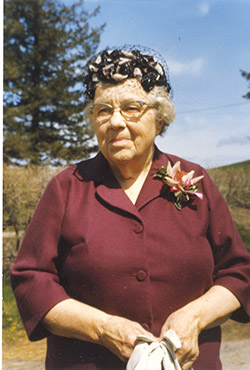
Dora Otter Fleener
Born 1894
Occupation: farm wife; housekeeper; author of Coming West from South Dakota
Residence: Rural Moscow
Topics:
The colored topic bar is hidden for screen reader users. Use the topic buttons below it, the "Filter by Topic" menu or the search box to find specific content in the transcript.
Sam Schrager: In this interview, Dora Fleener discusses an account of homesteading near Moscow in the 1870s that she heard from her father-in-law, Dave Fleener, proof that author William Drannan and Wild Davy were separate individuals, working out at various jobs before marriage, life on threshing operations, home remedies for illnesses, and the advent of cars. The shelter that he built when he first came here.
Dora Otter Fleener: I think he must have brought some stuff with him, like billboards and things like that when he came up, brought his wagon and team up from wall-to-wall country. And he built his first house, put a canvas over the top of his tarp that he used for braiding. And he just built kind of a two-board high for it, you know. In the open winter that winter, it was cold or anything, and much snow on these horses. He'd take one out and the other would stay by. One thing they had a lot of trouble with in the early days was that the people were driving horses through the country to Montana, you know, and they'd pick up everything that was loose. And sometimes the other horses that were running on the range, you know, they'd come and see horses coming, they'd come to the band, you know, of horses, and they'd just include them in a bunch, you know, they wouldn't try to separate them out. And he'd lost several that way, young two-year-olds or something like that. And sometimes they'd round them up on purpose, they had the theme of doing that anyway. Montana needed horses for some reason, I don't know why. That was after he came there, of course.
Sam Schrager: Did he ever mention Vigilante days?
Dora Otter Fleener: Well, he did too. He said, of course he went in, but he heard about them. He said, he had a woman that didn't come back, and didn't come back, and she spoke, and that's what the Vigilantes called him. Hung him up, you know, strung him up. It was going on in other parts of Idaho, and he'd come to you around here, you know, horse-leaving, I guess, horse and cattle-leaving at that time. He didn't have any, he knew that person himself.
Sam Schrager: Did he heard this around where he lived?
Dora Otter Fleener: Oh yes. Another thing, I didn't include in my part of it was the first lights they had, lard oil they used in the can, and on the crimp they used the can. They put a wick of a cloth in there like that.
Sam Schrager: Well, that's a pretty basic way to get your light, I guess.
Dora Otter Fleener: I'd say so, it wouldn't be much light. Like smokey, too, I'd think.
Sam Schrager: And what about the social life in those real early days?
Dora Otter Fleener: Well, they had dances, mostly dances and parties. Viola was the first town close by, you know, Viola the Blues. And people congregated in there to dance, and they had saloons too in those days, in the high old time, I guess. But they used to go horseback riding too, or they'd need to go in the wintertime or any time of the year, I guess, horseback. They'd go on a way that they, single-man would go. They would do a celebration, they'd take a wagon then, the whole family would turn on the board in the happy seats, just put a board across the wagon box, you know, about 20 miles or so that way, straight across the country, I guess. Talk about going to Colfax on the 4th of July celebration one time that way. They had somebody stay at home and look after their stall call. They couldn't get back there, and they'd get back the same day. They'd stay overnight, probably.
They'd be trotting in those days too. They'd use flags and bunnies, you know, and things trimmed up gay. I remember that in my day, horses and flags and their bridles, you know, and they'd put their flags on them. Oh, the speaker stand was all draped in a bunny, red, white, blue bunny.
Sam Schrager: Didn't the roads really, there just about weren't any then at all?
Dora Otter Fleener: No, there weren't.
Sam Schrager: Really, was it cross-country you'd have to go?
Dora Otter Fleener: As much as I could. Of course, I had to ride down the hills. Well, they had some way of going, you know, some trail of some kind, but then, as much as I could, of course, but then some hill you couldn't go. It was straight through because, you know, then after that, after they'd get roaded so dusty, then they couldn't hardly stand it, you know. So, I don't think they came to the country anyway, gave up such a dust, they couldn't see where they were going. Of course, that was later.
Sam Schrager: What about the night that you talked about, that he and his friend thought that they were lost when they were coming down from a dance?
Dora Otter Fleener: Yeah, I think they would have stepped over that night a long ways off, and they were coming back with their eyes, and it was kind of foggy and snow on the ground, and you couldn't tell their eyes or anything where they were. No fences, no buildings they could see, to tell where they were getting marked, they recognized, you know,… that they,… that's how Hughes thought that they were sure taking the wrong direction all the time, but they knew what to do, he gave his horse a free rein, you know, and let it go home by itself. He kept telling these guys, he'd tell the high Hughes that they'd find some kind of a shack or something, so they could stay over the rest of the night, but got to get their bearings, you know, later. He kept going, kept going, pictures came to a barn, building, he turned his horse loose and he was right in the barn, and the high Hughes recognized that it was their own place, so he took him back.
Sam Schrager: Did he ever talk to you about any of the old characters that he knew from those days? Any of the people in the country that really stood out as being characters, being different?
Dora Otter Fleener: I don't think he did. The high high Hughes was the only one that was with him, and he was nearer close. Of course it was, Mr. Bowles, he was a star keeper and a postmaster at Viola. I don't know if he was quite a character, but people always liked him real well because he, on the side of people that didn't have much to eat, he'd take wood in place of, trade wood for, trade provisions for wood rather. And that way they got along pretty well, you know, and he, in many of his two other corps they sent me to the backyard one time, and he traded for people. He was...
Sam Schrager: Is that, is that where Dave Fleener did his trading in Viola?
Dora Otter Fleener: Yeah, he did for a while I guess. For a musk of guys. His Viola was only three miles from there. In Moscow he was much farther. About eight miles from there, seven or something like that. He didn't leave anything else in there.
Sam Schrager: What about the first plowing that he did? Did he ever talk about it?
Dora Otter Fleener: Yes, he did the first plowing that first year he was there. Because it was such an open winter and there were two horses and a breaking plow. He brought a breaking plow with him. A few utensils, a few things like that he knew he'd need, you know. And he got his lumber to build his next house the next year. The wide board and batten they call it, they call it board and batten don't they? He built that the next year. Had a better house. Had the lumber I think from Viola or some sawmill around. They were getting up sawmills about that time. And those first boards were immense wide things. About 18 inches wide. Wide boards that feel around the country now in old houses and things. A big timber you know.
Sam Schrager: Did he ever tell you how come he turned down Allen's offer to start up in the town there?
Dora Otter Fleener: Well in the first place he didn't want to have any town property. Allen asked him twice to trade with him. He said let me just build a shack there in town. He didn't care anything about town at all. He could keep it up. He was going homestead you know. And then he asked him again to trade his data log for his team. So he couldn't do that. He went and arrested him.
Sam Schrager: Did he talk about seeing how the country got filled up with people?
Dora Otter Fleener: Well yes he did. One fire that came across the Sadler came to take up the land right across from him. There was a road above him. We rode down the west side of him. But the woman was sure that there would never be any isolated country. Always like it was then. She didn't like it so they never even unpacked their stuff. Put it out of the way. But long before Mr. Collins came in with his family so they settled there. It didn't take long for the country to settle up. That time. Railroad commenced to come in about the 80's. Things commenced to be quite normal. And after that it took so long to get their grain to Walla Walla. It took two days I think to get all that grain to Walla Walla. Their first market you know. They'd take the grain down there and then they'd get provisions for the last of the year. All winter or something like that. I guess I told you about the woman that wanted to buy a packet of needles. She wanted to buy a packet of needles. She wanted to buy a packet of needles. She said, why, how come so much? He asked her to be pricer. She said, it's a high cost of freight he told her. Ha ha ha. Freight down needles she didn't think that was that much. I guess some of the staff was afraid to go to Walla Walla. On the river and then the river. To get out of the part of it. Not that way but the other.
Sam Schrager: Did he talk about going to Walla Walla himself?
Dora Otter Fleener: Well I don't think he did. He tried freighting one time but he went up. He took up the claim I think. He didn't like it freighting because he couldn't use his own team. I guess it wouldn't cut out for freighting anyway.
Sam Schrager: And what was it that he told you about the early harvests that he worked in?
Dora Otter Fleener: He worked down the two ships. He'd go down there in the summertime to earn money. He'd leave his place you know, part of the year. He'd work there in the summertime. Harvest. Heading outfits. Thrashing outfits. And I guess after they got to finding a heater. Cut the bundles of the bed of the ice machine. He defeated. He had a bundle cutter on each side of him. He'd take the bundles and put them into the machine. Loose grain. And of course that worked pretty fast. He'd reach out for the bundles. And the fellow was cutting the string at the same time. He might get jabbed you know. It was pretty risky to do it really. I guess down there too. Thrashing bundle grain. But his job was to feed the feeder in the threshing machine. He couldn't feed too fast or too slow. He wanted to keep it up. He was studying bunching in there all the time you know. To make somebody an expert to know just how much to put in and how much not to put in.
Sam Schrager: I wanted to ask you just a couple of things about his earlier days. One thing you mentioned in his writing is that when he saw the... He saw the Brock Buston. And that the guys who were doing that work were really getting hurt. Yeah.
Dora Otter Fleener: They'd get the wild horses off the Broncs and bring them to ride. They'd get on them and just ride them. Not like they do in the rodeo. Now they only ride them for eight minutes or three minutes or something like that. And they stayed with them and they'd broke them in. And he never tried it because he's the one who did it. He'd bleed from the ears and holes. It was pretty jarring you know. You could stick with him though. That was in his earlier days in California I imagine.
Sam Schrager: And then this long trek that he took into Oregon up over to Siskiyou Summit? His partner didn't think they were going to make it?
Dora Otter Fleener: Yeah. Just a kid. He was 16 I think at the time. I think that they went from the end of the stage line and then they had that too deep snow and they couldn't... Stage didn't run over the bad road and the high parts of the mountain. There wasn't as much snow so they took that. I don't think it took them very long to walk it. Probably just day and a night or something like that. But I think most of it was on top of the snow. The snow was crushed hard. They couldn't do it hard to go. But they had to know their way you know. They'd get there until they were lost on the way. I guess he'd been across it before so he knew about where it was. And he blazed it. He had a hatchet on an axe and he chopped blazes into trees. He went along just for fun I guess. It makes it come through there. You can see how deep the snow was. The way up in the trees you know.
Sam Schrager: His friends really thought they weren't going to make it.
Dora Otter Fleener: Yeah. They long walked through the kid. He couldn't see anything. He couldn't make it at all.
Sam Schrager: And then it seems like he really had a lot to do with the Indians. The Pitt River Indians when he was in California. Yeah.
Dora Otter Fleener: He heard cattle there a lot of the time I think. And they were there a lot of the time too. Just kind of camped out. Like cowboys do sometimes. When those were made in provisions probably they'd just stay in camp there. Badlands. Well they're not badlands. They're actually there. Lava beds with their ... and their grass. That's where the cattle grazed. Indian country there. And when he got in, when he was in his north end California, his own claim. He took up claim there first. He built a shack there and the Indians used to come and knock on his door. And then they walked in. They were hungry and they couldn't feed all of them. So they had to make a bus stop to that. The dogs would have gotten so they wouldn't let the Indians come close to the house after a while. He said it's pitiful that they didn't have any clothes on out there. There's a shawl over there. Back, you know, for the people. The United States didn't provide them anything to eat or anything to wear. And they couldn't leave a reservation to hunt. Faced like they shouldn't have been able to, you know. In their own state they'd go in, native state they would go in and dig campers. Dig provisions for the winter. And they'd dig there and there. They'd leave their own part of the country but when they had an reservation they'd actually leave it. That's the reason it made the trouble I guess someone was bound to go off. I mean that's the trouble with the army trying to make them stay out there. They were so hungry that if they found anything dead, if a cow died or anything, they'd eat it anyway no matter how long it had been dead. Because they were so hungry.
Sam Schrager: What were a couple of the funny, amusing incidents that he told you that took place between him and the Indians?
Dora Otter Fleener: Well, the one I remember now is one about the Indian that was cold weather and he didn't have much on him there at the shipyard I guess. His partner gave him a spat in the bottom and said, aren't you cold there? And he said, no, I'm fine. No, actually like, like face no cold. He stood. His partner had two barrels of water hung down so he gave him a pair so he... He didn't think that they needed to hang those ones that they hung down at Scarface Charlie.
Sam Schrager: Was that Captain Jack?
Dora Otter Fleener: That Captain Jack. He didn't think they were anything that bad. I suppose they shot at him. A soldier, officer in the army or something wasn't it?
Sam Schrager: What did he say about it? He wasn't down there at the time, was he?
Dora Otter Fleener: No, but he heard about it. He was right there at the time. Of course he was among them probably at the time. He probably was in the reservation at that time or that part of the country but he wasn't there to see the actual trouble.
Sam Schrager: As I remember they chased the Indians pretty hard.
Dora Otter Fleener: Yeah, they did.
Sam Schrager: He mentioned in here too that when he was younger and his brother had tuberculosis and they had a pretty unusual kind of cure.
Dora Otter Fleener: Yeah, they had a trumpet. If you go on that he's drinking his lungs.
Sam Schrager: Made me think they probably didn't know anything what to do.
Dora Otter Fleener: Oh no, they didn't know anything they could do hardly. Try anything you know.
Sam Schrager: And this diphtheria epidemic, Dave's father had his own home cure for it.
Dora Otter Fleener: Yeah, burned down one, a brown bark.
Sam Schrager: I wonder where you ever picked that up from?
Dora Otter Fleener: Well I read in something the other day about early remedies and something. I guess they had that in Blacksburg County, quarterly. Bunch of grass, historian that. Elm tea was good for diphtheria. Didn't say slippery Elm, they didn't say anything about burnt Elm either.
Sam Schrager: What do you know about Wild Davey?
Dora Otter Fleener: Well, there's quite a lot of supposition about whether he was the same as Will Dranan or not. Will Dranan wrote the book, he didn't write it but he had told the story of 30 years in the plains and the mountains maybe you've heard of it. And Wild Davey, many people think he's the same man. We knew it was different because the Fleeners knew both of them. Because one of the Fleeners helped Dranan write it up. He was a newspaper man anyway. So Dranan told him the story and he wrote it see. And Wild Davey was a father up in the mountains. He wore long hair and was about the same size as Dranan. I guess that's the reason he got confused. But Wild Davey lived in the mountains and he had dogs and he had a hunter. He had coyotes and cougars that was his business. He had so many dogs that he used to eat some of them too. The story tells about the time that they met. She met Wild Davey, he lived up in the mountains here, Oscar Mountains, out of Troy. The women and folks used to be afraid of him and they'd bunch up at night and the men were out harvesting. They'd ride their kids on horseback and go and stay with each other. One day Mrs. Kissinger saw Wild Davey coming around toward her house. She was finishing washing the dishes. She met him out the corner of the house through the dishwater over him as he came around the corner of the house. He was a big snap. He never bothered anymore. He wasn't a bother anyway, probably coming over. He used to come to the cleaners town and one time his horses got away and he went to the country trying to find them. That's the way they knew it in there, got acquainted with him. They knew that there were two different people. I've run across different people and they were different here, but not very many people admitted.
Sam Schrager: Do you know if Davey...I heard that Wild Davey used to tell some pretty wild stories. He used to say he'd done a lot of kinds of stuff. That had something to do with why people have thought that he was dranning. I heard him called the windjammer.
Dora Otter Fleener: I don't know about that, but I wouldn't be surprised if I did. This Mr. Gamble, that's Lola Clyde's brother. He said he used to work in the harvest with him at Wild Davey. He didn't have much sense. He couldn't write a book. He said anything. His name was O.C. Covington, he said. The right name was. He was on my side. When I tried to prove these things, I tried to find his... Somebody said he was buried in the Troy Cemetery and I was there one day. I asked the postmistress if she knew where the cemetery was. She said which one. She said a set number out here. I wasn't about to let them all up to find out.
Sam Schrager: Do you think this guy really did bother the ladies?
Dora Otter Fleener: No, I don't think so. He had long hair and he looked like he was wild. He had so many dogs and he lived by himself. There were...especially anybody that didn't look right, I suppose. New country, you know, they're kind of... I'm afraid that most anything that doesn't look this right, I suppose.
Sam Schrager: Are there any other characters like him that you've heard...not like him, but any other characters like... you've heard about in the country?
Dora Otter Fleener: I can't recall any right now, anyway. I don't know. We knew a man that used to get drunk a lot and he used to stop at the school house and wave at us. I was a teacher and if we were out playing in the yard, you know... One time he came by my home. His mother was out, not closing, and he started yelling at her. And it didn't matter what he was doing, I was scared to death. About seven or eight years old then. But since we moved...Wardland County, we moved over there, too, and he... He used to come home drunk at night, and one night he and his wife stayed all night in the straw stack because he couldn't get home any farther. Another time he ran off the road and took over the buggy and he didn't hurt him, but he lost his hat. That seemed to worry him worse than anything else because he lost his hat. There was people coming and going at night, more or less, they noticed. To all the authorities who got onto it and found they had a steel in their house, a trap door in their pantry went down. That's the nearest we ever came to it.
Sam Schrager: Do you think that it cut down the drinking a lot to have prohibition?
Dora Otter Fleener: I don't know. They said it didn't. I don't know. I couldn't tell.
Sam Schrager: What about women's...the women's right to vote?
Dora Otter Fleener: I don't remember anything about that. I don't think it affected us much. At least I don't remember a prohibition. I don't think it's ever saying anything about it. They weren't people to say much about anything anyway, really. They didn't discuss anything. It seemed like, at least they'd done more of it, I think I'd have been a little bit better informed at the early age than I was. I never spoke anything bad about anybody or anything. Why or where for? We were going to school and they had, I guess, about time. Teddy Roosevelt was then coming in to come up for election. Part of the kids were from Republican parents and part of Democrats. We heard goody-oh and we called them a damn rat. Not to their face, you know. The Edmonton girls were Democrats. They were Republican. Their father was in the legislature in Idaho at that time. So, pretty strong Republicans. As much as I remember about being involved in politics at all.
Sam Schrager: What about the revivals that came to Moscow? Did you ever have anything to do with them as a kid?
Dora Otter Fleener: Only one of them. I think the Lowry meetings. That was the only one I remember anything about.
Sam Schrager: What meetings?
Dora Otter Fleener: Lowry. L-O-W-E-R-Y. I was the preacher and motive of the choir leader. I liked singing so I'd go on the cover of the choir. I'd say if anybody wanted to sing, they could. I'd play them sing, you know. But a funny part of it was he had a chair on the platform. I can't remember if it was one chair but it had several spindles in the back. You know how those are. You know what the spindles are, don't you?
Sam Schrager: Explain it to me.
Dora Otter Fleener: Well, they're the things that go up and down the back, you know, those round things. And he wanted to get the attention of the audience or the congregation or he could rip that baton across that, you know, and make such a funny noise. Everybody was startled and they just kept talking and paid attention. But that was in the tenth, I was going to say. So when you hear about it, I remember. Took about a fourth of a block there between Jefferson and Third Street. And then I saw this on the floor. I don't know whether they had benches or what. You'd say the back's too many. But it's kind of a crude outfit. But we had lots of fun in it. That weather was an awful lot of snow too. There was deep and thin clouds and snow, you know, and people didn't shove off their walks or anything. They just trapped the snow down and went over the top of the drift and packed the snow and kept on the trail. That's all they did. Of course, farmers like to have snow in town because they had used sled in the country and they couldn't clear downtown sleds. They couldn't run it. They didn't have any snow plows anyway to clear it off.
Sam Schrager: Do you remember what winter this was?
Dora Otter Fleener: 1912. February 1912.
Sam Schrager: Did you perform for the adults? Did the choir?
Dora Otter Fleener: Well, when they gave the order call, we were supposed to leave the platform and go down among the people. They asked me questions if they wouldn't want to be and all that. I wasn't very good at it. I just kind of bluffed it. I was never very good with words anyway. Arguing a point. That part went well too.
Sam Schrager: Do you remember, was it a pretty quiet or pretty noisy kind of a meeting? I mean, did people get pretty excited?
Dora Otter Fleener: No, no, no, it wasn't that kind. I remember it was quite tame. It was quite successful. I remember. I was used to a really loud preacher. I met this preacher that time. He was really a stomp arounder. He'd face up and down the platform and put him down to pulpit, you know. Pound his pulpit. It's podium or whatever you call it. And so I don't know why. I was used to being pretty loud. I was a preacher anyway, so it was an ordinary to me. He must have been there about two weeks, I think. The last second year of high school, I think, that year. I was made up of young people, mostly high school kids, I think.
Sam Schrager: Well, I wanted to ask you about the early thrashing operations. What are the earliest ones that you know about, or how were they when you...
Dora Otter Fleener: Well, I saw a few that were very feeble. The engine wasn't powerful enough to propel itself. It had to pull it out. And put it in one place or another, you know. I heard about somebody telling about a story, I guess, I've never been talking about that day. He was talking about early days. They were pulling this machine to one side and to another. It dropped into a ditch in the front end of it, you know. Probably dropped into a ditch and the horse couldn't pull it out. He was talking about that while they were eating dinner one day. And the cook got kind of worried about it. She said, well, they knocked the water clouds at all. The tank was in front of the engine, right under the smoke stack. That's what had come pretty close to the ground. That made all the people laugh. They said the water cloud was in the toilet in those days, you know. But it wasn't long before they got some engines and pulled it separate. But I didn't know why that was. There were just very few of them that couldn't propel themselves around. It got bigger and bigger and bigger, you know. They couldn't accommodate all the men in the homes. So somebody got the right idea and built a cook house. That went with the machine always, you know. I guess it was already two men on the cruise at that time. They got fits. And money then because real cash. It didn't get any other way very easy. Especially if a man had a teeny take out and a teeny wagon. One that paid pretty good money.
Sam Schrager: What was the cooking situation like in the cook house?
Dora Otter Fleener: Well, it was pretty awful I think. They had to get up so early in the morning to get the men. They had to get in long days because so many farmers wanted their work done. You know, before it rained came in for the right season. So got up about three thirty in the morning and went to the cook house. Did the kerosene lamp. Started the fire and had breakfast. The men slept in the straw sack. The fireman I guess, he was the one that would come up in the morning. He was the one that had to get up the steam, you know. And get ready to go after breakfast. Men had to get up and feed and harness their horses too. Worked to be done before breakfast. Had to get up early too. The cook, as I'm applying, she tells about the experience. She worked seven years, since I said seven years. The same man. She was saying that they... What did I say? Well they had to be really economical with their bills. And they had to get their meals on on time. She said they had to fry a whole milk pan full of steaks for breakfast. Had everything, warm biscuits, you know. Bean powder biscuits and everything that goes along with eggs and bacon and everything. When they moved they couldn't have it. They liked to take up and move many times. It didn't matter whether they were baking or what they were doing. She said they never lost any cakes or anything like that from falling or anything. Had to hold the oven door shut a lot of the time though. They'd come over and rough it down. They'd leave the oven door open. They'd use the cookhouse. It was hotter than they could get in there. You could imagine it would be like out in the middle of summer. The first meal. Besides they'd be raised so they wouldn't layer through.
Sam Schrager: They had the sides raised?
Dora Otter Fleener: Well they were kind of like awning, you know. They had a water barrel outside where they'd send the outside of the little platform up. It was part of the cookhouse too. The Funky kept that full of water for the cooks. They kept the wood split for them in a handy place. The town got the provisions for them and all. They got their milk from the man from the country. If they'd had cows, he'd go and get milk for them. The refrigeration they had was just a tub of water. They'd set the milk in. How they got along.
Sam Schrager: Did she talk about how hard the work was to her?
Dora Otter Fleener: She said it was late. Late when they got to work the other night, they probably met themselves getting up in the morning and they'd go to the market. They didn't come and eat, you know. They couldn't thrash anymore. They had to do up to work tonight and they had to do all that work up.
Sam Schrager: What about the work of the crews out from pictures I've seen? It looks like it was awful dusty.
Dora Otter Fleener: Sure, it was terrible. The first machine didn't have any blower either. They had to keep mowing the straw back from the... They'd run out the draper and drop it down. They'd keep mowing that back and that was terrible hard, dusty work. That chaff. They'd hang a chip over their face to keep breathing it so much.
Sam Schrager: Do you think they had a hard time holding the crews?
Dora Otter Fleener: Oh no, no, no. Say not they loved it. They would just... Well the men liked to get together for one thing. They had a big time, you know. And they all tried to outdo each other with their working and... Of course they didn't want to beg and do that. They weren't any clean way to do anything. Sleeping with a straw stack wasn't very good either. I don't think they'd be pretty chaffy and dirty. They'd be full of chaff.
Sam Schrager: Did they take much time to socialize when they weren't working? Did they have... I mean, did they sit and have storytelling sessions?
Dora Otter Fleener: No, they didn't have time. No, they didn't have time at all. Sometimes they didn't have time to go and suck eggs. I have a feeling to tell you about how they used to... Some of the young fellows used to rob the chicken houses from farmers. They knew what they were doing. They didn't care. They'd come in and see if they couldn't suck the eggs, you know. They'd try to get one of them fellows to suck an egg and he wouldn't... He'd just come right back up again and he couldn't stand it, you know. Some would like it.
Sam Schrager: You just put a hole in the egg and then suck a straw? Yeah, yeah.
Dora Otter Fleener: I wouldn't like that at all either would you?
Sam Schrager: That's an old saying that I hear sometimes. You sure broke him from sucking eggs.
Dora Otter Fleener: Yeah, yeah. They don't know any better than to suck eggs to make that work.
Sam Schrager: Were most of the guys in the crews mostly local boys?
Dora Otter Fleener: Yeah. Man, they were the family men. They needed their wives at home and... About to make money and all that way. That's about the only money they made during the year that was real cash. I know my sister, she used to... Her husband went out to work. She would always get up and... Do something important, you know, like papering or some big job that she couldn't do very well. She had meals to get in the home. And even she'd change her furniture around. One time she'd change her bedroom and her living room around. And then, you know, she'd change the bedroom to the living room and the living room to the bedroom. Came back from work on Saturday night, couldn't find a bed. But they always worked the full week, you know, when they came home on Sunday. Nobody worked on Sunday in those days. When they stores opened or anything, you couldn't buy anything, anything like that. In the Blue Law, one time, it was against the law to have anything open. They'd come home and get changed their clothes and take us out of a bath, I suppose. Jump in the creek or something. They didn't have any bathing facilities at all, you know, anything. Shower or bath, I believe.
Sam Schrager: That sounds so interesting. It sounds like it was really a big, almost like celebration in a way.
Dora Otter Fleener: Oh, it was, yes. Men looked forward to it every year, you know. You know, get together for men. They had a high old time. I guess they played more or less pranks on each other while they worked. But then they didn't stop work to do it. In the combine days, I know they used to play a prank on each other. Then they'd fill each other's pockets with grease and they'd grease in the combine and stuff like that. They didn't have much time. They were older men anyway, usually. Or seven kids.
Sam Schrager: Well, how would the threshing operation be owned by one guy and everybody would come work for him?
Dora Otter Fleener: Oh, yes, that's usually a partner sometime. But usually just one man on the sewing machine and he'd get around everyone that he could, you know. He'd say, well, I'm the country, probably. They liked to have the best operating machine. They didn't want to break down so much. The farmers, they'd speak for them ahead of time. Supposed to come after so-and-so got it done with them, they'd have theirs. Well, sometimes he had a breakdown and he couldn't get there. And it looked like the farmer might get somebody else. It was handy. That'd make the threshing machine man mad, you know. What's going to do is cheat him out of that much money. It works the other way, too. Sometimes if somebody begged him and paid him a little bit of bonus or something, he might. That one fellow wouldn't take somebody else's clothes or something. It worked both ways. Some hard feelings got started that way. So it was good when they got a combine so that didn't happen anymore. The choice of man had his own. It was a partnership combine business, too. Sometimes that wasn't too good either because one farmer wanted to do all the adjusting and all the say-so about it. The other one was pretty meek while he got left out. And if he wasn't meek, they had harsh words at each other. Now that they got their own combine, it would cost them an awful lot of money. But then, oh, he'd end up to their ears. And they'd have more fun with it, you know. They were going to do as long as they wanted to and nobody bothered them.
Sam Schrager: The old threshing machines, they were pretty cantankerous. They were pretty ticklish sometimes, keeping running.
Dora Otter Fleener: Well, yes, and just like any machinery, if they didn't have it up good, they were kind of rattled trap, kind of didn't want to start any with, you know, older. Sometimes they'd pick some up with haywire and it didn't last very long. Then just like they didn't have to do their combines now, they have to get them in probably perfect shape before the season starts. They'd have trouble during the season.
Sam Schrager: What were, were there jobs that were, that were the top jobs on the operation?
Dora Otter Fleener: Yes, the engineer and the separator man, of course. The separator man was the owner because he, the separator was the biggest responsibility of the whole thing. You know, to keep it going, going when it was about to break down or when it was plugged up sometimes. He watched it pretty carefully. The fireman, he had to know his business, had to keep up the steam all the time. He had to keep the stuff in there pretty fast. They felt as though they were above everybody else in the environment. Of course, the ... or two, he was pretty important. Two women were cooking together, not everyone, one couldn't hardly manage to work alone.
Sam Schrager: They usually, were they just hired like the men were from farm land?
Dora Otter Fleener: Well, yes, they were. Everybody that wanted a job and they were the best one that they could, you know, buy. And very many people wanted a job cooking because it was hard work and it was, of course, they had a few of the girls, 18 or so, you know, single girls or else. Young married women that didn't have any children or responsibilities at home, you know. I'm glad she was just a young married woman at that time. My husband worked on a machine too. My husband, Dora Hill, was a partner with her. She was a married girl, 18 I think at that time.
Sam Schrager: Was their pay pretty good compared to the men working on the harvest?
Dora Otter Fleener: I don't really know what the pay was. Man, it was pretty good for Cook. I asked her if she was a head cook and she said no, they were both shared likes. She said they were the ones that planned all the meals and the other one helped out, you know. But she said the men just worked together. So they got the same pay, I think $3 a day was pretty good pay at that time. I know men carpenters, they only got $3 a day. My dad had somebody build a chicken house and he only paid $3 a day for a carpenter work. The man, he had horses and a team and a wagon and he'd get more for them. I don't know how much more, but...
Sam Schrager: If he had a team and a wagon, then he'd haul the grain.
Dora Otter Fleener: He'd bundle the grain, he'd bundle the fodder. If he didn't pick up the shocks, you know. I think quite a number of them, maybe six or eight or ten I guess, he'd bundle the wagon. Racks, he'd go into a thrasher outfit and the running gear is the wagon, he goes, I'm in. Team, you know, he'd bring the wagon. And he'd go all over the field, you know and pick up the shocks. One man was on the ground, he had a bundle wagon. And the man that was on the ground, he'd take the bundle and throw it up to the fellow on the wagon. The fellow on the wagon catching on his fork and putting it in place and he always put it in the cellar. So they had to look and I took it down so that they wouldn't break the heads off. So I loaded it back in.
Sam Schrager: When you remember the early days, do you remember that was after they didn't do it? Were they still using headers in those days?
Dora Otter Fleener: No, they didn't use headers in my country at all. I think they were down in the river on the Tushy country down there. All along the way, it's burning down that way. I've seen pictures of them but I've never seen it work at all.
Sam Schrager: Well, I want to ask you about the coming of the cars in the first, what you remember about the early day. The first car coming into the country?
Dora Otter Fleener: The first one that I remember anything about was where our neighbors had a couple of Franklin's. It was about 1912 I imagine. They didn't have any top on it. It was on the other side from what happened now, you know, on the right-hand side instead of the left. And all the gears on that side right where the door would be on that running board. All that running board then too. The gears, the brake and the honker. So these on a boom, you know, honked. I guess about that time, a few doctors around town got cars but then people in the country couldn't use them. People in town couldn't get out in the country either in the wintertime because no one, mud and things, you know. And they didn't clear the road, didn't want any road surface or anything that time. But you get a car for about a thousand dollars. We got our first car in 1917 I guess to us. The Maxwell. The tires were so expensive and so hard to keep from cracking and deteriorating. You'd leave them on the sun, the rubber would crack, you know. And then they had the cotton fabric and that would, the rubber would crack. And then the water would get in there and rot that and cause a blowout. And they had a lot of tire trouble those days. If you had a tire trouble, you had to fix your own too. They had rims instead of wheels. The rim, the tire was on the rim and you'd unbolt it from the wheel and take it off and try to get the tire off the rim then. Some job would do that. They didn't have any hydraulic jacks you had to get under the car and put it under the axle. These lever jacks, you'd probably seen them, haven't you? You didn't have to go very far under the car in those days. They were higher up anyway. The Model A's, the Model T's were the best kind of car because they were higher off the ground. They didn't get hung up in deep ruts and snow and other things. They were in the mountains where there were rocks and stumps doing the roadways where they used to be. The cars got more and more cars. The road was a destiny that they couldn't see where they were going when they had to do something about the roads then, you see. One thing had fallen another and that thing. About 1917, 18, I think there were a lot of cars coming into the country.
Sam Schrager: What did your folks think about the cars when they first came in?
Dora Otter Fleener: Well, I don't know if my folks saw it but you'd hear a lot of talk about they never mount anything because it wasn't practical to have and they scared too many horses and caused too many runaways and everything. Underwood Master is a passing fad, you know what I thought it was. Hello. Can I bring your car, sir? Sure. I'm interrupting something. That's okay.
Sam Schrager: Is that where Drannans and met the Fleeners? Yeah.
Dora Otter Fleener: Yeah. They lived in Moscow. He came there to write it. Every day the kids would go and read what they'd written during the day and had a great time reading it because it was interesting. And I know that they said it, he called Ansel's father, my husband's father, when he wanted to verify some of the facts because he'd been in the, in the, the O'Dock War down there in Northern California and stuff. It was about that, you know. So he helped out with that some. So I know that.
Sam Schrager: So that's where, that's where they helped him?
Dora Otter Fleener: Henry Fleener was the one that did most of the helping. He did most of the writing. He and his wife. He did the actual writing of it. I understand. They call him that. Dave Fleener, that's my husband's father, the half brother of Henry's. Being as how he'd been in that same part of the country, they wrote about why he had it. He wanted to get some, verify some of the facts about their writing. That part of the country only. So he read that book, haven't you?
Sam Schrager: What I've read is, is a book by a man named Bate about that book called Frontier Legend, I think. It was a book, it was a book to show that that book was a bunch of lies. I know. You know that book?
Dora Otter Fleener: Yeah. I've already read it, but I've never read it, but I've already read a certain book.
Sam Schrager: Well. Now… drannan's wife probably.
Dora Otter Fleener: I don't think he ever had any wife.
Sam Schrager: Well, he was married later after he was in Moscow. He wasn't going to have a wife when he was here though.
Dora Otter Fleener: No, I don't think so. I don't think he lived very long after that, did he?
Sam Schrager: I think he died in 1913 or something like that in the southwest.
Dora Otter Fleener: I don't know if Seattle is where he died. I don't know if Seattle is where he died.
Sam Schrager: He was in Seattle for a while, but I...
Dora Otter Fleener: He might be in the dead city.
Sam Schrager: The story that Bate tells is that he died in the southwest.
Dora Otter Fleener: Yeah. Well, it might have been some of that story was not made up, but I know some of it wasn't either. I'm sure it wasn't all well-fixing.
Sam Schrager: But he was certainly working on the book when he was here in Moscow.
Dora Otter Fleener: Oh, yeah. That's a story about him one way or another. I don't know. All I know is what I know.
Sam Schrager: Oh, I was just wondering what you knew. When Dave's half-brother was helping him, was he writing the stuff about Kit Carson and that sort of thing?
Dora Otter Fleener: I guess so. I guess that Drannan told him the story and he wrote it down. He told him the whole thing. He told him Drannan couldn't even write. I don't know about that, but he wasn't able to put down what he wanted to say in a good order anyway. It's been said that he went to university and got it written. But I don't know if that's the truth or not. He might have got it rewritten or something. I don't know. I ended up there or something. But I know that Henry's kids, they were just youngsters. They liked to read his books. They would have written during the day, every day, because it's interesting. They must have written the whole thing, I think, from beginning to end. And it was told to them.
Sam Schrager: Did they think that was true?
Dora Otter Fleener: I suppose they did. I don't know. I've heard one or another.
Sam Schrager: Because Bates' story is that it wasn't true.
Dora Otter Fleener: I know. I've heard that. Drannan was telling something about that. I don't know about that book.
Sam Schrager: I've heard that they used to have dances up there. Is that right?
Dora Otter Fleener: Yeah. It was quite a place. It was isolated. One thing, it was hard to get to it, you know, up there in the Butte.
Sam Schrager: How did people get up there?
Dora Otter Fleener: They worked horseback mostly, I guess. There must have been some kind of road up there. Quite a feat to get that road cut out like it is now. I suppose you've been up there, haven't you?
Sam Schrager: I've never been up the top of Butte. No, we just see it.
Dora Otter Fleener: By winding road, and it didn't ride wide either. And it's scary to look down over there. I was born in a very country, I guess. I don't like these roads hung up on the side of the hills.
Sam Schrager: Remember about it, Burning Den?
Dora Otter Fleener: We lived inside of the university. Out in the country, we lived on a hill that was sort of high. You see it burning in the middle of the night. We were looking out the window, upstairs window. Seeing it. That's all I remember about it. How many people mourned about the fact that it burned up to many of their records and many of their trophies and everything, too.
Sam Schrager: What was that kind of car that you were describing to me? Was it a mudslinger? The first kind of hot rods that you used to have?
Dora Otter Fleener: Well, the mechanical minded, they would see if they couldn't find an old motor in the fix up. And the chassis, you know, they had to have a body to put it on. They built it with a seat and a bed for it. Kind of a pick up thing out of it. More than cost us a seat and a back. No fenders, so they wouldn't see it. If there wasn't any fenders, why didn't they sling the mud if they went through mud? We called them mudslingers. Was it any better? Can you get me any better with this? Can you get me any better with this?
Sam Schrager: I don't know, maybe a little better, but it doesn't sound much different to me.
Dora Otter Fleener: I wouldn't have to go into that anyway.
Sam Schrager: You come through loud and clear on the tape. Okay. Did you do much working out?
Dora Otter Fleener: Yeah, I did a lot of it. I said to her, I'm older than I am, she wasn't very well, so she taught school, but she didn't really work out. She had an education that she could teach. In those days, you could pass the examination. She taught school when she was 18. She stayed home and saw all the summers, and I worked out in different places around the neighborhood. I was good at sewing. I liked to sew, and so they had me sewing and doing housework more or less. Five dollars a week. I got paid a pretty good pay. Six days. I bought a piano, and I had an awful time paying for it. Well, I never did get entirely paid for it. I paid a hundred dollars for it. My dad paid for it. He didn't think I needed it. My mother spoke up for me, and so I got it. I worked there with people, and the piano, they wanted to get rid of it, so I worked for them. They took the job for me when he bought the piano, really, but I found out they wanted to get rid of the piano, and I wanted the piano so bad that I got a chance to have it that way by turning my wages over to my dad. That's all that I made for different years that I worked out. Worked out for one family where they were bailing bailers. I don't know how many men, but they had a whole table full, and they had so many flies, and what a place to work. The bedbugs ate me up at night. What a place to work. I worked for those other people that had the piano. I worked there helping cook for the warehouse men and the sacks that came in, sacked all the grains at that time, and they had men to pile the sacks in the warehouse as it fell in Whitman County, in Poland.
Sam Schrager: These people that had all the bedbugs, what work were you doing for them?
Dora Otter Fleener: I was helping cook for the main cook. They had a bailer crew or two, I don't know, one or two crews, but I know a lot of men.
Sam Schrager: Did you stick with the job?
Dora Otter Fleener: I didn't tell them about the bedbugs because I didn't want to complain. I guess I didn't want to get another room. I told her when I settled up that I thought I deserved more than $5 a week for a dollar a day. I guess I was supposed to get a dollar a day there because I was feeling alone. I know the first night I went to bed, took a nap upstairs, we had a clue, and didn't have electricity or anything, of course. I was dead tired and got bed off late because they worked until dark, and I had to feed them after that and do up to work afterwards. I was tired and went to sleep right away. I had an idea of what it was, I had never experienced it before, but I'd heard about them. I got up and looked, and I thought, well, I like to laugh, and they wouldn't bother me then because the bedbugs never bother me in daytime, they bother me at night. I'd heard that when I was a student, but they don't bother me mostly. I didn't stop them. So I thought I'd let them have the bed and I'd get down on the floor and lay on the rug. They beat me to the rug, I think. Couldn't win. When I settled up, I told her I didn't like the bedbugs and I thought that I ought to have more pay because I worked so hard and put in so much. She said, why didn't you tell me I'd got to give you another room? But I still figured that the other room had been just as bad as that. I was the kind that never complained and took things that they couldn't.
Sam Schrager: Did you get more pay?
Dora Otter Fleener: I got $10. I got all that.
Sam Schrager: How did you feel about the piano after you got it? Had you played piano before that?
Dora Otter Fleener: We had an organ before and I loved it so much, but then I didn't have a keyboard that I liked. I wanted more keys. The organ had only so many octaves and the piano had more. I got enough. I was good at it. I got married before I got paid for it. My husband never paid the rest of it. I lacked $35 to pay $100. I worked for a dressmaker too in Pullman. It was quite a long time. I worked for my board while I was working there, so we never paid for my board. I don't remember what I got there, but I got more pay there than I did in the early. I worked for Dr. Rounds in Pullman too. I was in day work. I couldn't work for my board. I worked downtown too. I got another place with a preacher. His wife met this preacher. That was a terrible place. I was in a shabby shackle of a place. They didn't like him either. So I quit there. I don't know whether he left the country or why. Family left. I got transferred there. I just quit, but I got another job. I stayed there. I had lots of fun with my board. They wanted me to pay $500 because I needed the extra hand to play cards. I used to entertain them by kicking up and getting my bunny suit on at night and trying to kick a light up from the ceiling. I had to light up the ceiling. I didn't have any shade on anything. I had to do the washing there. I had to do it in the basement. Everything was coal. Burned coal in the stove. There was coal smoke and mist in the air from the washing. You couldn't see anything without the drop lights. You couldn't tell if you had to wash and clean or anything. I didn't stay very long there either. Mrs. Gates, the person I was working for, was doing dressmaking. She got ailing and couldn't keep up with the work, so she quit. I was going to go on and do dressmaking by myself. I had plenty of work. People would come and give me their work, but I just was tired out. I just couldn't sleep at nights for worrying about the work. I quit that and got married. I tried to go to school before I started working in these places. After I worked at Cassidy, that was the place I fell in. I went to WSC at that time, WSU now. I thought I'd take some credits and learn how to teach. I got sick of that because I couldn't get the subjects I wanted to. I wasn't as much fun as I thought I was going to be, so I quit that and got married. I got a job. Tired of that and got married after that. In 1916, I got married.
Sam Schrager: What's a bunny suit?
Dora Otter Fleener: I wore it all over. Night clothes, feet and all.
Sam Schrager: That's what I thought. Did you know your husband for long before you got married?
Dora Otter Fleener: For quite a long time, because we were in the same neighborhood. I don't think he'd ever gotten married if I hadn't picked him up. There's something clear about this thing that crossed the plains in 1952. My husband's father was the only male left from that family. One boy died across the plain, the other one died of TB. Left only Dave, and that family was the male. He only had one son, which is Ansel and my husband. Although this Samuel had crossed the plain in 1952, he married again. He had four sons at that time, and none of those sons ever had a man child that carried on the name. I'm the sole person that propagated the cleaner name. See from that straight, I'd be a pretty good father in the natural world. It looked for a while so my sons wouldn't have a man child either. The oldest one didn't have any children at all. They only had one adopted when they managed to adopt a boy. Another son had both, he was the first one to have a girl. The youngest son didn't have any for a while because he was younger. He finally came up with three. He got six boys out of the 29. The grandchildren have a name cleaner now. It's up to them now to carry it on. That one's staying across the other cleaners all over the country now. I think of that one.
Sam Schrager: I was going to ask you from looking at these cures, whether there are any other cures that you remember from being a youngster and growing up, any home remedies that you heard about or tried.
Dora Otter Fleener: I can't remember the name on here, but my folks are great people to give us turpentine and sugar and kerosene and sugar for sore throat. These folks here, they drop the kerosene on it, you know, or turpentine or something like that. I remember the guy in here.
Sam Schrager: Did it work?
Dora Otter Fleener: I don't know. Something to do, I guess. I don't know. I can't carry it right off. I know that.
Sam Schrager: What about when you were working with animals? Because I know that you really liked the livestock. Were there any tricks that you used for treatment, treating them? Any beliefs that you had about how the best way to take care of them?
Dora Otter Fleener: Well, my dad used to use coal tar for everything in his time. I don't know. I didn't use that so much. He never had any horses, had any wire cuts, but he'd use coal tar up ahead of him, I know. He had one mare that got bruised her hoof by the hairline, you know, the hoof. He thought she would actually lose her hoof. I don't know what he did to save her, but she didn't lose her hoof after all. He was a great doctor. He was. A doctor that does kids with, I don't know what it is, he had a sore throat. He was often worried about diphtheria because he lived through that age, you know, when there was so much up-and-down. He'd lie down on his throat and he'd be sawing a white patch in his throat where he'd blow some of it for his throat. Make a funnel out of paper, you know, and then put the small end in and he'd blow it in the throat. He'd be breathing in a lot of it, going like that, lunging all the time. He was drawing in the breath that time. I wasn't very comfortable. That was his remedy. I used to have tons of lice locked on the kid all through my life, really. He was in. He used to have, for fever, he'd give aconite and belladonna. A few drops of water, we were supposed to take that every little bit. He'd have a teaspoon full of two or a rear ankle. He'd blow tobacco smoke in our ear. He didn't know whether he had a smoke pipe or anything. If he had a corn cob pipe, mother would ask him to blow smoke in our ear, you know, warm the smoke. I suppose it was to ease the ache somewhat. I never... ...stalk. I don't know. I used to treat him like I did with people. At the time, I'd give him peppermint or something like that.
Sam Schrager: Do you know if he had any beliefs about... ...weather? About what the weather was going to be like and whether it was going to be hard.
Dora Otter Fleener: Dad was a great hand to predict all the time about things. Circle around the sun, man, and so on and so on. He was a great little boy, wasn't he? Ken. Will you be bringing her up to supper?
Sam Schrager: Sure. Circle around the sun would mean what?
Dora Otter Fleener: Well, it would mean a storm. If the circle got bigger, what it meant. The storm wasn't going to come, I guess. If it got smaller, what it meant. The storm, I think that's what I would have been wrong. But the sunrise and the sunset, you know, they... ...wearing color meant so-and-so, too. A what? If it was a rainbow, not a rainbow, but a sunrise, you know, colored sunrise meant a storm. And that... ...he was a great believer in this, planting in the dark and the light of the moon, too. Heard about that, I guess, haven't you? I don't know which is which. I suppose they plant things in the ground and have roots in the ground. And there's a certain darker line of the moon, I forget which it is, and the one that I...
Sam Schrager: I think you plant things that are going to grow mostly in the ground in the dark of the moon. And if it grows up in the light, it's more round. Yeah, yeah.
Dora Otter Fleener: My dad never went far at all, but he always had good crops. So I don't know. I don't know much about myself. There's something in it, I guess, all right. If you put something like a board or something on the grass, it'll die out if it's in a certain time of the moon, you know. It won't if it's in... even in a certain darker line of the moon, it'll kill out.
Sam Schrager: You mean the grass underneath the board?
Dora Otter Fleener: It won't if it's in the other... I don't know which is which, though. I've seen things die out, probably with something laying on the ground that way, a piece of... ...tower purr. When it sticks down close to the ground, it can't get in the air too.
Sam Schrager: Was he much of a believer in good luck and bad luck?
Dora Otter Fleener: I don't think so, no. I don't think of that. I don't think there's a superstition about anything like that. Like cats on the ladder or anything like that. I don't think of that. Pension. Talking about his grandfather, though. Grandfather was talking about his grandfather. That was Ansel's father. His father. He, you can see, it goes... It seemed like his wife had to go after water down in the spring. Back East, in Indiana or someplace where they lived. And he was afraid of this ghost. He'd go with his wife and get water and let her bring the water back. Go with her and keep this ghost from putting her story they used to tell.
Sam Schrager: Do you have any idea where the ghost... Did he know where the ghost came from?
Dora Otter Fleener: No. Ghost was there at the spring, that's all he knew. He raised his wife and so he went to keep the ghost away from her.
Sam Schrager: But never carry the water?
Dora Otter Fleener: Yeah. Well, he didn't go alone then. So I never get to figure out. That's where the story went.
Sam Schrager: Did you ever hear anything about that sort of thing out here? People coming back after death?
Dora Otter Fleener: No, I don't. Well, I see. He used to tell stories about such things. He said there was a girl one time that died and then she came back to life. And they asked her what she saw and whether she was gone. She said, oh, there were a lot of little kids and everything was so beautiful. She said. I remember telling him that story. Telling him that story too. He tells a very weird one sometimes, you know, about bears getting after people and tearing them up. I can't remember more details than what he used to say, but I... I never got it good enough in my mind to remember it.
Sam Schrager: Well, I thought this story about... This friend's mother wouldn't let the boy go swimming. I thought that was a funny story.
Dora Otter Fleener: He did too. That was very funny.
Sam Schrager: That's how he told you they wouldn't let him go swimming until he learned how?
Dora Otter Fleener: They wouldn't let him go near the water until he learned how to swim. How do you learn how to swim any other way, I wonder?
Sam Schrager: He really believed that there were going to be airplanes?
Dora Otter Fleener: Oh, yeah, I guess so. I don't believe that, but he had the idea that he could build one. He didn't add yet. I thought he was crazy, you know, or I thought he was getting off the beaten path. Putting his mind to something, he ought to be more... He ought to have his mind on something else that was more necessary than that. Even though it's crazy things in the airplanes.
Sam Schrager: Well, I suppose that I should take you down to dinner. They're getting... They're starting to eat.
Dora Otter Fleener: If I don't get down there, I'm worried that I don't think. I'm sorry. Well, I don't know, answer the question you wanted to ask.
Sam Schrager: I guess that's mostly it. Is there anything else that comes to your mind that you want to say?
Dora Otter Fleener: No, anyway. Probably won't be after a while. Anyway, it happened, you know. I couldn't prove my point. Even Mr. David, when he wrote the history, he said they were the same one. Before Angela's dad died, while we talked about... He said they knew the same different person.
Sam Schrager: I never could figure out why Davey wouldn't call himself Brandon if that was who he was.
Dora Otter Fleener: I don't either. There's Bill Drannan and a lot of Davey. I don't know why they got the connection, Davey and Bill Drannan. No Davey about it. I don't know why Davey got the name Davey either, really, because his name is Cummington. Mostly Cummington, no Davey about it.
Sam Schrager: Did Davey live here for quite a while, you know?
Dora Otter Fleener: I guess so. He was here in the country when he came, anyway. I don't know how long before that.
Sam Schrager: Drannan didn't stay for very long?
Dora Otter Fleener: I guess it took a while. No, he didn't. He said he got it written. I think he left. As far as I know. I think the family was supposed to get some paid for it, helping him, but he never paid him anything. There was some hard feeling about it somehow, anyway. Kind of skipped out, you know. Took his manuscript and left.
Sam Schrager: Did the Fleeners, that helped him, do you think that they knew much about history? Were they very interested in it?
Dora Otter Fleener: I don't know. I don't have any idea. I don't know how they could tell whether it was a Thettinger or not or anything about that. I suppose they took it for you that he was telling the truth. But now that they told it, it seems they were told.
Interview Index
Her father-in-law, Dave Fleener, built a shelter when he homesteaded near Moscow. Horses often lost in "round-up" drives to Montana; rumor of vigilantes. Lard oil lights. Riding was cross-country. Fourth of July in Colfax.
Coming back from dance at Steptoe, his partner thinks they're lost, but Dave lets his horse find the way. Mr. Boles, the Viola storekeeper, helped people by trading for wood instead of money. Dave's first plowing with a breaking plow. He turns down offer from Lieuallen for free Moscow property, if he built a shack on it.
Two days to haul grain to Walla Walla. Their first market. High cost of freight for needles. Working harvest in Touchet. feeding bundled grain in the thrashing machine.
Injuries to men breaking horses. Crossing Siskiyou Summit on foot in deep snow. Pit River Indians unable to leave reservation to forage for food, causing their rebellion. An Indian with no clothes in the cold. Blowing on a trumpet to cure tuberculosis. Burnt alum and slippery elm bark cure for diphtheria.
Wild Davy and Will Drannan (author of 31 Years on the Plains and in the Mountains) were not the same man. Fleener family knew them both. Wild Davey hunted with a dog pack. Women were afraid of him; one threw a pan of dishwater on his head.
A drunk who used to holler at people; he tipped over his buggy.
She was attracted by sound of music in saloons. During T. Roosevelt's campaign, Republican kids called Democrat kids "damn rats. Lowery revival meetings (1912). The Methodist preacher was loud.
Early threshing. Working in the cookhouse was a long, hard job. Men enjoyed harvest, though it was dirty work. Sucking eggs for entertainment Women might do a big project at home while the men were away in harvest.
How problems over the order of threshing farms could arise. Combine owner could disagree Separator and engineer were top jobs. Hauling on bundle wagons.
The first car she remembers, a Hudson about 1912. They weren't too useful because road conditions were poor, but roads improved as cars increased. Changing tires was difficult. Many thought cars were an impractical fad.
Henry Fleener (Dave's half-brother) and his wife did much of the writing for Drannan's book. Henry's kids enjoyed reading what had been written that day. Dave was asked to provide verification for events in the Modoc country, (continued)
More about Drannan's book writing; he wasn't married in Moscow.
The road to Steptoe Butte. First hot rods were "mud slingers."
Her experience working out. Working to own a piano. Putting up with bedbugs cooking for a harvest crew. Unpleasant work in a Methodist parsonage; difficult washing; helping a dressmaker.
Sons to carry on the Fleener family name. Father's cures: turpentine or kerosene for sore throat; coal tar for horses; blowing sulphur down the throat to prevent diphtheria; aconite and belladonna for fevers; blowing tobacco smoke in the ear for earache. He predicted weather from the sky. A board on the grass will kill it during certain phases to the moon. David Fleener's father went with his wife to the spring because of ghosts; a report from heaven. Ansel Fleener, David's father, believed in airplanes.
More about Davey and Drannan.