
Political Shifts in Idaho
An Interpretive Essay for the Plastino Collection
The following essay was prepared by Antonio Isiordia in fulfillment of the Ben J. Plastino Fellowship. With generous support from the Plastino family, Isiordia conducted research in the Ben J. Plastino papers in the summer of 2026. Below is an essay reflection from Isiordia on what he learned about Idaho history through his work with the collection.
Through the Plastino Collection, one can witness the evolution of the political climate of the state of Idaho from as early on as the 1960s to the mid 1980s. The year 1980 is notable for a few reasons. This was the election year that was highlighted with Ronald Reagan vs. incumbent Jimmy Carter, and another race specific to Idaho was underway between four-term incumbent U.S. Senator Frank Church and U.S. House of Representative member Steve Symms. Ben J. Plastino reported extensively on this race alone, and, despite the advantages Frank Church held at the start of the race, Symms proved to be a difficult adversary. This race is crucial to better understanding the notable shift in political philosophy from a bipartisan ethos combining Democrats and Republicans to a staunch conservatism that continues to dominate Idaho in the present day. Another reason that 1980 needs to be examined is due to that aforementioned conservative political shift following this election and the impact this philosophy had on federal-state governmental relations and sentiments within the state legislature of the 1980s. Plastino points us to multiple instances of state politicians navigating the decisions of the federal government, largely at the expense of Idahoans through the form of sweeping budget cuts. Through this collection, we can witness the political philosophical shift of Idaho towards its current state of affairs, particularly through the 1980 election.
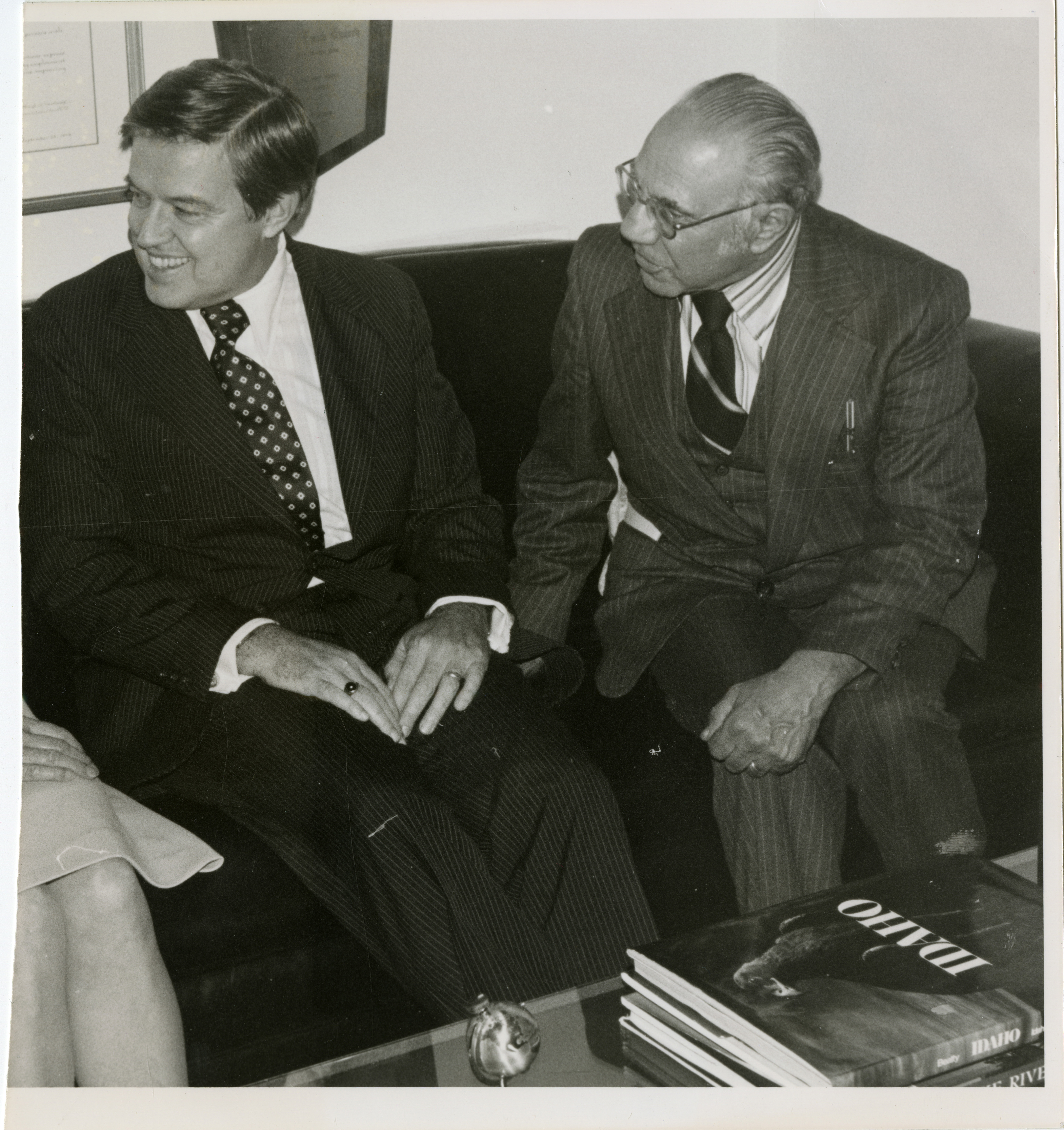
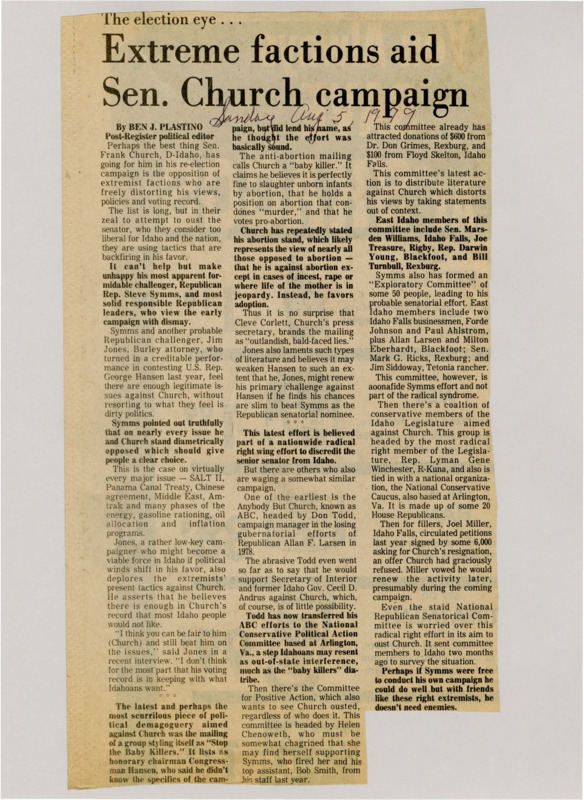
Coming off of the Carter Administration, and decades of civil rights reforms, the country was beginning to move in a different direction. This was highlighted with the U.S. Senate Race between Frank Church and Steve Symms. Plastino reported extensively on this race because it held the potential to provide insights to the future of the political landscape of Idaho. This race came with clear-cut lines in the sand. Plastino wrote that “[t]he two come out diametrically opposed, philosophically. Church rates high with the senior citizens and liberal to moderate groups, while Symms is near the bottom there. With the conservative factions, Symms is at the top and Church is at the lowest rung.” The race came at a risk for Symms and the Republican Party due to the reality that Frank Church was the incumbent U.S. Senator for twenty-four years and was one of, if not, the most formidable political opponent any Republican could face in Idaho. Despite the reality that this race was going to be risky, Symms believed it was one he could win despite the heavy odds. He was not unfamiliar with being the longshot candidate to win an election. Symms, while being interviewed by Plastino, said that “when he first ran for Congress in 1972 if he had polled the so-called Republican leaders they would have advised him not to run.” He would go on to win that election in 1972 and become notable within the U.S. House of Representatives leading up to the 1980 election.
Now in 1980, Symms believed “that since that time, Idaho has been drifting further to the right and away from liberalism [which would] give him an excellent shot for the post.” It became one of the most followed races on a national scale, and one of the most expensive. Plastino reported that this “titanic struggle between the two may be one of the costliest ever waged on the Idaho political scene. It likely will incur expenditures of close to $1 million each, or total $2 million.” When one considered the financial resources of both candidates, it was evident that contributions from the public would be vital. Plastino also wrote that both politicians “will depend heavily on out-of-state contributions… [t]hus out-of-state interests may play a key role in the Idaho campaign.” He proved correct in more ways than one.
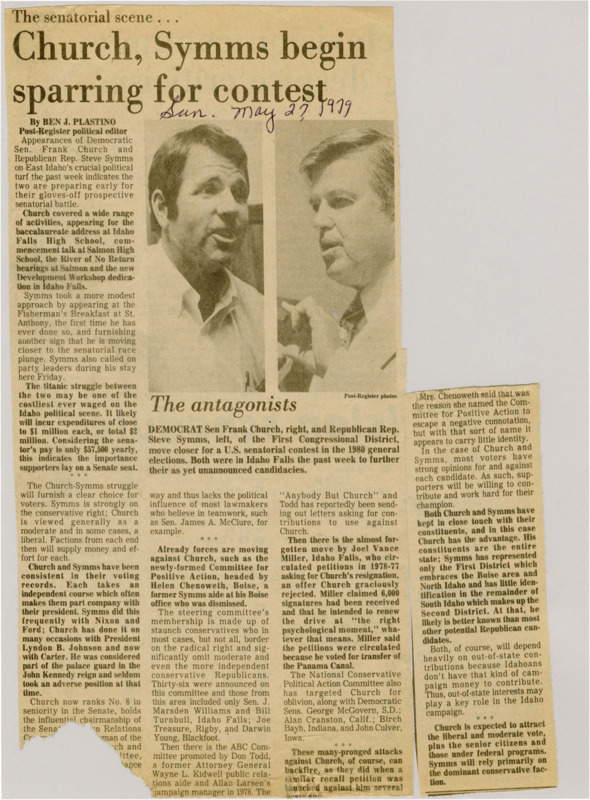
Out-of-state influences played a huge role in the race between Church and Symms, coming in the form of financial contributions as well as political attacks against Church from many special interest groups and committees. Plastino reported that Church faced many attacks on his political beliefs and voting records from groups such as the Committee for Positive Action, formed by Helen Chenoweth in Boise. The group was made up of mostly “staunch conservatives who in most cases, but not all, border on the radical right and significantly omit moderate and even the more independent conservative Republicans.” There was also the ABC Committee formed by Don Todd which stood for “Anybody But Church,” which was sending out letters to garner contributions more so against Frank Church than for Symms. He was even a key target of the National Conservative Political Action Committee, which was attacking Democrats up for reelection in 1980 across the country. Generally speaking, Republicans across the nation were working together to influence this race and vote Frank Church out of office. These attacks were routine and were not afraid to push out bold and even harsh messaging.
Plastino highlighted one example in particular that fit previously mentioned criteria of bold and harsh attacks on Frank Church. In the summer of 1979, he reported on a group that was branding itself as “Stop the Baby Killers.” With the endorsement of Congressman George Hansen, they sent out materials that labeled Frank Church as a “baby killer.” The materials went on to write that Frank Church “believe[d] it is perfectly fine to slaughter unborn infants by abortion, that he holds a position on abortion that condones ‘murder,’ and that he votes pro-abortion.” Congressman Hansen went on to express that he did not know the details of this group when he agreed to endorse them. Regardless of this endorsement being rescinded, Church and his campaign team went on the defensive and were not afraid to say that these attacks were “bald-faced lies” that distorted his moderate view on abortion that was against it except in cases of incest, rape, and if the mother’s life is in jeopardy. These attacks from special interest groups became so routine that it also created a situation that while could have been detrimental to Symms’ campaign, it proved to help in the end. Throughout this race Frank Church found himself on the defensive; spending a large portion of his time combating inaccurate commentaries on his character and political career. This race was heated, and as the election date neared, it was clear that it was anyone’s seat to win.
The Republican Party, having noticed that this win was within their grasp, looked towards their big-ticket party members to assist Steve Symms. Close to election day, Ronald Reagan, the candidate for President of the United States, visited Idaho to endorse and support Steve Symms for the U.S. Senate. It was obvious to Plastino that the visit was to support Symms and other Republicans in the state. He wrote blatantly that “it’s obvious Reagan isn’t coming to Idaho to pad his already overwhelming lead.” Idaho only had four electoral votes and it was evident that Idaho was Reagan’s. There was little Democrats could do to counter the Reagan visit to Idaho Falls and as they drew closer to election, it became clear that momentum was with the Republican Party. The rest of this race was spent gearing up for the election on November 4th and the results reflected the political reality of the country, not just Idaho.
On November 5th, 1980, Plastino reported that Steve Symms won the U.S. Senate race against Frank Church. He went on to claim that this win was a result of “the people wanting a conservative senator to replace what they felt was one who was too liberal for their own taste.” While Symms gave credit to Ronald Reagan for helping secure the win, Plastino expressed that “the strong nationwide conservative trend played the decisive role [for] Republican victories throughout Idaho.” Democrats across the nation were defeated as this national wave of conservatism hit the voting booths. Many voters across the country felt that the Carter Administration was unable to lead properly, giving way to the Republican tidal wave of victories that included Reagan’s ascension to the presidency and Steve Symms unseating Frank Church in Idaho.
An interesting note to consider is one of Plastino’s reflections after the 1980 election which proved accurate in its sentiments, but inaccurate in the time line established. Following the election, Plastino went on to say that “[t]he results would undoubtedly leave the Idaho Democratic Party in shambles for the next year or two. “ While one could look at the election of Cecil Andrus to the governorship until 1994 as contrary to this statement, this sentiment otherwise went on to be the status quo of the Idaho Democratic Party for the next near-half century. Plastino wrote more extensively of the Idaho Democratic Party’s situation a year later and acknowledged how grim things were. There was a noticeable shift in representation in the U.S. House and Senate. The people of Idaho had grown accustomed to some form of federal representation in the Senate and/or the House of Representatives aligning with their political affiliations. Plastino wrote that “[s]ince 1933, the Idaho [federal] delegation has included at least one member of each party. Between 1933 and 1981, two Democratic senators served briefly together and two Republican senators also held office simultaneously for six years.” Heading into the 1980s, however, the Democrats struggled to recover from the 1980 election and the Republican Party proceeded to have built a super-majority on the political scene of Idaho through the decade to the present day. With this considerable conservative shift, there was a noticeable change in attitudes regarding federal-state government relations and, vitally, spending. It is important to note that other areas of life were impacted, such as properly funding public education, but that topic will be discussed far more in depth in another work connected to this project.
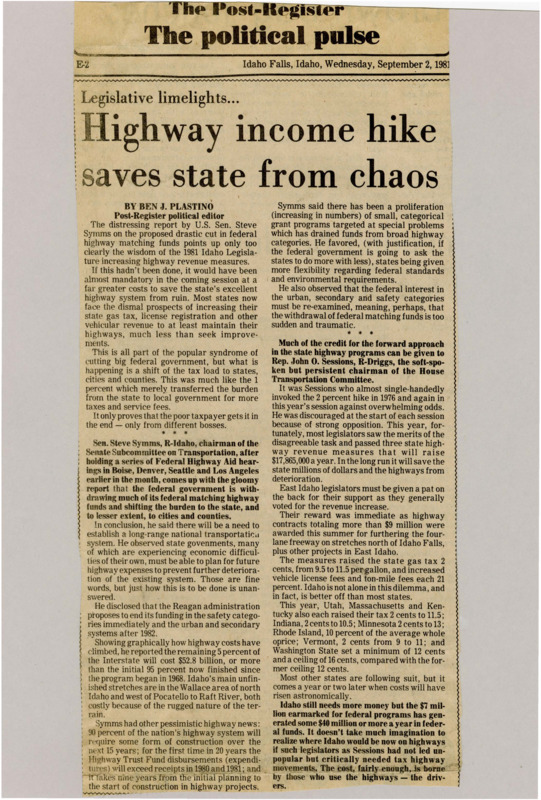
The Reagan Administration reaffirmed the notion that the federal government should be minimized to only its most vital functions. Plastino reported extensively throughout Reagan’s term on the federal tax cuts that impacted Idaho in many different ways. The stronger conservative shift allowed Republican lawmakers to endorse Reagan’s economic plans by implementing their share of downsizing at the state level. As early as Reagan’s first month, Plastino acknowledged that tax cuts were heavily impactful in Idaho. In 1981, he wrote that “all [state] legislators are committed to hewing a tight financial line. It’s their collective view that every program must justify its appropriation.” This tight financial line was at the expense or loss of many programs within the state of Idaho, one example being its highways. Reagan’s cutback program included the federal government’s help in maintaining and improving the roadways. The 1981 Idaho Legislature passed several tax increases to help minimize the impact of losing those federal matching funds. Other states did not have the foresight to do so, which only made a bad problem worse. Plastino, reflecting on Reagan’s budget cuts to highway matching funds and his earlier reporting on the 1% Initiative, wrote the following:
“This is all part of the popular syndrome of cutting big federal government, but what is happening is a shift of the tax load to states, cities and counties. This was much like the 1 percent which merely transferred the burden from the state to local government for more taxes and service fees.”
The federal government was taking a large step back from the obligations it once held. With the new wave of conservative philosophy spreading nationally, many of these obligations were passed to state and local governments. Highways became the responsibility of the state, but there are also examples of loss of federal funds impacting the local government.
Around the same time, Reagan’s cutback program changed the way federal impact funds were distributed, which had difficult implications for several school districts around the state. Federal impact funds were awarded to school districts that were losing income due to the tax-exempt status of federal property within their district boundaries such as government buildings and military bases. Plastino reported on the Idaho Falls School District and the loss of hundreds of thousands of dollars being lost due to budget cuts which only put “a further financial squeeze on patrons and students.” Despite the fact that Idaho Falls held a large population of employees for numerous federal government entities, under Reagan these funds were now earmarked for populations that lived on federal installations (military bases, reservations) and not just employment within the federal government. Much of the state of Idaho is owned by the federal government and these impact funds helped alleviate any loss of money that could incur from such circumstances, but this decision only pushed the burden elsewhere, meaning local taxpayers. They received a false hope that some funds would circulate through the state when Representative Symms announced that $300 million had been restored to the impact funds budget, but, after further digging, Plastino found that “Idaho schools will get very little of these funds.” The bulk went to Texas, where there are far greater federal installations. This situation supports the idea that Plastino was writing about earlier when he said that the burden gets passed on. These federal impact funds disappearing meant the money needed to be made up somewhere else. The end result was more than likely a more expensive levy to help alleviate financial burdens.
The conservative political philosophical shift following the 1980 election had a considerable impact on the state that has carried over into the modern day. The idea of minimizing the federal government’s influence carries with it a double-edged sword. There is less money being spent, but that just means the bill is paid for by another group, be it the state government or local tax payers. Plastino’s reporting on the Reagan Administration throughout the remainder of his journalistic career largely focused on budget cuts. The financial future of the state was always up in the air when more and more money was being removed from their budget. These budget cuts combined with the constitutional requirement (for Idaho) to finish every legislative session with a balanced budget meant that cuts were frequent and a staple of the 1980s. The Ben J. Plastino Collection is vital to witnessing the beginning of the conservative shift in Idaho that has since made itself the status quo There has not been a challenge to the Idaho GOP’s super-majority rule on the state and their political philosophies have determined the trajectory of Idaho. This collection shows its beginnings and the practices that became staples of the Idaho way of life. Our future is impacted by our past, and this collection can help us become a more informed constituency on how we became the Idaho that exists today and the potential Idaho that exists in the future.
Antonio Isiordia is a second-year M.A. student in English at the University of Idaho. He researches educational policies and practices in the state of Idaho from the 1960s to present day. He will be incorporating this research into his thesis. Prior to his Master’s degree, he taught high school English in Washington and Idaho.
Technical Credits - CollectionBuilder
This digital collection was built with CollectionBuilder, an open source framework for creating digital collection and exhibit websites that is developed by librarians at the University of Idaho Library following the Lib-Static methodology.
The projects uses the CollectionBuilder-CSV template and the static site generator Jekyll to create an engaging, metadata-driven interface for exploring the collection contents.