Public School Funding in Idaho
An Interpretive Essay for the Plastino Collection
The following essay was prepared by Antonio Isiordia in fulfillment of the Ben J. Plastino Fellowship. With generous support from the Plastino family, Isiordia conducted research in the Ben J. Plastino papers in the summer of 2026. Below is an essay reflection from Isiordia on what he learned about Idaho history through his work with the collection.
One of the unfortunate realities of public education in Idaho is the consistent difficulty that exists regarding its funding. It is not difficult to find, in every election cycle, school districts running levies or bonds to make up for insufficient funds needed to operate for the next school year or two. One example is when the Coeur d’Alene School District’s levy failed in March of 2023 after decades of successful votes. Due to an attempt to hold the levy in perpetuity, the voters within the district voted no. This created a tumultuous situation with potentially devastating consequences should the levy not pass in their second attempt in May of that same year. Coeur d’Alene School District administrators and educators repeatedly stated that many teachers and support staff would lose their jobs, all extracurriculars would be cut, and there was the possibility that one of their schools would close should the levy not be passed After reworking the language of the levy, removing the “perpetuity” clause, and heavy promotion, the levy passed in May. This is the cycle that many districts find themselves in, and not every district is as fortunate as Coeur d’Alene was in 2023.
This is the reality that thousands of educators face in the present day, but the truth of the matter is that public education has faced insufficient funding for decades upon decades. Utilizing the Ben J. Plastino Collection, it is possible to learn from past decisions of lawmakers and voters in the 1970s and 1980s where the pattern of underfunded public education began. The Plastino Collection provides insights on the state of affairs regarding public school funding, and some notable considerations that were made while designing a method to fund Idaho public education. With the Plastino Collection, there is an opportunity to look at notable legislation that impacted public school funding and the constant difficulty for legislators to come together to determine the best steps moving forward to properly fund public schools. Additionally, within the collection, there are the beginnings of hypothetical proposals of the time from “radical” politicians that have since come to reality that have only complicated public school funding.
Plastino reported on much of the legislation proposed and passed by the Idaho Legislature, with a focus on one particular piece at the end of the 1970s. The year was 1979 and through a ballot measure, which placed an issue on a statewide ballot to allow the citizens to vote, made the decision to pass through a 1% Initiative that had immediate impacts across the state, with particular emphasis on school districts. Explained by Plastino, the 1% Initiative “freezes local government budgets at their 1978 level.” This initiative took effect at the beginning of 1980, but it was immediately obvious that it was going to create a massive budget shortfall for school districts. Local taxes played a large part in funding school districts across the state. Freezing local taxes to the rates of 1978, despite the rising of property values and expenses in general, meant that schools were going to see little increase in their apportionments, or in severe cases, a loss of resources. In another article for the Post-Register, Plastino wrote how regular Idahoans were not going to benefit from the initiative for a few reasons. This meant that when the State Tax Commission broke down how tax relief was split up, Plastino summarized it as so:
“This initiative, as has been stated repeatedly, duped the small property owner because it mostly helps the private utilities, big corporations and those with income producing revenue, such as apartment and condominium owners. It left the average home owner, small businessman and farmer without significant relief, but in fact added to his burden in the way of higher fees for many school, county and city services.”
Regarding education, this created an immediate funding issue that needed to be resolved as soon as possible. This lack of help created an uptick in losses for the school districts and led to the aforementioned override levies being voted on by the local taxpayers of many communities in Idaho. These override levies raised property taxes to funnel money exclusively to the school district running the levy. These funds were then used to pay for things such as teacher salaries, materials, and other daily operations costs.
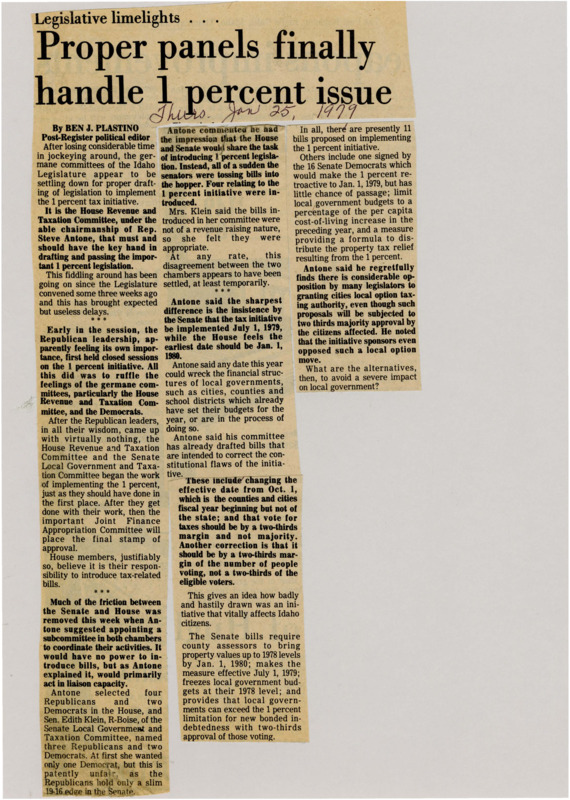
Plastino wrote in the aftermath of the 1% Initiative, that “[f]igures released by the Department of Education… showed that because of the l percent limitation, school patrons in 49 of the 115 school districts in the state were called-on to vote for override levies. Of this, 43 were approved and six were rejected, 87.76 percent, which showed Idahoans do support their schools.” This initiative drove schools to secure funding through override levies which, in turn, minimized the intended impact of the initiative in the first place. Plastino wrote that “the gullible Idahoans who rightfully resented the groaning property tax burden are finding that they will pay even more in override school levies, increased electrical rates, and higher fees for all services, such as park recreation, garbage collection, sewer, water, and other.” Many aspects of their lives saw an increase in expenses because, according to Plastino, the relief within this bill benefited the wrong population.
This piece of legislation highlighted an interesting reality for the state of Idaho during the time of Plastino’s reporting. From the 1960s through the end of the 1970s, Idaho contained a more balanced distribution of political power between Democrats and Republicans. In other words, there was more of a spectrum regarding political ideology between both parties in the state. This delicate balance came with the understanding necessary battles in legislative sessions to pass legislation that could hold potential benefits for the state and its people. The end of this broader spectrum among political leaders in Idaho came to pass during the 1980 election cycle. Voters in Idaho were unhappy with the distribution of power after previous political turmoil and expansive efforts of civil rights activism in the nation. Under President Jimmy Carter, Idahoans (along with much of the country) experienced a loss in confidence following Carter’s handling of the oil crisis of the 1970s and the Iranian Hostage Crisis. That loss in confidence was highlighted in Idaho with the U.S. Senate Race between Frank Church and Steve Symms. Plastino reported extensively on the race between the two that would come to mark a major tide change in American politics. While the specifics of this race will be discussed in another work, Steve Symms’ defeat of Frank Church in the 1980 election is of note. The general 1980 election resulted in a portion of the people of Idaho losing a representative that aligns with their political views in the U.S. Congress. Plastino mentioned afterwards that “[s]ince 1933, the Idaho [federal] delegation has included at least one member of each party. Between 1933 and 1981, two Democratic senators served briefly together and two Republican senators also held office simultaneously for six years.” Heading into the 1980s however, this reality vanished and led to a super-majority in favor of conservative politicians.
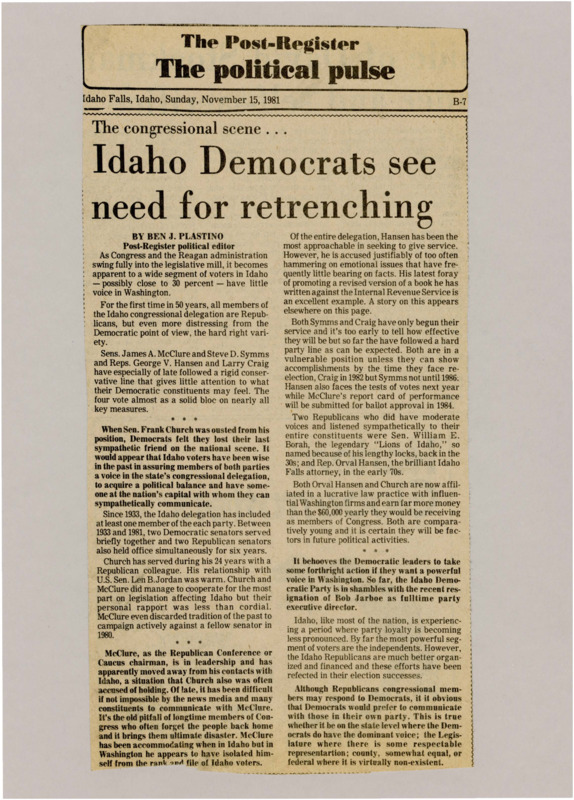
This race was one of many that benefitted the Idaho Republican Party and created the reality that the people of Idaho faced during this time; the beginning of a super-majority rule. One situation that arose was state leaders’ inability to solve financial instabilities with public school funding due to disagreements on how much money to spend and how it should be spent. There was consistent fighting between both political parties’ leaders regarding the best way to move forward. Throughout the 1980s, Idaho leaders were unable to agree on how to best fund public schools because Governor John Evans, the last Democrat to hold the governorship, and the Republican majority often butted heads. Discussing the 1984 election, Plastino highlighted this difference in ideology when he wrote that “[t]he key education issue centers on the arguments by Republicans that they allocated the maximum amount without wrecking state finances and by the Democrats that there was enough in the anticipated revenue increase to give more.” This is after the assessment from Plastino that “[e]ducation, unlike past years, became a strictly partisan issue in 1983. In the May special session, all of the 72 Republicans except one senator and eight state representatives opposed increased funding. In contrast, all of the 33 Democrat legislators voted for more education appropriations.” There existed a partisan divide with public school funding and it carried throughout all of the 1980s into the present day.
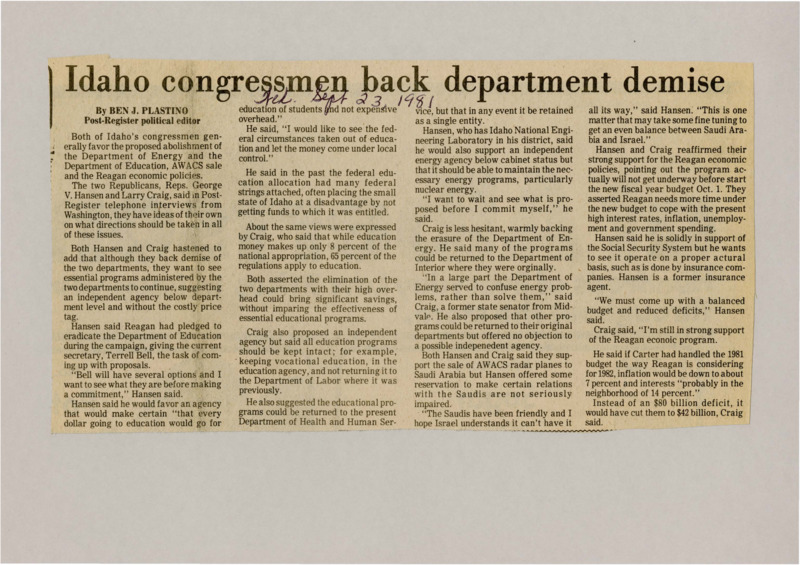
One of the most fascinating possibilities through the Plastino Collection is to witness the beginnings of ideas that later proved impactful on the educational climate of Idaho, and by extension, the country. In 1981, Plastino reported on Idaho’s two delegates to the US House of Representatives of the time, Larry Craig and George Hansen, and their desires to eradicate the Department of Energy and the Department of Education. He wrote that both wished to see these government agencies dismantled their functions and responsibilities moved to other departments or local agencies. This was not an attempt to eradicate the departments completely, but rather redistribute the authority to local or state governments. Craig in particular said “all educational programs should be kept intact” while pointing to “keeping vocational education in the educational agency, and not returning it to the Department of Labor where it was previously.” However, following the 1980 election cycle, a more aggressive effort began to remove the Department of Education and allow states to have control over the money allocated through the agency. Representative Hansen made the point to say that “Reagan had pledged to eradicate the [department],” but this did not come to fruition.
Another idea that has earlier beginnings was found while Plastino discussed the 1985 legislative session, where he acknowledged proposed legislation from lawmakers that he deemed to be “keen on regressive legislation.” One legislator in particular, J.C. Chadband suggested multiple pieces of legislation that were shut down almost immediately, or at the very least received little consideration. His most notable piece of failed legislation was one that could have changed the landscape of education, which was to “permit tax credits to parents of children attending private schools which would have virtually made education optional in the state.” This failed legislation, combined with the previously discussed proposed dismantling of the Department of Education, are important to consider when discussing the modern situation of public school funding. Modern day legislation is often termed new and original, but the reality is that many political ideas are merely recycled, restored efforts to push legislation to a current audience and attempt to establish these ideas into law, which is the case with these two examples. It is also notable regarding the duration of which these ideas have persisted within certain political belief systems. The reality that these two proposed ideas have been thought of for nearly a half century has the potential to show modern Idahoans how our history can impact our present and our future.
Within this collection, there is the potential for readers to see how significantly Idaho has been impacted by its past, and the current public school funding model is no different. The story of our modern-day public school funding system is nearly the same as it was a half century ago with different pieces of legislation or hurdles that only increase the difficulty for our students’ education to receive the funds it needs. The knowledge within this archive can help readers become more informed to the reality that our state has long struggled to fund its public schools and has made local taxpayers step up to provide the money needed for an adequate education. Legislation, whether it be limitations on property taxes or continuous tax cuts, will always carry the potential to create challenges for school districts and it will push the burden of education funding and many school districts’ shortcomings onto Idahoans. Political leaders have argued then, and argue now, on how to come to an agreeable solution to fund public education There now exists more considerations to keep in mind with the current state of the Department of Education and the creation of private school tax credits which were once seen as ideas that would never see the light of day. The Ben J. Plastino Collection allows its readers to realize the modern realities of many aspects of life, such as public school funding, and to perhaps become a more informed Idahoan when making considerations on those aforementioned realities. This state has a long history that is impacting our present and will impact our future, and collections such as these can help the uninformed change course and navigate political discussions and legislation with the knowledge and context necessary to engage in those discussions.
Antonio Isiordia is a second-year M.A. student in English at the University of Idaho. He researches educational policies and practices in the state of Idaho from the 1960s to present day. He will be incorporating this research into his thesis. Prior to his Master’s degree, he taught high school English in Washington and Idaho.
Technical Credits - CollectionBuilder
This digital collection was built with CollectionBuilder, an open source framework for creating digital collection and exhibit websites that is developed by librarians at the University of Idaho Library following the Lib-Static methodology.
The projects uses the CollectionBuilder-CSV template and the static site generator Jekyll to create an engaging, metadata-driven interface for exploring the collection contents.