
April 10, 1942 entry Item Info
214
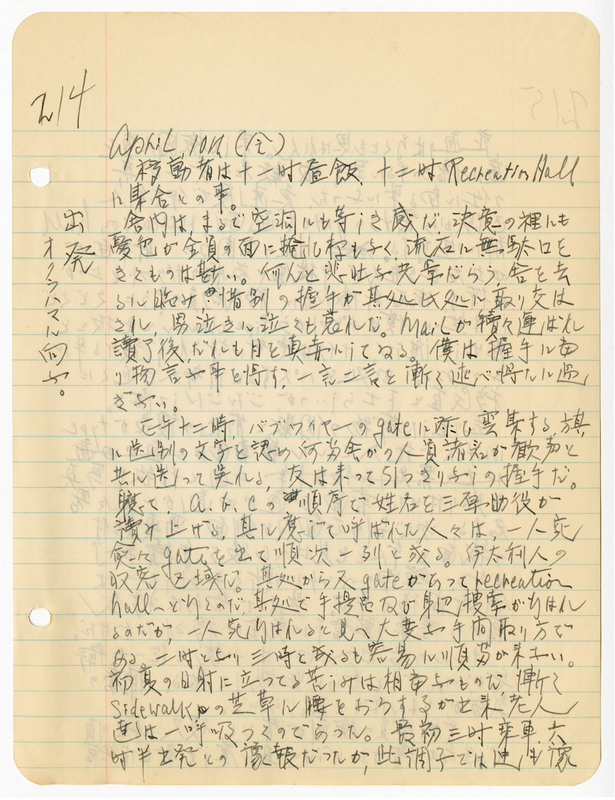
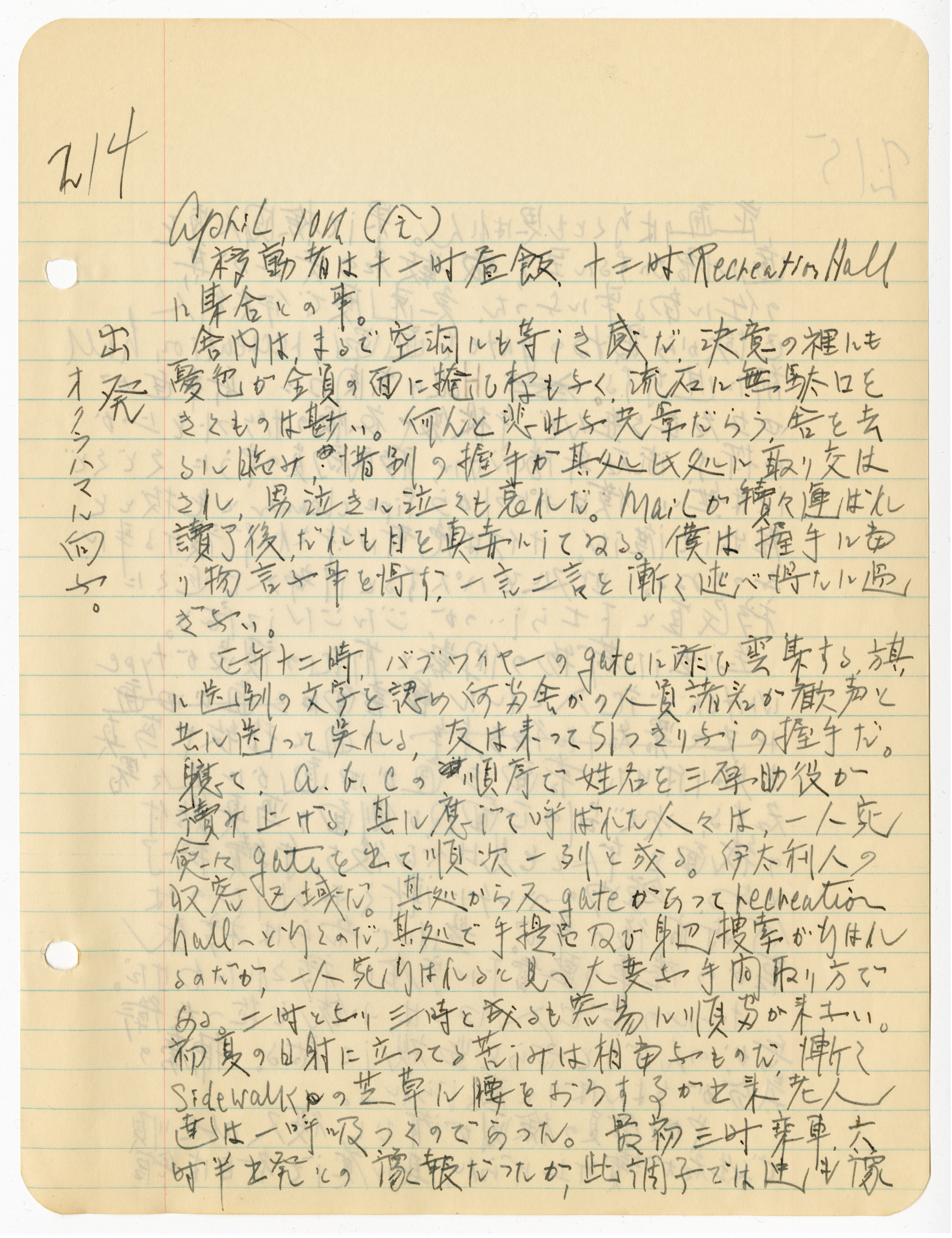
April 10th (Friday)
Those who are to transfer were ordered to have lunch at 11 and assemble in the Recreation Hall at noon.
Inside of the facility is almost like an empty cave. Everyone is determined to move forward, but sadness is on each face. There is almost no one even making small talk. What a sorrowful view. As we were leaving the barracks, we were exchanging farewell handshakes to each other here and there, and it was heartbreaking that all the men were crying. Mails were being brought over, and everyone had red eyes with tears when we were done reading them. I could not say anything while shaking hands except for a few words I was able to utter.
At noon, farewell messages on the flags gathered along the gate of the barbed wire fence were visible, and we could hear members of some barracks shouting farewell to see us off. We were shaking our friends’ hands just one after another. Representative Mihara called our names in alphabetical order. One by one as we were called, we went out through the gate and formed a line. That is the area where Italians are detained. We went from there through another gate to the Recreation Hall. Our carry-on items were inspected there, but it required a tremendous amount of work to check each one of us. We waited for two hours, and three hours, but processing did not go on easily. It was quite hard to keep standing in the early summer sun. Elders finally were able to sit down in the turf area on the sidewalk and take a break. The initial schedule was to get aboard on the train at 3 and depart at 6:30, but that appeared impossible judging from how things were going.
215
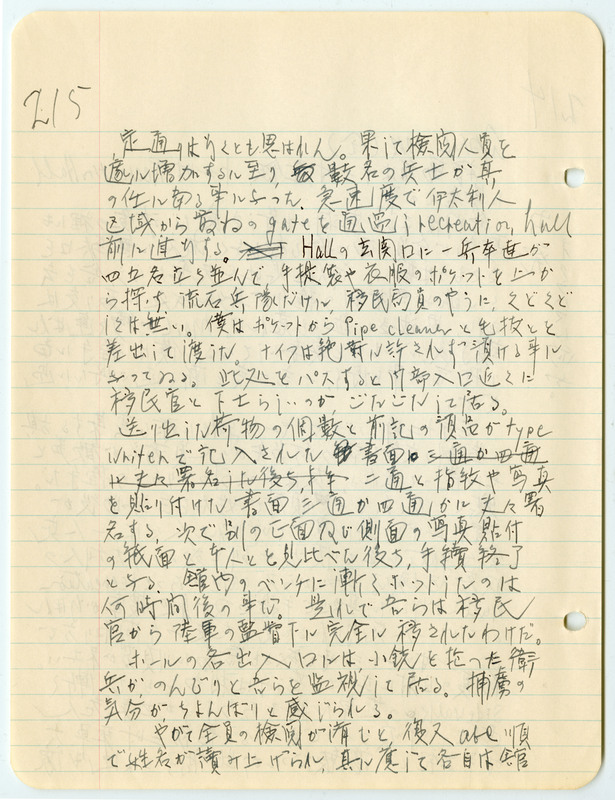
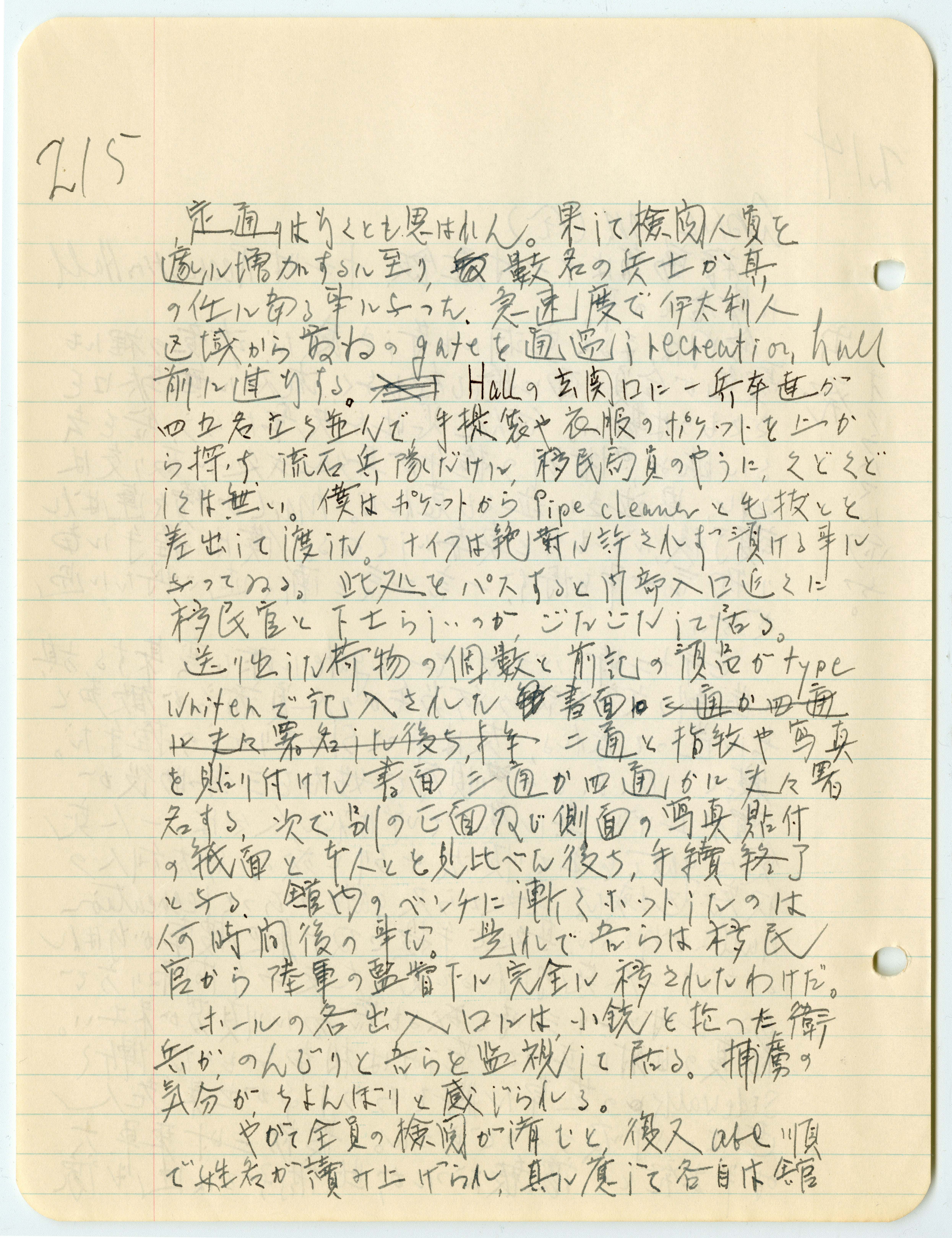
They finally decided to add inspectors, and several soldiers were assigned for the task. We hurried through the area for the Italians, went through the last gate and walked toward the front of the Recreation Hall. Four or five private soldiers were lined up in front of the hall entrance and patted us down on the pockets of our clothes and carry-on bags. As they are soldiers, they are not slow like INS officers. I took out a pipe cleaner and tweezer out of my pocket and handed them over. Knives are strictly restricted, and we were expected to hand them over to be kept by the administration. There were a bunch of INS officers and enlisted officers inside by the entrance after we went through it. We signed each of the two documents with the number of luggages sent in advance and the above-mentioned items left with them typed in, and also each of three or four documents with our photos and fingerprints glued on. They checked the front-view and side-view photos to match the person at the next spot, and that was the end of the procedure. It was hours after we left to finally be able to sit and relax on a bench in the building. This marked we have been moved from the INS surveillance to the army surveillance. Army guards carrying a gun were leisurely watching us at each entrance and exit in the hall. I had a bit of a prisoner of war feelings.
After everyone was inspected, our names were called again in alphabetical order, and we lined up in the clearing outside of the hall asn we were called.
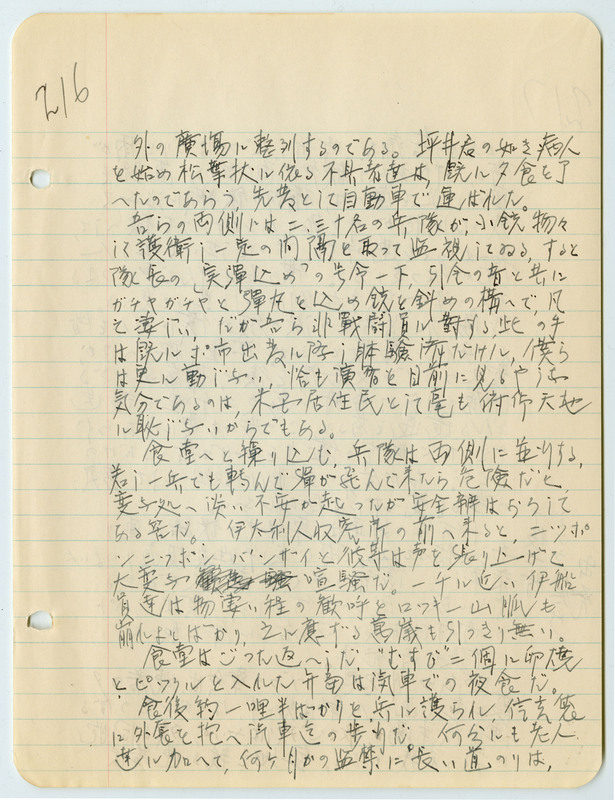
216
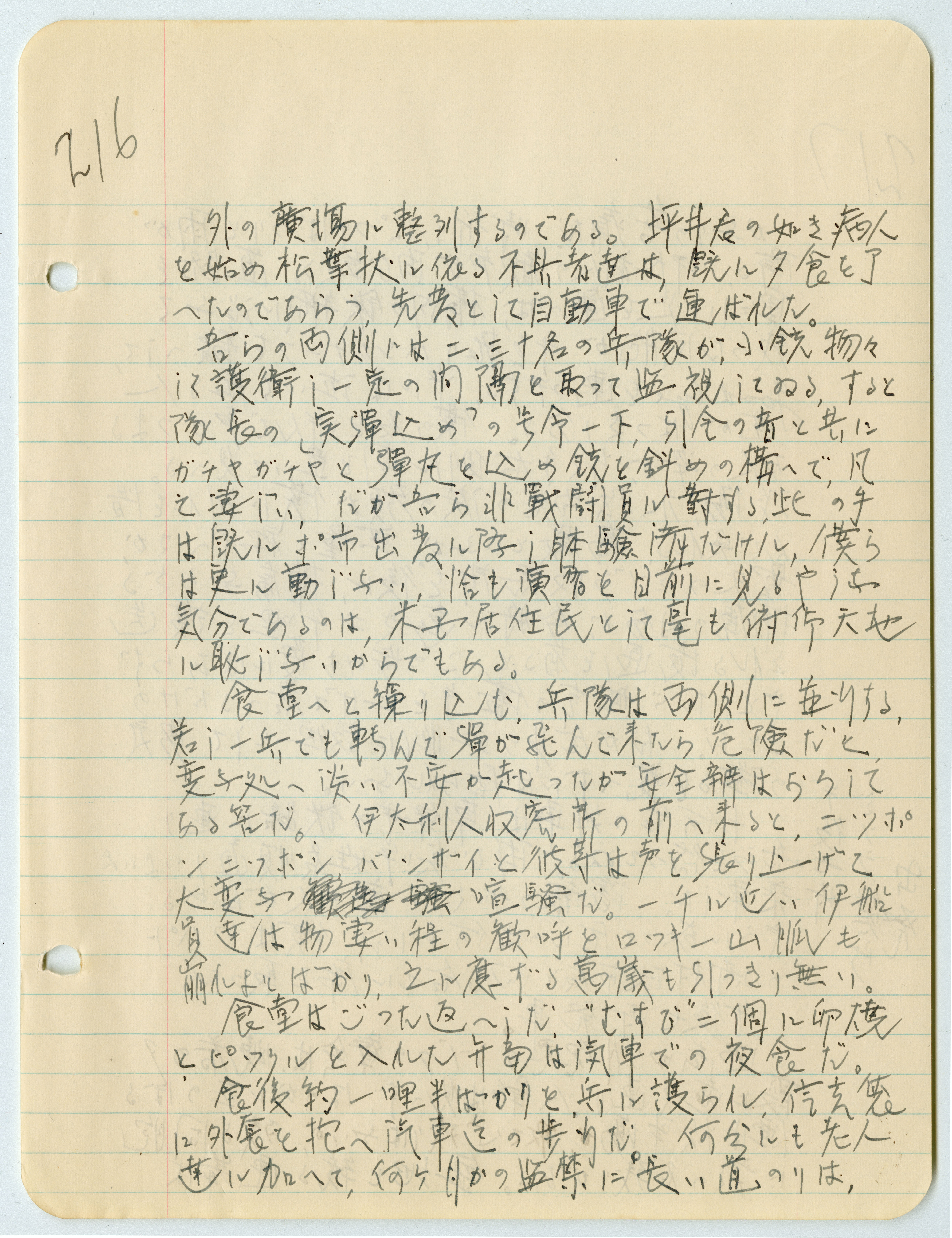
It looked like those who are in poor health like Mr. Tsuboi and disabled people needing crutches had already had dinner, and they were transported in a car as the first group. 20 to 30 soldiers were lined up keeping a certain distance from each other on both sides of us, guarding their rifles and watching us. Upon “Load up your firearm” commanded by the commanding officer , they loaded up their guns with rattling sounds and held them at the ready. Everything was so frightful. However, we all have experienced such treatment to us civilians when we left Po [1] city. That did not frighten us any longer. It was just like watching an army drill, and that is because we absolutely do not have anything to be ashamed of as a resident of the U.S.
We marched into the mess hall. Soldiers were lined up on both sides. I had this faint worrisome idea thinking it would be horrible if even one of them tripped over something and his gun discharges a bullet, but I am sure the safety locks were on. When we reached in front of the facility for the Italians, we heard such a loud cheer from them saying “Hurray Japan, Japan”. Shouting from nearly one thousand Italian sailors sounded powerful enough to have the Rocky Mountains crumble, and banzai calls in response from us arose one after another.
Mess hall was overcrowded. Boxed meal with two rice balls, omelet and pickles was for our night snack on the train. We marched to the train about one mile away after a meal guarded by soldiers, and I was carrying my drawstring bag and coat. A long walk was highly painful for the elders and us who have been detained for months.
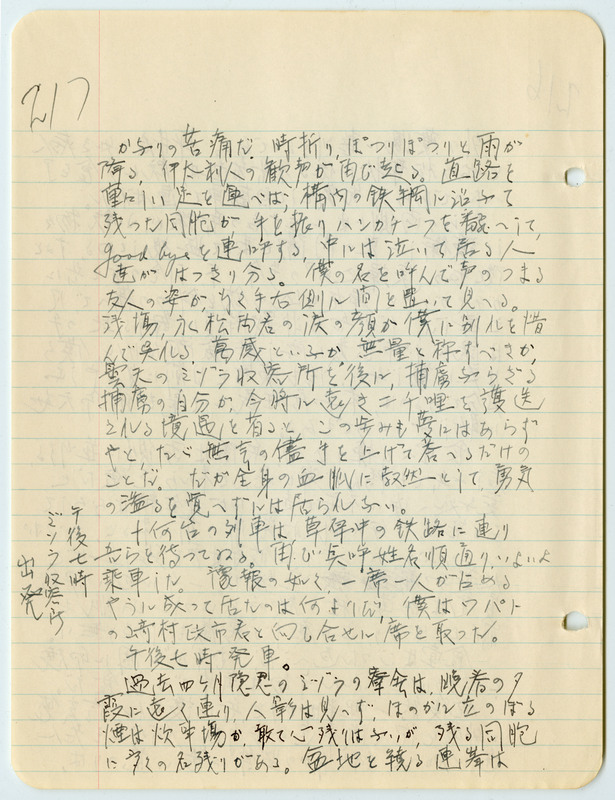
217
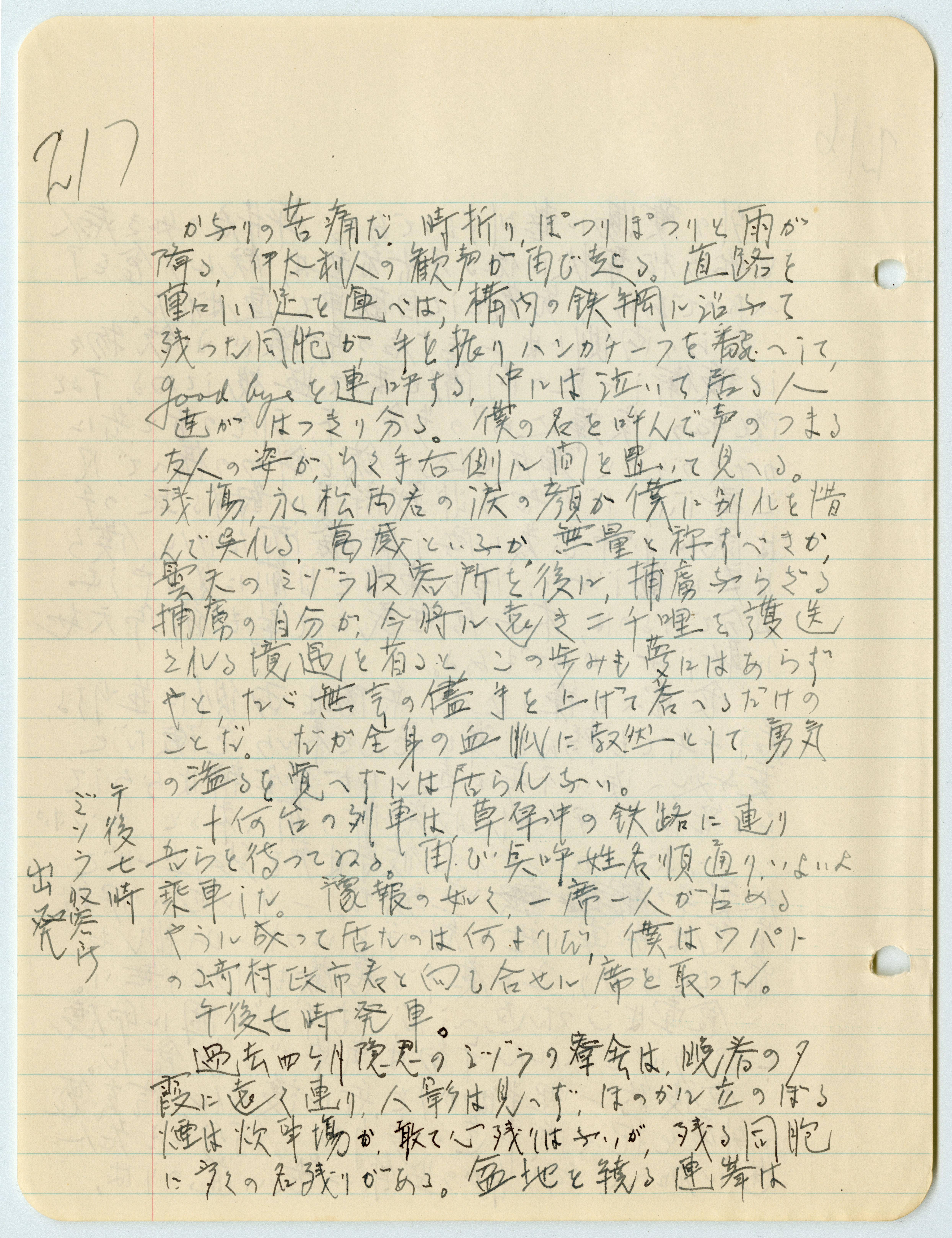
Raindrops were falling occasionally. Cheers from the Italians started again. As we were walking forward with our heavy feet, remaining fellow citizens in the facility were lined up on the wire fence, waving their hands and handkerchiefs, and shouting goodbye over and over again. I could clearly see some people crying. I saw my friends calling my names and getting choked up on the right side by side. Both Asaba and Nagamatsu in tears were bidding farewell to me. I was not sure if I was emotional or feeling numb. I was thinking of my situation where I am like a prisoner of war and being guarded and sent two thousand miles away leaving the Missoula camp behind under cloudy sky. I just raised my hand in response without a word, thinking this walk was not in my dream. However, I could not help finding energy in my bloodstream and feeling courage filling up my heart.
Over 10 train cars were hooked together and waiting for us on the railroad going through a field. Our names were called again, and we were going on board as we called. It was great that the seats were arranged to have one seat occupied by one person as I predicted. Mr. Masaichi Samimura and I took a seat facing each other. The train departed at 7 p.m.
The barracks in Missoula where we had been enduring hardship were lined up far away in the late spring foggy evening. I could not see anyone and was wondering if a faint trail of smoke was coming up from the kitchen. I do not miss the place but do tremendously miss the remaining fellow citizens.
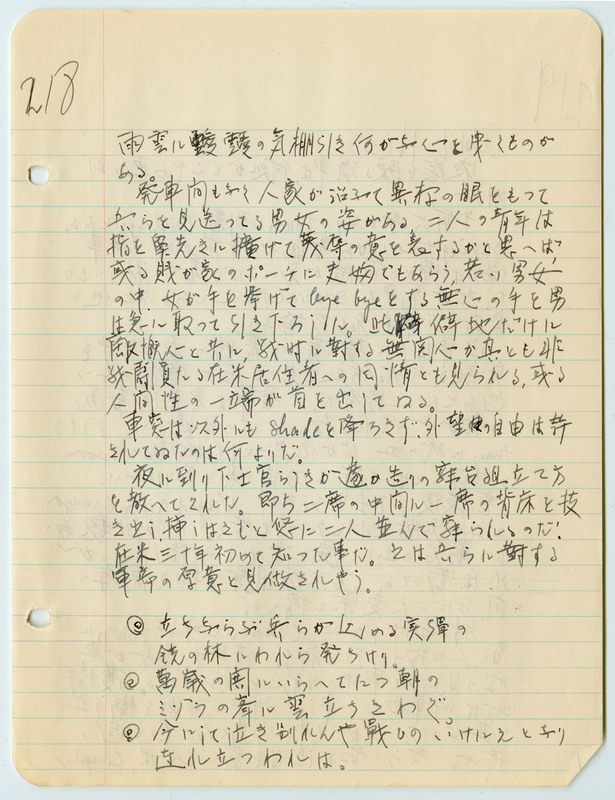
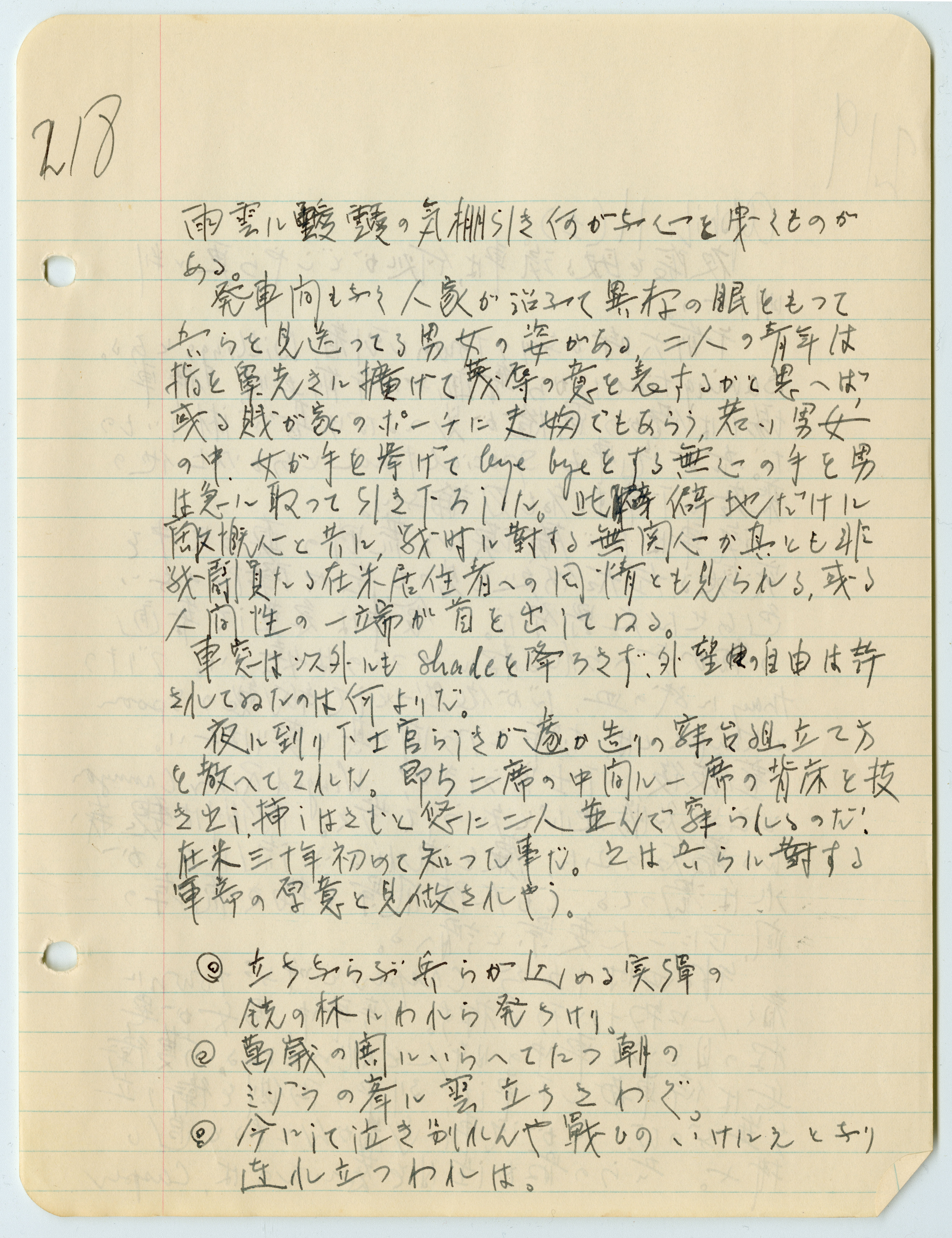
218
The range of mountain peaks surrounding the basin was brushed with rain clouds, and it somehow conjured up some feelings.
There were houses alongside shortly after the train departed, and I saw men and women strangely looking at us. Two young men spread their fingers in front of their nose in an insulting manner, while a young couple, probably husband and wife, were on the porch of their poor house. The woman raised her hand and innocently waved it bye bye, and the man suddenly grabbed her hand and put it down. It was relatively a remote region, and it seems like those people lack interest in the war along with hostility or are sympathetic toward non-combatting civilian residents of the U.S. Such an occasion gives us a glimpse of humanity.
The windows were surprisingly not covered with lowered shades, and it was good that we were freely able to see outside.
At night, a seemingly non-commissioned officer showed us how to assemble make-shift beds. It was inserting and sandwiching one back piece between two seats to make a bed big enough for two people to lie down side by side. I have been in the U.S. for 30 years, and I heard of this method for the first time. I would say this is a goodwill gesture for us given by the military.
We departed, through a forest of firearms, loaded with bullets by a line of soldiers Clouds arise on mountain peaks in Missoula, in the morning we left with fighting cheers of banzai I am crying over farewell as I sent away, as a victim of a war
[1] Portland?
- Title:
- April 10, 1942 entry
- Creator:
- Sakaino, Bunro
- Date Created (ISO Standard):
- 1942-04-10
- Description:
- April 10, 1942, diary entry written by Bunro Sakaino while he was incarcerated at the Fort Missoula Internment Camp in Missoula, Montana.
- Subjects:
- concentration camps diaries
- Location:
- Fort Missoula, MT
- Source:
- MG 387, George Shihei Shitamae papers, Special Collections and Archives, University of Idaho Library
- Translator:
- Transcribed and translated by Naoko Tanabe, 2024-2025, of Densho (densho.org)
- Source Identifier:
- mg387_1_7-1942-04-10
- Type:
- Text
- Format:
- application/pdf
- Language:
- jpn
U of I Digital Collections contain unique digitized and born digital archival materials in a variety of formats. The Library is committed to ensuring our resources are accessible to all users. Please contact us if you need support accessing or using this archived content.
Contact us about this record Library Help- Citation:
- "April 10, 1942 entry", Bunro Sakaino Concentration Camp Diary, University of Idaho Library Digital Collections, https://www.lib.uidaho.edu/digital/sakaino/items/sakaino079.html
- Rights:
- In copyright, educational use permitted. Educational use includes non-commercial reproduction of text and images in materials for teaching and research purposes. For other contexts beyond fair use, including digital reproduction, please contact the University of Idaho Library Special Collections and Archives Department at libspec@uidaho.edu. The University of Idaho Library is not liable for any violations of the law by users.
- Standardized Rights:
- http://rightsstatements.org/vocab/InC-EDU/1.0/