
June 30, 1942 entry Item Info
Relocation issues
There was an unofficial announcement that we are all going to be sent to a different location on May 23rd. The destination remained unannounced as usual, and we were told it would take three days and nights to get there and advised to bring an overcoat for the nights on the train as the destination is in high altitude. As expected, various rumors have been rushing through the camp like a flooded river, and it is almost impossible to hold control over it. It is said that the departure is scheduled for next Saturday or Friday.
367
Shortly after, on the 24th, an official announcement was made by Representative Takeoka that we will depart on Friday (29th), and the destination is Camp Livingston in Louisiana. It is expected to take one day and one night, and we were told to bring our coats for chilly night air on the trip. Just like when we left Missoula, we are to leave our belongings to the administration to transport and just have a carry-on bag for personal items such as toothpaste and others.
We are staying in tents when we get to Livingstone, and five or six people are interned in one tent. Is it located within 244 miles from New Orleans, and everyone is to be sent away. Another possibility is that they are sending the ones who wish to go back to Japan to the departing location and send the rest of us to Livingstone. We cannot take the announcement as it is spelled out. Judging from what the U.S. government has been doing to us, we do not know where they are sending us to. It must be Wisconsin, or Nex Mexico which we view as a problem location and have been talking about. Countless rumors are circulating. Someone said there was one of the largest prisons in the U.S. in Livingstone that could hold about 10,000 prisoners. He told us that it is surrounded by tall walls instead of wire fences, and you can see the sky, but otherwise it is such a gloomy place where the world outside the walls is completely separated as if he had been there. It is what Mr. Yashichi Kato in the 5th tent said. Both Minami and Masuoka believe in it and are spreading the story.
368
My friends from Northwest have mixed feelings. However, we all are dissatisfied with living in a leaky tent with dust and wind, and everyone seems somewhat hopeful assuming that we are not moving to somewhere worse than this place. However, we will all miss our lives here as well. Home is where you make it. Some people say they got used to this place, and if not living in a tent, they would not like to move away. It is human nature and also the honest feelings of people who have been living overseas far away from the homeland for decades.
Death of another fellow Japanese
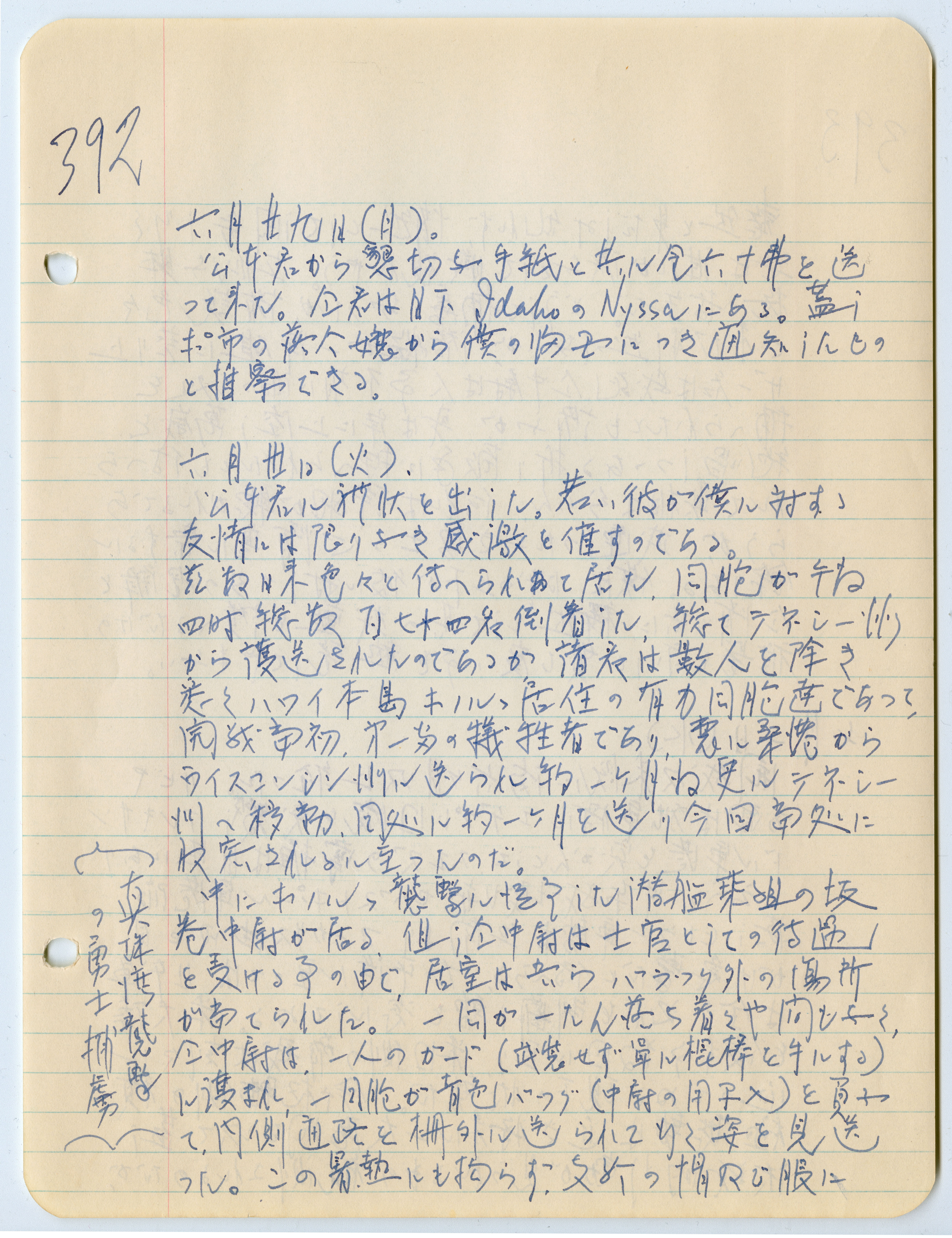
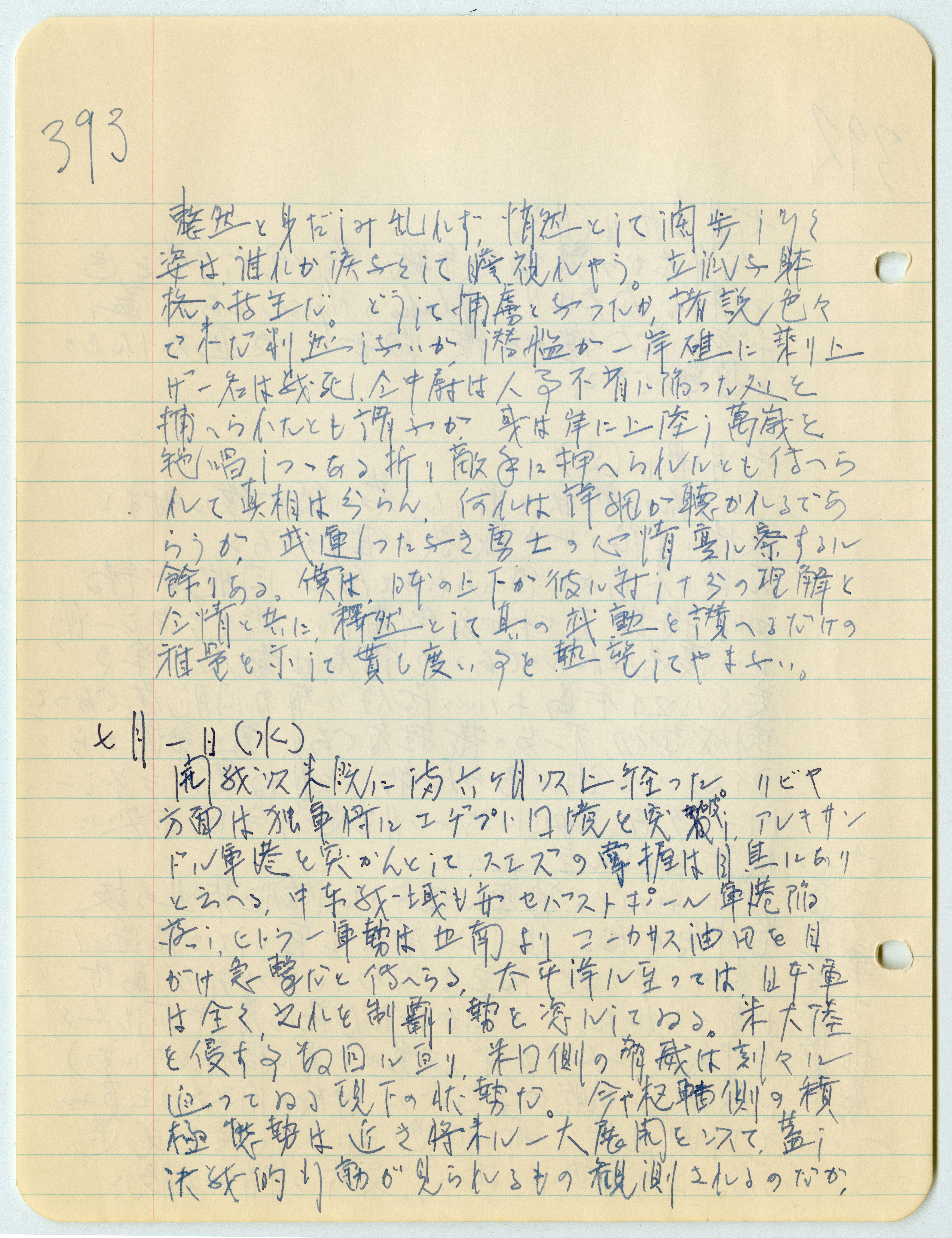
It was announced that Mr. Itsuharu [1] Shimoda from California, who was forced to be hospitalized on the 12th, finally passed away. It sounded like he was making a gradual recovery but developed a violent personality, and unfortunately died as a result of injection by a military doctor. It was reported that the cause of death was encephalitis triggered by syphilis.
A Buddhist memorial service was held as always in the morning on the 26th. Roll call has been conducted since that day with everyone gathered on the pass on the south gate of the wire fence. It is extremely painful to keep standing in around 100 degrees heat in the afternoon for elders and especially for people with health issues. This continued until our departure.
The flowers Mr. Ono planted in front of the seventh tent are blooming and attracting attention from a lot of people. Everyone is appreciative of them, and some even ask him to share, and he is fulfilling requests. When flowers Mr. Ono plants bloom, a relocation order is issued. We jokingly asked him not to plant anything any more but appreciate his hard work and emotionally supportive acts. There are many people who express their affection toward flowers too.
Departure
Each group was ordered to bring our packed belongings to the assigned area and leave them there by 7 am on the 28th, the previous day of the departure date. It was such a commotion from around 6 am, and all the items were brought out of each tent and piled up. It was Mr. Sato’s clever idea to line up our suitcases and bags separately.
Departed on the 29th. Breakfast was served one hour earlier at 6 am that day, and at 5:20 for us with health issues. We have been in the U.S. for decades, but it is very rare to have breakfast so early except for Sunday mornings before going fishing.
We lined up in alphabetical order a bit after 8 am, and roll call was conducted. The supervising major delivered a threatening message and said, “if we discover anyone who is hiding in a tent to stay behind, he will be shot to death.” That paints a piece of war scene, and a certain level of tension is detected.
All of us departed in five lines after 8 o’clock. Five brightly colored Red Cross trucks carried us with health issues to the boarding place within the camp.
370
Guards carrying a rifle were in the trucks with us with a bored look on their face, but we are already used to having rifles and machine guns pointed at us. All of us were relaxed knowing we will not do anything to be shot.
However, the boarding area was heavily guarded. Soldiers with guns and batons were on both sides of our lines, watching us closely not to let even a drop of water escape. We, with health issues, joined the others here and lined up at the back of the front area as a separate group. Mr. Tsuboi was using a cane, his steps were unsteady and he was followed by a soldier pointing a gun at him when he joined the line later with. It was so painful and hard to watch.
We went aboard, and they sent the sick and elderly to the last car. The last car was for the second half of the S names through the Y names, but there were not any seats for several of us.
I looked back when I got aboard and saw tens of armed soldiers gradually approaching toward the entrance of the car from a distance, farming a wall and pointing guns at us. It looked like they were being pulled into the car with a rope, and it was over the top. The guard was so heavy that I have not seen such a scene even in photos of prisoners of war transportation in Europe.
The train departed, and a guard shouted to tell young men to give up their seats for us. Young men seemingly from Panama gave their seats to Mr. Tsuboi and me. Shortly after, the supervising major took his soldiers and assigned tens of them to empty seats in different rooms to make a lot of seats available for us.
371
I got to have the end seats all for myself. The train started to move shortly after, ran slowly in the facility, stopped and departed blowing a whistle. It was 10:30 am.
We traveled through Lawton. It was reported that the city is recently suffering from a housing shortage due to increased population caused by military industries development and others. A quick look from a train window did not reveal anything though.
We are traveling through the south end part of the continent by train, and all we can see is a vast wild field or large farms as expected. It is characteristic of the South to see black people by the railroad. Interestingly, you can tell if black or white people living in the farm houses peppering the field by looking at laundry drying out. It is certain that black people live in the house if you see clothes in bright colors. Unlike the trip across Wyoming, I see trees, and green farm fields as far as we can see display the richness of the region. It is still the monotonous scenery of the continent though. I see cactus flowers growing in weird shapes by the railroad, and it is a rare sight for us who alway lived in an urban area.
We crossed the Oklahoma State border and kept running in the part of Texas. Scenery outside the windows was nothing but boring for our eyes. We spent more than one and a half hours at the Dallas station, the only city in Texas. It is getting to dawn, and neon signs are turned on. Where is the world war taking place? People are looking at our train as it is unusual but do not have any nervous expression on their face. Vastness of the U.S. just hit me.
372
Our train was parked outside of the city, and I saw a wild field on the right and can tell it is sparsely populated as you expect Texas to be. When I looked out of the window, I saw countless fireflies flying around like sparks. The surroundings are not serene, and beautiful lights of fireflies seem out of place just like lilies in mud. I saw fireflies blinking along the railroad, and they provide ever-lasting peaceful scenery.
I lied down and fell fast asleep in scorching heat on the train. I had a slight body ache and felt tired the next morning. Armed guards are with us on this trip, but they are not watching us when we go to the restroom. It is very lightly guarded. The guards are relaxed as usual, singing and chatting with each other and smoking as they wish.
We found ourselves in Louisiana State when we woke up the next morning. The sun was floating far away up in the red sky above a pine forest just as it was painted in Japanese red ink. It rather looked like a sunset than sunrise.
Shortly after, we passed a clean town in bright dark green. Lawn was surrounded by trees, and I even saw a swimming pool. The streets were spotless. Houses among trees are mostly bungalows, and I can imagine this is a wealthy neighborhood. It looked like an oasis for my eyes so bored with wild fields and large farmlands, and I truly appreciated the sight.
373
I assumed the name of the first station we stopped at is White as I saw a clear “White” signage, but it turned out there is another building with a “Colored [2]” sign on, and the above mentioned “White” signage is for the door for the white people. The name of the town is “Natchitoches”. It is probably a small city ruled by the oil money new rich. We arrived at Alexandria City shortly after, and seeing black men and women walking everywhere is something out of the ordinary. We arrived at Camp Livingston, and it was around 10 a.m. on June 30th when we pulled in the facility.
Armed soldiers were lined up and heavily guarding on both sides of the train as usual, with soldiers positioned a certain distance from each other and pointing light machine guns at us. Walls of other soldiers were also there in spite of the brutal heat to take a look at this unusual sight, waiting for us to get onboard. A few of them were waiting with a camera among them, but the guards spotted them and confiscated them all. This is because it is not permitted to take photographs of us or any publicity over us.
We got off the train and had to keep standing in scorching heat for a while. The welfare team drove us who are sick in their truck, and the others had to march in five lines for 4.8 miles to the camp. The truck for the sick departed about 10 minutes after the rest left, but it passed the walking ones on the way. Heavily armed soldiers on both sides of the lines were seen more than we used to see.
374
The thing that surprised me the most was that a troop of soldiers pointing a gun were following the lines from behind, squeezing them with a rope pulled on both sides. As I heard later, the supervising officer was worried and asked them if they wanted to take a break several times on the way, but they all refused it, kept marching for 4.8 miles and reached the new facility in the barbed wire fence.
Unlike the one in Sill, this camp has semi-permanent barracks. The maximum capacity is 15 people per barrack, and the upper part of the barrack outside walls can be opened and closed from outside. All have metal mesh to keep flies from coming inside, and they have some glass windows as well for sunlight to come in. Air circulation is superb, and they are like perfect summer houses.
There are three light fixtures hanging from the ceiling, and two stoves are installed. Each bed has a mattress, box spring, comforter and a pillow. Bedsheets are not provided perhaps due to a shortage of them.
There are passes outside the barbed wire fence, and another round of barbed wire fence outside of the passes. Watchtower(s) have guard(s), but they are not intimidatingly armed with machine guns as they were in Sill. The camp consists of 10 sections, and each section has 34 barracks. However, each section is divided by passes, and we are forbidden to freely go back and forth among them. All the facilities are situated in the forest, and it is like an auto camp. If the food is decent, this can be a favorable place for good health.
375
The distance to the latrines, washing rooms and shower facilities depends on the location of the barrack, and it causes some inconvenience.
Originally, we were arranged based on alphabetical order and assigned in two different areas, but we obtained the agreement from the authority and managed to put the people from California together and also from the Northwest. All the people from Panama and Hawaii moved to the J area, and Section K is to be occupied by the others.
Each of us first settled down where we preferred to form a group of friends situated together when we arrived. It is shameful to see some disputes over sovereignty based on the preoccupation.
Only one soldier with a baton is assigned to guard the barbed wire fence entrance for each section, and it seems extremely light. It might be because they finally understand how Japanese behave, or maybe they received a special instruction over how to treat us from the federal government due to an unusual situation we are put under.
Two light poles are being installed once every few weeks outside the barbed wire fence, and more powerful searchlights are shining bright light to watch us at dark nights into a deep forest.
Shortly after we arrived, we all were assembled, and the supervising officer of the camp gave us an official transfer acknowledgement.
376
He also made a statement that we were orderly and cooperative in Camp Sill, and that he is expecting the same attitude constantly displayed in this camp as well. His remarks were received with applause, and he was sent off with us cheerfully saying “goodbye” to him. It was an unexpected exchange of friendship between the military and unarmed Japanese civilians living in the U.S. during the wartime.
Meals
Meals in this camp are poor, and they are no comparison to what was served in Camp Sill. The portion is also so small that it is creating a lot of complaints. There is of course no way that they are offering a special diet for someone like me who is suffering from digestive system problems. First of all, bowls and plates are for soldiers, and they are beyond my description. They have a certain type of smell, and it does not stimulate my appetite.
I am surprised to see brave folks who are ready to devour even a plate while complaining about the quality of the food. There are two types of complaints about food, quantity and quality, and when the former type of people say “the food is bad”, it means “the portion is too small”. I would like to advocate higher quality food. I understand they have a limited amount of food, but there should be some room for improvement on nutrients and taste. I am afraid that some low ranked soldiers are skimming off our food or they are not working hard to serve Jap [3]. In that case, there should be something we can do to improve the situation.
Wooden Clogs
Someone made a pair of geta wooden clogs and started to wear them. Everyone is good with their hands. Mr. Sakimura made a pair for me, and Mr. Ono is making traditional straps for me.
377
It has been more than 30 years since I wore geta wooden clogs. I could not stand the noise as everyone is walking around in geta clogs on the floor, but now I got used to it and rarely wear shoes. One soldier in charge of meals looked happy to have a pair, and he said he begged one of the Japanese to get it. Clogs are convenient to wear to go to the shower rooms, and they are always hygienic. I am glad to see that Japanese are alway Japanese.
Radio
Radios have been returned after initially confiscated for inspection, and now we can openly listen to them. Mr. Kato is the representative listener in our group, and he is working hard listening to it every night. His reports are briefer than newspaper articles, but he is emphasizing that his news is delivered one night earlier.
Kiosk
Coupons have been distributed on two different occasions by today (June 21st), in the amount of two dollars and also one dollar and 90 cents. The kiosk is poorly stocked, but they offer cigarettes, toothpaste, shoe shiners, cigarette lighters, pencils, ink, shoe strings, and sometimes even candy bars. They are still missing daily items that we need. Two Japanese are responsible for working as a store attendant. Our cash is all held by the authority, and a two-dollar coupon is monthly distributed to each of us by the U.S. government. This is not enough for smokers. However, this should be a good policy after all if this war prolongs and we need to wait until peaceful time comes.
378
I heard that some of the detainees have more than 10,000 dollars held by the government, but the majority have just a small amount brought with them and occasionally receive money sent by the family. Those families also face forced removal and do not have means to generate income, and they cannot afford waste their savings either.
Meals have seen some improvement since Japanese personnel were assigned to be in charge of food, but there are still many aspects that we are not satisfied with. We sometimes even were provided with only one slice of bread. Shortage of milk is especially the biggest nutritional issue. Some angry members urge us to fast for two days or to throw away meals without eating them, and I am with them, but it is absolutely impossible to do for those who are complaining about the small portion. We heard that a correspondence inspector said some of us are complaining about the small potion while others are expressing satisfaction, and he asked which one is the true opinion of ours. We have never had such unpalatable meals. People might say we are spoiled with good food, but we lead such a life as we simply believe life is for us to enjoy.
Patients
Those who need to see a doctor are to report in advance and go to the hospital facility outside the fence in a group with a guard at a certain time in the morning. Dr. Tanaka is the main doctor to see us, and he has 20 to 40 patients every day.
379
Exchange to go back The first exchange boat for diplomats and others of both Japan and the U.S. departed from New York on June 18th. About 30 company employees and others from this camp were gradually sent to the port by guards. The first group of people who were ordered to return including Mr. Ichio Sato were added and left the camp at 4 in the afternoon of July 4th. They are scheduled to meet their families in New York. According to newspaper reports, the exchange boat (Swedish boat) delayed the departure and finally took off on the 18th. I am deeply disappointed that I did not get to be selected to be on this first boat. Such a departure order is unpredictable, and it comes at a moment’s notice. Those who applied to go back to Japan should always be ready.
(garden)
Mr. Onbarracko already planted seeds of vegetables, cosmos and asutas [4] in the empty space in front of our K-A # 1906 unit. Cosmos was brought from Camp Sill, and they had red and white flowers shortly after, offering a truly beautiful red-colored spot in this harsh surroundings. When I see those flowers in the early mornings when I get up, they conjure up warm feelings for my eyes in my tired heart that have been roughed up by an all male only environment. Tender emotions are tremendously sad and beautiful for us who are detained. It is also an unexpected love for nature felt by city people.
380
Inspired by his garden, the other barracks started building flower gardens one after another. They also are making vegetable beds here and there and enjoying the produce.
However, Mr. Sakimura volunteers to renovate and expand the round garden designed by Mr. Ono, started to build hexagon flower beds on the right and left sides and made a big deal deploying everyone in the barrack. We old folks were sweating to carry logs and pile dirt in scorching heat, and it was nothing but a waste of energy for us. I was just stunned to see what we ended up doing was planting some weed, pulling a wimpy young pine tree, carrying it over and planting it in the middle of it. Also, this pine tree is about 10 feet and has a few awkward-looking bundles of pine needles on the top just like messed up hair of a prostitute who just woke up. Big and small pine trees are all around. Native pine trees are offering nature decoration on both sides of the barrack. I have to say that bringing and proudly planting another pine tree in this environment is merely a tasteless and aimless action. It is like being offered piping hot sweet bean soup on an extremely hot afternoon. It is such a redundant idea like putting a roof over a roof. No consideration for natural beauty and no understanding of gracefulness. It is nothing more than assembling stuff to shape a form to satisfy materialistic desires. I despise that.
Extreme Heat
The heat is unbearable. It is not unusual to have the temperature at 95 or 96 degrees in the barracks on sunny days. I used to get dizzy at first and wanted to lay down on the ground many times.
381
It is fortunate that I am finally getting used to it and no longer feeling dizzy. May, June and July is the three-month rainy season here, and rain falling with thunder lightning offers a sort of coolness. There is a leak in the barrack roof every time it rains, and we are forced to move our beds around. The assigned officer came to check the leak once, promised a repair and left, but the promise was not executed no matter how many times it rained after that. This is another aspect of a war.
Poisonous Snakes
We have poisonous snakes in the facility, and we have already caught some of them. They are powerful enough that once you get bit, the poison travels all around in your body and kills you within several hours. One fellow caught an about 4-foot beautifully colored snake. One soldier saw it and told us that it’s an important sort of snake that kills poisonous ones. He told us not to kill this kind as they are helpful to get rid of poisonous snakes. Nature is alway good at controlling itself.
Baby Turtles
The ground in the facility is like clay does not absorb water. There is a lot of sand at the same time. The humidity is high despite the extremely high temperature. Maybe that is the reason why baby turtles come up once in a while. Some people catch them and keep them. Fireflies are not common, but we sometimes see them. Poisonous snakes, baby turtles and fireflies. What a strange contrast.
382
Duties
We are required to do physical work to beautify facilities directly related to our life in the camp. That includes mess halls, bathrooms and latrines, and also cleaning in and around the barracks and digging to build decks. We are all obligated to follow the orders. However, our understanding is that we have no obligation of physical work for the space outside of the camp beyond the barbed wire. We are supposed to be compensated if we voluntarily accept requests from the administration and offer our labor. It should be clearly understood as stated by the Consul General of Spain in Fort Sill. However, we are forced to render such physical labor almost every day here, and the elderly are obligated to work beyond their physical ability. As a result of negotiation made by our representatives, it was discovered that the authority has different understandings here. The administration ignores the existence of the barbed wire fence regarding our labor as they include the entire camp as the premises. I have to say that does not make any sense at all. I heard their response was that they were going to check with the federal government and it would take several days to get back to us. (We were told that on June 18th) Some elderly people encountered physically demanding tasks while working in the facility. Several of them had to carry large lumbers to a vehicle and unload them at another soldier barrack. They had to perform this unfamiliar duty under scorching heat at 100 degrees. They were of course somehow compensated, but this should never be forced.
383
Barrack Mates
The barrack mates of our number 1906 Barrack (All of them are numbered with 1900, and this is called number six by the military, starting from one) are as follows:
Sada, Sugimura, Masao Nose (he used to live in Seattle but was detained while working in Gaston, Oregon), Okamoto, Okazaki, Ono, Sakimura, Sasaki (Hiroshi), Sasaki (shun), Shinome, Tanbara and Takahashi. As Mr. Sato went back to Japan, we are currently (as of June 20th) one person short and have 14 people all together. The seventh barrack has only 11 as each of them has his own likings. Friends would like to stay together, and some barracks have less people than the maximum capacity. People from Oregon State mainly from Portland and those who are from Wapato and Yakima and have been together since they were detailed in Missoula are occupying four barracks of the fourth, fifth, sixth and seventh.
Inspection of Correspondence
It is favorable that censor of letters is being conducted in a fairly speedy manner as assigned officers are directly inspecting them in a barrack designated for mail handling. Letters written in Japanese though are sent to the central government, and it takes extra time. It does not function as correspondence any more. Letters written in the native language are supposed to be delivered swiftly according to the Geneva Convention, but we are flustered as we face such times of stress. The U S. government does not seem to have capacity to take care of such details.
[1] Itsuji?
[2] Spelled “colored” by the author
[3] This is the word that the author used
[4] アスタス not able to figure out what it is
- Title:
- June 30, 1942 entry
- Creator:
- Sakaino, Bunro
- Date Created (ISO Standard):
- 1942-06-30
- Description:
- June 30, 1942, diary entry written by Bunro Sakaino while he was incarcerated at Camp Livingston, near Pineville, Louisiana.
- Subjects:
- concentration camps diaries
- Location:
- Camp Livingston, LA
- Source:
- MG 387, George Shihei Shitamae papers, Special Collections and Archives, University of Idaho Library
- Translator:
- Transcribed and translated by Naoko Tanabe, 2024-2025, of Densho (densho.org)
- Source Identifier:
- mg387_1_7-1942-06-30
- Type:
- Text
- Format:
- application/pdf
- Language:
- jpn
U of I Digital Collections contain unique digitized and born digital archival materials in a variety of formats. The Library is committed to ensuring our resources are accessible to all users. Please contact us if you need support accessing or using this archived content.
Contact us about this record Library Help- Citation:
- "June 30, 1942 entry", Bunro Sakaino Concentration Camp Diary, University of Idaho Library Digital Collections, https://www.lib.uidaho.edu/digital/sakaino/items/sakaino212.html
- Rights:
- In copyright, educational use permitted. Educational use includes non-commercial reproduction of text and images in materials for teaching and research purposes. For other contexts beyond fair use, including digital reproduction, please contact the University of Idaho Library Special Collections and Archives Department at libspec@uidaho.edu. The University of Idaho Library is not liable for any violations of the law by users.
- Standardized Rights:
- http://rightsstatements.org/vocab/InC-EDU/1.0/