
January 1943 entry Item Info
 View Page 1
January 1943 entry
-
Item 1 of 31
Transcript
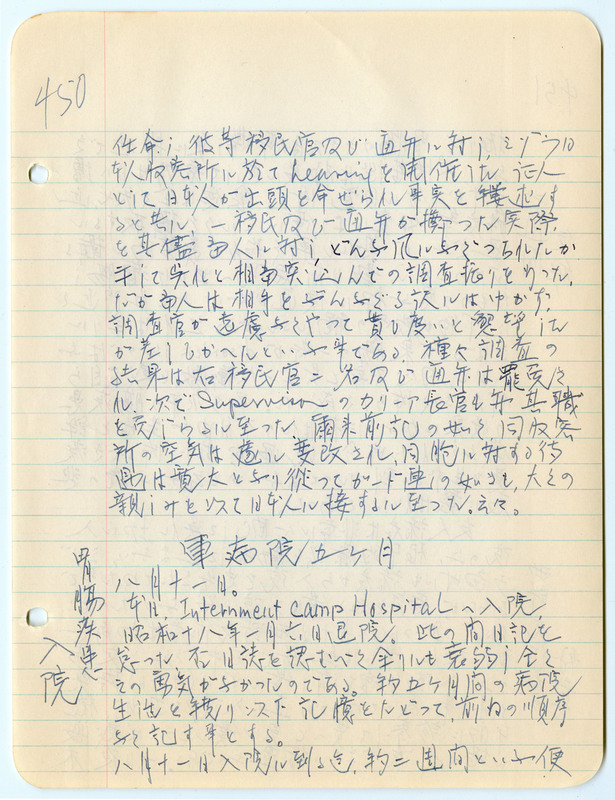
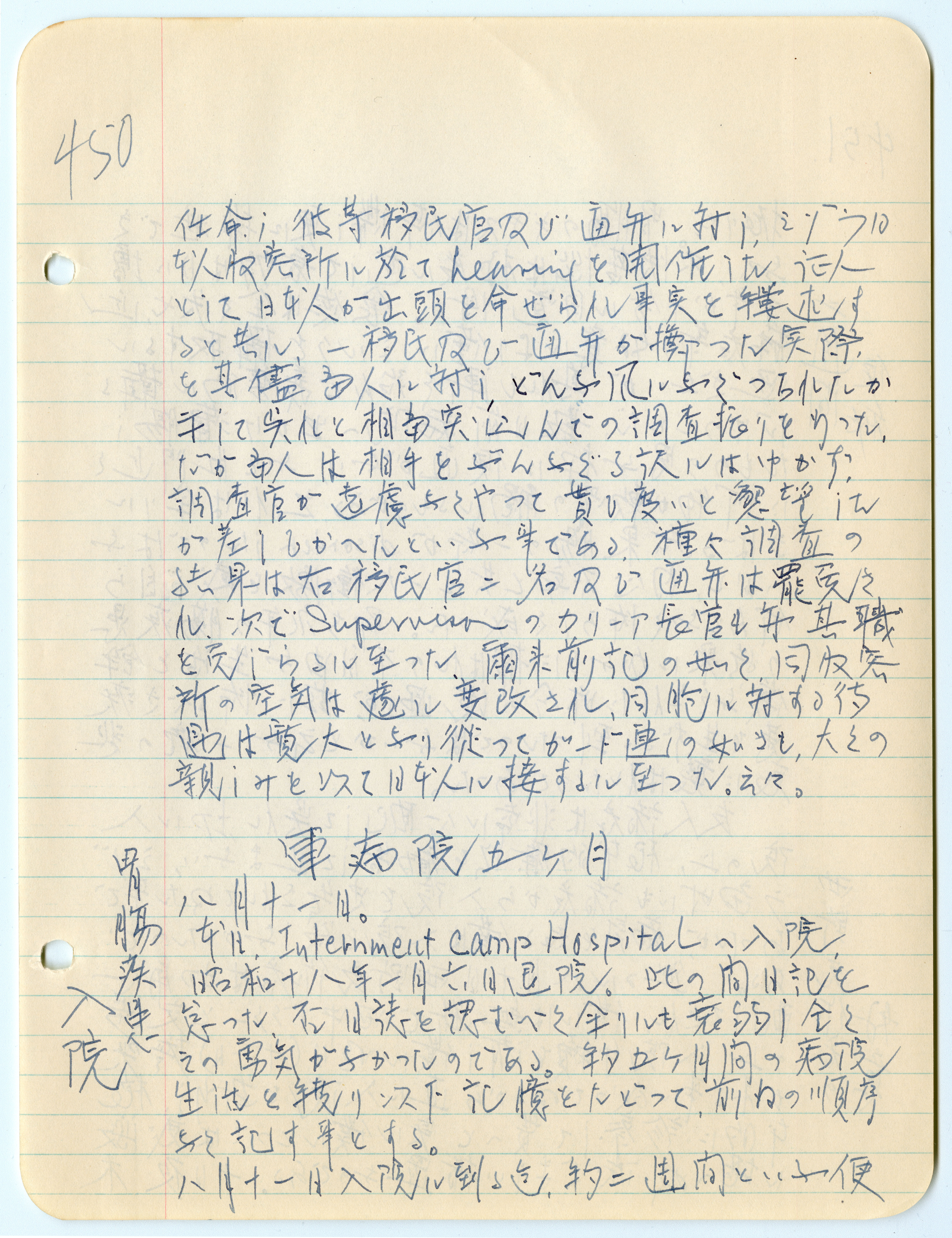
August 11
I was hospitalized in the Internment Camp Hospital today. I got discharged on January 6, 1943. I missed keeping my diary during this period. That is not true, I simply was too exhausted to write diary entries and did not have any stamina to do so. I will try to trace back my memory during the hospitalization for about five months and write about what happened in a chronological order.
I was constipated for two weeks before being hospitalized on August 11.
- Citation:
- January 1943 entry, page 1, January 1943 entry, Bunro Sakaino Concentration Camp Diary, University of Idaho Library Digital Collections, https://www.lib.uidaho.edu/digital/sakaino/items/sakaino323.html#sakaino324
- Rights:
- In copyright, educational use permitted. Educational use includes non-commercial reproduction of text and images in materials for teaching and research purposes. For other contexts beyond fair use, including digital reproduction, please contact the University of Idaho Library Special Collections and Archives Department at libspec@uidaho.edu. The University of Idaho Library is not liable for any violations of the law by users.
- Standardized Rights:
- http://rightsstatements.org/vocab/InC-EDU/1.0/
 View Page 2
January 1943 entry
-
Item 2 of 31
Transcript
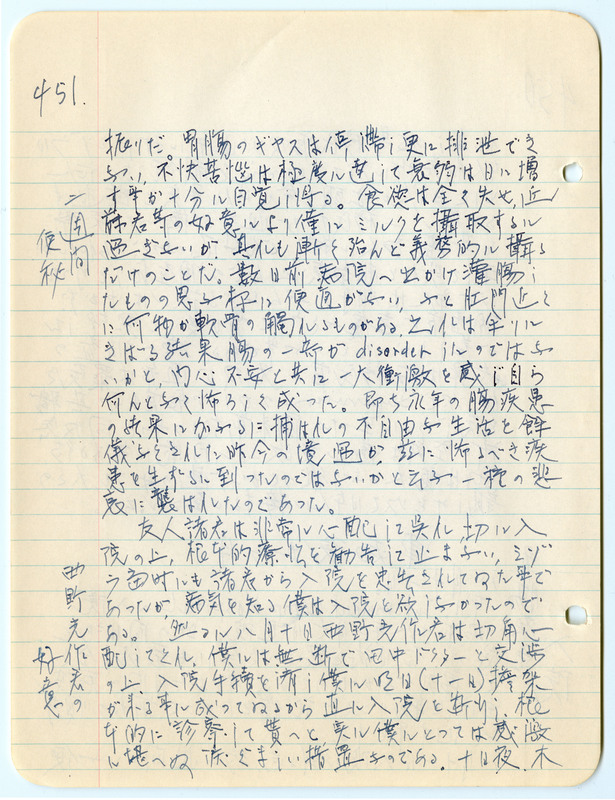
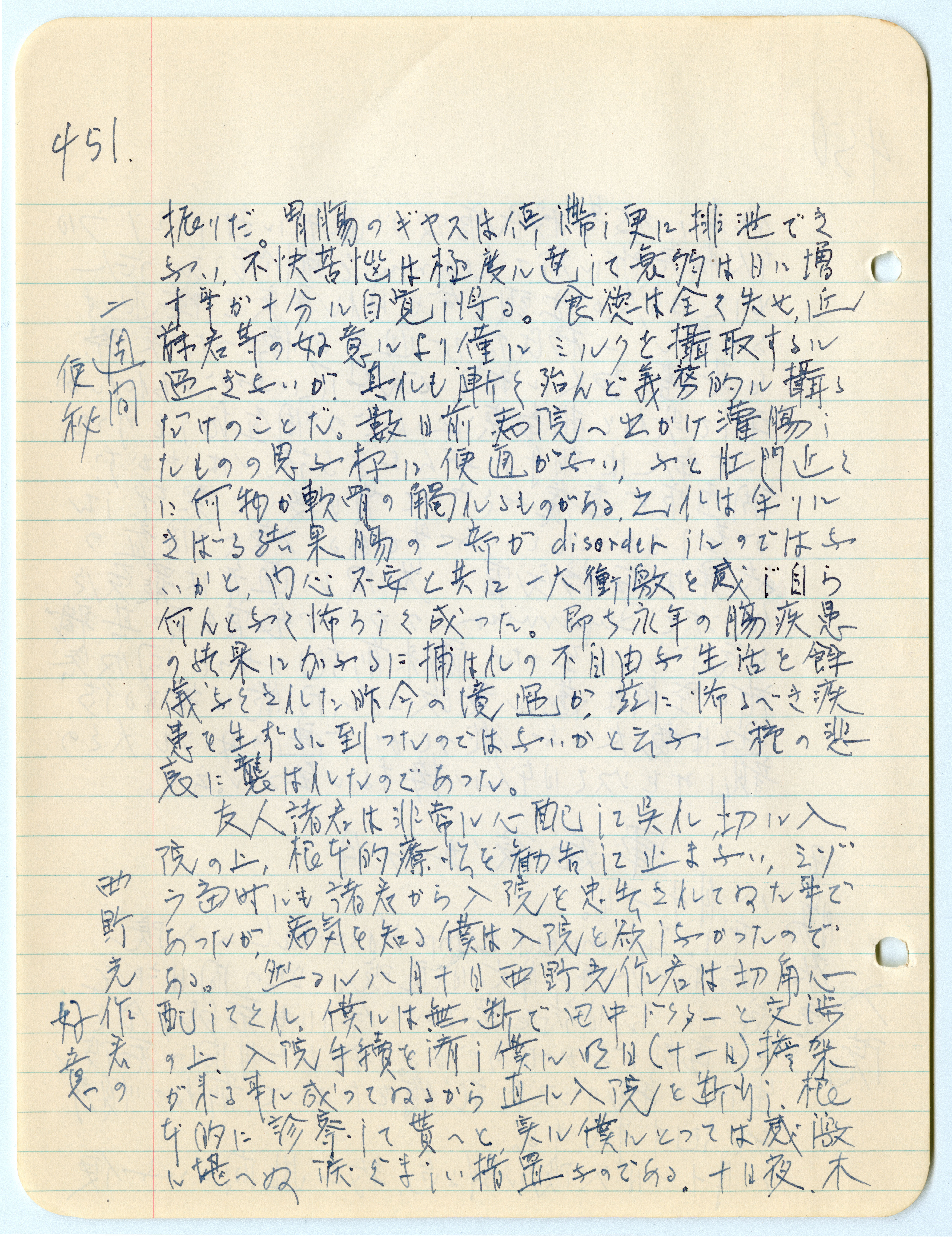
451
Gas was trapped in my digestive system, and I was not able to excrete. My discomfort and sufferings peaked, and I was fully aware that I was increasingly being weakened day by day. My appetite was entirely lost, I was just consuming milk out of Mr. Kondo’s kind attention, and even this had to be forced down. I went to the hospital for an enema, but it did not offer any solutions I was hoping for. I felt something touching cartridge near my anus, and I was shocked and frightened fearing that a part of my intestine is having some sort of disorder [1] as I was pushing too hard. I was overcome by sorrow thinking that my chronic digestive system forced such a trapped life without freedom on me these days and might even have resulted in causing dreadful disease.
All of my friends were very worried about me and advised me to be admitted to a hospital for some holistic treatment. They also advised me to be in the hospital while we were in Missoula, but I did not want to be hospitalized as I know how it is to be sick. Mr. Kosaku Nishino was worried about me, and negotiated with Dr. Tanaka without telling me on August 10th to complete the hospitalization application for me, and told me to receive holistic treatment in the hospital as he arranged transportation to have me picked up to get admitted on the following day (11th). I cannot help shedding tears for such friendship.
[1] This is the term used by the author
- Citation:
- January 1943 entry, page 2, January 1943 entry, Bunro Sakaino Concentration Camp Diary, University of Idaho Library Digital Collections, https://www.lib.uidaho.edu/digital/sakaino/items/sakaino323.html#sakaino325
- Rights:
- In copyright, educational use permitted. Educational use includes non-commercial reproduction of text and images in materials for teaching and research purposes. For other contexts beyond fair use, including digital reproduction, please contact the University of Idaho Library Special Collections and Archives Department at libspec@uidaho.edu. The University of Idaho Library is not liable for any violations of the law by users.
- Standardized Rights:
- http://rightsstatements.org/vocab/InC-EDU/1.0/
 View Page 3
January 1943 entry
-
Item 3 of 31
Transcript
452
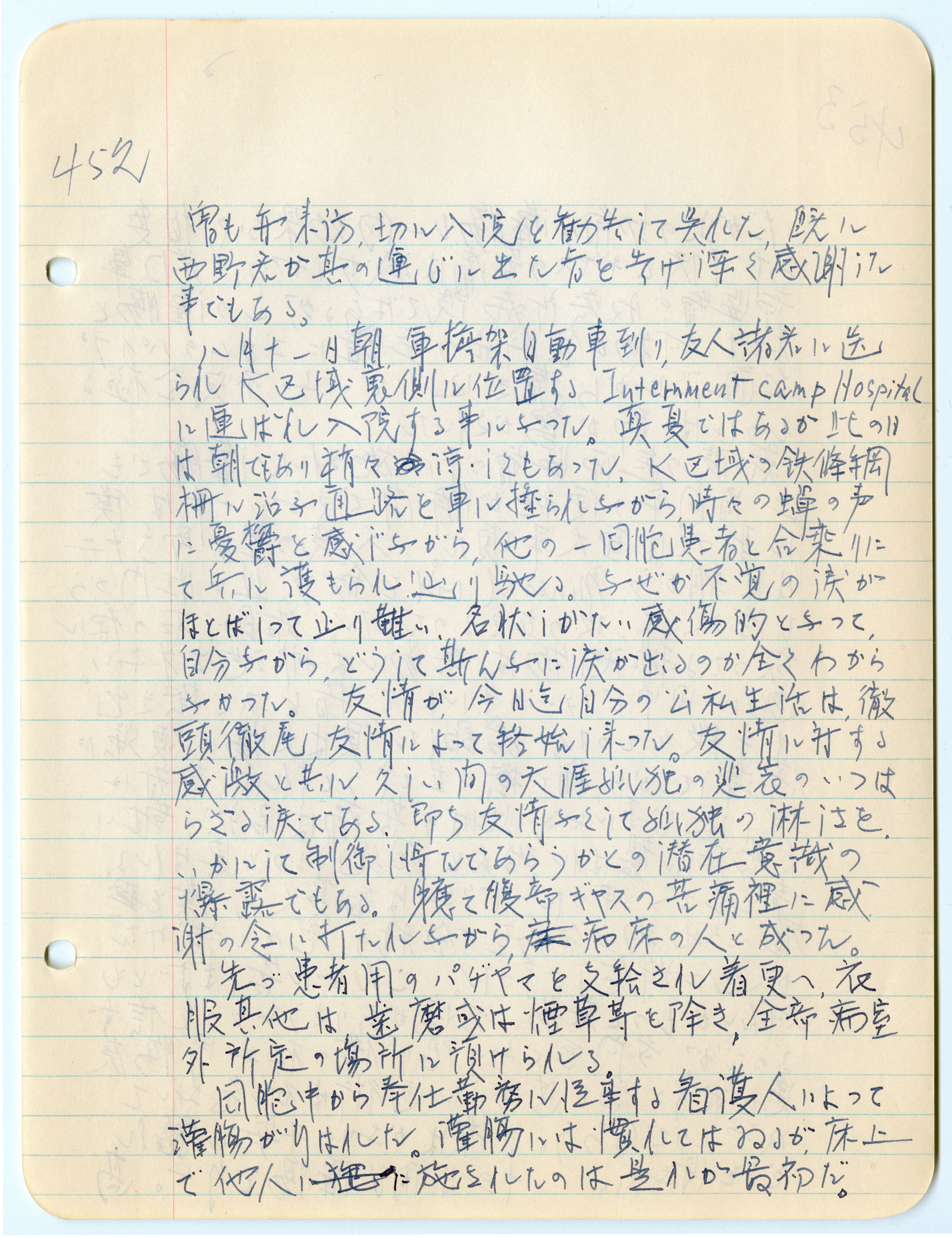
Kiso also visited me in the evening on the 10th and advised me to be treated in the hospital. I told him that Mr. Kiso had already made the arrangement and thanked him for his kindness.
A military medical vehicle came, and I was transported to the Internment Camp Hospital behind the K Area in the morning on August 10th, with my friends seeing me off. It was in the middle of the summer, but it was unusually cool on that day partially because it was still in the morning. I was in the car bumping up and down with other fellow patients and driving on the road along the barbed-wire fence in the K Area, feeling gloomy by the chirring of cicadas. I unexpectedly started to shed tears and could not stop them. I was overcome by sad feelings that I cannot describe and did not even know why I was crying so hard at all. Friendship has always been all I dearly cherish in my public and personal life. Tears are for my gratitude for the friendship and also sadness of my life by myself so far. This is now I became a patient with pains and discomfort of gas building up in my abdomen and gratitude in my heart.
Pajamas for patients were provided, and I got changed. My personal clothing and other belongings except for my tooth brush and cigarettes were stored in a designated location somewhere outside of the room.
Someone among our fellow citizens volunteering as a nurse gave me an enema. I am used to the treatment, but it was my first time to have someone else give one to me in bed.
- Citation:
- January 1943 entry, page 3, January 1943 entry, Bunro Sakaino Concentration Camp Diary, University of Idaho Library Digital Collections, https://www.lib.uidaho.edu/digital/sakaino/items/sakaino323.html#sakaino326
- Rights:
- In copyright, educational use permitted. Educational use includes non-commercial reproduction of text and images in materials for teaching and research purposes. For other contexts beyond fair use, including digital reproduction, please contact the University of Idaho Library Special Collections and Archives Department at libspec@uidaho.edu. The University of Idaho Library is not liable for any violations of the law by users.
- Standardized Rights:
- http://rightsstatements.org/vocab/InC-EDU/1.0/
 View Page 4
January 1943 entry
-
Item 4 of 31
Transcript
453
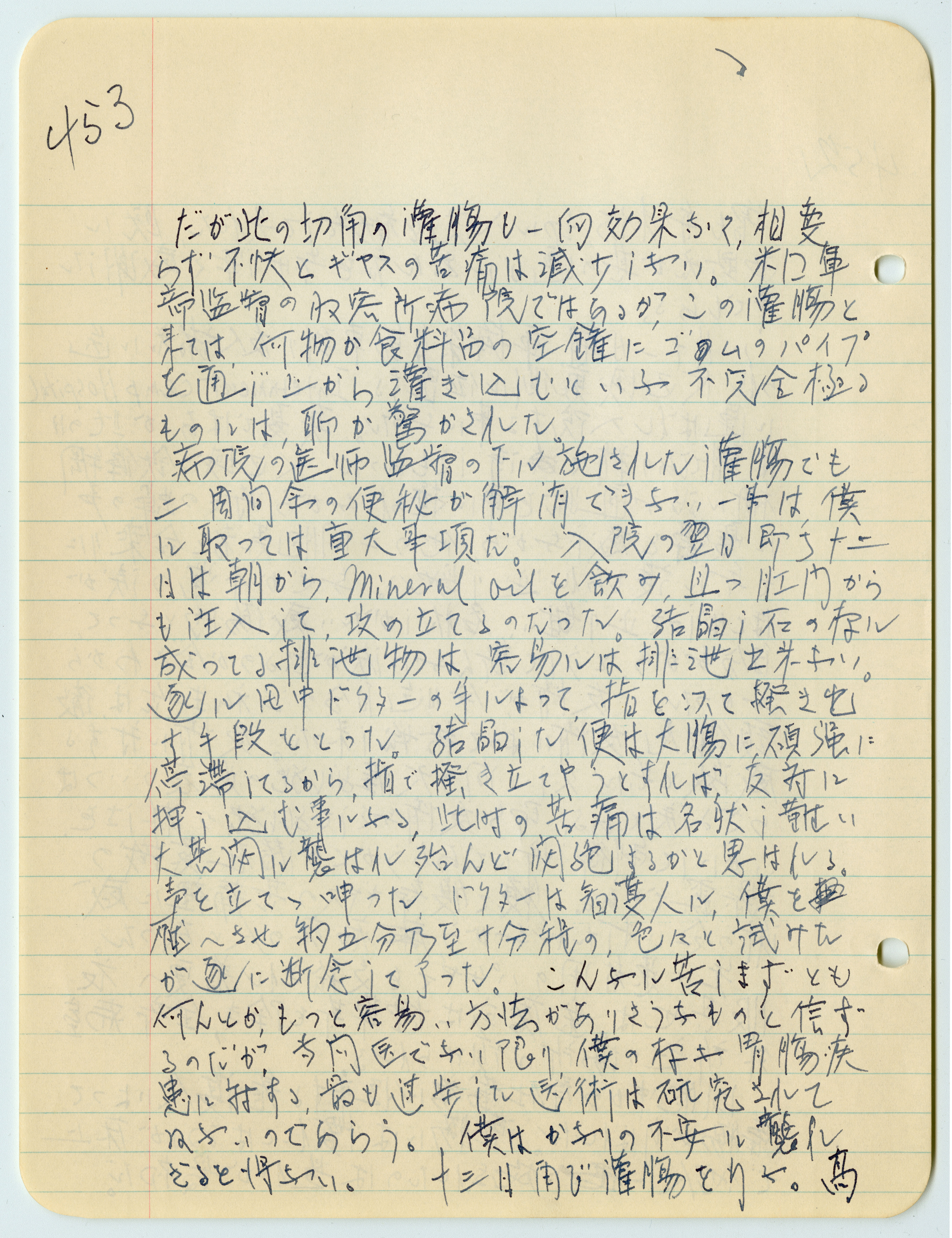
However, this one did not do any good, and discomfort and pain caused by gas did not diminish at all. I understand this is an internment camp hospital administered by the U.S. military, but I was surprised to see an utterly imperfect enema made with a sort of empty food can with a rubber pipe attached to pour solution into.
It was a serious issue for me that enema administered under supervision of the hospital doctors did not resolve constipation over the last two weeks. I chugged down mineral oil and had the solution inserted through the anus on the following morning on the 12th. Feces crystallized and hardened like stones cannot be easily excreted. Dr. Tanaka decided to scrape it out with his fingers. Hardened feces is firmly stuck and could be pushed back into the colon if attempted to be scraped out with fingers. There is no way to describe the pain I experienced, and I was afraid I would pass out. I groaned. The doctor had the nurse change my position and tried for five or ten minutes but finally gave up. I believe there should be an easier solution than the suffering I was going through, but unless you are a specialist, advanced medicine is not really applied to a case like my digestive system disorders. I cannot help feeling extremely worried.
- Citation:
- January 1943 entry, page 4, January 1943 entry, Bunro Sakaino Concentration Camp Diary, University of Idaho Library Digital Collections, https://www.lib.uidaho.edu/digital/sakaino/items/sakaino323.html#sakaino327
- Rights:
- In copyright, educational use permitted. Educational use includes non-commercial reproduction of text and images in materials for teaching and research purposes. For other contexts beyond fair use, including digital reproduction, please contact the University of Idaho Library Special Collections and Archives Department at libspec@uidaho.edu. The University of Idaho Library is not liable for any violations of the law by users.
- Standardized Rights:
- http://rightsstatements.org/vocab/InC-EDU/1.0/
 View Page 5
January 1943 entry
-
Item 5 of 31
Transcript
454 (186)
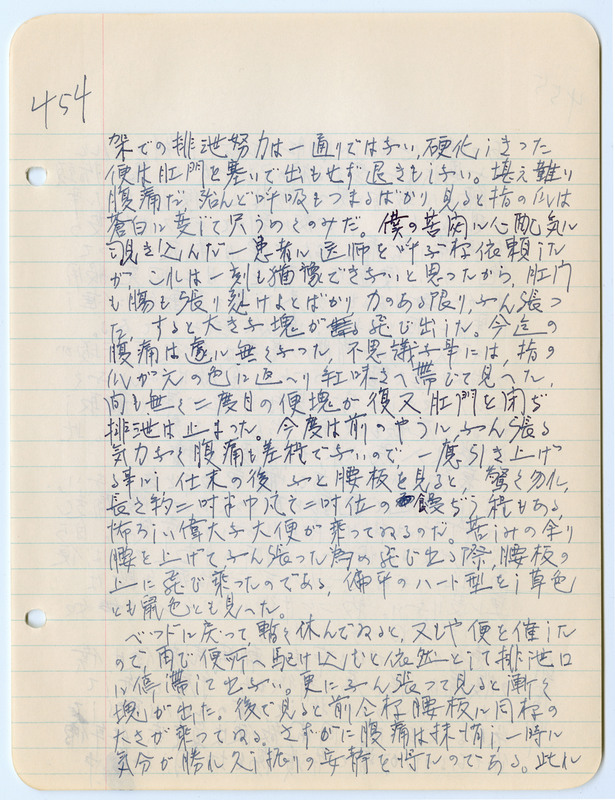
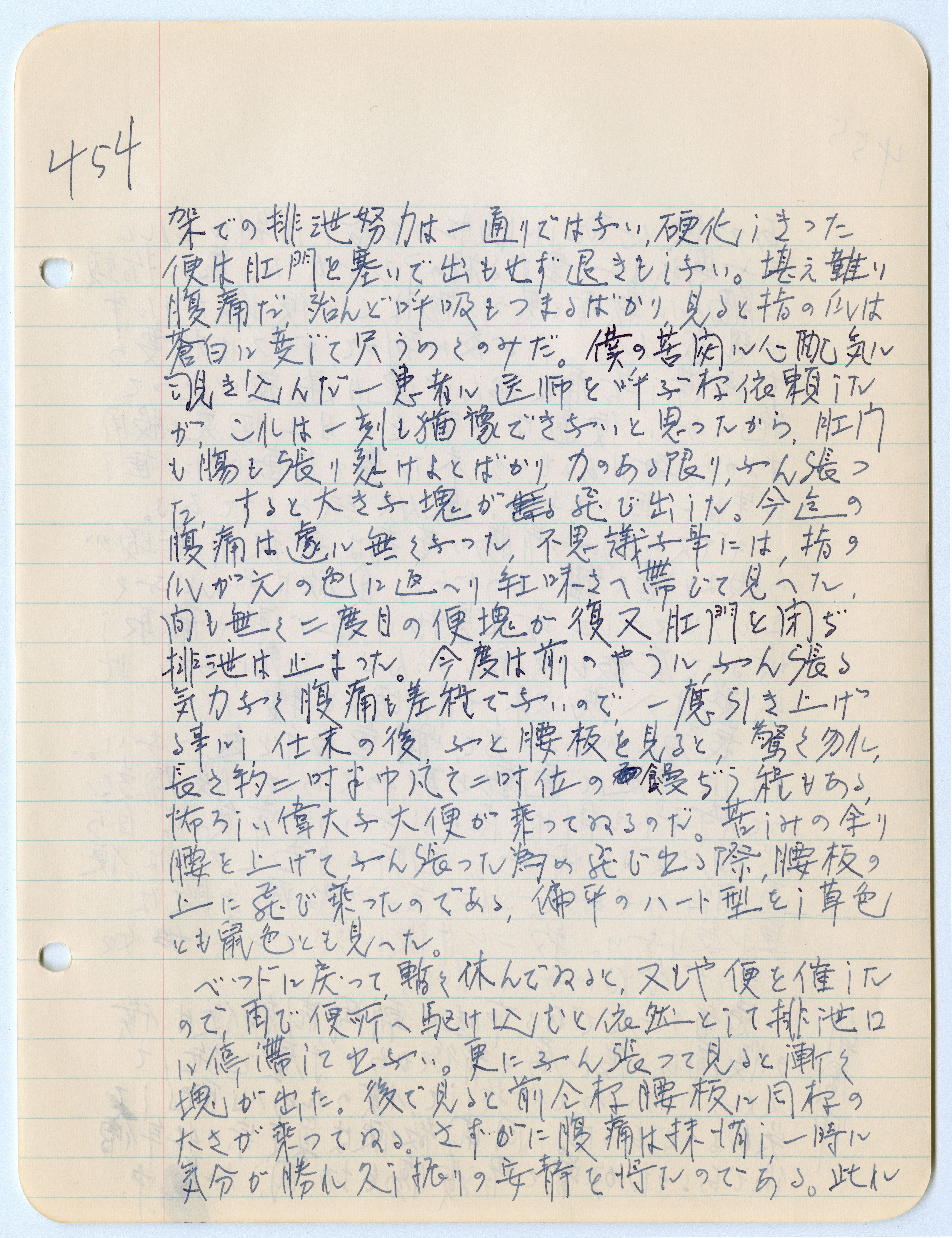
I received another enema on the 13th. It is more than hard to try to excrete on a platform [2]. Hardened feces blocked the anus, and it was not going in or out. I was suffering from unbearable pain. I could hardly breathe, noticed my fingernails were pale, and all I could do was groan. I asked another patient, who was worried about my pain and looking into my face, to call for a doctor, but I also realized it was a critical moment. I pushed as if I had been willing to tear up my anus and intestines, and a big mass was just pushed out. All the pain finally disappeared, and strangely enough, my fingernails regained the original color and even turned somewhat reddish. The second mass came out to close the anus, and that is the end of it. This time, I did not have any strength to push as I did for the first time, and the abdominal pain was not as bad either. I decided to go back to my room. I was surprised to see a mass about over two inches long and almost three inches wide on the panel after cleaning the site. It was pushed out and landed on the panel as I was suffering from the pain. It was flat and heart-shaped in sage or gray color.
I rushed to a bathroom after I felt another movement while resting in my bed after I went back, but it was again stuck and did not come out. I kept pushing, and another mass finally came out. I looked at it, and it was almost as big as the first one. My abdominal pain finally disappeared, and I was finally feeling comfortable after suffering so long.
[2] Maybe a bed or an operation table?
- Citation:
- January 1943 entry, page 5, January 1943 entry, Bunro Sakaino Concentration Camp Diary, University of Idaho Library Digital Collections, https://www.lib.uidaho.edu/digital/sakaino/items/sakaino323.html#sakaino328
- Rights:
- In copyright, educational use permitted. Educational use includes non-commercial reproduction of text and images in materials for teaching and research purposes. For other contexts beyond fair use, including digital reproduction, please contact the University of Idaho Library Special Collections and Archives Department at libspec@uidaho.edu. The University of Idaho Library is not liable for any violations of the law by users.
- Standardized Rights:
- http://rightsstatements.org/vocab/InC-EDU/1.0/
 View Page 6
January 1943 entry
-
Item 6 of 31
Transcript
455 (187)
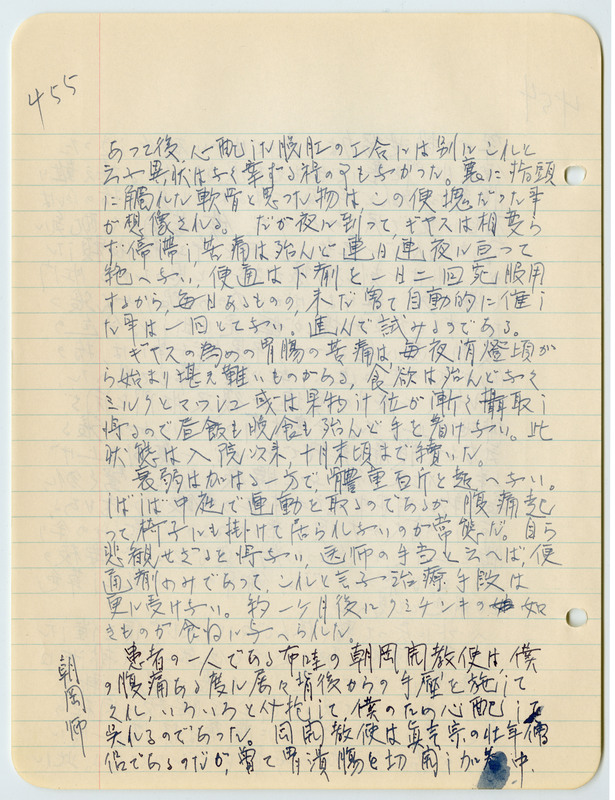
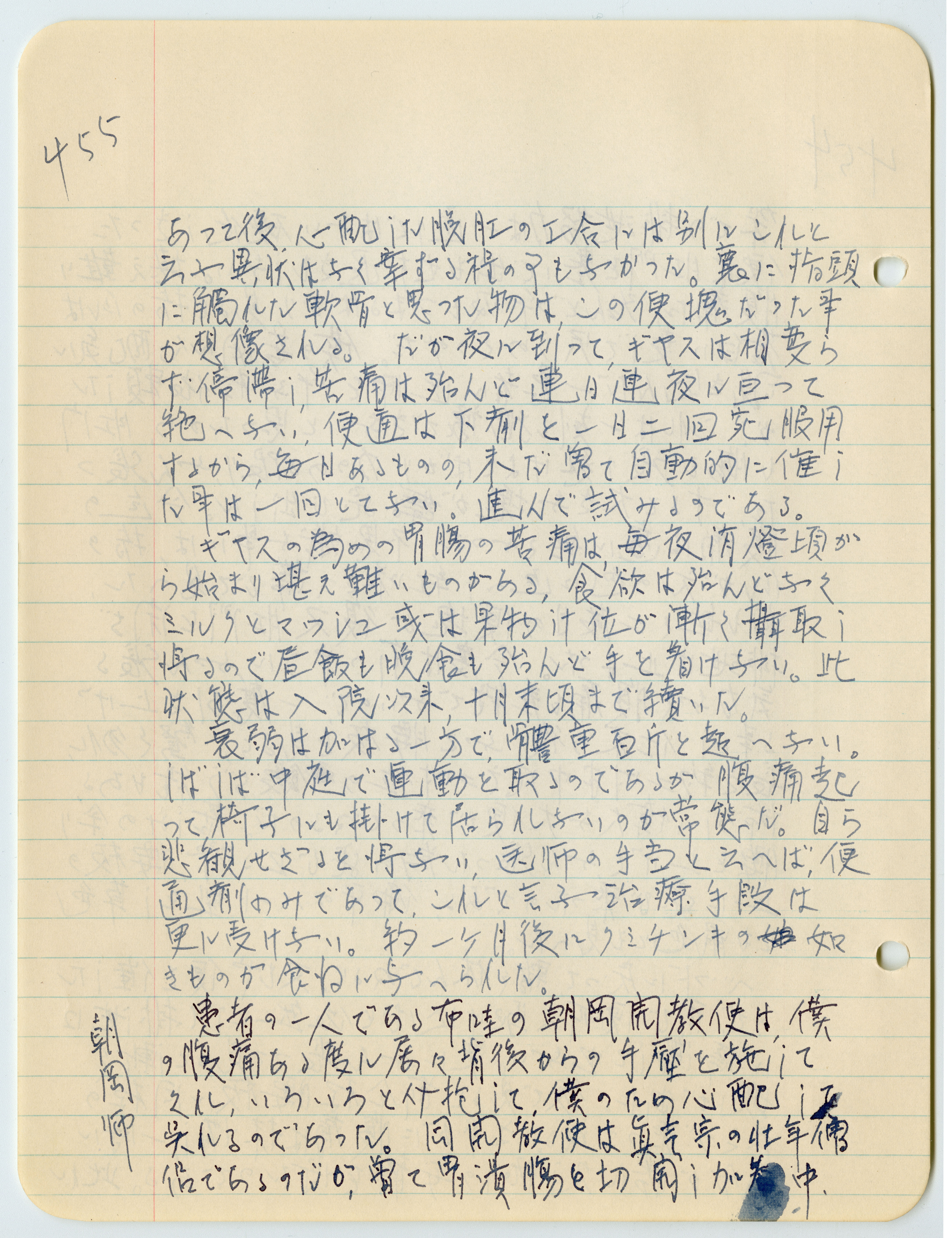
I was worried about the prolapse of anus, but it turned out I did not have to as there have not been any changes. I guess something like a cartilage that I felt on my fingertip was just hardened feces. However, gas was still remaining in my digestive system in the evening, and I was suffering unbearable pain day and night every day. I did have bowel movement every day as I was taking laxatives twice a day, but I never had natural movements at all. I was trying to see if that would be possible. Pain and discomfort in my stomach and intestines caused by gas start around bedtime every night, and it is hard to endure. I hardly had any appetite, was barely able to have some milk, mash or fruit juice and could not eat almost anything for lunch or dinner. Such a condition persisted until the end of October while I was in the hospital.
I was increasingly weakened, and my weight did not exceed 130 pounds. I often did some exercise in the courtyard but usually ended up having a stomachache and could not even keep sitting in a chair. I could not help feeling pessimistic. Laxatives are only treatment provided by a doctor, and I did not receive anything else. I was administered some type of herbal medicine after meals after one month had passed.
Missionary Asaoka from Hawaii among the patients was worried about me, offering some help and rubbing my back from behind every time my stomach ached. He is an elderly Buddhist monk of the Shingon School of Buddhism.
- Citation:
- January 1943 entry, page 6, January 1943 entry, Bunro Sakaino Concentration Camp Diary, University of Idaho Library Digital Collections, https://www.lib.uidaho.edu/digital/sakaino/items/sakaino323.html#sakaino329
- Rights:
- In copyright, educational use permitted. Educational use includes non-commercial reproduction of text and images in materials for teaching and research purposes. For other contexts beyond fair use, including digital reproduction, please contact the University of Idaho Library Special Collections and Archives Department at libspec@uidaho.edu. The University of Idaho Library is not liable for any violations of the law by users.
- Standardized Rights:
- http://rightsstatements.org/vocab/InC-EDU/1.0/
 View Page 7
January 1943 entry
-
Item 7 of 31
Transcript
456
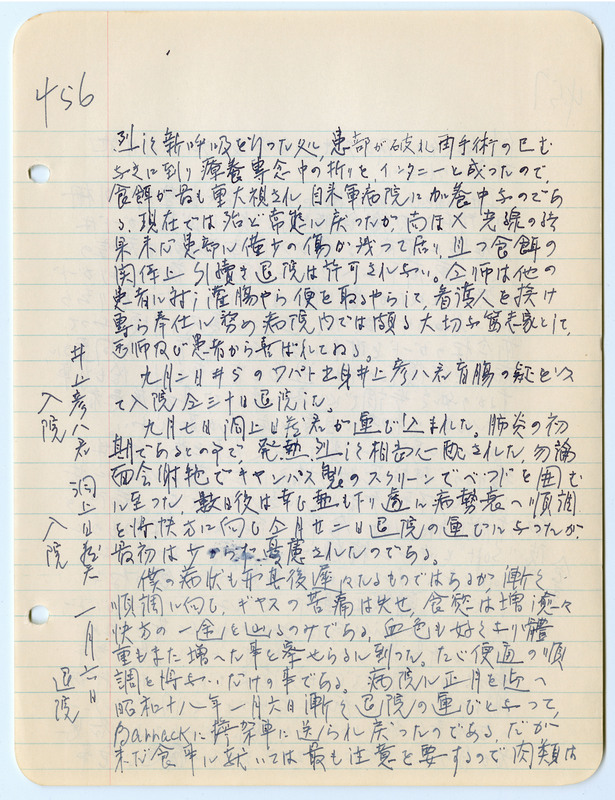
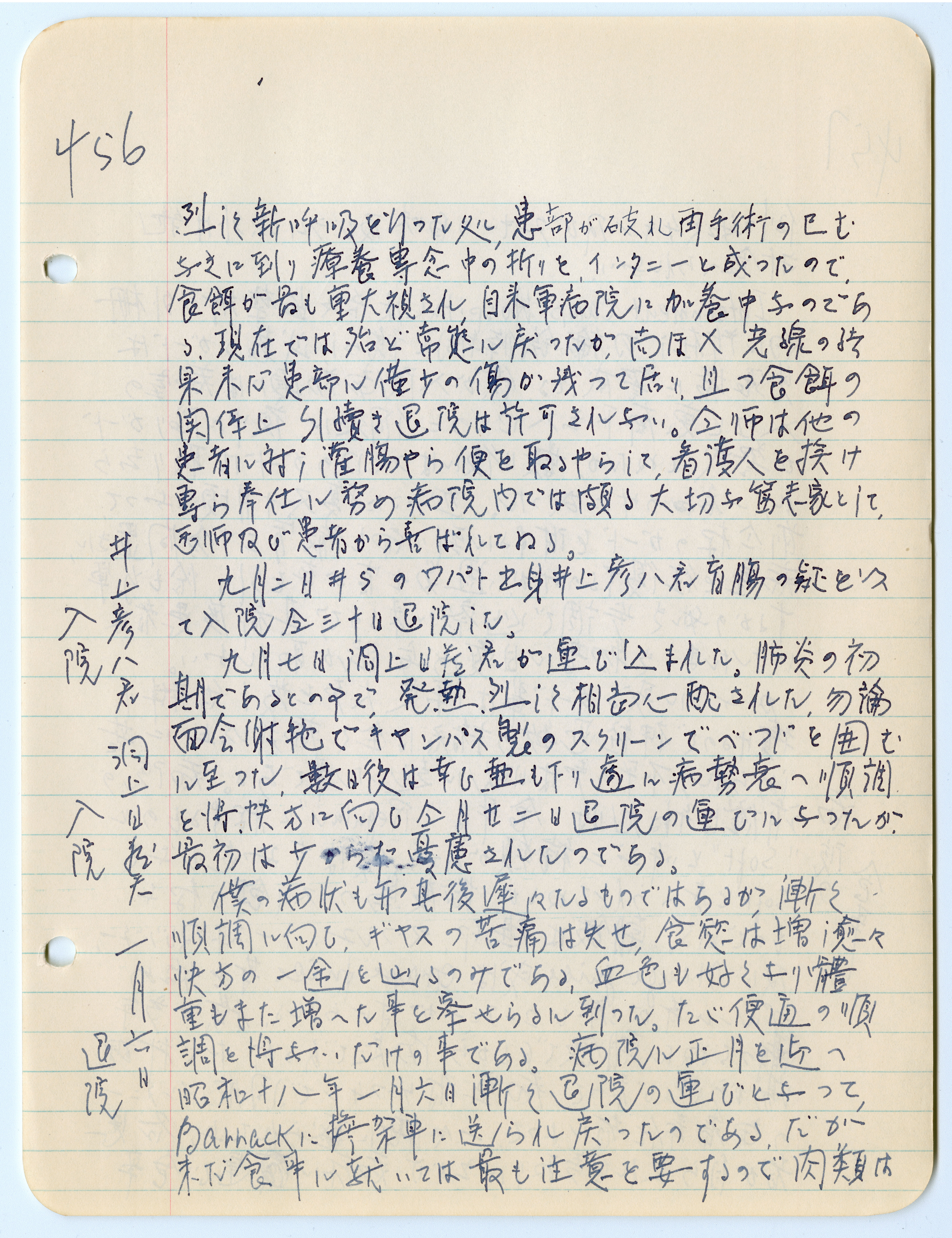
He underwent a stomach ulcer operation, and the suture broke open when he took a deep breath while recovering from the operation. He was held as an internee while he was recovering and had been treated in the military hospital ever since as his diet needed to be watched closely. He is almost cured, but his X-ray test result revealed small damage. He cannot be discharged yet as his diet still needs to be watched. He is helping nurses with enemas and stool samples, and both the doctors and the patients in the hospital are grateful for his dedication as a passionate volunteer.
Mr. Hikohachi Inoue from Wapato was hospitalized on September 2nd with suspected Appendicitis and discharged on the 30th day of the month.
Mr. Horagami was brought to the hospital on September 7th. It was the early stage pneumonia and seemed critical with a high fever. No visitation allowed, and canvas screens surrounded his bed. Fortunately, his fever subsided several days later, and he made steady recovery and was discharged on the 22nd day of the month. It was initially worrisome though.
As for my health issues, I was making slow recovery, my pain caused by built-up gas in my system disappeared, I regained my appetite and was getting steadily better. The only issue is my bowel movement regularity. I spent the new year at the hospital and finally was discharged on January 6, 1943, transferred back to the barracks in a medical vehicle. I still have to carefully watch what I eat and do not eat meat except for white meat of chicken or turkey and lamb.
- Citation:
- January 1943 entry, page 7, January 1943 entry, Bunro Sakaino Concentration Camp Diary, University of Idaho Library Digital Collections, https://www.lib.uidaho.edu/digital/sakaino/items/sakaino323.html#sakaino330
- Rights:
- In copyright, educational use permitted. Educational use includes non-commercial reproduction of text and images in materials for teaching and research purposes. For other contexts beyond fair use, including digital reproduction, please contact the University of Idaho Library Special Collections and Archives Department at libspec@uidaho.edu. The University of Idaho Library is not liable for any violations of the law by users.
- Standardized Rights:
- http://rightsstatements.org/vocab/InC-EDU/1.0/
 View Page 8
January 1943 entry
-
Item 8 of 31
Transcript
547
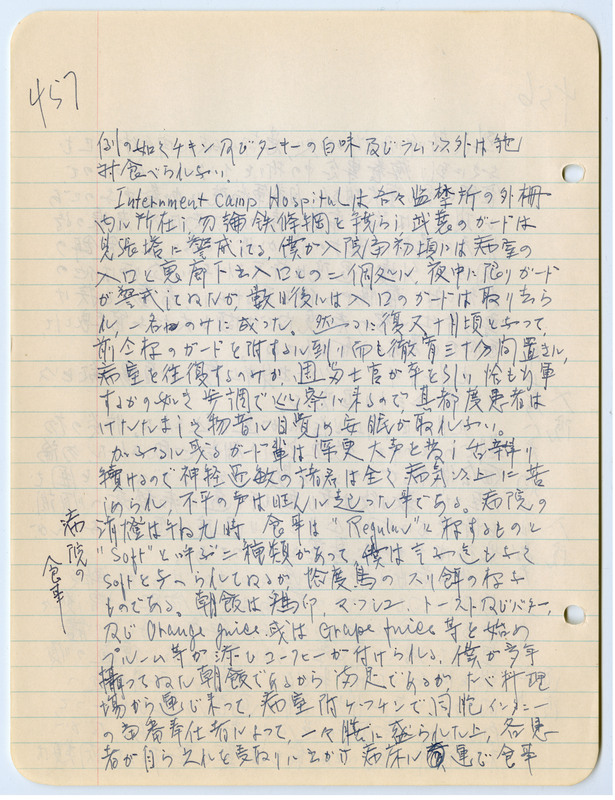
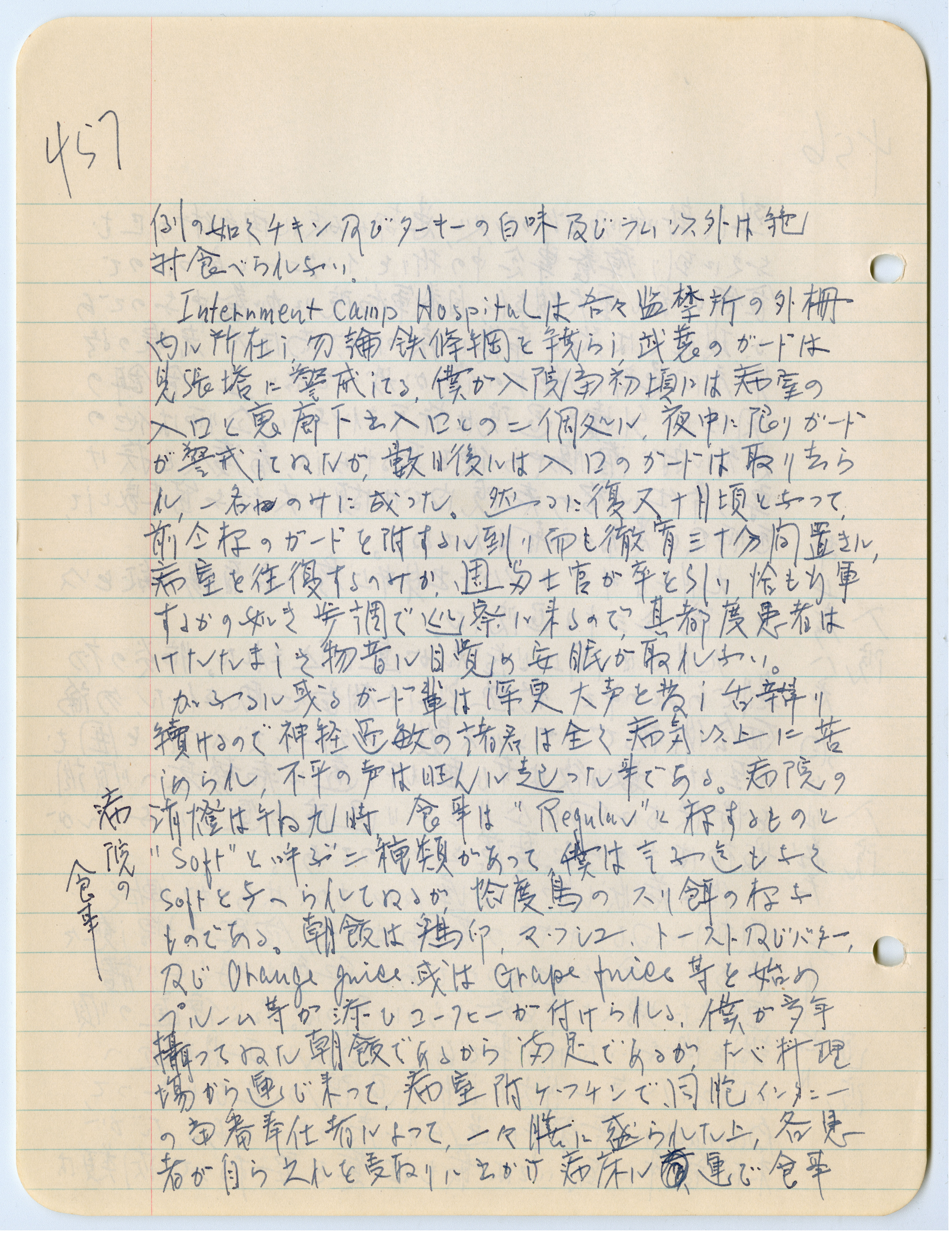
The Internment Camp Hospital is located inside of the outer fence surrounding our internment camp, and it of course has a barbed wire fence around with guards watching in the guard tower. There were two guards on duty at the hospital room door and the entrance on the back corridor at night when I got hospitalized. However, the guard at the entrance was removed several days later, and only one guard was on duty. They ended up having as many guards as they had had sometime in October, and they not only have them go between the hospital rooms every thirty minutes at night but march as if being led by an officer. We are not able to have a good night sleep as the noise wakes up the patients every time they come out. Sensitive folks are suffering from this more than from their health problems as the guards keep talking loudly at night, and complaints erupted. The bedtime with the lights off is at 9 p.m. at the hospital. Two kinds of meals, “regular” and “soft”, are served, and I am of course receiving soft meals. It is basically like mushed bird food. Breakfast is eggs, mash, toast, butter, orange or grape juice ,with something like prunes added, and coffee. I am satisfied with it as this is the type of breakfast I have been having for years, but everything is cold, and we could not have anything hot as food is brought from the cooking facility, with fellow internee volunteers taking turns and placing food in bowls and plates for each patient in the hospital room kitchens, and each patience has to pick it up and bring it back to the bed.
- Citation:
- January 1943 entry, page 8, January 1943 entry, Bunro Sakaino Concentration Camp Diary, University of Idaho Library Digital Collections, https://www.lib.uidaho.edu/digital/sakaino/items/sakaino323.html#sakaino331
- Rights:
- In copyright, educational use permitted. Educational use includes non-commercial reproduction of text and images in materials for teaching and research purposes. For other contexts beyond fair use, including digital reproduction, please contact the University of Idaho Library Special Collections and Archives Department at libspec@uidaho.edu. The University of Idaho Library is not liable for any violations of the law by users.
- Standardized Rights:
- http://rightsstatements.org/vocab/InC-EDU/1.0/
 View Page 9
January 1943 entry
-
Item 9 of 31
Transcript
458 (190)
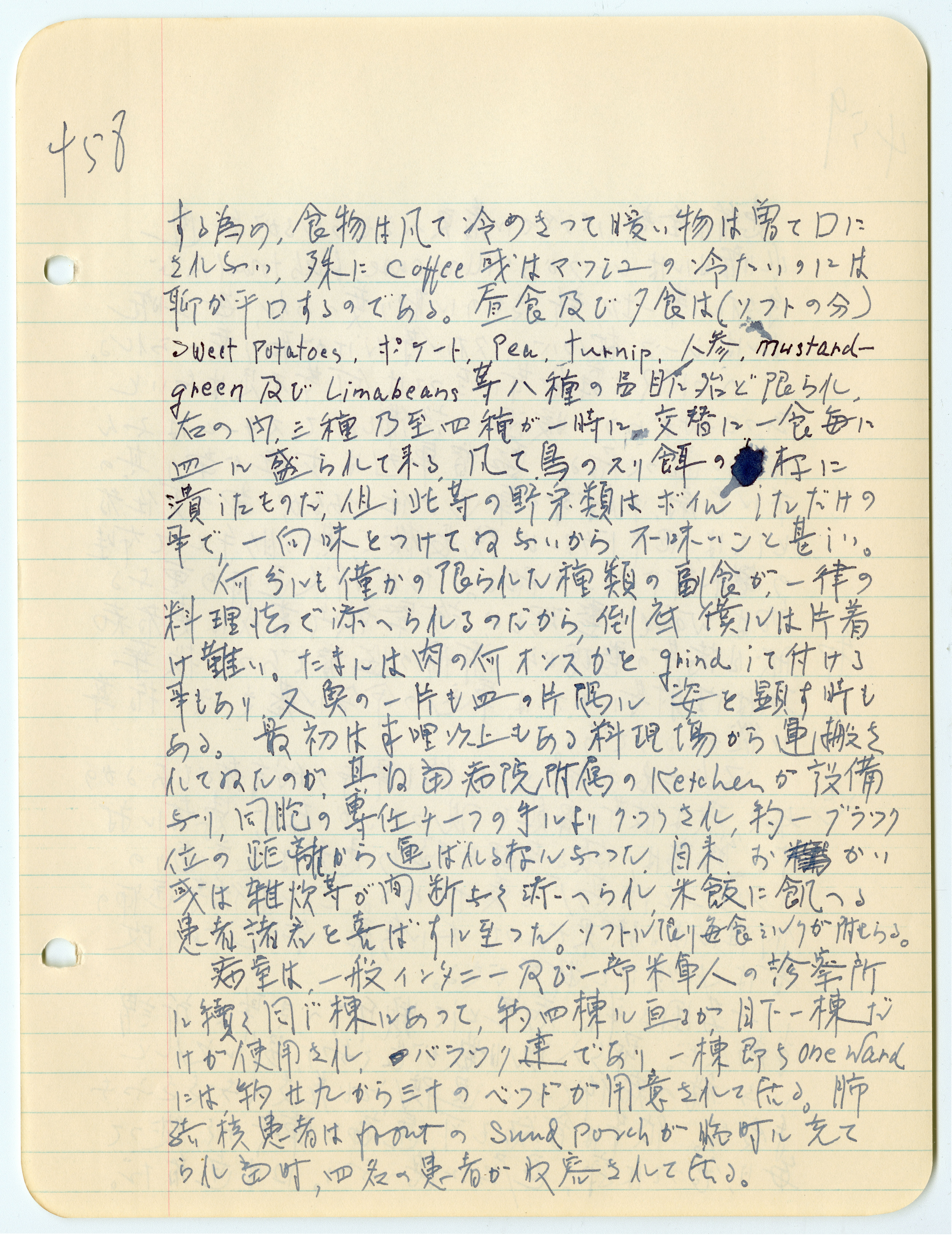
Cold coffee or mash especially is not appreciated. Lunch and dinner (for the “soft” kind) consists of eight ingredients, sweet potatoes, potatoes, peas, turnips, carrots, mustard greens and lima beans, and three or four out of the eight selections are served on plates at each meal. They are all mushed like bird food. These vegetables are just boiled without any flavors added, and they taste simply horrible. Side dishes with limited choices of ingredients cooked in the same method are served all the time, and I am having a hard time finishing what is on my plate. I occasionally have a few ounces of some sort of grounded meat added to my dish, and sometimes a small piece of fish appears on a coroner of my plate. Our meals originally were delivered from the cooking facility several miles away, but later on, a hospital kitchen was built with food cooked by a fellow chief cook, and it is delivered from the facility just a block away from where we are. Rice porridge has been served ever since, and it pleases those who are craving for rice. Milk is alway served with the “soft” meals.
Patience rooms for general internees and American soldiers are all in the same facility with the clinic room, and one out of the total of four units is currently used. They are barracks, and one ward holds 29 to 30 beds. Patients with pulmonary tuberculosis are temporarily admitted in the sun porch area in the front of the ward, and four of them are staying here.
- Citation:
- January 1943 entry, page 9, January 1943 entry, Bunro Sakaino Concentration Camp Diary, University of Idaho Library Digital Collections, https://www.lib.uidaho.edu/digital/sakaino/items/sakaino323.html#sakaino332
- Rights:
- In copyright, educational use permitted. Educational use includes non-commercial reproduction of text and images in materials for teaching and research purposes. For other contexts beyond fair use, including digital reproduction, please contact the University of Idaho Library Special Collections and Archives Department at libspec@uidaho.edu. The University of Idaho Library is not liable for any violations of the law by users.
- Standardized Rights:
- http://rightsstatements.org/vocab/InC-EDU/1.0/
 View Page 10
January 1943 entry
-
Item 10 of 31
Transcript
459
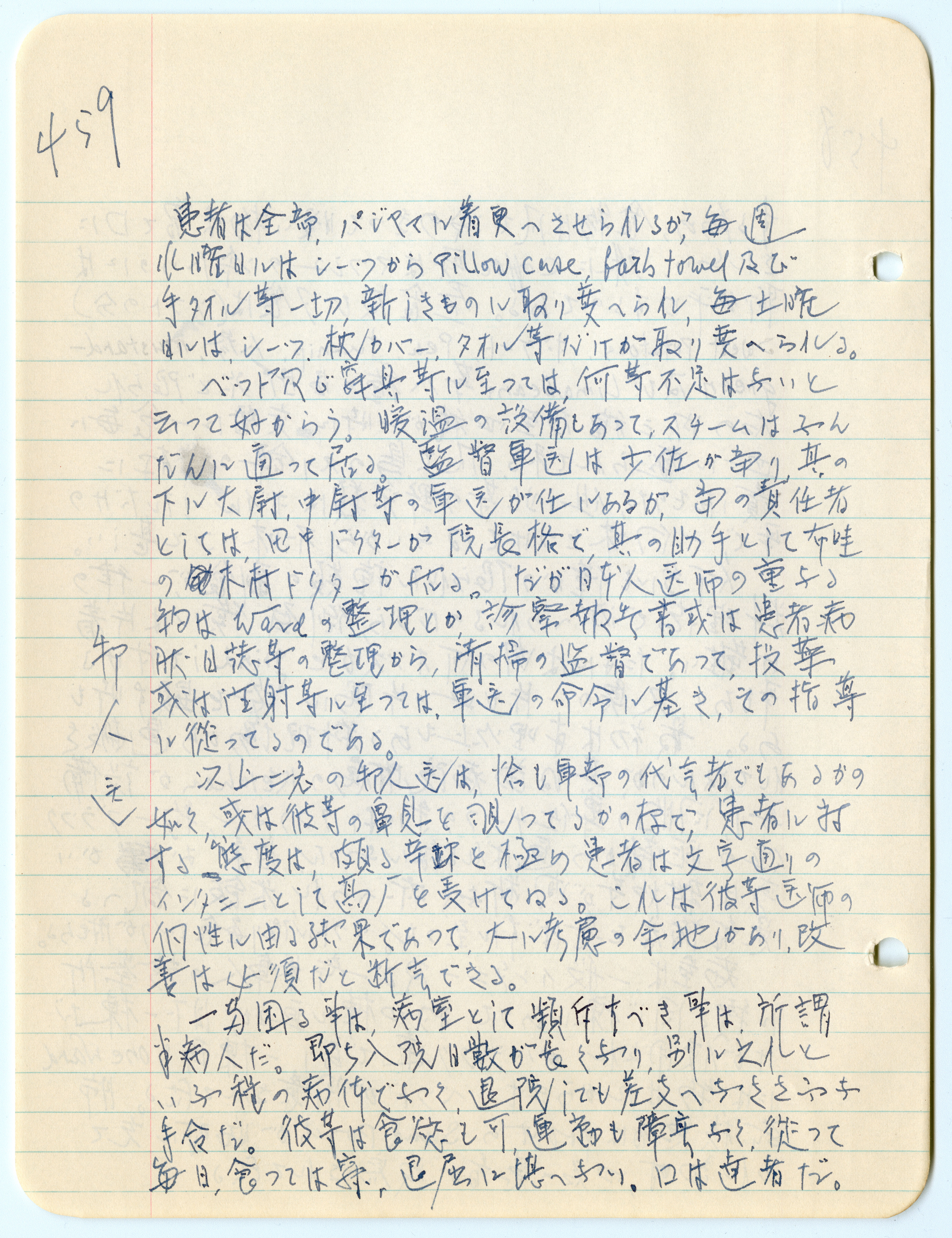
All patients are required to wear the hospital pajamas. Bed sheets, pillow cases, bath towels and hand towels are replaced with new ones every Wednesday, and only bed sheets, pillow cases and towels are replaced on Saturdays.
I would say beds and bedding is satisfactory. A Major is serving as the supervisor, and he manages captains and lieutenants serving military doctors under him. Dr. Tanaka serves as the director of the hospital, and Dr. Kimura from Hawaii is working as his assisting physician. However, the main task of the Japanese doctors is to organize items in the ward, to prepare medical reports, to keep diagnosis diaries and to supervise the cleaning of the facility. Prescription of medications and administration of shots are done based on the order of the military doctors, following their instructions.
The above-mentioned two doctors act as if they represent the U.S. military, or at least try to please the U.S. officers, and they treat their patients extremely poorly. We are placed under a high level of pressure as internees. This is due to the personality of the doctors, and I definitely think the situation deserves thorough consideration, and improvement is called for. The biggest issue and what the hospital should get rid of is some patients. They have been hospitalized for a long time, not really suffering from any health issues and could be discharged without any problems. They have a big appetite and do not have any difficulties exercising. They are totally bored with nothing to do but eating and sleeping. They are also chatty.
- Citation:
- January 1943 entry, page 10, January 1943 entry, Bunro Sakaino Concentration Camp Diary, University of Idaho Library Digital Collections, https://www.lib.uidaho.edu/digital/sakaino/items/sakaino323.html#sakaino333
- Rights:
- In copyright, educational use permitted. Educational use includes non-commercial reproduction of text and images in materials for teaching and research purposes. For other contexts beyond fair use, including digital reproduction, please contact the University of Idaho Library Special Collections and Archives Department at libspec@uidaho.edu. The University of Idaho Library is not liable for any violations of the law by users.
- Standardized Rights:
- http://rightsstatements.org/vocab/InC-EDU/1.0/
 View Page 11
January 1943 entry
-
Item 11 of 31
Transcript
460
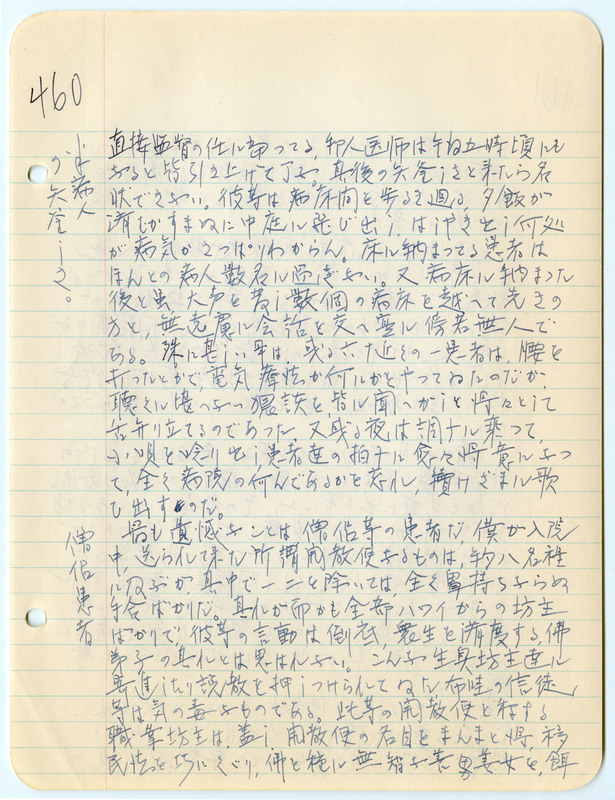
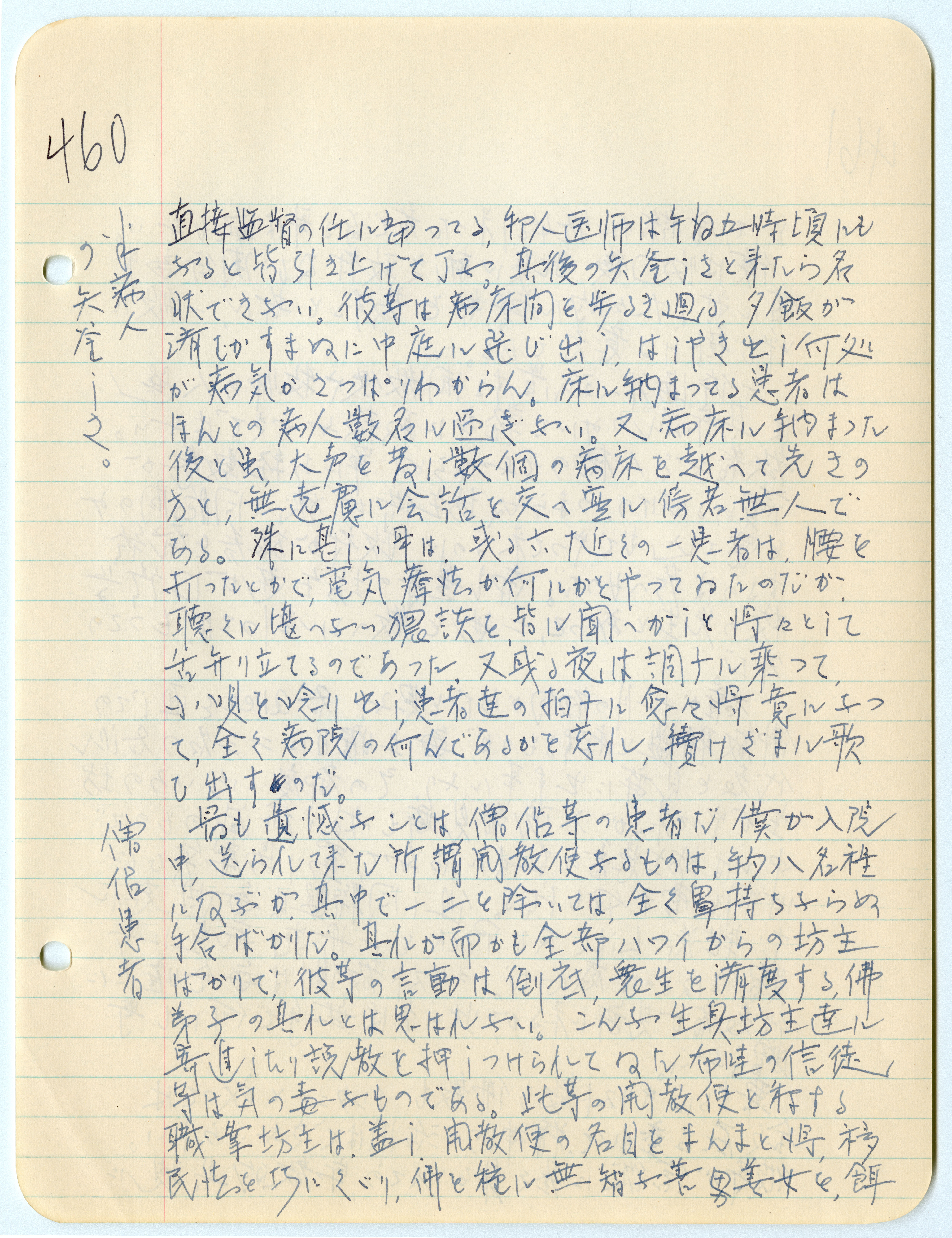
All the Japanese doctors who are directly treating the patients leave around 5 p.m. It is hard to describe how noisy it is after they are gone. They walk around among the beds, rush out into the courtyard right after dinner to run around, and I have no idea what kind of medical issues they have. Only several true sick patients stay in bed. Even after the bed time, some are loud and go over several beds to talk to someone without any consideration to other patients around them. One patient in his 60’s had a broken back and is undergoing some sort of electric treatment, but he joyfully keeps telling us all dirty stories. One evening, he started to sing. Applause from other patients encouraged him further, and he sang a song after another, completely forgetting what a hospital is all about.
What I find most pitiful is those monk patients. There are about eight so-called missionaries admitted while I was in the hospital, and they are all very arrogant except for one or two. They are all from Hawaii, and their words and acts do not match what Buddhist disciples are expected to do to save common people. I feel sorry for their followers in Hawaii who were forced to make offerings to such corrupt monks and to listen to their preaching. There is no doubt that those self-proclaimed commercial missionaries managed to obtain the position, went through some immigration law loops, selling the Buddhist religion to ignorant and good-hearted men and women to constantly make money off them.
- Citation:
- January 1943 entry, page 11, January 1943 entry, Bunro Sakaino Concentration Camp Diary, University of Idaho Library Digital Collections, https://www.lib.uidaho.edu/digital/sakaino/items/sakaino323.html#sakaino334
- Rights:
- In copyright, educational use permitted. Educational use includes non-commercial reproduction of text and images in materials for teaching and research purposes. For other contexts beyond fair use, including digital reproduction, please contact the University of Idaho Library Special Collections and Archives Department at libspec@uidaho.edu. The University of Idaho Library is not liable for any violations of the law by users.
- Standardized Rights:
- http://rightsstatements.org/vocab/InC-EDU/1.0/
 View Page 12
January 1943 entry
-
Item 12 of 31
Transcript
461
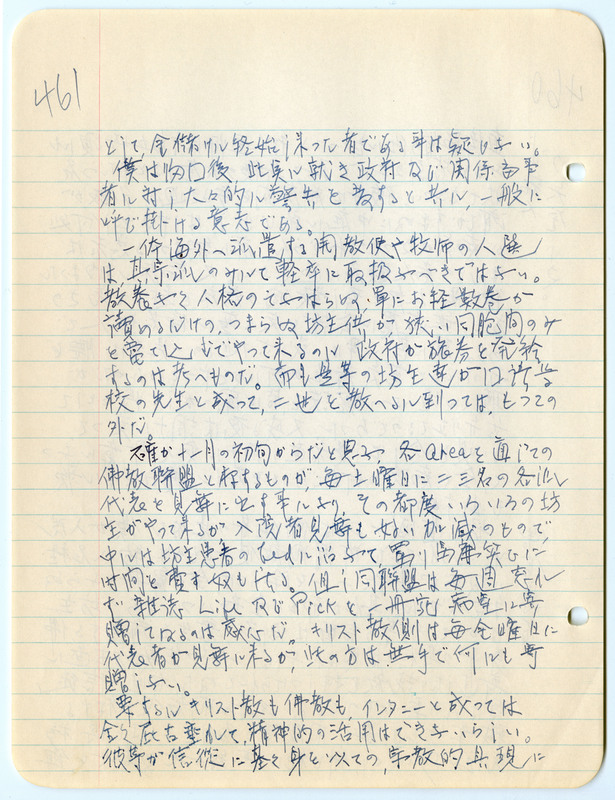
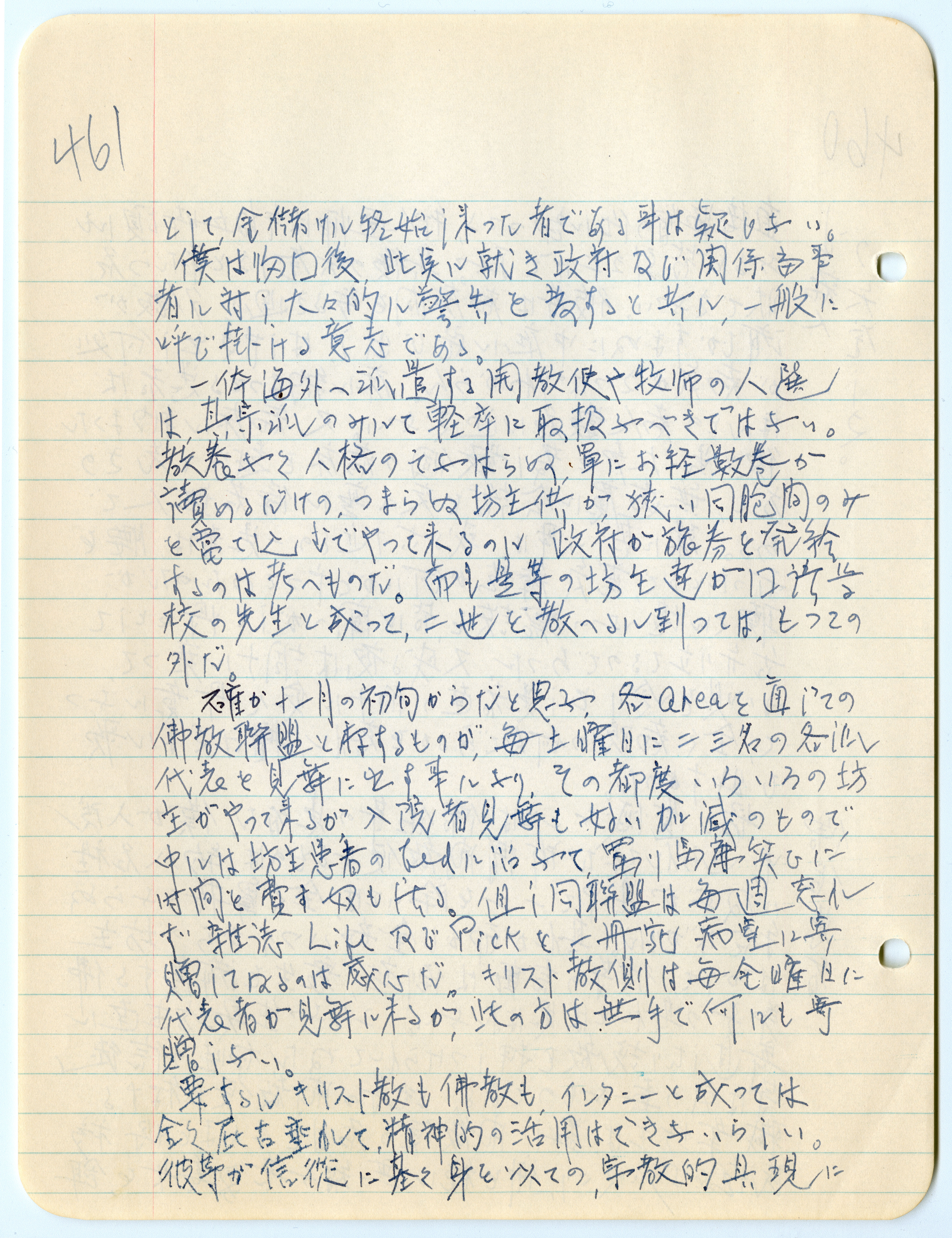
I am intending to alarm the government and authorities about such conditions and to call the general public for more attention.
The selection of missionaries and priests to be assigned to work overseas should not be all up to each religious organization. It needs to be revised how the government issues visas to unqualified monks who are not educated, do not have the right personality but just are able to recite a few pieces of Buddhist sutra. They just come to take advantage of a close-knitted community of their fellow citizens. It is absolutely out of the question to have them teach nisei students as their language school teachers.
I believe that this started at the beginning of November, but the so-called Buddhist Association started to send a few representatives from each Buddhism school to pay a visit to the patients through each area of the camp. They do not do anything particular, and some just spend their time on silly talks, laughing and sitting by monk friend patients. I am pretty impressed though that they always bring a copy of Life and Pick magazine to the patient rooms. The Christian group also send representatives on Fridays, but they are always empty-handed and do not give us anything.
I assume even Christian and Buddhist priests are totally discouraged and could not mentally function when they are internees. They are given the greatest opportunity to save their fellow internees utilizing their religious wisdom and rooted on their life as a religious disciple.
- Citation:
- January 1943 entry, page 12, January 1943 entry, Bunro Sakaino Concentration Camp Diary, University of Idaho Library Digital Collections, https://www.lib.uidaho.edu/digital/sakaino/items/sakaino323.html#sakaino335
- Rights:
- In copyright, educational use permitted. Educational use includes non-commercial reproduction of text and images in materials for teaching and research purposes. For other contexts beyond fair use, including digital reproduction, please contact the University of Idaho Library Special Collections and Archives Department at libspec@uidaho.edu. The University of Idaho Library is not liable for any violations of the law by users.
- Standardized Rights:
- http://rightsstatements.org/vocab/InC-EDU/1.0/
 View Page 13
January 1943 entry
-
Item 13 of 31
Transcript
462 (194)
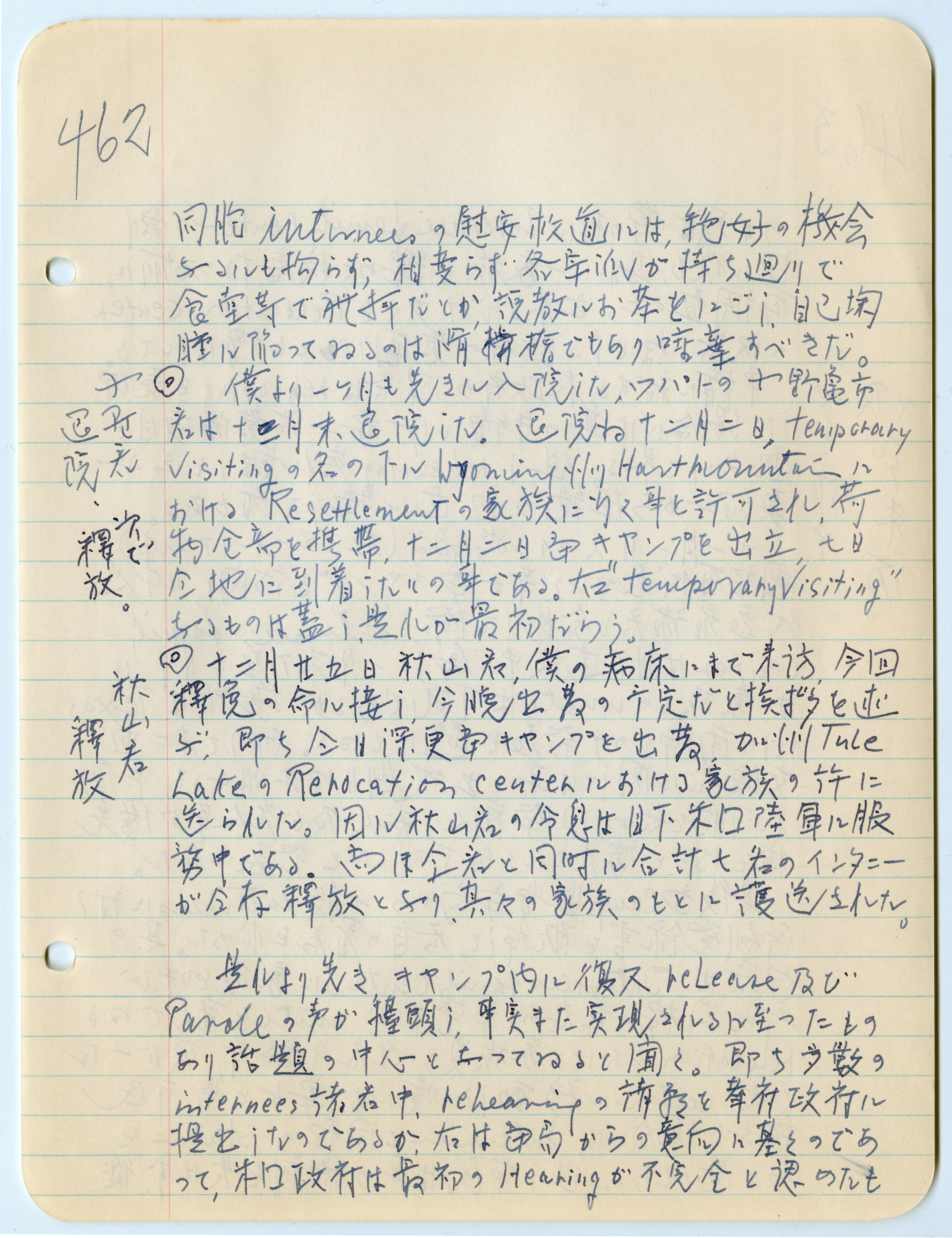
However, they are just taking turns offering prayers and preaches at the cafeteria and nothing else. Their self-satisfaction is laughable and also blamable.
Mr. Kameichi Ono from Wapato, who was hospitalized a month earlier than I was, was discharged at the end of November. Temporary visitation was issued for him on December 2nd after being discharged from the hospital, and he was permitted to go to his family at the resettlement [3] facility in Heart Mountain in Wyoming State. He wrapped up all his belongings and took off from the camp on December 2nd, and I heard he arrived at his destination on the 7th. This is probably the first case where such temporary visitation is permitted.
Mr. Akiyama visited me at my hospital bed on December 25th and told me that he was pardoned and will leave the camp on that day at night to join his family held in the Tule Lake Relocation Center [4] in California. Mr. Akiyama’s son is currently serving in the U.S. Army. Seven more internees were pardoned with him, and they were transferred with guards to join their family.
I heard that talks about the possibility of being released or paroled started up in the camp, and that is the main topic everyone is talking about now as some cases actually did take place. A number of internees have submitted their re-hearing applications to the federal government, and it was based on the instructions issued by the administration. I heard that the U.S. government admitted the initial hearings were incomplete.
[3] This is the term used by the author
[4] This is the term used by the author
- Citation:
- January 1943 entry, page 13, January 1943 entry, Bunro Sakaino Concentration Camp Diary, University of Idaho Library Digital Collections, https://www.lib.uidaho.edu/digital/sakaino/items/sakaino323.html#sakaino336
- Rights:
- In copyright, educational use permitted. Educational use includes non-commercial reproduction of text and images in materials for teaching and research purposes. For other contexts beyond fair use, including digital reproduction, please contact the University of Idaho Library Special Collections and Archives Department at libspec@uidaho.edu. The University of Idaho Library is not liable for any violations of the law by users.
- Standardized Rights:
- http://rightsstatements.org/vocab/InC-EDU/1.0/
 View Page 14
January 1943 entry
-
Item 14 of 31
Transcript
463
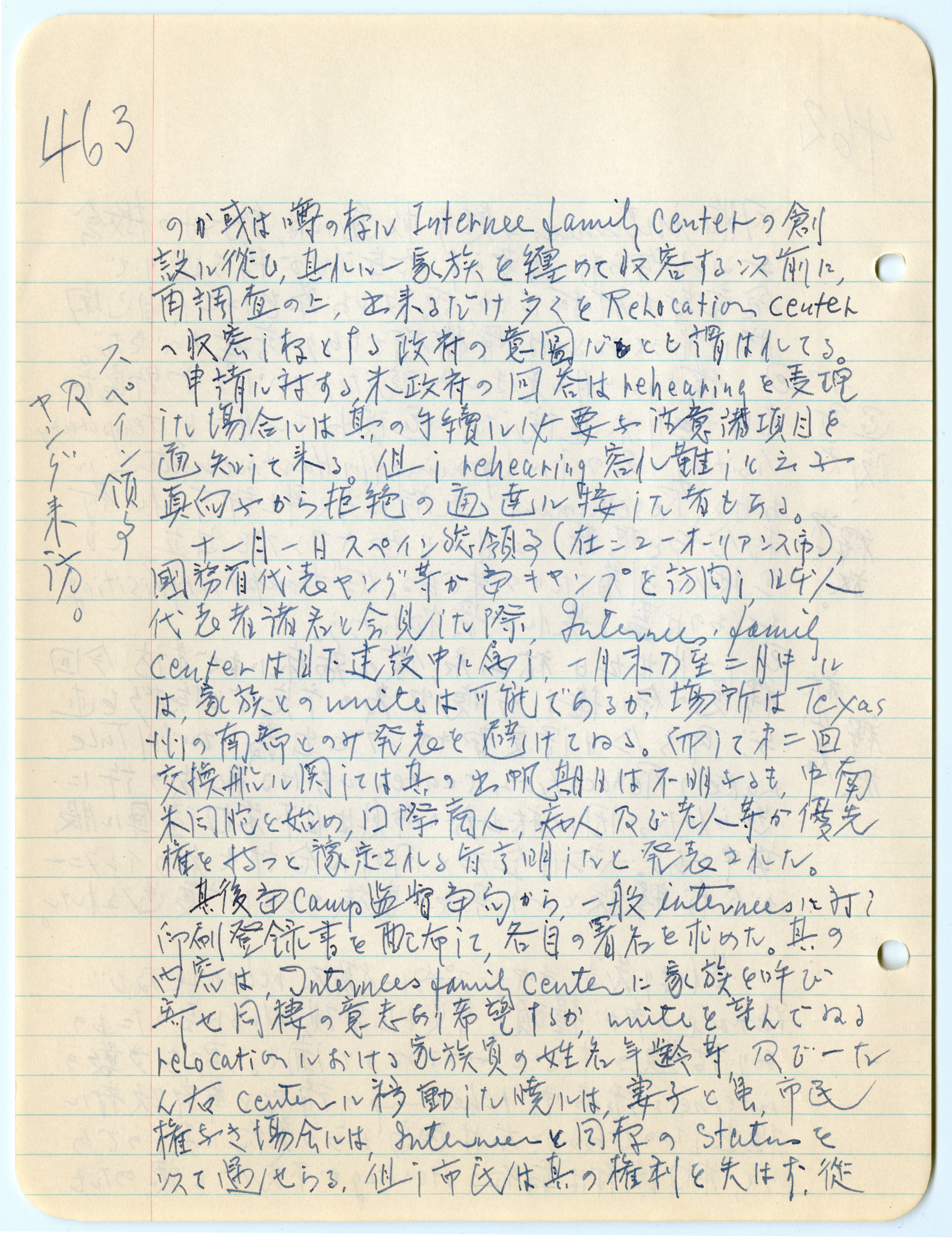
Also, rumor goes the government is planning to build internee family centers [5] and reviewing their investigations in an attempt to transfer as many internees as possible to relocation centers [6] before they try to reunite the families. Response from the U.S. government to those applications is that they will send us the procedure details to move forward if rehearing applications are approved. Some people received straight rejection to deny any possibility for rehearing.
The Consul General of Spain (in New Orleans) and the State Department representative Mr. Young visited this camp on November 1st. They had a meeting with Japanese representatives and stated that an internees family center is under construction and it is possible to be reunited with the family at the end of January or by the end of February. They said that it is located in southern Texas without revealing any specific information. As for the second exchange boat, the date of departure is unknown, but it is reported that they clearly stated the priority is expected to be fellow citizens from the South and Central America, as well as international merchants, those who are sick or elderly.
Printed registration forms were distributed to the general internees by the camp administration, and each of us was asked to sign it. It asked if we intend and wish to invite our family to the internee family center to be reunited. We were asked to provide the name and the age of the family members held in a relocation center if anyone wishes to be reunited. After being transferred to the above mentioned center, the wife and children will be granted the same status as internees if they do not have U.S. citizenship [7].
[5] This is the term used by the author
[6] This is the term used by the author
[7] This is the term used by the author
- Citation:
- January 1943 entry, page 14, January 1943 entry, Bunro Sakaino Concentration Camp Diary, University of Idaho Library Digital Collections, https://www.lib.uidaho.edu/digital/sakaino/items/sakaino323.html#sakaino337
- Rights:
- In copyright, educational use permitted. Educational use includes non-commercial reproduction of text and images in materials for teaching and research purposes. For other contexts beyond fair use, including digital reproduction, please contact the University of Idaho Library Special Collections and Archives Department at libspec@uidaho.edu. The University of Idaho Library is not liable for any violations of the law by users.
- Standardized Rights:
- http://rightsstatements.org/vocab/InC-EDU/1.0/
 View Page 15
January 1943 entry
-
Item 15 of 31
Transcript
464
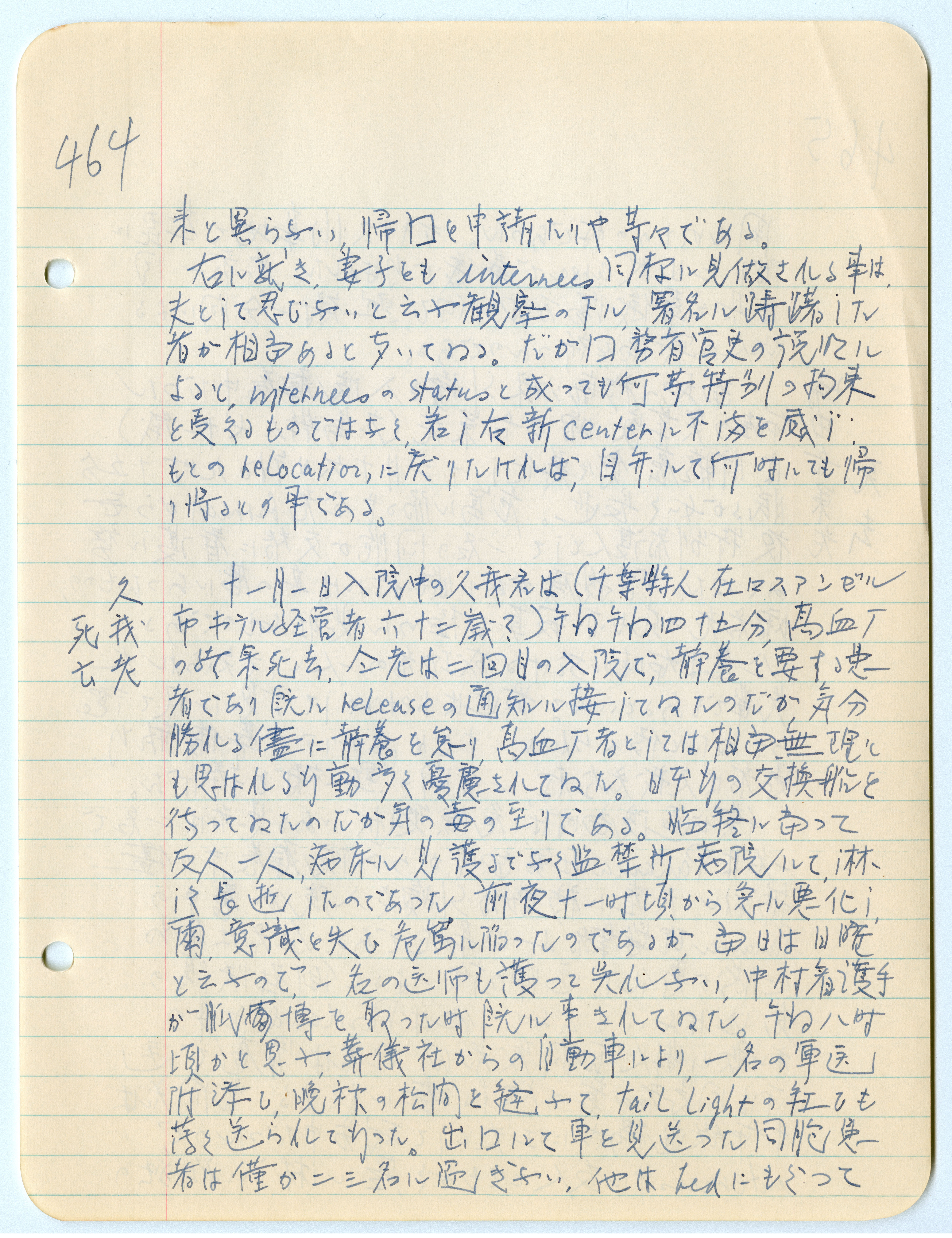
However, they will not lose their citizenship if they are U.S. citizens, and nothing will be different. They can apply to return to Japan and so on. I heard that a fairly large number of internees were hesitant to sign the form, citing it is not easy to swallow for a husband to have his wife and children labeled as an internee. However, according to the information provided by an officer from the Department of State, they will not be detained even with the internee status, and they can alway go back to the relocation [8] center by request if they are not satisfied with the above mentioned new center.
Mr. Kuga (from Chiba Prefecture, hotel manager in Los Angeles, 62 years old?) passed away at [9] ?:45 p.m on November 1st due to his high blood pressure while he was in the hospital. This elderly man was hospitalized for the second time, and his medical condition required plenty of rest. He had already received a release notice, but he did not take good care of himself when he was feeling better. We were concerned about him as he was pushing himself despite his high blood pressure. I am sorry for him as he was waiting for an exchange boat to go back to Japan. At the end of his life, he did not have any friends being with him and passed away in loneliness at the detention center hospital. His condition worsened around 11 the previous night, and he lost consciousness on his dying bed. It was Sunday, and no doctor was available to take care of him. He was already gone when nurse Kanamura took his pulse. It was probably around 8 p.m. He was taken away in a vehicle from a funeral home with a military doctor, going among pine trees in the late autumn with the red tail lights disappearing. Only a few fellow patients were at the gate seeing him off.
[8] This is the term used by the author
[9] Hour not listed
- Citation:
- January 1943 entry, page 15, January 1943 entry, Bunro Sakaino Concentration Camp Diary, University of Idaho Library Digital Collections, https://www.lib.uidaho.edu/digital/sakaino/items/sakaino323.html#sakaino338
- Rights:
- In copyright, educational use permitted. Educational use includes non-commercial reproduction of text and images in materials for teaching and research purposes. For other contexts beyond fair use, including digital reproduction, please contact the University of Idaho Library Special Collections and Archives Department at libspec@uidaho.edu. The University of Idaho Library is not liable for any violations of the law by users.
- Standardized Rights:
- http://rightsstatements.org/vocab/InC-EDU/1.0/
 View Page 16
January 1943 entry
-
Item 16 of 31
Transcript
465
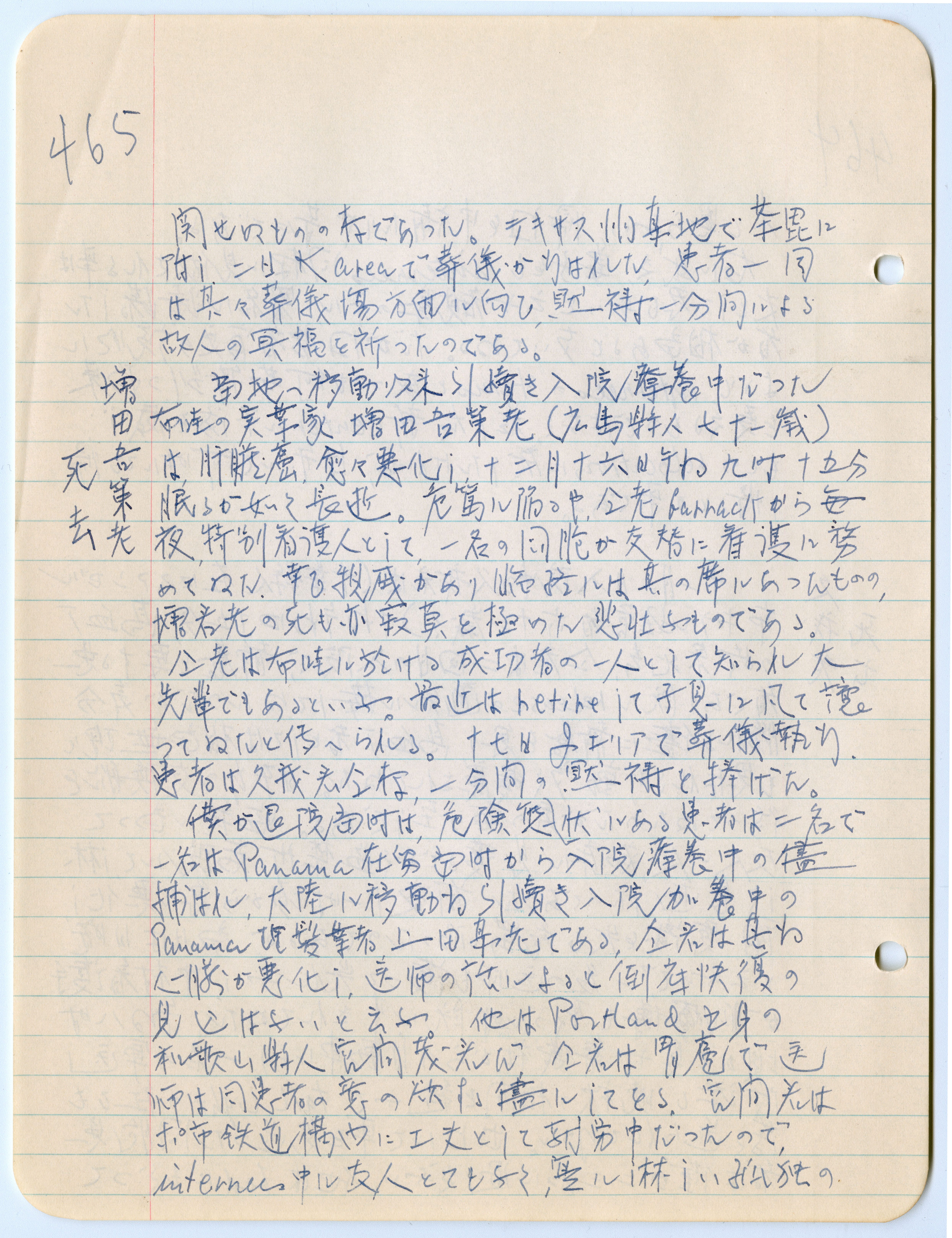
The others stayed in bed and did not seem to care. He was cremated at a location in Texas State, and the funeral was held in the K Area on the 2nd. All the patients faced the direction of the service and had one minute of silence to pray his soul rest in peace.
Mr. Gosaku Masuda, an elderly entrepreneur from Hawaii (from Hiroshima Prefecture, 71 years old) had been going through treatment in the hospital since he was transferred to this camp, but his liver cancer progressed. He passed away in his sleep at 9:15 p.m. on December 16th. When he slipped into a critical condition, fellow citizens in his barracks took turns, having one person watching over him every night as a special nurse. Fortunately, he also had a relative among them who was by his side when he passed away, but the surroundings of his death are also extremely sad and lonely. He is known as one of the most successful businessmen in Hawaii, and it is reported that he recently retired and passed his entire business down to his son. His funeral was held in the J Area on the 17th. All of us patients had one minute of silence except for Mr. Kuga.
Two patients were in critical condition when I was discharged from the hospital. One is an elderly named Mr. Ueda something, a barber from Panama. He was detained while he was being treated in a hospital there, transferred to the continent and continued to be hospitalized here. His liver condition deteriorated, and there is no chance for him to recover according to his doctor. The other one is Mr. Shigetu Miyama from Portland, originally from Wakayama Prefecture. He has stomach cancer, and his doctor lets him do whatever he wants to do. Mr. Miyama managed to get a position as a railroad worker in the Portland City railway station and did not have any friends among the internees here.
- Citation:
- January 1943 entry, page 16, January 1943 entry, Bunro Sakaino Concentration Camp Diary, University of Idaho Library Digital Collections, https://www.lib.uidaho.edu/digital/sakaino/items/sakaino323.html#sakaino339
- Rights:
- In copyright, educational use permitted. Educational use includes non-commercial reproduction of text and images in materials for teaching and research purposes. For other contexts beyond fair use, including digital reproduction, please contact the University of Idaho Library Special Collections and Archives Department at libspec@uidaho.edu. The University of Idaho Library is not liable for any violations of the law by users.
- Standardized Rights:
- http://rightsstatements.org/vocab/InC-EDU/1.0/
 View Page 17
January 1943 entry
-
Item 17 of 31
Transcript
466
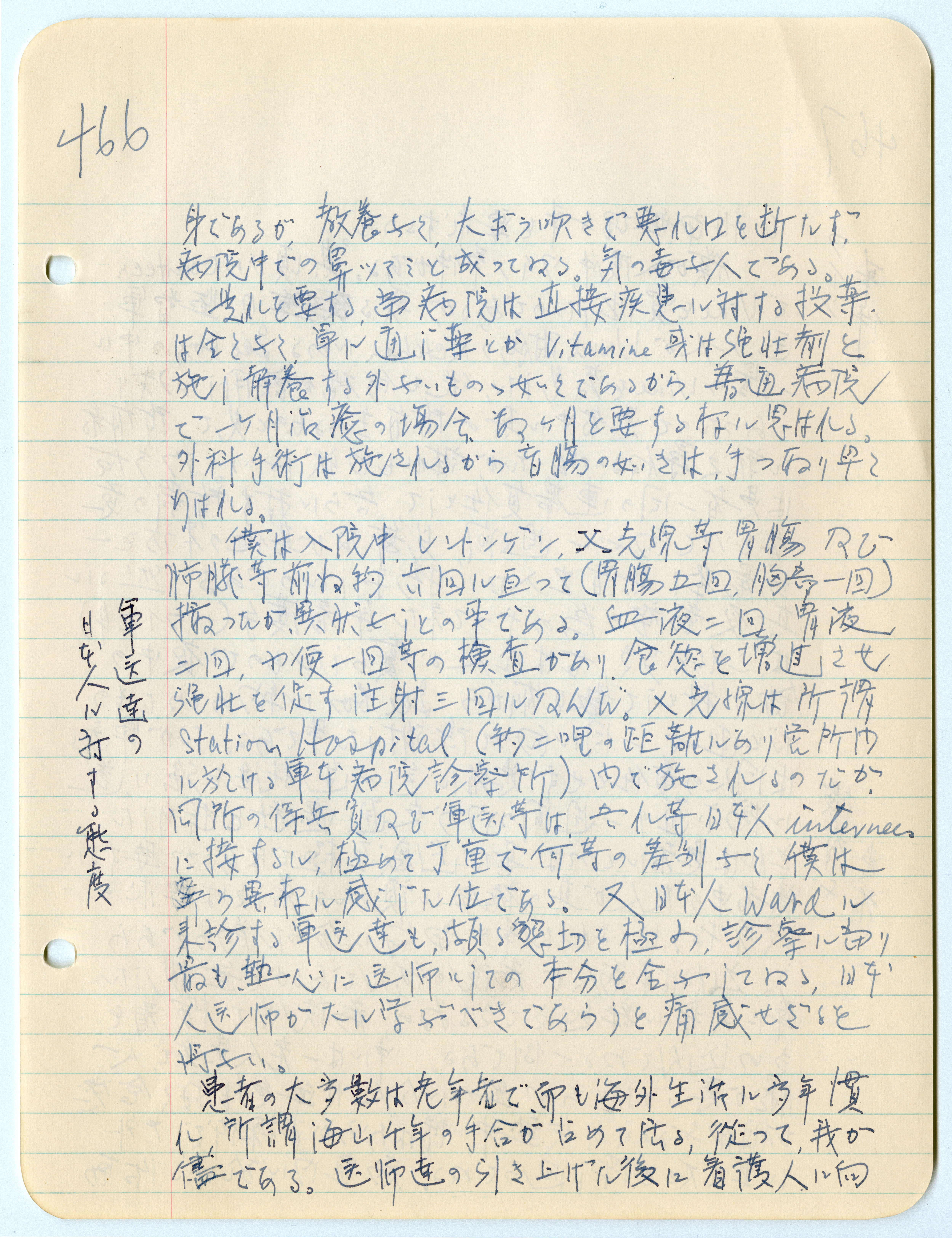
He was quite lonely, but at the same time, he was uneducated, a big liar with a constant bad mouth, and everyone in the hospital finds him a nuisance. I am feeling sorry for him.
This hospital administers laxatives and other supplements such as vitamins but nothing else. All we receive is rest. It takes this hospital several months to treat what would take a regular hospital one month. Surgeries are done, and something like appendicitis can be swiftly treated.
I had six x-rays taken of my digestive system and lungs (five x-rays for the digestive system and one lung x-ray), but no issue has been detected. I also took two blood tests, two gastric juice tests and one urine test, and I received three shots to boost my appetite and strength. x-ray is taken at the Station Hospital (a military hospital in the camp located about five miles away). The soldiers and military doctors working in the facility treat us Japanese internees with respect without any discrimination, and it feels almost strange. Military doctors who come to the ward for the Japanese patients are also extremely thoughtful, and they work passionately to fulfill their responsibilities as a doctor. I truly think the Japanese doctors have a lot to learn from them.
The majority of the patients are elderly with many years of living abroad, and they are quite seasoned. Those people are self-centered. They make some unreasonable demands to the nurses after the doctors leave.
- Citation:
- January 1943 entry, page 17, January 1943 entry, Bunro Sakaino Concentration Camp Diary, University of Idaho Library Digital Collections, https://www.lib.uidaho.edu/digital/sakaino/items/sakaino323.html#sakaino340
- Rights:
- In copyright, educational use permitted. Educational use includes non-commercial reproduction of text and images in materials for teaching and research purposes. For other contexts beyond fair use, including digital reproduction, please contact the University of Idaho Library Special Collections and Archives Department at libspec@uidaho.edu. The University of Idaho Library is not liable for any violations of the law by users.
- Standardized Rights:
- http://rightsstatements.org/vocab/InC-EDU/1.0/
 View Page 18
January 1943 entry
-
Item 18 of 31
Transcript
467
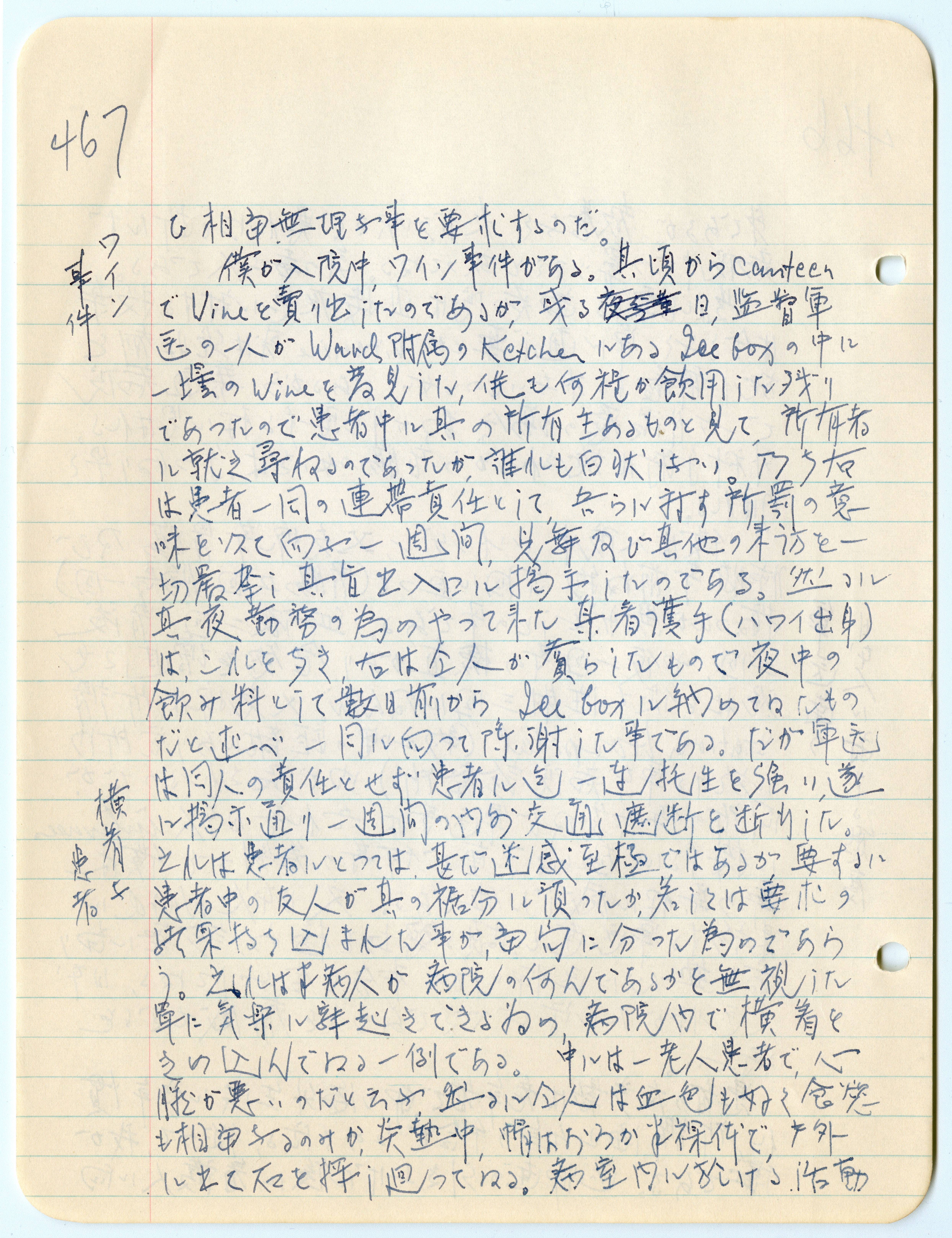
There was this wine incident while I was in the hospital. Canteen started to sell wine, and one of the supervising military doctors one day found a bottle of wine in an icebox in the kitchen. It was open and partially consumed, so the doctor assumed it belonged to someone among the patients. He asked around, but no one confessed. The doctor decided to hold all of us responsible for it, prohibit visitation of anyone for one week as a punishment and put out a notice at the entrance. However, one nurse (from Hawaii) who came for his night shift heard about it and told us that he is the one who had it, and he was keeping the bottle in the icebox for the last several days to have a drink at night. The doctor though did not hold this nurse responsible, forced all the patients to be punished and held the one week traffic ban at the entrance for one week as the notice said. It was such a nuisance for the patients, but I am assuming this was done because the administration discovered either some friends among the patients had a share of the wine, or the bottle was brought in upon request made by someone. This is just one sample to show some patients do not give any consideration to what a hospital is for, take it for granted as a place to leisurely get up and go to sleep and get quite lazy and comfortable in the hospital. One old patient among us is supposed to have some heart issues. However, he has a rosy hue on his face and healthy appetite, and he walks around outside shirtless without a hat to look for some stones when it is extremely hot.
- Citation:
- January 1943 entry, page 18, January 1943 entry, Bunro Sakaino Concentration Camp Diary, University of Idaho Library Digital Collections, https://www.lib.uidaho.edu/digital/sakaino/items/sakaino323.html#sakaino341
- Rights:
- In copyright, educational use permitted. Educational use includes non-commercial reproduction of text and images in materials for teaching and research purposes. For other contexts beyond fair use, including digital reproduction, please contact the University of Idaho Library Special Collections and Archives Department at libspec@uidaho.edu. The University of Idaho Library is not liable for any violations of the law by users.
- Standardized Rights:
- http://rightsstatements.org/vocab/InC-EDU/1.0/
 View Page 19
January 1943 entry
-
Item 19 of 31
Transcript
648
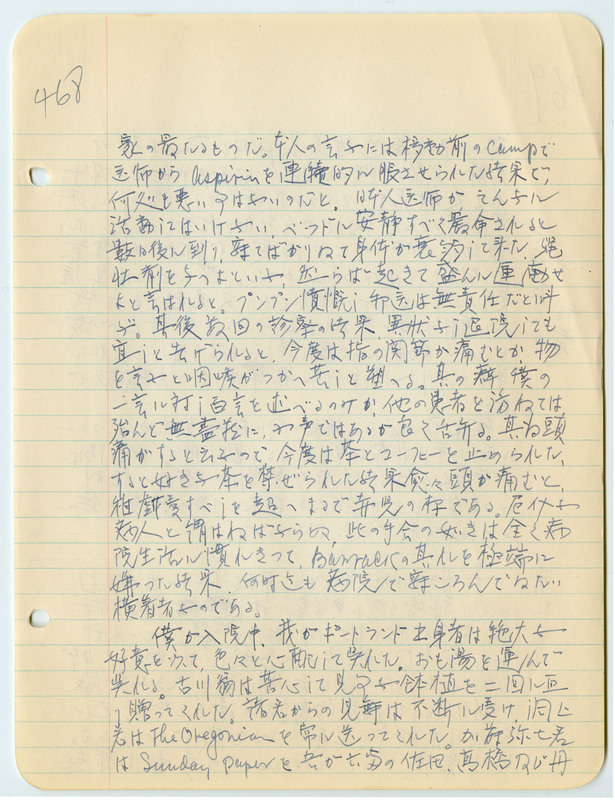
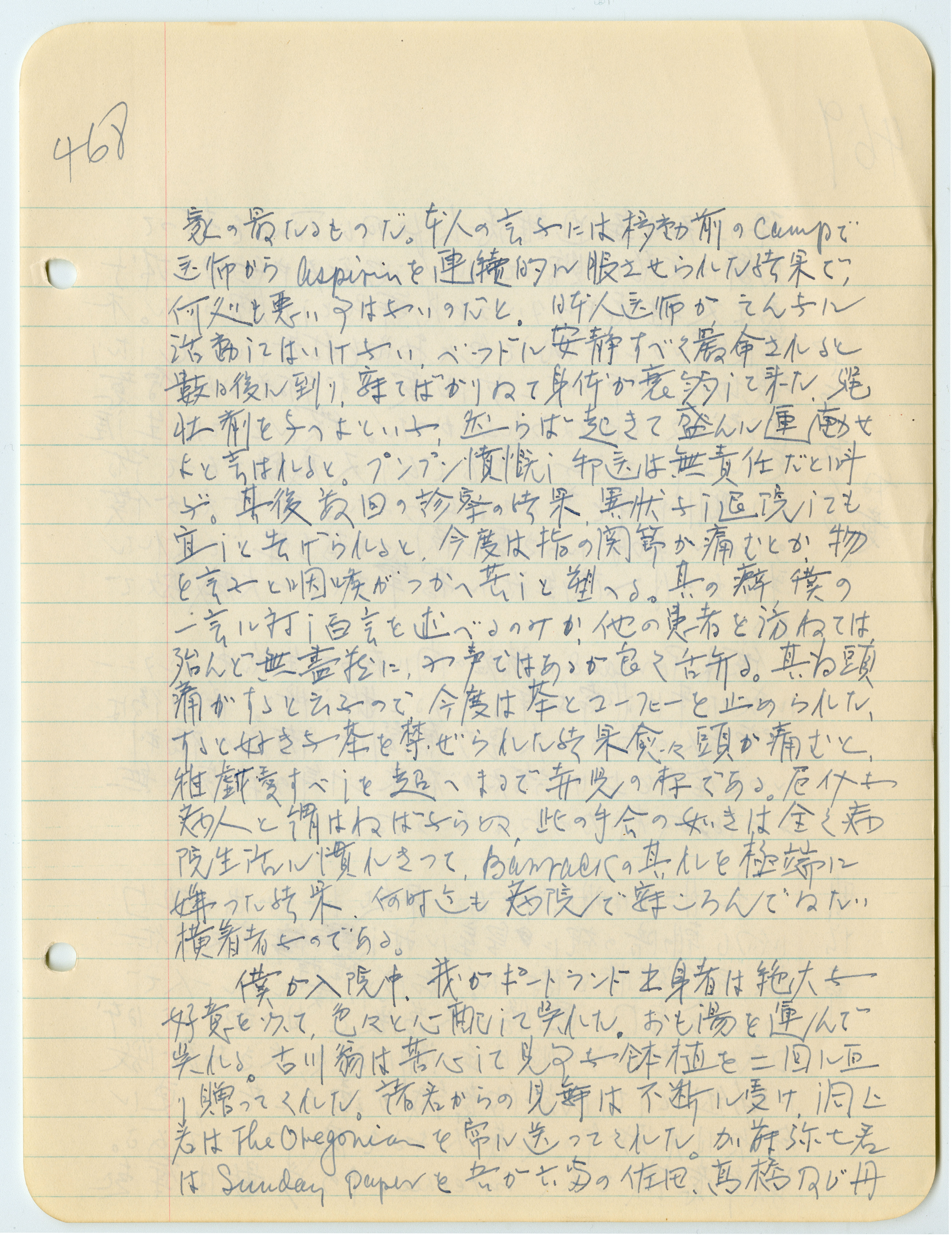
He is the most active in the room. This is due to his daily aspirin intake advised by a doctor before he was transferred to the camp according to him, and he said he does not have any medical issues. He was ordered by the Japanese doctors to stay in bed quietly without moving around. He said constantly being in bed makes his body deteriorate and demanded some supplements several days later. He was told to get up and do a lot of exercise, and he got angry this time and loudly said the Japanese doctors are irresponsible. When he was told that he could be discharged as they did not detect anything wrong after several tests, he claimed that his knuckles hurt and he had discomfort in his throat when he talks. He however always has hundreds of words to respond to my short comment, and he often goes to other patients and keeps talking in his quiet voice. He said he had a headache, and the doctor ordered him to stop his tea and coffee consumption. He then claimed that staying away from tea he enjoys makes his headache worse. He is just like a baby, and it is hard to view him as a lovable and childish figure. I have to say he is such a troublesome patient. Such fellows are completely accustomed to a life in a hospital and detest living in barracks, and all they want is to lead a lazy life in a hospital bed just lying around.
My friends from Portland were worried about me and extremely supportive while I was in the hospital. They delivered rice porridge for me. Elder Kogawa worked so hard to arrange potted plants and brought a pot to me twice. I was constantly receiving something from them, and Mr. Horagami was always sending The Oregonian to me. Mr. Yashichi Kato sent me the Sunday Paper, and Mr. Sada, Mr. Takahashi and Mr. Tanbara from our sixth unit took turns and visited me with a copy of Life and Times magazine every week.
- Citation:
- January 1943 entry, page 19, January 1943 entry, Bunro Sakaino Concentration Camp Diary, University of Idaho Library Digital Collections, https://www.lib.uidaho.edu/digital/sakaino/items/sakaino323.html#sakaino342
- Rights:
- In copyright, educational use permitted. Educational use includes non-commercial reproduction of text and images in materials for teaching and research purposes. For other contexts beyond fair use, including digital reproduction, please contact the University of Idaho Library Special Collections and Archives Department at libspec@uidaho.edu. The University of Idaho Library is not liable for any violations of the law by users.
- Standardized Rights:
- http://rightsstatements.org/vocab/InC-EDU/1.0/
 View Page 20
January 1943 entry
-
Item 20 of 31
Transcript
469
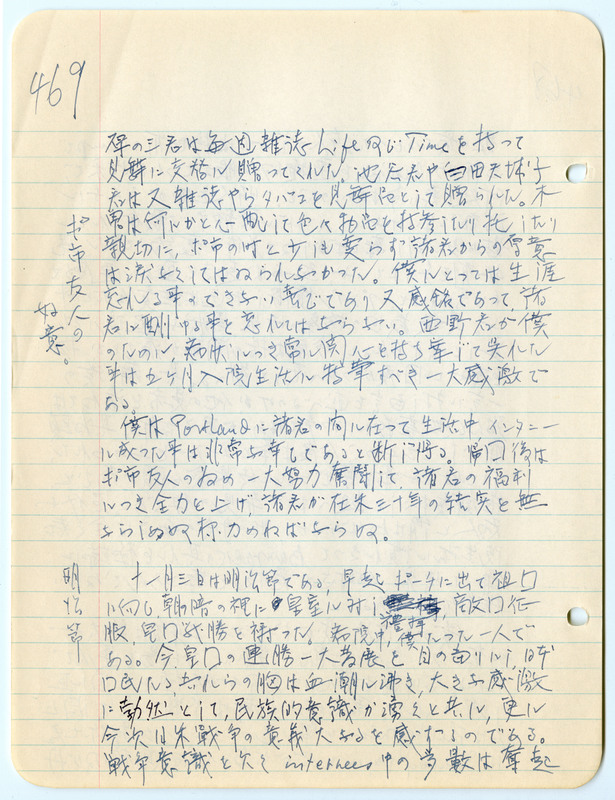
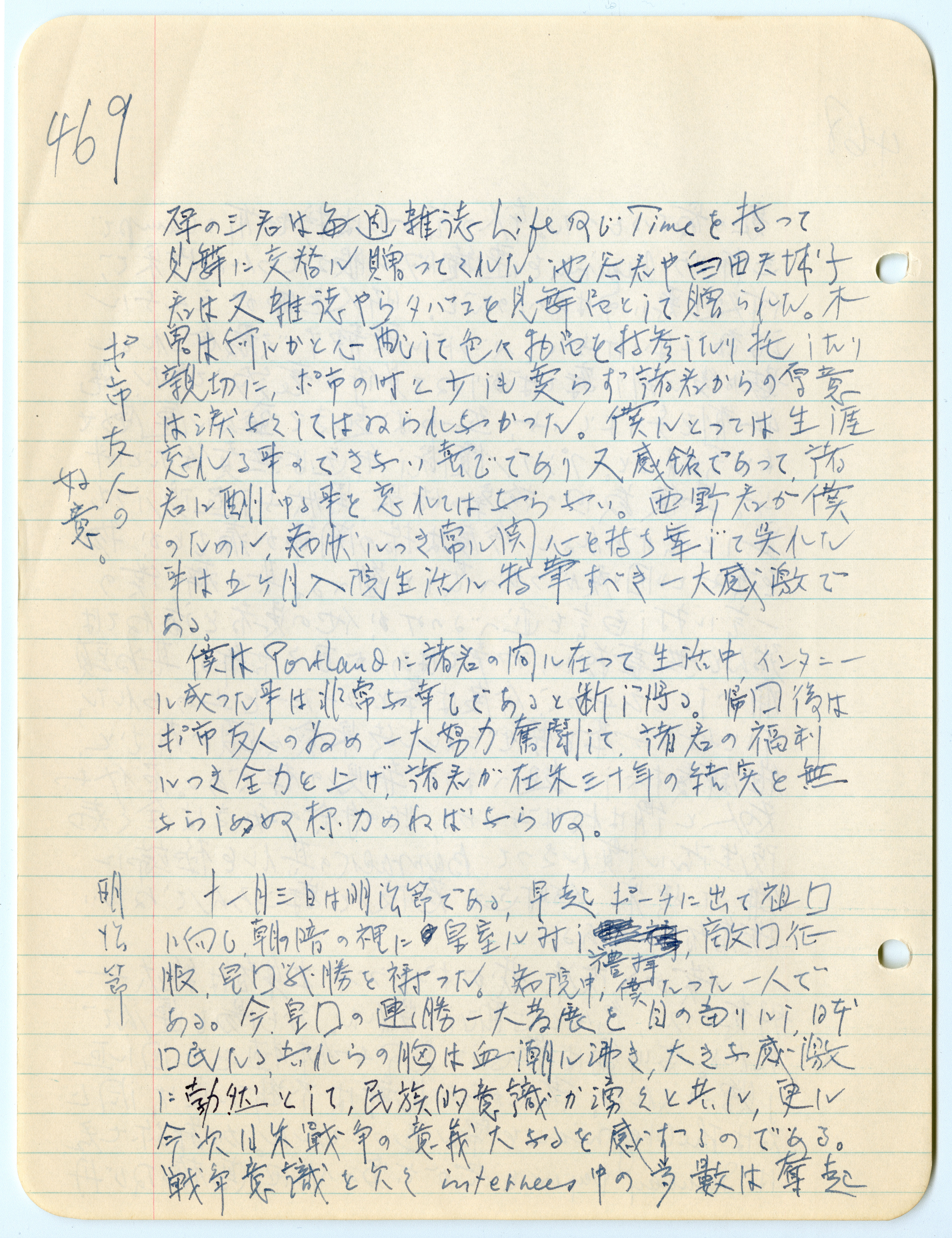
Mr. Ikegami and Mr. Usuta sent me magazines and cigarettes as a gift. Kiso was very worried about me and brought a variety of items or sent some with someone else. I could not help shedding tears over such kindness and continuous support given by my friends since we were in Portland. This is something beautiful I will not forget for the rest of my life, and I am extremely moved. I should never forget to pay it back and do the same to them. I am especially grateful to Mr. Nishino for his concerns and kind attention to my medical condition for five months while I was in the hospital.
I can definitely say that it is fortunate that I became an internee while I was in Portland with such friends. I and determined to work tirelessly for my friends from Portland, do my best to ensure their well-being and make every effort to make sure their hard work in the U.S. for 30 years will be rewarded.
November 3rd is the Meiji Setsu [10] day. I faced the direction of the homeland on the porch early in the morning and sent my prayer to the royal family for the conquest of the enemy nation and victory of imperial Japan. I was the only one praying in the hospital. Our hearts as Japanese are filled with fighting spirits when we witness the continuous victory panning in front of us. We feel uplifted and encouraged by the sense of pride as the Japanese people, and at the same time cannot help giving our thoughts to the importance of this war between Japan and the U.S. Many of those internees who are not willing to fight should pull themselves together.
[10] Birthday of Meiji Emperor
- Citation:
- January 1943 entry, page 20, January 1943 entry, Bunro Sakaino Concentration Camp Diary, University of Idaho Library Digital Collections, https://www.lib.uidaho.edu/digital/sakaino/items/sakaino323.html#sakaino343
- Rights:
- In copyright, educational use permitted. Educational use includes non-commercial reproduction of text and images in materials for teaching and research purposes. For other contexts beyond fair use, including digital reproduction, please contact the University of Idaho Library Special Collections and Archives Department at libspec@uidaho.edu. The University of Idaho Library is not liable for any violations of the law by users.
- Standardized Rights:
- http://rightsstatements.org/vocab/InC-EDU/1.0/
 View Page 21
January 1943 entry
-
Item 21 of 31
Transcript
470
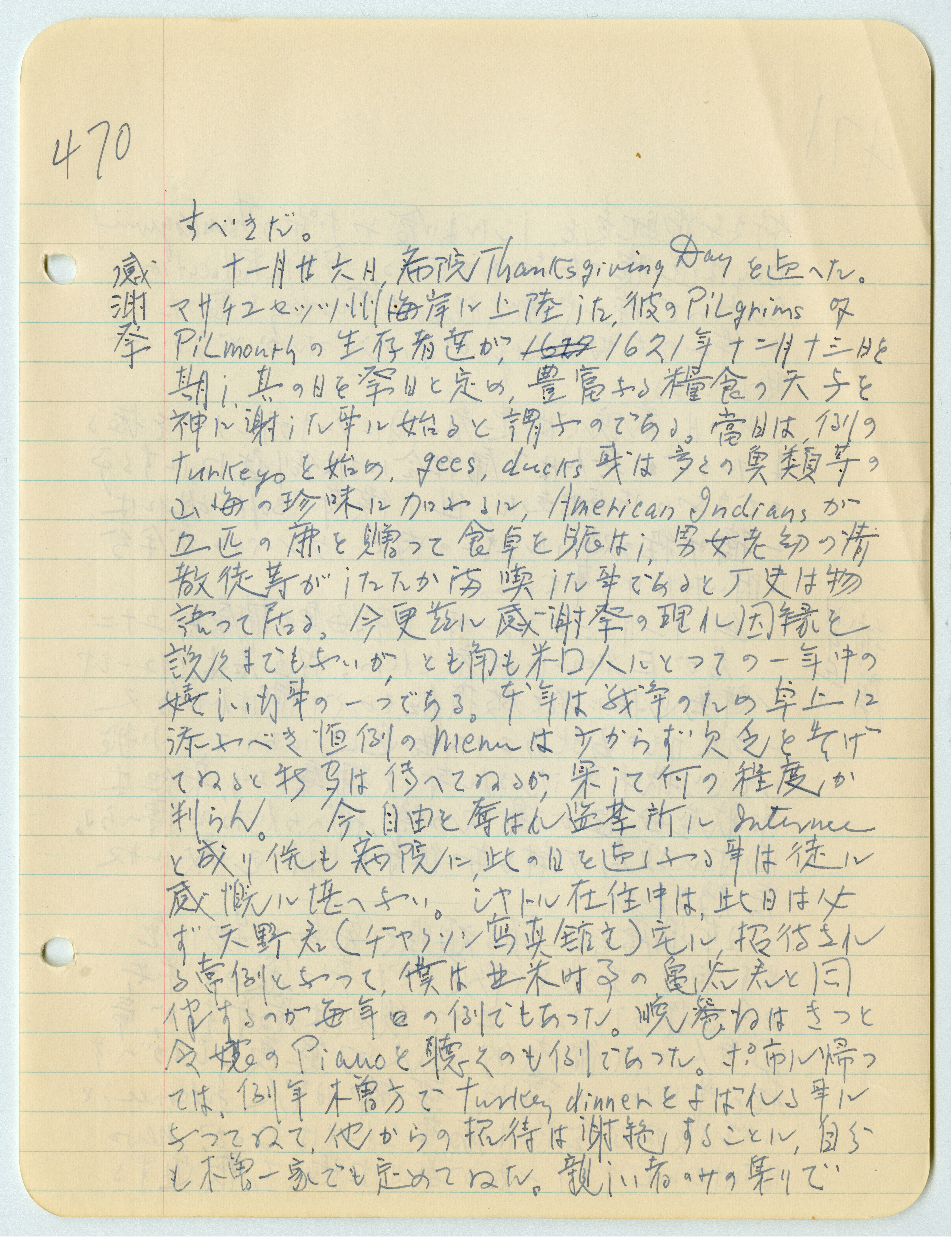
We celebrated Thanksgiving Day in the hospital on November 26. It is said that this started as the survivors of the pilgrims of Plymouth who arrived on a beach in Massachusett State designated December 13, 1621 as the celebration day and thanked God for the abundance of food given to them. On the celebration day, they had turkeys and also geese, ducks, various kinds of fish and food from the land and sea to enjoy, and American Indians [11] brought five deer as a gift to join them at the table. History tells us that Puritan men, women, elders and children had plenty to eat and enjoy. I know there is no need for me to talk about the origin of Thanksgiving any more, but this is one of the fun-filled celebrations for Americans. Newspaper reports that some ingredients for the regular holiday dinner menu are in low supply, but I do not know how severe it is. I have a lot of mixed feelings about being held as an internee in detention with my freedom stripped away and spending this day in the hospital. I was customarily invited to Mr. Amano’s (owner of Jackson Photo Studio) house on the holiday while I lived in Seattle, and I always went there with Mr. Kametani with the North American Post every year. It was also our custom to listen to his daughter playing the piano. I was invited to join a turkey dinner at the Kiso’s after I went back to Portland, and both the Kiso family and I turned down any other invitations.
[11] This is the term used by the author
- Citation:
- January 1943 entry, page 21, January 1943 entry, Bunro Sakaino Concentration Camp Diary, University of Idaho Library Digital Collections, https://www.lib.uidaho.edu/digital/sakaino/items/sakaino323.html#sakaino344
- Rights:
- In copyright, educational use permitted. Educational use includes non-commercial reproduction of text and images in materials for teaching and research purposes. For other contexts beyond fair use, including digital reproduction, please contact the University of Idaho Library Special Collections and Archives Department at libspec@uidaho.edu. The University of Idaho Library is not liable for any violations of the law by users.
- Standardized Rights:
- http://rightsstatements.org/vocab/InC-EDU/1.0/
 View Page 22
January 1943 entry
-
Item 22 of 31
Transcript
471
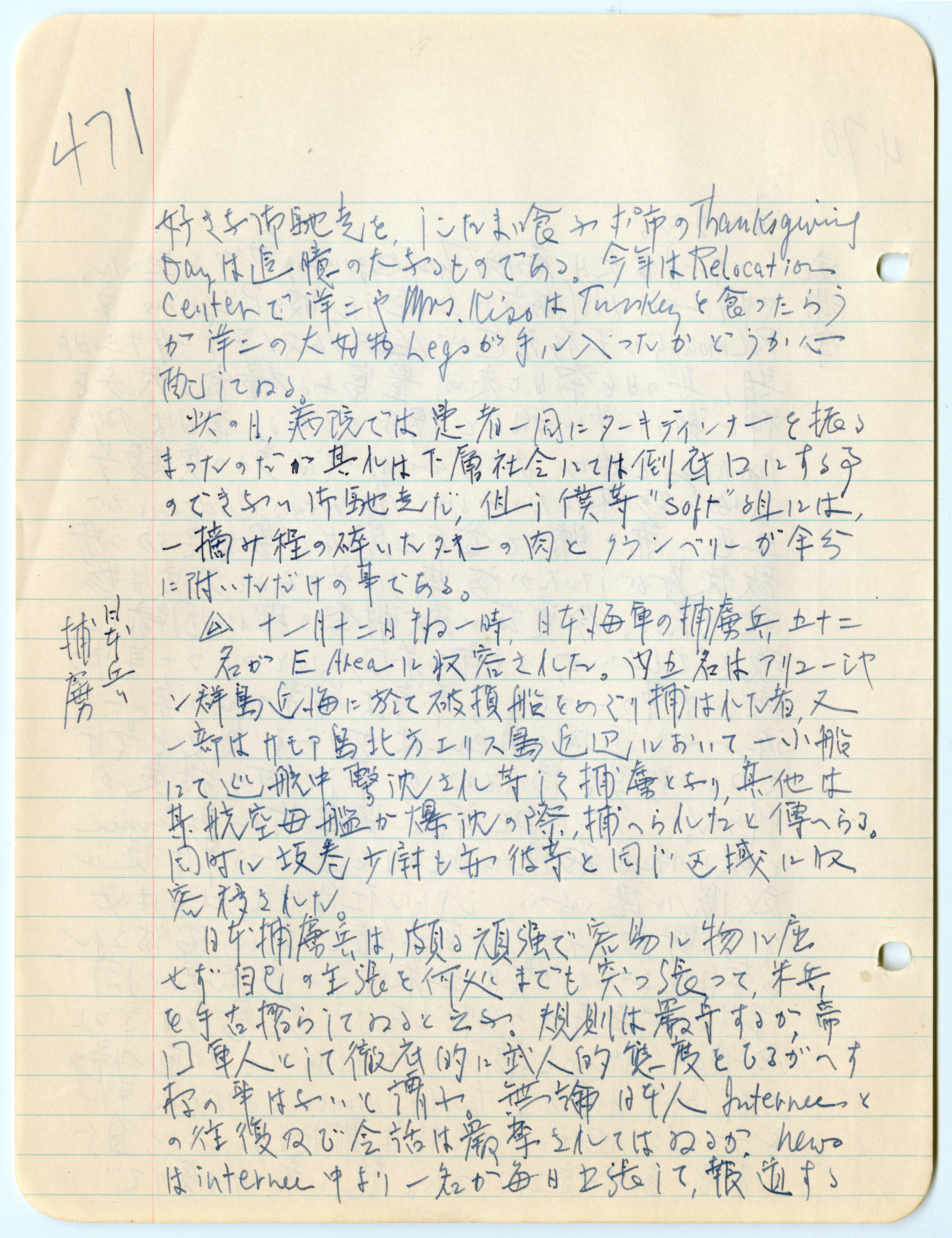
We ate a lot of our favorite food with only close friends and family, and Thanksgiving Day in Portland is big in my memory. I am assuming Yoji and Mrs. Kiso had turkey in the relocation center [12], but I am wondering if he got to get some dark meat that is his favorite.
A turkey dinner was served to all the patients in the hospital on the holiday, and it was a feast that people in a lower class could not afford. Our “soft” category food though had just a handful of mashed turkey and cranberry sauce.
52 war prisoners from the Japanese Navy were detained in the E Area on November 12th. Five out of them were captured when their boat suffered shipwreck in the Aleutian Island, and another small group of them was also captured when they were patrolling in a small boat, got attached and sank around Ellis Island north of Samoa Island. It is reported that the other ones were captured when an aircraft carrier was sunk by bombing. Second Lieutenant Sakamaki was also held in the same area with them.
I heard the Japanese soldiers are quite resilient and do not easily get defeated, holding on to their demands and giving American soldiers a hard time. They honor rules and regulations but never give up on their proud warrior mentality as an imperial army soldier. Visitation and communication between the Japanese soldiers and the internees is of course strictly prohibited, but one of the internees is to make a daily visit to report any news we have to them.
[12] This is the term used by the author
- Citation:
- January 1943 entry, page 22, January 1943 entry, Bunro Sakaino Concentration Camp Diary, University of Idaho Library Digital Collections, https://www.lib.uidaho.edu/digital/sakaino/items/sakaino323.html#sakaino345
- Rights:
- In copyright, educational use permitted. Educational use includes non-commercial reproduction of text and images in materials for teaching and research purposes. For other contexts beyond fair use, including digital reproduction, please contact the University of Idaho Library Special Collections and Archives Department at libspec@uidaho.edu. The University of Idaho Library is not liable for any violations of the law by users.
- Standardized Rights:
- http://rightsstatements.org/vocab/InC-EDU/1.0/
 View Page 23
January 1943 entry
-
Item 23 of 31
Transcript
472
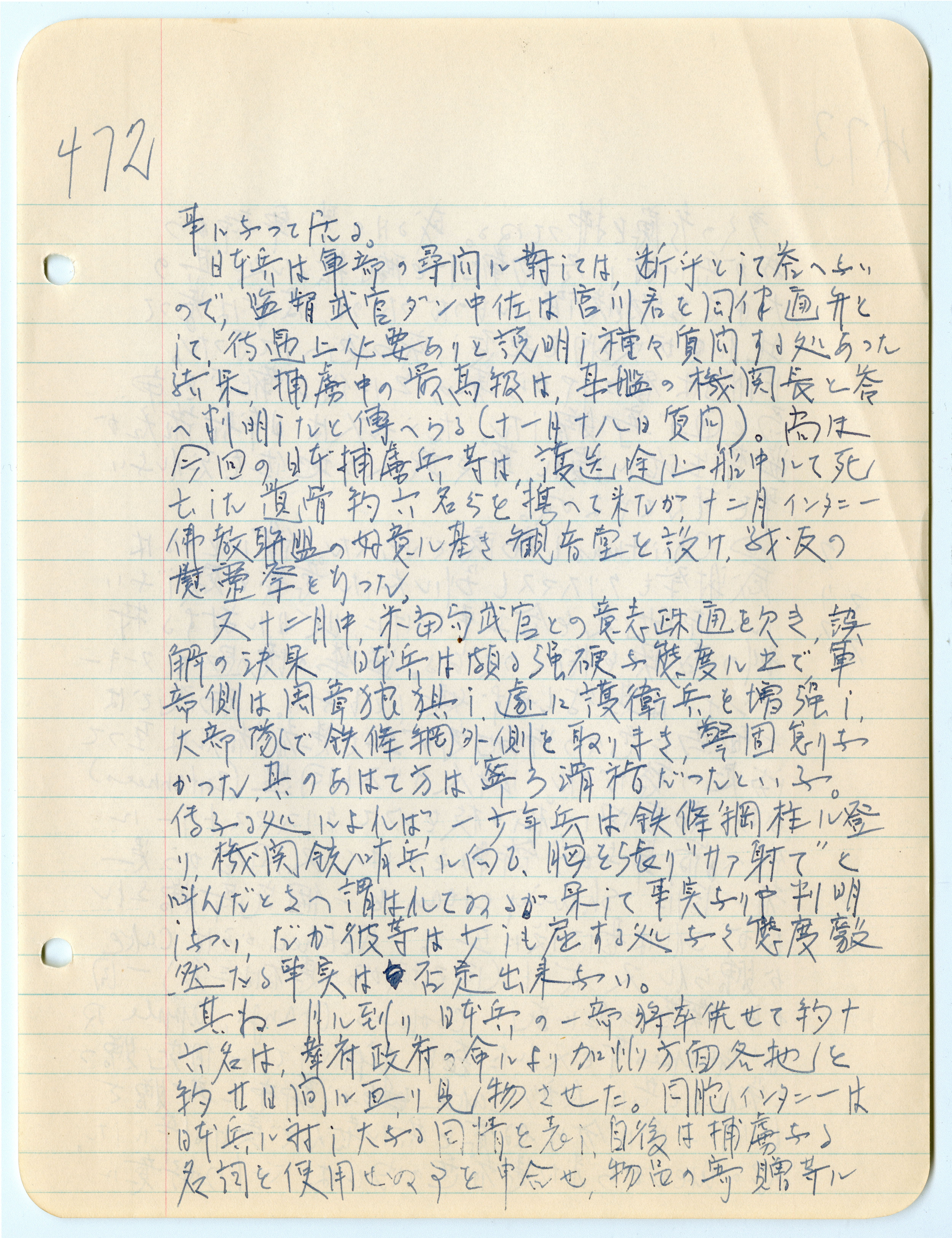
The Japanese soldiers never answer any questions by the military. Lieutenant colonel Dan appointed Mr. Miyagawa as an interpreter, explained that questioning is needed to determine how they are to be treated and asked a number of questions. As a result, it is reported that the highest ranked prisoners of war told them he was the engineer captain of a certain warship revealing his status. (question asked on November 18th) These Japanese prisoners of war carried the ashes of six fallen soldiers who passed away on board while transported. An Altar dedicated to Kannon Buddhist deity of mercy was set up with support offered by the internee Buddhist association, and we held a memorial service for the fellow soldiers.
We heard the Japanese soldiers were holding an extremely uncompromising approach toward the U.S. officers in the administration in December due to lack of communication. This panicked the military administration, and they beefed up the number of guards, positioned the large troop outside the surrounding barbed wire fence for continuous surveillance. It is said that the panic they went through was rather funny to see. Rumor goes one young soldier climbed up on a barbed wire fence pole and shouted, “Shoot me!”, pumping his chest and facing a guard holding a machine gun. However, it is hard to tell if that is true or not. There is no doubt though that they are truly holding their spirits high and maintaining their undefeatable manners.
Later on in January, some of the Japanese soldiers, about 16 of them, were sent to the California region for about 20 days ordered by the federal government. Our fellow internees are deeply sympathetic toward the Japanese soldiers and mutually agreed not to use the term “prisoner of war”, and are providing support by offering gifts and others.
- Citation:
- January 1943 entry, page 23, January 1943 entry, Bunro Sakaino Concentration Camp Diary, University of Idaho Library Digital Collections, https://www.lib.uidaho.edu/digital/sakaino/items/sakaino323.html#sakaino346
- Rights:
- In copyright, educational use permitted. Educational use includes non-commercial reproduction of text and images in materials for teaching and research purposes. For other contexts beyond fair use, including digital reproduction, please contact the University of Idaho Library Special Collections and Archives Department at libspec@uidaho.edu. The University of Idaho Library is not liable for any violations of the law by users.
- Standardized Rights:
- http://rightsstatements.org/vocab/InC-EDU/1.0/
 View Page 24
January 1943 entry
-
Item 24 of 31
Transcript
473
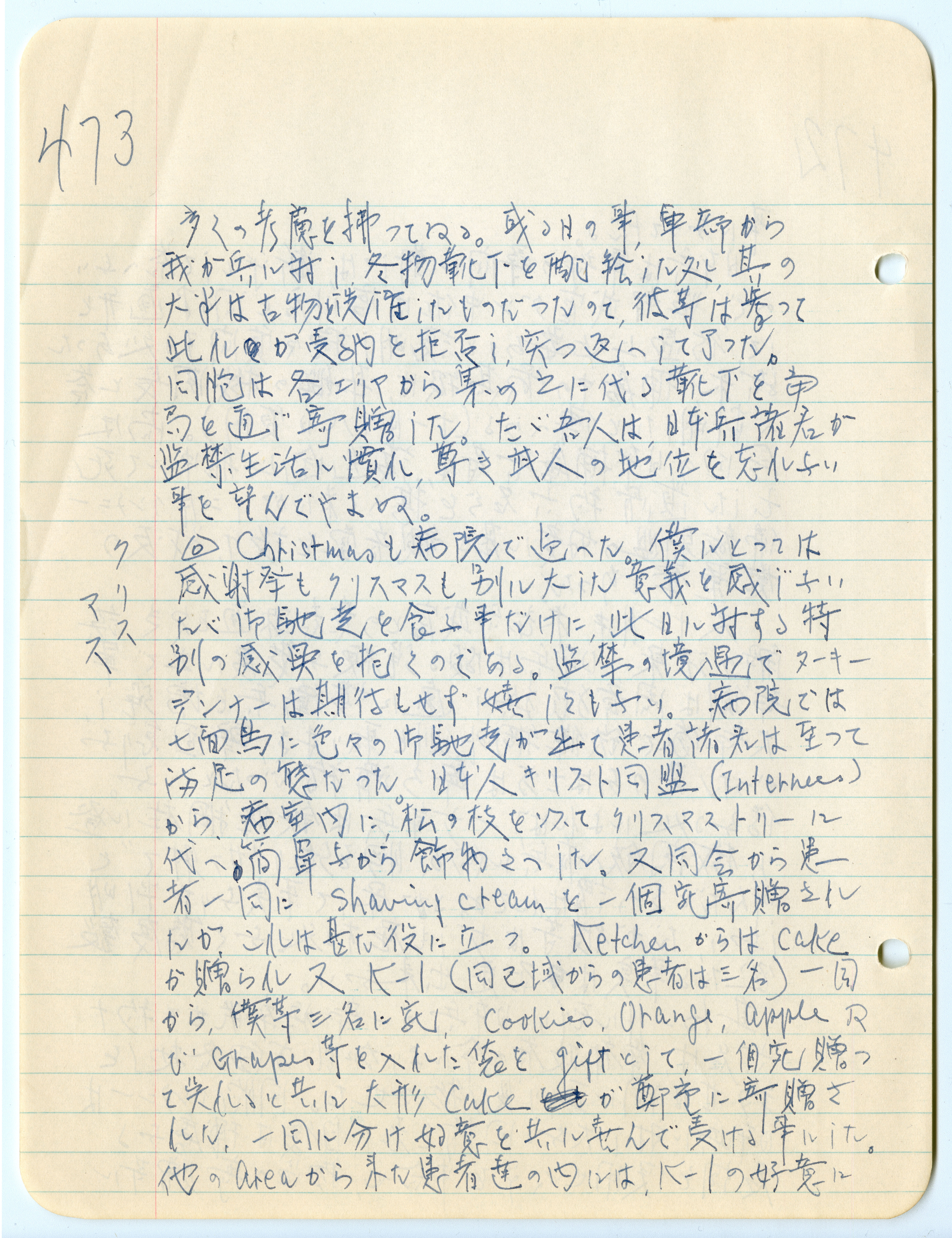
One day, the military administration provided winter socks to the Japanese soldiers, but the soldiers refused to accept them and returned as most of them were used ones that were just washed. We fellow citizens collected socks from each area and donated them through the administration. We simply hope that the Japanese soldiers will not get used to their life in captivity and forget that they are proud warriors.
I spent Christmas day at the hospital. It does not make any difference to me if it is Christmas or Thanksgiving, but I do have special feelings for those days simply because a big meal is served. Turkey dinner is not expected or joyful under detention. Patients in the hospital seemed quite satisfied with a turkey dinner served with other side dishes. The Japanese Christianity association (internees) provided a pine tree as a Christmas tree with some simple ornaments. The association also gave each of the patients a container of shaving cream as a gift, and it is very helpful. The kitchen gave us a cake, and everyone from the K-1 Area sent us (three patients are here from the area) a bag of cookies, oranges, apples and grapes as a gift. They also gave us a big cake. We decided to share and enjoy them together. Some people from the other areas were unhappy that they did not receive anything compared to what the K-1 area people kindly offered.
- Citation:
- January 1943 entry, page 24, January 1943 entry, Bunro Sakaino Concentration Camp Diary, University of Idaho Library Digital Collections, https://www.lib.uidaho.edu/digital/sakaino/items/sakaino323.html#sakaino347
- Rights:
- In copyright, educational use permitted. Educational use includes non-commercial reproduction of text and images in materials for teaching and research purposes. For other contexts beyond fair use, including digital reproduction, please contact the University of Idaho Library Special Collections and Archives Department at libspec@uidaho.edu. The University of Idaho Library is not liable for any violations of the law by users.
- Standardized Rights:
- http://rightsstatements.org/vocab/InC-EDU/1.0/
 View Page 25
January 1943 entry
-
Item 25 of 31
Transcript
474
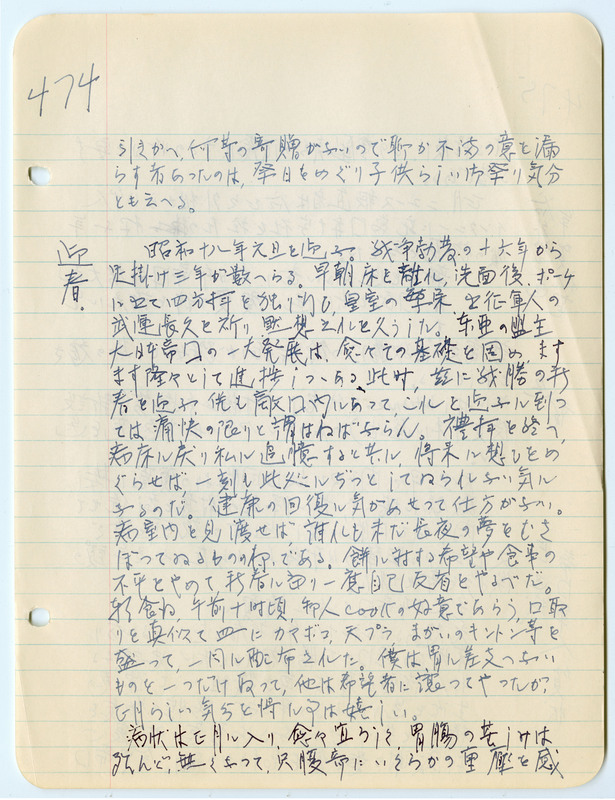
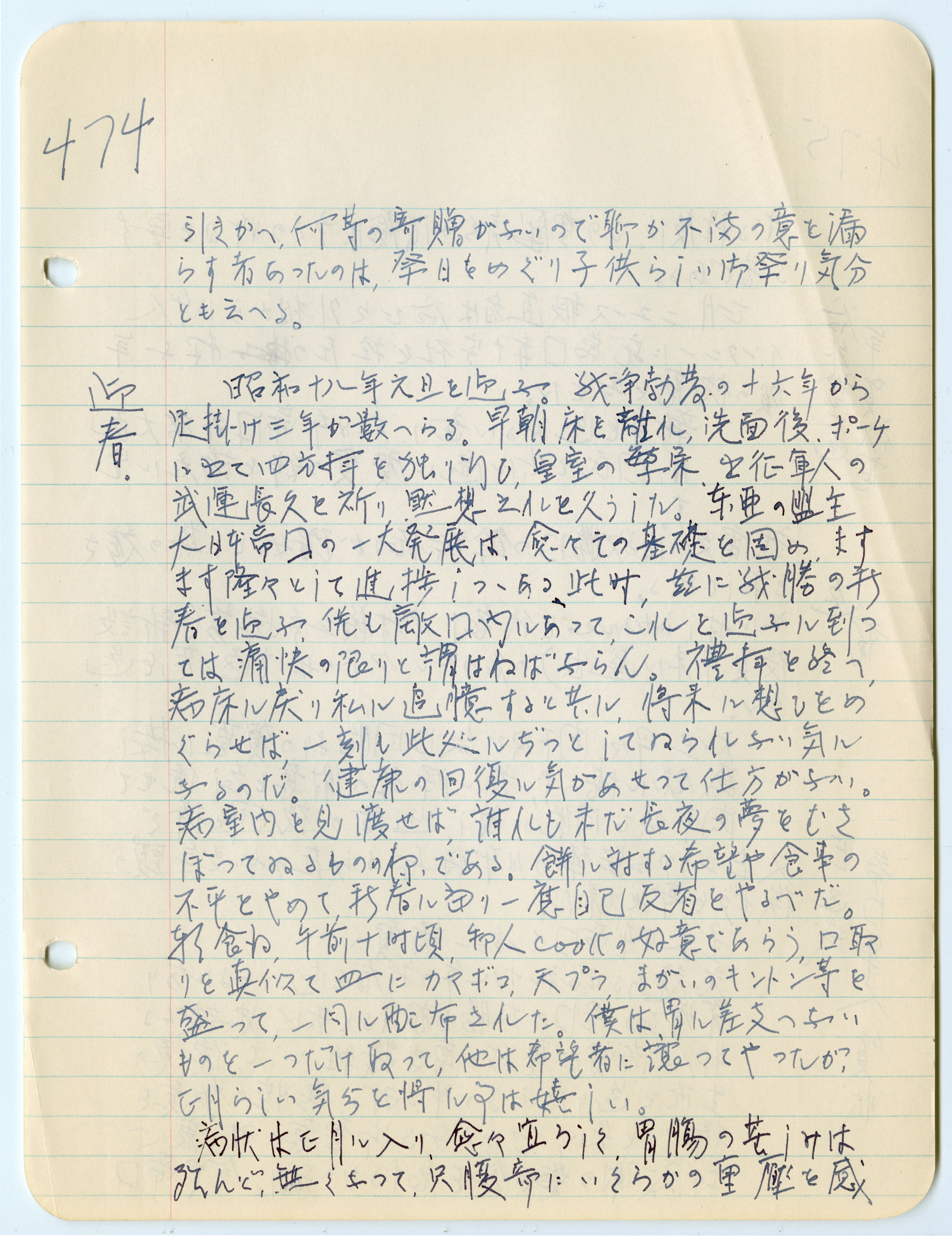
I think they were feeling almost like a child around the holiday.
This is the first day of the year 1943. It has been three years since the war started in 1941. I got up early in the morning and went out to the porch after washing my face to pray to the four directions by myself and have a moment of silence to pray for the prosperity of the loyal family and the success and longevity of the soldiers in the fields. Imperial Japan is going through leaping development as the leader of Eastern Asia, firmly establishing its foundation and bravely moving forward. I have to say it is such a delight to start this new year to celebrate the victory of the war especially within the enemy nation. I went back to my hospital bed after the prayer, traced back my memories and thought about the future. I felt like I could not just stay here doing nothing for another moment. It is no use to hurry to recover my health. It seemed like everyone else in the room was still having a long night dream. We need to reflect on ourselves to start a new year instead of demanding mochi rice cake and complaining about meals. It was probably a thoughtful offer made by a Japanese cook, but a plate of fishcake, tempura and some mock mashed sweet potatoes was served to everyone. I picked one item that my stomach could handle and gave away the rest of it to others. I was happy to taste some new year food though.
My symptoms were getting better in the new year, and my digestive system discomfort was almost gone. I sometimes feel heaviness in my stomach, but that is all.
- Citation:
- January 1943 entry, page 25, January 1943 entry, Bunro Sakaino Concentration Camp Diary, University of Idaho Library Digital Collections, https://www.lib.uidaho.edu/digital/sakaino/items/sakaino323.html#sakaino348
- Rights:
- In copyright, educational use permitted. Educational use includes non-commercial reproduction of text and images in materials for teaching and research purposes. For other contexts beyond fair use, including digital reproduction, please contact the University of Idaho Library Special Collections and Archives Department at libspec@uidaho.edu. The University of Idaho Library is not liable for any violations of the law by users.
- Standardized Rights:
- http://rightsstatements.org/vocab/InC-EDU/1.0/
 View Page 26
January 1943 entry
-
Item 26 of 31
Transcript
475
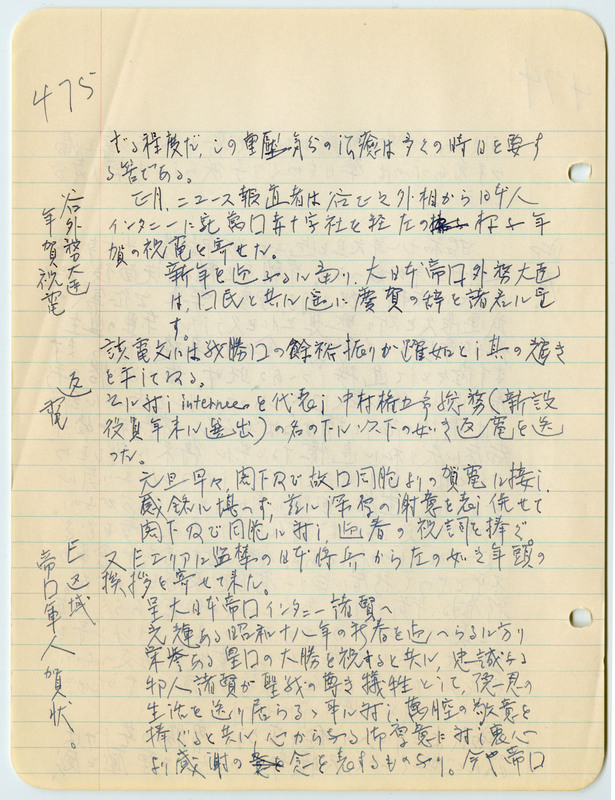
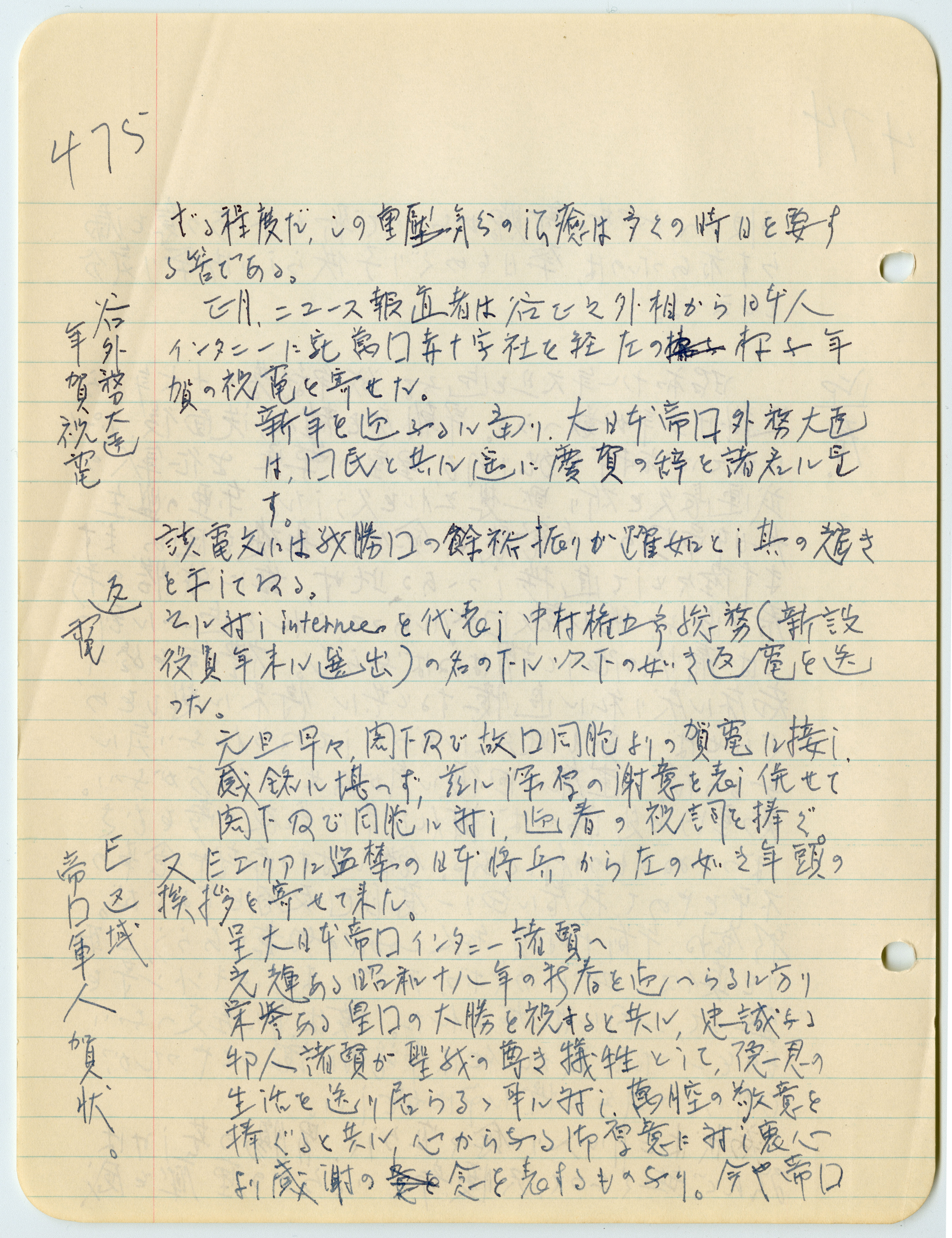
It would take a long time to get rid of the heaviness.
A news reporter reported that the Minister of Foreign Affairs Masahiro Tani sent a celebration telegram to the Japanese internees through the Red Cross as follows.
As a new year starts, the Minister of Foreign Affairs of Imperial Japan would like to send a note to you all to celebrate along with the people of the nation.
The message is full of confidence as the winning nation of the war. In response, we sent a telegram as follows under the name of Director Gengoro Nakamura (elected at the end of last year as a new officer).
We are deeply moved to receive a celebration telegram from the honorable minister and fellow citizens. We would like to express our deepest gratitude and send our best wishes for the new year to you and our fellow citizens.
A new year message was sent by the Japanese officers and soldiers detained in the E Area.
To all the internees of Imperial Japan,
We are starting the year 1943 and would like to celebrate the glorious victory of our imperial nation. At the same time, we would like to express our highest respect to you all royal Japanese citizens to live a life of endurance as a victim of the sacred battle. We send you our gratitude from the bottom of our heart to your kindness.
- Citation:
- January 1943 entry, page 26, January 1943 entry, Bunro Sakaino Concentration Camp Diary, University of Idaho Library Digital Collections, https://www.lib.uidaho.edu/digital/sakaino/items/sakaino323.html#sakaino349
- Rights:
- In copyright, educational use permitted. Educational use includes non-commercial reproduction of text and images in materials for teaching and research purposes. For other contexts beyond fair use, including digital reproduction, please contact the University of Idaho Library Special Collections and Archives Department at libspec@uidaho.edu. The University of Idaho Library is not liable for any violations of the law by users.
- Standardized Rights:
- http://rightsstatements.org/vocab/InC-EDU/1.0/
 View Page 27
January 1943 entry
-
Item 27 of 31
Transcript
476
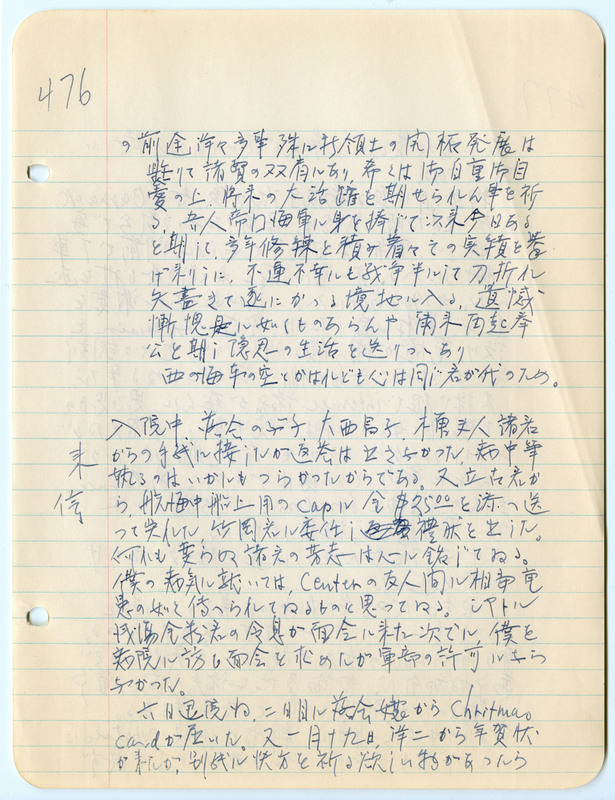
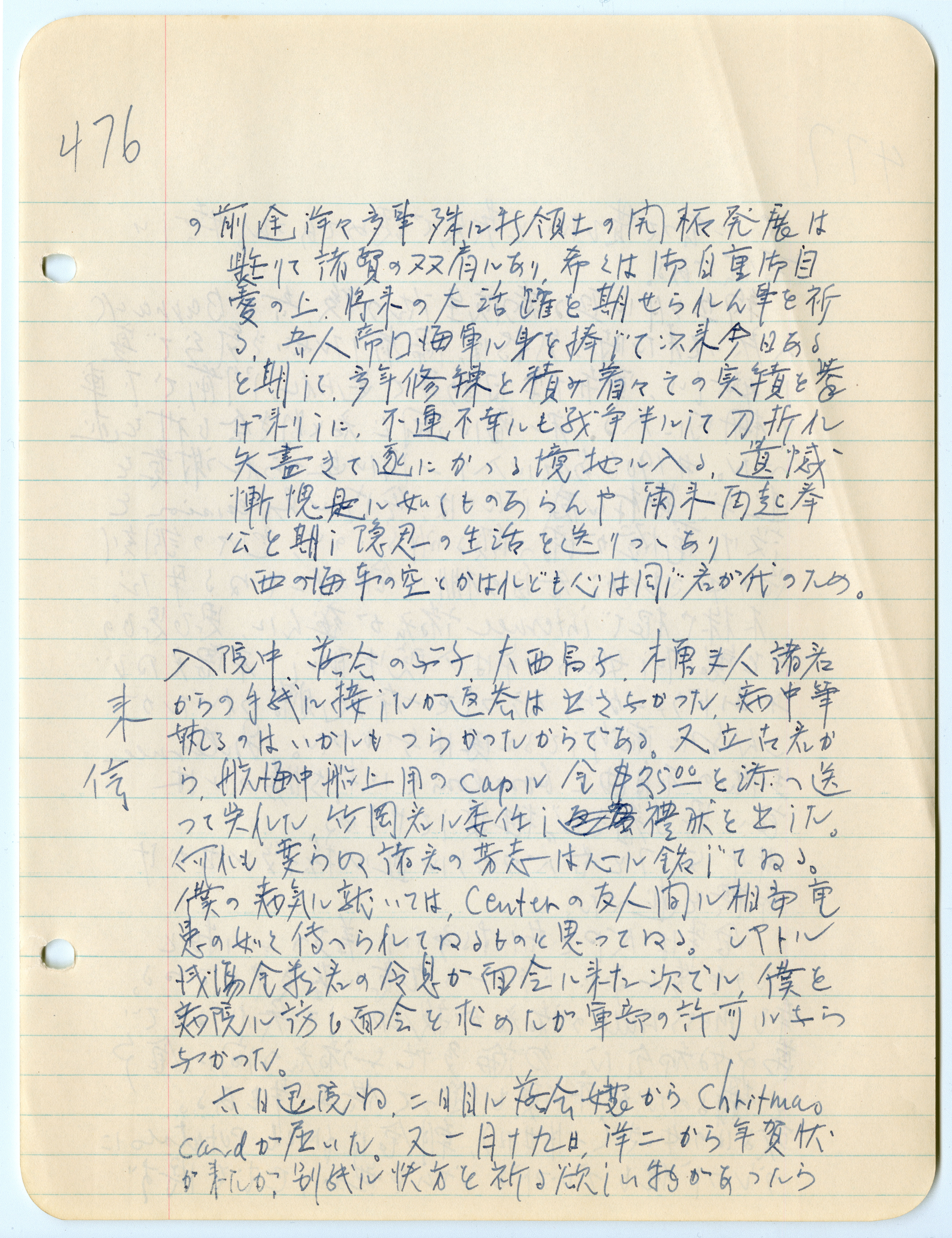
Our future activities and especially development of new territories are on your shoulders, and we wish you good health and success in your future endeavors. We have been going through training for a number of years since we devoted ourselves to the Imperial Japan Navy and have continuously achieved victories.Unfortunately, we fell into the current situation in the middle of our battle with our swords broken and with our arrows running out. It is impossible to express our frustration and regrets. We are living our silent lives of patience hoping to rise and fight again.
Ocean in West, and skies in East, we are separated, but our hearts are all for the era of the emperor
I received a letter from Nobuko Ochiai, Masako Onishi and Mrs. Kiso while I was in the hospital but did not write back. iIt is because I find it very hard to write when I am sick. Mr. Tatefuru sent me a boat cap to wear while sailing with a cash of 25 dollars. I asked Mr. Takaoka to sent him a thank you note for me. I am fully aware of kind thoughts sent by my friends as alway. I assume my friends in the center were told that I was seriously ill. Son of Mr. Kinzo Asaba from Seattle requested a visit to see me at the hospital when he was visiting here, but the military did not give permission.
A Christmas card from Ms. Ochiai was delivered two days after I was discharged from the hospital on the 6th. I also received a new year card from Yoji. He said he wishes me a quick recovery and I should ask his father if I need anything.
- Citation:
- January 1943 entry, page 27, January 1943 entry, Bunro Sakaino Concentration Camp Diary, University of Idaho Library Digital Collections, https://www.lib.uidaho.edu/digital/sakaino/items/sakaino323.html#sakaino350
- Rights:
- In copyright, educational use permitted. Educational use includes non-commercial reproduction of text and images in materials for teaching and research purposes. For other contexts beyond fair use, including digital reproduction, please contact the University of Idaho Library Special Collections and Archives Department at libspec@uidaho.edu. The University of Idaho Library is not liable for any violations of the law by users.
- Standardized Rights:
- http://rightsstatements.org/vocab/InC-EDU/1.0/
 View Page 28
January 1943 entry
-
Item 28 of 31
Transcript
477
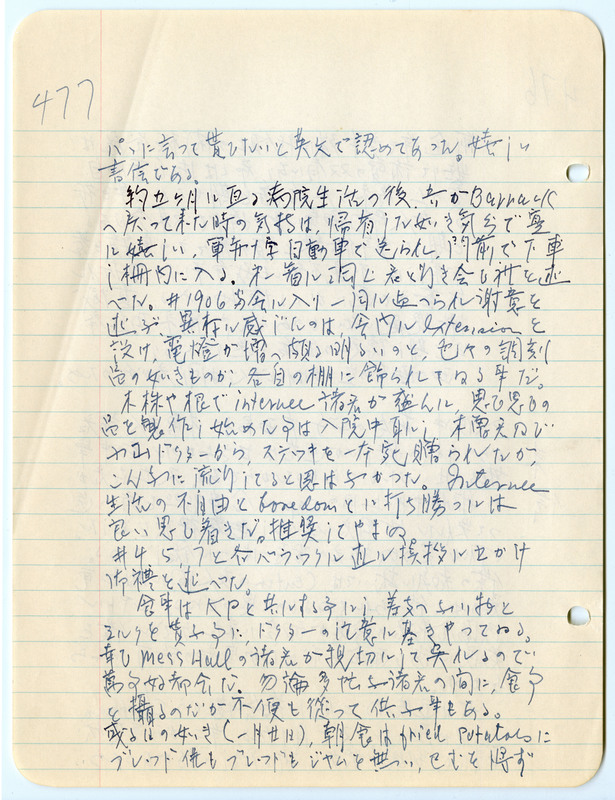
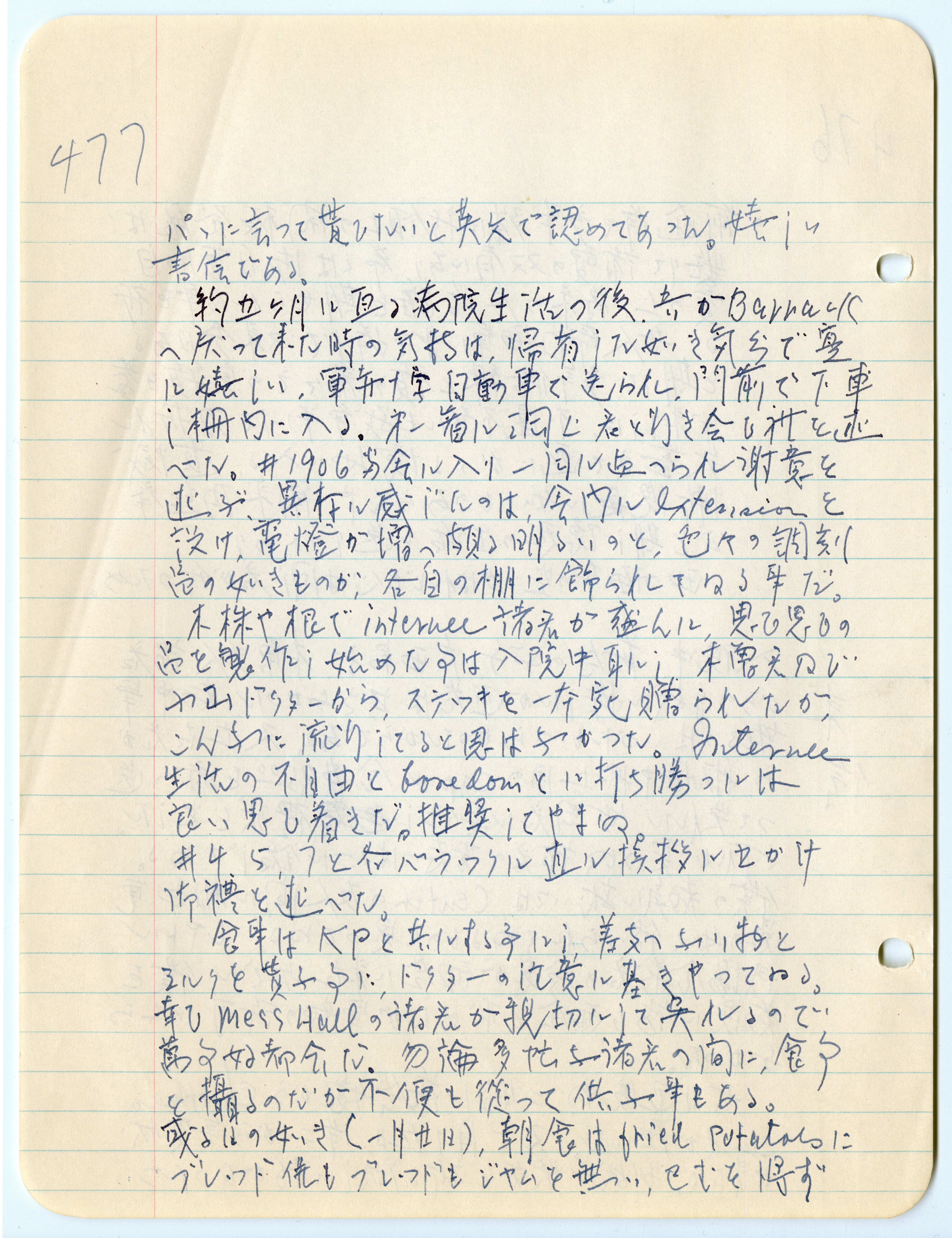
It was such a pleasant note.
I came back to our barracks after being in the hospital for about five months, and I was so glad to be back just like I came back to my hometown. I was brought back in a military Red Cross vehicle, got off in front of the gate and went inside of the fence. I saw Mr. Horagami first and thanked him. I went into the 1906 unit and said thank you to everyone there to see me. What was strange is that extensions had been installed in the building with more light fixtures, and it is extremely bright. There are also various sorts of sculpture-like objects displayed on each shelf. I heard that the internees had started to curve many different kinds of items out of logs and tree roots as they pleased while I was hospitalized. I was given a walking pole by Mr. Kiso and another one by Dr. Koyama, but I had no idea how popular this activity was. It is such a good idea to conquer boredom and absence of freedom in our life as an internee. I could not recommend it more.
I visited the barracks number 4,5 and 7 to say hello and thank you.
I made sure that it is not an issue to have meals with the K and P Area fellows and am provided with milk based on the doctor’s recommendation. It is working out nicely as people in the mess hall are very kind to me. Of course some inconveniences occur as we eat while a lot of people are busy. For example (on January 20th), fried potatoes and bread was served for breakfast, and jam was not there.
- Citation:
- January 1943 entry, page 28, January 1943 entry, Bunro Sakaino Concentration Camp Diary, University of Idaho Library Digital Collections, https://www.lib.uidaho.edu/digital/sakaino/items/sakaino323.html#sakaino351
- Rights:
- In copyright, educational use permitted. Educational use includes non-commercial reproduction of text and images in materials for teaching and research purposes. For other contexts beyond fair use, including digital reproduction, please contact the University of Idaho Library Special Collections and Archives Department at libspec@uidaho.edu. The University of Idaho Library is not liable for any violations of the law by users.
- Standardized Rights:
- http://rightsstatements.org/vocab/InC-EDU/1.0/
 View Page 29
January 1943 entry
-
Item 29 of 31
Transcript
478
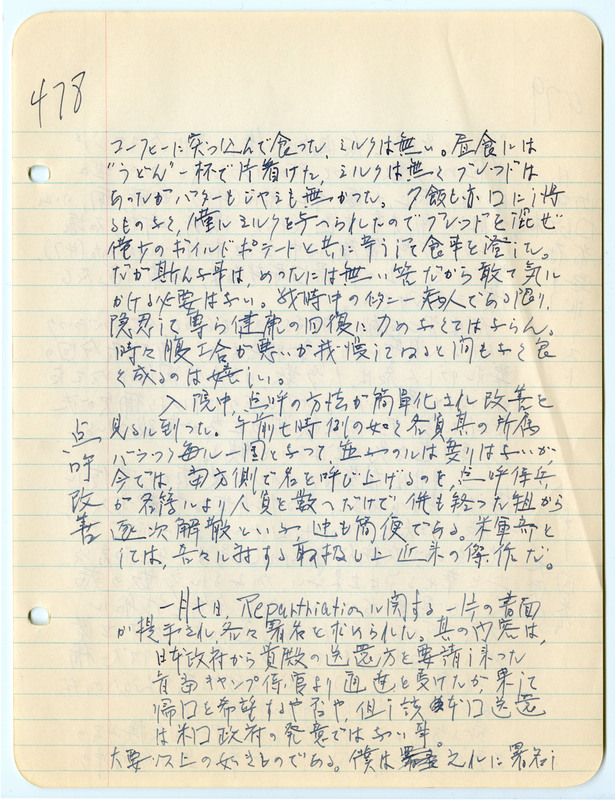
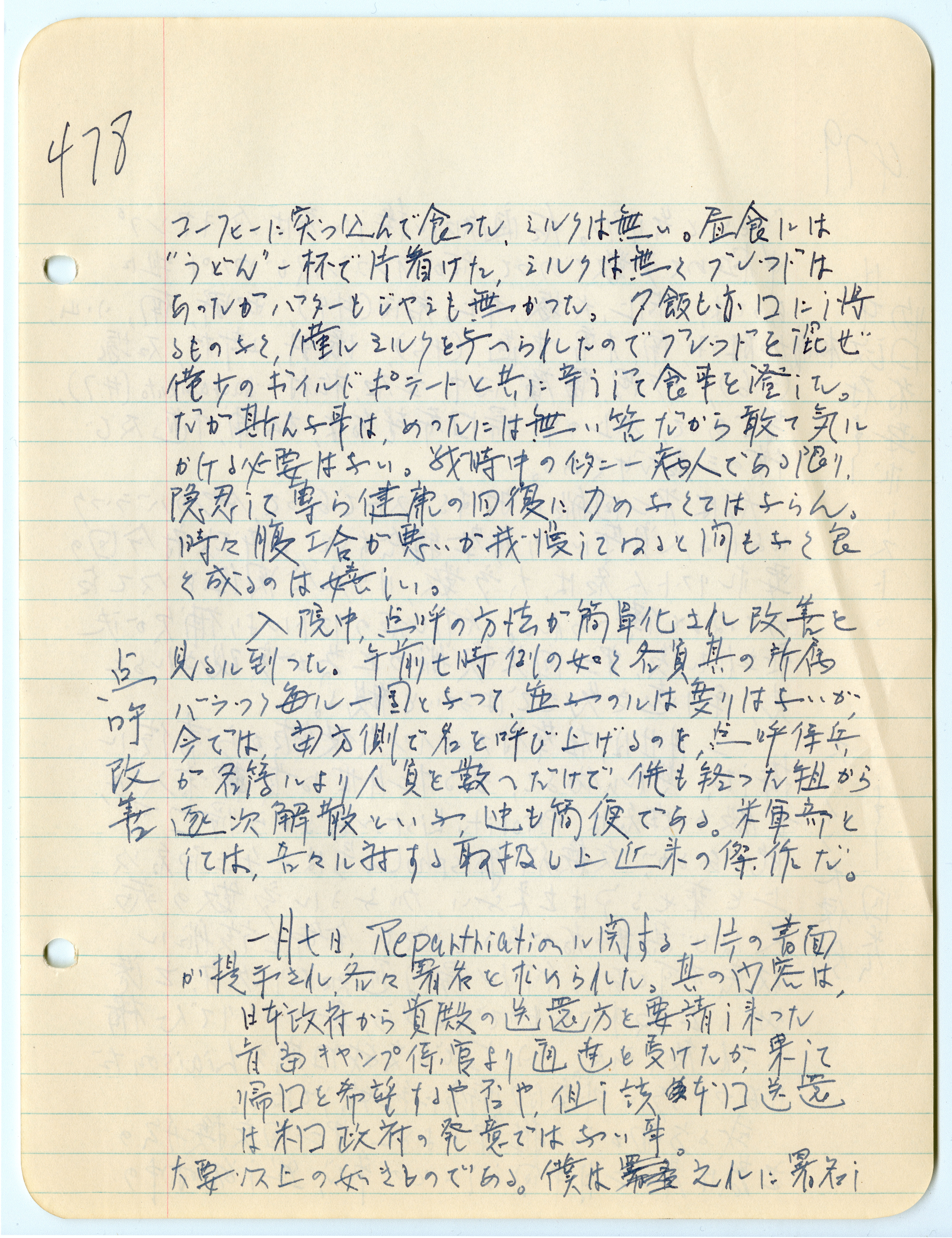
I dunked my bread in coffee and ate it. Milk was not available. A bowl of udon noodles was for lunch. Milk was not available, and butter or jam was not served either. Something I could not stomach was served for dinner, but milk was provided. I put bread and a bit of boiled potatoes in it and managed to have dinner. However, this rarely happens, and I do not need to worry about it. I simply need to focus on regaining my health with patience as I was a sick internee in wartime. I sometimes have digestive system issues, but I am relieved that they go away after a while.
Roll calling was simplified and improved while I was in the hospital. We all still line up in front of our barracks at seven every morning. However, the roll calling officers just match the number of people with the name list instead of calling each name, and the groups are dismissed as their check is complete. It is totally simplified. I would have to say this is the best improvement that the U.S. military administration has recently made for us.
One form regarding repatriation was distributed, and each of us was asked to sign. It is to question us if we received a request to go back to Japan by the Japanese government, if we received a notice by the camp administration and if we wish to go back to Japan. It also states that returning to homeland was not suggested by the U.S. government.
The above is what it is about. I signed the form and answered “yes”.
- Citation:
- January 1943 entry, page 29, January 1943 entry, Bunro Sakaino Concentration Camp Diary, University of Idaho Library Digital Collections, https://www.lib.uidaho.edu/digital/sakaino/items/sakaino323.html#sakaino352
- Rights:
- In copyright, educational use permitted. Educational use includes non-commercial reproduction of text and images in materials for teaching and research purposes. For other contexts beyond fair use, including digital reproduction, please contact the University of Idaho Library Special Collections and Archives Department at libspec@uidaho.edu. The University of Idaho Library is not liable for any violations of the law by users.
- Standardized Rights:
- http://rightsstatements.org/vocab/InC-EDU/1.0/
 View Page 30
January 1943 entry
-
Item 30 of 31
Transcript
479
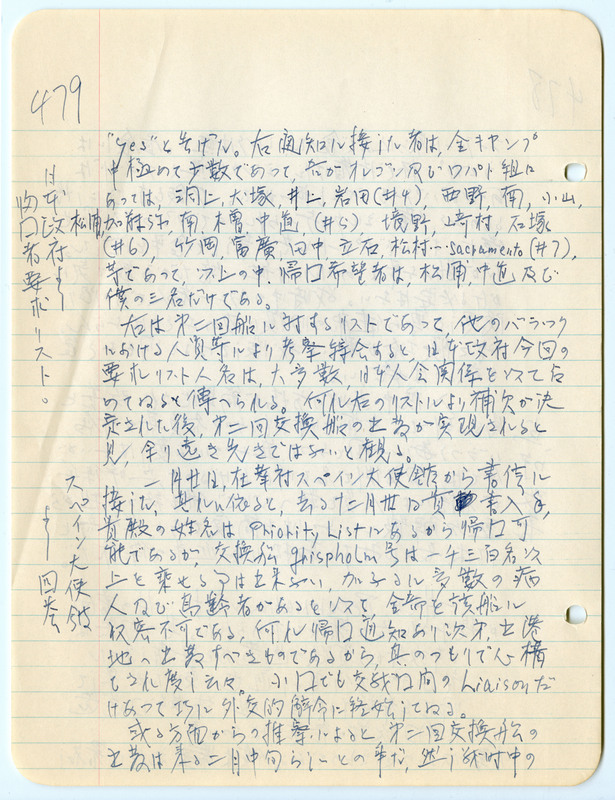
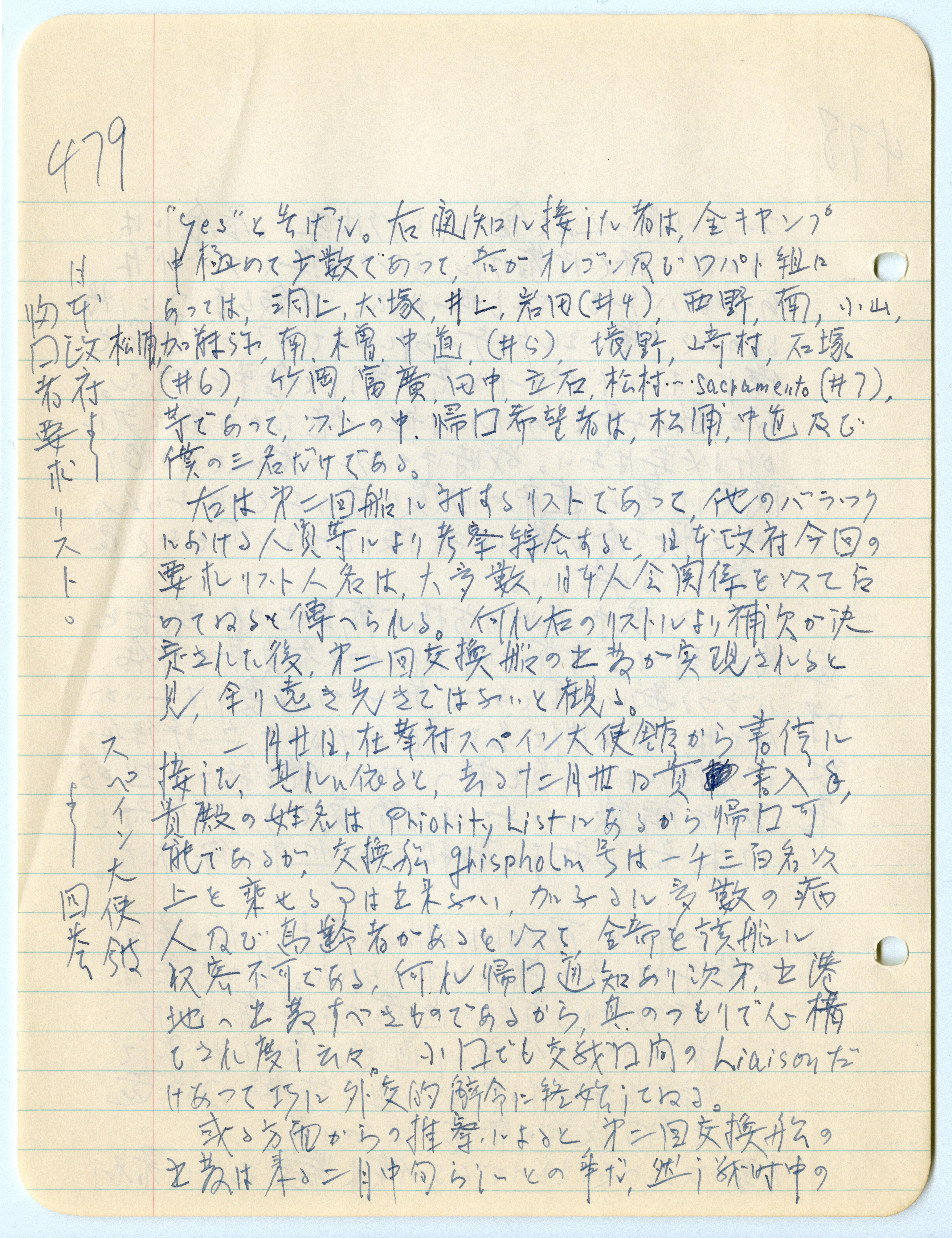
Only a few received the form among the all in the camp. Horagami, Inuzuka, Inoue, Iwata (Unit 4), Nishino, Minami, Koyama, Matsuura, Kato, Minami, Kiso, Nakamichi (Unit 5), Sakaino, Sakimura, Ishizuka (Unit 6), Takeoka, Tomihiro, Tanaka, Tateichi, Matsumura - Sacramento (Unit 7) are among them from the Oregon and Wapato group. Only three of us, Matsuura, Nakaichi and I, wish to go back to Japan.
The above is the list for the second exchange boat, and taking people from the other barracks into consideration, it is reported that the return request list by the Japanese government this time mostly includes those who are related to Japanese associations. Some additional passengers will be selected based on the list before the departure of the second exchange boat is scheduled, and I assume it will take place in the near future.
We received a letter from the Consulate-General of Spain in Washington D.C. It states that they received my letter on December 30th. According to the letter, my name is on the priority list and returning to Japan is possible for me. However, the exchange boat Gripsholm has a maximum capacity of 1,300 passengers. Considering a large number of sick elderly people in the list, it is impossible to hold them all on board. It says I will have to leave for the departure location when I receive a notice for the return soon or later, and I should just be prepared. It is a liaison nation although the county is small, and the letter is all gracefully diplomatic.
I heard that it is speculated that the second exchange boat is scheduled to depart in mid February.
- Citation:
- January 1943 entry, page 30, January 1943 entry, Bunro Sakaino Concentration Camp Diary, University of Idaho Library Digital Collections, https://www.lib.uidaho.edu/digital/sakaino/items/sakaino323.html#sakaino353
- Rights:
- In copyright, educational use permitted. Educational use includes non-commercial reproduction of text and images in materials for teaching and research purposes. For other contexts beyond fair use, including digital reproduction, please contact the University of Idaho Library Special Collections and Archives Department at libspec@uidaho.edu. The University of Idaho Library is not liable for any violations of the law by users.
- Standardized Rights:
- http://rightsstatements.org/vocab/InC-EDU/1.0/
 View Page 31
January 1943 entry
-
Item 31 of 31
Transcript
480
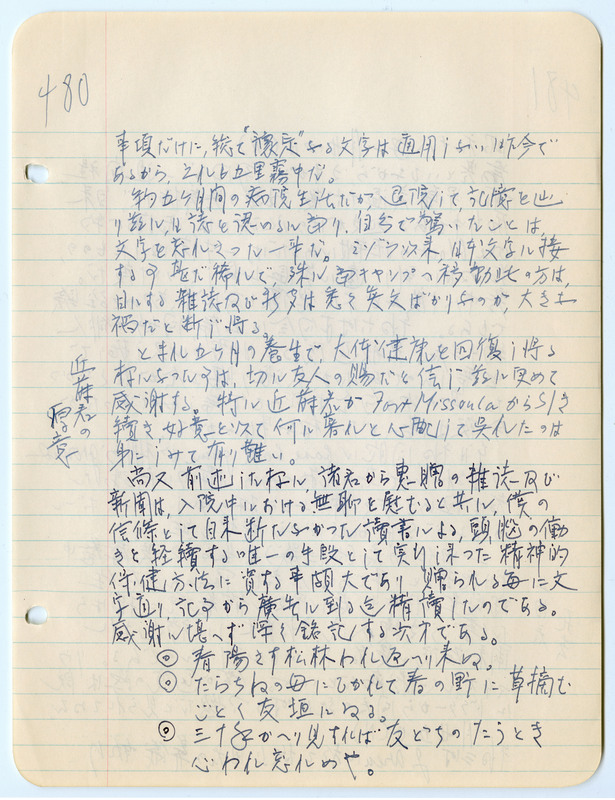
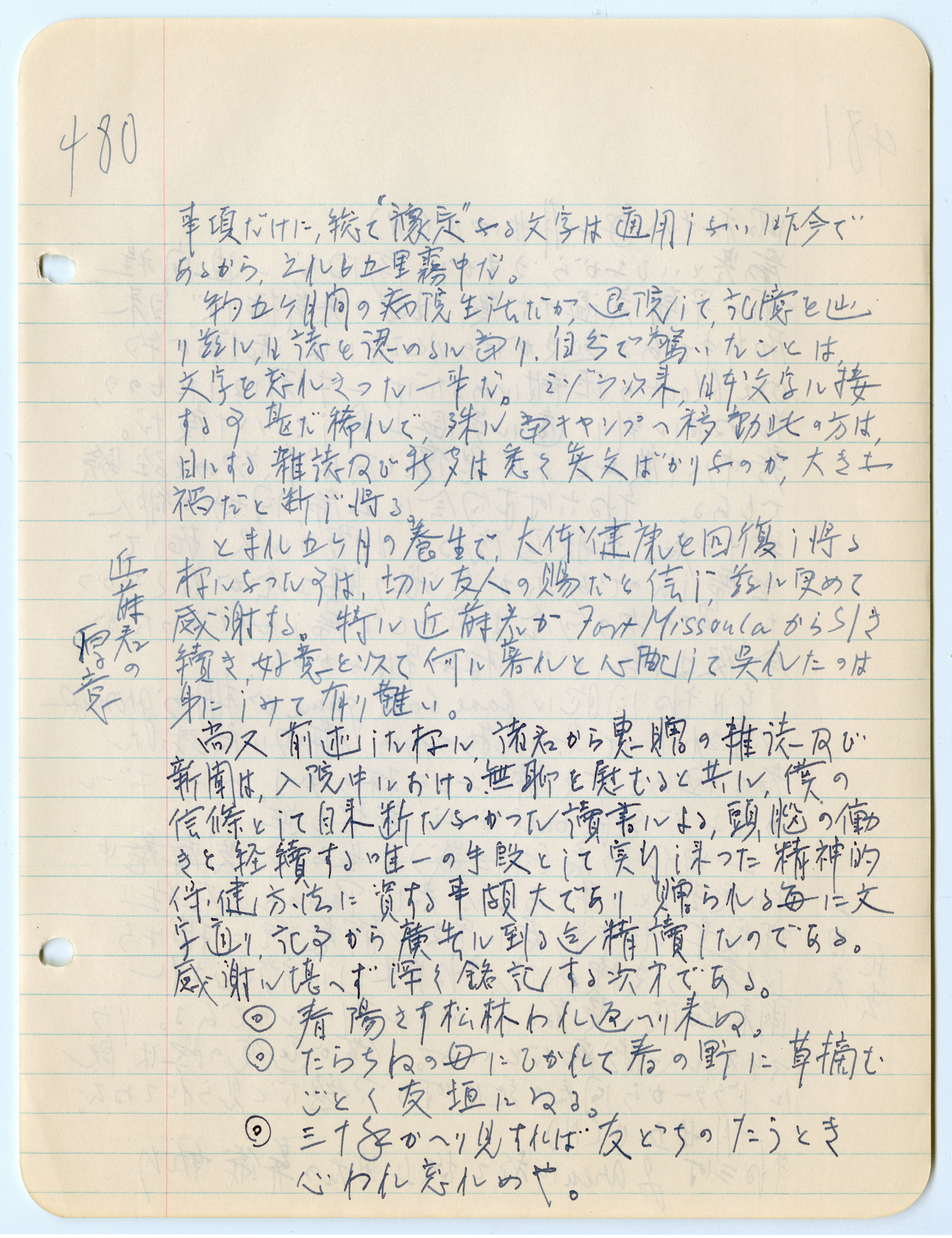
However, it is still unknown as any “plans” cannot be counted on during wartime.
I was tracing back my memories and keeping my diary when I was discharged after spending about five months in the hospital. , and what surprised me is that I completely forgot [Japanese] letters. I rarely had access to anything written in Japanese since we left Missoula. The main reason is especially after we moved to this camp, all the magazines and newspapers we receive are in English.
I regained my health after treatment for five months, and I believe I owe it to my friends and am grateful. I am especially grateful to Mr. Kondo who has been continuously kind and taking care of me ever since we were in Fort Missoula.
Magazines and newspapers given to me by my friends were great sources of comfort to me while I was in the hospital. It also largely contributed to my mental health as the only means to help me continue my personal belief of reading as an activity to stimulate my brain activities. I literally read every single letter including articles, advertisements and all every time I receive them. I am extremely grateful and would like to clearly record it.
I returned to the pine trees in the spring sun
Friends along side of the fence just as picking some wild flowers in the spring field with the mother
I will never forget how important my friends are when I look back the last 30 years of my life
- Citation:
- January 1943 entry, page 31, January 1943 entry, Bunro Sakaino Concentration Camp Diary, University of Idaho Library Digital Collections, https://www.lib.uidaho.edu/digital/sakaino/items/sakaino323.html#sakaino354
- Rights:
- In copyright, educational use permitted. Educational use includes non-commercial reproduction of text and images in materials for teaching and research purposes. For other contexts beyond fair use, including digital reproduction, please contact the University of Idaho Library Special Collections and Archives Department at libspec@uidaho.edu. The University of Idaho Library is not liable for any violations of the law by users.
- Standardized Rights:
- http://rightsstatements.org/vocab/InC-EDU/1.0/
- January 1943 entry (PDF)
- January 1943 entry,... (JPEG)
- January 1943 entry,... (JPEG)
- January 1943 entry,... (JPEG)
- January 1943 entry,... (JPEG)
- January 1943 entry,... (JPEG)
- January 1943 entry,... (JPEG)
- January 1943 entry,... (JPEG)
- January 1943 entry,... (JPEG)
- January 1943 entry,... (JPEG)
- January 1943 entry,... (JPEG)
- January 1943 entry,... (JPEG)
- January 1943 entry,... (JPEG)
- January 1943 entry,... (JPEG)
- January 1943 entry,... (JPEG)
- January 1943 entry,... (JPEG)
- January 1943 entry,... (JPEG)
- January 1943 entry,... (JPEG)
- January 1943 entry,... (JPEG)
- January 1943 entry,... (JPEG)
- January 1943 entry,... (JPEG)
- January 1943 entry,... (JPEG)
- January 1943 entry,... (JPEG)
- January 1943 entry,... (JPEG)
- January 1943 entry,... (JPEG)
- January 1943 entry,... (JPEG)
- January 1943 entry,... (JPEG)
- January 1943 entry,... (JPEG)
- January 1943 entry,... (JPEG)
- January 1943 entry,... (JPEG)
- January 1943 entry,... (JPEG)
- January 1943 entry,... (JPEG)
481
January 24, 1943 (Sunday)
It is supposed to be extremely cold, but we are in the southern region. It was 16 degrees early in the morning about a week ago. I have been showering in cold water right after I get up, but it was severely cold, and I was having a hard time as the bathroom is one block away. The temperature has been going up for the last several days, and now it is 80 degrees. It is still hard to believe it is 80 degrees in the middle of the cold season, and this is my first experience. I attended the haiku meeting at six in the afternoon. There are about 30 haiku poets in the club. I attended a meeting on Sunday after I was discharged from the hospital after a long absence, but I was having some stomach issues. I skipped the following meeting, but my symptoms were not unbearably bad this evening.
Some fellow citizens held a baseball game on the ground in front of the fence this afternoon. Just a few were left in the building after a lot of us went to watch the game, and it was like being in a silent forest. It is called baseball but actually is softball, and it is not anything special.
Mr. Jinsuke Ueda (63 years old) passed away today after his long treatment in the hospital. He was a barber when I lived in Panama and detained while going through treatment after he fell ill. He was continuously hospitalized, transferred to the U.S. and became a patient in the hospital until today. I heard he was suffering from rheumatism and some heart disease. His doctor thought his death was a matter of time when I left the hospital.
- Title:
- January 1943 entry
- Creator:
- Sakaino, Bunro
- Date Created (ISO Standard):
- 1943-01
- Description:
- January 1943 diary entry written by Bunro Sakaino while he was incarcerated at Camp Livingston, near Pineville, Louisiana.
- Subjects:
- concentration camps diaries
- Location:
- Camp Livingston, LA
- Source:
- MG 387, George Shihei Shitamae papers, Special Collections and Archives, University of Idaho Library
- Translator:
- Transcribed and translated by Naoko Tanabe, 2024-2025, of Densho (densho.org)
- Source Identifier:
- mg387_1_7-1943-01
- Type:
- Text
- Format:
- application/pdf
- Language:
- jpn
U of I Digital Collections contain unique digitized and born digital archival materials in a variety of formats. The Library is committed to ensuring our resources are accessible to all users. Please contact us if you need support accessing or using this archived content.
Contact us about this record Library Help- Citation:
- "January 1943 entry", Bunro Sakaino Concentration Camp Diary, University of Idaho Library Digital Collections, https://www.lib.uidaho.edu/digital/sakaino/items/sakaino323.html
- Rights:
- In copyright, educational use permitted. Educational use includes non-commercial reproduction of text and images in materials for teaching and research purposes. For other contexts beyond fair use, including digital reproduction, please contact the University of Idaho Library Special Collections and Archives Department at libspec@uidaho.edu. The University of Idaho Library is not liable for any violations of the law by users.
- Standardized Rights:
- http://rightsstatements.org/vocab/InC-EDU/1.0/