
Archie Phinney Hall
Geographic Coordinates: 46.72840512321433, -117.01278421473539
Location: 701 S Line Street
Archie Phinney Hall Overview
Date: 1938-
Standing: Yes. Original Construction: 1938 - Hugh Richardson; Whitehouse & Price. Addition: 1999 (elevator tower).
Name History: Originally named Chrisman Hall, briefly called Faculty Office Complex West
Notes on Naming: Renamed Archie Phinney Hall in 1987 in honor of Nez Perce anthropologist Archie Phinney.
Architect: Whitehouse & Price (Spokane); Hugh Richardson (Lewiston)
Architectural Style: Collegiate Gothic
Description: 4-story collegiate gothic brick building with basement. L-shaped plan. Reinforced concrete and brick, gable roof, stone coated metal shingles, each wing about 98' x 30'.
Additions: Elevator towers added in 1999.
Use History: Men's dormitory, later Sociology-Anthropology museum and department offices; misc. faculty offices.
Sources: Cards, Morton, UG 12 (2325)
History
Archie Phinney Hall, originally named Chrisman Hall after Brigadier General Edward R. Chrisman, was constructed in 1938 as a companion to Willis Sweet Hall to provide supplemental dormitory space. Designed by Hugh Richardson of Lewiston and based on plans by Whitehouse & Price of Spokane, it was built by the Howard S. Wright Company of Seattle for $388,130, funded through regents’ and local bonds. It was connected to Willis Sweet Hall via a shared kitchen, and provided housing for 111 male students.
The the name of the hall was changed in 1987 from Chrisman Hall to Archie Phinney Hall, for Nez Perce anthropologist Archie Phinney of Culdesac, Idaho. Between 1969 and 1987 the hall was simply called “Faculty Office Complex West”–counterpart to Willis Sweet Hall’s title of “Faculty Office Complex East.” For a number of years the hall housed the Anthropology and Sociology Department, its museum, and related offices. As of 2024, it is home to the Department of Culture, Society and Justice.1
Design
Archie Phinney Hall is an example of Collegiate Gothic-style on campus. It features Gothic-arched entryways, along with simple details influenced by the English Arts and Crafts movement. The building emphasizes simplicity over ornamentation, similar to its partner, Brink Hall (Previously named Willis Sweet Hall). The design of the building celebrates both effeciency and intentional aesthetics.2
Physical Description
Archie Phinney Hall is a four-story, L-shaped masonry building. It has a gabled-belcast stone coated metal roof and burnt red brick walls accented by clinker bricks. The fourth floor is dotted with dormers. Its windows are mainly six-over-six sash, arranged symmetrically except for the elevator tower addition from 1999. This addition was built to echo the hall’s original design. Built into on a grassy hillside, the hall is bordered on one side by the Academic Mall, and surrounded by campus buildings.3
Archie Phinney

Archie Phinney was born on September 4, 1904, in Culdesac, Idaho, and passed away on October 29, 1949, in Lewiston, Idaho, at the age of 45. He was the first Nez Perce to earn a B.A. from the University of Kansas, and the first Plateau Indian to receive a Ph.D. He authored Nez Perce Texts, a significant contribution to the preservation of Nez Perce language and oral tradition. Phinney worked for many years with the Bureau of Indian Affairs at the North Idaho Agency and played a vital role in the formation of the National Congress of American Indians (NCAI). His career focused on improving conditions for the Nez Perce and advancing their status as a sovereign nation within the United States. Though he died young, his work had a lasting influence on Native advocacy, policy, and education. 4
Edward R. Chrisman
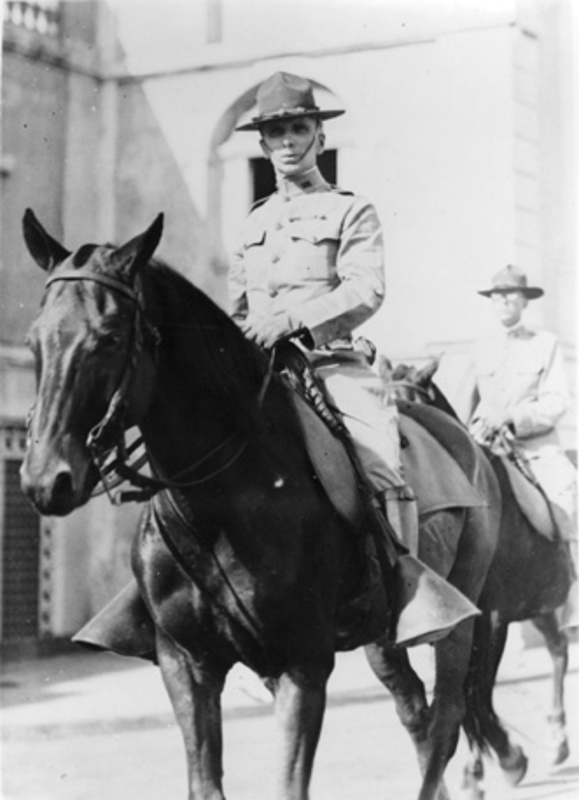
General Edward R. Chrisman (1866–1939), Idaho’s “Grand Old Man”, had a long and celebrated career at the University of Idaho. He arrived at the school in 1894 to establish the Military Science Department while also teaching mathematics.5
Chrisman was a West Point graduate with distinguished service in the Spanish-American War. He served as Professor of Military Science and later as Commandant of Cadets at the University of Idaho. In 1936, Congress honored him with an emeritus appointment, a role he held for the remainder of his life.6 His tenure at the university spanned over 40 years, including a cumulative 22 years of teaching and instruction.7
Notes
-
Nathan J. Moody, “National Register of Historic Places—Registration Form: The University of Idaho Historic District,” initial submission to Idaho SHPO, unpublished, University of Idaho, Moscow, Idaho, May 7, 2025, 31. ↩
-
Ibid. ↩
-
Ibid. ↩
-
Walker-Harmon, Shelley. “Archie Phinney Hall: Building History and Institutional Memory at the University of Idaho.” HIST495: Senior History Seminar, Dr. Dale Graden, unpublished, University of Idaho, December 2024, 23-30. ↩
-
Special Collections and Archives, General Chrisman: Idaho’s Grand Old Man, University of Idaho Library, July 2, 2014, https://harvester.lib.uidaho.edu/posts/2014/07/02/general-chrisman-idahos-grand-old-man.html. ↩
-
Ibid. ↩
-
Walker-Harmon, “Archie Phinney Hall,” 15. ↩
Browse Images
![Sociology. University of Idaho. Prof. Harry C. Harmsworth and Edwin Henry Pfuhl Jr. test drug sample. [244-01a]](https://objects.lib.uidaho.edu/campus/small/campus01884_sm.jpg)
![Sociology. University of Idaho. Prof. Harry C. Harmsworth and Edwin Henry Pfuhl Jr. with drug paraphernalia. [244-01b]](https://objects.lib.uidaho.edu/campus/small/campus01885_sm.jpg)
![Sociology. University of Idaho. Prof. Harry C. Harmsworth and Edwin Henry Pfuhl Jr. with drug paraphernalia. [244-01c]](https://objects.lib.uidaho.edu/campus/small/campus01886_sm.jpg)
![Chrisman Hall, University of Idaho. Architect's drawing. [76-1]](https://objects.lib.uidaho.edu/campus/small/campus02754_sm.jpg)
![Chrisman Hall, University of Idaho. Sweet Hall. [76-10]](https://objects.lib.uidaho.edu/campus/small/campus02755_sm.jpg)
![Chrisman Hall, University of Idaho. Sweet Hall. [76-11]](https://objects.lib.uidaho.edu/campus/small/campus02756_sm.jpg)
![Chrisman Hall, University of Idaho. Construction. [76-2]](https://objects.lib.uidaho.edu/campus/small/campus02757_sm.jpg)
![Chrisman Hall, University of Idaho. Construction. [76-3]](https://objects.lib.uidaho.edu/campus/small/campus02758_sm.jpg)
![Chrisman Hall, University of Idaho. Construction. [76-4]](https://objects.lib.uidaho.edu/campus/small/campus02759_sm.jpg)
![Chrisman Hall, University of Idaho. [76-5]](https://objects.lib.uidaho.edu/campus/small/campus02760_sm.jpg)
![Chrisman Hall, University of Idaho. [76-6]](https://objects.lib.uidaho.edu/campus/small/campus02761_sm.jpg)
![Chrisman Hall, University of Idaho. [76-7]](https://objects.lib.uidaho.edu/campus/small/campus02762_sm.jpg)
![Chrisman Hall, University of Idaho, Navy Building, Agricultural Sciences Building. [76-8]](https://objects.lib.uidaho.edu/campus/small/campus02763_sm.jpg)
![Chrisman Hall, University of Idaho. Sweet Hall. [76-9]](https://objects.lib.uidaho.edu/campus/small/campus02764_sm.jpg)