
Carol Ryrie Brink Hall
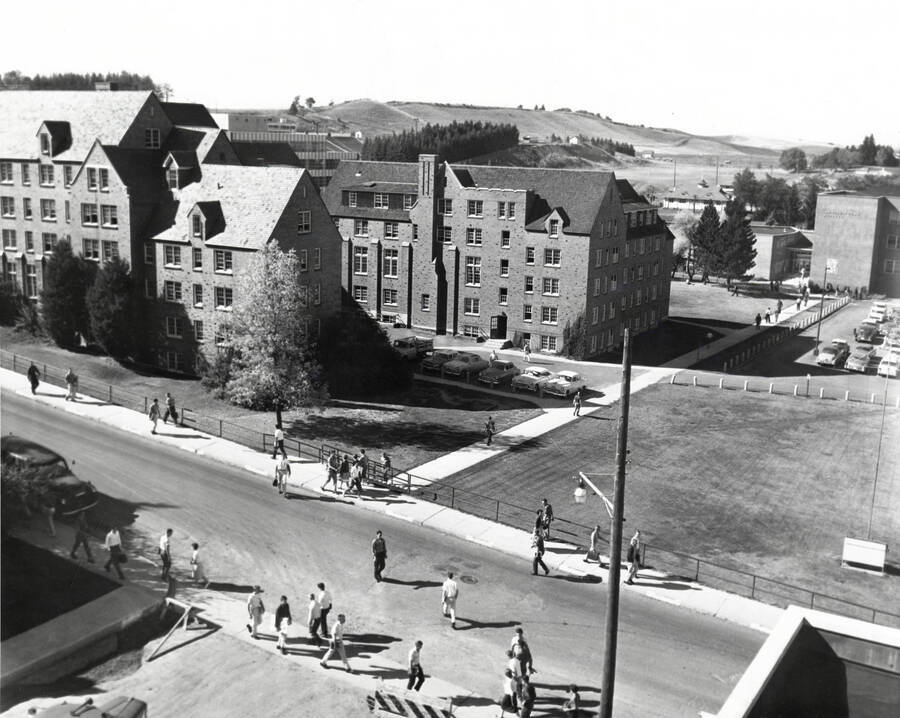
Geographic Coordinates: 46.72811631525914, -117.01233587112586
Location: Line Street and Idaho Avenue 801 & 701 S. Line St
Carol Ryrie Brink Hall Overview
Date: 1936
Standing: Yes. Original Construction: 1936 - Hugh Richardson; Whitehouse & Price. Addition: 1999 (elevator tower).
Name History: Willis Sweet Hall; later called Faculty Office Complex East
Notes on Naming: Willis Sweet Hall named after one of the UI's founders and member of the Board of Regents, 1889-1893; later called Faculty Office Complex East. Renamed Carol Ryrie Brink Hall in 1982 in honor of UI alumna and prominent author.
Architect: Whitehouse & Price (Spokane); Hugh Richardson (Lewiston)
Architectural Style: Collegiate Gothic
Description: Reinforced concrete, red fireproof brick, trimmed with Boise Sandstone. Gable roof, composition shingles, five floors, front 178' long, wings 81' and 129' long respectively, each wing about 29' wide.
Additions: Elevator towers added in 1999.
Use History: Originally a men's dorm housing 200. Currently houses placement center; math/statistics/English departments, miscellaneous faculty and grad offices.
Cost: $388,130. $250,000 (Regents bonds); $138,130 (local bonds)
Sources: Cards, Morton, UG 12 (2325)
History
As one of the first large residence halls on campus, Carol Ryrie Brink Hall (originally Willis Sweet Hall) was instrumental in shaping student life at the University of Idaho. Its construction in the mid-1930s was part of a bold campus expansion made possible through a university-led bond program; a creative solution to minimal state funding during the Great Depression. 1
Students housed here benefitted from a highly efficient kitchen that could serve a full dining room in under three minutes, thanks to features like a 17-foot steam table and a soapless dishwashing system. The hall’s reputation for innovation drew national attention. 2 Colleges from across the country sent representatives to view this state-of-the-art kitchen and “to study its novel features and operation.”3
Carol Ryrie Brink Hall is a four-story, L-shaped brick building designed in the Collegiate Gothic style, with subtle Arts and Crafts elements. The main entrance to the hall is a handsome gothic arched doorway at the apex of the building. Built prior to Archie Phinney Hall, it served as a template for the later structure, sharing design features such as its steep, gabled roof and its use of dark red brick. The building’s symmetrical facade is composed largely of six-over-six sash windows. Brink Hall’s understated ornamentation along with the clean lines and cohesive materials of its design reflect early 20th-century academic architecture in Idaho. 3
The building has endured challenges, including a 1956 arson incident that caused significant damage. The fire was caused by a student reporter who was later sentenced to a 25 year term in prison. 4 In 1982, it was renamed for author Carol Ryrie Brink, an Idaho native and university alumna known for writing vividly about her home state.5
Carol Ryrie Brink
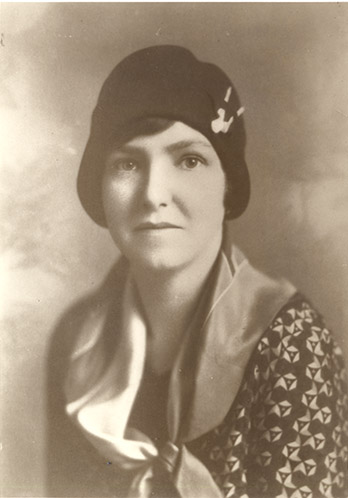
Carol Ryrie Brink (1895–1981), born and raised in Moscow, Idaho, was a prolific author of over thirty books—both for children and adults—including the 1936 Newbery Medal–winning Caddie Woodlawn. 6
During her time at the University of Idaho (1914–1917), she contributed to The Argonaut student newspaper and Gem of the Mountains yearbook, before transferring to UC Berkeley and graduating Phi Beta Kappa in 1918. 7 Her deep ties to the university were honored in 1965 with an honorary doctorate in letters, and in 1982, after her death, the historic Willis Sweet Hall was renamed Carol Ryrie Brink Hall to celebrate her legacy.8
Willis Sweet

Willis Sweet (1856–1925) greatly aided the establishment of the University of Idaho in Moscow. Sweet was a lawyer, newspaper editor, and rising political figure in the late 1880s, and he personally drafted the legislation (alongside legislator John W. Brigham) that led to the university’s creation. Sweet successfully lobbied the territorial legislature while still in his pajamas to get the bill passed the next morning. 9 Sweet went on to serve as the first president of the university’s Board of Regents and remained deeply involved in its early governance and identity. 10
Notes
-
Nathan J. Moody, “National Register of Historic Places—Registration Form: The University of Idaho Historic District,” initial submission to Idaho SHPO, unpublished, University of Idaho, Moscow, Idaho, May 7, 2025, 27,28. ↩
-
Ibid. ↩
-
University of Idaho bulletin, v. 32, no. 20, August 1937, Walker-Harmon, Shelley. National Register of Historic Places Historic Context and Evaluation for: ASUI Golf Course Clubhouse, Carol Ryrie Brink Hall, Graduate Art Studio, Radio/TV Center. Class paper, HIST 504, April 21, 2024. ↩ ↩2
-
Keith Petersen, This Crested Hill: An Illustrated History of the University of Idaho (Moscow, ID: University of Idaho Press, 1987),105. ↩
-
Moody, University of Idaho Historic District, 28. ↩
-
University of Idaho Library, “Carol Ryrie Brink,” Idaho Writers Index, accessed July 17, 2025, https://www.lib.uidaho.edu/digital/iwi/items/iwi-4.html. ↩
-
Ibid. ↩
-
Moody, University of Idaho Historic District, 28. ↩
-
University of Idaho Library, “Willis Sweet and the Founding of the University,” Harvester: The University of Idaho Library Blog, June 14, 2014, https://harvester.lib.uidaho.edu/posts/2014/06/14/willis-sweet-and-the-founding-of-the-university.html. ↩
-
Ibid. ↩
Browse Images
![Mathematics. University of Idaho. Kenneth A. Bush at blackboard. [257-1]](https://objects.lib.uidaho.edu/campus/small/campus01964_sm.jpg)
![Willis Sweet Hall, University of Idaho. [75-1]](https://objects.lib.uidaho.edu/campus/small/campus02744_sm.jpg)
![Willis Sweet Hall, University of Idaho. Living room. [75-10]](https://objects.lib.uidaho.edu/campus/small/campus02745_sm.jpg)
![Willis Sweet Hall (renamed Carol Ryrie Brink Hall in the early 1980s). [75-11]](https://objects.lib.uidaho.edu/campus/small/campus02746_sm.jpg)
![Willis Sweet Hall, University of Idaho. Kitchen. [75-2]](https://objects.lib.uidaho.edu/campus/small/campus02747_sm.jpg)
![Willis Sweet Hall, University of Idaho. Kitchen. [75-3]](https://objects.lib.uidaho.edu/campus/small/campus02748_sm.jpg)
![Willis Sweet Hall, University of Idaho. [75-4]](https://objects.lib.uidaho.edu/campus/small/campus02749_sm.jpg)
![Willis Sweet Hall, University of Idaho. [75-6]](https://objects.lib.uidaho.edu/campus/small/campus02750_sm.jpg)
![Willis Sweet Hall, University of Idaho. [75-7]](https://objects.lib.uidaho.edu/campus/small/campus02751_sm.jpg)
![Willis Sweet Hall, University of Idaho. [75-8]](https://objects.lib.uidaho.edu/campus/small/campus02752_sm.jpg)
![Willis Sweet Hall, University of Idaho. [75-9]](https://objects.lib.uidaho.edu/campus/small/campus02753_sm.jpg)