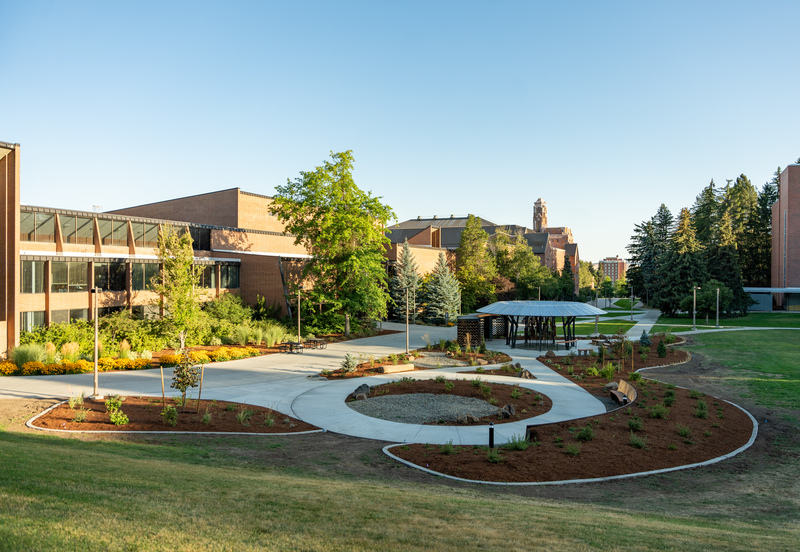
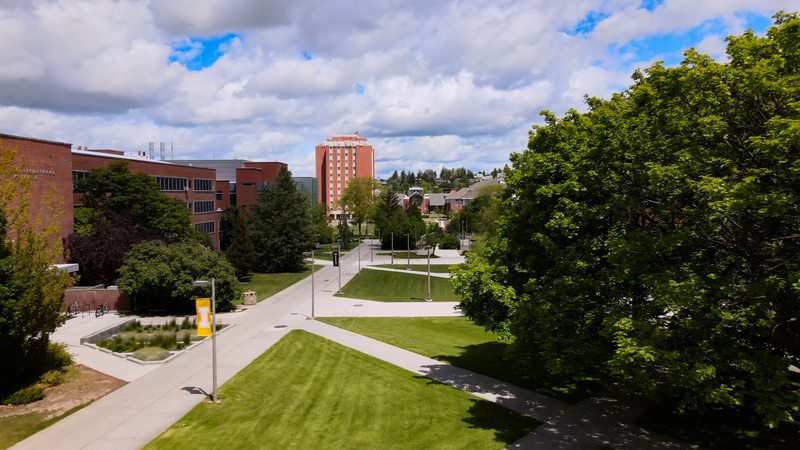
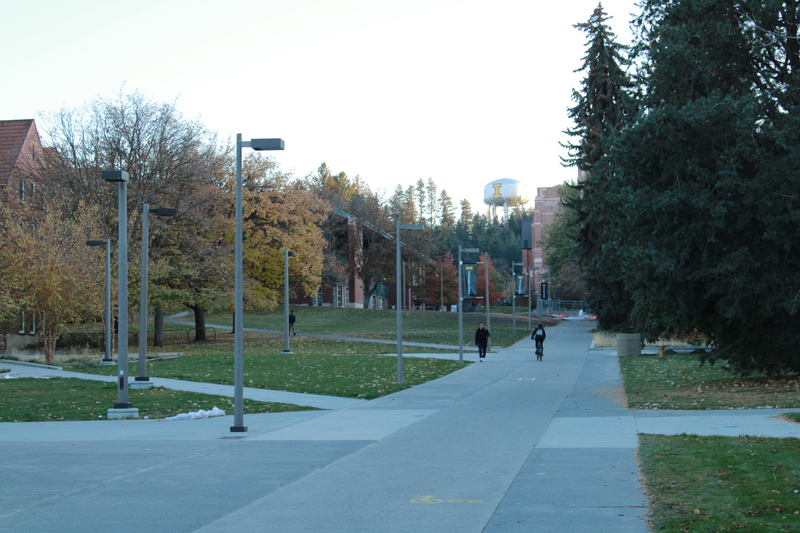
The Academic Mall has long served as a central pedestrian artery at the University of Idaho, linking key academic buildings, residence halls, the library, and the ISUB. Its development paralleled the university’s own growth, gradually taking shape as enrollment rose and departments expanded. The opening of Chrisman Hall in 1939, followed by the Agricultural Science Building in 1951, marked early moments in the mall’s emergence as a defined space. Later additions such as the Agricultural Biotechnology Building in 2000 and the IRIC Building in 2016 extended its reach. The university’s Long-Range Campus Development Plan emphasizes the mall as both a practical and symbolic element of the campus—supporting research, learning, and daily life while reinforcing a broader commitment to community and the natural environment.1
Framed by major academic and administrative buildings, the mall forms a vital connection between the campus core and prominent structures like the Memorial Gym, Art & Architecture South, and the Administration Building. It reflects a vision of landscape architecture that supports both circulation and community gathering. The space is intentionally car-free, reinforcing its role as a safe and welcoming pedestrian zone at the heart of campus life.2
Physical Description
The mall features interlocking paved walkways bordered by lawns, mature trees, and low plantings. These pathways weave between buildings and open greens used for studying, relaxing, and hosting events. The space encourages movement through the academic and social core of campus while maintaining the feel of a calm, verdant commons.3
The Vandal Healing Garden and Memorial emerged in response to the tragic events of November 13, 2022, when four University of Idaho students—Ethan Chapin, Madison Mogen, Xana Kernodle, and Kaylee Goncalves—were murdered just south of campus. In the aftermath, the College of Art & Architecture proposed a project to honor their lives and the lives of all students who have passed away while enrolled at the university. A community design workshop in September 2023 produced a vision for an interactive space fostering both group gathering and individual reflection. Funded by $285,000 in donations, the project was realized through student labor during the summer of 2024. Participants worked without pay or credit, exemplifying the university’s spirit of solidarity and service. Architecture student Jackson Wiedenfeld reflected, “I wouldn’t change it for anything.” The university dedicated the memorial on August 21, 2024, at the former site of MacLean Field.4
Design
The site was conceived as a dual-purpose space for communal remembrance and private contemplation. A circular pavilion anchors the northern end of the garden, offering a covered area for gathering. The southern section, known as the “healing walk,” integrates natural landscaping and seating along a gently curving path. Materials and plantings were chosen for both their symbolism and connection to campus—many were repurposed or salvaged, linking the memorial to broader themes of renewal and memory.[5]
Physical Description
Rectangular in shape and oriented north to south, the site measures approximately 190 by 100 feet. At its center, a steel-framed pavilion with a metal roof shelters a mosaic sculpture commemorating students who died while enrolled. A circular concrete path and wooden benches frame the space. Nearby, a small steel booth holds message containers for visitors. The healing walk features a landscaped berm and a curved pathway planted with dogwood, maple, hydrangea, and evergreens. A bench made of black locust wood—salvaged from a fallen campus tree and ICCU Arena remnants—offers a quiet spot for reflection. To the south, a 20-foot steel-faced light stands on the hillside, described by Dean of Students Blain Eckles as “a beacon of light and hope.”[6]
Notes
Nathan J. Moody, “National Register of Historic Places—Registration Form: The University of Idaho Historic District,” initial submission to Idaho SHPO, unpublished, University of Idaho, Moscow, Idaho, May 7, 2025, 37, 72. ↩
University of Idaho campuses, panoramic view. 'campuses of the University of Idaho, Moscow, showing the Metallurgical and Agricultural Buildings, also Assay Laboratory.' [2-24]
University of Idaho campuses, panoramic view from gym tower; north down mall. Library, Physical Science, Gault/Upham, University Classroom Center, and Faculty Office Complex. [2-42]
University of Idaho campuses, panoramic view from Gault/Upham south; Field House, Memorial Gym, Physical Science, Agricultural Science, Faculty Office Complex, University Classroom Center. [2-43]

![George Gagon presenting plans for new dormitory complex to Board of Regents, University of Idaho. [151-1]](https://objects.lib.uidaho.edu/campus/small/campus00559_sm.jpg)
![Forestry Building (Proposed), University of Idaho. Architect's drawing. [173-1]](https://objects.lib.uidaho.edu/campus/small/campus00735_sm.jpg)
![University of Idaho campuses, panoramic view. [2-1]](https://objects.lib.uidaho.edu/campus/small/campus00736_sm.jpg)
![University of Idaho campuses, panoramic view. [2-10]](https://objects.lib.uidaho.edu/campus/small/campus00737_sm.jpg)
![University of Idaho campuses, panoramic view, oblique over Administration Building. [2-13]](https://objects.lib.uidaho.edu/campus/small/campus00738_sm.jpg)
![University of Idaho campuses, panoramic view east from above athletic field. [2-14]](https://objects.lib.uidaho.edu/campus/small/campus00739_sm.jpg)
![University of Idaho campuses, panoramic view. [2-15]](https://objects.lib.uidaho.edu/campus/small/campus00740_sm.jpg)
![University of Idaho campuses, panoramic view. [2-16]](https://objects.lib.uidaho.edu/campus/small/campus00741_sm.jpg)
![University of Idaho campuses, panoramic view. [2-17]](https://objects.lib.uidaho.edu/campus/small/campus00742_sm.jpg)
![University of Idaho campuses, panoramic view. [2-18]](https://objects.lib.uidaho.edu/campus/small/campus00743_sm.jpg)
![University of Idaho campuses, panoramic view from East. [2-19]](https://objects.lib.uidaho.edu/campus/small/campus00744_sm.jpg)
![University of Idaho campuses, panoramic view. [2-2]](https://objects.lib.uidaho.edu/campus/small/campus00745_sm.jpg)
![University of Idaho campuses, panoramic view from East. [2-20]](https://objects.lib.uidaho.edu/campus/small/campus00746_sm.jpg)
![University of Idaho campuses, hand-colored panoramic view from campuses. [2-21]](https://objects.lib.uidaho.edu/campus/small/campus00747_sm.jpg)
![University of Idaho campuses, panoramic view. [2-22]](https://objects.lib.uidaho.edu/campus/small/campus00748_sm.jpg)
![University of Idaho campuses, panoramic view. [2-23]](https://objects.lib.uidaho.edu/campus/small/campus00749_sm.jpg)
![University of Idaho campuses, panoramic view. 'campuses of the University of Idaho, Moscow, showing the Metallurgical and Agricultural Buildings, also Assay Laboratory.' [2-24]](https://objects.lib.uidaho.edu/campus/small/campus00750_sm.jpg)
![University of Idaho campuses, panoramic view. [2-25]](https://objects.lib.uidaho.edu/campus/small/campus00751_sm.jpg)
![University of Idaho campuses, panoramic view. School of Mines, Administration Building, and Horticulture Building. [2-26]](https://objects.lib.uidaho.edu/campus/small/campus00752_sm.jpg)
![University of Idaho campuses, panoramic view. 'Assey, Moral [I.e. Morrill] Hall & metallurgical Bldg.' [2-27]](https://objects.lib.uidaho.edu/campus/small/campus00753_sm.jpg)
![University of Idaho campuses, panoramic view of Ridenbaugh, Engineering, Administration Buildings. [2-28]](https://objects.lib.uidaho.edu/campus/small/campus00754_sm.jpg)
![University of Idaho campuses, panoramic view. Corner across from infirmary, north boundary. Students lined up on sidewalk. [2-29]](https://objects.lib.uidaho.edu/campus/small/campus00755_sm.jpg)
![University of Idaho campuses, panoramic view from brickyard. [2-3]](https://objects.lib.uidaho.edu/campus/small/campus00756_sm.jpg)
![University of Idaho campuses, panoramic view from water tower over Administration Building. [2-30]](https://objects.lib.uidaho.edu/campus/small/campus00757_sm.jpg)
![University of Idaho campuses, panoramic view from School of Mines. No. 45. [2-31]](https://objects.lib.uidaho.edu/campus/small/campus00758_sm.jpg)
![University of Idaho campuses, panoramic view from Administration Building over Mines, Morrill, and Science. [2-32]](https://objects.lib.uidaho.edu/campus/small/campus00759_sm.jpg)
![University of Idaho campuses, panoramic view from Administration Building. [2-33]](https://objects.lib.uidaho.edu/campus/small/campus00760_sm.jpg)
![University of Idaho campuses, street scene from Morrill toward Administration Building. Science on left. [2-34]](https://objects.lib.uidaho.edu/campus/small/campus00761_sm.jpg)
![University of Idaho campuses, panoramic view. Science Hall. [2-35]](https://objects.lib.uidaho.edu/campus/small/campus00762_sm.jpg)
![University of Idaho campuses, panoramic view. Mines Building, Morrill Hall, Science Hall. [2-36]](https://objects.lib.uidaho.edu/campus/small/campus00763_sm.jpg)
![University of Idaho campuses, panoramic view from Science Hall: gym, Art & Architecture, U-Hut. [2-37]](https://objects.lib.uidaho.edu/campus/small/campus00764_sm.jpg)
![University of Idaho campuses, panoramic view of Administration and Engineering Buildings. [2-38]](https://objects.lib.uidaho.edu/campus/small/campus00765_sm.jpg)
![University of Idaho campuses, panoramic view of U-Hut, Engineering, and Science Hall. [2-39]](https://objects.lib.uidaho.edu/campus/small/campus00766_sm.jpg)
![University of Idaho campuses, panoramic view from brickyard. [2-4]](https://objects.lib.uidaho.edu/campus/small/campus00767_sm.jpg)
![University of Idaho campuses, panoramic view of Hays, Forney, Ridenbaugh, and Engineering Buildings. [2-40]](https://objects.lib.uidaho.edu/campus/small/campus00768_sm.jpg)
![University of Idaho campuses, panoramic view. [2-41]](https://objects.lib.uidaho.edu/campus/small/campus00769_sm.jpg)
![University of Idaho campuses, panoramic view from gym tower; north down mall. Library, Physical Science, Gault/Upham, University Classroom Center, and Faculty Office Complex. [2-42]](https://objects.lib.uidaho.edu/campus/small/campus00770_sm.jpg)
![University of Idaho campuses, panoramic view from Gault/Upham south; Field House, Memorial Gym, Physical Science, Agricultural Science, Faculty Office Complex, University Classroom Center. [2-43]](https://objects.lib.uidaho.edu/campus/small/campus00771_sm.jpg)
![University of Idaho campuses, panoramic view toward field house from Administration Building. [2-44]](https://objects.lib.uidaho.edu/campus/small/campus00772_sm.jpg)
![University of Idaho campuses, panoramic view from water tower across Administration Building. [2-45]](https://objects.lib.uidaho.edu/campus/small/campus00773_sm.jpg)
![University of Idaho campuses, panoramic view; Mines Building, Morrill Hall, and Science Hall; snow scene. [2-47]](https://objects.lib.uidaho.edu/campus/small/campus00774_sm.jpg)
![University of Idaho campuses, panoramic view; Mines Building, Morrill Hall, and Science Hall; snow scene. [2-48]](https://objects.lib.uidaho.edu/campus/small/campus00775_sm.jpg)
![University of Idaho campuses, panoramic view from Administration Building toward Science and the Infirmary. [2-49]](https://objects.lib.uidaho.edu/campus/small/campus00776_sm.jpg)
![University of Idaho campuses, panoramic view from brickyard. [2-5]](https://objects.lib.uidaho.edu/campus/small/campus00777_sm.jpg)
![University of Idaho campuses, panoramic view from Administration Building toward Science and the Infirmary. [2-50]](https://objects.lib.uidaho.edu/campus/small/campus00778_sm.jpg)
![University of Idaho campuses, panoramic view looking past Infirmary toward Moscow. [2-51]](https://objects.lib.uidaho.edu/campus/small/campus00779_sm.jpg)
![University of Idaho campuses, panoramic view, Gym and Morrill Hall. [2-52]](https://objects.lib.uidaho.edu/campus/small/campus00780_sm.jpg)
![University of Idaho campuses, panoramic view from Administration toward Infirmary. [2-53]](https://objects.lib.uidaho.edu/campus/small/campus00781_sm.jpg)
![University of Idaho campuses, panoramic view of students on Gym steps looking toward Morrill Hall. [2-54]](https://objects.lib.uidaho.edu/campus/small/campus00782_sm.jpg)
![Administration Building, snow scene 'Going to classes.' [2-55]](https://objects.lib.uidaho.edu/campus/small/campus00783_sm.jpg)
![University of Idaho campuses, panoramic view looking east down drive in front of engineering, snow scene. [2-56]](https://objects.lib.uidaho.edu/campus/small/campus00784_sm.jpg)
![University of Idaho campuses, panoramic view, street scene. [2-58]](https://objects.lib.uidaho.edu/campus/small/campus00786_sm.jpg)
![University of Idaho campuses, panoramic view across tennis courts. [2-59]](https://objects.lib.uidaho.edu/campus/small/campus00787_sm.jpg)
![University of Idaho campuses, panoramic view east from old Pullman highway. [2-6]](https://objects.lib.uidaho.edu/campus/small/campus00788_sm.jpg)
![University of Idaho campuses, panoramic view toward Science. [2-60]](https://objects.lib.uidaho.edu/campus/small/campus00789_sm.jpg)
![University of Idaho campuses. Panoramic view [2-61]](https://objects.lib.uidaho.edu/campus/small/campus00790_sm.jpg)
![University of Idaho campuses, panoramic view toward Science. [2-62]](https://objects.lib.uidaho.edu/campus/small/campus00791_sm.jpg)
![University of Idaho campuses, panoramic view. [2-63]](https://objects.lib.uidaho.edu/campus/small/campus00792_sm.jpg)
![University of Idaho campuses, panoramic view. Engineering Building, Administration Building, old 'I' tower (1916- ). [2-64]](https://objects.lib.uidaho.edu/campus/small/campus00793_sm.jpg)
![University of Idaho campuses, panoramic view from asphalt mixer. [2-65]](https://objects.lib.uidaho.edu/campus/small/campus00794_sm.jpg)
![University of Idaho campuses, panoramic view from asphalt mixer. [2-66]](https://objects.lib.uidaho.edu/campus/small/campus00795_sm.jpg)
![University of Idaho campuses, panoramic view. [2-7]](https://objects.lib.uidaho.edu/campus/small/campus00796_sm.jpg)
![University of Idaho campuses, panoramic view. Ridenbaugh Hall, Engineering, Administration Building. [2-8]](https://objects.lib.uidaho.edu/campus/small/campus00797_sm.jpg)
![University of Idaho campuses, panoramic view. [2-82]](https://objects.lib.uidaho.edu/campus/small/campus00798_sm.jpg)
![University of Idaho campuses, panoramic view. Ridenbaugh Hall, Engineering, Administration Building. [2-9]](https://objects.lib.uidaho.edu/campus/small/campus00799_sm.jpg)
![University of Idaho campuses, oblique aerial view. #10. [3-1]](https://objects.lib.uidaho.edu/campus/small/campus01965_sm.jpg)
![University of Idaho campuses, oblique aerial view. [3-10]](https://objects.lib.uidaho.edu/campus/small/campus01966_sm.jpg)
![University of Idaho campuses, oblique aerial view from west. [3-11]](https://objects.lib.uidaho.edu/campus/small/campus01967_sm.jpg)
![University of Idaho campuses, oblique aerial view. [3-12]](https://objects.lib.uidaho.edu/campus/small/campus01968_sm.jpg)
![University of Idaho campuses, oblique aerial view. [3-13]](https://objects.lib.uidaho.edu/campus/small/campus01969_sm.jpg)
![University of Idaho campuses, oblique aerial view. [3-14]](https://objects.lib.uidaho.edu/campus/small/campus01970_sm.jpg)
![University of Idaho campuses, oblique aerial view. [3-14a]](https://objects.lib.uidaho.edu/campus/small/campus01971_sm.jpg)
![University of Idaho campuses, oblique aerial view. [3-14b]](https://objects.lib.uidaho.edu/campus/small/campus01972_sm.jpg)
![University of Idaho campuses, oblique aerial view. [3-15]](https://objects.lib.uidaho.edu/campus/small/campus01973_sm.jpg)
![University of Idaho campuses, oblique aerial view. Morrill Hall. [3-16]](https://objects.lib.uidaho.edu/campus/small/campus01974_sm.jpg)
![University of Idaho campuses, oblique aerial view. [3-17]](https://objects.lib.uidaho.edu/campus/small/campus01975_sm.jpg)
![University of Idaho campuses, oblique aerial view. [3-18]](https://objects.lib.uidaho.edu/campus/small/campus01976_sm.jpg)
![University of Idaho campuses, oblique aerial view. Hays Hall. [3-19]](https://objects.lib.uidaho.edu/campus/small/campus01977_sm.jpg)
![University of Idaho campuses, oblique aerial view. [3-2]](https://objects.lib.uidaho.edu/campus/small/campus01978_sm.jpg)
![University of Idaho campuses, oblique aerial view. Memorial Gymnasium. [3-20]](https://objects.lib.uidaho.edu/campus/small/campus01979_sm.jpg)
![University of Idaho campuses, oblique aerial view. [3-21]](https://objects.lib.uidaho.edu/campus/small/campus01980_sm.jpg)
![University of Idaho campuses, oblique aerial view. [3-22]](https://objects.lib.uidaho.edu/campus/small/campus01981_sm.jpg)
![University of Idaho campuses, oblique aerial view. Administration Building. [3-23]](https://objects.lib.uidaho.edu/campus/small/campus01982_sm.jpg)
![University of Idaho campuses, oblique aerial view. [3-24]](https://objects.lib.uidaho.edu/campus/small/campus01983_sm.jpg)
![University of Idaho campuses, oblique aerial view. #27. [3-25]](https://objects.lib.uidaho.edu/campus/small/campus01984_sm.jpg)
![University of Idaho campuses, oblique aerial view. [3-26]](https://objects.lib.uidaho.edu/campus/small/campus01985_sm.jpg)
![University of Idaho campuses, oblique aerial view. [3-27]](https://objects.lib.uidaho.edu/campus/small/campus01986_sm.jpg)
![University of Idaho campuses, oblique aerial view. [3-28]](https://objects.lib.uidaho.edu/campus/small/campus01987_sm.jpg)
![University of Idaho campuses, oblique aerial view. [3-29]](https://objects.lib.uidaho.edu/campus/small/campus01988_sm.jpg)
![University of Idaho campuses, oblique aerial view. [3-3]](https://objects.lib.uidaho.edu/campus/small/campus01989_sm.jpg)
![University of Idaho campuses, oblique aerial view. [3-30]](https://objects.lib.uidaho.edu/campus/small/campus01990_sm.jpg)
![University of Idaho campuses, oblique aerial view. [3-31]](https://objects.lib.uidaho.edu/campus/small/campus01991_sm.jpg)
![University of Idaho campuses, oblique aerial view. [3-32]](https://objects.lib.uidaho.edu/campus/small/campus01992_sm.jpg)
![University of Idaho campuses, oblique aerial view. [3-33]](https://objects.lib.uidaho.edu/campus/small/campus01993_sm.jpg)
![University of Idaho campuses, oblique aerial view. [3-34]](https://objects.lib.uidaho.edu/campus/small/campus01994_sm.jpg)
![University of Idaho campuses, oblique aerial view. [3-35]](https://objects.lib.uidaho.edu/campus/small/campus01995_sm.jpg)
![University of Idaho campuses, oblique aerial view. [3-36]](https://objects.lib.uidaho.edu/campus/small/campus01996_sm.jpg)
![University of Idaho campuses, oblique aerial view. [3-37]](https://objects.lib.uidaho.edu/campus/small/campus01997_sm.jpg)
![University of Idaho campuses, oblique aerial view from over ASUI-Kibbie Dome. [3-38]](https://objects.lib.uidaho.edu/campus/small/campus01998_sm.jpg)
![University of Idaho campuses, vertical aerial view. [3-39]](https://objects.lib.uidaho.edu/campus/small/campus01999_sm.jpg)
![University of Idaho campuses, oblique aerial view. [3-4]](https://objects.lib.uidaho.edu/campus/small/campus02000_sm.jpg)
![University of Idaho campuses, oblique aerial view. [3-40]](https://objects.lib.uidaho.edu/campus/small/campus02001_sm.jpg)
![University of Idaho campuses, oblique aerial view. [3-41]](https://objects.lib.uidaho.edu/campus/small/campus02002_sm.jpg)
![University of Idaho campuses, oblique aerial view. [3-42]](https://objects.lib.uidaho.edu/campus/small/campus02003_sm.jpg)
![University of Idaho campuses, oblique aerial view. [3-43]](https://objects.lib.uidaho.edu/campus/small/campus02004_sm.jpg)
![University of Idaho campuses, oblique aerial view. [3-44]](https://objects.lib.uidaho.edu/campus/small/campus02005_sm.jpg)
![University of Idaho campuses, oblique aerial view. [3-46]](https://objects.lib.uidaho.edu/campus/small/campus02006_sm.jpg)
![University of Idaho campuses, aerial view. [3-47]](https://objects.lib.uidaho.edu/campus/small/campus02007_sm.jpg)
![University of Idaho campuses, aerial view. [3-49]](https://objects.lib.uidaho.edu/campus/small/campus02008_sm.jpg)
![University of Idaho campuses, oblique aerial view. [3-5]](https://objects.lib.uidaho.edu/campus/small/campus02009_sm.jpg)
![University of Idaho campuses, oblique aerial view. [3-50]](https://objects.lib.uidaho.edu/campus/small/campus02010_sm.jpg)
![University of Idaho campuses, oblique aerial view. [3-51]](https://objects.lib.uidaho.edu/campus/small/campus02011_sm.jpg)
![University of Idaho campuses, oblique aerial view. [3-52]](https://objects.lib.uidaho.edu/campus/small/campus02012_sm.jpg)
![University of Idaho campuses, oblique aerial view. [3-53]](https://objects.lib.uidaho.edu/campus/small/campus02013_sm.jpg)
![Aerial view of University of Idaho campuses, sorority and fraternity houses. [3-54]](https://objects.lib.uidaho.edu/campus/small/campus02014_sm.jpg)
![Aerial view of University of Idaho campuses. [3-55]](https://objects.lib.uidaho.edu/campus/small/campus02015_sm.jpg)
![University of Idaho campuses, oblique aerial view over east Neale Stadium. [3-6]](https://objects.lib.uidaho.edu/campus/small/campus02016_sm.jpg)
![University of Idaho campuses, oblique aerial view. [3-7]](https://objects.lib.uidaho.edu/campus/small/campus02017_sm.jpg)
![University of Idaho campuses, oblique aerial view from west. [3-8]](https://objects.lib.uidaho.edu/campus/small/campus02018_sm.jpg)
![University of Idaho campuses, oblique aerial view. #27503-B. [3-9]](https://objects.lib.uidaho.edu/campus/small/campus02019_sm.jpg)
![University of Idaho campuses, drawing. [4-1]](https://objects.lib.uidaho.edu/campus/small/campus02020_sm.jpg)
![University of Idaho campuses, drawing. [4-2]](https://objects.lib.uidaho.edu/campus/small/campus02021_sm.jpg)
![Map of proposed campuses buildings. [4-3]](https://objects.lib.uidaho.edu/campus/small/campus02022_sm.jpg)
![Pen and ink drawing. Aerial view of University of Idaho campuses. [4-4]](https://objects.lib.uidaho.edu/campus/small/campus02023_sm.jpg)
![University of Idaho, composite illustration. Supplement, Moscow Gem. [5-1]](https://objects.lib.uidaho.edu/campus/small/campus02086_sm.jpg)
![University of Idaho, composite illustration. [5-2]](https://objects.lib.uidaho.edu/campus/small/campus02087_sm.jpg)
![University of Idaho buildings: Engineering, Tau Kappa Epsilon, Alpha Gamma Delta, Administration, Gymnasium, Kappa Sigma, Morrill Hall. [5-3]](https://objects.lib.uidaho.edu/campus/small/campus02088_sm.jpg)
![University of Idaho, map of buildings occupied by U.S. Navy, by H.C.D. [5-5]](https://objects.lib.uidaho.edu/campus/small/campus02089_sm.jpg)
![University of Idaho, map of buildings occupied by U.S. Navy. [5-6]](https://objects.lib.uidaho.edu/campus/small/campus02090_sm.jpg)
![University of Idaho campuses scenery. [6-10]](https://objects.lib.uidaho.edu/campus/small/campus02428_sm.jpg)
![University of Idaho campuses scenery, Physical Science Building. [6-11]](https://objects.lib.uidaho.edu/campus/small/campus02429_sm.jpg)
![University of Idaho campuses scenery looking south towards Memorial Gym. [6-12]](https://objects.lib.uidaho.edu/campus/small/campus02430_sm.jpg)
![University of Idaho campuses scenery looking uphill toward 'I' tank. [6-13]](https://objects.lib.uidaho.edu/campus/small/campus02431_sm.jpg)
![University of Idaho campuses scenery, portion of back of Administration Building. [6-14]](https://objects.lib.uidaho.edu/campus/small/campus02432_sm.jpg)
![University of Idaho campuses scenery, winter scene. [6-15a]](https://objects.lib.uidaho.edu/campus/small/campus02433_sm.jpg)
![University of Idaho campuses scenery, winter scene. [6-15b]](https://objects.lib.uidaho.edu/campus/small/campus02434_sm.jpg)
![University of Idaho campuses scenery, winter scene. [6-16]](https://objects.lib.uidaho.edu/campus/small/campus02435_sm.jpg)
![University of Idaho campuses scenery, winter scene. [6-17]](https://objects.lib.uidaho.edu/campus/small/campus02436_sm.jpg)
![University of Idaho campuses scenery, winter scene. [6-18]](https://objects.lib.uidaho.edu/campus/small/campus02437_sm.jpg)
![University of Idaho campuses scenery, winter scene at night. [6-19]](https://objects.lib.uidaho.edu/campus/small/campus02438_sm.jpg)
![University of Idaho campuses scenery, winter scene at night. [6-20]](https://objects.lib.uidaho.edu/campus/small/campus02440_sm.jpg)
![University of Idaho campuses scenery, winter scene. [6-21]](https://objects.lib.uidaho.edu/campus/small/campus02441_sm.jpg)
![University of Idaho campuses scenery, winter scene. [6-22]](https://objects.lib.uidaho.edu/campus/small/campus02442_sm.jpg)
![University of Idaho campuses scenery, winter scene. [6-23]](https://objects.lib.uidaho.edu/campus/small/campus02443_sm.jpg)
![University of Idaho campuses scenery, winter scene. [6-24]](https://objects.lib.uidaho.edu/campus/small/campus02444_sm.jpg)
![University of Idaho campuses scenery, winter scene. [6-25]](https://objects.lib.uidaho.edu/campus/small/campus02445_sm.jpg)
![University of Idaho campuses scenery, students skiing. [6-26]](https://objects.lib.uidaho.edu/campus/small/campus02446_sm.jpg)
![University of Idaho campuses scenery. [6-29]](https://objects.lib.uidaho.edu/campus/small/campus02449_sm.jpg)
![University of Idaho campuses scenery near Memorial Steps. [6-3]](https://objects.lib.uidaho.edu/campus/small/campus02450_sm.jpg)
![University of Idaho campuses scenery, road from Administration to Ridenbaugh. [6-30]](https://objects.lib.uidaho.edu/campus/small/campus02451_sm.jpg)
![University of Idaho campuses scenery, winter scene. [6-33]](https://objects.lib.uidaho.edu/campus/small/campus02454_sm.jpg)
![University of Idaho campuses scenery, Lombardy Poplar Lane. [6-34]](https://objects.lib.uidaho.edu/campus/small/campus02455_sm.jpg)
![University of Idaho campuses scenery, Lombardy Poplar Lane. [6-35]](https://objects.lib.uidaho.edu/campus/small/campus02456_sm.jpg)
![University of Idaho campuses scenery, Lombardy Poplar Lane. [6-36]](https://objects.lib.uidaho.edu/campus/small/campus02457_sm.jpg)
![University of Idaho campuses scenery, Lombardy Poplar Lane. [6-37]](https://objects.lib.uidaho.edu/campus/small/campus02458_sm.jpg)
![University of Idaho campuses scenery, 'The Big Willow.' [6-38]](https://objects.lib.uidaho.edu/campus/small/campus02459_sm.jpg)
![campuses scene from Administration Tower. University of Idaho [6-39]](https://objects.lib.uidaho.edu/campus/small/campus02460_sm.jpg)
![University of Idaho campuses scenery. [6-4]](https://objects.lib.uidaho.edu/campus/small/campus02461_sm.jpg)
![University of Idaho campuses [6-40]](https://objects.lib.uidaho.edu/campus/small/campus02462_sm.jpg)
![University of Idaho campuses scene. Students on Administration Building steps. [6-42]](https://objects.lib.uidaho.edu/campus/small/campus02463_sm.jpg)
![University of Idaho campuses scene. Students on Administration Building steps. [6-43]](https://objects.lib.uidaho.edu/campus/small/campus02464_sm.jpg)
![University of Idaho campuses scene. Students on administration building walkway. [6-44]](https://objects.lib.uidaho.edu/campus/small/campus02465_sm.jpg)
![University of Idaho campuses scene. Students on administration building walkway. [6-45]](https://objects.lib.uidaho.edu/campus/small/campus02466_sm.jpg)
![University of Idaho campuses scene. Students on administration building walkway. [6-46]](https://objects.lib.uidaho.edu/campus/small/campus02467_sm.jpg)
![University of Idaho campuses scene. Students and faculty or administrators next to administration building entrance. [6-48]](https://objects.lib.uidaho.edu/campus/small/campus02469_sm.jpg)
![University of Idaho campuses scenery. Looking towards agronomy building. [6-49]](https://objects.lib.uidaho.edu/campus/small/campus02470_sm.jpg)
![Old engineering building and industrial arts building. Looking from Administration building University of Idaho. [6-50]](https://objects.lib.uidaho.edu/campus/small/campus02472_sm.jpg)
![Marriage of Don Macklin and Elizabeth Zinser in the new arboretum [6-51]](https://objects.lib.uidaho.edu/campus/small/campus02473_sm.jpg)
![University of Idaho campuses scenery, winter scene. [6-52]](https://objects.lib.uidaho.edu/campus/small/campus02474_sm.jpg)
![University of Idaho campuses scenery, winter scene. [6-6]](https://objects.lib.uidaho.edu/campus/small/campus02475_sm.jpg)
![University of Idaho campuses scenery, arboretum. [6-8]](https://objects.lib.uidaho.edu/campus/small/campus02477_sm.jpg)
![University of Idaho campuses scenery. [6-9]](https://objects.lib.uidaho.edu/campus/small/campus02478_sm.jpg)