
Ridenbaugh Hall
Geographic Coordinates: 46.72448, -117.00897
Location: South side of quadrangle, corner of Blake and Nez Perce
Ridenbaugh Hall Overview
Date: 1901-. Occupied 1902
Standing: Yes
Notes on Naming: Named for Mary E. Ridenbaugh, vice-president of the Board of Regents, and regent from 1901 to 1907
Architect: W.R. Ritchie (Spokane)
Architectural Style: Renaissance Revival
Description: Brick, gabled, three floors, 78' x 96', 15,712 sq. ft. Set on a native basalt foundation, this blocky red brick building rises three stories and is topped with a truncated hip roof. Listed on National Register of Historic Places
Use History: Was first women's dormitory and site of domestic science classes, then in 1927 was men's dormitory. Later used as music practice rooms, and currently also houses the Art and Architecture gallery
Cost: $17,000. $17,000 (state appropriation)
Sources: Cards, Morton, UG 44, IHS 141, Beacon, Facilities Architecture Drawing Archives
History
Ridenbaugh Hall is the University of Idaho’s oldest extant building. W.R. Ritchie, one of the Northwest’s most celebrated architects, designed the hall, which was commissioned under the administration of the fourth university president, James Alexander MacLean. Construction began in 1901, and was completed in 1902. The building originally served as a women’s dormitory and mixed-use space that accommodated home economics classrooms. The university has appropriated it for several functions during its lifetime, including transitioning it into a men’s dormitory in 1927. It was added to the National Register of Historic Places in 1977. Today, Ridenbaugh Hall serves as gallery space for art students, music practice studios, and offices.1
Design
The design of Ridenbaugh Hall reflects the architectural sensibilities of the early twentieth century and the formal style associated with W.R. Ritchie. Its arrangement and detailing convey the building’s role as a dignified residential and instructional space for students.2
Physical Description
Ridenbaugh Hall is a three-story masonry structure with a rectangular plan and symmetrical façade. The exterior features red brick walls with stone trim, a hipped roof, and evenly spaced windows. Decorative stone elements frame the main entrance, and a central gable adds emphasis to the front elevation. The building’s proportions and material palette contribute to its enduring presence on campus.3
Mary E. Ridenbaugh
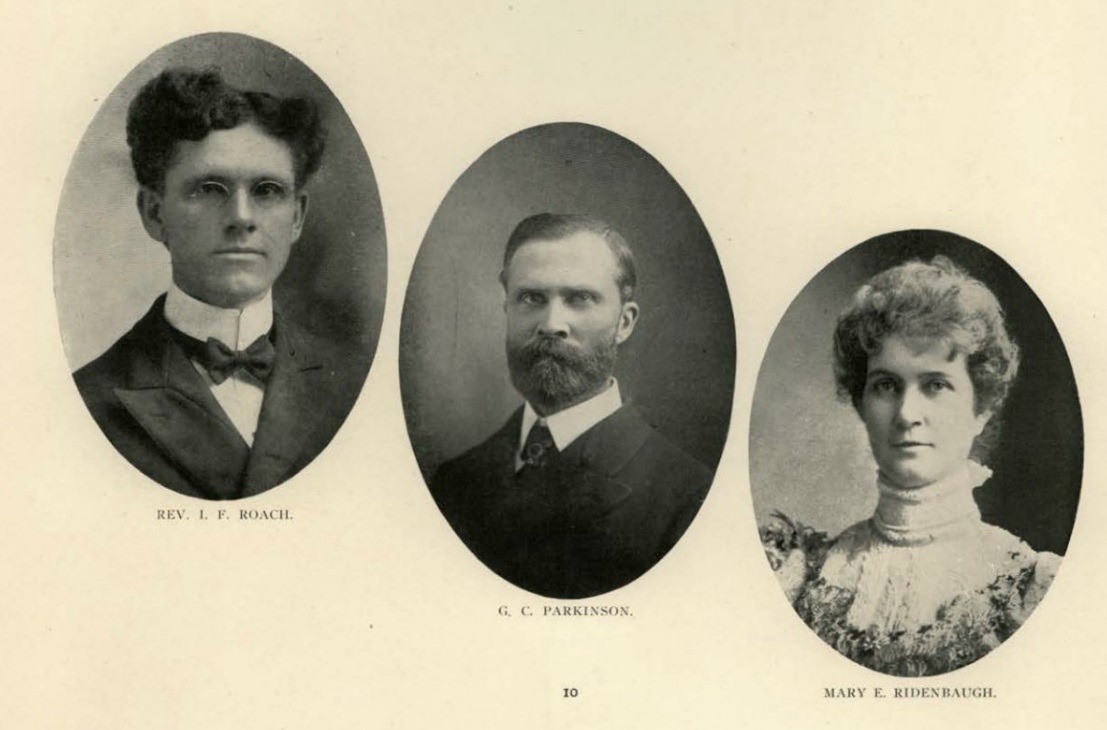
Mary E. Ridenbaugh (1857–1926) served as vice president of the University of Idaho’s Board of Regents from 1901 to 1907 and played a vital role in advancing women’s education at the university. She championed the creation of a dedicated women’s dormitory—Ridenbaugh Hall—completed in 1902 and the first U of I building named in honor of a female figure. Her advocacy facilitated the development of Idaho’s earliest domestic science programs, including cooking classes held in the building’s inaugural kitchen. Ridenbaugh also contributed significantly to civic life in Boise, helping to establish the Carnegie Library and serving as a founding member of the Columbian Club. Her legacy endures through structures, programs, and institutions that reflect her lifelong commitment to education and public service.4
Notes
-
Nathan J. Moody, “National Register of Historic Places—Registration Form: The University of Idaho Historic District,” initial submission to Idaho SHPO, unpublished, University of Idaho, Moscow, Idaho, May 7, 2025, 12. ↩
-
Ibid. ↩
-
Ibid. ↩
-
Mann, Cerena. “Mary Ridenbaugh.” Boise LocalWiki. Accessed August 13, 2025. https://localwiki.org/boise/Mary_Ridenbaugh. ↩
Browse Images
![Ridenbaugh Hall, University of Idaho. [58-1]](https://objects.lib.uidaho.edu/campus/small/campus02385_sm.jpg)
![Ridenbaugh Hall, University of Idaho. Entrance hall. [58-10]](https://objects.lib.uidaho.edu/campus/small/campus02386_sm.jpg)
![Ridenbaugh Hall, University of Idaho. Dining room. [58-13]](https://objects.lib.uidaho.edu/campus/small/campus02387_sm.jpg)
![Ridenbaugh Hall, University of Idaho. Student room. [58-14]](https://objects.lib.uidaho.edu/campus/small/campus02388_sm.jpg)
![Ridenbaugh Hall, University of Idaho. Student room. [58-15]](https://objects.lib.uidaho.edu/campus/small/campus02389_sm.jpg)
![Ridenbaugh Hall, University of Idaho. [58-17]](https://objects.lib.uidaho.edu/campus/small/campus02390_sm.jpg)
![Ridenbaugh Hall, University of Idaho. Dining room. [58-18]](https://objects.lib.uidaho.edu/campus/small/campus02391_sm.jpg)
![Ridenbaugh Hall, University of Idaho. [58-19]](https://objects.lib.uidaho.edu/campus/small/campus02392_sm.jpg)
![Ridenbaugh Hall, University of Idaho. [58-2]](https://objects.lib.uidaho.edu/campus/small/campus02393_sm.jpg)
![Ridenbaugh Hall, University of Idaho 'Girls Dormitory.' [58-20]](https://objects.lib.uidaho.edu/campus/small/campus02394_sm.jpg)
![Ridenbaugh Hall, University of Idaho. [58-21]](https://objects.lib.uidaho.edu/campus/small/campus02395_sm.jpg)
![Ridenbaugh Hall, University of Idaho. Interior. [58-22]](https://objects.lib.uidaho.edu/campus/small/campus02396_sm.jpg)
![Ridenbaugh Hall, University of Idaho. Student room. [58-24a]](https://objects.lib.uidaho.edu/campus/small/campus02397_sm.jpg)
![Ridenbaugh Hall, University of Idaho. Student room, Myrtle Hitt studying. [58-24b]](https://objects.lib.uidaho.edu/campus/small/campus02398_sm.jpg)
![Ridenbaugh Hall, University of Idaho. Student room. [58-24c]](https://objects.lib.uidaho.edu/campus/small/campus02399_sm.jpg)
![Ridenbaugh Hall, University of Idaho. [58-25]](https://objects.lib.uidaho.edu/campus/small/campus02400_sm.jpg)
![Ridenbaugh Hall [58-26]](https://objects.lib.uidaho.edu/campus/small/campus02401_sm.jpg)
![Ridenbaugh Hall [58-27]](https://objects.lib.uidaho.edu/campus/small/campus02402_sm.jpg)
![Ridenbaugh Hall, University of Idaho. [58-3]](https://objects.lib.uidaho.edu/campus/small/campus02403_sm.jpg)
![Ridenbaugh Hall, University of Idaho. [58-4]](https://objects.lib.uidaho.edu/campus/small/campus02404_sm.jpg)
![Ridenbaugh Hall, University of Idaho. [58-5]](https://objects.lib.uidaho.edu/campus/small/campus02405_sm.jpg)
![Ridenbaugh Hall, University of Idaho. Hall and parlor. [58-6]](https://objects.lib.uidaho.edu/campus/small/campus02406_sm.jpg)
![Ridenbaugh Hall, University of Idaho. Entrance hall. [58-7]](https://objects.lib.uidaho.edu/campus/small/campus02407_sm.jpg)
![Ridenbaugh Hall, University of Idaho. [58-8]](https://objects.lib.uidaho.edu/campus/small/campus02408_sm.jpg)
![Ridenbaugh Hall, University of Idaho. Library. [58-9]](https://objects.lib.uidaho.edu/campus/small/campus02409_sm.jpg)