
John Cushman Interview #1, 10/27/1977
Description: n/a
Date: 1977-10-27 Location: Moscow; Washington; Spokane; New York
Subjects: University of Idaho; professors; presidentso; plays; teaching; teachersho; colleges and universities; education; world wars; clubs; students; Native Americans; pageants
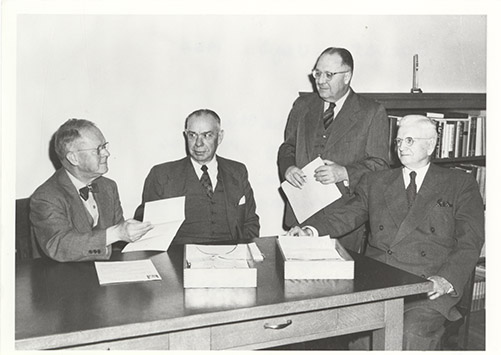
Rachel Foxman: Conversation with John Houston Cushman took place in his home in Moscow on October 27th, 1977. The interviewer is Rachel Foxman.
Well, I brought some questions I wanted specifically to ask you. Could you tell me something at all about your early education?
John Cushman: Well, I grew up in a little town. There were nine of us in class, and we graduated in the class of 1909.
Rachel Foxman: And where was this from?
John Cushman: And given me. It was near Bangor. And they had the winning basketball team for several years since the little school. It was amazing. And there were three girls, six boys and six boys went to college and the girls and one went to a finishing school. Married my cousin. And so. Did you two boys are the middle aged men now?
I was valedictorian, which was not hard. well, they were only nine. as I think of it now, it seems quite ridiculous that that's, everyone should take the same percentage. We all had to take Latin for years and three years of ranch and the English and the management. And we all had the junior exhibition, which, in which we recited.
I don't know what you got there. About seven minutes long. And then in the senior year, we we had a part and they graduate actors who had. And so we had to experience to do that. we had some rather good teachers too. They were generally from Bates College. Bates over Colby, Maine, Bowdoin. My three cousins went to Bowden.
So last year when I needed a hat specialist, I chose a man from Bowdoin over in Seattle. Doctor Michelle was born and in Switzerland, and he lives. He did live as a boy near Concord, Lexington. And then he got his his medical training at Columbia and came out to the Swedish hospital in Sierra Leone.
Rachel Foxman: What year did you start college? Your undergraduate work?
John Cushman: I went to Brown University.
Rachel Foxman: And what year did you enter?
John Cushman: I entered 19th, at nine, 1999. Graduated in 1913. And then I went up to Harvard rear in 1914 and started teaching, then at Syracuse University.
Rachel Foxman: While you were going to Harvard?
John Cushman: No, no, no, no, I, I went there for five years and then came out here. And, I came here in 1990 about the time everyone was coming back from the war and, excited to grow. I left Syracuse and when they had about 5000. And we used to have, 60 and a class in English as freshmen.
And we had three sections. And what that amounted to. And, while I was there in the English department. I did, some plays for the English club, and their activity was, plays and given out of dollars. They, they had what they call the castle. They bought, Richmond's, which were buildings exactly like a medieval castle.
And it was kind of nice. I don't know if there's is true. And I did, Barrie play, they had me book writing, and then I did it. Prunella, did you ever hear that?
Rachel Foxman: You never had the delayed.
John Cushman: And that was Marguerite Clark. She was quite famous in movies. And later on that she did, that play on the stage and on Broadway. It has a musical accompaniment.
And, did I did a part in that honor, honorable Ernest. Well, I it was a good year. Like, An Oscar Wilde play and it. Do you another play?
Rachel Foxman: No, I don't.
John Cushman: You say I play attractive play. I think so. Anyway, And I was taught Barrie along with you, and Green Arrow and, and some of the later Victorians, I guess you Garland and got ready. Oh, God.
Rachel Foxman: Are those, the types of plays that were being put on when you were in school?
John Cushman: Yeah, when I was at Harvard Jazz, and there was a wonderful stock company that, played in Boston right near the public library, and they the, one of the railroad stations you could get out there if you were coming, as I used to, from Brown and it was near the original, Massachusetts tech before they moved across the the Charles River.
Where are they now? and this is a charming theater. I can't remember the man's name. they the women's name because they were, quite well known actors, and they put on the guise of their plays and their shop plays. So I got to be very familiar with all those. You wouldn't have them, of course, in a college town, because they had never put on so many.
They did about one a week and they were excellent.
Rachel Foxman: And you say you studied, in the workshop 47 and Harvard?
John Cushman: No, I didn't no, no, no, never did. I did I have done quite a lot with playwriting down here. And the pageant and the chief thing I did, I did that three times a year and once in Boise.
I recently turned in a copy of, production to the university. So they have it out there. okay. Fine. Thank.
Rachel Foxman: Well, what brought you up to, to Idaho?
John Cushman: Oh, well, I was just I was going to go to New York and start a place I. Five years, and that's what I was going to do. and think of acting, of course. production. Pretty great that, I got this offer very late in the fall. It was, the head of my department was on vacation after summer school.
I ponderay Lake, where I had, summer camp. And so I got hired at ponderay, and that's, that's right. The university. I could very surprised when I came here and found where it was. And you get you get into, and, Spokane at 9:00 at night, coming through. I came from Syracuse. Gosh. And Chicago.
Rachel Foxman: You came by.
John Cushman: Train? Yes. I hadn't ever been farther than Niagara Falls, which is the next time you see, Niagara, two towns passed around. at any rate, that evening I got on the little train that comes down here. It gets here at 1:00 in the morning. I left Syracuse when they were having their state fair. It's a very famous fair at Syracuse, the state fair.
And they were crowded. All that I was glad and, and, I took my old boardinghouse keeper to see a play to celebrate my farewell. And, we went to see Denman Jackson and the old homestead at Wagner. And appropriately, the purpose. And then, when I landed here in Saratoga in Moscow, I found they were having the state fair here, and I could have a price, say.
And it took me about a month before I got a room to live in for that year. And that year I had a heater that I had to get on prepare. and I could decide whether I would chop wood for the evening and have a nice while. I'm going to bed. I usually be at home late at night and then, rest got hit in the morning when I wanted, get comfortable at the start of the day for breakfast and use my cane.
And then I couldn't do well. And, in the night, I was kept through my window open. And there's a great big family cat, a yellow one, and he'd come in and that's very tired in the morning, and he'd crawl down inside the covers, down by my feet for an hour or two. Yeah, yeah. Well, And then he'd crawl out again.
Rachel Foxman: So that when you came to Moscow, you boarded with a family.
John Cushman: No, I didn't go out with them. I just ate wherever I could down on Main Street, and I. January 8th was in boys who were undergraduates. They weren't my students. And, and we ate at cheap little hotels, I guess mostly it was good and food, and we ate occasionally at a cafeteria. I got acquainted with Miss Matthew and you heard anything?
Rachel Foxman: No.
John Cushman: Name Matthew. She was in French, and she taught. And she had graduated from Washington and had taught at Aberdeen the year before. And she came over to Moscow and lived with a regents wife, widow. And, she was part of the social scene here and now, my work outside of the university. And she had started this in 1919.
I came here in 1919. And, I did praise through 1930. And I started.
Rachel Foxman: But you must have done it seems to me that that time period, there were a lot of different styles of drama being.
John Cushman: Produced where I, so I, I had nothing to go by except occasionally to go to Spokane to see a film show. but otherwise just movies. I was very lucky not to have many movies as I as again, where they came this second year here and here and as we were down very simply, little movies, that.
The first show I did here, a long one, because we were doing a lot of one act and then and, so I used to do a series of one actors about every month, and that was pretty, you understand, I try to work out in English. I did that on the side.
Rachel Foxman: As well as.
John Cushman: Yes, yes, I was hired. Now I was in department. Had I did all the drama. And then another man, Mr. Chan, with Mr. Asia minor, played our county. He came when I did and he took care of public speaking. He later became the last rep. And then Baker Brown, now who went to northwestern and then became quite a famous and professor, also philosophy.
He was teaching journalism. And, that's the way doctrine that a man had built his new department. We all knew the only one of us who was a day, wasn't really an English teacher at all. And he turned out to be the poorest, that he had the most scholarly background. He came to Stanford, that, the department then started off very well.
And, when I became head, when Doctor Miller died and we happened to have a department match like that, I think people enjoyed it because they were good teachers and because they were read, man. And it worked out very well. And because Idaho in those early years wasn't primarily interested in a scholar of education in English, and they would be in a forestry, mining or something else.
so frequently had people say, well, I'd never heard of you and I'd say, well, were you in and engineering, mining? something like that, because they usually run as fast as they can. They get away from English.
I never had any trouble, getting actors at home. The men always seemed to be willing to take part there. One year I had a bad time of it back east during the First World War. You see, that came around 1917. I didn't read that 1919. I had one play to do, and I had about one man. Oh man that I could count on.
So I chose a little play that was based on a famous novel called Cranford. Did you have you heard of that? Cranford? That's. It's really like a Jane Austen pay, a lots of country ladies in, and, it turned out to be a good play anyway, for, for the war, there's hardly any undergraduates on the campus, and we had a bad time.
We had no, I never got that band. And so that is not my problem. when you are now, out here, we did have that two main plays. I say graduation play is seen as a happy graduation by that, was before my time. So I always had enough of time. We had the play and the regular plays and the auditorium.
And the next morning, Sunday morning was the commencement. So they had to clear out everything on the stage and have it ready fixed for the morning. And so I tried to get a play that wasn't too long. And some of the best grades we did with those commencement plays, I did one called Pygmalion. You know, and it was awfully well done.
My, hero lead was in, a fellow who became a famous, chemistry man, very like Malcolm Renfrew. And he settled in, California. In Los Angeles, he was trained at nothing at, one of those schools in Chicago. And, he did that play. His sister's name was Verna Johannes. And you have her name?
Rachel Foxman: I don't believe.
John Cushman: She. She was connected with the way the. And home economics school, ma'am. And then went over to alma and she married in about 35, and her husband died within a year. It was rather tragic. All right. Happy life. She was on Mac. I guess, the the first play I did hear you're interested in that spring sometime.
I was at Brown. I had to be going to Boston. I lived in Maine, so I was going to Boston. And so I'd stop up and see a play. And this one was very, very, very, very rare. And she, was very famous and and she was in this play called The Amazons that has an arrow. It's about a mother and a lord and lady who live in England.
And, they bring their three girls at, like, boys because their father was so disappointed not to have boys. And so they were right. And that they also tried to keep all men away from them. And the comedians. Oh man, we did this up in Derry and we did, Saint Lucia and I started that quite early. This thing at that time we played in Kellogg and Wallace and and, the ones out by the lakes got good and, father up.
I'm having how old you are. I know when people made firm exits who couldn't near together that moment.
Rachel Foxman: Where the play's pretty well received.
John Cushman: Oh, yeah. Oh, yes, they were. There's first play which I entertained the hero of, just a short time ago. He came back for his 55th anniversary from Boise, and, he came here to this apartment, and he now lives in some quite the same time. He was a lawyer, trained as a lawyer. They loved you. He never liked me very much because I had distracted some of his students.
Another one of them became a judge. And here's one of my best actors. I had time with these lawyers because they were trained in high school so rigidly that they couldn't relax and take different parts. they could make their voice sound so they could be heard at something where they display the Amazons is a very strong, I think, a pretty good high school grade would me.
At any rate, Berger did it charmingly and amusingly. And so I did that for my first show. of course, had much easier doing plays because they didn't have so many movies, you see, and so they hadn't seen the plays that I chose. And there were several John Jay writers then, and I never I always chose Broadway plays and Shakespeare, some of my best actors, Romeo and Juliet and I, and we used to take those two Spokane because in the spring the teachers, met up there and they hope to get their first jobs, at the meeting.
And so they, the, the president of the university would generally get us an invitation to appear and then version characters. And so I took the, my scenery for, Romeo and Juliet, which is staircase. I didn't know that that would be made. And and, way to the local gray man to target up that part and we.
Yeah. No time. we had Martin likes to use, you know, spot lighting. And that's what makes those things work.
Rachel Foxman: When you, when you first came here, I suppose you did some performing in the UI.
John Cushman: Did you ever. Yes, yes, that's where we finally went. I had that from my office to. I occasionally had my some of my regular English classes. I know the name. Of course it was. I was over there. They just came into my office and sat around a circle long like that was in that class. And,
The first year I was here, I had non dramatic literature, English and advanced English class. I saw one of the girls last summer, and she's in her 70s, having, and because she doesn't look the same and, but I was so amused that I was hired to do the plays and have the non Shakespearean plays.
and Doctor Miller, who was my chief, also had, Doctor Kittredge from Harvard in Shakespeare. So naturally, he wanted to do that, and they'd do it for several years before I came to it.
Rachel Foxman: When would you use the, the you had facility instead of using the auditorium?
John Cushman: that never happened. I always use, I always use, yes. I was in a scrap with the music head because he wanted to use it. I had to go to the president sometimes to get my share. I used to happen to. I did, Jennifer. Hi, coach. Wherever I am indeed. Today, singing and I have occasionally done things like that.
Rachel Foxman: Was the you but not big enough for you to.
John Cushman: Use. Oh, no. Is that one? No, no. We, we would try it for things that we wanted to do. We used masks, for instance, for some of our plays, one actors, we tried usually those things. no one actors. And so but we found that the match closed in their voices to match. We didn't know how to make them.
Exactly. one of the girls liked the idea of making Mash, and so she did. And and we used that kind of help, how we could.
Rachel Foxman: What kind of play would you use that mask?
John Cushman: Well, it is something connected with a desert down around New Mexico, I can't remember. They must have been. Spanish? Mexican.
Rachel Foxman: So it was rather experimental.
John Cushman: Oh, yeah. Yeah. Is that.
Rachel Foxman: What it was used.
John Cushman: For? That? That we did? You, a lot of it. Not always. Sometimes it was testifiers and some the actors that they go, I hated to memorize parts and so forth, but then I could tell from the work they did. And when I paid, if I could depend on them for, long practicing.
Rachel Foxman: Well, and I don't I don't know if I understand. When you first came here, was there a Department of Drama or was there.
John Cushman: No, there wasn't, there wasn't, I developed that.
Rachel Foxman: And when did you develop the drama?
John Cushman: I couldn't tell you. I developed so the the club that they wanted had. And so we had a little pen that looked like a draft card. And we called the club the garden club. The garden. Yes. And that was about the time. It's correct. There was a student. you see, I had her when she left. She came here first.
She tried out and she went off to college, and then she came back after 2 or 3 years, as an assistant in the department. Well, she came back where I tested. I had, to teach full time in English. And then she took over that. Who had joined in?
Rachel Foxman: When you would do plays, would you be the one that would be designing the sets as well as.
John Cushman: I did all of that? Yes. I had some very good help. I had a college carpenter. He was a wonderful carpenter. And he do these broad staircases. They were far too heavy. when I was in Syracuse, I did a play for the Drama League, which was a national organization, and did it downtown and run the big city theaters and, I did a play that one of the the local janitors recognized.
He said, I know what this is. I used to do this in New York. I printed, I worked on the play in New York, and it was at a set, the fire. And that was my Barry. And the reason why this, that and the first act. A young girl had decorated the apartment and she tried different kinds of wallpaper.
So there's all kinds of on paper, everything was crazy about the set. So of course I felt I was setting the stage. I would recognize that.
And, And Romeo and Juliet, Mercutio died, of course, about the middle of the play and, then he became the stage manager. So he had a skullcap on his head, and he was directing the evening of the, the the drops overhead when the curtain accidentally slid open the same her costar, the dead, my character doing the things with his wings and and so he had chagrined.
Been a reader ever since I did. Who do that, too? I had done it before I came here, and I did a group of plays in the Episcopal, Guild Hall, where they had a little stage, and we used to read the plays with a book in a hand, and we'd act them out and found myself one evening during a fight in, court with a married lady.
Man. Yeah. Who he has been doing when the bat. So she was reading out a book in in the bed, and I, So.
We used to play every two weeks without food for dresses. We didn't memorize them. You see, we had them, and they worked very well. I did that for years. And that's beside the page I did on the campus.
Rachel Foxman: How long would it take you to do a play that you do on the campus? A full length,
John Cushman: I suppose six grade six weeks for the the one at Grace?
Rachel Foxman: And how long for the full length plays?
John Cushman: But not much longer. But we'd have more rehearsal. They had them sometimes in the afternoon they it and grab hammock. after rehearsal it would be that long.
Rachel Foxman: And you were teaching drama classes in that time too, as well?
John Cushman: Yes. We organized, introductory courses and advanced courses and, did advanced writing, too. in my early years, I was very interesting. I, I was enjoyed I think my best course was great books and I started that in 25. And Professor President Dell asked me to do it for the business school. So we'd have about 150. And I had three Episcopalian daughters who would read my quizzes.
Rachel Foxman: Sounded like they spread you pretty thin.
John Cushman: Yes, yes, I had did that. And after I stopped being had, I did that and I had about five classes I taught till I was 70. You see, most of them stop at 65. And it didn't seem to cause me any trouble. And I enjoyed it a lot.
Rachel Foxman: You know, it's I've, one more question about theater right now. It seems to me that they don't do as much Shakespeare now on the campus, it sounds like when you were there, they did not.
John Cushman: they had a star was bobbed hair, and I protested it, for acting, you see. And, they quoted it. And when they asked me about this, I noticed what I had to say about,
Rachel Foxman: And what was it that you had to say?
John Cushman: Well, that I didn't approve of it because I didn't want to have to work with bobbed hair. I want them to have as long as you have. and we could do all kinds of things with that. A of course, they have gorgeous hair for Shakespeare. As far as the men go. They have really beautiful hair. Some other.
Rachel Foxman: They do. Do you think that people could understand Shakespeare better though them?
John Cushman: Well, I had Mr. Jennings and he translated Shakespeare's plays and even Doctor Miller, Max Siberia, he'd recognize it. We had translated everybody didn't realize it. He could understand it. and you say in there. And he did, he did Romeo and Juliet, you know, in the movies, too. And, he was used to that.
We had some very interesting people.
Rachel Foxman: Mr. Jennings sounds like.
John Cushman: Yes, yes, he was a fine, fine writer. Even Professor Baker found him a fine writer. He did 2 or 3 plays for him.
Rachel Foxman: Can you tell me at all what that pageant was like? Night on the mountain?
John Cushman: Well, yes, it was pretty good. we, competed that year the first time with, Well, why, they they did that as more artificially more. Their staging was built. Well, good. mountains were built on wood.
Rachel Foxman: So now what was the competition?
John Cushman: Well, that, you see, we did naturally on the athletic field. And so we'd look up on the top of the hill there. They have read him and Abe golf is up there on a wooden horse, and he showed only when he turned the light on. We had some trouble with our lighting at first, but I finally got that better.
Professor Johnson of engine of mine. Electrical engineering. He was the head of that. He did that program. And then we had an electrician. We have his name in reverse, and he's not very, but he was on the campus here, and he did, that, man.
Rachel Foxman: Who came up with the idea to do this pageant.
John Cushman: Doctor Miller, I think because he had taught it, Sam. And he has studied it in the East in pageantry, had been well known of college and, it was a way of getting, you know, early English plays, you know, and, so I think he started it, I didn't.
Rachel Foxman: And he and Talbot Jennings wrote the play for him.
John Cushman: Well, he worked with me on that. Coach and officer, Professor Brosnan, who was a American history man. But we had a great big committee where the Danish women and we had the president, university and all sorts of people.
Rachel Foxman: How many people did you have in the production?
Could you.
John Cushman: Write? I couldn't say I had to have a lot. I have and some of the pageants, some of the later ones, Miss Collette and somebody who did Mr. Chavez's work, he would be doing it. I didn't finish talking to you. Did, about the assistants I had? One of my actresses has to Brown. Harry Bran is his name, and he was a painter.
He was painting. Where is your garage? He painted houses and things like that. And so he used to paint on machinery for me. And that was kind of how I would have been no good at it. Now, that summer, when I worked at Harvard, they sent me to getting doorknobs and things like that, and I was no good at all to that.
I didn't happened to have done that kind of thing as a boy. So I'm in them here having done all that. And I would advise a person not to take so much French, Latin as I took. I could a those as well as my English. You. I got about it at Brown. We didn't have any major work.
They told us what we had to do and that we did, and we had practically no choice. And it still does good work.
Rachel Foxman: Well, when you say that you, had a competition with wall and wall or was it like,
John Cushman: I mean, you say in the area, I mean, oh, for people in the northwest. No.
Rachel Foxman: Was it like the state?
John Cushman: Yeah. Like they compete. They compared their show without they have had a one recently, I understand two years ago that was very good trails west. Yes. They. I didn't see that.
Rachel Foxman: And did they do lower the mountain every year.
John Cushman: No they didn't usually I did it only about three times. in all the years I was here, governor McConnell was present. He was in, you know, knows by in, in the story. And so he was in it. And then when we did it in Boise and they, a law firm, I can't think of that name.
but they they did it. They were the young boys then something begins with age. I mean, I can't think.
I didn't know anything about the history history at that. But Mr. Jennings did. He was an Idaho boy. And, so I depended on him. He. We had a bear. So we had a chapel, and we had a priest. That's what I'm saying. And we had, it started in, well, a group of football men, which I used for Indians.
And then we got costumed by getting the Nez Perce Indians up there, and, and they each brought a costume and, so these boys were those. And they look like Indians because they were big husky. But by the time we got to dancing, them, they went through the and then in dance. And then they had a great time.
It was like trying to recite chanting around the campfire. That's the way we at it. Or by the campfire. And, we chanted all about Sacajawea, were being swept by some other tribe of Indians and then share bed on a hilltop, with Lewis and Clark, leading them to Portland. And so, and, and we introduced it by that chanting around.
They put the campfire, but they, they found they couldn't do their regular football tactics. And then in a breath after to recite that, we got one of our facts. one of the girls danced. Who sang soprano? Now she came, we put her in with the covered wagons, and they were way down the other end. And you looked way down and saw them coming into a set, to protect themselves from the attacks from Indians.
And she sang soprano home sweet home, which was lovely. And, they did. Do you know, you can get quite nice effect and then we call the the end, which we planned the that's the barren way. The dances, barren ways. And so they, they, they came down out of the hills with capes on long capes. They come to the ground and they were the color sagebrush and the skirts down and that other and blues and greens and whites of the water come dancing down in among them all.
And then they'd rise up in the colors of their yellow and peach color and, the fruits and happiness and things like that. And then the dancing of those two colors, and as the waters and the fruits. And that was the final scene of the pageant.
Rachel Foxman: The book, beacon for Mountain and Plain, says the, the scene where there was a lot of square dancing. Was a great favorite.
John Cushman: Yes. Well, that Mrs. Brown made her hit and that she was one of the, the partners that you got from some country farm to, there was a horse and buggy across sagebrush and then danced all night and as they did, you know, and then that's where we gathered them horses from the country here we had an awful lot of horses, and they were taken care of, but they, egg department and, we had the horses, we had chiefs.
Joseph Pratt who, who tie down his horse because he didn't know a horse alligator. And he had a white horse. He was like a circus. And he had that lovely speech where they sang those and will fight no more forever. And he that beautifully. I think he was a Jewish lad. And his features were right with that, that he probably looked more romantic.
at least heroic than Chief Joseph himself. It was very well built. And, there was one child of no idea who was kind of, A star man. We called him, and he would read the signs and, and, prophesy about and kind of preach. And so,
Rachel Foxman: I understand one scene took place out of the memory of Dean French's childhood.
John Cushman: That I don't remember that I don't know that I know that.
Rachel Foxman: Something from, was quoted from beacon, from Mountain Plane, I believe it was the Idaho City.
John Cushman: Rising. I read that, of course, but I, I would know some of those things that were there. I know the name very well.
Rachel Foxman: The pageant sounds like it was grand. Do you think they could do it nowadays?
John Cushman: Well, they don't have any page to do it.
Rachel Foxman: No. That's true.
John Cushman: You where they filled all that back with building. I don't know why they do. I wish they would. I never said yeah.
Rachel Foxman: It's interesting to hear about
John Cushman: And.
Rachel Foxman: I've heard a great deal about, George Miller. Maury.
John Cushman: Was that his name, judge Maury Miller?
Rachel Foxman: Yeah, he was. He was your.
John Cushman: Yes, Dean. He was. He hired me. Yeah.
Rachel Foxman: He was. It seems to me that, he's quite well known. And then he was pretty well respected.
John Cushman: Well, he looked like a, a farmer. Exactly. In overalls. And he would he liked to make farms and he'd dress the bad. And he loved to go hunting. And so he would look that way.
Rachel Foxman: Was he an Idaho boy?
John Cushman: Oh, no. He was from Indiana. And, he had come just two years for, I mean, he was much older and he's been gone about. I wonder how many years his son, his dad,
Rachel Foxman: You know anything at all about, from then called the Hume folks named after Dean. You?
John Cushman: Yeah, I was I don't know how much of a fight there was, but he was a brilliant teacher, and he went to Stanford. He was my dean for the first year. Yeah, but he wasn't here. He was on leave. And,
I don't know, he's ever lived here in my time. And since 1919 that, I don't know what the fight would be about.
Rachel Foxman: As I understand that there were, was, big dispute between freshmen and sophomores.
John Cushman: No, I didn't.
Rachel Foxman: And so that, the dean would just simply have them all line up his teams and play like a rough football game.
John Cushman: Where I never heard that before.
Rachel Foxman: I wondered if that had been a tradition when you were here.
John Cushman: No, no, it hadn't been, yeah.
Rachel Foxman: I understand Dean French was a great influence.
John Cushman: Oh, yes, I think she is. That the strongest dean in the northwest. The man of the school.
Rachel Foxman: why is that?
John Cushman: I don't know, dates after Pasadena. Cheers. An Irish Cal and, she seemed very dignified. She said she and her junior, Milo, put on her cap and gown for an honorary degree that they each got in Washington, and she couldn't have done it right. I, I used to see Junior minor when I was in college with her husband, Southern and Milo, and they would do all and they changed their name.
I was very lucky, as many of us were, who went to, eastern schools regularly and, had the money to go see the plays. And I think the luckiest one I saw was, a nation of, doing the jobs and had a guy and all that. She'd do one after another. I she just love right? Yes.
I mean, she learned English, too. She, she talked a rush. And that first. Do you read those books like Gerald Crawford? Gerald Crawford is a producer, and she worked with. And there's an event and, that that other one that has a repertory company in New York, they did several plays that in her old age that I.
And I saw her first because she was much, much younger.
That's the only thing I regretted, not being not living out here, which I enjoyed, but, being back east to see the prize. So I was kept up, the theater, is won. And the New York, nowadays that challenged about prize.
Rachel Foxman: It seems like it was, the 20s and 30s was an outstanding time.
John Cushman: Well, I'm surprised because when I look back at some of those plays, Mr. Tomaso was here for his 55th anniversary this year. Was in a play, Clarence, do you know that it's that Booth stack? And, when you read those plays in the 20s, they see, for his paper. I can imagine why I can, I go to see all those plays that they have over here at the student union where they have a dinner, you know, and then they have a play.
And most of those are about that period. And I've enjoyed all those. I think I studied also that pageant dress. And because I studied with Professor Baker, he had a course in all of English read from the start. And so if you study those early plays and then you know pretty well what pageantry is all about. Doctor Miller also studied with an English professor who, knew a lot about English ballads.
And that comes into it show and, so it was natural if you went to Harvard to be in on that, and that kind of dramatic literature.
Rachel Foxman: Seems like Professor Baker was probably one of the most outstanding men. In fact, I.
John Cushman: In the world, in the world as he was.
Rachel Foxman: King. Is there any reason why in particular?
John Cushman: I don't know, because he was he was famous for, in my time in college, a debate. And he he wrote a book on debate and, that this, driving business came into his interest later.
Rachel Foxman: Was a because he was the first one teaching theory.
John Cushman: I think. So they had 2 or 3 other ones in the country, but there's one in Iowa and.
There's, I think one in Michigan.
Rachel Foxman: University of.
John Cushman: Michigan.
Rachel Foxman: Yeah, that was the other one. Grinnell. And I'm 40 or university law.
John Cushman: Well, is the University of Iowa. Yeah. One I'm thinking. Yeah. And of course they had one in Pittsburgh.
Rachel Foxman: The baker seems to be the one.
John Cushman: Yeah.
Rachel Foxman: When you talk about the plays that were coming up over 20 years, you talk about Thomas Wolfe.
John Cushman: His lectures were kind of dumb because I think they were a little dusty. He seemed, had them a long time and didn't keep up with them the way one could. We didn't have anyone brown quite like him. We had, had one man have who did the blaze and who was a charming person. And he gave dramatic readings that were very attractive.
Rachel Foxman: When you were here, would you or did you do any of, like, the Eugene O'Neill plays at all?
John Cushman: Well, of course I taught. I taught a course in drama. Race, yeah, modern drama. And that included the O'Neill plays. So some of these have been written since I stopped teaching Long Day Journey nine. Some of those I knew have, but I never incorporate them in the in the cars.
Rachel Foxman: We had people out here in the West take to, all this drama knowledge that you had. There was.
John Cushman: Well, I don't know. I tried it when I taught great books, I taught the Bible and, some of my most enthusiastic people were the Mormon bishop and his wife. So I got by with them. And I never had had had known anything about them. At Syracuse, where I taught, it was a methodist school, not that I went to this church.
I had not met this ministers in my freshman English who were learning English. I hope they learned.
I'd have out of this 30 year, 40, 50, in Whitman, too. At that time.
Rachel Foxman: When you were at Harvard, were there women allowed in the in.
John Cushman: The school? There were over and that here. But we didn't see them very often. The women who worked in the library at Harvard had to wear long sleeves. They weren't meant to do anything so daring have to have short sleeves. And I talked with one guy who worked in the library. We were quite amused and how strange they were.
Rachel Foxman: That's made it difficult for them in the summer.
John Cushman: oh yes. Long sleeves.
Rachel Foxman: I don't think there'd be a lot of difference in approach between what was being taught in the East and what was being taught in the West.
John Cushman: I think there is, my oldest granddaughter is 13, and she started German this year. And I told her parents I regret it out of German, too. But yeah, I thought, French are so much better and and and, New England, you find French used a lot more than German. Of course, if you had the same kind of training I did, you probably would get,
Rachel Foxman: Did you find much difference in the discipline between the students that you have used and the ones.
John Cushman: That you were? I've trained it was like for examination, final examination. We'd go to the chapel when it was time for our exam, and I would be looking for a certain course I was taking. And they did say blue. It would say instead of Blue Book it might say think book, Red book or Yellow book or some other color.
And then you'd go and sit down at one of the books and do you and they had people pacing up and down. Constantine. And there's no one near me who was in my class, so I couldn't have possibly cheated. But they had this pacing back and they did half or two. You there. You got so that it was a 9 to 3 really, when you wanted to think, you know, how to have somebody walking back and forth, back and forth.
So they didn't believe in any of that. And because have had trouble with Annapolis and, and, West Point, haven't they. Well, but lately. Yes.
Rachel Foxman: I, I started out going to college in the East, and when I came out here.
John Cushman: Where did you.
Rachel Foxman: Go? I was, to school in Michigan at Wayne State University.
John Cushman: I didn't know that. But some of the New England schools, private schools. And I know the girls go to those and and enjoy them a lot. It seems I don't know about the social part of it. That's, But I know they're trained in politics and things like that.
Rachel Foxman: I know, and.
John Cushman: Where is Wayne saying it's in.
Rachel Foxman: Detroit?
John Cushman: Is in Detroit? That's right.
Rachel Foxman: In the city. of course, there's a lot of theater and a lot of cultural events happening there.
John Cushman: I think one of my friends here in biology went back there. Perhaps he went to a Catholic school. He was a graduate. he had one these little bikes that you ride on with a little, seed, kind of a basket on the side. And I used to go riding with him a lot and that, you know.
Yeah.
Rachel Foxman: Yeah. And but it it seemed that when I, when the discussion of drama back in the East, it was a lot broader people could draw from a lot different sources than they could out in the West.
John Cushman: I'm trying to think of what it was I was doing, and I asked doctor not to cascade. That was a name he could pay the pipe organ. And so he played. But you got him. And so I used that and it became event. But the German woman here, oh she that has offered to, to copy for house in this play I was doing and trying to think what I was doing, I can't see the thing.
I don't think it was very good. It might have been. It was some other play that's in. It was found that I use it and she couldn't stand it. I think I copied.
Rachel Foxman: Was it harder to teach the classics, do you think, in the West.
John Cushman: Than it was? No, I never thought so. I always enjoyed teaching. I never had anyone using any dirty words or writing anything on the board like that. I never had that problem. I never had the problem of discipline and.
Rachel Foxman: Were you taught here between 1990 to 1930?
John Cushman: No, I dropped 90 1961.
Rachel Foxman: But oh, I'm sorry to 1961, and you must have seen a lot of changes.
John Cushman: Oh, yes.
Rachel Foxman: And a lot of changes and.
John Cushman: And yes, I suppose I did, but I didn't say long enough to get into the rebellious part that came out my,
Rachel Foxman: You must have also gone through so many types of drama, from Bernard Shaw to.
John Cushman: Oh, yeah, they were doing in the 50s. Yes.
Rachel Foxman: Was it, you still kept up to, to teach those things?
John Cushman: Well, I did those because every year I had the course seriously in drama, and I usually read my plays so they would be fresh.
Rachel Foxman: And did you find it hard when you were trying to direct the play, going from the different styles that were.
John Cushman: Well, the hardest thing I had was stopping smoking. It used to make me smoke. Moscoso no, it was just nerve wracking.
We did. We got quite a reputation, right? reading plays too. I still think that's good. And the audiences seemed to like it too.
Rachel Foxman: Was there much theater being done by the small rural areas, or was it mostly what you were taking out to the small towns?
John Cushman: Oh, I don't know. I didn't care, oh. Without the school of education. And there was quite a lot of. And as there and the people who were trained in elocution, you know, the early years, they, they sounded rather artificial or something.
I was involved entirely with the natural, with. I started in as a kid. just a few years old. I was, I was reciting in Sunday school, reciting pieces, and now until I was about 12. And then for some reason, I couldn't bear to do it again. But, I was naturally, I meant to do something with praise.
I should have gone ahead. Perhaps when I came out here in 1919, in New York, I did interview one of the the man who started and, Had him and read for him. I had been doing a lot of Drama guild, a lot of the plays then were reading.
Rachel Foxman: What kind of things were you doing on the campus when the depression struck? Was that that many?
John Cushman: You know, I didn't, it struck family because I remember being cut off $600 for one year when I started teaching at Syracuse. I was paid $900. That was a year's salary. And then by the time I left there, I was getting 1600. And that included working in summer school and night school. So I worked really hard and I came out here for 1800.
So you see, it was better here. They asked me why I came out here. That was the main reason, because, I just kind of hated to go to New York and gamble of that amount because I didn't have any money to to help me when I went abroad the year I graduated, my mother and my grandmother had died, and she left me in my mother's care because she had died when I was young.
And so, I went bad on my grandmother's money. And my mother had been born in Scotland. So I got to see some of the family.
And then I had five years saved, cuz I just had two jobs in my life by virtue of sheer wickedness. And then 61. Yeah, that's quite a time. Sure. Yeah, yeah. As I'm sure.
Rachel Foxman: So many changes in education that you must have been through the different approaches.
John Cushman: Yeah, well, I went to a country high school, so I.
It wasn't difficult for me to adjust to a simple scheme as they had here. And it's been such a decent place. I always.
Was where Detroit was. Right. That was it.
Rachel Foxman: Oh, I was this, awfully dirty. An awfully.
John Cushman: Big. Yeah.
Rachel Foxman: Well, never say no.
John Cushman: I suppose it would be hard. We didn't know anything about murders when I was in school. I'd come home late at night and find the night watchman welcoming me at the main gates. Before I came in here. That man. And that's the way we came in. I'd go to a play, and then I stopped at one of those little restaurants, eat a piece of pie, and, a hunk of ice cream, then walk up the hill, which was like a mountain about half a mile, and get to bed about two have a dog.
We had three stairs. We had the Keith Home Theater in Providence, and in the summer they had the lovely soccer players and I saw and a number of players. They were famous during the winter. And, in New York, a country where so long running because they traveled all over the country, I regret, all the aspects of the theater that have deteriorated.
Rachel Foxman: What types of things do you think have deteriorated in the theater?
John Cushman: Well, I think with decency and. Language. Those.
I didn't see the play there, and I. Because I didn't want to see the story of Christ done with that kind of music. Jazzy music. I didn't think I'd like it. There were 2 or 3 of them, you know, that were written about the same time, and I don't know if Mr. French. So I didn't go to that one.
Rachel Foxman: Do you go and see many plays on campus?
John Cushman: I don't see very many because I've had a stroke and I can't. Rockwell. So it's very hard for me to do that.
Rachel Foxman: And that it seems like nowadays plays on campus now. They've got that new performing arts and.
John Cushman: I've never seen it.
Rachel Foxman: It's, well, they're going to start building phase two pretty soon. It's going to be all classrooms, and someday you won't be the drama department anymore.
John Cushman: Yeah.
Rachel Foxman: And of course, when I came here, that's where all the plays were done. And over in the education.
John Cushman: Bill, you know, around Christmas time, I would be having a series of plays, the president of his game. But if it's so muddy up there, then it was none of it was paved. Nowadays it's all paved. And, you couldn't get your audience in after that. And because it's a bad. I don't know how people managed it. We used to have, we had windows, but these glass windows that you shared have been so bad that they know not much snow.
Rachel Foxman: And then the east.
John Cushman: Yeah.
Rachel Foxman: Off the the.
So we're going to be all warm here. We won't have.
John Cushman: Much. Well, I enjoy Syracuse, too. Yeah, I'm sure I wouldn't like. Now. And around Boston. I don't suppose that, like, I used to rock from my boarding place and Harvard and, Cambridge down to the river and across the river to the. Elizabeth bought a house which was a, a settlement house, chiefly Jewish people. And they were my best practice to them that they were 18 or 20.
They were called the Julius Caesar and tribe. I had a, loving cap, you know, that they gave me, engraved with Julius Caesar. They had done Julius Caesar, and they did for Mace Drive by Godfrey. And I used to take them up to that vast and, commons to listen to the rebel rabble rousers that we get together on the, those places and they do in London to, you know, in Hyde Park and, soapbox orators,
Well, there's one actor that's connected with Michigan. I hope I can think of his name. There are two, really, but got his first one car. He was back before 1920, chiefly, and he died. And he was quite famous as a writer. his his name. I can't think of any play of his now.
Rachel Foxman: I know Arthur Miller was there. It was his school. Arthur Miller.
John Cushman: Yes, I have the Miller's Modern on. Yeah, but this other one, she's funny. I can't think, naturally. Where, when I have him in class and he, I can't seem to think of the titles of any of those anymore. That's one thing you lose when you go. Is your memory.
Rachel Foxman: Do you have a favorite, favorite playwright at all? One that you love the best of all?
John Cushman: Well, I think James and Barry, I like the best.
Rachel Foxman: There are any particular reasons why? Well.
John Cushman: He's very gentle and very witty. He's a generous. He was a very wealthy man. Do. The Scotchman. And to one reason. When I was 15, Malcolm invited me to come down to a guest in Maine because he was a senator. And so he invited me down. And I was down there, New York City. Play that game, I guess, with, leading lady Mary Shaw was her name, Mary Shaw, and she was the lead in this play.
She's the only one I'd ever heard of her. Gosh. But the rep was tremendous. Just wonderful.
I told you, though, that I'm surprised to discover that some of my early preferences seem awfully simple. Now. And that's true of the novels, too. I don't care about them anymore. we don't have many problems, of course, of, social environment. We we didn't then. Jane Austen never did that.
Rachel Foxman: Seems like O'Neill was the one that started.
John Cushman: Well, Neil is pretty good. Yeah, she's pretty good. He seemed really. Yeah. Social good. Pretty good. He went. He went with Pastor Baker's workshop. You know, he learned that way.
Rachel Foxman: Did you ever happen.
John Cushman: To know him when? No, I never did. He was. And then my job, came there later than he did. I think his shows were running when I saw.
Plays in New York.
Rachel Foxman: Seems to me he was part of the Provincetown Players.
John Cushman: Yeah. She was. Did you? Yeah. No. No, I never happened to go to Provincetown. the nearest I came was Moby Dick. Have you read Moby Dick? Yeah, yeah. No. That's Provincetown. Yeah. And then, of course, I knew about Gertrude Lawrence. She had a lot to do with that. There was some I paid her. I tried every one that I had to do where I was born as Corrigan, Maine, and later went to this little country town.
And in Skowhegan, they have a summer theater and a lake outside the town, about half dozen. Man. It was on a streetcar, and part of the treat of going was to ride in the streetcar and had that half dozen mile ride out and and had a very charming theater hit. When I first saw it, it just had trees and just the stage had a real flat, and they had grass and play a rake, come along and one of the plays.
Okay, I have five musical. It had a girl in it who, didn't marry the man that wanted to marry you. And so they became very old. And then the last that he was out of the two of them as other people. And her name was Jane Adair. Have you ever heard her? Well, Jane, the day I became one of those old ladies who, would poison men.
Do you remember that play?
Rachel Foxman: Oh, I skipped an old lady.
John Cushman: Yes. Arsenic nowadays. Oh, she was one of the original actresses in that. Oh, she was a very beautiful girl. When I know her first a young girl. And she was in this play by Gilbert Golding. Seven. There's a little one act play that they were doing because it was the last show of the season, and they wanted some soft ones and so some man who could do all man's parts well did that, and I remember that.
And then some of the later ones, for some seasons they had nothing but them. And the time I saw that was Anna Christie I shot in New York. Actress do Anna Christie, and they were doing a hard season then, but I was on I over there at that time. So I did see that some of their time, and it was quite famous to like what they got and like what.
And that still remained to.
And then do you know Mr.. Mrs.. Showed up here in college. She's a piano teacher. She had a sister in Maine who is connected with a group of people who do plays each year. So if she isn't connected with the plays, she does more with the business. But she's very much interested in this group. And they do cheerfully.
Shakespeare up there. But they can count on never that it's paces. They raise potatoes. Okay, Jack, I spent my whole life and to say to raise.
Rachel Foxman: Have you gotten back to the East very often?
John Cushman: No, not very often. My father's been gone quite a while. My youngest cousin, she was nine years younger than I died last year. would have no reason for going, My son lives in and Minneapolis, and they see wonderful shows in Minneapolis. And they had they're. And the girls the oldest one is 13. Where they play the French horn and break their, risques and.
Yeah. And they swam and their father, Jason fishing because he has a for those that I think he's bringing them up right.
Rachel Foxman: I wanted to know when you came out here the first time on the train, how many how long did it take you to. Come on.
John Cushman: Oh, I can remember several days. I may have perhaps asked drama department. The first one they had, they didn't have one. When I came here. I came here as an English professor. And then. Oh, I would say about six years after I came, I was appointed head of that, and I had. Some assistants then, not the assistants. And Mr. Shivers gave by scenery or anything like that.
But I usually some undercoat the at grays and I didn't do so much of that and and then we had several young assistants that didn't stay Mr. Chavez and stayed about as long as anyone. I think perhaps the one who is here now has stayed about as long as he had. What is his name, Mr. Sears? Yes, I says, and I liked him very much.
I quite I have talked with him. He's gained more like what I think anyway. I kept thinking I must make a date with him, get to talk with him. And that's on display.
Rachel Foxman: When did, Miss Collette come on.
John Cushman: This is, she. When did she. She came first as an undergraduate. Of course, she was an English major, so I naturally had her. And she used to do funny back. And then she was here, and Mr. Jennings was the other one there in the drainage.
Rachel Foxman: As a student.
John Cushman: As a student. Mr. Jennings didn't finish his work here when the First World War came on. So he'd been here before I came here. I didn't know him directly. He was married and living in Boise. And then he came up here for a year to thinking that perhaps you would write some novels. Hey, that he could do that.
And I think he could have again, but I think he could. And so I was busy having them do write praise and and we did pretty well. It's pretty hard. And and some are still out again. big part in that.
Rachel Foxman: There was a lot of playwriting being done on campus.
John Cushman: Is there.
Rachel Foxman: Now. Well was there at your time I don't believe no.
John Cushman: No, no, there wasn't that I started it, I see and I did it in connection with my lecture course.
Rachel Foxman: Now that I'm not aware of them teaching a class like playwriting at all.
John Cushman: Creative writing. Well, they had a wild eyed man here has had is that one when I stopped. I rather sorry about that. That, he didn't approve of some of my courses. So they stop when I start. And so. They never come around again, I suppose. I suppose it's more scholarly, which I think a modern university should be, that.
Yeah. I didn't see that needed when I was here. I probably when you say, who were you?
Rachel Foxman: the person responsible for starting the summer theater here at the university.
John Cushman: No, no, it's. And this, this was who who would be in Mrs. Chavez's grade. And he went to Cardwell, and he's already retired from there. And his wife was from Massachusetts, and she was an actress. They were both delightful people.
Rachel Foxman: I didn't catch the name on.
John Cushman: So s o our e. s now, his father had something to do with the theater in Washington, DC in connection with Abraham and Lincoln. The one that. But he was shot to dead, and that's where he came from. And he did his training at Pittsburgh. And he was a very good man. And I wrote several recommendations for him.
He he he was in.
Where did Ed Abner fare better than in what town in Miss Michigan? I think.
Rachel Foxman: Adrian, Michigan.
John Cushman: No, it was a town where one of their private colleges is. Because that's where Mr. Salazar.
Rachel Foxman: There's one in Adrian.
John Cushman: No. Well, it might have been Adrian. That wasn't the name of the college. Down. University got their college there. President Franklin, one of our best friends, came from that college in Michigan.
took a group of students around the state and, acted with them. And many of these people turned into, judges who had a, And we went around, we played in Walla Walla and we played in Boise, and of course, Knapp and Carmen and all those places. We said that and Boise and all over the state.
In fact, when 4th of July came, we had a date and we were kind of hard up. So we got a job doing a play, and we did it in the Mormon church. And that, I was afraid, might be questionable, but it seemed as they enjoyed praise and all such were farmers groups, families came to this little place.
It wasn't a town. It was just sort of, a little country center. And and they gathered after their picnic dinner in the church, and we had to show. And my bad, I am a very innocent young man. And that plays about the wife who selects her successor, and she thinks she's going to die. So she selects her successor to be my next wife.
And that's what the main plot is. And, he gets innocently drunk and you'd think the Mormons wouldn't like that very much. And so that was what I had to do every night. And we call ourselves the varsity players.
Rachel Foxman: And the university.
John Cushman: Yes.
Rachel Foxman: Is there any pay in that at all?
John Cushman: Well, I did all the paying that was done. we didn't have any money and, and we got by pretty well. a big show was it at, Spokane. And they complimented us to that. It went so smoothly and we did that two years, and we went up at lakes and we went up to, this the Montana schools.
We came home that way, and Idaho Falls. So we made a circle around as a. Community there for two years. I always felt the need of getting out. See, getting out by the people who are. I suppose some of them I know because of the pageant that we did in Boise. they are this bright. Are someone.
Someone, students of letters and one and.
Rachel Foxman: Okay. Is there a script of that pageant at the university, do you know?
John Cushman: Oh, yes.
Rachel Foxman: everybody.
John Cushman: Has. I'm sure there is. I knew it until this last match when we moved my home out here. I know about all those things that I could have shown you them, but I can't now because I, We packed things away in storage and that, that, prep, period that we had that's up there now. I left most of my books, my plays and things like that.
And we used to read, whether the library have that too. So that staff.
In that particular John Johnny gave.
Rachel Foxman: I don't know.
John Cushman: That. Well, it's about neighbors, as the title is. And and, you can do it when you don't have any man, you know, and, crash and drama. You usually have a lot more women than men. And so it's very you sort of have pleasure. I like that, and I good.
Rachel Foxman: There's a lot of plays. I'm sure that that you did that were popular in your time.
John Cushman: Oh that they're gone. Gone, gone. Yes. They were paperbacks. Yes. Yeah.
Rachel Foxman: And also our perspective has changed so much.
John Cushman: We want we wanted the students to take the course if they were interested in teaching to, have a list of plays that they could use when they went out on a job. They wanted them.
Rachel Foxman: When, when you were teaching, here, was it were you interested in seeing your students go out and being, like, professional actors, or were you advocating.
John Cushman: No, I didn't no, no, I didn't particularly.
I don't know that I ever analyzed.
That. I was interested in making a living, but. And, I enjoyed what the next play was going to be, and, Mr.. John.
And, it started in, in, Montreal. And then about the wayfaring man. That's the name of the playwright, and that's in the library, I'm sure. Wayfaring man. And then they moved out into the West through Canada and go down in such places as as that town. You mentioned. Where was it where you went to school in Detroit?
Did you arrive at Detroit? Would be one of those French, you know, towns and, then out here in part because, that's how I know they came down the streams out west here. They, they found the French fry this. Right. And they were kind of like scouts, you know, and a lot of them are Indians.
So that kind of life got into, I know. But I don't know how much of it got into Troy. I don't know our Kendrick. I just that I don't know that, Genesee. Lots of our students have been in Genesee teaching.
I don't know, I think it's hard, don't you, to evaluate, but, a place kind of do via.
Rachel Foxman: I mean, before you see it done or just reading it.
John Cushman: No, I mean doing it, acting in it. It's it's the, that this basically is, you see, you don't know what Bart Adams was like. I do, because I used to see him and Helen Hayes, she's like, have a second. That you catch, as you can with music, for instance, you got a record, reputation, her medium, piano music.
And you, person. Pretty good idea.
Rachel Foxman: Doesn't seem like we have any stars of the stage anymore.
John Cushman: Than she does, because all the great ones do pretty well. Stopped.
Rachel Foxman: And there's not even in that I find difficult about Moscow is there's not really a place outside of the university that you can see plays being done. You have to go into California or into a state which has a bigger city. You go up to Spokane and that's a shame. I think being a drama student, it's important to.
John Cushman: See I don't get to see them anymore as I used to over in Seattle. I used to see the repertory theater is getting better every year. So they tell me they choose plays there, that they want their high school students to know. So here I was seeing Macbeth. some play like that, and then they do some modern ones they've done in New York in the last year or two.
And they have another theater there where they do jazz, modern things, very modern and generally just grab them and, they run those all the time. Do. That, that we living out in the country, I see and I can't drive my car anymore. And this is Cushman and matter very much so we don't do that. You have to get down to the ferry by 11:00.
Are you likely to miss the last boat for a long time? About 1:00. And then you have to hang around the wharf.
Rachel Foxman: You know, I mean, be pretty.
John Cushman: Rough. Yeah, it's. Yeah, we have occasion. They planned it. So we go early in the morning over to see either to stand small down.
That's very nice. Very nice. Everybody is very kind to the old people out here across the most prosperous part as a part of the same people live down the other and we don't see them much. They eat before we do and men them in better cars, and many of them are in wheelchairs. They have a lot of arthritis that they're contending with, and that there are many more women than men.
The men don't survive as long as the women do.
We have all kinds of entertainment out here. tomorrow night we're having a movie. Ruggles of Red. red gap. You're in that position. very amusing movie years ago with Charles Laughton. And so we're going here in tomorrow night.
Rachel Foxman: Have you ever thought of putting together dramatic reading for all these people?
John Cushman: I can't, because since I have had my stroke, my voice drags after a letter. You have to be very stable to do that. Well, sir Jasper lay. My eyes out. Good. Either. And you really have to see ahead. Quick.
Rachel Foxman: Or be able to memorize. Very well.
John Cushman: Well, I don't try to memorize. No. Yeah. No, I can't,
Rachel Foxman: Know that. Well, you were saying about when you were directing plays and the rehearsals and the long hours. It hasn't changed. Yeah, we still go. Yeah. Eight in the morning till 10:00. I still have to do your studies.
John Cushman: Yes, you do. And I had always had to do that because, we all right. Chaucer and Shakespeare. I had five courses and great books at three. And then the modern drama, and. Yeah, then when I,
Rachel Foxman: Novels.
John Cushman: Well, I did that earlier. Mr. banks did that on me later on.
Mr. Sherman, did you know him? he's one of the later ones. Yeah, it was a student of mine who is a very good student and a very good teacher.
Rachel Foxman: Seems like a lot of people that came here to go to school. One of his teachers, ma'am, is that usual, do you think?
John Cushman: Oh, I guess it is. I don't know how many colleges take their own. Sure. What they do at Harvard is two years. They send them away for a dozen years and then bring them back when they've made good and some other school. You know, a lot of the Harvard teachers in politics, land down in Washington is that wonderful?
A woman who wrote a book on on Johnson. I can't think of a name, but it's a brilliant book. Yeah.
Rachel Foxman: I suppose. Yeah, I suppose, but I would think that people might have the desire to go.
John Cushman: There, do one thing better than they used to. I could hardly ever get my dean to hire a woman. Strangely, I have he had been a school superintendent, and I imagine that that if you're a woman teacher, you're probably a high school teacher. And so I used her a lot. Have over there. And I didn't have the trouble with the women.
so I think some of the men who come here, though, in college, you see, in English, we have practically everyone who comes here in their first year. Freshman English. And so some of them would have to have women. And I imagine some of the engineers might not run anywhere that, far since they some are think that they have.
No, no, they and some of our men, much better at teaching, men students and they, married men. We found that true.
Rachel Foxman: Do you think that students related better to men?
John Cushman: Do you know Mrs. Boaz?
Rachel Foxman: No, I've heard of that.
John Cushman: Yes. Well, she did very well. Well, both the business school and the the engineering school. Those men. Teacher. She was very good. She was one of my students.
Rachel Foxman: Do you think they tried to keep women out of this university?
John Cushman: No, I was going to say. Now it's different, isn't it? Because they they're paying them just the same and they're giving them your chances. They had to pay. That is her name. She lives out there on the mountain, Wolf. No, she is one of the teachers in that room. But the head of the department is from Washington. She lives up there?
Yeah. I can't think of her name. And then there's Doctor Stevenson. She's a very bright woman who teaches language, and they have several. That one. And chemistry is both very, very right. And Mrs. Sharon is very bright too. So they have plenty of good women. Do you know Mr.. And that piano teacher, Mrs. Brickman? She she's very good to.
Rachel Foxman: So that woman it was harder for women to
John Cushman: Oh is that they're they're better off now.
Rachel Foxman: Were women pay the same as men?
John Cushman: No they weren't, they weren't until recently.
Rachel Foxman: About how much less would you say.
John Cushman: I don't know because I don't know. You see, I don't know now that they, I don't have anything to do with it. I get my pay from his pension from me and from Boise. And we don't have anything to do with this university.
Rachel Foxman: Were they allowing, in the early part of your career teaching here? But they are allowing married students to come to school here where they're allowing them to live.
John Cushman: And go in. Yes, yes.
Rachel Foxman: Did they do you know, was it very strict trying to keep.
John Cushman: I don't know that they were I don't know that they had any problem that kind. Curfews for the girls. I know they had plenty of homes that were meant for couples and children too.
Rachel Foxman: Where they're very strict and keeping the the single men and women in their own living quarters.
John Cushman: Well, I don't know much about it. I didn't know anything about it.
Rachel Foxman: I would think did. Sounds like Dean French kept a pretty.
John Cushman: Oh, yeah. Yeah, she was very, very strict. She she used to, we had a chain that dinner by the men's fraternities, and she would lecture to them on the table manners. But, you know, you invited it on and said. And the university Russian would be doing that, probably. we've had some of our students, though, as dean over there watching them.
I have a student who's been over there. But Miss French, I liked her very much. didn't mind her strictness.
Rachel Foxman: did she go to school here?
John Cushman: I suppose not, I suppose she went as, probably to Lewis and, one of the normal schools. She may have gone some her some other state, I don't know.
Rachel Foxman: She seems very proper. She seemed very concerned with etiquette and teaching students what was proper.
John Cushman: Well, wasn't I would think that would be Catholic more than anything.
I would think so.
Rachel Foxman: She seems like she was quite a lady. Yeah, well, sense of the word.
John Cushman: She, I think, was one the strongest women they enjoyed in any of their schools here. They had several of them from one. she was here. She was here a long time. She was. She was related by friendship to the Jerry days. And they a member had a lot of money. And I suppose that had something to do with her prosperity here.
Rachel Foxman: This wasn't a very old university when you came to teach here.
John Cushman: No, it's not a year older than I am. It started about a year before I did. My secretary's mother was one of the early students here. She was a national, lady up in Spokane. She used to be an English teacher down in Boise High School. And she was particularly interested in drama and speech and and backpack.
Rachel Foxman: Did you find that you lacked for books and teaching materials as opposed?
John Cushman: No, I don't think so. in great books, that was the only problem I was permitted. So from eight $0.50 and then I could buy the books, you see, and read about 25 copies of each book. And some of those people did would try to buy copies and reserve.
And we did that all the time. I got I taught from about 25 to. July I or six to, Oh, that's a long time trying to write a 6 to 9.
Rachel Foxman: Do you remember, Oh, I'm sure you do. And the influence included all of what? You were here when Lindley was present.
John Cushman: Yeah.
Rachel Foxman: And most present.
John Cushman: I was here when. But then ran up and were present. And then.
Rachel Foxman: There must have been someone after them that was present.
John Cushman: When you were here. Oh, yes. Carry is the next one. And, then, What is the next one's name? His wife went blind in Minnesota, where he went. I can't think of his name. Can you tell.
Rachel Foxman: Me it's not the fullest?
John Cushman: No, no. There's before him. The man before him. I can't think of his name. I remember when he came back. I was one of those hall and shake his hand.
Rachel Foxman: Was there much difference in the way that each of those men approached?
John Cushman: Oh, yes. Is that many of us here on him one year before he. When he had been here two years when I came here. and then, doctor, I was the best man, I think. And here's a about eight years. He was just the most charming. He was an English professor. naturally. I appreciate that. He was.
And his wife was charming and and loved me.
Rachel Foxman: So, was there a lot of difference when you had a president that was in English, as opposed to somebody that was in agriculture?
John Cushman: You know, because I got along with Doctor Janet very well. He was in education. What is the next man's name? He's an education professor to. I can't think of what his name was. He's a very good looking neo major. He was our president for Sanford Air Neo.
Yeah.
They had little slivers in them. They wouldn't say.
Rachel Foxman: No. Was that here in this town?
John Cushman: Oh, yes. Yeah. And then, I was very fortunate because the second year we started the university club, that was the unmarried professor. And so we got acquainted with each other, which we never had before. would have done at any later time than that. It was very pleasant. And we had a nice cook. She was a Swedish lady, and she just didn't.
Wonderful job. And she looked after a dog for me, and she kept him at night and her porch, which she had to sleep on. And she and the dog sat there.
I had to let him go on and then pat in later years, because he knocked down the policeman and down, and he ran into the. So I had to send him down on a train. One of the boys who waited on table at that house lived down there, and he took him, hoping to a join.
Rachel Foxman: Did you know Doctor Church from the history department?
John Cushman: Yes, I knew him very well, and I used to go back east together. We go back to Montreal, and he'd go down to New York State.
Rachel Foxman: And that will he was a hit.
John Cushman: Now he lived in Pennsylvania, and I had many students from Pennsylvania from where he lived, shortly after his death, he was buried in his home cemetery, and they had a big flood, the river. And it rushed. And a number of bodies are part of their graves. And we hope that he was kept in those braces.
Rachel Foxman: Did you ever call on him when he lived on Adam Street?
John Cushman: Well, I didn't very often, but I did sometimes I understand. I remember once his maiden sister was there when I, a little boy, was 3 or 4 years old, and we took him to calling unknown. Oh, I know him very well.
Rachel Foxman: He taught history.
John Cushman: Here. He he went to school in Cornell. That's right. Close to Syracuse, where I taught. And he knew a lot of people there whom I had known as teachers.
Rachel Foxman: And he suppose he came out here to teach with the same reason that you did.
John Cushman: Oh, I wouldn't know. I picked him, Professor Helms place. Oh, I Professor Hume was educated there, too, and I think that's why they got him, because him and had that education. He was European history.
Rachel Foxman: He's also the man that's responsible for giving us that house for the museum there.
John Cushman: Yes, because he had a van. He lived there. He boarded there first and then everybody, and he went to his nephew and niece. And then it came. Find me a museum.
Rachel Foxman: Yes. I'm very glad to have an understanding of empathy of theirs. When they were there.
John Cushman: Yet they're in.
Rachel Foxman: Love with you. They're family.
John Cushman: Yes. Yeah.
Rachel Foxman: Did you know that?
John Cushman: Yes, I know you. I used to run around with his daughter, one of his daughters. He had about four, I think. I don't know, is a Brandy singer. Yes. She used to have me and and well, praise to him. Oh, really? Oh, yes. And she was very much interested in when we did a play in New York and, Spokane.
Rachel Foxman: How would she help? She would help with the singing and.
John Cushman: Well, yes. our there was any problem about costuming or anything like that and. I, I don't know that I'd want this to be reported if you Jan had, Okay. And in the first place. No.
Rachel Foxman: That were here.
John Cushman: No, I did at one time had a woman in town and Mrs.. And cabbage who so misery and she could cut anything out without a pattern and so she made a great deal for me and, Davis did a lot of draping of stages and things like that. Mr. Walton, when he was alive. And it is remarkable how I got help from all kinds of people.
But that wasn't education, because I was teaching in a student back in the day. And that that's the best I could do is what I had to work with. If I had had a rich university, right, I could have had, a customer who was used to it.
Rachel Foxman: She felt like it was a lot of things where you had to make do with what you had.
John Cushman: And yes, I did. I sometimes used just draperies, you see. Not even windows. no, I.
Rachel Foxman: Could could you give me a, an estimate about how much money you might have in a year to work program, but.
John Cushman: We are finally, when Mr. Jennings came in, he was a student body president. And so he advised me to try and with them. So I tied in with the issue and most of the time. And I'd get 2 or $300 a year from them.
Because I had to pay for my royalties as well as these other things.
Rachel Foxman: That was a long association.
John Cushman: Yes, yes it was.
Rachel Foxman: It's only just.
John Cushman: Yes, I knew a lot of student body presidents.
Rachel Foxman: Were there any over any student body and they the you why would you ever go and conflict with them at all about how much money you were spending or.
John Cushman: No, I never happened to do.
Rachel Foxman: They were pretty supportive then.
John Cushman: Yeah, well, they generally did it. I didn't have to protest.
Rachel Foxman: you know, we were doing places the townspeople could come and join in and be.
John Cushman: That part where we those that I read, you see for of for years down at they and Episcopalian church, the townspeople were welcome to come anytime they wanted to.
Rachel Foxman: But no memorized plays.
John Cushman: No, no, we didn't do that. no.
Rachel Foxman: No community theater.
John Cushman: it's a charity patronized by faculty. Have a any students came? I don't see why. Because we had quite a lot of faculty, and some of them are very good. and we read praise they might have liked in it, as they would later on in movies. They were more or less that caliber of play.
Rachel Foxman: So you're saying you did these, like, reader's plays for four years?
John Cushman: Yeah.
Rachel Foxman: What year were you doing them then?
John Cushman: Gee, I must have started by 1920.
Rachel Foxman: And what years you do for the reader's drama?
John Cushman: oh. About 1922 to 24. And then when that when Mr. Buchanan became president. well, before then, because he was in the plays, but he was in the Cranston and he was he was really good for 40, though, as as when Fred Branch it was here. That was my predecessor and coaching branch. Oh, Fred.
Rachel Foxman: Fred, I thought he.
John Cushman: Came after you. Well. Oh, that's true, Fred. Oh, that's that's true.
Rachel Foxman: Because I knew Fred.
John Cushman: He was school. Yeah, yeah, he came after I did.
Rachel Foxman: And he was an English.
John Cushman: No, he was in grammar and wrong.
Rachel Foxman: And then it became the school.
John Cushman: Yes. Miss Collette became his assistant. I think that's where you were. And that's how she came in. She came after you, Fred. Gene.
Rachel Foxman: It's obvious that the way back.
John Cushman: No, no. They were. Don't you remember the one who was at Miami? He came as one of James assistants.
Rachel Foxman: But he wasn't head of the drama department.
John Cushman: No, no, I would say one of the assistants. Yes. Yeah.
Interview Index
Grew up in a small town; had a class of nine which they all graduated in 1909; three girls and six boys, three of the boys went to college; he was valedictorian; all had the same studies, taking Latin, French, etc.
Had good schoolteachers, most went to Baldwin College.
He went to Brown University from 1909-1913, then went to Harvard till 1919. Everyone was coming back from the war.
He did plays for the English club; outdoor plays; they bought a rich man’s house that looked like a medieval castle and they converted it into a theatre.
Lead in Barry play called Prunella was Margaret Clock, who became famous on stage in Broadway; he was the Honorable Earnest for the play. Taught many Victorian playwrights. Very popular for productions at his school. Did about one a week.
Never studied in the Harvard Workshop 47. Very involved in plays. Gave University a copy of their production.
Why he came to Idaho. Was planning on going to New York to study plays; had taught for five years, though more about studying acting and not production. Someone from his department was at a lake for summer vacation, and he met him up there and was hired. Came by train from Syracuse in the Chicago area, got into Spokane in the evening.
Left Syracuse when they were having their State Fair. Took his old boardinghouse keeper to see a play to celebrate his moving away. Took him about a month to find a room to live in for the year.
Ate at cheap restaurants and hotels on Main Street with boys from local college. Got acquainted with Ms. Matthew, she graduated from Washington and taught at Aberdeen, taught French, and came to Moscow; part of the social scene here.
Came to Moscow in 1919 and did plays there until 1930. Mr. Kenworthy came the second year he was there and put on movies.
First play he did was series of one-actor plays. Taught English courses as well as organizing all the drama.
Back East during the First World War, had one play to do and only had one man. Chose a play called Cramford, like an Austen play. For the war there was few undergraduates on campus. Tried to get plays that weren’t too long.
Lived in Maine, went through Boston. Saw a play, called the Amazons. Went up to Coeur d’Alene as well.
Plays were well received. Produced many plays such as Shakespeare, did plays in Spokane. Had modern lighting.
Did some performing in the U-hut(?). Had an office over there and held some classes there. First year he was in non-Dramatic Literature course, he just saw one of the girls last week who was in that class. Amused he had hired to produce the non-Shakespearean plays. Always used the Auditorium for plays; fight with music Director to use the U-hut.
When he first came here there wasn’t a department of Drama, he developed it out of the “curtain club”. Designed all the sets with help of college carpenter. Experimenting with designs, wallpapers, etc.
He became stage manager after the actor who played Mercutio in Romeo and Juliet died halfway through the play.
Took six weeks for one-act plays at the University. Was teaching Drama classes at that time as well. Still active in the Drama and English Department after no longer being Head; did not stop until he was seventy.
Less Shakespeare now than in the past. Bob Dale pushed for more modern plays; he disapproved of him. He had Mr. Jennings help translate Shakespeare’s plays years ago; Mr. Jennings was a great writer too.
Pageant Light on the Mountain. Competed for the first time in Walla Walla.
Electrical Engineer and Electrician worked with them on the pageant. Dr. Miller came up with the idea of the pageant. Jennings worked with him on the play. Had a large committee for the production of the pageant.
Summer he worked at Harvard set him to getting doorknobs and other miscellaneous things. Thought he took enough French and Latin he could teach it.
Didn’t know anything about the history at the University of Idaho and depended on Jennings for help. Used a group of football men as Native Americans, and invited Nez Perce tribes who brought costumes to put football players in.
Book Beacon from Mountain Plain made into play.
Could they do the pageant nowadays? George Moory Miller was the Dean, well respected, looked like a farmer. Fight with Hewn Pipes, another Dean, went to Stanford.
Did many of the Shakespeare plays, went regularly to the Easter schools to see plays.
Professor Baker teaching first theory and criticism classes for drama. Very knowledgeable in drama in the west. Women who worked in the library had to wear long sleeves. Drama in the Western colleges.
Taught till 1961, saw a lot of changes in drama and attitudes of the people. Saw a lot of plays changing; still taught Bernard Shaw. Hardest thing he had to do was stop smoking. Drama not very popular in the rural towns.
Depression effected Syracuse. He was paid $900 when he started, when he left was paid $1600. Came to Moscow, was given $1800.
Didn’t like some of the plays about the Bible, didn’t like the “jazzy” music.
Julius Caesar Club, some of the best actors he used, very young.
Arsenic and Lace. Mrs. Schult, piano teacher at the University.
Hasn’t been back East in years, father and cousin who lived over there are dead. Son lives in Minneapolis, they see wonderful shows. Oldest daughter is 13.
Ms. Collette was an English undergraduate, had many classes with her in it. Lots of playwriting being done on campus now. Had no classes on playwriting when he taught, had Creative Writing though.
He funded the Varsity Players club name on campus.
Had no particular desire to see what his students were to do as a career (act, direct, etc).
Moscow area has no plays outside of the school. He went to Seattle and visited the Repertory Theater.
Modern theater, finds generally disagreeable. Moscow is a very nice small town, kind to the old people. Can’t do dramatic readings because stroke drags on his voice.
Many students who come to the University of Idaho stay as teachers. Want to send them away for a dozen years before they bring them back. Do students relate to male teachers better than female teachers? Cushman thinks not and gives example of female teachers in the sciences and engineering that are successful teachers. Women weren’t paid the same as male teachers until recently.
Men and women strict rules on separate sleeping quarters. Didn’t think they had any problems with this though; had homes meant for couples and children. Dean French was one of strongest woman deans; was a lady in all-sense of the word. Some students have become deans at Washington.
School started a year before he did. Present when Linda and Opum (?) were present. Not much difference in presidents who were in English versus Agriculture.
Professor Hilm was a professor in European History; bought a house which he willed and niece and nephew before it became a museum. Lived with the Adair family as well, “ran” around with Bernadine (one of the daughters) who was one of the daughters, who helped with his plays.
Estimate of how much a drama teacher made a year. Worked with the ASUI to get two to three hundred dollars a play. He had a long association with them.