
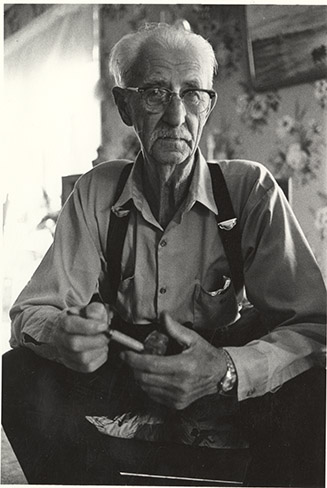
Elmer Flodin Interview #2, 1/10/1975
Description: Destruction of land by fertilizer and logging. Olson family threshing; Wells family. Dry Ridge cemetery. 1-10-75 1 hr
Date: 1975-01-10 Location: Potlatch; Dry Ridge
Subjects: African Americans; Native Americans; cemeteries; death; farming; logging; politics; threshing; timber
All right? And you know, Christ, if Dad knew about.
Sam Schrager: What's what was his story? The way the way that the way you heard it.
Elmer Flodin: You heard it. He wrote back in turn and told him that when he drove into Troy. What the heck? Well, you've got to be very prepared to take it here, to take for fresh. That's all right. I heard that when I was a kid.
Sam Schrager: I heard one other one he used to say. They asked him about the hills and they said, well, he'll he out there, isn't it? Because it's Platte, Minnesota. And he said, Well, but all the hills run down. So there's no trouble with that.
Elmer Flodin: Yeah. Got caught by. But he's insane coming back.
Sam Schrager: What about Magnusson and your Johann. Your Johann and Johansson? Those the two brothers. What do you remember about them? I heard they. They did a lot of things.
Elmer Flodin: A lot of you ended up here and or, you know, a target for. Well, lately ignored it. Well, I don't really. And until I do.
Sam Schrager: Do you remember them doing things together in the old days?
Elmer Flodin: or a thing you'd see. All I know is you see them in town together. And when they had a corncob pipe and one light pipe did one flare up and they both light the chamber. And as in the church you went to church to. So we've seen maturity and we shouldn't be.
Sam Schrager: I heard it.
Elmer Flodin: That's all I.
Sam Schrager: Know.
Elmer Flodin: I really got along. They were they were just a pair. But I went to one one the first one night he passed away and she showed me Churchill. You see that? Hold that hold under my the left or no church That used to be in a way I wanted you live addition were pulling in and around occurred. All right already known to infielder that Richard said they moved from there Detroit.
Sam Schrager: That was the church everybody went to.
Elmer Flodin: Go into it.
Sam Schrager: So he died in the middle of a ceremony.
Elmer Flodin: And his brother, he got here from lost. No wonder he thought I was. Magnus had died in church.
Sam Schrager: I've seen their graves right next to each other in the cemetery. I'd heard from Carl. He said that they. That they sold their place. You know, And then they were really sorry. Know, they. They went back to it almost every day to look at it. Well, I had to go back and see it. And finally they got it back again.
that's what he said.
Elmer Flodin: No, I didn't. I didn't know anything about that. I know that after Magnus died in the church and after he lived in the lady up right down here in the restroom and Sunday night, right next to Nazarene Church, already toward that old building, then that's where he was the last.
Sam Schrager: This guy that I said before was a you didn't know him. I think I said his name was Wild Bill. But what I heard is that his name was Wild Davy and that he wore buckskin jacket around the country a lot.
Elmer Flodin: But a I'll tell you, that was before my time. Or if I was, I guess I was born here, little kid. I don't even remember seeing very used to it. I heard about it.
Sam Schrager: Where did you hear that? There was a guy. You know.
Elmer Flodin: It is he. He lived. He had a dugout, something like that over mid head down here and back to Kendrick. And he had a dugout in Iraqi side. He end Bull Creek Canyon.
Sam Schrager: Do you hear? He had a lot of dogs?
Elmer Flodin: I don't know. A lot of dogs all the time.
Sam Schrager: Did you hear anything else about him? Like the what do you.
Elmer Flodin: Think you should have heard? You know, they said he'd always had a pint grow a tail and hog brains had always had a wide brimmed hat. But my half brother, he couldn't see them. He didn't know him at all. You know, I to do they're like some of the more of like all elephant medicine, if he will ever know.
I he always come over there when you come work the cage up there go on and stop do is come back from three or four days ago, you know, try to do a mosquito trade and then you always do one night.
Sam Schrager: Over there, you stay overnight and Boulder Creek.
Elmer Flodin: And over here in a matter of Boise, you know.
Sam Schrager: Archibald you mean Davey would always. You did. See, I.
Elmer Flodin: Hardly. I bet your car he sure.
Sam Schrager: He remembered a little bit about him. He told me he was the first guy that told me about it.
Elmer Flodin: Happened.
Sam Schrager: He said he he used to that. He said he was great. Hunter. While they did, he liked to shoot, shoot the wall.
Elmer Flodin: And now like a he drove your airplane should know about because he had to come by day when he went from Boulder Creek to Moscow.
Sam Schrager: Did you ever hear about this? There was a miner who lived on Boulder Creek or down around Park. I heard from a couple of people there was a sort of a foolish miner out there. He was a guy dug around and dug a lot of holes and didn't ever get anything. But you never heard of him.
Elmer Flodin: He No, no, I didn't know of anybody. Prospect No, in there.
Sam Schrager: What about Marshall Hays? What have you heard about him?
Elmer Flodin: Well, I'll tell you, there's another one that that happened. I wasn't fresh. I could have been over six years old when he got killed. Right.
Sam Schrager: Did did you hear. Well, I know I mean, a lot of these things like this, I mean, they're beyond what, Pete, what most people are old enough to remember. I mean, everybody that was old enough to 15 or better or 20 that time, they're mostly all dead. But I was wondering what you heard about what what happened in in every.
Elmer Flodin: Instance, I knew that he was copying Troy and then that Ashli, he shot in the right. I don't know what what happened between them. I don't know what she did. What about that you write about?
Sam Schrager: Did you hear.
Elmer Flodin: The one that Billy began not talking again? Make no sound from the dead.
Sam Schrager: You think so?
Elmer Flodin: Yeah, Because. Well, and again, he was in the livery barn during the shoot. He drove back and lived by. You should very limiting for your own shoulder. So and again, he told me that he was he was there at the time she one was up the street and one was in the living room and they had to be beside her in a corner hotel and and that was taken down here.
Bill was seven years old, and I never looked till well before Billy McGann died. He told you the bullet hole you see in the bullet hole, nauseated and itchiness. And there were seven bullet holes struck. Really? Try to be honest.
Sam Schrager: I really.
Elmer Flodin: Tried that. Hi.
Sam Schrager: Who was that? What was that about? I lied.
Elmer Flodin: Most.
Sam Schrager: I would see. I'd heard that he that Sly wanted to get his two sons after. After he got his. That his sons were going after Sly. And that's why the shoot you shoot down on the street.
Elmer Flodin: And I don't know what I No don't know what the trouble what It's not about that you know no Harding or before that he I know all well Chapter two Negro. Negro. He tried to arrest him there and he kept pushing right out of town. And he chased, including you talked to. He'll never want to go down in Dare to a William Taylor hurt on the back road that way.
Yeah. And kept you shoot at all. Shot or not you'll.
Sam Schrager: You'll.
Elmer Flodin: Get you in narrative and he hollered evacuation so it'd be my time next session next time you phone Troy in psychology all your children. Too bad I want that chance of that production because of pressure you figure out should you think.
Sam Schrager: Of Joe stood up to Joe stood up to.
Elmer Flodin: Him. He stood up to do it in tone there. But then after you go to his horse, you start out and he starts shooting at the president of it. And you know what this said? And it was just but I don't know, last all of all of it had to shoulder with bust English and Tommy if he'd shot your relative or he had it because you didn't head right to shoot it.
But when he's good enough to get out hoarsely, tone it down on our Hey, I think I read you okay might have been in you know, we're there right across her depression or how she's taking you know about cat how she today and all your usual down there or eight of them so I just want to show the ocean break Gibraltar I never heard Well my.
Sam Schrager: If you ever heard of Joe fighting anybody.
Elmer Flodin: Yeah it was later on Dewey I'll tell you who to pick on. Joe you two had a bunch of you see? Would Chuck Welsh American? I got to tell you, Chuck, which is a lot like Eugene, but, you know, you start an argument and. Chuck, you did it, but it was just consideration. Good at Anyway, that's white do.
Sam Schrager: That's really good.
Elmer Flodin: I would draw him. Christ you hear it? We hear like that. Always laugh at having gone by earlier. You would for the funny do it.
Sam Schrager: Did you ever meet Lou Wells, Joe's wife?
Elmer Flodin: I know. I seen her. I have there. He's going to back to Trump to injury she no lady but that's all. You don't even remember her. You know she's kind of skinny woman.
Sam Schrager: Or Arthur Burr. You know him? He told me once, he said, Joe used to like to say, I like my whiskey. But Lou, she likes her tobacco.
He said she used like Q to back.
Elmer Flodin: yeah. You know, to do that, you know, if.
Sam Schrager: In fact he said she used to spit it through the knothole of the, the old log cabin, she was that good.
Elmer Flodin: And you know, you know, I don't remember. I can't remember Chuck So he started get he was he was a very dark day and he enjoyed it here for like the one thing in the old.
Sam Schrager: West Joe He used to he used to freight to some didn't he. I heard he used to haul stuff he couldn't.
Elmer Flodin: He don't load. And I think they're very all right over here.
Sam Schrager: You told me he was a really strong man.
Elmer Flodin: Joe. You know, he was strong and Chuck was stronger.
Sam Schrager: Stronger than Joe.
Elmer Flodin: Was a man. I was right. You should keep him on landing, rolling back, getting him horses and roll back to love. Just good. Was it hard and completely handed for him?
Sam Schrager: This is Chuck.
Elmer Flodin: Now you know you up and wonder. Yeah, I know. He I heard about my read along worked at the camp 14 for Frank Gene and you found out I didn't big pine panel probably three feet and better into any good rolling logs and did break period baseball and I shot cholesterol actually when I was in power. You know I would.
Sam Schrager: thank you.
Elmer Flodin: I made Chuck did He was married and broke his first what Neil were doing that she married a Dan Ross Roth Jewish in his girlfriend. She died when he was first wife, something like that. Dear, you people should know a lot about them.
Sam Schrager: But, Joe, Ed, you know.
Elmer Flodin: And the whole family married a daughter. They get married, you call and her two children, they should know about them.
Sam Schrager: What about what you heard about? Volmer and. And the hard times in 93. Did you ever hear talk about Volmer, the guy that the town of Troy was name before they replaced it?
Elmer Flodin: First, tell me.
Sam Schrager: More about the man I heard he owned. He'd owned a lot of re got a lot of land in here during the war. A lot of places.
Elmer Flodin: He married. He married Hitler land. But they threw the first flour mill down at Driscoll. That's what it almost. We had 300 million company where you what you like and in aggregate I'm not sure with everything went down on the coast in Baker on like you see at that time a lot of my life I wasn't I wasn't even here.
Sam Schrager: never even thought of you.
Elmer Flodin: Know I was I was born in Baltimore. I know it was there. Baltimore when I was born. You were?
Sam Schrager: Well, I want to ask you about about the Thracian, too. And about what? You know, what that was like. You're telling me that that that the Olsens ran a real good thrash operation. And I know Carl. You know, he would never just tell me that they did a real good job because he wouldn't say that about himself. But you told me they done that.
They did do really good work. Is that right?
Elmer Flodin: You've been called an Oscar. Oscar Carter engineer and Oscar a shepherd and royalty. If we Green could be dressed in green. Asked you to do it, and I'll tell you one another one was Albert died Denmark, where Robert had passed away and they had to take an outfit together. It was to edit the track, move it actually Oscar the head of it.
But we like able to share it. It's not known if Hamlet could be the Oscar right now.
Sam Schrager: Paul When you say that about how it could be thrashed off trash, you mean if it was dry enough or what.
Elmer Flodin: If we'd dried enough and could be hold Oscars you machine to do it and you'd always check in this drawer behind to on the share for two season. Nothing's going to happen.
Sam Schrager: Did they work fast.
Elmer Flodin: They were chased after could set the machine so to take a lot of rain so everyone on the set instead she shot for sure that it would take it more or they take that you like. Yeah, I'd like an hour and read this out. Don't read this there. Well if I showed you that calendar, of course you know all them section in 10 hours tracking out there for for 1924 that was Oscar for Shepherd and Beauty guide and science in their office You know stable And then he trained him already so he will work with him every year I have Euler's ten separate but am aim here to attachment to Amory today.
Sam Schrager: What kind of a did you work on a cruise up here at all? I work with them.
Elmer Flodin: The only thing you know, they come around here. Well, they need to me about him. Department go together and capture the show.
Sam Schrager: Right.
Elmer Flodin: And that's how I work with him.
Sam Schrager: How did you work from Dawn till Dark or how did you. How did it go?
Elmer Flodin: they you know, they put in 12 hours. 12 hours, but they did bad, you know, so much. And they used to go like down into Yankee country. There you take an hour before breakfast and then try to the dark by the fourth. You know, But tell you what they used it before.
Sam Schrager: What did you tell me?
Elmer Flodin: Currently, no, the administration of well.
Sam Schrager: he did tell me that he thrashed and he tells about it. But all I'm saying is he wouldn't say we were good dressers, You know, he'd say, well, we thrash.
Elmer Flodin: But it that's one thing as a an Oscar to invest around the country is nobody could beat him but I don't care where you went to yarn or yarns universal 200 originally pretty good track into that. He couldn't come up tomorrow night could to my brother in law or Andrew Hopkins and he could come up to.
Sam Schrager: Do they does that mean that they get a lot more.
Elmer Flodin: Work. Yes in New York did it.
Sam Schrager: Were they much in demand then? Did people want him to.
Elmer Flodin: Use.
Sam Schrager: That as much as they can handle in.
Elmer Flodin: More more naked hand? Did you see they used to take a little barrage and right quick enough around Preston He ran around a little. And you all know, you start out there and and Andrew Hawkins and by the second machine so you went up there should end ultimately to make major entry into law and a big very and end up on dry creek and then they'd go up or owned by evil, come clean, run by pleasant.
You.
Sam Schrager: When did this when did this the stuff in what happened there to thrash and why did it go out.
Elmer Flodin: Well it started they started with these smaller machines. I get 28, 26 and easy to get tractors. And lots of people started dressing with no car. Well, Robert Bush car, a car or two car wash crew, they got rid of their steam engine, met and they bought him this monitor And John Deere case, cage gas, tractor. And his name would Albert Robert Robert a one of them do do after him And then they come back.
Sam Schrager: I mean Carl told me that Robert really knew an awful lot about a lot of things that he, Robert is the one in the family and he sort of singles out as being a guy that that studied and knew things, especially about mining, just about anything you'd ask him. He said he he'd have an answer.
Elmer Flodin: Yes. He took a course of university in mining, but when they come down to steam and machinery like tracking Oscar, it would take him. Do he Oscar and Oscar come straight back in years eventually for fear of passage. Been Alfred.
Sam Schrager: That's right. I've seen a picture of.
Elmer Flodin: Yeah, yeah. And then so he knew all about steam then and and he taught Carl to run the engine. And then he ran the separator. But at the end, taking your life, I would like to be tomorrow and Eve on my way here had administration. I said, Oscar and Carl had one Bob. And you all know Johnson had to take an outfit, Charlie Schmidt to do.
Sam Schrager: You know nothing about the Olson's? Is this Carl? It just makes me think that those guys would be as honest as a day is long. Any, you know, all the work they were doing. I mean, I would think that they'd really give people a lot for, you know, do the best they could. We put out a lot of effort.
Elmer Flodin: You know, out here. That's one thing I say. But Albert, he was kind of hotheaded. Robert He admitted he worked out in a machine. Robert connected, Put.
Sam Schrager: Mean, Crowden and.
Elmer Flodin: Welch try to go too much grain. you know, but I'm sure he took care of it. Robert Carter, Member What they had to say to him because Oscar like having to go to the I can't get up or told anybody would you would get in their but fortunately I or did.
Sam Schrager: Did you tell me that once at that Carl but Carl's mentioned to me too once he got really mad his teacher he quit school.
Elmer Flodin: And they met a guy. He.
Sam Schrager: He got what.
Elmer Flodin: He made a guy kick bad kids. You know him. No good mechanic or I hate to live here or the house is just decide.
Sam Schrager: This guy's father was a right guy.
Elmer Flodin: But.
Sam Schrager: But what? What did this guy newly did he get? Was he giving Carl a hard time or.
Elmer Flodin: No, I don't know. Is there an argument during school about Carl College temperament? We were. And they got an argument and then took a look at home. I was there when it happened.
Sam Schrager: That last time Carl went to school.
Elmer Flodin: And went to school. Guy to stop stopped moving here to make that a huge ring in Brooklyn doubleheader it guy with did Carl it you know to name told him that he was going guy to a stop in do you get him and it took it looks like you know God if he gets an argument he ingested an argument you know he figured he's he's going to win that's why and now Oscar was absolute you either way you could I don't think kind of argumentative Oscar.
Sam Schrager: Oscar He died young.
Elmer Flodin: Q died she would happen to Oscar after a name change your name rough sagebrush up there shaking in shape if you're going kid news endorsed it didn't know enough to afraid to go kidneys to I think it was cancer to kidney he died or you know seen him when he used to tell him.
Sam Schrager: Gritted teeth or were.
Elmer Flodin: Grazed. He should have been, you know, gunshot wound up there round here. Lots. Yeah. He liked to play cartwheels to him, play poker and rub me in different games to draw night the next daylight that time.
Sam Schrager: But this one, he was sick.
Elmer Flodin: You know.
Sam Schrager: Where where was he then? Was he still there? They had the whole place.
Elmer Flodin: Yes, the right. Of course. You know where Danny Mickens kids. Guys her? Well, yes. Across the road, back on the hill, there was a cab. And that's the place you car an Oscar or Oscar about it when you come out and even qualify him. And then he got married to then had to move in over there, were able to walk.
That's why he died on. And I.
Sam Schrager: Yeah because he would did he had it for a long time before he finally died of.
Elmer Flodin: Food. So you must've been three years, you know. So forget it. It was, you know, you put it on a girl and you do not get it. Hold. I agree with that. You would. No. When you died enjoying, you couldn't have been reduced thirties.
Sam Schrager: Do you remember that? The parents, their parents.
Elmer Flodin: Met Rachel? Yeah, Yeah. You see, in a neighborhood? Yeah. After the him you every 30.
Sam Schrager: Seems like they raised quite a family.
Elmer Flodin: They did away from children and family and I don't know which to boys or car name and I don't yet and and maybe a three years longer than you.
Sam Schrager: Do you do remember in with the father Mr. Olson he were you remember about his work and what he did out a.
Elmer Flodin: Lot He you were transitional for a toy lumber company. That's what he worked for. You know, he was just on woman, unfortunately.
Sam Schrager: Which one of his sons was he like? You remember? I mean, if you were going to say, was he like, which women the boys took after him.
Elmer Flodin: To more or No.
Sam Schrager: I'm just trying to to know a little what what, what he was like.
Elmer Flodin: Alton, he was a good natured guy, full of fun. We would make New Yorker. Alton. He wouldn't like her or Albert or. And you have to know, I don't know of any of the boys would really actually always avoid actual and Oscar you should be better focused on your family.
Sam Schrager: Or or you know any other thing I want to ask you about too was about this the way that the farming is changing. You talk to me about some before and I really got the idea that that I remember that the way you see it, it's really grown in the land, the way they're farmed. Now, why.
Elmer Flodin: They all have one thing you can take these nitrate you and put that little pellet in the ground where we use cherry flour and at over probably red clover. That high good enough this sort of or you know when you finish oils you could walk you had jumped their agreement so I don't know. Yeah I read I read poverty that's what will also tell you too we raised some good wheat crop and red color ground if they is no longer.
Sam Schrager: Run or would you get the same kind of yield.
Elmer Flodin: Or here? Without a doubt. I mean, I received a bushel wheat on it and and we didn't have no gains. We got no we had different kinds of wheat. 44 and God it was a ministry into wheat but we never had no grain. If we had against wheat, we could have had our exposure wheat to.
Sam Schrager: Well, now when you see.
Elmer Flodin: Out here you see no way to plow. You don't see different humus drinking around.
Sam Schrager: The humus in the ground. Yeah.
Elmer Flodin: You don't see that anymore. After nitrate we use little string here. It's like webs where you plowed know.
Sam Schrager: You mean after you plowed, you see that you.
Elmer Flodin: Could see that you grew and you're proud going to see it, but you don't see that. I think that that's your set your life you if I don't know if you'll help me in that ground. Of course, we didn't write like we do now, but they grow and turn up like a nice garden. I mean.
Sam Schrager: You mean when you're.
Elmer Flodin: Wheat flour producing clover, you're like, No, you take and we don't know. And here we are. You go down 12 inches and look what you're turning up at the hard drive location. You hadn't washed off. We had good, rich water right down. I walked in for up to here. They had this high.
Sam Schrager: Up in soil up to halfway up to your knee.
Elmer Flodin: Fall and a foot burner or we plowed, we brought up to 14. I didn't know that. Or you know they say Shannon time. I wish I didn't really know. It would be simple to say.
Sam Schrager: That it was good soil. Clear it down.
Elmer Flodin: And I can show you spots like around U.S. south side you see earlier ground that occurred down there and over across the field for over a rock. And we could plow 14 inch deep and never even know the visual off there.
Sam Schrager: What is it? What happened to the soil? We're washed up.
Elmer Flodin: And then found down to heel all the time, blown it off.
Sam Schrager: Portion of the earth and washed off because it hasn't.
Elmer Flodin: It's going to take you years, keep it plowed downhill. Every time you plow six meters, say no, you plow 16 inches wide and eight inches deep. Well, you have turn. It will completely over. You don't say definition, all right. You know, that can make it. And on the side of that problem, go out there 20 inches. Well it makes it insurable a year after you've gone down off the hill, that you won't get it in time.
Need.
Sam Schrager: Well, how did you rotated? Did you have a first grow a crop and then grow clover or fallow it, or how did you do it?
Elmer Flodin: Well, we'd plow under cover and then pretending to fall and then go backward. Piece and barley rotated for a little bit. And in the rotated or maybe back on base, you. So they stays drier inside. And then after I got my knee for in 49 and I got a hold on these big chisels them through using probably heating them, there's a real chance to really call them high beams 3 to 3.
But I had three of them and I went down 18 inches and broke up bottom and said, Hilliard said when he ran to my place, didn't want to quit in 62. Entirely different town here and on his head and it just.
Sam Schrager: What was the difference.
Elmer Flodin: Probably, you know and you could see four years and of course you could know for years. You could see where that usually every time you see a crack longer in the bottom of your furrow. And I went on my heels initially, so couldn't wash it, had to run right into it.
Sam Schrager: You sort of contoured.
Elmer Flodin: It pretty good never to get in. And it would it could run if I had it corner right over my feet over here, like before connector to get good up far enough so I could go around the whole, around. And I done it every third you.
Sam Schrager: Every third year. You chiseled it. Yeah.
Elmer Flodin: I every third year a telephone conversation with to this place here are negative anyhow for demolition. Scheduled three times.
Sam Schrager: Do you think it helped that helped hold the soil? Besides besides making it easier to plow and chisel.
Elmer Flodin: Eventually cut that water went right down here, crane down to a replaced It couldn't go like you close eight inches. No, I'd say do it now. What? It comes just did what you call it. Plow sold in the run here and then it gets a afraid water and you take that good would it your table. It couldn't do that but it shifted coal and then we plowed ended over.
You had all of that there to hold it. Did you believe that this.
Sam Schrager: When you when did they start with this fertilizing the kind they're doing now?
Elmer Flodin: When they started this, we didn't use it here till in the in the fifties. Are you have they to they started with it down here a lot of water before because Fred weeds and he used to find this place to it all fell into place and he had a friend down there schoolmate and he'd been using it and he tried three different years to take over on that nitrate ground and could get your ammunition standing in the way to do that.
Family told him. He said, You use that. He says you can do it for a reason where you can buffalo your entire life because the end of the way that takes everything. There is a dish on the bottom. All you use is that pellet don't or he when it first came out I belong to it all conservation said 1930 and we had a meeting up here at Hopkins is the news many reached out from Kenrick and George we began to see were there and then it all, all of us did well, he says.
Just like you get shaky shot or you wash off after it naturally. And that's what's going to happen to you. Nitrate did that.
Sam Schrager: They were telling you not to use it.
Elmer Flodin: Then you were against the gas nitrate. Got him. He used to come up here ever or go through country. He'd always jump into.
Sam Schrager: So what's his name?
Elmer Flodin: Many.
Sam Schrager: Many and stuff.
Elmer Flodin: He lives right across from the Kennedy School.
Sam Schrager: Is he? He's retired now.
Elmer Flodin: He's retired. He's old contribution man. The first damn good one to move. Manning was good.
Unknown: And we all.
Elmer Flodin: Tell.
Sam Schrager: You, you think it's the fertilizing that's really the goes you know.
Elmer Flodin: You take that news counter work that's what they taught us did not to play around and work it down to him Charity contour seed control Yeah that's one take that that's what they were for and you see a lot of that going on to know people are getting more careful about their seeding.
Sam Schrager: You think it like your fields here in a lot worse shape now than they were when you were.
Elmer Flodin: You played out from that nitrate you didn't play don't.
Sam Schrager: Can you see it.
Elmer Flodin: You can tell to play how to grow more. Sure was doing it hard. We aren't getting harder and you take and go out All right let's go out on all random acreage out that way and go out into the hidden hills. You have a chance to of that ground. You can find it just like Pelham, just like it was gravel that would actually start to get just played out yesterday.
Even with your group there with Jack and you hear and after screwing up my left that now there was a fellow by the name of Williams. He come from Kansas and he was here in Moscow for seven years and he selling combined for Farmer and he went back there and he commuted for he said there was just a plot through town for dead people to move to Alaska home, but it couldn't reach a thing.
You can't even make grass resign and stand with you and you're doing his uncle and auntie died in eastern Montana. He went into western Minnesota and he said, but the same thing over there. But I can you can tell you about that to me, that showed what was firmly in the air. Well, you see, you've heard and read now about what happened in Africa after you took all that timber.
And there folio where that people are striving, they can't reach and they're not happy. I'm not going to talk to vegetation or plantation.
Sam Schrager: Do it. By the way, do you think that that that's why they, the creeks don't run here much anymore like they used? Is it because we cut the timber off the hill?
Elmer Flodin: Absolutely. Absolutely. This creek down here, Great creek. I could go down here and fish in a nice stream in July and August. It was running water here too. You come from springs in that have been cleaned up in White Pine initially you can say even Bear Creek back was a good stream. Come clean back from Sand Mountain and make my and that was all Tim Snow later telling you I know what you you got know when it goes it all goes at one time.
Want to get one thing in Why I don't care how deep the snow fall Get out bring tolls and rain and snow and your original title to fight and not be defeated. Yes, I remember the name. No work down here. I I've seen the times, you know August when Bear Creek would be its weather cottage room here that grapefruit down here generally.
Sam Schrager: That's a different that's hard for me to you know I mean I can see it what you're saying that's so hard to imagine it having never seen it myself.
Elmer Flodin: Have you ever seen it? You wouldn't believe it. You wouldn't believe it. Different to digital so that.
Sam Schrager: When when did that start to happen? Only the creek start to go down.
Elmer Flodin: That's that started after did load of at Bear Creek after it logged off all through Bear Creek all the way from below aimlessly and cleaned up to make a mountain and then log everything up here, clean up to the most amount, you know, and decide.
Sam Schrager: You think it'll change again if the timber grows back?
Elmer Flodin: What are you going to go back to? Where you belong with these cartridge not left as a result, Have you ever been on to each fork? Part vegetable?
Sam Schrager: Well, I don't think.
Elmer Flodin: So. You go up there and see what's left here, which I sent you. Now they loved it. Three time, three or four times. And a shovel that they took down. There is just one guilders. Yes, Mayor. And he was killed. What they didn't take, they knocked over to catch and get in logs. It's a All right.
Sam Schrager: Look at I've seen I've seen that kind of stuff. I've seen it. I've seen it up on near Bald Mountain where we had I was a lookout.
Elmer Flodin: Yeah. And you take the same road, you go up to deprivation it, go east or train to the North Fork. You committed any after, not go clean down south to declare what you have to change the machine there quite country back if you lose it. Yes. One little spot there on a yes if you leave this back and park their little standing timber in white pines about 90 dirty, but they belong there pretty quick.
They had to get nothing, you know.
Sam Schrager: But why? Why do you think it did all that happened? I mean do you think they just did were ignorant of it or they didn't care or.
Elmer Flodin: What what part but just wandered all along? Shake, get off here and their love and now like with them catch you know you'd think about whoever you make a skid you would go down well you hook on to a tree here you used to go up wherever you walk right down to detail exactly the same that it's all ahead of you.
You have that right now.
Sam Schrager: When did they start logging on Bear Creek and all the way up to the end?
Elmer Flodin: It got here when Partridge came over that it was 1917. You know, down here, it's going back some pretty good. But then that was half log that was different. You didn't run to the timber. You have a skidding road and breakfast in the afternoon and that all day and country Burton in he load it with horses and is sure that your standard white pioneers made much of it do or middle creek instead but you take down go back in what you starting with these big cats you don't see much left and them trees are standing they can't take the wind, but they don't like to turn back.
Now they are starting to die.
Sam Schrager: Well, what's going on? It sounds like it sounds like they they're ruining the country.
Elmer Flodin: They're in our heyday to blame the state and the federal government. Why did they allow that to be happening on their land, their partners take over, be demolished. Why? Why did they make them be careful about the logging? Now you hear about being held canyon. Do you make them do it with helicopter guys? You don't want to tear off the timber, but they should have made them be more careful with their catch not to run down the little trees that did it anyway, I guess.
Sam Schrager: But you know, you got to you got the first the woods and then the farms too. It sounds like the soil. Soil is going to hell, too. And, you know, and you, you run the farms and you ruined the you ruined it or what have you got left?
Elmer Flodin: You ruined the timber for a watershed. And after that was your farming with it was taken over there. No, no you don't. You don't see much good summer range that we used to have. We have no moisture for it. Like last year. Dry and hot to good. That was in when I was a kid and to many, many years had grew, although you didn't see it, you didn't see did like that We had a thunderstorm.
Of course, we never know periods like we've been having lately get worse every year. Now you take our to last year you know how were you'd been around for two years. Three years. All right you see not been dry in half and that I'll go back I'll go back at least ten years or less. And it's a difference group.
Sam Schrager: Well, how was it 50 years ago in the summer? Was it was it you know, it wasn't it wasn't so dry and hot as it is now.
Elmer Flodin: Way different. Would easily like one of each. And, you know, you could always look for me, you know, and capture the water and have good range on major our major under 40 you lay all was your category never missed.
Sam Schrager: Well what is I mean do you think that there that there has something to do not having rain has got something to do with cutting the timber. Is that it.
Elmer Flodin: Or cutting the timber down. Well you figured in all would like that tell you about up here. No. Well up in White Pine mask amount you can find an order in the north of Rangoon. Well that was the elephant in the stream moisture near now. And there is no snow up there. There's nothing to get from in you money.
Sam Schrager: But you really think they have like the moisture in the air itself helps cause the rain come.
Elmer Flodin: Pure and the streams not like you take that tree, the one down here, but will kill all one spring valley dry pick back. We can all potash, all of them are running water. You see the sun has him to draw moisture from one of the three automobiles Now don't have it you still not right people from dry last year.
Sam Schrager: Sure did.
Elmer Flodin: All but what were feeding from the spring down here from just bring it down wash the water.
Sam Schrager: You think that it's you know, I was thinking that because our hills aren't as high, let's say they're you know what? They're only 4000 feet, you know, and round they're as warm as the ones are south of here, like off the Clearwater, south of Clearwater, where you get 8000 thousand feet. I suppose that'd make a big difference, too.
We don't have as much. It gets dry earlier around here because our hills are a lot lower. You don't have the snow staying late anyway, you know.
Elmer Flodin: But you take now you in there. No like after in June and July station well up and pick up an across the bay last lake. I know when we couldn't go in there last year you know kind of snowdrifts you know usually and as you move and my work out me and my work is much more next year surprise.
You know, if I see in Polish Creek don't you McKendrick and Margaret because.
Sam Schrager: You think going back to horse logging would be a good way to.
Elmer Flodin: Go, some way to be more careful in the woods, either dead or I with the cats. Not too. Yes, go on. Hogan Gidley. Yes. You could not get winch of to winch remote, which is probably going in never to get right to your small timber. How do you feel once when you have a chance to go up on each work, are able to go clean up there to the divide that leads into our formation and then also, I don't know how it will on a diamond road or to down to a board cabin used to be.
And you can just see for yourself here was like, you know.
Sam Schrager: You told me the Indians carried this country burned off. It seems like maybe they knew what they were doing out here.
Elmer Flodin: But I got a more wonder, agree with me that you need to America and I have the room. Where did you get this ship? A great big white paint up to six feet across here and all these big pine timber first here, taking care of the timber. No infestation. No. Now you can't rule tree like that. You'll die before it gets big.
Sam Schrager: And now So probably the burning kept the disease out here.
Elmer Flodin: You betcha. And it was like underbrush or small trees saying scrub in underneath. There's all burnt off.
Sam Schrager: I wonder how they burned or when they burned.
Elmer Flodin: It burnt out in a way. Good, right? It had a bad fire.
Sam Schrager: With they said, let's say wood, they said down a ridge and burned up or had.
Elmer Flodin: Already burned the whole country. It burned the whole country is country dead, but it went all the way from here. Clean up to bulldoze in the road and wash your squared off. I never got in a big fire. Did we just have another kind of get us?
Sam Schrager: Yeah. I wonder if there is any way to figure out when they stop burning. I mean, what about when they stopped? I suppose it was when your father came. They they were still burning. So it probably stopped some not too long after.
Elmer Flodin: Well, after the whole sheriff got in here, the Indians got over in reservation. That. That stopped it. Forgive me if you do them on the reservation and it wasn't prevalent. You. So it started quite a while back. Story continues.
Sam Schrager: And what about the farming? What could you do about it? You stopped using fertilizer. Now could you bring the soil back?
Elmer Flodin: Well, you'd have to go back to. Yes, I've done report. We're talking here today. Do we put lies, get, you know, get high priced? You going to have a back to grow water right now? I had to do something. You can't really find a job.
Sam Schrager: Did you tell me once that you could see the the places where they're not or is not being farmed or you can see the color of the grass as being different.
Elmer Flodin: And you can you can tell you can tell a different time where we have a different place. You introduce a new if you had a place to go, a lot of here I'll take my two acre garden here again to field a good solid ground. Actually two different. I show you what I've got a good soil.
Sam Schrager: You know I've seen it.
Elmer Flodin: Worse it which. And you should destroy manure that build up to ground even if he had not and. And manure anything anymore. I don't know what you're doing. Maybe this is going to run together on me. If you do to the finger and take off your garden each year and put it into rain and plow under you reap is a good thing to break up to.
Sure, I see and read for it Oscar Hawkins and had seven acres up there and he's planted around eight inches deep and we took up a root that big at the bottom that was pulled out at the bottom so that much of what you can figure out which all 20 inch or so now that it opened up the bottom of your or you take down roots, whatever that big whenever that happened to be.
Sam Schrager: It's probably about two inches around him to it his diameter.
Elmer Flodin: Okay. Well let me let that get that take in the ground. Oscar had shed the 44 white when you started all that to fill up the soil. Rape, I'll tell you, is a good thing to build up which is anything during this time. I think.
Sam Schrager: They've all using that lately you.
Elmer Flodin: Know and it's it's a cheap to put it do it it crazy do us you know and Oscar he learned to partially complete since about $16 she can change maker to seed it.
Sam Schrager: And that's great he's great yeah.
Elmer Flodin: I sure will do you get over to tomorrow and you put that into for all you plant and if you to do an air to lay your ground over like you would with a lot of other alfalfa in it, you got a four week drone next year again you one.
Sam Schrager: The one other thing I want to ask you about was that the cemetery on Dry Ridge here. Now, I've heard I mean it's a beautiful.
Elmer Flodin: It is is supposed to be the nicest Jim to around the country but no no my butch folks when they bought a hotel down here, around the hotel down there, they went all in to see all my screen are over there, too. And you're grateful to be buried. That's what you folks that was. Appreciate because he also I'll come to give it credit.
Sam Schrager: To do you know about when that cemetery got going was it it was it there when you were a little kid.
Elmer Flodin: Who used to go in the 1800 you go down or I don't know when the first ones were buried there every day. And graves have dirty nobody knows anything about last year and again Monday. But nowadays to next year, the folks up there, Eddie sort got to work and use all that light to catch on from when his father died.
Dad told him not to take that out because Mr. and Mrs. Miller with the wanted this place saying we appreciate what you're getting. So. And she died. She had dead to take care of their loss because the boy went back east. So we did it right? Well, I did too last year and into grass. And they start digging down there.
MARSH and more. Charlie daughter Do you take my mom and my letter to then get hit by lightning? ANDERSON How.
Sam Schrager: Come they didn't how how come they didn't know that there's somebody going there.
Elmer Flodin: Should be in should be in the book. Everybody is marked in that book with this up there, I share Lost friends. They're going to find themselves finding a cache and boxes down there. After a few years.
Sam Schrager: You will now I've heard that it's it's that it's hard to to dig in the ground there too is that term.
Elmer Flodin: Or you under towards the last last of that greater you take a sharpie and drive it as hard as you can you know stick on it and you get very much.
Sam Schrager: Is this all year round? It's hard to.
Elmer Flodin: Hit that we all the time. It's a blue hard fan.
Sam Schrager: Or.
Elmer Flodin: A blinker. He does pretty good with that degree. He does pretty good again. But when you go to do it by hand and boy or man, you will continue to.
Sam Schrager: Form in an old age if.
Elmer Flodin: They're own to.
Sam Schrager: And who have you have you done graves up there?
Elmer Flodin: Yeah, that's a lot of the houses and what we used to do called his. We were just there to set it all under 201 over here. I shoot a lot of our time You get a of probably that bigger. Yeah. It up and down through and in between you get break through to the.
Sam Schrager: You mean you use dynamite you know.
Elmer Flodin: You you can shoot the whole way it will shoot the whole big issue to hold your head. You go to work the rest of it but that gives the chance to pick against it. And you know, I know you have it because it's you know what they are a lot longer.
Sam Schrager: Yeah.
Elmer Flodin: Guess you have that that drive, that historic canyon right there and then you had to go with your hand because depending on the edge or to pick to work, I take this route.
Sam Schrager: In the.
Elmer Flodin: Way I always.
Sam Schrager: Is it choose it in the summer you can see where people are buried.
Elmer Flodin: Sometimes it not great of almost always up there. And I forget to jump over to my new buried it this is Petersen deputy inside the courtroom and then Mrs. Sandberg up here the mother and then it's Mrs. Crazy. You saw her face across the road and then right down there, across from my folks, it was just a green spotted with and a little better trailer in the center of your right and a middle of your driveway.
Which one? A gravel track on each side us. Shortly after we did you could tell that for me it's just shades of gray and the it so it must be a gas can we ultimately.
Sam Schrager: You see that is it you can see these other places in the in the cemetery too. Or just where it stays greener than a mile.
Elmer Flodin: On the other. I'll tell you all of that. Most of the time it's grass.
Sam Schrager: So you can't tell. No, you.
Elmer Flodin: Can't tell them anything. The only ones I could tell were simply.
Sam Schrager: The ones right in the road.
Elmer Flodin: And I guess you can see anyone in the cemetery look up through a sheet from 30 degrees down to get up for that. Very entertaining, you know, unless you don't know who is up there. And she might repeat that to you and start talking about that. You know, I know she didn't know anything about yesterday and it makes you mad to it.
Right. But I'm wearing a black dress.
Sam Schrager: What do you think it what do you think it is? It is that the birds, not people find some beautiful about the cemetery. I think it's beautiful, but I'm wondering why it's so. Is it the trees that are there? And it. It's just. Just something about it. It's lovely.
Elmer Flodin: Well, I'll tell you you take on record cemetery nowadays here like she does first put them all out right the right And so I've had some red up there. She did and took them all out. Yeah but like the bush Notre Dame we dug up got them now like bushes, you know, they put tombstones over here, all the people and, and the Underbank could have been one vanquish.
He took chances, you know.
Sam Schrager: What does that mean? Does that mean that he was better to bear to the people? Now.
Elmer Flodin: I'll say I'll say that for here now in Christ there is actually we had about ten years. I want more paper.
Sam Schrager: Okay, but. But I didn't get that. Would you really do think that the Frank and the Frank was that is been the best man had.
Elmer Flodin: To say Frank at their best when we had in Troy.
Sam Schrager: What about during that. The hard times in that in the deep depression was the back to back help people.
Elmer Flodin: yes that was only moment and might not be up to people you can find. How of you know what pressure so.
Sam Schrager: I guess I should get going.
Elmer Flodin: Or you think you ought to ask and you won't get very frank Rocky out here. You don't know a lot of people. Very.
Interview Index
Johanneson Brothers. Wild Davey. Holes in the hotel sign from shooting of Marshall Hays.
Joe Wells chased by Hays, was sorry he didn't have chance to kill Hays. Joe and Chuck Wells were very well liked. Chuck's strength in logging; he broke peavey handles.
The Olson brothers thrashing outfit did high quality work, the best in the country. Oscar's skill and his death. Combines end thrashing outfits. Carl quits school
Nitrate robs the soil. Rotating with red clover yields good crops.
Erosion of the deep, rich soil. Plowing fourteen inches down. Chiselling eighteen inches down once every three years kept moisture in the ground. Fertilizer comes in the fifties. Decline of land with fertilizing.
Cutting of timber ruined water flow in creeks. Timber won't grow back with cat logging methods. Potlatch logged just to get all the timber they could. Horse logging didn't damage the timber. State and federal governments are to be blamed for letting Potlatch get away with it. Reduction of summer range due to heat.
Indians took better care of country than we did. Indian burning of country was widespread - grass fires. Ways of improving soil now.
Dry Ridge Cemetery is beautiful. Outsiders choose to be buried there. Loss of record of burial of some people; a burial that hit another grave. It takes four men all day to dig through the hard soil; using dynamite to start digging. Seeing outline of graves in summer from gases.
Frank Brocke was best banker Troy ever had.