
April 16, 1942 entry Item Info
234
April 16 (Thursday) to 28
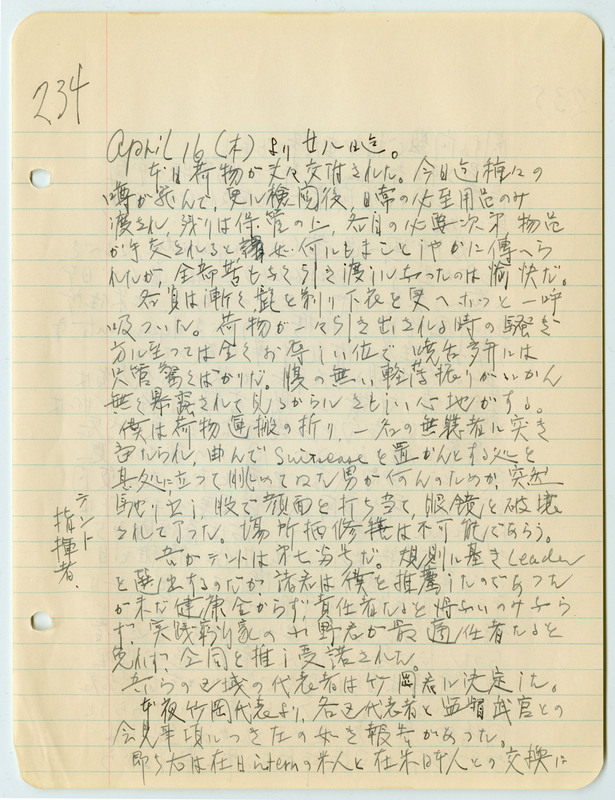
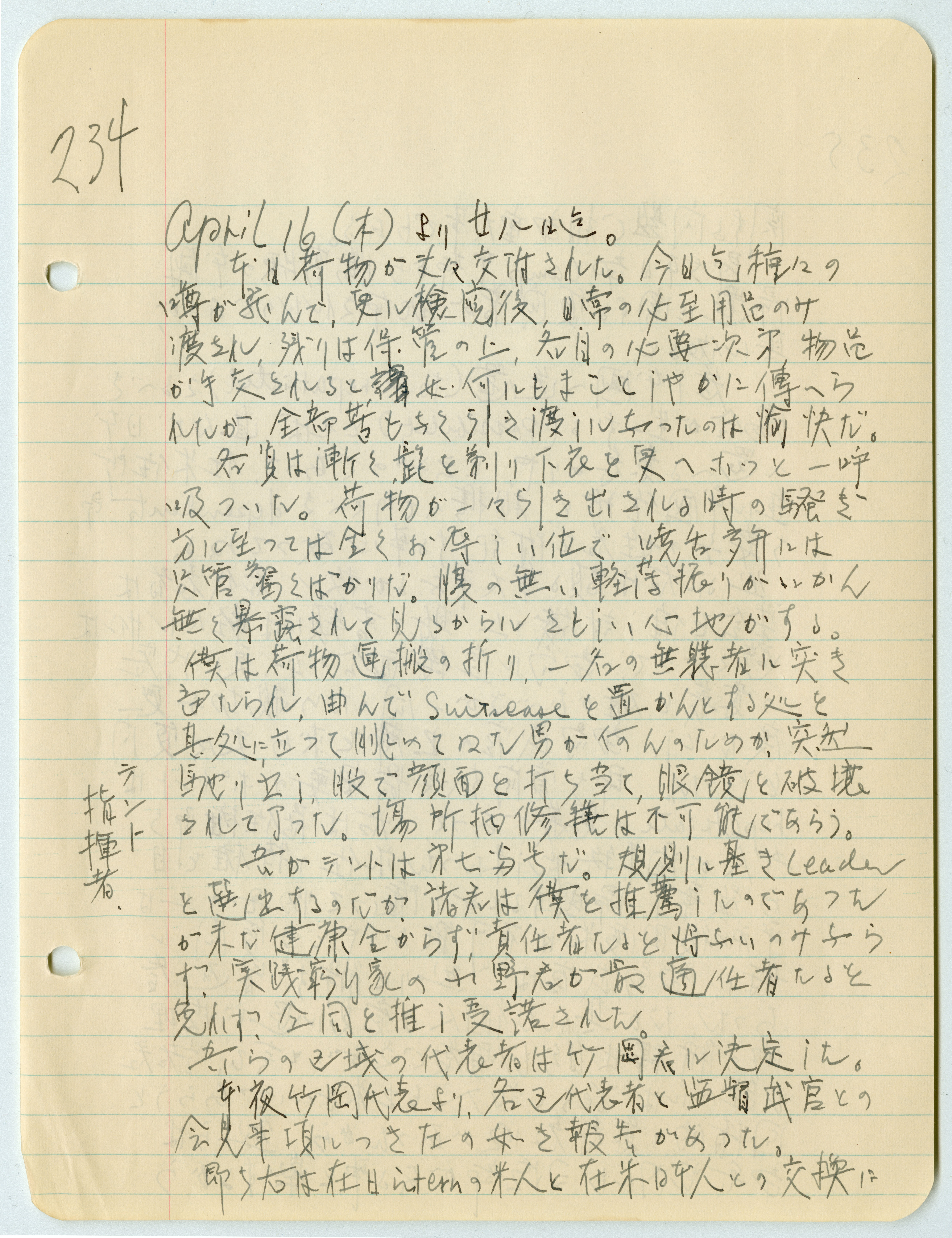
Our belongings were handed over to us today. Various rumors have been going around until today, including realistic ones like only basic daily items are to be handed over, and the rest of it will be kept and released based on individual needs. It is pleasant to have everything handed over without any problems.
Each of us finally shaved, changed our clothes and felt relieved. We were almost embarrassingly animated when our luggage was pulled out one after another, and we were surprisingly talkative. Our thoughtless and frivolous selves were openly revealed, and it just reflects poorly on us. I got bumped into by a rude guy while carrying my belongings and tried to put my suitcase down. A man who happened to be standing and watching there suddenly sprung out for some unknown reason, hit his face with his thigh and broke his glasses. I think it would be impossible to have then repaired considering where we are.
Our tent is the 7th one. We were choosing the leader as regulations require, and everyone recommended me to be the one. I am not yet in total health to fill the responsibilities. Practical Mr. Ono could not escape from being elected as the most fit to the position, and he was unanimously approved.
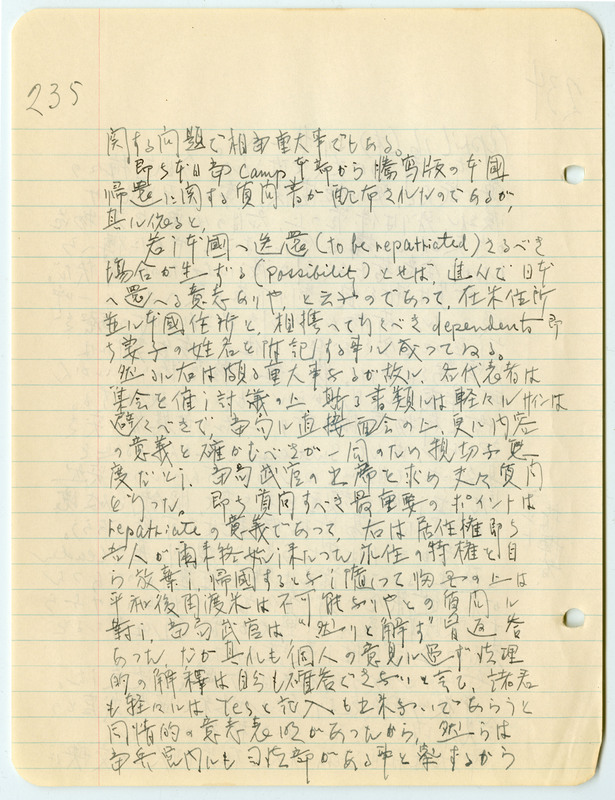
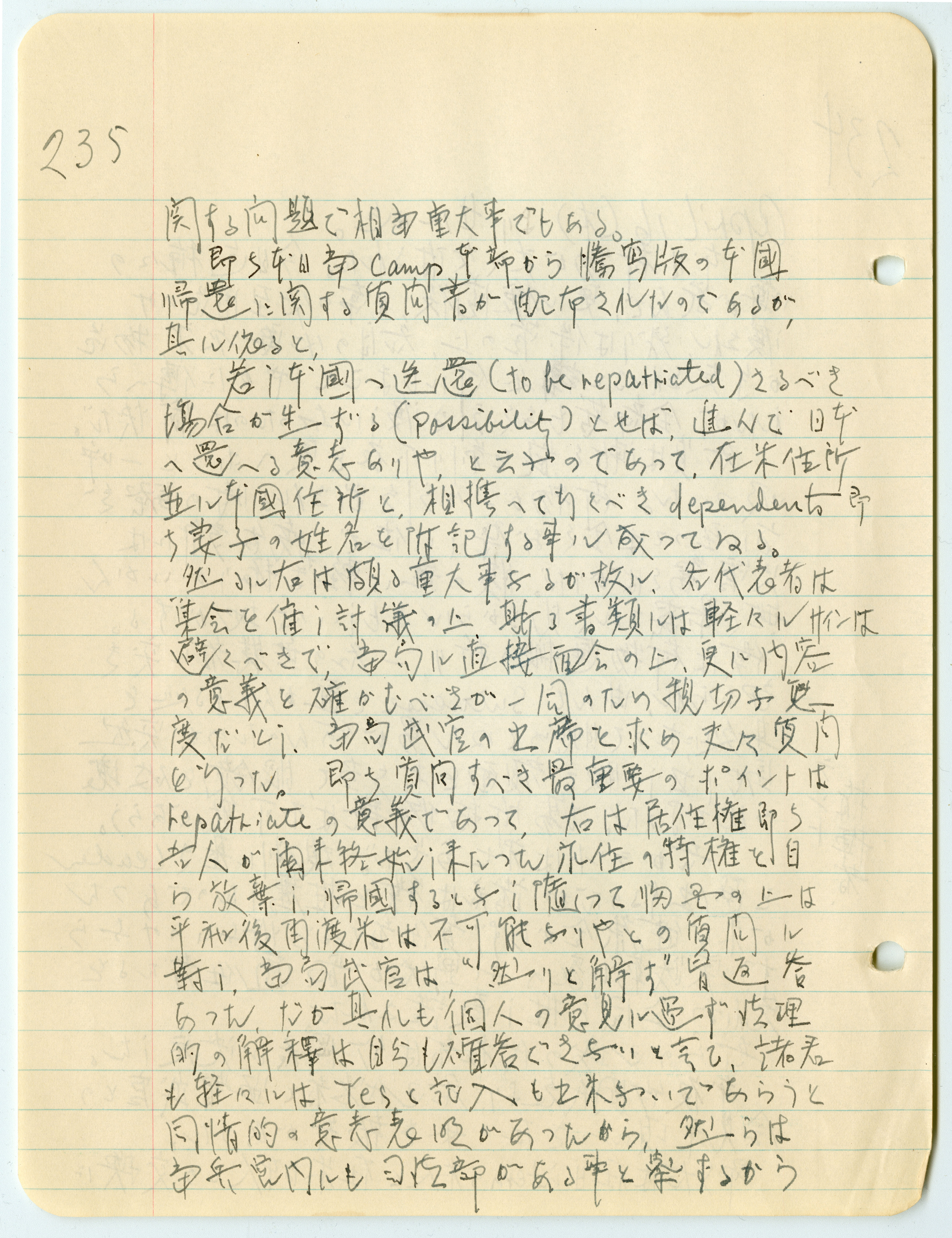
Mr. Takeoka was appointed as the representative of our area. Mr. Takeoka reported on the meeting held by the representatives of each section and the supervising officers as follows. It is regarding exchange programs between Americans in interns in Japan and Japanese residing in the U.S., which is significant. Printed questionnaires about going back to the home county will be distributed by the camp headquarters, and according to this, they are to find out if we would be interested in voluntarily going back to Japan if there is possibility to be repatriated. We are to required to fill out our U.S. address and the Japanese address, as well as names of dependents, our wives and children, who we will take back with us.
Therefore, this is an extremely important matter, and leaders from each tent should hold a meeting to discuss it. We should avoid signing such documents without paying attention to details, and we came to the conclusion that it would be most kind done by the leaders to directly meet with the authorities to understand the intention behind it, and we asked officers from the headquarters to attend a meeting with us and asked our questions. The most important matter we need to ask about is the meaning of repatriation. We asked if it would be impossible to come back to the U.S. when peacetime comes if we voluntarily give up our permanent residence status that we have been granted, and the answer given by the officers is “That is our understanding”. However, they also said that is just their personal interpretation, and they cannot offer legal interpretations for sure. They expressed their sympathy toward us and said they understand we would hesitate answering yes.
236
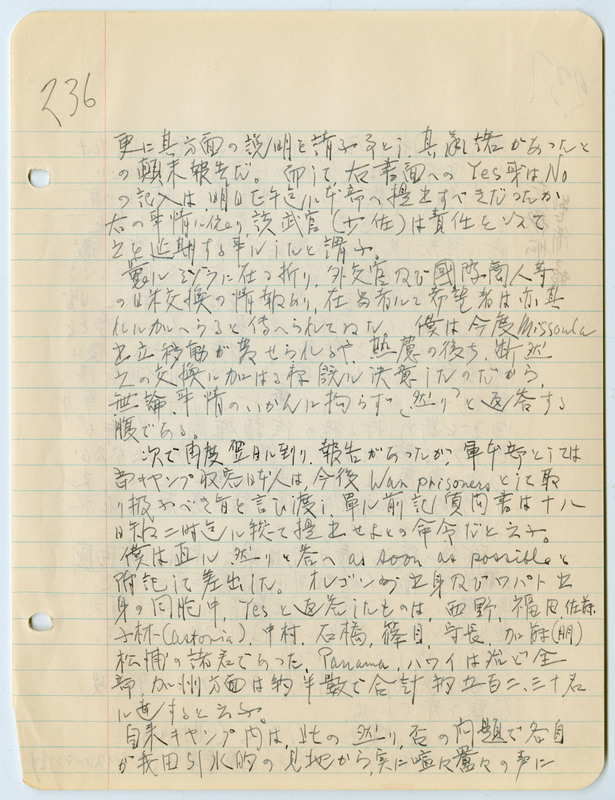
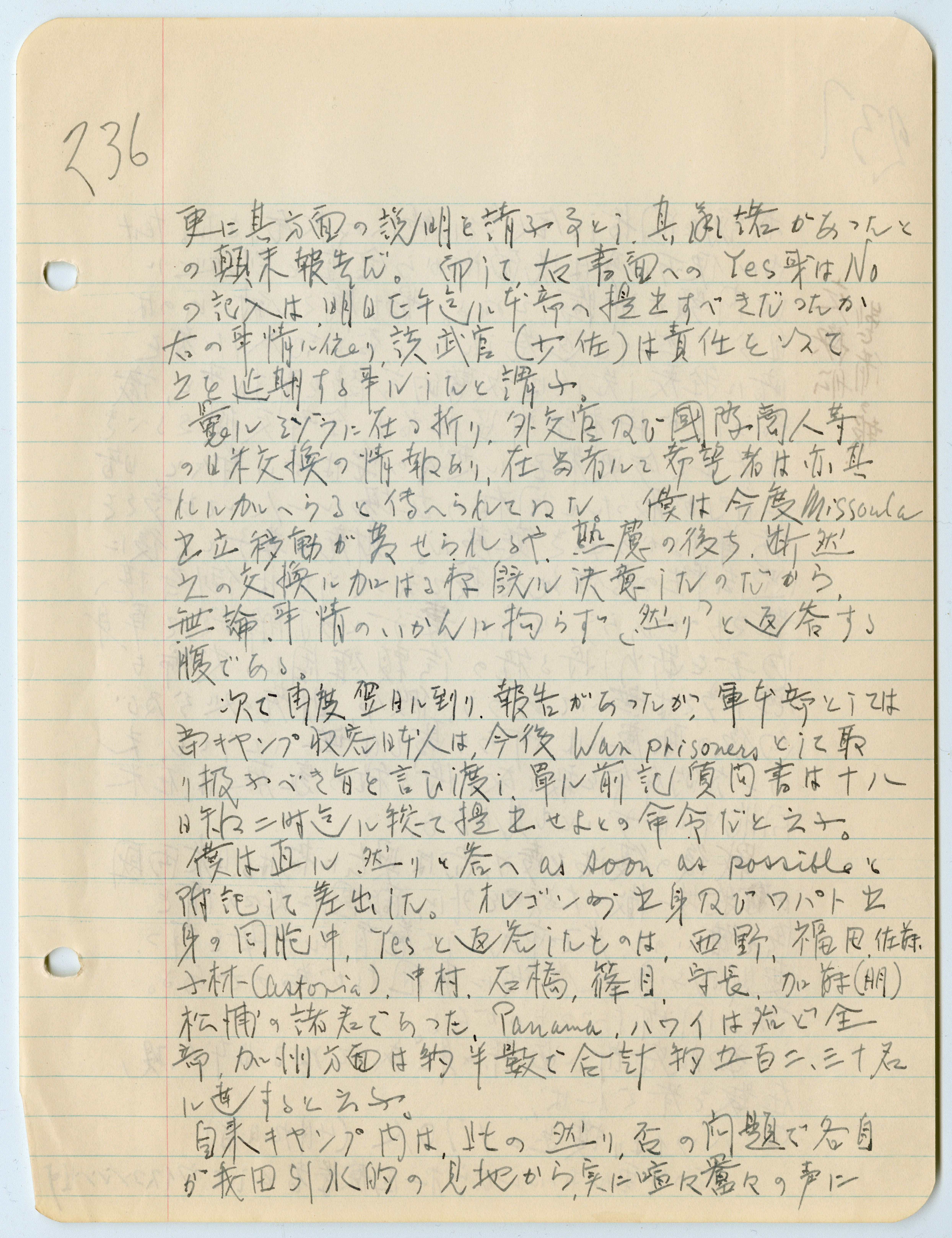
We assume the headquarters has a legal department and requested more information from the department, and it was reported that they agreed on it. We were told that the deadline to provide a yes or not answer to the questionnaire has been extended from the original deadline at noon tomorrow due to the situation, and the officers are to hold responsibility for the extension.
While we were in Missoula, we were told there is some information about exchange possibilities with diplomats and international merchants between the two countries and those who desire to go back could be added to the list . I have made up my mind right after the order to be moved from Missoula to be added to the list after careful consideration. I will of course answer yes no matter what.
Next on agenda is the last item, and it was reported that the military headquarters administration announced that the Japanese internees at the camp are to be treated as war prisoners and that they issued an order that the above mentioned questionnaire is due to be submitted by 2 p.m. on the 18th. I answered yes right away, added a note to say as soon as possible and submitted it. Nishino, Fukuda, Sato, Kobayashi (Astoria), Nakamaura, Ishibashi, Shinome, Morinaga, Kato (Akira), Matsuura are the ones who answered yes among the fellow citizens from Oregon and Wapato. There are a total of about 520 or 530 of us including almost all from Panama and Hawaii, and approximately half from California.
It is unbearably noisy in the camp now with this yes or no question as each of us is selfishly trying to gain higher ground and insisting on his own opinion on this issue.
237
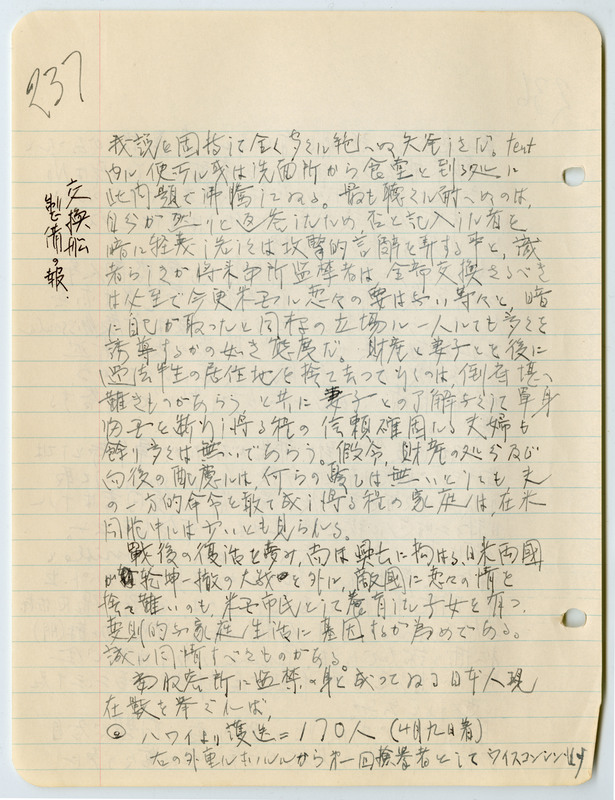
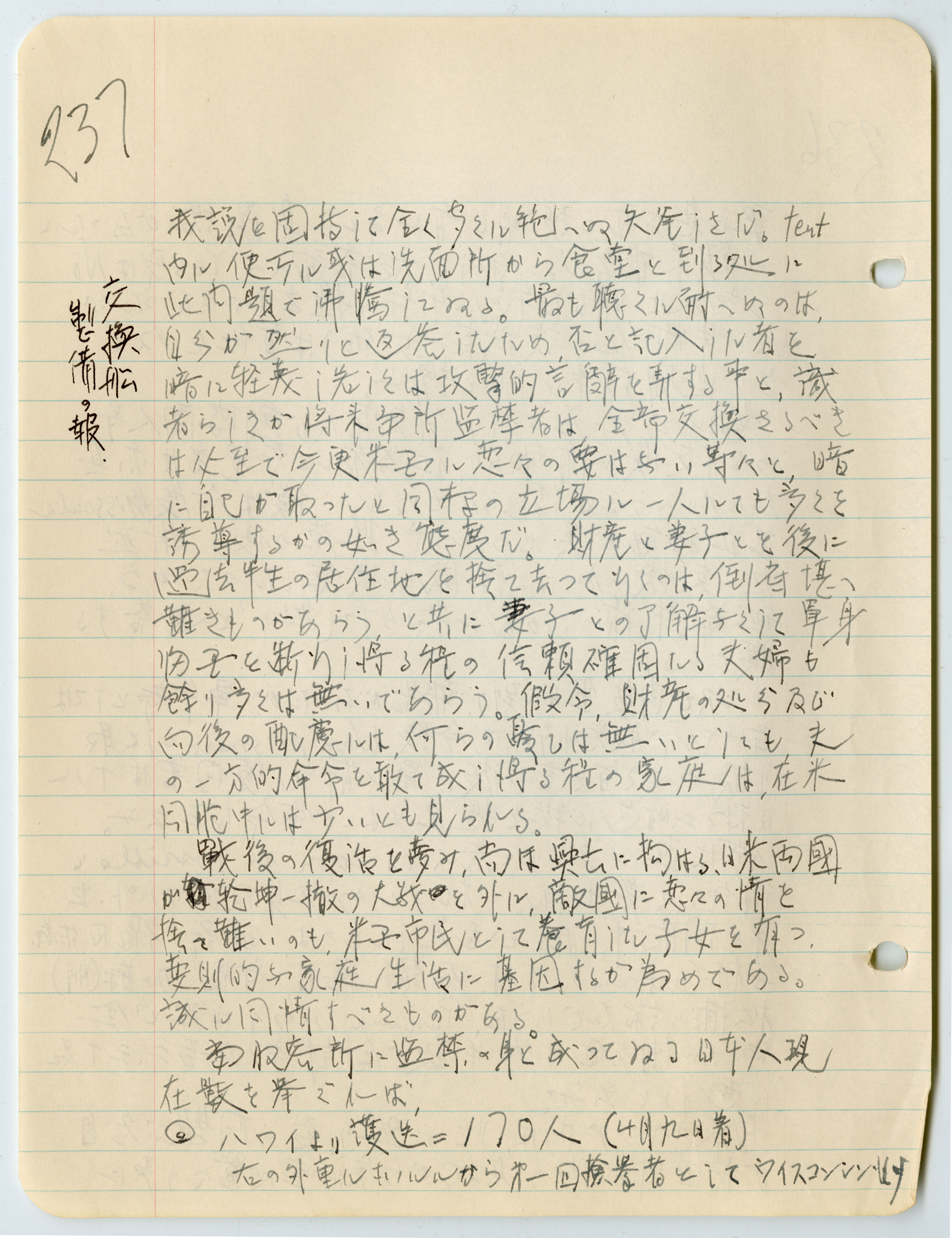
Heated arguments about this matter are seen in the tents, at the latrines and the space between the water sink area and the mess hall. The most unbearable thing to overhear is indirectly insulting statements made by those who answered yes aimed at those who answered no, and also those who seem to be well informed secretly trying to convince as many people as possible to give the same answer yes as they did. They are telling others that all internees in this camp are doomed to be exchanged in the future, and there is no use to stick to the U.S. any longer. It must be truly difficult to leave the wife, children and property behind and abandon the residence for the last half of the life. At the same time, I don’t think there are a lot of married couples with such strong trust built between them that the husband can go ahead and go back to the homeland by himself upon the wife and children’s approval. Even if someone does not have anything to be concerned about what to do with the property or what will happen in the future, there are few families among the fellow Japanese living in the U.S. where the husband can make everyone follow his unilateral order.
They are dreaming of rebuilding their life after the war and cannot abandon the enemy nation despite the past violent war between Japan and the U.S. because they have raised their children as a U.S. citizen in their families. I cannot help feeling sympathetic toward them.
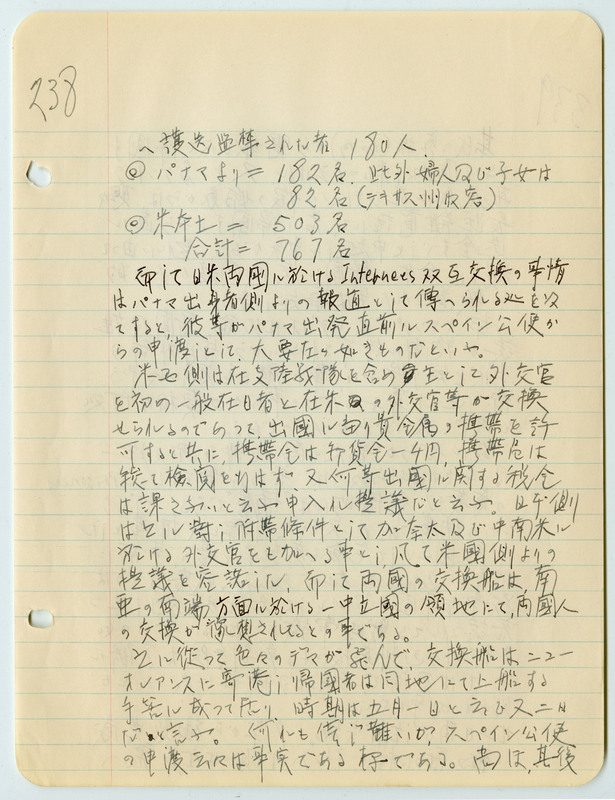
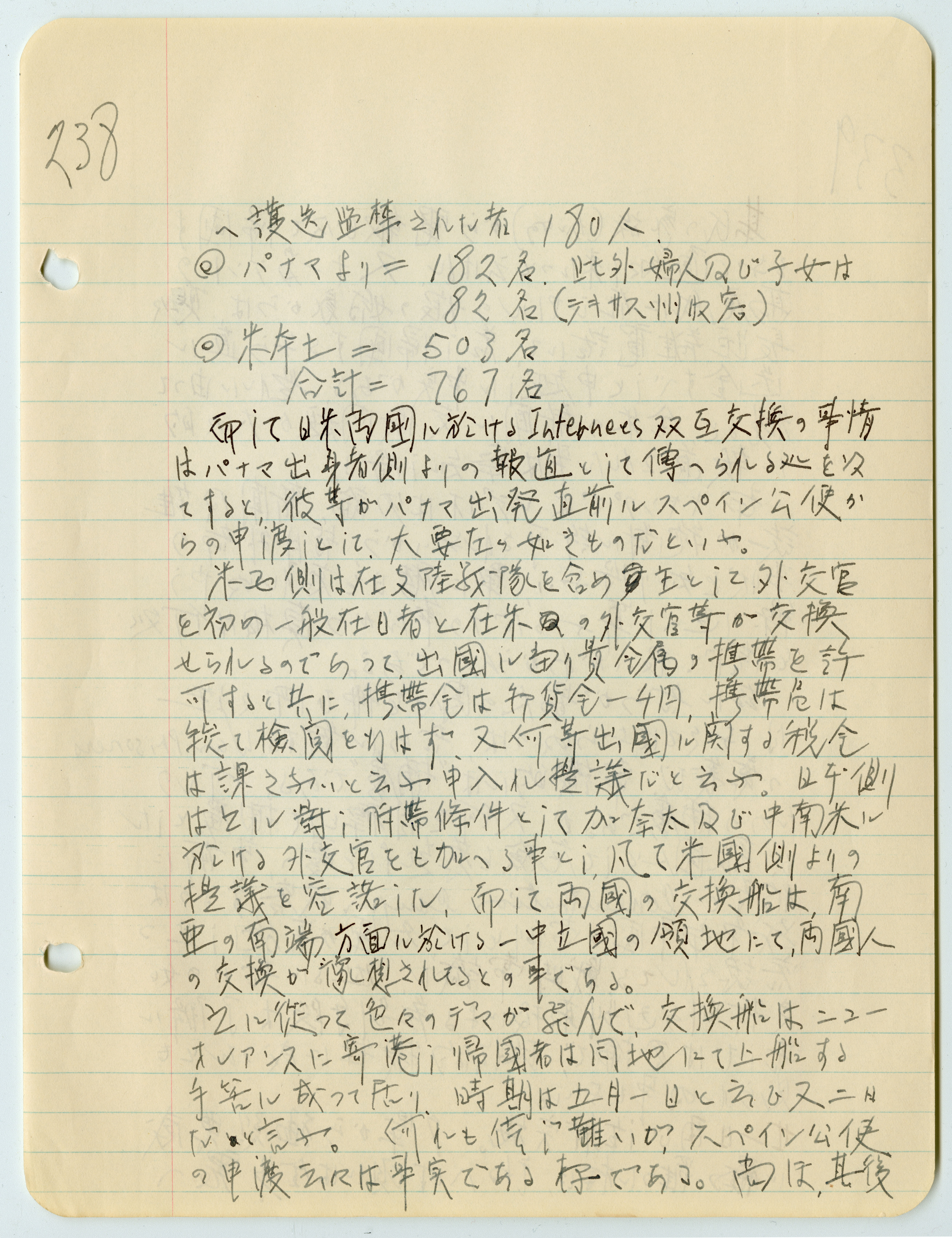
The numbers of interned Japanese in this camp are as follows:
Sent by guards from Hawaii 170 (arrived on April 9th)
Besides the above, the first round of people arrested in Honolulu and sent by guards from Wisconsin 180
From Panama 182
Women and children besides the above 82 (interned in Texas)
From the U.S. mainland 503
Total 767
According to a report from the Panama people side, they received a notice from the Consul general of Spain right before the departed from Panama, and the summary of it is as follows.
The U.S. proposed to exchange diplomats and civilians living in Japan and arn soldiers in China, and diplomats and others living in the U.S. They are to be allowed to take valuables with them when they leave the country as well as one thousand yen. It was also proposed that their belongings not be inspected and no tariff is to be imposed when they leave. The Japanese government counter offered an additional request to include the diplomats in Canada and the central and south America and accepted the proposal. We were told that it is expected our exchange boats are to exchange people from both countries in a politically neutral territory somewhere at the south end of South Asia.
There have been numerous rumors going around, and some are saying that the exchange boat is scheduled to stop at New Orleans, that those who are going back are to embark there, and the departure will take place on May 1st or 2nd. Any of them are hard to trust, but it seems to be the fact that the Consul general of Spain sent a notice and so on.
339
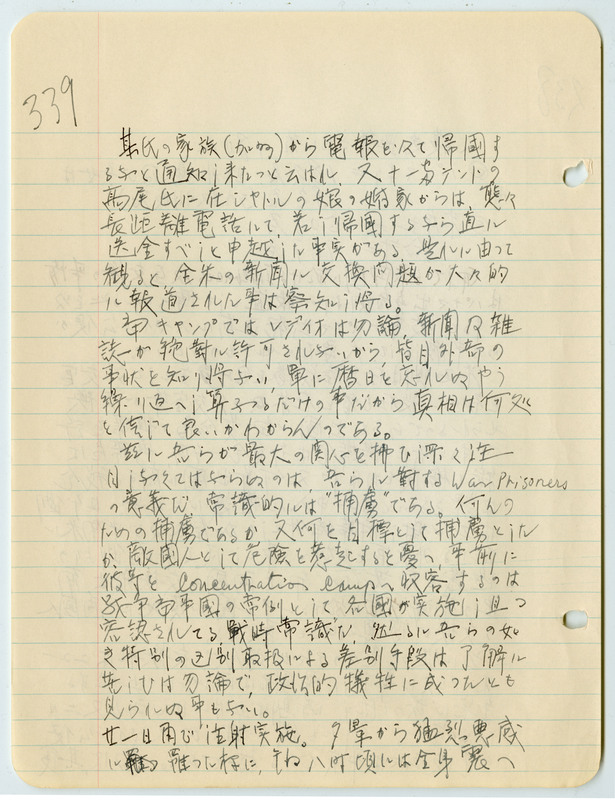
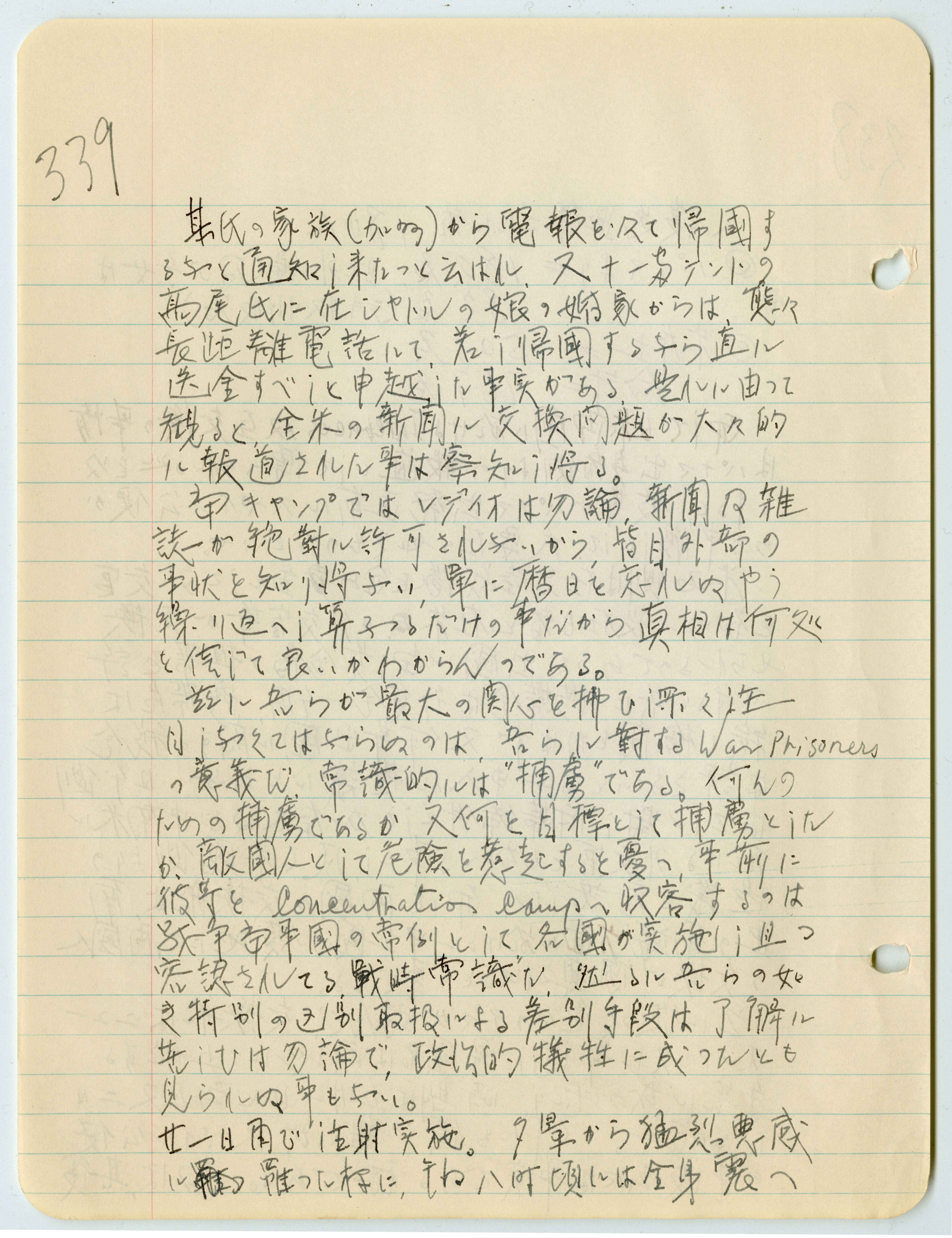
Later on, someone (California) received a telegram from his family to tell him not to go back to Japan. It is also a fact that Mr. Takao in the 11th tent received a long-distance telephone call from the family of the husband of his daughter, and they asked him to send money right away if he decided to go back. Judging from those, we can imagine that exchange boat issues are largely reported in newspapers all over the U.S.
Not only radios but any newspapers or magazines are permitted in this camp, and we are completely unable to get information from the outside world. We are just counting days to keep up with a calendar and have no means to sort out what to believe.
Moreover, the issue we need to pay the most attention and be very careful about is the definition of war prisoners. The basic meaning is war prisoner, but what are we prisoners for, and what is their purpose for them to keep us as war prisoners? It is common to be cautious about possible danger brought by enemy aliens, and it is also commonly done by a nation in a war, and approved by others, to incarcerate them in a preventional matter in concentration camps. However, it is of course hard to understand why this discriminatory method is taken against us by designating special areas, and it could be viewed that we are victimized by political reasons.
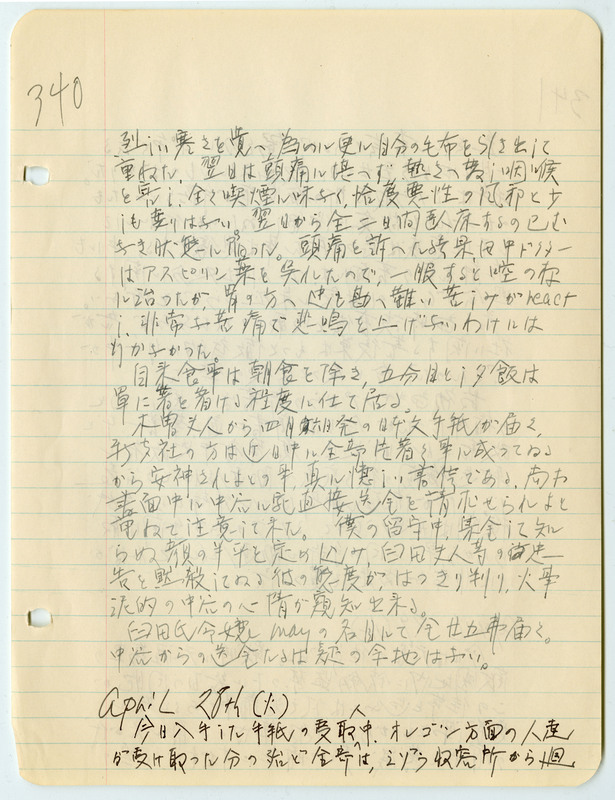
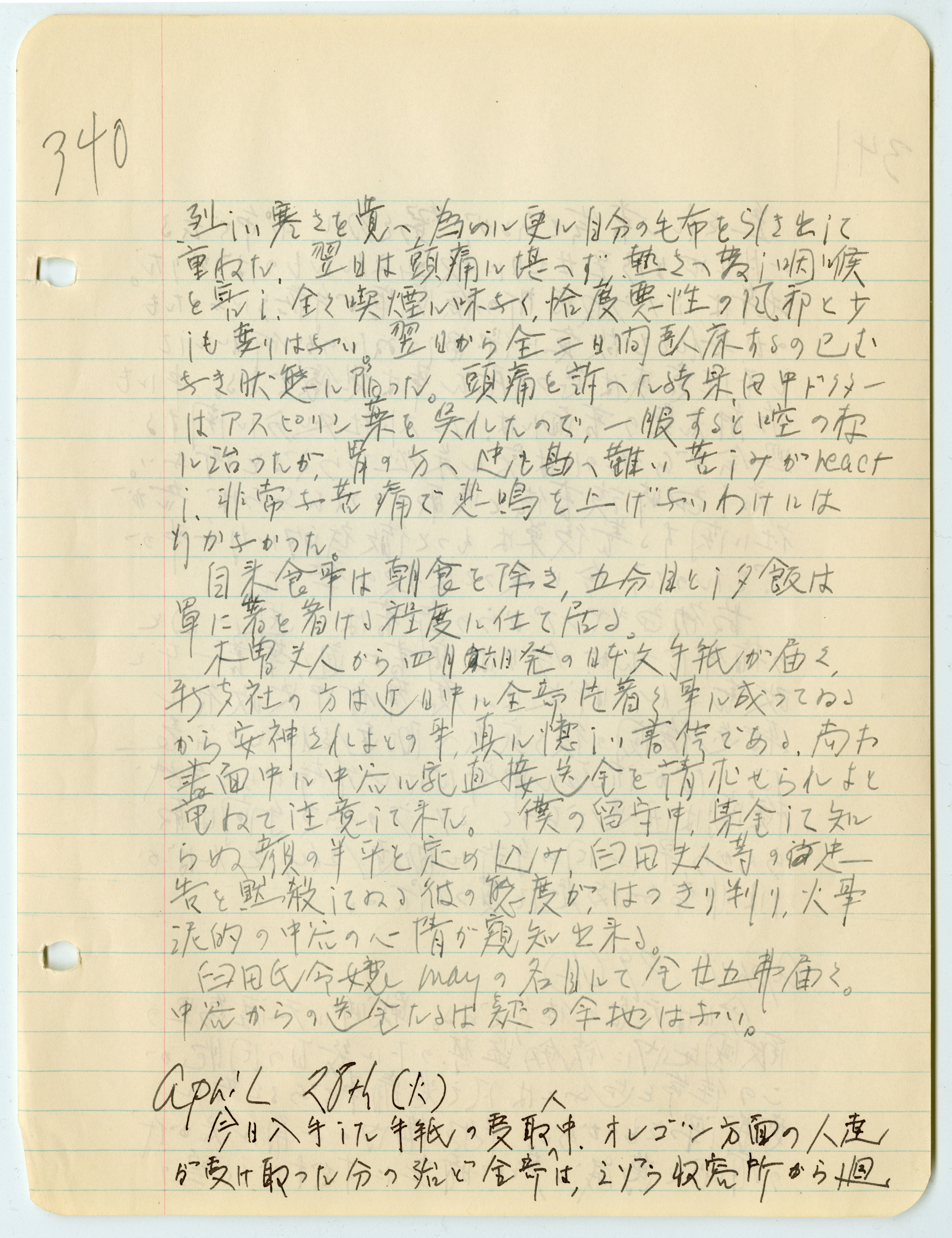
We got a shot again on the 21st. I started to have horrible chills in the evening, I felt terribly shaky and cold all over my body around 8 p.m. and grabbed my blanket and put it on top.
340
I got a terrible headache the following day, had a fever and coughs, smoking was not enjoyable, and it was just like having a bad cold. I ended up having to stay in bed for two entire days from the day after. Dr. Tanaka gave me some aspirin as I told him that I had a headache, and it was all gone after I took one tablet. However, my stomach had a terrible reaction to it, and I was in excruciating pain and could not help screaming.
I have been skipping breakfast, eating until I am half full and having just a few bites for dinner as my routine.
I received a letter from Mrs. Kiso mailed out on April 6th. It is such a thoughtful letter to let me know that the newspaper publisher will be closed in the new future and I do not have anything to worry about. She also repeatedly advised me in her letter to directly contact Nakatani and demand him to send payments to me. He is collecting fees while I am away and pretending he had nothing to do with it despite advice from Mrs. Usuta and others, and that clearly reveals to me his sneaky personality to rob someone who is in crisis.
I received 25 dollars sent to me from the account of May, a daughter of Mr. Usuda. There is no doubt that this is from Nakatani.
- Title:
- April 16, 1942 entry
- Creator:
- Sakaino, Bunro
- Date Created (ISO Standard):
- 1942-04-16
- Description:
- April 16, 1942, diary entry written by Bunro Sakaino while he was incarcerated at Fort Sill, Oklahoma.
- Subjects:
- concentration camps diaries
- Location:
- Fort Sill, OK
- Source:
- MG 387, George Shihei Shitamae papers, Special Collections and Archives, University of Idaho Library
- Translator:
- Transcribed and translated by Naoko Tanabe, 2024-2025, of Densho (densho.org)
- Source Identifier:
- mg387_1_7-1942-04-16
- Type:
- Text
- Format:
- application/pdf
- Language:
- jpn
U of I Digital Collections contain unique digitized and born digital archival materials in a variety of formats. The Library is committed to ensuring our resources are accessible to all users. Please contact us if you need support accessing or using this archived content.
Contact us about this record Library Help- Citation:
- "April 16, 1942 entry", Bunro Sakaino Concentration Camp Diary, University of Idaho Library Digital Collections, https://www.lib.uidaho.edu/digital/sakaino/items/sakaino109.html
- Rights:
- In copyright, educational use permitted. Educational use includes non-commercial reproduction of text and images in materials for teaching and research purposes. For other contexts beyond fair use, including digital reproduction, please contact the University of Idaho Library Special Collections and Archives Department at libspec@uidaho.edu. The University of Idaho Library is not liable for any violations of the law by users.
- Standardized Rights:
- http://rightsstatements.org/vocab/InC-EDU/1.0/