
May 5, 1942 entry Item Info
May 5 (Tuesday)
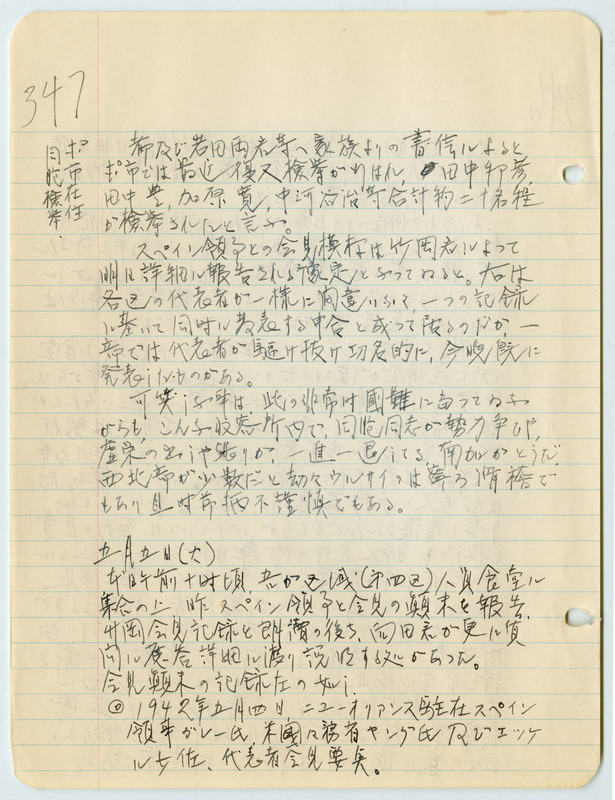
At 10 a.m. today, members of our area (the fourth) gathered at the mess hall to be fully reported on the meeting with the Consul General of Spain held yesterday. The meeting minutes of the meeting was read, and Mr. Mukada had a question and answer segment to provide more detailed information. The details are as follows.
Meeting minutes of Consul General of Spain in New Orleans Gale [1], Mr. Young of the Department of State and Major Eckel held on May 4, 1942.
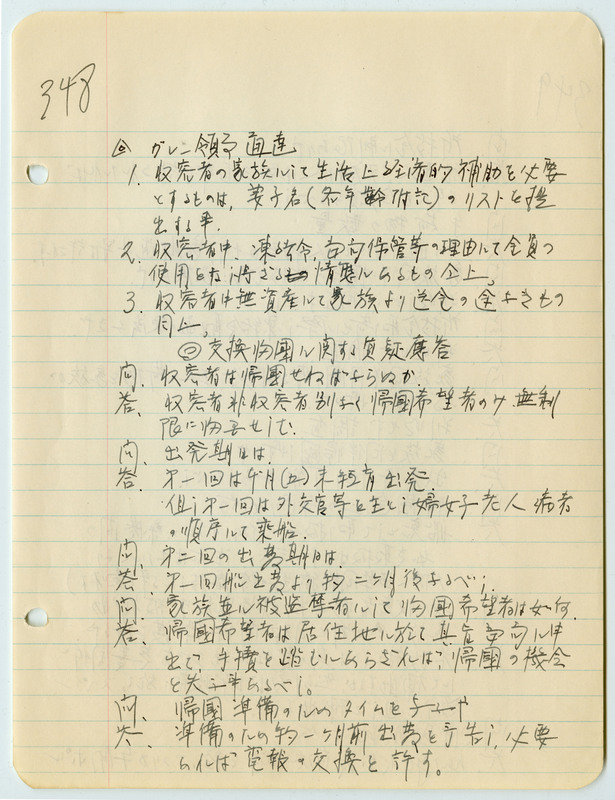
Communications from Consul General Gale
-
Submit a list of the names of the wives and children (including their age) if any families need financial support for their daily life.
-
Report any tools or equipment that cannot be used by the internees due to a freeze order or held by the administration.
-
Report anyone among the internees who does not own any assets or means to receive money from the family.
Questions and Answers regarding the exchange program
Q: Are the internees required to go back to their homeland?
A: Regardless if a person is an internee, those who wish to go back are allowed to do so without limitation.
Q: What is the schedule for the departure?
A: The first boat is scheduled to depart from New York this month (May). However, the first boat is mainly for diplomats, and women and children, elderly and sick people in this order.
Q: What is the schedule for the second boat?
A: It should be about two months after the first boat departs.
Q: How about the internees, detainees and the families?
A: Anyone who wishes to go back can apply for it where they live. If the application is completed, no one will miss the opportunity to go back.
Q: Is some preparation time allowed to go back to homeland?
A: The departure schedule will be announced approximately one month in advance, and telegram correspondence will be allowed if needed.
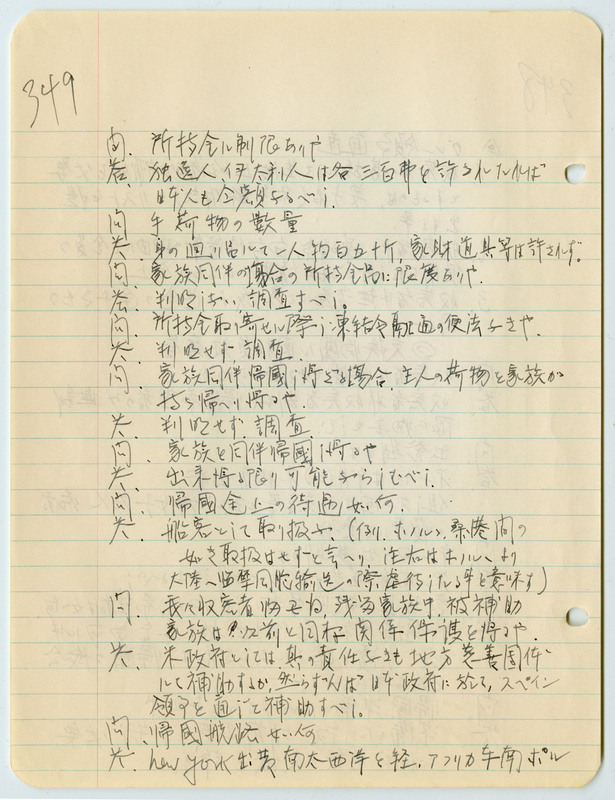
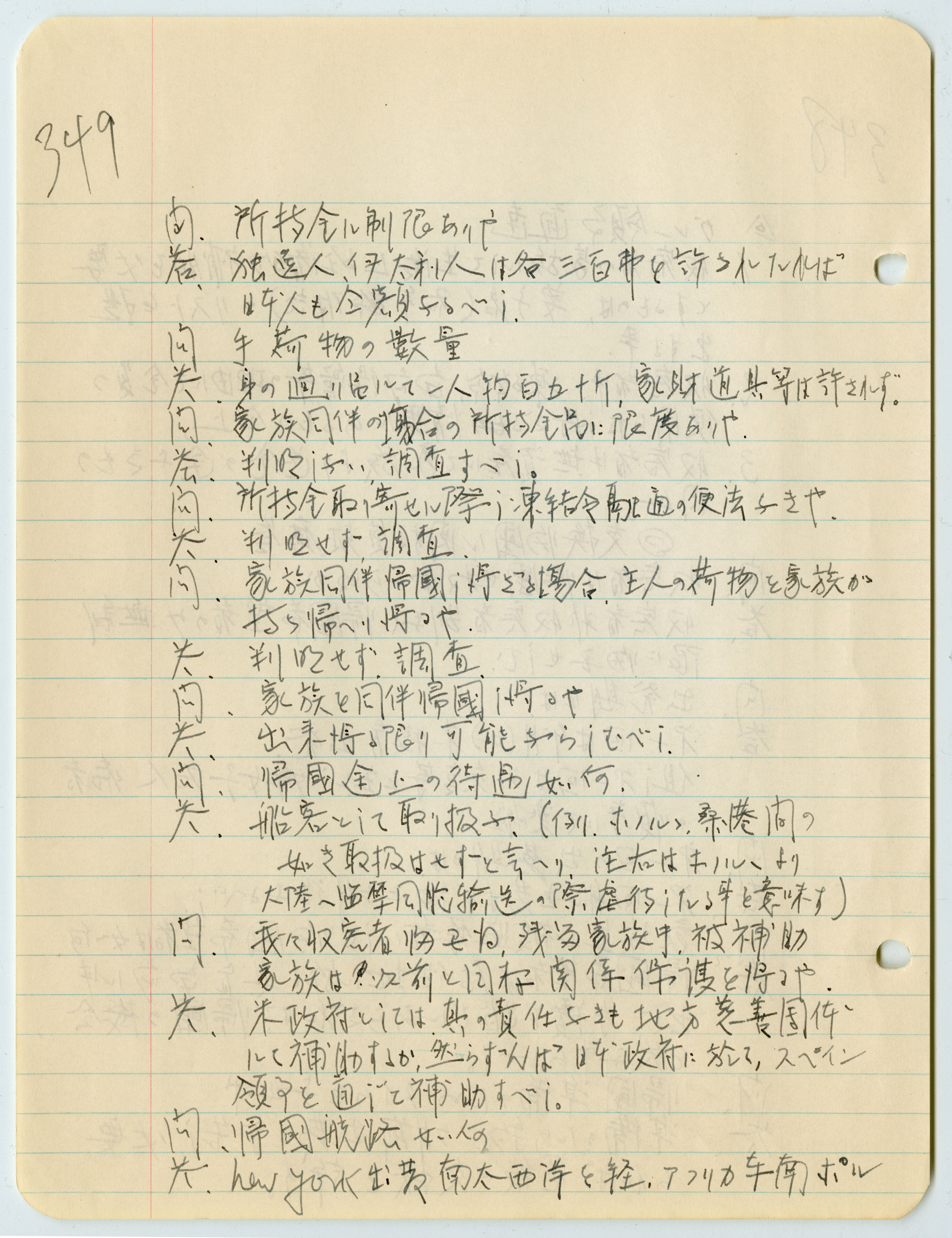
349
Q: Is there a limit to the amount of cash carried out?
A: Maximum amount allowed to Germans and Italians is 300 dollars, and it should be the amount for Japanese as well.
Q: Numbers of luggage pieces
A: It should be up to 200 pounds, and furniture or equipment will not be allowed.
Q: If traveling with the family, is there a limit to the amount of cash carried out?
A: We do not know and need to find out.
Q: When we retrieve our cash, would it be possible to access our frozen cash assets?
A: We do not know and need to find out.
Q: If an internee is not able to go back with the family, is the family allowed to take his belongings back with them?
A: We do not know and need to find out.
Q: Would it be possible to go back to homeland with the family?
A: We will try to make it happen as much as possible.
Q: How are we to be treated on the way back?
A: You will be treated as a passenger. (For example, they said what happened on the trip(s) between Honolulu and San Francisco will not happen. Footnote for the above mentioned is that the fellow detained Japanese were abused while transported from Honolulu to the continent)
Q: After we internees go back, would the families receiving government assistance continue to receive the aid?
A: The U.S. government does not have any responsibility to do so. You should ask local charity organizations for support, or the Japanese government should offer assistance through the Consulate General of Spain.
Q: What is the route to go back?
A: The boat is scheduled to depart from New York, travel across the South Pacific Ocean and arrive at Markas Port in Lawrence, territory of Portugal in the south east of Africa, where the exchange will take place.
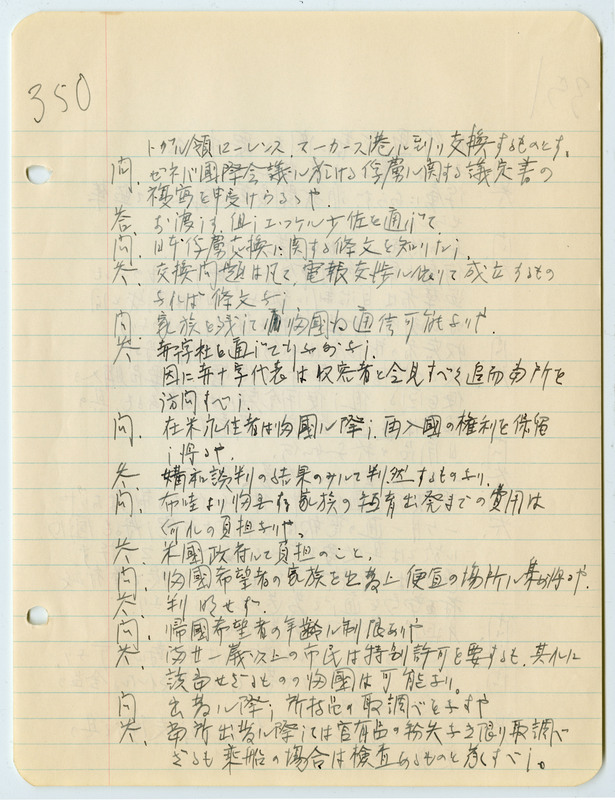
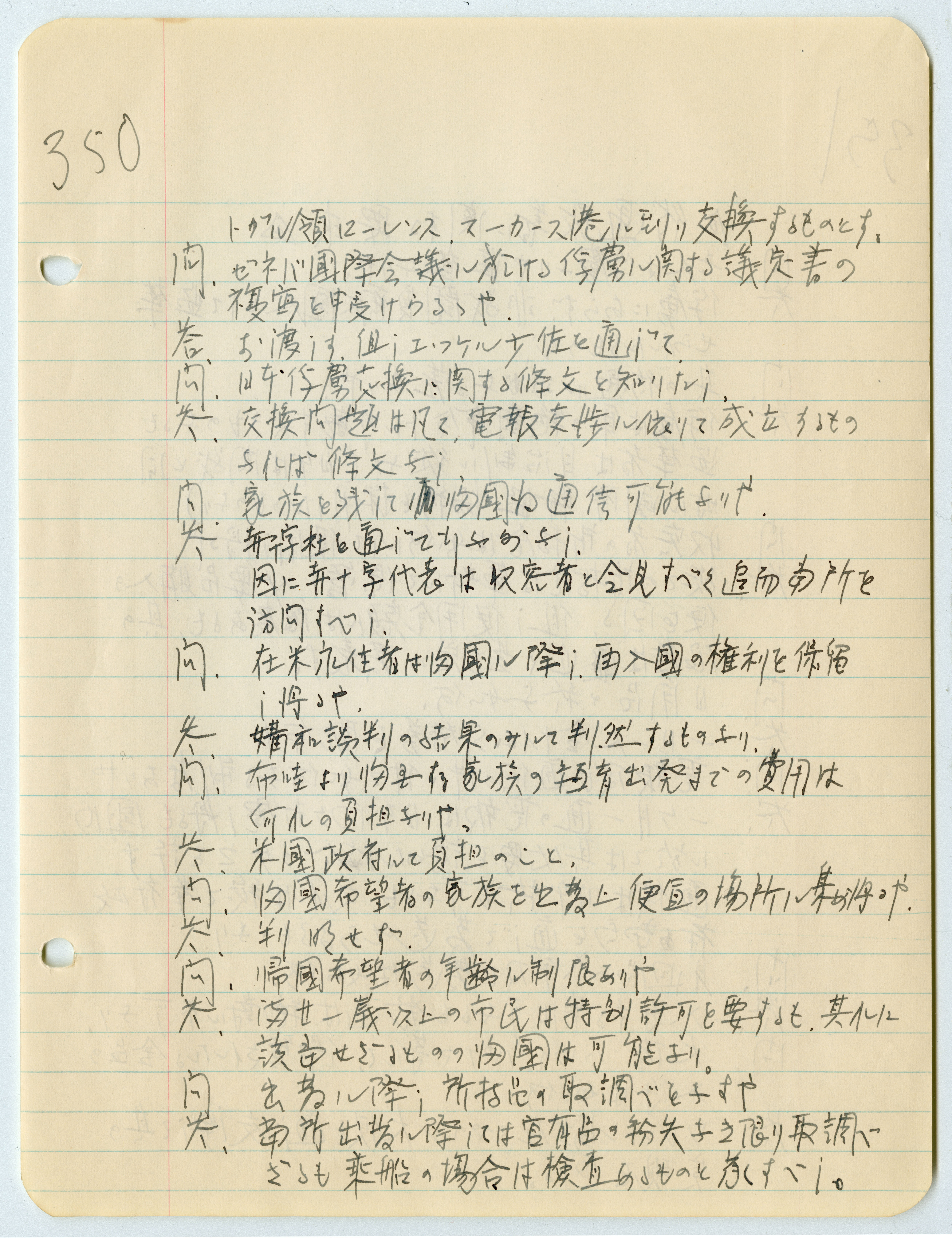
350 Q: Would it be possible to obtain a copy of the Geneva Convention minutes regarding the treatment of prisoners of war?
A: We will provide it through Major Eckel.
Q: We would like to obtain written regulations of the prisoners of war exchange.
A: The exchange agreement was negotiated entirely by telegrams, and we do not have any written regulations.
Q: Would it be possible to correspond with the family if we leave them behind and go back?
A: It would be possible through the Red Cross. Representatives from the Red Cross are visiting the camp to meet with the internees.
Q: Would it be possible for those who has permanent resident status to maintain the right to enter the U.S. again after he they go back to the homeland?
A: It depends on the result of the treaty.
Q: Who covers the traveling cost to New York for the families from Hawaii?
A: The U.S. government will cover the cost.
Q: Would it be possible to gather the family members of those who would wish to go back to a convenient location before departure?
A: We do not know.
Q: Is there an age limit for those who wish to go back?
A: Anyone at age 21 or older needs to obtain a special permission, but it is possible to go back for anyone else.
Q: Will the luggages be inspected at the departure?
A: There will be no inspection upon leaving the camp as long as there are no items missing that are owned by the government. Inspection should be expected upon boarding the boat.
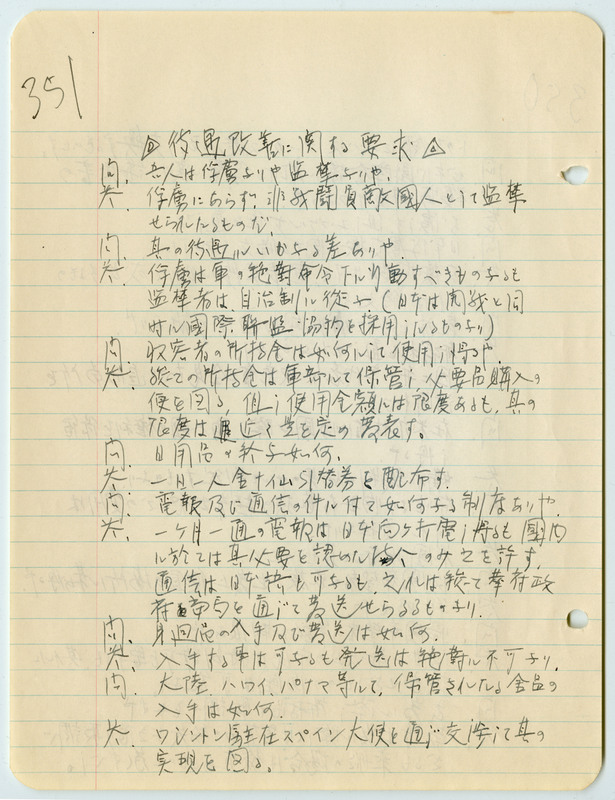
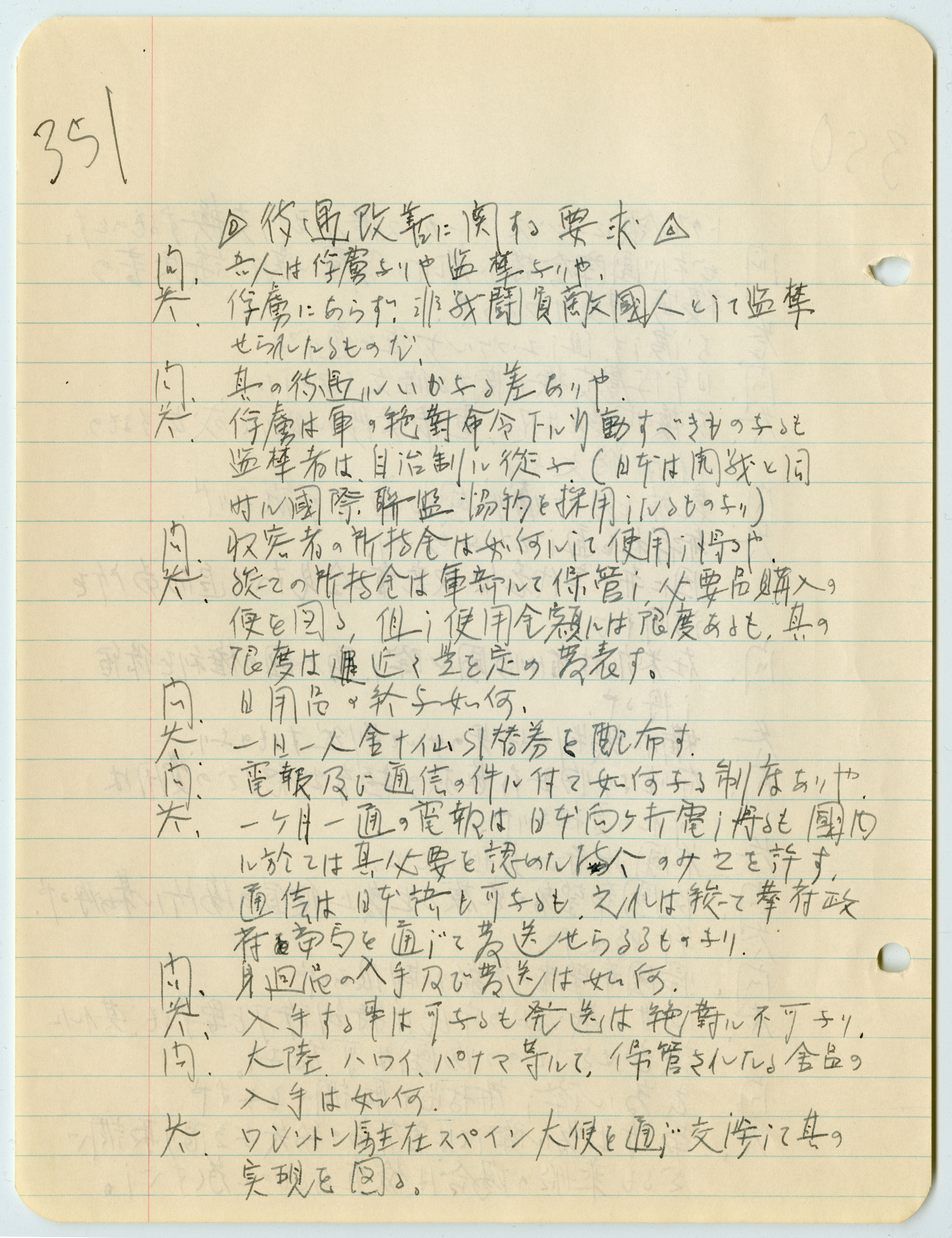
351 Demands toward improvement of treatment
Q: Are we prisoners of war or internees?
A: You are not prisoners of war but interned as civilian enemy aliens.
Q: How would they be treated differently?
A: Prisoners of war are to absolutely obey military orders while internees are self managed. (The Japanese government adopted the United Nations regulations upon starting the war)
Q: How can the internees spend their money?
A: Military will hold all the cash and arrange purchases of needed items. There is a limit of amount used, and the maximum amount will be determined and announced shortly.
Q: Are basic daily life items to be provided?
A: Ten-cent tickets per day will be distributed to each.
Q: Is there any limit to telegrams or other correspondence?
A: One telegram per month to Japan is allowed, and domestic telegrams are allowed only when permitted. Correspondence is allowed in Japanese, but all are to be mailed through the authorities in Washington D.C.
Q: How can we purchase and send belongings?
A: You can purchase items but cannot send them.
Q: Would it be possible to get back the assets held in the continent, Hawaii and Panama?
A: We will try to make it happen by negotiating through the Consul General of Spain in Washington D.C.
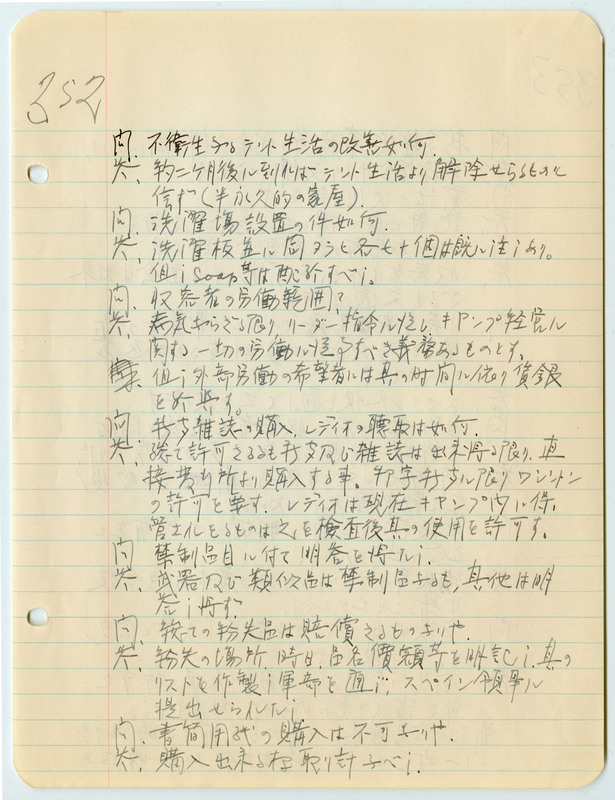
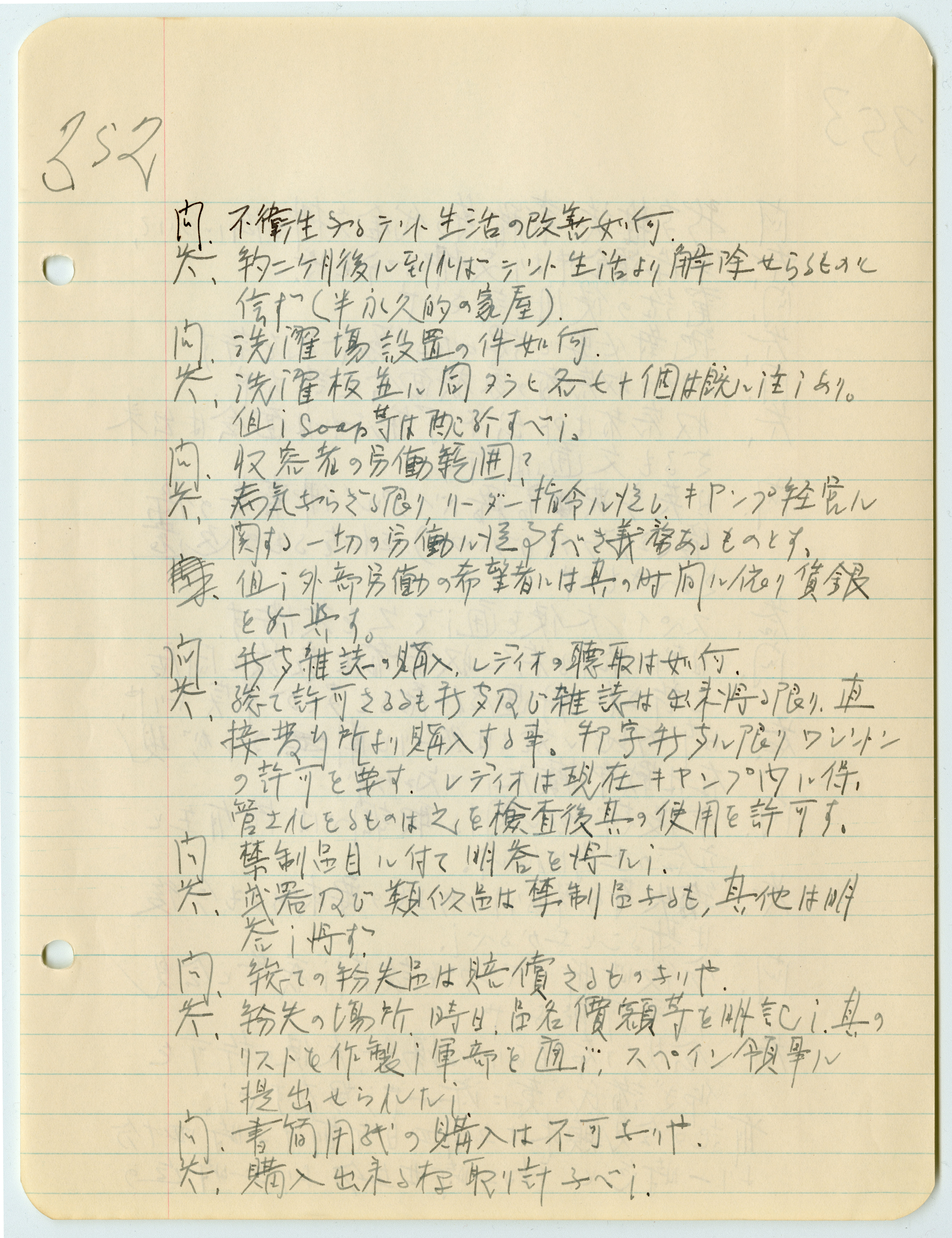
352 Q: Can we expect improvement for the insanitary tent living environment?
A: We believe that you will be released from living in tents in about two months. (semi-permanent housing)
Q: Is a laundry facility scheduled to be built?
A: We already have ordered 70 washing boards and 70 washing tubs. Soap should be distributed.
Q: What is the labor required to the internees?
A: Unless someone is sick, all the internees are required to work to maintain the camp. Those who wish to work outside will be paid by the hour.
Q: Is it allowed to purchase newspapers and magazines, and to listen to the radio?
A: It is all allowed, but we urge you to directly purchase newspapers and magazines from the publishers. Japanese newspapers require permission from Washington. D.C. Radios currently held within the camp will be allowed to be used after inspection.
Q: We would like to have clear descriptions of restricted items.
A: Weapons are not permitted, but we cannot offer a clear answer about other items.
Q: Are lost items to be compensated?
A: If you have lost items, prepare a list of the location where the items were lost, the date, description of the items and purchase amount clearly spelled out and submit it to the Consul General of Spain.
Q: Would it be possible to purchase stationery?
A: We will try to make it possible.
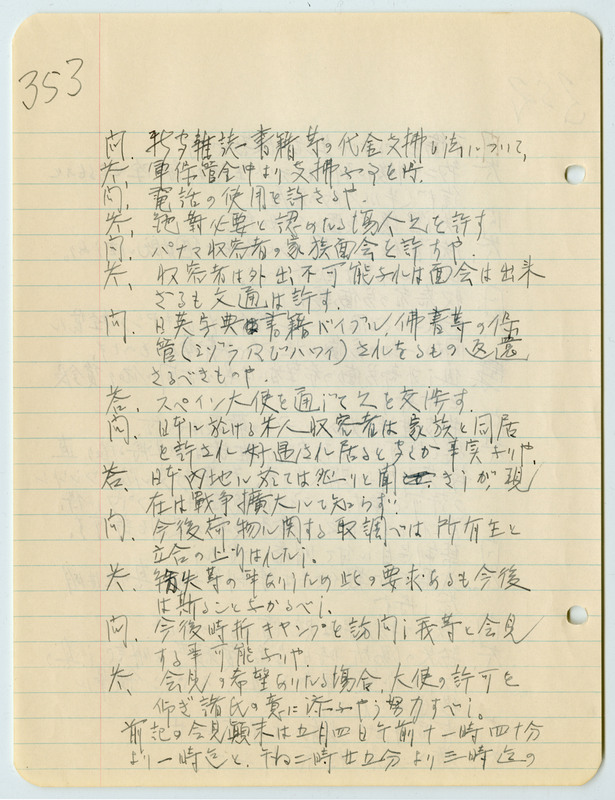
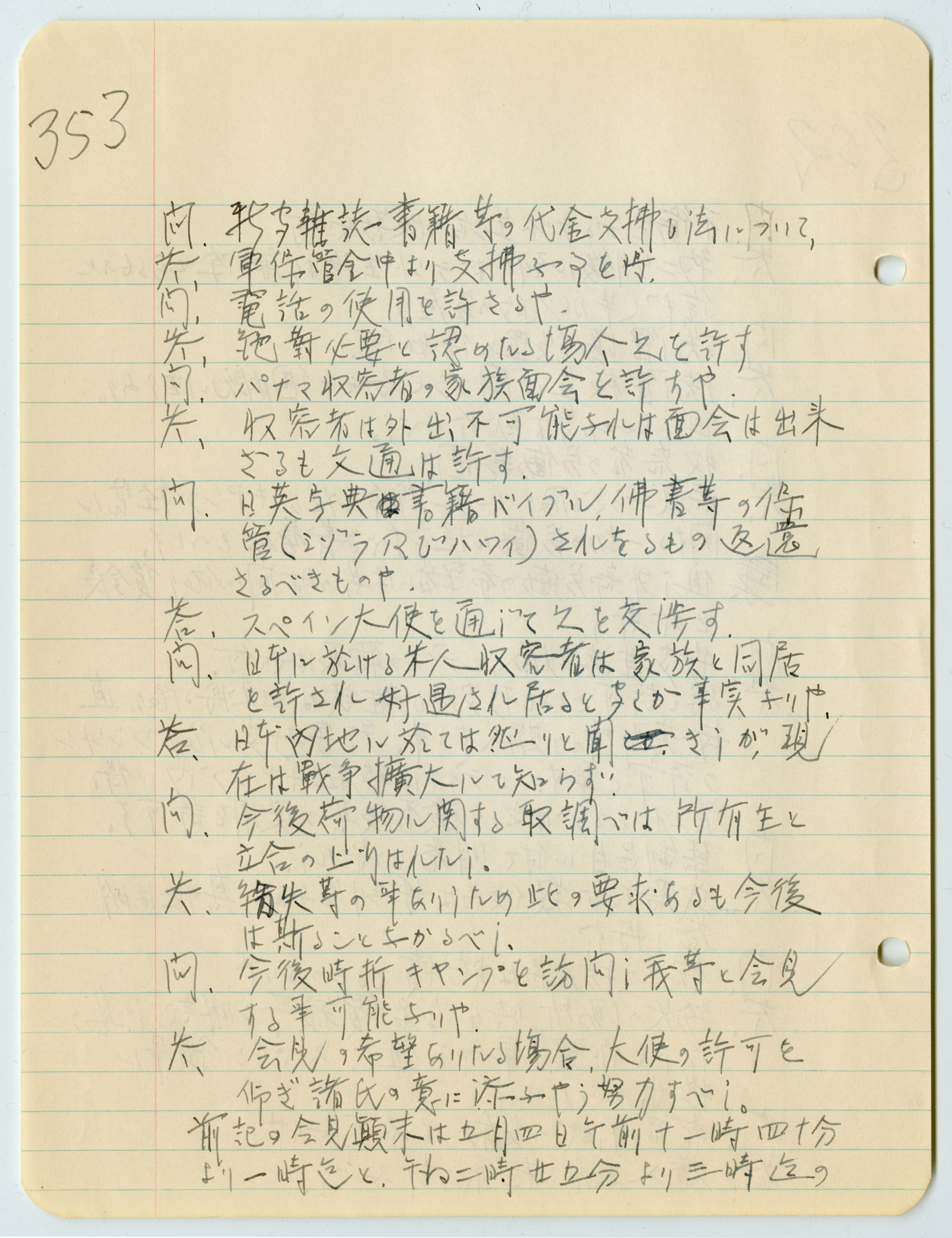
353 Q: How are we to pay for newspapers and magazines?
A: Purchase amount will be debited from the cash hold by the military administration.
Q: Would it be possible to make phone calls?
A: It will be permitted when it is approved to be absolutely necessary.
Q: Would the internees from Panama be allowed to visit the family?
A: Visiting is not permitted as the internees are not allowed to go out, but correspondence by letters is permitted.
Q: Japanese English dictionaries, books, the Bible and Buddhist books are held by the authorities. (in Missoula and in Hawaii) Will they be returned?
A: We will negotiate for the return through the Ambassador of Spain.
Q: We heard that American internees in Japan are allowed to live with their family and are treated well. Is it true?
A: We heard that was what was happening in Japan as well, but we currently do not know how it goes due to the expansion of the war.
Q: We would like to ask the owner to be present when inspection of personal belongings is conducted.
A: We made our demand for it as missing items were reported, but such incidents should not happen in the future.
Q: Can we have occasional visitors to see us in the camp?
A: We will ask for permission from the ambassador and try to meet your request if you request a visit.
354
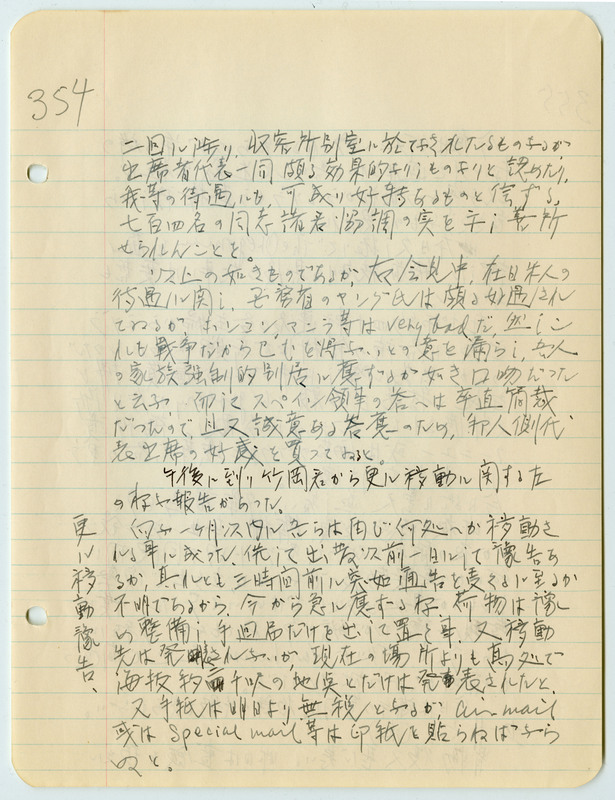
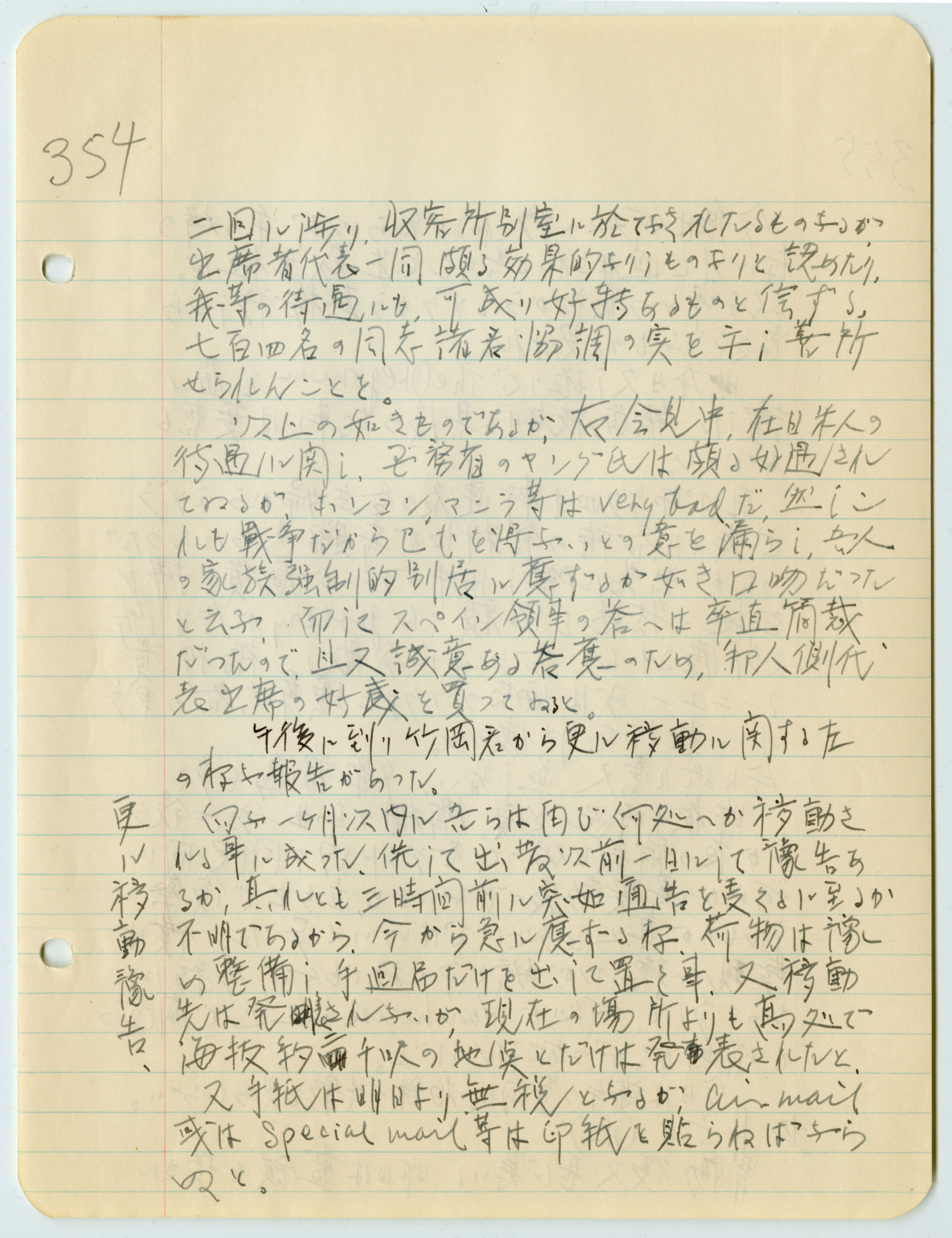
The above report was presented in two segments, from 11:40 am to 1 pm and also from 2:25 pm to 3 pm on May 4th at a separate room in the camp. I recognized it was extremely efficiently conducted by the presenting representatives. I believe that this will help in improving the living conditions for us. I hope they work on creating a harmonious environment among the fellow internees and do their best.
Reported as above. Mr. Young from the Department of State expressed his opinion about treatment of U.S. citizens living in Japan and mentioned that they are treated well in Japan, but the condition is very bad in Hong Kong, Manila and other locations. He said it is the way things go during a wartime and seemed to support the policy to forcefully separate our families. However, the response from the Consul General of Spain was direct and clear, and also sincere, and his comments impressed the Japanese representatives.
Mr. Takeoka went on and presented his report on the relocation in the afternoon as follows. It is determined that we will be relocated again to somewhere within the next month. It is unclear if we are to receive a notice one day prior to the departure or a last-minute notice three hours in advance. We should be prepared to act quickly by packing our belongings and having only items used daily out for us to use. The destination has not been announced, but it has been announced that it will be somewhere in a higher altitude than where we currently are, at a location approximately 2,000 feet above sea level. It was also reported that there will be no tax on the postage starting tomorrow, but air mails and special mails require stamps.
355
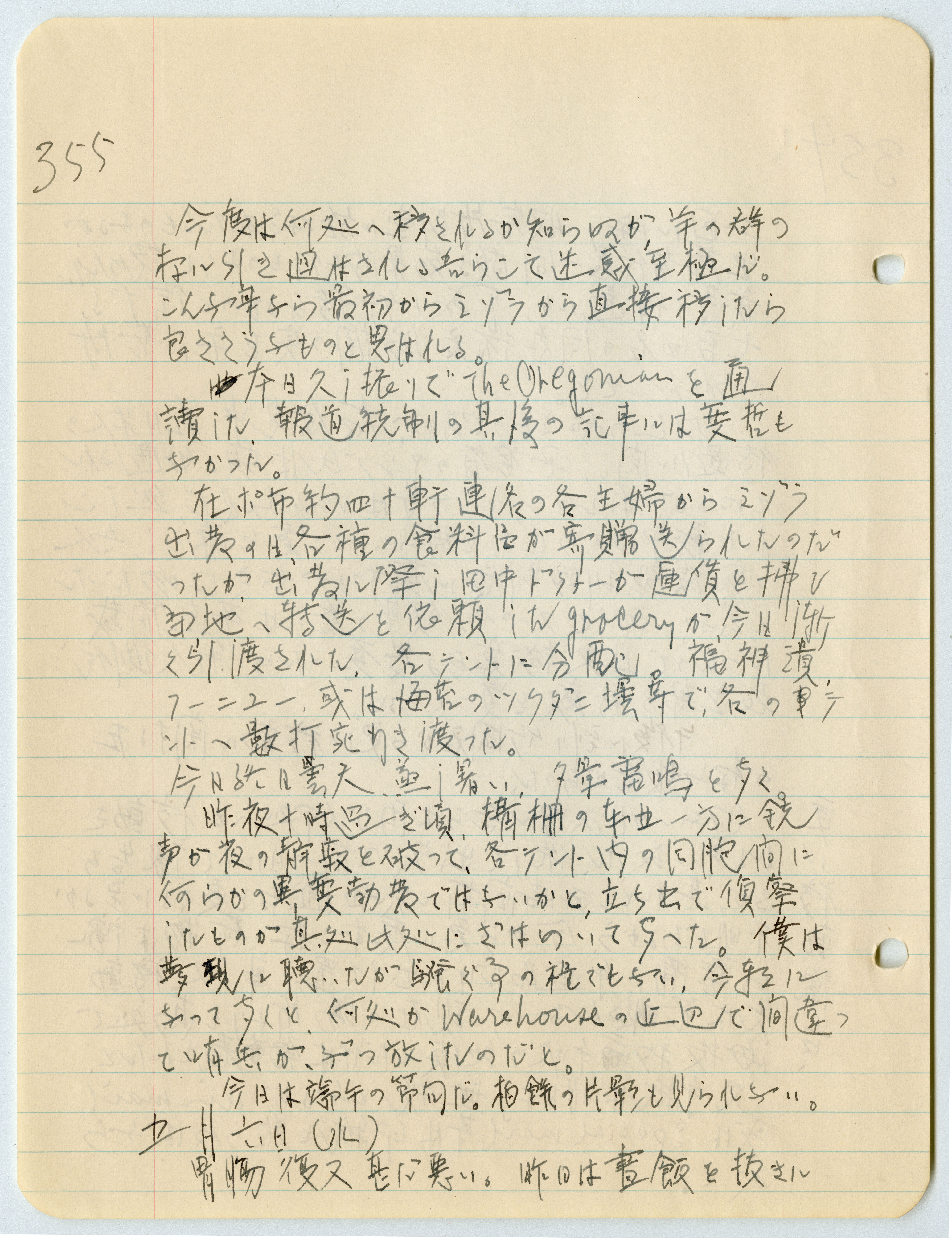
I don’t know where we will be sent out this time, but it is very bothersome to be hauled around like a herd of sheep. I have to say it would have been the better option to move us to the location directly from Missoula.
I have read The Oregonian thoroughly today, after being unable to do so for a while. The articles are ordinary under the news censorship.
A gift of various groceries from a group of about 40 housewives living in Po [2] city was delivered when we departed from Missoula, and Dr. Tanaka paid for the shipment and asked them to make a special delivery to this location. It was finally brought to us today and distributed to each tent. Each tent received several servings of fukujinzuke pickles, funyu [3], jarred stewed nori seaweed and others.
It has been cloudy and muggy all day today. We heard thunder in the evening.
We heard a gunshot through the silence of the night from the east side of the fence last night. I could hear people coming out of the tent and making noises here and there, trying to inspect if something unusual happened to our fellow Japanese. I heard it in my half dreamy state and did not think it was worth fussing about. I was told this morning that a soldier accidentally fired his gun by a warehouse somewhere.
It is Boys’ Festival Day today. The typical treat kashiwamochi is nowhere to be seen.
[1] Could be a different name
[2] Portland?
[3] ?
- Title:
- May 5, 1942 entry
- Creator:
- Sakaino, Bunro
- Date Created (ISO Standard):
- 1942-05-05
- Description:
- May 5, 1942, diary entry written by Bunro Sakaino while he was incarcerated at Fort Sill, Oklahoma.
- Subjects:
- concentration camps diaries
- Location:
- Fort Sill, OK
- Source:
- MG 387, George Shihei Shitamae papers, Special Collections and Archives, University of Idaho Library
- Translator:
- Transcribed and translated by Naoko Tanabe, 2024-2025, of Densho (densho.org)
- Source Identifier:
- mg387_1_7-1942-05-05
- Type:
- Text
- Format:
- application/pdf
- Language:
- jpn
U of I Digital Collections contain unique digitized and born digital archival materials in a variety of formats. The Library is committed to ensuring our resources are accessible to all users. Please contact us if you need support accessing or using this archived content.
Contact us about this record Library Help- Citation:
- "May 5, 1942 entry", Bunro Sakaino Concentration Camp Diary, University of Idaho Library Digital Collections, https://www.lib.uidaho.edu/digital/sakaino/items/sakaino138.html
- Rights:
- In copyright, educational use permitted. Educational use includes non-commercial reproduction of text and images in materials for teaching and research purposes. For other contexts beyond fair use, including digital reproduction, please contact the University of Idaho Library Special Collections and Archives Department at libspec@uidaho.edu. The University of Idaho Library is not liable for any violations of the law by users.
- Standardized Rights:
- http://rightsstatements.org/vocab/InC-EDU/1.0/