
July 7, 1942 entry Item Info
July 7 (Tuesday)
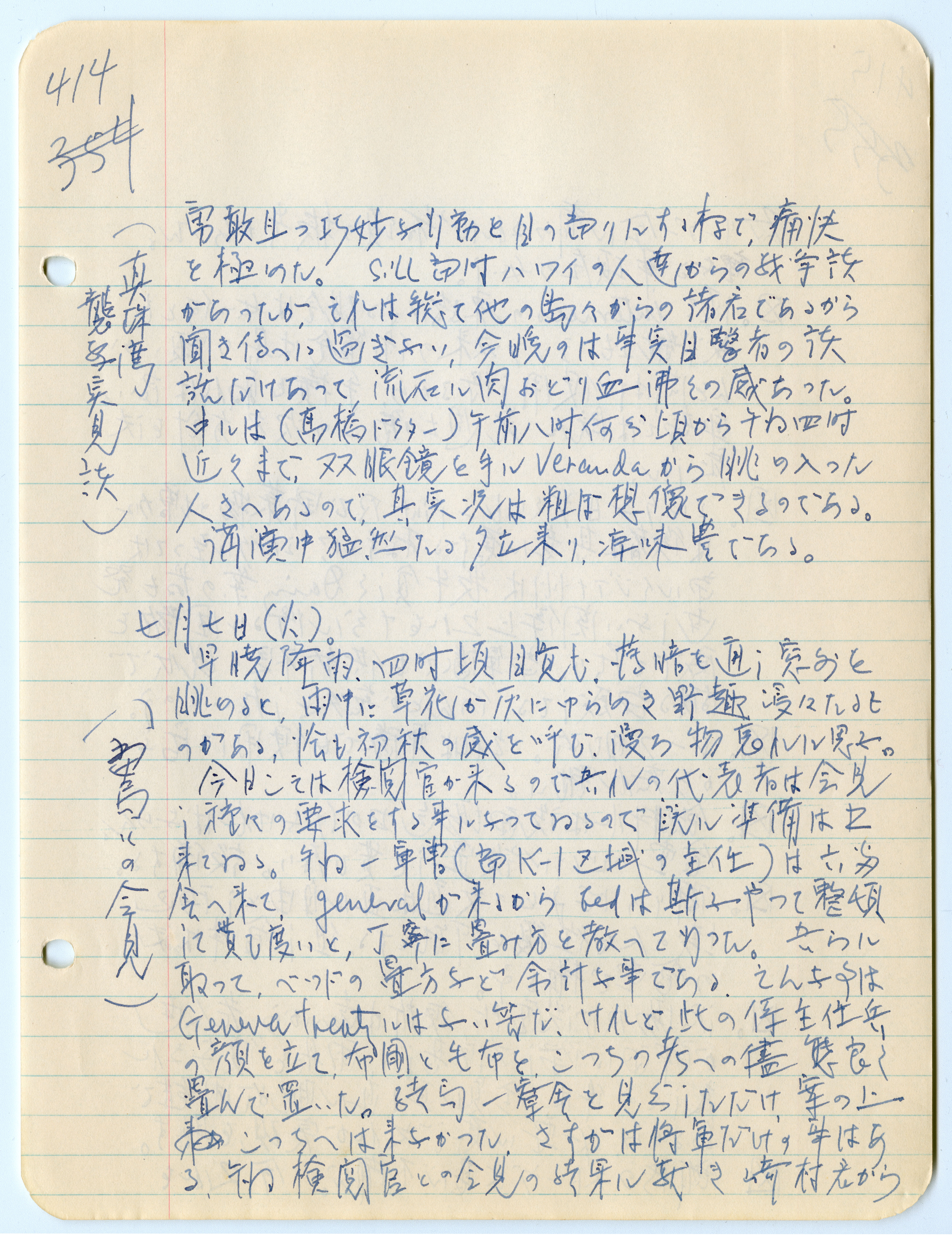
It rained in the early evening. I woke up around 4 a.m. I saw flowers shaking in the foggy rain when I looked out the window, and I found it as a beauty in the wild. It conjures up early autumn sentiment, and nothing looks permanent. The inspector is sure to come today, and our representative is ready to present various demands we have as planned. One sergeant (supervisor of our K-1 region) came over to the 6th barrack, asked us to tidy up our beds as a general was coming, taught us how to make a bed in detail and left. It is no use for us to learn how to make bed. I am certain that it is not included in the Geneva Treaty. However, just to help him, I tidied up and folded my comforter and blanket as I liked. The inspector ended up stopping by at one barrack and did not come to ours as I suspected. He is a general after all. Mr. Sakimura reported on the meeting with the inspector to each leader in the afternoon .
415
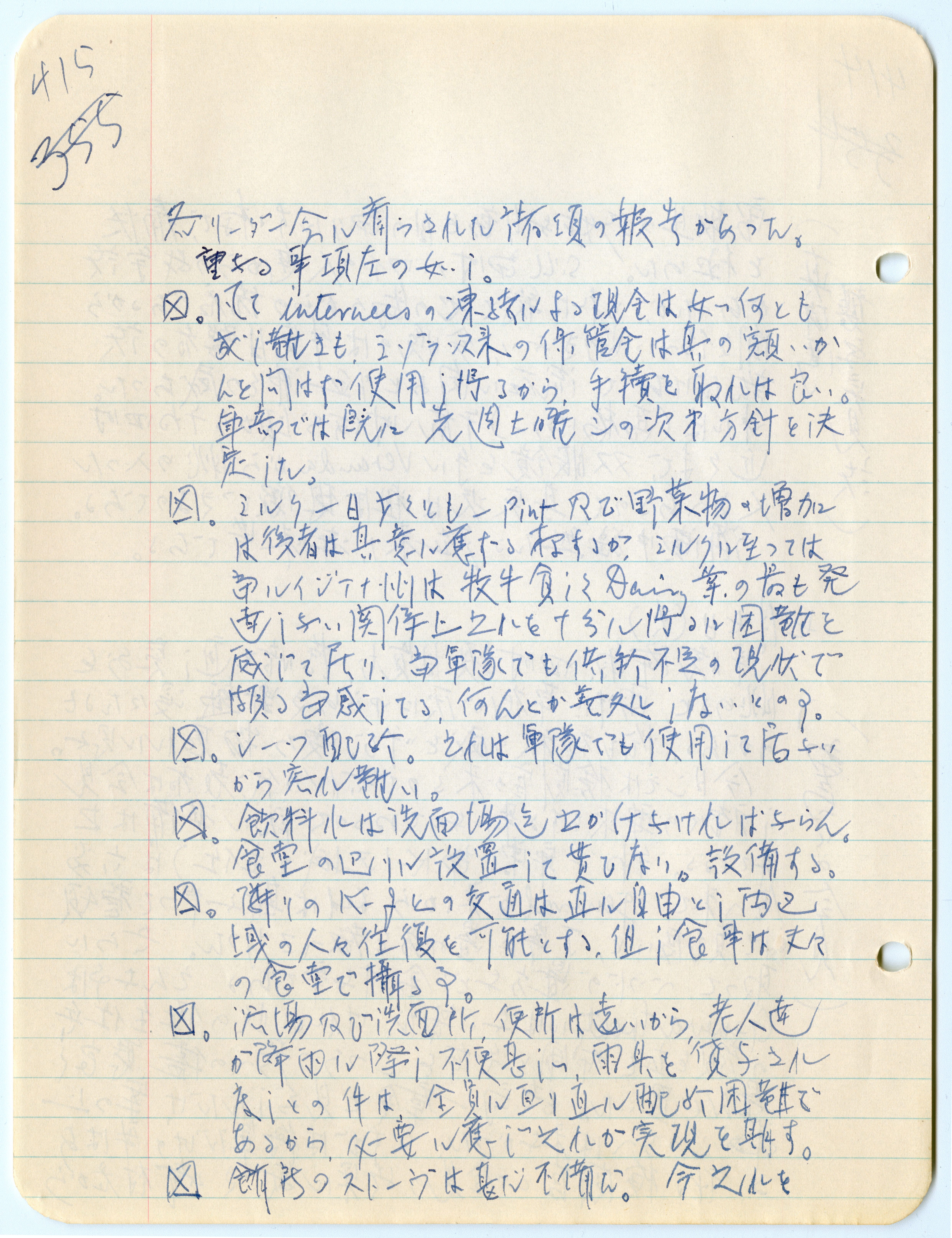
The following are the items.
-
Cash owned by the internees and frozen by the administration is not available, but money held by the administration since Missoula can be used. Requests can be made. The military has already made this policy last Saturday.
-
As for at least one pint of milk provided daily and an increased amount of vegetables, the later request was granted, but it is difficult to secure enough milk as the dairy industry is least developed in Louisiana State with a low number of cows. The military is also suffering from low supply and having difficulties. They would like to work on it.
-
As for distributing bed sheets, it is not granted as even the military is not distributing them.
-
We need to go to the washing area for drinking water. We would like to ask for drinking water available around the mess halls. They will install them.
-
We would like to go to the next unit freely and have traveling between both areas possible. Yes, but we need to have meals in the designated mess hall.
-
We requested rain gears as bathrooms, washing areas and latrines are far away. It is such a nuisance for elderly people when it is rainy. Their response is that it is hard to provide everyone with supplies, but they will try to make some available as needed.
-
Stoves in the kitchens are in terrible condition.
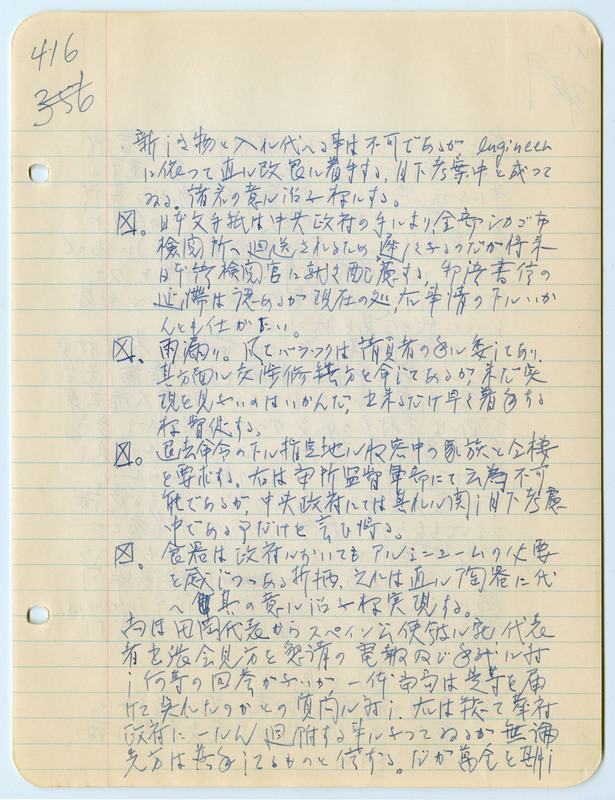
416
Their response is that it would not be possible to replace them with new ones now, and they will have engineers to fix them. It is currently being considered, and they will work to achieve what we requested.
-
Letters written in Japanese are all to be sent to the inspection center in Chicago by the federal government, and it takes a long time to deliver. Would it be possible to consider having Japanese inspectors in the facility in the future. Their response is that they recognize the delayed delivery of Japanese letters, but they cannot do anything about it.
-
As for leaking roofs on rainy days, their response is that management of the barracks is all assigned to the contractors. It is regrettable that the repairs they ordered have not been conducted yet, and they will push the contractors to work on it as soon as possible.
-
As for our request to live with our family in the designated areas who have been ordered to be removed from home, Their response is that it is not possible to do anything about it by the camp administration. Only thing they can tell us is that the federal government is currently considering that option.
-
As for dinner plates, the government understands a need for aluminum and will replace them with ceramic ones as requested.
Our representative Taoka sent a letter and telegram to the Spanish ambassador to request a meeting with our representative. We questioned if the administration had delivered the correspondence. Their response is that all correspondence is to be forwarded to the federal government first, and they obviously believe the party has received it.
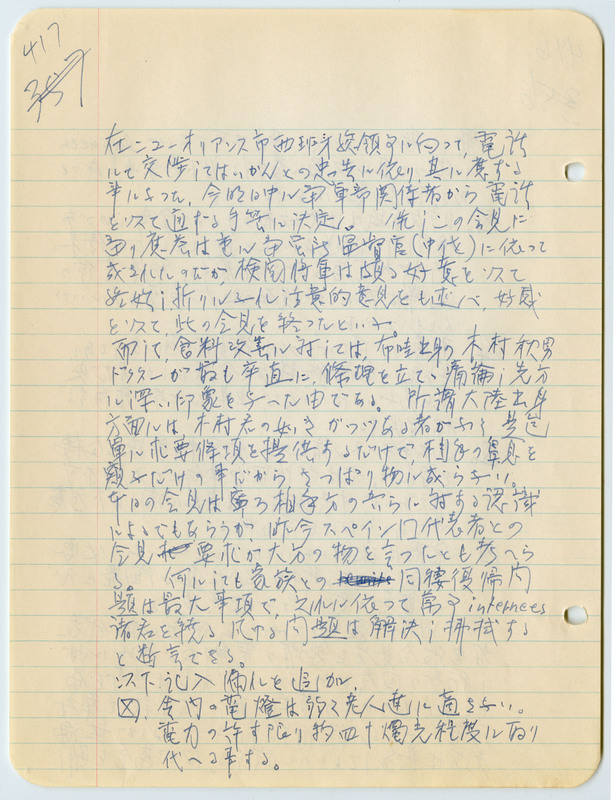
417
Phone call to the Consul General in New Orleans City was advised just to be safe, and they decided to follow that and a representative of the military will contact them by phone in the next few days. The supervising officer on the camp (lieutenant colonel) answered the questions at the meeting, and it was reported that the inspector commander was empathetic throughout the meetings, sometimes offered his opinions to correct the administration and ended the meeting in a positive note.
As for the improvement of food served here, we were told Dr. Akio Kimura from Hawaii made an honest, logical and convincing presentation and deeply impressed the inspector. After all, those from the main continent are useless as they just rely on someone gutsy like Dr. Kimura to deliver their requests to the military and watch how the reactions will be. The meeting held today was mostly about our demand to contact Spanish representatives although it depends on how the administration views us. The biggest concern is if we can reunite with the family or not, and the answer to this could wipe off all the other problems for all the internees.
I missed a few items and listed them below.
Light bulbs in the facility are not bright enough and not appropriate for elders. We would like to have them replaced with 40 watt bulbs as the power permits.
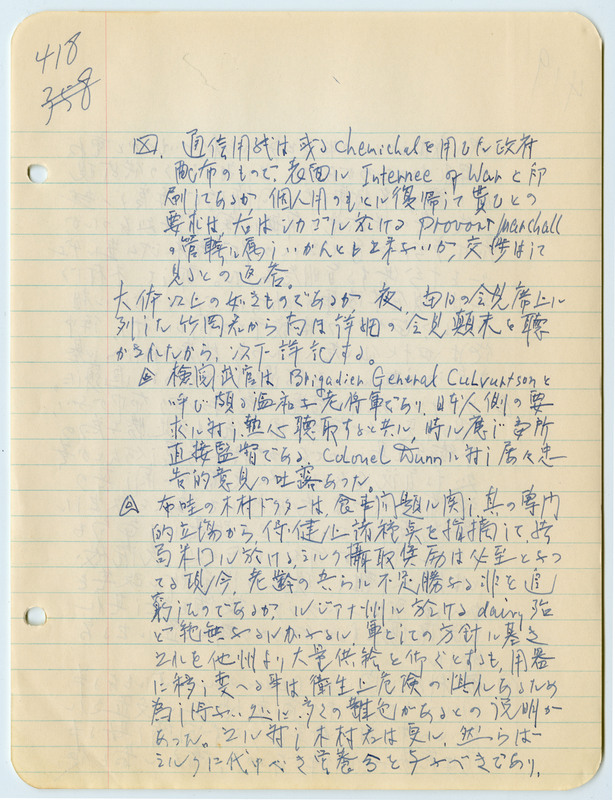
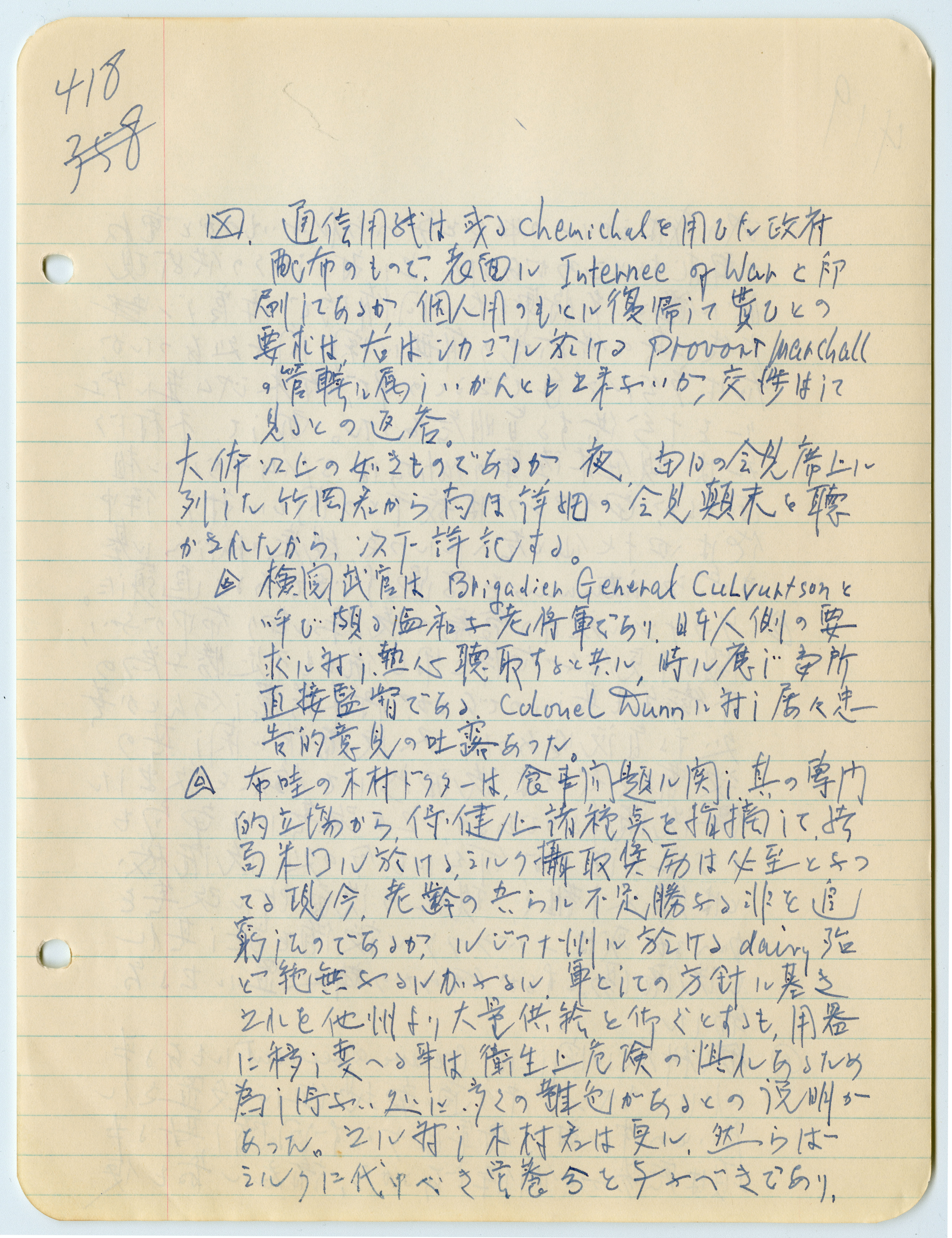
418
-
As for our request to replace the letter paper with a certain chemical with “Internee of War” printed in front and provided by the government with personal stationary as we used to use, their response was they are not authorized to make the change as it is managed by the provost marshall, but they will negotiate.
-
That is about all, but I heard more details from Mr. Takaoka who attended the interview in the evening. I listed the details below.
-
The inspection officer is Brigadier-General Culbertson, and he is an mild-mannered elderly general. He closely listened to requests from the Japan side and occasionally expressed his advice and opinions directly to the supervising office of the camp Colonel Dunn.
-
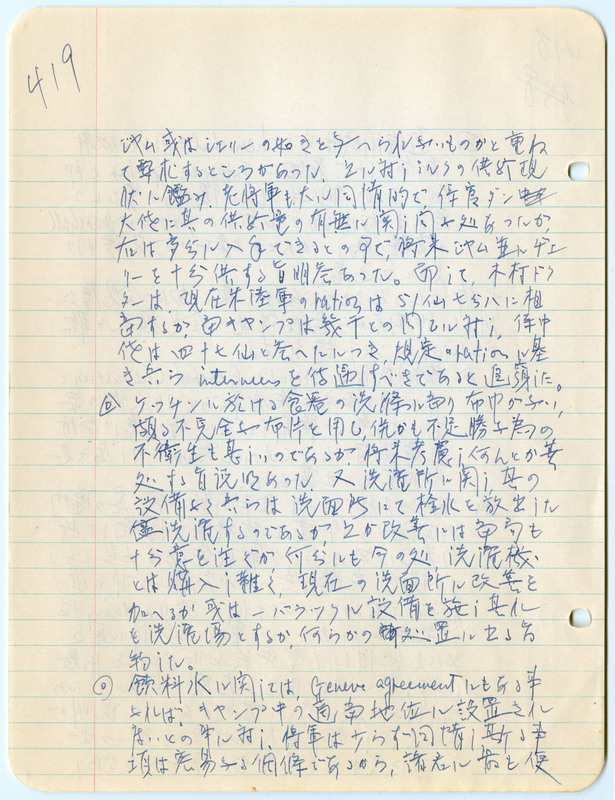
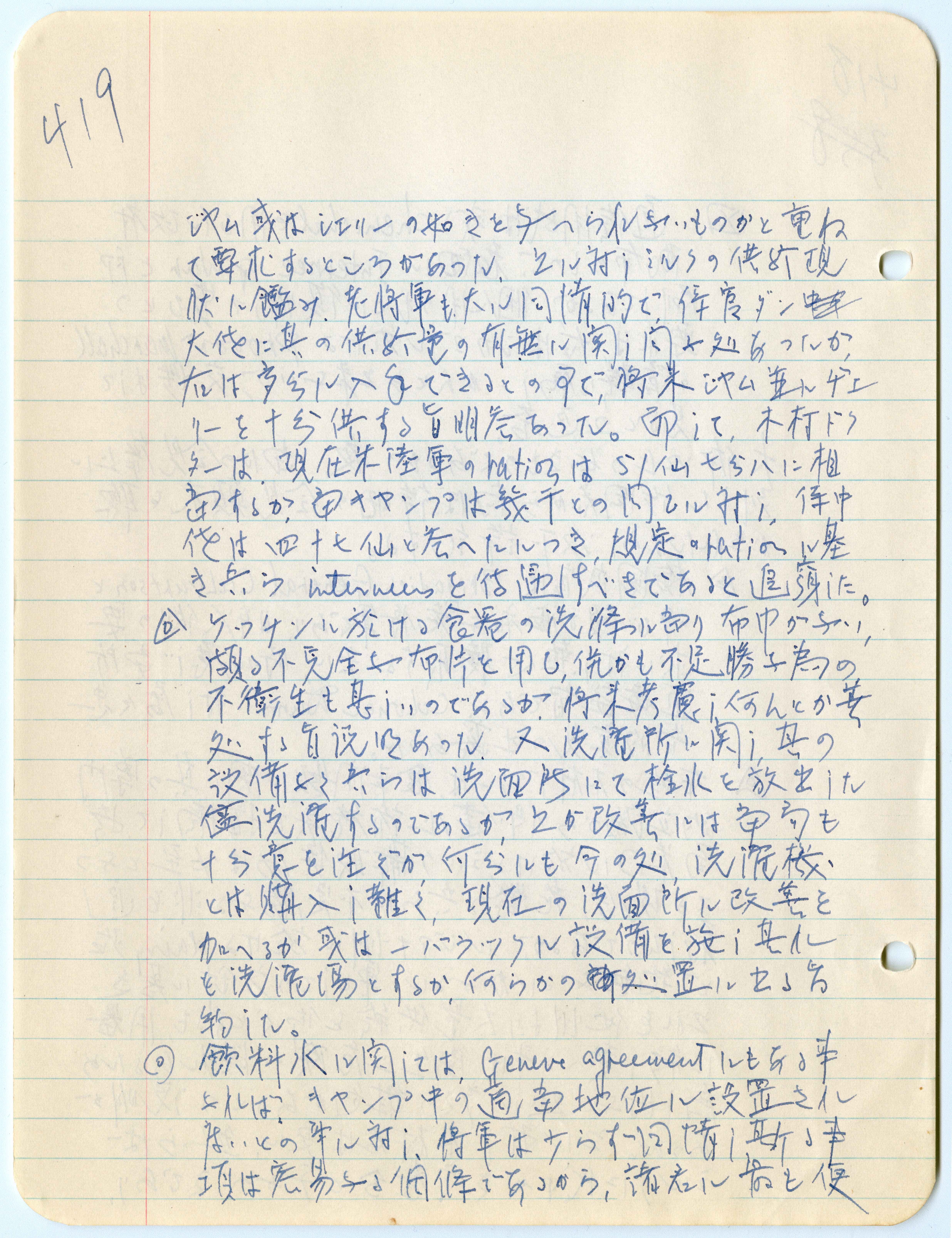
Dr. Kimura from Hawaii pointed out several health issues on food from his professional point of view. He emphasized shortage of milk for the elderly while the U.S. government encourages consumption of it. Their response is that milk supply in Louisiana State is almost non-existent, and there is some health risk involved in holding in containers even if they request large supply from other states. They said they are facing a lot of difficulties. Mr. Kimura pushed his demands and said if they are not able to provide milk,
419
they should offer something else to provide enough nutrients instead of milk and asked if it would be possible to have jam or jello. The old general was very empathetic about the milk supply and asked about the volume of supply to Colonel Dunn. He was told that they probably can get the above, and he clearly asked them to provide jam and jello from now on. Dr. Kimura asked about the ratio adopted in the camp, pointing out that the current ratio [1] for the military is 51 cents. When the officer answered it is 47 cents, he insisted that we internees should be offered the ratio based on the regulations.
-
As for dish washing in the kitchen, we do not have dish towels. We have some very unfunctional cloth pieces, but the supply is very low, keeping the environment extremely unsanitary. They told us that they will take it into consideration and try to make improvements. As for the lack of laundromats, we go to the restroom sinks and wash our clothes under running water. The administration ensured that they will pay attention to make improvements, but it is not likely for them to be able to purchase washing machines at this point. They promised to take some measures such as renovating the existing bathroom facilities or setting up another barrack designated to be a laundry facility.
-
As for drinking water, we requested water stations approximately provided according to the Geneva Convention agreement. The general seems fairly sympathetic to it and assured us that he will make recommendations to set up new water stations in the most convenient way for us.
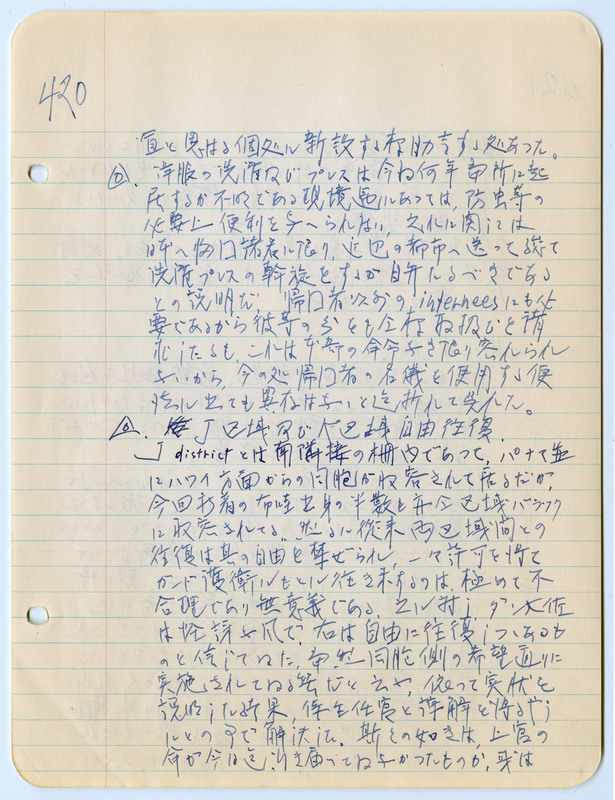
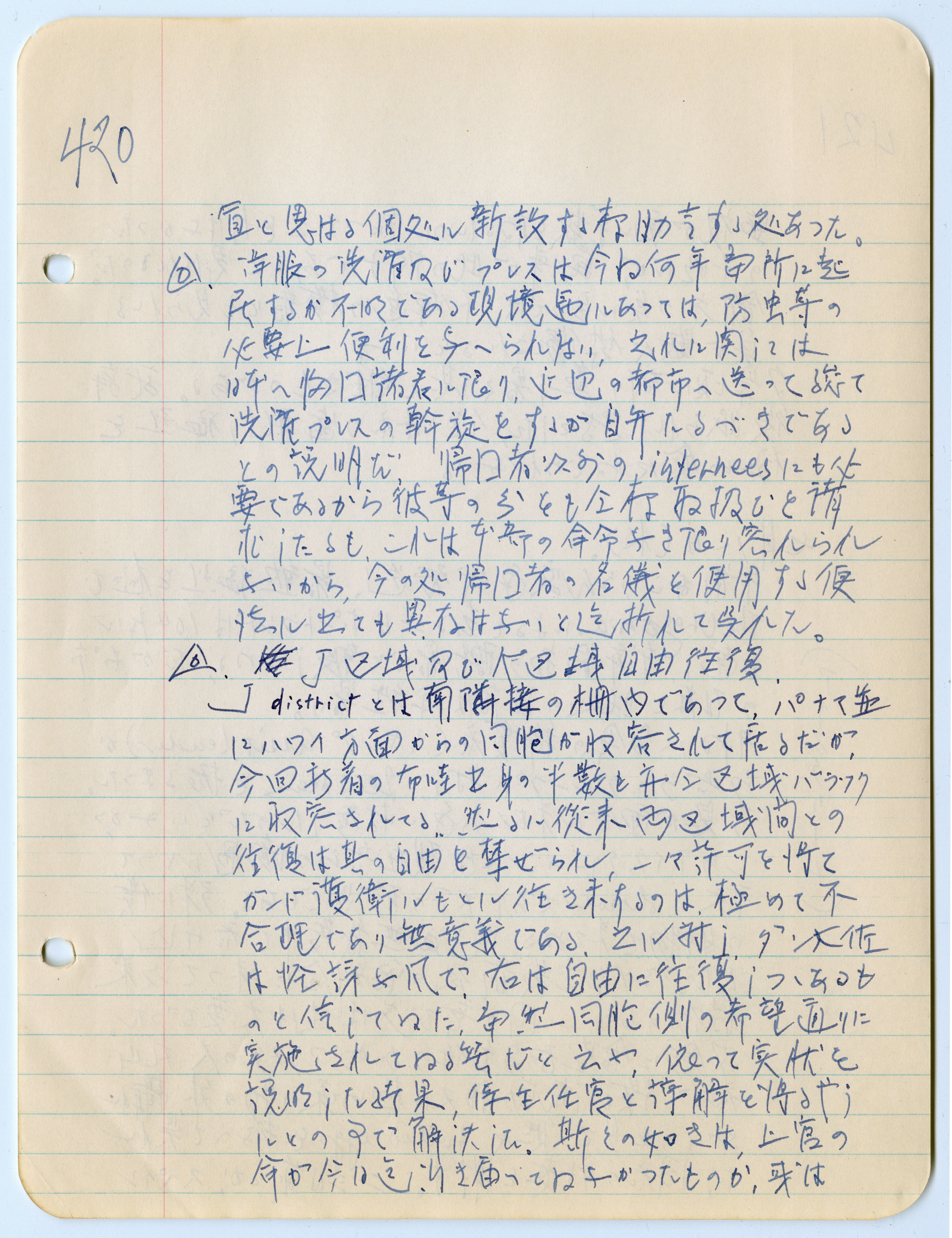
420
-
As for washing and pressing our clothes, we currently do not know how many more years we are to live in this facility, but we are not provided with any services for moth control reasons. The response is that the administration will arrange services provided by local vendors in the nearby cities for those who are scheduled to go back to Japan, but the cost should be covered by the customers. We requested the same arrangements to be made for the other internees as it is needed, but we were told that it is not possible without the approval of the headquarters.They offered a compromise that they will have no objections for us to use the name of the people who are going back to Japan to access such services.
-
As for free access between the J area and the K area, this is where fellow Japanese from Panama and Hawaii are interned, and a half of the newcomers from Hawaii this time are also interned in barracks in the same area. However, free access between the both areas is prohibited, and it is extremely meaningless and unreasonable to obtain permission from a guard every time we visit the other area back and forth.
-
Colonel Dunn seemed puzzled and told us that he believed the visiting back and forth freely between the areas was permitted, and it definitely should be allowed as we wish. After hearing about the current situation, he concluded that we should get approval from the supervising officer. I don’t know if the orders from the top management have not been delivered, or if it is taking the guards some time to execute the orders although they know what is expected.
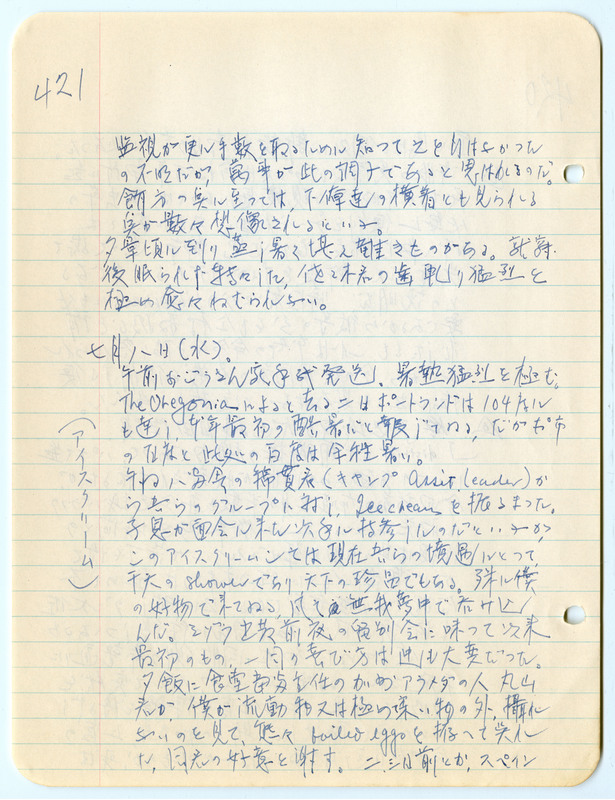
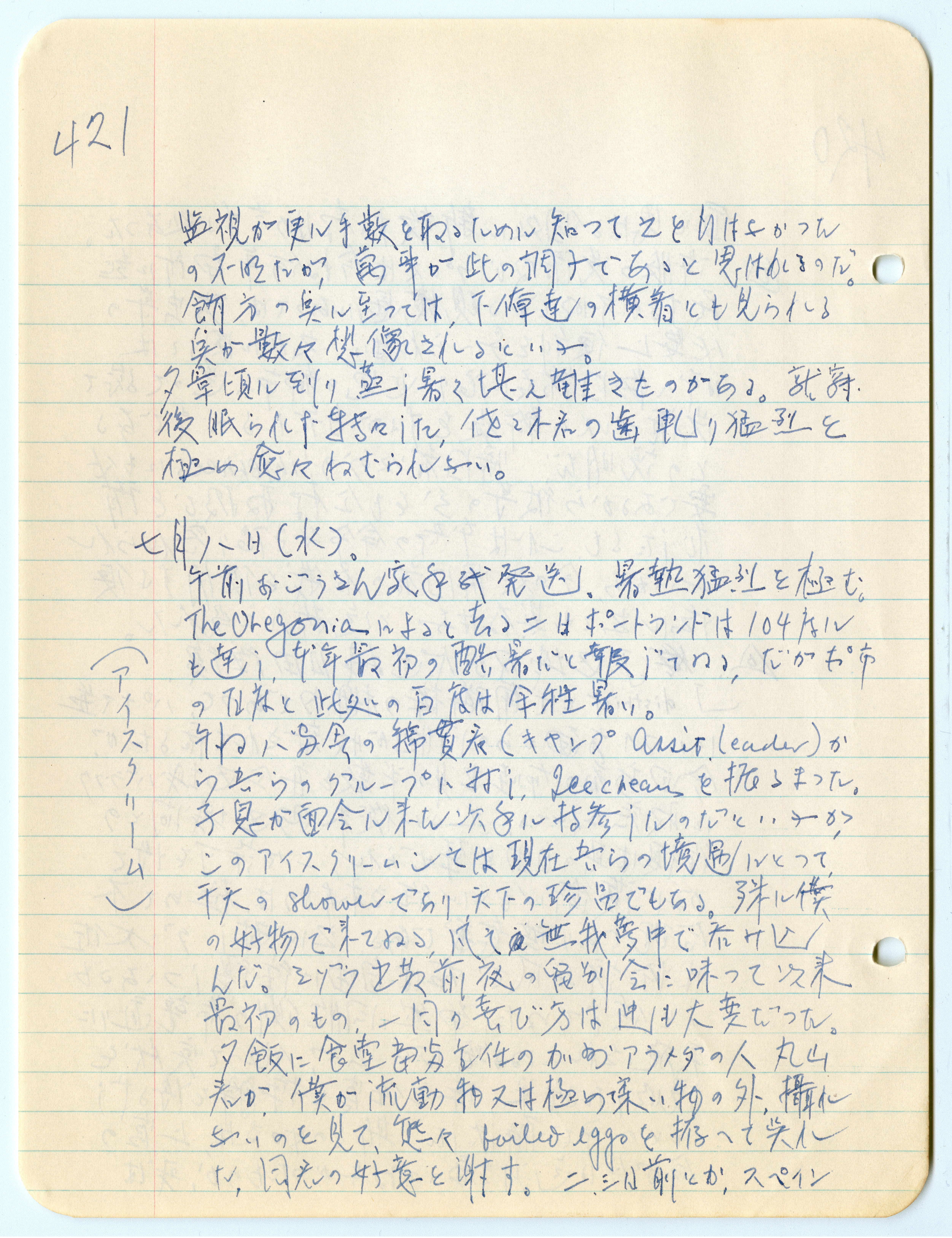
421
I would think this is typical though, and it is how things go here. We can also imagine some neglect made by lower rank officers. It got muggy and unbearable in the evening. I had a hard time falling asleep after I went to bed. Teeth grinding by Mr. Sasake made it harder to fall asleep.
[1] Uncertain what type of ratio is mentioned here
- Title:
- July 7, 1942 entry
- Creator:
- Sakaino, Bunro
- Date Created (ISO Standard):
- 1942-07-07
- Description:
- July 7, 1942, diary entry written by Bunro Sakaino while he was incarcerated at Camp Livingston, near Pineville, Louisiana.
- Subjects:
- concentration camps diaries
- Location:
- Camp Livingston, LA
- Source:
- MG 387, George Shihei Shitamae papers, Special Collections and Archives, University of Idaho Library
- Translator:
- Transcribed and translated by Naoko Tanabe, 2024-2025, of Densho (densho.org)
- Source Identifier:
- mg387_1_7-1942-07-07
- Type:
- Text
- Format:
- application/pdf
- Language:
- jpn
U of I Digital Collections contain unique digitized and born digital archival materials in a variety of formats. The Library is committed to ensuring our resources are accessible to all users. Please contact us if you need support accessing or using this archived content.
Contact us about this record Library Help- Citation:
- "July 7, 1942 entry", Bunro Sakaino Concentration Camp Diary, University of Idaho Library Digital Collections, https://www.lib.uidaho.edu/digital/sakaino/items/sakaino247.html
- Rights:
- In copyright, educational use permitted. Educational use includes non-commercial reproduction of text and images in materials for teaching and research purposes. For other contexts beyond fair use, including digital reproduction, please contact the University of Idaho Library Special Collections and Archives Department at libspec@uidaho.edu. The University of Idaho Library is not liable for any violations of the law by users.
- Standardized Rights:
- http://rightsstatements.org/vocab/InC-EDU/1.0/