
February 11, 1943 entry Item Info
February 11 (Thursday)
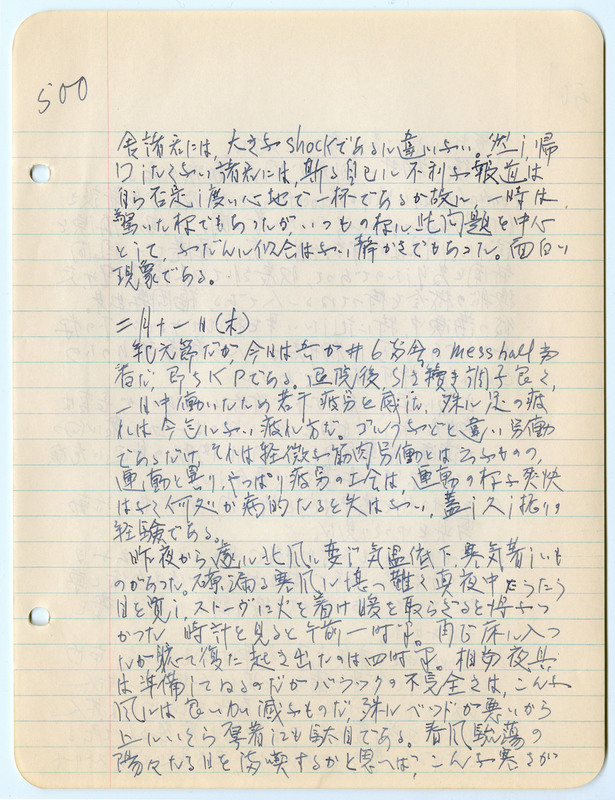
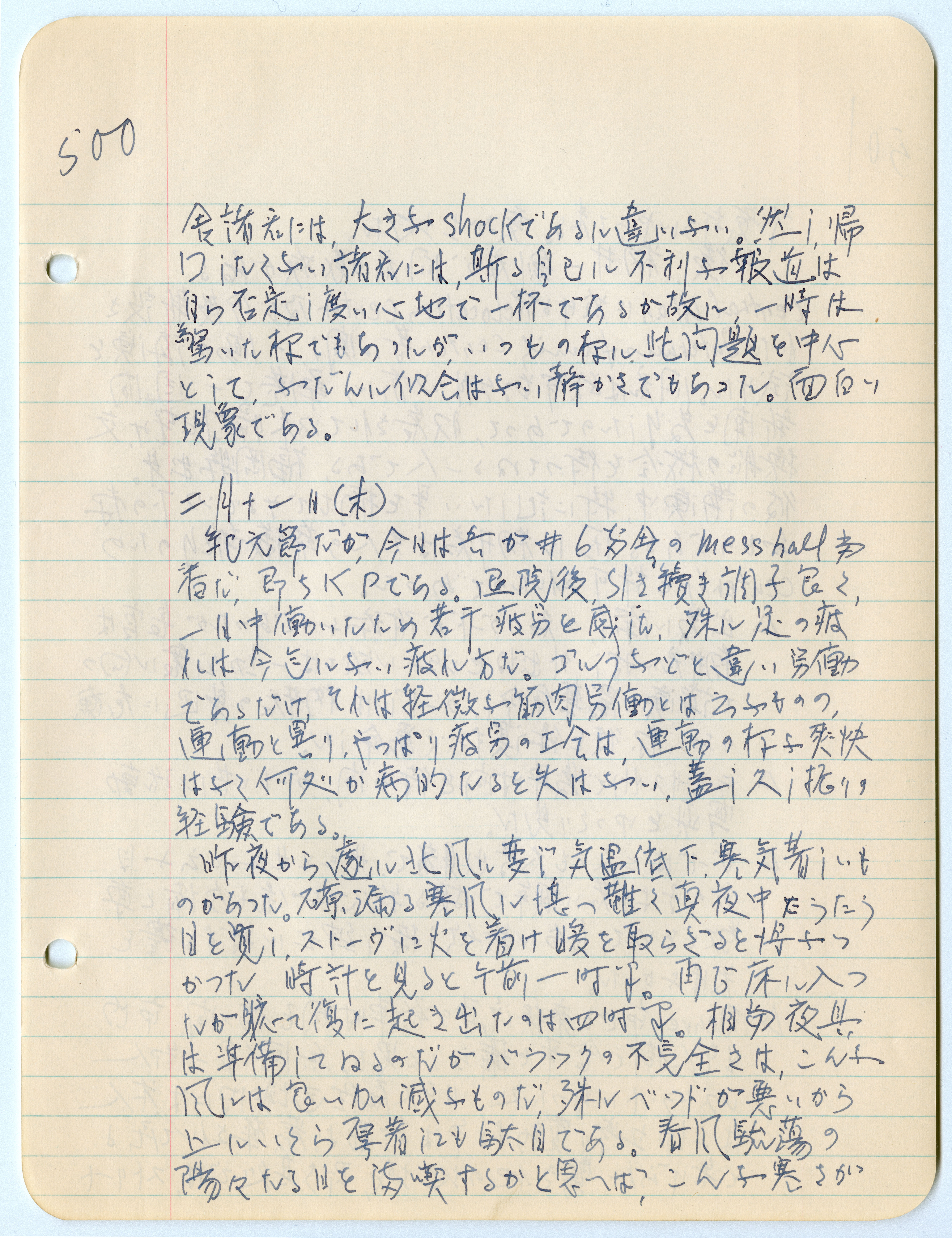
It is Emperor Day, but our sixth unit is in charge of the mess hall. I have been feeling well since being discharged from the hospital but got a bit tired after working all day. My legs feel especially tired as I have never felt before. Laboring is not like playing golf, and even though it only requires light movements of your muscles, the fatigue you feel is like something you would feel when you are sick, not like refreshing feelings you get after exercising. I have not felt this for a while.
Wing shifted blowing from the north last night, lowering the temperature and bringing extremely chilly weather. I woke up with the cold wind coming in through the cracks and had to turn on the stove and warm up. I looked at the clock, and it was 1:30 a.m. I went back to bed but got up at 4:30 a.m. I have a lot of bedding for me, but this is how badly these barrakes are built. Our beds are especially poorly built, and layers of beddings on top do not help. We enjoy sunny days with spring breeze, and such chilly weather hits us all of a sudden. It is a strange place.
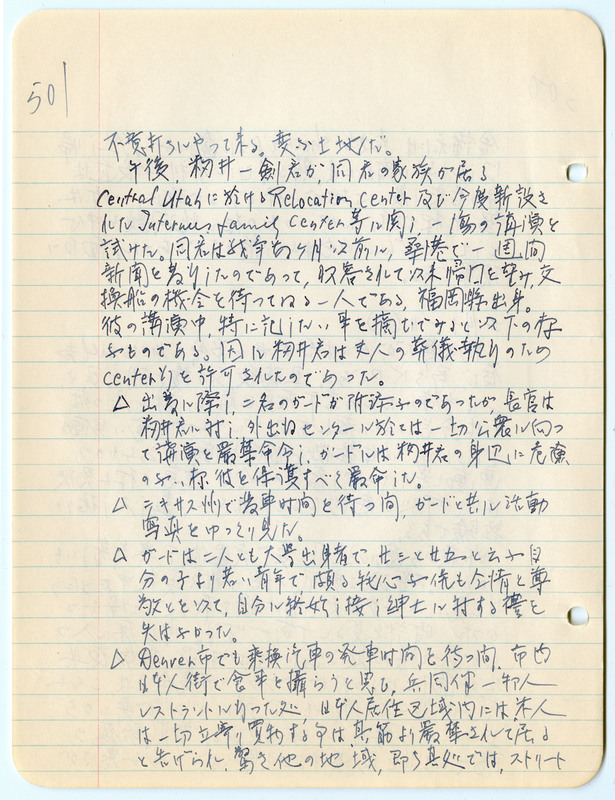
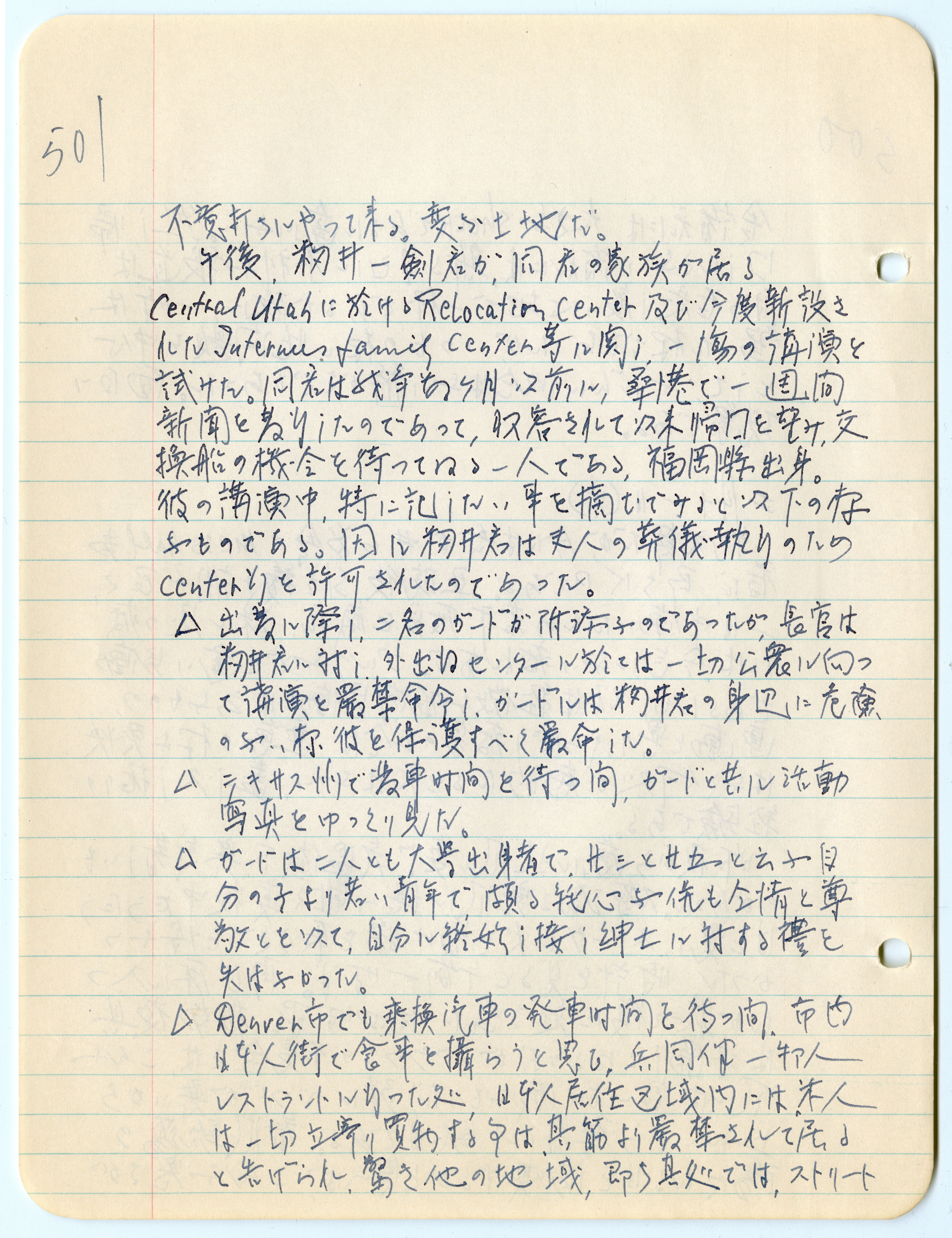
501 Mr. Ikken Momii had a talk this afternoon about the relocation center [1] in central Utah where his family is incarcerated and the newly-constructed internees family center. He published a newspaper in San Francisco for one week several months before the war started. He wishes to return to Japan since he was detained and is one of the people who have been waiting for an opportunity to be on an exchange boat. He is from Fukuoka Prefecture. I listed some bullet points from his talk below. He was permitted to go to the center to hold a funeral for his wife.
-
Two guards were assigned to accompany Mr. Momii, and the captain strictly ordered him not to speak publicly in the center after he leaves. The guards were ordered to eliminate any danger around him and protect Mr. Momii.
-
He had plenty of time to watch a movie with the guard when they were waiting for the train to depart in Texas State.
-
Both guards are college graduates, and one is 23 years old and the other is 25. They are both younger than his children, and they maintained sympathetic and respectful attitudes toward him, treating him as a gentleman.
-
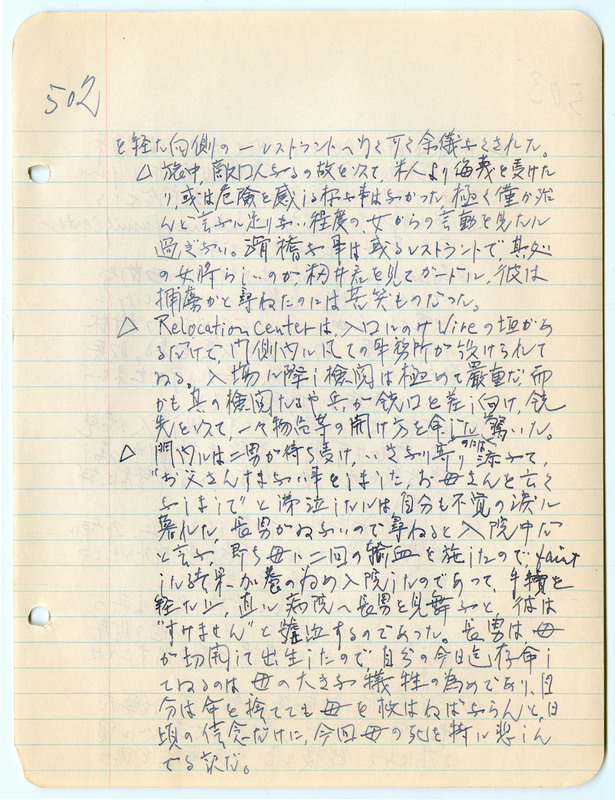
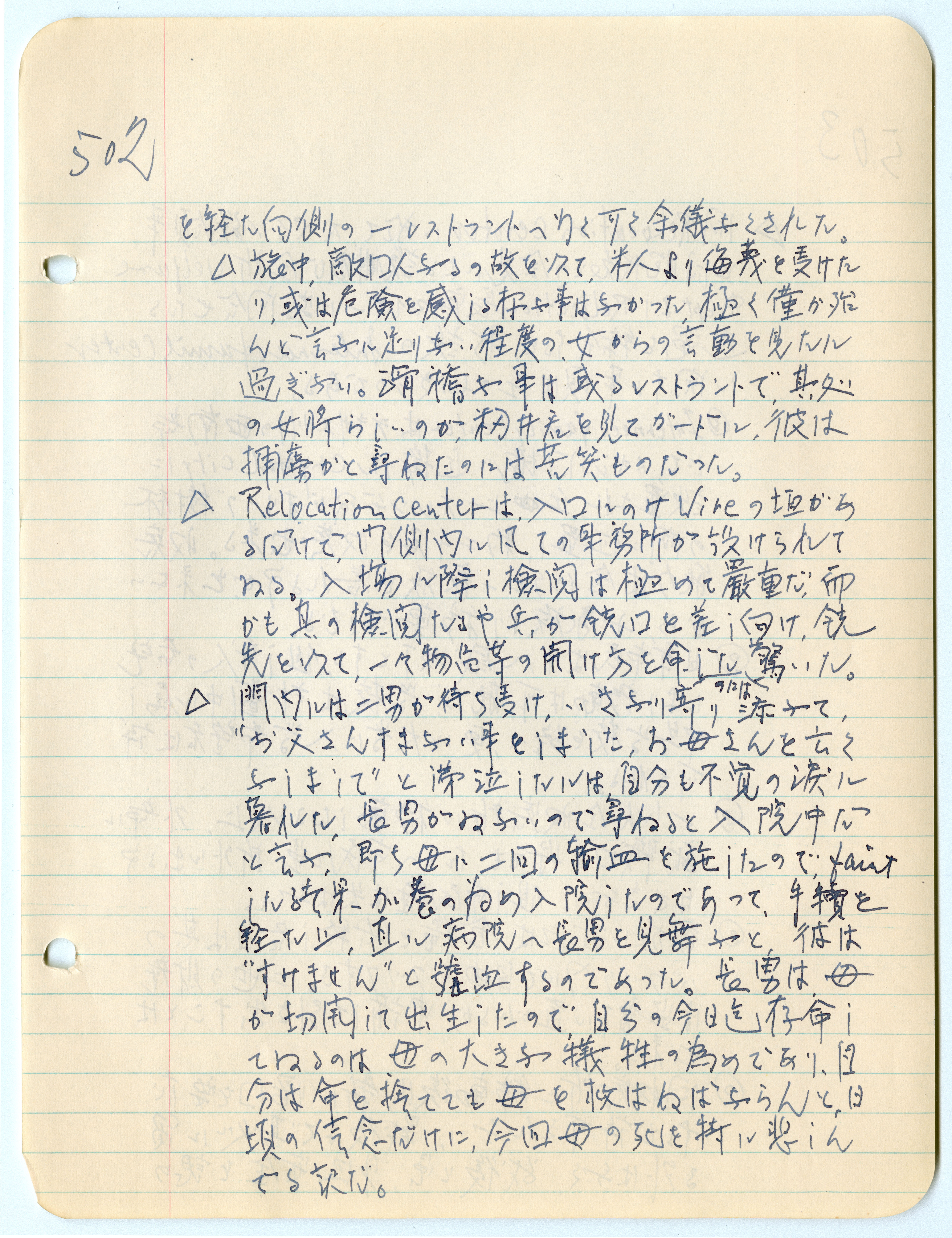
He wanted to have a meal in Japantown in the city of Denver while they were waiting for the train. He was told that Americans are not strictly prohibited to shop in Japanese residential areas by the authorities when he went to a Japanese restaurant with the American guards.
502
-
He was surprised but did not have any other options but to go to another restaurant across the street.
-
He never encountered any discrimination by Americans or felt any danger as he is an enemy alien. All he saw were small and frivolous remarks made by women. What is funny is that the female owner of the restaurant asked the guards if he was a war prisoner, and that gave him a bitter smile.
-
The relocation center has a barbed-wire fence only in front, and all the office buildings are in the campus. The inspection upon entering is strict. He was surprised to have soldiers pointing guns at him, ordering him to open each item he brought, pointing at them with the tip of their gun.
-
His second son was waiting for him inside of the gate. The son ran to him crying and said, “I am sorry, father. We lost our mother.” He could not help shedding tears. He did not see his eldest son and asked about him. He was told the son was hospitalized. He fainted as he underwent two sessions of blood transfusion for their mother., and they admitted him just to be safe. Mr. Momii finished checking in and visited his eldest son at the hospital. The son cried bitterly and said, “I am sorry.” The eldest son was born by caesarean section and thinks he owes his life to her huge sacrifice. He always thought it is his duty to save her even with his own death, and her death this time is especially painful for him.
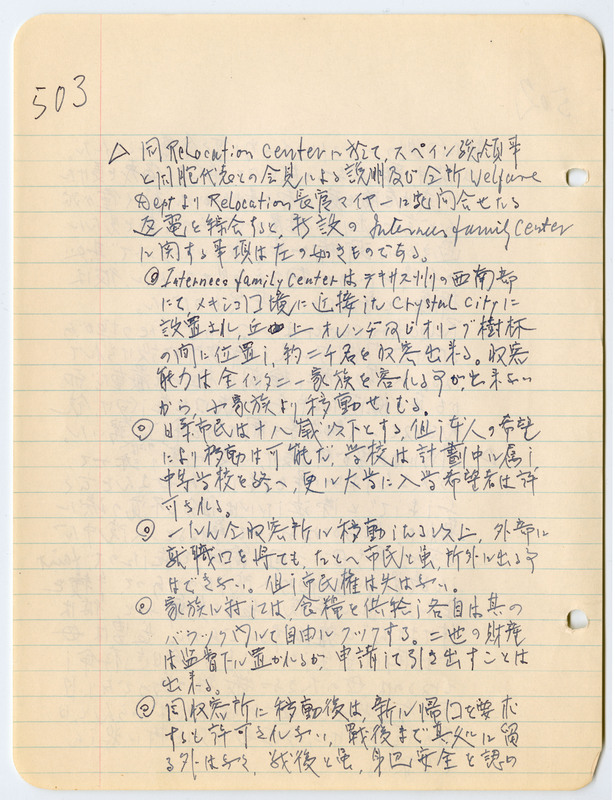
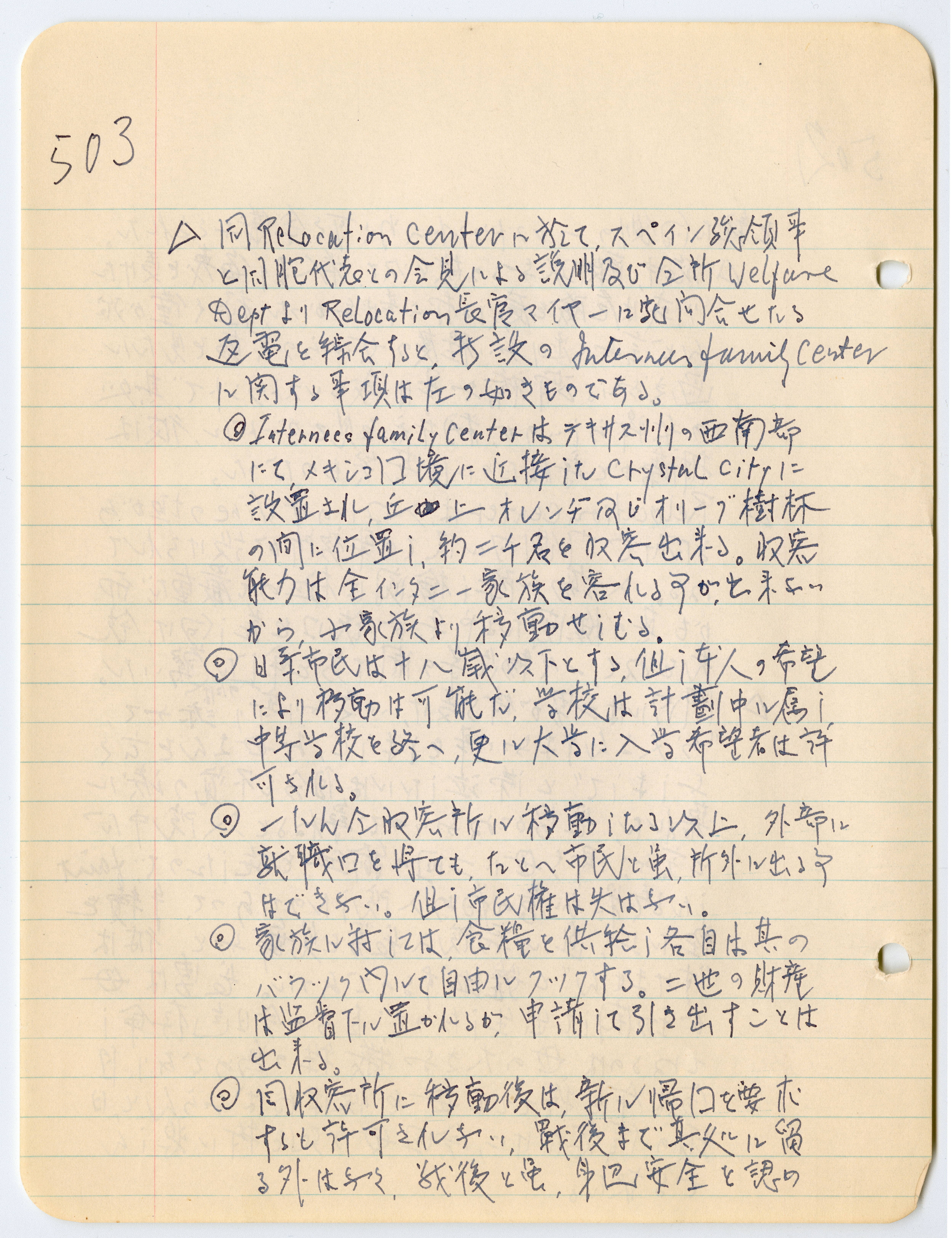
503
Below is a summary of what Consul-General of Spain and Japanese representative reported in a session they held at the relocation center [2], as well as response from the Relocation Director Myer [3] to the questions sent by the Welfare Department regarding the newly-constructed internee family center.
-
The internee family center is located in Crystal City near the Mexico border in the southwest region of Texas State. The facility is situated among orange and olive trees on a hill and has capacity to hold approximately 2,000 people. Small families are to be transferred first as the number of all the internees and their family members exceed its maximum capacity.
-
Japanese Americans under age 18 will be accepted, but they are also allowed to move to a different location if they wish. School system is included in the plan, and high school graduates will be allowed to attend college if they wish.
-
Once transferred to the camp, it is not allowed, U.S. citizens or not, to leave even with a job offered outside of the camp.
-
Each family is to be provided with food for them to freely cook in the barracks. Personal properties owned by nisei will be under control of the administration and can be withdrawn by submitting a request.
-
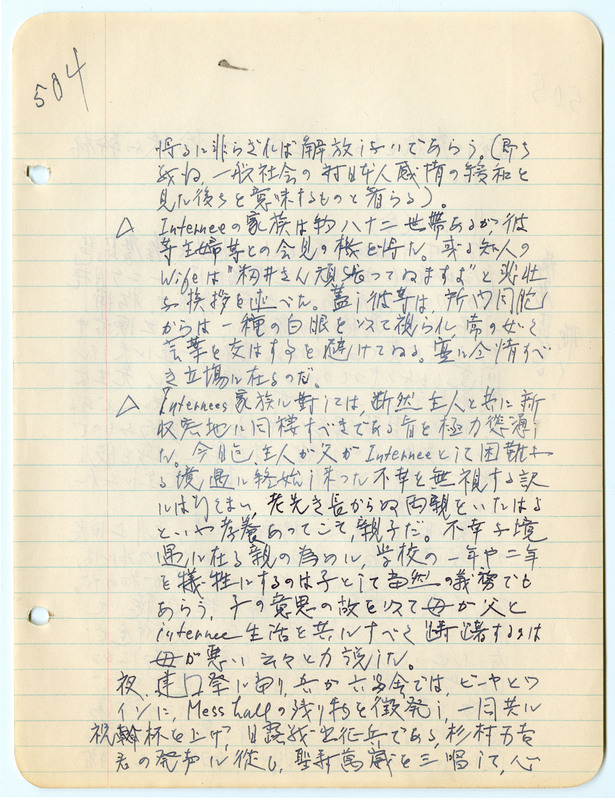
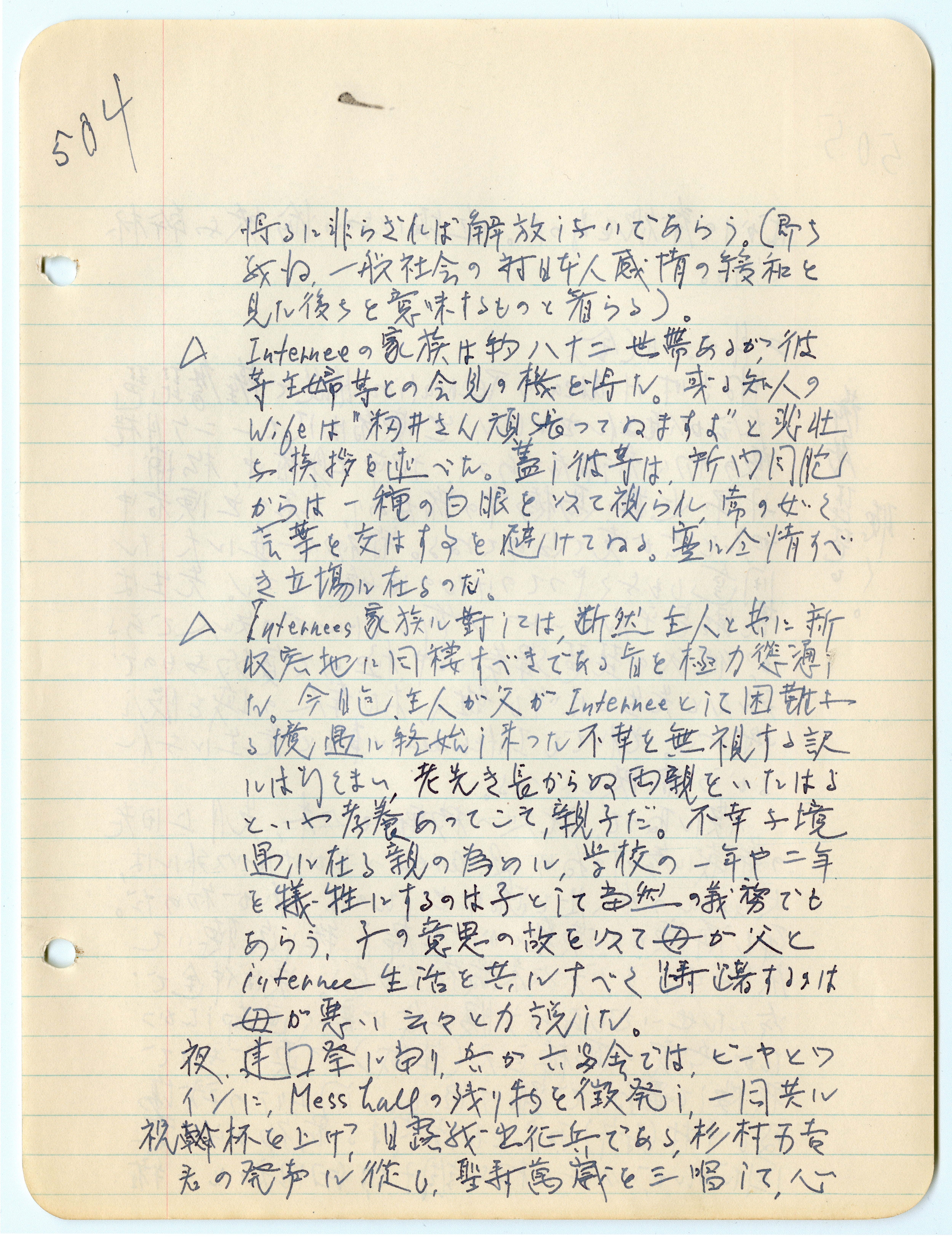
It is not allowed to request to go back to Japan after being transferred to the camp, and the only option is to stay until the war is over. Release from the camp is not expected until security is confirmed.
504
-
(This probably means they are to be released after hostility against Japanese subsides in public society)
-
There are about 82 families of internees, and we had an opportunity to meet with some of the wives of the households. The wife of someone we know said, “Mrs. Momii is hanging in there”, and it is a pitiful speech. They are somewhat discriminated against among the fellow citizens in the camp and usually avoid talking to the other people. I am very sympathetic about the situation they are in.
-
I empathize that the family of the internees should be reunited with their husbands in the new facility. They cannot dismiss the misfortune of their husband and father who has been in a difficult situation as internees. Taking care of elderly parents for a little left of their lives is what a parents and children relationship is all about. It naturally is a duty of a child to sacrifice one of two years of schooling for the parents going through hardship. It is the mother’s fault if she hesitates to reunite the interned father because the children do not want to. I tried hard to convince them.
We managed to get beer, wine and some leftovers in the mess hall to celebrate the Emperor’s Day in the sixth unit at night. We made a toast and gave three banzai cheers to wish longevity for his majesty led by Mr. Bankichi Sugimura who served in the Russo-Japan war.
505
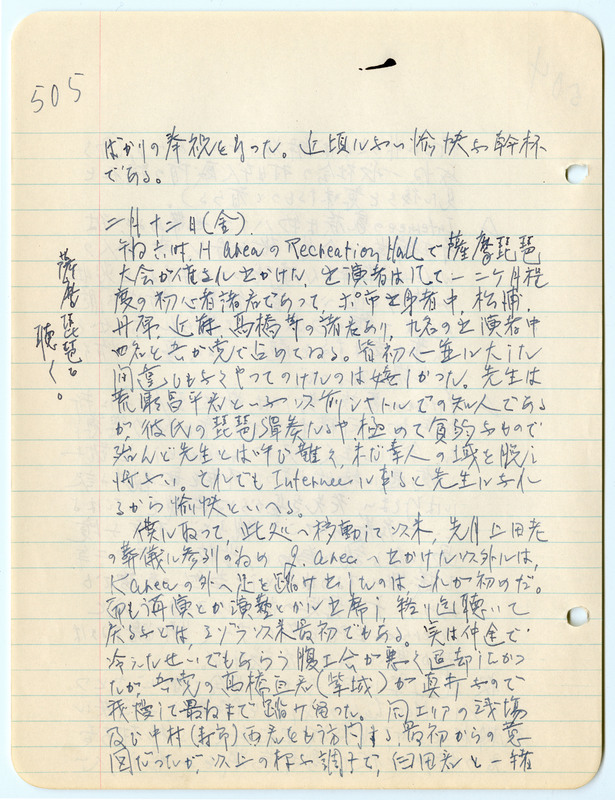
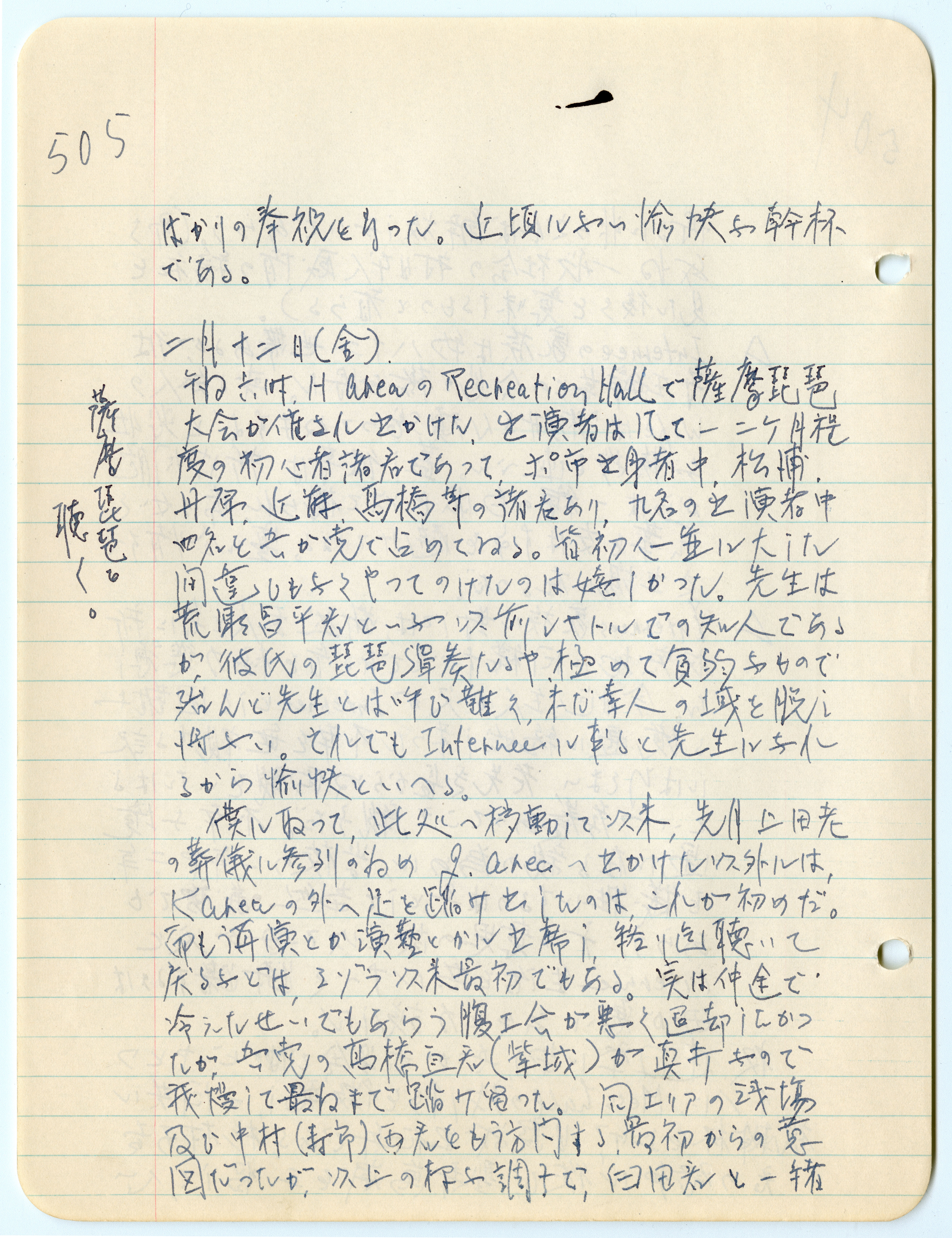
It was the first cheerful toast we had since a while ago.
[1] This is the term used by the author
[2] This is the term used by the author
[3] Director of the War Relocation Authority Dillon Myer
- Title:
- February 11, 1943 entry
- Creator:
- Sakaino, Bunro
- Date Created (ISO Standard):
- 1943-02-11
- Description:
- February 11, 1943, diary entry written by Bunro Sakaino while he was incarcerated at Camp Livingston, near Pineville, Louisiana.
- Subjects:
- concentration camps diaries
- Location:
- Camp Livingston, LA
- Source:
- MG 387, George Shihei Shitamae papers, Special Collections and Archives, University of Idaho Library
- Translator:
- Transcribed and translated by Naoko Tanabe, 2024-2025, of Densho (densho.org)
- Source Identifier:
- mg387_1_7-1943-02-11
- Type:
- Text
- Format:
- application/pdf
- Language:
- jpn
U of I Digital Collections contain unique digitized and born digital archival materials in a variety of formats. The Library is committed to ensuring our resources are accessible to all users. Please contact us if you need support accessing or using this archived content.
Contact us about this record Library Help- Citation:
- "February 11, 1943 entry", Bunro Sakaino Concentration Camp Diary, University of Idaho Library Digital Collections, https://www.lib.uidaho.edu/digital/sakaino/items/sakaino408.html
- Rights:
- In copyright, educational use permitted. Educational use includes non-commercial reproduction of text and images in materials for teaching and research purposes. For other contexts beyond fair use, including digital reproduction, please contact the University of Idaho Library Special Collections and Archives Department at libspec@uidaho.edu. The University of Idaho Library is not liable for any violations of the law by users.
- Standardized Rights:
- http://rightsstatements.org/vocab/InC-EDU/1.0/