
March 25, 1942 entry Item Info
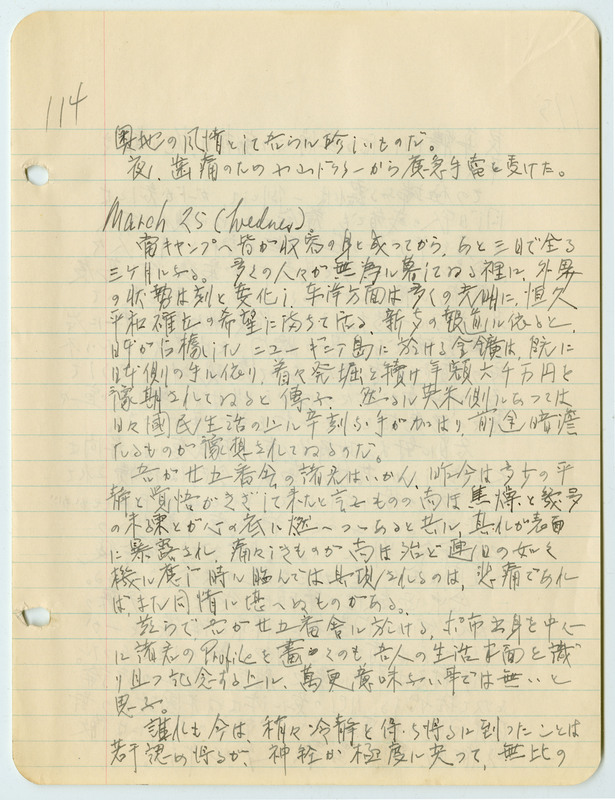
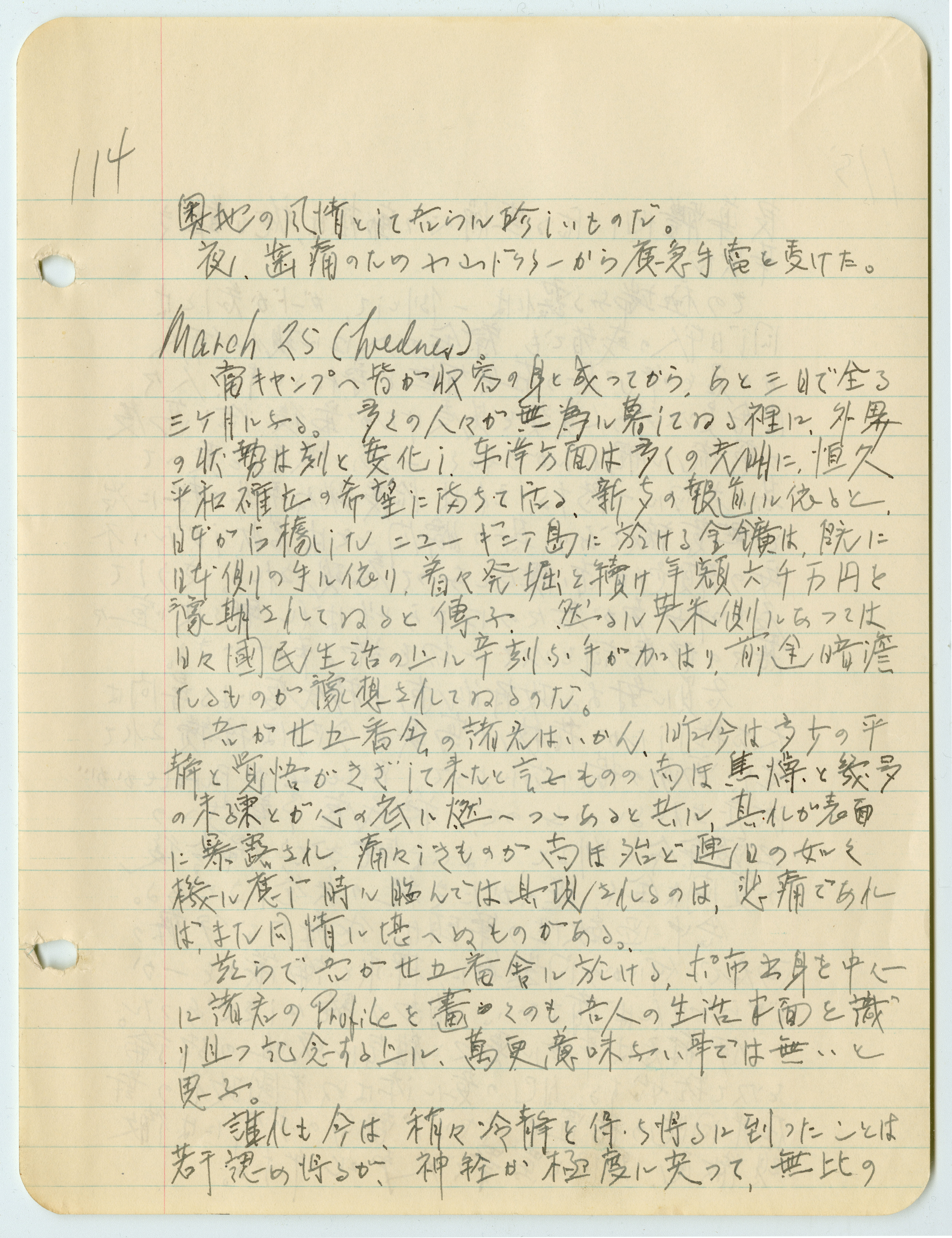
March 25 (Wednesday)
It will be a full three months since we all were incarcerated in this camp in three days. While a lot of people here were living without any purpose, the world outside the camp is constantly changing, with bright achievements made in the East filled with hopes for permanent peace established in the region. According to the newspaper, Japan occupied a gold mine in New Guinea, and it is reported that steady mining is continuing under its control and expected to yield 60,000,000 yen annually. However, hardship is casting upon the lives of its people in the nations on the U.S. and British sector, and a dark future is forecasted for them.
I’m not sure about my fellow residents of the 25th barracks. They are gaining a certain level of calmness and endurance, but at the same time, frustration and the feeling of missing life is boiling up at the bottom of our hearts. Those feelings surface and burst, and it is such a pity to have them explode on occasions day after day. I cannot help feeling sorry for everyone.
I do not find it a pointless endeavor to write up a profile of fellows in the 25th barrack mainly from Po [1] City to record and celebrate their lives.
I could see that everyone finally learned to maintain the calmness, but we are still extremely restless,
115
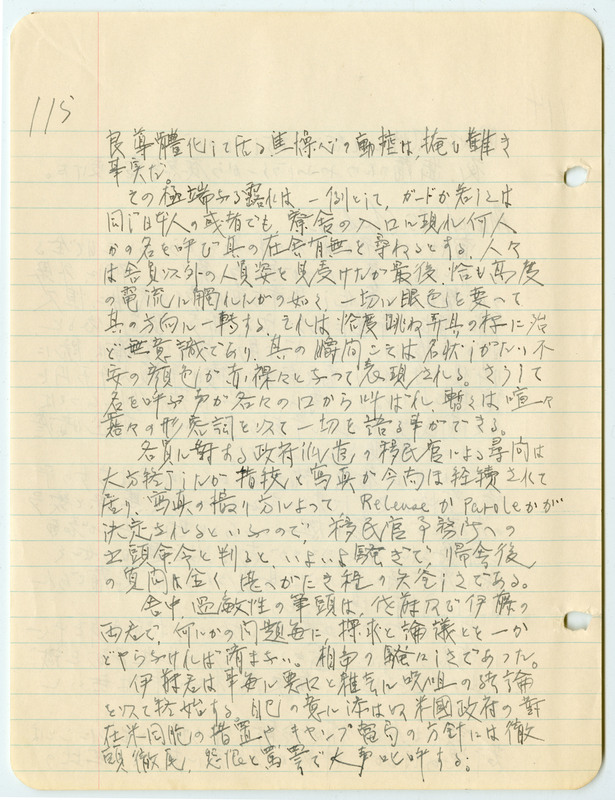
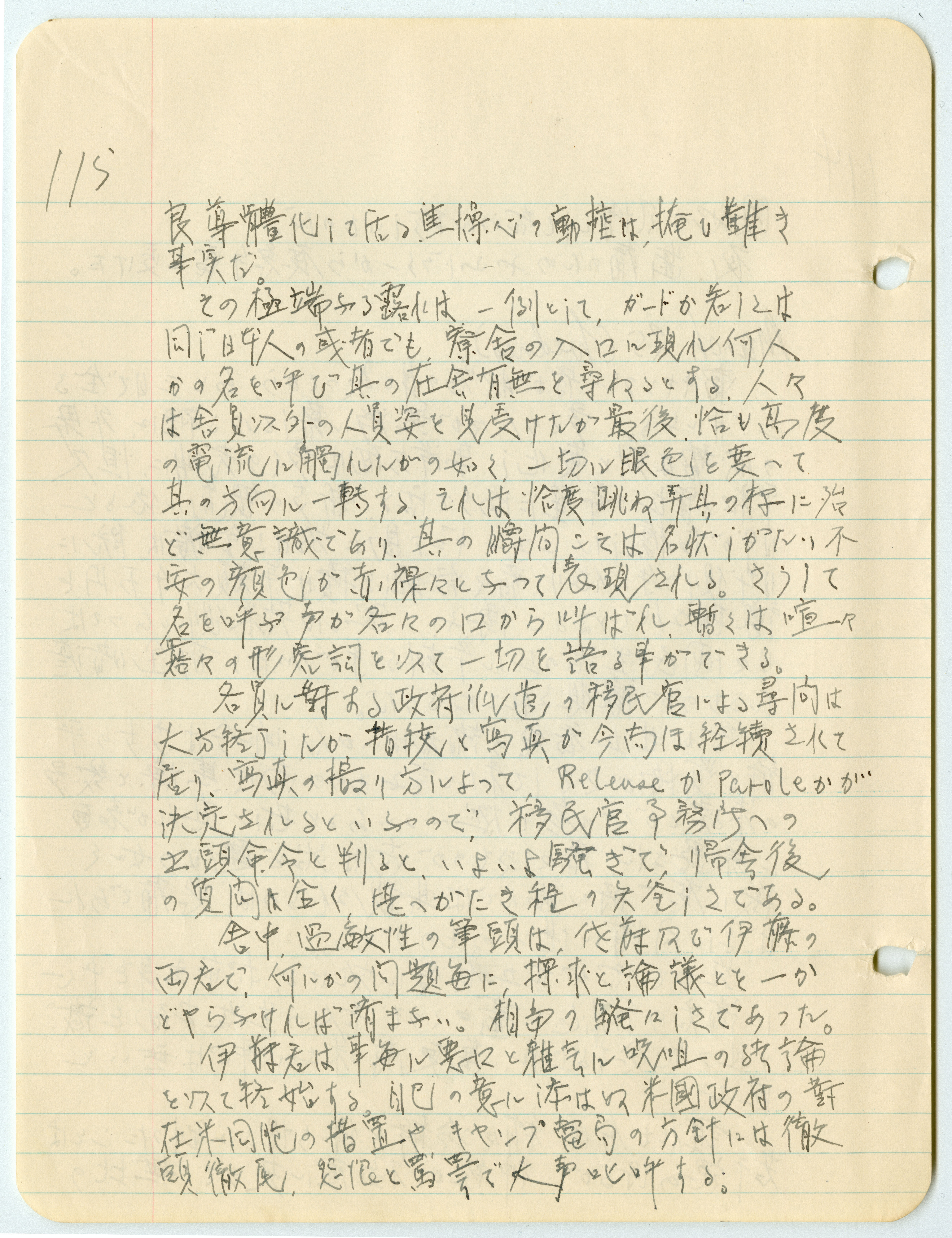
and it is undeniable that frustration spreads as if traveling through an electrical conductor.
One extreme example of how it bubbles up is to imagine a guard or a fellow Japanese person coming to the door of the barrack and calling the name of several people to ask if they are in the barrack. As soon as people see another person besides their fellow residents, the expression of their face immediately changes, and they all turn their head in the direction as if high volt electricity touched them. It is almost an unconscious movement as springs jump up, and indescribable insecurity clearly appears on the faces at that moment. Then, the names are yelled by each one, and chaotic is the adjective to describe what would go on after that for a while.
Investigation of each internee by immigration officers has been almost completed, but fingerprinting and photo taking is still being conducted. It is said that the way someone’s photo is taken determines if he receives release or parole recommendation, and it causes commotion when someone receives an order to report to the immigration office. It is unbearably noisy with questions asked after he comes back to the barrack from the office.
The most intense in the barracks are Mr. Sato and Ito, and they cannot help deeply examining and arguing over every single issue. They make a fairly high level of noise. Mr. Ito insists on his ill-spoken remarks, negative comments and his own dreadful opinions from the beginning to the end. He relentlessly shouts out his deep anger and abusive verbal attacks toward the treatment of the fellow Japanese citizens living in the States by the U.S. government and the policy of the camp authority.
116
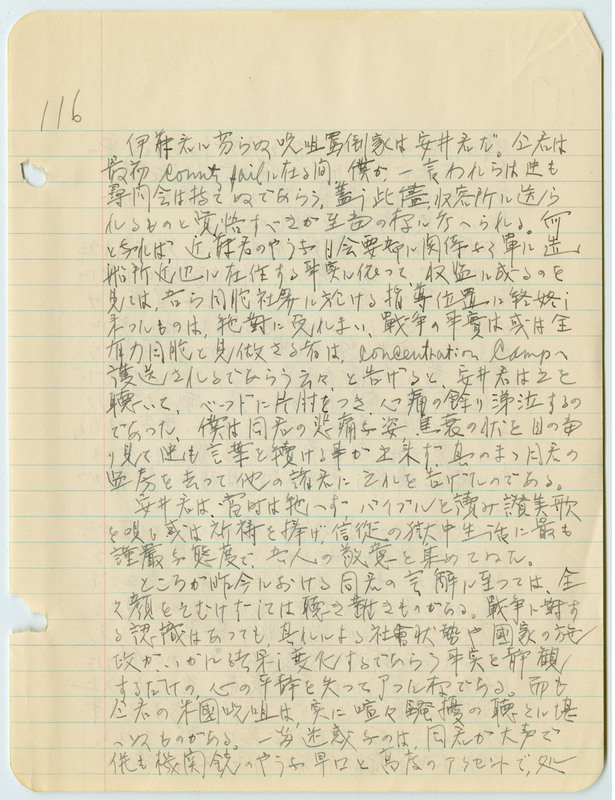
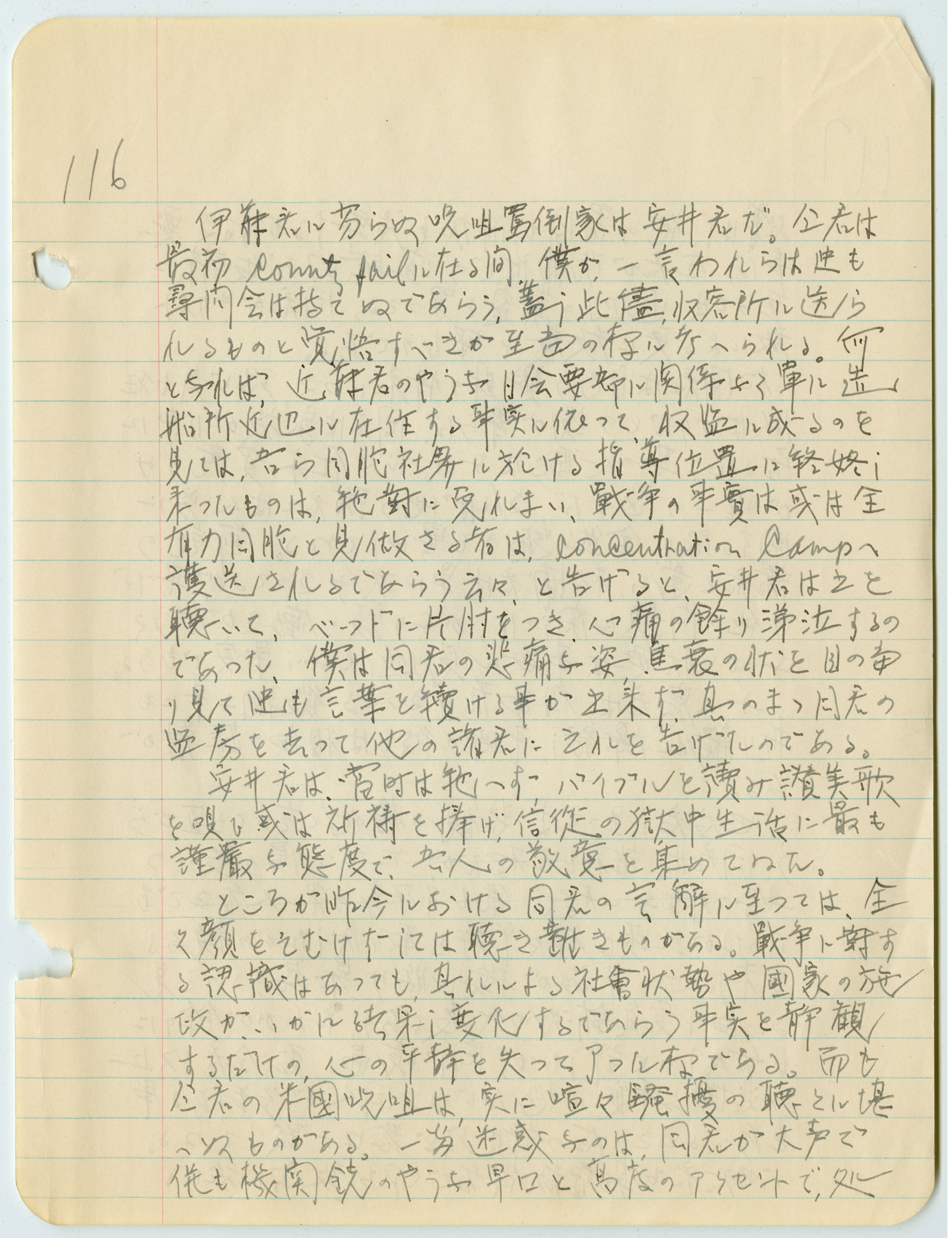
Another figure as angry and bad-mouthed as Mr. Ito is Mr. Yasui. This person could never have had a hearing while he was in a county jail if I had not said anything. I imagine he should have been prepared to be sent directly to a camp. He was detained due to the fact that he lived nearby a military shipyard regardless of his relationship to the management of Japanese associations. Therefore, it is definitely inevitable [to be sent to a camp] for those who have been continuously serving in leadership positions in our fellow community. The fact of war is that all the fellow citizens in power are to be sent to a concentration camp. Mr. Yasui put one elbow on the bed and shed his tears when I said that to him. I did not have a word to continue our conversation when I saw how sadly hurt and exhausted he was in front of me. I just left his unit and told other fellows how he was.
Mr. Yasui was constantly reading the Bible, singing hymns and praying and was respected by us all for his solemn attitude. However, his recent remarks are hard to hear without our faces turned away from him. He is aware of the war, but he has lost the calmness of his mind to quietly observe the changes of social situation and national governance caused by the war. On top of that, his cursing against the U.S. is loud and vulgar and is unbearable to hear. Worst of all is his horrible voice when he loudly speaks with a thick accent with the speed of a machine gun no matter where he is as if he is forcing others to agree or to add. His loud and sharp tongue in the bathroom is receiving disgust from people around him.
117
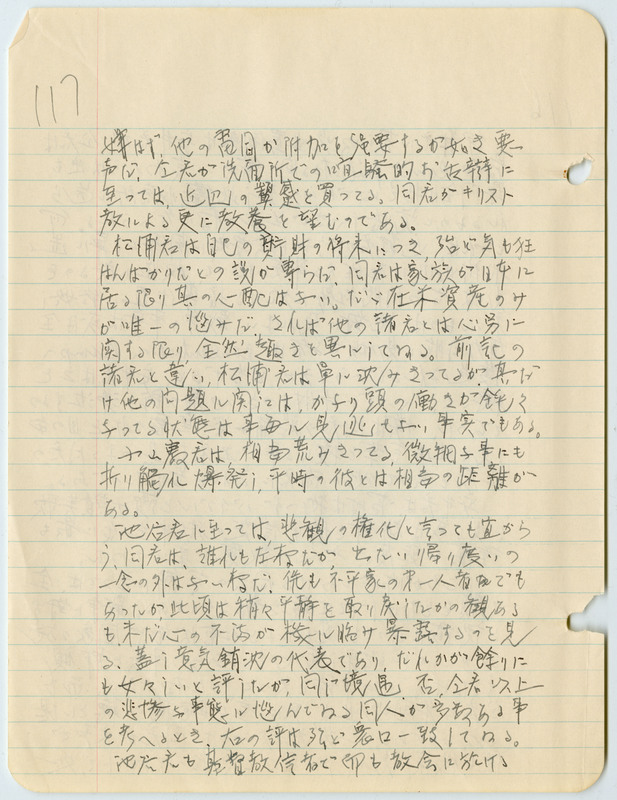
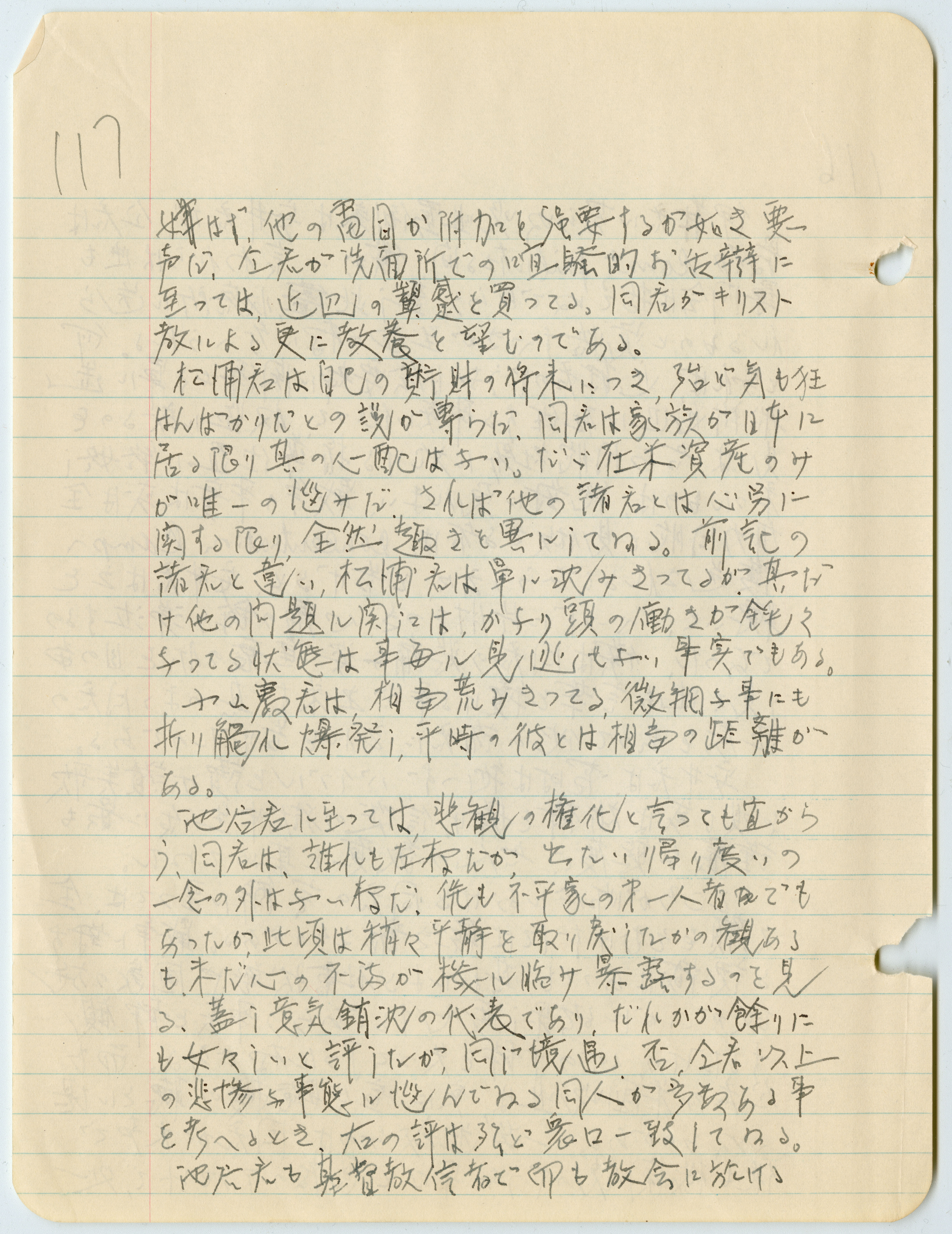
I am hoping for further Christianity education provided to him.
It is widely said that Mr. Matsuura is almost losing his sanity over the future of his assets. He does not have anything to worry about as long as his family is living in Japan. The only issue for him is his assets in the U.S. His worry is totally different from the other fellows. Unlike the fellows mentioned above, Mr. Matsuura is simply depressed, and because of that, it is an apparent fact that he has a decreased ability to deal with other issues.
Mr. Gen [2] Koyama is quite distressed. He explodes over tiny issues, and the personality is distanced far from who he normally is.
As for Mr. Iketani, I can say he is a total pessimist. He does not have any other desires but to get out and go back as anyone else wishes. He was one of the loudest complainers, but it seems that he is regaining the calmness of his mind. However, I still witness his frustration burst up on occasions. He is the most depressed, and someone criticized him for being too wimpy. That is what everyone agrees with considering so many people are in a similar situation or even suffering from worse issues than he is. Mr. Yasui is also a Christian and one of the most important church members, but he does not have enough faith yet just like Mr. Yasui.
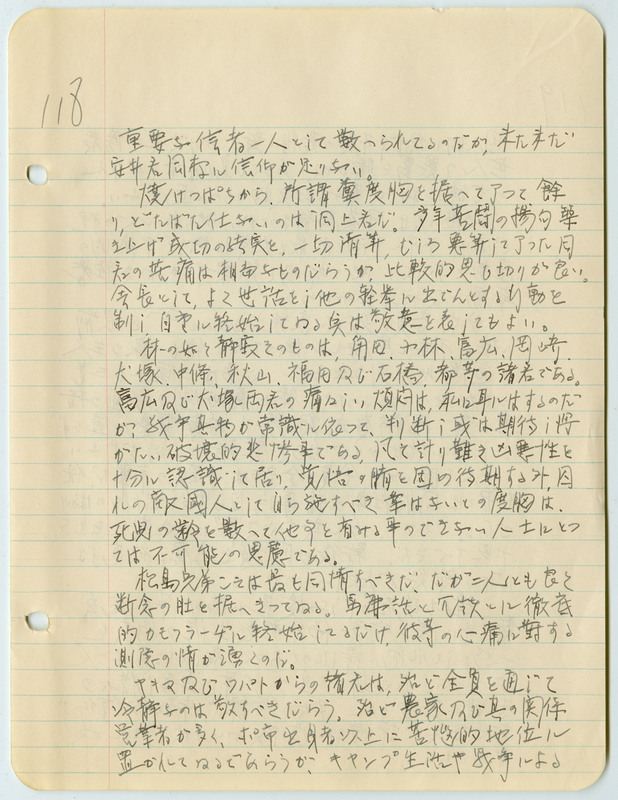
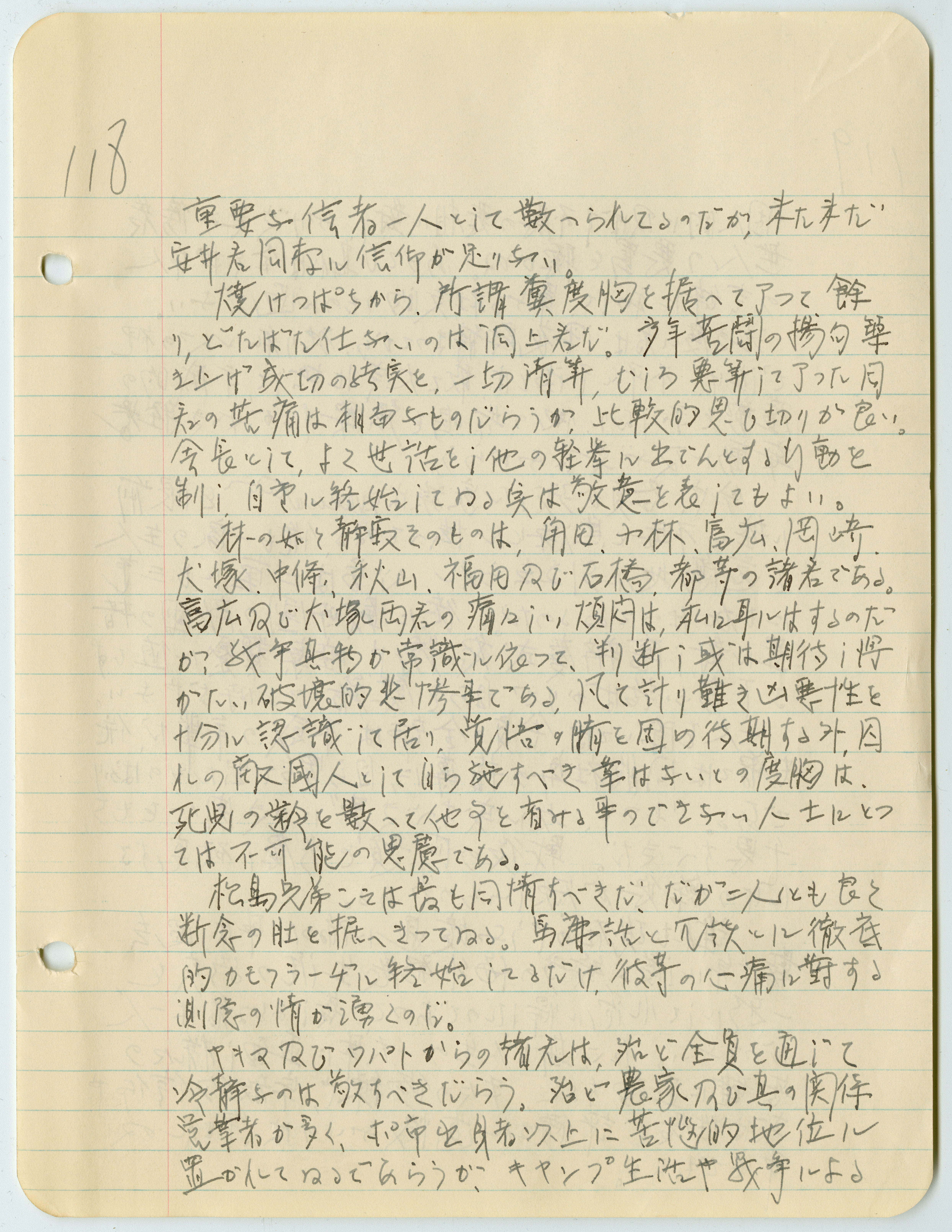
118
It is Mr. Horagami [3] who did not get agitated after he gave up on it and gained a strong mentality. He got rid of, or rather lost in an awful situation, everything his success brought to him after struggling for many years. His suffering must be more than we can imagine, but he is relatively good at letting it go. He takes good care of the others as the representative of the barrack, keeping reckless actions by the others at bay and constantly controlling himself. I would respect that.
Kadota [4], Kobayashi, Tomihiro, Okazaki, Otsuka, Nakajo, Akiyama, Fukuda and Ishibashi and Tsuzuki [5] are as quiet as woods. I heard of both Mr. Tomihiro and Otsuka’s sufferings full of pain, but war itself is a destructive disaster that we cannot possibly judge by our common sense. They are fully aware of the unmeasurable viciousness of the war and made up their mind that there is nothing else for detained enemy aliens to do but to stay put. This mindset is impossible for those who are not able to deal with anything else but counting the age of the deceased child.
The Matsushima brothers are to be the most sympathized. However, both are good at letting things go. As they constantly camouflage [their sufferings] with jokes and silly stories, and that makes my imagination deeper over the pains they are holding in their hearts.
Almost all the fellows from Yakima and Wapato are respectable for his calmness. Almost all of them were engaged in agriculture or other related businesses and are probably in a more difficult situation than people from Po [6] City.
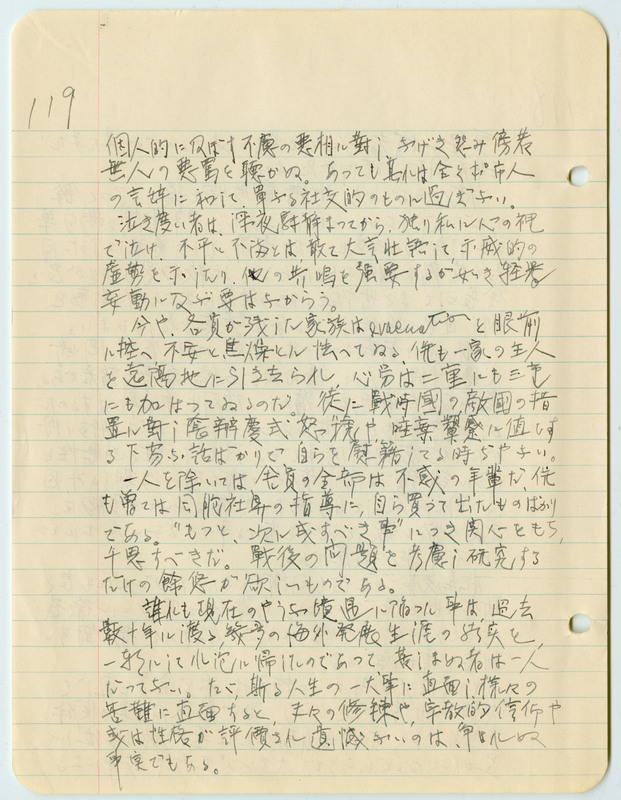
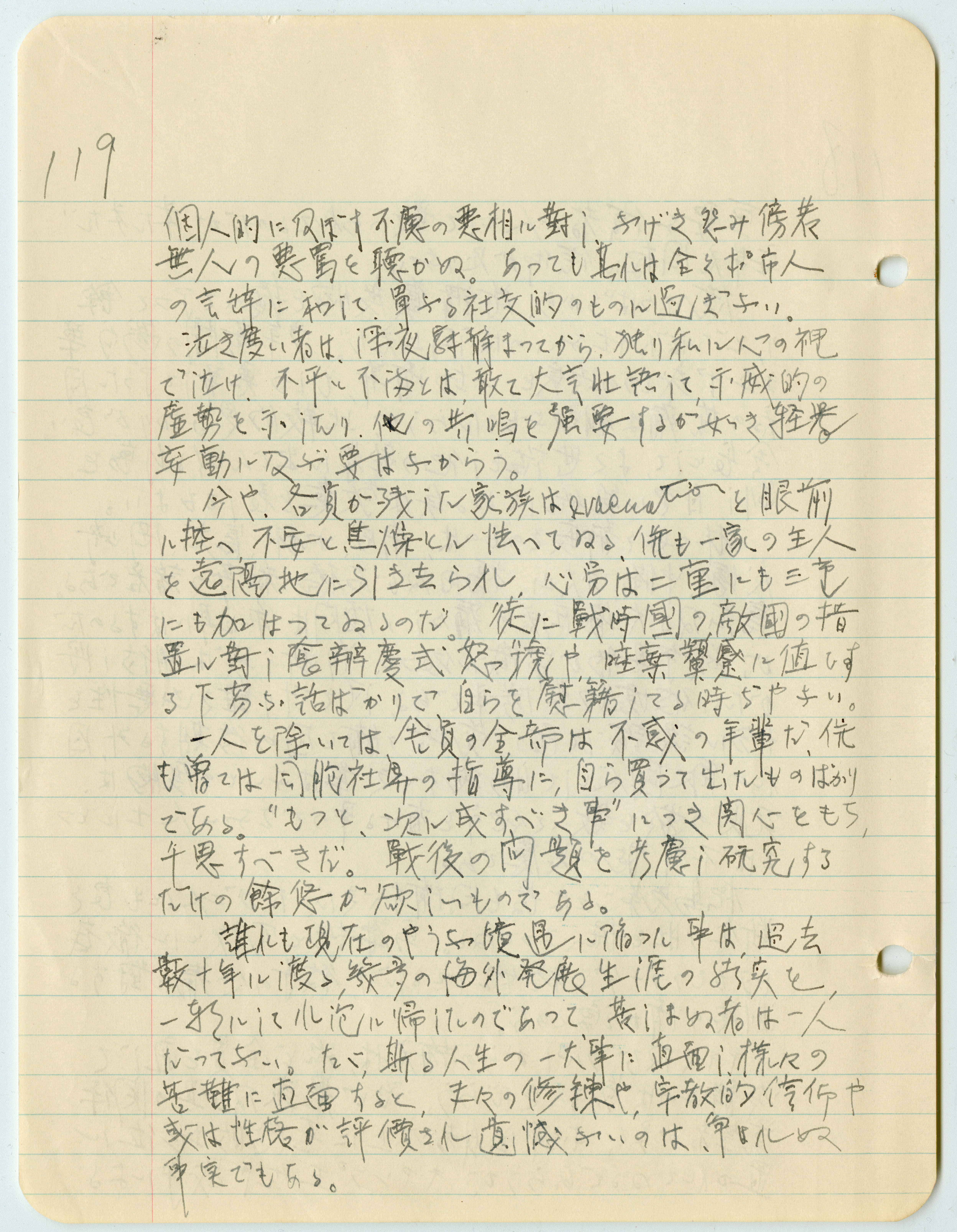
119
However, they do not express sorrow or anger or make harsh remarks without any consideration for others, either over a life in the camp or unexpected disturbance upon individuals caused by the war. Even if they do, that is merely social comments to go with remarks made by the people form Po [7] City.
If someone wants to cry, he should cry by himself in the middle of the night after everyone has gone to sleep. It does not seem to be necessary to make dramatic speeches, show of bluff or ill-considered actions to force agreement from others.
Family members each of us left behind are now facing evacuation with fear, insecurity and frustration. They all had the head of the household taken away to a faraway location and are bearing double and triple-fold sufferings. Aimlessly, rumors about the treatment of enemy aliens during wartime are all disgraceful, and it is not time to try to comfort ourselves. Everybody but one in this barrack is over 40. All of us have been volunteering to assume leadership positions in the fellow citizen community. We should give our deep thoughts to “next actions we should take”. I would like to have some space in our time and mind to contemplate and study future issues after the war.
Everyone who fell into the current situation lost all he has accomplished through life with many overseas endeavors in vain. There is no one who is not suffering. However, it is an unarguable fact that our mindset, religious faith and personality is openly evaluated when we have the biggest difficulty in our lives and face various challenges.
200
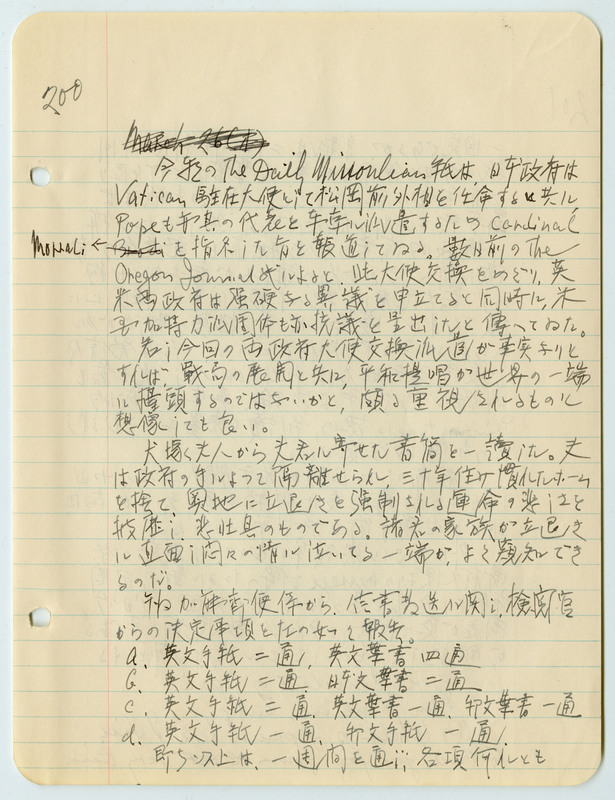
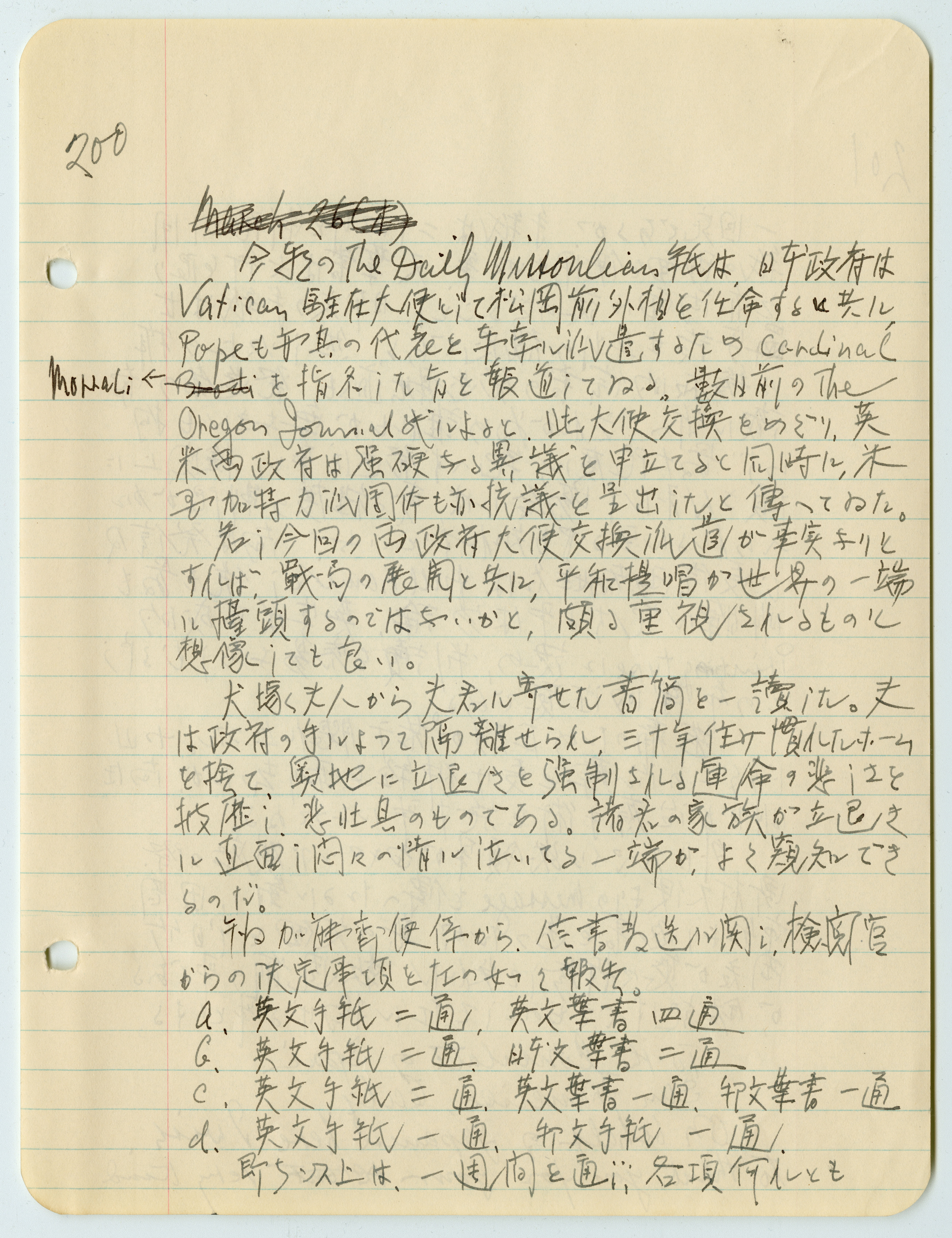
The Daily Missoulian this morning reports that the Japanese government appointed former Minister of Foreign Affairs Matsuoka as the ambassador to the Vatican, and at the same time, Pope has chosen Cardinal Morrali as the representative to send to Tokyo. According to The Oregon Journal issued a few days ago, both Britain and the U. S. government expressed strong opposition against the ambassador exchange, and at the same time, American Catholic church associations also filed their protest. If this ambassador exchange between the two governments is true, we could imagine the call for peace could be a strong voice rising from a corner of the world and gain importance as the war pans out.
I quickly read a letter from Mrs. Otsuka to her husband. She expressed her sorrow as she had her husband detained by the government and is to be forced to abandon her home she has been living in for 33 years and be removed to deep in the continent. It is full of sadness. It vividly conveys an image of suffering and tears of the family members of each facing forced removal.
Report came from the censorship authority regarding mailing personal letters as follows: a. Letters in English – 2 / Postcards in English – 4 b. Letters in English – 2 / Postcards in Japanese – 2 c. Letters in English – 2 / Postcards in English – 1 / Postcards in Japanese – 1 d. Letters in English – 1 / Letters in Japanese – 1
201
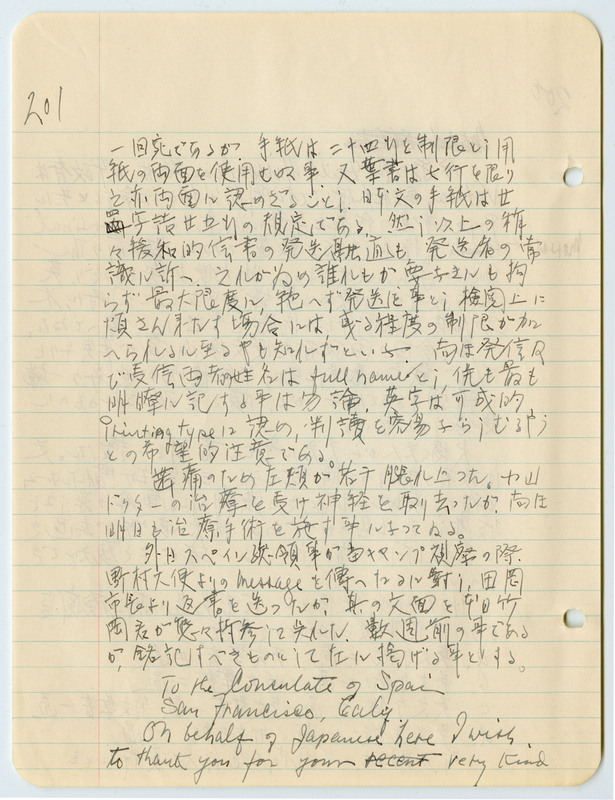
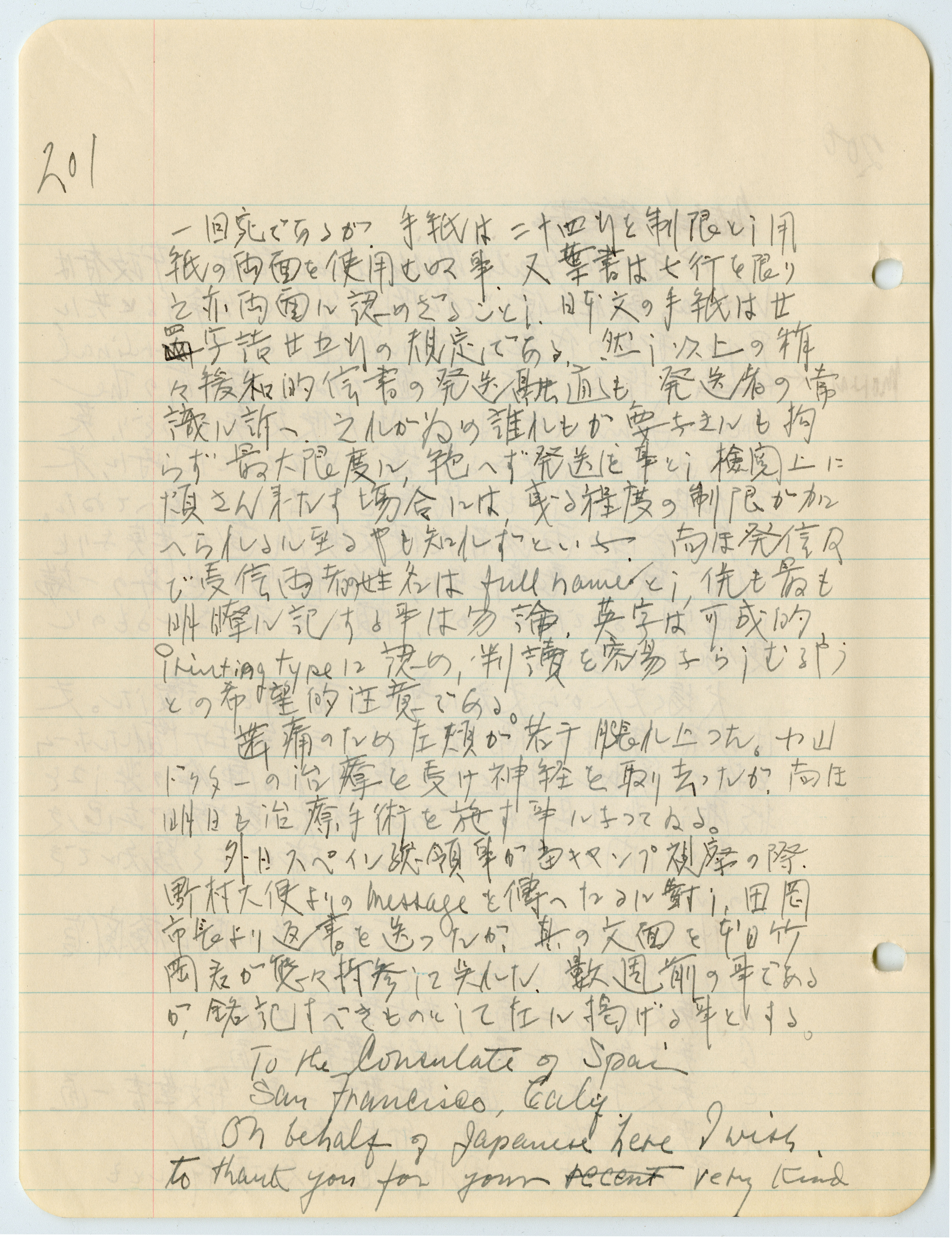
One option is for throughout a week. Letters are restricted to up to 24 lines, and we are not allowed to use both sides of the paper. Postcards are for up to seven lines of sentences, and it is not permitted to write on both sides. As for letters written in Japanese, the restriction is 24 cells in a column and 25 cells in a row. The mailing restrictions listed above could have some room for flexibility and rely on the common sense of senders. However, if everyone constantly mails out the maximum number of correspondence although not needed, and overwhelms the censorship department, stricter restrictions might be imposed. The name of the sender and receiver should be in full. They obviously need to be clearly written, and they request us print names to make them easy to read.
My left cheek is slightly swollen due to the toothache. I received root cannel treatment from the doctor, but I am scheduled to have another surgery tomorrow.
Mayor Taoka sent his response to the Consul of Spain as the Consul relayed a message from ambassador Nomura to this camp, and Mr. Takeoka brought the contents of the letter to us. It happened several weeks ago, but it is worth recording. The letter goes as follows:
To the Consulate of Spain San Francisco, Calif
On behalf of the Japanese here, I wish to thank you for our recent very kind…
202
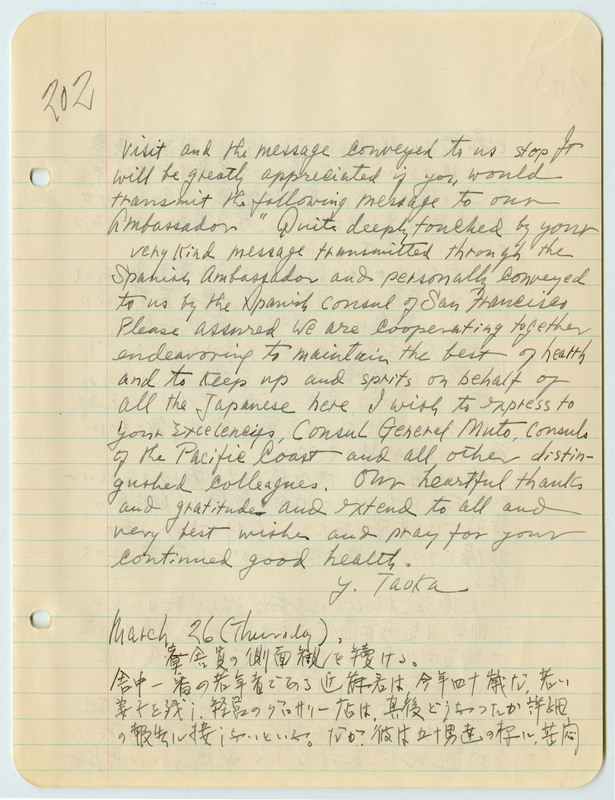
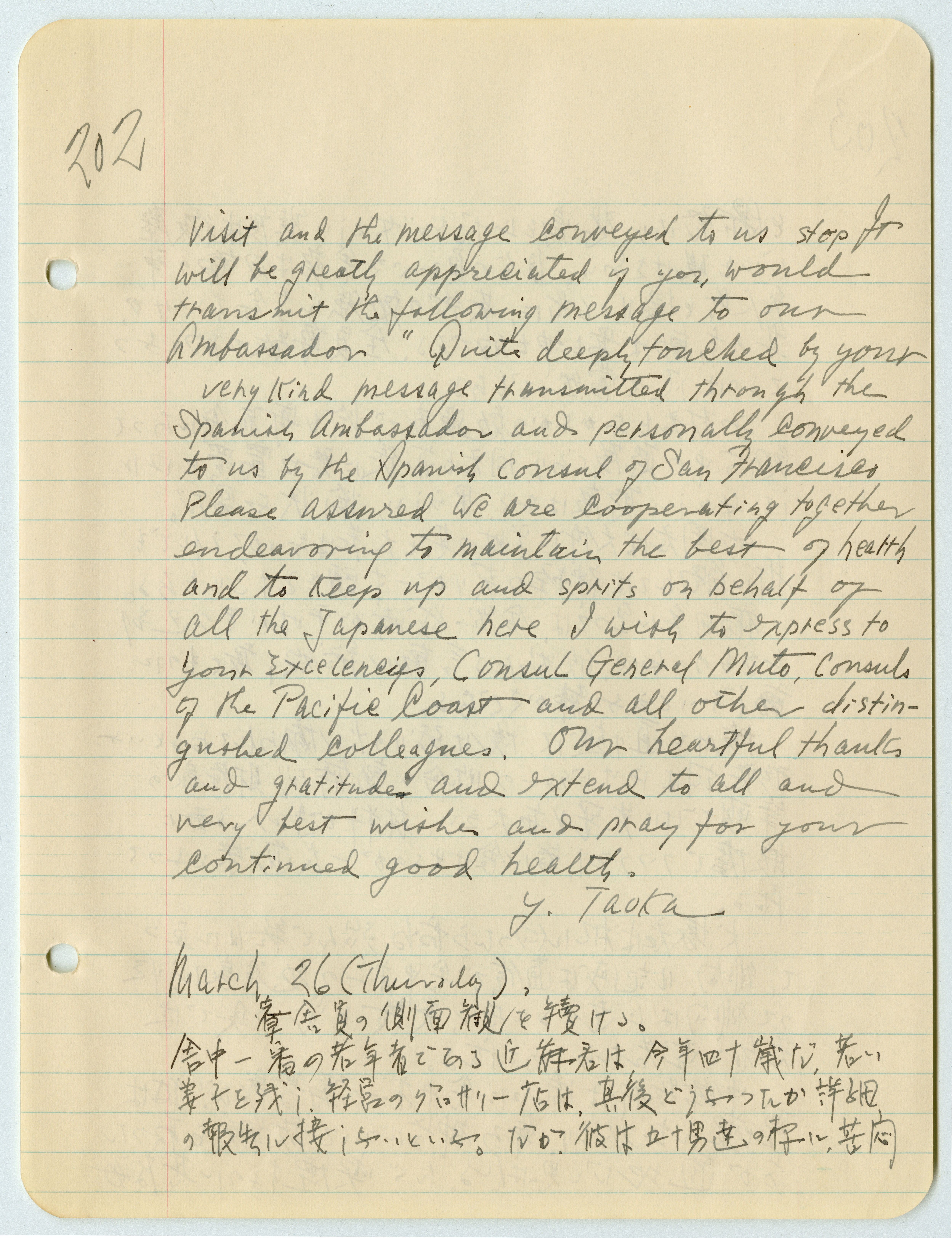
visit and the message conveyed to us stop. It will be greatly appreciated if you would transmit the following message to our Ambassador. “Quite deeply touched by your very kind message transmitted through the Spanish Ambassador and personally conveyed to us by the Spanish consul of San Francisco. Please assured we are cooperating together endeavoring to maintain the best of health and to keep up and sprits [sic] on behalf of all the Japanese here I wish to express to your Excelencies [sic], Consul General Muto, Consul of the Pacific Coast and all other distinguished colleagues. Our heartful thanks and gratitude and extend to all and very best wishes and pray for your continued good health.
Y. Takoa
- Title:
- March 25, 1942 entry
- Creator:
- Sakaino, Bunro
- Date Created (ISO Standard):
- 1942-03-25
- Description:
- March 25, 1942, diary entry written by Bunro Sakaino while he was incarcerated at the Fort Missoula Internment Camp in Missoula, Montana.
- Subjects:
- concentration camps diaries
- Location:
- Fort Missoula, MT
- Source:
- MG 387, George Shihei Shitamae papers, Special Collections and Archives, University of Idaho Library
- Translator:
- Transcribed and translated by Naoko Tanabe, 2024-2025, of Densho (densho.org)
- Source Identifier:
- mg387_1_7-1942-03-25
- Type:
- Text
- Format:
- application/pdf
- Language:
- jpn; eng
U of I Digital Collections contain unique digitized and born digital archival materials in a variety of formats. The Library is committed to ensuring our resources are accessible to all users. Please contact us if you need support accessing or using this archived content.
Contact us about this record Library Help- Citation:
- "March 25, 1942 entry", Bunro Sakaino Concentration Camp Diary, University of Idaho Library Digital Collections, https://www.lib.uidaho.edu/digital/sakaino/items/sakaino009.html
- Rights:
- In copyright, educational use permitted. Educational use includes non-commercial reproduction of text and images in materials for teaching and research purposes. For other contexts beyond fair use, including digital reproduction, please contact the University of Idaho Library Special Collections and Archives Department at libspec@uidaho.edu. The University of Idaho Library is not liable for any violations of the law by users.
- Standardized Rights:
- http://rightsstatements.org/vocab/InC-EDU/1.0/