
March 26, 1942 entry Item Info
202
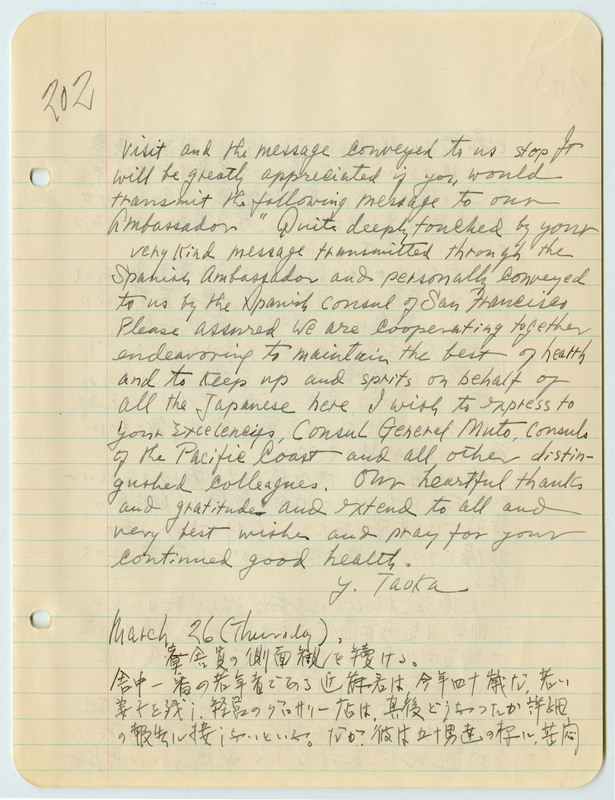
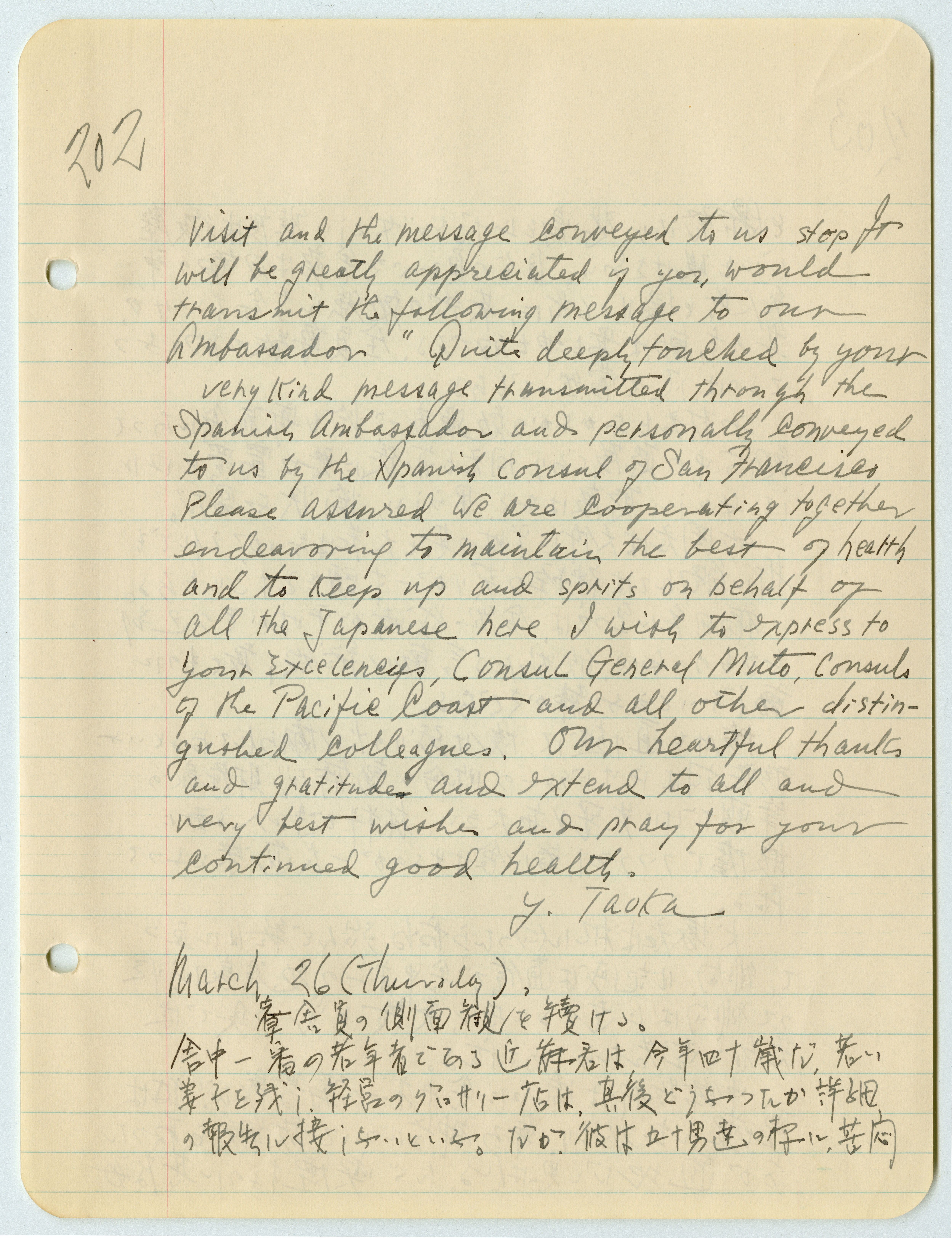
March 26 (Thursday)
Continuing to observe the members of the unit.
Mr. Kondo is forty years old this year, making him the youngest member of the unit. I heard that he left behind a young wife and child or children, and that he hasn’t heard anything about the current situation of his grocery store. Nevertheless, he never displays the sudden outbursts of anger that some of the men in their fifties do, nor does he shrink back timidly like a girl.
203
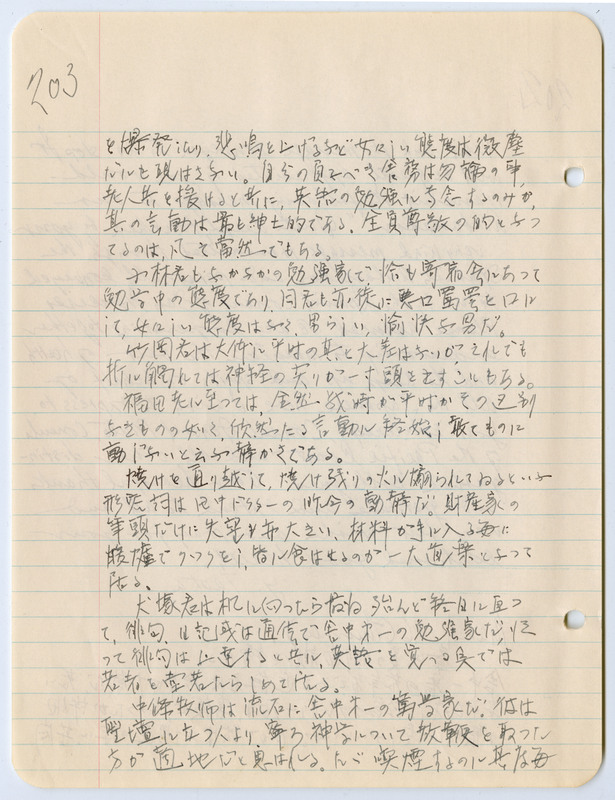
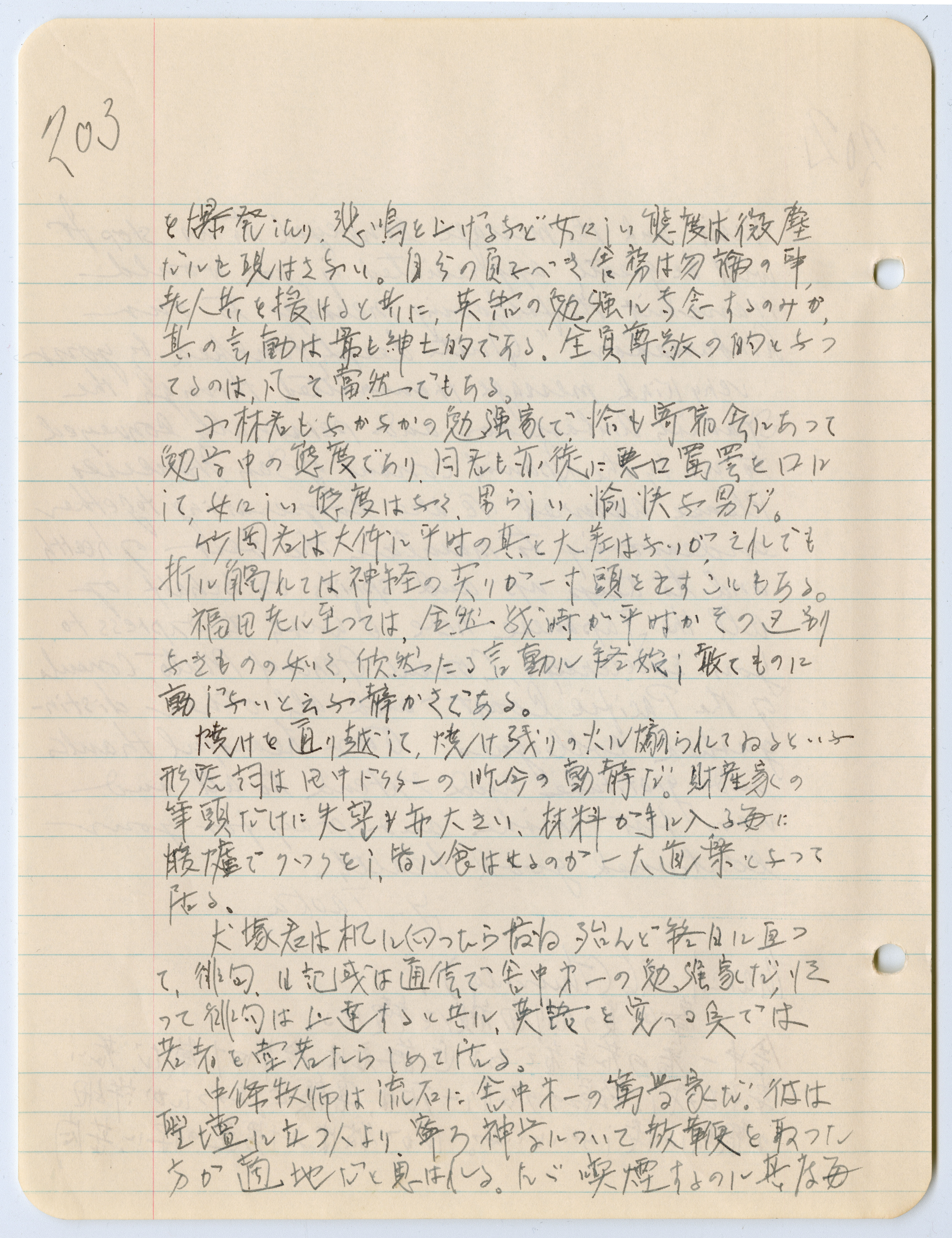
… He of course fulfills his responsibilities in the barrack but also helps the elderly, diligently studies English and is such a gentleman in his speech and action. It is natural that he is respected by all of us.
Mr. Kobayashi is also eager to learn as if he was a student studying in a dorm. He also does not speak ill of anyone or make offensive remarks and does not act cowardly either. He is a pleasant and manly person.
Mr. Takeoka does not display a big difference from what he normally is, but his frustration peeks out on occasions.
As for Mr. Fukuda, he is calm and constantly maintains his positive attitude without showing any reactions to anything, as if there was no difference between wartime and peaceful times.
All burnt out and still smoking in leftover flames. That is the description of recent actions of Dr. Tanaka. His despair is sizable as he is one of the wealthiest. Cooking over a stove whenever he gets some ingredients and feeding everyone is his biggest hobby now.
Mr. Otuka is the most diligent in the barrack, and once he sits at the desk, he spends almost the entire day composing haiku poems, keeping a journal and writing letters. His haiku skills are improving, and young people are surprised to see how much English he is learning.
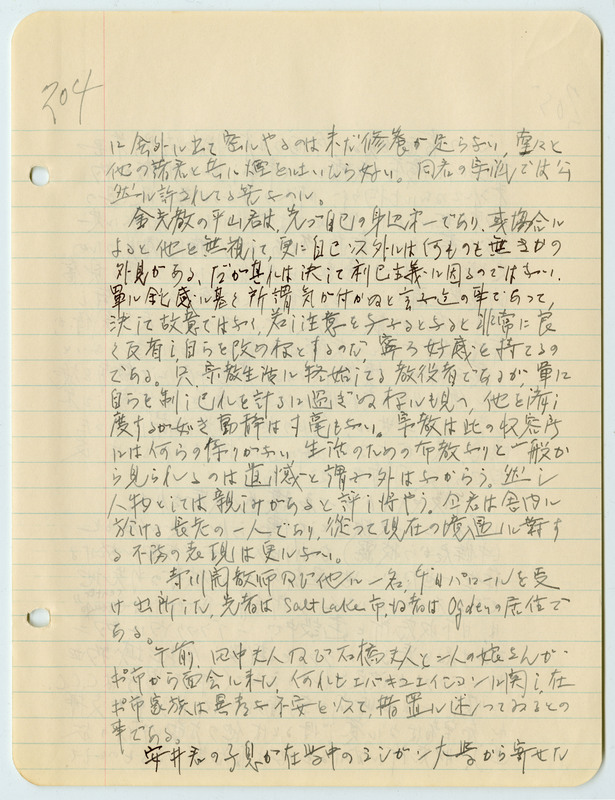
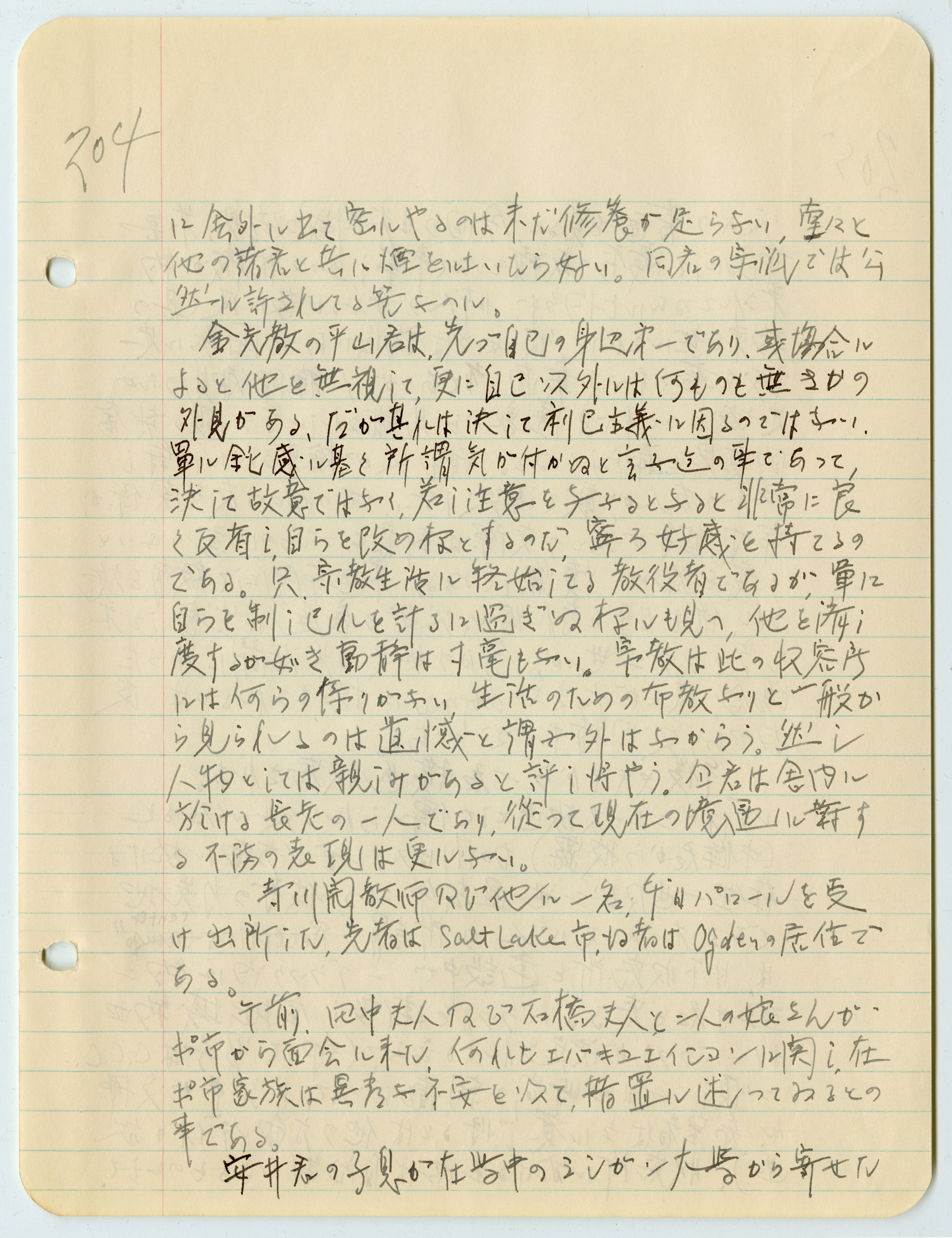
Reverend Nakajo is naturally the most industrious of all. I think he would be better to teach theology than preaching at the podium. One thing is he still sneaks out of the barrack every time he secretly smokes. That reveals that he is not fully enlightened yet.
204
He should openly smoke with everyone else. It should be publicly accepted.
Mr. Hirayama with the Konkokyo church takes care of things around himself first, and on occasions, it seems that he ignores others and acts like there was nobody but himself. However, that is not because he is selfish. He is simply clueless and not sensitive enough to notice what is going on. It is not intentional, and if you give him a piece of advice, he will deeply reflect on that and try to improve himself. He is rather likable. However, although he is a preacher continuously devoting his life to the religion, his philosophy seems to simply control and observe himself, and he does not take any actions to save others at all. Religion has no place in this camp. I have to say it is unfortunate that the public views religious mission as a means to make a living. However, it is fair to say that he is a friendly person. He is one of the leader figures in the barrack and does not express his dissatisfaction with the current situation.
Missionary Terakawa and another person received parole and left the camp. The first is to live in Salt Lake City and the latter in Ogden.
Mrs. Tanaka, Mrs. Ishibashi and her two daughters came to visit from Po [8] City. I heard each of them said the families in Po [9]City are feeling very anxious and having a hard time deciding what actions to take regarding the evacuation [10].
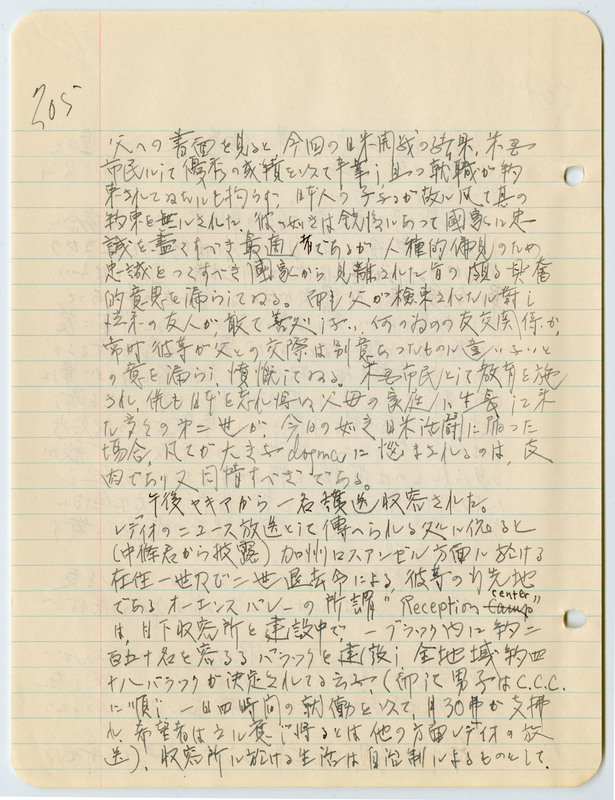
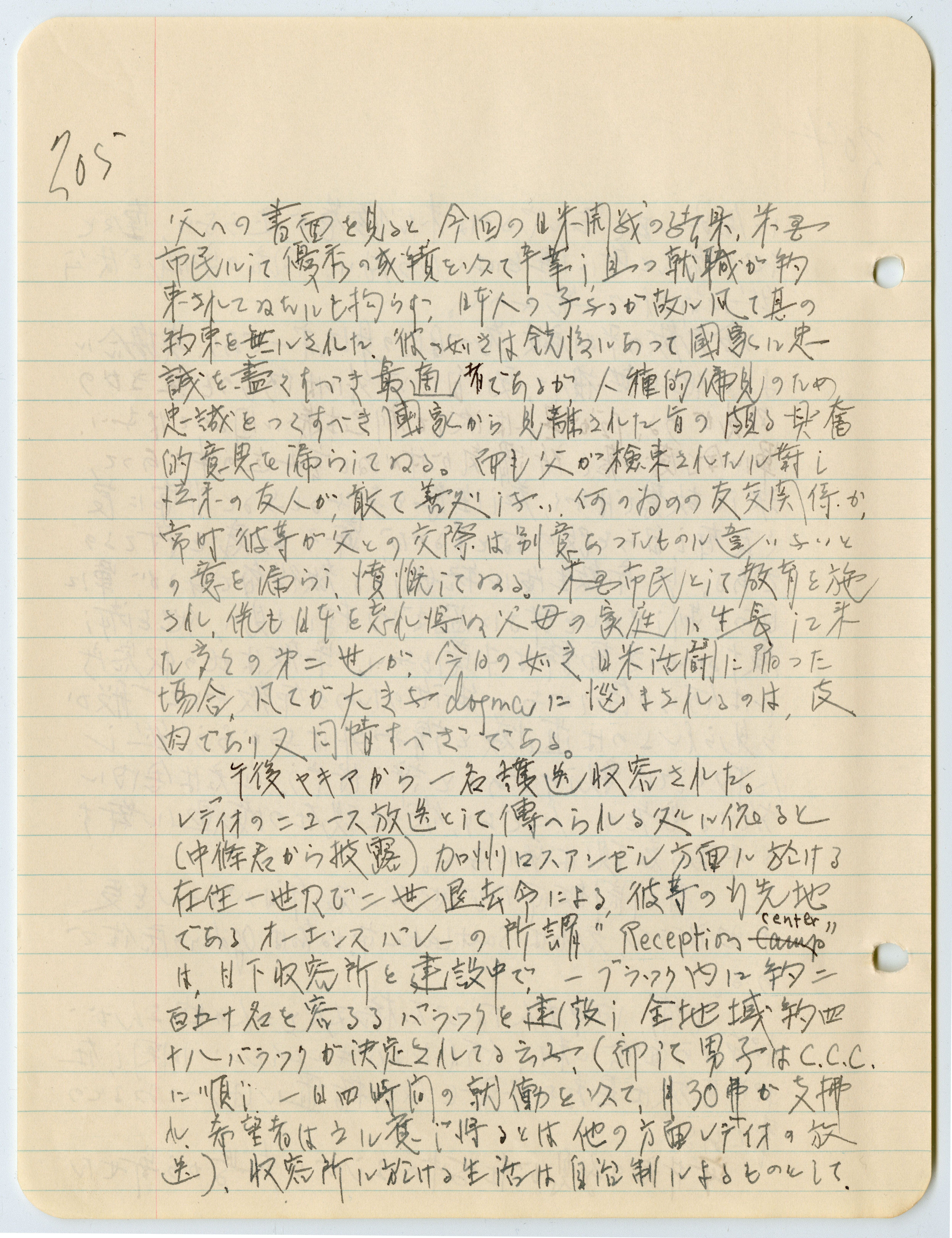
205
According to the letter to Mr. Yasui from his son, who graduated from the University of Michigan, although he is a U. S. citizen, graduated from the University with high academic achievement and has been offered a guaranteed job position, was denied employment simply because he is a child of a Japanese. He is one of the most qualified to be a loyal citizen to the nation and serve behind guns. He expressed his frustration over the abandonment by the very nation he pledges his legion due to racial prejudice. Moreover, his long-term friends did not do a thing to help when his father was detained. What is friendship for? He is angry and thinks the friends must have been holding some different feelings toward his father even when they were socializing with the father. It is ironic and pitiful to see that many nisei who have been educated as a U.S. citizen, and grown up in a family with the parents who are still attached to the homeland, are suffering from large dogmatic issues when a war breaks out between Japan and the U.S. One person has been brought over and detained from Yakima this afternoon.
According to a report broadcasted on a radio news (Mr. Nakajo reported to us), a so-called “Reception Center” in Owens Valley is currently under construction where issei and nisei residing in the Los Angeles area in California are schedule to be sent to due to the removal order. Barracks to hold 250 people each are being built, and a total of forty-eight barracks are scheduled to be built in the entire area. (Male workers will be paid 30 dollars a month for a four-hours-per-day labor schedule in compliance with the Civilian Conservation Corps. Those who are interested can apply according to another radio news)
206
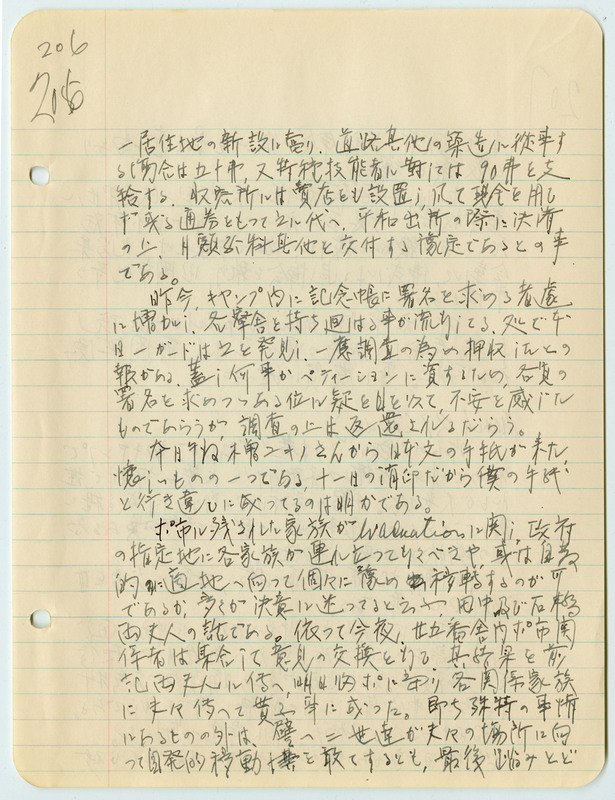
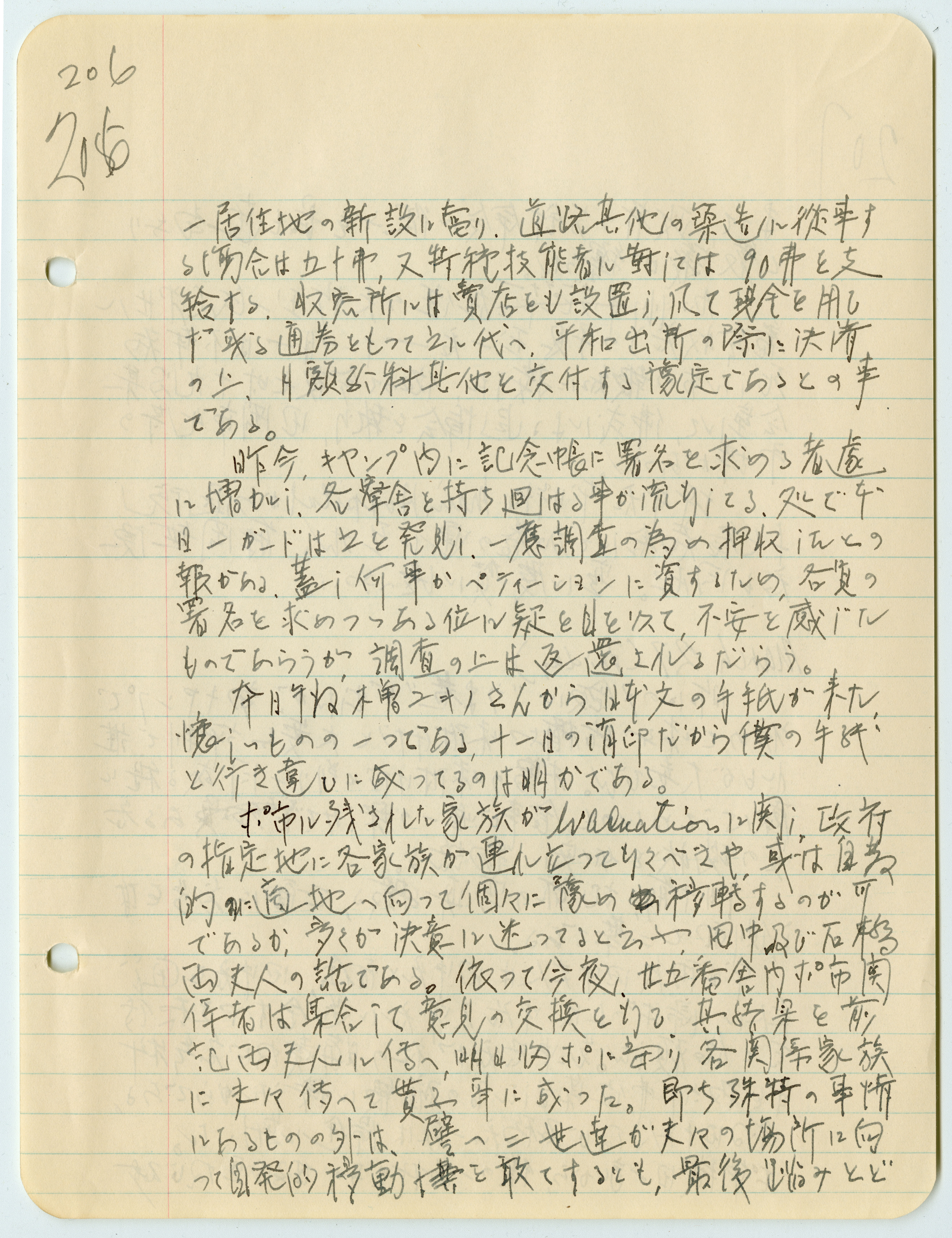
Autonomy is granted to life in an incarceration camp, and 50 dollars will be paid if someone works on roads or other construction programs toward building the new living facilities, and it will be 90 dollars for skilled workers. There will be a kiosk set up in a camp. Cash is not needed as a type of tickets will be issued in lieu of cash. I heard the final calculation will be done when leaving the camp in peaceful times, and monthly pay and others will be paid.
An increasing number of people request to have their memory books signed by others these days, and it is popular to bring the book around in the camp. One guard discovered it one day and confiscated a book for investigation. It is probably because they doubted that we were collecting signatures from each of us for some sort of petition, and it should be returned after the investigation.
I received a letter in Japanese from Ms. Yukino Kiso this afternoon, and it brought back memories. It is postmarked with a November date, and that means she had not received my letter.
I heard many families left in Po [11] City is having a hard to time regarding the evacuation [12] trying to figure out if each family should go to the location designated by the government together, or if it would be possible to voluntarily move to a place of their choice. Both Mr. Tanaka and Mr. Ishibashi told me. Therefore, we decided to gather the people form Po [13] City in the 25th barrack this evening to exchange our opinions regarding this matter. Our plan is to send our final recommendations to the wife of both gentlemen [14] mentioned above and ask the wives to relay our message to each family. We agreed, except for those in some special situation, that it would be best to stay put and follow the policy order issued by the government even if nisei people voluntarily leave for places of their choice.
207
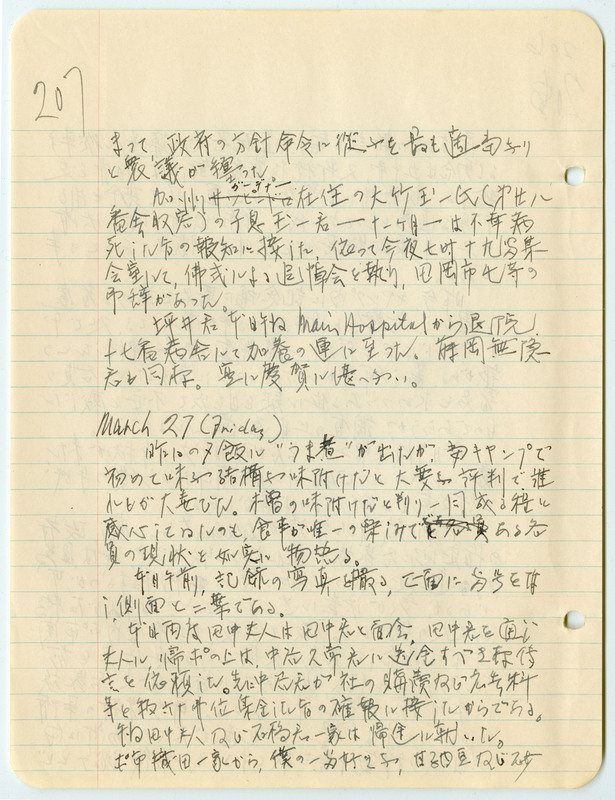
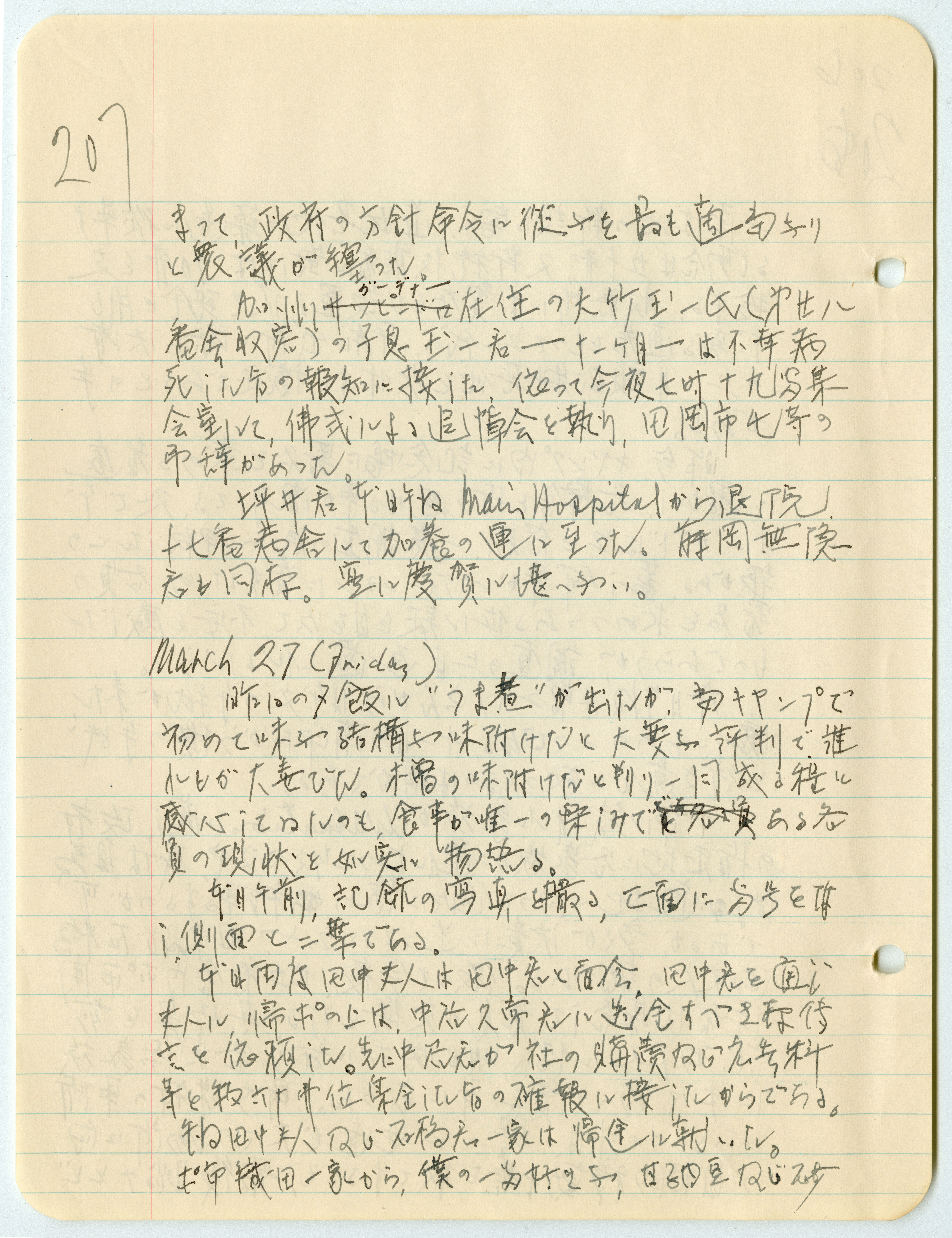
News came that the son of Mr. Tamakazu [15] Otake from Gardena in California (interned in the 28th barrack), Tamakazu [16], eleven-month-old, unfortunately passed away of sickness. We held a memorial service at the meeting room at 7 this evening, and condolence messages including the one from Mayor Taoka were read.
Mr. Tsuboi was discharged from the Main Hospital and is recovering in the 17th barrack, and so did Mr. Muon [17] Fujioka. It is certainly something to celebrate.
[8] Portland?
[9] Portland?
[10] “Evacuation” in katanaka is the word written here.
[11] Portland?
[12] Evacuation is the word used by the author
[13] Portland?
[14] Tanaka and Ishibashi
[15] Tamaichi?
[16] Tamaichi?
[17] Could be a different name
- Title:
- March 26, 1942 entry
- Date Created (ISO Standard):
- 1942-03-26
- Description:
- March 26, 1942, diary entry written by Bunro Sakaino while he was incarcerated at the Fort Missoula Internment Camp in Missoula, Montana.
- Subjects:
- concentration camps diaries
- Location:
- Fort Missoula, MT
- Source:
- MG 387, George Shihei Shitamae papers, Special Collections and Archives, University of Idaho Library
- Translator:
- Transcribed and translated by Naoko Tanabe, 2024-2025, of Densho (densho.org)
- Source Identifier:
- mg387_1_7-1942-03-26
- Type:
- Text
- Format:
- application/pdf
- Language:
- jpn; eng
U of I Digital Collections contain unique digitized and born digital archival materials in a variety of formats. The Library is committed to ensuring our resources are accessible to all users. Please contact us if you need support accessing or using this archived content.
Contact us about this record Library Help- Citation:
- "March 26, 1942 entry", Bunro Sakaino Concentration Camp Diary, University of Idaho Library Digital Collections, https://www.lib.uidaho.edu/digital/sakaino/items/sakaino019.html
- Rights:
- In copyright, educational use permitted. Educational use includes non-commercial reproduction of text and images in materials for teaching and research purposes. For other contexts beyond fair use, including digital reproduction, please contact the University of Idaho Library Special Collections and Archives Department at libspec@uidaho.edu. The University of Idaho Library is not liable for any violations of the law by users.
- Standardized Rights:
- http://rightsstatements.org/vocab/InC-EDU/1.0/